Speechless

National  Review Online, September 11, 2001

September 11.jpg

We are used, those of us who work in the financial markets, to watching the news as it breaks. The information snakes across our screens, impassive, unrelenting, flowing in the orange of a Bloomberg headline, or the boldface red of Reuters' breaking news. With luck, it is something quick, something timely, something to give a trader the edge, enough perhaps, to make that extra buck. There are televisions too, mounted, on the walls of our Midtown office, hanging , even, from the ceiling, relaying garrulous, greedy CNBC, and the nonstop chatter of a world going about its business. And then the chatter stopped. On the TV screens, we could see the smoke, billowing murderous and black, out of that first brutally wounded tower, a dismaying repeat, it seemed then, of an earlier tragedy. The messages went out to Downtown, to the people we knew were there. Some said that they might evacuate their building, others were not so sure. It looked as if, they hoped, everything would be OK.

There was still at that point a remnant, just, of normality, an impression, almost, of maneagable horror. What we were witnessing, it appeared, was another bloody chapter in the long terrorist war, cruel, spectacularly savage (could that really be true about a plane, we wondered) but not something so different from what New York City, and the world, had been through before.

So the routine news continued to flow, retail sales, CBOT December wheat, but there was no real return to work, just a few half-hearted glimpses at the dealing screen, with the gaze returning again and again to CNBC, to the images of that first tower, and then, suddenly, drawn by a fireball, to the other. More smoke, more flames, and fluttering down from the windows of the outraged building, scraps of paper, Hell's tickertape, the last trace of all those shattered offices.

Safe in Midtown, we watched the World Trade Center's end, we watched the destruction of the building we knew so well, the site, for us, of countless meetings, the workplace, we worried, of too many friends.

Later, we could see that the European stock markets had fallen, but, it was not something, really, that we wanted to discuss.

Star Monkey

National Review Online, September 3, 2001

Ham's Grave, Aug 2001  © Andrew Stuttaford

Ham's Grave, Aug 2001  © Andrew Stuttaford

The astronaut's grave is plain, a metal plaque on a slab of concrete on the grounds of the Museum of Space History just outside Alamogordo, N.M. There is no statue, no elaborate monument, just the silence of a desert hillside. Wreaths do not flourish in the dryness of the American Southwest, but some kindly individual has left a pancake-shaped cactus in memory of the dead flier. A face has been cut into the plant, two eyes and a jagged smile. The carving was, doubtless, well meant, a tribute, perhaps, to a simple, friendly, soul, but the impression it leaves is faintly grotesque, more Jack O'Lantern than Smiley. That is not inappropriate, because to modern sensibilities there is something disturbing about the story of the deceased, a small dark space pioneer by the name of Ham, America's first Astrochimp. Yes that's right. Ham was a chimpanzee, a space-suited representative of the species known technically, and somewhat insultingly, as Pan Troglodytes. It is largely forgotten now (although not in the Comoro Islands, a fine nation that, a few years ago, issued a stamp in Ham's honor), but the early days of America's attempt to storm the heavens were marked by the space-bound trajectories of a number of luckless mammals.

Various rhesus monkeys, all called Albert, were shot off into the sky from captured German V2 rockets. As the space program progressed to homegrown technology, other tiny simians, Able, Baker, Sam, Miss Sam, and Gordo all followed in the Alberts's exhaust trails, as did a squadron of mice, but this was not enough for NASA. Before Homo sapiens could be risked, the space agency moved up the evolutionary scale, turning to man's closest relative, known then, as now, to be the chimpanzee, but quite how closely related, well, in those days, nobody could be sure.

Times have changed. DNA testing has now made it possible to argue that the traditional division between humanity and the four species of Great Ape (Chimpanzee, Bonobo, Gorilla, and Orangutan) owes more to vanity than biology. According to this view, we are simply the fifth, and most sophisticated, variant. Within this new, and alarmingly expanded, family, our nearest relations, the chimps, turn out to be closer to us than they are, for example, to the gorillas. What is more, over the last 30 years, detailed observation of chimpanzees in their native setting has established that they have at least the rudiments of a culture, one that includes the use of tools, barter and primitive medical techniques. As noble savages, however, the often unruly and violent chimps fail to make the grade. The mark of Cain turns out, depressingly, to be a sign of a good brain.

Quite how good is far from clear. Measuring animal intelligence is difficult, and prone to anthromophic exaggeration, but it does seem that a chimp possesses the intellectual ability of a two- to three-year-old. That may be no revelation to a parent of toddlers, but it is a fact worth remembering when considering what happened to Ham in the years that followed his abduction from his African birthplace. The derivation of his name, "Holloman Aerospace Medical," gives the critical, ominous clue.

The museum in Alamogordo takes up the narrative, although, sadly, the simian spaceman does not make it to the museum's pantheon, a plaque-bedecked Valhalla known as the International Space Hall of Fame. No, Ham's story is confined to the building's lesser regions, more specifically, a corridor decorated with a series of educational posters, the first of which provides a good prologue. It features a glorious color image of a rocket at launch and the headline, "Before there was John Glenn or Neil Armstrong there was…," and there right in the corner is a little circular cut-out of Ham's head, a Caliban satellite for the giant, gleaming Saturn 5, an enigmatic, humbling reminder of where we all come from.

Other posters show some of the chimponaut training process. We see three chimps being taught to become accustomed to sitting in one place for up to 24 hours. It is a scene out of daycare hell. One ape sits, impassive, a cross-legged lama, the second slumps, pensive with a hint of Rodin, while the third wriggles like the bored two year old he so clearly resembles. Another shot shows the three chimpanzees reclining side by side, each in an open container. Two are holding hands. Reassurance? Other grimmer tests ("windblast", "acceleration/deceleration") are, tactfully, not shown and nor is the darker side of the "mild" electric shock/banana pellet routine used to train Ham to pull the right levers when he was in his capsule.

There are, of course, pictures of the great day, January 31, 1961. Ham is in his spacesuit, an eerie mix of the futuristic and the primitive, looking like a suspicious old man as he stands with his trainer, showing few signs of the "friskiness" that had earlier earned him his ticket to the infinite (and with that ticket came a name; previously he had been known as "61"). Later, we see him lying in his "couch", NASA's Ikea-style description of his capsule-within-a-capsule. During the flight our chimpanzee Columbus is photographed staring out of his little window, face impassive, eyes as black as the space through which he was flying. Finally, after his safe return, Ham is portrayed reaching for his reward, an apple (John Glenn, it has been pointed out, got a Senate seat for pretty much the same achievement). He looks, to humans at least, to be grinning, but if it really was a grin, it must have been one of relief.

For the flight would have been a juddering, jerking nightmare for anyone, let alone for a passenger unable to understand what was going on, but bright enough to suspect that it was nothing good. To make it worse, almost everything that could go wrong, did. The exhibit skirts the issue, but, to put it bluntly, Ham was nearly toast. Right at the start, his rocket started sucking in fuel too fast. As a result, the angle of the craft's climb was too steep and too high, subjecting poor Ham to g-forces far fiercer than ever expected, a process repeated on re-entry sixteen minutes later, when the retrorockets cut off too soon, sending our once-frisky Icarus plunging down to earth at nearly 6,000 mph, 1,400 mph faster than planned. These were not the only difficulties. Quite early in the flight, cabin pressure collapsed, a development that would have been fatal for an astronaut, but not, fortunately, for an astrochimp safe in his self-contained couch. On the other hand, no one ever subjected Neil Armstrong to "mild" electric shocks every time he pulled the wrong lever, which was the threat that continued to hang over Ham even as his capsule careened through space.

In fact the redoubtable chimponaut, hardened by the rigors of his bleak training regime, performed very well, going about his preordained tasks (Watch for the white light, pull the left lever! Watch for the blue light, pull the right lever!) with surprisingly few outward signs of stress, despite the massive g-forces and the weightlessness. One final insult remained, however. On splashdown, the capsule promptly sprung a leak. By the time rescuers arrived on the scene (late, of course: they had expected Ham to land somewhere else), our hero was in severe danger of drowning. Once recovered, he appeared distinctly unimpressed by this shambles of a trip. Ham may have taken NASA's apple, but for a few hours the biting, irritable chimp displayed every symptom of the syndrome we now call air rage, something probably made worse by the gesticulating, shouting, flashbulb-popping Cape Canaveral press corps that surrounded him on his arrival back on dry land.

NASA did not seem to mind. The agency had what it wanted — good publicity (Ham made the cover of Life!) and good science. To quote from his tombstone, Ham "had proved that mankind could live and work in space." All was now set for Alan Shepard's historic flight. Unfortunately, America's Soviet rivals were even quicker to get the message. The next primate to leave the Earth, less than three months later, was Yuri Gagarin. As for the astrochimp, it was back to the barracks for him for a while, but a rival, Enos, got the first orbital mission, leaving the discarded Ham to be retired to the National Zoo in Washington, D.C. There, at least, there were no levers, no shocks, no crazed wild rides, but it was, apparently, a somewhat isolated existence, a miserable fate for such a gregarious animal. After 17 years this Chimp of Monte Cristo was moved to a more congenial zoo in North Carolina and, finally, the company of his own kind. He met Mrs. Ham; in fact, some say that he met two Mrs. Hams, but these better times were not to last. Within two years Ham had died of, poetically, an enlarged heart.

To judge Ham's treatment by current standards would be posturing of a type that is, these days, regrettably familiar. We are often too quick to apply contemporary criteria in measuring the supposed failings of the past. Nevertheless, from what we know now it is clear that humanity does need to take another look at its handling of the Great Apes. And if Ham's strange, sad odyssey can remind us of that, he will have helped out yet another species.

His own.

Dead Men Talking

National Review Online, August 12, 2001 

Crossing Over.png

Who, these days, is prepared to act their age? Teens carry on as if they were 30, the middle-aged think that they are 20, and now, if a new TV hit is to be believed, the dead are behaving as if they were alive. The show, Crossing Over with John Edward, a surprise success for cable's Sci-Fi Channel, stars the eponymous Mr. Edward. He's a fast-talking psychic with slow-witted fans, many of who like to believe that this former ballroom-dancing instructor can put them in touch with the dear departed.

For what is, presumably, a matter of fantasy, Crossing Over is surprisingly matter-of-fact. The introductory tune is mildly spooky, with a hint of the X-Files, but the rest of the format is more daytime talk show than nighttime séance. There are no Ouija boards, no startling emanations of ectoplasm, no tables are tipped. Those who prefer more mumbo in their jumbo need to look elsewhere (perhaps to Mr. Edward's series of audio tapes: his Unleashing Your Psychic Potential, for example, offers listeners the recipe for a ritual psychic spring-cleaning, something, in case you are wondering, which involves sage and plenty of Kosher salt).

On Crossing Over, the tone is conversational and relaxed. The audience sits in front of the seer, ranged in expectant rows on a dais. By talk-show standards, it appears to be a fairly upscale crowd, ranking perhaps half way between Oprah and an Al Gore town meeting. Well, I did say "fairly" upscale. Women outnumber men, and if the dead are present, they are low key and discreet, at least to start with.

Mr. Edward begins the proceedings briskly. As his fans will already understand, the great man is surfing the interred-net hoping to pick up a name, a fragment of a name, or any clue, indeed, that will sound vaguely familiar to one of the people in the room. It doesn't take long (for a show about eternity, Crossing Over is very rapidly paced). Mr. Edward typically comes out with a syllable or two, "Francesca," say, or "Francis" or "Fran." After a few moments, a member of the audience will normally react, eagerly proffering a candidate, "Francesco," perhaps, for consideration. If Francesco turns out to have "passed" ("kicked the bucket," "bought the farm," or "croaked" are not acceptable terms on this program), that will be enough for the psychic. He'll turn into a quick-fire interrogator, Sam Spade on Speed, with a bewilderingly fast Q & A designed to show that ex-Francesco is now in touch.

Mr. Edward will ask the audience member about cats, dogs, colon surgery, mantelpieces, ceramic teapots, anything. Surprisingly often (and surprisingly quickly), the psychic will succeed in turning up some precise little reference that could "only" have come from the dead man. Let's say that ex-Francesco loved ceramic teapots. By supposedly prompting the psychic's question about ceramic teapots, ex-Francesco will, to use the jargon of the show, have provided "validation." The dead guy will have "come through" by putting the idea of ceramic teapots in John Edward's head. Well, that's what the audience clearly wants to think. Crossing Over is a show for the sort of people who would have preferred The Sixth Sense to have a more upbeat finale. The amiable Mr. Edward is pleased to oblige. Bereaved relatives turn out not to be so bereaved as they had once thought, and the ratings keep on rising (particularly among women, a group previously under-represented among the dank ranks of Sci-Fi Channel viewers).

To be fair, some of Mr. Edward's findings are indeed remarkably specific. These discoveries are usually accompanied by little gasps and shouts of recognition among the not-so-bereaved-after-all. Their astonished comments are always along the same lines, "oh my God how did he do that wow that's amazing," but subtitles are provided when the exact wording of the audience's amazement comes across a little inarticulately. This happens more often than you might think. If there is one thing muddier than the reasoning on Crossing Over, it is the diction.

Then again, I have no idea either how Mr. Edward does it. Maybe it is, as is claimed in the introduction to the show, all "real." The only people who know for sure are the dead and they are not talking, to me at least (Granny, phone home). If I had to make a guess, Mr. Edward is probably an extremely able "cold reader." Cold reading is an old "psychic" trick. The term is basically a fancy way of describing the use of intuition, empathy, guesswork and, initially, very, very general questions (Francis, Francesca, Fran) to come to that one remarkable revelation that convinces the credulous that the spirits are indeed "coming through." It takes skill, which Mr. Edward certainly has, and it also takes, how can this be put politely, a certain special something in the minds of his subjects.

It cannot be put politely. Those special somethings are naivety, superstition, and a problem with rational thought, qualities that are all too common in this supposedly sophisticated country's current high tech re-run of the Dark Ages. It is a ridiculous phenomenon, and Crossing Over is very far from being its only example. What makes Mr. Edward one of its more representative figures, however, is not only his show (or considerable commercial success), but the peculiarly maudlin banality of his vision of the afterlife. It is the vision that is the sub-text to Crossing Over, but which is set out more explicitly elsewhere, notably in Mr. Edward's "inspirational" novel, What If God Were the Sun? This is a book modestly described by its publisher as "incomparable" (and, in a way, it is) but the seagulls on the cover are fair warning. Those of us old enough to remember the 1970s know what that can mean.

To describe this novel as sugary is an understatement. Diabetics should not read it except under close medical supervision. For page after page, the reader is subjected to a sickly sweet mash of simpering truisms and New Age folklore. The conclusion, of course, is that there is no conclusion. As he "crosses over," the narrator, "Timothy," finds himself floating through a "tunnel of light" with a "sensation of overwhelming love and peace," which, mercifully for the rest of us, he cannot "put into words."

Arrival on the other side is, it turns out, a little bit like Thanksgiving, only worse. All the relatives are in town ("Uncle Dominick and Aunt Gina…Aunt Marsha and Grandpa Jack, too") and so are in the in-laws (including those impolite enough to die before our hero had the chance to get to know them first time round). Before you ask, yes, this is meant to be Heaven, not Hell. And that is to be expected. The notion of Hell is far too judgmental, far too demanding for this sort of New Age cosmology. There's no St. Peter blocking the gate, just a rather vague "life review" designed to give "a type of closure." We leave Timothy surrounded by his family and his "oldest and dearest" friend, his dog Chester. "It's so wonderful to know that our beloved pets are waiting on the other side to meet us, too!"

It's not exactly Valhalla, is it? Other belief-systems have offered the prospect of a rather more inspiring afterlife than this perpetual family reunion. Unfortunately, these usually came with a fairly substantial downside. Just ask Dante. To take another example, the Ancient Egyptians believed that the newly deceased had to appear in front of Osiris, the Judge Bork of the Underworld. This was a "life review" with consequences. The hearts of those judged guilty would be fed to a beast that was part-lion, part-crocodile and part-hippopotamus. There would be no Chesters in their future.

That is not the sort of talk that many of Mr. Edward's fans would like to hear. They are looking for the comfort of faith without its rigor. They want the prospect of Heaven without the danger of Hell, and, above all, they seem to need the cozy reassurance that nothing has consequences, not even death. And why shouldn't they? After all, it would seem to be a perfect creed for a society that sees the term "endless self-indulgence" as a promise, not a criticism.

Wait a minute. Didn't I say that Crossing Over was a "surprise" success? What was I thinking?

End of a Century

National Review Online, august 6th, 2001 

A few days ago, in a quiet English country town, the long, long life of Bertie Felstead finally came to an end. And when the old man died, a small, surviving fragment of the 19th century died with him. He had been a local celebrity, an approachable Methuselah, a dapper figure in blazer, regimental tie, and, sometimes, on very special occasions, a row of medals. He had bright eyes, a cheery, amazed-to-be-here smile, and a lifespan that stretched across civilizations. Born on October 28th, 1894, Mr. Felstead was ancient enough to have seen the imperial spectacle of Queen Victoria's Diamond Jubilee, sufficiently young to have outlived the Clinton presidency. It was an astonishing achievement, made all the more remarkable by the fact that, in his youth, Mr. Felstead was to participate in an event that characterized, more than most, the last moments of the world into which he was born. Historians like to tell us that the European 19th century did not end at the moment dictated by the calendar. Its optimistic bourgeois spirit, its almost naïve belief in progress, continued to flourish for more than another decade. It took the First World War to bring that "long 19th century," and so much else, to a close. Spiritually and physically, the Europe that emerged from that conflict bore very little resemblance to the seemingly stable culture that had existed only four years before. In August 1914, totalitarian hecatombs were the stuff of nightmare, believable, perhaps, by madmen or in the dark of night, unimaginable in the reassuring light of an Edwardian morning. Forty months later Lenin was already ordering his first mass executions.

The men that went off to fight that summer were still the soldiers of the older era, still the sort of men who believed that war could be a bit of a lark. With luck, they thought, it would be over by Christmas. In Britain, poignantly, the troops were all volunteers, professional soldiers, "Territorials" (National Guardsmen) perhaps, or the first wave of that trustingly patriotic civilian army that was doomed to die in the killing fields of Flanders and of France.

Christmas 1914, of course, eventually arrived, but peace did not. Despite this, up and down the line the holiday was marked by informal cease-fires, the sound of carols, and, surprisingly often, even more. The opposing armies shared meals, drinks, and cigarettes. There were contests, peaceful for once, a shooting match, card games, some soccer. The generals did not approve, but to see these encounters as an early pacifist spasm is to believe hindsight's myth. Those sentiments would come, but only later, after the disillusion brought by countless battles over scraps of Belgian mud. In that first, almost innocent Christmas of the war the troops were celebrating a truce, not a mutiny, a day off, not a desertion, and, yes, they were pleased to do so with their counterparts in the opposite trench. The enemy was still the enemy, certainly, but that word had not yet come to bear its full, modern significance. There could be room for a break in a war that was still, just, being fought according to the rules of a dissolving, shared civility.

A year later, the orders went out. There was to be no repetition of such disgraceful scenes. Christmas fraternization was a crime, a desertion, a betrayal of the glorious dead. In the event, these instructions were largely superfluous. The sporting contest of 1914 was no more. The war had become an abattoir struggle that stretched the length of a continent. There had been too many casualties, too many tens of thousands of corpses, too many bitter memories. The hundred-yard gulf between the two trenches was no longer so easily crossed by mistletoe, schnapps, and a burst of song. In a couple of magical spots along the Front, however, wonderfully, hauntingly, the older decencies still managed to linger on. One of those places was Laventie, in France. Bertie Felstead, in those days a private in the 15th Welch Fusiliers, was there. The man who was to survive into the 21st century participated in one of the final grace notes of the long 19th.

It was a story that this last witness would often tell. "We were only one hundred yards or so apart when Christmas morning came. A German began singing All Through The Night, then more voices joined in and the British troops responded with Good KingWenceslas…you couldn't hear each other sing like that without it affecting your feelings for the other side."

"The next morning all the soldiers were shouting to another, "Hello Tommy, Hello Fritz." The Germans started it, coming out of their trenches and walking over to us. Nobody decided for us, we just climbed over our parapet and went over to them. We thought nobody would shoot at us if we all mingled together." And nor they did. No shots were exchanged, only cigars and cigarettes. "We met, we swapped cigarettes and had a good smoke…Of course, we realized we were in the most extraordinary position, wishing each other Happy Christmas one day and shooting each other the next, but we were so pleased to be able to forget the war and shake hands."

Someone started kicking around a soccer ball. "It wasn't a game as such, more of a kick-around and a free-for-all. I remember scrambling around in the snow. There could have been 50 on each side. No-one was keeping score." No one was keeping score. Ah, the relief of it. Just for a moment, just for a snatched miraculous instant, there was a pause in that daily murderous struggle, a pause in that struggle where the savage accounting never seemed to stop, a pause in that struggle where high commands always knew the score.

Just for a few minutes, it was all so different. In the age before the mass ideologies and the slaughters that they made so easy, it was still possible for these opponents to remember what they had in common. "The Germans were men of their Fatherland, and we [were men] of our Motherland, and human nature being what it is, the feelings built up overnight and so both sides [had] got up…to meet halfway in No Man's Land." To Bertie Felstead, a civilized, understated man, a man of an older era, it was the natural thing to do and, as for those Germans that day, well, they were, he said, quite simply, "all right".

It couldn't last. The 20th century was not to be kept waiting. After about half an hour an officer appeared to warn his troops that they were in France to fight "the Huns, not to make friends with them." It was not long before artillery had replaced the carols.

In 1916, there were no Christmas Truces.

Apes in Time

Planet of the Apes

National Review Online, July 28, 2001

apes.JPG

Well, they finally, really did it. Planet of the Apes is out, and the critics are in (except for this one: the power and global influence of NRO did not stretch to two preview tickets — thanks, Jonah), but it is not true to say that this event marks the return of our monkey masters. They have never left. The original Planet was followed by four sequels, which was no mean feat: The second in the series ended with a supposedly conclusive atomic explosion. Even the sequels had sequels. There was a TV show (the first episode was watched by half the viewing public), a cartoon series, and even a rather serious-minded documentary. Somehow, at some moment in the process, those clever monkeys managed to carve out their own long-armed, human-hunting, ram's horn blowing space right in the sweet spot of American popular culture, up in the pantheon somewhere between Captain Kirk and Danny Partridge.

If you don't believe me, what else can explain the fact that that the orangutan priest/scientist/Machiavellian wily Doctor Zaius, the shrewd guardian of ape orthodoxy, has enjoyed an afterlife that has included an interactive advice bureau over the Internet and being feted by song in The Simpsons ("Doctor Zaius, Doctor Zaius, Doctor Zaius")? Even the altogether less important Aldo, a truculent, but ambitious gorilla, who rises to the rank of general in the course of the final two movies, is celebrated by an action figure, a 96-piece jigsaw puzzle and a loyal following on the web.

So great is the force of this franchise, that it can even bring fame to the silent. In the first two movies Nova is the beautiful, but primitive girlfriend of the marooned astronaut, Taylor. She is given a two-piece costume and a one-word script. As roles go, it's no Ophelia, but more than 30 years later, the actress who played Nova can still be seen at sci-fi and collectables conventions, surrounded by fans, most of whom were born long after the moment she said that precious, unique, loyal word, "Tay-lor." Two syllables, two films. They have proved to be more than enough for immortality.

What is the secret of the simians' success? Well, interactive Doctor Zaius wouldn't tell me ("Why do you bother me with such trivia?") but clearly nostalgia is part of the explanation. By itself that would not be enough. Just ask the hoodwinked hordes who were lured in to see the Brady Bunch movies. In our age of endlessly recycled memories, all the old icons are still out there, never, quite, allowed to fade, (they even remade Mister Magoo) shown in rerun or in syndication, on Nick at Night or AMC, available in DVD, video and retro-style lunch box. Very few of them, though, still have the genuine pull still enjoyed by those damn, dirty apes.

It helped, of course, that the first Apes movie was as good as it was. From the moment that that spacecraft crashed into the stark, strange landscape of an alien planet (in reality, a part of this country now represented in the U.S. Senate by that stark, strange John McCain) the viewer is transported to a world upside down, a world transformed, to borrow Shakespeare's phrase, into a "wilderness of monkeys," where the gorillas ride horses, humans are vermin, and the Statue of Liberty is a shattered ruin, left, like our former civilization, in fragments on a deserted ocean shore.

The script, co-written by Rod Serling, is a splendid period piece, a close cousin of the writer's other great legacy, The Twilight Zone. It features the same crackpot moralizing, the same sly references to current controversies (one of the younger chimps has evidently been to Tom Hayden's Berkeley) and the same imaginative power. Like the best of those shows, it is hokey enough to be nostalgically comfortable, but clever enough, still, after all these years, to thrill, provoke, and enthrall. The cast rose to the occasion, most of all, Charlton Heston (Taylor), the film's greatest and, ironically, most savage presence (once Taylor gets his rifle, the spaceman proves unstoppable. He triumphs: No ape ever gets to pry any weapon from Taylor's cold, dead hands). Played by Heston in a style that is part Shatner, part histrionics, and wholly compelling, it is remarkable performance, made all the more memorable by the fascinating problem with which our hero is confronted. For Taylor is an angry misanthrope who has the misfortune to land on a planet where men no longer rule.

And that is the concept that has ensured the success of these movies. As a species, we have always been intrigued by the notion of a world where the usual rules did not apply. It appeals to our barely controlled love of disorder and escape. The Romans used to celebrate it during the festival of Saturnalia, a time when the aristocrat played the slave, and the plebeian the senator. In medieval Europe, peasants used to delight themselves with tales of the land of Cockaigne, a place that was like Heaven, except more fun, not least because it was the former nobility that had to do all the heavy lifting.

The planet of the apes is a sort of reverse Cockaigne, like Hell, in a way, only worse. In this world, all of us, rich and poor, turn out to have been the nobility, and now we must pay. It is a fascinating, terrifying idea, and one that proved strong enough to sustain the Apes franchise through the distinctly less impressive sequels that followed. The scripts were weaker and, critically, the power of the original concept was diluted by the fact that in the later movies, humanity was in, at least with a chance.

The second movie, Beneath the Planet of the Apes, has its moments, but had to weather a finale that involved grotesque mutants (my guess is that those folks needed no make-up: their features had already been permanently scarred by the uncontrollable laughter triggered by the sight of some of the screenplay) making their quavering way through a hymn in praise of the particularly nasty nuclear weapon that they have chosen to worship. The last three films are best seen as a separate trilogy, and they are burdened somewhat by an unattractive and not particularly subtle sub-text about race relations in mid-20th-century America.

Those wanting to know more about this politicized angle need to contact Mr. Eric Greene, the author of the wonderfully odd Planet of the Apes as American Myth — Race, Politics and Popular Culture. Despite its leaden prose and leftist polemic, Mr. Greene's book is a fascinating and insightful read, even if, at times, the author appears to have been left a little deranged by his obviously intense and repeated exposure to the Apes movies. To the best of my knowledge, he remains the only person to have spotted the sexism inherent within Conquest of the Planet of the Apes. Without Mr. Greene's help, I would not have realized that Caesar's choice of mate (Would it be the "demure chimpanzee" Lisa or a "voluptuous and eager" alternative?) revealed that "even in the ape world…women's roles are divided into the stereotypes of either virgin or whore." Who knew?

The ability of the franchise to endure and to survive the occasional missteps of the later films (if you think that the hymn-singing mutants were absurd, just wait until the moment that the monkey statue starts to cry) is a tribute to the strength of its original notion, a notion made all the more seductive by its choice of protagonists, the apes. Planet of the Dogs just would not have packed the same punch. The choice of apes was the masterstroke. It made the films, somehow, believable.

For deep down, we know that, when it comes to the animal kingdom, the apes are in a class of their own, they are different, they are smarter, and they are family. They really could have made this their planet. A few million years ago, at the critical evolutionary moment, it was between them or us. We got lucky, that was all (something to do with monoliths from outer space: it was all explained in 2001: A Space Odyssey), but we never have quite escaped our simian past, and, all too often, it shows. As the 17th Century playwright Congreve, once admitted, it is not possible to "look long upon a monkey without very mortifying reflections."

We use the apes as humanity's distorted mirror, and as its chattering reproachful goad. That is why they so intrigue us, and that is why the Apes movies, with their unsettling suggestion that evolution was not, perhaps, for the best, have had such a grip on our imagination. And so, as soon as I can get my stinking paws on a ticket, I shall go to Tim Burton's new film.

So long, of course, as Doctor Zaius gives me permission.

Spirits in the Sky

National Review Online, July 24, 2001

Drinks.JPG

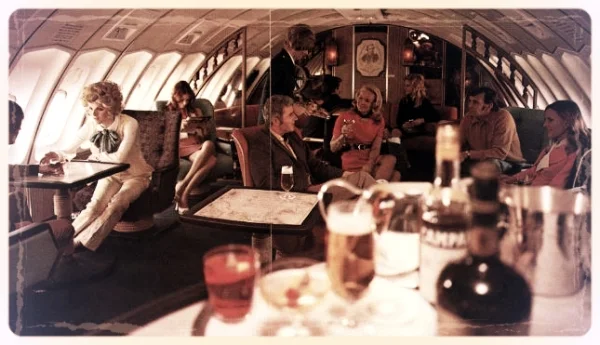
Is it possible, do you think, that Democratic senators are, in reality, demons sent by the Devil to pester, humiliate, and torment the rest of us? It may be a somewhat far-fetched theory, but take a look at the latest proposed policy initiative from Dianne Feinstein and see if you can come up with any other explanation.

 Ms. Feinstein, the senior senator from California, has decided that the experience of air travel in this country needs to be made worse. The senator, a lawmaker with, clearly, too little to occupy her time, has recently written to the CEOs of seven major air carriers suggesting that they should not serve any passenger more than two alcoholic drinks in the course of a domestic flight.

 Now, a "suggestion" from Dianne Feinstein is, like a "request" from Don Corleone, something to take seriously. Just in case any of the CEOs did not understand this, the sober-sided senator spelled out the threat implicit in her proposal. If the airlines would not comply "voluntarily" they would be required to do so by law. "I am," she warned sternly, "in the process of writing legislation." And that legislation would be tough. The ban, she explained, would apply "regardless of the type of alcoholic beverage served."

 Let us imagine what that could mean. You are in Coach, in a middle seat narrower than George W. Bush's Florida majority. One neighbor, grotesquely obese, is spreading out from the confines of his chair into your own space. The other, who does not appear to have washed for some days, is sobbing quietly after a nasty spot of turbulence over Des Moines. Two rows behind, a baby screams, but undeterred his mother carries on with the grim task of changing a diaper then and there (she has little choice — the line for the restroom stretches halfway down the plane). The flight itself, theoretically a six-hour hike from New York to Seattle, took off very late owing to unspecified "trouble" at O'Hare. You will, you already know, miss the meeting that was the purpose of your journey in the first place. The flight attendant has just informed you that the last chicken entrée has already been taken, leaving a choice of a bean-based mush or a packet of honey-coated pretzels. It has been two or three hours since your last drink. To numb the pain, you ask for a third Bud Light. Under the terms of the Feinstein fatwa your request will be denied.

 If there is anything guaranteed to spark an outburst of anger, this is it, which is ironic really, as the alleged purpose of the two drinks limit is to reduce "air rage." Of course, why Sen. Feinstein should be so worried by this subject is not clear. The senator was, after all, famously relaxed ("we've got to step back…let cooler minds prevail") when, in this year's most spectacular instance of aerial misbehavior, a hot-dogging Chinese jet collided into an American surveillance plane. We can only speculate as to what it is that has now led Ms. Feinstein to take a new harder line against trouble in the sky. It would, of course, be absolutely inappropriate to suggest that a double standard is at work and quite, quite wrong to hint that the senior senator from California is a self-important busybody, who finds it easier to boss around American citizens than stand up to Communist China.

 No, the answer must lie elsewhere. Was there, perhaps, an incident, senator, a squabble, maybe, on one fraught flight over just whose suitcase was going to have priority in a jam-packed overhead locker? We can only speculate. There is no evidence of such a drama, but then, why worry too much about that? There is no evidence of any epidemic of air rage either, but that does not seem to have stopped Ms. Feinstein.

 The real data are, in fact, rather reassuring. In response to the senator's proposal, a spokesman for an airline industry group, the Air Transport Association, has claimed that most of the four thousand or so (usually fairly minor) incidents of "air rage" that take place each year do so on the ground. Minor or not, that is four thousand too many, but it is worth remembering that U.S. airports catered for over six hundred million passengers last year. Based on those statistics, therefore, unruly travelers account for .0007 percent of the total, and most of those are enraged not by drink, but by delays. One of the principal causes of those delays, Sen. Feinstein, has been Washington's failure to bring the private sector into the management of the air-traffic-control system.

 What is more, when a drunken passenger is, or may become, a problem, the airlines already have all the powers they need. As Ms. Feinstein's own press release admits, under FAA regulations airlines are prohibited from serving alcoholic beverages to any person aboard who appears to be intoxicated. Disorderly passengers can be handcuffed or otherwise restrained. Quite rightly, as a number of loutish holidaymakers have recently discovered, they can also be prosecuted.

 As for those who argue that two drinks should be enough for anyone, well, that may be true for them (and for me. I'm a very frequent flier, but, in the air at least, a very infrequent drinker) but it is not for others, and those folks should be left to make their own choices. A drink or three can help wile away the time, or soothe, perhaps, the truculent traveler who might otherwise cause just the sort of problems which, supposedly, so alarm the senator. In addition, most of us know those terrified fliers (hi, Mom!) who need more than a little something to help them through their ordeal. Why should they suffer?

 In the end though, the utilitarian case misses the point. This particular example, the right to that third beer, may be not be the most important cause, but what matters here is the underlying principle, the principle that government should not take away any of our freedoms without a good reason. In this instance, Sen. Feinstein has not shown us that reason. The facts do not support her argument, and if we reject Satan as an explanation for Dianne's draft diktat (and, probably we must, although the Devil does, notoriously, find work for idle hands), then the only motive that can be found is in her own mindset, one all too typical of her party's leadership: priggish, arrogant, condescending, and unbelievably interfering.

 And you don't need to get in an airplane to be angry over that.

Another Fine Mess

National Review Online, July 18, 2001

Ken Clarke.jpg

When the British Conservative Party decides to make a mess of things, it does so in style. Last night, Mrs. Thatcher's tatty successors did it again. Battered, humiliated, and crushed in two successive general elections, the Tories are now identified with precisely one popular policy, their opposition to any attempt to abandon the Pound in favor of the European Union's laughable single currency, the Euro. So last night, when Conservative MPs had the task of narrowing the shortlist of candidates for the party's leadership down to two contenders, what did they do? Why, naturally they gave the most votes to former finance minister Ken Clarke, who politically, at least, is best known for one thing. He wants Britain to adopt the Euro. Now, that is a perfectly respectable, if misguided, opinion, but it is a remarkable viewpoint to be held by the challenger for the leadership of a profoundly euroskeptical party, although that, in turn, is less strange than the fact that, when the final vote is held this September, Mr. Clarke is very likely to end up the winner.

In part, of course, Ken Clarke's success is the product of desperation. The Tories are patient folk, but, after two of the biggest defeats in British electoral history, they would quite like to start winning again. Opinion polls repeatedly show that Mr. Clarke is easily the most popular Conservative in the country, despite the fact that he rejects the Conservatives' most popular policy. He combines political heft (Clarke is widely perceived as having enjoyed a successful ministerial career, although no one can quite say why) with a likeable public image. Untidy (the suits!), non-workaholic (the naps!) and rather portly (the waistline!), Mr. Clarke has perfected the English art of concealing a sharp intelligence, and no small amount of arrogance, behind a façade of shabby bonhomie. He is known to enjoy a few drinks and it is a fair guess that lean cuisine remains a mystery to him. Spectacularly (he is also a former Health Minister) Mr. Clarke also smokes, and, as Deputy Chairman of British American Tobacco, he would probably like you to take up the habit as well.

Being a merchant of death, however, is not enough, by itself, to make Ken Clarke the best choice for the Tory party. When it comes to more conventionally political matters, he has shown himself to be a very conventional politician, with ideas that are very unlikely to prove much of a challenge to the Labour Party's existing dominance. Mr. Clarke came into politics in the 1960s and his attitudes stem from the orthodoxies of the compromising and vaguely defeatist Conservative Party of that era. This too is probably the source of his fixation with the EU. Back then, "Europe" was seen as a relatively prosperous, sunlit alternative to the gloom of Britain's decaying welfare state. Indeed, in those days, that is just what it was, but times have changed. Thinking in the EU has not, however, and its dirigiste economic model has now clearly run out of steam. Post-Thatcher it is the Continent that should look at the UK for economic inspiration, not the other way round.

This is a change that seems to have eluded Ken Clarke. He fails to grasp the fact that, for Britain, deeper integration within the federal European project can only mean one thing, an irrevocable return to the high-taxing, bureaucratized ways of 30 or 40 years ago. Mr. Clarke may be the most attractive of the candidates for the Tories' top job, but his failure of imagination over Europe means that he is also the most dangerous.

The GOP was faced with a similar temptation last year. John McCain offered the prospect of a landslide, but the price he asked, campaign "reform," was too much for a party that still had some principles. It was a decision made easier, of course, by the fact that, in George W. Bush, the Republicans had an alternative candidate with a reasonable chance of victory. Looking at the potential opposition to Mr. Clarke, in a party where the ranks of aspiring leaders had been thinned by electoral carnage, it is by no means sure that Britain's Conservatives have had the luxury of such a choice.

To prove this, just look at the relative success of one of Mr. Clarke's supposed rivals, the mysterious Michael Ancram, a man who had risen to obscurity as Chairman of the Tory Party. Unelectable (as a member of the hereditary aristocracy he is considered beyond the pale in Tony Blair's supposedly classless new Britain), his campaign platform consisted of two pretty daughters and one vague principle (something to do with "unity"). Nevertheless, in a sparse field it was enough. The great man got some votes, and by the end of his campaign the London Times could even talk about yet another Tory sect, the "Ancramites."

It was not to last. Ancram and the Ancramites were defeated in an earlier round of voting. Another challenger dropped out shortly thereafter, leaving two other candidates. One, Michael Portillo, a former defense minister, had been the early front-runner. Once viewed as Mrs. Thatcher's heir, Portillo, an occasionally charismatic politician, who was seen by some as a potentially exciting choice to take on Tony Blair, has, over the past few years, compounded bad luck (he was out of parliament at a crucial time) with worse tactics. A self-indulgent and very public "journey" of self-discovery designed to help him connect to a wider audience played poorly with a party that, even these days, still prefers some degree of emotional reticence. The wider audience was pretty startled too. Doubts as to what the former Thatcherite stood for were intensified by the speed of his departure from the Iron Lady's old certainties. British Conservatives are a pragmatic bunch. They understand the reason for a strategic retreat, but would, perhaps, have preferred that this one had been carried out somewhat less enthusiastically.

Unfairly, Mr. Portillo's admission a few years ago of some early homosexual relationships may also have inflicted some lasting damage, but in the end it was questions over his judgment and what he stood for that were to prove fatal. Despite a strong start, his campaign was clumsy, and, in the absence of any real evidence of his electoral pull, the old doubts returned and he was done for. He was eliminated in last night's ballot, passed on the one side by the popular appeal of Ken Clarke and, on the other, by the ideological attraction of the other remaining challenger, Iain Duncan-Smith, the most recent keeper of the Thatcherite flame.

Iain Duncan-Smith, or "IDS" as he has been dubbed by the egos of the Parliamentary Conservative Party, is an amiable former army officer and the son of a Battle of Britain hero. He is bright, well informed, and a confirmed Euroskeptic. In fact, unlike Mr. Clarke, there is no doubt that he actually supports Conservative policies. By rights, all this should make IDS the favorite for the final ballot in September (all Party members get to vote), except for one teeny-weeny problem. Many Tories worry that the undeniably retro Mr. Duncan-Smith may be completely unelectable. He is, they worry, too unknown, too old-fashioned, too uptight, and perhaps the worst offense, too bald (a no-no, allegedly, in politically sophisticated Britain). Over the next couple of months IDS will have to show that these concerns have been overdone. If he can do that, he will see off Mr. Clarke. If he cannot, Conservative Party members will face a difficult dilemma. Do they vote for Mr. Clarke, a proven vote-getter, who might win an election, but whose policy preferences run the risk of splitting the party, and enmeshing Britain in a federal Europe, or do they vote for IDS and run a high risk of a third electoral disaster, a disaster that might give Mr. Blair the mandate he needs to adopt the Euro?

IDS, I think, needs to get a move on.

Baltic Reflections

National Review Online, July 14, 2001

© Andrew Stuttaford

© Andrew Stuttaford

It is playtime now in Tallinn. The brief, bright northern summer has transformed the Estonian capital into a city of outdoor cafes, tourist buses, and long, lazy strolls. At night, if you can call it that, music bursts out of the bars and clubs, bouncing off old town walls, and echoing down winding streets still lit by a sun that seems never quite ready to set. Add to the picture some of Europe's most attractive architecture, a vista of church spires, merchant houses, and impressive medieval fortifications and you have, for once, a city that really does deserve the label "fairytale." But, as with all the best such tales, reality is not quite what it seems. A good portion of the old town is, in fact, a reconstruction, the product of years of careful rebuilding, a restoration made necessary by Russian bombardment towards the end of the Second World War. The country's prosperity is also less than Tallinn's glow may initially suggest. Estonia's current economic recovery, the most impressive of any former Soviet Republic, is the product of hard work and free-market economics, but it remains, inevitably, uneven. Outside Tallinn, much of the country remains trapped in post-Leninist torpor, while even in the capital itself existence is tough for many, particularly if they are old, dependent on a hopelessly inadequate pension, and wondering where it was that their lives had gone.

A new exhibition located, with characteristically blunt Estonian reproach, a hundred yards or so from the Russian embassy, gives part of the answer. It commemorates the 60th anniversary of the mass arrests and deportations of June 1941, an episode of totalitarian savagery that still haunts this small Baltic nation. The black mourning banners announcing the exhibit flutter in the breeze. They are dark reminders of a cruel past, a haunting contrast to the bright skies, pale stucco and cheery advertising of contemporary Tallinn, basking in the summer sun.

To enter the exhibit hall is to return to that past. Walk into the lobby and find yourself in a gray dawn, feet crunching on a gravel path. It was the last sound that many deportees were to hear in what they mistakenly thought was still their familiar, normal existence. It was the sound of visitors, but who was it, they must have wondered, so early in the morning? Secret policemen, their victims were soon to discover, prefer not to do their work in the full light of day.

The exhibit's second room, an old dining hall by the look of it, gives the background to the tragedy. On its stone floor, strangely, there are patches of illustration, faded signs of the zodiac, a relic, perhaps, of some earlier avant-garde daubing. They must have proved impossible to erase. In a way, that is appropriate. All around the room are relics of another modernist experiment, Soviet Communism, the future, the world was once told, that "worked," the future that, in June 1940, rolled into Tallinn on the back of Red Army tanks, and left an indelible stain on the history of Estonia.

It was to be the end of the country's pre-war independence, a brutal return to the foreign rule that had characterized this land for over seven hundred years, a return made worse by the fact that of all Estonia's alien rulers, the Soviets were the worst, barbarians with a Plan that had no room for small, inconvenient nationalities. Estonia's First Republic passed into memory and into myth; it was, as older people sometimes still refer to it, "the Estonian time," a lost Eden, a moment in the light no more durable, in the context of centuries of oppression, than the short Baltic summer. And yet its memory endured, preserved by the Estonians as a reminder to themselves, if not to an indifferent world, that they were still a nation. In Tallinn's museums you can still find lovingly preserved consumer products from the 1920s, chocolate bars and tins of coffee, resplendent under glass, poignant souvenirs of an outraged sovereignty.

You can see that same clutching for the past at the deportation exhibit. There is evidence, that all-important proof, of Estonia's inter-war existence prominently on display. Drawn from home movies and news reels,  jerking images of farmers, factories, picnics, politicians, parades with too many flags and all the other clumsy baby steps of a new nation flicker and shine as they are projected against the walls of the old banqueting hall.

Across the room, there are reproductions of the doomed republic's newspapers from 1940-41. They reflect the end of independence. In June and July, 1940 the front pages could still boast a few advertisements, for Alex Rahn's radio store, for example, or "Isis Kreem" ointment, but these suggestions of capitalist prosperity already have to coexist with pictures of arriving Soviet satraps, 'elections' where the communists win over 90 percent of the vote, and the first calls for Estonia to join the USSR. By August the same year, the advertising has gone, and so has the republic's independence. Free Estonia is mutated into the 'Estonian Soviet Socialist Republic', the latest recruit into Stalin's gargoyle Union. The headlines now jabber of progress, proletarians and production. The only significant information is what they leave out.

On June 14, 1941, the front page of the principal Estonian newspaper featured a photograph of rowers on a canal in Moscow. There was no mention, of course, of the real news that day, the simultaneous arrest and deportation of people across all three Baltic countries. Ten thousand were deported from tiny Estonia alone, of whom one third (counter-revolutionaries, I'm sure) were under the age of seventeen.

The Tallinn exhibit tells some of their stories. There was Niina (guilty!), arrested at 14, and Juula (guilty! Her brother was a philatelist, and thus, it was explained, a British spy). As for Ebba Saral, well, she was a criminal too dangerous to be confined to a mere cattle truck with the others. They put her on a sofa on a flatcar and, surrounded by guards, she rode into hell "like a queen." She and her husband (a professor — guilty!) both perished. There is a photograph of his grave, and copy of her death certificate, grudgingly issued nearly half a century after her execution. Fittingly, it is in Russian. This is, sadly, not a rare story. In the first year of the Soviet occupation a total of sixty thousand Estonians (four percent of the population, the equivalent of around eleven million Americans today) were deported, conscripted or murdered.

Two doors then lead from the exhibit's main hall. It is not much of a choice. One door leads to "prison," the other to "Siberia." "Prison" is an assembly of iron doors and a nightmare reconstruction of a squalid Soviet jail cell. "Siberia" displays homemade tools and rough-hewn luxuries, the former essential for existence, the latter for sanity. There are group photographs of the deportees, stoic in the tundra, dumped into a wilderness and left to adapt or to die. Some of them even managed to survive and so, miraculously, did the dream of freedom. An independent democratic Estonia finally reemerged from the wreckage of the Soviet Union in August 1991.

Understandably, this new Estonia has applied to join NATO. Russia's arrogant, disturbing opposition remains one of the best reasons to agree to the request. George W. Bush appears to sympathize. Speaking recently in Warsaw, he said that, "All of Europe's new democracies, from the Baltic to the Black Sea" should have the chance of NATO membership. It was, for the peoples of the former Soviet bloc, a marvelous moment. In Western Europe, needless to say, the political classes were not quite so sure. To many of those folks, the real threat lies elsewhere. Sweden's prime minister, a Social Democrat by the name of Goran Persson, marked Mr. Bush's arrival in Europe by calling on the European Union to build itself up as an alternative to American "domination."

Of course, Swedish Social Democrats know a thing or two about "domination." Not long after those Red Army tanks rolled into Tallinn, a few weeks, perhaps, after the day that Ebba Saral was taken to her death in the East, the Swedes (the government was led by a Social Democrat then, as now) decided to do something about Moscow's Baltic land grab. And what they did was give it diplomatic recognition, one of the first two countries in the world to do so.

The other was Nazi Germany.


Rough Justice

National Review Online, July 5 2001

Slobodan_Milo_evi_.jpg

The Serbs made a furtive sale and a dirty trade. It was a handover made in exchange for a dollop of aid and a whitewashed reputation. You do not have to be either an admirer of Milosevic or a worrier about black helicopters to find it more than a little distasteful. Last weekend's events in Belgrade and The Hague may have been a short-term victory for Uncle Sam, but, in the longer term, they may come to be seen as a disaster. What they really represented was a triumph for a form of intrusive international jurisprudence that already represents a menace to effective diplomacy and will, in the end, be a threat to the interests of this country. It is worth remembering, after all, that if there is any legitimacy to prosecutor Del Ponte's crusade, it is based on the authority of the United Nations, an organization that has never been notably friendly to the U.S.

Yes, that's right, the U.N., that same collection of moral colossi whose most recent notable achievement in the area of human rights has been the decision that the slave state Sudan represents a better guarantor of basic decency than does the United States. The sad thing about last weekend's drama was that it was all so unnecessary. Milosevic was, mercifully, already a beaten man, a thug at the end of his tether, who seemed destined finally to face the judgment of his own nation, a people that he had led to disaster and humiliation. The trial would have lasted longer than that of Romania's unlamented Ceausescu, and the punishment might have been less, shall we say, immediate, but the consequences would, for practical purposes, have been much the same. Yugoslavia's failed savior would have been finished. Almost as importantly, such a trial would have provided an occasion for his countrymen to confront their own past. With, doubtless, the help of some prompting from outside, the proceedings would have been a valuable chance for the Serbs to contemplate not only the crimes committed by their former leader, but also the horrors in which far too many of them had themselves participated. Milosevic, too, had many willing executioners.

There is a clear danger that removing the trial to The Hague will dilute that message. Handled with anything other than the most exquisite sense of fairness, it may well play into the hands of those who want to portray Milosevic as a martyr, a victim of victors' justice, a hapless scapegoat found guilty only by a kangaroo court. In such a scenario, the real evidence of terrible atrocity would almost inevitably be dragged into controversy and disrepute. The slaughtered tens of thousands would suffer further, grotesque insult. Their corpses would be mocked as tragic accidents and their mass graves as exaggerations. The dead would be left slandered and their memory reduced to nothing more than the bogus prop of a fraudulent show trial, the basis of a poisonous myth that could prove compelling in a Serbia where history too was a casualty of Milosevic's war. The very real chance of such a development cannot be ignored. The rump of the old Yugoslavia is an embattled and broken nation, surrounded by hostile states and, understandably, skeptical about the evenhandedness of NATO's new justice. It is a fertile ground, as we already know, for paranoia and crazed theories of betrayal.

Distance too, will pave the way for another, gentler form of denial, the seductive fantasy in which nobody, neither the Serbs, nor NATO, is guilty. Only the bogeyman Slobodan will be to blame. Safely tucked away in Holland, Milosevic will become the repository for a people's guilt, out of sight, out of mind and off their conscience. In Germany's immediate post-war years the conveniently deceased, and thus equally absent, Hitler fulfilled a similar function for surprisingly large numbers of his former supporters. It is not difficult to imagine the same occurring in Serbia, but more nastily. After all, in the Balkans national myths have a way of turning rapidly rancid, and, unlike in the territory of the fallen Reich, there is hardly anyone on the ground to keep the peace should the desire for revenge become too great to contain.

So if the decision to try Milosevic abroad is an opportunity missed, and a risk taken, what exactly was its point? It cannot have been deterrence. The prospect of a Dutch jail is unlikely to put off any more than the feeblest of dictators-in-waiting. What Milosevic's fate may do, however, is operate as a disincentive to some future despot contemplating a voluntary abdication. In the end, the Yugoslav leader had, of course, to be shoved out of office, but at least even he had the sense to go (reasonably) quietly when the game was up. The Hague has been his reward. Future dictators will draw the necessary conclusions.

In all probability, the real purpose of making such an effort to get hold of Milosevic was something else: It was to make clear that this latest application of international law was for real. To be fair, there was some practical justification for this. If, like the NATO allies, you intervene in the affairs of a foreign country, it is always handy to get a little legal backing, even if you have to make it up. The problem is that, in going along with this, the United States has given further momentum to the efforts of an increasingly assertive international bureaucratic class, prominent in the U.N. and elsewhere, to grab ever more power for itself. Kyoto was one notorious instance, but this is a continuous, relentless process. There will soon, for example, almost certainly be a permanent international criminal court (Iranian judges, anyone?), which will, you can be sure, have a permanent anti-American agenda.

Meanwhile, activist European magistrates have used this era's more expansive notions of international law to start taking it upon themselves to 'investigate' a perceived retired oppressor or two, none of whom, strangely, ever appear to be on the Left. Augusto Pinochet was harassed for years, and there's even excited talk about prosecuting Henry Kissinger, but when it comes to Mikhail Gorbachev, the hero of Afghanistan, Vilnius, and Tbilisi there is only silence. No French magistrate, I suspect, will be bothering Gorby.

President Bush appears to understand the implications of this. Quite rightly, he has made clear that the US will not subject itself to the proposed International Court, but international law has, of late, shown a tendency to turn up in the most unexpected places. The Bush administration will have to make sure, in its understandable enthusiasm to punish the butchers of the former Yugoslavia, that it is not inadvertently setting a precedent for future less savory 'international' prosecutions of, say, US troops on a peacekeeping mission.

Such an outcome really would give Milosevic the last laugh.

De-Demonizing Rum: What's wrong with 'underage' drinking?

National Review, June 25 2001

Jenna Bush.jpg


IT was a day of shame for the Bushes, an incident made all the more embarrassing by the family's previous well-publicized difficulties with alcohol. I refer, of course, to the regrettable 1997 decision by then-governor George W Bush to approve legislation further toughening the penalties for underage drinking. In Texas, the legal drinking age is 21. A typical Texan of 19—let's call her "Jenna"— is judged to be responsible enough to vote, drive, marry, serve in the military, and (this is Texas) be executed, but she is not, apparently, sufficiently mature to decide for herself whether to buy a margarita. The 1997 legislation made things worse: Miller Time could now mean hard time, a possible six months in jail for a third offense. It is a ludicrous and demeaning law, but it has been policed with all the gung-ho enthusiasm that we have come to expect in a land where the prohibitionist impulse has never quite died. In Austin, there is now a special squad of undercover cops dedicated to fighting the scourge of teenage tippling. In other words, they hang around in bars.

The crusade does not stop there. The Texas Commission on Alcohol and Drug Abuse boasts a campaign called "2young2drink," which features billboards, a hot line (Denounce your friends!), and a program enticingly known as "Shattered Dreams." Other efforts include the Texas Alcoholic Beverage Commission's sting operations (Make your kid a snoop!) and, for those parents 2stupid2think, a helpful series of danger signs compiled by the Texas Safety Network. One early indicator that your child is drinking may be the "smell of alcohol on [his] breath." Who knew?

But it's unfair to single out Texas. The legal drinking age has been raised to 21 in every state, a dreary legacy of Elizabeth Dole's otherwise unremarkable tenure as President Reagan's transportation secretary. She is not apologizing; her only regret is that the age of barroom consent was not increased to 24. In her jihad against gin, Mrs. Dole forgot that the guiding principle of the Reagan administration was supposed to be a reduction in the role of the state.

And, as usual, government is not going to do any good. The only circumstances in which the approach taken by the zero-tolerance zealots could have the faintest chance of success would be in a society where alcohol was a rarity. Zero tolerance has been a disastrous failure in the case of young people and illegal drugs; how can it be expected to work with a product that is available in every mall or corner store? Sooner or later, your child will be confronted with that seductive bottle. The only question is how he is going to deal with it.

Not well, if the Dole approach continues to hold sway. Demonizing alcohol—and thus elevating it to the status of forbidden fruit—is counterproductive. Adult disapproval magically transforms that margarita from a simple pleasure into an especially thrilling act of rebellion.

My parents avoided this error. Growing up in more tolerant England, I could always ask them for a drink, and, fairly frequently, I would even be given one. At least partly as a result, I went through adolescence without feeling any need to drink a pint to make a point. My drinks were for the right reasons. The only recollection I have of any real parental anxiety in this area was when, at the age of about 13, I accepted a brandy from a friend of the family (an alleged murderer, as it happens, but that's another story). The worry was not the drink, but the uninsured glass containing it: antique, priceless, and, as our host explained to my trembling mother, quite irreplaceable. In the event, the glass survived me, and I survived the drink.

Parents, not bureaucrats, are the best judges of how and when their offspring should be permitted to drink. Intelligent parents don't let alcohol become a big deal, a mystery or a battleground. They teach its perils, but its pleasures, too. Have a bottle of wine on the table, and let the kids take a gulp; it will not, I promise, turn them into Frenchmen. Treat a drink as a part of growing up, as something to be savored within a family, rather than guzzled down in some rite to mark passage from that family.

Furthermore, too much of the discussion about alcohol in this country reflects prohibitionist fervor rather than scientific fact. We act as if alcohol were a vice, a degenerate habit that can—at best—be tolerated. In reality, it does not need to be apologized for. Alcohol has been a valuable part of Western culture for thousands of years. It can be abused, sure, but it can inspire as well as intoxicate, illuminate as well as irritate. In excess, the demon drink merits its nickname; in moderation, it can be good for you.

Ah yes, some will say, but what about drunk driving? They have a point. While it is possible to debate the numbers, there can be little doubt that the higher drinking age has coincided with a reduction in the number of highway deaths. But has the price been worth paying? The question sounds callous, particularly given the horrors of the individual tragedies that make up the statistics, but all legislation is, in the end, a matter of finding a balance between competing rights, interests, and responsibilities. We could, for example, save lives by denying drivers' licenses to those over 65, but we do not. We understand the trade-off: There is an interest in safer roads, but there is also an interest in allowing older people to retain their independence.

In the case of the drinking age, the balance has shifted too far in one direction, away from individual responsibility and towards government control. Raising the limit may have reduced drunken driving, but the cost in lost freedom has been too high, and, quite possibly, unnecessary: Alcohol-related auto accidents seem to be falling in most age categories. The problem of teen DWI is best dealt with directly, by strengthening the deterrents, rather than obliquely, in the context of a wider attack on "underage" drinking—an attack that might, in fact, ultimately backfire on those whose interest lies in combating the drunk at the wheel.

For the most striking thing of all about the minimum drinking age of 21 is how unsuccessful it has been. A 19-year-old in search of a drink will not have to hunt for long; just ask "Jenna." Almost impossible to police effectively, our current policy sends a signal to the young that our legal system is capricious, weak, occasionally vindictive, and not to be respected. In the interest of enforcing important laws—such as those against drunk driving—we should do what we can to make sure our young people see the police not as interfering busybodies, but as representatives of a mature, broadly respected moral order, who are prepared to treat them as adults. Those who believe government should be in the message-sending business should pay a little more attention to the message they are really sending, when they ask the police to enforce unenforceable—and frankly indefensible—taboos.