The Last Silo

National Review Online, November 4, 2001

 © Andrew Stuttaford

 © Andrew Stuttaford

The desert south of Tucson, Arizona, bone dry, rocky, and mountainous, looks a bit, some say, like the end of the world. And that is just what it could have been. Take I-19 towards the Mexican border and, not far from a town with the optimistic name of Green Valley, the visitor can turn off the Interstate and take a narrow approach road to a place that could once have triggered the Apocalypse. It is quiet around there now, the only visible excitement seems to be Monday-night bingo at the American Legion, but it was probably quiet there then too, 20 or 30 years ago, except that at that time a very different game was being played a few yards on from that peaceful, dusty spot, a game that could have meant that all our numbers were up. In those days, any travelers who wandered a little further up the approach road would have come across a curious spider-web antenna on the right-hand side, and beyond that, a chain-link fence, some lights, and behind the fence, a slightly elevated chunk of concrete, the top of a storage tank, perhaps. Scrambling over that fence would have been a very, very bad idea. It would not have been long before the guards came, seemingly, from nowhere and as they carried you off, they probably would not have taken the trouble to explain that, yes, you were quite right. That chunk of concrete was indeed the lid of a storage tank.

 © Andrew Stuttaford

 © Andrew Stuttaford

And what that tank contained was a nuclear warhead perched on top of a Titan II, the largest intercontinental ballistic missile ever developed by this country. The actual payload has never been disclosed, but it would have well been over one megaton, some claim as many as nine. A single megaton represents an explosive-force equivalent to the detonation of a million tons of TNT or, to put it another, bleaker, way it is around 80 times the power of that firecracker they let off over Hiroshima.

This monster, fortunately, had keepers. Four-person crews from the 390th Strategic Missile Wing watched over the Titan's silo in rotating 24-hour shifts that combined boredom, tension, and routine in a way that would have been very familiar to any sentry in any of mankind's past wars. And so, as two decades passed, the missile's guardians checked and double-checked and waited for the order that never came, the command to launch their rocket, that projectile that could have ended the world. In a strange kindness, the crews were not told the identity of their Titan's selected target. That, it was felt, would have been too much to bear. Moscow, Leningrad, Minsk? Better not to know.

The Green Valley silo, Complex 571-7, became operational in July 1963, part of a program that involved the construction of a total of 54 Titan II silos in Arizona, Arkansas, and Kansas. For more than 20 years these underground sentinels remained on alert, safe in their discreet, intimidating fortresses each containing just one missile, four men, and enough power to annihilate a city and, maybe, a civilization. The missiles endured and, it is no coincidence, so did we. Built in the era of Khrushchev, at a time when Berlin's wall was a still fresh obscenity, they were the brilliantly engineered product of a country realistic enough to be able to identify the danger it faced, and sufficiently tough to be prepared to do something about it.

The Titan II missiles were eventually phased out in the early 1980s, and the silos were decommissioned. Some were dismantled, some were abandoned and, this being America, some were sold as potentially prime real estate for the really nervous homeowner. Green Valley is now the only silo that remains reasonably intact. Turned into a museum in 1986, it still houses a Titan II, but this last surviving guard dog is toothless (the warhead has long since been removed from the missile). Even now, however, the ageing weapon still merits a little respect: This complex must be the only museum in the world set up in a way designed to satisfy satellite scrutiny. The silo's 760-ton door is permanently kept half open, and before the defanged missile was replaced in its launch duct, it was, very publicly, made inoperable. As is noted in the museum's guidebook, "Treaties deal in numbers, and it would not be wise to count a museum as part of our arsenal".

There were not many visitors to "big missile country" the time I visited Complex 571-7. It was hot, even for Arizona in August, just another mellow, lazy afternoon in that long untroubled summer of 2001, that tranquil, slumbering season which was to come to a terrible, unimagined end just three weeks later. But back in that now hopelessly remote then, in the deceptive peace of a country where Mohammed Atta was already making his final arrangements, unfashionable conflicts drew few crowds; the sites of our neglected Cold War triumph were, it appeared, of fairly limited appeal. There were two or three history buffs, earnest with note pads and questions, and a family group, father, young son, granddad (but no wives — the Titan museum, I suspect, is one for the guys).

 © Andrew Stuttaford

 © Andrew Stuttaford

To reach the silo's command post, it is necessary to climb down a steep staircase that leads to a small cage 35-feet below ground. This "entrapment area" is the last holding point before entrance to the corridor to the bunker's reinforced core. The mesh gates open, and we are in. It is a functional place, all metal walls and lime-green institutional paint, a little bit like the below decks of an elderly aircraft carrier, until that moment when, after walking through long corridors and past enormous blast doors, you find yourself on the set of the Starship Enterprise.

It is a vision of Shatner chic, high-tech, 1960s style, clunky steel boxes, punch-card computers, illuminated buttons, and old-fashioned digital counters, only this was no science fiction, these were the controls of a rocket that could really fly. A genial guide talks us through Armageddon's rituals, the warning message over the speakers, the walk to the safe containing the launch codes, their insertion into the command console, the final authentications, and then that last stage before irrevocability, the two simultaneous flicks of two separate keys into two separate mechanisms (kept sufficiently far apart so that one man alone could not send off the missile). After that, there would have been nothing to do but wait. This was a procedure that left no opportunity for second thoughts. Once the keys had been turned, the missile would take off a minute later. There would have been nothing that the men at Complex 571-7 could have done to stop it. As the missile shot five hundred miles into the sky, its former custodians would have had little to do other than contemplate the remains of their future. The silo contained enough food, water, and air for 30 days. After then, well, no one could say.

The guide is standing by the console. He summons a small boy out of our group. Side by side the guide and the child insert the keys to doomsday, they turn them, make believe, but accomplished Strangeloves, with perfect synchrony (the keys have to be turned within two seconds of each other if the system is to work). As a proud grandfather applauds, Hell's ignition light goes on. Klaxons sound. Lift-off! Except, of course, that it wasn't. The missile cannot be launched; that old Titan was, as we all knew in that safe, deluded August, a harmless, spooky souvenir of more dangerous decades, a reminder of an era when this country was under constant threat of attack, a time, we thought then, that had passed forever.

In the long years of its operation Complex 571-7 was never a place for such illusions. Built and run by men who could contemplate destroying a planet to save it, it is a palace for pessimists, blast-proofed, locked and barred, much of its equipment, even, mounted on springs, able to bounce back from the tremors of a nearby nuclear explosion (the silo could survive almost anything other than a direct hit) with no great damage. It was a last line of defense, the threat that kept the peace, and everyone knew it. The Titan II was the weapon to be used when all else had failed. So the crews that lived with it beneath the earth did what they had to, relentlessly, dutifully and accurately completing those dull daily chores that made Mutually Assured Destruction credible and, as a result, impossible.

You can see some of their faces in photos that line the site's frugal visitor center, fading now as fast as the memory of their unsung vigil, those unknown heroes of an essential struggle, dedicated individuals who understood that to win a war it takes time, courage, patience, determination and, if necessary, a willingness to do the unthinkable.

Is that, I wonder, something that enough of us still understand?

Moderately Crazy

National Review Online, October 23, 2011

Mullah Omar.png

Mullah Omar Mohammed, the Taliban's one-eyed leader, is, we are often told, insane. A twitching, convulsing Cyclops in a turban, this lunatic clergyman is, apparently, a standout kook even in a region famous for its delusional and psychotic despots. Amazingly, however, he might not be the craziest participant in the current crisis. That distinction may have to be reserved for the urbane and superficially more normal-seeming Colin Powell, a man who, according to press reports last week, has expressed an interest in "reaching out" to more "moderate" elements in the Taliban, a task about as anchored in reality as an attempt to find Charles Manson's inner sweetness. The secretary of state has subsequently attempted to "clarify" his position, emphasizing that no such overtures will be made to the Taliban's "leadership," a conveniently elastic term that does little to disguise the bizarre nature of this whole initiative.

To put it bluntly, the idea of a "moderate" member of the Taliban is no more plausible than the notion of a moderate member of the Ku Klux Klan. Intellectually, if it is appropriate to use that term in this context, the Taliban's teachings are not only a rejection of Afghanistan's traditionally (relatively) tolerant religious heritage, but they also go, in their absolutist contempt for the modern world, many steps beyond the already hard-line Islamic fundamentalism that inspired so many of the anti-Soviet mujaheddin. Drawn from the ranks of the orphaned, the dispossessed, and the alienated and inspired by the petty and vindictive certainties of barely educated village preachers, the lopping, chopping, and murderous Taliban are the extremist's extremists, the Khmer Rouge of the Khyber Pass.

It is also worth remembering that their rule is a fairly recent phenomenon. These are fresh-minted fanatics. Time and incumbency will eventually reduce the fervor of even the most ideologically driven of dictatorships. As the years pass, youthful enthusiasm (the Taliban gets much of its support from young men) will evolve into paunchy middle-aged torpor. What's more, as a regime endures, its very success will, ironically, conspire against its core principles. The ranks of the true believers will be diluted by the arrival of careerists and other opportunists, just the sort of pragmatic people who a Colin Powell might look for in his hunt for "moderates." There has not been enough time for this to happen within the Taliban state, and there is at least one good reason to think that it may take a while before it could be expected to do so — the peculiarly retrograde ambitions of the Taliban mean that they have comparatively little dependence on the sort of skilled technocrats normally essential for the smooth running of any society.

Traditionally, even the worst dictatorships have adopted at least some ideas of what we conventionally think of as progress: Trains ought to be made to run on time, electrification must be brought to the countryside, a civil service should function. To achieve such aims, any movement, however despotic, must succeed in co-opting the help of just the sort of technically qualified and, probably, relatively apolitical specialists who might constitute a force for moderation. The Taliban has no need of such people. Their objective, an Afghanistan transformed into a replica of an imagined 8th-Century Arabia, is about destroying, not building, a modern civilization and it is difficult to believe that they will need the assistance of many engineers, scientists or even administrators as they go about their grisly business.

This appears to be true even in the armed forces. While Taliban troops do, undoubtedly, include some trained, professional military, their numbers are fairly few (apart, perhaps from some of bin Laden's own "Arab" detachments), and there are unlikely to be enough of these career soldiers to be worth appealing to as a potential source of opposition to the regime's excesses. This should be no great surprise; brutal, unstructured, and primitive, Afghanistan's civil wars have been fought at a level that requires cunning and enthusiasm rather than sophistication and a West Point style officer corps.

Also, the Taliban military appears, by (admittedly low) Afghan standards, to be fairly cohesive. Warfare in Afghanistan is typically characterized by shifting alliances and repeated betrayals, but the rise of the Taliban has varied somewhat from this familiar pattern. The ideological fervor of Mullah Omar's movement (which was formed in a way that manipulated ethnic — Pathan — identity and yet bypassed much of the usual tribal power structure) and the speed of its early victories mean that its forces are less of a cobbled-together coalition than is normally the case in Afghanistan. The Taliban has, unfortunately, had to absorb relatively few allies of convenience, those fickle friends of a type that the U.S. might otherwise be able to tempt away.

This is true even outside the regime's Pathan heartland, where some degree of coalition forming by the Taliban might reasonably have been expected. Mullah Omar, however, is not really someone, to use a State Department term, known for "reaching out." In non-Pathan areas of the country, therefore, the Taliban have ruled more like an occupying army than a government. Only limited attempts have been made to win over the locals, who will be, by definition, unable to defect from an administration that they never joined in the first place.

This quest for "moderate" members of the Taliban is, therefore, not only a long shot, but could also be counterproductive. It risks confusing, antagonizing, or demoralizing just the sort of local anti-Taliban forces, actual or potential, who could assist U.S. efforts on the ground.

More importantly, perhaps, these hints about the acceptability of some supposedly moderate Taliban faction send out a terrible message elsewhere in the region. The United States is never going to be loved in the Middle East, but, if it is to succeed in this conflict, it must at least ensure that it is respected. When bin Laden's disciples want to attract followers they do so not with images of American strength, but with the idea of American weakness. There is repeated gloating over those outraged corpses in Mogadishu and, now, gleefully, over the destruction of two tall buildings, sent tumbling to their doom on a bright blue September morning.

The appeal of such propaganda in a neighborhood already profoundly hostile to the United States can only be met by the projection of American power, and in a prolonged, tricky, and asymmetrical contest, that is something that will take more than superior military hardware. The U.S. will have to be seen to show uncompromising determination, iron resolution and the unshakeable intention to see this battle through, preferably with allies but by itself if necessary. It must demonstrate to the Muslim world's many waverers that the United States is loyal to its friends, but implacable towards its enemies, that it is not, in other words, the sort of country ready to cut a deal with members of a regime that is still harboring the killers of so many Americans.

Domestically, the political impact of any overtures to elements within the Taliban would be likely to be even worse. Within the United States, American foreign policy is, at the moment, seen as having an unusual moral clarity. After 6,000 funerals, there need be no qualification or equivocation. Right is on our side. That is what those flags, displayed, it seems, on every street are all about. Americans realize that they have been attacked, and their people butchered, by an evil and dangerous assailant. This nation can see that bin Laden, the barbarians who harbored him, and the ideology he represents must be "ended", and it knows that this process may well be long, difficult and bloody. This country understands, in fact, a great deal about the situation in which it now finds itself, and that is why it is giving the administration the very broad support that it needs to do the job.

It is, however, support that could be quick to drain away if the response to the al Qaeda onslaught comes to be muddled by the State Department's familiar blend of cynicism and reflex internationalism, that sleazy instinct for appeasement that comes disguised in the tough language of realpolitik, and which even now, it appears, might be prepared to sell us the concept of the Taliban's kinder, gentler elements.

American Icon

National Review Online, October 15, 2001

bert_n_bin.jpg

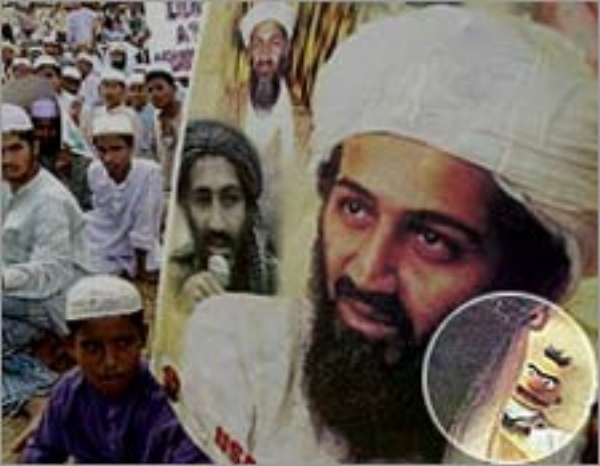
It was a moment of laughter in a month of murder, the return of harmless absurdity to a world gone mad. The background was not promising. Bangladeshi Osamaniacs had gathered in their capital city, Dhaka, to show their support for bin Laden and their hatred for you and me. They marched as such mobs always do, violently, noisily, and under the banners of jihad, an embarrassment, I hope, to their faith and a disgrace, I know, to their country. Posters were brandished, some of them showing pictures of the crowd's hero, that grim symbol of Islamic rage, severe in his white turban and dark beard, with, it was to turn out, a rather surprising companion. Clearly visible on some of the posters, muttering, it would appear, into bin Laden's left ear, is Bert, Sesame Street's grouchiest Muppet, a difficult fellow, to be sure, but not an individual with any previously known links to the al Qaeda network.

Pictures of the demonstration swept across the planet, prompting Fox News to run a piece on "Bin Laden's felt-skinned henchman" and the makers of Sesame Street to issue a rather pompous condemnation of the "abuse" of one of their characters ("Sesame Street has always stood for mutual respect and understanding…this is not at all humorous"), although, as a suspicious Fox correspondent was quick to note, the show's spokeswoman would not be drawn on the yellow Muppet's "current whereabouts." Was there something to hide?

Well, don't worry, Bert, as it happens, is innocent. The real explanation for his appearance with the world's most notorious criminal (which can be found on the invaluable www.snopes2.com) lies elsewhere, in that blend of frivolity and technological superiority that so enrages Muslim fundamentalists about our glittering, tantalizing, ubiquitous civilization. For years now the web has played host to the running joke that "evil Bert" has been the crony and adviser of history's wrongdoers. Search the Internet and you can find doctored photographs of Bert with O. J., Hitler, Kevin Costner (some people really did not like Waterworld) and now, it seems, Osama bin Laden. And this — this joke — was the image that a printer in Bangladesh chose to download when he was surfing the web for a picture of Bin Laden to make into a poster for Osama's devotees. Somehow or other the bungling Bangladeshi either failed to notice Bert or, if he did, he omitted to crop him from the photo.

Symbolically, this fiasco could really not be better: whether it was in the reliance on advanced Western technology to create the propaganda materials for protesters who would abolish the future, or whether it was in the pathetic failure to use it effectively, a failure that led to the elevation of yet another symbol of the decadent West over the heads of its ignorant, benighted foes. It may have been an accidental triumph, but who cares? Western culture, represented in this case by the unlikely standard-bearer, Evil Bert, had once again humiliated its dim, dismal, and demented opponents, fools who would run a world, but cannot operate a PC.

And yes, it is okay to laugh, although if you are a woman in Afghanistan please do so only in private (the Taliban have made it a crime for women to laugh in public). This tale of botched posters is marvelously, gloriously funny, a welcome relief after these weeks of grief. Those demonstrators were made to look ridiculous, and it gave this country a wonderful, mocking picture of a contemptible enemy. We need more of such images. The pampered rich kid bin Laden, a designer tribesman with his laundered robes, Timex Ironman Triathlon ("the watch of choice for top athletes"), and Stone Age certainties is a gift to caricaturists, and yet (with some exceptions, notably The Onion) there seems to be a curious reluctance to make fun of this ludicrous figure. In part, probably, this is a consequence of the exquisite sensitivities of the Politically Correct era (should we not be trying some "mutual respect," should we not be making an effort to understand him?) and in part it is the natural inclination of a sheltered, rather soft generation still uncertain as to how to respond in the aftermath of such an appalling, unexpected onslaught. To take one example, according to press reports, we are, apparently, in for a kinder, gentler Halloween. Bin Laden masks, it is being suggested, would be in poor taste.

In fact, such rude, tasteless gestures are very important, and, insofar as they can contribute to victory, they can help honor our dead. It is possible to belittle bin Laden (in fact, if some tabloid accounts are to be believed, it is very easy indeed), without belittling his crimes. Far from trivializing a conflict, humor can be a very useful weapon in its pursuit. Current reports linking the anthrax attacks on the tabloid press to their less-than-flattering descriptions of bin Laden and his acolytes would, if true, suggest that this is well understood by al Qaeda. Laughing at an enemy boosts morale and reminds us that any adversary, however fearsome-seeming, can be overcome. In the Second World War, Hitler was often portrayed in Anglo-American popular culture as a figure of fun, a laughable, histrionic little man with delusions of grandeur, and yet no one would argue that the Allies were not serious about the evil done by his regime or the importance of, to use a currently fashionable term, 'ending' the Third Reich.

So let's have those bin Laden masks, the nastier the better, and take it from there. This is someone to jeer and to scoff at, a clown in a cave to be mocked, parodied, derided, lampooned, taunted, and ridiculed, a jerk on a jihad that we can only despise. Our laughter will help cheer us up, and, who knows, so great is the reach of the Western media (ask Evil Bert), it may also transmit a message to some of those in the Muslim world who now demonstrate their support for terror, an important message about the man that they so admire.

He's a loser.

Diana, Again

National Review Online, October 6, 2001

Diana.jpg

There is, let's admit it, something grimly satisfying about having a prejudice confirmed. So, if you are one of those people who believe that there is absolutely nothing more to say about Charles and Di, Christopher Andersen's new work, Diana's Boys, is the book for you. Once again weary readers are presented with the same shop-soiled menagerie (mean queen, pained prince, plain Camilla, horrible Hewitt, foolish Fergie, loveable Tiggy, playboy Dodi), the same exhausted anecdotes (hysteria at Highgrove, bulimia in the palace, Charles' confession of adultery, Diana's TV interview, the rudeness at Harry's birth), and, above all, that same doomed, fascinating heroine, bewitching and manipulative, a Sybil in Chanel, with her bewildering, ever-shifting personality leading all those around her to ruin and to despair.

We know how her story will end, of course. We are told again about those last tragic hours in Paris, that speedy departure from the Ritz and the disaster in a tunnel, hours that will be particularly familiar to fans of Mr. Andersen, in that he had already discussed them at some length in an earlier bestseller, The Day Diana Died. Now, Mr. Andersen, the author of two books about Katharine Hepburn, three volumes about the Kennedys, and two works about Princess Diana, is clearly a man who is not too worried about reworking a profitable subject. It is best, however, if such a return to the mother lode can be justified by the claim that something fresh is being discovered. The kindly Ms. Hepburn has, most obligingly for her biographers, been very long-lived, leaving plenty of room for the two, doubtless distinct, efforts by Mr. Andersen, Young Kate and The Remarkable Love Story of Katharine Hepburn and Spencer Tracy. The Kennedys enjoyed far less staying power than the formidable actress, but, in their case Mr. Andersen could, presumably, reduce the risk of repeating himself by moving across, then down, the former First Family tree. He followed Jack and Jackie with Jackie after Jack, and then, in a confirmation of his mortuary franchise, he gave us The Day John Died.

In Diana's case, however, going back to the celebrity seam was not so straightforward. The inconveniently dead princess lacked Ms. Hepburn's powers of survival. A "Young Diana" was all there ever was, and all there ever would be. There were no long decades, just a few short years filled with incident, almost all of which Mr. Andersen had already chronicled. The Kennedy alternative, harvesting the family tree, was also tricky in the case of the gloomy royals. Compared with JFK the poor princess lacked a sellable surviving spouse. Who, other than Camilla, who would go for Charles after Diana?

That only left the sons, William and Harry, in Diana's words, her "one splendid achievement", and so they appear to be. But as camouflage for an opportunistic retelling of the Spencer story, her offspring prove hopelessly inadequate. This is hardly their fault. They may, in the words of Mr. Andersen's publisher be "the world's two most celebrated royals" (eat your heart out, Elizabeth), but they simply have not done enough to carry a biography. This would be true of almost any teenager. Diana's children are no exception, as a quick glance at this book's index reveals.

Entries under "William, Prince" include "backside pinching of… e-mail romances of…formality disliked by… Harry dangled from window by." Take away the story of their parents, and the Windsor princelings' lives are the stuff of trivia. While that is not a bad level for Mr. Andersen's writing style ("Finally, the Princess of Wales leaned forward to see what the boys' found so riveting: steamy photos of the buxom Barbi twins, Playboy centerfold models Shane and Sia") he is astute enough to know that, when it comes to book sales, his best hopes still lie with Diana. So, much of what we get is a tired rehash of a failed marriage and a tragic death, with, on occasion, the only variety coming, quite literally, from the pagination.

On page 43 of Diana's Boys, for instance, we can read that "William's mother indulged in an orgy of self-mutilation. At various times, Diana slashed her wrist with a razor, stabbed herself in the chest with a pocketknife, cut herself with the jagged edge of a lemon peeler, and hurled herself against a glass display case, shattering it." This is a drama that may be familiar to admirers of page 49 of The Day Diana Died where readers are told that "in an orgy of self-mutilation, at various times Diana slashed her wrist with a razor, stabbed herself in the chest with a pocketknife, cut herself with the jagged edge of a lemon peeler, and hurled herself against a glass display case, shattering it."

The only difference between these two accounts lies in the description of its protagonist. In Diana's Boys the lemon-peeler-wielding princess is also, in keeping with the theme of a book allegedly focused on her sons, described as "William's mother," rather than just the "Diana" used in the earlier text.

To be fair, there are some revelations (at least to this Brit) in the more recent book. I was, for example, unaware of the fact that, in an unorthodox variant of the curt handshake generally preferred by the English upper classes, one socialite allegedly prefers to greet Prince William by putting her hand down the front of his trousers. For the most part, however, even those parts of Diana's Boys that relate specifically to the children cover fairly familiar ground, if in ever more excruciating detail. In The Day Diana Died, Mr. Andersen tells us that William once "tried to flush his father's shoe down the toilet", while in Diana's Boys, we learn that they were "four-hundred-dollar" shoes.

More excruciating for William, should he ever look at this book, will be the speculation about his love life, speculation helpfully illustrated by an inspired selection of photographs that manages to include seductive pictures of no fewer than three cuties whose names (Tara Palmer-Tomkinson, Emma Parker Bowles, Davina Duckworth-Chad) seem more substantial than the outfits that they are wearing. For the time being, however, both the young princes seem remarkably well balanced given what they have been through, but it is difficult to read Mr. Andersen's book without wondering whether Diana's boys are destined to share some of the bleaker aspects of their parents' fate.

For, while the source of many of Charles and Diana's problems lay in their own personalities (well summarized in Sally Bedell Smith's Diana in Search of Herself, psychobabble-heavy, but nevertheless the best single account of the whole miserable saga) other factors were also very much to blame. In particular, the royal couple had to contend with the challenge of living in a country that no longer knew what it wanted from its monarchy. Like their predecessors, the prince and princess were public figures, but the public had changed. To their cost, Charles and Diana were to discover that the old deference was dead, taking with it the stuffily comfortable etiquette that once cocooned the inhabitants of Buckingham Palace. It had been replaced by a relentlessly intrusive tabloid-driven agenda that mixed class resentment and prurience with the curiously old-fashioned notion that the Royal Family should set some sort of example, although no one seemed to be able to agree on what that example should be.

It is worth remembering that when, in the bawling, mawkish week that followed Diana's death, the formerly vilified princess was being sanctified for allegedly being able to show her true feelings, the Queen was at the same time coming under attack in the press ("Show us you care") for failing to fake hers. What Fleet Street wanted from Her Majesty ("Speak to us Ma'am — Your people are suffering") was a blubbering expression of regret for a former daughter-in-law she clearly no longer really cared for.

Poor William ("the heir") and, to a lesser extent, Harry ("the spare") face a lifetime of trying to satisfy the conflicting, unclear, and capricious demands of such scrutiny, of which Mr. Andersen's book is an early, and relatively harmless, example.

No wonder William is said to doubt whether he wants to be king.

In a Glass House

National Review Online, October 3, 2001

Amr Moussa.jpg

If there is a word for chutzpah in Arabic, Amr Mussa must know it. Mr. Mussa is the secretary general of that distinguished 22-nation association, the Arab League, and he wants the world to know that he is shocked — shocked — by comments made by Italian Prime Minister Berlusconi last week. This is no small matter; as secretary general of an organization with a membership that includes Syria, Iraq, Libya and Sudan, Mr. Mussa cannot be somebody who it is easy to upset. But Mr. Berlusconi has succeeded, apparently, where Colonel Qaddafi could not. Amr Mussa is, now, at last offended. Like the despots who pay his wages, the butchers' bureaucrat responds badly, it turns out, to a little criticism. The idea of debate is as foreign to him as it is to his masters. After days of controversy, fury and posturing, what Mussa wanted was for us to understand that the lout Berlusconi had gone too far. It was, said Mussa, "dangerous" and unacceptable" for the Italian to have spoken in the way that he did. Take note of those adjectives, "dangerous" and "unacceptable": they have a jailhouse ring to them. They are the language of the secret policeman, not the rhetoric of democracy.

The Italian prime minister's crime, as we all must now know, was to talk about the "superiority" of Western civilization, a culture that, Mr. Berlusconi had the effrontery to claim, consists of a "value system that has given people widespread prosperity in those countries that embrace it, and guarantees respect for human rights and religion," respect, he argued, that was not to be found in Islamic countries.

As Jonah Goldberg noted in Friday's NRO, there is much to be said for this point of view and it is striking that the opposition to it has come neither from democratic Arab parliamentarians (strangely, there do not appear to be any) nor from logic, nor from reasoned argument. Instead all we are offered is the spectacle of a hireling civil servant cleverly brandishing the one word that, in the West, is almost always guaranteed to stop all rational debate: racism. Mr. Berlusconi's comments, were, said Mr. Mussa, "racist." The ploy has seemed to work. Belgium, a country that puts the less in spineless (and is the current holder of the EU presidency) has already apologized.

But Mr. Mussa should be careful. People in glass houses should not throw stones (and, no, before anyone complains, that phrase is a figure of speech: it is not a reference to the rougher edges of Sharia jurisprudence). If he is really so worried about racism, the secretary general of the Arab League should look first to his own membership, to the slaver state Sudan, perhaps, or to Libya, a country where last year's pogrom against black immigrants in the provincial town of Az Zawiyah (50 dead, in case anyone was counting) could initially be described in a government newspaper as no more than a "summer cloud." If not there, perhaps Mr. Mussa would like to look instead to the presses of Egypt and Syria, countries where little that is printed appears without some degree of government approval, countries where there is widespread circulation of the sort of gutter anti-Semitism not generally seen in Europe since the days of the Third Reich.

Mr. Mussa does not even have to leave the confines of his own bureaucracy to find racism, or at least racism in the ludicrous way that he defines it. If the secretary general of the Arab League genuinely believes that Berlusconi's attempt to weigh the relative merits of Western and Islamic cultures really represents some form of racial prejudice he should take a look at the website of his own organization, and check out what is written there about the years of Islam's initial expansion.

"These Muslim believers were not merely conquerors. They rapidly established a new and dynamic civilization that for centuries was the only bright light in an otherwise culturally and intellectually stagnant world."

Oops.

Faking a Prophet

National Review Online, September 29, 2011

nostradamus.jpg

The e-mail arrived on my computer, garlanded with exclamation marks and entitled "Holy Smoke!!" It was a day or so after the slaughter at the World Trade Center — murders, it seemed, that had been forecast nearly half a millennium ago by Nostradamus, the 16th Century French seer. He had written, I was informed, the following words:

In the year of the new century and nine months,
From the sky will come a great King of Terror,
The sky will burn at forty-five degrees.
Fire approaches the great new city…
In the city of York there will be a great collapse,
Two twin brothers torn apart by chaos.
While the fortress falls the great leader will succumb.
Third big war will begin when the big city is burning.

Spooky, eh? A lot of people seemed to think so. All over the country Scullys were transformed into Mulders. There was a run on Nostradamus books (the New York Times reported that in the week of September 11th no fewer than three editions of Nostradamus were in the Amazon Top 25, a feat more typically associated with that much younger wizard, Harry Potter). At least one website dedicated to the far-sighted Frenchman has had to suspend part of its service due to "excessive load." Amazingly, the extra demand had not been foreseen.

The problem, however, is that the two chilling quatrains are as bogus as Big Foot, as credible as a Clinton, as ridiculous as Roswell. Of course, this sort of thing has been happening for years, sometimes, even, in a good cause. In 1943, in an attempt to terrify the notoriously superstitious Nazi leadership, fake quatrains prophesying their doom were parachuted, like some mystical maquis, deep into the heart of occupied Europe.

More recently, a quatrain purporting to warn that in December 2000 "the village idiot" would be proclaimed leader of "the greatest power" consoled bitter Democrats in the aftermath of the presidential election. They should have known better. The verses were obviously faked. As we all know, the real "village idiot" went abroad and grew a beard.

Turning to the "WTC" verses, the latest, and easily most tasteless hoax, we find that the second quatrain ("In the city of York…") is entirely made up, much of it a borrowing, ironically, from a 1990s paper by a Canadian student looking to demonstrate how ambiguous sounding verses can be used to "predict" anything. The four lines of the first quatrain are, by the low standards of this field, somewhat more authentic. They appear to be cobbled together from random, and heavily modified, pieces of the great man's work. To take one example, there is a reference in the prophecies to a year and a number of months, but the year is 1999 and the number of months is seven (something that led the seemingly innumerate fashion designer Paco Rabane to shut up shop and flee Paris in, August 1999, ahead, he thought, of an imminent crash landing by the space station Mir). Russia's cosmic jalopy, however, continued to lurch round the planet while unkind skeptics gathered outside Mr. Rabane's shuttered offices, champagne glasses in hand, and celebrated an apocalypse averted.

The first "WTC" quatrain is not, in fact, the only example of cut and paste prophecy in the Nostracademy. Followers of the enigmatic Mr. Baines of the Nostradamus Society of America (it is worth visiting their website, just for the Vincent Price-style greeting) will know that their latter-day sage has adopted what he calls a "collage method" to interpret the prophecies. Using this technique, with its unfortunate reminder of that old saying about chimpanzees, typewriters, and Shakespeare, it was possible to claim that the World Trade Center attack (which, apparently, left Nostradamians "shocked but not surprised") was predicted in the Frenchman's writings. By jumbling up the words from no fewer than five quatrains, Mr. Baines has assembled a passage that appears to show that the knowledgeable Nostradamus had forecast the tragedy.

It appears not far from the age of the great millennium
In the month of September from the sky,
Will come the great king of terror,
At 45 degrees, the sky will burn,
The bird of prey appears and offers itself to the heavens
Instantly a huge scattered flame leaps up.

And so on…

With nearly one thousand quatrains to choose from to make up a text, this ghoulish grab bag of mixed-up verse proves absolutely nothing — other than some people's desperation to find meaning in gibberish.

And that is something that Nostradamus makes it very easy to do. A physician who built, amazingly, a reputation as an effective doctor on the basis of his "cures" for the plague (sawdust, cloves, roses, and a few other bits and pieces) he was, clearly, a remarkable salesman with a good sense of what was going to pull in the paying customers. So, in the introduction to his principal work, he cleverly portrays himself as an exciting man of mystery, an intriguing wand-toting Merlin "sitting by night in [his] secret study."

The verses themselves are filled with the sort of magical sounding apocalyptica that will always find a readership, and even today enliven any long wait in the supermarket checkout line. Of course, the wily seer took care to couch his warnings in such vague terms that he could never ever be proved to have got the future wrong. It was, grumbled a perceptive contemporary, the Englishman William Fulke, a clever trick. The "craftye Nostradamus," he complained, wrapped his predictions "in such dark wryncles of obscuritye" that no man could make any sense of them. But that is only partly the point. The ambiguity of the text actually adds to its attractiveness. Humanity likes a riddle. Besides, readers could fill in the gaps with their own imagination. They might not be able to make any sense out of the quatrains, but they could make nonsense, and for most people that would do just as well.

So, take a quatrain such as this:

When Venus will be covered by the Sun
Beneath the splendor will be a hidden form:
Mercury will have exposed them to the fire,
Through warlike noise it will be insulted.

And, so far as the authors of Nostradamus — Prophecies for Women are concerned, those lines can be reinterpreted as follows: "The mercurial nature of women will already have begun to expose men to a fiery new aspect of life, and through militancy on the part of women this maleness will be exposed and insulted."

Now there's something to look forward to.

In the view of the writers of Prophecies for Women, Nostradamus had put the PC in prophecy. He had, apparently, predicted a "paradigm shift that will place women in most of the positions of power throughout the civilized word during the years of the twentieth and twenty-first centuries," including, the authors guessed, the November 2000 election to the presidency of a certain former Texas governor. Wow. Except that it was meant to be Ann Richards. Oh well.

Other seemingly more successful predictions, the ones we tend to hear about, are the results of similarly wishful thinking, much of which is dissected in James Randi's indispensable and marvelously sarcastic The Mask of Nostradamus. As Mr. Randi shows, essential tools for the true believers include credulity, shaky historical knowledge, dubious translations, dyslexic anagrams ("Pay, Nay, Loron" for Napoleon) and a refusal to contemplate the harsh facts of Renaissance cartography. "Hister," I'm afraid, is the old name for the lower Danube; it is not, as is often claimed, a coy reference to a future Fuhrer.

But for many, probably most, people, none of Mr. Randi's arguments will make any difference. The notion of prophecy is more fun than dull reality, and, in a curious way, it can be a comfort to the gullible, a reassuring, if misleading, suggestion that there is at least some predictability and order in a changing world. It fits too with the mood of our superstitious times, with its shifting, uncertain notions of truth. These days, skepticism doesn't sell, and logic no longer convinces, even if it ever gets a chance to make itself heard. James Randi's book can be difficult to find, but his 16th century competitor fills the cyber shelves. Nostradamus enthusiasts at Amazon.com can buy The Prophecies, The Complete Prophecies, The Unpublished Prophecies, The Secret Prophecies, The Further Prophecies, The Final Prophecies, The New Revelations, The Secrets, The Dream Book, The Conversations (Volumes One, Two, and Three), The Essential, The Code, The Visions of The Future, The Final Reckoning, The Conspiracy, Across The Centuries, Predictions of World War III, and, most alarmingly, Comet of Nostradamus: August 2004 — Impact!.

On a personal note, I would be grateful if those people who have ordered Nostradamus 1999: Who Will Survive? could contact me. I have a bridge to sell them.

Pinter’s Poison

National Review Online, September 26, 2001

Harold Pinter.jpg

The Lincoln Center's festival of plays by Harold Pinter was, the critics said, one of the highlights of that long ago Manhattan summer, that summer before, the summer of 2001. The sequence of nine pieces was a celebration and a tribute, New York's homage to England's most celebrated dramatist, a man that the city had, apparently, taken to its heart. To Newsday, the plays were "deliriously rewarding," while the Village Voice found them "a source of pleasure and contemplation." One writer in the New York Times talked of "genius," while another, gleefully anticipating the menace of a typical Pinter production, warned that "alarm sirens should be screaming at Lincoln Center. Evil has arrived…" Well, the alarm sirens did scream in New York, but not at the Lincoln Center. Evil did come to Manhattan, but it was no play. And down, down in Hell, in that wrecked abomination that they call Ground Zero, the rescuers still dig, looking for traces of people, including, quite possibly, some who might have attended a Pinter festival just a few weeks before.

With his audience in body bags, and the city that had so recently honored him torn and broken, you might expect that the eloquent Harold Pinter could find something to say, something to let us know, in words that we could never hope to find, what he thought about this tragedy.

And so, in his own fashion, he did.

On September 20th, Pinter cosigned a letter to the London Daily Telegraph that gives us his view on downtown's mass murder. It begins with a brief nod to New York's dead, but then, comes briskly to the real point. "Stop the war!" As the letter is, effectively, addressed to America, we can only assume that its authors believe that the responsibility to abandon any fight lies with the U.S., not bin Laden. Retaliation, they argue, would be pointless. A crusade against countries which "are said to" harbor terrorists will not, the writers warn, bring safety to the "cities of America and Europe."

The "are said to" betrays, I suspect, the skillful dramatist's touch, the insertion of ambiguity, where there is, in fact, none.

The greater criminals, the letter implies, are to be found in London and Washington. "In Afghanistan, four million people are homeless and scores of thousands are starving or dying…because of sanctions, imposed by the West in their attempt to force the Taliban government to hand over Osama bin Laden." It is a new variant on that old tired theme of moral equivalence, the perverse logic once used to support the claim that there was no meaningful difference between the home of the Gulag and the land of the free.

And, as always, those making such a case need to keep clear of any awkward, inconvenient reality. Why the Taliban should want to play host to bin Laden is never discussed in the letter, and nor is there is any mention of the fact that Afghanistan's misery began long before the imposition of sanctions. There is no suggestion either that the Taliban's savagery, of a type so primitive that "medieval" would be an compliment, might have something to do with the country's current predicament. We are told nothing of the relief workers, driven out of Kabul by the Taliban's village Stalins, for being too modern, too helpful, too threatening. There is silence too about the regime's laws, cruel dictates that deny people medical care, or even the right to work, because they are, unfortunately for them, women. Widow? Well, that's just too bad. Mr. Pinter and his friends also seem to have little to say about those tens of thousands of Afghanistan's brightest who have fled, escapees from a nation where going beardless can be a crime, exiles from a country that they might otherwise have helped to rebuild.

But perhaps we should not be surprised at these omissions. Pinter's plays, renowned for their enigmatic silences, are as famous for what they leave out as for what they put in.

Equally well known, at least over in England, are Mr. Pinter's leftist politics, and it is these that place the letter to the Daily Telegraph in its real context. Now, he is, of course, a man of the theater, and these views may in part be a pose, a thrilling role, perhaps, for a dramatist who has always seemed to relish the drama of opposition and the excitement of some safely imaginary martyrdom, but that doesn't make them any more attractive. We saw this display at its self-indulgent worst during the Thatcher years, a time when the rich, successful playwright liked to portray himself as a dissident (he was a founding signatory of Britain's Charter 88, a British pressure group of which the very name was an insult to Charter 77's brave fight against the Communist system in Czechoslovakia), a fantasy Havel for Britain's alienated chattering classes.

With humbug comes hypocrisy. A self-proclaimed humanitarian (of course!) Pinter is, he likes to remind us, a campaigner against torture, and yet he is also "an active delegate" of the Cuba Solidarity Campaign, an organization that likes to claim that Castro's Caribbean charnel house "is the most democratic state in the world." Good leftist that he is, Pinter is, we must presume, an egalitarian, but he is an egalitarian with a big house, a fat bank account and a ludicrously self-important website, a website where he is at pains to remind us that he is married to Lady Antonia Fraser. Don't worry comrade, we peasants know our place.

And through it all, dank and poisonous, runs a visceral anti-Americanism. It is an old European infection, still all too common and with more than a whiff of the continent's dark 20th century about it, and it is likely to cause trouble as this crisis unfolds. It is a hating, jealous assumption of moral and intellectual superiority, the wrath of the pygmy who has discovered that he is no giant. You can hear this rage in the virulence of Pinter's language over the years (the U.S.A., is a "bully," "a bovine monster out of control," its crimes are "systematic, constant, clinical, remorseless") the one-sidedness of his causes, and in his choice of favored authoritarian regimes (Castro's Cuba, Sandinista Nicaragua), a curious selection that would seem to hint that the playwright is yet another European intellectual who still sees something sexy in the socialist jackboot.

Under these circumstances, Harold Pinter's signature on this letter should be seen for what it is, a particularly tasteless attack on an America he despises, whose hospitality he has recently accepted, whose checks he has just cashed and whose dead he now insults.

On Afghan Plains

National Review Online, September 24, 2001

Brydon.JPG

Afghanistan is, say those here who tell the U.S. to do nothing, a graveyard of empire, a land where American soldiers should not go, a mountainous desolation filled with a savage race of warriors that we would be crazy to challenge, a place, as Kipling so often described it, of terrifying cruelty.

 When you're wounded and left on Afghanistan's plains,

And the women come up to cut up what remains,

Jest roll to your rifle and blow out your brains,

An' go to your Gawd like a soldier.

 It is a landscape, runs the argument, where technological advantage counts for little. These, we are warned, are the fearless guerrillas who could shoot down a Soviet attack helicopter or defy the best of Imperial Britain.

 A scrimmage in a Border Station —

A canter down some dark defile —

Two thousand pounds of education

Drops to a ten-rupee jezail —

The Crammer's Boast, the Squadron's pride

Shot like a rabbit in a ride!

 The Taliban understand the deterrent power of their country's daunting image. Speaking to the press on Friday, the Afghan regime's ambassador to Pakistan seemed to revel in the country's bloodstained past, "So the only master of the world wants to threaten us, but make no mistake: Afghanistan, as it was in the past — the Great Britain, he came, the Red Army, he came — Afghanistan is a swamp. People enter here laughing, are exiting injured."

 The ambassador's message is as clear as his grammar is shaky, but the truth, needless to say, is rather less forbidding. For a would-be invader, the lessons of Afghan history are not quite so bleak as myth would suggest. Contrary to legend, and for all the undoubted ferocity of the country's defenders, history shows that it is possible to mount a successful attack on Afghanistan. Those fearsome tribesmen can be beaten in a fight. The Soviets often achieved this during their long conflict with the Afghans, and, what is less well known today, so did the British in the course of theirs.

 Britain's first (1838-42) and second (1878-80) Afghan wars saw a good number of battlefield victories by Queen Victoria's troops. The problem, however, then as now, was that winning battles was not the same as winning wars. For all their formidable reputation, the redcoats proved no more successful than the Red Army in establishing any lasting authority over this troublesome territory

 It was a failure that was symbolized for generations of Britons by Dr. William Brydon. The Victorians often took a mawkish pleasure from images of their own failure, so long as that failure was either heroic or tragic. Dr. Brydon, clinging to his pony as he made it into Jalalabad in January 1842, managed to be both. Battered and bruised, the brave surgeon was the sole survivor of a British exodus from Kabul. 16,000 people, the scraps of an army and its camp followers, had fled the Afghan capital the week before. Dr. Brydon was the only person to reach safety. It was possibly the most humiliating moment in the history of the Empire, and a defining moment in the creation of the West's image of the invincible Afghan.

 Poor Dr. Brydon had, in the most horrifying way imaginable, been taught the other main lesson of Afghan history. Don't stay too long. Where the both the British and the Soviets went wrong, militarily speaking, was not in their initial onslaught, but in their attempts to impose alien rule on the country. Afghanistan may be a fissile half-state filled with a number of feuding ethnic groups, but, as much as its Pathans, Uzbeks, and Tajiks may loathe each other, they tend to hate the interfering outsider far, far more. And in their hatred, they have always had an ally in the country's brutal terrain. Those who want to control Afghanistan have to declare war on geography itself.

 The story of the Soviet intervention is well known, but in its failure (if not its motivation) it was not so different from those two British attempts well over a century ago. In 1838, the British succeeded in installing their own puppet ruler in Kabul. The sybaritic and cruel Shah Shujah failed to win any indigenous support, and the English presence was quickly seen as an intolerable infidel insult. "The mullahs," noted one officer, "are preaching against us from one end of the country to the other." It was an almost inevitable consequence of the invaders' arrogance that political ineptitude and cultural insensitivity were accompanied by military incompetence. In a country used to the politics of endless rivalry, the utterly predictable (except it seemed, to the Brits) betrayals, treachery and slaughter followed in due course. It was not so long later that Dr. Brydon was making his melancholy way back to Jalalabad.

 Significantly, however, in terms of current debate in the U.S., it has been forgotten that the last stage of the war, a punitive expedition, went relatively well for Britain. It was an example of how a carefully defined mission with clear and limited objectives can succeed as much in Afghanistan as anywhere else. Shah Shujah was dead (killed, naturally, under a flag of truce) by the time that the British returned to Kabul but the Afghan capital was reoccupied long enough for them to proclaim a somewhat unconvincing victory and return to the comforts of their Raj.

 Britain's second Afghan war followed a similar course. Attempts to reduce the country's independence again came to nothing, despite the occupation of Kabul on a number of occasions (at the end of the first of which, Queen's Victoria representative was murdered in the now traditional way). The invaders also fared little better in the rest of the country, which remained uncontrollable despite some notable British victories, which the Afghans, in their stubborn way, simply chose to ignore.

 London at last got the message. Pride saved by some conventional military successes, the British withdrew, having managed to leave Kabul in the hands of a new ruler, Abdur Rahman. Rahman was (genuinely) independent enough to satisfy local sensibilities, militarily competent (he managed to impose something roughly resembling unity on the country) and not actively hostile. So far as neighbors of Afghanistan are concerned that is about as good as it gets. Thereafter problems on the frontier with British India rarely rose much above a state of vaguely criminal disorder, periodically and effectively policed by the occasional intervention by Her Majesty's military.

 Today's challenge for America is more complicated, and more dangerous than anything ever faced by the British. Much of the solution probably lies in the shrewd and cleverly oblique approach recently advocated by James Robbins on NRO. Nevertheless, if as seems likely, some U.S. troops see action in Afghanistan, the real lesson of history is that they can prevail against this supposedly invincible enemy.

 But they mustn't try and run his country.

After Darkness

National Review Online, September 17, 2001

Union Square, September 14, 2001 © Andrew Stuttaford

Union Square, September 14, 2001 © Andrew Stuttaford

As the sun sets over an outraged Manhattan skyline small groups of people begin to gather outside their apartment buildings. They are holding candles, and they stand together, a little awkwardly, somewhat embarrassed. This is not a city that is comfortable with open displays of sentiment. This is a town where neighbors like to keep to themselves. But this night they stand together, sometimes looking to that new emptiness to the south, as the light cupped in their hands flickers, but never, quite, seems to go out. There's a soft wind, a perfect early autumn breeze that blows against the flags that seem to be everywhere, outside a bar, in the window of a supermarket, on a baby stroller, outside our local firehouse, a base now of brave men in mourning. The breeze also catches this city's newest, and saddest, banners, little paper fliers stuck to the walls, to the phone booths, to the streetlights, each one carrying a name.

Robert Sutcliffe, Larry Boisseau, Gilbert Ruiz, Sara Harvey, Ye Wei Liang…

Union Square, September 14, 2001 © Andrew Stuttaford

Union Square, September 14, 2001 © Andrew Stuttaford

Each piece of paper has a story to tell. Each is different, and yet each, heartbreakingly, is the same. They almost all come with that identical, awful heading, "Missing," evidence of tragedy and last, desperate hope. Readers are provided with addresses, ages, height, distinguishing characteristics, jewelry, and, often, a final, doomed location, usually a floor or a stairwell in the buildings that we are still learning to call the "former" World Trade Center. There are photographs, wedding-day joyful, passport unflattering, graduation-day solemn, awkward at a company dinner, smiling happily with a laughing toddler, raising a glass in a restaurant, posing proudly in a fireman's uniform.

Linda Oliva, Taimar Khan, Jan Maciejewski, Gene Calvi, Arnold Lim…

Union Square, September 14, 2001 © Andrew Stuttaford

Union Square, September 14, 2001 © Andrew Stuttaford

The Armory on Lexington Avenue and 26th Street has become one of the locations where relatives of the missing can go to give these details to the authorities. The building's monumental beaux-arts solidity gives off a reassuring aura of civic order. It is a red-brick counterpart to the city's tirelessly effective mayor, Rudy Giuliani; it is a place where government is doing what it should do, and doing it well. Kindly ladies sit in little makeshift booths dispensing hot meals and snacks. Military types jump in and out of humvees, shockingly soldierly in a city where camouflage is usually only a fashion statement. Those little fliers are all over the place, attached, seemingly, to every surface, even to the media trucks that line the sidewalks. I see a middle-aged woman reach out to touch one. She strokes the paper, softly.

John Scharf, Terry Gazzini, Alexis Leduc, Jason Jacobs, Vanavah Thompson…

It is not far from the Armory to Union Square, the place where downtown is traditionally said to begin. Despite two decades of gentrification, it is still a little scrappy, still believable in its century-old role as a rallying point for demonstration and protest. Tonight it is, once more, full. Thousands have come here, again carrying candles. Other flames flicker by little makeshift shrines, illuminating the faces that stare out from posters of the missing, pasted, to the trees, to the walls, to the entrance to the subway station, to the concrete of the construction barriers.

Arlene Babakitis, Kevin Williams, Joanna Sigismund, Kristy Ryan, Margaret Echtermann…

Union Square, September 14, 2001 © Andrew Stuttaford

Union Square, September 14, 2001 © Andrew Stuttaford

For a city that has got too used to the whiff of acrid smoke wafting up from ruined Lower Manhattan, the sweet smell given off by the candles is gentle relief. There is music too, "We Shall Overcome "sung beautifully by women with intense, clever faces, from NYU probably. Sung tonight, it is a memorial hymn, but also, perhaps, a reproach to those mourners who want justice as well as "peace." In this part of the square that night, there is a taste of future controversy, with banners that protest American bombs rather than the American bombed. Other posters warn against the temptations of racism. Fair enough, but we have no need of lectures, not now, not here. "War is not the answer," read the placards in one corner. We will see.

But we are downtown, a place where people prefer to do their own thing, so others, less political, start to sing different songs, from slow tunes to show tunes ("New York, New York," extempore and ragged, never sounded better), from pop hits to, several times, "The Star-Spangled Banner. " In an age of recorded music, we no longer remember lyrics, but two men who do, lead the way, coordinating the effort for the rest of us. It was a memorial service, Big Apple style, moving and raucous, a wake, a party and a jam session. Someone starts playing a sax. To add to the din, a jet, a fighter, swoops low overhead. In our newly learned reflex, we all look up.

Union Square, September 14, 2001 © Andrew Stuttaford

Union Square, September 14, 2001 © Andrew Stuttaford

There are cheers too, cheers for the fire truck making its way further downtown, and applause as someone succeeds, finally, in placing a little American flag in the hand of the statue of Washington that stands in the middle of the square. As the Stars and Stripes slide in to old George's metal grasp, the refrain goes out, "U.S.A., U.S.A., U.S.A."

Things are quieter in Washington Square Park, ten blocks or so to the south. A few people are sitting there, some, still, with candles, which are guttering now as they slowly burn out. It is late. Someone has a guitar and is playing songs from the Sixties. An appreciative old man, eccentric in baseball cap and Allen Ginsberg beard, spins round and round, dancing to the music in the jig of the irrevocably deluded. At the north end of the park there is a triumphal arch, splendid evidence of Victorian confidence. It commemorates the centenary of Washington's first inauguration (which took place here in New York, of course, not far from what we now know as Ground Zero). Prolonged restoration work means that it is surrounded by a supposedly temporary fence and this fence too now bears the spoor of Tuesday's slaughter, the evidence of our lost confidence, those poor hopeful, hopeless scraps of paper, garlanded with flowers and flags, illuminated by clusters of votive candles.

Sean Fagan, Andy O'Grady, Michael Baksi, Giovanna Gambale, Harry Goody…

Normally, if you gaze south from here, towards Houston Street and beyond, you can expect a view of the Twin Towers. At this time of the evening they glitter and shimmer, transformed from their daytime ordinariness. The blink, blink, blink of the lights at the end of their antennae become Manhattan's lodestars, reassuring against the backdrop of a blank, urban darkness. But not tonight. All that can be seen now is a vast cloud of smoke, transformed by the rescue operation's klieg lights into a ghostly, ghastly unnatural white. And we all know what is behind that cloud.

Nothing.

Two Cities

National Review Online, September 15, 2001 

East 51st Street, September 15, 2001 © Andrew Stuttaford

East 51st Street, September 15, 2001 © Andrew Stuttaford

There is a border now that divides Manhattan, somewhere to the south of Fourteenth Street. To those of us who have not crossed it since last Tuesday, it is “down there,” a once familiar territory where shops, schools, restaurants, and even some streets are closed. It is, they say, a shuttered dusty place, the gateway to the nightmare that we now call Ground Zero, the nightmare we never thought was possible. Not here. North of this line, we live in what is a very different city, a city with more of a resemblance to the Gotham that we once knew, that confident city that flourished here in the distant past, before September 11. We are the lucky ones and we know it. Even on Tuesday, life in this safer zone did not, quite, stop. Emerging from my Midtown office that grim, scarred, scared noon, Madison Avenue was quiet, too quiet, but there were still people in the street. They were talking not screaming, they were walking to the shops, not running for their lives. There were, of course, reminders of atrocity elsewhere, the scraps of overheard conversation, frantic and tense, the callers on their cellular phones, redial, redial, redial, and then, at last through, their shouted cries of reassurance audible to all, amplified by anxiety and the high volume etiquette of mobile communication, “No, no, I’m OK, don’t worry.”

And the smoke, not billowing, of course, on Madison and 50th (over Midtown the sky that terrible day remained untouched, a bright, brilliant, taunting blue), but three miles away, “down there.” It mocked us, a cruel cumulus to the south, death’s dark expanding banner, a bleak smudge on the heavens. It was, we already knew, a funeral pyre, and, in its height it was a perverse tribute to the immense size of those two oddly ungainly icons, the twin towers that now meant more to us than we ever could have imagined.

In this tranquil, still civilized part of Manhattan, our taste of smoke came later, with just a whiff on Wednesday when the wind turned north. It was a delayed, acrid belch from the beast that had consumed so many, so much, so quickly, so soon. Downtown’s butchery left other traces too in our zone of unnatural calm, the dust-covered fire engine, parked at 6 A.M. outside the station on a cordoned-off 51st Street, the cops chatting there quietly, tired (how long had they been up?), but still watchful, as a man who tried to bike past them was quick to find out.

There were the flags at half mast, a somber memorial fluttering from the police station, the firehouse and the office buildings. You could see other flags too, less funereal, more defiant, proudly on display in new, unexpected venues, at the entrance to a local bar, on the antenna of a delivery truck, behind the counter of a store. The Red, White and Blue flies “down there” too. We can see it on television, giving some dignity to that other, devastated New York, hanging from the ruins of what was once someone’s work place, put there by a rescue worker with a touch of poetry in his soul. We can only hope that he has survived.

Midtown Manhattan, September 15, 2011, © Andrew Stuttaford

Midtown Manhattan, September 15, 2011, © Andrew Stuttaford

At the deli, at lunchtime the second day, supplies have run a little low (the bridges were closed); the small depleted pile of sandwiches looks even careworn than usual. ”How old are these?," asks the customer, for an instant the voice of that aggressive, querulous Noo Yawk we all know so well. Then he realizes he doesn’t care. He buys his food with a rueful smile. There are more important things to worry about.

The bars in my neighborhood are open, not full, but not empty either, and in the Thai place where a friend (a refugee from an emptied Tribeca) and I ate on Wednesday night, the tables were busy. It will take more than murderers to persuade Manhattan to cook for itself. Only the buzz was different. There is anger now, as well as sadness, and more talk of international politics, probably, than would normally be heard in this restaurant in the course of a year. Osama Bin Laden, it is a name we all know now.

Thursday dawns, and with it, traffic, and some suggestion of a normal life, returns to much of Manhattan. But this is a flawed, illusory normality, undermined by unease and subverted by our sense of unearned survival. At the tip of the island, the firemen and the police still dig, stoic in their own tragedy (how many dead, two hundred, three hundred?) a line that held, a stolid link with the city’s fragile ordered past, the source, we dream, of miracles. Six firemen saved, the television tells us, sheltered in their SUV. They live! We celebrate, high fives in Hell. And then our joy is denied. There is, it turns out, another explanation, and then thoughts return “down there,” to the people we knew, and will know no more.

Night falls. I leave my office building. From the usually taciturn security guard, I hear an almost gentle “take care.” There is a curious smell in the air, pungent and harsh. Meanwhile, outside the hospitals, the relatives wait, photographs in their hands. Have we seen that brother, that wife, that cousin? They were last witnessed at their desk, glimpsed in an elevator, seen in a lobby, and now there is nothing, just silence. Later, past midnight, there is the sound of thunder, and the heavens light up. For an instant, we look up alarmed.

But this time the storm in the sky comes from nature, not man.