Children of the Revolution

Catriona Kelly: Children's World

National Review, March 5, 2008
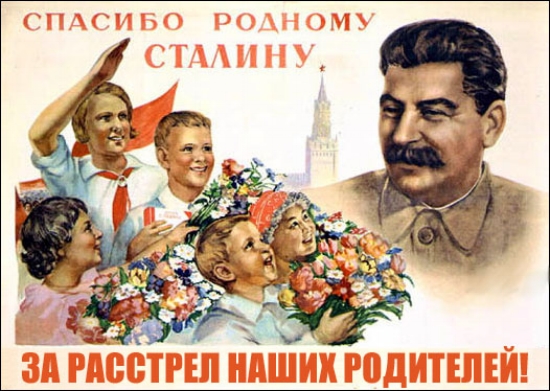
It is fair to assume that any volume with space for a discussion of the "crisis" in mid-20th-century Soviet children's theater is aimed at a specialist audience. That said, if the subject of "Children's World" (Yale University Press, 736 pages, $45), Oxford professor Catriona Kelly's immense, imaginative, and thoroughly researched new book — a history of child-rearing in Russia between the twilight of the tsars and the fall of Gorbachev — is somewhat academic, her prose style is not.

She writes clearly, keeps her use of pedagogic jargon to a minimum, and even leaves room for occasional flashes of dry, donnish humor. Describing the shabbily manufactured playthings of the inter-war years, she recounts how "smudgy and ungainly wooden figures passed for dolls, shaggy and savage-looking hairy lumps for toy animals." Meanwhile, locating a kindergarten on the top floor of an elevator-less Moscow building was evidence of the way that "the eccentricities of centralized planning made themselves felt."

High Table witticisms aside, this book's real value for the lay reader comes from the unusual perspective it offers on the wider Soviet experience, a perspective sharpened by its author's eye for the telling detail. Lenin's wife, Nadezhda Krupskaya, educationalist, scold, and harridan, was, Ms. Kelly records, opposed to birthday parties (they served no educational purpose and, horrors, emphasized a child's individuality). Opposed to birthday parties! That tells you almost everything you need to know about the elaborate fanaticism of the dreary Mrs. Lenin. It also says quite a bit about the cause she served: The Bolshevik revolution was designed not only to remake Russia, but to transform human nature itself.

Not all aspects of the approach taken by the fledgling Soviet bureaucracy to the treatment, education, and upbringing of children were, as Ms. Kelly shows, negative. That's not to claim (and she wouldn't) that the early period of communist rule was a time of educational liberalism — at least in any meaningful sense. Youngsters may have been given more opportunity to express themselves than in either the typical tsarist or Stalinist school, but only within strict ideological limits. What's more, many of the reforms of that era, and even some of the freedoms, must primarily be understood as devices to promote the state's assault on the family, an institution the Bolsheviks regarded with deep suspicion. Under the circumstances, it's easy to imagine that the return to social conservatism (and, with it, more regimented schools and a more conventionally organized curriculum) that accompanied Stalin's rise to supreme power in the 1930s was welcomed by many parents: One of this book's rare weaknesses is that we are never really told if that was indeed the case.

The inspiration for the change in direction under Stalin was, of course, neither philanthropic nor democratic. It merely reflected his willingness to use the appeal of both restored order and, for that matter, revived Russian nationalism (something that would have been taboo in Lenin's Kremlin) to shore up support for his dictatorship. In schools, as elsewhere, the revolution's egalitarianism — or, more accurately, collectivism — was overlaid with the cult of state and leader. The collective had been transformed into a congregation. Egalitarianism evolved into patriotic obligation as much as moral duty. The primary function of the educational system became the production of docile, loyal and subservient citizens. In some of the most interesting passages in her book, Ms. Kelly explains how this effort was orchestrated — and, often, how subtly. Its traces could be detected even in the way that children were portrayed in fiction, reportage, and textbooks. They were demoted from being the spunky, assertive heroes of revolutionary lore into altogether more passive creatures, forerunners of the dutiful and deferential Homo Sovieticus they were being molded to become.

Now, it could be argued, quite reasonably, that most schools in most countries try to churn out good citizens, however they define the term. Furthermore (as Ms. Kelly also acknowledges) what may seem like extreme regimentation to us would have appeared far less startling to the Western observer of, say, half a century ago — an epoch when schools on either side of the former Iron Curtain would have generally been much more disciplined than they are today.

Nevertheless, this book leaves no doubt that Soviet regimentation was indeed extreme. While Professor Kelly doesn't dwell on the cruelties of communist despotism, she never succumbs to the usual bien-pensant temptation of trying to find a supposed moral equivalence between East and West. This is demonstrated most strikingly, perhaps, by her decision to include (among a consistently well-chosen range of illustrations) a page of mug shots taken from the archives of a secret police home for "Family Members of Traitors to the Motherland." These particular family members cannot have been more than 9 or 10 years old. Their faces stare out, bewildered, haunted, trying to please, victims of a tyranny that could not, would not, forgive their genes.

In the end, ironically, the successes of Soviet education — standards rose, facilities were upgraded, some degree of independent thinking came to be acceptable — helped foment the widespread disillusion that contributed so much to the regime's eventual implosion. "In a pattern that comes up again and again in Soviet history," Ms. Kelly writes, "rising standards brought rising expectations." She might have noted the additional irony that those rising standards also taught the Soviet population that its expectations would never be met by the system in which they had been trained for so long, so hard, and so cynically to believe.

The rest is history.

Fixin' Nixon

Conrad Black: Richard M. Nixon - A Life in Full

The New Criterion, March 1, 2008

Nixon.jpg

Judging by the tone and the content, if not the length, of his epic, sprawling, and (on several levels) fascinating new biography of Richard Nixon, Conrad Black is not inclined to attempt much analysis of what, ultimately, made Tricky Dick tick.. There have, he snorts, “been many amateur psychoanalyses of Nixon, [but] none of any apparent validity or value.” None? When Black refers to the “psycho-media speculation” contained within press coverage of the various medical disasters that befell the former president in the immediate aftermath of his resignation, he doesn’t mean it as a term of approbation.

Now it is true that Nixon did have to put up with more than his fair share of long-distance psychoanalysis (so much so, in fact, that when David Greenberg wrote Nixon’s Shadow [2003], a valuable study of shifting perceptions of the thirty-seventh president, he devoted an entire chapter to “the psychobiographers”), and more than a fair share of that was nonsense, make-a-buck flimflam, or propaganda masquerading as science. At the same time, there can have been few presidents whose behavior did more to attract this sort of attention. Nobody should expect the occupants of the Oval Office to be regular folks, and few of them have been. Nevertheless, even when compared with other members of this often eccentric fraternity, there’s something about Nixon’s psyche that makes it stand out in its strangeness, its melancholy, its noir, and its mystery.

In part, of course, this reflects Nixon’s misfortune (for a man who achieved so much, Nixon was, as Black demonstrates, remarkably unlucky) to be living at a time when increasing (and frequently hostile) media scrutiny combined with the mid-century infatuation with psychiatry to ensure that almost no aspect of his career or character was not picked apart. If his predecessors had received similar treatment, Nixon would not have seemed quite so peculiar.

Nixon himself understood that he was something of a puzzle, and rather relished it. In President Nixon—Alone in the White House (2001), his intriguing account of the Nixon presidency, Richard Reeves recounts how Bob Dole once told Nixon “that he was destined to be misunderstood because he was too complicated a man to be totally understood.” Nixon had responded to that with enthusiasm, saying, “Aha! Now you’re getting somewhere.” Reeves then goes on to argue that Nixon “did not want to be understood. If other men thought he was unreadable, then they must think there was a great deal more inside him than just a powerful mind voyaging alone in anger and self-doubt.”

You can debate the second part of that diagnosis, but not the first: Nixon clearly did not want to be understood. That doesn’t mean, however, that a biographer should avoid trying to do so. Black doesn’t, but his efforts too often come across as more a matter of (deftly chosen) adjectives than anything more substantial. Even if one makes allowance for Black’s distaste for such analysis, his failure to deliver more of it diminishes the roundedness of his book, and is, in such a perceptive author, a disappointment. What his readers are offered instead is a biography where, with the notable exception of the canny, and feline, depiction of Kissinger, politics tend to be handled more convincingly than personality, a chronicle where the emphasis is on the event rather than the individual. Black, the author of a notable biography of FDR, is evidently a writer who prefers to focus his attention on the external, on great men, on momentous events and the grandest of themes. The rest, I’d guess, he sees as trivia, little more than gossip. Nixon would approve.

To read Black’s book is to be treated like the guest at a lavish dinner party presided over by an opinionated, brilliant, mordantly amusing, powerful, and loquacious host. As the port is passed round and the cigars light up, the host holds forth—for hours and hours (this work is easily over a thousand pages long) and hours. Glasses are drained and doubts drowned. Stories tumble out, anecdotes cascade. Portentous verdicts are cast: the opening to Communist China“was an imaginative diplomatic initiative of great geopolitical consequences … but to the extent it was sold, then and subsequently, as a combination of Columbian exploration, Bismarckian diplomacy, and Jesuitical missionary work, it was a confidence trick to reelect the president, pad the CVs of the two ex- plorer/diplomat/pilgrims, and garnish the post-governmental wallet of Kissinger.” Lapidary pronouncements are made: “Nixon’s trousers were slightly too short (often the case with Americans).” Widespread rumors are discounted: Nixon tells the author that “Edgar [Hoover] had a lot of files, but I had a lot of files too, and there was nothing in them about Edgar in a red dress.” Erudite digressions are explored: “Disraeli was rivaled only by Churchill as the greatest wit of all British prime ministers.” And insidery recollections are shared:

His office was another Nixonian classic. It was reached by walking through a large travel agency on the ground floor of a building on a suburban boulevard, then taking an elevator up two floors, opening a box with a bronze eagle on it, and announcing oneself on the telephone receiver within.

All this is filtered through, and often illuminated by, our host’s distinctive, distinctly orotund, use of language. He deploys a startling, imposing, and baroque phraseology. Black’s language is never dull, but it does teeter between the enlightening (the Democratic-led “assault on Nixon” had become “the rape of the executive”), the arch (“the influx of newcomers to California … tended to be conventional southerners well to the right politically of the egalitarian EPIC group, which had believed in collective economics and the absence of complexional distinctions”), the absurd (“malignant Nibelungen within the IRS”), the Agnew (“It was another herniating levitation of pandemic hypocrisy”), the sly (“Kissinger tried a fully gymnastic range of explanations”), and occasionally the bizarre (Jesse Jackson as “rutting panther”).

And, no, as enjoyable as the occasion may be, the magnate’s guests at this splendid feast will never entirely be able to shake off the sense that they are receiving a message de haut en bas. Black, Conrad Black, Lord Black of Crossharbour, was a newspaper mogul in the old style, a mover, a shaker, a macher, and it shows. Nixon gives “the annual Atlantic Richfield Dinner address in London in the autumn of 1992, and dazzle[s] the most eminent dinner audience that city could produce,” a dinner audience that included Lord Black, but not me, or in all probability, dear reader, you.

None of this is to detract from Black’s ability to spin a “rocking, socking” (to borrow a term Nixon used to describe his more vigorous campaigns) yarn. A thousand pages, maybe, but they don’t pall, and they are dauntingly thoroughly researched. The narrative is comprehensive, detailed, generally judicious and, in its careful assessment of Watergate, is closer to a plea in mitigation than an outright case for the defense. Overall, it’s almost impossible and largely pointless to highlight any particular topic covered in those thousand pages, but if I have to choose one, it would be the subtle and sympathetic way in which Black handles Nixon’s tortured and complex dealings with a truly masterful trickster, the enigmatic, cunning, and ruthless Eisenhower.

Where the book fails is in “The Transfiguration,” the book’s ambitiously titled final chapter. The picture Black paints is of the painstaking, carefully crafted step-by-step creation of the last “new Nixon”—a largely rehabilitated figure, a much consulted, highly respected foreign policy sage, the grandfatherly “most successful ex-president in the country’s history,” a figure whose fate was apparently beginning to prick what Black refers to with characteristic melodrama as the “Great American Puritanical Conscience.” This overstates matters. With the passing of the years, we have indeed witnessed the emergence of a fairer, more balanced assessment of Nixon (and this biography will help in that process). Some of the wilder accusations of the Watergate era have now been shown up for the ludicrous overreaction they always were, and as they have faded, so some of the luster has, at last, been restored to Nixon’s reputation.

At the same time, it remains unclear just how seriously people really took Nixon’s advice in those final years. Not so much, I reckon. As for the circles in which he was allegedly regarded as either martyred or, well, transfigured, they are, in their very different way, unlikely to have been much more representative than those of Pauline Kael; the New Yorker critic was supposedly unable to work out how Nixon could have won his 1972 landslide when “no one she knew” had voted for him (as it happens, she didn’t actually say that, but the story’s too good not to repeat). What works for Atlantic Richfield will not work so well in Atlantic City or, for that matter, anywhere else in America outside, perhaps, the Beltway and, certainly, Yorba Linda. The restoration of Nixon’s image is far less complete than Black would have us believe.

It may not be the most scientific of tests, but the fact that, as David Greenberg records, masks of Nixon were the top-selling Halloween costumes in October 2000, over a quarter of a century after his resignation, must mean something. In the American popular imagination Nixon will always be seen primarily as a villain, albeit one who can sometimes be played for laughs, or pathos, or both. There were traces of that in Frank Langella’s enthralling performance as the fallen president in the play Frost/Nixon, but Nixon fans may not find it entirely reassuring that Langella was previously best known as a notably effective Dracula.

It’s difficult not to think that, in writing the final chapter in the way he did, Black may have allowed himself to be swayed by his hopes for his own future. In a still-disputed verdict, Black was found guilty last year of defrauding Hollinger International, the company he used to lead, as well as of obstruction of justice. He is currently appealing. Under the circumstances, the idea that Nixon (who was a friend of Black’s) was able to pull off a comeback may well be a source of comfort, inspiration, and, Black might hope, precedent. The author himself has preferred to downplay the extent to which he identifies, or should be identified, with his subject, but choosing, while under indictment, to write a supportive (if still critical) life of a public figure whose most well-known line was that he was “not a crook” may be revealing and is indisputably provocative.

What Black cannot surely deny is that his understanding of what happened to Nixon has been colored by his own problems, whether it’s on the reluctance of Henry Kissinger (once an appointee of Black’s to the Hollinger International board, but now, it seems, somewhat estranged) to stand by the beleaguered Nixon or on the way that the use by prosecutors of plea bargains and whistleblowers has“encouraged a system of suborned or intimidated perjury, or at least spontaneous clarity of recollection, to move upwards in the inculpation of officials in any organization where wrongdoing is alleged.” As so often, Black makes a good, if over-elaborately expressed, point.

It’s worth adding that whatever else this volume reveals about Black’s state of mind, its completion under what in the introduction are referred to as “very distracting circumstances” is also a phenomenal demonstration of discipline, willpower, and self-control. Yet again, Nixon would approve.

The Lives of Others

Orlando Figes: The Whisperers

Moscow, February 1991 © Andrew Stuttaford

Moscow, February 1991 © Andrew Stuttaford

It has been the worse part of a century since the bloody birth and savage adolescence of the Soviet state, but the events of those years are still obscure — lost in time, muddled by propaganda, and treated, even now, as the stuff of spin. Those terrible decades remain camouflaged, murky and mysterious, glimpsed mainly in shadow or in tantalizing, elusive outline. They have been best illuminated not in nonfiction accounts, but in novels, short stories, and verse — by Solzhenitsyn’s zek grateful for his day “without a dark cloud,” by the deadpan of Shalamov’s spare, unsparing Kolyma Tales, by Ahkmatova’s torn, desperate, eloquent laments:

This was when the ones who smiled
Were the dead, glad to be at rest.
And like a useless appendage,
Leningrad Swung from its prisons.
And when, senseless from torment,
Regiments of convicts marched,
And the short songs of farewell
Were sung by locomotive whistles.
The stars of death stood above us
And innocent Russia writhed Under bloody boots
And under the tires of the Black Marias.


That’s not, of course, to deny that there have been some excellent histories of that era. One of the most notable in recent times was Orlando Figes’sPeople’s Tragedy: The Russian Revolution 1891–1924. Professor Figes, a British historian, is now extending that saga deeper into the nightmare that enveloped the Soviet Union with The Whisperers, a massive, sprawling, and unsettling book billed as a description of “private life in Stalin’s Russia.” In researching it, Figes has made extensive, and extraordinary, use of freshly opened family archives and a large number of personal interviews. As well he might. To understand the founding period of the USSR is tricky enough. To uncover the private lives, and thoughts, of those who lived through it, inhabitants of a society where reticence, conformity, and role-playing could be, even at home, matters of life and death is doubly difficult. Then there is, as Figes writes, this:

People with traumatic memories tend to block out parts of their own past. Their memory becomes fragmentary, organized by a series of disjointed episodes (such as the arrest of a parent or the moment of eviction from their home) rather than by a linear chronology. When they try to reconstruct the story of their life, particularly when their powers of recall are weakened by old age, such people tend to make up for the gaps in their own memory by drawing on what they have read, or what they have heard from others with experiences similar to theirs.

To accept this logic is to accept that seminal accounts of this period, such as The Gulag Archipelago or Eugenia Ginzburg’s Journey into the Whirlwind, have evolved from, respectively, works of collective history and individual recollection into the imagined, or partly imagined, autobiographies of countless victims of the terror. Figes himself claims that “many Gulag survivors insist that they witnessed scenes described in . . . Ginzburg, Solzhenitsyn, or Shalamov, that they recognize the guards or NKVD interrogators mentioned in these works . . . when documentation clearly shows that this could not be so.” Figes never specifies what he means by “many” (the numbers involved are probably, I suspect, less than that adjective implies), but there can be little doubt that the phenomenon is real. Complicating matters further, memories have been distorted not only by trauma and time, but also by wishful thinking:

People who returned from the labor camps . . . found consolation in the . . . idea that, as Gulag laborers, they too had made a contribution to the Soviet economy. Many of these people later looked back with enormous pride at the factories, dams, and cities they had built. This pride stemmed in part from their continued belief in the Soviet system and its ideology, despite the injustices they had been dealt, and in part, perhaps, from their need to find a larger meaning for their suffering.

Additionally, as Figes reminds us, it’s a viewpoint that finds an echo and reinforcement in the widely held opinion that victory in the “Great Patriotic War” can be seen as some sort of justification for the horrors of Stalinist rule.

These ideas are bizarre, but for large numbers of Russians they beat the alternative: facing up to just how much was lost, thrown away, or destroyed in pursuit of a delusion and in the name of a tyrant. This recourse to the comfort of denial and the ease of evasion is of more than academic interest. It helps explain the Putin government’s approach to the Communist past. A definitive reckoning with history, that long-overdue Soviet Nuremberg, is too daunting to contemplate, too potentially demoralizing for the nation as a whole, too incriminating for a still-compromised Kremlin establishment. Speaking last year in support of a new manual designed to help the teaching of Russian history in the country’s schools, Vladimir Putin conceded that aspects of the former dictatorship were “problematic.” Nevertheless, he went on to say that Russia could not allow “other states” to “impose a sense of guilt” upon it. The words he used reveal both unease about the past and, implicitly, a desire to reshape it.

If Figes’s analysis casts doubt on the reliability of some accounts of the Stalin years, those he has unearthed for the purposes of this book add fascinating detail to what we know, or think we know, of that epoch. Nevertheless, to view The Whisperers as a comprehensive survey of “private life in Stalin’s Russia” would be a mistake. For example, there is not a great deal about how it was to experience, and, where possible, endure, the camps and prisons that have come to symbolize the Stalinist order, an aspect of “private life” that Figes appears to believe lies mainly outside the scope of his chosen topic; I’m not so sure.

Meanwhile, at the other end of official approval there is, with one critical exception (the writer Konstantin Simonov, a man who was both too tough and too weak to avoid aligning himself with the system), less than might be expected about those who actively supported the regime or who, in one way or another, flourished under it. As for those “ordinary” Russians who managed, so far as they could, to keep out of the way of history, they feature relatively rarely. Readers looking for more on their lives would do better to turn to the evidence collected in Sheila Fitzpatrick’s Everyday Stalinism, and Stalinism as a Way of Life, edited by Lewis Siegelbaum and Andrei Sokolov.

What Figes offers is something less all-embracing. It is, primarily, a look at lives spent on the edge, neither at the heart of darkness nor untouched by it. The stories he recounts could not, by definition, fail to be interesting, but however skillfully he tries to weave them together (and Figes is a highly accomplished storyteller), the final picture is not as coherent as it might be. It’s difficult to avoid the suspicion that on this occasion this talented author’s reach was greater than his grasp.

As a result, the principal value to be derived from The Whisperers is almost incidental to what is supposed to be its main theme. In particular, the book’s earlier sections are a remarkable evocation of the sheer scale of the Bolshevik project. This was, in reality, nothing less than an attempt to remake man according to the dictates of what was, for all practical purposes, a millennial cult run by a lethal combination of fanatics, sadists, and opportunists. Nothing could be allowed to stand in the way of this task, and, with the resources of the state behind it, nothing was. In such a climate, the family, the most redoubtable bastion against totalitarianism, was bound to be a key target of the regime. And, as the narratives selected by Figes underline, that is what it became. The conflict, persecution, and occasional moments of stubborn resistance that ensued make up the grim, gripping, and horrific drama around which this book revolves.

But if the Bolsheviks proved effective at sweeping away much of what had preceded them, the ramshackle utopia with which they replaced it was a broken-backed wreck. Another striking aspect of the oral histories contained in this book is how often they share a subtext of astonishing material deprivation and hardship. If the Soviet Union was, as its supporters abroad liked to claim, a “new civilization,” it was one with large elements of the pre-modern about it.

And the physical squalor was, as Figes repeatedly demonstrates, matched by the moral; this, indeed, inspired the book’s title. The Stalin years, he writes, left the Russian language with “two words for a whisperer — one for somebody who whispers out of fear for being overheard . . . another for the person who informs or whispers behind people’s backs to the authorities.”

Mr. Putin, I think, would approve.

Spies Like Us

Joseph Weisberg:  An Ordinary Spy

The New York Sun, January 16, 2008

Weisberg.PNG

Mark Ruttenberg, the hero of "An Ordinary Spy" (Bloomsbury, 288 pages, $23.95), Joseph Weisberg's deft, sour, and clever new novel of espionage, bureaucracy, and disenchantment, is — it is true — a spy. But he's no James Bond.

Just read what happens, or doesn't, when he shows up for a celebration at the Russian embassy in the country to which, as a novice CIA agent, he has recently been posted. The poor fellow fails to make any real progress with the general who is the most important target in the room, he gets "tipsy" on two shots of vodka, and when, finally, he runs into a girl he has been trying to recruit, he is not only snubbed, but also floundering:

I had an impulse to rush after her, grab her arm, and spin her back around. But I didn't know what I'd do after that. Did I want to kiss her? I'd always found Daisy attractive … [b]ut I'd wanted to recruit her, not sleep with her.

Good God, man, get a grip! In cloak-and-dagger Valhalla, 007 is, undoubtedly, shaking his head (as well as that third martini). The contrast between his stumblebum spy and Ian Fleming's swashbuckling psychopath is, however, one that evidently amuses Mr. Weisberg. As fans of his debut novel, the lovely and beguiling "10th Grade" (2002), will recall, Mr. Weisberg is a sly, dryly funny writer, and even in the far more downbeat surroundings of his new book, he sporadically allows himself to unleash the occasional fleeting and stealthy joke at the expense of the luckless Ruttenberg and the frustrating, dull, drab routines that make his a life far removed from the spy game's glittering, legendary, and deceptive glamour.

But the disillusion, and not only Ruttenberg's, that permeates this book is generally closer to the "quiet desperation" of old Thoreau's loopy ravings than any profound ideological crisis; there is no hint of the majestic decay and mythic exhaustion that run through le Carré's best, possibly because Mr. Weisberg is describing an agent at the beginning of his career — an agent working, what's more, for a nation that, unlike George Smiley's Great Britain, is unwilling to accept eclipse, humiliation, and relegation to the second tier.

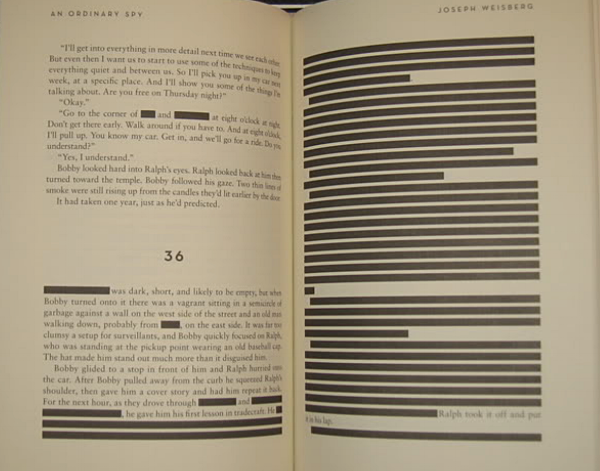
Nevertheless, there are moments when readers of "An Ordinary Spy" may worry that its portrait of the CIA as a cesspit of careerism, groupthink, and deadening conventionality may be a warning that the United States is poised to follow its transatlantic cousin into decline. The fact that the book's author formerly worked for the agency (he was employed there for three years and, by the time he quit, was in training to become a "case officer" much like Ruttenberg) only adds to the concern: Even if he never advanced very far in the intelligence service, Mr. Weisberg must have learned enough to offer up an accurate description of its workings. Whether that is, in fact, what he has done is a different question (I've no idea one way or another), but his writing feels authentic, an impression he tries to reinforce by displaying his text in a "redacted" format that is simultaneously bogus and real. As a former CIA man, he was indeed required to submit his manuscript to Langley's Publications Review Board, but ahead of doing so, he anticipated what the board might ban. Both the board's deletions and his own pre-emptive strikings-out are evidenced by the thick black lines that are the censor's impenetrable spoor, with no way to distinguish between them.

It's a device that sometimes irritates, but it helps transport outsiders into the secret world, at least as they might imagine it, a world made all the more mysterious, all the more opaque, and all the more disturbing by the fact that Mr. Weisberg's readers aren't actually informed where within it they have ended up: The country where the greater part of the drama unfolds is never disclosed. If I had to guess, it's located somewhere in Central Asia, the Middle East, or North Africa, but we're never told for sure.

And maybe that's the most effective device of all. The United States now finds itself enmeshed in a probably endless, possibly apocalyptic struggle against an adversary that knows no limits, no rules, and no borders, a conflict where every diplomatic outpost, but particularly those in countries of the type that Mr. Weisberg doesn't name, is a listening station, a sentry box, and perhaps more. In one form or another, such outposts have existed whenever there have been nations with interests to protect. They have been manned by guards, by observers, and by spies; patriots often, ideologues occasionally, but for the most part, ordinary men doing a job that is rarely extraordinary, and changes history even less.

And it is the story of two of these ordinary men, these ordinary spies, that Mr. Weisberg sets out so skillfully. There's no great message that underpins this novel, no intimations of coming American collapse: just a tale well told of lives that were meant to be spent watching, probing, plotting, guessing, and double-guessing, lives that, it turns out, go somewhat awry, lives that are illuminating only in their insignificance, and yet they are lives on which yours, and mine, may depend.

We Happy Two

Nicholas Wapshott: Ronald Reagan and Margaret Thatcher: A Political Marriage

The New York Sun, November 5, 2007

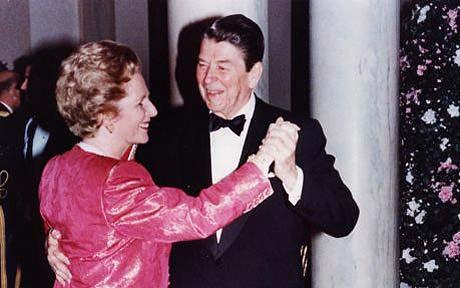
One of the more poignant features of the current competition among Republican presidential hopefuls, fiercely fighting for a chance to lose to Senator Clinton in 2008, has been a series of missions to Maggie. Mitt Romney saw Margaret Thatcher, the former British prime minister, late last year in Washington, D.C., while Fred Thompson and Rudy Giuliani were at pains to include meetings with the Iron Lady in the course of their recent trips to London. The political consequences of such encounters will, I'd guess, be minimal, but the briskly written, perceptive, and, ultimately, moving "Ronald Reagan and Margaret Thatcher: A Political Marriage" (Sentinel, 336 pages, $25.95), by The New York Sun's Nicholas Wapshott, helps explain why, nearly two decades after she was driven from office, a frail, elderly Englishwoman still merits visits from American politicians looking to win the most powerful job in the world.

As its title would suggest, the focus of this volume is the personal alliance of Reagan and Mrs. Thatcher, a combination that represented the most productive and historically significant incarnation of the Special Relationship between England and America since that astonishingly effective blend of Anglo-American genes better known as Sir Winston Churchill (whose mother was, of course, from Brooklyn). Well-buttressed by skillfully chosen quotations from letters and telephone records (some previously unpublished), the central story of "Ronald Reagan and Margaret Thatcher" is of a relationship between two politicians of conviction whose friendship, shared goals, and remarkable ability to reinforce and support each other through some very difficult times were key features of international politics in the 1980s — and, so it was to turn out, critical factors in the eventual collapse of the Soviet Union.

Given his subject matter, it's to be expected that Mr. Wapshott has somewhat less to say about the domestic scene on either side of the Atlantic. Yet, American readers may also find that this book makes an excellent, if brief, introduction to Mrs. Thatcher's career as a whole.

There is, however, one aspect of this account that may come as a surprise. These two leaders are often seen as a matching pair, but the tones of their respective biographies differ in some profound ways. To be sure, both came from hardscrabble backgrounds —Mrs. Thatcher's far less so than Reagan's — which they later romanticized, but there was always something sunnier about Reagan and the arc of his rise, something that owed a great deal to the difference in the two leaders' personalities, but also something to the myth and the reality of opportunity in the country in which the Gipper was, as he always knew, lucky enough to be born.

The latter is something Mrs. Thatcher, a lifelong admirer of America, would be presumably quick to admit. Yet, despite her fondness for America — and despite the usual claims from the usual suspects that she was "America's poodle" — this most patriotic of women always put Britain, and its national interests, first. At times, this led to disagreement with Reagan, and, as Mr. Wapshott shows, the conflict could become quite sharp. In the course of one spat, we read how Secretary of State Haig was quick to send Washington an ominous, and urgent, weather advisory: Mrs. Thatcher, he warned, had spoken to him with "unusual" vehemence, a terrifying image, given the intensity of even her usual vehemence. She would, Mr. Haig warned the president, be writing with "her concerns." Yikes.

On that particular occasion, the prime minister had been frustrated by the Reagan administration's attempt to extend the extraterritorial reach of American law. There was more serious trouble between this generally harmonious duo over equivocation within the White House in the run-up to the Falklands War, and, tellingly, horror and bewilderment in Downing Street at Reagan's repeatedly stated belief that it was possible to rid the planet of nuclear weapons. Mrs. Thatcher, correctly and characteristically, thought that this was hopelessly, dreamily, and dangerously "unrealistic." She could not, she explained, foresee a nuke-free future "because there have always been evil people in the world."

Fortunately, shrewd, easygoing "Ron" was usually prepared to listen to his shrewd, hectoring "Margaret." So much so, in fact, that in Mr. Wapshott's not unreasonable view, "Reagan's readiness to take Thatcher's advice ensured that her interventions in American policy [meant that] … she acted as an unofficial, unappointed, but wholly effective additional cabinet member." Under the circumstances, to argue, as Mr. Wapshott does, that Reagan and Mrs. Thatcher had entered into a "political marriage" is no exaggeration. What's more, this was not just any marriage: It was a good one. In a good marriage, the partners are able to disagree, and they continue to pay attention to each other, even when they are at odds. They never forget that, in the end, they are on the same side; the prime minister and the president never did. As Denis Thatcher — an often underrated figure, who is, refreshingly, given his due in this book — was early to recognize, his wife and Nancy's husband shared a vision, a close ideological bond made all the stronger by the fact that both had spent long years as representatives of a minority viewpoint not only within their own countries, but within their own parties.

But the vision thing was not, by itself, enough. The relationship between Reagan and Mrs. Thatcher was political, yes, but it was reinforced and strengthened by ever deepening personal affection. This is visible in much of the material chosen by Mr. Wapshott, and in particular in the charming anecdote with which he concludes his introduction:

One day an insistent call from Thatcher interrupted a meeting in the White House. Reagan mouthed to the assembled company that it was Thatcher, and they waited patiently as the president listened in silence to the force of nature on the other end of the line. Eventually, he placed his hand over the mouthpiece and gushed to everyone in the room, with a broad smile, "Isn't she wonderful."

She is. He was. They were.

The Godfather, Part I: Stalin as a Boy

Simon Sebag Montefiore: Young Stalin

The New York Sun, October 24, 2007

Young Stalin
Young Stalin

When Josef Stalin finally succumbed to the stroke he so richly deserved, a distraught Pablo Neruda mourned the death of this "giant. ... the noon, the maturity of man and the peoples." Such attitudes are, mercifully, now rare. Once known genially as "Uncle Joe," Stalin is now regularly reviled as a monster and a despot to be ranked with history's worst.

Despite this, it continues to be the case that, in the popular imagination, the name Stalin fails to deliver anything like the sense of horror conjured up by Hitler. The reasons include the persistence of leftist ideology, the fact of cultural distance, and the recollection of wartime alliance. There's something else, however, that should not be overlooked: Stalin the man is barely known, and what is thought to be known is that he was something of a plodder, a bureaucrat, the embodiment of Soviet drab: in other words, a bore. That's not a quality humanity expects from its enduring villains: Just ask Shakespeare, just ask Milton.

In our memory, Hitler is not only the incarnation of evil but also its most vivid caricature. By contrast, in public Stalin was managerial rather than charismatic, cleverly distanced from the cult of personality that enveloped him. He went to extraordinary lengths to ensure that little of substance was disclosed about his private life. His biography was transformed into pious myth, systematically drained of real interest. Those few people who knew the truth, or part of the truth, managed to survive only if they kept it to themselves.

While this culture of secrecy began to change during the Khrushchev era, the twists, turns and imperatives of Kremlin politics conspired to keep the real Stalin hidden from the historical record. After 1991 this was no longer so, but while the details of Stalin's crimes are now widely available, the individual who inspired them has remained a strangely elusive figure, still scarcely more than the "gray blur" of ancient Menshevik libel. If any historian can bring an end to this relative indifference it is Simon Sebag Montefiore. His bestselling "Stalin: The Court of the Red Tsar" (2003) was a masterful, magnificently readable, and immaculately researched account of the Soviet leader's long rule. As a portrait of ascendant malignance, it has rarely been equaled.

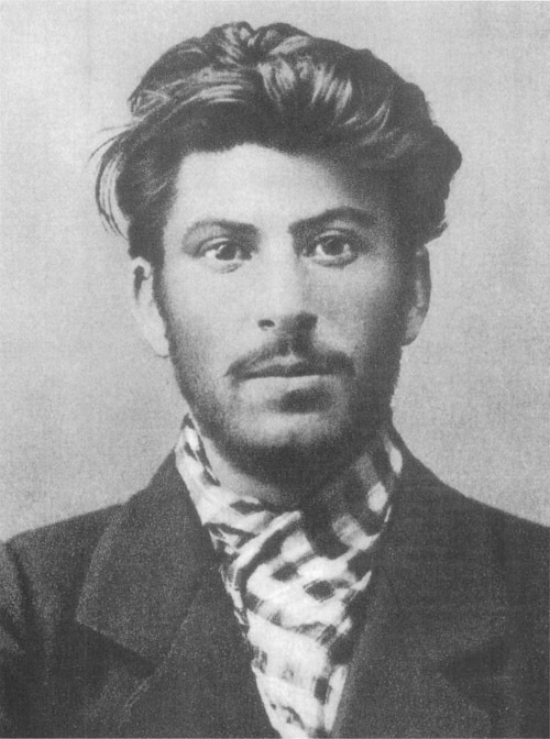
Mr. Sebag Montefiore's new book adds more depth to this picture. "Young Stalin" (Knopf, 460 pages, $30) is a kind of prequel to the earlier volume. It tells the story of the dictator's earlier years, from Georgian boyhood to his (often underrated) role as one of the key organizers of the Bolsheviks' Petrograd coup. Even told badly, this would be fascinating, but the ever-fluent Mr. Sebag Montefiore recounts it with brio, insight, and quite remarkable amounts of additional, never-before published information: I read it in one sitting. In some ways "Young Stalin" comes across as a picaresque, if grim, adventure, a bawdy chronicle of seminary school rebellion, banditry, bank robbery, revolutionary intrigue, jail, piracy, extortion, love, murder, romance, exile, scandal, and, even, hunting trips with the tribesmen of the remote arctic taiga. It doesn't hurt either that Mr. Sebag Montefiore's considerable literary gifts allow him to bring life back to the lost, exotic realm within which his saga unfolds, the brutal mass of contradictions that made up the Romanovs' ramshackle, doomed empire.

The fact that, for most of his youth, Stalin was a fairly marginal figure enables Mr. Sebag Montefiore to focus even more closely on the character of his subject. Young Stalin comes across, like so many psychopaths, as charming, manipulative, and highly intelligent. Musically gifted, an accomplished poet, and a relentless autodidact, he was no less of an intellectual than the revolutionaries he so liked to disdain. But, crucially, he was also what he was proud to call a praktik, a tough guy capable of doing the "black work" of revolution. Stalin was only in his early 20s when he moved to the oil port of Batumi. 'Within three months, the Rothschilds' refinery had mysteriously caught fire ... the town was flooded with Marxist pamphlets; informers were being murdered ... factory managers shot.'

There was, of course, far, far worse to come. For reasons we can only guess at, Stalin not only excelled at black work; he relished it. Part of the blame for this must lie with a dirt-poor childhood spent in a town notorious for its hard-edged and thuggish ethos, a childhood scarred also by violence that extended into the home itself: His father was an abusive drunk. Nobody could be trusted, not even family. Throw in Stalin's psychopathy, his egomania, his seminary-sharpened ability to detect heretics, and his experience of the way the tsarist secret police managed to suborn so many supposedly loyal comrades and we can detect the outlines of the nightmare to come. Vladimir Lenin certainly could, and he was thrilled. "That chef," he commented, "will cook up some spicy dishes." So he did. And with them he poisoned a culture, a nation, and a world.

Campbell's Soup

Alastair Campbell: The Blair Years - The Alastair Campbell Diaries

The New Criterion, October 1, 2007

It was Henry “Chips” Channon, one of the most entertaining, and informative, of Britain’s twentieth-century political diarists, who asked what was more “dull than a discreet diary.” Quite. Yet in some ways it is the discretion of the diaries just published by Alastair Campbell, Tony Blair’s former press secretary (and much, much more), which makes them so interesting. ]What’s in them, I suspect, matters far less than what’s been left out.

The published diaries amount to “only” 350,000 words out of the more than two million Campbell wrote between starting work for the then-opposition leader Blair in 1994 and resigning some nine years later. The full text is promised for another time, but for now Campbell has, he says, produced a volume focused on Blair himself: “I always intended … to be part of the mix that starts to shape the first draft of historical judgement around him.” Even the admission that this master media manipulator is now spinning history is itself spin. It comes across as candor, refreshing after a decade or so of, well, something else, but he’s only confessing to what everyone had already assumed.

Prior to publication, the diaries were also vetted to ensure that they did not breach secrecy laws or otherwise risk damaging the United Kingdom’s national interest. In addition, Campbell tells us “some conversations so private they will never see the light of day” have been excluded, as have a number of others which “the participants would have assumed to be confidential for some time.” All that’s reasonable enough, but it still leaves hundreds of thousands of words to account for.

Campbell cleverly highlights one area they cover with his claim that he has “no desire” to make the “hard” job of Prime Minister “harder for anyone … let alone Gordon [Brown],”phrasing of such marvelous insincerity that one can only applaud. In writing that, Campbell comes across as public-spirited, loyal, and admirably reticent. At the same time he makes it quite clear that he has the goods on Britain’s new leader, the dour, jealous Chancellor whose Gollum’s quest for the keys to Number 10 Downing Street helped create, define, undermine, and, eventually, destroy Blair’s premiership. Those expecting Campbell to have shed much light on the complex rivalry and partnership between the two men will be disappointed. Worse, bundling Brown offstage destroys any pretensions these diaries may have to offer a properly rounded picture of Blair’s leadership. It’s unfair to compare them to Hamlet without a prince, but less so to say they are an Othellowithout an Iago.

Whatever the sympathy Campbell may claim to feel for the latest holder of that “hard job” he writes so sanctimoniously about, he had none for Blair’s predecessor, the hapless John Major. Campbell was a prominent member of the coterie that orchestrated the destruction of a Conservative government that was nothing like as incompetent or as sleazy as it was smeared, caricatured, and, fatally, believed by the electorate to be. The Labour landslide of 1997 was the culmination of the most brilliant, and the most unscrupulous, election campaign the country had ever seen. Unfortunately, these diaries offer little fresh insight as to how this was done.

In one respect this doesn’t matter. The key element, the transformation of “old” Labour into “New,” has already been explained far better elsewhere. Campbell may have been at the center of these changes, but the portrait he paints of them is partial, admittedly incomplete, and clearly selective. Not for the first time, the reader is simply left to guess at what has been omitted, and why.

A significantly greater disappointment is how (relatively) little Campbell, a former journalist, has to say about the way that he enlisted Britain’s powerful media class as critical allies in the fight against the Major government. Yes, we are told a bit about the wooing of Rupert Murdoch, but there’s almost no discussion of the tactics for which Campbell became infamous, the brutally effective bullying, deception, and intimidation of the media rank and file. Neither does there appear to be much recognition that Campbell was pushing at an open door: a large percentage of the media class wanted the Tories out.

For Campbell to concede this would, I reckon, have meant accepting that his (undeniably enormous) contribution to the 1997 victory was slightly less than he believes. It would also make nonsense of his obsessive contempt, even hatred, for the media that gathered pace, rancid, vitriolic, and increasingly unbalanced, as the years went by. Given the position that Campbell held, this fury and this disdain are deeply disconcerting. What makes it even more remarkable is that media coverage of the Blair government was, as it happens, broadly supportive until the Iraq war.

The real problem, of course, was that any carping was unacceptable to those at the helm of the New Labour “project,” a project that was, at its core, both profoundly authoritarian and tinged with a gimcrack messianism. What must have made this criticism (such as it was) all the more galling was that it persisted despite the extraordinary efforts made to smother, bludgeon, blunt, and derail it. These went beyond the abuses of the opposition years (although those continued in office, unabated and, in these diaries, largely, and absurdly, unmentioned) and extended into the machinery of government itself. Within days of Labour’s win, and with the help of nifty legal and procedural footwork, Campbell was given the authority to tell civil servants what to do. The political impartiality of the civil service was one of the many British traditions to take a battering under the new regime. As one of Campbell’s shrewdest critics, the commentator Peter Oborne, has noted, “within two years of taking power … New Labour had sacked seventeen of the nineteen information chiefs in Whitehall, a staggeringly high turnover.” Draw your own conclusions. In fact, you’ll have to: Campbell has tellingly little to say on the subject.

None of this is to argue that there’s nothing in these diaries worth reading. On the contrary. Neither press secretary nor any of his later, grander titles do full justice to Campbell’s role. He was not only Blair’s principal propagandist and most feared enforcer, but also a key policy adviser, Bobby, in some respects, to Tony’s Jack. He was, therefore, a diarist in the right place at the right time. Whether it’s on Northern Ireland, the Balkans, the Iraq crises, the response to 9/11, or the neatly drawn descriptions of British and international statesmen from Blair to Clinton to Yeltsin to George W. Bush, there’s plenty here to digest, even if not much of it is very new.

Finally, and try as hard as he might to avoid it, by the end of these diaries its author has revealed something of himself, above all that he (a former alcoholic with a history of depressive illness) is a man driven, even if it’s never exactly clear by what. There are the shreds of ancient socialist orthodoxy (a fanatical attachment to Britain’s failed state school system), and, almost certainly related to that, there is the class resentment left over from his misfit youth (which in turn dovetails neatly into the more iconoclastic aspects of the New Labour “modernization” of the United Kingdom). Then there is the delight—wild, baroque, and ecstatic—that he takes in hating those on his enemies list. The poisonous media, the wretched Tories, a Labour minister or two, whoever; it’s the hating that’s the thing. Or perhaps the secret lay in the exercise, and the narcotic, of power. In any event, whatever it was that drove Campbell, Blair saw that he could use it, and he did.

And as to what that says about Tony Blair, once again you’ll have to draw your own conclusions.

Hearts of Darkness

Robert Gellately: Lenin, Stalin and Hitler : The Age of Social Catastrophe

The New York Sun, September, 19, 2007

soviet_german_brest_1939.jpg

In the course of humanity's long, violent history, there was one brief, happy interlude, a decade or so on either side of 1900, when those fortunate enough to live in the more advanced parts of the planet were able to persuade themselves that barbarism had been banished from their culture, never to return. To those luckiest of men, the last true optimists, the barriers — psychological, political, and technological — that separated them from the savagery of the past were as reassuringly robust as the stout, solid bourgeois architecture then transforming their cities.

This self-satisfaction we now know was pure hubris, a lethal, beautiful, boastful illusion. Confronted in 1914 with the reality of industrialized warfare, that illusion died. As the war progressed, if one can use that word, the social and political restraints keeping man's atavistic ferocity at bay began to fray all across Europe, and nowhere more dangerously than in the Russian Empire. By 1917, this most backward, and therefore most fragile, of the continent's great powers was a society on the precipice. It only took the slightest of shoves, in the form of the Bolsheviks' opportunistic and initially bloodless coup, to topple it over into the abyss. The consequences were worldwide, appalling, and destructive on a scale that had never before been seen.

When in the subtitle of his new book, "Lenin, Stalin, and Hitler" (Knopf, 698 pages, $35), Professor Robert Gellately refers to an age of "social catastrophe," it is no exaggeration. But his use of that phrase also makes a more subtle point. The devastation of the era he describes (roughly 1914–45) went far beyond the physical, far beyond rubble, ruin, and mass graves. The very notion of society itself was torn apart. As for man's idea of himself, it had been changed forever, and not, in any sense, for the better. Man could now be certain that the barbarian within him would always be there, however advanced the civilization — tempting, terrifying and, given an opening, unstoppable.

While Mr. Gellately explicitly narrows the focus of his book to Lenin, Stalin, and Hitler, its title still promises more than he manages to deliver. Rather than devoting himself to the wider implications of what he is discussing, Professor Gellately offers a conventional history within a largely conventional framework. For those in need of a serious, scholarly introduction to the subject, it's an excellent overview of Nazi and Soviet totalitarianism, but despite its great length — with footnotes the book runs to nearly 700 pages — an overview is all that it is. There's not a lot that's new about either the information or the arguments it contains.

Mr. Gellately worries that one aspect of his book may "disturb" some readers — the suggestion that Lenin was a monster to be ranked alongside Stalin and Hitler. As he himself might acknowledge, however, this insight is not particularly original: Historians Dmitri Volkogonov and Richard Pipes (to name but two he cites) have already covered much of this ground, and done so highly effectively. Nevertheless, despite their efforts and those of quite a few others, the real nature of Lenin's ideology remains poorly understood. In repeating the message that the story of Bolshevism is not one of good intentions gone awry, but of an evil that worked all too well, Professor Gellately is performing a very useful public service.

That the Bolsheviks were able to do what they did owed a great deal to the collapse not only of the old order, but of order itself. The rise of the Nazis was made possible by almost exactly the opposite, the desperation of a nation willing to try something, anything, to hang on to what it could of its former way of life. If that meant throwing democracy — and with it, the Jews — to the wolves, too bad.

Hitler's mandate was no blank check, however. As Professor Gellately explains in some of the most intriguing sections of his book, the prewar Third Reich was, in marked contrast with its Soviet rival, a "dictatorship by consent." Compared with what was going on in the USSR at the same time, the use of coercion was limited, largely predictable, and rarely truly murderous. The awful exception, of course, was the ever more hideous persecution of the Jews, but prior to 1939, even that was incremental, a slow-motion pogrom both camouflaged and reinforced by the language of bureaucracy and the law.

That Hitler found it necessary to proceed in this way was a paradox of his earliest years in power. The restoration of social calm was key to his popularity but difficult to reconcile with his long-term agenda of military adventure, unending conquest and relentless genocide. With the invasion of Poland, that paradox became an irrelevance, but neither the frenzy of war nor the intoxication of a victorious blitzkrieg, can fully explain the speed with which so many of the Wehrmacht's "ordinary men" either descended into barbarism or demonstrated their willingness to act as its accomplices. In some cases, it was merely a matter of days. That they did so was a sign that pointed the way to Auschwitz. It also suggested that, even before the tanks had begun to roll, the German people had already moved far, far down that most terrible of roads.

Disappointingly, Professor Gellately never fully succeeds in explaining what it took to make this possible. He takes refuge instead in the observation that, by the time World War II had concluded, it had "raised questions about the very meaning and future of Western civilization." That is right, so far as it goes, but it's too simplistic. The more troubling questions posed by that war are not limited to any one civilization: They concern the essential nature of mankind itself. And there's no comfort to be found in the answer, none at all.

In the Land Of Mammon

Robert Frank: Richistan : A Journey Through the American Wealth Boom and the Lives of the New Rich

The New York Sun, August 15, 2007

Despite unprecedented social, political, economic, and cultural upheaval, there is, still, just a part of this country's vision of itself that is forever Bedford Falls. That was an idea of nation as extended community, diverse, but not too diverse, a land of opportunity, certainly, but one where no one was left too far behind, or ended up too far ahead. There was Potter, but he was an outsider, the moneyed exception that proved the modest rule, the rule that was also an ideal, of an America where everyone was in the same boat.

Robert Frank, the author of the entertaining, provocative, and dryly amusing "Richistan" (Crown, 278 pages, $24.95), was prompted to write his book by the realization that this was, quite literally, no longer the case. As the writer of the Wall Street Journal's "Wealth Report" (the existence of which tells you something about the times in which we live), his beat took him each year to Fort Lauderdale's International Boat Show, a "weeklong celebration of boats, beaches, and billionaires." There he met a Texas yachter who told him that "the American rich seemed to be floating off to their own country," a country that Mr. Frank has dubbed Richistan.

In Mr. Frank's view, today's new rich are busy creating their own virtual, self-contained nation, complete with their "own healthcare system (concierge doctors), travel network (Net Jets, destination clubs), separate economy (double-digit income gains and double-digit inflation), and language...They didn't just hire gardening crews; they hired personal arborists". Yes, there's a touch of hype in that description (if any journalist is going to make it to Richistan, he's got to sell a lot of books), and a touch of the nothing new, too: The very rich have always been different. It's just how that's changed.

That said, there's no doubt that Mr. Frank is on to something. The key, as he explains, is the remarkable growth in the numbers of America's rich. In 1995 there were nearly 4 million households with a net worth of more than $1 million. By 2004, that total had increased to more than 9 million (both tallies are based on 2004 dollars). Now, as Dr. Evil discovered, and as Mr. Frank concedes, $1 million is not what it was. It's not a bad start though.

It's not just that there are more rich folk around. They are also richer, much richer, than they used to be. By 2004, more than 100,000 households enjoyed a net worth of more than $25 million. If you feel like a loser reading those words, it's no better writing them, believe me. Be that as it may, this wild, if uneven, accumulation of wealth is basically a sign of good times, a largely benign side effect of capitalism on the move. Mr. Frank clearly understands this. His description of the wonders, extravagances, and peculiarities of Richistan is essentially travelogue and guidebook, neither indictment nor paean, and despite the mega-yachts, megamansions, and the $899 pair of children's shoes (crocodile-skin Sperry Top-Siders, since you ask), there is no suggestion of Robin Leach.

Mr. Frank may poke some fun, but for the most part he takes Richistan as he finds it. Yet, for all that, it's possible to discern some faint hints of unease. The source of this, I suspect, is partly aesthetic and partly (for want of a better word) patriotic. So much ostentation may not only be in poor taste, but is it also a betrayal of older, more austere American values, a rejection of Bedford Falls?

Above all, it's likely to be the unevenness that worries Mr. Frank the most, an anxiety betrayed by the statistics of rising inequality that occasionally surface in his pages. Not all of these are breaking news: For example, most of the shift in the concentration of wealth in favor of the top 1% took place two decades or so ago. Nevertheless, the fact that the share of national income now held by the top 1% of earners is at a postwar peak is food for thought, especially at a time when the median income of American households is under severe pressure.

The rich may be pulling away from the rest of the population, but "Richistan" shows how the richest are pulling away from those who are just by-their-fingertips rich or, horrors, merely affluent. Mr. Frank explains how this acts as both carrot and stick to the toilers of Lower Richistan (net worths of $1 million to $10,000,000 million as they try to buy, as well as work, their ways to higher status. In 2004, some 20% of these treadmillers spent more than they earned. That's neither sustainable economically, nor is it a recipe for happiness. Where it may lead is major political change.

Politics is, frustratingly, a topic that is largely beyond the scope of this book. To be sure, Mr. Frank makes the obligatory reference to the swerves to the left that followed both the Gilded Age and the Roaring '20s, but there's little discussion of the extent to which the very existence of Richistan (not to forget the threat it represents to social cohesion) may help history repeat itself. Nor does he examine what may be Richistan's most significant, if somewhat perverse, contribution to this country's political development, one that may follow from the increase in inequality within Richistan itself, and, more dangerously still, its approaches. As that trend continues, there's a clear risk that some of society's best, brightest, and most influential will be left feeling that they have missed not only the yacht, but also the boat.

1688 and All That

Michael Barone: Our First Revolution: The Remarkable British Upheaval That Inspired America's Founding Fathers

National Review, July 30, 2007

Clio, that most elusive of Muses, can be glimpsed, but never caught. The interpretation of history is forever in flux, as much reflection of the present as window on the past. There are few better examples of this than England’s turbulent 17th century. Depending on whom you asked, and when, its conflicts were painful, but ultimately progressive; painful, but ultimately reactionary; or painful, but ultimately pointless. The natural response to the publication of yet another interpretation of one of the pivotal events of that century, the “Glorious Revolution” of 1688, is to ask, what now?

According to Michael Barone, the answer is star-spangled Macaulay, classic Whig history with a distinctly American accent. The Glorious Revolution was, he writes, America’s “first revolution,” “a reference point” and “a glowing example” for the American Founders. The ghosts of P. T. Barnum and Betsy Ross will be unable to resist a smile at those words. To describe England’s last revolution, a characteristic mix of royal infighting and aristocratic maneuver, as American is, in its endearing exaggeration and patriotic pride, more typically American than anything that actually happened in 1688. That said, Barone’s broader point holds true, but with one important caveat. The Founders were inspired by the Glorious Revolution, but less by its reality than by its myth. The same may well be true of its latest chronicler.

That hasn’t stopped him from writing an excellent, well-researched overview of the prelude, consummation, and consequences of the revolution that is his topic and his totem, the revolution that saw off James II, England’s last Catholic king, and with him the last serious chance that the nation would succumb to absolute monarchy. Our First Revolution is no small achievement. The history of England in the 1680s is one of whirligig allegiance, helter-skelter intrigue, and perilous diplomatic gamesmanship. To retell it, as Barone does, in a manner that’s both informative and easily accessible to the general reader, demonstrates a way with a story that would be beneath the dignity, and beyond the skills, of many academic historians.

That’s not to say that the book is without its flaws. The most significant is, somehow, also very American. Barone is a product of a country that is, in a number of respects, history’s happiest accident, so it’s perhaps not surprising that, despite some hints to this effect, he cannot quite bring himself to admit the extent to which the Glorious Revolution was the product, not of optimism, but of pessimism. Its inspiration lay not in the quest for freedom, but in the fear of a return to the disorder of the six or so preceding decades, decades that had seen an intellectual, moral, and political unraveling so profound that it led to warfare, regicide, and dictatorship. When Hobbes, the finest philosopher of the age, wrote that the absence of a common, recognized authority would mean war (“and such a war as is of every man against every man”), he was writing from experience: Barone notes that the English civil war claimed perhaps 190,000 lives, as a percentage of the population more than that accounted for by the Kaiser or Hitler. In Scotland and Ireland the toll was still worse.

Despite that, Barone feels able to dismiss the upheavals of civil war and republican government as something of an irrelevance. This is to ignore the fact that the anxieties that fueled the Glorious Revolution were a direct response to the savage lessons of those earlier years. And so was the willingness to overthrow a monarch, or even monarchy itself, if that’s what it took to keep the peace.

Those lessons began in the 1620s. On one side the Stuarts, James I and, more fatefully, his son Charles I, were trying to create a modern centralized despotism of the type rapidly gaining ground across the Channel. On the other were England’s merchant class and much of its gentry, jealous of privileges and liberties dating back to the Middle Ages. Charles tried to trump these ancient traditions with superstition: the belief that a king ruled by divine right. But a century into the Reformation, the Almighty was not what He once had been. Kings might rely on God, but did God rely on kings? And if God did not rely on kings, what did He have to say about the rest of the social order?

In their attempt to find out, the English rejected Charles, they rejected the egalitarianism of the mid-century radicals, they rejected Puritan excess, they rejected Cromwell’s Commonwealth, and they rejected military rule. In 1660 they returned, exhausted, to monarchy and Charles II, a cheery cynic who understood that faute de mieux was as good a reason as any to be accepted as king. It’s a measure of his political skills that Charles (who had no legitimate children) was able to ensure that his brother James, a devout Catholic, would succeed him. It’s a measure of his perceptiveness that he thought that his dour and stubborn sibling would hold the job for less than four years. In the event, James II, who came to the throne in 1685 dreaming of Catholic restoration and hog-tied parliaments, hung on for just over 46 months. By early 1689, he had been replaced by William of Orange, a safely Protestant Dutch prince, and William’s wife, Mary, who was not only a safely Protestant English princess, but James’s eldest daughter, a Goneril all his own.

It may fit a little awkwardly with his overall thesis of 1688 as a signpost pointing to the liberties of an independent America, but Barone doesn’t dodge the degree to which religious intolerance was responsible for James’s downfall. The U.S. Constitution may have provided for absolute religious freedom, but its architects lived in a more safely secular environment. Wary survivors in an age of religious fury, the revolutionaries of 1688 enjoyed no such luxury. Religion needed to be tamed, fenced-in, watched. They feared that toleration of some expressions of religious belief might come at too high a price. In that sense, the First Amendment would, to them, have looked like a suicide pact. A militant Catholicism was not only resurgent on the European mainland, but had become the ideological enabler of despotism. Not to resist James’s attempts to foster a Catholic revival would have been madness. When the king demonstrated that he was prepared to use the tools of absolutism to get his way, he merely proved his opposition’s point.

Barone faces a similar problem in discussing the revolution’s immediate aftermath. The passages in which he describes it come across as a little confused, incoherent, and ambiguous. There’s a good reason for that: These events were confused, incoherent, and ambiguous. Barone’s difficulty is that he needs them to form a clear path to Philadelphia. What he gets instead is a muddle. What he misses is that that was the idea.

William’s motive in coming over from the Netherlands to grab the crown was partly dynastic, but primarily strategic. He wanted to lock England into an alliance against Louis XIV. The rest, so far as he was concerned, was conversation. That left those who supported him with the job of securing social peace and, while they were at it, their own privileges. With despotism discredited (its very arbitrariness made it the antithesis of order), and a republic looking too tricky to contemplate, they tried to dream up an answer to the question of where sovereignty really lay. This led to some fine-sounding declarations ambiguous enough to satisfy just about every faction. These efforts were then supplemented by years of piecemeal legislation — ad hoc, gradualist (after an initial flurry), and pragmatic — that helped shape a new constitution without ever defining it. The most satisfactory answer, it was discovered, to the big questions, was silence. It’s difficult to think of anything less like the spirit of Philadelphia in 1787.

To find a connection it’s necessary (and a touch anachronistic) to treat the Glorious Revolution settlement as a whole, but that’s what the American Founders seem to have done. To them these laws (which included the promotion, ironically, of greater religious toleration, the enactment of a bill of rights that was an obvious predecessor of its American namesake, and provisions designed to promote the independence of Parliament) were a precedent. They were both a fumbling codification and, in their apparent success, a definitive proof of the notion that sovereignty was too potent to be entrusted to one person or, indeed, one institution. Look at this another way, however, and liberty becomes a practical means, not an idealistic end — a crucial distinction largely invisible to those who used the romantic myth of a Patrick Henry–style 1688 as a rallying cry for the English in America nearly a century later.

Nevertheless, the fact that this dispersal of sovereignty was accomplished by bestowing rights and freedoms upon a significant portion of the population was not a myth. As Barone convincingly shows, the fragmentation of the old order left a space for the growth of free enterprise and freer enquiry, a space in which the ideas that became America could flourish, a space that was, essentially, an accident, the happiest of accidents.