Tower of Power

Norbert Lynton: Tatlin's Tower - Monument to Revolution

The Weekly Standard: June 14, 2010
Imagine that a critic had written a book centered on Olympia and Triumph of the Will without emphasizing the fact, however well known, that the Nazi ideology to which the director of those movies had dedicated her talent had led to the slaughter of millions. You can’t. It would be inconceivable. Few can deny that, at their best (if that’s the adjective), Leni Riefenstahl’s films were works of genius, but their hideous context should never be ignored. And generally it isn’t.

The artists who promoted Soviet communism are given an easier ride. To take perhaps the most prominent, Sergei Eisenstein is remembered today as a stylistically revolutionary filmmaker. Fair enough. But who mentions that he, no less than Riefenstahl, was a flack for totalitarian savagery? And Eisenstein was not alone. As the Bolsheviks hacked their millennial way to a radiant future built on slaughter, medieval despotism, and the annihilation of the society that had preceded them, they were cheered on by some of the brightest creative spirits of their era, by Malevich, by Rodchenko, by Mayakovsky, by—well, take your pick.

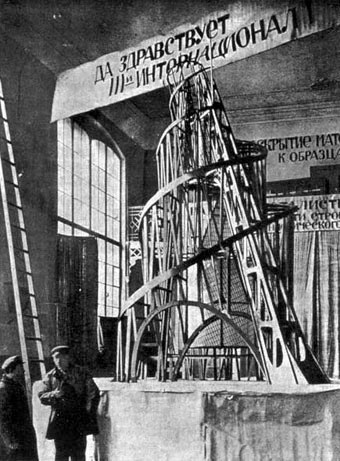
Amongst those who cheered the loudest was Vladimir Tatlin (1885-1953), designer of the immense (perhaps 1,200 feet tall) unbuilt structure that became a defining emblem of revolutionary élan. He is the subject of this fascinating, if in one sense tellingly uncritical, study completed by the noted British art historian Norbert Lynton shortly before his death in 2007. Scholarly, densely argued, and rendered more opaque still by the gaps in Tatlin’s foggy biography, the book is wonderfully illustrated but not the easiest of reads. That said, persevere for long enough and you will be left mourning the brilliant culture of Russia’s imperial twilight, struck by the strangeness of what replaced it, and appalled by the moral vacuum at the heart of Lynton’s book.

Already deservedly (as Lynton demonstrates) famous as one of Russia’s leading modern artists, Tatlin began planning his building, the “tower” of Lynton’s title, in early 1919, shortly after taking a senior position in the ministry run by Anatoly Lunacharsky, Lenin’s commissar for enlightenment. The tower was to be a monument to the Third International (the Comintern) and thus to global revolution. As such, it would have been a celebration of massacres past, present, and to come. Dreamt up as a wonder of the modern world, Tatlin’s tower was to be the lighthouse of some nightmare Pharos, a beacon illuminating only the way to destruction.

None of this seems to have bothered Lynton overmuch. He confines himself to anodyne remarks about the tower’s role as an incitement to revolution without worrying too much what that revolution might mean in practice, a peculiar omission from a man (a Jewish boy in Hitler’s Reich) who had himself been forced to flee the rage of a state.

On the other hand, one of the strengths of this book is the manner in which Lynton links Tatlin’s plans for his tower to the curious (and now largely forgotten) fusion of mysticism and futurism (Lynton’s suggestion that the tower also reflects Christian imagery is less convincing) that could be found in the thinking of some sections of the pro-Bolshevik intelligentsia: His “temple” would, Tatlin gushed, be the precursor of a future “temple of the worlds—which would .  .  . move in infinite space,” emancipating “all the world from bondage to gravity” and paving the way for the “expression .  .  . of mutual love of all the generations,” of a mankind that must become “sky-mechanics and sky-physicists.”

A marginally less overexcited Nikolai Punin, future lover, companion, and heartbreaker of the poetess Anna Akhmatova, and a man ultimately destined to perish in the Gulag, explained how the tower, home to the coming world government, would be an “organic synthesis of architecture, sculpture, and painting.” It was to encompass three large halls, one “for legislative purposes,” shaped like a cube, that rotated annually, one pyramidal (for bureaucrats) that rotated monthly, and one cylindrical, dedicated to “disseminating information to the world proletariat,” which was meant to rotate daily. These halls would be enveloped within a double helix framework that hinted at the ziggurats of antiquity and myth. Location, too, was crucial. The idea was that this vast, asymmetrical edifice of steel, iron, and glass would squat in the middle of the former St. Petersburg. Taunting and overshadowing the elegance and grandeur of the old imperial capital that had itself once represented a new direction for Russia, it would stand as a rebuke to history and homage to the future.

tatlin2.png

Spiraled, pointing, angled, closer in appearance to a giant telescope or piece of artillery than to a building, Tatlin’s work conveyed both an impression of coiled power and energy unleashed. This was an architecture parlante intended to roar, a stupendous symbol of the new age. Statues of men on horseback were, like the aristocrats—the individuals—they depicted, to be consigned to the past. Tatlin’s tower would be utilitarian, a manifestation of the collective will, a “living machine” made of industrial materials yet somehow organic, functional, more-than-modern and, like the revolution, in perpetual motion.

Of course, it was never built. The resources were not there; the political will was not there (those running the new Soviet state preferred their monuments representational, solid, and stolid); and the technology was not there. Failing to take account of the last was a rare lapse for Tatlin, the son of an engineer and a man who took pride in his technical savvy, unless the tower was (as plausibly claimed by John Milner in the fine monograph on Tatlin he wrote in the 1980s) not so much impractical as explicitly utopian from the get-go, a manifesto rather than a blueprint.

Tatlin did manage to build at least three large-scale models of his tower, photographs of which are included in Lynton’s book. The first stood around 15 feet high above a circular base (in which someone could crouch, turning the cranks that moved the tower’s halls); the second, slightly smaller and decidedly more elegant, was exhibited in 1925 in Paris, home of the Eiffel Tower that had partly inspired it; and the third, stripped down and simplified, made an appearance, like some futurist fetish, at a ceremonial parade in Leningrad the same year. All three have since vanished, long since lost like so much else in the Soviet junkyard, but Tatlin’s original vision itself endured in the leftist imagination as a statement of the what-could-be and, later, the what-could-have-been. Artistically, its status as one of the 20th century’s most influential icons of architecture unbound remains undiminished.

tatlin3.jpg

As for Tatlin, his career went into a decline in the culturally more conventional years of full Stalinism, neither out of favor, nor quite in. His became a life of smaller-scale projects, from furniture design, to stage sets, to art more traditional than anything he had produced for decades. What was left of his old utopian obsessions revealed itself in prolonged attempts to perfect the Letatlin, his final challenge to “the bondage of gravity.” A man-powered flying machine of remarkable beauty—oddly, no images of this craft are included in Lynton’s book—it was inspired by the work of Leonardo da Vinci, another artist uncomfortable with strict divisions between the aesthetic and the practical, in the same field. It never flew.

Tatlinplane.jpg

Towards the end, Lynton includes a picture of an older Tatlin. He looks sad, beaten, crushed, an Icarus who had fallen to earth without ever reaching the heavens.
King & the Commissars

David King: Red Star over Russia

The New Criterion, March 1, 2010

Yezhov and stalin.jpg

To be asked to pick the best book that you have read in the past year is usually an invitation to equivocation, but that was not the case on one evening in the late 1990s when my interrogator—and that’s the word—was the Baroness Thatcher of Kesteven. “Well,” I replied, “The Commissar Vanishes.”

She hadn’t heard of it. Good. Liked the book’s concept. Better. Told an aide to write down the title. Better still. Didn’t know that it was written by an unreconstructed lefty. Ah, just as well.

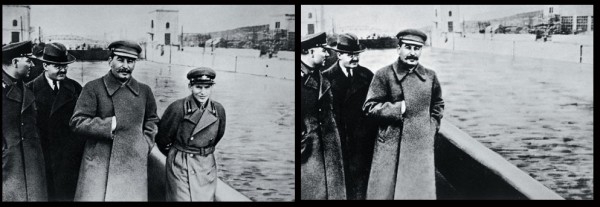
David King’s The Commissar Vanishes: The Falsification of Photographs and Art in Stalin’s Russia (1997) remains one of the finest and most unusual pieces of Sovietology ever produced. To start with, it is based on photographs, posters, and illustrations drawn from its author’s massive 250,000-piece collection of images relating to Russia, the former Soviet Union and “Communist movements everywhere,” a unique resource that King has been assembling for decades. This reddest of hoards is a monument to King’s political leanings—he has published more than is entirely healthy on the topic of Leon Trotsky—but, thanks to its range, it has ended up as something far grander than that. The same might be said of The Commissar Vanishes. Inspired by the way in which the Soviets wrote Trotsky out of history, King’s command of his material transforms what might have been a mildly interesting Fourth Internationalist lament into a startlingly original evisceration of the Stalinist method.

Specifically, the book revolves around the way that images and, in particular, photographs were repeatedly chopped, changed, juggled, retouched, altered, and manipulated by a regime determined to remove inconvenient traces of inconvenient people from the historical record. Execution was not enough. The lives that had gone before that concluding bullet in the skull had to be retrospectively reshaped to fit Stalin’s Procrustean view of how the Soviet story should be told.

It was a campaign that recognized no distinction between public and private, and it was a campaign that nobody could safely ignore. King highlights the precision with which the famous artist and photographer Alexander Rodchenko inked out the faces of the purged from his personal copy of a book he had himself produced. Blackly blank-faced, these remnants, these apparitions, these Banquos at the apparatchiks’ dangerous feast, linger on the page alongside those still in favor, a warning, a reproach, an act of insurance. As the countless scribblings over, hacked-out heads, and other precautionary mutilations of books from this era bear witness, such ad hoc self-censorship was commonplace, if too crude and small-scale for the needs of a modern totalitarian state. To fill that gap, specialists emerged, dedicated to the wholesale reengineering of history into a malleable, constantly reedited narrative.

But it was not enough to lie about the past. Those lies had to work. They had to be buttressed and reinforced. They had to be illustrated. In one characteristic sequence, King shows how Trotsky, the commissar of King’s tellingly elegiac title, was among those subsequently “vanished” from a frequently published photograph of the second anniversary of the October revolution. With tinkering such as this, history could be continuously (the party line was always changing) reshaped, reinvented, and manufactured in a process only occasionally—and incompletely—redeemed by the archetypically Soviet slovenliness of those who sliced and diced their way through the past but sometimes allowed the faintest suggestion of the truth to slip through. In another photograph of those same celebrations republished in 1987, most of Trotsky has been edited out, but his elbow survives, unexplained, unidentified, somebody’s elbow, nobody’s elbow.

As an explanation of history through its manipulation, The Commissar Vanishes is a technical tour de force. As an examination of the wider pathologies of the Stalinist state it is a masterpiece. It was followed by Ordinary Citizens: The Victims of Stalin (2003), a collection of over a hundred mugshots from the NKVD/KGB archives, glimpses of the doomed hours or days from their annihilation.

Compared with the narrower focus of those two earlier works, Red Star over Russia is an unruly sprawling epic, “a fast-forward visual history of the Soviet Union” from 1917 until just after the death of Stalin. Based again on King’s archive, this book is another extraordinary creation, but to understand it properly it helps to look at the reasons King gives for concluding his narrative when he does:

The subsequent “period of stagnation”, when Leonid Brezhnev was in charge, was generally as dull and sluggish on the visual front as it was politically, and for this reason has been left out. So too have the final years of collapse under Mikhail Gorbachev and Boris Yeltsin.”

Perhaps the perestroika era was omitted because the break in the narrative would have been too tricky to manage. Perhaps. Given his ideological orientation, it is difficult to avoid the suspicion that King might have found this terminal renunciation of 1917’s once radiant future just too awful a development to contemplate. That said, his assertion that it was largely aesthetic considerations that led him to pass over the stodgy Brezhnev era rings true. As the art editor of the London Sunday Times’s magazine between 1965–75, he was at the helm during the magazine’s creative zenith, a time when its striking layout was, none too coincidentally, often highly suggestive of the early Soviet and pre-Soviet avant-garde, an approach successfully repeated in Red Star over Russia.

King has a good eye and a Fleet Street–sharpened sense of how to lure the reader in. Red Star over Russia’s cover is of a dramatically charging Red cavalryman, designed in civil war–era Kiev but anticipating Roy Lichtenstein by four decades. Meanwhile the beautiful Tamara Litsinskaya graces the cover of Ordinary Citizens. Pause for a moment to remember her: she was twenty-seven years old, “non-party,” and, on August 25, 1937, she was shot. Inevitably, there is the suspicion that King’s pursuit of the aesthetically (and commercially) effective could tempt him to ignore other, higher, considerations. A mugshot is not a pin-up. Then again, human nature is what is. To the observer—and that’s what buying Ordinary Citizens makes us—the loveliness of this young woman only adds to the poignancy to us of her terrible fate, and thus to the power of King’s message. Now we will remember Tamara Litsinskaya. And so we should.

To take another example of how the search for the right image risks clashing with the dictates of good taste, consider the inclusion in Red Star over Russia of the best-known of Dmitri Baltermans’s photographs of peasant women grieving over the victims of a Nazi massacre near Kerch. It is one of the greatest war photographs ever taken. It helped define the conflict for many Soviets. It belongs in the book. Nevertheless, thanks to the passing of time and to Red Star over Russia’s superior production values, Baltermans’s bleak, unforgivably beautiful image also becomes an objet d’art, glossily packaged for our contemplation, but increasingly disconnected from the tragedy it records. More troublingly still, the relatively poorly and rarely photographed Holodomor (1932–3), the genocidal man-made famine in which as many as seven million Ukrainians may have died, merits just one small photo, a snapshot really. Seven million dead. One photograph.

Red Star over Russia is also a volume that, however inadvertently (it was clearly not King’s intent), forces its readers to ponder their reaction to beauty deployed in the service of evil. That’s a topic that can generate a safely academic debate when it comes, say, to the artistic qualities of artifacts used by the Aztecs in their rites of human sacrifice. It becomes rather less comfortable the closer we come to our own time. Too often the response is denial or evasion. The Nazis never produced anything of aesthetic interest. The creative successes of Fascist Italy were always a despite, never a because. The artistic explosion of the early Soviet era was a gorgeous false dawn, tragic symbol of the nascent Utopia that Stalin cut down. None of these claims is true.

So far as the best of that Soviet art is concerned, the extent of its creators’ achievement should be acknowledged—many of the works reproduced by King are first rate—but so should the fact that this was art knowingly put at the disposal of a regime set on mass murder from the very beginning. That’s an ugliness King is unwilling to confront, quite possibly because this long-time admirer of Trotsky retains some allegiance to the conceit of the Revolution Betrayed, and thus to the assertion (to use a polite word) that the Bolshevik experiment was a glorious dream that went astray—an assertion that would, had it any connection with reality, do much to get many of the regime’s early cheerleaders off the moral hook.

It’s an attitude that can also be detected in King’s handling of some of the mugshots included in Red Star over Russia: those of the defendants in the first and second great Moscow show trials of the late 1930s. To be left unmoved by these portraits (and they are portraits—the NKVD used natural light, eliminating the frozen artificiality of the flashbulb photo) of these broken, terrified, furious, stunned individuals would be monstrous. At the same time, it’s impossible not to wonder over what horrors these members of the old Bolshevik elite had themselves presided. King never tells us. It’s perhaps no less significant that while King puts together a vivid indictment of the Stalin regime, most of the images he deploys to illustrate the early years of the revolution (with the exception of some harrowing photographs of the Volga famine of 1920–1) convey a sense of dynamism, of progress on the move. Where atrocity is depicted, it is only obliquely, in a few posters and in a civil war photograph of captured Red Army soldiers held, naturally, on a White “death ship.” To be sure the Whites frequently reverted to a near-primeval savagery in their fight against Bolshevism, but of the almost unimaginable, almost ecstatic cruelty unleashed on Russia by the revolutionaries we are shown nothing.

For all that, no page of Red Star over Russia is wasted: there is enough in this book to sustain more than one interpretation both of the revolution and of what it became. Many of the images, most notably the reproductions and photographs of the regime’s initially utopian, increasingly deranged, and ultimately surreal iconography, can, if read properly, be used to help pinpoint Communism for the millennial cult that it really was. At its core, there was nothing progressive about it. I doubt that King would agree with this diagnosis. He concludes Red Star over Russia with the snide observation that the fall of the Soviet Union brought “a united sigh of relief” to “the capitalists of the world.” The liberation, however imperfect, of tens of millions of ordinary citizens by that collapse doesn’t rate a mention. Some people never learn. Faith can be like that.

Walking With Destiny

Paul Johnson: Winston Churchill

National Review, December 9, 2009

One of the most remarkable aspects of Winston Churchill’s sprawling epic of a life was the way that he was able to cram it all in — to do all that — in a mere 90 years. It is only marginally less miraculous that Paul Johnson has now managed to make an excellent job of summing up that life — and, no less important, offer up a good measure of the man who lived it — in a book of a little under 200 pages.

This is not a “definitive” Churchill. For that, turn to the massive official biography begun by his son and taken to a triumphant conclusion by the indefatigable Sir Martin Gilbert. Nor is it a full-length (if not Gilbertian in size) work on the lines of Roy Jenkins’s Churchill (2001), a fine, feline interpretation (Johnson rates it as the best single-volume account of Churchill’s life) made all the more interesting for having been written by a man who had, like Churchill, been Britain’s home secretary and chancellor of the exchequer, although not, mercifully (he was a socialist of sorts, and a Europhile of conviction), prime minister.

Paul Johnson’s take is something else, a deft, brisk, admiring Life of a Great Man, a book for a country-house weekend, perhaps, crafted in vintage style and best read, I’d think, in the company of some vintage port. A distinguished journalist (and a regular NR contributor) and successful popular (in the best meaning of that term) historian, Johnson writes in a slightly archaic rhythm, a lavish, lively prose that is sometimes old-fashioned (“At this moment providence intervened”) and occasionally orotund (“the two worked together to bring the great fleet of measures into harbor, wafted by the winds of their oratory”). This is an author who cares about narrative, and who relishes grand, sweeping (frequently, very sweeping) judgments, faintly irritating pulpitry (“It is a joy to write his life. . . . None holds more lessons, especially for youth”), well-chosen anecdotes, and neat, shrewd observations (“Churchill had always used clothes for personal propaganda”). The resulting mix comes as a rich treat after the dense jargon and denser preoccupations that characterize the efforts of so many contemporary academic historians. Readers looking for an attempt to squeeze Churchill into the straitjacket of early-21st-century attitudes will be disappointed, as will those looking for some rote revisionism, but then they probably should not have been reading Johnson in the first place.

Despite going a little easy on his subject over what were, at least arguably, his two most notorious (and very different) blunders — the Gallipoli campaign and his 1925 decision to put Britain back on the gold standard at too high a parity — and making no mention of some of the more harebrained schemes Churchill dreamt up in World War II, Johnson shows that he is prepared to criticize, at least on occasion. Thus he takes aim at Churchill’s quixotic, last-ditch defense of the poisonous Edward the Abdicator, and at more serious, if lesser known, errors of judgment, such as the role that Churchill played in carelessly pushing 1920s Japan on a path that was eventually to transform the Japanese from allies into antagonists. There was, Churchill told the then–prime minister of Britain, not “the slightest chance” of a war with Japan in their lifetimes. The eerie intuitive sense that enabled him to be one of the first Englishmen to understand the true nature of both Nazism and Bolshevism was, this time, nowhere to be seen. Less than 20 years later, Singapore fell.

But if Johnson has (for the most part) avoided the temptations of hero worship, he has an appreciation for the heroic qualities of Churchill’s life. This is only underlined by the obvious pleasure he takes in demonstrating how far Churchill could stray from more conventional notions of how heroes should behave, perhaps most charmingly in the story of when, in 1946 and aged 17, Johnson (lucky fellow!) had the opportunity to ask the greatest of Britain’s leaders to what he attributed his success in life: “Without pause or hesitation, he replied: ‘Conservation of energy. Never stand up when you can sit down, and never sit down when you can lie down.’ He then got into his limo.” A seasoned veteran both of dusty, sand-blown imperial campaigns and of the mud of the Western Front, who had, as prime minister and aged nearly 70, to be dissuaded from showing up for the D-Day landings, Churchill was a warrior as much as he was a warlord, yet somehow I suspect this is not the sort of reply, self-deprecatory and sly, that an Achilles would have given.

What Achilles would have recognized, however, was Churchill’s relentless pursuit of glory and fame. Along with his romantic ideal of nation, and his gargantuan appetite for excitement, it is as close as we can come to finding a key to understanding what drove this complex man. With the idea of an afterlife appearing as unlikely to Churchill (for all practical purposes an atheist, but in a very English way: he was, he once said, a buttress of the Church of England, “support[ing] it from the outside”) as to the heroes of the Iliad, his achievements could be the only sure route to the immortality that he craved.

In bidding farewell to the outgoing Labour members of his wartime coalition, Churchill told them “the light of history will shine on all your helmets.” To make sure that it shone on his, he became his own Homer. “Words,” he had once remarked, “are the only things that last forever.” The sole reward he requested for his services during the war was that a large quantity of Britain’s wartime papers be classified as his personal property. By effectively gaining exclusive access to so much of the official record, he was able to be among the first to get in his word (or, more accurately, more than 2 million words) on the topic of the war; and so, aided by a dedicated team, he did. The six volumes of his The Second World War were to shape our understanding of the conflict for a generation, and in no small respect they still do. They also made Churchill a great deal of money ($50 million, at today’s value, not including serialization rights), something that was never a small consideration for a man so skillful at turning ink into gold.

His account is highly partial and, even allowing for what was known at the time, it leaves out much of the story, but, as Johnson explains, “by giving his version of the greatest of all wars . . . he was fighting for his ultimate place in history. What was at stake was his status as hero. So he fought hard and took no prisoners. On the whole he won the war of words, as he had earlier won the war of deeds.” But then, given Churchill’s way with language, a talent so profound that there was a time when it seemed only his speeches stood between the island race and defeat, this could not have been an entirely unexpected result.

And it’s a mark of Johnson’s sensitivity as a writer — and his keen eye for good material — how often he is prepared to let Churchill speak for himself. If there’s a drawback to this biography it is that it doesn’t contain much fresh detail for those already familiar with the story: The only two things new to me were the revelation that Churchill couldn’t stand the sound of whistling (by contrast, Johnson relates that Hitler was “an expert and enthusiastic whistler: he could do the entire score of The Merry Widow, his favourite opera”) and the claim that Churchill’s liver, “inspected after his death, was found to be as perfect as a young child’s,” something that might suggest that this peripatetic and famously bibulous statesman regularly included Lourdes in his wanderings.

But this lack of new information, almost inevitable in a brief summary of a well-known life, is compensated for by the pleasure of rereading the quotations from Churchill, familiar, well-loved friends for the most part, that Johnson weaves through his text as the best of all guides to the man who first said them. There are the jokes, the asides, and, of course, extracts from those great, rolling, resonant speeches. To read them is to hear again that voice, a voice (in this case speaking on the threat to British India) capable of conjuring up imagery that has not yet lost its power to chill or, in what may be our own coming age of Western retreat, sound the alarm: “Greedy appetites have been excited and many itching fingers are stretching and scratching at the vast pillage of a derelict Empire.”

And then there’s this, from 1940, on the Anglo-American “special relationship”: “The British Empire and the United States will have to be somewhat mixed up together in some of their affairs for mutual and general advantage. For my own part, looking out upon the future, I do not view the process with any misgivings. . . . No one can stop it. Like the Mississippi, it just keeps rolling along. Let it roll. Let it roll on full flood, inexorable, irresistible, benignant [regrettably, Johnson omits that splendid ‘benignant’], to broader lands and better days.”

If I admit that rereading those words in the age of the EU, of Gordon Brown, and of Barack Obama left me sad, I hope that you will understand.

A Proper Revolution?

Steve Pincus: 1688 - The First Modern Revolution

National Review, October 15, 2009

Infuriated by the high-church, high-Tory critiques of a British historian impertinent enough to suggest that the tercentenary of England’s Glorious Revolution of 1688 was not worth celebrating, Mrs. Thatcher’s then Lord Chancellor jibed that “academic historians never make their money by saying that the established truth is true.” I’m not sure what the late Baron Hailsham of St. Marylebone would have made of a new account of that same revolution by Yale professor Steve Pincus. Meticulously researched and deftly written, Pincus’s book demolishes established truths (actually untruths) about the Glorious Revolution only to cram 1688 into a corset (“the first modern revolution”) that might be meant to be sexy, but ultimately doesn’t fit. That said, this is so evidently serious a book that old Hailsham might have been not only forgiving but even, maybe, something of a fan.

The 1688 revolution was traditionally believed to derive much of its gloriousness from its absence of significant bloodshed, except in Ireland (which, revealingly, was not thought to count), a blessing usually put down to the fact that its central drama — the overthrow of James II, England’s last Roman Catholic king — was an essentially conservative affair. According to this version of events, the replacement of James with the dual monarchy of the Dutch prince William and his wife (and James’s daughter) Mary was an easy sell, a restoration as much as a revolution, intended by a good number of its supporters to return hallowed (if sometimes fictional) English liberties to their central place in a constitution threatened by the newfangled ways of a monarch in thrall to a foreign religion and, no less sinisterly, to the absolutist ideology of “Lewis XIV” (to use the contemporary, splendid, and unapologetically English spelling), the foreign tyrant who was the wretched James’s ally, mentor, and paymaster. Yes, the Glorious Revolution may have paved the way to more radical changes in the way England was run, but so far as possible (even during the tricky 1688–89 hiatus) it did so in a way that was in accord with existing law — and who could object to that?

The distinction between this happy tale and the chaos and slaughter of subsequent revolutions abroad is obvious and, for those remaining Britons who know their history, a source of pride, clinching proof of a sensible people’s innate talent for moderation. When, in a classic exposition of both this view and her indomitable tactlessness, Mrs. Thatcher took advantage of the bicentenary of the French revolution to remind Le Monde that the Glorious Revolution was an example of the way that English liberties had evolved in a process marked by “continuity, respect for law, and a sense of balance,” the Iron Lady was making the point that the French Revolution was everything that 1688 was not — and that it was all the worse for it.

Ironically, the survival of this “Whig interpretation” of (to borrow Mrs. Thatcher’s description) 1688’s “quiet revolution” has been helped by the persistent disappointment of leftist British historians that, despite a possible near miss in the 1640s, their country has never enjoyed the imagined benefits of a “proper” revolution. Lord Macaulay and Edmund Burke, the two most influential exponents of the Whig analysis, may have shaped their narratives in a manner designed to persuade their countrymen that the revolutionary upheavals then raging on the Continent (Macaulay’s The History of England from the Accession of James the Second was published in 1848, while Burke was writing when the guillotine was at its busiest) were not the British way, but it was an approach that played into the hands of later, lesser writers only too keen to dismiss James’s dethroning as just another aristocratic putsch. The 1688 revolution was, sniffed Engels in 1892, a “comparatively puny event.”

That’s not Professor Pincus’s view. He maintains that the 1688 upheaval was not only enormously significant (which it was), but that it should be considered — dubious compliment — the first “modern revolution.” Sadly, he never quite succeeds in satisfactorily establishing what that term means, coming closest when he writes about “a structural and ideological break with the previous regime . . . and a new conception of time, a notion that they [revolutionary regimes] are beginning a new epoch in the history of the state and . . . society,” an idea of Year Zero that is, awkwardly, difficult to square with the painstaking quest for precedent that was such a feature of 1688.

These definitional problems should come as no surprise. Stripped of its already imprecise chronological sense, “modern” is in this context too vague and too broad an adjective to mean very much: Even the most archetypically “modern” revolution — the Russian, with its strong strains of murderous millennial fantasy and traditional peasant Jacquerie — came with distinctly medieval aspects.

If there’s one thing we do know about modern revolutions, it’s their tendency to extreme violence. Unfortunately, Pincus’s determination to demonstrate the modernity of 1688 occasionally appears to have led him to paint a portrait of its convulsions in colors somewhat closer to the blood-drenched hues of revolutionary France than to the discreet, largely decorous tones that this most proper of revolutions really deserves. Even if we include (as we should) the Irish campaign and the fighting in Scotland, the Glorious Revolution can be blamed for perhaps some 20,000 deaths, almost none of them in England. By contrast, the revolution that tore England apart in the 1640s cost 190,000 lives in England alone (as a percentage of the population, a total higher than that accounted for by World War I — and in Scotland and Ireland the relative toll was even worse). It was a catastrophe so terrible, and in its social implications so potentially dangerous, that it goes a long way toward explaining the restraint displayed by the revolutionaries of 1688. That earlier conflict had come close to being a “modern revolution” — and there was little appetite to repeat the experience.

Pincus makes much of the rancorous controversies, sharp ideological divisions, and (in an attempt to debunk the argument that the revolution was little more than the maneuverings of shifting aristocratic cabals) popular enthusiasms that characterized England’s politics in the aftermath of the revolution and on deep into the 1690s. He demonstrates that these struggles had revolutionary consequences. Nevertheless, those who fought in them generally did so within well-established legal and political structures. 1688 was indeed a proper revolution, but in both senses of the word.

Another element in Pincus’s definition of a modern revolution is that it typically represents a clash not between the old order and the new, but between two conflicting visions of modernity. That’s a contention that could be disputed when it comes to some of history’s later revolutions, but it works well for 1688, in particular as an explanation of why so many conservatives were prepared to throw in their lot with the revolutionaries. As Pincus shows, by 1688 James had taken England a long way down the road to Versailles. The machinery of a Continental-style centralized absolutist state was being put in place. To add insult to injury, this was linked to an aggressive recatholicizing effort (albeit often camouflaged by bogus calls for wider religious toleration) that left little doubt that James’s ultimate ambition was to impose upon England a “national” Catholicism equivalent to the Gallicanism then being preached from French pulpits. Under the circumstances, many traditionalists, however deep their philosophical (and, not infrequently, religious) scruples about turning against their lawful king, felt that their vision of England left them with no choice other than revolt or (almost as devastating to James) sullen neutrality.

But with James consigned to history by his 1690 defeat (at the Battle of the Boyne, in the Roman Catholic Ireland that was his last redoubt), what next for England? Many studies of the 1688 revolution conclude with the former king’s final flight to France and a quick canter through the Bill of Rights (sound familiar?) and the other legislation most associated with the post-revolutionary settlement. If the biggest weakness of Pincus’s book (other than sporadically subjecting 1688 to the Eisenstein treatment) is an at times elliptical approach to narrative, its biggest strength is the way that the author takes the story far deeper into the 1690s than is customarily the case. We could argue about whether, as Pincus claims, the changes seen in those years constituted a continuing revolution, but that they were revolutionary is indisputable.

While these changes bear strong hallmarks of the improvisation and desire for compromise that are a characteristic of English political history, Pincus makes a forceful case that they were more cohesive than is usually understood. They were certainly comprehensive. By 1697, England had reset its foreign policy. Equally, attitudes to political and religious freedom had been altered in ways almost unimaginable a decade or so before, and the financial system had been restructured in a manner that was a death knell to the ancient aristocratic ideal of land as the source of wealth. The bourgeois trading and manufacturing Britain that was to dominate the planet was very clearly taking shape. Perhaps the greatest pleasure to be found in reading this book, however, comes from the prominence that Pincus gives to the debates that accompanied this transformation: often overlooked and almost always fascinating discussions that, in their sophistication, breadth, depth, and cleverness, foreshadow the brilliance of the thinking that was to emerge in America during the course of the third, and most glorious, English revolution of all — the one that caught fire in 1776.

Lord Ha-Ha

Peter Dickinson: Lord Berners - Composer, Writer, Painter

The Weekly Standard, August 9, 2009

It is easier to describe the appearance of Gerald Tyrwhitt (1883-1950), the 14th, and strangest, Lord Berners, than the man himself. In his short story The Love-Bird, Osbert Sitwell gave his hero (a version of Berners) a "natural air of quiet, ugly distinction." Cecil Beaton thought that Berners resembled "a bald wax figure in a cheap clothes shop," while the cat-loving author Beverley Nichols was suitably feline, claiming that there was "a legend that nobody who has ever seen Gerald in his bath [was] ever quite the same again."

The mismatch between this once-renowned aesthete's disappointing looks and his lifelong pursuit of beauty was too much fun to overlook.Understanding the elusive, talented, and complex Lord Berners is altogether more difficult. He was a composer, a painter, and a writer, sometimes of merit, sometimes less so. He was a creative force who created, in the end, not that much. He was a prankster--on occasion tiresomely so--and a parodist, a satirist, a dryly laconic, sporadically cutting wit, a surrealist in a buttoned-up suit, a modernist in a country house, and he may (or may not) have had lunch with Hitler. An introvert who knew "everyone," Berners, a lover, appropriately, of masks, manipulated his own famously eccentric image so skillfully that in many respects his public persona was, three or four decades before Andy Warhol, both protective shield and his most successful, and possibly most enduring, artistic achievement.

Under the circumstances, it's fitting that this life of Berners by the British composer, pianist, and critic Peter Dickinson is not a conventional biography--for that, turn to Mark Amory's marvelous Lord Berners: The Last Eccentric (1998), essential reading for anyone looking to fill in the gaps left by Dickinson's patchy, distinctly non-narrative approach--but a fascinating collage of impressions, recollections, and analysis of different aspects of this multi-faceted individual's life, work, and career. It's impressively buttressed by a well-researched discography, a nicely reproduced selection of his paintings, some of his poems, a few unpublished writings, and even details of Berners's record collection.

Partly funded by the Berners Trust, this is Berners for completists. If you think that there's a touch of the Trekkie about the whole project, you'd be right. Dickinson "has been interested in Lord Berners for over thirty years." He has written a great deal about him, he arranged for an important revival concert of Berners's work, he was "prominently involved" in events to mark Berners's centenary, and he has done much else besides to focus attention on his lordship's career.

The book's intriguing core is made up of interviews conducted over the years with a clutch of ancients who had known Berners well, including Sir Harold Acton, the choreographer Sir Frederick Ashton, the widow of Britain's would-be Führer, Berners's chauffeur, and Robert ("mad boy") Heber-Percy, the much younger man with whom Berners lived for the final quarter of his life, despite the inconvenience posed by the mad boy marrying and, adding issue to injury, fathering a child.

The usual place to begin for those who agree that Berners deserves scholarly treatment of this sort is his music. Music was the art form that meant the most to him, and musically he was at the very least a minor talent from a country unable to boast much in the way of the major. He was dubbed the "English Satie" (Satie objected); he worked with Diaghilev and Balanchine. Stravinsky praised a youngish Berners as "a composer of unique talent," but it was a talent that was not exercised as much as it might have been: There was simply too much else that interested and entertained him.

In any event, as a rich man, Berners never had to produce anything. To be sure, he was an artist, but he wasn't confined to a garret--he owned a number of properties in England and abroad--nor did he starve: His table was legendary. Maybe this shrewd and remarkably (although largely self-taught) knowledgeable judge of good music just knew his limitations. (For what it's worth, his compositions do nothing for me, but then I'm no expert, nor am I an enthusiast for the serious music of that period. For those who are, I suspect that Dickinson makes a convincing case that Berners still matters.)

As for his paintings, they are a mixed bunch, competent enough, pleasant enough, but with exceptions, not enough. Kindly comparisons have been made with Corot, but the reaction of the reliably unkind Evelyn Waugh to the news that a 1931 exhibition of Berners's work had sold well was, for once, only slightly unfair: "[This] shows what a good thing it is to be a baron."

By contrast, if we discount (and we must) The Girls of Radcliff Hall (1937), a high camp roman à clef, Berners's writing, at its best, merits more than a second look. That said, to claim, as some have done, that his Far from the Madding War (1941) ranks somewhere close to Waugh's Put Out More Flags is, notwithstanding moments of sharp insight and a good joke or two, a stretch. Berners's short stories lurch from sub-par Saki to interminable whimsy.

His memoirs, however, are a delight. Taken as a whole, First Childhood (1934) and A Distant Prospect (1945) are, with the posthumously published Dresden and The Château de Résenlieu, a charming, engrossing, and frequently very funny portrait of a late-Victorian/Edwardian upper-class upbringing that is too knowing to fit comfortably into the prelapsarian myth-making so typical of many of the reminiscences of that epoch, yet is made poignant by our sense, and Berners's sense, of the civilization that was so carelessly and yet so carefully destroyed in 1914.

Tellingly, as the 20th century ground relentlessly on, the outbreak of a second world war drove Berners to the edge of psychological collapse. Not even the ruins of what had already been lost were, he feared, to be spared destruction.

These characteristically slight, slyly profound autobiographical scraps also come as near as Berners ever came to really revealing something of himself, the aesthete who came of age in a society of hearties, the Englishman with, for his time and island, an astonishing appreciation of Europe far grander, and far finer, than anything now likely to emerge from the gimcrack European Union, the fabulist who understood the loveliness, the escape, and the magic of absurdity. Not for nothing did Nancy Mitford give the lightly fictionalized Berners who appears in The Pursuit of Love the name Lord Merlin, proprietor of a hallucinatory, fabulous estate where a "flock of multi-coloured pigeons tumbl[ed] about like a cloud of confetti in the sky" and the dogs wore diamonds.

With Lord Merlin, it was impossible to know where "jokes ended and culture began." And not for nothing had Berners himself conjured up a similarly resplendent menagerie (more or less, in reality the canine jewelry came from Woolworth's) for his own estate at Faringdon. PETA types may relax: The dye used on the pigeons was harmless. And with Lord Berners, too, the border between the art and the jokes was ill-defined and unpoliced, each in their own way aspects of a far greater composition.

Determined, perhaps, to secure his hero's place in the cultural pantheon, Dickinson seems almost embarrassed by the stunts, japes, and trickster exploits that underpin Berners's reputation, but prefers, instead, to downplay them in favor of the music which, "everybody agrees .  .  . was his most important single contribution."

Everybody? This misses the point that Mitford, if imperfectly, grasped: "Lord Berners" was Berners's finest creation, that greater composition, a brilliant, if accidental, anticipation of our era, and a gentle rebuke to the conventions, pretensions, and the horrors of his own.

And that's something for which Dickinson should give this most gifted of amateurs a little more credit.

Heart of Darkness

James Palmer: The Bloody White Baron: The Extraordinary Story of the Russian Nobleman Who Became the Last Khan of Mongolia

National Review, June 18, 2009

To find even a quick allusion to the White Russian civil-war commander Baron Roman Nikolai Maximilian von Ungern-Sternberg (1886–1921) is to be pulled into a past too strange to be believable and too terrible not to be. Three years ago, I was working on an article on Mongolia for National Review. When the text I’d submitted for editing was returned, a reference to the country’s “brief, brutal, and bizarre rule [by] a crazed Baltic baron” was questioned: “Are you certain about this?” As James Palmer’s absorbing, wonderfully written new biography of this gargoyle khan, exterminationist anti-Semite, paranoid mystic, and (some thought) reincarnated god shows, when it comes to Ungern, certainty has a way of vanishing into myth, rumor, and whispered campfire tale: There is much about the baron that remains, in Palmer’s perfect adjective, “elusive.”

An earlier, and profoundly influential, biographer (of sorts), the Franco-Russian Communist Vladimir Pozner, came to the same conclusion (Ungern “kept on escaping me”) but took a different tack in response. His Bloody Baron (1938) openly blended fact with fiction and, more surreptitiously, well-crafted Soviet propaganda, to recreate the baroquely cruel baron of legend — but not just legend. There was indeed an Ungern, a killer, a torturer, a burner-alive, who battled the Bolsheviks with a heedless bravery and primitive ferocity so devastating that he was able to turn a corner of Siberia into a charnel-house realm all his own. And yes, he later did the same with a swathe of Mongolia that he transformed into an anticipation of Babi Yar and a reminder of Genghis.

But that was not enough for Pozner. His baron is, almost, a creature of nightmare seemingly lurking in the thin space between reality and the darker side of the human imagination, yet not without a certain atavistic grandeur that was, in fact, entirely lacking from Ungern’s shabby, psychotic, ragtag crusade: “From a distance came a call of trumpets. The street filled with Ungern’s squadrons, riding slowly. The Baron leant out of the window. A stream of horsemen flowed along the roadway. On their shoulder-straps two-headed eagles were foreshortened: legions of silver eagles ready to wing northwards.”

This is the baron who can be glimpsed in comic book (in one of Hugo Pratt’s Corto Maltese series), in video game (Iron Storm), and even in the lyrics of “Ungern-Sternberg,” a song by French punk rockers Paris Violence: “Ungern-Sternberg, chevalier romantique / Tu attends la mort comme un amant sa promise . . .” (“Ungern-Sternberg, romantic knight / You wait for death like a lover . . .”)

Faced with, and fascinated by, epic monstrosity, we — as a species — seem disturbingly willing to keep ourselves at a comfortable emotional and intellectual distance from its deeper, even more hideous implications. In The Bloody White Baron, Palmer does not hold back from detailing the horrors (this is not a book for the faint-hearted) for which that chevalier romantique was responsible, but he does so clinically, analytically, immune to their dark spell: “Ungern’s sadism . . . was appalling and inexcusable, but also explicable. The obsession with . . . whipping was an exaggerated version of the discipline of the old Russian imperial army, where fifty lashes were considered a light punishment. Ungern favored ‘a hundred blows to each part of the body.’ . . . ‘Did you know,’ he mused, ‘that men can still walk when the flesh and bone are separated?’”

By contrast, when Ungern makes an appearance in Buddha’s Little Finger, a 1996 novel by the Russian writer Victor Pelevin, it is as the stern, laconic guardian of an infinite, coldly beautiful Valhalla, and if anything, an oddly admirable figure. Of the maniac there is barely a suggestion; of the chevalier romantique, there is all too much.

It’s no surprise that the other two best-known biographical accounts of the baron are themselves “elusive.” In Beasts, Men and Gods (1922), Ferdinand Ossendowski, a Polish adventurer, writer, and Munchausen detained by the baron in Urga (today’s Ulaanbaatar), paints a vivid portrait of a soldier lost to mysticism, madness, and massacre, a warlord startlingly reminiscent of Apocalypse Now’s Colonel Kurtz. Ossendowski’s accuracy is as disputed as the role he came to play in Ungern’s entourage, and Palmer jeers that the Pole “was not always the most reliable of storytellers.” No, he was not; but — notwithstanding Palmer’s use of an impressive range of archival material — Ossendowski’s flawed, sometimes fantastical yarn remains a significant, and unavoidable, influence on this latest biography of a man who seemed to relish the speculation he provoked: “My name is surrounded with such hate and fear that no one can judge what is the truth and what is false, what is history and what myth.” Naturally, the source for that quotation is Ossendowski.

There’s more than a trace of Ossendowski in Dmitri Alioshin’s Asian Odyssey (1940), a memoir by one of Ungern’s veterans, and another major (possibly even reasonably accurate) resource for Palmer. Typically for some of Ungern’s earlier chroniclers, little is known about Alioshin: We cannot even be sure that that was his real name. This lurid, frequently stomach-churning volume is also, if unintentionally, a revealing account of its author’s own moral disintegration: “A few days later we caught a Bolshevik commissar, a former army officer. We tied him to a pole and marched a detachment past him. Each man struck him as hard as he could in the face. He died in fifteen minutes. The next commissar we caught was beaten to death with a nagaika, a strong army whip which tears the flesh from the bones.”

Note the echo of Ungern’s obsessions. Note too that “we”: The once-idealistic officer was descending into barbarism, a process that ground on as the young Russian’s odyssey unfolded on its dreadful course. Tragically, his was a story not so different from that of many others swept into the maelstrom of an empire collapsing into revolution, ruin, and civil war of an atrocity that might have shocked even Hobbes. It’s also a story that helps us peer deeper into the abyss into which Ungern so ecstatically jumped.

But unlike Alioshin, Ungern did not have to fall so very far to leave civilization behind. The baron may have been the scion of one of those ancient German families that retained their hold over Russia’s Baltic provinces until almost the last days of the czars, but arguably the most important thing he inherited from his forebears was a streak of insanity. Violent, charmless, impulsive, and uncontrollable, the baron, as Palmer demonstrates, was from the beginning a Junker amok, noblesse with no hint of oblige. He made a nonsense of his education, and his career in the imperial army was a stop-go fiasco redeemed, and then only partly, by World War I.

It was the Bolshevik revolution that finally gave Ungern his chance to shine, if that’s the word. Within months of Lenin’s coup, the baron’s bravery, energy, and fanatical opposition to a new order that he believed to be literally demonic had allowed him to carve out a prominent role in the White forces ranged against the Red Army in Siberia’s Transbaikalia. Russia’s Calvary was Ungern’s opportunity. Like Conrad’s Mr. Kurtz in the Heart of Darkness on which Apocalypse Now was modeled, the baron had “immense plans”: He dreamt of building a great Asiatic empire as bulwark and spearhead against the revolutionaries (and anyone else) who “threaten[ed] the Divine Spirit” in mankind. And like Conrad’s Kurtz, Ungern appears to have been beguiled, emboldened, and inspired by the wilderness in which he found himself, far from home, far from convention, far from conscience.

Palmer deftly and briskly (this is not a long book) guides his readers through a conflict that raged throughout southeast Siberia and, ultimately, Mongolia. Given the remoteness of time and place, not to mention the bewildering range of characters, factions, and causes, Palmer’s success in telling this tale as clearly as he does is no small achievement. More than that, he brilliantly conveys a sense of the savagery, scope, and strangeness of this war, a war of telegraphy and sorcery, a war at the intersection of ancient and modern, of European and Asian, a war fought in a distant ghastly nowhere, a blood-drenched free-for-all where the most effective forces included huge armored trains, mounted cavalry, and lethal squads of Tibetan dobdobs, “monk-enforcers, their clothes lightly smeared with butter and their faces painted with soot to strike fear into the enemies of the faith.”

But of all the images that crowd this evocative book, there is none more haunting than one that Palmer borrows from Alioshin, a description of Ungern leading his troops during their final retreat: “[He] rode silently with bowed head in front of the column. [He] had lost his hat and most of his clothes. On his naked chest numerous Mongolian talismans and charms hung on a bright yellow cord. He looked like the reincarnation of a prehistoric ape-man. People were afraid to look at him.”

And so they should have been — but as much for what Ungern says about all of us as for what he might have done to them.

Notes of a drink-man

Kingsley Amis: Everyday Drinking: The Distilled Kingsley Amis

The New Criterion, January 1, 2009

There are, I suppose, various possible things I might do after failing to reconcile with an estranged wife because of my refusal to give up alcohol. Becoming a drink columnist for a national newspaper is not one of them. Then I’m not Kingsley Amis. Then again, Elizabeth Jane Howard soon ceased to be Mrs. Kingsley Amis. Oh well. Some or all of those columns later re-appeared, clean-shaven, refreshed, and tidied-up as Every Day Drinking (“Being paid twice for the same basic work is always agreeable”), the second of three books (the other two are On Drink and How’s Your Glass?) that differ from much of Amis’s oeuvre in that they are specifically about drink rather than being merely drink-sodden.

Don’t misunderstand that “merely.” An immense torrent of alcohol surged through much of Amis’s work, sweeping his novels and their protagonists on their bleary, boozy, too British to be Bacchanalian, way, and, as it did so, it shaped our view of their creator. As Amis complained/boasted in his Memoirs, he had “the reputation of being one of the great drinkers, if not one of the great drunks, of our time.” Part of the blame lay with the characters with whom he peopled his fiction: “A link is set going and is reinforced every time one of my chaps raises a glass to his mouth, and I have to admit that some of them do so rather often.” Somewhat defensively, and after allowing for the necessary journalistic exemption, Amis goes on to warn that writing and drinking don’t mix: “Whatever part drink may play in the writer’s life, it must play none in his or her work.”

By many accounts, Amis stuck fairly strictly to this rule. Alcohol was his theme, not his muse. Even in his extraordinarily bibulous, and, under the circumstances, remarkably productive, later years, he would write for a few disciplined, Mojave-dry hours in the morning before calling it quits and plunging into a liquid lunch, wet afternoon, and thoroughly saturated evening. Influenced, doubtless, by Dixon’s most memorably dreadful morning in Lucky Jim, Martin Amis has described his father as “the laureate of the hangover,” and so the Old Devil was—but, surely, in both senses of the phrase.

Every Day Drinking, On Drink, and How’s Your Glass? are now available in one volume, with, perhaps unsurprisingly, Christopher Hitchens (a friend of Amis, that’s all I mean by that “unsurprisingly”—really) providing a new introduction. He does so deftly, with charm and insight. It’s even less of a surprise that a highlight of this collection is frequently said to be Amis’s discussion of the hangover. Grand stuff it is too: amusing, certainly, but also awash with patent cures, long-marinated advice, and the details of “three notable breakfasts.” Unfortunately, it is also chock-full of bunkum, and pretentious bunkum (“the metaphysical hangover”: come on) at that.

Hangovers are a bad business, but they are (fairly) easily seen off with Veganin (a take-no-prisoners painkiller, long available over-the-counter in the U.K.), Coca-Cola, and, once things have calmed down intestinally, an Egg McMuffin. There’s no need to make a big deal about them, but that is exactly what Amis is doing, disappointing behavior from a man so skilled at deflating mystification, humbug, and fuss, from the writer who so relished repeating (in the Memoirs) Brendan Behan’s approval of the way that Parisians (allegedly) ordered wine:

You don’t catch ’em saying “Have you a nice full Burgundy with a good big body?” … Christ, it’s “D’ya want the ten, the twelve or the fourteen percent and d’ya want the label with the sluts dancing or the bastard with the big hat?—What d’ya want?”

That’s, so to speak, the spirit, and that, I suspect, is also the spirit in which Every Day Drinking and On Drink were designed to be read (How’s Your Glass?, a dull series of quizzes of interest only to drink nerds, is something else altogether).  Amongst Amis’s targets are wine snobs, reverse snobs, “authenticity,” the “no-reds-with-fish superstition,” Paris, “curiously shaped” bottles, and dancing (“ridiculous and shameful”). Food (“irrelevant rubbish” with no place in a “drink-man’s” refrigerator) is, as often with Amis, an object of disdain. Amis’s later career as a restaurant critic was one of his better jokes.

And if it’s good jokes and convivial writing that you’re looking for, there’s plenty to be found in Every Day Drinking and On Drink, as well as, amongst other treats, generous portions of splendidly forthright advice (good and bad) and an endearingly eclectic selection of cocktail recipes (good and bad): tomato ketchup has no place in a Bloody Mary, Sir Kingsley.

But it’s not just the thought of Stolichnaya colliding with Heinz that may leave some readers a touch queasy. Complicated undercurrents swirl beneath the breezy, blokey surface. At one level, with his references to wine merchants, drinks parties, waiter wars, and the pub, Amis is presenting himself as one of the “chaps” (even then, a mildly arch, somewhat dated term to use so repeatedly in print), a modestly prosperous, immodestly reactionary everyman (and I mean man: “females” are generally relegated to annoyances, totty, or comic relief), but on closer inspection this proves to be a confidence trick.  With their name dropping, vacation dropping (“Should you find yourself in Athens, you seriously should make the trip to Naxos”), and condescendingly matey intellectual ostentation (Goethe’s Harzreise im Winter is, “between you and me, rather crappy”), the conceit that these writings reflect the lives of their intended readers is, between you and me, nonsense—flattering nonsense, but nonsense all the same.

In truth, Every Day Drinking and On Drink are aspirational, and what its readers are meant to aspire to be is Amis. Back in 1965, Amis (lightly disguised as Lieutenant-Colonel William “Bill” Tanner) had written The Book of Bond or Every Man His Own 007, a “how to” guide for would-be Bonds, extremely funny (find it if you can), but firmly tongue-in-cheek.  As Books of Amis, Every Day Drinking and On Drink were intended a little more seriously, and that, ultimately, is the tragedy they represent. Drink was Kingsley’s (other) Thing, a prop, a pleasure, a crutch, a social lubricant, and, I’d guess, a means of “getting away … from this body … from this person … from attending to my own thoughts.” These last words are borrowed from The Green Man’s Maurice Allington, an alcoholic, and, of all Amis’s numerous fictional alter egos, the one who may have come closest to reality.  Allington is contemplating the relief that only death will bring, but, in the meantime, we know that he will make do with the bottle.

In his invaluable Life of Kingsley Amis, Zachary Leader observes that the question of alcoholism is given “short shrift” in On Drink (Amis wrote there that he had “little to offer” on the topic). Plausibly enough, Leader suggests that for Amis the distinction between drinker and alcoholic rested on whether the drinking was a social activity. Quite possibly: it’s questionable science, but as a rationalization it could work. Amis’s writings can thus be interpreted as an attempt to redefine his own drinking in a way that made it seem, if only to himself, as a normal expression of sociability—and therefore nothing to fear. Snarling Garrick get-togethers are transformed into something jovially Pickwickian; binges and pratfalls are just what any chap might to do; a compulsion becomes a respectable intellectual interest, and, what’s more, a nice little earner: all under control, then.

Except that, as Amis must have been too sharp not to realize, it wasn’t. As Hitchens recalls, “the booze got to him in the end, and robbed him of his wit and charm.” There’s nothing particularly social, or sociable, about that. In the end, of course, it helped kill him. He’d got away at last.

Sacred monsters

Michael Burleigh: Blood & Rage: A Cultural History of Terrorism

The New Criterion, October 1, 2008

New York City, September 2001  © Andrew Stuttaford

New York City, September 2001  © Andrew Stuttaford

If you are searching for a few scraps of comfort about the nature of our species, you would do very well to avoid Blood & Rage: A Cultural History of Terrorism, the latest in a series of profoundly depressing books by the British historian Michael Burleigh. If, on the other hand, your objective is to examine the current global eruption of Islamic extremism through a wider perspective than the usual minaret, mullah, and middle-eastern rancor, Blood & Rage is an essential, imperative read, and well worth crossing the cyber pond to buy (it’s as yet unavailable in the United States).

A decade ago this was probably not a volume Professor Burleigh would have anticipated writing.  In the final sentences of his grim, grand, and uncomfortably perceptive The Third Reich: A New History (2000), even the generally gloomy Burleigh was cheered by the way that the disasters of the twentieth century appeared to have dealt a devastating blow to the millenarian dreaming that had done so much to devastate that era:

The lower register, the more pragmatic ambitions, the talk of taxes, markets, education, health and welfare, evident in the political culture of Europe and North America, constitute progress… . Our lives may be more boring than those who lived in apocalyptic times, but being bored is greatly preferable to being prematurely dead because of some ideological fantasy.

The following year, the twin towers fell.

History, once again, had made a fool of the historian. By 2008 Burleigh could write, apocalyptically enough, of “an existential threat to the whole of civilization.” If the Clinton years had seemed a little “boring” when compared with what had gone before, it was only because we were too distracted, too complacent, and too incurious to notice what beasts were slouching our way.

Burleigh doesn’t want us to repeat that mistake. Blood & Rage is urgent, insistent, and angry, so much so that it occasionally topples over into the clichés of what Brits dub “saloon bar” wisdom (imagine Fox’s Bill O’Reilly pontificating in a Surrey pub). Like much of Burleigh’s work, Blood & Rage is panoramic in its scope (it begins with Fenians and ends with jihadis), and it’s packed with intriguing and awkward historical detail, quite a bit of which is guaranteed to irritate the usual suspects on campus and in the media. The book has been criticized for lacking a clear unifying theme, but there’s not a lot that nationalist killers such as, say, the IRA, ETA, or Black September have in common with the millenarian butchers of al Qaeda or the Russian anarchist fringe—except, most notably, the corpses they leave behind (it says a great deal about Burleigh that he often takes the trouble to record the names of the victims). If there is one broader lesson to be drawn from Blood & Rage, however, it’s this: terrorism may ebb and flow, but it will, like Cain, always be with us.

For a deeper understanding of the specific plague that we pigeonhole as “al Qaeda,” read Blood & Rage in conjunction with Earthly Powers (2005) and Sacred Causes (2006), Burleigh’s remarkable two-volume depiction of the danse macabre of religion, politics, and revolutionary violence that has whirled its way through four centuries of an emerging “modern” era that still has, evidently, plenty of room for the old Adam. Taken together, these three extraordinarily wide-ranging books can be seen, among the many other attributes they share, as a shrewd and unsettling investigation of the persistence, allure, and danger of religious (in a very broad sense of the word) absolutism, a phenomenon that has, in one way or another, been an important element in all too many of mankind’s attempts to establish an organizing principle for its societies.

In earlier epochs, enforcing its imperatives was made (for those who needed it to be made easier) by the belief that to do so was God’s will. Thus killing the heretic was worship, not murder, a tough, noble deed that brought heaven just a touch closer. But in Earthly Powers and Sacred Causes Burleigh reminds us that you don’t need God for an Inquisition or, for that matter, a religion. Oddly, Sacred Causes is subtitled “The Clash of Religion and Politics, from the Great War to the War on Terror.” Clash? It’s true that the years after 1918 were marked by an onslaught on the established churches by Europe’s new totalitarian states, but the nature of that attack was itself, in many respects, “religious.” This wasn’t a clash between religion and politics so much as an attempt to merge the two forcibly. Belief in God was sometimes a casualty, rationality always. “The people dream,” wrote Konrad Heiden (Hitler’s first biographer), “and a soothsayer tells them what they are dreaming.” As Burleigh explains, these totalitarian regimes “metabolized the religious instinct.” Both state and state-sponsored cult became, he argues, “objects of religious devotion,” their ideologies “political religions” of a type already visible in the revolutionary France that is in some ways the principal villain of Earthly Powers.

This is, I suppose, a perverse tribute to the persistence of man’s innate religious instinct, something to which Burleigh attaches an importance at odds with the usual orthodoxies. Of course, it’s not particularly novel to regard Nazism as a cult (although in The Third Reich, Burleigh extends this analysis further than most), but it’s somewhat rarer to see a similar diagnosis applied so comprehensively to Bolshevism (the Asian variants of Communism are, unfortunately, outside the scope of these books, although I can guess what Burleigh, a writer who is as humane as he is caustic, would have made of Maoism) and, more provocatively still, to the very roots of supposedly “scientific” socialism itself.

But if God died, He took His time doing so. We have grown accustomed to the idea that religion in Europe spent the post- Enlightenment centuries rapidly retreating to the private sphere, and thence to quietist oblivion. This process may have been uneven, but it was, so runs the argument, as continuous and as inevitable as the defeat of those throne-and-altar types who tried to impede it. Burleigh reveals this narrative to be as inaccurate as it is incomplete. He resurrects philosophers, politicians, and movements largely written out of more conventional accounts of the past. To be sure, some of those exhumed are so marginal and so mad that they might have been better left to molder on undisturbed, but the cumulative effect is fascinating, a rich rococo mess, rather than the dully one-directional tramline that defines the progressive view of history.

If the religious instinct survived (as it was always bound to—we are what we are), the weakening of long-established vehicles for its expression left it vulnerable to the new political religions and with them the delusion that it was possible for man to build heaven here on earth, a fantasy that paved the way for attempts to create a state of limitless reach and unbridled cruelty. That’s not to claim (and Burleigh wouldn’t) that the totalitarian impulse is now solely the preserve of the unbeliever. In an age defaced by the Taliban and al Qaeda, who could? Besides, attempting to pin the blame on either godliness or godlessness is less useful than looking at the very nature of belief itself—and how it can, and frequently does, mutate so horrifically, and how, for that matter, it can be manipulated.  After reading Burleigh’s books and contemplating their rogue’s gallery of madmen, prophets, and monsters, it’s difficult to avoid the conclusion (even if it’s never directly spelled out) that the origins of jihadi violence lie as much in the darker recesses of the human psyche as in the peculiarities of any one religion or, indeed, region. As Burleigh demonstrates, a Bernard Lewis may be an invaluable guide to the appeal of bin Ladenism, but so is Fyodor Dostoevsky.

In his ideas, in the breadth of his writings, and in the distinct, acerbic, and sometimes bleakly humorous spirit that permeates them, there’s a hint of Edward Gibbon about Burleigh. If we listen to what he has to say (including some useful practical suggestions at the end of Blood & Rage), we may have a better chance of avoiding our very own decline and fall. The last one was bad enough

A Cabinet of Soviet Curiosities

Paul R. Gregory: Lenin's Brain 

The New York Sun, May 21, 2008

Moscow, February 1991 © Andrew Stuttaford

Moscow, February 1991 © Andrew Stuttaford

Sometimes the smallest of things can illuminate the largest. A fossil tells the story of massive planetary change, a line or two of poetry does more to explain trench warfare than a dozen history books, and the miniatures of Nicholas Hilliard bring Gloriana's long vanished England back to iridescent, dangerous life. In writing "Lenin's Brain" (Hoover Institution Press, 163 pages, $15), Houston University professor Paul R. Gregory has mined the Hoover Institution's extraordinary collection of Soviet archival material to come up with 14 brief, deftly chosen tales that brilliantly illuminate the cruelties, the absurdities, and the failures of the USSR's malignant, broken-backed utopia, with a precision and a concision that have rarely been equaled.

Professor Gregory's book is as grim as it is fascinating; the nearest it comes to offering any sort of relief is with its account of the fate of its eponymous red-gray matter. The Soviet leader's brain was not the source of much laughter in the course of Lenin's lifetime, but the absurd, darkly funny story of its subsequent fate is a farce that would have delighted Mikhail Bulgakov and must surely, one day, tempt Tom Stoppard.

The saga begins with the removal of the brain in the immediate aftermath of its owner's death, to be poked and prodded, examined and venerated. From there it went on a long, strange trip from skull to jar to slide, ending up divided into 30,953 carefully selected slices. (I am unclear whether this total includes the portion that was dispatched to Berlin's Kaiser Wilhelm Institute.) A German brain specialist was put in charge of the project for a while, but he proved unacceptably foreign and irritatingly independent. In the end, however, Stalin's Politburo got the result it wanted from a team of more biddable experts, "proof" that Lenin was smarter than just about anybody else — a mixture of pseudoscience and elitism that was all too typical of the Bolshevik project. As the episode reminds us, the Soviet leadership believed that the masses were inherently unreliable: Without an "enlightened elite to manage [them], there would never be a peasant-worker paradise. By this logic, the creators of this dictatorship must themselves be head and shoulders above the rest."

The rest of "Lenin's Brain" shows the society these geniuses created. It was a civilization where mass murder was commonplace ("the Leningrad troika sentenced 658 defendants to death in a single day"), where history (such as the truth behind the massacre of Polish officers at Katyn) was almost infinitely malleable, and where, in 1944, 180,014 Crimean Tatars were exiled from their ancestral homeland "without incident," a comment from the secret police chief that, in just two words, shows how brutal and brutalized this paradise had become.

And so it goes on. Mr. Gregory introduces his readers to the notion of "former people" (byvshie liudi), individuals whose background, behavior, or associations (such as who they were related to) meant that "they were no longer [to] be regarded as human beings." We read how debate was suppressed (even at the Party's highest levels), and are given details of a paranoia that ran so deep that the notion of "anti-Soviet agronomists" could be taken seriously. In the end, ironically, the result was that the Kremlin's bosses no longer had access to the information they needed to run their empire efficiently: The chapter describing how the decision was taken to invade Afghanistan is a devastating portrait of a secretive and fumbling gerontocracy seduced by conspiracy theory and ancient ideological assumptions into a disastrous international adventure.

But of all Professor Gregory's stories, the most haunting is that of Vladimir Moroz. After the arrest of his parents and older brother in 1937, Vladimir and his younger sibling were transferred to (separate) secret police-run orphanages. There he made the mistake, records show, of expressing "dissatisfaction with the arrests" of his family. He was then arrested himself, tortured, and sent to a corrective-labor camp. He died there six months later.

He was 17 years old.

Round Two?

Edward Lucas: The New Cold War

National Review, May 5, 2008

Putin
Putin

It’s not just the fact that Edward Lucas is a quietly proud, quietly amused holder of Lithuania’s Order of Gediminas (Fifth Class) that distinguishes him from many other non-native (he’s English) commentators on Eastern Europe; it’s also the depth of his interest in, and sympathy for, this long-contested stretch of territory’s cultures and peoples, an interest and a sympathy that resonate throughout this fine, timely, and thought-provoking new book.

It’s an interest he has pursued at first hand. Lucas (whom — full disclosure — I’ve known for more than 20 years) spent time in Poland as a student, and has been covering the region as a journalist since the late 1980s in a career that has included stints in Berlin, Vienna, Prague, Tallinn, Vilnius, and Moscow. He is now the Central and East European correspondent for The Economist. It’s his sympathy for the nations once trapped behind the Iron Curtain, and his grasp of their struggles — past, present, and, quite possibly, future — that now lead him to warn of the danger that a revived Russia might represent not only to their independence but also, for that matter, to the West.

To be sure, The New Cold War is, as its title reveals, a polemic. Obviously sensitive to accusations of hyperbole, Lucas takes care to stress that today’s threat is subtler than in the days of a divided continent and Mutually Assured Destruction. Nevertheless he’s out to alarm. He describes a Russia now run by, and for, its security services, a power once again on the prowl beyond its borders. Domestically it has, he shows, reverted to a form of authoritarianism, albeit one that, Lucas readily concedes, allows far more leeway than in the grim, gray, grinding Soviet past: “Never in Russian history have so many Russians lived so well and so freely.”

This is not an unfamiliar tale (news coverage of Putin’s rule has been more critical than Lucas sometimes appears to think), but here it’s recounted with fluency, authority, and an eye for detail that, even in this book’s lighter moments (of which there are a respectable number; he is a dryly amusing writer), betray its author’s long experience of the ramshackle, turbulent, and bewildering space that is all that remains of the utopia that never was:

I went to visit a new [Georgian] finance minister . . . who was being energetically promoted by the ever-optimistic American embassy. His office was bright, modern, and computerized. We had an enjoyable chat about e-government and zero-based budgeting. . . . As I left, I used an old journalist’s trick and asked to use the restroom, saying that I would find my way out. Not only was the toilet worse than a midden, but my detour to some of the other offices produced a much more convincing picture: a warren of ill-lit and dingy offices, each filled with rickety wooden furniture. Dumpy little men in ill-fitting brown suits were engaged in chain-smoking conversation with thickset men in leather jackets. Not a computer was in sight.

Clearly Lucas retains an unromantic, often skeptical view of the states that stumbled, lurched, and strode into the murky post-Soviet dawn. He’s often their cheerleader, but he’ll heckle too. Equally, his view of Russia is more balanced than his book’s title might suggest. After witnessing the chaos, violent criminality, and, for many, penury of the Yeltsin era, he can appreciate the attraction of the (partially) restored order and increasing prosperity associated with Putin, if not their political consequences. It’s telling that mounting suspicions (in Lucas’s view, “the weight of evidence so far supports the grimmest interpretation”) that the security services were behind the “terrorist” apartment bombings that helped pave the way for Putin’s election in 2000 have done little to dent his popularity: Russians have been prepared to pay dearly for the hope that the trains might someday run on time.

This is yet another reminder that the benign “universal” values (liberty, democracy, and so on) so cherished by Lucas are far from being universal priorities. Freedom may be important to Russians but it has demonstrably mattered less than the restoration of stability, and, probably, the desire that their country be, once again, a force to be reckoned with. But if nationalism can function as a valuable social glue, it can also gum things up. Adopting an increasingly rancid notion of the national interest may play well at home, but it has proved to be better theater than policy, and it’s leading Russia in a direction that is not just destructive, but self-destructive.

Bullying small neighbors is one thing (it’s an example of derzhavnichestvo, something that great powers just tend to do — and get away with), but Putin’s diplomacy has often appeared to put petulance before realpolitik. Aiding the Iranian theocracy may be an enjoyable way to taunt the West, but it makes little strategic sense for a country with mounting Islamist problems of its own. As for Putin’s embrace of China, Lucas approvingly quotes a Russian observer who despairingly, and reasonably, depicts such a partnership (presumably designed to act as a counterweight to those wicked Americans) as “an alliance between [Russian] rabbit and [Chinese] boa constrictor.”

Similarly, there is clear evidence, repeated by Lucas, that increasing meddling (to use a mild term) by the Kremlin has held back economic development. Times have been good but they could have been better. Investment has been deterred, delayed, or distorted. The high price Russia now receives for its oil and gas has been a godsend, but the resulting bonanza has both encouraged and financed the damage that an ever more assertive state is inflicting upon a still fledgling free market. Despite this, the prospects of rich pickings from Russia’s petro-economy not only have, as Lucas demonstrates in some of the most unsettling sections of his book, dampened Western criticism of Putin’s rule, but also look likely to set in motion a process that will leave Europe unhealthily dependent on Russian energy resources. To Lucas, “the growing [Western] business lobby tied to Russia represents a powerful fifth column of a kind unseen during the last Cold War. Once it was Communist trade unions that undermined the West at the Kremlin’s behest. Now it is pro-Kremlin bankers and politicians who betray their countries for 30 silver rubles.”

That’s a tirade too far, but it inevitably brings to mind Lenin’s best, if apocryphal, jibe: the one about rope, revolutionaries, capitalists, and selling. It’s a comparison that would gain added resonance were Lucas able to prove his contention that there is, once again, an ideological element to Moscow’s rivalry with the West. I’m not convinced that he is. To be sure, some of Putin’s more intellectually enterprising acolytes have managed to cobble together a doctrine of sorts, a haphazard jumble of grandiloquent, nostalgic nonsense that goes by the name of “sovereign democracy,” but nobody appears to take it terribly seriously. Nor should they. Russia has some traditions of government that are, mercifully, all its own, but these days they are, mercifully, no longer for export. There is no ideology behind Russia’s current maneuverings abroad, merely an old-fashioned pursuit of power, influence, and wealth — legitimate aims for any nation, great or small, flawed in this case by a profound misunderstanding of where its people’s best interests really lie.

But if the Kremlin is to play these games, so must we. Lucas concludes his book with some recommendations as to how to shove back. Some are sensible (focus on energy security), some naive (would Russia really care, or even notice, if it were suspended from the Council of Europe’s parliamentary assembly?), and some unnecessarily antagonistic (Georgia in NATO?). The first stage in any effective response, however, is a realistic understanding of what Russia is up to. This bracing, dismaying book doesn’t tell the full story (in particular, there’s not enough discussion of the extent to which Russia’s ambitions are both hobbled and inspired by its weakness), but it’s an excellent place to start.