Facing New Crises, Macron Repackages Old, Bad Ideas

At the end of last week, the Financial Times published a lengthy interview with French president Emmanuel Macron in which Macron referred no fewer than nine times to humility and may, occasionally, have meant it:

I don’t know if we are at the beginning or the middle of this crisis — no one knows. . . . There is lots of uncertainty and that should make us very humble.

Macron’s humility only goes so far, and will not have been encouraged by his starstruck interviewers, who write that he is “overtly intellectual [and] always brimming with ideas.”

They are right, but unfortunately, Macron’s ideas are old ideas, if sometimes repackaged.

Read More

Corona Conspiracies

Say what you will about Carl Jung, myth-spinning Swiss sage, madman, and psychiatrist, but he wasn’t always (completely) wrong. Writing in the middle of the last century, he noted how:

The Middle Ages, antiquity, and prehistory have not died out, as the “enlightened” suppose, but live on merrily in large sections of the population. Mythology and magic flourish as ever in our midst and are unknown only to those whose rationalistic education has alienated them from their roots.

Sadly, that argument falls apart in the second half of the second sentence, perhaps even more than when those words were first published. In an era of apocalyptic environmentalism, revived Marxism, and goop, mythology and magic are finding dismayingly large audiences among those given the benefit of, at least nominally, a rationalist education.

Read More

Back to the Future: The Return of the Euro-zone Crisis?

In 2011, amid controversy over the euro zone’s bailouts for Greece and other casualties, Germany’s head of state, President Christian Wulff, did what German politicians — and, even more so, a German president — are not meant to do. He said the unsayable:

Solidarity is the core of the European Idea, but it is a misunderstanding to measure solidarity in terms of willingness to act as guarantor or to incur shared debts. With whom would you be willing to take out a joint loan, or stand as guarantor? For your own children? Hopefully yes. For more distant relations it gets a bit more difficult . . .

The unsayable is even more unsayable when it is true. Brussels may look down on the nation-state as dangerous anachronism, but it is, however imperfectly, a family in a way that the EU is not. The European “family” did not exist in 2011, and it does not exist in 2020. None of this is to deny that there is a certain degree of fellow-feeling among the EU’s “citizens,” but for most of them, it only goes so far, which was Wulff’s point. To Bavarians, Saxons are family in a way that Greeks are not.

Read More

Cuomo’s Moment?

The fact that I am writing this from home, in a New York City that has been more or less shut down, with the National Guard checked into neighboring hotels and, just a few blocks away, Gotham’s principal conference center hosting an emergency hospital, is a reminder that to dismiss almost anything these days as an impossibility is unwise. And so, yes, it is possible that Andrew Cuomo could be chosen as the Democratic nominee at whatever sort of convention the party is able to hold in Milwaukee in August. But it is also extremely unlikely.

Read More

Setting a Precedent

Whether Britain’s COVID-19 lockdown will be worth what it will cost — a bill involving far more than just money — was and is, for now, unknowable. That it would be used as an excuse by empowered authoritarians to go even further than highly intrusive regulations allowed them to go was, by contrast, all too predictable. When the state is given a mile, its rank and file will generally add a few inches all of their own. Between them, police and local bureaucrats have already distinguished themselves with stunts such as pulling over cars to check if their drivers are on “appropriate” journeys, dyeing a beautiful lake black to discourage visitors, and deeming Easter eggs “non-essential” purchases.

Read More

Health versus Wealth Is a False Choice

Deciding how and, critically, when, to put America back to work again after the COVID-19 shutdowns has, all too often, been framed as a debate between green eyeshade and stethoscope. Or, to put it another way, risking lives to put a few points on the Dow. Today’s appalling unemployment data are a reminder that describing the choice in that way is to play politics with a pandemic, and to avoid confronting the daunting dilemmas that will be involved in finding the right time to sound some sort of All Clear.

Read More

After the Iceberg

The economic numbers are beginning to come in, and, predictably enough, just about wherever you check, they are appalling. In Pennsylvania alone last week there were more than 350,000 first-time claims for unemployment assistance. That compares with (seasonally adjusted) initial national claims over the last year averaging in the low 200,000s, and the news is only going to get worse in Pennsylvania and, probably, every other state. Brokerage research, usually a reliable source of good cheer until well past the last moment, now makes for bleak reading. On Friday, Goldman Sachs estimated that U.S. GDP would tumble by an annualized 24 percent in the second quarter (against earlier expectations of a 5 percent hit). A pandemic has consequences and so do the measures taken to contain it. This week Morgan Stanley ratcheted up the gloom, forecasting an annualized 30 percent GDP decline in a second quarter when unemployment could hit nearly 14 percent. Tracking the course of these projections shows how rapidly the mood is darkening, and expectations play no small role in driving the economy.

Read More

Macbeth’s Two Ghosts

National Review Online, April 11 2018

Of all Shakespeare’s ghosts, perhaps the most terrifying is the “horrible shadow” of the murdered Banquo, invisible to all but the tyrant who arranged his killing, a bloodstained reproach, a dreadful warning — the incarnation of a guilt which, like the victim himself, will not fade away. Its appearance is the astoundingly choreographed centerpiece of a remarkable newMacbeth that transferred from the U.K. to New York earlier this year (it has now moved from the Brooklyn Academy of Music to Broadway’s Lyceum Theater). This Macbeth,(directed by Rupert Goold and with Patrick Stewart in the starring role) is an enthralling, hectic, cacophonous triumph, a vivid portrait of a collapsing natural, moral, and political order that manages both to honor Shakespeare’s hideous hurlyburly of power, psychosis, and evil while overlaying it with allusions to a fouler tyrant from a later even more terrible time. And, no, this is not yet another crass “modernization” of a play that needs none: our understanding of both Macbeth and the despot to come is refreshed, deepened, and jolted.

A first-rate cast does all that it can to assist. So, for example, the austerely attractive Kate Fleetwood is unbearably, irresistibly watchable as an unnerving and ultimately unnerved Lady Macbeth, the fourth of the four women who lure, in one way or another, the Thane of Cawdor to his doom; while Christopher Patrick Nolan as Seyton, a leering thug with a stink of sulfur about him (the sound of his name is all too fitting) becomes the embodiment of how low Macbeth will sink in order to hang on to his ill-gotten crown. That’s never lower than when Macbeth orders the murder of his rival Macduff’s family, a slaughter that reduces Macduff to a level of misery that would be unthinkable if Michael Feast didn’t make it so real:

All my pretty ones? Did you say all? O hell-kite! All? What! All my pretty chickens and their dam

At one fell swoop?

Above all, this is a drama that revolves around an extraordinary performance by Stewart, a light year or two away from the Starship Enterprise, but still very much in command. From the moment that we first see him, he dominates the stage, sometimes obviously, as a military man reveling in victory, sometimes subtly as he steels himself for regicide or, finally, despairingly, as he yields to defeat.

The most distinctive thing about this Macbeth may be the way that it is haunted not by one ghost, but two. We never see the second. It is glimpsed only in hint, in gesture, in the laughter that accompanies a savage joke, in flickering newsreel of past parades and, mostly, in our own memories of the cruelties of all our day-before-yesterdays, cruelties which Shakespeare never lived long enough to see — except, perhaps, in his imagination — but which we will not, should not, live long enough to forget.

The first traces of this malign presence can be detected in the appearance of the soldiers in the opening scenes: leather coats, leather boots, flat caps, uniforms more usually associated with Kursk than Cawdor, with cattle trucks rather than cavalry. It’s evoked again by the basement, moral and physical, within which the action unfolds, a miserable space that does duty as hospital, kitchen, torture chamber, bar, palace, banqueting hall and (underlining the way that this play never escapes the lower depths — even when the drama supposedly moves outside) the moors, forests, and battlefields of Macbeth’s much contested kingdom. Huis Clos. No exit. This bunker, this arena is a bleak, clinical, claustrophobic place, its white-tiled walls efficient in a cheerless mid-century way, easy to swab down after who knows what. It’s best reached by an old-fashioned concertina-gated elevator, a mechanized entrance to some sort of hell, to the Lubyanka of our nightmares.

But it’s when we arrive at the play’s core, with Macbeth ascendant and regnant, the former king dead, and the search for traitors well underway, that this second ghost, that of Joseph Stalin, comes closest into view. Beyond a moustache, Stewart never really attempts impersonation; The rest is just suggestion, the sometimes uncanny resonance of the play’s own lines, and the adroit use that Goold makes of the gaps left between them. Thus we see Macbeth making his plans in the wake of what has clearly been a good day out at the hunt. He is pleasant, cheery, his hat pushed back at the casual angle that Stalin (a man who could pantomime relaxation) sometimes favored when out in the field. He is holding a shotgun, and as he talks, he jovially swings the weapon out towards the audience, pointing here, pointing there, randomly, precisely, playfully, maliciously, aiming at you, at me, at Banquo, at Duncan, at Bukharin, at Trotsky, at tens, at thousands, at millions.

And when Macbeth orders Banquo killed he does so in a light, conversational tone, apparently as preoccupied with the making of a sandwich as the planning of an assassination. As for Stalin, well, he could sign death lists condemning thousands and then take in a movie, something light, a comedy perhaps, to round off an undemanding day. When Banquo is eventually butchered, he is murdered in plain sight, cut down in a crowded railroad car. His executioners know that in Macbeth’s police state no-one will dare intervene. They don’t. As Khrushchev once asked in a not so different context, would you?

Banquo returns, of course, as ghost to feast, but until that moment, it is Macbeth who is in charge that evening, expansive, welcoming, a “humble host,” but still taking care to remind his guests that they owe their seats at the table to him. It’s a point brilliantly underlined by the way that Stewart takes the time, leisurely, elaborately, and sadistically, to take a cigarette from the mouth of one of his guests (Lennox) and then crumble its contents over the man’s motionless head. Lennox (Mark Rawlings) may be a thane, a noble, but under the new regime, he is, to borrow Khrushchev’s phrase for members of Stalin’s entourage, just another “temporary person.” The thane sits rigid, a deer caught in the headlights with darkness, maybe, just ahead.

It’s an interlude that owes nothing to Shakespeare and, I imagine, everything to Stalin, whose soirées, if that’s the word, were master classes in the uses of humiliation. In Stalin: Court of the Red Tsar, Simon Sebag Montefiore explains how they went:

Sometimes Stalin himself “got so drunk he took such liberties,” said Khrushchev. “He’d throw a tomato at you.” [Secret police chief] Beria was the master of practical jokes along with Poskrebyshev. The two most dignified guests, Molotov and Mikoyan, became the victims as Stalin’s distrust of them became more malicious. Beria targeted the sartorial splendor of the ‘dashing’ Mikoyan. . . . [H]e slipped old tomatoes into Mikoyan’s suits and then ‘pressed him against the wall’ so they exploded in his pocket. . . . Beria once wrote “PRICK” on a piece of paper and stuck it on Khrushchev’s back. When Khrushchev did not notice, everyone guffawed. Khrushchev never forgot the humiliation.”

No he didn’t. He organized Beria’s execution within months of Stalin’s death. It’s not too long either before Lennox is plotting against Macbeth. The indignities inflicted by Stalin upon his clique are historical fact, the shift in Lennox’s loyalty is Shakespeare, but the way the two narratives, one real, one not, are woven together by Goold brings the former to life, and an extra dimension to the latter. It’s a rare example of the director monkeying with Macbeth’s original storyline, and it’s notable that it only affects a relatively minor player. For the most part Goold is simply content to add subtext, ornamentation, a touch of gimmickry (the moment the Weird Sisters decide to start rapping their way through their incantations is not a success), and some interpretation. The play’s dark heart is left largely untouched. Shakespeare is allowed to be Shakespeare. The Soviet theme is there for those who want to make something of it, but it’s an enrichment, not an intrusion. It’s a device to illuminate, not distort.

Thus the murder of Macduff’s wife and children, butchered not “for their own demerits” but for his, is shocking as theater, and monstrous as a prelude of what history had in store. The killing of the kin of the enemies (real or presumed) of the Soviet state might still have been shocking, but it certainly wasn’t rare. And then there is this, a description of Scotland under Macbeth’s brutal rule:

Alas! Poor country;

Almost afraid to know itself. It cannot

Be call’d our mother, but our grave; where nothing,

But who knows nothing, is once seen to smile;

Where sighs and groans and shrieks that rent the air

Are made, not mark’d; where violent sorrow seems

A modern ecstasy.

Stalin’s gargoyle utopia could be described no better.

But this is still Shakespeare’s Macbeth, not Solzhenitsyn’s. The differences between Scottish king and Soviet dictator are, in a way, almost as haunting as the similarities. In the early scenes of the play, Macbeth is, famously, a hesitant killer, whose sense of guilt then never — quite — disappears. In this production, his final moments are freighted with an exhausted hopelessness that goes further than anything in the original play. Stalin, by contrast, got where he did by doing what it took, unprompted, remorselessly, and with no signs of a conscience. In a sense he was his own Lady Macbeth. He died raging, unrepentant, and in charge, a figure so dangerous that, once stricken, it was hours before anyone even dared enter his room. He got away with his crimes, but now, at least, we have a Shakespeare to remind us what they were.

See it while you can.

The Great Danes

National Review Online, February 14, 2006

mohammed.jpg

It's been a rough, tough, dismaying week for those Europeans who like to believe that the pen is mightier than the scimitar. Yes, an additional number of publications reprinted those pesky cartoons, one selling out its print run when it did so, but these were brave, temporary gestures, as evanescent as the paper on which they were printed, as futile as fists waved in the face of a storm.

While the Danish prime minister was stubbornly sticking to the principles of free speech and a free press, principles which he had, perhaps naively, and certainly optimistically, thought would find support from governments across Europe, his words were nearly drowned out by hints, murmurings, and shouts of appeasement from the gray, shrunken statesmen of Brussels, Paris, London, Stockholm, and many other capitals—take your pick—of a continent that once saw itself as the home of Enlightenment.

Of course, there were exceptions to the dismal, despairing rule, and, naturally, one of them was the Somali-born Dutch MP, Ayaan Hirsi Ali, fearless and furious, one of the few politicians in Europe who still says how things really are:

"Shame on those papers and TV channels who lacked the courage to show their readers the caricatures in the cartoon affair. These intellectuals live off free speech but they accept censorship. They hide their mediocrity of mind behind noble-sounding terms such as "responsibility" and " sensitivity. " Shame on those politicians who stated that publishing and re-publishing the drawings was " unnecessary, "" insensitive, "" disrespectful" and " wrong." I am of the opinion that Prime Minister Anders Fogh Rasmussen of Denmark acted correctly when he refused to meet with representatives of tyrannical regimes who demanded from him that he limit the powers of the press. Today we should stand by him morally and materially. He is an example to all other European leaders. I wish my prime minister had Rasmussen's guts... I do not seek to offend religious sentiment, but I will not submit to tyranny. Demanding that people who do not accept Mohammed's teachings should refrain from drawing him is not a request for respect but a demand for submission."
 

Indeed it is, and judging by the reaction of Dutch prime minister Balkenende, he's ready to grovel. He didn't, he sniffed, have "much use" for Hirsi Ali's contribution, a view that would not have been shared by Theo van Gogh, the director with whom she worked on the movie, Submission. Of course, van Gogh is dead now, butchered by a Muslim extremist offended (ah, that word again) by his film. Interestingly, if one recent poll on a related matter is any indication, the Dutch people themselves are likely to take a very different line from their prime minister. Eighty-four percent, apparently, believe that Hirsi Ali should make a sequel to Submission, even if many of them were far from being fans of the original movie. They are smart enough to understand that, if it is to mean anything, free speech must include freedom of speech about those with whom you disagree.

It was this freedom that van Gogh was testing, it was this freedom that Jyllands-Posten is testing, and it is this freedom that the Dutch foreign minister will be compromising when he travels this week to the Middle East alongside Javier Solana, the EU's foreign policy chief, for talks aimed at reducing the tension over the cartoons, a pointless and humiliating exercise that can only reinforce the dangerous impression held by many of the region's Muslims that Europe's governments somehow control Europe's newspapers and can thus be blamed for their contents.

The fact that such a mission is unlikely to take much account of the opinions of Dutch voters should surprise nobody. Europe's leaders have long tended to prefer the top-down and the technocratic to the views of electorates they see as atavistic, irrational, and prone to disturbing nationalist enthusiasms. This is why they had the arrogance to prescribe multiculturalism as an appropriate response to mass immigration, an idea of remarkable stupidity that goes a long way toward explaining the predicament in which Europe now finds itself.

Of course, we don't yet know what this delegation to the Middle East will be saying, but comments made in an interview with the London Daily Telegraph by the EU's sinisterly named Commissioner for Freedom, Security and Justice reveal some clues. Saying that millions of Muslims felt "humiliated" by the cartoons, and referring to a supposed "real problem" faced by the EU in reconciling freedom of expression with freedom of religion (actually, there's no "problem" at all, unless fanatics choose to make one), he suggested that the press should adopt a voluntary code of conduct. By agreeing to this "the press will give the Muslim world the message: we are aware of the consequences of exercising the right of free expression, we can and we are ready to self-regulate that right." Why the "Muslim world" outside Europe, much of which is represented by dictatorships, mullah-states and kleptocracies, should have any say in the contents of the continent's supposedly free press was not discussed.

In fairness it should be mentioned that the commissioner, Franco Frattini, subsequently put out a vague, ambiguous, and confusing press release purportedly intended to clarify his remarks, but once you have cut through the waffle, checked out the full text of the original interview, and grasped the fact that he was already talking about some sort of code before the current crisis, the commissioner's intentions become all too clear. One way or another, he wants the press muzzled.

And Frattini is not alone. The president of the EU's "parliament," and thus a man supposedly dedicated to the freedom of debate, could bring himself to defend free expression only "within the boundaries of respect for the religious beliefs and cultural sensitivities of others." Javier Solana meanwhile, paved the way for his trip by telling Al-Arabiya television that "respect does not stop at countries' borders and it includes all religions and specifically what concerns us here, our respect for the Islamic religion." As so often in the last week, the idea that "respect," if it is to mean anything other than capitulation, has to flow both ways, seems not to have merited a mention.

Of course, there is something more than a little disingenuous about the manner in which European politicians like to portray themselves as defenders of the right of free speech even as they reduce it to rubble. The Swedish government, at least, was being more straightforward when, just before the weekend, it arranged to shut down a website that had run one rather innocuous cartoon of the Prophet Mohammed. Tellingly, the website belonged to the newspaper of a political party of the hard right, yet another sign of how the establishment's refusal to enter into any serious debate over multiculturalism has handed the issue over to Europe's rougher fringe, who can only gain as a result. It's telling too to read how the Swedish foreign minister reportedly excused her government's actions: "We are already seeing reactions in certain countries who have responded to the Swedish Democrats [the political party in question] having these pictures on their website, and this could naturally have grave consequences for Swedish people and Swedish interests." What, I wonder, is the Swedish for "submission"?

The Swedish authorities are unusual only in the directness of the measures that they have taken, and in the frankness with which they have explained the motives behind them. Other, more discreet, governments are probably content to let their laws take their course, something that will come as cold comfort to anyone who still believes in controversy, debate, and the free exchange of ideas. The development of Europe's state-sponsored multiculturalism has gone hand-in-hand, as it had to, with the enactment of laws that chip away at free speech (and have gone further, far further, than understandable restrictions on direct incitements to violence), but which have, ironically, encouraged and inflamed those that they were meant to appease.

Jacques Chirac was quick to condemn the republication of the Danish cartoons in Charlie Hebdo, an iconoclastic French weekly, as an "overt provocation", but was able to leave the dirty work to others. The French Council of Muslims, a body set up with official support, is reported to be organizing the prosecution of poor Charlie, quite for what remains unclear, but doubtless the Council's lawyers will be able to find something useful in France's laws against "hate speech" or any number of other offenses dreamt up by the enforcers of multiculturalism. The prosecution, like that of the author Michel Houellebecq may well end in failure, but any prosecution, successful or otherwise, comes with a cost in time, worry, and lawyers' fees, a cost that will make other authors, editors, and publishers think twice before publishing anything that might irritate the imams. And France is by no means alone in this respect. Many European countries can boast, if that's the word, similar laws on their own statute books, and even in Britain, traditionally a defender of free speech, the House of Commons recently came within one vote of passing a law that would almost certainly have made publishing the cartoons a criminal offense.

If the law doesn't do the trick, perhaps intimidation will. The threat of violence, and sometimes more than the threat, has run through the hysteria and bombast of recent days, and it has involved far more than the torching of a few embassies, appalling though that was. Sometimes the threats, usually of trouble from Europe's Muslim minorities, were explicit, and sometimes they were more subtle, a hint here, a comment there, that "provocations" such as the cartoons could further radicalize Islamic populations worldwide, further complicating the war on terror, and bringing the prospect of a terrifying "clash of civilizations" ever closer. If European governments are incapable of resisting such pressure, and, after the last week, it seems clear that they are, how many writers and artists can be expected to run the risk of Muslim wrath? Underlining that point, The Liberal, a small British political periodical, withdrew one of the Danish cartoons from its website after being warned by the police that they could not guarantee the safety of the magazine's staff.

At least the magazine was able to acknowledge what had happened by leaving a blank space marked "censored" on its website. After the events of these last days, we can be sure that other acts of censorship or self-censorship will pass insidiously and in silence, unnoticed, un-mourned, or, at best, explained away as a gesture of that "respect" that Europe's elites are now so eager to proclaim.

And as for the Danes, they must be feeling very, very alone. The notion of European solidarity has been revealed as the myth it always was. Denmark, and its tradition of free speech, has been left to twist in the wind, trashed, abused, and betrayed. An article published in Jyllands-Posten (yes, them again) on Friday revealed clear frustration over the way that the country is being treated. It's in Danish only, but one phrase ("Ytringsfrihed er ytringsfrihed er ytringsfrihed. Der er intet men.") stands out, and it deserves to be translated and repeated again, and again, and again: "Free speech is free speech is free speech. There is no but."

Fine words. Is anyone listening?

Drawing Fire

National Review Online, February 6, 2006

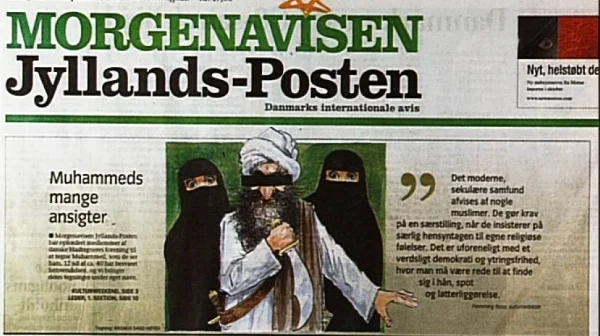
Jyllands.jpeg

It says something for the cowardice, duplicity, and wishful thinking of too many of the West's politicians (and much of its media) that one of the most striking illustrations of the crisis in its relations with the Islamic world has come from twelve mediocre cartoons.

The broad outlines of this saga ought to be familiar, wearily, painfully familiar, but they are still worth tracing back to the beginning, both to clear up some of the distortions that have grown up around it, and to see what the very nature of the controversy itself can tell us. The whole thing began when the Danish children’s writer, Kåre Bluitgen, complained last autumn that he was unable to find anyone willing to illustrate his forthcoming book about the Prophet Mohammed. He had, he said, been turned down by a number of artists frightened by the prospect of reprisal if they ignored the traditional Muslim prohibition on pictorial depictions of Islam’s founder. Twenty or thirty years ago, such fears would have been no more than paranoia, but that was before Denmark, like elsewhere in Europe, found itself with a large, and incompletely integrated, Muslim population. Back then Salman Rushdie had not yet been driven underground by an Ayatollah’s death warrant. Back then Theo Van Gogh was still alive.

Self-censorship is tyranny's sorry, trembling little helper, and so it's to its credit that the right-of-center (which, in Denmark, is not very right at all) Jyllands-Posten, one of the country's major newspapers, picked up Bluitgen's story. What it did with it was ornery, well-intentioned and somewhat naïve. Forty cartoonists were invited to give their own interpretation of the prophet. Twelve, a little more than a third, accepted, for 800 Danish crowns (roughly $125) apiece. As we now know, the result was a storm of protest in the Muslim world, and in recent days, pushback in the West. The cartoons have been republished all over Europe and the twelve cartoonists are now, like Geert Wilders, Ayaan Hirsi Ali, and Salman Rushdie before them, learning what it is to live in hiding. They have reportedly opposed the republication of their work. It's difficult to blame them. They have been given a terrible demonstration of what it takes to survive in an era rapidly tumbling back into the pre-modern.

As for the cartoons themselves, they come from all perspectives. One satirizes Jyllands-Posten, another Mr. Bluitgen. None are very funny, or, by Western standards, remarkable. It's telling that the delegation of Danish Muslims who visited a number of Middle Eastern countries to stir up trouble over the cartoons, had to boost their dossier of grievance with three additional (and genuinely disgusting) pictures that Jyllands-Posten had never even seen and whose provenance remains, let's be polite, unclear. To try and compare the actions of Jyllands-Posten, as Bill Clinton effectively did, with the race-baiting traditions of Der Stürmer   is to reveal an ignorance of history and a disdain for free speech that disgraces the office he once held. Even the most notorious of the cartoons, the one that shows Mohammed with a bomb decorated with Islamic text in his turban, can be seen not as an insult, but as a challenge to Muslims to demonstrate that (as is indeed certainly the case) there is far more to their faith than the atrocities that have recently defaced it. Harsh? Maybe, but it was also in the Western tradition of vigorous, free discussion. And as such it should be defended.

Ideally, the publication of these cartoons would have prompted Muslims to ask themselves why Islam, one of the world's great religions, could come to be seen in such a bad light. It hasn't worked out that way. Protests have been followed by boycotts, bluster and, now, violence. The protests and the boycotts are fine. They are all part of the debate. Violence, and the threat of violence, is something else, and, as many more moderate Muslims understand, it is doing far more damage to the reputation of Islam than a few feeble caricatures.

Needless to say, the theocracies, kleptocracies, and autocracies of the Middle East, always anxious for something, anything, to distract attention from their own corruption, uselessness, and thuggery, have played their own, typically malign, part in whipping up anger. Ambassadors have been recalled. Denunciations thunder down. Angry resolutions are passed. But amid all these calls for "respect" is there any acknowledgement that many Islamic countries could do more, much more, to respect the rights of those of different faiths to their own? To take just one example, Egypt's ambassador to Copenhagen is recommending that diplomatic action against Denmark should continue, but her own country's persecuted Christian minority would be grateful indeed if their troubles were confined to a few cartoons. Respect, it seems, is a one-way street.

But that's what too many in the Muslim world have been taught to believe, by multiculturalism as much as the mosque. In the cowed, cowering Europe of recent years the idea that religious minorities have a right not to be "offended," a nonsense notion that gives veto power to the fanatic with the thinnest skin, has increasingly been allowed to trump the far more fundamental right of others to speak their mind. Writers have been prosecuted, plays have been tampered with, and works of art withdrawn. Last week, the British House of Commons came within one vote of passing a law that would almost certainly have made U.K. publication of the Danish cartoons a criminal offense. It is a sign of how far matters have been allowed to degenerate that the initial blunt refusal of Denmark's prime minister to even hold a meeting with a number of ambassadors from Islamic countries over the incident ("I will not meet with them...it is so crystal clear what principles Danish democracy is built upon that there is no reason to do so...As prime minister, I have no power whatsoever to limit the press—nor do I want such power.") was seen as shocking as it was.

Needless to say, there were others who did their best to ensure that normal servility was resumed. While most Danes backed the prime minister, a former foreign minister, a once-respected figure who has long since become a flack for the Brussels establishment, donned Neville Chamberlain's black jacket and pinstripes to denounce the cartoons "as a pubescent demonstration of freedom of expression." The U.N.'s High Commissioner for Human Rights wrote to the Organization of Islamic Conferences (which, as it was perfectly entitled to do, had complained about the cartoons) saying that she understood the OIC's concerns, if not, it appeared, the right of free speech, and she was far from being the only senior international bureaucrat to do so (and, yes, naughty Kofi made sure to throw in a few weasel words of his own). Closer to home, the EU's commissioner for Freedom, Security and Justice denounced the cartoons as "inappropriate," an adjective as Orwellian as his job description, an adjective that can only have encouraged those out to bully the Danes.

In the end, it was left to other newspapers to rally round. With the republication of the cartoons in the Christian journal, Magazinet, the Norwegians were the first to support the Danes, a gesture understandable in a country where the local publisher of Rushdie's Satanic Verses had been fortunate to survive an assassination attempt in 1993, but which was bound to inflame matters still further. And when it did, other newspapers across Europe, in France, in Germany, in the Netherlands, in Spain and elsewhere joined in, either republishing the offending cartoons or, notably in the case of France's left-of-center Le Monde, adding more of their own.

So, what now? Like it or not, the cozy, consensual, homogenous Denmark of half a century ago has vanished, never to return, and, like it or not, the old Europe shaped by Christianity, the Reformation, the Renaissance and the Enlightenment now plays host to a large and growing population with a very different intellectual and spiritual tradition. And, in an age of global communication, the idea that these problems of coexistence can be confined to one continent is an illusion. An insult in Århus can reverberate in Damascus and Amman, and for that matter, Kabul, Basra, and Baghdad too. It's this that explains why the Bush administration, with hearts, minds and a war to win, condemned the cartoons, and it's this, far less forgivably, that explains why Turkey's (supposedly moderate) Islamist prime minister feels that he has the right to tell the Danish press what it may or may not publish.

Of course the publication of those cartoons was (quite explicitly) a provocation, but the furor that followed shows that it was an acceptable thing to do. The editors of Jyllands-Posten wanted to draw attention to the fact that fears for the freedom of expression were both real and realistic. They have succeeded on both counts. Europeans realize now, if they were dim enough not to understand before, that they are faced with two very different ways ahead. The first, and better, alternative is to recognize that, to many, freedom of speech is a value as important as religious belief may be to the faithful, and to give it the protection it deserves. Reestablishing this badly eroded principle will not be easy, but to fail to do so will be to empower the fanatic to legislate for all.

The second alternative is, broadly speaking, for Europe to attempt to buy social peace by muddling along as it does now, muzzling a little speech here, rooting out a little liberty there. But this approach isn't working now. There's no reason to think that doing more of the same will prove any more effective in the future. Besides, at its heart, this is a policy of surrender, submission and despair. It is a refusal to accept that people can agree to disagree, and it is a refusal to confront those who cannot. It foreshadows an era of neutered debate, anodyne controversy, and intellectual stagnation. It will lead, inevitably, to societies irrevocably divided into immovable blocs of ethnicity and creed, carving up the spoils, waiting to take offense and thirsting for the fight, which will one day come.

Despite some of the stirring statements in favor of free speech that have been made over the last week the best bet is that Europe will continue to slide into that second, dismal, alternative. The warning signs are already there to see. Tony Blair's Labour government (again, due partly to the presence of British troops in Iraq and Afghanistan but, doubtless, due also to the presence of Muslim voters in many key parliamentary constituencies) has been at pains to condemn the cartoons, and Norway's governing left-wing coalition wasted no time in distancing itself from Magazinet. Even Magazinet's editor has now stumbled down the same sad route: "If I had dreamt of something like this happening I would not have done it. It's out of control.'' Meanwhile, a number of the newspapers that have chosen not to run the cartoons have done so explicitly on grounds of self-censorship, or, rather, they claim, "restraint," or maybe "respect": Choose your own alibi.

Even more ominously, at the prompting of our old friend, the EU's commissioner for Freedom, Security and Justice, Brussels bureaucrats are arranging a meeting for "experts" and "community leaders" (to be held no later than the end of April) that will discuss some of the issues arising out of this controversy. It is reported that, "proposals to counter race and religious hatred [may be] dusted off." We can guess where that might lead.

And as for where it all started, Jyllands-Posten has now announced that it regrets having published the cartoons: "If we had known that it would end with death threats and that the lives of Danish people could be put at risk, we would have naturally not have published the drawings." The paper apologized only for having underestimated the extent to which Muslims revere their prophet, but then it added this, "fundamentalist powers have prevailed over the freedom of speech...Danish media will now be careful about expressing attitudes that fundamentalists can misuse to create hate and bitterness."

Whip cracked. Lesson learned.