Gas-Mask Chic: Dressing for Armageddon

National Review, September 30, 2002

Gas-Mask-On-A-Man-With-A-Rifle.jpg

For reasons that need, sadly, no explanation, we find ourselves living in a nervous, uneasy era, a time when every backfiring car becomes a bomb, every spilled sachet of sugar a plague. Once again, an enemy is out there, but the threat now is not the familiar Soviet-style Armageddon, but the occasional hit-and-run, jihad on the installment plan, which although revoltingly vicious, should, with luck— and preparation—leave most of us unscathed. Preparation? Back in the Cold War years, that never seemed necessary. Mutually Assured Destruction meant that the threat to civilians was both minimal and total. Now attacks seem certain, but the odds of survival are good. Still, with homeland security in the hands of Tom Ridge and Norman Mineta, it may be wise to improve on those odds—and that's just what many Americans are starting to do. In the immediate aftermath of the terrorist strikes some stores saw a surge in demand for guns and televisions, a good first step, but then what?

In Gotham, where I live, New York magazine tried to help out. Its "Survivalist's Guide to Living with Terrorism" offered a series of spooky lists, tailored (of course!) to income level. Silk-stocking survivalists were told to get ready for a designer doomsday with equipment that included a Maxa Beam searchlight ($1,687), Altec suspension expedition backpacks ($329), Eagle Gear "War Bags" ($195), Mobiflex portable shelter systems ($2,700), a Sea Eagle HSR sport boat ($3,200), and, to keep the irradiated rabble at bay, two pneumatic Tasers (priceless). Poorer folk were expected to make do with rather less. Recommendations for Archie's bunker included candles, Ziploc bags, and (don't ask) kitty litter.

Missed that issue? Never mind, there's always the Internet. With its themes of menace, conspiracy, government ineptitude, and the chance to make a buck, the current crisis may be the web's finest hour. And why not? As is pointed out at www.gammascout.com (home of the "Gamma-Scout" radiation detector), "government can only do so much." Indeed. At www.gasmasks.com they avoid talk of politics and get straight to the point: "Do you really want you, your spouse or your children to go through life with breathing disorders or scarred flesh from 3rd degree burns, or worse? It's just not necessary." Well, it you put it that way . . .

So where to begin? With the threat of NBC (nuclear, biological, and chemical) attacks, we are now being offered carnage a la carte. I'll start with the nukes, but first, a disclaimer. As trial lawyers, like cockroaches, will undoubtedly survive the worst that bin Laden can throw at us, it's necessary to say that neither NATIONAL REVIEW nor I am endorsing—or condemning—any of the products mentioned in this survey, which is, I should add, about as comprehensive as this nation's airport security. Full disclosure: My own supplies include a radio, bottled water. Red Army-designed flashlights, a .357 Magnum (Tasers are for wimps), Cipro, potassium iodate, and cans of some nasty-looking beans (my wife is a vegetarian).

Now, back to the nukes. If a nuclear device explodes on top of you, there's not much to be done, but in the case of a dirty bomb, or a more conventional nuke that has gone off at a somewhat safer distance, there are some useful steps that can be taken. First swallow a pill. Fallout will contain radioactive iodine, something that is not only highly carcinogenic, but also thrilling fodder for the thyroid, a gluttonous gland, always greedy for a little more iodine, radioactive or otherwise. Greed, though, can be good: An effective defense against this menace comes from preemptively swallowing "clean" iodine, which should ensure that the duly sated thyroid has no room to absorb any iodine that glows. My own iodine stash comes in the form of potassium iodate pills from www.medicalcorps.org. I'm not convinced there's a huge distinction, but at www.nukepills.com they're selling "FDA-approved" potassium iodide ("different spelling, different drug").

After pills, pillboxes. Those wanting their own purpose-built shelters should check out www.disastershelter.com, but the homes in this line may be of limited use in Manhattan—some of these constructions are rather larger than the average apartment. Helpfully, at www.disastershelters.net (no relation) guidance is given on how to design a better-than-nothing shelter (the euphemism is "expedient") for the real-estate-starved or the simply improvident. One suggestion is to huddle under a table in a basement with "two feet of books or other heavy objects . . . placed on and around the table." Anything by Bernard Lewis should work particularly well. For those who have forgotten their kitty litter, "a 5 gallon bucket with plastic bags could be used for sanitation."

But what exactly would you be sheltering from.' Fallout is see-through, and if you want to see it through, some sort of radiation meter will be essential. But be careful. At the cheerfully named www.planetwide-exodus.com, they warn, accurately enough, that many Geiger counters now on the market were designed for geological research and "cannot handle" the amounts of radiation that would be produced in the aftermath of an attack, which is something they may have in common with us humans. The uncomfortably frank realists at www.homelandprotection.net are offering the Raditect: "the first Gamma Radiation Detector designed for home and office use" for those "nuclear emergencies that would present a long-term health risk, not immediate annihilation." Despite its promising name the focus at www.geigercounters.com seems to be on products for a more sedate era, including the "Inspector," which is, apparently, suitable for "applications requiring higher levels of sensitivity such as checking food for radioactive contamination." Forget food. What about me? At www.twotigersonline.com, there's a "pocket dosimeter" (in essence a personal nuclear odometer) designed to tell you just how irradiated you really are.

If the assault is biological rather than nuclear, coping may be a lot less work. We are already tragically familiar with the effects of anthrax, but conventional medicine—often antibiotics—will usually be able to deal effectively with most biological threats. If you have problems getting hold of antibiotics, www.tetrahedton.org ("an educational corporation" that deals with "health science and government cover-up[s]”) seems to be recommending a rummage through the feedlots. But with supplies of Advance Calf Medic (a possible source of oxytetracyline) being as scarce in Manhattan as a barnyard and a pitchfork, your HMO might, for once, be a better bet.

More practical, if a little unsentimental, are the folks at Gasmasks.com, the compassionate conservatives of viral Armageddon. Their "Biological Survivors Caring Kit" is a complete head-to-toe outfit for someone who doesn't want to get too close: It's something to wear "while caring for a loved one contaminated with a deadly virus, so the caregiver cannot get infected."

Mention of Gasmasks.com raises the question of chemical attacks, the third pony of bin Laden's bargain-basement apocalypse. Comfortingly, some of the protective gear against this threat may be of use against N and B, as well as C, but be sure to watch out for gas-mask grifters. At www.homelandgasmasks.com, there's dark talk of the older (and often foreign) military-surplus masks being offered to "unsuspecting Americans." You can see a few of them (masks, not unsuspecting Americans) at www.approvedgasmasks.com with its rogues' gallery of gas masks fit only for use as a "Halloween costume or conversation piece," a list that includes the Russian M4I Aardvark. From the look of it, you will die laughing long before the gas gets to you.

Approvedgasmasks.com also boasts a wide range of hopefully more effective devices: the Scott ProMask, the SGE 1000, the SGE 400se, the MSA Advantage 1000, the MSA Advantage 3000, the MSA Night Ranger (lens resistant to shrapnel!), the MSA Ultra-Twin, and the M-95 Military. If that's too much to choose from, try the narrower selection at Homelandgasmasks.com (Panoramic Visor, Economy, and, for the kids, the Junior). Fashionistas will appreciate the different colors available at Gasmasks.com: neon yellow, midnight black, or, for the tactless, cobalt blue.

Of course, most such masks are somewhat bulky and difficult to carry around, at least without raising a few eyebrows. In preparing to save your life, you might well lose your job. At www.gasmasks-usa.com, they have a solution for this, a compact "Quick Escape Mask." This may buy just enough time for you to parachute out of your building (www.aerialegress.com), swallow your pill, grab your "One Person Tote N Go Survival Kit" (from www.areyouprepared.com—comes complete with emergency poncho and nine towelettes), and head for the hills, or, possibly, that book-lined table.

Once in the hills, thoughts will turn to longer-term survival. True pessimists will have bought the $6,320 Super Pak (one year, two people, 344 cans, one can-opener) from www.healthywealthyandwise.net. The state of kitchen facilities will, of course, be uncertain, but that won't worry purchasers of "super fresh, super tasting" MREs (Meals Ready to Eat, including country captain chicken, Jamaican pork chop, and many others) from Two-tigersonline.com. Cooking instructions include placing the unopened pouch "inside your shirt, allowing your body temperature to help warm the food inside."

That's the spirit: determined, dauntless, and a little bit daffy. Al-Qaeda doesn't stand a chance.

A Fundamentalism of Their Own: With the Atheists in Boston

National Review, February 6, 2002

On Good Friday, when others were in church, I visited an atheists' convention. Choosing to hold the gathering—the 28th National Convention of the American Atheists—over the Easter weekend was, their president explained, not much more than a matter of favorable hotel rates. Ellen Johnson smiled as she said this: It was not a claim that a skeptic would expect anyone to believe. So America's infidels gathered in their doubters' redoubt, a nondescript Hyatt on the grounds of Boston's Logan airport, transformed for a few days into a heretic Vatican. Around 250 souls (maybe that's not the word) had turned up for the fun, typically bright, somewhat eccentric sorts, often with the style sense of faculty members at a failing community college. Guys, shoulder-length hair does not work with bald on top. Oddballs? Well, the affable man sitting next to me did spend a surprising amount of time busily crossing out the word "God" from his dollar bills. Cranks? Judging by the pamphlets on display outside the main auditorium, quite possibly, although, to be fair, I did not witness anyone actually picking up a copy of The Unpleasant Personality of Jesus Christ.

It was not, it has to be said, a conservative crowd. Mentioning George W. Bush in a speech was better for jeers than for cheers. I did run into one likable rightist. “National Review, eh? There aren't many of us here." Not that it worried him. As a nonbeliever from the South, be was used to being in a minority', and he was enjoying the opportunity' for a little secular chitchat. Why the atheists? Well, the humanists were "just too touchy-feely." He had a point. Apart from one appalling moment when a hunched-shouldered woman whimpered that she was "afraid," there was none of the mush-'n'-gush that so often mars public gatherings nowadays. Refreshingly, too, there was little talk of "the children," although the enthusiasm that greeted the recital of an essay on school prayer by the young daughter (she's against) of an atheist from Alabama (so's he) had more than a touch of the Laura Bush about it.

That isn't to say that emotion was not on display. This was not a gathering very typical of the roughly 10 percent of all Americans who have no religious faith (a larger group than Jews, Muslims, Lutherans, or many others). For the most part, such secular folk keep their concerns to themselves. They are, spiritually speaking, part of the Leave Us Alone coalition, indifferent to theological controversy and free from transcendental torment. The Hyatt's heathens were made of more awkward, angrier stuff.

Given their background, that's not surprising. American Atheists is the organization (it has fewer than 5,000 members) founded by the "most hated woman in America," Madalyn Murray O'Hair, whose litigation brought an end to organized school prayer. She was a famously confrontational character, and even today her successors are a touch irritable. Contrary to rumor, there are no horns on their heads, but watch out for the chips on their shoulders. These are the Wahhabis of atheism, disbelief's true believers. Oppressed by their sense of oppression, they also show signs of succumbing to the temptation of that most pernicious of contemporary cults, the cult of the victim.

There were tales of social anxiety, embarrassment, and snubs, regrettable certainly, but hardly the Inquisition. In listening to the anguished protests against trivial slights, it was difficult to avoid the conclusion that this was a group that had lost all sense of proportion. On September 11, the United States was subjected to murderous assault at the hands of religious extremists. In addition to the carnage, bin Laden's war represents an attack at the ideological and spiritual level: It is a challenge to the West and to its enlightenment. Hog-tied by the pieties of multiculturalism and constrained by a perceived need to appease Muslim "allies," this country has proved incapable of mounting an intellectually effective response. If ever there was a moment for a clear, sensible leadership from supporters of the secular, it is now.

Judging by their convention, however, this is not something that we can expect anytime soon from America's atheist activists. In discussing the aftermath of 9/11, the convention's focus rested not on Islamic fundamentalism but on safer, stupider topics, grotesque in their self-indulgence and irritating in their irrelevance; the iniquity of "God Bless America" (the G-word is, apparently, a problem in a national song) and government's supposedly disgraceful role in the use of religion to comfort a wounded nation. The overthrow (by the reviled George W. Bush, no less) of a real theocracy, that of the Taliban, barely rated a mention. In their obsession with wicked old Christianity, these atheists seemed to be lost in yesterday's struggle. They were ready to fight the Kaiser, but it is Hitler who is now in town.

There were, it was true, a couple of lectures that dealt with the threat from Islamic extremism. The first, on "holy terror," had the merit of making the point that there was a need to defend and to promote Western culture, a rare assertion in contemporary America. The second was a talk by "Ibn Warraq" (prudently, he uses a pseudonym), the author of Why I Am Not a Muslim, a book with a title and theme echoing that of Bertrand Russell's Why I Am Not a Christian.

Brought up a Muslim on the Indian subcontinent, Mr. Warraq is a slightly old-fashioned figure, a shabbily genteel man with more than a hint of India's mid-20th-century intelligentsia about him. His talk (blunt in language and sharp in logic) was a fascinating analysis both of the roots of Islam and of its association with today's religious violence. How accurate it was, I'm not expert enough to judge, but it is worth remembering that Lord Russell never had to conceal his real name. Certainly, in its analytical and textual rigor, Ibn Warraq's lecture was a considerable improvement on the patronizing sugarcoating that usually passes for discussion of Islam, the "religion of peace."

Revealingly, though, the time dedicated to these two talks was no greater than that allocated for slapstick: a presentation on religious kitsch ("Bibleman" has, appropriately enough, so far as skeptics are concerned, to be seen to be believed) and a guide to some of the more demented Christian websites. Both these lectures were amusing enough, but the emphasis placed on them suggested an audience more comfortable with taking cheap shots than concentrating on what really matters. A talk on the cloning controversy revealed the same flaw. The opportunity for serious argument was lost in the course of an endless joke involving foreskins, nuns, and a hermaphroditic divinity. The joke wasn't funny and, in the context of a convention of atheism, was about as shocking as a striptease in a brothel.

It was also a wasted opportunity, but perhaps this was at least partly inevitable. Any convention, unless choreographed by Elizabeth Dole, is bound to include some partisan entertainment to rally the troops. Nevertheless it was a shame. There is a need for a more frank discussion about those areas where the dictates of religion and the requirements of science come into conflict, but such a happy moment seems a long way off. After all, even debates between faiths are off-limits these days, deemed too tricky for our era of moral relativism and exquisite PC sensitivity. The virtue of good judgment has been turned into the vice of "judgmentalism," and we live with the result: an era of religious hucksters and New Age nonsense, a time of woolly thinking when no distinction is made between the writings of St. Augustine and the babblings of some two-bit West Coast Wiccan.

Could atheism be an antidote? You do not have to be a nonbeliever to see that its theoretically rational philosophical method could play a part in restoring notions of reason and objectivity to a society that regards both with suspicion. It the Boston atheists are any indication, however, you do have to be an optimist to think that this could happen. Fundamentalism, it was obvious that weekend, does not depend on a god.

Still, here were times when the convention showed what could be. There was Mr. Warraq's talk, for instance, and, perhaps most striking of all, a lecture by Michael Cuneo, a professor from New York City, an expert on delusions of devilry, and those who prey upon it. In an amusing presentation, he spoke of ceremonies that combine the best of The Exorcist with the worst of Elmer Gantry. This was skepticism at its good-humored, informative best, an inspiration, one would think, to the Hyatt's godless horde. But there was one small irony.

Prof. Cuneo teaches at Fordham, a Jesuit university, and, yes, he's a Catholic.

Fashion Victims

National Review Online, February 26th, 2002

Gulagwomen.jpg

Over in Europe, as George Bush has been reminded only very recently, the chattering classes are uncomfortable with the notion of evil. As an idea it is just so, to borrow a word from the French foreign minister, "simplistic." However, even allowing for the old continent's tawdry attempts at world-weary sophistication, it is disappointing, to say the least, that a disgusting event in London last Wednesday passed with little notice, no criticism and, here and there, some applause. It was a spectacle that combined shallow frivolityand deep, deep moral relativism and, of all unlikely places, it occurred at a show during the British capital's Fashion Week, at the catwalk debut for a collection created by Helga and Eva, 24-year-old twins from Austria.

Helga and Eva claim to find their inspiration in their country's past, including, they say, the Third Reich. They have already enjoyed some success. Their label was included as part of Fashion Week's "New Generation," a group of young designers sponsored by a leading British retailer.

In what was, doubtless, intended to be a witty gesture, invitations to see the twins' collection were based on Nazi-era passports. At the show itself, the musical backdrop contributed to the totalitarian theme with a soundtrack that combined classical tunes, Wehrmacht chants and folk songs, all overlaid with Led Zeppelin. Jimmy Page's heavy metal was included, apparently, as a gesture to contemporary western culture.

The collection featured designs based on both the industrial and political aesthetic of the former dictatorship. On display that Wednesday were cloaks and knitted sweaters, all, naturally, in parade-ground brown, and often emblazoned with the regime's most famous symbol, the swastika. In a neat touch, jackets and dresses were edged with little Iron Crosses.

The London press seemed to like what it saw. A commentator in one leading daily said that Helga and Eva had brought the old despotism's fashion sense "in from the cold", while another newspaper ran a friendly piece in which the writer noted that the twins' collections were available at a number of expensive British stores. American fans of designer tyranny will be thrilled to know that these clothes can also be found in New York, Boston, and LA.

Interestingly enough, the prospect of Helga's and Eva's show did not seem to worry Britain's Labour government, usually so sensitive to the slightest hint of political incorrectness. The night before the collection's launch, there was a party in honor of Fashion Week hosted by Tony Blair's wife, Cherie, and the secretary for trade and industry, a busy lady, who doubles up as the U.K.'s "minister for women."

To be fair, these two grandees may have had no idea what would be strutting down the catwalk the next day, and, so far as I know, there was no foretaste of the totalitarian treat to come. It was an evening of chandeliers, not searchlights, of velvet ropes, not manacles. There were no guard-dogs, no watchtowers, no burial pits. The waiters wore shoes, not jackboots, and carried drinks, not guns. Guests were permitted to arrive by taxi rather than cattle truck. There were no amusingly staged beatings or faux executions to sit through. Best of all, everybody was allowed home alive at the end of the evening.

How very different it was 60 or 70 years ago, in that era desecrated by men marching under the symbol now found to be suitable for an expensive knitted sweater. The twins' art is, consciously or unconsciously, a celebration of cruelty, an insult to slaughtered millions, many of whom ended their lives dressed in the only real totalitarian style, the rags and tatters of concentration camp clothing. That two designers can borrow evil's insignia to make a fashion statement is yet another dismal reminder of how little mankind has really understood the nature of 20th-century mass murder.

At this point, I should, however, admit that I have changed a few details in this story, none of which ought to make any difference, but, strangely, they seem to.

The twins' real names are Natasha and Tamara Surguladze. They do not come from Austria, but from the former Soviet republic of Georgia. Their Tata-Naka label features designs inspired not by the Third Reich, but the USSR.

Oh, so that's all right then.

The London Daily Telegraph described the scene:

Graphic prints were based on original propaganda motifs from the "industrial art" movement championed by Lenin and Trotsky. Others featured the Cyrillic letters CCCP, which represented the former Union of Soviet Socialist Republics. Sweeping cloaks and knitted sweaters in "Red Square red" were emblazoned with the symbol of the Russian revolution, the hammer and sickle, while glittering Russian stars clasped the edges of jackets and dresses…The "Mother Russia" theme was reflected in the invitations, based on the old USSR passports…and in the music, a garage mix of Shostakovich, Red Army chants and folk songs, overlaid with Led Zeppelin.

And, no, this is not all right.

Yet, somehow, people think that it is. Fascist fashion would shock. Communist chic does not. To wear the swastika has become, quite rightly, a taboo, but the hammer and sickle is, in the hands of Tata-Naka, no more than a vaguely "daring" image, a mark of Cain reduced to a potentially lucrative logo. Quite why this should be the case is difficult to grasp. The Soviet Union and Nazi Germany were as bad as each other. Trying to find a moral distinction between those two charnel-house states is a pointless exercise in political theology — about as useful as debating how many devils can dance on the head of a pin, and rather more dangerous (it is a partial explanation for the failure to hold a Soviet Nuremberg). Nevertheless, that is exactly what we tend to do — on those rare occasions when the issue is discussed at all. And the usual conclusion, that Hitler's Germany was easily the greater (and history's greatest) horror, has developed into a part of our culture's conventional wisdom, a facile nostrum that removes the need to ask the necessary questions about other monstrous savagery.

It is an illusion that soothes, and it accounts for the fact that most readers of this article were, I suspect, more than a little relieved to discover that the twins had taken their design hints from the creators of the Gulag rather than the architects of Auschwitz.

Well, weren't you?

Rummy and Juliet

National Review Online, December 11, 2001

Donald-Rumsfeld-2.6.16c.jpeg

He is a mauler of mullahs, and a colossus in Kabul, but for the secretary of defense these triumphs may only be a beginning. Squinting through his glasses for media briefing after media briefing, this gray-flannelled generalissimo is America's newest TV sensation. What's more, with every appearance, some say, he is making additional conquests, not of Herat this time, but of hearts, the hearts of women all over America, each beating a little harder at the thought of a man who, these ladies like to believe, doesn't need the help of a B-52 to make the earth move. Donald Rumsfeld, it seems, has become a romantic icon, a History Channel guy who is going to wind up on Lifetime. We shouldn't really be surprised. Chicks dig chiefs, or, to use Henry Kissinger's more elegant phraseology, " power is the great aphrodisiac." In a celebrity-saturated culture, Secretary Rumsfeld may also be benefiting from a subliminal association with an already-established idol, one called Cruise (the actor not the missile). There are, after all, some remarkable similarities between the two men. Both are a little on the short side, both were high-school wrestling stars, Tom Cruise played a naval aviator, and Donald Rumsfeld was a naval aviator. Could it be that in the fantasies of his followers, Rummy is really Maverick?

It took Larry King to try and bring discussion of some of these issues out into the open. Interviewing the defense secretary the other night, CNN's most courageous investigative journalist came out with the question that no one else in America had dared to ask.

"Secretary Rumsfeld…Do you like this image? You now have this new image called sex symbol."

It is safe to say that, unless there was more to Robert McNamara than met the eye, this is not a question that has ever previously been put to a wartime secretary of defense, but there was no need to worry. As we all now realize, Mr. Rumsfeld is someone well equipped to deal with an unexpected challenge, and his response to this latest media impertinence was calm and to the point.

"Oh come on."

As fans of Rummy's press conferences will know, follow-up questions can be dangerous (to the journalist). Larry King, however, is no member of the milksop Pentagon news corps. Eager for martyrdom, he persevered with his line of inquiry, fearlessly claiming that Mr. Rumsfeld was indeed "the guy." At this point, it would be reasonable to hope that the defense secretary would, as befitting his job description, stick to his guns. Our hero wavered. And who can blame him? Told by the seven-times married Mr. King that, when it comes to love-god status, you are now "the guy," it must be difficult to resist.

So, Mr. Rumsfeld admitted that he could be a sex symbol, but "for the AARP." He was, he explained, "pushing 70 years old".

And then came the moment, horrible to watch, when Larry King went too far. He suggested that the hammer of Kandahar was "kidding" about his age, an assertion that brought a stern response.

"I'm 69 and a half years old. Don't give me that stuff."

The Rumsfeld we all know and fear was back. An alarmed Mr. King hastily moved on to safer subjects, such as the role of Kuwait in the current conflict. There was no more analysis of Rummy's attractiveness on TV that evening, and there has not been much since. So far as mainstream media are concerned, this important topic remains largely hidden under a broadcast burqa, driven there either by fear of savage Rumsfeld reprisal or by liberal reluctance to admit that the GOP had finally found a politician who some women actually liked. Newspapers have been no more forthcoming.

So what then is the truth about the defense secretary's sex appeal? The Internet, usually so helpful when it comes to study of this kind, was of little assistance. An initially promising Google check revealed 134,000 entries under "Donald Rumsfeld" (well behind his popular doppelganger "Tom Cruise" (399,000) but closing in on "George Clooney" (143,000)). On closer examination, however, these sites seemed to focus on trivia such as the war, terrorism and the future of the nation. If there were any Rumsfeld fan pages, they were hidden in cyberspace's equivalent of the caves of Tora Bora.

The inevitable next step in this research, from the web to real women, can often be difficult for those of us who surf the Internet, and it was not made any easier by the harsh budgetary constraints within which anyone who deals with NRO has to operate. Plans for a nationwide survey, scientifically compiled by, say, Gallup and broken down by region, income group, age, ethnicity, political affiliation and tendency to watch C-Span had to be shelved in favor of a random series of questions addressed to a far smaller and entirely unrepresentative sample of the fairer sex. However, even after removing the rather over-enthusiastic replies of a few female conservative journalists (this is a family-oriented website), the conclusion was clear: When it comes to the ladies, Rummy has got what it takes.

The revelation that Secretary Rumsfeld remains married, after nearly half a century, to his childhood sweetheart was, to this group, both encouraging (as to his qualities) and disappointing (as to their prospects). Other, less-daunting objections were swiftly swept aside by Rummy's would-be Juliets. Yes, it was conceded, he could be a little brusque, but a straight-talking manner is these days apparently more seductive than a bulk-bought copy of Leaves of Grass.

The "AARP issue" turned out to be even less of a problem. The much younger "Betty" (Chicago, Illinois) offered to "share [Rumsfeld's] early bird special any time." If anything, the defense secretary's age appears to add to his allure. In tough times, daddy is back, and so, incidentally, are his clothes. The always stylish "Susanne" (Pelham, New York) appeared pleased by "her" Donald's fashion sense, a development that may suggest that the next time Naomi Wolf is advising a politician how to dress "alpha" she should steer him away from earth tones and towards Gerald Ford-era gray. So great is the appeal of Adonis Rumsfeld that, Freddy Krueger-like, his power even reaches into the subconscious, and, more specifically, the dreams of "Kathleen" (Washington, DC), an experience she described as "invigorating."

The only sour note in this entire investigation came from a disappointing source, Vice President Dick Cheney. Speaking to US News & World Report from his now traditional "secret, secure location." Mr. Cheney conceded that the defense secretary was "a babe magnet" but only "for the 70-year-old crowd." (He repeated the slur Tuesday night in a Fox News interview.) Well, if that's not a Lieberman moment, what is? Coming from Mr. Rumsfeld, those careful words of qualification were appropriately modest, but from the mouth of Dick Cheney, they sounded a little just a teeny bit envious.

Mrs. Cheney's comments were not recorded.

Moderately Crazy

National Review Online, October 23, 2011

Mullah Omar.png

Mullah Omar Mohammed, the Taliban's one-eyed leader, is, we are often told, insane. A twitching, convulsing Cyclops in a turban, this lunatic clergyman is, apparently, a standout kook even in a region famous for its delusional and psychotic despots. Amazingly, however, he might not be the craziest participant in the current crisis. That distinction may have to be reserved for the urbane and superficially more normal-seeming Colin Powell, a man who, according to press reports last week, has expressed an interest in "reaching out" to more "moderate" elements in the Taliban, a task about as anchored in reality as an attempt to find Charles Manson's inner sweetness. The secretary of state has subsequently attempted to "clarify" his position, emphasizing that no such overtures will be made to the Taliban's "leadership," a conveniently elastic term that does little to disguise the bizarre nature of this whole initiative.

To put it bluntly, the idea of a "moderate" member of the Taliban is no more plausible than the notion of a moderate member of the Ku Klux Klan. Intellectually, if it is appropriate to use that term in this context, the Taliban's teachings are not only a rejection of Afghanistan's traditionally (relatively) tolerant religious heritage, but they also go, in their absolutist contempt for the modern world, many steps beyond the already hard-line Islamic fundamentalism that inspired so many of the anti-Soviet mujaheddin. Drawn from the ranks of the orphaned, the dispossessed, and the alienated and inspired by the petty and vindictive certainties of barely educated village preachers, the lopping, chopping, and murderous Taliban are the extremist's extremists, the Khmer Rouge of the Khyber Pass.

It is also worth remembering that their rule is a fairly recent phenomenon. These are fresh-minted fanatics. Time and incumbency will eventually reduce the fervor of even the most ideologically driven of dictatorships. As the years pass, youthful enthusiasm (the Taliban gets much of its support from young men) will evolve into paunchy middle-aged torpor. What's more, as a regime endures, its very success will, ironically, conspire against its core principles. The ranks of the true believers will be diluted by the arrival of careerists and other opportunists, just the sort of pragmatic people who a Colin Powell might look for in his hunt for "moderates." There has not been enough time for this to happen within the Taliban state, and there is at least one good reason to think that it may take a while before it could be expected to do so — the peculiarly retrograde ambitions of the Taliban mean that they have comparatively little dependence on the sort of skilled technocrats normally essential for the smooth running of any society.

Traditionally, even the worst dictatorships have adopted at least some ideas of what we conventionally think of as progress: Trains ought to be made to run on time, electrification must be brought to the countryside, a civil service should function. To achieve such aims, any movement, however despotic, must succeed in co-opting the help of just the sort of technically qualified and, probably, relatively apolitical specialists who might constitute a force for moderation. The Taliban has no need of such people. Their objective, an Afghanistan transformed into a replica of an imagined 8th-Century Arabia, is about destroying, not building, a modern civilization and it is difficult to believe that they will need the assistance of many engineers, scientists or even administrators as they go about their grisly business.

This appears to be true even in the armed forces. While Taliban troops do, undoubtedly, include some trained, professional military, their numbers are fairly few (apart, perhaps from some of bin Laden's own "Arab" detachments), and there are unlikely to be enough of these career soldiers to be worth appealing to as a potential source of opposition to the regime's excesses. This should be no great surprise; brutal, unstructured, and primitive, Afghanistan's civil wars have been fought at a level that requires cunning and enthusiasm rather than sophistication and a West Point style officer corps.

Also, the Taliban military appears, by (admittedly low) Afghan standards, to be fairly cohesive. Warfare in Afghanistan is typically characterized by shifting alliances and repeated betrayals, but the rise of the Taliban has varied somewhat from this familiar pattern. The ideological fervor of Mullah Omar's movement (which was formed in a way that manipulated ethnic — Pathan — identity and yet bypassed much of the usual tribal power structure) and the speed of its early victories mean that its forces are less of a cobbled-together coalition than is normally the case in Afghanistan. The Taliban has, unfortunately, had to absorb relatively few allies of convenience, those fickle friends of a type that the U.S. might otherwise be able to tempt away.

This is true even outside the regime's Pathan heartland, where some degree of coalition forming by the Taliban might reasonably have been expected. Mullah Omar, however, is not really someone, to use a State Department term, known for "reaching out." In non-Pathan areas of the country, therefore, the Taliban have ruled more like an occupying army than a government. Only limited attempts have been made to win over the locals, who will be, by definition, unable to defect from an administration that they never joined in the first place.

This quest for "moderate" members of the Taliban is, therefore, not only a long shot, but could also be counterproductive. It risks confusing, antagonizing, or demoralizing just the sort of local anti-Taliban forces, actual or potential, who could assist U.S. efforts on the ground.

More importantly, perhaps, these hints about the acceptability of some supposedly moderate Taliban faction send out a terrible message elsewhere in the region. The United States is never going to be loved in the Middle East, but, if it is to succeed in this conflict, it must at least ensure that it is respected. When bin Laden's disciples want to attract followers they do so not with images of American strength, but with the idea of American weakness. There is repeated gloating over those outraged corpses in Mogadishu and, now, gleefully, over the destruction of two tall buildings, sent tumbling to their doom on a bright blue September morning.

The appeal of such propaganda in a neighborhood already profoundly hostile to the United States can only be met by the projection of American power, and in a prolonged, tricky, and asymmetrical contest, that is something that will take more than superior military hardware. The U.S. will have to be seen to show uncompromising determination, iron resolution and the unshakeable intention to see this battle through, preferably with allies but by itself if necessary. It must demonstrate to the Muslim world's many waverers that the United States is loyal to its friends, but implacable towards its enemies, that it is not, in other words, the sort of country ready to cut a deal with members of a regime that is still harboring the killers of so many Americans.

Domestically, the political impact of any overtures to elements within the Taliban would be likely to be even worse. Within the United States, American foreign policy is, at the moment, seen as having an unusual moral clarity. After 6,000 funerals, there need be no qualification or equivocation. Right is on our side. That is what those flags, displayed, it seems, on every street are all about. Americans realize that they have been attacked, and their people butchered, by an evil and dangerous assailant. This nation can see that bin Laden, the barbarians who harbored him, and the ideology he represents must be "ended", and it knows that this process may well be long, difficult and bloody. This country understands, in fact, a great deal about the situation in which it now finds itself, and that is why it is giving the administration the very broad support that it needs to do the job.

It is, however, support that could be quick to drain away if the response to the al Qaeda onslaught comes to be muddled by the State Department's familiar blend of cynicism and reflex internationalism, that sleazy instinct for appeasement that comes disguised in the tough language of realpolitik, and which even now, it appears, might be prepared to sell us the concept of the Taliban's kinder, gentler elements.

American Icon

National Review Online, October 15, 2001

bert_n_bin.jpg

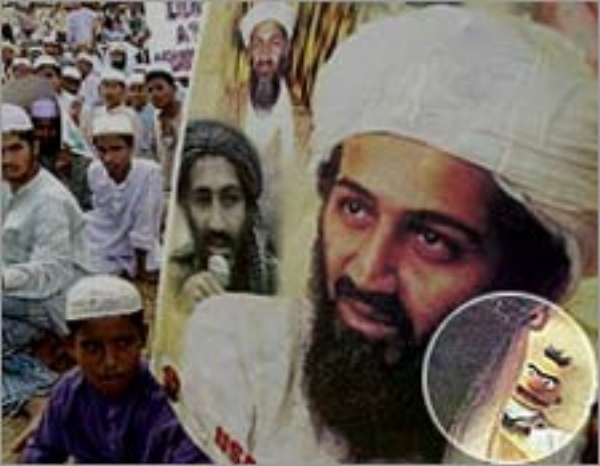
It was a moment of laughter in a month of murder, the return of harmless absurdity to a world gone mad. The background was not promising. Bangladeshi Osamaniacs had gathered in their capital city, Dhaka, to show their support for bin Laden and their hatred for you and me. They marched as such mobs always do, violently, noisily, and under the banners of jihad, an embarrassment, I hope, to their faith and a disgrace, I know, to their country. Posters were brandished, some of them showing pictures of the crowd's hero, that grim symbol of Islamic rage, severe in his white turban and dark beard, with, it was to turn out, a rather surprising companion. Clearly visible on some of the posters, muttering, it would appear, into bin Laden's left ear, is Bert, Sesame Street's grouchiest Muppet, a difficult fellow, to be sure, but not an individual with any previously known links to the al Qaeda network.

Pictures of the demonstration swept across the planet, prompting Fox News to run a piece on "Bin Laden's felt-skinned henchman" and the makers of Sesame Street to issue a rather pompous condemnation of the "abuse" of one of their characters ("Sesame Street has always stood for mutual respect and understanding…this is not at all humorous"), although, as a suspicious Fox correspondent was quick to note, the show's spokeswoman would not be drawn on the yellow Muppet's "current whereabouts." Was there something to hide?

Well, don't worry, Bert, as it happens, is innocent. The real explanation for his appearance with the world's most notorious criminal (which can be found on the invaluable www.snopes2.com) lies elsewhere, in that blend of frivolity and technological superiority that so enrages Muslim fundamentalists about our glittering, tantalizing, ubiquitous civilization. For years now the web has played host to the running joke that "evil Bert" has been the crony and adviser of history's wrongdoers. Search the Internet and you can find doctored photographs of Bert with O. J., Hitler, Kevin Costner (some people really did not like Waterworld) and now, it seems, Osama bin Laden. And this — this joke — was the image that a printer in Bangladesh chose to download when he was surfing the web for a picture of Bin Laden to make into a poster for Osama's devotees. Somehow or other the bungling Bangladeshi either failed to notice Bert or, if he did, he omitted to crop him from the photo.

Symbolically, this fiasco could really not be better: whether it was in the reliance on advanced Western technology to create the propaganda materials for protesters who would abolish the future, or whether it was in the pathetic failure to use it effectively, a failure that led to the elevation of yet another symbol of the decadent West over the heads of its ignorant, benighted foes. It may have been an accidental triumph, but who cares? Western culture, represented in this case by the unlikely standard-bearer, Evil Bert, had once again humiliated its dim, dismal, and demented opponents, fools who would run a world, but cannot operate a PC.

And yes, it is okay to laugh, although if you are a woman in Afghanistan please do so only in private (the Taliban have made it a crime for women to laugh in public). This tale of botched posters is marvelously, gloriously funny, a welcome relief after these weeks of grief. Those demonstrators were made to look ridiculous, and it gave this country a wonderful, mocking picture of a contemptible enemy. We need more of such images. The pampered rich kid bin Laden, a designer tribesman with his laundered robes, Timex Ironman Triathlon ("the watch of choice for top athletes"), and Stone Age certainties is a gift to caricaturists, and yet (with some exceptions, notably The Onion) there seems to be a curious reluctance to make fun of this ludicrous figure. In part, probably, this is a consequence of the exquisite sensitivities of the Politically Correct era (should we not be trying some "mutual respect," should we not be making an effort to understand him?) and in part it is the natural inclination of a sheltered, rather soft generation still uncertain as to how to respond in the aftermath of such an appalling, unexpected onslaught. To take one example, according to press reports, we are, apparently, in for a kinder, gentler Halloween. Bin Laden masks, it is being suggested, would be in poor taste.

In fact, such rude, tasteless gestures are very important, and, insofar as they can contribute to victory, they can help honor our dead. It is possible to belittle bin Laden (in fact, if some tabloid accounts are to be believed, it is very easy indeed), without belittling his crimes. Far from trivializing a conflict, humor can be a very useful weapon in its pursuit. Current reports linking the anthrax attacks on the tabloid press to their less-than-flattering descriptions of bin Laden and his acolytes would, if true, suggest that this is well understood by al Qaeda. Laughing at an enemy boosts morale and reminds us that any adversary, however fearsome-seeming, can be overcome. In the Second World War, Hitler was often portrayed in Anglo-American popular culture as a figure of fun, a laughable, histrionic little man with delusions of grandeur, and yet no one would argue that the Allies were not serious about the evil done by his regime or the importance of, to use a currently fashionable term, 'ending' the Third Reich.

So let's have those bin Laden masks, the nastier the better, and take it from there. This is someone to jeer and to scoff at, a clown in a cave to be mocked, parodied, derided, lampooned, taunted, and ridiculed, a jerk on a jihad that we can only despise. Our laughter will help cheer us up, and, who knows, so great is the reach of the Western media (ask Evil Bert), it may also transmit a message to some of those in the Muslim world who now demonstrate their support for terror, an important message about the man that they so admire.

He's a loser.

In a Glass House

National Review Online, October 3, 2001

Amr Moussa.jpg

If there is a word for chutzpah in Arabic, Amr Mussa must know it. Mr. Mussa is the secretary general of that distinguished 22-nation association, the Arab League, and he wants the world to know that he is shocked — shocked — by comments made by Italian Prime Minister Berlusconi last week. This is no small matter; as secretary general of an organization with a membership that includes Syria, Iraq, Libya and Sudan, Mr. Mussa cannot be somebody who it is easy to upset. But Mr. Berlusconi has succeeded, apparently, where Colonel Qaddafi could not. Amr Mussa is, now, at last offended. Like the despots who pay his wages, the butchers' bureaucrat responds badly, it turns out, to a little criticism. The idea of debate is as foreign to him as it is to his masters. After days of controversy, fury and posturing, what Mussa wanted was for us to understand that the lout Berlusconi had gone too far. It was, said Mussa, "dangerous" and unacceptable" for the Italian to have spoken in the way that he did. Take note of those adjectives, "dangerous" and "unacceptable": they have a jailhouse ring to them. They are the language of the secret policeman, not the rhetoric of democracy.

The Italian prime minister's crime, as we all must now know, was to talk about the "superiority" of Western civilization, a culture that, Mr. Berlusconi had the effrontery to claim, consists of a "value system that has given people widespread prosperity in those countries that embrace it, and guarantees respect for human rights and religion," respect, he argued, that was not to be found in Islamic countries.

As Jonah Goldberg noted in Friday's NRO, there is much to be said for this point of view and it is striking that the opposition to it has come neither from democratic Arab parliamentarians (strangely, there do not appear to be any) nor from logic, nor from reasoned argument. Instead all we are offered is the spectacle of a hireling civil servant cleverly brandishing the one word that, in the West, is almost always guaranteed to stop all rational debate: racism. Mr. Berlusconi's comments, were, said Mr. Mussa, "racist." The ploy has seemed to work. Belgium, a country that puts the less in spineless (and is the current holder of the EU presidency) has already apologized.

But Mr. Mussa should be careful. People in glass houses should not throw stones (and, no, before anyone complains, that phrase is a figure of speech: it is not a reference to the rougher edges of Sharia jurisprudence). If he is really so worried about racism, the secretary general of the Arab League should look first to his own membership, to the slaver state Sudan, perhaps, or to Libya, a country where last year's pogrom against black immigrants in the provincial town of Az Zawiyah (50 dead, in case anyone was counting) could initially be described in a government newspaper as no more than a "summer cloud." If not there, perhaps Mr. Mussa would like to look instead to the presses of Egypt and Syria, countries where little that is printed appears without some degree of government approval, countries where there is widespread circulation of the sort of gutter anti-Semitism not generally seen in Europe since the days of the Third Reich.

Mr. Mussa does not even have to leave the confines of his own bureaucracy to find racism, or at least racism in the ludicrous way that he defines it. If the secretary general of the Arab League genuinely believes that Berlusconi's attempt to weigh the relative merits of Western and Islamic cultures really represents some form of racial prejudice he should take a look at the website of his own organization, and check out what is written there about the years of Islam's initial expansion.

"These Muslim believers were not merely conquerors. They rapidly established a new and dynamic civilization that for centuries was the only bright light in an otherwise culturally and intellectually stagnant world."

Oops.

Faking a Prophet

National Review Online, September 29, 2011

nostradamus.jpg

The e-mail arrived on my computer, garlanded with exclamation marks and entitled "Holy Smoke!!" It was a day or so after the slaughter at the World Trade Center — murders, it seemed, that had been forecast nearly half a millennium ago by Nostradamus, the 16th Century French seer. He had written, I was informed, the following words:

In the year of the new century and nine months,
From the sky will come a great King of Terror,
The sky will burn at forty-five degrees.
Fire approaches the great new city…
In the city of York there will be a great collapse,
Two twin brothers torn apart by chaos.
While the fortress falls the great leader will succumb.
Third big war will begin when the big city is burning.

Spooky, eh? A lot of people seemed to think so. All over the country Scullys were transformed into Mulders. There was a run on Nostradamus books (the New York Times reported that in the week of September 11th no fewer than three editions of Nostradamus were in the Amazon Top 25, a feat more typically associated with that much younger wizard, Harry Potter). At least one website dedicated to the far-sighted Frenchman has had to suspend part of its service due to "excessive load." Amazingly, the extra demand had not been foreseen.

The problem, however, is that the two chilling quatrains are as bogus as Big Foot, as credible as a Clinton, as ridiculous as Roswell. Of course, this sort of thing has been happening for years, sometimes, even, in a good cause. In 1943, in an attempt to terrify the notoriously superstitious Nazi leadership, fake quatrains prophesying their doom were parachuted, like some mystical maquis, deep into the heart of occupied Europe.

More recently, a quatrain purporting to warn that in December 2000 "the village idiot" would be proclaimed leader of "the greatest power" consoled bitter Democrats in the aftermath of the presidential election. They should have known better. The verses were obviously faked. As we all know, the real "village idiot" went abroad and grew a beard.

Turning to the "WTC" verses, the latest, and easily most tasteless hoax, we find that the second quatrain ("In the city of York…") is entirely made up, much of it a borrowing, ironically, from a 1990s paper by a Canadian student looking to demonstrate how ambiguous sounding verses can be used to "predict" anything. The four lines of the first quatrain are, by the low standards of this field, somewhat more authentic. They appear to be cobbled together from random, and heavily modified, pieces of the great man's work. To take one example, there is a reference in the prophecies to a year and a number of months, but the year is 1999 and the number of months is seven (something that led the seemingly innumerate fashion designer Paco Rabane to shut up shop and flee Paris in, August 1999, ahead, he thought, of an imminent crash landing by the space station Mir). Russia's cosmic jalopy, however, continued to lurch round the planet while unkind skeptics gathered outside Mr. Rabane's shuttered offices, champagne glasses in hand, and celebrated an apocalypse averted.

The first "WTC" quatrain is not, in fact, the only example of cut and paste prophecy in the Nostracademy. Followers of the enigmatic Mr. Baines of the Nostradamus Society of America (it is worth visiting their website, just for the Vincent Price-style greeting) will know that their latter-day sage has adopted what he calls a "collage method" to interpret the prophecies. Using this technique, with its unfortunate reminder of that old saying about chimpanzees, typewriters, and Shakespeare, it was possible to claim that the World Trade Center attack (which, apparently, left Nostradamians "shocked but not surprised") was predicted in the Frenchman's writings. By jumbling up the words from no fewer than five quatrains, Mr. Baines has assembled a passage that appears to show that the knowledgeable Nostradamus had forecast the tragedy.

It appears not far from the age of the great millennium
In the month of September from the sky,
Will come the great king of terror,
At 45 degrees, the sky will burn,
The bird of prey appears and offers itself to the heavens
Instantly a huge scattered flame leaps up.

And so on…

With nearly one thousand quatrains to choose from to make up a text, this ghoulish grab bag of mixed-up verse proves absolutely nothing — other than some people's desperation to find meaning in gibberish.

And that is something that Nostradamus makes it very easy to do. A physician who built, amazingly, a reputation as an effective doctor on the basis of his "cures" for the plague (sawdust, cloves, roses, and a few other bits and pieces) he was, clearly, a remarkable salesman with a good sense of what was going to pull in the paying customers. So, in the introduction to his principal work, he cleverly portrays himself as an exciting man of mystery, an intriguing wand-toting Merlin "sitting by night in [his] secret study."

The verses themselves are filled with the sort of magical sounding apocalyptica that will always find a readership, and even today enliven any long wait in the supermarket checkout line. Of course, the wily seer took care to couch his warnings in such vague terms that he could never ever be proved to have got the future wrong. It was, grumbled a perceptive contemporary, the Englishman William Fulke, a clever trick. The "craftye Nostradamus," he complained, wrapped his predictions "in such dark wryncles of obscuritye" that no man could make any sense of them. But that is only partly the point. The ambiguity of the text actually adds to its attractiveness. Humanity likes a riddle. Besides, readers could fill in the gaps with their own imagination. They might not be able to make any sense out of the quatrains, but they could make nonsense, and for most people that would do just as well.

So, take a quatrain such as this:

When Venus will be covered by the Sun
Beneath the splendor will be a hidden form:
Mercury will have exposed them to the fire,
Through warlike noise it will be insulted.

And, so far as the authors of Nostradamus — Prophecies for Women are concerned, those lines can be reinterpreted as follows: "The mercurial nature of women will already have begun to expose men to a fiery new aspect of life, and through militancy on the part of women this maleness will be exposed and insulted."

Now there's something to look forward to.

In the view of the writers of Prophecies for Women, Nostradamus had put the PC in prophecy. He had, apparently, predicted a "paradigm shift that will place women in most of the positions of power throughout the civilized word during the years of the twentieth and twenty-first centuries," including, the authors guessed, the November 2000 election to the presidency of a certain former Texas governor. Wow. Except that it was meant to be Ann Richards. Oh well.

Other seemingly more successful predictions, the ones we tend to hear about, are the results of similarly wishful thinking, much of which is dissected in James Randi's indispensable and marvelously sarcastic The Mask of Nostradamus. As Mr. Randi shows, essential tools for the true believers include credulity, shaky historical knowledge, dubious translations, dyslexic anagrams ("Pay, Nay, Loron" for Napoleon) and a refusal to contemplate the harsh facts of Renaissance cartography. "Hister," I'm afraid, is the old name for the lower Danube; it is not, as is often claimed, a coy reference to a future Fuhrer.

But for many, probably most, people, none of Mr. Randi's arguments will make any difference. The notion of prophecy is more fun than dull reality, and, in a curious way, it can be a comfort to the gullible, a reassuring, if misleading, suggestion that there is at least some predictability and order in a changing world. It fits too with the mood of our superstitious times, with its shifting, uncertain notions of truth. These days, skepticism doesn't sell, and logic no longer convinces, even if it ever gets a chance to make itself heard. James Randi's book can be difficult to find, but his 16th century competitor fills the cyber shelves. Nostradamus enthusiasts at Amazon.com can buy The Prophecies, The Complete Prophecies, The Unpublished Prophecies, The Secret Prophecies, The Further Prophecies, The Final Prophecies, The New Revelations, The Secrets, The Dream Book, The Conversations (Volumes One, Two, and Three), The Essential, The Code, The Visions of The Future, The Final Reckoning, The Conspiracy, Across The Centuries, Predictions of World War III, and, most alarmingly, Comet of Nostradamus: August 2004 — Impact!.

On a personal note, I would be grateful if those people who have ordered Nostradamus 1999: Who Will Survive? could contact me. I have a bridge to sell them.

Pinter’s Poison

National Review Online, September 26, 2001

Harold Pinter.jpg

The Lincoln Center's festival of plays by Harold Pinter was, the critics said, one of the highlights of that long ago Manhattan summer, that summer before, the summer of 2001. The sequence of nine pieces was a celebration and a tribute, New York's homage to England's most celebrated dramatist, a man that the city had, apparently, taken to its heart. To Newsday, the plays were "deliriously rewarding," while the Village Voice found them "a source of pleasure and contemplation." One writer in the New York Times talked of "genius," while another, gleefully anticipating the menace of a typical Pinter production, warned that "alarm sirens should be screaming at Lincoln Center. Evil has arrived…" Well, the alarm sirens did scream in New York, but not at the Lincoln Center. Evil did come to Manhattan, but it was no play. And down, down in Hell, in that wrecked abomination that they call Ground Zero, the rescuers still dig, looking for traces of people, including, quite possibly, some who might have attended a Pinter festival just a few weeks before.

With his audience in body bags, and the city that had so recently honored him torn and broken, you might expect that the eloquent Harold Pinter could find something to say, something to let us know, in words that we could never hope to find, what he thought about this tragedy.

And so, in his own fashion, he did.

On September 20th, Pinter cosigned a letter to the London Daily Telegraph that gives us his view on downtown's mass murder. It begins with a brief nod to New York's dead, but then, comes briskly to the real point. "Stop the war!" As the letter is, effectively, addressed to America, we can only assume that its authors believe that the responsibility to abandon any fight lies with the U.S., not bin Laden. Retaliation, they argue, would be pointless. A crusade against countries which "are said to" harbor terrorists will not, the writers warn, bring safety to the "cities of America and Europe."

The "are said to" betrays, I suspect, the skillful dramatist's touch, the insertion of ambiguity, where there is, in fact, none.

The greater criminals, the letter implies, are to be found in London and Washington. "In Afghanistan, four million people are homeless and scores of thousands are starving or dying…because of sanctions, imposed by the West in their attempt to force the Taliban government to hand over Osama bin Laden." It is a new variant on that old tired theme of moral equivalence, the perverse logic once used to support the claim that there was no meaningful difference between the home of the Gulag and the land of the free.

And, as always, those making such a case need to keep clear of any awkward, inconvenient reality. Why the Taliban should want to play host to bin Laden is never discussed in the letter, and nor is there is any mention of the fact that Afghanistan's misery began long before the imposition of sanctions. There is no suggestion either that the Taliban's savagery, of a type so primitive that "medieval" would be an compliment, might have something to do with the country's current predicament. We are told nothing of the relief workers, driven out of Kabul by the Taliban's village Stalins, for being too modern, too helpful, too threatening. There is silence too about the regime's laws, cruel dictates that deny people medical care, or even the right to work, because they are, unfortunately for them, women. Widow? Well, that's just too bad. Mr. Pinter and his friends also seem to have little to say about those tens of thousands of Afghanistan's brightest who have fled, escapees from a nation where going beardless can be a crime, exiles from a country that they might otherwise have helped to rebuild.

But perhaps we should not be surprised at these omissions. Pinter's plays, renowned for their enigmatic silences, are as famous for what they leave out as for what they put in.

Equally well known, at least over in England, are Mr. Pinter's leftist politics, and it is these that place the letter to the Daily Telegraph in its real context. Now, he is, of course, a man of the theater, and these views may in part be a pose, a thrilling role, perhaps, for a dramatist who has always seemed to relish the drama of opposition and the excitement of some safely imaginary martyrdom, but that doesn't make them any more attractive. We saw this display at its self-indulgent worst during the Thatcher years, a time when the rich, successful playwright liked to portray himself as a dissident (he was a founding signatory of Britain's Charter 88, a British pressure group of which the very name was an insult to Charter 77's brave fight against the Communist system in Czechoslovakia), a fantasy Havel for Britain's alienated chattering classes.

With humbug comes hypocrisy. A self-proclaimed humanitarian (of course!) Pinter is, he likes to remind us, a campaigner against torture, and yet he is also "an active delegate" of the Cuba Solidarity Campaign, an organization that likes to claim that Castro's Caribbean charnel house "is the most democratic state in the world." Good leftist that he is, Pinter is, we must presume, an egalitarian, but he is an egalitarian with a big house, a fat bank account and a ludicrously self-important website, a website where he is at pains to remind us that he is married to Lady Antonia Fraser. Don't worry comrade, we peasants know our place.

And through it all, dank and poisonous, runs a visceral anti-Americanism. It is an old European infection, still all too common and with more than a whiff of the continent's dark 20th century about it, and it is likely to cause trouble as this crisis unfolds. It is a hating, jealous assumption of moral and intellectual superiority, the wrath of the pygmy who has discovered that he is no giant. You can hear this rage in the virulence of Pinter's language over the years (the U.S.A., is a "bully," "a bovine monster out of control," its crimes are "systematic, constant, clinical, remorseless") the one-sidedness of his causes, and in his choice of favored authoritarian regimes (Castro's Cuba, Sandinista Nicaragua), a curious selection that would seem to hint that the playwright is yet another European intellectual who still sees something sexy in the socialist jackboot.

Under these circumstances, Harold Pinter's signature on this letter should be seen for what it is, a particularly tasteless attack on an America he despises, whose hospitality he has recently accepted, whose checks he has just cashed and whose dead he now insults.