Area 51 Revisited

National Review Online, May 23, 2003
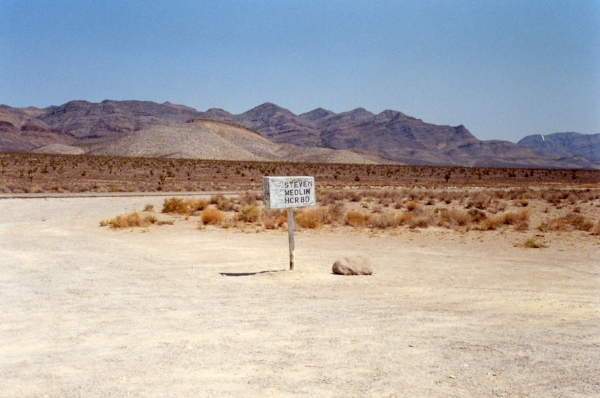
The White Letterbox, August 2002  © Andrew Stuttaford

The White Letterbox, August 2002  © Andrew Stuttaford

The famous "black mailbox" is, these days, white. It is battered, chipped, and covered with graffiti, but white, definitely white, not black at all — a suitable symbol for Area 51, a place where legend and reality never quite seem to match. To find it, drive north from Las Vegas into the Nevada desert, bleak and broiling at the time of my visit, blistering in the late August sun, an empty, strangely lovely place of dust devils, triple-digit temperatures, and massively overheated imaginations. Highway 93 will take you most of the way. Just past the supermarket at Ash Springs, turn left at the intersection onto that stretch of Highway 375 now officially (thank you, Governor Miller!) known as the Extraterrestrial Highway. No little green men, but a large green sign — decorated, naturally, with a couple of flying saucers — tells the visitor that this is no ordinary scenic route. This is a drive where it is wise to watch the skies as well as the road.

The mailbox itself is another 20 miles farther along. It stands, a solitary sentinel in the desert, just to the left of the highway. A dirt track heads southwest, to the mountains in the distance and, much nearer, to a far more formidable obstacle, the boundary of a vast forbidden zone: Area 51, the secret installation that some call Dreamland.

Area 51! The name follows the numbering pattern established for mapping the old nuclear-testing site that it, alarmingly, adjoins. The notoriety dates from that moment, sometime in the early 1990s, when America's interest in UFOs, never a field reserved solely for the sane, tipped over into outright mania — a mania exploited by the entertainment industry to create a series of movies and TV shows that simultaneously fed off, and fed, the narratives and obsessions of those who believed E.T. had come for real. The result was to create an echo chamber of the ludicrous, where fiction, fantasy, and (very rarely) fact bounced off one another to create ever-amplifying myth, paranoia, and pre-millennial speculation. For some, the story centered on the sweaty, delusional sexual psychodrama of all those probing, prying, prurient abductions; for others it was a blend of gearhead fantasy and conspiracy theory centered on a mysterious, lonely base baking in the Nevada sun.
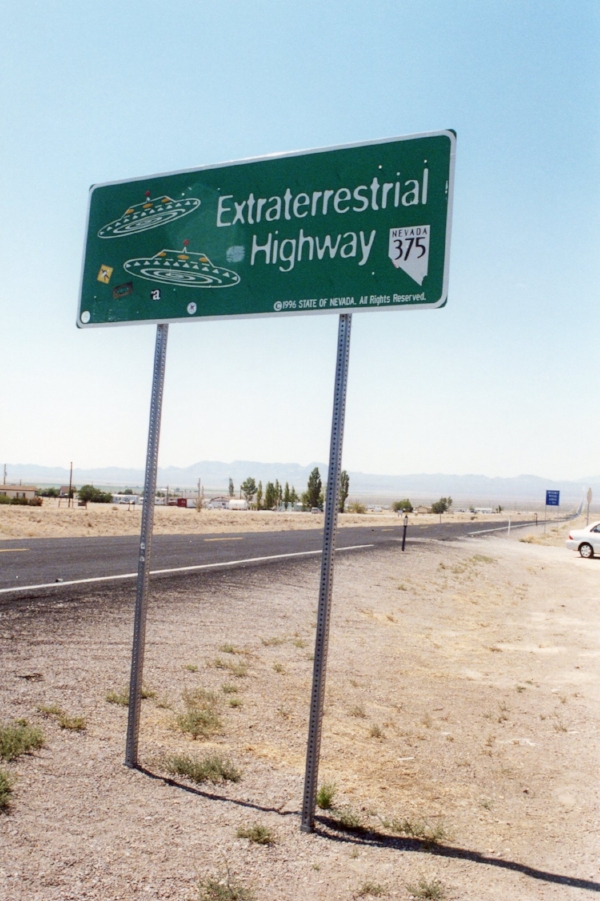
Extraterrestrial Highway, August 2002  © Andrew Stuttaford

Extraterrestrial Highway, August 2002  © Andrew Stuttaford

Area 51! It was a video game, a book (many, many books, actually, including Area 51, Area 51: The Reply, Area 51: The Truth, Area 51: Excalibur, Area 51: The Mission, Area 51: The Sphinx, and Area 51: The Grail), and a rap CD by the Body Snatchaz. It was the subject of sci-fi drama, numerous documentaries, frequent articles, and wild, wild rumors, all fed by tall tales and repeated sightings of lights in the sky — enigmatic, hovering, darting, pulsating, unexplained, all colors, all shapes, and, for the credulous, all meanings. It was, inevitably, a place where Mulder and Scully came calling and it was, only slightly less predictably, the base from which Will Smith and Jeff Goldblum saved the world in Independence Day.

Area 51! Depending on who you chose to believe, it was a top-secret testing ground for the U.S. Air Force, a treasure house of extraterrestrial technology, a morgue for little green (well, gray actually) corpses, or, more cheerfully, a facility (ever since a treaty signed with Eisenhower in 1954) for aliens who were still alive. More lurid still, there was talk of genetic experimentation, of ghastly unnatural cocktails of human and alien DNA, and of subterranean vats filled with body parts and other unknown horrors.

Subterranean vats filled with body parts? If that's not enough to put off uninvited visitors to Area 51, a locally produced pamphlet warns what the U.S. government will do to those who stray too close:

When you approach the boundary… there are signs on both sides of the road — Do Not Pass The Signs or you will be arrested on a charge of trespassing on the Nellis Bombing and Gunnery Range. The fine for a first offense is $600… You will see two tripod mounted surveillance cameras. You may also see guards in white jeep Cherokees or champagne colored Ford pick-ups watching you from nearby locations. As long as you do not violate the boundary, they have no authority to interfere with your activities. If you hike near the border — do not pass any of the orange posts that mark the boundary!

Well, that sounded like way too much trouble, the sort of challenge more suited to a fearless investigative reporter than to me. Craven and cautious, I rejoined Highway 375 and headed further west, to Rachel, Nev., home of the Little A'Le'Inn.

Little A'Le'Inn, Rachel, NV, August 2002  ©  Andrew Stuttaford

Little A'Le'Inn, Rachel, NV, August 2002  ©  Andrew Stuttaford

Rachel is a slight, scrappy settlement with a population of under 100 — an encampment more than a town, little more than a few trailers and a Baptist church dumped in the middle of the high desert plain. Except for the alien invasion just across the horizon, not a lot is going on in this burg. For entertainment, there's checking the readings on the radiation-monitoring station (a reminder of all those nuclear tests), hanging out at the Quik Pik convenience store, and, of course, the Little'A'Le'Inn (formerly the Oasis, Club 111, the Stage Stop, the Watering Hole, and the Rachel Bar and Grill), the Silver State's best-known intergalactic diner/motel, home of the "World Famous Alien Burger" ("served with lettuce, tomato, pickle, onion, and our Special Secret Alien Sauce") and notorious epicenter of Area 51 intrigue.

The diner ("earthlings," a sign says, are "welcome" — phew!) itself is impossible to miss. Alien figures peep out through its windows, and a tow truck is parked outside — a small flying saucer hanging forlornly from its hoist. To enter, go through the door invitingly marked "Notice — Cancer & Leukemia cases… Possible Compensation Available!" (another souvenir of those pesky nuclear tests) and you will find yourself in a large, low-ceilinged dining room with a pool table, a bar, and the biggest collection of alien ephemera outside the flea markets on Jupiter.

There are rubber aliens, plastic aliens, glow-in-the-dark aliens, inflatable aliens, gray, green, purple, and orange aliens, aliens in T-shirts, an alien in a dress, and mom, pop, and junior alien all sharing a comfortable chair. The walls are lined with more — alien yo-yos, alien cigarette lighters, alien ashtrays, alien sippy cups, alien guitar frets, alien playing cards, alien beer coolers, alien beer mugs, alien sunglasses, alien jewelry, alien key rings, alien refrigerator magnets, alien postcards, alien Christmas decorations, alien baseball caps — and the T-shirts, as countless, it seems, as the stars in the sky: "Area 51 — it doesn't exist and I wasn't there."

For more dedicated enthusiasts, there are books, magazines, pamphlets, videos (yes, that old autopsy film — again), and, lining the walls, those inevitable blurred, ambiguous pictures of lights in the sky that are always a feature of places such as these. And then there are the bumper stickers praising Newt Gingrich and attacking that hopeless man from Hope.

Gingrich? Clinton? There is a sense that this is a place that time may be passing by, that the Little A'Le'Inn may be becoming the Little A'Le'Out. Back in the 1990s, Rachel was a hotbed of alien activity (or, at least, the search for alien activity), complete with a research center/trailer (close to the Quik Pik) run by one Glenn Campbell (not to be confused with Glen Campbell — one "n," Rhinestone Cowboy). The town played host to UFO seminars, UFO Friendship Campouts, UFO technicians (supposed ex-Area 51 employee Bob Lazar — worked on alien technology, saw mysterious alien writing), Ufologists, UFO tourists, and, of course, Larry King. Yes, Larry King — UFO Cover-Up? Live From Area 51. You missed it?
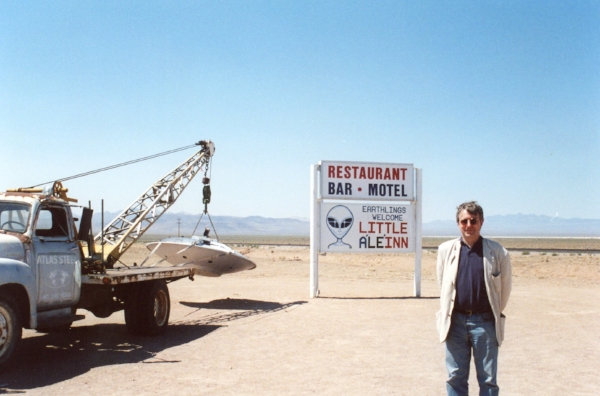
Rachel, Nevada, August 2002  ©  Andrew Stuttaford

Rachel, Nevada, August 2002  ©  Andrew Stuttaford

But that was then. The saucers will return, doubtless, to soar again over our popular culture, but UFOs, for now, appear to be going the way of the hula hoop, and it's going to take more than Spielberg's revealingly lackluster Taken (complete with Area 51 references) to bring them back. That's not to say that Rachel's visitors have been reduced solely to the ranks of the extraterrestrial. Some humans — true believers or just the curious — are still coming to scrutinize the skies, to peer at the base, and to dodge the fearsome "cammo dudes" who guard its perimeter. Others show up just to giggle, cheerfully buying the tchotchkes that celebrate a phenomenon in which they do not really believe.

The small group of diners at the Inn was mainly European, strangers in a stranger land, laughing as they chowed down on alien burgers and surveyed the alien kitsch. They had found their alien Graceland, a desert theme park of the absurd, another piece of exuberant Americana to treasure and to mock, a spectacle impossible to imagine in their own constrained, more sober continent. Gamely, a member of the Inn's staff told her story. She had, naturally, seen those "lights in the sky." That's not so peculiar in the vicinity of an air base where new planes and other hardware are tested, but no one seemed to mind.

It's telling that Glenn Campbell has moved on. They remember him with a smile at the Quik Pik, but the self-dubbed "Psychospy" has abandoned Rachel for cyberspace. According to his website, Area 51 is now a "has-been." The Research Center "has moved on to broader issues." And so has the U.S. The saucer frenzy of the 1990s was self-indulgence for safer times, play-acted paranoia suitable for an era when the country believed it had no real enemies. Now the adversary is visible, his strength, ironically, the product not of some highly advanced technological civilization, but of something almost more alien — a primitive, theocratic fanaticism that should have been buried centuries ago. Under these circumstances, talk of an extraterrestrial menace seems embarrassingly frivolous. Besides, nowadays most people rather like the idea of secret bases.

So long as they are on our side.

Prize Specimen

National Review Online, May 7, 2003

We will never know how many Ukrainians died in Stalin's famines of the early 1930s. As Nikita Khrushchev later recalled, "No one was keeping count." Writing back in the mid- 1980s, historian Robert Conquest came up with a death toll of around six million, a calculation not so inconsistent with later research (the writers of The Black Book of Communism (1999) estimated a total of four million for 1933 alone). Four million, six million, seven million, when the numbers are this grotesque does the exact figure matter? Just remember this instead:

The first family to die was the Rafalyks — father, mother and a child. Later on the Fediy family of five also perished of starvation. Then followed the families of Prokhar Lytvyn (four persons), Fedir Hontowy (three persons), Samson Fediy (three persons). The second child of the latter family was beaten to death on somebody's onion patch. Mykola and Larion Fediy died, followed by Andrew Fediy and his wife; Stefan Fediy; Anton Fediy, his wife and four children (his two other little girls survived); Boris Fediy, his wife and three children: Olanviy Fediy and his wife; Taras Fediy and his wife; Theodore Fesenko; Constantine Fesenko; Melania Fediy; Lawrenty Fediy; Peter Fediy; Eulysis Fediy and his brother Fred; Isidore Fediy, his wife and two children; Ivan Hontowy, his wife and two children; Vasyl Perch, his wife and child; Makar Fediy; Prokip Fesenko: Abraham Fediy; Ivan Skaska, his wife and eight children.Some of these people were buried in a cemetery plot; others were left lying wherever they died. For instance, Elizabeth Lukashenko died on the meadow; her remains were eaten by ravens. Others were simply dumped into any handy excavation. The remains of Lawrenty Fediy lay on the hearth of his dwelling until devoured by rats.*

And that's just one village — Fediivka, in the Poltava Province.

We will never know whether Walter Duranty, the principal New York Times correspondent in the U.S.S.R., ever visited Fediivka. Almost certainly not. What we do know is that, in March 1933, while telling his readers that there had indeed been "serious food shortages" in the Ukraine, he was quick to reassure them that "there [was] no actual starvation." There had been no "deaths from starvation," he soothed, merely "widespread mortality from diseases due to malnutrition." So that was all right then.

But, unlike Khrushchev, Duranty, a Pulitzer Prize winner, no less, was keeping count — in the autumn of 1933 he is recorded as having told the British Embassy that ten million had died. ** "The Ukraine," he said, "had been bled white," remarkable words from the journalist who had, only days earlier, described talk of a famine as "a sheer absurdity," remarkable words from the journalist who, in a 1935 memoir had dismayingly little to say about one of history's greatest crimes. Writing about his two visits to the Ukraine in 1933, Duranty was content to describe how "the people looked healthier and more cheerful than [he] had expected, although they told grim tales of their sufferings in the past two years." As Duranty had explained (writing about his trip to the Ukraine in April that year), he "had no doubt that the solution to the agrarian problem had been found".

Well, at least he didn't refer to it as a "final" solution.

As the years passed, and the extent of the famine and the other, innumerable, brutalities of Stalin's long tyranny became increasingly difficult to deny, Duranty's reputation collapsed (I wrote about this on NRO a couple of years ago), but his Pulitzer Prize has endured.

Ah, that Pulitzer Prize. In his will old Joseph Pulitzer described what the prize was designed to achieve: " The encouragement of public service, public morals, American literature, and the advancement of education."

In 1932 the Pulitzer Board awarded Walter Duranty its prize. It's an achievement that the New York Times still celebrates. The gray lady is pleased to publish its storied Pulitzer roster in a full-page advertisement each year, and, clearly, it finds the name of Duranty as one that is still fit to print. His name is near the top of the list, an accident of chronology, but there it is, Duranty, Times man, denier of the Ukrainian genocide — proudly paraded for all to see. Interestingly, the list of prizewinners posted on the New York Times Company's website is more forthcoming: Against Duranty's name, it is noted that "other writers in the Times and elsewhere have discredited this coverage."

Understandably enough, Duranty's Pulitzer is an insult that has lost none of its power to appall. In a new initiative, Ukrainian groups have launched a fresh campaign designed to persuade the Pulitzer Prize Board to revoke the award to Duranty. The Pulitzer's nabobs do not appear to be impressed. A message dated April 29, 2003 from the board's administrator to one of the organizers of the Ukrainian campaign includes the following words:

The current Board is aware that complaints about the Duranty award have surfaced again. [The campaign's] submission…will be placed on file with others we have received. However, to date, the Board has not seen fit to reverse a previous Board's decision, made seventy years ago in a different era and under different circumstances.

A "different era," "different circumstances" — would that have been said, I wonder, about someone who had covered up Nazi savagery? But then, more relevantly, the Pulitzer's representative notes that Duranty's prize was awarded "for a specific set of stories in 1931," in other words, before the famine struck with its full, horrific, force. And there he has a point. The prize is designed to reward a specific piece of journalism — not a body of work. To strip Duranty of the prize on the grounds of his subsequent conduct, however disgusting it may have been, would be a retrospective change of the rules, behavior more typical of the old U.S.S.R. than today's U.S.A.

But what was that "specific set of stories?" Duranty won his prize "for [his] dispatches on Russia especially the working out of the Five Year Plan." They were, said the Pulitzer Board "marked by scholarship, profundity, impartiality, sound judgment and exceptional clarity…."

Really? As summarized by S. J. Taylor in her excellent — and appropriately titled — biography of Duranty, Stalin's Apologist, the statement with which Duranty accepted his prize gives some hint of the "sound judgment" contained in his dispatches.

"Despite present imperfections," he explained, he had come to realize there was something very good about the Soviets' "planned system of economy." And there was something more: Duranty had learned, he said, "to respect the Soviet leaders, especially Stalin, who [had grown] into a really great statesman."

In truth, of course, this was simply nonsense, a distortion that, in some ways bore even less resemblance to reality than "Jimmy's World," the tale of an eight-year-old junkie that, briefly, won a Pulitzer for Janet Cooke of the Washington Post. Tragic "Jimmy" turned out not to exist. He was a concoction, a fiction, nothing more. The Post did he right thing — Cooke's prize was rapidly returned.

After 70 years the New York Times has yet to do the right thing. There is, naturally, always room for disagreement over how events are interpreted, particularly in an era of revolutionary change, but Duranty's writings clearly tipped over into propaganda, and, often, outright deception, a cynical sugarcoating of the squalor of a system in which he almost certainly didn't believe. His motivation seems to have been purely opportunistic, access to the Moscow "story" for the Times and the well-paid lifestyle and the fame ("the Great Duranty" was, some said, the best-known journalist in the world) that this brought. Too much criticism of Stalin's rule and this privileged existence would end. Duranty's "Stalin" was a lie, not much more genuine than Janet Cooke's "Jimmy" and, as he well knew at the time, so too were the descriptions of the Soviet experiment that brought him that Pulitzer.

And if that is not enough to make the Pulitzer Board to reconsider withdrawing an award that disgraces both the name of Joseph Pulitzer and his prize, it is up to the New York Times to insist that it does so.

*From an account quoted in Robert Conquest's The Harvest of Sorrow. ** On another occasion (a dinner party, ironically) that autumn Duranty talked about seven million deaths.

Turn Off, Tune Out & Drop Out: Do you know what week it is?

National Review  Online, April 23, 2003

TV-1.jpeg

If there’s one fashion disaster that has endured throughout the ages it is the hair shirt. There is something perverse about our species, a self-indulgent sense of guilt that makes us take rather too much delight in self-denial. Ever since the awful moment when the first caveman was hectored by the first Neanderthal nag, the killjoy has been a malign presence at our side, a preaching, prattling parasite condemning and chastising, perennially telling humanity what to do — always for our own good, naturally. The excuse for such interference used to be the Hereafter, the preservation of the immortal soul, the pitch to avoid the sulfur, fire, and brimstone. But we live in more secular times these days — and with the afterlife increasingly an afterthought, do-gooders are busily turning their attention to this life too. Health is the new holiness. Narcotics are a no-no, sex is “high risk,” boozers are losers, tobacco is a taboo, the Big Mac is a lawsuit, and, now, seemingly in a final insult, one of the last remaining pleasures, television — that flickering, fascinating window into countless different worlds, that most kindly of household appliances — is coming under savage attack.

Yes, April 21-27 is TV-Turnoff Week! Just days after televised images of toppled statues and desert heroics transfixed this nation, an organization calling itself the TV-Turnoff Network is advising us to switch off the tube for what could be a long, long week. In a press release issued, fittingly enough, on that annual hair-shirt holiday, April 15, the Network predicted that “more than seven million people will participate in over 17,000 organized Turnoffs in every state in the U.S., as well as numerous other countries.”

I don’t know about you, but there’s something about the idea of an “organized Turnoff” that sounds deeply depressing to me. A quick check of a list of the Turnoff’s supporters is enough to confirm that, despite some benign participants, its core is indeed a killjoy cabal. Signatories of a letter supporting the Turnoff Week include the American Medical Association and the American Heart Association, miscellaneous “advocacy” groups including “The Alliance for Childhood” (opposed to “test-stress” but, readers will be relieved to know, in favor of a “new national commitment to peace education”) and, inevitably, Hillary’s old chums at the Children’s Defense Fund, as well as an organization with a name — Shape up America! — that led to some unaccustomed exertion on my part: a shudder of fear as, slumped on the sofa, I hastily put down my drink and reached for the remote, desperate to find something, anything, that would push the thought of “shaping up” far from my mind.

Superficially, at least one of the points made by those who have signed that letter might seem to have some appeal: “Research demonstrates conclusively that turning off the TV boosts school performance. Federal studies show that at all grade levels, students who watch an hour or less of TV per day consistently have better reading skills than other students — and this disparity increases at higher grade levels.” Well, maybe, but after a moment of thought, it’s not hard to see that this argument muddles cause with effect. Brighter kids — or children with more actively involved parents — are far more likely than their dimmer brethren to look for intellectual excitement beyond the boob tube. The contrary notion, the idea that Jackass addicts will, once their sets have been switched off, turn to Dickens, Melville, and Hemingway for their thrills is, quite simply, absurd.

There is, of course, potential for serious discussion about how much television Americans, and particularly younger Americans, choose to watch; but that’s not what the Turnoff Taliban is really about. Look a little closer at what their supporters have to say, and it’s easy to see that their destination is Rodham County: “Watching less television also means less exposure to a wide array of antisocial behaviors, including violence, over-consumption and racial and gender stereotyping.” It’s not difficult to suspect that the Turnoff Network’s greatest objection is not to the medium, but to what they see as its message.

These folks choke over their lattes at what they call “commercialism.” In other words, they disdain the cheery excesses of American capitalism, the ceaseless, chattering parade of vulgar hucksters, relentless hustlers, and insistent ad men who play so important a part in the consumer capitalism that the Turnoff crowd so affects to despise. They look down on the greedy, grabby, gabby, glittering, energetic mess of a culture that has brought this country so much prosperity, and its people so much opportunity.

That’s an old — and familiar — form of snobbery. But these days, of course, the hair shirt comes mainly in green, and so it’s no surprise to discover that amid the alternative forms of entertainment proposed for TV-Turnoff Week is a celebration of the most dismal of all the killjoy carnivals — Earth Day (April 22). “Turn off the tube and go for a hike, help in a stream clean-up, or write a letter to a legislator about an environmental issue that’s important to you.” Help in a stream clean up?

Further suggestions carry less ideological freight and don’t, at least, involve waterproof clothing. They can, however, be just plain goofy — “Shakespeare’s birthday is traditionally observed on April 22 or April 23 (depending on your source). Take an evening and read some of his sonnets as a family, or act out a scene from a play.” Well, if it’s dad who has decided to deprive his wretched offspring of the joys of television, King Lear might be a selection to avoid. Other choices included in the Network’s list of “101 screen-free activities” include (and I’m not making this up) watching the clouds, looking at stars, and learning about native trees and flowers. And if watching the clouds, looking at stars, and studying native flora is not excitement enough, why not “make paper bag costumes and have a parade?”

As with most liberal campaigns, not only do “the children” play a prominent part in the Turnoff Network’s message, but so does a health threat — in this case, smoking’s most likely successor as national scapegoat: the pudgy menace of “obesity” currently waddling across the fruited plain and dooming us all to early, if substantial, graves.

Fear of fat already seems set to tarnish the allure of those infamous Golden Arches and may now, it seems, be used to cast a shadow over the simple pleasures of a night with Seinfeld. “More than one in four American adults is obese,” we are warned, and tiny tots, it appears, are no longer so tiny — “more than one in ten children is obese.” All is not lost, however. “Turning off the TV reduces sedentary behavior — because no other waking activity is as sedentary as watching TV — and can affect nutritional choices, as it means seeing fewer advertisements for high-fat, high sugar foods” — advertisements which we poor peons are, presumably, powerless to resist on our own.

Of course, the Turnoff is not intended to stop at a week. Those seven days are just a first step. Worse is to come. Parents are urged to “try and restrict viewing to a half-hour per day or one hour every other evening.” That’s an unnecessarily rigid approach which will not only succeed in isolating their children from much of contemporary culture — good as well as bad — but which also makes very little intellectual sense. When it comes to deciding what children should watch on TV, quality should surely be a more important measure than quantity, a notion clearly lost on an organization that, for bad measure, also recommends canceling your cable — thus banishing from the home even relatively educational programming, such as A&E and the History Channel.

And the TV-Turnoff Network even has plans for those of us who, despite all the dangers, persist with the tube. In its opinion, viewers need to be subjected to a little improving propaganda every now and then. In a recent filing with the FCC, the Network called on the Commission to “adopt a regulation that requires all TV broadcast stations to run periodic announcements throughout the broadcast week and in all dayparts [sic] reminding viewers that excessive television-viewing has negative health, academic and other consequences for children and that parents and guardians retain and should exercise their First Amendment right and ability to turn off their television sets and limit their children’s viewing time.”

That’s a pretty strange way to look at the First Amendment, but unfortunately I don’t have time to discuss it.

Buffy is on in a couple of minutes.

Lancers, Fusiliers, Rats...The ongoing glory of the British regiment

National Review, April 21, 2003

Iraq.jpg

WHEN the British, over 40,000 strong, arrived in the Persian Gulf they brought more than troops, hardware, support staff, and supplies. There was history, too, in their baggage. One need look no further than the names of just some of the units now deployed in the war—storied regiments with lineages that stretch back through the centuries, from Kuwait to Normandy, the Somme, the Crimea, and often far past. The Royal Scots Dragoon Guards (the successors of a regiment that served in Afghanistan, but in 1879-80) are in the Gulf for the war against Saddam, and so to pick out but a few more, are the Black Watch (whose battle honors include, ahem, a "'successful action" in Brooklyn. N.Y.. against one George Washington), the Life Guards (who first saw action in 1685), and that enduring symbol of Churchill's defiance and determination, the Parachute Regiment.

Each British regiment usually specializes in a specific type of soldiering. There are, for example, artillery, infantry, armored, and engineering (the "sappers") regiments—but when they go to war they are joined together in larger formations, "much like," a brigadier explained to me, "the way in which the different sections. woodwind, strings, and so on, are combined to make up an orchestra." This orchestra is one that often reprises the past: Much of the move across the sands towards Basra has been led by formations grouped together into the 7th Armoured Brigade, a unit that still wears the insignia of the "Desert Rat," that strange scrawny rodent that became a symbol of strange scrawny Monty's World War II triumphs in North Africa.

British history, it seems, is not ready to end quite yet. Who would have thought it? When, more than 20 years ago, the "task force," Margaret Thatcher's marvelous makeshift armada, returned from its Falklands victory to cheers, tears, and Union Jacks on the quayside, Brits were told that it was. at last, goodbye to all that. The curtain had fallen, chaps, and there was no time for an encore. The rascally, glittering, wicked, and glorious age of empire was finally done, finished, buried, and anathematized—exchanged for the obligations of a grayer, more sober era.

And so, it seemed, was the British military. The downsized heirs of Kipling's rough-and-tumble conquistadors were destined now for the shrunken campaigns of a mid-sized European power, fighting budget cuts at home, terrorists in Belfast, and boredom in West Germany as they waited, and watched, and waited some more for the Red Army that never came.

After the Wall came down, so did the money that the U.K. was prepared to spend on its military. A defense "review," carrying the sort of bland. vaguely threatening name—"Options for Change"—that is more McKinsey & Co. than Sandhurst, saw the size of the army reduced by a little under one-third; to not much more than 100,000 men. Regiments were merged or disbanded, often with startlingly little sentiment. To take just one example, the 16th/5th Lancers, a regiment with roots that stretched back over 300 years, led the way into Iraq in February 1991, yet within two years found its proud name on the scrap pile, lost in a merger with little patience for the past.

Yet, somehow, the past has endured, taught in every recruit's basic training and nourished by a system that is the British army's greatest strength: the regiment. To borrow the words of Field Marshal Wavell, "The regiment is the foundation of everything." The concept of the regiment stems from the fact that recruitment was once organized on a local basis, but its survival as an institution owes a great deal to one crucial psychological insight: Men may enlist to serve their country, but they will fight hardest to protect their friends. Most British soldiers spend their entire career within the same regiment—over the years it becomes their principal source of friendship, their clan., their community, almost a surrogate family.

This sense of community is intensified still further by the British army's perception of itself as a caste set somewhat apart from the rest of society. Currently the army is, as it has been for much of British history, made up entirely of volunteers. The notion of the citizen soldier has been rejected in favor of the creation of a smallish force of highly trained professionals. This professionalism is a source of enormous pride to the troops, something Donald Rumsfeld may have discovered if he paid heed to Sgt. McMenamy of the Queen's Royal Lancers in early March. After hearing misinterpreted reports that the defense secretary was considering either leaving the Brits behind or giving them a secondary role in the coming conflict, the sergeant (described by the London Times as an "intimidating figure") was quoted as saying: "We are second to none, so it's a bit cheeky to suggest we can't be trusted to fight in the front line." ("A bit cheeky," let's be clear, is a classic example of British understatement.)

Like any community, the regiment has its own institutional memory that, added to the shared experience of highly intensive training and active duty, binds together the current generation and develops a sense of collective identity far more effectively than abstract notions of patriotism ever could. Visit the head- quarters of a British regiment, and there will almost certainly be a museum dedicated to its past campaigns; dine in its officers' mess and you will, in all probability, eat amid the portraits and the heirlooms of those who came before—silver from India, perhaps, or a tattered banner from one of Napoleon's lost legions.

Even the regiments that have been merged or amalgamated away into bureaucratic oblivion still manage to live on in the souls of their successors. Take the Royal Regiment of Fusiliers, which is now with the Desert Rats in Iraq. Its men celebrate their regimental forebears—the Royal Northumberland Fusiliers, the Royal Warwickshire Fusiliers, the City of London Regiment, and the Lancashire Fusiliers—on four separate days each year (for Gallipoli, Normandy, Albuhera, and Minden). These honored ancestors are the insistent ghosts of countless past glories, and it would not do to let them down.

Today's warriors, the latest in a long line of British expeditionary forces, as they march through a dusty landscape not so different from the battlefields of Victoria's old empire, are fighting for the honor of their clan, for its past, and for its totems. For some of the men, a former captain in the Irish Guards told me, it's a little "like playing for a famous football team." And would a little scrap of cloth bearing the caricature of a rat really mean something to those who wore it? "Oh yes," he said. Another officer agreed, particularly for those who fought together as Desert Rats in the last Gulf War, but stressed that much of the attention on that famous rodent has been a media creation. a hook to catch the attention of the wider British public, to whom the name of Monty's legendary army will mean much more than the history of any one regiment.

But to the soldiers themselves, it is their regiment that counts the most—not the Desert Rats. It should come as no surprise that Lt. Col. Tim Collins of the Royal Irish, when he spoke to his troops about the conduct that would be expected of them as they prepared to fight in Iraq, chose to emphasize the duty they owed their regiment: Cruelty or cowardice, he warned, could "harm the regiment or its history." And nothing could be worse than that.

It's early yet in this war, but somehow I don't think that Lt. Col. Collins will he disappointed.

The President of the Left

National Review, March 24, 2003 

If there is anyone more sanctimonious than The West Wing’s Jed Bartlet. it's the moralizing old ham who plays him. But prissy, preachy Martin Sheen wasn't always this way. There were times, back in the depths of the wicked, whacked-out 1970s, when today's straitlaced star was a boozer, a three-packs-of-cigarettes-a-day man, and who knows what else. It was also the decade when he gave two of the greatest performances in the history of American cinema. As the restless, murderous Kit Carruthers, Sheen was an astonishingly convincing guide to the beauty, brutality, and strangeness of Terrence Malick's hypnotic Badlands. In Apocalypse Now, he took audiences on a different journey, this time deep into a heart of darkness so profound that it engulfed not only the character he portrayed but also, ultimately, Sheen himself.

The making of Apocalypse Now was—like the war it described—a chaotic, prolonged nightmare, with the tropical heat of its Philippines location only adding to the pressure on an actor "interiorly confused" and also busy partying far, far too hard. By the end of filming, Sheen had suffered a heart attack so severe that he was given last rites. But the "white light" that was, reportedly, a part of his near-death experience seems to have had an effect roughly equivalent to that more famous light seen on the road to Damascus. He cut back on the drink, reconnected with the Catholic Church, and. in the ominous words of a profile in the London Daily Telegraph, "took up politics." While his movie career seemed doomed never to regain its former heights (forget Damascus, the road from Apocalypse Now to Beverly Hills Brats can't have been easy), when it came to politics, Sheen shone.

He has opposed Star Wars (Pentagon, not George Lucas), excessive violence in movies (probably not George Lucas either) sanctions against Iraq, the proposed invasion of Iraq, and, a little belatedly, the Hiroshima and Nagasaki bombings. He's campaigned for the homeless, pacifism, migrant workers. Bill Clinton (a "hero"). Janet Reno (also a "hero"). Al Gore (heroic status unclear), animal rights, and the environmentalist movement. Gerry Adams, the murkiest of Northern Ireland's politicians, was yet another "hero." although there was to be some subsequent (rather muddled) backtracking. The Contras were not heroes. They were "obscene assassins." Cop-killer Mumia, on the other hand, is an "incisive critic of our criminal-justice system" and a "voice for the voiceless"— except, presumably, when they are murdered Philadelphia policemen.

His authority reinforced by the fact that he portrays a president on an upscale soap opera. Sheen uses celebrity status to push his causes (fair enough—it's our fault, not his, if we take an actor seriously just because of the roles he plays). But "Jed Bartlet" has not been his only taste of office, either on screen (he has played other presidents and at least two Kennedy brothers) or off. In 1989, Sheen was named honorary mayor of Malibu. Naturally, His Honor marked his appointment with a decree proclaiming the area "a nuclear-free zone, a sanctuary for [illegal] aliens and the homeless, and a protected environment for all life, wild and tame." Interviewed more than a decade later by Hispanic magazine. Sheen relived the moment with obvious pleasure;

"The reaction was what I kind of half- expected, and it wasn't favorable. I was considered a radical who sold out the city. It just shows you the power of words and the power of someone's convictions. It just scared the hell out of them."

Well, not really—it just shows that people don't like having a loopy mayor. But no matter; If Sheen had become a St. Paul, the rest of us were, to him, like so many Galatians, an errant people to be hectored, lectured, and generally harangued.

And that's the best way to understand his politics - as an extension of his deeply held religious beliefs. Sheen's political views may be wrongheaded, but, despite all the controversy, they are hardly that unusual. Yes, they show strong traces of what Sheen once referred to as the "radical way of the cross," a version of that 1960s Latin American "liberation theology" which in the end proved to be neither liberation nor theology (it's no surprise to discover that Sheen enjoyed a long friendship with those "activist" priests, the Berrigan brothers, both of them, you guessed it, "heroes"), but they are not so far removed from the more mainstream market-skeptical, leftish strain of thought often found within Catholicism. Even his vocal opposition to an invasion of Iraq (which has, most recently, included filming a commercial for Win Without War) looks less exceptional when seen in the light of the Vatican's obvious discomfort with the direction of U.S. policy in the region.

That said, so what? That Sheen's numerous crusades may have religious roots should not exempt them from criticism, nor should the fact that the actor is, by all accounts, "sincere." When it comes to an agenda like Sheen's, sincerity in and of itself is no defense.

His lawyers might wish it were. One of the hallmarks of Sheen's activism is the number of times he has been arrested, around 70 at the latest count, often carefully choreographed for photogenic spectacle, which might include, say, prayer (yet another Nagasaki protest, this one at Los Alamos in 1999) or, for real excitement, fake blood (Fort Benning, same year).

There is another way in which these martyrdoms have been a touch theatrical. None were likely to have serious consequences. Now that there's a chance that they might, Sheen has seemed to shy away. Following a conviction for trespass at a demonstration at Vandenberg Air Force Base, he is on three years" probation and is taking care to avoid the police, handcuffs, and the judiciary. As he explained to Newsday last fall, "If I get arrested for anything now, I go right in the slammer." The actor's taste for martyrdom clearly includes neither the big house nor the loss of hundreds of thousands in dollars from his appearances in Aaron Sorkin's fake White House (Sheen reportedly earns around $300,000 for each episode of The West Wing, not so much less than the $400,000 that George W. Bush makes for a year in the real thing), but it's telling that it has taken this, rather than any change of heart, to stop—at least until his probation expires—the seemingly endless run of arrests.

To get arrested once is unfortunate, to get arrested 70 times looks rather more like arrogance. We live in a democracy, a system that, for all its flaws, does offer a legal mechanism for peaceful change. It's called voting. But in a democracy no one, not even Barbra Streisand, always gets his or her way. Most people accept that they have, at least temporarily, to live under some laws with which they may profoundly disagree. In his repeated recourse to (let's be euphemistic) "direct action," Sheen appears not to—an approach that is, at its core, undeniably undemocratic. Sheen's justification would, doubtless, be that much-vaunted "morality" of his. It's a morality that may be commendable in the context of his private life, but applied in the public sphere, it has clearly led him to the belief that he is entitled to ignore the ground rules of a democratic society. In breaking the law to make a political point, he is, in effect, saying that his morality trumps your vote.

Revealingly, when the law and his own notions of what is right coincide, Sheen is only too happy to don the jackboots. For example, driven in part, doubtless, by one son's painful battle with substance abuse, he was a leading opponent of a California ballot initiative designed to allow certain low-level drug users to receive treatment rather than jail. That shouldn't be a surprise. Sheen is a zealot: a man so convinced of his own rectitude that, for him, any compromise becomes a sin. Needless to say, such moral absolutism usually comes with a profound disdain for the points of view of those who disagree—to Sheen, I suspect, their opinions count for no more than their votes.

And when it comes to disdain, Sheen wins the Oscar. For a man supposedly dedicated to Christian values of reconciliation and love, Martin Sheen has a very sharp tongue indeed. George W. Bush, he says, is a "thug," "dull," "dangerous," "a bad comic working the crowd," a "moron." and a "white-knuckle drunk" in denial about his past difficulties with alcohol.

There's not a lot of humility either. Interviewed last year by Time Out, the actor explained how his commitment to "social justice" had helped win him the role of Jed Bartlet:

"It gives the character a level of credibility that somebody who didn't take a stand on issues of social justice wouldn't have projected. And it isn't anything I've done overtly, it's just who I am. I cannot not be who I am, regardless of what part I am playing."

Translation: "My goodness shines through."

Spirits in the Sky

billy-meier81.jpg


Their cloning techniques may (or, more likely, may not) be cutting edge, but there's nothing particularly novel about the Raelians. That's true both literally (they have been around since the 1970s) and, ahem, spiritually — the wilder realms of UFO lore have long been filled with numerous cults, creeds, and true believers in salvation from the skies.

Distinguishing between all the varieties of alien enlightenment can be confusing. To use a possibly unfortunate word, "space" does not permit a detailed survey of what is on offer, so here's a quick guide to some of the players, with a handy comparison of certain key issues to help you choose the group best suited to your needs. NRO's dedicated team of in-house sensitivity counselors insist that the word "cult," with its pejorative connotations, be avoided, so let's just say that all these people have managed, at one time or another, to attract an enthusiastic following. All claims of alien contact have been taken at face value.

Before making your choice, here are some questions you might want to ask:

Should I go for an established brand?

Undoubtedly. We have selected four for your consideration.

The grandfather of galactic goodwill was George Adamski. Highly qualified in both bunkum (he founded the "Royal Order of Tibet" — in, naturally, California), and burgers (he ran a fast-food stand), Adamski's rendezvous with destiny was in 1952, the year he first met up with the likeable Venusian, Orthon. Subsequent highlights included a trip to Saturn and a number of best-selling books. Less successful than some in his field, Adamski failed to transform his saucer sorties into a more-lasting creed, despite claims of a mysterious meeting with Pope John XXIII. Adamski died in 1965, leaving behind a rich legacy of blurry photographs, wild tales, and entertaining conspiracy theories. His memory lives on at the Adamski Foundation.

A year or so after Adamski and Orthon first exchanged small talk (via hand signals and telepathy) Englishman "Sir" George King heard a voice telling him that he was to become the "voice of the Interplanetary Parliament." King was, apparently, "shocked by the implications of this statement" but rapidly came to terms with his new role, which included contact with a "Cosmic Master" known as Aetherius, also based in Venus, but not, strangely, an acquaintance of Orthon. Not long afterwards, "Sir" George founded the Aetherius Society, probably the first UFO-based religion. It's still in existence today after almost half a century, an impressive feat — the original Star Trek only lasted three seasons.

Nearly two decades later, it was Claude Vorilhon's turn. Following an encounter with a pint-sized alien exuding "harmony and humor," Claude, a French journalist, became the prophet Rael. His disciples, the Raelians, are now said to number 55,000 — not counting clones.

Aliens have even been seen in Switzerland, a sensible country generally better known for its banks than its cranks. Despite this, at least one of its citizens, Eduard "Billy" Meier, has been chatting to extraterrestrials for years. Matters really took off, so to speak, in the mid-1970s when Semjase, a sexy siren from the Pleiades, started allowing Billy to photograph her "beamships." It wasn't long before fame and Shirley MacLaine came knocking at Meier's door. The actress went away "amazed" and she wasn't alone. Meier admirers soon formed themselves into an acronym known as FIGU, an ambitious institution dedicated to the "worldwide dissemination of the truth" — under the circumstances a possibly self-defeating enterprise.

Will my new friends ask me to commit suicide?

Probably not, but the Heaven's Gate fiasco offers some useful hints for those wishing to avoid such unwelcome requests. References to human bodies as temporary "vehicles" are a bad sign. An unhealthy interest in plastic bags, sleeping pills, and vodka is even worse. Do not accept any offers of Kool-Aid.

Morks or dorks? How cool are their aliens?

The aliens featured in this survey all predate the Model E. T. standardized in the popular imagination by Close Encounters of the Third Kind. As a result they look more like inhabitants of this planet than Spielberg has taught us to expect. Billy Meier's Semjase, tall, slender, blonde, and blue-eyed, a space chick with more than a hint of Stockholm about her, is undoubtedly the coolest in this cosmic collection, but that's not saying much. Look at the competition. Orthon (one-piece brown leisure suit, red shoes) had no style and Rael's alien (four-feet tall) had no stature. It's difficult to draw any conclusions about the elusive "Cosmic Masters" favored by the Aetherius Society. They appear to believe that they should be heard, but not seen, and clearly prefer to communicate through human intermediaries.

Did the group's founder change or otherwise enhance his name?

This seems to be essential. Claude turned into "Rael," and Eduard became "Billy," a homespun, if not particularly Swiss choice, somewhat eclipsed by the names of Billy's kids — Gilgamesha, Atlantis-Sokrates, and Methusalem. Adamski was a "professor" and "Sir" George King discovered that a knighthood was not enough. He ended his career as both a "prince" and an "archbishop."

Should I worry if the group's founder looks a little weird?

No. Would-be recruits for these groups have much more-important things to worry about. Still, it's an understandable question when confronted with pictures of Billy Meier's beard (a Jehovah/ZZ Top mix) and Rael's topknot, which functions, reportedly, as an excellent antenna for extraterrestrial communication.

They may be nuts, but are they liberal nuts?

An important question for any regular reader of NRO and the answer, regrettably, is yes. Our alien friends often come across as Left-wing Democrats, particularly in their loopy environmentalism (insert Al Gore joke of choice here), welfare largesse, pacifist leanings, and hopelessly utopian worldview. Is it only coincidence that Jimmy Carter once claimed to have seen a flying saucer?

The current tensions in the Middle East are, naturally, a focus of concern. Rael, who has had an interest in the region for many years (there were long-standing plans to build an embassy for incoming aliens near Jerusalem) is opposed to an invasion of Iraq, and, if recent commentary published by Billy Meier's FIGU is any guide, so is Semjase. The "war-waging howling American, G. W. Bush" clearly has a major P.R. problem in the Pleiades, but Dubya's support elsewhere in our solar system remains unclear. Orthon hasn't been heard from for years, but a patchy Cold War record suggests that Adamski's spaceman would not be chummy with Rummy. That's no surprise. Orthon came from Venus, not Mars.

What will be expected of me?

This can vary, but it may be more than just cash. For example, members of the Aetherius Society are often busy charging "Spiritual Energy Batteries" (don't ask) and climbing the mountains first charged with spiritual power back in the heady days of Operation Starlight.

Raelians seem to prefer mounting to mountains. Their "sensual education" ("sensual education allows us to learn to take pleasure with our organs") may be as strenuous as an Aetherian hike, but it sounds like more fun. (For more on this topic, see Any chance of a date?, below).

Will I be cloned?

It's only the Raelians who are concerned with cloning. All life on earth is, apparently, the product of genetic engineering by an alien race known as the Elohim. The Raelians want to repeat the trick, but their cloning technology is optimistic, not mandatory.

I'm interested in one of these groups, but has it ever suffered any embarrassments?

You're considering signing up with one of these groups and you are concerned about embarrassment? That's like being worried about the beard and the topknot. The answer to this question ought, of course, to be yes. These beliefs are the superstitions of a technological age. They are often attached to highly specific "scientific" claims, which have a nasty habit of being subsequently refuted. The Raelians might be about to run into this difficulty very shortly. However, such moments tend to turn out to be less of an embarrassment than might be thought. To take one analogy, many religious sects have a long tradition of forecasting the end of the world on a specific date — only to see that day pass by without apocalyptic incident. They then continue on as if nothing had happened, which indeed it hadn't.

In similar vein George Adamski was unperturbed when shown the first photographs (taken by the Soviet lunar orbiter — Luna 3) of a bleak and lifeless dark side of the moon (a place where this most curious George had earlier claimed to have seen trees, cities and snow-capped mountains). Adamski simply denounced the pictures as fakes, a subject on which he was something of an authority, and stuck to his stories of those handsome folk from Saturn, Venus and Mars. In this field, ordinary notions of embarrassment do not seem to exist.

Despite this, the Aetherius Society has been more cautious:  "People on Venus, Mars and the other planets in this solar system are living on higher vibratory planes and even if we go there we will not see anybody unless they decide to make themselves visible to us." 

Disprove that.

Any chance of a date?

That's hard to say. When it comes to sex, no sects are the same. Nineteenth Century Christianity included the Shakers (celibate) and the Oneida Community (not at all celibate). The same is certainly true in the UFO sphere. The best bet for space-age swingers? Probably the Raelians. They seem to be up for pretty much anything. This has led, naturally, to stern criticism in NRO but it may explain why the Raelians were always more successful in attracting recruits than the determinedly asexual (some devotees even chose to be castrated) Heaven's Gate.

Conclusion

Are you now bewildered, lost, and completely confused? Has your mind now been filled with useless "knowledge"? Excellent. You are now ready to make your choice.

The truth is out there.

Chick-Tac-Toe

National Review, December 23, 2002

Las Vegas, August 2002  © Andrew Stuttaford 

Las Vegas, August 2002  © Andrew Stuttaford 

MOST people go to Las Vegas for the gambling. Dazzled by neon, crazed by greed and Wayne Newton, they challenge the odds, trying to outwit the trickster goddess, Lady Luck herself. But I was there for a different, wilier adversary. I was in town for the chicken. It was payback time, a chance for the revenge I'd seen waiting for since that shameful, sultry night in Manhattan's Chinatown all those years ago. You know the sort of evening—too much Tsingtao, not enough sense. Next thing, you're in a seedy airless room doing something you shouldn't: in my case, playing a chicken at tic-tac-toe—and losing. Years later I tried to track the bird down for a rematch, hut it had flown the coop: dead in a heat wave, said some, off hustling in another hutch, said others. And then the rumors began—whispers about tic-tac-toe-playing poultry spotted in Atlantic City, claims of sightings in Indiana and Las Vegas, reports of the theft of three uncannily smart birds from a county fair in Bensalem, Pa. And always there in the background, a muttered, mysterious name: Bunky Boger.

The stories are true. A slick chicken is back on the scene, hut this time it's not alone. Chickens skilled in tic-tac-toe have come home to roost in no fewer than three locales—all of them casinos (and two of them called Tropicana)-— while others, avian carny folk, work the county-fair circuit, usually without being stolen. The source of this scourge? Bunky Boger. Turns out he runs a Springdale, Ark., farm known for training animals to perform the feats some call remarkable and others just plain peculiar. Bunky's brainy brood docs not stop at the O's and the X's. According to the Philadelphia Inquirer, these chickens dance and play basketball too.

NATIONAL REVIEW's budget for investigating strange tales from Arkansas has shrunk over the last couple of years, so I can't claim to have checked Boger's methods. There's talk, however, of "positive reinforcement" (basically the use of food as a reward) and other behaviorist techniques of the sort developed by the psychologist B. F. Skinner. Broadly speaking. Skinner saw personality as a blank slate, pliant and ripe for conditioning. This is an idea that played no small part in the disasters of 20th-century collectivism, but it seems to work well when applied to chickens. Far mightier than the Mighty Ducks, Boger's chickens are tricky to lick. Recorded defeats are few and hit between; just a handful this year, so rare that the two Tropicanas (Atlantic City and Las Vegas) are prepared to offer $10,000 to any customer able to take on the chicken, mano a claw, and win.

Ten thousand dollars? That's not chickenfeed. Maybe I was counting chickens before they were dispatched, but revenge, it seemed, was going to be profitable as well as sweet.

Outside the Las Vegas Tropicana, all is anticipation. Large signs proclaim the "Chicken Challenge—Play Tic-Tac-Toe With a Live Chicken." A poster shows a chicken contemplating a tic-tac-toe Götterdämmerung. The creature's blue eyes (contacts?) are bulging with tension. It's sweating pullets. Good.

Las Vegas, August 2002  © Andrew Stuttaford

Las Vegas, August 2002  © Andrew Stuttaford

Once you're inside, there is a brief detour for paperwork (tackling the chicken is free, but prospective foes of the fowl have to sign up beforehand for the casino's optimistically named "Winner's Club") and then it's on to the main event, first heralded by a glimpse of white feathers fluttering in a large, glass-fronted booth and an amazed Italian muttering, "Pollo? Un pollo?

A crowd has gathered behind the velvet rope, would-be contestants (around 500 over a twelve-hour day) looking for- ward to the game, and, less admirably, spectators waiting to jeer. It's a tough arena. Be felled by the fowl, and the display attached to the booth will declare your shame for all to see with flashing lights and an announcement of the result ("Chicken wins"), followed by insulting slogans ("You're no egg-spert" is one of the milder examples). The crowd is no kinder. The losers slink off amid mocking laughter, crushed and beaten-—well, a little embarrassed anyway.

And then it's my turn. I step up to the booth, staring fiercely at the chicken. It's time for some psychological warfare. The creature gazes back imperturbably. Is that intelligence I see in those beady black eyes? Is it a brainy bird or merely bird-brained? Mr. Boger seems unable to decide. In a confusing interview with the Las Vegas Review-Journal, the Springdale Svengali boasted that his chickens were "smart little peckers" but then, in a disloyal twist (did a cock crow three times?), he went on to condemn them as "kind of simple-minded." "You wouldn't," he said, "want to take their advice on the stock market"—which, if New York attorney general Eliot Spitzer is to be believed, would put the chickens on a par with a number of Wall Street's leading investment banks.

Simple-minded or not, my chicken moves away from the glass window of her booth and heads at a leisurely pace into a more secluded area, a "thinking" booth within the booth. Suddenly the chicken makes its choice (the bird always gets to go first). An O appears on an illuminated touch screen, together with the information that I have 15 seconds to respond. And so I do. X. My opponent operates under no such time constraints. As the seconds drag by, the display flashes up the words "Chicken's thinking," this contest's equivalent of the annoying little hourglass that always accompanies those slower software moments. There are, of course, some skeptics, wild-eyed folk—Chicken Challenge's Capricorn One crowd. They whine that the bird is a fake, a feint, fowl play at its worst. The thinking booth, they claim, is nothing more than a device to hide the fact that the chicken does nothing—its "moves" are all the work of a pre-programmed computer. Is there a HAL in the henhouse, an updated twist on "The Turk," that supposedly chess-playing automaton once famous for puzzling 18th-century Europe.' I prefer not to think so.

The Tropicana, Las Vegas, August 2002  © Andrew Stuttaford

The Tropicana, Las Vegas, August 2002  © Andrew Stuttaford

O, X, O. As the game progresses, it becomes clear that it's too soon for the chicken to crow. The hen tenses. At one point a move is preceded by a savage, primeval display. Wings beat, and that noble head turns towards me, cruel, merciless, and proud. It's a chilling moment. The chicken, like all birds, is descended from the dinosaur. Could the Tropicana be transformed into Jurassic Park?

Well, no. An O and an X or so later, and the game draws to its close. It's a tie. The chicken acknowledges the result with a curt nod and turns away, ready for the next challenger. I walk off, honor satisfied, but true revenge for the Chinatown fiasco remains elusive. Next stop, Atlantic City.

In conclusion, it's important to point out that, in keeping with NATIONAL REVIEW’s policy, no birds were harmed in the writing of this article. PETA, however, has complained about the Chicken Challenge, and a representative of the chicken activists at the Virginia-based United Poultry Concerns condemned the whole spectacle as "degrading" and "derisive." Judging by the Las Vegas setup, that seems harsh. The Chicken Challenge booth is relatively spacious and housed in an air-conditioned environment. There's food and water inside. What's more, according to a spokeswoman from the Tropicana, no one chicken has to play for more than about 90 minutes at a time. The booth is manned—if that's the word—by chickens drawn from a squad of 15 (all known as "Ginger"). Each Ginger is regularly rotated but never, apparently, rotisseried.

Bunky Boger himself seems untroubled by the controversy. As he explained to the Review-Journal; "A chicken would rather play tic-tac-toe than float around in a can with noodles."

Find me a chicken that could argue with that.

Gas-Mask Chic: Dressing for Armageddon

National Review, September 30, 2002

Gas-Mask-On-A-Man-With-A-Rifle.jpg

For reasons that need, sadly, no explanation, we find ourselves living in a nervous, uneasy era, a time when every backfiring car becomes a bomb, every spilled sachet of sugar a plague. Once again, an enemy is out there, but the threat now is not the familiar Soviet-style Armageddon, but the occasional hit-and-run, jihad on the installment plan, which although revoltingly vicious, should, with luck— and preparation—leave most of us unscathed. Preparation? Back in the Cold War years, that never seemed necessary. Mutually Assured Destruction meant that the threat to civilians was both minimal and total. Now attacks seem certain, but the odds of survival are good. Still, with homeland security in the hands of Tom Ridge and Norman Mineta, it may be wise to improve on those odds—and that's just what many Americans are starting to do. In the immediate aftermath of the terrorist strikes some stores saw a surge in demand for guns and televisions, a good first step, but then what?

In Gotham, where I live, New York magazine tried to help out. Its "Survivalist's Guide to Living with Terrorism" offered a series of spooky lists, tailored (of course!) to income level. Silk-stocking survivalists were told to get ready for a designer doomsday with equipment that included a Maxa Beam searchlight ($1,687), Altec suspension expedition backpacks ($329), Eagle Gear "War Bags" ($195), Mobiflex portable shelter systems ($2,700), a Sea Eagle HSR sport boat ($3,200), and, to keep the irradiated rabble at bay, two pneumatic Tasers (priceless). Poorer folk were expected to make do with rather less. Recommendations for Archie's bunker included candles, Ziploc bags, and (don't ask) kitty litter.

Missed that issue? Never mind, there's always the Internet. With its themes of menace, conspiracy, government ineptitude, and the chance to make a buck, the current crisis may be the web's finest hour. And why not? As is pointed out at www.gammascout.com (home of the "Gamma-Scout" radiation detector), "government can only do so much." Indeed. At www.gasmasks.com they avoid talk of politics and get straight to the point: "Do you really want you, your spouse or your children to go through life with breathing disorders or scarred flesh from 3rd degree burns, or worse? It's just not necessary." Well, it you put it that way . . .

So where to begin? With the threat of NBC (nuclear, biological, and chemical) attacks, we are now being offered carnage a la carte. I'll start with the nukes, but first, a disclaimer. As trial lawyers, like cockroaches, will undoubtedly survive the worst that bin Laden can throw at us, it's necessary to say that neither NATIONAL REVIEW nor I am endorsing—or condemning—any of the products mentioned in this survey, which is, I should add, about as comprehensive as this nation's airport security. Full disclosure: My own supplies include a radio, bottled water. Red Army-designed flashlights, a .357 Magnum (Tasers are for wimps), Cipro, potassium iodate, and cans of some nasty-looking beans (my wife is a vegetarian).

Now, back to the nukes. If a nuclear device explodes on top of you, there's not much to be done, but in the case of a dirty bomb, or a more conventional nuke that has gone off at a somewhat safer distance, there are some useful steps that can be taken. First swallow a pill. Fallout will contain radioactive iodine, something that is not only highly carcinogenic, but also thrilling fodder for the thyroid, a gluttonous gland, always greedy for a little more iodine, radioactive or otherwise. Greed, though, can be good: An effective defense against this menace comes from preemptively swallowing "clean" iodine, which should ensure that the duly sated thyroid has no room to absorb any iodine that glows. My own iodine stash comes in the form of potassium iodate pills from www.medicalcorps.org. I'm not convinced there's a huge distinction, but at www.nukepills.com they're selling "FDA-approved" potassium iodide ("different spelling, different drug").

After pills, pillboxes. Those wanting their own purpose-built shelters should check out www.disastershelter.com, but the homes in this line may be of limited use in Manhattan—some of these constructions are rather larger than the average apartment. Helpfully, at www.disastershelters.net (no relation) guidance is given on how to design a better-than-nothing shelter (the euphemism is "expedient") for the real-estate-starved or the simply improvident. One suggestion is to huddle under a table in a basement with "two feet of books or other heavy objects . . . placed on and around the table." Anything by Bernard Lewis should work particularly well. For those who have forgotten their kitty litter, "a 5 gallon bucket with plastic bags could be used for sanitation."

But what exactly would you be sheltering from.' Fallout is see-through, and if you want to see it through, some sort of radiation meter will be essential. But be careful. At the cheerfully named www.planetwide-exodus.com, they warn, accurately enough, that many Geiger counters now on the market were designed for geological research and "cannot handle" the amounts of radiation that would be produced in the aftermath of an attack, which is something they may have in common with us humans. The uncomfortably frank realists at www.homelandprotection.net are offering the Raditect: "the first Gamma Radiation Detector designed for home and office use" for those "nuclear emergencies that would present a long-term health risk, not immediate annihilation." Despite its promising name the focus at www.geigercounters.com seems to be on products for a more sedate era, including the "Inspector," which is, apparently, suitable for "applications requiring higher levels of sensitivity such as checking food for radioactive contamination." Forget food. What about me? At www.twotigersonline.com, there's a "pocket dosimeter" (in essence a personal nuclear odometer) designed to tell you just how irradiated you really are.

If the assault is biological rather than nuclear, coping may be a lot less work. We are already tragically familiar with the effects of anthrax, but conventional medicine—often antibiotics—will usually be able to deal effectively with most biological threats. If you have problems getting hold of antibiotics, www.tetrahedton.org ("an educational corporation" that deals with "health science and government cover-up[s]”) seems to be recommending a rummage through the feedlots. But with supplies of Advance Calf Medic (a possible source of oxytetracyline) being as scarce in Manhattan as a barnyard and a pitchfork, your HMO might, for once, be a better bet.

More practical, if a little unsentimental, are the folks at Gasmasks.com, the compassionate conservatives of viral Armageddon. Their "Biological Survivors Caring Kit" is a complete head-to-toe outfit for someone who doesn't want to get too close: It's something to wear "while caring for a loved one contaminated with a deadly virus, so the caregiver cannot get infected."

Mention of Gasmasks.com raises the question of chemical attacks, the third pony of bin Laden's bargain-basement apocalypse. Comfortingly, some of the protective gear against this threat may be of use against N and B, as well as C, but be sure to watch out for gas-mask grifters. At www.homelandgasmasks.com, there's dark talk of the older (and often foreign) military-surplus masks being offered to "unsuspecting Americans." You can see a few of them (masks, not unsuspecting Americans) at www.approvedgasmasks.com with its rogues' gallery of gas masks fit only for use as a "Halloween costume or conversation piece," a list that includes the Russian M4I Aardvark. From the look of it, you will die laughing long before the gas gets to you.

Approvedgasmasks.com also boasts a wide range of hopefully more effective devices: the Scott ProMask, the SGE 1000, the SGE 400se, the MSA Advantage 1000, the MSA Advantage 3000, the MSA Night Ranger (lens resistant to shrapnel!), the MSA Ultra-Twin, and the M-95 Military. If that's too much to choose from, try the narrower selection at Homelandgasmasks.com (Panoramic Visor, Economy, and, for the kids, the Junior). Fashionistas will appreciate the different colors available at Gasmasks.com: neon yellow, midnight black, or, for the tactless, cobalt blue.

Of course, most such masks are somewhat bulky and difficult to carry around, at least without raising a few eyebrows. In preparing to save your life, you might well lose your job. At www.gasmasks-usa.com, they have a solution for this, a compact "Quick Escape Mask." This may buy just enough time for you to parachute out of your building (www.aerialegress.com), swallow your pill, grab your "One Person Tote N Go Survival Kit" (from www.areyouprepared.com—comes complete with emergency poncho and nine towelettes), and head for the hills, or, possibly, that book-lined table.

Once in the hills, thoughts will turn to longer-term survival. True pessimists will have bought the $6,320 Super Pak (one year, two people, 344 cans, one can-opener) from www.healthywealthyandwise.net. The state of kitchen facilities will, of course, be uncertain, but that won't worry purchasers of "super fresh, super tasting" MREs (Meals Ready to Eat, including country captain chicken, Jamaican pork chop, and many others) from Two-tigersonline.com. Cooking instructions include placing the unopened pouch "inside your shirt, allowing your body temperature to help warm the food inside."

That's the spirit: determined, dauntless, and a little bit daffy. Al-Qaeda doesn't stand a chance.

A Fundamentalism of Their Own: With the Atheists in Boston

National Review, February 6, 2002

On Good Friday, when others were in church, I visited an atheists' convention. Choosing to hold the gathering—the 28th National Convention of the American Atheists—over the Easter weekend was, their president explained, not much more than a matter of favorable hotel rates. Ellen Johnson smiled as she said this: It was not a claim that a skeptic would expect anyone to believe. So America's infidels gathered in their doubters' redoubt, a nondescript Hyatt on the grounds of Boston's Logan airport, transformed for a few days into a heretic Vatican. Around 250 souls (maybe that's not the word) had turned up for the fun, typically bright, somewhat eccentric sorts, often with the style sense of faculty members at a failing community college. Guys, shoulder-length hair does not work with bald on top. Oddballs? Well, the affable man sitting next to me did spend a surprising amount of time busily crossing out the word "God" from his dollar bills. Cranks? Judging by the pamphlets on display outside the main auditorium, quite possibly, although, to be fair, I did not witness anyone actually picking up a copy of The Unpleasant Personality of Jesus Christ.

It was not, it has to be said, a conservative crowd. Mentioning George W. Bush in a speech was better for jeers than for cheers. I did run into one likable rightist. “National Review, eh? There aren't many of us here." Not that it worried him. As a nonbeliever from the South, be was used to being in a minority', and he was enjoying the opportunity' for a little secular chitchat. Why the atheists? Well, the humanists were "just too touchy-feely." He had a point. Apart from one appalling moment when a hunched-shouldered woman whimpered that she was "afraid," there was none of the mush-'n'-gush that so often mars public gatherings nowadays. Refreshingly, too, there was little talk of "the children," although the enthusiasm that greeted the recital of an essay on school prayer by the young daughter (she's against) of an atheist from Alabama (so's he) had more than a touch of the Laura Bush about it.

That isn't to say that emotion was not on display. This was not a gathering very typical of the roughly 10 percent of all Americans who have no religious faith (a larger group than Jews, Muslims, Lutherans, or many others). For the most part, such secular folk keep their concerns to themselves. They are, spiritually speaking, part of the Leave Us Alone coalition, indifferent to theological controversy and free from transcendental torment. The Hyatt's heathens were made of more awkward, angrier stuff.

Given their background, that's not surprising. American Atheists is the organization (it has fewer than 5,000 members) founded by the "most hated woman in America," Madalyn Murray O'Hair, whose litigation brought an end to organized school prayer. She was a famously confrontational character, and even today her successors are a touch irritable. Contrary to rumor, there are no horns on their heads, but watch out for the chips on their shoulders. These are the Wahhabis of atheism, disbelief's true believers. Oppressed by their sense of oppression, they also show signs of succumbing to the temptation of that most pernicious of contemporary cults, the cult of the victim.

There were tales of social anxiety, embarrassment, and snubs, regrettable certainly, but hardly the Inquisition. In listening to the anguished protests against trivial slights, it was difficult to avoid the conclusion that this was a group that had lost all sense of proportion. On September 11, the United States was subjected to murderous assault at the hands of religious extremists. In addition to the carnage, bin Laden's war represents an attack at the ideological and spiritual level: It is a challenge to the West and to its enlightenment. Hog-tied by the pieties of multiculturalism and constrained by a perceived need to appease Muslim "allies," this country has proved incapable of mounting an intellectually effective response. If ever there was a moment for a clear, sensible leadership from supporters of the secular, it is now.

Judging by their convention, however, this is not something that we can expect anytime soon from America's atheist activists. In discussing the aftermath of 9/11, the convention's focus rested not on Islamic fundamentalism but on safer, stupider topics, grotesque in their self-indulgence and irritating in their irrelevance; the iniquity of "God Bless America" (the G-word is, apparently, a problem in a national song) and government's supposedly disgraceful role in the use of religion to comfort a wounded nation. The overthrow (by the reviled George W. Bush, no less) of a real theocracy, that of the Taliban, barely rated a mention. In their obsession with wicked old Christianity, these atheists seemed to be lost in yesterday's struggle. They were ready to fight the Kaiser, but it is Hitler who is now in town.

There were, it was true, a couple of lectures that dealt with the threat from Islamic extremism. The first, on "holy terror," had the merit of making the point that there was a need to defend and to promote Western culture, a rare assertion in contemporary America. The second was a talk by "Ibn Warraq" (prudently, he uses a pseudonym), the author of Why I Am Not a Muslim, a book with a title and theme echoing that of Bertrand Russell's Why I Am Not a Christian.

Brought up a Muslim on the Indian subcontinent, Mr. Warraq is a slightly old-fashioned figure, a shabbily genteel man with more than a hint of India's mid-20th-century intelligentsia about him. His talk (blunt in language and sharp in logic) was a fascinating analysis both of the roots of Islam and of its association with today's religious violence. How accurate it was, I'm not expert enough to judge, but it is worth remembering that Lord Russell never had to conceal his real name. Certainly, in its analytical and textual rigor, Ibn Warraq's lecture was a considerable improvement on the patronizing sugarcoating that usually passes for discussion of Islam, the "religion of peace."

Revealingly, though, the time dedicated to these two talks was no greater than that allocated for slapstick: a presentation on religious kitsch ("Bibleman" has, appropriately enough, so far as skeptics are concerned, to be seen to be believed) and a guide to some of the more demented Christian websites. Both these lectures were amusing enough, but the emphasis placed on them suggested an audience more comfortable with taking cheap shots than concentrating on what really matters. A talk on the cloning controversy revealed the same flaw. The opportunity for serious argument was lost in the course of an endless joke involving foreskins, nuns, and a hermaphroditic divinity. The joke wasn't funny and, in the context of a convention of atheism, was about as shocking as a striptease in a brothel.

It was also a wasted opportunity, but perhaps this was at least partly inevitable. Any convention, unless choreographed by Elizabeth Dole, is bound to include some partisan entertainment to rally the troops. Nevertheless it was a shame. There is a need for a more frank discussion about those areas where the dictates of religion and the requirements of science come into conflict, but such a happy moment seems a long way off. After all, even debates between faiths are off-limits these days, deemed too tricky for our era of moral relativism and exquisite PC sensitivity. The virtue of good judgment has been turned into the vice of "judgmentalism," and we live with the result: an era of religious hucksters and New Age nonsense, a time of woolly thinking when no distinction is made between the writings of St. Augustine and the babblings of some two-bit West Coast Wiccan.

Could atheism be an antidote? You do not have to be a nonbeliever to see that its theoretically rational philosophical method could play a part in restoring notions of reason and objectivity to a society that regards both with suspicion. It the Boston atheists are any indication, however, you do have to be an optimist to think that this could happen. Fundamentalism, it was obvious that weekend, does not depend on a god.

Still, here were times when the convention showed what could be. There was Mr. Warraq's talk, for instance, and, perhaps most striking of all, a lecture by Michael Cuneo, a professor from New York City, an expert on delusions of devilry, and those who prey upon it. In an amusing presentation, he spoke of ceremonies that combine the best of The Exorcist with the worst of Elmer Gantry. This was skepticism at its good-humored, informative best, an inspiration, one would think, to the Hyatt's godless horde. But there was one small irony.

Prof. Cuneo teaches at Fordham, a Jesuit university, and, yes, he's a Catholic.