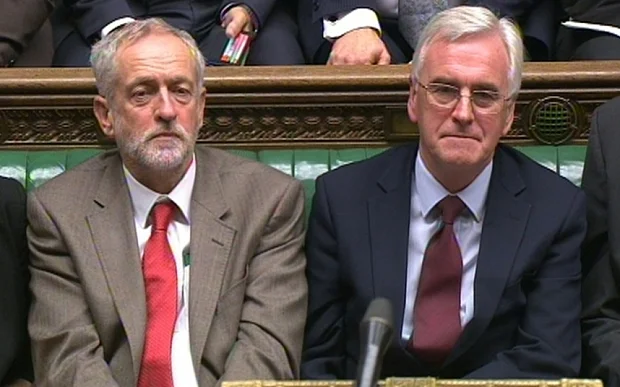
Time has let Corbyn off the hook

Corbyn Adams.jpg

Talk of contacts with Czech Intelligence has generated some entertaining headlines but it hasn’t done Jeremy Corbyn much harm. According to a YouGov poll, only eight per cent of voters think less of him. Nearly two-thirds (some of whom, I suppose, may have already thought that he was a Commie spy) are apparently left unchanged in their opinion and six per cent seemed somewhat impressed. We shouldn’t be surprised. The unelectable, unthinkable Corbyn swept to the leadership of the Labour Party and then led his unelectable party to an almost unthinkable result in the general election. Nearly nine months later, this unelectable party is ahead at the polls: a lead that has grown since Jan Sarkocy started to reminisce.

We do not know what, if any, Cold War skeletons may yet emerge from Corbyn’s cupboard, though it should be stressed that there is, so far, no convincing evidence that he was recruited as an agent or did anything other than have meetings with a representative of a foreign government. But even if there were to be any revelations, it’s difficult to see what difference they would make. After all, there are horrors enough out there as it is: they range from Corbyn’s involvement with (let’s be polite) Irish republicanism to a politically and psychologically disturbing series of fanboy infatuations with thugs, goons and hard men overseas. That some of them are on the hard Left is unsurprising, given Corbyn’s always adventurous interpretation of “democratic” socialism, but it says something – and nothing good – that others appear to be united by little more than their distaste for the liberal West, a liberal West that includes the country that Corbyn would like to lead.

Corbyn, secular and socialist, has praised the revolution that led to Iran’s klepto-theocracy. He once called for “political compromise” with ISIS, and has marched rather too closely in step with a Kremlin that in reality, if not always in imagery, has long since left the red flag behind.

Large numbers of Labour voters are aware of at least some of this, and quite a few are aware too that there is plenty more – hatred of Nato, say, or a degree of sympathy for Serbia’s Slobodan Milosevic – bubbling in the sewer from which Corbyn’s enthusiasms emerge. Yet they still vote for him and his party. They would thus be unlikely to be too concerned by accusations of Cold War skullduggery from over 30 years ago, even, I suspect, if it turned out that “Agent Cob” had handed the Czechs some gossip he felt might speed up the march to Utopia.

Such insouciance is a worry, but not much of a mystery. To no small extent, Corbyn has been let off the hook by nothing more complicated than time. It’s been more than three decades since his alleged Czech encounter, and, for that matter, since he invited two convicted IRA terrorists to a meeting in parliament shortly after the Brighton bombing. The Troubles were ended by the Good Friday agreement and the Cold War by the collapse of the Soviet empire. Memories of both conflicts have faded and so have the passions they once aroused. Time can be too good, and too forgiving, a healer. It is also an accomplished gravedigger. Many of those able to understand the significance of Corbyn’s past behaviour are no longer around to explain.

Later generations have been taught a version of the past that has also been helpful to Corbyn. The Left won the history wars: Corbyn’s Irish entanglements are often excused, with more success than his contemporaries might have expected – or the IRA’s victims deserved – as freelance peacemaking. His embrace of socialism’s rougher variants and with it, a certain fondness for the other side of the Iron Curtain, is regarded as evidence of a heart in the right place. The Soviet experiment was built on a noble ideal, you see. Or so the lie goes.

The broader history of Britain’s 1970s and early-1980s has been rewritten in a way that emphasises the twilight of the pit village rather than the winter of discontent. The focus is on the harshness of Thatcher’s economic medicine, not the deadliness of the disease it was attempting to cure. The remarkable recovery that followed is reduced to a caricature – big hair, big phones, and sharp elbows.

Under the circumstances, Corbyn can be portrayed not as the revolutionary turned relic that he was, but as a former dissident, a prophet, a fighter for fairness, an eccentric, kindly, truth-teller, an image that owes a great deal to his grizzled grandad appearance and almost nothing to the truth.

There are those who are excited by dark tales from Corbyn’s time in the wilderness, seeing it as a promise of what the future might bring. They are not wrong. But those who tell themselves that the old boy has mellowed are fooling themselves. And those who tell themselves that what Corbyn might have muttered to a man from Czechoslovakia (the original “faraway country” filled with people of whom the British were said to “know nothing”) is an irrelevance, of no more importance today than some of the other unsavoury company he has more provably kept in the past, reveal only what they don’t know or, maybe, don’t care to know. They are either ignorant of, or have decided to ignore, Corbyn’s extensive track record of support for causes and regimes hard to reconcile with parliamentary democracy, a record that – as demonstrated by his cynically delicate waltz around the anti-Semitism running through a segment of the Labour party, or his threats against the press after the Czech story broke – is by no means played out.

Perhaps this blindness, willing or otherwise, is just the complacency of those who live in a country where, whatever they may claim to the contrary, most believe that things cannot go that wrong – “Venezuela, here? Impossible”. Comforted by that illusion, an illusion made credible by not having no clear memory of the 1970s, many on the centre-Left, and even the centre, will be prepared to take a risk on a Corbyn-led Labour.

Buying a place to live is beyond the reach of many of the young, wages have stagnated, and the government is busy blundering its way to a Brexit which will be loathed by far more than the 48 per cent. What’s to lose? Quite a bit, as it happens, as Britain may one day discover.

An International Man of Mystery

National Review Online, February 17, 2018

Peter Wyngarde.jpg

Afew weeks ago, a British actor died at the grand old age of 90 (probably). Peter Wyngarde’s death was accompanied by wryly affectionate obituaries and, among Brits of a certain age, a certain sadness: For a brief iridescent moment, one of the zanier icons of their youth had shone. Now he was gone.

According to an early-1970s survey, 40,000 Australian women chose Wyngarde as the man to whom they would have liked to lose their virginity. He was voted Britain’s best-dressed male personality, admittedly no great feat, in 1970 and then again in 1971. Mobbed by tens of thousands of women — how many virgins is unknown — on his arrival in Sydney, he took three days in hospital to recover.

Despite an “amorous” crowd, held back by 50 policemen, there was a gentler conclusion to Wyngarde’s opening of a menswear store in Plymouth, a city in the more sedate southwest of England. A writer for the website Hellfire Hall, “part of the official Peter Wyngarde Appreciation Society,” recalled that Wyngarde, “wearing a grey speckled suit with a mauve shirt and matching tie, tried on several garments…before settling for a black leather jacket and an aubergine-colored suit.” (Aubergine is British English for eggplant.)

This might be the moment to mention that Wyngarde, or rather Jason King, the character and self-caricature (“a romantic extension,” he explained) he played on television as the Sixties seeped into the Seventies, was the inspiration for Austin Powers. An old episode, or even a still, is all it takes to understand why.

Wyngarde reached this peak after appearances on the stage, in a film or two, and, increasingly, in television drama. The Sixties being the Sixties, he gravitated towards roles in telly-time treats designed for a Britain beguiled by James Bond. He showed up in The PrisonerThe Saint, and (most notably as the Hellfire Club’s John Cleverly CartneyThe Avengers. The latter two were part of a stable of not-always-so-serious action and adventure shows produced by ITC, a company run by a wily British TV mogul with an eye on the American market.

ITC enlisted Wyngarde (he signed his contract on a napkin over a meal) in Department S, a new series about three agents working for a crack Interpol unit. There was a former G-man and a female computer expert, and then there was King, best-selling crime writer, ladies’ man, charismatic, eccentric, flamboyant, witty, ingenious. His moustache was dramatic. His tailoring was epic. His fights didn’t always work out too well, but his shrewd, knowing performance stole the show, and in Jason King he was given his own.

King’s big-knotted wide ties were often — just as on that day in Plymouth — the same color as his shirts, another trademark. His boots were snakeskin, his dressing gowns silk, his foulards silk, his cravats silk, his voice silk. His coats were sweeping, his caftans evoked decadence in Tangier rather than a grubby pilgrimage along the hippie trail, and his tight leather outfit was worn with obvious and unashamed delight.

Wyngarde fell short of the matinee-idol standard (ITC’s boss grumbled about his failure to look like The Saint’s Roger Moore), but women, sometimes in hot pants, sometimes in less, sometimes in more, didn’t seem to mind as they succumbed, not always one by one, to King’s louche charms. A medallion swung and so did King, a Lothario, but despite the occasional appalling comment (a habit he shared, like so many others, with Wyngarde), no Weinstein.

Nearly a decade after Jason King had ended its run, readers of the X-Men comic books discovered that the original name of the villainous mutant Mastermind, a member of another Hellfire Club who looked — how can I put it — somewhat familiar, was Jason Wyngarde, evidence — as if any were needed — of how tricky it was to work out where Wyngarde ended and King began. To judge by some unflattering comments from one or two of his colleagues, Wyngarde may have not found it too easy to do so himself. He even “lent” King his clothes, and with them, much of his style: “I was inclined to be a bit of a dandy, I used to go to the tailor with my designs,” he confessed later, surprising nobody.

On the show itself, King’s adventures were interwoven with those of Mark Caine, his fictional creation and alter ego: In its first episode, King, the author, pitches a Mark Caine adventure to an American TV producer. The fictional Caine is played by the fictional King and the fictional King by the real — that adjective will have to do for now — Wyngarde playing Wyngarde as Wyngardewanted Peter Wyngarde to be seen by his fans.

The X-Men’s Mastermind had the ability to project illusions, to make people see what he wanted them to see.

In 1970, capitalizing on the success of Department S, Wyngarde released an LP, modestly called Peter Wyngarde. RCA had told him he could do what he liked. Fools! What the record company got was what Wyngarde’s obituarist in the London Times describes as a “revoltingly seedy album,” a bizarre and pretentious collection of songs, more spoken than sung, and, in its saner moments, designed (we must hope) as a not entirely serious showpiece of what a Jason King (who gets a shout-out at its nadir) might relax to or seduce to:

Do go in
No, the lights haven’t fused – it’s candlelight.
Now what would you like to drink — I’ve started on Champagne.
That is a beautiful dress! Do sit down
No, not over there – it’s too far away.
Come over here, it’s closer to everything.

Other tracks veered onto far more dangerous ground, most notoriously the supposedly jokey, undeniably very creepy “Rape,” about which the less said the better. RCA pulled the album after its first pressing. Decades later it was reissued by an independent label under the title “When Sex Leers Its Inquisitive Head.”

By then, sex had done rather more than that: In 1975, Wyngarde was found guilty of committing an act of “gross indecency” with a truck driver in a provincial British bus station. This followed an official warning for something similar the previous year. Wyngarde blamed a “mental aberration” (the first incident had been a “misunderstanding”). He received a token fine, but the spell was broken. His career never recovered. Prejudice played its part, but the scandal had shattered an image inextricably connected to that of King’s globe-trotting Casanova. Making matters worse, within a year or so, the bleakness of late-1970s Britain, and the fashions that came with it, had reduced King to an embarrassing memory too recent for nostalgia to rescue. Wyngarde’s mannered style of acting only reinforced the impression that time had passed him by. A battle with alcohol and a reputation for being “difficult” won’t have helped either. His best-known role after his fall was in Flash Gordon, where he played the sinister General Klytus, face hidden behind a golden mask.

But Wyngarde’s mask was subtler, a flickering, layered creation. Sometimes it wasn’t even there at all. If he hid, this King’s Road magnifico, known (some say; along with so much else in Wyngarde’s biography, there is a debate about this) in some showbiz circles as “Petunia Winegum,” hid in a way still possible before the Internet’s panopticon gaze, not quite in plain sight, but not far from it either. There are hints in Department S and Jason King that all was not as it seemed (and even more so in that infamous LP), although the reality may have been less clear-cut than newspaper headlines and men’s-room walls after Wyngarde’s conviction liked to suggest. We will never know for sure: Thus there was a marriage in the 1950s, and something seems to have happened with Vivien Leigh, Scarlett O’Hara no less. Years later, when there was no longer any need to pretend, there was still a touch of King in the way Wyngarde described past encounters with the opposite sex, perhaps even with an approximation of accuracy. Who’s to say? The mask was allowed to slip only so far. It had, after all, been the work of a lifetime, a product of necessity, fantasy, and ambition.

The early sections of Wyngarde’s Wikipedia entry (at least as I write) are evidence of a wild reimagination at work: “Peter Wyngarde’s date and place of birth, his birth name, and his parents’ nationalities and occupations are all disputed.” Well, yes. He was born between 1924 and 1933 in either Marseilles or Singapore (probably in Singapore in 1927, although Wyngarde preferred to cite Marseilles in 1933). His father was not a diplomat named Wyngarde, but Henry Goldbert, a naturalized Brit from Ukraine, who seems to have been a merchant seaman, at least for a while. His mother was either a French or a Swiss national and may have been Eurasian. Wyngarde said she looked like Claudette Colbert and was a racing driver. Then again, Wyngarde also claimed that he was a nephew of the French actor Louis Jouvet (he wasn’t), that he’d studied for a few months at Oxford (he hadn’t), and that Peter Wyngarde was the name he was born with (Cyril Goldbert just wouldn’t do).

It is true that he was interned by the Japanese during the later stages of the Second World War in a camp near Shanghai. The British writer J. G. Ballard, a rather more highly regarded teller of tales, was also there (an experience that inspired his Empire of the Sun) and remembered him (as Goldbert) from those years. For his part, Wyngarde said that he had no memory of Ballard. Maybe it was too awkward to admit to the connection: Ballard had known him while the mask was first being assembled. Goldbert, unlike Ballard (who was interned with his parents), was alone. It was there that he turned to acting and not, I suspect, only in the camp’s makeshift theater. His performances included a version of Dr. Jekyll and Mr. Hyde in which he played every part.

A Tragedy of Errors

The Weekly Standard, January 26, 2018

WSMay.jpg

In July 2016, Theresa May won the Tory party leadership contest, and thus became the U.K.’s prime minister, for one simple reason. There was no one else. It was less than a month after the Brexit referendum had upended Britain’s political order. The only thing her predecessor, David Cameron, was running for was the exit. Her sole credible rival, Boris Johnson, long the party’s darling and the most prominent Conservative to campaign to leave the E.U.—May had been a tactically tepid “Remainer”—was the favorite for the job. But he was felled in a botched coup by his most important ally, Michael Gove, a Leaver with laughable dreams of 10 Downing Street himself.

And the lack of a credible alternative is why May is still at her post. In April 2017, she called a snap election intended to strengthen her hand in advance of Brexit negotiations that instead cost her the modest majority she had inherited from Cameron. The Conservatives can now govern only thanks to the support of Northern Ireland’s Democratic Unionists. But Johnson remains tainted by the referendum’s rancid aftermath and has not shone in his role as foreign minister. No other electorally plausible challenger has emerged.

“She’s just not up to it,” one former Tory M.P. told me over Christmas—and he is far from alone in that thinking. To be burdened both by a second-rate leader and the complications of minority government would be hard going for the Conservatives at the best of times. These are anything but. Brexit is an immense economic, legal, and diplomatic task made infinitely more difficult by a political environment for which May must take the lion’s share of the blame.

By squandering the Tories’ majority in an ill-planned and tin-eared election campaign, May not only turned the parliamentary arithmetic against her but also trashed the aura of authority that had come with her leadership victory just the year before. A lame duck who is allowed to limp on remains a lame duck. Most ominously of all, the Tories’ poor performance made a mockery of the assumption that a Labour party led by the far-left Jeremy Corbyn was unelectable and has only accelerated his takeover of Britain’s main opposition party. In Britain, the opposition is rarely more than a recession or a fiasco away from government. With a bungled Brexit offering the prospect of both, betting against a Corbyn premiership would be unwise.

Brexit, the reversal of over 40 years of ever-deeper integration with the E.U., will be easy enough to bungle. Those four decades cannot be wished away. The Gordian solution, simply quitting the E.U. and trading with the bloc under the rules set by the World Trade Organization, is not as straightforward as the hardest Brexiteers are wont to claim. Such an arrangement would not, said the director general of the WTO in November, be “the end of the world,” and he should know. Nevertheless, its impact on the country’s intricate connections with the global economy would come with consequences that no one should wish to see.

Besides, it’s unlikely that such a stark break is what the majority of those who voted for Brexit wanted. The question posed by the referendum was deceptively simple: “Should the United Kingdom remain a member of the European Union or leave the European Union?” A vote to leave was a vote to leave, just that: It said nothing about the relationship that the country should maintain with Brussels after Brexit. The polling on this topic is muddled, and plenty of politicians have their own self-serving interpretations of what the voters “really meant,” but in the end it has been left to May’s government to resolve what Britain should aim for.

A starting point might have been recognition of the extraordinary rancor that the referendum has left in its wake. The vote was close: 52 to 48. Many Remainers— the more upscale voting bloc, with a higher percentage of those Britons used to getting their way—believe that they were robbed. A referendum, they argue, was not the way to decide such a complex matter, and the case for Brexit was dishonestly made. A smarter government would have acknowledged the strength and persistence of Remainer sentiment as it decided its next move.

That’s not what May did. To the extent that the Tories’ post-referendum strategy consisted of anything more than bickering amongst themselves (they are divided over the nature of the deal that should be cut with the E.U.), soundbites (“Brexit means Brexit”), and wishful thinking (claiming that countries were “queueing up” to do trade deals with Britain), they behaved as if 52 percent was a much larger slice of the pie than conventional arithmetic would suggest.

The most obvious solution was the “Norway option,” a shift to the status enjoyed by Norway, Iceland, and Liechtenstein, who are outside the E.U. but inside the “Single Market.” This is the plan that might have eased the anger of many Remainers. But May ruled it out, fearing trouble from her party’s hard Brexiteers and, perhaps even more, that accepting “Norwegian” immigration rules risked alienating blue-collar voters—especially those she hoped would follow up on their support for Brexit by switching more permanently from Labour to the Tories.

Despite encouraging noises from Brussels, there were some decent arguments against pinning too much hope on the Norway option. Perhaps the most important stems from the conflict between the E.U.’s insistence on the free movement of workers and British unease over immigration. Theoretically, the Norway option offers a significant exception (essentially an “emergency brake”) to the right of residents to move between Single Market states, which is not available to E.U. members. A British announcement that it was prepared to take full advantage of that exception might have sold the Norway option back home—though equally might have sunk it in Brussels. May’s speedy rejection of the Norway option means that we will never know. As so often during Britain’s long European entanglement, it was hard to avoid the suspicion that its government did not know what it was doing.

May’s failure to reach out to at least some of the 48 percent cost her party dearly in last year’s election. The Conservatives were hit hard by the defections of aggrieved Remainers in the affluent south, defections that lost them more seats than the number they gained due to increased support from Leave voters elsewhere. There’s been no recent British election more necessary not to get wrong. Instead, the Conservatives have set the stage for a drama in which their weak parliamentary position could easily combine with a bad Brexit deal and the growing strength of the hard-left Labour opposition to create a historic catastrophe.

There are many paths to disaster, but the central concern must revolve around the lack of a Conservative majority. May can insist on little in London and less in Brussels. And time is not on her side. When she filed notice under Article 50 of the Treaty of Lisbon on March 29 last year, formally beginning the U.K.’s exit from the E.U., she did so without any clear notion of the type of Brexit she either wanted or could realistically expect to negotiate. Nonetheless, she started the clock running. She should have waited until she was ready: If the U.K. has not finalized the terms of its divorce from Brussels and (not the same thing) agreed on the basis of at least an interim relationship with its ex by March 29, 2019, it will crash chaotically out of the E.U. The economic and political damage would take years to clean up.

That said, in December, Brussels and London agreed that they had made “sufficient progress” on a divorce settlement to turn the discussion to their relationship after Brexit. They reached this milestone by coming to agreement on the rights of E.U. citizens in the U.K. (and, up to a point, vice versa) as well as a basis for calculating how much the U.K. must pay (probably around $55 billion) to satisfy its existing obligations to the E.U. They have also found sufficiently vague and sufficiently optimistic wording to keep alive the fantasy (made more fanciful still by the rejection of the Norway option) that the whole of the U.K. can quit both the Single Market and the E.U.’s customs union without the necessity of reintroducing a hard border between Northern Ireland (part of the U.K.) and the Irish Republic (an E.U. member). Such a border would not only be economically disruptive in its own right but also cut through the blurring of divisions on the Emerald Isle that British and Irish membership in the E.U. had made possible and, as such, could represent a threat to the hard-won peace enjoyed since the 1998 Good Friday Agreement. More prosaically, it could trigger an Irish veto of a deal on the U.K.’s future relationship with the E.U., which will have to be approved by all the member countries.

Yet this is to assume there will be something to veto: But there is no chance of the U.K.’s both agreeing on and implementing its post-Brexit relationship with the E.U. by the 2019 deadline. At this point even the simpler Norway option couldn’t be adopted in time. As a result, the E.U. and U.K. are discussing a “transition period” during which Britain will be a de facto member of the E.U. without having any say in how it is run. It will be a rule-taker, not a rule-maker, which will infuriate harder-line Brexiteers, and not only them. May will have to watch her M.P.s carefully.

Quite when the basis of this transition agreement will be settled is unclear (the U.K. is hoping by the end of March)—as is what is required before it can enter into legal force. What does seem to be agreed is that it will last about two years. To think this will be time enough—trade deals are complex beasts, and this one has to be agreed on by 28 countries—is optimistic. It is just as likely that all the transition will achieve is to push the cliff’s edge two years into the future.

If Britain fails to close a mutually satisfactory deal by this new deadline, it’s uncertain whether it will be permitted to linger on in that humiliating transitional status while it renews its efforts to work something out. Britain’s increasingly uncomfortable position (and an approaching general election) might well mean that it is forced to accept the alternative identified by the E.U.’s chief negotiator last year, some variation of the bloc’s free-trade deal with Canada, the Comprehensive Economic and Trade Agreement (CETA)—a deal, incidentally, that took seven years to negotiate.

A “Canadian” solution would still have to be squared with the Irish border conundrum and would raise tricky legal and political issues arising out of the “most favored nation” status that various countries, including Canada, enjoy as a result of their E.U. trade deals if the U.K. tries for a sweetened deal. And it will: CETA’s benefits include eliminating some 98 percent of tariffs, knocking down barriers on bidding for public contracts, and easing rules on temporary transfers of workers, but it doesn’t have much impact on non-tariff barriers to traded goods, nor will it liberalize the trade in services, two areas of particular British concern.

The precise form an improvement might take remains elusive. More than 18 months after the referendum Britons know what May doesn’t want (Norway or Canada) but are left to guess at the nature of the “bespoke and comprehensive” deal she is looking to wrest from Brussels. Nervous about divisions within her party and unwilling to explain to the British public how hard a hard Brexit could be, May has been long on platitudes (a “deep and special relationship,” our “strongest friend and partner”) and short on precision.

Within her cabinet, the key division is between those, such as finance minister Philip Hammond, who want a deal effectively based on maintaining close regulatory alignment with the E.U. and those, such as Johnson, looking for a broad agreement that nevertheless gives the U.K. freedom to diverge from the E.U.’s regulatory structure. David Davis, the underwhelming “Brexit minister,” has recently edged closer to the Hammond camp. He has previously called for “Canada plus plus plus,” and an “overarching” deal. If that remains his goal, fairly close regulatory alignment will be part of it.

Where all these approaches overlap is in the desire to include services in any deal and to make trade with the E.U. as “frictionless” as possible. The latter ambition recognizes that potential barriers to trade can extend far beyond tariffs. They can, for example, include regulatory roadblocks and literal ones too: That long line at customs can wreak havoc.

As for the former, it’s not hard to understand: Services account for some 80 percent of Britain’s GDP and made up 38 percent of its exports to the E.U in 2016. The U.K. reported a $19 billion trade surplus in services with the E.U. the same year. It’s worth noting, because they will be a major presence on any British wish list presented to Brussels, that financial services, even narrowly defined, make up roughly 8 percent of the country’s economy, and that’s before the boost they give to other businesses, such as law, accounting, real estate, and, naturally, restaurants. Meas-ured by the trade surplus it generates, finance is the U.K.’s most successful services export.

London clearly accepts that any agreement will involve trade-offs (less alignment means less access and so on). That’s realistic enough, but the British government’s insistence that a favorable special deal is within the U.K.’s reach is not.

The E.U. sells many more goods to Britain than it imports: a surplus of $133 billion in 2016. This ought to offer an incentive to strike a more attractive deal with the U.K. (the sixth-largest economy in the world, after all) than Brussels is suggesting, including sufficiently generous provision for services. But to many members of the E.U., Britain’s negotiating stance looks like an attempt to have its cake and to eat it. Seen through continental eyes, infamously perfidious Albion is trying to grab privileged access to the Single Market without meeting the obligations that go with it, including, of course, the rules governing who can settle on the skeptic isle.

For the E.U. to accept such a regime would be regarded as a wasted commercial opportunity (especially the chance to take business from the much envied, much resented City of London). But the political hit would be worse, and in the trudge to “ever-closer union,” politics trumps economics. The notion that “the four freedoms”—the free movement of goods, capital, services, and labor—underpinning the Single Market are indivisible is, to Brussels, an essential element in the building of a united Europe. Its leadership won’t want to set a precedent by handing the Brits a deal that might encourage other malcontents to head for the exit ramp.

Those who ask why this should count for so much to Britain—many countries trade quite happily with the E.U. without being part of the Single Market—need to remember that the E.U. is the U.K.’s closest neighbor and largest customer (in 2016 it accounted for 43 percent of U.K. exports). If Britain leaves the Single Market, its access to it will, by definition, deteriorate. That’s a very different trading challenge from the one faced by a country like, say, the United States, which has long since learned to make do with an imperfect trading relationship with the E.U. The suspension in 2017 of negotiations on a possible U.S.-E.U. free-trade deal, the Transatlantic Trade and Investment Partnership, may have been a setback for free trade, but it didn’t make life any more difficult for American companies.

By contrast, Brexit will change Britain’s economic relationship with the E.U. for the worse (and this, whatever hard Brexiteers might believe, will not be compensated for by expanded trade elsewhere any time soon). This is not just a matter of British companies risking a decline in their business in Europe. Over the decades, the U.K. has successfully exploited its comparatively deregulated economy to be a useful conduit for international companies wanting frictionless—that word again—expansion into the E.U. and a valued host to a valuable part of increasingly integrated European supply chains. Much of this business is well enough established to survive even a somewhat unsatisfactory Brexit deal, but it will struggle to grow.

All of this is good news for Labour. The weaker the economy, the greater the chance that Jeremy Corbyn can win a general election—the next is set for 2022, if the Tories can hang on that long. And the greater the chance that Corbyn will win, the less confident business will become, weakening the economy still further in a vicious circle that, with every turn, brings an extremist closer to 10 Downing Street. Labour is already polling slightly ahead of the Conservatives. The economy is slowing (GDP growth is forecast to decline to 1.4 percent in 2018, after approximately 1.6 percent last year), in part, I suspect, due to worries over Brexit, worries that the current confusion is doing nothing to alleviate. The Tories’ approach to Brexit is giving the entirely accurate impression of a party that is both divided and incompetent. Meanwhile, Remainers remain enraged, and the closer the end of the transition period comes to 2022, the fresher that rage will be. The hard left is licking its chops.

If Labour does prevail, there will be little that is moderate about the way it governs. Scarcely two years since Corbyn unexpectedly became its leader, the party has been transformed. An eccentric fanatic, he may not be the brightest, but he and his coterie have shown a sharp grasp of how to make the most of the opportunity he was so carelessly given. What mattered, they realized, was to take control of the Labour party, long the principal alternative to the Conservatives, and wait for the election victory that will come its way when voters want the Tories out—as one day they are bound to. Much of the party’s organization, including its commanding heights, has been taken over by the hard left. There has not so much been a long march through the institution as a blitzkrieg. The large number of new members who joined the party either to vote for Corbyn or to rally behind him have stood by their man, and Labour moderates in Parliament (still quite a large group) have largely been reduced to unhappy acquiescence.

Whatever he said in 2016, Corbyn, the leader of a party that supported Remain, has always favored withdrawal from the E.U. His halfheartedness during the referendum campaign, in one of the many ironies of that vote, almost certainly put Leave over the top. To Corbyn, the E.U. is an obstacle to socialism, and these days he is barely bothering to conceal what he really thinks (unlike an overwhelming majority of Labour party members, he opposes remaining in the Single Market). Despite his party’s commitment to “respecting” the referendum result, Labour has—through mood music, creative ambiguity, and the occasional tantalizing hint—managed to retain much of its appeal to Remainers. It is the Tories who are tarred with Brexit.

Many Conservatives who defected last year to punish their party for Brexit may be worried enough about the possibility of a Corbyn victory to come home the next time round, but that’s unlikely to be enough to save the day. In particular, under-45s have turned on a Tory party they see as old-fashioned (to many of them Brexit is an exercise in ill-judged, and probably racist, nostalgia), out-of-touch, and uncaring. Throw in wage stagnation, a housing market that makes it prohibitively expensive to buy, and an absence of historical memory of where the hard left, including Jeremy Corbyn, were trying to take Britain in the late 1970s, and it’s hard to see them changing their minds by 2022. That’s something of which business is also well aware, with the result that the vicious circle will make yet another turn.

Under the circumstances, if the Tories continue to handle Brexit in the way they are now doing, Britain will be Corbyn’s for the taking. Whether he would give it back is an interesting question.

Mueller’s revelations so far aren’t particularly damning—but the White House has been put on notice

Prospect, Oct 31, 2017

Mueller.jpg

The unsealing of a grand jury indictment of Paul Manafort, Donald Trump’s campaign manager in mid-2016, did not come as much of a shock. Long-standing suspicions about Manafort’s dealings with Ukraine and what the Washington Post has delicately referred to as his “complicated financial past” were bad enough, but when the FBI descended on his house in a pre-dawn raid in August, well…

Special Counsel Robert Mueller was appointed to look into possible links between the Trump campaign and the Kremlin, but he can nose around much more widely than that job description might suggest—and then follow up on whatever it is he thinks that he has found.

What Mueller thinks he has found arises out of Manafort’s career as a political consultant and lobbyist, and specifically the work he carried out for Ukraine’s ‘Party of Regions’, the party of the now-deposed president, Victor Yanukovych, and the party that succeeded it after Yanukovych fled to Russia. Along with his business associate and fellow Trump campaign worker Rick Gates, who has also been indicted, it is alleged that Manafort laundered millions of dollars, failed to declare his full income to the taxman, failed to register as a ‘foreign agent’ and failed to furnish the information that that status would have required. When questioned about this, Manafort allegedly lied to the Feds—something that is also illegal.

The indictment has its theatrical moments, including talk of “conspiracy against the United States”—a phrase that means rather less than non-lawyers might think. As is usual when American prosecutors want defendants to crumble, squeal or both, every imaginable charge—bank fraud, failures to disclose foreign bank accounts, you name it—is thrown into the mix, pushing the potential prison sentence out into some dismayingly distant date (Manafort is 68). The indictment also includes notice that prosecutors will seek forfeiture of any assets traceable back to the alleged money laundering, something that will add to the pressure on the defendants and will not, I suspect, have gone unnoticed by their lawyers.

Bad as this all is, these indictments may have been greeted with a degree of relief in the White House. Donald Trump was quick to—surprise—tweet that “this [was] years ago, before Paul Manafort was part of the Trump campaign. But why aren’t Crooked Hillary & the Dems the focus?????”

While this isn’t wholly accurate—the allegations cover the period between “at least 2006 and 2015”—the president had a point. The conduct complained about does not—in any direct way—relate to the Trump campaign. It also seems that at least one prominent Democrat, the older brother of Hillary Clinton’s campaign chairman, has been caught up in the indictment’s backwash: Tony Podesta has announced that he is leaving the lobbying firm he founded amid speculation that it is one of the unnamed firms that came under investigation by Mueller for its work with Manafort.

However, any celebrations in the Oval Office will have been muted by the knowledge that Mueller now has Manafort where he wants him. If Manafort has anything to confess about campaign shenanigans—and, to be fair, we don’t know that he has—he now can be under no illusion about how much he has to lose by not doing so. It is also unlikely to have escaped Trump’s notice that the fact that this indictment has nothing (directly) to do with the election campaign cuts both ways. It is also an unsettling reminder of how far Mueller can cast his net.

Then there’s George Papadopoulos. Before Monday, he was relatively little-known, a low-level foreign policy adviser to the Trump campaign. Now we learn that he had plead guilty to lying to the FBI about his relationship with the Russians as part of a plea bargainCourt papers were released disclosing that he “met with the [U.S.] Government on numerous occasions to provide information and answer questions”—in exchange, obviously, for leniency.

Previously Papadopoulos had said that he met his Russian contacts—“the overseas professor” and “a certain female Russian national”—before he had joined the Trump campaign. But not only were they far better connected than Papadopoulos had originally let on (he had told the FBI that the professor was a “nothing”), in reality they only took an interest in him after he had boarded the Trump train. It was only then that the professor told him that Moscow had “dirt” on Hillary Clinton: it had “thousands of emails”. With the help of other Russian officials, all three tried to set up a meeting between the campaign and the Russian government. Papadopoulos was also invited to Russia with “another foreign policy advisor,” although he never went.

It is not a particularly pretty picture, but it is neither damning nor complete. We do not know yet who else on the Trump campaign knew what Papadopoulos was up to. We do not know yet what else Papadopoulos knows about contacts between the campaign and the Kremlin. And we do not know yet, to pass on one intriguing theory, whether he’s been wearing a wire.

The president, however, wants you to know now that “there [was] NO COLLUSION!”

Even if there was, it is worth noting that while ‘collusion’ with Russia might be embarrassing, it is not necessarily illegal. So far, there is no proof that the Trump campaign’s dealings with the Russians crossed that somewhat blurry line into criminality.

So, what now? Politically, Trump is in no position to fire Mueller, but legally Mueller is still very far from being in a position to trigger Trump’s departure. The Trump presidency has had a bad day, but it has had many bad days—so many that the indictment of one of his former campaign managers, which would be a monumental drama had it happened under any president, just seems like another pratfall. The legal investigation will grind on, armed with all the formidable weapons that a skilled prosecutor such as Mueller knows how to wield, weapons now reinforced by two indictments and one guilty plea. Trump will have to live with that.

Jeff Sessions Will Continue to be a Thorn in Trump’s Side—Whatever the President Tweets

Prospect, July 28, 2017

SessionsTrump.jpg

Those whom the gods would destroy, they first hand a smartphone. Yes, Donald Trump has been at the Twitter again.

“A.G.” is Trump’s Attorney General, former Alabama senator Jeff Sessions. The “Special Council [sic]” is better known as Bob Mueller, the former FBI director who has been appointed by Sessions’ deputy, Rod Rosenstein, as Special Counsel to investigate alleged links between the Trump campaign and, in essence, the Kremlin. The appointment was Rosenstein’s decision, rather than Sessions’, because the latter had recused himself from having any involvement with the Russian investigation after it emerged that he had not told the Senate about two almost certainly innocuous meetings with Russia’s ambassador, the remarkably ubiquitous Sergey Kislyak.

TrumpSessions1.JPG

On July 24, Trump posted again:

TrumpSessions2.JPG

And on July 25:

TrumpSessions3.JPG

Then, less than ten minutes later:

TrumpSessions4.JPG

Awkwardly, it was Trump who had first taken this “VERY” weak position last November. Magnanimous in the immediate afterglow of victory, the then President-elect told the New York Times that he didn’t want to pursue an investigation against Clinton, although, The Donald being The Donald, he left himself wriggle room, saying “we’ll have people that do things”—as the Times put it, “without elaborating.”

Half a year later, Trump is maintaining that his “beleaguered A.G”, has not been doing enough… things.

The approaching tread of a special counsel will do that to a president. Mueller has assembled a formidable legal teamSome of its members have previously given money to the Democrats. That’s also true of a number of Trump’s family and staff, but it’s clearly added to the alarm Team Trump now feels. Always punch back: White House counsellor Kellyanne Conway is now talking about “Mr. Mueller and his band of Democratic donors”.

It’s not an apples-to-apples comparison, but it’s still telling that Mueller has recruited many more lawyers for his team than Trump has found for the Department of Justice (just one of the parts of this government where the administration has struggled to hire the people it needs). Mueller also has all the funding he needs and, critically, can poke into just about anything that interests him—a feature that few presidents, let alone this one, would relish.

As is so often the case, the problems Trump currently faces owe more to his paranoia, braggadocio and clumsiness than any known wrongdoing. He has done more than many to fuel the frenzy over Russia that has gripped Washington since he took office. That said, National Review’s Andy McCarthy, a distinguished former prosecutor and a “reluctant” Trump voter, has made the case that, as a matter of law, Sessions had no reason to recuse himself to the extent that he did, at the time he did, or, indeed, at all. Maybe so—but as a matter of politics, he had little choice.

That is a subtlety too far for Trump. He complained last week that Sessions should never have recused himself, but that, if he was going to, he should have said so before he took the job and Trump would then “have picked somebody else”. But Sessions assumed office on February 9th and only recused himself on March 2nd, the day after the Washington Post revealed that he had met with the Russian ambassador.

Trump is on firmer ground when he connects Sessions’ recusal to the appointment of a special counsel —with little notice given to the White House—by Rosenstein, an appointment with which Trump disagrees (“I have done nothing wrong. A special counsel should never have been appointed in this case”) and which, as McCarthy has noted, came with a twist. Citing applicable regulations, McCarthy contends that, in the case of a potential conflict of interest within the Department of Justice over an investigation, a special counsel can be only appointed when that investigation is a criminal investigation, “Crimes,” writes McCarthy “have knowable parameters.” That limits the degree to which the special counsel can go nosing around. Yet, rightly or wrongly, in this instance the starting point was not a criminal but a counter-intelligence investigation. Such investigations, observes McCarthy, are designed “to collect information, and from an investigator’s point of view, you can never have enough information”.

Shortly after selecting Mueller, Rosenstein briefed the Senate. Afterwards, its leading Democrat was reported by the Washington Post as saying that if one thing was clear from that session it was that “Mueller has broad and wide-ranging authority to follow the facts wherever they go. That gives me confidence and should give the American people some confidence.” The Donald may not feel quite the same way. When Trump described Sessions as “beleaguered”, he was quite possibly just projecting.

Nevertheless, the attorney general can be under no doubt that he is under attack from his boss. And the blows keep falling, via Twitter, in interviews or even in the course of a press conference with the Lebanese prime minister. The list of offences grows: The recusal, the failure to investigate “Crooked Hillary”, not taking tougher action over “the leaks from intelligence services.” On Wednesday, in a pair of tweets sent by the president while Sessions was actually attending a meeting elsewhere in the White House, he was accused of failing to replace “Acting FBI Director Andrew McCabe, a Comey friend who was in charge of Clinton investigation but got big dollars ($700,000) for his wife’s political run from Hillary Clinton and her representatives,” a claim, incidentally if unsurprisingly, that stretches the facts a little further than they should go.

Sessions is on the outs, but he is not (as I write) yet out. For all the “firings” that marked his long stint at NBC’s The Apprentice, The Donald doesn’t like giving people the sack. He is “very disappointed” with his attorney general, he says, “but we will see what happens. Time will tell. Time will tell.” It will—but in the meantime, it’s hard to tell what’s going through Trump’s mind. If he’s just venting over an ever-more-menacing investigation, this has, even by The Donald’s standards, been a costly tantrum. He has humiliated and angered Sessions, who, by becoming the first senator to endorse candidate Trump, went out on a limb for him last year. The way he’s being bullied now is a lesson to Trump loyalists that, with the Donald, loyalty only flows one way.

Meanwhile, Senate Republicans have rallied round Sessions—someone who was, until recently, one of their own. Like their GOP counterparts in the House, they must have already been concerned over how much of a liability Trump, and his approval rating of only 36 per cent, might be in next year’s midterms. They will be even more worried now. The more they fret, the less clout Trump will have on Capitol Hill—and the more his agenda will fray. It will not have escaped their attention, either, that brutalizing Sessions risks angering the significant part of the Republican voter base that appreciates his leading role in driving through tough policies on immigration. Sections of the rightwingmedia are already firing warning shots.

For now, Sessions shows no sign of resigning, and even if he did, Trump’s problems would not go away. After the way he has treated the current incumbent, recruiting a successor will be difficult. Even if the president finds the sufficiently pliable candidate he evidently would prefer, securing his or her confirmation by the Senate will take some doing—although a recess appointment might be a way to circumvent this, if only temporarily. For now, the only person with the power to remove Mueller is Rosenstein, an independent-minded sort who has also come under fire from Trump. He’s unlikely to want to help out.

What’s left for Trump are three main options, none of them much fun. He can live with the status quo, and accept that Mueller’s probing will lead where it will lead. He can try to persuade Rosenstein to refine the scope of the special counsel’s investigation, something that Rosenstein could do but at the cost of setting off a political uproar (and imagine if Mueller resigned in protest). Most dangerously of all, Trump could arrange his own version of Richard Nixon’s Watergate-era Saturday Night Massacre by firing Sessions, Rosenstein and—because he would then probably have the power to do so—Mueller. This may be one option if he calculates that, so long as there is no smoking gun and the Senate and House are controlled by what is at least nominally “his” party, he could dodge impeachment proceedings—if not lesser inquisitions.

And, of course, the president will continue to try to change the subject, whether by renewing the focus on Clinton scandals, or, say, stirring up the culture wars.

TrumpSessions5.JPG


It's Time For The Norwegian Option

NorwayEFTA.jpg

Extricating the UK from the EU after over four decades of membership was never going to be straightforward. And yet, more than a year after the referendum, David Davis’s talk of moon landings aside, the Government’s approach has been dismayingly vague and delusionally blithe. It has no one to blame other than itself.

Once the voters had (correctly, in my view) “advised” Parliament that the UK should depart the EU, it was up to the Government to decide on the type of Brexit it would put to Brussels. Representative democracy was back. The various Leave groups were self-selected and even Vote Leave’s “official” status was derived from bureaucratic fiat — designation by the Electoral Commission — rather than any popular mandate. This group’s “promises” were what they were, but they were binding on no one. There is also the little matter of the 48.1 per cent who voted to Remain. If such a closely-fought referendum were to be truly advisory, the opinions of the losers ought to count for something in shaping Britain’s Brexit proposals.

Some confusion was to be expected after the referendum’s unexpected result, but, even allowing for the Tory brawl that ensued, not on the scale of the chaos that Britain has witnessed. The months that passed between June’s referendum and the Article 50 notification in March were squandered by a team that didn’t have a clue when it took charge, doesn’t seem to have much of one now and has now blundered further by throwing away its parliamentary majority.

Article 50 gives the two sides two years to work things out. If that deadline is missed (and no extension is agreed), what follows is the hardest of hard Brexits. The clock, as the serpentine Michel Barnier, the EU’s chief Brexit negotiator, warned last week, is ticking.

Theresa May has repeatedly argued that “no deal is better than a bad deal”, a mantra that could — in indicating a willingness to walk away from the table — be defended as a negotiating tactic, but only if the EU is convinced that May is actually ill-informed enough to believe what she is saying. Unfortunately that could well be the case, but awkward reality cannot be wished away. No deal would be bad for the EU, but disastrous for Britain, triggering major economic (and probably not just economic) difficulties at home and, Tory ultra-Brexiteers please note, opening Number 10’s door to Jeremy Corbyn—or some equally sinister successor.

Even if it can be cobbled together in time, a more flexible Brexit featuring some sort of free trade agreement (hopefully including services, but quite possibly not) will still be rough going for Britain’s exporters, used to the “frictionless trade” with the EU that would be torn away from them. Tariffs won’t be a problem, but more insidious regulatory barriers will be. The notion that the UK can bypass the latter by simply importing the relevant rules into its post-Brexit legislation is naïve. Regulations change constantly, and Britain will struggle to keep up, even — fingers crossed — if an increasingly mercantilist EU cooperates, and, if or when it comes to services, particularly financial services, “regulatory equivalence” will only be able to do so much in the face of a bloc that regards the City with a dangerous mix of envy and distaste.

The idea that a buccaneering Global Britain, sailing out into the blue on a smile and a shoeshine, will be able to make up the shortfall anytime soon is fantasy. To be sure, there will be free trade deals to be had, but they will take time and, with the UK not in the strongest of negotiating positions, they will come at a price. And the Britain that signs them won’t be so very buccaneering. There’s a great deal to be said for a post-Brexit UK that goes fully “offshore”, deregulating, cutting taxes, flushing the green crap, but the political party that says so will lose the next election: the buccaneers will be sunk before they can set sail.

If Brexit is to be a way out of Brussels’ ever closer, ever less democratic union, while protecting Britain’s access to the more positive aspects of European integration, the best route (as a growing number of observers are pointing out) runs, so to speak, through Oslo. The much-maligned, much misunderstood “Norway option” — continued membership of the European Economic Area (EEA), and thus participation in the EU’s Single Market, on a basis similar to that enjoyed by Norway and two other European Free Trade Association (EFTA) countries — could represent either a transitional arrangement or, arguably less desirably, a final destination in its own right.

Norway, whatever some critics of the Norwegian option may maintain, is not a member of the EU either legally or in practice. Norwegians have twice rejected the delights of EU membership and, judging by opinion polls, they won’t be changing their minds any time soon. Yes, it’s true that Norway does make payments (on a net per capita basis, a bit lower than that now paid by the UK into the EU) connected to its membership of the EEA, but they mainly consist of direct assistance by Norway to poorer parts of the EU, and Britain should expect to pay as well, perhaps — naughty thought — drawing on some of its swollen foreign aid budget to help do so.

It’s also true that remaining in the EEA will imply accepting (much) more of a brewed-in-Brussels regulatory burden than enthusiasts for laissez faire (me, for one), would like. That would be a bigger problem if Brexit promised a bonfire of controls, but, as noted above, with Corbyn at the door and the Tories as they are, it can’t. And Norway has more of a say in those areas of EU regulation that concern it than is often claimed, including, as a last resort (it would risk retaliation), a “right of reservation” enabling it to reject EU legislation.

Then there’s immigration. While Norway has to play by the Single Market’s free movement rules, it also has the right (subject again to the risk of retaliatory measures) to unilaterally apply a temporary emergency brake to immigration from the EU in the event of “serious economic, societal or environmental difficulties”, a right likely to be the subject of fierce debate ahead of any agreement to let Britain take the Norwegian option or anything like it. That said, occasional murmurings, admittedly not always from entirely reliable figures (Tony Blair comes to mind), hint that there might be slightly more room for manoeuvre on this topic than hitherto imagined.

It’s also worth adding that Britain’s membership of the EU has little to do with immigration from outside the EU, a net 189,000 people in 2015 alone, compared with a net 184,000 from the EU the same year. If the government wants to reassure voters that it is determined to cut immigration, more effective restrictions on non-EU immigration would be a useful step forward, a step that Theresa May has notoriously failed to take: in 2010, the year she became Home Secretary, net non-EU immigration stood at 217,000, a total not so very different from where it stands today.

And, for the avoidance of remarkably persistent doubt, membership of the EEA is not the same as membership of the EU’s Customs Union. Britain would essentially (there are some technical issues) be free to cut the trade deals it wanted with that excitingly wide world beyond the EU.

With administrative chaos quite likely to add to the pain that a hard Brexit could inflict, a Norwegian-style prix fixe solution also has the advantage of drastically reducing Brexit’s complexity. Given that, and the broader continuity it preserves, the Norway option ought to be welcomed by business, and (polling indicates) not just business, whether as a temporary fix or — a separate debate — a final destination. And for the EU, it safeguards more of the benefits that the status quo gives its members, while (in what would be a tremendous development for Brussels, if not for many of those living within the EU’s borders) removing that perennial British obstacle to ever closer union.

Sadly, there is no guarantee that the Norwegian option (or something like it) is available for Britain to take up. Far from it. The moment may have passed — or been frittered away — if it ever existed, but for the UK even to propose it would suggest a seriousness about what Brexit involves and what Britain wants from it that has, up to now, been lacking. And that, at least, would be a start.

Meet Jeremy Corbyn’s Bad Lieutenant

National Review Online, June 26, 2017

CorbynMcDonnell.jpg

 John McDonnell, Labour leader Jeremy Corbyn’s principal lieutenant and — Jezza is not the brightest red in the asylum — much of his brainpower too, isn’t that enthused by this democracy thing. McDonnell, who is also Labour’s “shadow” chancellor of the exchequer (chief financial spokesman), has called on trade unions to support a mass demonstration in London on July 1 designed to put pressure on embattled British Prime Minister Theresa May to stand aside. Barely a week after a general election in which the electorate selfishly declined to throw enough votes his party’s way, he explained how “we need people doing everything they can to ensure [a fresh] election comes as early as possible.” “We want,” he added, “a million on the streets of London . . . ”

Peaceful protest is an integral part of the democratic game, but when McDonnell summons people to the streets, both his record and his rhetoric suggest that — despite a subsequent request, calculated and unconvincing, that demonstrators should follow Gandhi’s example — he has something edgier in mind.

He has, after all (before some half-hearted backtracking), claimed that May’s government is not “legitimate” on the grounds that it failed to win an absolute majority in the House of Commons. No matter that the Tories won many more seats (318 in the 650-seat parliament) than Labour (262), no matter that they may be able to cobble together a de facto majority, and no matter that, if they cannot, they can be voted down in Parliament. To John McDonnell, constitutional scholar, they lacked legitimacy.

But then, so far as McDonnell is concerned, they always do.

Here he is in 2012: “I want to be in a situation where no Tory MP . . . no coalition minister, can travel anywhere in the country, or show their face anywhere in public, without being challenged, without direct action.” They were “social criminals” who should be put on trial.

The Conservative-led coalition government had an absolute majority. It didn’t seem to matter.

  And for a clue as to what McDonnell might mean by “direct action” (“what we  used to call insurrection”), take a look at his celebration of those who kicked “the sh** out of Millbank” (a reference to the building housing the Tory party’s headquarters) at protests in November 2010, the “spark [that lit] all the combustible material that then brought people out . . . and that’s the best of our movement.” To be sure, Ed Woollard, the protester who threw a fire extinguisher at the police from the top of the Millbank Tower, went too far. That, conceded McDonnell, was “wrong,” although the 32-month sentence Woollard collected for his particular exercise in direct action was “too much.”

Protest, McDonnell maintained, neither for the first nor the last time, should be “nonviolent.” Such restraint cannot have been easy for a man who occasionally appears to wrestle with his inner Gandhi. He has recalled how he felt after sitting in Parliament hearing proposals from the government to scale back the public sector in the wake of the financial crisis: “Sometimes you feel like physical force, you feel like giving them a good slapping, because the anger that you feel is because these people who tell us that we’re all in this altogether will go back to their homes tonight, their mansions. They’ll count their shares, they’ll receive their bonuses, and they’ll expect us to pay [for their crisis].”

Mansions, shares, bonuses: McDonnell is a man who exults in the language of class warfare. He may have been an MP since 1997 and an apparatchik, politician, or both since the early 1980s, but his background is proletarian enough. His father was a bus driver and trade-union official. In September 2011 McDonnell warned “any institution or any individual that attacks our class, we will come for you with direct action.”

Our class. We will come for you. Direct action (again).

After musing about “slapping” the elected politicians sitting opposite him, McDonnell promised to resist the government’s economy measures “in every form possible.” He urged his listeners to leave debates to the House of Commons — his contempt for Parliament has been a recurring theme throughout his career that is impossible to miss — and then: “Where we will win will be on the streets and on the picket lines, in the demonstrations and in the strikes and, yes, in the direct action that will be needed to prevent these cuts.” 

“Voters,” wrote the pseudonymous “Habibi” of Harry’s Place in a critical (and valuable) September 2016 piece on McDonnell, “are the ultimate judge, the final arbiter.” The shadow chancellor doesn’t seem to see it that way.

Those MPs who risked a slapping and were targeted (one day) for trial got off rather more lightly than Esther McVey, the coalition government’s (Conservative) employment minister. In McDonnell’s view, she was “a stain on humanity.” He quoted comments that she should be lynched. Lynched. Later he maintained that he had been angry, but no apology was forthcoming.

This did not impress Yvette Cooper, a prominent member of Labour’s soft center (and one of those Corbyn beat in the 2015 leadership election): “It’s really, really not okay. People do say things in the heat of the moment. He should have apologized. He should absolutely have apologized. The idea that a woman MP, as Esther was at the time, should be lynched, it’s just wrong.”

Well, yes.

Cooper continued: “How can we stand up against oppression and bullying by the powerful or by the mob, as Labour has always done, if we are not prepared to deal with the minority in our own party who might be doing that kind of thing?”

Might be doing that kind of thing? No, they were doing that kind of thing. And McDonnell had done his bit to create the climate in which they could

Times change: After Labour’s unexpectedly strong performance in Britain’s June election, the principled Ms. Cooper let it be known that it would be really, really okay if she were offered a senior position in Corbyn’s team, a team in which McDonnell was the second-most-important member. Corbyn accepted her surrender, but rejected her offer.

When, on another occasion, McDonnell announced that he wished he could have gone back to the 1980s and assassinated Margaret Thatcher, he was not, for once, angry, merely, he said, joking. He apologized, although that did not stop him from subsequently quipping that there had been “massive support” for the idea.

The first Thatcher government secured a decent parliamentary majority; the second and third were elected in landslides. It is hard to get more legitimate than that, yet . . . 

McDonnell has also apologized — but not really; it was primarily one of those apologizing-for-giving-offense apologies — for remarks he made in 2003 at an event to commemorate the death by hunger strike of Bobby Sands, a Provisional IRA terrorist (direct action by bombing and a gun battle with the police): “It’s about time we started honoring those people involved in the armed struggle. It was the bombs and bullets and sacrifice made by the likes of Bobby Sands that brought Britain to the negotiating table. The peace we have now is due to the action of the IRA. Because of the bravery of the IRA and people like Bobby Sands, we now have a peace process.”

Awkwardly, McDonnell had begun by opposing that very same process. Three months before the Good Friday Agreement, McDonnell had, the Daily Telegraph’s Andrew Gilligan revealed, told a nationalist newspaper that “an assembly is not what people have laid down their lives for over 30 years. We want peace, but the settlement must be just and the settlement must be for an agreed and united Ireland.”

Asked to name the ‘most significant’ influences on his thought, McDonnell replied: ‘Marx, Lenin, and Trotsky, basically.’

Put another way, negotiations between two democratically elected governments (and Northern Irish political parties) had, if what was eventually agreed was to be abided by, to reflect the demands of a violent minority whose legitimacy to decide on the province’s future flowed, as McDonnell saw it, not from the ballot box but from those “bombs and bullets” and the righteousness of the nationalist cause. This was not the argument of a democrat, but it was the argument that McDonnell chose to make, at least for a while. As Gilligan noted, McDonnell “changed his position when the IRA accepted the accord and supported the agreement.” Oh.

In 2016, the left-of-center New Statesman unearthed an interview McDonnell had given to, appropriately enough, the Trotskyist Alliance for Workers’ Liberty ten years before. Asked to name the “most significant” influences on his thought, McDonnell replied: “Marx, Lenin, and Trotsky, basically.” That would be not one but two mass murderers, as well as a millenarian crank who never killed anyone but was certainly excited at the thought of the slaughter to come.

If McDonnell had disclosed that he had drawn his inspiration from the speeches of Goebbels, or, say, what he’d  read in Mein Kampf, his parliamentary career would not have gone much farther, but in today’s Britain some butchers are more equal than others, their catastrophes and their victims ignored, explained away or consigned to the memory hole.

More interesting, if somewhat less reprehensible, was the nod in the same interview to the prewar Italian Communist politician and theorist Antonio Gramsci, the man who may best account for the strategy adopted by Corbyn and his associates after Corbyn’s surprise victory in the Labour Party’s 2015 leadership contest (McDonnell ran his old friend’s campaign). Gramsci is perhaps best known for his advocacy of a “long march through the institutions,” the notion (as the New Statesman’s George Eaton described it) of “working within established organizations (such as Labour) with the intention of winning them for the revolutionary cause.” The Labour party is one of the great institutions of the British state. If the far left could win control of the party, radicalize it, and then keep its traditional support more or less intact (not so difficult given the tribal loyalty that Britain’s two largest parties still enjoy), then it would, almost inevitably, pull the national political debate leftward and, even better, be in a position to take power should the Tories stumble.

That was the plan, and, purge by purge, activist by activist, it was working. What no one anticipated was that the Conservatives would stumble quite so quickly and quite so badly. A hung Parliament and the momentum away from Theresa May’s Tories that has persisted since the election has brought Labour’s extremist leadership far closer to power than any democrat should want.

In 2011 McDonnell said he was “someone who still sees the relevance of Trotsky’s Transitional Program.” What that program envisaged (to put it too simply) was a series of escalating demands by or on behalf of the working class that the existing capitalist system could not satisfy, a failure that would lead, in Trotsky’s words, “to one final conclusion: the conquest of power by the proletariat.”

That’s really, really not okay

Corbyn or ‘Soft Brexit’: Choose One

National Review Online, June 12, 2017

CorbynBrexit.jpg

Theresa May has just three key matters to attend to in what ought to be the death throes of her shattered premiership. The first is to cut a deal with Northern Ireland’s Democratic Unionist party good enough to give her a de facto, if precarious, parliamentary majority. As I write, that’s nearly, probably, maybe there. The second is either to postpone the first round of the Brexit talks with the EU (due to start in a few days) or to ensure that they proceed without any blow-ups. The third is to announce that she is resigning as leader of the Conservative party and will leave 10 Downing Street as soon as her successor is chosen.  

As she sorts through the statistics of her defeat — and even if the Tories emerged as the largest party, it was a defeat — there are some scraps of comfort. The Conservatives’ share of the vote (42.5 percent) was the highest since the 43.9 percent that Margaret Thatcher, still basking in Falklands glory, secured in 1983, and the Tories did better than they had in Scotland for a very, very long time, thanks mainly to the efforts of its charismatic Scottish leader, Ruth Davidson, someone who both adapted Conservatism to local conditions while preserving its essence and, while she was at it, helped take a second Scottish independence referendum off the agenda for quite some time.

But none of this counts for much when measured against the scale of the disaster that May has inflicted on her party and on her country. She has thrown away a small, if not entirely reliable, majority and (if she’s lucky) replaced it with a fragile less-than-coalition. She has greatly complicated the treacherous Brexit process. She has squandered one of Margaret Thatcher’s greatest legacies: The hard Left is now dangerously close to power. Labour won some 40 percent of the vote last week, its highest share since Tony Blair’s heyday, an era when it was a very different party.

Calling a snap election was a forgivable gamble, forgivable because it looked like a safe bet. Burdened by an extremist and in some cases none too bright leadership, Labour was vulnerable. A popular figure (particularly when compared with Labour’s Jeremy Corbyn), May seemed set for a substantially increased majority, maybe even a landslide, something that would have strengthened her hand at home during the Brexit negotiations.

 Meanwhile, pushing out her mandate to 2022 would buy her potentially valuable breathing space. Under the timetable set in motion when May gave notice under Article 50 of the EU treaty in March (an act of extraordinary irresponsibility if she was already contemplating an election), the two sides have two years to work out the terms of their divorce (which does not, incidentally, include sorting out what their post-separation relationship should look like). If they don’t come to terms, there is (in the absence of an extension or transitional agreement) simply a break, after which trade between the UK and the EU would be governed by, to use the shorthand, WTO rules. Whatever some Brexiteers like to claim, that would not be a happy state of affairs. There are signs that uncertainty over what may lie ahead is beginning to unsettle business. That uncertainty — exacerbated by May’s unwise decision to opt for a “hard Brexit” rather than one of the gentler “prix fixe” alternatives — will weaken the economy, at least for a while. May presumably calculated that by 2022 the worst of this turbulence would be behind her.

A gamble is still a gamble. Good odds are no reason for carelessness, for stupidity, or for hubris. May’s campaign displayed all three in abundance. One survey has shown that 57 percent of Labour voters swung behind the party in the last month before the vote, 26 percent in the final few days. To butcher a storied Sun headline: It was the campaign wot lost it.

Among many blunders there were two that stood out. The first was proposing changes to the rules governing state-funded “social care” (including plans for a predatory “dementia tax”) that were seen as an attack on the elderly (typically among the Conservatives’ most loyal supporters), especially those who had the effrontery to own their own homes and the desire to pass something on to their children, achievements and aspirations that once were at the core of Thatcherism. It was a gesture that might not have delighted those children either: According to one poll, 50 percent of 35- to 44-year-olds voted Labour, but only 30 percent for the Conservatives.

Throw in the suggested changes to a free schools meal program and, in just a few self-destructive paragraphs in a manifesto that was ill-conceived enough as it was, May had revived the legend — one of the most powerful in British politics — of the Tories as the “nasty party” (a phrase, ironically enough, that she had made famous).

Then there was the decision to base so much of the campaign on May. Say what you will about Stalin and Mao, mass murderers and all that, but they earned their personality cults. May, by contrast, had been prime minister for less than a year, and before that a home secretary (interior minister) whose time in office was notable primarily for its longevity and failures over immigration. What’s more, by becoming the centerpiece of her own campaign, May seemed to repudiate some of the qualities that Brits most appreciated about her — understatedness and, by politicians’ standards, self-effacement. Then, in a cruel paradox, she was brought low when those aspects of her character proved to be all too genuine. Awkward in the spotlight, she stalked from Potemkin event to Potemkin event, too grand or too unsure of herself (take your pick) for debate and serious questioning. Voters were offered the repetition of slogans (“strong and stable leadership”) and evasive sound bites that grew emptier and more embarrassing by the day. She was a more likable robot than Hillary Clinton, but one with even less vim.    

She also chose the wrong battleground, casting herself as the defender of the Brexit she had (tepidly) opposed, a battle that has already been won. (Most Britons now accept, if in many cases reluctantly, the referendum’s outcome.) And she did so not solely on the strength of her (much bragged-about but largely untested) negotiating skills, but also by promising that she would be going for a “hard Brexit.” That includes withdrawal from the “single market” in which Norway and other non–EU members happily participate, a promise that would not only prove economically expensive but also cost May dearly at the polls. Yes, the half-truth that “hard Brexit” would be hard on immigration delivered the Tories votes and some seats in working-class areas not previously known for their enthusiasm for May’s party, but the extra twist of the knife it applied to resentful Remainers in the south of England cost the Conservatives more.

With the Tories facing a Labour party led by Jeremy Corbyn, this was an election that needed to be about more than Brexit and May’s managerial skills. Corbyn, a man of the hard Left, an extremist ably backed by extremists rather brighter than he is, should have been confronted on his record and on his ideology. But despite some tabloid venom, Corbyn was treated by the Tories with disdain rather than subjected to the more forensic treatment that was called for. The result was that this courteous fanatic was able to get away with being repackaged as a genial old codger, progressive, pleasantly eccentric, and principled. The last, at least, was true, but those principles — atavistic, intolerant, and irreconcilable with respectable democratic practice — were never properly examined. To be sure, a good number of people liked what they saw of Corbyn’s program, but many were either beguiled by its mood music — “hope,” “fairness,” an end to “austerity” — or just used a vote for him as a vehicle to express annoyance with May and a more general resentment, sometimes justified (for example, real wage growth has been dismal for years), sometimes not.

That resentment is strongest among young voters, and it delivered them to Labour. Convinced that coffin-dodgers and boomers are robbing them of their future, whether by voting for Brexit or by imposing tuition charges for university or by driving up house prices beyond their reach, “generation rent” hit back, its choice of weapon — a vote for Labour — unaffected, willfully or otherwise, by any understanding of Corbyn’s past association with terrorism or, for that matter, of where his brand of socialism will lead, an ignorance reinforced by left-wing bias in the educational system and a convenient forgetfulness of what the 1970s were really like.

This rejection by the young means trouble for the Tories for a long time. But they have horrifying short-term problems to contend with too. Should May’s government fall any time soon, the momentum behind Labour is likely to sweep Corbyn into power. The most immediate threats revolve around Brexit and the search for a new Tory leader, two closely connected conundrums. Whatever she might think or hope, Theresa May is finished, and her party does not have much time to find a replacement. The idea that May would ever be able to negotiate a satisfactory “hard Brexit” was always, to put it mildly, unconvincing, but with the EU fully aware of her weakness, it’s now impossible. And there is no fallback. May has argued for a while now that “no deal is better than a bad deal,” a characteristically vacuous argument that sidesteps the distressing reality that “no deal” (which would mean trading under those WTO rules) is a bad deal, a very bad deal indeed.

A breakdown of the Brexit talks would create chaos in Parliament and trigger the election that would take Corbyn to Number 10. As mentioned above, May should, given the circumstances, try to suspend the negotiations for now, and there were signs over the weekend that the EU is expecting just that. Failing that, begin the talks, and do everything possible to keep them going. In the meantime, the Tories must pick a new leader, a process complicated by the small matter that, at the time of writing, the incumbent shows little sign of wanting to go. But assuming that she can be prevailed upon to accept the inevitable, there are a number of alternatives.    

Naturally there is talk that Boris Johnson (the former mayor of London and current foreign secretary) is “on maneuvers.” Naturally, he has denied it. But Johnson has been left badly tarnished — a joker turned into a knave — by his role in the Brexit campaign and the turmoil that followed it. He’d be unlikely to tempt errant Tory voters back into the fold, and as he appears to be loathed by much of the EU leadership, his chances of striking a decent Brexit deal would be minimal. David Davis, the tough and intelligent Brexit minister, would normally be someone to consider, but his bewildering failure to master his EU brief ought to rule him out — although it may not. In the last few days Davis has, intriguingly, edged — just a bit — away from hard Brexit. Ruth Davidson’s triumph in Scotland saved May on Election Day, but she still has plenty to do in her home country. She has also said that she’s not interested in the national leadership, for which she’s not, in any event, eligible (as she doesn’t sit in the British parliament). Davidson, who like most of her compatriots favored remaining in the EU, has now suggested that the Tories should consult with other parties on the shape that Brexit should take. Those other parties would probably run a mile, but in principle she’s not wrong.

If I were in a position to choose the next Conservative leader, I’d either skip a generation and opt for, say, a promising up-and-comer such as Priti Patel or — spoiler alert, crazy thoughts ahead — perhaps look for a Nixon to go to China. Ken Clarke may be 76, a euro-fundamentalist and a man on the Tory left, but he was an effective chancellor of the exchequer (finance minister), and he’s a well-liked figure both in the UK and, I would imagine, within the EU’s hierarchy. If Clarke could be persuaded to stand (unlikely) and to endorse a soft Brexit (maybe less unlikely), he — or if not him someone of similar views, such as Dominic Grieve (a former attorney general, respected in Parliament on both sides of the aisle and a holder of the Légion d’honneur, no less) — might be best placed to deliver the “soft Brexit” (of which the ‘Norway option” continues to be the best variant) that is the only realistic way for the country and the Tory party to get out of the current mess.

Even suggesting those last two individuals (however improbable it is that they would want the job) will shock euroskeptic readers, but whoever the new Conservative leader turns out to be, the reality of what lies ahead is clear. Corbyn or “soft Brexit”: Choose one.

Could Theresa May Actually Lose to This Guy?

The Weekly Standard, June 7, 2017

MayCorbyn.jpg

When British Prime Minister Theresa May called a snap general election back in April (the vote will be held this Thursday) the governing Conservatives were seen as a shoo-in. They were roughly 20 points ahead in the polls, May was liked and the Labour leader Jeremy Corbyn—seen as dangerous, dimwitted, or both—was not.

That was then. It was to be expected that the gap between the two parties would narrow. It was not to be expected that the most notable feature in the Conservative Party's manifesto would be an idea—the now-deservedly notorious " dementia tax"—that for all intents and purposes took aim at people over the age of 65, a group that leans fairly heavily Tory and votes in large numbers. Coupled with a scheme to reduce spending on free school meals for young children, it did a lot to revive the caricature of the Tories as the "nasty party," a caricature that Brits are all too willing to believe.

May partially backtracked on the dementia tax. The retreat was not quite enough to reassure the nervous, but it was enough to undermine her already weakened reputation as a strong leader. (There had been a reversal over taxes some months before.) This was a harsh blow to a campaign which revolves to a remarkable degree around the person of May, who is a politician with neither the record nor the personality capable of sustaining a cult.

These Tory missteps were bad in themselves, but they also drew the public's attention away from where it belonged—on the extremism of a Labour leadership that at times (most notably—but not only— when it came to its association with Irish Republican terror) was strikingly at odds with much of Labour tradition. The result was that the election's inevitable tribal pull looks stronger than had been anticipated. Disaffected Labour voters appear to be returning to the fold, their ranks swollen by young voters, many of whom are either unaware, indifferent, or willfully ignorant of Corbyn's poisonous past.

In England, at least (Scotland, Wales and Northern Ireland play by different rules) the political battle has returned to a traditional two party contest, Labour versus Conservative—of a sort not seen for some time. Earlier talk of a fragmented left now looks overdone. The center-left Liberal Democrats, (the standard-bearers of the E.U. cause) may be boosted by Tory defectors still pining for Brussels. But they are not luring over enough Labour Party voters appalled by their party's hard left turn to make a difference. Meanwhile the collapse of support for the euroskeptic UKIP, a party widely regarded as having fulfilled its purpose, is seeing its voters returning from whence they came. Those on UKIP's right are going back to the Conservatives, those on its left to Labour. Tory hopes of gains in the Midlands and the North were based partly on the expectation that many of those 'patriotic old Labour' voters (as UKIP liked to describe them) would be marching their way. That migration doesn't seem to be going as planned.

The sense, fed by the Tories' shrinking lead in the polls, is that momentum has been moving in Labour's direction. This has led John McDonnell, Corbyn's closest ally, to boast of "a subterranean shift" in the electorate's mood, much of it due, he argues, to younger voters. There was indeed an impressive last-minute surge in voter registrations among the under-25s, although their turnout (traditionally underwhelming) remains uncertain.

After Brexit, few are prepared to rule out how far subterranean shifts might go, and worried Conservatives will have noted that betting on the election is following the pattern witnessed ahead of the E.U. referendum. The amount being wagered is encouraging for the Tories, as it was for those who wanted to stick with Brussels, but the volume of bets (typically in much smaller amounts) favors Labour, just as it did Brexit. On the other hand, the well-chronicled phenomenon of " shy Tories" means that, despite pollsters' best efforts, the likely Conservative vote is probably being undercounted. Perhaps even more so in a year when many previously loyal Labour voters may be contemplating a switch to the old enemy, thanks to Corbyn.

And then there is the wild card introduced by the horrific terrorist mass-murders in Manchester and London. Will those killings rally voters around May, particularly given Corbyn's past artful equivocation on terrorist violence—not to mention his former opposition to the shoot-to-kill policy that allowed the police to deal with the London Bridge terrorists in only eight minutes? Or will May be blamed for the attacks taking place on her watch, a theme which Labour has played up by emphasizing the substantial cuts in police numbers presided over by May while she was Home secretary.

So who's going to win? That Labour has closed much of the initial gap seems beyond dispute, despite anecdotal evidence " on the doorstep" that the party's recovery has been overestimated. Beyond that, pollsters are divided, with some raising the possibility of a "hung" parliament in which the Tories would, at best, be able to struggle on as a minority government. Others suggest that the Conservatives will obtain a decent, even relatively comfortable majority. For my part, I can report that two Tory friends have told me that they have had nightmares about a Corbyn win. So there's that.

If I had to guess (full disclosure: I was wrong about Trump, Brexit and the UK's 2015 general election) May will secure an overall majority of 20 to 30 seats. That's more than David Cameron managed, but not enough to restore the damage done to her prestige by a badly bungled campaign. To achieve that, she would (and calculating this is not a precise science) need a majority of 80 or more. It's worth adding that the lower May's majority, the more difficult her already treacherous path to a Brexit that works will be, and if she fails to land an overall majority . . .

Which brings us to the possibility of a "coalition of chaos" created by Labour winning sufficient seats to form a government with the Scottish National Party (tacitly backed maybe by the Liberal Democrats and other minor parties). If that's the outcome, jump to one side as the pound plummets past you.

Voting will end at 10:00 p.m. London time (5:00 p.m. EST) after which the exit polls will be released. The first concrete result will be announced about an hour later, probably from Houghton and Sunderland South in the industrial northeast. Labour will retain this safe seat, but this is Brexit country (UKIP came in second here in 2015) and the numbers may give some useful clues as to where UKIP votes are going.

Two to three hours after that, the results will start to pile up. If May improves her position in the North and the Midlands, then she's well on her way to a comfortable victory. By 11:00 p.m. EST it ought to be pretty clear who will form the next government. If it's still up in the air at that point, that will be bad news for May.

Six-hundred and fifty parliamentary seats are being contested on Thursday. The Conservatives held 330 at the time the election was called. Of the other major parties, Labour held 229 and the SNP 54. To secure the sort of majority that would repair her reputation, May needs the Tory haul to be into the 360s. As for the coalition of chaos, if Labour's total goes much beyond 260, pour yourself a very stiff drink.


Meet Mr. Corbyn

National Review Online, June 1, 2017

Corbyn2.jpg

Two years ago, in a vivid reminder of why Mensheviks have a way of losing out, Jeremy Corbyn was handed the chance to run for the leadership of Britain’s Labour party by some soft-headed members of the soft Left. To be eligible, Corbyn needed to be nominated by 15 percent of Labour’s parliamentary party. That was a problem. Corbyn was far to the left of most of his fellow MPs and had made little effort to build bridges to those who failed to show the ideological purity he expected — and that was almost all of them. There was also the small matter of his appeal to the broader public, which was then considered — happy days — to be minimal. The necessary 35 nominations looked beyond reach, but growing grassroots pressure and some deft work on social media persuaded a handful of MPs to “lend” Corbyn their support by agreeing to nominate him. Their justification for doing so was that it would be healthy if the hard Left were allowed to play its part in the debate over the party’s future direction. Corbyn received 36 nominations, one more than he needed. Pandora’s ballot box was now primed. On September 12, 2015, Corbyn became Labour’s leader. If some recent polls are correct, he now has an outside possibility of becoming Britain’s prime minister after the general election set for June 8.      

Margaret Beckett, a former deputy leader of the Labour party, later described those MPs who “lent” their nominations to Corbyn as “morons.” She confessed that she had been one of them. She was right: They had thrown a lifeline to someone who, given the opportunity, will strangle them with it.

Brought up in a left-wing family that was reasonably well-off, Corbyn could easily be mistaken for one of those 1960s student radicals who breathed in whatever was in the campus air and never got over it. Sadly this — how to put it — less than academic individual (he left the equivalent of high school with two Grade ‘E’ A levels — ask a Brit what that means, and he or she will tell you once the laughter subsides) was only able to stick with “Trade Union Studies” at the Polytechnic of North London for a few months.

Never mind: Family tradition, the spirit of the times, and the peculiarities of Corbyn’s personality were enough to do the trick. Before long, he was a hardworking and effective member of his neighborhood Labour party, austere, consumed by politics, a union organizer, an activist on his way up, a true believer on the march. He eventually arrived in Westminster in 1983 as the MP for Islington North, a part of the city being gentrified by the educated, metropolitan Left; Corbyn’s radicalism played well there.

It was also a part of London that hosted a prominent Irish diaspora, something that may have reinforced Corbyn’s focus on the conflict in Northern Ireland as the “anti-imperialist” struggle closest to home. It may have been an era of terrorism and sectarian violence in the province and of bombings on the U.K.’s mainland, but support for the Republican cause (Troops Out and all that) was nothing out of the usual in the redder corners of the British Left. Nevertheless, a number of Corbyn’s associates took it further than most, and Corbyn then took it further still. It was Corbyn who invited two convicted IRA members (one of them convicted for explosives offenses) to the House of Commons (to discuss, it was said, prison conditions in Northern Ireland) shortly after the 1984 IRA bombing of the Grand Hotel in Brighton that killed or seriously injured a number of leading Tories, while narrowly missing its main target, Mrs. Thatcher. It was remarkably tactless of John McDonnell, a longstanding friend of Corbyn’s with intriguing connections to the IRA himself, to joke publicly in 2010 that he wished he could go back in time to the 1980s and “assassinate” Mrs. Thatcher. (McDonnell will be chancellor of the Exchequer if Corbyn wins.) He apologized for the quip, but in 2014 he “jokingly” returned to his earlier theme, saying that there had been “massive support for actually assassinating Margaret Thatcher.” McDonnell was Corbyn’s campaign manager in the Labour leadership contest.

Corbyn’s association with the IRA was more than a matter of one meeting in the House of Commons. For years, he had dealings with leaders of Sinn Fein, the party often labeled the “political wing” of the IRA — a distinction, despite denials, without much difference, at least at its highest ranks. In Comrade Corbyn, her excellent biography of Labour’s new leader, Rosa Prince describes the reaction of Kevin McNamara, Labour’s “shadow” Northern Ireland secretary (the party was in opposition at the time), and a supporter of Irish reunification himself, to Corbyn’s decision to invite Sinn Fein president Gerry Adams to speak to a meeting at the annual Labour-party conference in 1989. Speaking of Adams, McNamara said that, as far he was concerned, “there is no place for people who defend murderers at the Labour-party conference.”

And yet, years later, Margaret Beckett was prepared to “lend” her support to the man who thought that there was.

Corbyn now maintains that his actions helped pave the way for the peace process, an argument (Rosa Prince notes) dismissed by the Catholic Northern Irish writer Eilis O’Hanlon, a fierce critic of Sinn Fein:

When they [Corbyn, McDonnell, and the rest] were out defending the IRA . . . [they] didn’t know when, or if, that campaign would end. They still happily supported, or had an ambivalent attitude towards, Republican violence. They knew exactly what they were doing, and how their solidarity was used by the Republican movement to paint its murder campaign as part of some wider campaign for social justice.

To call them useful idiots is to be naïve.

To “lend” one of them a nominating vote was, yes, moronic, but something worse than that, too.

Fast-forward a few decades, and Britain is again facing a terrorist threat, this time from Islamic extremism. Corbyn’s response has been instructive. He condemned the Manchester bombing but didn’t neglect the opportunity to connect it to “wars our government has supported or fought in other countries,” a claim that might have had more force had it not come from someone who so frequently blames Britain or, more generally, the West, for the world’s evils.

On other occasions, he has just taken the other side. Thus Corbyn opposed the Falklands campaign as a “Tory plot,” the war to stop Serbia’s attack on (a touch ironically) Muslim Kosovars, and (naturally!) the invasion of Afghanistan after 9/11. (He was, however, pleased to write for the Communist — and pro-Soviet — Morning Star newspaper while the USSR was fighting in Afghanistan.) He was against the Iraq War, a respectable enough position, but not so much when coming from him.

The crisis over Ukraine showed that little had changed. Writing in the Morning Star (itself little changed) in 2014, Corbyn repeated Kremlin smears about the new “far right” Ukrainian government and described Moscow’s adventurism in Ukraine as “not unprovoked.” Three years later, Corbyn (no friend of NATO during the Cold War or now), argued that no more British troops should be sent to the Baltic States and, undermining notions of deterrence still further, refused to commit to the principle of collective defense enshrined in NATO’s Article 5 (a principle, while we’re talking about it, that President Trump should do more to affirm).

Long antagonistic to the United States, Corbyn seems to have a softer spot for Iran, using the 35th anniversary of that country’s Islamist revolution to call for an end to the ‘demonization’ of its regime.

Long antagonistic to the United States, Corbyn seems to have a softer spot for Iran, using the 35th anniversary of that country’s Islamist revolution to call for an end to the “demonization” of its regime by the West and for the immediate lifting of sanctions. (This was before Obama’s nuclear deal — such as it is.) It would be reassuring to think that the cash Corbyn received (up to £20,000) for appearances on Iran’s propagandist Press TV between 2009 and 2012 had helped shape those views, but unfortunately they appear all too sincere.

Under the circumstances, it is hardly surprising that he has also referred to Hamas and Hezbollah as “friends,” something he now says he regrets. He has also said that he regrets the remark he made to a parliamentary committee investigating anti-Semitism in the Labour party (it’s come to that): that Jews were “no more responsible for the actions of Israel” than Muslims were for the “various self-styled Islamic states or organizations.” Quite a few read that as an attempt to equate Israel (a nation for which Corbyn has — shall we say — scant affection) with ISIS. This, explained Corbyn, was a misinterpretation: “It would have been better . . . if I had said Islamic countries rather than states.”

It might also have been better had he not compared the U.S. with ISIS, but in 2014 (in other words before Labour MPs “lent” him those nominations) that’s what Corbyn did. In the course of one of his many interviews on RT (the rebranded Russia Today) he explained that what was needed was a “political compromise” with the Islamic State. Some of what ISIS has done was “quite appalling,” he conceded, but the same could be said of “some of what the Americans did in Fallujah and other places.” The following year, Corbyn told Press TV (them again) that the American “assassination” of bin Laden was a “tragedy”: There had been no real effort made, you see, to put Osama on trial.

Previous articles

close dialog

Advertisement

close dialog

World

Meet Mr. Corbyn

By Andrew Stuttaford

June 1, 2017 8:00 AM


(Reuters photo: Darren Staples)

Friend to terrorists, thugs, and anti-American zealots from east to west

Two years ago, in a vivid reminder of why Mensheviks have a way of losing out, Jeremy Corbyn was handed the chance to run for the leadership of Britain’s Labour party by some soft-headed members of the soft Left. To be eligible, Corbyn needed to be nominated by 15 percent of Labour’s parliamentary party. That was a problem. Corbyn was far to the left of most of his fellow MPs and had made little effort to build bridges to those who failed to show the ideological purity he expected — and that was almost all of them. There was also the small matter of his appeal to the broader public, which was then considered — happy days — to be minimal. The necessary 35 nominations looked beyond reach, but growing grassroots pressure and some deft work on social media persuaded a handful of MPs to “lend” Corbyn their support by agreeing to nominate him. Their justification for doing so was that it would be healthy if the hard Left were allowed to play its part in the debate over the party’s future direction. Corbyn received 36 nominations, one more than he needed. Pandora’s ballot box was now primed. On September 12, 2015, Corbyn became Labour’s leader. If some recent polls are correct, he now has an outside possibility of becoming Britain’s prime minister after the general election set for June 8.

Advertisement


Advertisement


Margaret Beckett, a former deputy leader of the Labour party, later described those MPs who “lent” their nominations to Corbyn as “morons.” She confessed that she had been one of them. She was right: They had thrown a lifeline to someone who, given the opportunity, will strangle them with it.

Advertisement


Brought up in a left-wing family that was reasonably well-off, Corbyn could easily be mistaken for one of those 1960s student radicals who breathed in whatever was in the campus air and never got over it. Sadly this — how to put it — less than academic individual (he left the equivalent of high school with two Grade ‘E’ A levels — ask a Brit what that means, and he or she will tell you once the laughter subsides) was only able to stick with “Trade Union Studies” at the Polytechnic of North London for a few months.

Never mind: Family tradition, the spirit of the times, and the peculiarities of Corbyn’s personality were enough to do the trick. Before long, he was a hardworking and effective member of his neighborhood Labour party, austere, consumed by politics, a union organizer, an activist on his way up, a true believer on the march. He eventually arrived in Westminster in 1983 as the MP for Islington North, a part of the city being gentrified by the educated, metropolitan Left; Corbyn’s radicalism played well there.

It was also a part of London that hosted a prominent Irish diaspora, something that may have reinforced Corbyn’s focus on the conflict in Northern Ireland as the “anti-imperialist” struggle closest to home. It may have been an era of terrorism and sectarian violence in the province and of bombings on the U.K.’s mainland, but support for the Republican cause (Troops Out and all that) was nothing out of the usual in the redder corners of the British Left. Nevertheless, a number of Corbyn’s associates took it further than most, and Corbyn then took it further still. It was Corbyn who invited two convicted IRA members (one of them convicted for explosives offenses) to the House of Commons (to discuss, it was said, prison conditions in Northern Ireland) shortly after the 1984 IRA bombing of the Grand Hotel in Brighton that killed or seriously injured a number of leading Tories, while narrowly missing its main target, Mrs. Thatcher. It was remarkably tactless of John McDonnell, a longstanding friend of Corbyn’s with intriguing connections to the IRA himself, to joke publicly in 2010 that he wished he could go back in time to the 1980s and “assassinate” Mrs. Thatcher. (McDonnell will be chancellor of the Exchequer if Corbyn wins.) He apologized for the quip, but in 2014 he “jokingly” returned to his earlier theme, saying that there had been “massive support for actually assassinating Margaret Thatcher.” McDonnell was Corbyn’s campaign manager in the Labour leadership contest.

Advertisement


Advertisement


Corbyn’s association with the IRA was more than a matter of one meeting in the House of Commons. For years, he had dealings with leaders of Sinn Fein, the party often labeled the “political wing” of the IRA — a distinction, despite denials, without much difference, at least at its highest ranks. In Comrade Corbyn, her excellent biography of Labour’s new leader, Rosa Prince describes the reaction of Kevin McNamara, Labour’s “shadow” Northern Ireland secretary (the party was in opposition at the time), and a supporter of Irish reunification himself, to Corbyn’s decision to invite Sinn Fein president Gerry Adams to speak to a meeting at the annual Labour-party conference in 1989. Speaking of Adams, McNamara said that, as far he was concerned, “there is no place for people who defend murderers at the Labour-party conference.”

Advertisement


Advertisement


And yet, years later, Margaret Beckett was prepared to “lend” her support to the man who thought that there was.

close dialog

Advertisement

close dialog

Corbyn now maintains that his actions helped pave the way for the peace process, an argument (Rosa Prince notes) dismissed by the Catholic Northern Irish writer Eilis O’Hanlon, a fierce critic of Sinn Fein:

When they [Corbyn, McDonnell, and the rest] were out defending the IRA . . . [they] didn’t know when, or if, that campaign would end. They still happily supported, or had an ambivalent attitude towards, Republican violence. They knew exactly what they were doing, and how their solidarity was used by the Republican movement to paint its murder campaign as part of some wider campaign for social justice.

Advertisement


To call them useful idiots is to be naïve.

To “lend” one of them a nominating vote was, yes, moronic, but something worse than that, too.

Fast-forward a few decades, and Britain is again facing a terrorist threat, this time from Islamic extremism. Corbyn’s response has been instructive. He condemned the Manchester bombing but didn’t neglect the opportunity to connect it to “wars our government has supported or fought in other countries,” a claim that might have had more force had it not come from someone who so frequently blames Britain or, more generally, the West, for the world’s evils.

On other occasions, he has just taken the other side. Thus Corbyn opposed the Falklands campaign as a “Tory plot,” the war to stop Serbia’s attack on (a touch ironically) Muslim Kosovars, and (naturally!) the invasion of Afghanistan after 9/11. (He was, however, pleased to write for the Communist — and pro-Soviet — Morning Star newspaper while the USSR was fighting in Afghanistan.) He was against the Iraq War, a respectable enough position, but not so much when coming from him.

Advertisement


The crisis over Ukraine showed that little had changed. Writing in the Morning Star (itself little changed) in 2014, Corbyn repeated Kremlin smears about the new “far right” Ukrainian government and described Moscow’s adventurism in Ukraine as “not unprovoked.” Three years later, Corbyn (no friend of NATO during the Cold War or now), argued that no more British troops should be sent to the Baltic States and, undermining notions of deterrence still further, refused to commit to the principle of collective defense enshrined in NATO’s Article 5 (a principle, while we’re talking about it, that President Trump should do more to affirm).

Long antagonistic to the United States, Corbyn seems to have a softer spot for Iran, using the 35th anniversary of that country’s Islamist revolution to call for an end to the ‘demonization’ of its regime.

Long antagonistic to the United States, Corbyn seems to have a softer spot for Iran, using the 35th anniversary of that country’s Islamist revolution to call for an end to the “demonization” of its regime by the West and for the immediate lifting of sanctions. (This was before Obama’s nuclear deal — such as it is.) It would be reassuring to think that the cash Corbyn received (up to £20,000) for appearances on Iran’s propagandist Press TV between 2009 and 2012 had helped shape those views, but unfortunately they appear all too sincere.    

Under the circumstances, it is hardly surprising that he has also referred to Hamas and Hezbollah as “friends,” something he now says he regrets. He has also said that he regrets the remark he made to a parliamentary committee investigating anti-Semitism in the Labour party (it’s come to that): that Jews were “no more responsible for the actions of Israel” than Muslims were for the “various self-styled Islamic states or organizations.” Quite a few read that as an attempt to equate Israel (a nation for which Corbyn has — shall we say — scant affection) with ISIS. This, explained Corbyn, was a misinterpretation: “It would have been better . . . if I had said Islamic countries rather than states.”

It might also have been better had he not compared the U.S. with ISIS, but in 2014 (in other words before Labour MPs “lent” him those nominations) that’s what Corbyn did. In the course of one of his many interviews on RT (the rebranded Russia Today) he explained that what was needed was a “political compromise” with the Islamic State. Some of what ISIS has done was “quite appalling,” he conceded, but the same could be said of “some of what the Americans did in Fallujah and other places.” The following year, Corbyn told Press TV (them again) that the American “assassination” of bin Laden was a “tragedy”: There had been no real effort made, you see, to put Osama on trial.   

Beyond Corbyn’s attraction to Islamism (a movement with far-from-Islington views on women, gays, and just about everything else) as an ideology that can be portrayed as “anti-imperialist,” there is also some old-fashioned political calculation at work. Britain has plenty of Muslim voters, and they tend to favor Labour. Corbyn’s foreign-policy positions may go too far for quite a number of them, but they still help lock in the idea of Labour as a pro-Muslim party.

There’s also something else. Looking back over Corbyn’s career, it’s difficult to miss the way that he appears to be drawn to the hard men, the killers and the thugs — the IRA, Castro (whom he called “a champion of social justice”), Chávez (“he made massive contributions to Venezuela & a very wide world”), Trotsky, or, indeed, Islamists. In person, Corbyn may be quiet, shy, and courteous, but there is steel there, too. (He split with his second wife over her insistence on an ideologically inappropriate selective school for their eldest child) as well as a whiff of sulfur, whether in his fan-boy enthusiasm for those hard men, or in choosing to surround himself with an entourage of inquisitors, enforcers, and commissars-in-waiting, not least the clever, sinister McDonnell and strategist Seamus Milne, a somewhat incongruous Stalinist among all the Trots.

Looking back over Corbyn’s career, it’s difficult to miss the way that he appears to be drawn to the hard men, the killers and the thugs — the IRA, Castro, Chavez, Trotsky, or, indeed, Islamists.

There is also the nastiness he clearly inspires in some of his followers. In Comrade Corbyn, Rosa Prince recounts the role that Corbyn played in edging out moderate Labour-party members in a constituency where he was active early in his career. Corbyn himself was “never confrontational,” but one of his contemporaries recalls that “he would be part of whipping up an atmosphere of hostility.” Three decades later, Prince explains how “the tendency for political discourse to turn ugly is writ large in Corbyn’s Labour party.” His social-media followers have shown themselves more than capable of bullying, sometimes purely political, sometimes including threats of physical violence, and, sometimes, when it comes to women at the wrong end of Corbynista wrath, disturbingly misogynistic. Prince adds that “some of those who have found themselves on the receiving end of such treatment feel Corbyn and his allies have failed to do enough to address it.” I am shocked, shocked to hear that intimidation might have been going on.

Labour’s manifesto promises tax-and-spend, heavy-handed intervention in the economy, some nationalization, and various other stupidities too depressing to mention. That’s all bad enough, but if Labour were to win and Corbyn and his team tightened their grip more, what follows would be much, much worse.