Let Them Eat Cake

National Review Online, February 20, 2001

Warren Buffett.jpg

Egalitarianism is a dimwit's doctrine at the best of times, but when we hear it from the very rich, it becomes simply grotesque. With Marie Antoinette it took the form of sheep. She liked to dress up in supposedly rustic clothes and, surrounded by groveling courtiers and gamboling lambs, would pretend that she was a shepherdess. Outside the palace grounds real farm workers lived in real poverty, but their fate was, naturally, of no concern to the queen of France. Now, Warren Buffett is no Marie Antoinette. There are no lambs in his life. Instead, the Sage of Omaha prefers to demonstrate his egalitarianism by supporting grave robbing.

Surrounded by groveling accountants and gamboling leftists, the "aw shucks" billionaire has become a leader of a new campaign to preserve the estate tax. Meanwhile, beyond the Buffett zone of IRS-exempt foundations and well-paid tax lawyers, the levy on dying continues to march onward.

The technical arguments against the estate tax are examined elsewhere in NRO, but it is may be worth taking a closer look at those wealthy folks who are spearheading the latest effort to defend it. The centerpiece of their campaign is a petition drive being organized by Bill Gates's father and the Boston-based lobby group, United for a Fair Economy.

UFE is, according to the New York Times, a "non-partisan" organization. But a quick glance at the UFE website reveals a fairly standard left-wing agenda enlivened by ancillary touches of the absurd that are only to be expected from a body funded by the likes of Resist, the Agape Foundation, and the "Unitarian Universalist Veatch Program at Shelter Rock."

To get an idea of what UFE really stands for, check out its list of recent "accomplishments." These have included the production of "Applying Tzedek to the Economy" (a modification, in case you were wondering, of UFE's "core workshop"), collaborating with the education department of the AFL-CIO, and, unsurprisingly, campaigning against free trade.

Seattle-based Gates Sr. must have been thrilled to see his UFE chums when they came to his hometown for the WTO summit. They "ran teach-ins, coordinated protests and brought smiles to people's faces with [their] street theater antics." Did Gates the Elder invite his son along to share in the fun? One UFE correspondent notes that the Seattle protests — regarded by the rest of the world as a form of vicious mob rule — were, in fact, a "smashing" success — "[M]uch more hopelessness and isolation was broken in Seattle than glass." Oh yes, did I mention that gifts to UFE are, ahem, tax-deductible?

In 2000, UFE campaigned to support Bill Clinton's veto of estate-tax repeal, a precursor to this year's effort. Much of last year's campaign was organized through one of UFE's affiliates, the pompously named "Responsible Wealth." RW targets as potential members those people with an annual household income of more than $145,000 or assets in excess of $650,000. There is no truth in the rumor that they also recruit turkeys for Thanksgiving.

Not the most modest of organizations, RW likes to proclaim that its 450 members are "leaders in business, community, government, philanthropy, academia and finance." Who are we to argue? Members available for media interviews on the estate tax include a stockholder in a paper mill, an assistant professor at the Rochester Institute of Technology, and the proprietor of the White Dog Café in Philadelphia.

RW's rhetoric shares the basic UFE approach, but adds the cringe of the self-hating, yet self-important, wealthy: "As beneficiaries of economic policies that are tilted in our favor, we feel a responsibility to speak out and change the system to benefit the common good." That explains why RW is also opposed to the 1997 capital-gains tax cut, which might come as a surprise to Mr. Buffett's shareholders/disciples in Berkshire Hathaway.

As for RW's latest campaign, the text of the new pro-estate tax petition ran on the op-ed page of last Sunday's New York Times. As is to be expected of a document carrying the RW logo, it is a poor, sad piece of collectivist boilerplate. The only thing more annoying than the petition's text was its list of signatories. There were the usual suspects, prominent members of the bossy families that have been hectoring America for a century or so, foundation-protected Rockefellers, and a Roosevelt or two. Bill Gates, Sr. was there of course, right at the top, still busily promoting himself on the back of his son's success. Other grandees on the list included Paul Newman and Clinton donor Agnes Gund, the Sanka heiress, who is also the president of MoMA. New York was also ably represented by Democrats Henry and Edith Everett, a pair of "ardent anti-smoking activists" whose most entertaining philanthropic moment was the withdrawal of a gift to the Central Park Children's Zoo, reportedly on the grounds that the proposed commemorative plaque was too small. (Some legacies, it seems, do matter.) Finally, of course, there is the name of the genius billionaire investor with all the wacky political ideas. Yes, George Soros has signed.

Warren Buffett has not, however. As far as he is concerned, the petition does not go far enough. Mr. Buffett, the son of a four-term congressman, is worried, you see, terribly, terribly worried, about the dangers of a society where success depends on family rather than on merit, and he wants us all to know it. It is quite unfair to suggest that there is any contradiction between this view and his fundraising for Mrs. Clinton's Senate campaign. Some unkind people have suggested that the only reason that the former First Lady was in a position to run was because her husband was in the White House — in other words, because of her family. Mr. Buffett must have known better. Indeed, he was so enthusiastic a supporter that he told one gathering that he would have liked to have hired her himself. She had everything it took, he said, including, he stressed, "integrity".

And that tells you all you need to know about the political judgment of Warren Buffett and the campaign to preserve the estate tax.

The Gulag Glitterati

National Review  Online, November 1, 2000

sarandon2-sml_2000_1549210i.jpg

Poor, poor Elizabeth Hurley. As a fembot in The Spy who Shagged Me, she tried to get the best of Austin Powers. Her fate? Blown to pieces by Doctor Evil. Brutal, yes, but quick. Ms. Hurley's latest opponents, Gulag glitterati Tim Robbins and Susan Sarandon, may not be so gentle. The English actress, they say, has done them wrong, and she must be punished. Severely. Her offense dates back to July when she shot a commercial for Estee Lauder. Hurley claims that she was unaware that such filming would be treated as crossing a picket line by her union, SAG, the Screen Actors Guild. Indeed, being based in the U.K., she just "did not know" that the union was on strike. Whatever the explanation, SAGtivist Susan Sarandon was outraged. As for Tim Robbins, her long-time partner, well, he seems to have been channeling Stalin's prosecutor, the late, and much-missed, Andrei Vyshinsky. "We are bringing Hurley to trial," he foamed, "She will not get away with it." Note that "we." As Mr. Robbins, a prominent supporter of the strike, well knows, his comments are likely to resonate with those union officials responsible for deciding the former fembot's fate. The consequences of a "guilty" verdict could be serious. The equally influential Ms. Sarandon has supported calls for a lifetime ban on "scab" actors. If the case goes against Ms. Hurley she may never work in Hollywood again.

This is not a problem that is likely to face her tormentors. The spectacle of two successful stars threatening to destroy the career of a fellow actor, would, you might think, at least raise a flicker of concern or a murmur of protest, but it has not. No one is even asking what it is about Ms Hurley that has so enraged Mr. Robbins. After all, she is not the highest profile performer to have crossed the picket lines. Tiger Woods, for example, broke union rules to shill for Buick (he has since been fined for this offense), while Shaquille O'Neal did the same for Disney. On these cases, however, the exquisitely PC Sarandon and Robbins are not reported as having had much to say. Criticizing Elizabeth Hurley, a foreigner, was one thing. Telling the popular athletes, People of Color after all, where they could or could not work, might have been altogether more awkward.

Awkward questions are not something that Robbins and Sarandon have often had to face. This is despite a history of political activism that has lasted decades and in Robbins's case, even stretches as far back as a "progressive" childhood during which a tiny Tim would occasionally perform on stage with his father, a Greenwich Village folk singer. Susan Sarandon began more conventionally (arrested in Vietnam War protests, worked in a Nicaraguan hospital during the Sandinista dictatorship and so on), but she has now developed a red repertoire equal to that of the great left-wing divas of Hollywood's past. Lillian Hellman may have scribbled for Stalin, and Hanoi Jane was pleased to peer down a gun sight for Uncle Ho, but that was easy. In those days of ideological struggle and clashing armies it was not too difficult to find something dramatic to do. By contrast, until the recent election, the greatest political excitement of our age had revolved around a semen-stained dress, hardly the most glamorous backdrop for an actress who seems to see herself as the most substantial world-historical figure since, oh, I don't know, Vanessa Redgrave.

But that has not stopped our heroine, supported more often than not by Tim Robbins. The couple's causes are many, misguided, and multiplying. It is not difficult to find some recent examples. If Sarandon and Robbins prevail, Hurley is not going to "get away with it," but cop-killer Mumia just might. They are hard on Giuliani, and soft on Saddam (they opposed the Gulf War in 1990, and they oppose the Iraq trade embargo now). However, the Iraqi chamber of commerce should not expect too much business from an America run by these silver-screen dunces: both actors are, of course, anti-free trade and pro-Nader.

There's more. Ms. Sarandon is against sugar, white flour, and dairy products for her kids and against you having a gun to defend yours. Private Ryan, she feels, was a bad thing ("basically tells you if you want to be a guy you now have to kill at point-blank range"), and Dr. Laura is worse. On immigration policy, however, matters are a little confused. Robbins and Sarandon campaigned for the admission to the U.S. of refugees (HIV positive Haitians) from one Caribbean hellhole, while supporting the return of Elian Gonzalez to another.

Nonsense, of course, but unfortunately it matters. Idiots, too, have consequences. Susan Sarandon and Tim Robbins may be more extreme than most, but they certainly contribute to the liberal mood music that the media is giving us as the soundtrack of our times. We know the tune, and we have been taught the words. What is depressing is that so many people should choose to sing along on the basis of a celebrity say-so.

Doing what famous folk tell you to do should not be the American way, and yet, increasingly, it is — just ask the presidential candidates who appeared on Oprah. Susan Sarandon too recognizes the power of her celebrity, and, reasonably enough, sees nothing wrong in using it to promote her own agenda. What is unreasonable is that anyone pays any attention. But, dazzled by her glamour, fame, and, yes, money, they do.

The result is an Old Country deference, a courtiers' crawling like that which used to be seen at the feet of princelings and duchesses, a groveling of a type that people once fled to America to avoid.

A quick glance at some recent media comment is revealing. In the course of a tough discussion on the Lifetime cable channel, interviewer Dana Reeve noted that Ms. Sarandon had been "an advocate for human rights ever since..[Sarandon] could speak." The writer of a rigorous profile in the Los Angeles Times, meanwhile, reported that the actress "does not intimidate; she comforts and inspires…she offers hope." To the clear-thinkers at Variety she is a 'model of civic selflessness'.

It is only fair to point out Susan Sarandon supports some good causes as well as the bad, AIDS research, for example, but this only adds to her resemblance to some Lady Bountiful from feudal times, visiting the grateful, but ignorant, peasants to dispense largesse and give out advice.

Sometimes that advice was sensible, sometimes not, and it always had a sub-text: The nobility were superior, enlightened folk, caring sorts who knew what was best for you. And as the peons always understood, it was best not to get on the wrong side of them.

This is a lesson that the unfortunate Elizabeth Hurley is learning. She was quick to write a Bukharin-in-the-Lubianka-style letter to the union, " If I could undo the situation I would, but I cannot. I did not try to hide the situation: I apologized immediately…but I cannot rewrite history. I was then, and am now deeply sorry about what happened and the pain and disappointment that it has caused the membership…. It will not happen again." She also "gave" $25,000 to SAG's strike fund. Maybe that will do the trick, and the Englishwoman will "get away" with a fine and/or a suspension, but, for the moment, she is still facing an end to her career in Tinseltown. However, she has been humbled in a way that should appeal to the most demanding of Lady Bountifuls. Surely then Susan Sarandon will, in the end, offer Miss Hurley some of that famous "comfort," and call for clemency.

After all, isn't she meant to be an opponent of Hollywood blacklists?

Reefer Madness

National Review Online, October 10, 2000

Hague.JPG

For the Right Honorable William Hague M.P., leader of Her Majesty's Opposition and heir to Margaret Thatcher, the substance abuse never seems to stop. First there was the beer. In an interview with GQ magazine earlier this year, Mr. Hague revealed that as a young man he would occasionally drink as much as an impressive 14 pints a day. It was an announcement that split the nation. Some Britons chose to believe the Conservative leader, others thought that he was making it up. Either way Mr. Hague was in trouble. To prudes he seemed to be endorsing binge drinking. To the UK's tipplers, however, he was a bar-room Al Gore, boasting about imaginary achievements in a vain attempt to impress the crowd. The controversy lasted for weeks, and allowed Tony Blair's increasingly accident-prone Labour government to regain some political momentum.

And now there is the difficulty over cannabis, a problem that arose, rather surprisingly, in the middle of last week's Conservative party conference. These conferences are an annual British political ritual, a gathering of the faithful for each of the main parties. They bear some resemblance to U.S. political conventions. Labour's event, presided over by a Tony Blair literally sweating with tension had not gone that well. Arguments over too high gas taxes, too low pensions and London's ill-fated, expensive and empty Millennium Dome were capped by the publication of a book detailing the poisonous relationship between Mr. Blair and his finance minister. Incredibly, the Socialists had even fallen behind the Tories in the opinion polls, the first time that this had happened since 1992.

The Conservative conference was designed to build on this Labour weakness and, indeed, to demonstrate the very real progress that the Tories have made since their disastrous 1997 defeat. With an election expected next year, the conference was to be a showcase for William Hague's claim that his party was ready for government. Initially, all went well. Then, fatefully, Ann Widdecombe began to talk about reefer. As she spoke, the chances of a Tory government began to recede, dispersing, it seemed, in a puff of smoke. The showcase had turned into a chamber of horrors.

And Miss Widdecombe was the principal exhibit. For what she has to say is important. She is in charge of the Conservatives' domestic policy, one of the two or three most powerful people in a party that has had a weakness for a strong woman since the days of you know who. The spinsterish Ann Widdecombe is also a truly English eccentric. A diminutive figure with a dress sense borrowed from the Janet Reno House of Style, she has a resemblance to Margaret Rutherford and a pudding-bowl haircut straight out of Laurence Olivier's Henry V. A century ago Miss Widdecombe would have been a missionary in some remote corner of the Empire, and she would have been a good one. Hospitals would have been founded, schools would have been built, ancient cultures would have been destroyed. Clever, determined, and decidedly odd, "Doris Karloff" has turned her unconventional appearance into a political weapon, a useful symbol of her plain-speaking image.

It is an image that she uses to push a fairly standard law and order populism, an agenda which, as she explained to the conference, is going to include zero tolerance for cannabis users. Anyone, even a first-time user, caught in possession of marijuana would be given a mandatory $150 fine and, with it, a criminal record. And that is what caused the trouble. For current practice in the UK is rather more laid-back. Of the 100,000 people charged with cannabis possession last year around half (typically first time users) were "cautioned" (a "caution" is an official "don't do it again" police warning, and does not carry a criminal record).

As she spoke the conference applauded, but they were cheering the way to electoral disaster. In an age of largely consensus politics, relatively trivial issues can assume an iconic importance far greater than they deserve. Within a few hours Miss Widdecombe's hard line on pot had come to be seen as a rejection of recent attempts to build a more inclusive party, a party that would also have more appeal to the young (or even the middle-aged — the average paid-up Tory is over 60 years old). Symbolically too, the speech was seen as a clumsy blow to Mr. Hague's efforts to triangulate between the two distinct traditions, libertarian and paternalist, that co-exist rather uneasily within the modern Conservative party.

Worse, various senior policemen weighed in to criticize the mandatory fines as unworkable, not the most encouraging sign for a law and order initiative. No one appeared to have discussed the new policy with the people who would have had to implement it. It also quickly became obvious that the proposed scheme would criminalize too many people, and too many of those people, realized some of the shrewder Tories, would be the children of electorally critical "Middle England."

Within a few more hours the back-pedaling had begun, hastened along by the sudden confessions of eight members of Mr. Hague's cabinet. All eight, it seems, had inhaled at some time in their distant pasts. The Conservatives' culture spokesman had, excitingly, also once had amyl nitrate thrust up his nose. In a refreshing change from politicians' usual 'I tried it once/it made me feel ill/I couldn't see what the fuss was about' one or two of the eight actually admitted to having enjoyed the weed. Their youthful 'experiments' had, it seemed, been a success.

The Labour party, meanwhile, is saying little and its cabinet is admitting to nothing, not even the viewing of a Cheech and Chong movie. This cannot last, but, for the time being, Prime Minister Blair is, I suspect, just enjoying the fun. For, politics being politics, Tory back-pedaling is being accompanied by Tory back-stabbing. Some are now suggesting that Ann Widdecombe was set up for a fall by a rival faction within the party. Others are using the whole fiasco to question William Hague's leadership abilities. Mr. Hague, meanwhile, is backing Miss Widdecombe "150 percent", which is a number that should make her very uneasy. 100 percent would do, William, if you meant it.

All this, of course, will be punished at the polls by a British electorate that has repeatedly shown that it has zero tolerance for dazed, confused, and divided parties. As for the mandatory fines themselves, well, they are now being compared to speeding tickets, and William Hague is praising his team for "starting the debate about drugs." If those words herald the beginning of a re-examination of this issue within the Conservative party so much the better. The current laws, let alone these recent proposals, give too much power to big government. They also do not work. Those are two good, Conservative, reasons to oppose them, and they are reasons that would fit neatly into a wider critique of a Labour government that is as overbearing as it is incompetent.

Realistically, however, the chances that the Tories would be prepared to take the risk of supporting such an approach are remote. Probably not much more, in fact, than 150 percent.

Red Affront

National Review Online, October 3, 2000

Prague.JPG

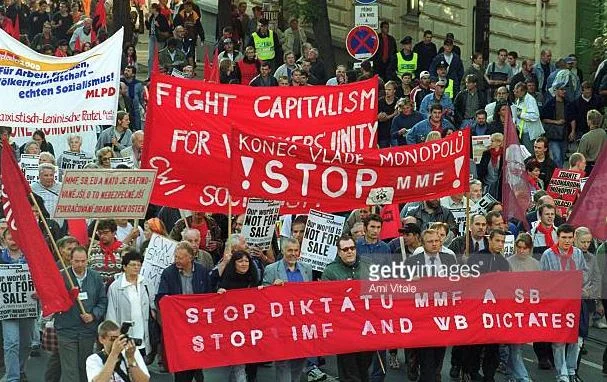
In some senses, Prague got off lightly. In London, after all, "anti-capitalist" demonstrators had recently spray-painted the Cenotaph with the suggestion that Britain's principal war memorial would make a good place to urinate. The mainly foreign protesters in Prague last week were far more refined. They merely chose to march into town under red flags and the hammer and sickle, symbols of a regime that not so long ago was murdering and imprisoning tens of thousands of Czechs.

The occasion, of course, was the joint annual meeting of the World Bank and the IMF. Such events now attract the protests of another set of anti-capitalists, the vicious travelling circus of the anti-globalization movement, and the intimidation and violence that it brings with it. This was the case in Seattle and Melbourne. Now it was Prague's turn.

Anti-globalization is the latest manifestation of the Left's seemingly indefatigable attempts to mess things up for the rest of us. Undaunted by the economic, environmental, and human disaster of socialism's last hundred years, they have now turned their angry attention onto free trade, and the supposedly sinister forces behind it, the World Bank and the IMF. There are, of course, differences from the past. This new Left is not as monolithic as its predecessors. The iron discipline of the Comintern has been replaced by a plethora of tiny cells, connected, strengthened, and somehow amplified by the power of an Internet able to create an impression of size even where none exists. So, the Prague action was meant to be supported by demonstrations across the globe, each of which was excitedly previewed on the web. In Melbourne, C.A.C.T.U.S. (Campaign Against Corporate Tyranny United in Struggle) was planning a carnival, while in Bangladesh the Garment Workers Unity Forum and the Revolutionary Unity Front intended "to make a demonstration waving black flags." In these United States, steelworkers in Chicago were apparently preparing to confront Harris Bank with a puppet show.

Harris Bank was left intact. Prague was not so lucky. Six or seven thousand protesters arrived from abroad, determined to shut down the city in the name of their version of global justice. Naturally, they were quick to move on Wenceslas Square, a sacred place for many Czechs, the heart of their Velvet Revolution, but a site of tragedy too: the spot where, in 1969, Jan Palach, a young student who really understood what idealism was, burned himself to death in protest against an earlier generation of invaders that had come to this city. Then, of course, it was the Soviet Army, but, as we have seen, the symbols of the anti-globalizers, those red flags, that hammer and sickle, they are just the same. And so was the message: "Do it our way, or there will be violence."

Of course, no one was ever that explicit. Most of the protesters were quick to come out with statements rejecting any violence, but their websites gave them away. One of the most prominent contained a list of suggested activities that included "occupations of offices, blockades and shutdowns, appropriating and disposing of luxury consumer goods, sabotaging, wrecking or interfering with capitalist infrastructure, appropriating capitalist wealth and returning it to the working people." That does not sound entirely peaceful to me.

The producers of www.destroyimf.org were more straightforward, running with the slogan "Turn Prague into Seattle." Many protesters tried to do just that. In the process they cost the people of what is still a poor country a great deal of money. Demonstrators fought with police, ripped up sidewalks, threw Molotov cocktails, and, in what is rapidly becoming an irritating cliché, stormed McDonalds, the franchised Winter Palace of their gimcrack revolution. The comrades at www.destroyimf.org could barely conceal their excitement at the drama of it all, a re-run, it seemed, of the glorious days of the Bolshevik rising. To one John Reed wannabe, September 26 had been "the day the IMF died." Judging by the breathless commentary on their website, it had been eleven hours that shook the world: "1215: Fighting begins; anarchist column takes the railway below the bridge. 1400: Protest columns fan out to the south and east. 1900: Column surrounds opera house. 2300: Minor running battles and windows smashed."

It seems that the revolutionaries were, at least in part, successful. The IMF and World Bank proceedings wound up a day early, the organizers unconvincingly claiming that they had completed all the work that they had come to Prague to do. Even if that were true, they should have stayed put, sipping champagne to pass the time and to make their point, occasionally, perhaps, hurling a few stale canapés into the baying mob below. The early retreat was a sign of weakness, and it was not the first from the supranational financial institutions. Since the whole anti-globalization movement started gathering pace, official reaction has been a blend of appeasement and apology. We caught a glimpse of this approach at Seattle in Bill Clinton's shifty "defense" of free trade, and we have seen plenty of it since then.

This is strange. It is not as if the foes of globalization have much intellectual force behind them. Their arguments are a blend of Al Gore greenery and Maoist economics, all wrapped up in a sort of sickly sentimentalism about the Third World that would, in fact, further impoverish that luckless part of the world. Bogus, economically illiterate, and potentially catastrophic, it is not a case that should be difficult to rebut, but none of our leaders seems to be trying hard to do so. Instead we see shame-faced equivocations or worse, the Uriah Heep-like pandering of those such as World Bank President Wolfensohn, a man pleased to pronounce that we live in a world "scarred by inequality." In between their bouts of savagery, the protesters in Prague were, he noted, "asking legitimate questions."

What nonsense. Here and there, you may find a true believer. There was the British schoolteacher who confided to Reuters that she was in Prague because her clearly rather odd child "often woke up in the middle of the night, frightened about global warming." For the most part, however, the game being played in the Czech capital was of a different, much nastier kind. It was partly about violence, the sheer Clockwork Orange fun that a punch-up can bring, and it was all about power, the right to boss everybody else around.

For all the talk about the working classes, the dispossessed seamstresses of Latin America, and the impoverished women farmers of Africa, the demonstrators tended to be Western European and university-educated. For such people, protests of this nature reinforce their bourgeois sense of moral and social superiority over the lower orders, the class they feel born to rule. As one of the organizers, Martin Shaw, a "Nottingham University graduate and anarchist" explained to the London Daily Telegraph, "Working people do not have the benefits of an educational system and they are afraid of losing their jobs." Not only that, but these blue-collar saps are couch potatoes, sitting back "in front of their televisions," grumbled another activist, rather than joining the battle against world capitalism. The corollary of this is that the "working people" need the Martin Shaws of this world to put things right for them. If you think that this sounds like the early 20th-century revolutionaries, you would be right. There is the same apocalyptic language, the same overweening sense of self-importance, the same absence of a paying job.

Unfortunately, too, there are the same prospects of some very real success. For, at bottom, these protesters are speaking the language of those very organizations that they claim to oppose. To take one, closely related, example: Environmental activists used to perform the same outsider role as the anti-globalizers do today, but much of their belief in regulation and control proved appealing to the soft-left consensus that prevails in our international institutions. And so, to their barely concealed delight, environmentalists found themselves co-opted into the global bureaucratic process. Their unelected, unaccountable pressure groups were magically transformed into "Non-Governmental Organizations." Better funded, but still unelected and still unaccountable, these NGOs were given consultative seats at the supranational legislative table. The result, at least in part, was the ludicrous Kyoto treaty.

A similar future beckons for some appropriately house-trained anti-globalizers. The cluttered WTO agenda in Seattle was evidence that officialdom is open to some of their ideas, an impression that Mr. Wolfensohn's platitudes will have done nothing to contradict. In Prague, indeed, certain pressure groups were invited to meet and debate with the IMF/World Bank delegates. This will only be the beginning of a prolonged courtship and, as for those other Non-Governmental Organizations, you and me, well, you can be sure that we will not be invited along.

Candida's Camera

National Review, Sept 11 2000

royalle_candida.jpg

WHEN actress Candida Royalle (Legends of Porn, Classic Swedish Erotica 2, Teenage Pony Girls) announces that she is "going to be hard on you," you sit up and pay attention. Not that we needed the warning. We had all paid good money ($49) to see her perform, and we were sure she would not let us down. Nor does she. True to her name, Candida is open, frank, and often very revealing. Miss Royalle knows how to give a good lecture. Yes, lecture. To the crowd gathered in an upstairs room in Manhattan's "School for the Physical City," Candida Royalle is much more than a sex star. She is an entrepreneur, sharing her hard-won practical insights with an eager and ambitious audience. The event has been arranged by The Learning Annex, an "alternative adult-education organization" that offers evening classes at a number of cities across the country. The demand for its "powerful, inspirational, nurturing, and insightful" seminars is in the American tradition, a reminder of the relentless drive for self-improvement that took this nation from log cabin to Martha Stewart. Recent courses have included Spanish, calligraphy, running your own laundromat, the power of persuasion, becoming a medical transcriptionist, and "Breaking into Adult Movies—in front of or behind the camera!"

Candida's pupils are ushered into a large, brightly lit classroom painted in the Pokemon palette that only an educational bureaucrat would choose. It's all very normal—Educating Rita rather than Deep Throat. There's no buzz, no guilty anticipation, just a naughty pile of coarse, er, course materials heaped on a side table: flyers for FOXE ("Fans of X-Rated Entertainment"), an order form for Breaking into XXX—the Porn Stud Handbook. And our teacher? Miss Royalle is a trim fortyish blonde in a short skirt, more Mary Kay than Miss Jean Brodie.

This is not enough to hold two members of the class, who slink off within minutes, disappointed perhaps to discover that the evening will not feature "adult situations." Maybe they will be back for the Tantra lessons ("Reach higher levels of sexual ecstasy than ever!"). The only other source of awkwardness is the presence of a film crew shooting the lecture for National Enquirer’s TV show. Strangely, not everyone wants to appear in front of these particular cameras.

These are shy folks, mostly. One woman, an exotic dancer, is interested in making "bubble-bath-type videos" for her fans, but she is an exception. This mainly male crowd doesn't want to get naked. They want to be "suits," Sam Goldwyns of smut. That's wise, for as our lecturer explains, the life of a wannabe porn stud is far from easy. Performing under conditions that would make even Priapus pause (Viagra helps, apparently), men are props, not star attractions. As such they are not likely to make much money. Most people aren't renting adult movies to gape at the guys. So the women are paid more. As even the EEOC might agree, this is not discrimination, it's the marketplace.

Which is really the theme of the evening. Naughty pictures are now a significant American industry. The Nude Economy is for real: By some estimates, annual sales of pornography in the U.S. alone already exceed $10 billion. That's a Fortune 500, Wall Street Journal kind of number, one that tells us, among other things, that proper management has finally come to this improper trade. And that's where the Learning Annex fits in. As Candida's students earnestly take notes, she briskly runs through the economics of adult video, who gets paid how much to do what to whom, the complexities of copyright, the perils of distribution, and the market in foreign licensing.

It's surprisingly dry stuff, and the ensuing discussion is matter-of-fact. In the United States, business is a serious matter, and while we have come a long way from the Comstock laws, our cheery, upbeat lecturer is subject to an equally demanding set of rules, those of American enterprise. To Candida's obvious delight, it's a tough code and a little austere. And in the way she describes it, with relish and without irony, there's a touch of Cotton Mather, a hint of the old Puritan idea that self-denial is the key to success. The boogie nights are clearly over. The film set should be free of drugs and alcohol and carefully budgeted. The artistic impulse must also be kept firmly under control (only "one-third of the film can be story, with 60 minutes for sex"). There's respect for hard work, suspicion of ripoffs ("Watch everything, watch everyone . . . if it's yours, watch it like a hawk"), and a shrewd appreciation for what counts—the bottom line in every sense.

Unfortunately, these days the bottom line is not enough. Sanctimony has evolved, not died. We live in a time when many businesses, particularly those with a potential image problem, feel they have to go beyond the buck. They like to demonstrate, at least in their advertising, that they have some higher—usually vaguely politically correct—redeeming social purpose. Forestry companies become model environmentalists, brewers natter on about "responsible" drinking, and "the people of Philip Morris" are so busy sheltering abused women and feeding the hungry it's amazing they have any time for making cigarettes.

Candida Royalle is no exception. A few years ago the former "teenage pony girl" founded Femme Productions to make films that, she says, that men too will want to watch. Now she takes herself, well, a little seriously. As her website notes, Candida has "addressed many conferences . . . including the World Congress of Sexology, the Smithsonian Institution, [and] the American Psychiatric Association." Sadly, it's not enough for her films to be dirty, fun, and profitable. In our relentlessly didactic era they must also promote "positive sexual role modeling."

What's that? Well for one thing, something that, as we are clearly expected to know, Republicans oppose. Like most corporate piety, Candida's spiel has a liberal tinge. As some readers may remember ("House of Porn," October 27, 1997), Ms. Royalle is a founding member of Feminists for Free Expression, and presumably someone well able to understand that the principal threat to her business comes from a much larger group, the feminists against free expression and their fellow-travelers in the "progressive" camp. Despite that, her talk is punctuated by moments of leftish political commentary. There's an almost nostalgic swipe at "Reagan/Meese" and a dark warning that if George W. is elected, "we're really in for it."

But her audience doesn't seem worried. This is a Coolidge crowd. Their business is business. They have no more interest in discussing threats to free expression than a moonshiner would have in debating Prohibition. To these aspiring pornographers, the First Amendment is a commercial device, not a human right. They want to concentrate on record-keeping, employee relations, soundtracks, budgets, legal obligations, and the uses of DVD ("save your bloopers"). It's all about the economics of sex. Though far from romantic, it is still a pursuit of another American fantasy, the dream of success. Is it true, asks the exotic dancer, that one porn star makes "as much as $150,000 a year"?

At that, two stockbrokers in the class exchange faintly superior smiles. Still, they understand where she is coming from.

Hollywood Ten

National Review Online, August 8, 2000

Bo Derek.jpg

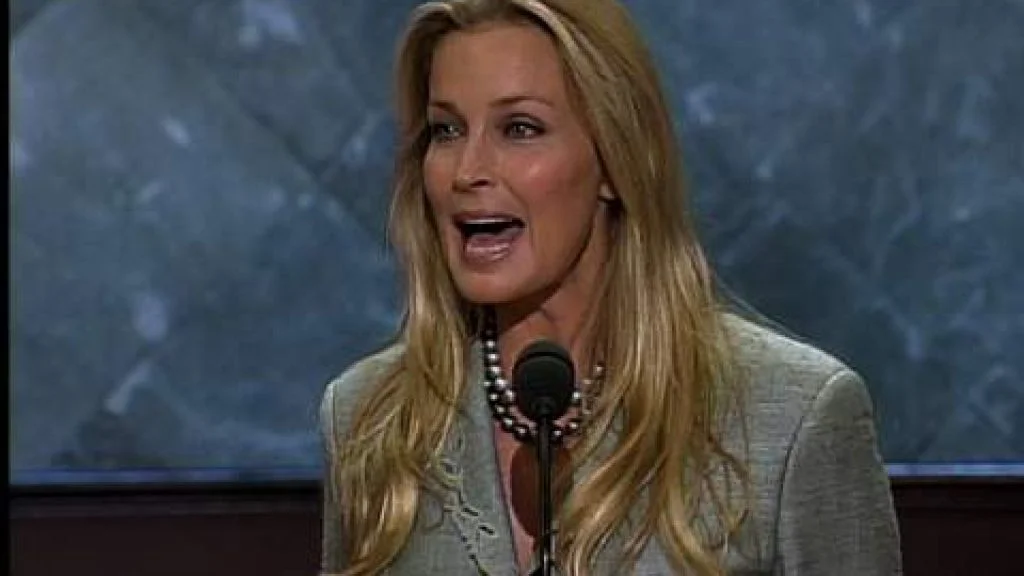
Is there no end to the empathy? It's a long, hard GOP convention for the hard-hearted among us, a grim procession of blind mountaineers, teachers, "the children," breast-cancer advocates, diabetic beauty queens, and deaf ones too. Tonight, though, twenty minutes or so after the showing of a "compassion video," the podium will brighten up. As the Republican's convention website boasts, a "film icon" is coming to town. Hepburn? Bacall? Well, no. It's Bo Derek, actually, more of a poster than an icon, perhaps, but a welcome visitor nonetheless. And who'd have thought it? Bo Derek, a cheerleader for George W. Yes, that's right, THE Bo Derek. You know, cornrows, the 10 girl, sex goddess of the later disco era, the seductress clad in a wet swimsuit, and, often, gloriously, much much less.

It turns out that she's on the right, an unlikely star for an all too strait-laced party. She's a Republican and has been for years. Back in 1996, she was quoted as saying that her heroes included General Schwarzkopf and Presidents Reagan and Bush. As for Bob Dole, well, "the man was an absolute superman. His energy wiped me out." And that was before the Viagra.

Bo's no Barbra Streisand, though. Sure, she'll speak at the convention for a minute or two, but for the most part she's happy to play the supporting role. She isn't a Hollywood wonk, with a program for every problem, hectoring and haranguing the peons as to how they should live their lives. As she has explained to Fox News's Bill O'Reilly, "movie stars…live in a bubble…and for me to give my opinions and maybe influence anybody is absurd."

Her Republicanism seems practical, unideological. As a younger woman she saw herself as a Democrat. She thought the Democrats were "nicer people" who cared about people more. Then filming abroad opened her eyes: "You can't help but compare America to other countries the more you travel, and that's when I just realized in looking [at] different issues that I was a Republican." The free market, she realized, works. Welfare is fine "when people really need help, but as a lifestyle, I don't think it's good for the people receiving it…It discourages dignity and incentives."

She is no social conservative. It would be better to see her as a R-rated Christine Todd Whitman. A (generously illustrated) profile in the current issue of Cigar Aficionado describes her as pro-gay rights, pro-choice and, on occasion, anti-clothes. "We're born nude and it just seems like the most natural thing." There's a brief nod in the direction of some feminist piety (something about women voting the same way), but I suspect that Bo is never going to be one of the sisters. She had an unforgivably happy marriage to a much older guy, she took off her clothes in a lot of movies and, let's face it, she just looks too good.

However, her opinions don't make her look good in notoriously liberal Hollywood. It is even hinted that Bo's politics may have held back her career. Well, maybe, but when that career includes Bolero, Tarzan the Ape Man, and Ghosts Can't Do It, there may be another explanation. Nevertheless, when she describes the reaction to her views, her story rings very true. "It's really tough to have a nice, open conversation," she told O'Reilly. Apparently, her entertainment-industry pals "get really angry…and they treat me as though I'm some hateful monster."

Yes, I bet they do. They are liberals, supporters of that other cigar aficionado, the one in the White House. And, as we all know, the Left doesn't have much time, or respect, for anyone who dares to disagree with them. As Bo's clearly discovered, Democrats are not "nicer people." She's brave to speak her mind, but she's going to be lonely. Conservatives in the movie business are few and far between, and they are likely to stay that way. There's Moses, of course, our own Charlton Heston, and some of the more secular action heroes, Willis, Norris, Schwarzenegger, but these guys do have a touch of the last stand about them. TV isn't much better, although it was good to see Rick Schroder, NYPD Blue's Lieutenant Sorenson, at the convention on Tuesday night. He was smart, compelling, and — unlike most of Republican showbiz — under 40. Otherwise, the Right is only left with a presence in country music (and I'm not so sure about that k. d. lang) and wrestling, of course: the Rock, the thinking man's Jesse Ventura, is in the GOP line-up.

Sadly, this isn't going to be enough, and even more sadly, this matters. In our tranquil, ill-educated times, showbiz sets not only the cultural, but the political agenda. The drip, drip, drip of a predominantly liberal message in the movies, TV, and the other entertainment media is bound to wear through to the ballot box. We saw this in Britain, where a hostile cultural scene proved to be the harbinger of the crushing Conservative defeat in the 1997 election. Writing in the London Sunday Times the following year, the newspaper's then-resident leftist, the writer Robert Harris, noted — with, probably, some satisfaction — that he couldn't think of one single "important" British writer or, for that matter, a film director, theater director, composer ("apart from Lord Lloyd Webber"), actor, or painter who was a Conservative.

As Mr. Harris went on to point out, "the entertainment and fashion industries are now two of the biggest economic sectors in the world. Never have we lived in a time more conscious of style, and never in democratic history has it been less stylish to be on the right."

Now, he was writing in a British context, but, like it or not, it's not too difficult to see the same process gathering pace over here. It's not going to be easy to reverse. On this battlefield, the Right are simply too few. Sure, Republicans have got the Rock, but the Democrats have the (Sharon) Stone. Bo Derek may turn some heads, but she's not enough to turn the tide. Suggesting a solution to this problem is beyond the scope of this article, but to those who say that this all doesn't matter, that substance will prevail over style, I have only three words to offer: William Jefferson Clinton.

Loud and Clear

National Review Online, June 16, 2000

PRDay.jpg

The ‘wolf pack’ attacks in Central Park were a disgrace. The reaction to them — an unappetizing blend of ethnic politics and PC posturing — has not been much better, evidence of a mindset that, if it didn't exactly cause last Sunday's nightmare, certainly paved the way for it. Key to it is the idea that the police are always in the wrong. If they make an arrest they've gone in too hard, probably, it will be alleged, from racist motives. Any mistake will bring vilification, maybe prosecution, and certainly Al Sharpton. As for the cops involved in the Diallo tragedy, their bonus was pre-trial condemnation as murderers by the First Lady of the United States.

If, on the other hand, the police do nothing, they are also to blame. They are lazy bums, we will be told, more interested in their next doughnut than helping the public. And this, of course, became the spin on Central Park. Leftist lawyer Ron Kuby, a newcomer to the law-and-order crowd, worried that the police may have been sitting 'on their fat butts' rather than doing their jobs. Ah, what sweet liberal relief.

Awkward questions over the Puerto Rican parade could be glossed over as the media turned on an easier target — the police. The story became not what the bad boys did do, but what the NYPD didn't do, the "Cop Out" as the Daily News put it. Inevitably, Reverend Al caught the mood, appearing as an adviser to two of the victims in a $5,000,000 lawsuit against, not, naturally, the assailants, but the city.

Of course, much of the criticism was unfair. Rudy Giuliani's claim that 2,500 bottles of beer had been confiscated may have had the ring of desperation about it, but most cops did a good job. Also, it must be remembered that it's not easy to see what's going on in the middle of a huge crowd. Spotted from a couple of hundred yards away wilding can all too easily be mistaken for high jinks, spring-break fun, rather than feral nastiness.

Besides, if the police had moved in and acted pre-emptively, what would have been recorded by all those amateur video cameramen in the park? Not women, naked, humiliated, and in tears, but white cops pushing their way through a minority crowd, and I think we know how the evening news would have played that story. Somebody else would have sued for $5,000,000. The police explanation that the mob was about to get out of control would have been rejected, as being based on derogatory, racist assumptions.

Mind you, it appears that, on this occasion there is something to the criticism: Too many of the police were those crucial couple of hundred yards away, at the perimeter rather than in the action. Police treatment of some of the victims also left much to be desired and added to reports of crowd control that seemed strangely detached, "lackadaisical" in the words of one witness. A disturbing number of New York's Finest just did not want to get involved. In short, NYPD blew it, and if you believe the conspiracy theorists, they did so, because they were told to.

This has been denied, and believably so. There was no need: The police are getting the message. Why take that risk, why go down that darkened alley, when your only reward is Geraldo to Couric to Rosie criticism on the TV? The constant agitation is taking its toll. Cheap shots at the police claim more victims than just the boys in blue. It's no coincidence that Big Apple crime figures are on the rise, and not only in Central Park. Across the Atlantic the Brits have gone down the same anti-police route, culminating in the publication of an official report of absurd political correctness. The consequences? Street crime in London is running at twice last year's levels.

And if there was a day for a cowed New York police force to be careful, restrained and low profile it was last Sunday. At the National Puerto Rican Day Parade there can be no room for anything that could be remotely interpreted as a Sipowicz moment. Ethnic parades are a weird phenomenon, more Serbia than Central Park, yet they are the principal symbols of New York's ruling ideology, the "glorious mosaic" of former mayor David Dinkins, a vision of racial harmony best represented by that old Coke commercial ("I'd like to teach the world to sing"). In reality, of course, such a view is not the real thing. So the police normally take a pretty tough line with parades, confiscating drinks, lining the streets, and generally delivering a message of zero tolerance. Just ask the folks on St. Patrick's Day.

But there wasn't enough of that last Sunday. Zero tolerance was, at times, replaced with anything goes. Revelers may have been 2,500 bottles short, but as one onlooker explained, "alcohol was all over the place." It wasn't supposed to be that way, but then with the Puerto Rican Day parade it rarely is. For the authorities want us to believe that this parade is the jewel in the mosaic, "an annual celebration", as Hillary's website puts it, "of Puerto Rican culture, music and ethnic pride," a happy and enjoyable day for all. In reality, as is inevitable with almost any large gathering, the picture is more tricky than that. Mentioning that fact beyond, perhaps, a coy reference to "exuberance," is not part of the liberal script. It was fascinating to see that, as the first serious reports of trouble emerged, New York politicians were quick to defend the parade. There had been problems, certainly, but they couldn't be allowed to get in the way of the greater 'truth' that they wanted us to hear. The day had been a success, they soothed in the tone of voice that they would have used to tell Mrs. Lincoln that, yes indeed, the play had been a smash.

And sadly, the police had learned their lines too well.

Moms Away: The new brand of gun nut

National Review, June 5, 2000

 © Andrew Stuttaford

 © Andrew Stuttaford

IT'S not so much what they said (although that was bad enough), but how they said it. Several hundred thousand gun nuts were gathered on the Mall. They were hectoring, self-righteous, and, when it came to firearms, quite incapable of rational discussion. I'm referring, of course, to the "Million Moms" and their march. It was Mother's Day 2000. The Moms were in D.C. to call for "commonsense" gun control—licensing, registration, the usual thin edges of the wedge. There was opposition from the Second Amendment Sisters, but theirs was only a small rebel encampment, all baseball caps and American flags.

 © Andrew Stuttaford

 © Andrew Stuttaford

This day belonged to the other side, to the pink and white T-shirts of the Million Mom March. It was a triumph for Donna Dees-Thomases, the self-styled "suburban mom" who organized the march. It had taken around nine months to set up. As Mrs. Dees-Thomases, a publicist by trade, likes to say, "women understand what you can create in nine months." The march itself (which was really more of a rally) was impressive, seemingly flush with cash (thanks for the free bottled water!), and well organized. There were tents, placards, posters, pink banners (but rarely the Stars and Stripes) fluttering in the breeze. Charlton Heston didn't show, but there were plenty of other celebrities, all under the command of a stern-faced Rosie O'Donnell. The Moms themselves were a disciplined bunch, standing for hours under a hot early-summer sun, attentive to the speeches coming from a large stage. They could also gaze at a number of giant screens dotted around the Mall that showed images of the audience, the speakers, and, from time to time, misleading statistics of the "if you have a gun in the house you are doomed" variety. This being the United States of Oprah, there were occasional moments of tears and communal hugging, but not too many. This was a disproportionately upscale group, more restrained, Katie Couric rather than Erin Brockovich.

 © Andrew Stuttaford

 © Andrew Stuttaford

It was also a crowd of dupes. The Million Mom March was brilliantly manipulative agitprop, a textbook example of how the Left will find a potentially popular, modest-sounding issue and twist it in a way to help along their agenda.

Not that they will admit it. These campaigns are always portrayed as being above mere politics. Donna Dees-Thomases is at pains to stress that her cause is "bipartisan." It is, of course, unfair, very unfair, to draw any conclusions from the fact that her sister-in- law is Susan Thomases, a longtime confidante of Hillary Rodham Clinton, but if this rally was independent it was only in a very NPR sort of way. Hillary herself attended the march, and her husband videotaped a message of support. Gore 2000 stickers and signs were everywhere. I did see one placard concerning George W, but it suggested that he "wasn't fit to run a laundromat." On the podium the (so to speak) big guns were more discreet. Susan Sarandon briefly slipped the leash with a speech that seemed to be headed in the direction of five-year plans and the collectivization of agriculture, but most speakers stuck to the subject—"commonsense," limited firearms legislation. That was their single issue, they claimed, and "in November" they want it to go the Moms' too. If it is, Al Gore will be in the White House and, ultimately, the Bill of Rights will be in the outhouse.

 © Andrew Stuttaford

 © Andrew Stuttaford

They may succeed. Gun control resonates with all those suburban moms who feel that firearms are, well, icky. Back in the early 1980s, their mothers or aunts or older sisters used to feel the same way about cruise missiles. Disarmament then, and now, is a perfect wedge issue that can be pitched purely at the emotional level. Speaker after speaker talked of an epidemic of gun violence. Singer Melissa Etheridge kept "hearing a lot of fear." Well, yes, Melissa. That's because of events like this march. Death, we were led to believe, stalks the suburbs and the schoolyard, and he's packing heat. In fact, over the last 20 years the murder rate's down and firearms-related accidents have fallen dramatically. All this at a time when gun ownership has greatly expanded. Even schools are safer. But you won't have heard those facts at this rally.

The Moms aren't big on facts or reasoned argument. Their spin kit ("Public Relations 101") has firm instructions for supporters wanting to publicize the march on TV or in the newspaper: "Before your interview, inform the local media contact that you will not engage in debate with others." To discussion, these mothers, like others in the "progressive" camp, prefer the coercive language of crisis (health care, global warming, you name it) to push their agenda. It's an approach that works best when it can be tied in with real tragedies. And so it was on the Mall. Homemade placards bore the pictures of murdered loved ones. Speakers included a teacher from Columbine, grieving mothers, and crippled children, a trail of tears designed to lead to only one conclusion. There was, of course, no mention of those thousands whose lives have been saved by the defensive use of guns.

Yes, thousands, probably far more. But as Mrs. Dees-Thomases understands, what politician is brave enough to raise that point with a teacher from Columbine? Just in case someone does dare, the Moms' leader bas another arrow in her quiver. She bas labeled her march a campaign for "safe kids." As she knows, Americans seem to accept any number of restrictions on their freedom so long as they are allegedly for the benefit of "the children," the Trojan Ponies of our liberty. To this end, the Moms' keynote deceptive statistic (every campaign should have one) is that twelve "kids" are killed every day by gunfire (to reach that number, you have to include tots of 19). At the rally itself, the imagery was child-centered. There was a stroller march down the Mall and a sing-along with Raffi. Up on the stage, it was W. C. Fields's hell; kids making speeches, kids singing songs, and even kids lining up to ring a sort of reverse Liberty Bell (it was made from melted-down guns). For those who had not already had enough of little children, the viewing screens would occasionally show footage of yet more.

The only people able to speak for all these youngsters, it was argued, are mothers. They have to be the right sort of mothers, of course. Pistol-packing mamas need not apply. Dads, of course, didn't rate a mention.

For the Moms, this is seductive stuff. It tells them that they are a uniquely moral force, that they are important, custodians of the future or something like that. No wonder they are lapping it up. The implications for the rest of us are not so great. The underlying message of the march was that society has to be run, first and foremost, in the interests of its children as determined by (approved) moms. And whatever else that means, it means more gun control. To those who ask why, writer Anna Quindlen had one. revealing answer: "because I said so." The crowd went wild—laughing, cheering, and repeating the phrase. They forgot one thing. The American people are not all children.

Or are they?

Andy, Get Your Gun

National Review, February 21, 2000

S&W.jpg

I DIDN'T want to be Bernie Goetz. I just wanted a handgun. Legally. Something to keep at home. A move within Manhattan had taken me away from the comforts of doorman security (you know how it is). A little extra protection seemed prudent, 911 calls can take a while to answer, and Rudy isn't going to be mayor forever. Should be pretty straightforward, I thought. In my native Britain it would be impossible. But this is the United States, home of the Second Amendment, land of liberty. Government knows its place. They do things differently in America. But then there's New York City, a place where the old constitutional certainties have been replaced by the rules of the NYPD, License Division. If you believe that this is a local problem, a Big Apple nightmare that could never apply to you, think again, A dozen states already insist on handgun permits. Citing as always "the children," it is clear that Candidates Gore and Bradley want to expand on this at the federal level. The Brady Act was not enough. There's earnest talk of licensing, registration, additional checks to which, allegedly, only the unreasonable could object.

But the unreasonable have a point. New York City's licensing system has turned a right into a privilege. Like all privileges, it's enjoyed only by the few. There may be more than 7 million people in the five boroughs, but only 40,000 have valid handgun permits. Licensing isn't the thin end. It is the wedge. If you want to find out what that modest-sounding licensing requirement can mean in the hands of a bureaucracy that doesn't want you to have a handgun, come here, to the City.

It starts with a form, of course—PD 643-041 (Rev. 1-94) h1. Some of the questions are obvious (arrest record and, excitingly, "aliases"). Others are odd ("Have you ever been denied appointment in a civil service system?") or, seemingly, aimed at members of the Clinton administration (list any incidents of "Temporary Loss of Memory"). Watch out for question 19: "Have you ever had or applied for any type of license or permit issued to you by any City, State or Federal agency?" You haven't? Well, if you are a driver you have. Forget to mention your driver's license and you will be rejected and have to start all over again.

Next, submit the form. This, naturally, can be done only in one place, and in person: Room 110 at Police Headquarters, Manhattan. Nowhere else will do—not Room 109, and certainly not Room 111 Anywhere in Brooklyn, Queens, Staten Island, or the Bronx is out of the question (although Queens—and nowhere else— is where you must go for your rifle or shotgun permit). The form needs supporting documentation: yes, including that driver's license. It is not enough, however, merely to present your driver's license. A notarized statement certifying that you did indeed apply for that driver's license is also essential. The fact that your photograph and signature are on the license is irrelevant. No notary, and it's no go.

It's at this point that capitalism comes to the rescue. Even in New York. There is no need to struggle through this process alone. A small industry of license consultants has sprung up. Some, doubtless, add little value, but the repeated official warnings against them are very reminiscent of something chat might have come from a pre-Miranda cop explaining that, no, no, you really don't need that fancy lawyer. I opted for the pistol-consultant equivalent ($395 all-in) of a fancy lawyer, Larry Goodson of License Services, "Specialists in Firearms Licensing, Training, Selection and Safety," an outfit in Queens. We never met. Like Charlie in Charlie's Angels, he was a mysterious voice over the phone. I imagined him as one of those drill sergeants in an old war movie, dispensing the gruff advice that would see his rookies through their grueling ordeal. Much of which, we know, would consist of waiting for that encounter with destiny.

Which can take a while. There aren't many gun-license applications each year (between one and two thousand), but when it comes to processing them, the city that never sleeps, dozes off. The applicant just has to wait, hoping that his home can be a castle even without a cannon. And if the Grandson of Sam came crashing through the door? Well, a friend of mine recently managed to frighten away an intruder from his apartment, but he had a loud voice, a sand wedge, and, crucially, a cowardly burglar. Would I be so lucky? A lifetime of avoiding hand-to-hand combat would mean that any brawl would be likely to turn out badly. The only weapons in my place were kitchen utensils, a Swiss Army knife, and, perhaps, a very heavy book.

The weeks passed, safely, but without any word from Police Headquarters. Finally, after five months, a letter arrived. I had to contact the License Division within "five days of receipt" to fix up an interview in, you guessed it. Room 110. "Failure to respond and/or comply with this notice will result in disapproval of your application." Away on vacation? That, probably, would be too bad. Do not pass Go, do not collect handgun.

The interview is to be taken seriously. This is not just a quick check for drool on the chin or blood on the hands. The police want to be sure that the would-be gun owner knows the law, and they might, warned pistol consultant Larry, try to trip me up. Try they did. The interviewing officer was courteous, friendly even, but it didn't stop him from asking whether I would be taking my gun to the target range every weekend once I received my premises residence license (with target endorsement). It was a trick. As, fortunately, I remembered, holders of such permits can take their guns to the range only twice a month (unloaded, in a locked box). At the end of the interview, there is little clue as to how you have done ("That's to avoid incidents," explained Larry). Next, two more officers have to review the case.

Which they did for another three months. Then, finally, the great day arrived, if not the permit. I had been approved, but the permit has to be picked up in person at Police Headquarters in, for variety, Room 152. Neglect to claim the permit within 30 days and it will he canceled, and the applicant is back to square one, Room 110. With the permit comes a handgun-purchase authorization. This entitles the holder to purchase a gun from another licensee, a licensed dealer, a policeman, or, so long as the deceased held a valid license, a corpse. Fail to buy a gun within 30 days, and the authorization is canceled, along with the pistol license that it took eight months to obtain.

Finding somewhere to buy a gun legally in Manhattan is not much less challenging than looking for a liquor store in Saudi Arabia. Early negotiations with a fellow called "Chop" in a Midtown outlet didn't work out, but a trip to New York Ironworks hit, so to speak, the target. It's a store where the NYPD crowd goes to buy weapons, extra equipment, and fashion essentials such as "Frisk 'Em" gloves. It is also just around the comer from Police Headquarters, which matters, because that is where, for the fourth time in this process, the new gun owner has to return. Within 72 hours and packing heat (so long as the heat is unloaded and in a locked box). It's a quick pass through the metal detectors (yes, they do work) and then back to Room 152 (so long as it's Monday to Friday, between the hours of noon and 2 P.M.). The pistol will be poked and prodded, and the bill of sale perused. Survive this and the process is complete. The gun can be kept at home. So there it sits, gripped by its newly mandatory trigger lock, a last line of defense.

For the time being anyway. The pistol license, of course, is issued subject to certain conditions. And the first of these, listed right at the top of the Police Department's little handbook for licensees? The license "is revocable at any time."

Illustrated Men

National Review, august 9, 1999

Tattoo.png

THE German was heavily tattooed, a North Sea Queequeg, but it was when he pulled his trousers down that the crowd finally reacted—with gasps, squeals, nervous laughter. It was not that Theodor—aus Hamburg—was particularly well endowed, just that he was hung like a chandelier designed by Torquemada. There were chains, studs, odd metal piercings, distinguishing characteristics that even Bill Clinton couldn't deny. Theodor's little striptease took place at the Second Annual New York City Tattoo Convention, three inky days in the Roseland Ballroom. Entering that gray, gloomy building you notice a plaque "In Honor of the Married Couples Who First Met Here," a list of names each with the date of that first happy encounter. What, I wondered, would the Lubes (from 1927) or even the Fortgangs (1961) have thought of Theodor?

They would have seen tattoos before. There have been professional tattooists in Manhattan for over 150 years. The Bowery's Sam O'Reilly invented the electric tattoo machine over a century ago. Its descendants were there at the Roseland, the sound of their needles like a swarm of wasps, their sting leaving not venom, but tiny dots of color.

Tattooing was a part of the rough carnival subculture that has long been an American staple, its vaudeville-era stars tattooists with names like "Painless Jack" Tryon, "Sailor George" Fosdick, and Lew "The Jew" Alberts. It may have been banned by God (Leviticus 19:28, since you ask), but in the United States tattooing was a small, half-licensed rebellion, a male-bonding process for tough guys. Marines, the boys in the fleet, even England's George V, a navy veteran, wore one.

The designs reflected tough-guy tastes. Anchors, devils, sailing ships, boxing gloves, daggers, Old Glory, a pair of dice, and, of course, "Mother." Other gals on view might include a busty "Miss Liberty," a bare-breasted mermaid, or a Hawaiian maiden with only a ukulele for modesty.

This brand of macho chic lives on. You could hear it in the Led Zeppelin that thundered through the Roseland's speakers. You could taste it in the Ballroom's bar, where people were drinking Bud and (glorious vision!) smoking. You could see it on the forearms and biceps of the bulky thirtysomethings in the crowd, burly dudes, all ponytails, denim, and tattoo.

But what was Theodor doing here. There was nothing very macho about him. He may have had an Iron Cross hanging from his nipple, but he was pretty weedy, not the sort of man that I'd want in my Wehrmacht. What he was, however, was an illustration of a society in evolution.

We tend to view cultural shifts in terms of some dramatic event: the arrival, say, of Marcel Duchamp at the Armory Show, or Elvis at Sun Records. But history isn't really like that. The greatest changes are, like Theodor's body, marked in countless tiny, mostly unpredictable ways.

And so the endless, tedious campaign against Western values has resulted not in their defeat in some watershed event, but in their gradual transformation, a transformation achieved by innumerable microscopic reevaluations of our culture. Even tattoos have now been reinterpreted. To be sure, there are many for whom a spot of ink is nothing more than what it always was: a bit of fun or, these days, a fashionably naughty gesture. We all know the type, the college girl with a flower above the ankle, the investment banker with enigmatic Chinese calligraphy on his shoulder. According to one estimate, 20 million Americans have been tattooed. But for another, smaller, more self-important crowd, the tattoo means something else. It is part of an imagined "tribal renaissance," an attempt to tap into the (allegedly) superior authenticity of those primitive folk who never left the squalor of the rain forest, mud hut, or atoll.

The problem is that these original noble savages were really just people with too much time on their hands and too few toys. They played with what they had, and what they had was their bodies. Consequently they didn't just tattoo. They pierced, they stretched, they cut, and they scarred.

And so, argue neo-tribalists, should we. At the Roseland, one man posed for gawkers by the door, his bald head a riot of color, his nose, in a nod to headhunter cool, pierced by a bone.

Others milled around inside, the sort of people, I suspected, unable to get through airport metal detectors without drama. Cheek rings glinting in the fluorescent light, these modern primitives searched for specialized merchandise tables, eyeing the latest in septum tusks and nostril screws from Pleasurable Piercings. If you're thinking this sounds more S & M than Samoa, you're probably right. This is not an authenticity that has to be accurate. It just has to annoy, alarm, or provoke. And so tattoos are also creeping across the body, far beyond the point where they can be concealed by a rolled-down sleeve or a buttoned shirt. That would imply discretion, the opposite of this definition of authenticity. The man with a tattooed face is walking graffiti, and we, hopeless conformists, are the bland, blank wall.

Or so he would like to believe. In fact, he's rebelling against an authority that exists only in his imagination. He's messed himself up for nothing. This illustrated man may be a primitive, yes, but only in the sense that he hasn't kept up with the times, in reality, as he fails to understand, nobody really cares what he does to himself. He'll regret it one day. He should get over it.

Oh, that's right. He can't. They don't come off.