Stench & the City

Emily Cockayne: Hubbub

The New York Sun, July 11, 2007

If there's one voice that can be heard above the hubbub described in Emily Cockayne's aptly titled new book, it is the voice, splenetic, dyspeptic, and thoroughly fed up, of the grumbler in high dudgeon. For all their traditional stoicism, the English have always known how to complain, and to do so with an acerbity and wit that leaves more famously querulous nations (yes, Jacques, yes, Pierre, I'm talking about you) looking like little more than whiny schoolchildren.

When it comes to the topic of "Hubbub" (Yale University Press, 335 pages, $35), the squalor, grubbiness, and general unpleasantness of everyday life in the cities of 17th- and 18th-century England, there was, as its author shows, plenty to gripe about. And to help her, she's recruited an awkward squad of sourly eloquent grumblers, from Samuel Pepys to the "slightly deranged" vegetarian and would-be "boghouse" reformer Thomas Tryon (who died in 1703, allegedly and appropriately, of "Retention of Urine") to the "notoriously peevish" Oxford antiquarian, Anthony à Wood (1632–95).

Here, for example, is what Matt Bramble, the fictional alter ego of the reliably grumpy Tobias Smollett (1721–71) had to say about a society ball in Georgian Bath:

Imagine to yourself a high exalted essence of mingled odours, armpits, sweating feet, running sores and issues, plasters, assafoetida drops, musk, hartshorn, and sal volatile; beside a thousand frowzy streams, which I could not analyse.

Imagine that? You'd probably rather not. But after working your way through the vivid, splendidly horrible pages of "Hubbub," a book that so revels in the nastiness it describes that most of its chapters appear to have been named after Snow White's worst nightmare ("Ugly," "Itchy," and "Mouldy" are just three of their dank and dismal number), you won't be able to avoid doing so. Not only that, you will understand that the stench of assafoetida drops was merely one of the lesser assaults on the senses of poor Mr. Bramble. That party was about as good as it got. Beyond the masterclass theater of ballroom and grand house lay the smoky, reeking cityscapes of early modern England, territories where the medieval was only yesterday, and could, quite easily, have become tomorrow.

It was a muddy, desperate world of licentious fustilugs, determined dog-skinners, essential gunge-farmers, and rootling "piggs," of dissolute rakehells, and the drabs who serviced them, a world of urban dunghills and city "hog-styes," a world inhabited by people marked by tetters, morphew, "psorophtalmy" (eyebrow dandruff, since you ask), and pocky itch, and clothed in grogram tailored by botchers. If you suspect that one of the many pleasures of "Hubbub" is the exuberant vocabulary that so enriches the texts cited by its author, you'd be right. Delightfully, it's an exuberance that has infected Ms. Cockayne herself: She must be one of the few 21st-century writers to use words such as axunge, muculent, and smeech.

This evident, and endearing, empathy for the period of which she writes is more than a matter of language. Yes, it's true that, in a refreshingcontrasttothecarefully picturesque, fiercely scrubbed picture that is the hallmark of BBC manufactured-for-export flummery, the dryly amusing Ms. Cockayne "unashamedly" highlights the worst of urban life of the time. Nevertheless, it's also evident that she is, as she says, determined to guard against what historian E.P. Thompson has called the "enormous condescension of posterity." Some aspects of their ancestors' life might revolt modern Englishmen, but may have been a matter of indifference, or even enjoyment, to their grimy forebears.

At the same time, it would be even more condescending to believe that the citizens of the septic isle were simple fatalists, passively accepting the muck, chaos, and disease that surrounded and, not so occasionally, engulfed them. As Ms. Cockayne's grumblers, not to speak of countless lawsuits against slatternly neighbors and slovenly tradesmen, reveal, they were anything but. Life could be better. Life ought to be better. Life would be better.

This was an age, perhaps the first, of a self-consciously progressive modernity. Raging in the 1740s against the state of the British capital's streets, Lord Tyrconnel sneered that they gave the impression of a place populated by

a herd of barbarians. … The most disgusting part of the character given by travellers, of the most savage nations, is their neglect of cleanliness, of which, perhaps, no part of the World affords more proofs than the streets of London … [the city] abounds with such heaps of filth … as a savage would look on with amazement.

Running through that speech is the implicit understanding that Englishmen had left barbarians and barbarism behind. Englishmen could do better. Englishmen ought to do better. Englishmen would do better.

So, eventually, they did. Twenty years later, parliament passed a series of laws designed to tidy up those streets of shame and much more besides, laws that were just part of an accelerating, if uneven, modernization that quite literally paved the way for industrial revolution and economic triumph.

And some of the credit for this must go to the grumblers. If necessity is the mother of invention, then discontent is the father. So buy this marvelous book, the most engaging work of social history I have read in years, and let Ms. Cockayne introduce you to a cast of characters you will never forget and a past we have failed to remember.

One tip: "Hubbub" is best enjoyed after eating, not before.

Something There Is That Doesn't Love a Wall

Frederick Taylor: The Berlin Wall: A World Divided, 1961–89

The New York Sun, May 30, 2007

Berlin, August 1978, © Andrew Stuttaford

Berlin, August 1978, © Andrew Stuttaford

To cross over into East Berlin in the 1970s, as I did on a couple of occasions, was to take a trip that, even then, seemed like a voyage back into a lost, almost unimaginable era. The rampaging ideologies, cruel and convinced, that had done so much to wreck Europe were in retreat across the western part of the continent, their fervor dimmed by exhaustion, bitter experience, sweet, if uneven, prosperity, and, credit where credit's due, careful American supervision. In East Berlin, by contrast, it was still 1945 or, if you prefer that date of a future that already appeared to have passed the West by, 1984.

There were occasional ruins and countless bullet holes, relics of Hitler's Götterdämmerung; there were the apartment blocks that proclaimed a utopia with no room for humanity, and then there was that sense, deadening, clammy, gray, of an oppression that Winston Smith would have understood all too well. Not just a sense, a reality: the Stasi, East Germany's secret police, was more than 100,000 strong, with at least another 200,000 informers, all for a population of just 17 million.

And then there was that wall, a symbol of horror, tyranny, and finally, deliriously, liberation. In his highly readable new book, "The Berlin Wall: A World Divided, 1961–89" (HarperCollins, 512 pages, $27.95), Frederick Taylor attempts to combine the tale of the Berlin Wall with a more general history of the German Democratic Republic, an approach that is understandable, yet sometimes a little frustrating: Mr. Taylor's account is very far from being a comprehensive study of what was one of the last century's most peculiar, disturbing, and interesting states.

Nevertheless, there's an undeniable logic to looking at the "other Germany" from the perspective of a wall that was both an admission of its failure and the key to its survival. While Mr. Taylor has no sympathy for the communist regime, the picture he paints is more complex than the usual Cold War cartoon. The wall was, he shows, the desperate response of the dictatorship to the prospect that its state would collapse from within, emptied out by the lure of West Germany's remarkable economic recovery. For many East Germans freedom and an increasingly higher standard of living were there for the taking. All it required was a train ticket to East Berlin, and a little luck.

For all of Berlin, East and West, was supposedly still under the shared control of World War II's "big four." As a result, the border within the city continued to be porous in ways inconceivable elsewhere on the intra-German frontier. In the first 12 years of its existence, the GDR lost around a sixth of its population to the west. As the 1950s progressed, and the barbed wire and death strips went up around the rest of East Germany, Berlin was the escape hatch, the way out. This was unsustainable. If that hatch wasn't locked tight, East Germany would collapse, and if East Germany collapsed, it would almost certainly take the fragile Cold War truce down with it.

As 1960 turned into 1961, the rush for the exit only intensified. Torschlusspanik ("panic that the door will be closed") gripped the GDR. If anything, however, the panic was underdone. The door wasn't just closed that year. It was bricked-up. In chilling, precise detail, Mr. Taylor explains how the regime made its preparations (meticulous, cynical, and, somehow, very German), kept the Soviets onside (one of the many strengths of this book is its focus on the tricky relationship between the Kremlin and East Berlin), and then succeeded in incarcerating an entire nation in the course of one August weekend.

Critical to that success was the passivity of Britain, France, and America, nominal guarantors of a nominally united city. As Mr. Taylor makes clear, they huffed, and they puffed, but they never tried to blow that wall down. To have done so would almost certainly have meant war, and who was prepared to risk Armageddon for the right of East Germans to travel? It was an exercise in Realpolitik that condemned millions to imprisonment in their miserable abomination of a republic for nearly 30 more years, but the obvious implication to be drawn from Mr. Taylor's narrative is that this was the correct thing to do. And so it was.

That is not the same as saying that this was a morally straightforward decision, yet to read this book carefully is also to see the traces of another story, that of the West German politicians (mainly on the left) who appeared to have few qualms about accepting, and perhaps even liking, the idea of that socialist sibling of theirs. When in 1987 Gerhard Schröder pronounced (with, it seems to me, unseemly relish) that reunification was a "big lie," he was not, as Mr. Taylor reminds us, alone.

Fortunately, the future chancellor got it wrong. Two years later, time caught up with East Germany. When it did so, it came rushing in at a pace that suggested it was desperate to make up for those wasted, frozen decades. Mr. Taylor describes those lovely, wild, exhilarating weeks movingly and with undisguised enthusiasm. But, while he does mention some of the difficulties and ambiguities that have followed reunification, it's difficult to avoid the feeling that his head, like his heart, remains caught up in the optimism of 1989–90. History, however, moves on, remorseless, relentless, and forgetful. As Mr. Taylor himself notes, the PDS (essentially the old East German Communist Party in unconvincing democratic drag) is now an important part of the coalition that runs Berlin.

Some people never learn, and others never give up.

England's Arcadia

Juliet Nicolson: The Perfect Summer

The New York Sun, May 2, 2007

1911.JPG

Of all the legends with which humanity deludes itself there are few more persistent, enchanting, and tormenting than that of a lost golden age. The Jews of the Old Testament pined for Eden, and the ancient Greeks dreamed of Arcadia. In the fantasies of many modern Britons, that vanished, magical idyll may have taken place on the island they call home, and not that many years ago, but that has only sharpened the sense of loss and tightened its grip on the English imagination.

This particular golden age was said to have been ushered in with a funeral, that of Queen Victoria. It ended, no less ironically, amid celebrations, as cheering crowds feted the declaration of a war that, everyone said, everyone knew, would be over by Christmas. Nearly half a century later, Philip Larkin described the days that followed in his poem "MCMXIV." He did so with a photographer's precision ("moustached archaic faces / Grinning as if it were all / An August Bank Holiday lark"), a poet's lyricism, and a historian's insight. Larkin concludes with lines that blend fact and myth into a lament for the timeless, prelapsarian Albion that had been thrown so carelessly away.

Never such innocence,

Never before or since,

As changed itself to past

Without a word — the men

Leaving the gardens tidy,

The thousands of marriages,

Lasting a little while longer:

Never such innocence again.

Nostalgia for that brief heyday, its glitter, glory, and grandeur only gaining in retrospective magnificence from the years of slaughter and decades of decline that followed, is a reflection of the horror that the British feel about World War I, a conflict that became, and remains, the greatest trauma in their long history. It's a nostalgia, deep, sentimental, self-indulgent and infinitely sad, that can be found in books, in the cinema, on canvas, and just about anywhere else you may care to look. To give just a few instances, it's this nostalgia that inspired the unexpected power of "Another World, 1897–1917," by former Prime Minister, Anthony Eden. It's this nostalgia, misty and melancholic, that saturates "The Shooting Party," James Mason's elegiac farewell to the big screen, and it's this nostalgia, bitter sweet but undeniable, that runs through "The Go-Between," the only one of L.P. Hartley's novels still widely read today.

To understand this nostalgia is to understand the spirit in which Juliet Nicolson has written "The Perfect Summer" (Grove Press, 264 pages, $25) an evocative, gossipy, and, on occasion, profoundly moving description of five sunbaked months in the middle of 1911. To understand this nostalgia is to understand why this book has sold so well in England. Its success may say as much about the United Kingdom today as its contents do about that same country roughly a century ago. The narrative that unfolds in "The Perfect Summer" revolves around country houses, society balls, naughty debutantes, new money, newer mores, ancient aristocracy, artistic experimentation, wild gambling, the coronation of a monarch, and the meals, oh, the meals. A country house breakfast might include "porridge, whiting, devilled kidneys, cold grouse, tongue, ham, omelette, kedgeree, and cold sliced ptarmigan": Never such breakfasts again.

To be sure, the book contains dutiful references to the gross inequality and grotesque poverty that scarred this era, but with the exception of her vivid description of a series of bitter, and portentous, strikes (and what prompted them), it seems as if Ms. Nicolson, a scion herself of the English upper classes, probably only wrote the more hardscrabble passages as a sop to our own more egalitarian age. They represent brief eat your-greens interludes before she returns with evident relish to the richer, wickedly enjoyable fare that makes up the bulk of her book.

After all, she has to: The essence of an idyll is that it must be idyllic. What's more, this particular idyll has long been scripted to derive its emotional force from the way that it was destined to end on the Western front. The suggestion that this splendor might have crumbled regardless has no part to play in this legend. Nor do awkward statistics, such as that Britain lost many more people, albeit far, far less cruelly, through emigration in the decade or so before the war, than it was to lose in the trenches.

Pedantic folk searching for that type of analysis will have to look elsewhere. It has no more place in "The Perfect Summer" than Mrs. Bridges did "upstairs." This book, by contrast, simply asks its readers to lie back and think of an England that never quite was. So pour yourself some champagne and revel in the sybaritic trivia that Ms. Nicolson lays out so invitingly before us. For example, who could not enjoy discovering what really happened during all those country house Saturday-to-Mondays ("weekend" was considered a frightfully common term), especially as they were, it turns out, ideal venues for romantic intrigue?

Ideal, yes, but a hopeful Romeo still had to watch his step. Among the many delightful anecdotes to be found in this book is the tale of Lord Beresford, who was always, apparently, very careful to check that he was sneaking into the right room. There had, you see, been an earlier and most unfortunate occasion when this lord had leapt "with an exultant ‘Cock-a-doodledo,' onto a darkened bed, believing it to contain his lover, only to be vigorously batted away by the much startled Bishop of Chester."

Never such innocence again?

Victory at All Costs

Lynne Olson: Troublesome Young Men

The New York Sun, April 11, 2007

If there is one thing, and one thing only, to be grasped about Britain's failure to head off Hitler in time, it's that it was almost certainly inevitable. Unfortunately, this is something that readers of "Troublesome Young Men" ( Farrar, Straus and Giroux, 448 pages, $27.50), a new book that explains how Winston Churchill rose to power and appeasement fell, will have to discover from another, more balanced source.

What's more, to describe "Troublesome Young Men" as a "new" book in anything other than the most literal sense is to be too kind. Yes, the additional, if occasionally rather gossipy, focus that Lynne Olson puts on some of the critics of appeasement who rallied around Churchill is welcome (she's particularly good on the studied ambiguity of Anthony Eden, the former foreign minister who had resigned from Neville Chamberlain's government in early 1938), but for the most part, the story she tells is as dated as Chamberlain's frock coat. More morality play than serious study of the past, and riddled with the clichés of class warfare, it's a version of events that had already found its definitive form by 1940 with the publication of "Guilty Men," a fierce, best-selling tract by the pseudonymous "Cato" (in reality, a triumvirate led by Michael Foot, a young journalist who later became leader of the Labour Party).

"Guilty Men" was brilliantly written, brilliantly persuasive, and brilliantly unjust. Designed to saddle Britain's Tories with responsibility for the mess in which the country found itself after the collapse of France, while at the same time carefully exonerating the Left from any meaningful share of the blame, this cunning polemic succeeded to an extent that even its shrewd, deft, and manipulative authors cannot have expected. It helped pave the way for the crushing defeat of the Conservative Party (even with Churchill at its head) in the 1945 election, and it shaped the way that Britons thought of the disastrous run-up to the war. More than six decades later, it still does.

It's no surprise that it played so well. By making scapegoats of toffs and Tories, Cato spared the rest of the British people the embarrassment of asking themselves what exactly they had been doing while the threat from the Third Reich grew. It was, after all, a period in which Britons in their millions had not only participated in 1935's unofficial "Peace Ballot" (collective security, "effective" sanctions, you know how it goes), but had also, after three more years of Hitler, taken to the streets to celebrate the deal Chamberlain cut at Munich. Tellingly, Ms. Olson has nothing to say about the former. The latter she attributes to Chamberlain's manipulation of both the press and his own party.

To an extent she's right. Some of the most interesting passages in "Troublesome Young Men" are those that show how the prime minister was nothing like the ineffective weakling of popular legend, at least when it came to domestic politics. Despite that, Chamberlain could not (even had he wanted to) afford to ignore the concerns of an electorate ready to pay almost any price to avoid a fresh European war. Any price, that is, other than spending money soon enough on the rearmament that might have made a difference.

Might? Part of the appeal of "Guilty Men" was that it had no room for such shilly-shallying. To the armchair strategists that wrote it, all was clear. This should have been done. That should have been tried. It was an approach, helped by hindsight and the luxury of the hypothetical, which came with an additional advantage. Suggesting that the solutions to the conundrum posed by Hitler were obvious implied that the failure to adopt them (until too late) must have been the result of stupidity, stubbornness, naïveté, or something more malign. In essence, it presumes some sort of guilt. Like many before her, Ms. Olson has gratefully applauded that verdict.

In reality, the situation was far more complicated. There was indeed plenty of stubbornness, naïveté, and the rest of it to go round in the Baldwin and Chamberlain governments, but the idea that there were any easy answers to the problems that Britain faced is nonsense. For example, there was no significant political constituency for military action against Germany until at least the Anschluss, and even if there had been, how would it have been paid for? A few years after the worst of the Great Depression, there was little money to spare, especially for a nation already burdened by bills for the defense of an empire. As for the failure to cooperate with potential allies against Hitler (another key element in Chamberlain's rap sheet), one, the USSR, was a hostile, genocidal dictatorship with, as the Finns were shortly to demonstrate, a feeble army; another, France, was thoroughly demoralized; and a third, Poland, was to last less than three weeks when the panzers struck. And America, of course, was nowhere to be seen.

Even if we put moral considerations to one side, none of this necessarily justifies what was done at Munich, but it helps explain it. That Ms. Olson has largely chosen to ignore these issues is a shame. She's a skilled and lively writer, quite capable of handling complex topics in a way that would not deter the popular audience at which this book (with its occasional lapses into Harlequin baroque) is clearly aimed. As it is, "Troublesome Young Men," which finds itself on much firmer ground when its author turns her attention to the Phony War and Chamberlain's fall, is a fair read, but, all too often, an unfair history.

Battered Kingdom

Margaret Gaskin: Blitz: The Story of December 29, 1940

The New York Sun: January 3, 2007

If, in 1932, nearly 15 years after the catastrophe of the "war to end all wars" had finally drawn to a close, any Britons were still foolish, complacent, or naïve enough to cling to their island nation's traditional sense of inviolability, Stanley Baldwin, the country's once-and-future prime minister, wanted to smash that illusion beyond repair. Speaking to the House of Commons in November of that year, he warned that the "man in the street [had] to realize that there is no power on earth that can protect him from being bombed. Whatever people may tell him, the bomber will always get through."

And so, less than a decade later, the bomber did. Impatient with Germany's defeat (or, more accurately, failure to prevail) in the Battle of Britain, Hitler ordered the Luftwaffe to turn its attention from the few to the many. The duels in the sky during that lonely, legendary, dangerous summer of 1940, almost archaic in their occasional chivalry, were to be replaced by the more typically 20th-century spectacle of fire, ruin, and indiscriminate slaughter. The systematic assault on Britain's cities, then described and now remembered as "the Blitz," began in early September 1940. By the time the worst of it was over, roughly nine months later, nearly 45,000 were dead, with, perhaps, an additional 70,000 seriously injured. The horrors of the V-1 and V-2 attacks on an exhausted England (close to 10,000 killed) toward the end of the war were, of course, yet to come.

In writing "Blitz: The Story of December 29, 1940" (Harcourt, 448 pages, $27), Margaret Gaskin has essentially attempted to tell the story of the Blitz through the events of a single night that saw the largest air raid on London up to that point. It was a 100-bomber onslaught that set off a firestorm designed to reduce the British capital's historic core, the City, to nothing more than rubble. Sadly, despite a careful, and often striking, selection of reminiscences and contemporary accounts (so far as it goes, the book is very well researched) that are often as moving as they are vivid, Ms. Gaskin's overall narrative fails to convince. To use a possibly unfortunate word, her "Blitz" is something of a dud.

In part that's due to a prose style that is sometimes orotund ("A lifetime in the hurly-burly of the public presses had honed the robust tongue in which [Winston Churchill rallied] his London tribe, his British tribe, his tribe of ‘English-speaking peoples'") or shopworn (Hitler's Berchtesgaden is, wait for it, a "spectacular mountain fastness"). But more troubling still is that the author simultaneously manages to cram in and leave out too much information. Readers will have to wade through (a surely unnecessary) World War II 101 ("As Hitler's master manipulator of truth, Goebbels took considerable personal pride in what his Führer saw when he looked at his beloved maps at the end of 1940"), but are deprived of many more directly relevant details surrounding the Blitz that could have put the events Ms. Gaskin is trying to relate into better context.

We are, for example, told remarkably little about the planning, events, and principal personalities on the German side and not much more about those organizing the defense of Churchill's battered kingdom. Nor is there a great deal of discussion about what the decision by Hitler to shift to a mass bombing offensive really meant. Destructive as the Blitz was undoubtedly to prove (oddly, Ms. Gaskin neglects to provide a full accounting of the toll) it was a sign that Berlin's hopes of a quick victory in the west had evaporated. Instead they were replaced by a strategy of attrition (according to Goebbels, some of the pilots involved saw it as an "aerial Verdun," a damning and telling phrase).

The chances that this would succeed, as the German leadership fully understood, were highly dependent on America's assistance to England being kept to a minimum (to be fair, Ms. Gaskin handles the increasing desperation of Britain's pleas to America very well). By leaving the aftermath of December 29 largely out of her book, however, Ms Gaskin makes it impossible to work out where that particular raid fitted into the broader history of the Blitz. Instead, she cuts to Winston Churchill's funeral a quarter of a century later, an epilogue to a drama seemingly without third, fourth, or fifth acts.

Indeed, with a death toll of roughly 200, the bombings of December 29 were far from being the most lethal of the Blitz. Far worse was to come the following year, culminating in the last great attack on May 10 that killed nearly 1,500. That said, the significance of the night Ms. Gaskin describes is that its blazing warehouses, doomed alleys, and tumbling buildings represented the death throes of the old City, the ancient, cluttered, rabbit-warren mercantile and commercial heart of the empire, the stamping ground of Dickens, Pepys, and Johnson. When, some 40 years later, I worked in that same area, the street names — Basinghall, Aldermanbury, Cheapside, Paternoster — may have been freighted with history, but all too often they were lined with nothing more than the drab concrete of utilitarian postwar construction.

And it's difficult not to think that alongside that old City there perished much of the moral restraint holding the British back from the idea — and the, possibly necessary, barbarism — of total war. Grasping this change, is, one would think, an essential element in understanding the meaning, and the consequences, of those months of destruction. Yet the only reference to this issue in Ms. Gaskin's text is a brief remark by Arthur Harris, the deputy chief of air staff. The Germans, he said, had "sown the wind." Indeed they had. Harris subsequently rose to head Britain's Bomber Command and, less than three years later, the firestorms of Operation Gomorrah had already devastated Hamburg. By the time the war ended, some 600,000 Germans had perished in Allied raids over the Reich.

Hitler had sown the wind and his people had reaped the whirlwind.

Cultural Suicide

Ian Buruma: Murder in Amsterdam: The Death of Theo van Gogh and the limits of Tolerance

National Review, December 4, 2006

theo-van-goh.jpg

It’s far too soon to know if the 2004 murder of Dutch filmmaker Theo van Gogh by a Muslim fanatic will turn out to be a warning heeded in time, or if it will prove to be just another episode in the decline of a country wrecked by the mixing of multiculturalism with mass immigration. Judging by the nature of the debate ahead of Holland’s upcoming elections, judging by the departure of parliamentarian Ayaan Hirsi Ali to the safer, more welcoming haven of America, and judging by this perceptive, misguided, depressing, and (sometimes unconsciously) revealing book, it will be the latter. If Murder in Amsterdam is a grim read, it’s not only because of the events its author recounts, but also because of the way he recounts them. Born in 1951, a child of the Dutch upper-middle class (“blazers and pearls and Hermès scarves”), and now a professor at Bard College, Ian Buruma is a distinguished man of letters, a gifted cultural historian, a skilled writer of impeccably refined sensibility: It’s no surprise to see his byline occasionally popping up in The New Yorker. This background makes him both one of the best possible guides to van Gogh’s murder and one of the worst.

Buruma’s Dutch upbringing and well-traveled later years have left him nicely placed to help us understand a small, clubby country that can be tricky to penetrate and even more difficult to decode. With his help, we mingle with intellectuals, with politicians, and with Muslims, young and not so young, pious and not so pious. We meet Hirsi Ali herself, and we visit van Gogh’s parents, still mourning the brilliant provocateur that was their wild, loutish, infuriating, and endearing son.

When it comes to describing the two protagonists in this terrible drama, Buruma rarely misses a trick. His vividly drawn portrait of Theo is made painful, not only by our knowledge of the slaughter to come, but also by the hideous irony that a man astute enough to realize that the old easygoing Holland was under lethal assault was too careless, too stubborn, and too confident to realize that he too was in danger. Nobody would harm him, said blithe, foolish Theo: He was just “the village idiot.” But that familiar comfortable village had been torn down, replaced by a multicultural shantytown, yet another miserable utopia in which there would be no room for rowdy jesters, rude pranksters, or free spirits of any kind.

As for van Gogh’s murderer, Mohammed Bouyeri, Buruma tracks his descent from minor misfit to holy warrior step by deluded step until that murderous November morning comes to seem inevitable, ordained, as logical as the carnage that concludes a Shakespearean tragedy. But if the how is made grippingly clear, Buruma leaves the why something of a mystery. Worse still, when it comes to suggesting how such horrors can be avoided in future, the best he can come up with is a bit more appeasement (he wouldn’t use the word, of course), yet more “tolerance” and acceptance of the fact that “Islam is a European religion,” a grand-sounding observation that is as obvious as it is unhelpful.

As always seems to be the case, some of the killer’s squalid why can be explained by personal inadequacies and, almost certainly, severe psychological problems, but to dismiss Bouyeri as Lee Harvey Oswald on a prayer mat is to miss the point. Buruma knows this perfectly well. He chooses to stress the unhappiness of the “immigrant” (Bouyeri is Dutch-born) marooned in a country where he will always be considered an alien. Fair enough, but it’s only part of the story.

Buruma has far less to say about the extent to which the Dutch themselves (or, more precisely, the Dutch elite) dug van Gogh’s grave. After all, these were the people who as a result of political correctness, indifference, and complacency did nothing to combat Islamic extremism. Not only that, but they went out of their way to vilify those who were prepared to do so (check out how Pim Fortuyn and van Gogh were described both before and after their murders). These people have spent decades denigrating their own history, their own culture, and their own traditions; to them, nationalism was among the gravest of sins. No wonder Bouyeri was unimpressed.

Buruma is too smart, and too honest, an observer to ignore these issues altogether, but his reluctance to spend much time on them shows that he has not moved as far from the attitudes of bien-pensant Holland as he would like us to think. Readers will look in vain for much sympathy for the ethnic Dutch, citizens of a state turned upside down with little discussion and less consent (raising these issues was “racist,” “Islamophobic,” choose your bogeyword) — omissions that go some way toward explaining why integration has been such a failure.

It’s also pretty clear that the author of Murder in Amsterdam, like so many other secular Europeans, has little idea of quite how dangerous truly fundamentalist religion can be. It’s telling that Buruma can find time to grumble that “conservatives” have appropriated the idea of the Enlightenment as a last redoubt from which they can defend their (presumably reprehensible) values. That’s a shot that’s not only cheap but also aimed at the wrong target. Standing up for reason is too important a task to be regarded as something reserved only for Europe’s Left or, for that matter, its Right. It’s going to be hard work and, yes, it may be a little uncomfortable at times: Café debates, ecumenical babble, and generous welfare payments won’t be enough to do the trick. Voltaire would have understood this. So, I’m sure, does Buruma; he just can’t face admitting it.

Holland’s establishment consensus is so stifling that it ought to be no surprise that the most prominent dissidents have emerged from outside the mainstream: the immigrant, Ayaan Hirsi Ali (now in exile); the homosexual, Pim Fortuyn (murdered); and the clown, Theo van Gogh (murdered). It ought to be no surprise, but maybe to Buruma it is. To read his descriptions of all three is to detect a certain distancing, a touch of disapproval, and perhaps even a little distaste. They rocked the boat, you see, in a way that was not very Dutch, no, not at all.

Logue’s Odyssey

The New Criterion, December 1, 2006

helmet.jpg

I was waiting to hear what the English poet Christopher Logue had done to the Iliad, and I was worried. The omens, threatening an evening of eat-your-greens earnestness, would have troubled the most phlegmatic of soothsayers. As for the theater in which I found myself, it was more depressing than Ford’s after Booth. A long way off Broadway in all but the most geographical sense, it was a hard-seat hall a few minutes’ walk from those now-vanished towers. The only thing emptier than the bleak, Beckett-bare stage was an auditorium begging for tumbleweed. We had been told that the entire cast (the performance was a dramatization of some of Logue’s verse) would number exactly three: three actresses, to be precise.

The plains of Troy. The end of a long siege. Great armies clash. Achilles. Ajax. Hector. New York City. Three girls. T-shirts. No armor. Not a chariot in sight. An evening, I thought, of modernist austerity, dreary iconoclasm, and banal feminist resentment loomed grimly ahead.

I was wrong. What followed was simply remarkable, an hour or so of extraordinary, compelling drama, beautifully played by the three actresses I had been too ready to malign in a work (produced by Verse Theatre Manhattan) that had the class—and the modesty—to allow Homer’s tale and Logue’s lyricism to weave their own enchantment. And so they did.

Here’s Achilles setting off to avenge Patroclus:

The chariot’s basket dips. The whip

Fires in between the horses’ ears.

And as in dreams, or at Cape Kennedy, they rise,

Slowly it seems, their chests like royals, yet

Behind them in a double plume the sand curls up,

Is barely dented by their flying hooves,

And wheels that barely touch the world,

And the wind slams shut behind him.

The reference to Cape Kennedy is characteristic of Logue’s “account” of the Iliad (he doesn’t pretend to understand classical Greek, and has never described what he is doing as translation), a rendering peppered with allusions to the millennia that have passed since Homer first told his story of bickering gods, warring men, and a doomed city. These references don’t jar; there’s nothing crass, no stretching to be hip about them. They remind us that some of the force of this epic derives from its own no less epic antiquity, and they do so sometimes obliquely, sometimes specifically: Achilles’s “helmet screams against the light;/ Scratches the eye; so violent it can be seen/ Across three thousand years.”

This playfulness with chronology extends to the way in which Logue shuffles Homer’s narrative, chopping here, adding there, and then (sometimes, it seems) simply throwing up the pieces into the air for the sheer fun of seeing where, and how, they land. In part, this reflects the way that Logue’s odyssey through the Iliad began back in 1959, with an invitation to contribute a passage to a new BBC version of Homer’s poem (a classier Maecenas then than now). This set in motion a process that led Logue to his Patrocleia (based on the Iliad’s sixteenth book) and Pax (inspired by the nineteenth). With those completed, Logue “realized that conflating Books 17 and 18 as GBH (Grievous Bodily Harm, an English legal term for serious forms of criminal assault) would allow me to try my hand at something new—600-odd lines devoted almost entirely to violent, mass action—which would unite Patrocleia and Pax.” Packaged together as War Music (1981), they did so triumphantly.

Naturally enough, this most cinematic (he has worked in the movies) and leisurely (it took ten years) of poets next offered up a prequel, Kings (1991), his account of the Iliad’s first two books. This was followed by The Husbands (1994) (Books 3 and 4), and, in 2003, All Day Permanent Red (the title is, typically for this magpie-writer, stolen from an advertisement for Revlon lipstick), a blood-drenched rewriting of Homer’s first battle scenes:

Slip into the fighting.

Into a low-sky site crammed with huge men,

Half-naked men, brave, loyal, fit, slab-sided men,

Men who came face to face with gods, who

spoke with gods,

Leaping onto each other like wolves

Screaming, kicking, slicing, hacking, ripping,

Thumping their chests:

  “I am full of the god!”

Blubbering with terror as they beg for their lives:

  “Laid his trunk open from shoulder to hip—

Like a beauty-queen’s sash.”

Falling falling

Top-slung steel chain-gates slumped onto concrete,

Pipko, Bluefisher, Chuckerbutty, Lox:

  “Left all he had to follow Greece.”

  “Left all he had to follow Troy.”

Clawing the ground calling out for their sons in revenge.

It’s easy to discern that this poet of war and heroism is also something of a pacifist. Logue may be a former soldier, but his military service culminated with a spell in a British army jail located, with vaguely appropriate panache, in a crusader castle in Palestine. Later, he was involved with the UK’s Campaign for Nuclear Disarmament, a prominent, mercifully ineffective organization that misunderstood the Cold War for decades, and probably still does.

Nowadays, Logue, a man who remains, I imagine, a creature of 1950s bohemia (Soho, Paris, knew Samuel Beckett and Henry Miller, was—as Count Palmiro Vicarion—a writer of pornography for Maurice Girodias, the mid-century’s most interesting publisher of naughty books), modestly and immodestly tells journalists that marching against nuclear weapons was a good way to pick up chicks.

The latest chapter in Logue’s Homeric saga is Cold Calls (2005), a work more subdued in tone than what preceded it. Thanks to its winning, to widespread surprise, Britain’s prestigious Whitbread Poetry Prize earlier this year, it has drawn more attention than anything he has written since War Music. Ironically, Cold Calls is far from the finest installment in Logue’s ongoing masterpiece. Like an Oscar given to one of Hollywood’s ancient, the award was probably a reward for longevity (Logue was born in 1926) as well as an admission that he should have received such recognition many years before.

This suspicion is only reinforced by the Whitbread judges’ comment that Logue had brought the Iliad “bang up to date.” Oh dear. They seem not to have noticed that there is nothing very much in that saga that needs renovation, a makeover, or a lick of fresh paint. As Logue himself has said, “It’s more modern than modern.” The Iliad is timeless. It always has been and, unless something very unexpected happens to human nature, it always will be. Four days after I saw that performance, those two towers were dust. The play was forced to close. When it re-opened, after a hiatus that only added to its force, American troops were in Afghanistan. Bang up to date? I think so.

If, in the end, Cold Calls disappoints, it is only slightly, and only when compared with some of the earlier volumes. Logue has set himself a high bar, and the piecemeal way in which his work appears does this latest chapter no favors. Within the context of his wider enterprise, Cold Calls is a success; it just has trouble standing alone in the spotlight. Scattered through its pages are hints that Prospero’s bag of tricks is emptying. The starburst similes are beginning to stale, talk, yet again, of the Russian Front is a little tired, old hat, old helmet.

But it’s too soon to write off the aged magician as he works away, chopping, changing, messing with, yet somehow never losing sight of his source. Cold Calls is billed as “War Music Continued,” yet by beginning with a long battle sequence rooted in the events of the Iliad’s fifth book, Logue abandons the nod to Homer’s narrative contained in War Music’s more or less sequential rendering of books 16 to 19. He then returns (briefly, sort of) to the chronological fold by using the Greek hero Diomed’s (Diomedes) impious attack on Aphrodite (Homer, book 5) as an introduction to a passage inspired by the episode (Homer, book 21) in which the river god Scamander battles Achilles. It’s neatly done, it’s characteristic of the way that Logue weaves his way through Homer, and it paves the way for yet more games with the Iliad’s original plot.

According to Homer, Scamander’s support for Troy was a matter of simple theopolitics. Fine, but a touch dull. Logue, still channeling Wardour Street, prefers something more seductive. Wounded by Diomed, the teary goddess of love (“her towel retained by nothing save herself”) makes her way to the river to ask for its water’s healing touch. Naughty Scamander (“astonished by his luck”) is only too pleased to help. When, after a sexy, bawdy, teasing, imploring exchange, that towel finally “goes curling off” into the flow (as we, and wicked Count Palmiro Vicarion, always understood it would), we know that the smitten Scamander will oblige his Aphrodite by sweeping the Greeks away. And so the river does:

Almost without a sound

Its murmuring radiance became

A dark, torrential surge

Clouded with boulders, crammed with trees,

         as clamorous as if it were a sea,

That lifted Greece, then pulled Greece down,

Cars gone, masks gone, gone under, reappearing, gone

That whole passage is, typically for Logue, of the Iliad, yet not in it.

The same, broadly speaking, is true of what follows a little later, a foul-mouthed slanging-match between Athena, Hera, and Aphrodite, each dressed like celebrity trash, and behaving not like the goddesses of Olympus, but its fishwives. It leaves an impression, coarse and more than a little grotesque, that doesn’t gel too well with the way that Logue has, in his earlier volumes, succeeded in conveying the beauty, power, willfulness, and menace of the gods, but the fault lies not with the Englishman, but (dare I say it) with the Greek. One of the more puzzling aspects of the Theomachy, the battle between the gods in Books 20 and 21, is the way that it begins in elemental grandeur but ends in a brawl and an exchange of insults, something that Homer presumably inserted as a respite, a moment of comic relief amid the relentless slaughter, Keystone muddled in with the carnage. Logue’s take, for all its faults, works a great deal better.

If, after this, the concluding sections of Cold Calls are mildly disappointing, it’s not so much for what they are as for what they might have been. In a book described as a continuation of War Music, Logue might have been expected to be building towards the death and desecration of Hector, the Iliad’s tragic climax and a subject worthy of his skills. Instead this volume, which ends with the delegation of the desperate Greek leaders visiting the sulking Achilles, turns out to be set much earlier in Homer’s narrative:

They find him, with guitar,

Singing of Gilgamesh.

“Take my hands. Here they are.”

You cannot take your eyes away from him.

His own so bright they slow you down.

His voice so low, and yet so clear.

You know that he is dangerous.

Patroclus has yet to die, let alone Hector.

Logue has said that Cold Calls is the penultimate chapter of his epic, and, judging by an interview he gave the London Independent last year, it appears that the last chapter (“this bit isn’t in the Iliad at all”) will not take readers much closer to the destruction of Priam’s noblest son. Instead, he is planning to describe an assault by the Trojans on the Greek camp that will, in the end, decide nothing.

In a way though, perhaps it’s fitting that he will leave this ancient, ageless cycle of revenge, glory, bravery, and violence, of Troy, Gilgamesh, and Stalingrad, uncompleted, still alive, still alluring, still with us:

And now the light of evening has begun

To shawl across the plain:

Blue gray, gold gray, blue gold,

Translucent nothingnesses

Readying our space,

Within the deep, unchanging sea of space,

For Hesper’s entrance, and the silver wrap.

Covered with blood, mostly their own,

Loyal to death, reckoning to die

Odysseus, Ajax, Diomed, 

Idomeneo, Nestor, Menelaos

And the King.

Scribble, scribble, scribble, Mr. Logue.

Look but Don't Touch

David Thomson: Nicole Kidman

The New York Sun, September 5, 2006

Eyes.jpg

Right at the beginning of this mad, maddening, provocative, and sometimes beautifully written book, "Nicole Kidman" (Alfred A. Knopf, 304 pages, $24.95), David Thomson admits that he "loves" Nicole Kidman, a confession that is both essential and superfluous. Skeptical as we all should be about long-distance psychoanalysis, Mr. Thomson's book is more love letter than biography, both a meditation on obsession and a monument to it. He writes:

There she is in profile, her right shoulder raised, her chin lowered … with just a flap of brown cloth covering her breasts and a considerable expanse of white skin … a white that has a streak of icy blue in it, a rare milky hue. ... It is the quality of flesh you find in Ireland still, and in religious paintings of the Renaissance, and it is a mysterious fusion of the spiritual and the erotic — as pale as Cranach.

To read those words is to feel a twinge of sympathy for poor Mrs. Thomson, a frisson of anxiety for pretty Nicole, and a moment of worry for President Bush — 25 years after John Hinckley, we all know that love letters to actresses can sometimes have alarming consequences. But it's too soon to call the FBI or issue a restraining order: Mr. Thomson stresses that his love for Ms. Kidman will endure only so long as they don't meet.

That may be just as well. When eventually they do make contact (mercifully, only by phone), Ms. Kidman comes across as "a languid, superior, but amused prefect who had called a naughty boy to her study to see what he had been up to," an image that conjures up a mixture of repression, guilt, and vaguely masochistic peculiarity that may strike some (if not me — I am, like Mr. Thomson, British-born) as very English. It is an image that is, he supposes, deliberate: "[S]he tries to be what you want her to be."

Mr. Thomson is simply (so to speak) projecting, but in doing so, he nicely illustrates one of his book's wider themes. Movies are collective fantasy, their stars empty vessels into which audiences pour their dreams, longings, and delusions, a role far more demanding than any performed up on that beguiling, gorgeous screen. When Mr. Thomson claims that his love would not survive a face-to-face with his "fragrant," "ripe," "sexy," "elegant," "hot," "glorious," "ravishing" heroine, we almost trust him: He understands the danger of letting reality collide with fantasy, and he believes that cinema celebrity turns its creatures into people incapable of normal interaction.

If you think all this might be way, way too much of a stretch, you may have a point. Sometimes a trip to the cinema is just popcorn and 90 minutes in the dark, sometimes stardom is just a job. Regardless, don't let that you put you off buying this book, which is a wild, berserk ride, swerving here, careering there, and narrowly missing the ditch on more occasions than I can count. But as with "The Whole Equation," Mr. Thomson's garrulous, insistent, and unashamedly eccentric history of Hollywood, it's well worth hanging on until the end. Author of the wonderful, essential, and captivating "Biographical Dictionary of Film," Mr. Thomson has a profound knowledge of the movies and a love for them that exceeds even his adoration of the goddess from Down Under. It's impossible to read " Nicole Kidman" (how he must revel in the fact that the two of them will be linked forever, if only bibliographically) without learning far more about film, and looking at film, than the notion of a work dedicated to the life and times of a "sexy beanpole" with "commas for breasts" would suggest.

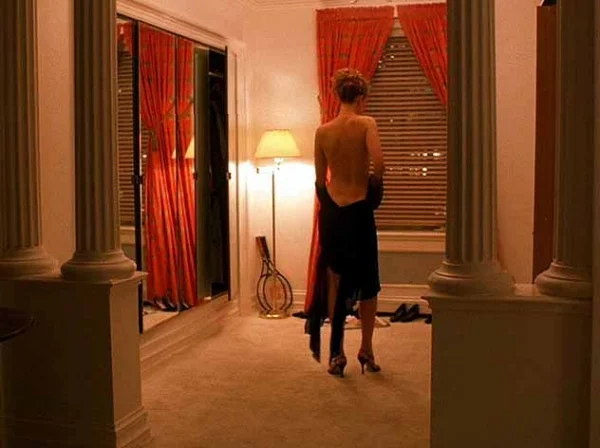
With its odd mix of biography, sharp cultural commentary, acute film criticism, and not so concealed longing, " Nicole Kidman," as should be evident by now, is neither conventional showbiz bio, nor tabloid exposé. With the exception of one deliciously prurient detail about the filming of "Eyes Wide Shut," gossip-hounds will be disappointed. If its writer is occasionally pretentious (he is), immodest (all those pages where he suggests how scripts could have been improved), and too prone to drool over Nicole's "very lovely, supple body," it only adds to this book's ramshackle, discursive, opinionated, and besotted charm. Besides, even when spouting nonsense, Mr. Thomson is more informative and entertaining than most writers. Far removed from the arid monotony of film-school Bauhaus, the sparkling rococo of his prose is a joy to read.

Above all, don't miss his sly, clever summaries of Ms. Kidman's oeuvre, particularly of those shockers he believes to be unworthy of his muse's talents, such as "Malice," a fiasco he describes as ending up shipwrecked "on the wilder shores of denouement." That's a phrase so neat that I can even forgive Mr. Thomson for disclosing his dream of Nicole as Belle de Jour being toyed with by a Gestapo officer and an "elderly Chinaman."

But can Mrs. Thomson?