Money Manager

Ben Bernanke: The Courage to Act  - A Memoir of a Crisis and Its Aftermath

The Weekly Standard, February 5, 2016

Georgetown, Washington DC, November 2008 ©  Andrew Stuttaford

Georgetown, Washington DC, November 2008 © Andrew Stuttaford

In The Courage to Act, former Federal Reserve chairman Ben Bernanke reveals, a little unexpectedly, that he can tell a taut tale well, and in a manner accessible to someone who wouldn’t know a CDO from an Alt-A mortgage. After a likable autobiographical beginning, the book is centered on the Fed's response to the financial crisis that started to unfold just over a year after Bernanke took office in 2006. Bernanke was right to see that catastrophe threatened to engulf more than Wall Street, and he was right to see that, in the much-mocked phrase, something had to be done.

It's easy to criticize the technical aspects of bailouts based on Depression-era powers usable in "unusual and exigent circumstances" and put together with "chewing gum and baling wire." But that misses the point. Financial panics feed on themselves. What mattered about the rescue packages was not their structure but what they symbolized: Money, a lot of money, was available, and the mechanisms were in place to dole it out. With confidence gone and liquidity evaporating, that was what markets needed to know.

Neither left nor right nor center rejoiced in what was widely characterized as a helping hand for the rich, but there were more explicitly ideological objections to the bailouts, too, most notably from congressional Republicans. They ranged from the nutty—TARP as "Bolshevism," a label that would have surprised Lenin—to a more intellectually coherent insistence on greater respect for the disciplines of laissez faire.

But to argue against the interventionism of 2008-09 on the grounds that markets are best left to sort themselves out was (as the ebbing Bush administration also appreciated) to succumb to a form of fundamentalism with no connection to political reality. From Greece to Spain to France to Italy, economic stagnation, or worse, has shaken the European Union's political order to a degree largely unimaginable a decade or so ago. And not in a way that bodes well for free enterprise.

Over here, the maelstrom on Wall Street did its bit to propel Barack Obama into the White House. The feebleness of the economic recovery that followed has played its part in the rise of Donald Trump and Bernie Sanders. To maintain that America's political center would have held in the event of a collapse in the banking system—empty ATMs and all the rest—is absurd.

As it was, the mayhem triggered by the implosion of Lehman Brothers offered a taste of a larger calamity dodged. Bernanke would have preferred to help out Lehman, too—both the Fed and an essentially helpless Treasury understood that its failure would be an "epic disaster." But the law, he writes, stood in the way: Lehman Brothers was in such bad shape that it wasn't eligible for the emergency financing deployed elsewhere. It's been suggested that this was merely a convenient excuse. Bernanke himself admits that the Fed was reaching the limits of the politically and financially feasible. Market conditions were such that any assessment of Lehman's underlying strength (and eligibility for aid) was more art than science, leaving some wiggle room had the Fed been prepared to take it.

Nevertheless, I'm inclined to believe Bernanke's insistence—his version of events, unsurprisingly, is more or less in line with what Tim Geithner and Hank Paulson have to say in their memoirs—that the law counted. In an age of technocratic excess, that's cause for mild patriotic celebration. In marked contrast to the lawlessness that scarred the defense of the eurozone, the Americans stuck by the rules.

But any celebration is tempered by the knowledge that the Fed's emergency powers have been rewritten in the wake of the Dodd-Frank Act to exclude lending to specific institutions ("broad-based" lending is still permitted), a right Bernanke claims to have been "happy to lose." This change was cheered on by the likes of Elizabeth Warren; the Republican chairman of the House Financial Services Committee, fretting about moral hazard, thought that it did not go far enough. As it is, this restriction will almost certainly make it impossible for the Fed to give the sort of support it gave to smooth J. P. Morgan's takeover of Bear Stearns, let alone to AIG. And that'll be fine—until it's not.

When it comes to moral hazard, Bernanke notes that "no firm would willingly seek Bear's fate." It wasn't insouciance over risk that brought so much ruin, but the failure to understand it.

Drawing the correct line between the necessary independence of the Fed and necessary democratic accountability is (as Bernanke clearly appreciated) not straightforward, particularly during a financial rescue operation when the maintenance of market confidence—and thus, often, secrecy—is of the essence. A couple of years after the bailouts, it emerged that the emergency financing extended to Wall Street's finest was much larger than realized. Congress would not have taken the news well had it known this at the time.

Given the seriousness of the situation—and the fact that the Federal Reserve had to do most of the heavy lifting—Bernanke likely found an acceptable balance between the needs of finance and the demands of Capitol Hill. But occasionally some of his comments ("even the risk of a once-in-a-century economic and financial catastrophe wasn't enough for many members of Congress to rise above ideology and short-run political concerns") betray the impatience of the technocrat with democracy's rougher edges.

There are hints, too, of technocratic bias in Bernanke's analysis of the causes of the crisis. He's unwilling to let interest rate policy take much of the blame and, to be fair, he makes a decent case why it shouldn't. He does admit that the Fed was slow to notice the problems that were developing and slow to fully grasp their significance. He acknowledges that a ludicrously fragmented regulatory system had failed to keep up with rapidly evolving capital markets. But in the end, private sector culprits—including subprime lunacy, the bewilderingly intricate interconnectedness of the modern financial system, and good old-fashioned panic—dominate his perp walk.

Hyman Minsky, the economist who, decades ago, warned that a prolonged period of financial stability could lead to dangerous investor complacency, gets the shout-out he deserves. But did the widespread perception—boosted by heavy, if misdirected, regulation—that markets were well regulated reinforce that overconfidence? There is also the inconvenient fact that capital adequacy rules strongly encouraged banks to favor mortgage lending and, critically, the purchase of mortgage-backed securities—so long as the latter were rated Triple A by the rating agencies that were, themselves, given a privileged position by regulators.

Triple A! What could go wrong?

Bernanke also has little to say on the way that postcrisis regulation has hit the willingness of banks to lend. That's ironic, given his belief that shrunken credit flows made the Great Depression worse; doubly so, as reining in the banks has probably canceled out no small part of the boost that the ultra-low interest rates generated by quantitative easing (QE) were meant to bring.

Bernanke recalls that after QE1 and QE2, he had concluded that the Fed's securities purchases had been "effective" but "not enough, on their own, to achieve an adequate pace of economic growth and job creation." QE3 came next. That began to taper off toward the end of his tenure, by which time Bernanke believed that the economy was in considerably healthier shape.

It was impossible, he concedes, to know how much of the recovery was due to the Fed's work, but Bernanke is convinced that "unconventional monetary policies" promoted growth and reduced the risk of deflation. That could be true. But there may eventually be a harsh price to pay for choosing to put the laws of economics to one side for so long. Years in which interest rates—the cost of money—have been so disconnected from market forces have left a trail of mispriced investment and unwise borrowing that is likely to end up in a nasty bust. What will an already overstretched Fed be able to do then?

Bernanke was not given the benefit of the doubt that Alan Greenspan—the "Maestro"—enjoyed. Tough times will do that. His immediate response to the crisis infuriated many. The measures he took in the years that followed were greeted with another round of jeers by many and crossed fingers by more. Even those who profited from the stock market recovery built on his cheap money seemed suspicious of their friend at the Fed.

Only a few brave contrarians have called Ben Bernanke a maestro. His historical reputation will probably be all the better for that. By detailing what he did and why he did it, this book won't hurt it, either. In the end, the consequences of his grand gamble will count for more. And we still don't really know what those will be.

A Distant Funhouse Mirror

Christopher Buckley: The Relic Master

National Review, January 25, 2016

ToH_B1_MOF_229_StNectaire_ReliquaryStBaudime2.ashx_.jpg

By the late Middle Ages, scraps of Mary Magdalene were strewn all over Europe. Not only was her body (or most of it) on display in the town of Saint-Maximin in Provence (it’s still there, if you want to take a look), but, as Charles Freeman notes in his Holy Bones, Holy Dust: How Relics Shaped the History of Medieval Europe (2011), “there were three more of her bodies” to see, one near Ancona, one in Rome, and one in Constantinople. Lucky Abbéville had a head; Cologne had embraced two of her arms, and “five more were known” elsewhere. Relics were part of the sea of faith, to borrow a phrase, in which most Christians swam, but they were also a handily profitable device to prop up temporal and spiritual power. As such, they were an excellent business opportunity.

Enter Dismas, the Swiss hero of The Relic Master, Christopher Buckley’s beguiling, funny, and slyly erudite new book. Dismas (named, not inappropriately, after the penitent thief crucified alongside Christ), a former mercenary — a Reisläufer — and former monk (“couldn’t get used to the hours”), has become a dealer in relics, one of the best, a man not without a certain degree of integrity. Disdainful of the sloppier and more disgraceful frauds, he deals in nothing he knows to be false. He stands by that leaf he sold from the Burning Bush.

Dismas is in Basel for the 1517 relic fair, a fair that never existed but is located by Buckley in a city that plays host nowadays to an annual fair showcasing contemporary art. The kneecap of Saint Afra then, a spot painting by Damien Hirst now, objects of desire and of worship, objects that magically bestow much-coveted properties on their owners, some sort of holiness in the first case, some sort of sophistication in the second, as well as the status that comes with buying anything — kneecap or spot — that is outrageously expensive enough.

Such relics often fetched tidy sums, not least because of the revenues brought by the pilgrims who came to venerate them, thereby possibly improving their prospects in the afterlife — for a price: “Donate such and such sum,” writes Buckley, “to venerate such and such relic, and so many years would be deducted from your term in Purgatory.” They could be useful, indulgences: get-out-of-purgatory-sooner cards, never short of takers. After Basel, Dismas delivers a haul of relics to one of his two main clients, an archbishop of great splendor and greater cynicism. After careful episcopal evaluation, it is determined that the 296 relics “would provide an aggregate indulgence value of 52,206 years off time in Purgatory. And provide his grace with a tidy return on his investment.” It was madness, but, like many manias, not without its internal logic.

Buckley’s tone is amused and amusing, but choosing to write such a book now, after the Internet bubble, after the 2008 bust (how were collateralized mortgage obligations, uh, valued, anyway?), and at a time when billion-dollar “unicorns” gallop through private-equity portfolios, undercuts any suggestion of condescension. Thus Dismas and many, many others discover that their cash has been looted by a crooked financier, Master Bernhardt. The locals contemplate what might be an appropriately grotesque punishment — burning, death by bear, something even nastier involving fishhooks? In the end, he gets off with a “well-attended” beheading. Absent the beheading, an echo of Madoff there, I thought; Bernie, Bernard, ah.

The year 1517 is an interesting one — a year at the cusp — for Buckley to pick. Within weeks of Dismas’s expedition to the relics fair, he is in Wittenberg, visiting his other key client, the Elector Frederick of Saxony. And Dismas is with Frederick when the elector is told that Martin Luther has been busy at the Castle Church: “‘Ninety-five [theses],’ Frederick smiled, ‘is our church door sufficiently commodious?’”

Dismas is soon wondering what Luther’s less than indulgent treatment of indulgences might mean for his trade: “Many indulgences were earned by venerating relics. If indulgences were abolished, who would come to venerate the holy bones?” He was right to worry: Frederick gave up collecting relics within a year or two. And then there was grim John Calvin. His Treatise on Relics (1543) is a work far rougher on those souvenirs of sanctity than anything you’ll find in Buckley. So much of the Virgin Mary’s milk was on display, jeered Calvin, that “had the Virgin been a wet-nurse her whole life, or a dairy, she could not have produced more than is shown as hers in various parts.” A dairy.

Hints of the shift in thinking beginning to percolate through Europe at this time are scattered through The Relic Master. Dismas is a traditionalist, but he struggles to answer some of the increasingly awkward questions that his friends are beginning to ask. Surely the “indulgence business” was in the Gospels “somewhere.”

I’ll pause now to reassure anyone worried that he or she has stumbled into a discussion of a learned volume on 16th-century religious controversies rather than a review of the latest book by Christopher Buckley, a famously enjoyable writer related, so to speak, to this magazine. Fear not: The Relic Master covers some serious historical ground and boasts an impressive list of sources at the end, including Freeman’s book and an account of a marriage in 16th-century Nuremberg that I, for one, will be hurrying to read — one day. But it also features killings, torture, hand-to-hand fighting, attempted crucifixions, a beautiful girl, bizarre superstitions, three loutish arquebus-slingers, trout nibbling at a severed arm, power politics, a lecherous Medici, herbal Viagra that works, black humor (“Frederick’s not a burner”), good jokes, and some splendidly wry writing: “Tetzel was a supple theologian. He’d pioneered a new form of indulgence whereby you could buy full indulgence for sins you had not yet committed. Even Jesus hadn’t thought of that.” Supple.

It’s never easy to know how to handle the distant past in fiction. Hollywood’s classic couldn’t-care-less generated some terrific lines (“War, war! That’s all you ever think about, Dick Plantagenet! You burner, you pillager!”) but failed to convince, while more respectable attempts at the old ye olde were neither authentic nor readable: Sir Walter Scott, I’m looking at you. Others have mined history to make fun of the present, or to make fun of the past; some — Robert Harris, for example, in his Cicero trilogy — have treated it seriously, both as a window into a vanished civilization and as a device to reexamine more modern times. Others still (such as, in his own way, Umberto Eco in The Name of the Rose) have tried to understand a way of thinking that can seem impossibly alien today.

There are glimpses of that lost sensibility in The Relic Master. Buckley’s characters are not Enlightenment folk centuries out of time, or even Bob Hopes cracking wise on the road to Chambéry — but their 16th-century attitudes are presented lightly and never weigh down what is essentially a romp, a caper, written with a wink (“A German pope? Judgment Day will come first”) in breezily contemporary prose (not a “prithee” in sight). Buckley is often described as a satirist, but in this book he comes across more as someone enormously entertained by man’s perennial absurdity, an absurdity he relishes pushing just that bit further, teasing then — and now.

So far as the plot is concerned, the MacGuffin involves the faking of one Jesus burial shroud and then the taking of another (it’s complicated). Dismas’s dream of a prosperous retirement in safe, neutral Switzerland (Harry Lime might sneer, but the Swiss have long been a sensible people) has been trashed by the banker who looted his savings. That compels him to go on one last, atypically dodgy “mission” — that’s where the shroud(s) come in — to earn back that retirement in the mountains. And as we all know, one last missions have a way of turning tricky. Dismas’s farewell tour is no exception. I won’t be a spoiler, but I will say that, once again, fishhooks have an unpleasant role to play, that a ridiculously narcissistic Dürer (yes, that Dürer) is an accomplice, that the girl shoots a mean crossbow, that an imperial posse is thwarted, that disguises are deployed, that a performance of the Last Supper is sabotaged, and that the arquebus-slingers — Unks, Cunrat, and Nutker, three goons with strong Three Stooges characteristics — turn out not to be so bad in the end.

It’s a story that — as capers should — rolls merrily along. It was clearly fun to write, and it is certainly fun to read, but the very best of this book comes in moments such as this, included in the description of Dismas’s arrival in Wittenberg:

“Did you bring wonderful things?”

“One or two. Saint Barbara. A toe.”


Ruble Trouble

Book Review of Red Notice: A True Story of High Finance, Murder, and One Man's Fight for Justice by Bill Browder. Published originally in The Weekly Standard.

Not long after Russia's financial crisis, in 1998, I attended a conference on Eastern European stock markets. The keynote speaker was Richard Pipes, veteran historian of Russia and the Soviet Union. His talk included an examination of how property rights had evolved—or, rather, failed to evolve—in Russia over the centuries. "If we'd heard that a year ago," one battered investor told me, "we would have saved a lot of money." It's a shame that Bill Browder was not there that day.

Read More

A Most Unholy Union

Monetary union in Europe was not a pathway to more efficient markets but, at least in part, a dirigiste attempt to rein them in. The untidiness of Europe’s old foreign-exchange markets must have outraged Brussels’s central planners, but their fluctuations acted as invaluable warning signals to investors and lenders of trouble to come and, in the shape of a currency crisis or two, gave miscreant governments a powerful incentive to take away the punch bowl before it was too late. 

Read More

Narcissus and Echo

When the established order collapses, those who live among the ruins often take comfort from the hope that someone will turn up to tell them what comes next. With a dysfunctional and humiliated Germany struggling to come to terms with a military defeat that it still did not understand, there was nothing very remarkable about the views of the young, down-at-heel Ph.D. who, in early 1922, complained in an article for his hometown newspaper that “salvation cannot come from Berlin,” the shamed and shameful symbol of old Reich and new Weimar. But all was not lost: “Sometimes it looks as though a new sun is about to rise in the south.”

Read More

A Most Curious Country It Was

There was a time, a time not long after history ended, when the narrative was clear. The Soviet Union collapsed, followed by a period too close to chaos for comfort. Finally Putin, picked out from backstage, and promising a firmer hand on the tiller; if no one was sure of the course he would set, how bad could it be? The past was past, after all. In 2006, Peter Pomerantsev, the British son of Soviet-era émigrés, flew into Moscow set on a career in Russian TV. His book tells what happened next.

Read More

The Prog Prince

Caravan!   Van der Graaf Generator! Yes! Genesis! To Englishmen of a certain age, just reading some of these old names will take them back to an era when progressive rock haunted the turntable, songs stretched out endlessly (three minutes would barely be enough for a proper guitar solo), and lyrics—well, they took themselves more seriously than be-bop-a-lula ever could: “For from the north overcast ranks advance / Fear of the storm accusing with rage and scorn.” That was Genesis, by the way, from their song “Can-Utility and the Coastliners” (1972), a characteristic ramble from their prog-rock heyday, a time whenPeter Gabriel, notPhil Collins, was the front man. 

Read More

Writing the Coattails

Boris Johnson: The Churchill Factor - How One Man Made History

National Review, December 18, 2014 (December 31, 2014 Issue)

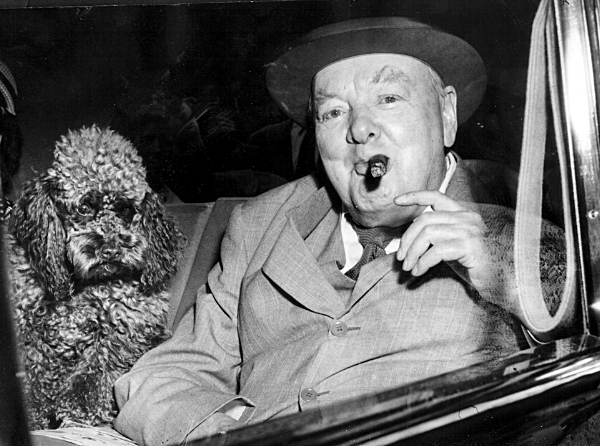
About halfway through Britain’s long Blair nightmare, I went to two dinners where Boris Johnson was billed as the guest speaker. Each time he was eagerly awaited: a man on the rise, a gifted journalist, an engaging and eccentric television personality, a Tory MP. Each time he was late. When he eventually turned up — all scarecrow hair and unconvincing excuses — he explained that he’d left his notes behind. He pressed on regardless in that blend of Drones Club and High Table that he has made his own. Both speeches were funny, sharp — and more or less identical. Johnson knows, as Winston Churchill knew, that a spontaneous speech takes plenty of preparation. A book by Boris on Winston — first-name politicians both — ought to make sense. Like Churchill, Johnson is phenomenally ambitious, unusually resilient, and remarkably skilled at using showmanship, élan, and his pen to build, refine, and reshape his image.

It’s a shame, then, that The Churchill Factor is not very good. The grand old stories roll on grandly by, but there’s little that’s new for those who know their Churchill, and not enough depth for those who don’t. But if you’re interested in Johnson, this book is well worth a look. If Boris was someone to watch back when I listened to him make one speech two times, he is much more so today. He has since twice won election as mayor of London — no small feat for a Conservative — and is poised to reenter Parliament in the 2015 general election. From there he will be well placed to run for the Tory leadership in the likely event that David Cameron has just led his party off a cliff.

Johnson’s success owes a great deal to the manner in which he has defused his potentially toxic poshness. Like the hapless Cameron, Alexander Boris de Pfeffel Johnson went to the wrong school (Eton) and the wrong university (Oxford), and then capped the whole disgraceful gilding by joining the Bullingdon Club, an Oxford gang of the rich and sporadically destructive brought to politically tricky national attention some years ago when an ill-wisher leaked the club’s 1987 photo — a snapshot of archaic finery, Flashman attitude, and Sloane Ranger hair, a photo in which both Cameron and Johnson appeared.

Cameron has tried to deal with this embarrassment of privilege by recasting his public persona (very) gently downscale. The more charismatic Johnson, gambling that Brits take more pleasure in eccentricity than in reverse snobbery, has moved in the opposite direction, putting on a display of wild toff rococo — a bit of Wooster, a spot of Biggles, a touch of Raffles — that has left class warriors too amused to be chippy.

It’s a performance that rests heavily on Johnson’s way with words. His speeches are punctuated by slang, dated terminology, and madcap verbal construction. An accusation of infidelity was famously, if inaccurately, dismissed as an “inverted pyramid of piffle.” But what works in a sound bite palls over the course of a book. Tootling, monstering, wonky, squiffily, tosser, prang, perv, titfer, snortingly, bonkers, bunging — crikey, Boris, hold the shtick already. Unnecessary adjectives and superfluous adverbs run wild. Metaphors meander. A promising description of Churchill’s house — crammed with researchers, writers, and secretaries — as “one of the world’s first word processors . . . a gigantic engine for the generation of text” dragged on so long that all I wanted was the delete button. To be sure, there are splendid moments (“the French were possessed of an origami army: they just kept folding”), but they are swamped by verbosity.

So it’s ironic that the best section of the book is Johnson’s superb analysis of how Churchill’s oratory was put together, what it was meant to convey, and why it worked as well as it did. Sadly, Johnson himself ignores two key Churchillian tricks — short words over long, “Anglo-Saxon pith” over intruders with Latin and Greek origins — burdening the readers of this book with such treats as chiasmus, philoprogenitive, and eirenic, words that probably played little part in the small talk of Alfred the Great.

But these ten-guinea words are sly demonstrations of erudition, deployed for political, not literary, effect. Boris may play Wooster to beguile the plebs, but he wants them to understand that he is no upper-class twit. At the same time, he needs his audiences to feel that he is an inclusive sort of fellow, with them if not necessarily of them. So he brings his readers alongside him on trips to the sacred sites — to Chartwell, to the House of Commons, to kind Nurse Everest’s grave — while throwing in glimpses of a life that he invites them to share, if only by proxy: lunch at the Savoy, a birthday bash for a hedge-fund “king” at Blenheim Palace. Condescending, yes, but cleverly disguised. Only rarely does the mask slip, and the text sprouts tics more typical of history books written for the late-Victorian nursery: “Those were the days, you see, when there was no moral pressure on MPs to have a ‘home’ in the constituency.”

“You see”? Well, I suppose I do. Thank you, sir.

Notionally, Johnson has written this book to revive ebbing memories of Churchill and to remind his readers that, whatever some cruder Marxists might have to say about history’s being driven by “vast and impersonal economic forces,” one man can make a difference. Based primarily on a fine retelling of the events of 1940, Johnson makes a strong, if unsurprising, case that Churchill was such a man.

But Boris’s real objective in writing about Churchill is to promote Boris. Wisely, he doesn’t try to push Churchill comparisons — hosting the London Olympics doesn’t quite rank with seeing off Hitler — but there’s enough there for a satisfactory subliminal message. So Johnson tells the story of a man comfortable in his unorthodoxies, a statesman who was larger than life, and, like a certain twice-elected mayor of London that I could mention, larger than party.

In recent years, Johnson has positioned himself as offering a more robust, less politically correct version of David Cameron’s “modernized” conservatism, more libertarian, not so committed to environmentalist piety, pro-immigration (for its purported qualities as an agent of economic growth), and a booster of London’s cosmopolitanism, too, but not so respectful of multiculturalist orthodoxy. Johnson portrays Churchill, not unreasonably, as an early-20th-century Whig, an optimist, a Progressive of sorts.

But the old imperialist is not safely pigeonholed. Johnson defends his hero against the accusation that he was a warmonger and — as he should — places some of Churchill’s rougher views within the context of his times. Occasionally (not as uncharacteristically as fans of the allegedly plain-speaking Johnson like to believe), Boris simply dodges the issue: There is nothing on Churchill’s response to the Bengal famine of 1943, startlingly callous then and now.

Johnson — clearly conscious that times have moved on for the island race — takes care to signal that, despite his obvious admiration for Churchill, he himself is no reactionary. He distances himself from some instances of the more “unpasteurized” Churchill, but not too far. The last lion is still idolized by many of those who will be picking the next Conservative leader, an election evidently on Johnson’s mind. Why else tread quite so carefully on the question of Churchill’s complicated views on a united Europe, that most treacherous of Tory topics?

But tread carefully Johnson does. He has his eyes on the prize. Churchill would have understood.