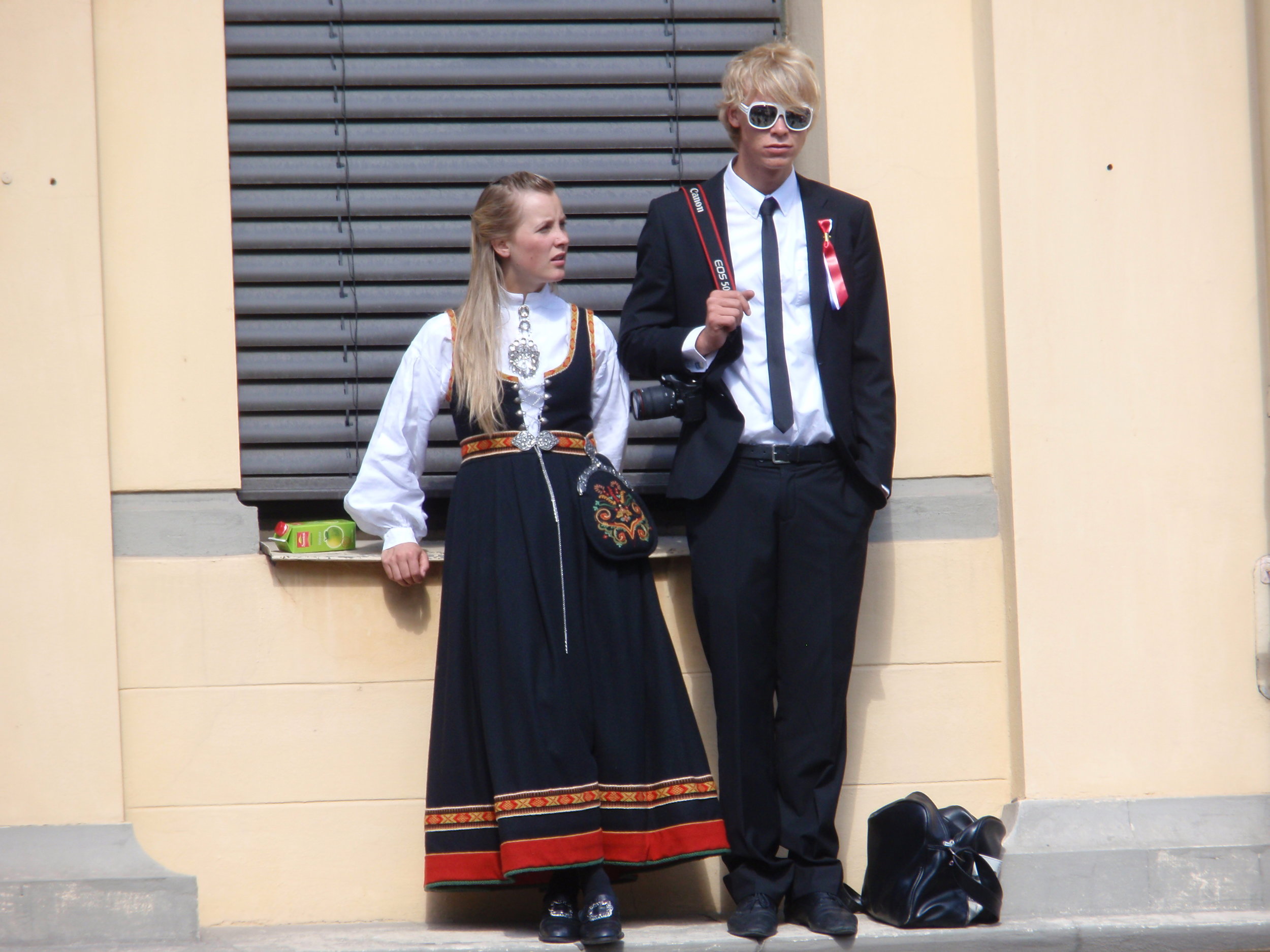
Not just remembrance

On Nightmare in Berlin by Hans Fallada, Theory of Shadows by Paolo Maurensig, A Legacy of Spies by John le Carré & The Accusation: Forbidden Stories from Inside North Korea by Bandi.

The New Criterion, May 1, 2018.

Berlin1945.jpg

The past, wrote William Faulkner, lending a hand to generations of scribblers struggling for a first line, “is never dead. It’s not even past.” That was seldom more true than in Germany immediately after the Second World War, the setting for Nightmare in Berlin, the penultimate— and posthumously published—novel by Rudolf Ditzen (1893–1947), the German writer better known as Hans Fallada, a pen name cobbled together from two of Grimm’s tales. This uneven but compelling book initially appeared in 1947 as Der Alpdruck (The Nightmare), but it was first translated into English (by Allan Blunden) in 2016 and released in the United States last year. Presumably adding Berlin—a city with a dark grip on the Western imagination—to the title was to boost the book’s sales, and to connect it to its successor, the better-known Jeder stirbt für sich allein (Every Man Dies Alone). This became an English-language bestseller after its first translation (in 2009) and the award of a new title—Alone in Berlin—featuring that bookstore-bait burg along the Spree.

Even by the questionable standards of the creative class, Fallada had a rocky start. Highlights included two failed suicide attempts, the first of many sanatorium stints, murdering his opposite number in what may or may not have been a suicide pact, speedy discharge from the army in 1914 (in retrospect, a spot of luck), alcoholism, and drug addiction (both were problems for much of his life), and two terms of imprisonment for embezzlement. His first novel came out in 1920, after another go at suicide, but before he took up theft. By the beginning of the 1930s, however, Fallada was enjoying some success, notably with Little Man, What Now? (1932), in which he used the plight of one couple to illustrate the effects of the economic crisis that plunged the Weimar Republic into a night it could not survive.

Fallada’s decision to keep on in Germany after the Nazi takeover—and the sporadically squalid compromises that choice involved—contributed to the postwar eclipse of his reputation abroad. He expressed some support for the Nazis early in their rule (“this is the party which will save Germany from chaos”) but never joined them and soon lost whatever sympathy he’d had for their regime. Despite that, he largely avoided trouble by mainly confining himself to non-political fare, although Wolf Among Wolves (1937), focused yet again on Weimar woes, had the dubious distinction of being both praised by Goebbels (“a super book . . . . That fellow has real talent”) and being filmed for East German television.

Nightmare in Berlin draws heavily on Fallada’s existence amid the ruins of the Third Reich. Like Fallada, its hero (if that is the word), Dr. Doll, is a writer haunted by the sporadically squalid compromises he has made. Like Fallada, he shared a weakness for morphine with a much younger second wife. Like Fallada, he spends time in rehab, including —yes, like Fallada—a stay in a clinic where he is the only man: many of the other patients were prostitutes under treatment for sexually transmitted diseases. Like Fallada, Doll is appointed the interim mayor of a small town by the Soviet military authorities. Like Fallada, Doll is overwhelmed by the task and retreats to Berlin, “a city reduced to rubble, burnt out and bled to death,” a city of scant rations, hardscrabble squabbles, “trickling debris,” and “rats, looking for something unspeakable in the basement.” And, like Fallada, Doll finds a literary patron, the head of a new arts association. Nightmare in Berlin’s Granzow owes a lot to Johannes Becher, a future East German culture minister, back in Berlin after years in the USSR as a guest of Stalin’s more congenial tyranny.

When Doll greets the incoming Red Army as liberators and hails them as “comrades,” the response is a “withering gaze,” a reminder that as a German he “belonged to the most hated and despised nation on earth.” This realization may account for the most striking omission in a book Fallada described as “a faithful and true account . . . of what ordinary Germans felt, suffered and did between April 1945 and the summer of that year.” Maybe, but when it came to mass rape by the Soviet occupation forces, the dominant issue—beyond simple survival—for many “ordinary Germans” at that time (the victims included Fallada’s first wife, to whom he had remained close), Fallada opted for silence. Perhaps he had found he could live with a fresh set of jackboots. Nightmare in Berlin was first published by Aufbau, a company set up with Soviet approval. Becher was one of its founders.

Nightmare’s prose, typically for Fallada, is unvarnished. The book is intrinsically episodic: “the great collapse,” Doll’s mayoralty, the return to Berlin, a battle over an apartment, the time in clinics, and ultimately a resumption of his career. The plot was never the point. Fallada explained that Nightmare was “essentially a medical report, telling the story of the apathy that descended upon a large part, and more especially the better part, of the German population in April 1945.” Writing it, he confessed, had not “been an enjoyable experience,” partly, I suspect, because of the guilt he himself felt, guilt that he expresses through Doll, a man complicit simply by his passivity in the face of a tyranny that had tyrannized him: Doll had been interrogated, arrested, and spied upon. The Nazis had “banned his books some of the time, allowed them at other times,” but although he was “appalled” by them, he “never did anything about it.” Fallada once wrote that he did not like “grand gestures, . . . being slaughtered before the tyrant’s throne, senselessly . . . is not my way.”

Fallada had few illusions about himself or his compatriots. Asked by the Soviets to address the locals on the day of the Reich’s capitulation, Doll notes the rote cheers and raised arms—“the right arm still, in many cases, raised in the salute that had been drilled into them over many years.” His “nation . . . bore its defeat without dignity of any kind, without a trace of greatness.”

For all that, this sour, subdued, exhausted novel staggers to an unconvincingly uplifting conclusion:

And maybe people will learn something, after all . . . . Doll, at any rate, was determined to be part of this learning process. He saw his path laid out before him, the next steps he had to take, and they meant work, work and more work.

It reads better if “The Internationale” is playing in the background.

By this point Fallada was, in the words of one biographer, “a physical and psychological wreck.” He died in the Soviet sector of Berlin almost exactly six months later, in February 1947.

alekhine18 (2).jpg

At around the time that Doll and Fallada were trying to come to terms with their pasts, Alexander Alekhine was avoiding a reckoning with his. In the early stages of Paolo Maurensig’s Theory of Shadows, Alekhine, with only one brief interruption the real-life world chess champion since 1927, is the solitary guest in a hotel in Estoril, Portugal. It is March 1946. A heavy drinker for decades, Alekhine is hard-up, in poor health, deep into his own endgame. He is also waiting to hear which Soviet master will challenge him for the world championship in a contest that also will be a proxy for a broader ideological struggle. A traitor to the radiant future, Alekhine had quit revolutionary Russia in 1921, never to return, never forgiven.

Framed as a book within a book (playing games with narration is something of a Maurensig trademark) and as fiction inserted into fact, the complex and atmospheric Theory of Shadows falls somewhere between historical reconstruction and a seductive reimagining of Alekhine’s last days. Its Italian author is probably best known for The Lüneburg Variation, an extraordinary debut published, encouragingly, after his fiftieth birthday. As they do in Theory of Shadows, chess and the Holocaust intertwine in the earlier (somewhat superior, more tightly constructed) book, which also contains references to Alekhine, most significantly this:

[A]nti-Semitic articles appeared with increasing frequency under the byline of the world champion, who . . . noted that after having been so long polluted by Jewish blood, the world of chess would finally recover its purity.

That alludes to a number of articles in the Pariser Zeitung, a newspaper published by the Germans during their occupation of France. Unabashed by inconsistency, Alekhine maintained—take your pick—that these pieces were not his work, or that they had been written under duress, or that his text had been doctored: a clash of excuses undermined both by their contradictions, and, some years after his death, by the discovery of interviews he had given to two Madrid newspapers in 1941. Among the self-incrimination: huzzahs for Capablanca, that rival of rivals, for “depriving the Jew Lasker of the world chess scepter.”

In Theory of Shadows (which was translated by Anne Milano Appel), Maurensig revisits the Paris articles, but adds more to the charge sheet, including Alekhine’s participation in tournaments in Nazi-dominated Europe and his relationship with Hans Frank, Hitler’s proconsul in Poland, a lover of chess and of genocide. Alekhine recalls playing chess in Frank’s residence. Was it “possible to dance the polka in the middle of hell”? Yes, Alekhine had concluded, it was.

And so:

At the end of the war, he was left with few friends: to the French [Alekhine had become a French citizen] he was a collaborator, to the Soviets a traitor; even the White Russians who had settled in Europe would not forgive him for having worked, during the Revolution, for the ministry tasked with expropriating the assets of emigrants.

The past parades through his afternoon dreams, but benignly: his mother, the czar, long-dead acquaintances, an agreeable contrast to “bizarre” or “terrifying” nightmares after dark.

A violinist, David Neumann, comes to stay at the hotel. “Alekhine found himself thinking that the man was quite likable. Despite his surname, which clearly disclosed his race.”

Ah.

Someone slides newspaper articles beneath Alekhine’s door. All “without exception” concern the Nuremberg trials then underway. A man and his wife—two more new guests—dine with Alekhine for the first time; the husband’s remarks grow progressively more probing. The wife, ominously silent, stares at Alekhine and then “abruptly [runs] her index finger across her throat.” It is an unusually melodramatic moment. Maurensig writes in a sotto style that reinforces the impression of a trap slowly but relentlessly closing around the grandmaster: appropriate enough in a book where chess, that most implacable of games, is, as in The Lüneburg Variation, a deity—or demon—demanding attention and much, much more.

The hotel gradually fills, the Portuguese secret police show up, a Russian is overheard discussing Alekhine on the phone. Another clipping, a photo, another dinner conversation: French hit squads are hunting Germany’s collaborators all over Europe. One night Alekhine hears someone fumbling with the lock to his door. The ratchet continues to turn, sometimes, maybe, only in his imagination, sometimes not. Alekhine dies alone in his room. Choked on a piece of meat. That was the official story, difficult to reconcile with the widely circulated photograph of the dead man, seemingly asleep in his chair, wearing an overcoat that would have been unnecessary inside. But that was the official story.

Theory of Shadows opens in 2012 with a novelist (with just a touch of Maurensig about him) explaining that he is in Portugal to research what he is convinced was Alekhine’s murder. Despite an Orient Express–load of potential culprits—including the Soviets and those French hitmen—he has been unable to decide who was responsible: “And I know that you cannot write a story centered on a crime without unmasking the killer at the end.” The pages that follow, written by Maurensig, a trickster-writer layering a narrative where reality has a way of slipping out of sight, disprove that. And Maurensig’s crumbling Alekhine—cold and narcissistic under the camouflage of a brilliant naif consumed only by chess—and the circumstances in which he finds himself, would be book enough without a death, let alone a solution.

In an epilogue, the novelist (whom Maurensig never names) meets the individual who discovered (“or so they wanted people to believe”) Alekhine’s body. But what he really saw, or so he says, was the aftermath of a murder. He then reveals who he thinks arranged the killing and their motive for doing so. It is right, this witness-of-something suggests, that the novelist is telling this story as fiction: “Perhaps only the imagination allows us to arrive at certain hidden truths.” That is what Maurensig has done. Perhaps.

Berlin, August 1978 © Andrew Stuttaford

Berlin, August 1978 © Andrew Stuttaford

In A Legacy of Spies, David Cornwell, the author better known as John le Carré, returns entertainingly, and with some relish, to his past—to The Spy Who Came in from the Cold, the novel that made his name. And the past catches up, unpleasantly, with Peter Guillam, a former agent first encountered in Call for the Dead (1961): the elastic lifespans and variable biographies of some of the Le Carré regulars who crop up in this book will niggle the pedantic.

Guillam is now retired in Brittany, “resolutely” fighting off the “accusing voices” that occasionally—the night is kinder to him than to Alekhine—“attempted to disrupt my sleep.” Then his former employers write, asking him back to London: “A matter in which you appear to have played a significant role some years back has unexpectedly raised its head.”

Appear to. Le Carré has not lost his ear for cautious bureaucratic prose.

When Guillam arrives at the Service’s “shockingly ostentatious new headquarters” (and so it is from the outside: disappointingly, I have never been in a position to assess the interior) across the Thames, it’s evident that time has moved on, and so has Leviathan. Different accents—Le Carré’s prickly sensitivity to the nuances of English class is as acute as ever—different, careful jargon (“assets” now, not “joes”), impersonal electronic security, more women, tracksuits, quietness, cleanliness, no windows, sealed windows, locked doors: “Somewhere . . . between Cambridge Circus and The Embankment, something has died.”

But the performance lives on—“Bunny . . . managed a half-squeeze of the eyes for friendly”—and so, for all that regrettable ostentation, does the parsimony. A flat is found for Guillam—in, of course, Pimlico’s Dolphin Square, a massive 1930s apartment complex famous for politicians, spies, and scandal, some of it true—at “a concessionary rental of £50 per night . . . set against [his] pension.” Ashe, the low-level operative who was the first to contact Alec Leamas on East Germany’s behalf in The Spy Who Came in from the Cold, had lived there, too. Le Carré likes an old tune.

Le Carré’s writing before the Wall fell was marked by a world-weariness that periodically edged close—but not as close as is sometimes claimed—to calling down a plague on the houses of all the Cold War’s antagonists. Nevertheless, it is difficult to read A Legacy of Spies without detecting some sympathy for the hard edges of those who operated London’s vanished Circus. The stakes, after all, were higher back then. Regret, or, more rarely, guilt, was—generally—for later. Their successors are tough enough, but they have a sickening primness about them. They mouth, and some may even believe, the platitudes of a legalistic, self-righteous society with little awareness of, let alone understanding for, the cruel dilemmas of the past. Rather than risk too much embarrassment over that past, they are—times have changed, you see—willing to throw one (or two) of yesterday’s men under the bus. The embarrassment? The lives knowingly and unknowingly put in danger—and then tragically lost—in the interest of a cause rather more worthwhile than the avoidance of a scandal that in saner times would not be a scandal. A cause, writes Le Carré, acidly, if oddly oblivious of still strong sentiments east of the old curtain, that “the world barely remembers.”

And so, arriving in front of the block of flats that has concealed a safe house for decades, one of those investigating Guillam asks which bell she can press “without catching gangrene,” a phrase mixing contempt with an undeserved presumption of moral superiority. Guillam suggests that she press the one marked “ethics,” “Ethics being Smiley’s own choice for the least alluring doorbell he could think of.”

Smiley. He may have been transformed into a brand like Fallada’s bolted-on Berlin (“George Smiley novels” are now a thing), but it’s good to see him back, if only in flashback up until almost the end, conjuring up memories —to me, anyway—of Alec Guinness on the telly nearly forty years ago.

In one chair sits George Smiley, looking the way only George looks when he’s conducting an interrogation: a bit put out, a bit pained, as if life is one long discomfort for him and no one can make it tolerable except just possibly you.

If you have watched the BBC’s adaptations of Tinker Tailor Soldier Spy and Smiley’s People, try to read that passage and not think of Sir Alec. Gary Oldman can have Churchill: that ought to be enough for anyone.

This time Smiley is in the shadows. A Legacy of Spies chronicles a long-delayed aftershock of the events described in The Spy Who Came in from the Cold. Smiley, who planned that grand deception, is frequently discussed, but appears principally in those flashbacks, his presence only emphasized by absence, an absence that will be a challenge to preserve if the children of three of those killed as a result of that (in Leamas’s phrase) “filthy, lousy operation” —and what preceded it—get their way. They want revenge. It is perhaps indicative of where, perhaps despite himself, Le Carré’s underlying feelings lie, that, of these vengeful offspring, one is an unrepentant believer in the old East Germany, another is a thug, and we never meet the third at all.

“We were not pitiless,” argues Smiley. “We were never pitiless. We had the larger pity.”

Prospero has forgotten neither the magic of espionage noir (“there is a flicker to his smile like a faulty light bulb that doesn’t know whether it’s on or off”) nor the appeal of knowledge, real or imagined, passed on to us bumpkins by someone who was a real spy for a while: “The tortured are a class apart. You can imagine—just—where they’ve been, but never what they’ve brought back.”

A Legacy of Spies delivers, if only near its finale, an unmistakable political message, particularly for Brits. Le Carré’s stories typically come with a subtext. There were those nods to moral equivalence between the Cold War’s two sides and, often, a revealing combination of class resentment (a souvenir of an upbringing on something of a tightrope) and center-left mandarin condescension. In the introduction to the fiftieth-anniversary edition of The Spy Who Came in from the Cold, he brags that he was “writing for a public hooked on Bond and desperate for the antidote.” It was?

Le Carré’s politics have taken a harder, angrier turn in recent years, both inside and outside his books. Much of the grumbling is standard fare: wicked America, wicked corporations, wicked neocons, wicked climate change, wicked Thatcher, although an attack on Salman Rushdie added surprising variety. Rushdie should have, Le Carré advised, withdrawn The Satanic Verses until things calmed down: “I don’t think it is given to any of us to be impertinent to great religions with impunity.”

Impertinent. So judges the mandarin, so rules the former Eton beak.

Naturally, Le Carré disapproves of—the impertinence of it—“that jingoistic England that is trying to march us out of the EU,” and his lofty disapproval permeates Smiley’s grand farewell in A Legacy of Spies, degrading it to a mandarin whine. No, Smiley says, his work has not been for capitalism (the appalled italics are Le Carré’s), or Christendom, or even, after a while, for England. It was for Europe (the appalled italics are mine). If he had an “unattainable ideal,” it was an ideal he still holds, that “of leading Europe out of her darkness towards a new age of reason,” now managed, we must assume, by Brussels.

Can a fictional character be embarrassed by his creator?
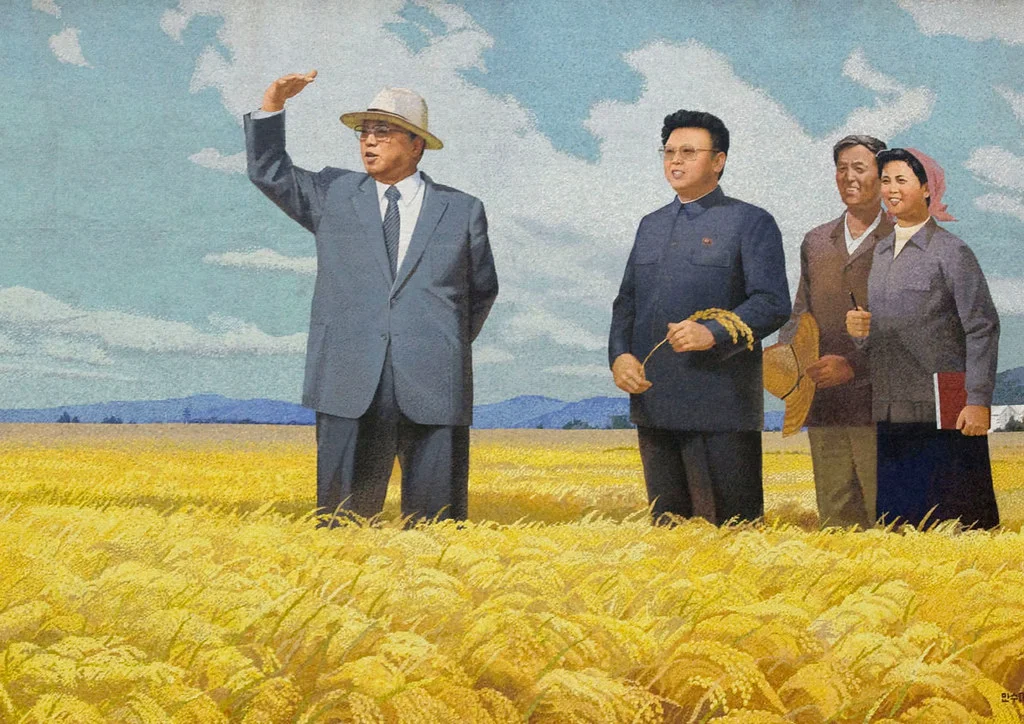
Kim.jpg

When the Soviet empire collapsed, some worried that Le Carré would have nothing more to say. When North Korea failed to follow suit, the pseudonymous writer known only as “Bandi” (the name comes from the Korean for “firefly”), supposedly a member of North Korea’s state-controlled writer’s association, must have wondered whether he would ever see what he really wanted to say in print in his own land. Between 1989 and 1995, he had secretly turned to writing fiction that told the truth about a country where fact is drowned out by mandatory fantasy.

Nearly two decades later, or so the story goes, Bandi told a relative who was planning to defect about what he had done. Taking the manuscript—handwritten, bulky, and lethally incriminating—with her was too risky, but she agreed to try to send for it if she got out. And that is what she managed to do. The manuscript was smuggled out, and the stories it contained were published in South Korea in 2014 and translated into English (by Deborah Smith) last year. A collection of poems included in the same bundle of papers was published in South Korea a few months ago.

The Accusation’s American publishers, Grove Atlantic, concede that they cannot be sure that its author is not an emigré already beyond Pyongyang’s grasp. We do not even know for certain that it is the work of just one person. That said, there is enough circumstantial evidence, including the involvement of a respected human rights activist, and analysis of both the paper on which the manuscript was written and of Bandi’s language—like East and West German before reunification, North and South Korean have drifted marginally apart—to accept, for now, these stories for what they are said to be.

Bandi has been compared to Aleksandr Solzhenitsyn, but the collection of seven short stories that make up The Accusation has neither the sweep of The Gulag Archipelago nor the heft of Solzhenitsyn’s best-known novels. A more fitting comparison might be Varlam Shalamov, the author of Kolyma Tales, terse, precisely crafted glimpses of horror, some just a few pages long, that, taken as a whole, provide a vivid depiction of life—and death—in Stalin’s concentration camps, a guidebook to one kind of hell.

Bandi’s more discursive stories are accounts of what, in North Korea, passes for ordinary life. The camps, the prisons, and the mass graves cast a deep shadow but are largely offstage—until they are not. Schoolchildren suspected of “counter-revolutionary tendencies” are forced to watch the execution of a victim, bound, gagged, and allegedly guilty of an absurd charge: smearing “feces on supplies that were to be exported to the Soviet Union.” It works: “Myeong-chol . . . began to feel ever more cowed and docile, rushing to obey whatever task his teachers . . . might set him.”

Bandi’s characters are cogs in a machine that straitjackets, exploits, and never ceases to watch them. They fear it, worship it, or both. North Korea has been run by leaders saluted by portents (the birth of Kim Jong-il was reputedly heralded by a double rainbow), and associated with superhuman feats and the miraculous. It is a country where the uncertain boundary between communist rule and theocracy has been blurred more brazenly than usual. In one story, “Pandemonium,” the elderly Mrs. Oh, struggling through the countryside to see her daughter, is suddenly summoned to meet one of the passengers who emerges from one of a convoy of passing cars.

[His] pale golden clothes seemed to shed a soft veil of mist . . . a man who was unmistakably “the Great Leader, Father of Us All, Kim Il-sung . . .”

. . . Mrs. Oh dropped to her knees about five paces in front of Kim Il-sung. As she did, words slid as smoothly from her mouth as a coiled spring being released.

“I respectfully pray for the long life of our Great Leader, Father of Us All.”

No matter who you were, if you lived in this land, beneath these skies, you would have memorized these words time and time again ever since you learned to speak; hence they flowed without a hitch from Mrs. Oh’s mouth.

“Oh, thank you.” This cheerful voice came from somewhere above Mrs. Oh’s head.

North Koreans know that the apparatus that contains them can turn on them for infractions that the paranoid logic—in one story curtains drawn in the daytime not only disrupt the obligatory unity of a streetscape, but could be a signal to spies—of totalitarianism can make into the gravest of sins. And as Bandi reminds us, such sins can endure across the generations, reducing the children and grandchildren of the guilty to pariahs, to “hostile elements,” to “crows.” The past is never dead. There is a timelessness about this collection and the state it describes. Most of these stories could have been written twenty years before or, for that matter, twenty years after Bandi put pencil to paper. Even the calendar has been torn out of history and rebased to the glorious year—1912—in which the Great Leader, Kim Il-sung, was born on the very day that the imperialists’ Titanic disappeared beneath the waves. Just a coincidence, comrade?

Kim follows Kim follows Kim, and, even after his death, the first of them, Kim Il-sung, selflessly carried on as its head of state, “the Eternal President of the Republic,” a position slightly renamed now that he shares it with his son, the equally deceased Kim Jong-il. “If you want a picture of the future,” wrote George Orwell in Nineteen Eighty-Four, “imagine a boot stamping on a human face—forever.” It is a forever that North Korea has made its own:

One by one, columns began to form in the square, neatly divided like blocks of tofu. Each column accumulated new blocks in rapid succession, as though the phrase “without exception” were a long steel spit, skewering people in bunches and delivering them promptly to the square. Eventually, with only five minutes to go, the entire square was a sea of color, with columns stretching out on both sides of Department Store 1 . . . .

Senior state functionaries began to make their way out onto the VIP platform. A hushed silence descended on the square, which quivered with palpitations like the sea after a storm has just subsided.

Many of Bandi’s tales end with the protagonists turned against the regime, and, as far as we know anything about North Korea, the level of dissent has increased in the decades since Bandi wrote them, not least due to the famines of the 1990s. Nevertheless, that hushed silence still, for the most part, prevails.

Nothing has been heard of Bandi for over a year. Neither good news, nor bad news, nothing.


Do Not Speak, Memory

Masha Gessen - Never Remember: Searching for Stalin's Gulags in Putin's Russia

The Wall Street Journal, March 16, 2018

Vagankovskoye Cemetery, Moscow, Russia,  March 1993 © Andrew Stuttaford

Vagankovskoye Cemetery, Moscow, Russia, March 1993 © Andrew Stuttaford

Imagine a Germany where the Third Reich’s monuments abound but memorials to the Holocaust are scarce. Hitler is venerated by millions and his dictatorship given a positive spin by an authoritarian state that never definitively broke with the Nazi past. Replace Germany with Russia, Hitler with Stalin, and the Third Reich with the Soviet Union and that is pretty much the situation that prevails in Russia today.

The unbroken connection to the Soviet era is key to understanding “Never Remember,” a short, haunting and beautifully written book by Masha Gessen, the Russian-American journalist who is one of Vladimir Putin’s most trenchant critics. About halfway through, Ms. Gessen tells how Irina Flige, an activist who spent decades trying to restore to public view memories of what occurred under communism, has concluded it is wrong to see the problem as forgetfulness because, as Ms. Gessen summarizes it, “forgetting presupposes remembering—and remembering had not happened . . .” In Ms. Flige’s words, “historical memory can exist only when there is a clear line separating the present from the past. . . . But we don’t have that break—there is no past, only a continuous present.” In contrast to Germany, there was no reckoning. There was no Soviet Nuremberg.

Ms. Gessen offers up various explanations for this, including the long duration of Communist rule and the ways in which the categories of victim and perpetrator overlapped. The trauma was something that Russians inflicted on one another. In a sense they still do. Ms. Gessen is evidently saddened and frustrated by the spectacle of a people—her people—wandering through a manufactured reality unbothered by, or oblivious to, the obscenities or incongruities that surround them. Some of the old regime’s statues were, in the false democratic dawn of the 1990s, defaced and toppled or—in the case of one statue of Stalin—dug up and exiled to a sculpture park of shame in central Moscow. Now, however, the statues stand in the same place proudly, cleaned up but unexplained, sharing space with a rare commemoration of the Soviet regime’s victims as well as statues of poets, writers, and—why not?—Adam and Eve.

The melancholy that saturates Ms. Gessen’s prose is reinforced by pages filled with Misha Friedman’s bleakly evocative photographs, images that convey unease, absence and loss. The huts and barracks of the Gulag, ramshackle to start with, and often designed to be temporary, have often just rotted away—“only the barbed wire remained,” Ms. Gessen writes. Other, sturdier structures survive, either ignored—one of Mr. Friedman’s photographs is of a ruined prison on the edge of a housing complex—or inaccessible, swallowed up in the vastness of Siberia. One camp—just one—not far from the Urals has been restored, a project begun, tellingly, on the private initiative of two local historians but now taken over by the state. While, as Ms. Gessen notes, it has not been turned into some defense of the Gulag, its message has been muffled, shrouded in a deceptive neutrality. Ms. Gessen herself is no neutral (she describes the “distinguishing characteristic of the Putin-era historiography of Soviet terror as . . . [saying] in effect, that it just happened, whatever”).

This is an angry book. Ms. Gessen makes her case with a series of vignettes ranging from the discovery of a mass grave in northwestern Russia to a trip to the region of Kolyma in the country’s far east. (“If the Gulag was anywhere, it was in Kolyma.”) The years of glasnost and Boris Yeltsin finally provided pitifully small scraps of comfort to the descendants of the disappeared—a photograph, a death certificate, something—yet the Gulag’s poison continues to seep through the generations. When Ms. Gessen visits Kolyma’s “capital” in 2017, all the people with whom she has contact are later visited by the FSB, the successor to the KGB.

The Red Broom

Anne Applebaum - Red Famine: Stalin’s War on Ukraine

National Review, November 27, 2017

GolodomorKharkiv.jpg

Nearly 40 years ago, I met the parents of a graduate-school friend. They were exiles, Ukrainians, a people said not to exist, not really. Their son had told them that I took an unfriendly interest in Soviet history, and that I knew a little about their lost homeland.

The father asked if I’d heard about a famine there in the early 1930s. I had: something to do with collectivization.

“There was more to it than that.”

In Red Famine, Anne Applebaum, a prominent journalist and the author of fine histories of the Gulag and the Soviet subjugation of Eastern Europe, recounts just how much more there was. Red Famine is powerfully written, extensively researched, and, frequently, painful reading. It tells of a meticulous annihilation that tore a nation away from its traditions, its language, its morality, its past, its future, its everything: “A woman whose six children died over three days in May 1933 lost her mind, stopped wearing clothes, unbraided her hair, and told everyone that the ‘red broom’ had taken her family away.”

Her life had unraveled, her culture had unraveled — there’s accidental symbolism in that unbraiding — and she unraveled. The land around her unraveled too: once a breadbasket, now a wasteland, a domain of the dead and those waiting to die, Muselmänner, as they were known in Auschwitz.

Neighbor was set against neighbor, cannibalism was far from rare (yes, you read that right).

By the time — it took less than a year — the red broom had completed its 1932–33 sweep (there were smaller sweeps before and after), roughly 3.9 million Ukrainians were dead: a decimation, and more. Countless others were deported, many to a Gulag that had plenty of demand for slave labor. Large numbers never returned.

Some of this came with collectivization, Stalin’s decision to impose larger collective or state-owned farming across the USSR. Even Walter Duranty, the New York Times’ Moscow correspondent and a reliable shill for the Soviet dictator, admitted that collectivization had been a “mess”; still, he said, while there had been casualties, “you can’t make an omelet without breaking eggs.” And quite often those casualties were not unwelcome to the regime. Communism, like the millenarian movements it succeeded, rested on the notion of a great sorting between sinners and saved. Collectivization could be used to weed out enterprising, more successful private farmers, the relentlessly demonized “kulaks” (a category regularly expanded to include peasants who owned, say, a cow or a pig more than their fellow villagers), who were too smart to be won over by deceptive promises of the bounty that Communism would bring to agriculture: They were another of the Soviet Union’s disposable classes, “former people” in the sinister and, all too often, prophetic terminology of that era.

In Ukraine, the noose was drawn far tighter than anywhere else — a fact still denied by today’s Kremlin and its apologists. The millions who starved to death there, like those who died in famines elsewhere in the USSR at that time, were, it is maintained, the victims of a reckless agricultural experiment, nothing more. Applebaum agrees that the “chaos of collectivization helped create the conditions that led to famine,” but rightly goes on to argue that neither chaos, nor the weather, nor crop failure can account for the death toll in Ukraine, and especially that terrible spike in the spring of 1933. For that, the better explanation is a series of measures enacted by the regime that can only have been intended to kill. There’s a reason this famine is known to Ukrainians as the “Holodomor,” a term, Applebaum explains, derived from the Ukrainian words for hunger and extermination.

Stalin, writes Applebaum, “launched a famine within the famine, . . . specifically targeted at Ukraine and Ukrainians.” It was not enough to hit the region’s faltering farms with grain-production targets they had no chance of meeting and then to requisition what they had managed to grow. Seed corn was often seized too, as were livestock, potatoes, and, eventually, just about anything else that someone might have hoped to eat. Houses were repeatedly ransacked in hunts for any hidden scraps. Cooking utensils (and other goods) might well be taken, too. Tight controls were imposed to restrict movement out of the countryside into hungry cities (which were often unable or unwilling to help in any case), let alone out of Ukraine. Exports of grain, however, continued. Millions in hard currency were worth more than millions of lives.

Traveling to find work elsewhere was out of the question. Farms and villages judged to have fallen particularly short of production quotas — no small number — were “blacklisted”: burdened with yet more restrictions, confiscations, and prohibitions, and denied credit, essential services, and the right to barter or trade. The peasants were trapped, cut off. Not to be starving was a sign of guilt, inviting another search.

Applebaum records how a Polish diplomat crossing the border from rural Ukraine into an adjacent Russian province in May 1933 was left with the impression that he had crossed into “Western Europe,” so great was the contrast. Ukraine had, quite clearly, been singled out.

And the reason for that was Stalin’s recognition that Ukrainians’ belief that they were a people distinct from their Russian neighbors was authentic and thus potentially dangerous. The confused period that followed the Bolshevik Revolution had seen two attempts to establish a separate Ukrainian state as well as a massive peasant uprising that had evolved into a war of all against all — and a serious threat to the nascent Soviet regime. When the Bolsheviks finally secured their hold over the country, they first played, by their dismal standards, nice. Ukrainians were led to believe that their Soviet Republic would, in a real sense, be Ukrainian and, often, run by Ukrainians.

That was never likely to be a solution acceptable to Stalin, that paradoxical Georgian enforcer of Russian imperial control, a man who knew a thing or two about nations — and how to break them. When, in 1925, Stalin declared that “the peasant question is the basis, the quintessence, of the national question,” it was Ukraine that was on his mind. If Ukraine was to become “a true fortress of the USSR, a truly model republic,” which Stalin had said that he wanted, the uncomfortably large, uncomfortably independent peasantry, the repository of so much of Ukrainian tradition and, in some sense, Ukraine’s soul, would have to be ground down.

But Ukraine would have to be decapitated, too. Applebaum details the silencing and, often, destruction of much of Ukraine’s intelligentsia, and the purge of a Ukrainian Communist Party with a membership too prone, the Kremlin suspected, to go its own way.

The Holodomor is properly understood only when it is understood as part of a broader, deeper assault on the Ukrainian national idea. Applebaum records how, even as “the famine was raging, . . . Stalin’s de facto spokesman in Ukraine forced through a decree eliminating Ukrainian textbooks as well as school lessons tailored to Ukrainian children” — another warning that Moscow had not finished with Ukraine. Taken as a whole, Stalin’s multifaceted onslaught on Ukrainians as a peoplewould (as Applebaum points out) “certainly” pass the test established for genocide by Raphael Lemkin, the legal scholar who coined the term. Indeed, Lemkin acknowledged as much. Whether it would meet the narrower definition of genocide set out in the U.N. Convention on Genocide is, Applebaum contends (perhaps too cautiously), a different matter, but, as she notes, that convention was heavily influenced by a Soviet Union that had no interest in being asked to answer for its crimes.

The final stage of genocide or ethnic cleansing — call it what you will — is usually the replacement of the old population with a new one. Russian peasants started to move into the emptied villages, the beginning of what Applebaum describes as a “slow-motion movement of Russians into a depopulated Ukraine” that was to last for decades, further blurring the idea of a Ukrainian Ukraine in a way that helped the Soviets then, and helps Vladimir Putin now.

The Holodomor was unmentionable in the Soviet Union until just before the USSR’s collapse. And shamefully, indifference in the West played a part in greasing its transformation from a topic that was forbidden into one that came close to being forgotten. Applebaum rightly highlights the role played in the original Soviet cover-up by Times man Duranty, not least the way he so effectively smothered the reporting of Gareth Jones, a Welsh journalist who stepped off a train at a place he wasn’t meant to, walked for three days through the hell the Holodomor was creating, and told the world what he had seen.

Memory can sometimes outlast efforts to repress it. When, in the late 1980s, it finally became possible to talk about the Holodomor in the USSR, the long-buried memories of those years played their part in paving the way to Ukrainian independence in 1991. This was perversely acknowledged by the “Russian-backed separatists” who (Applebaum relates) destroyed a Holodomor memorial in the occupied eastern Ukrainian town of Snizhne in 2015. It was a desecration that also echoed the Kremlin’s attempts to escape the consequences of the past by evasion and denial, a would-be rewriting of history that makes this compelling book all the more timely — and all the more necessary.

Gods and Monsters

Erich Kurlander: A Supernatural History of the Third Reich

National Review, October 2, 2017

Nazioccult.jpg

Adolf Hitler once argued that National Socialism represented “a cool and highly reasoned approach to reality based on the greatest of scientific knowledge and its spiritual expression.” If there are any people foolish enough still to fall for that, they will not enjoy this book. While the enthusiasm of some Nazi leaders, most notoriously Himmler, for the occult has been a staple of pop culture and the more disreputable corners of historical “investigation” for years, this volume shows that many others felt much the same way.

Kurlander depicts a Third Reich in which, despite uneven and often ambiguous efforts to rein them in, seers, magicians, and psychics flourished. Buddha was drafted into the master race, parapsychology “so long as it comported with ‘Nordic-Germanic feeling’” was recognized as legitimate, and the grounds were laid for an “Ario-Germanic” national religion as a syncretic (it wouldn’t all be Wotan) “substitute for Christianity.” Meanwhile, charlatan-historians and charlatan-folklorists hunted for proof that large swathes of Europe were part of an ancestral German homeland, charlatan-archeologists searched for evidence of “the Nordic origins of Asian civilization,” charlatan-doctors worked on monstrous human experiments, and charlatan-scientists struggled to develop weapons designed to draw on mysterious untapped electromagnetic forces. This arsenal was intended to include death rays, sound weapons, and anti-gravity devices — an absurdity and a waste made all the more grotesque by the contrast with the remarkably sophisticated technology successfully deployed by Germany during the war.

If the magical weapons proved harmless, the same cannot be said of the mix of superstition and pseudoscience that ran through the Nazis’ thinking about race, a mix that goes some way to accounting for both the intensity of their anti-Semitism and the meticulousness of the slaughter that followed. “Traditional” anti-Semitism rested on a distrust of difference reinforced by religious and then economic resentment. It generated exclusion, violence, and, as time went by, increasingly elaborate conspiracy theories. But the notion of Jews as perpetual enemies of an advanced “Aryan” race was a fairly new confection, dating back only to the mid 19th century.

Kurlander is an excellent guide to the complex and often conflicting “histories” of the Aryans’ origins, versions of which featured sex with angels, God-men from Tibet, a descent from heaven, moons made of ice crashing into the earth (the weirdly popular “World Ice Theory,” in which Hitler was one of numerous believers), and much more besides. These narratives also incorporated tales of a fall: The original Aryans had been scattered. Their racial integrity had been diluted by intermingling with “lesser breeds.” They had been preyed upon by — whom else? — the Jews, routinely smeared as parasitic and as a disease but also in terms that sometimes appeared to be more than metaphor: Hitler dubbed Jews the children of the devil and believed that forestalling the “Jewish apocalypse was our duty, our God-given mission.”

Kurlander contends that this supernatural dread was genuinely felt by “the Third Reich’s brain trust,” a claim that should be treated with some caution. When it comes to the supernatural, what people believe and what they say they believe are frequently very different — more so, indeed, than they might themselves understand.

When studying the translation of concepts of such malevolence into the deeds that became the Holocaust, it is easy to make the all too common mistake of treating the Nazis as a case apart, as an unparalleled eruption of evil. And, yes, there were aspects of the Third Reich — from the particular horrors it devised to an ideology that was as bizarre as it was sinister — that distinguished it from the other mass-murdering regimes of the last century. But take a step back and the similarities between National Socialism and its totalitarian counterparts on the left quickly become visible.

This is true of their shared “supernatural” dimension. All were essentially millenarian. Communist revolutionaries (nominally philosophical materialists despite a fundamentally mystical view of historical forces) would not have appreciated the connection, but it was there all right — the religious impulse is hard to discard — complete with the promise of a merciless sorting, after which the saved would march to a better world. Untethered to atheism, the Nazis could be more explicitly millenarian, referring to a “thousand-year” Reich. This number has, notes Kurlander (citing another author), “deep biblical overtones,” overtones to which he pays too little attention — a curious misstep in a history of this type, as is his relatively cursory handling of the Nazis’ knotty relationship with Christianity.

As Kurlander makes clear, the Nazis’ racial and occult obsessions did not come out of nowhere. The party that evolved into the National Socialists had roots in the Thule Society, a group formed in early 1918, focused on the occult, anti-Semitism, and, as Germany descended into defeat, politics. Its members sported a swastika in homage to the Aryans’ supposed Indo-European heritage — an important, if counterintuitive, theme that ran through much of esoteric German racism and was associated with the admiration for “Eastern” spirituality of the sort later felt by quite a few leading Nazis. The Thule Society (the name is a reference to a “Nordic” interpretation of the Atlantis myth) had in turn emerged out of a broader Germanic intellectual community that had wallowed in a swamp of Grenzwissenschaft (or “border science,” to give this nonsense — astrology, anthroposophy, “natural” medicine, parapsychology, radiesthesia, theosophy, and all the rest — a kinder name than it deserves), Aryan fantasy, and racial hysteria for decades.

There is no “right” side of history, no law that makes what we call progress inevitable. Other parts of Europe were also doing their bit to let the Enlightenment down. As Kurlander points out, it was a Frenchman, Arthur de Gobineau, who, writing some 40 years before the beginning of the Dreyfus Affair, did much to popularize the idea of a superior Aryan race. Anti-Semitism was far from being solely a Teutonic vice. Kurlander accepts that border science had scant respect for borders but maintains (without satisfactorily explaining why) that Germans were more despairing of the growing ascendancy of scientific materialism than most Europeans, and therefore more prone to succumb to the “re-enchantment” offered by border science. If that was true before 1914, it was even more so after a war that shattered any illusions about modernity — and a defeat that brought humiliation, chaos, and revolution in its wake. As Kurlander tells it, “hundreds of thousands of Germans and Austrians” bought “occult and New Age literature,” read “border scientific journals,” and participated in “astrological and theosophical societies, séances and spiritualist experiments.”

A key element in this collective derangement was the suspicion — still flourishing in the West today — that modern science had torn apart the harmony that had allegedly once existed between man, nature, and the divine, a breach that could be restored by a more spiritual, holistic approach. More often than not, the results — such as “biodynamic” agriculture (a more straightforwardly superstitious variant of organic farming) — were largely innocuous, but the fact that there was a biodynamic “plantation” on the grounds of Auschwitz is a reminder of where the retreat from reason can lead, a lesson that, judging by our own overly relaxed response to resurgent pseudoscience (the anti-vaxxers come to mind) or political attacks on the scientific method, has not been learned.

The dream of restoring a lost whole — even one that had never seen the light of day — was particularly toxic when applied to ethnicity. Imagining a heroic national past (even one with mythic or supernatural undertones) was not confined to Germans, nor was a sense of being a cut above other races, but in Germany, such prejudices were unusually intense. Kurlander never specifies quite why, but the comparatively late (1871) creation of a unified German state — a state then partly unraveled by the Treaty of Versailles — must have increased the pressure on Germans, including, in different ways, their kin in the multiethnic Austria-Hungary of Hitler’s youth or the truncated Austria that was left after World War I, to define who they were. Among the ways they responded was by emphasizing who was not German, most notably the Jews, reviled for the threat they were meant to represent to the unity of the Volk: They were an Other that could have no place in a nation that wished to survive as a nation.

Even if he might occasionally exaggerate the contribution of the specific outlandish beliefs he describes to the catastrophe that unfolded, Kurlander provides a careful, clear-headed, and exhaustive examination of a subject so lurid that it has probably scared away some of the serious research it merits. In remedying that, Kurlander offers a strikingly different and deeply disturbing perspective on the rise and subsequent trajectory of the Third Reich, and, most unsettling of all, on the numinous appeal of its Führer. Hitler both shared and channeled (some contemporaries referred to him as a medium) the discontents of a people so drastically detached from reality that they were seduced by a conjuring trick, albeit one in which the conjurer himself may well have believed. It was a dark magic so potent that it took an apocalypse to break the spell.


Proletarians, Painters and Propagandists

The Wall Street Journal, September 29, 2017

RedWedge.jpg

The poet Vladimir Kirillov vowed to ‘burn up Raphael for our Tomorrow’s sake’ but didn’t say what would come next. The Bolsheviks’ was a supremely didactic revolution, intended to produce a new kind of man. Artists were ready to help out. Even before the revolution, painters such as Kazimir Malevich had taken abstraction to new extremes, pursuing what he called the ‘zero of form’—a rejection of everything that had gone before and a timely anticipation, it might be thought, of the Bolshevik ‘year zero’ that lay just ahead.

‘Revolution: Russian Art 1917-1932’ (Royal Academy Publications, 320 pages, $65) is a beautifully illustrated account of art that followed upon, but was ultimately discarded by, the revolution. It closes with a 1932 exhibition commemorating the artists of the new order’s first 15 years, a swan song for an avant-garde rapidly being eclipsed by the inspiring banality of Socialist Realism.

While “Revolution” focuses on painting, the lavishly produced ‘Revoliutsiia! Demonstratsiia! Soviet Art Put to the Test’ (Art Institute of Chicago, 324 pages, $65)takes a broader approach with regard to types of artistic expression, documenting theater productions, posters, periodicals and other ephemera as well as painting, photography and design. The works are often of remarkable quality, raising uncomfortable questions about how we are to regard great art that was the accomplice of totalitarianism.

The earlier part of ‘Moscow Vanguard Art: 1922-1992’ (Yale, 278 pages, $55) highlights the debate between those who pushed art’s frontiers forward toward Utopia and those who believed that the masses needed something more easily understood. Stalin, no Utopian, took the latter side, to the delight of artists such as Evgeny Katsman: After a meeting in 1933 to discuss this controversy with the Soviet leader, Katsman rhapsodized in his diary over Stalin’s ‘sweet face’—a vision that only a Socialist Realist could see.

The Road to Red October

The Wall Street Journal, September 29, 2017

RussianRevolution.jpeg

‘Few apocalyptic millenarians live to see the promised apocalypse, let alone the millennium,” writes Yuri Slezkine in “The House of Government” (Princeton, 1,104 pages, $39.95), a brilliant retelling of, mainly, the first two decades of the Soviet era in a sprawling saga centered around a famous and infamous Moscow apartment building created for the new elite. The Bolsheviks were a millenarian sect if ever there was one, as Mr. Slezkine, a professor at the University of California, Berkeley, demonstrates. And, even if the millennium proved elusive, they were able to set off an apocalypse in Petrograd, then Russia’s capital, almost exactly a century ago.

That old-time millenarian ardor smolders away in “October” (Verso, 369 pages, $26.95), China Miéville’s history of what he calls the “ultimately inspiring” Russian Revolution: “This was Russia’s revolution,” he writes, “but it belonged and belongs to others, too. It could be ours. If its sentences are still unfinished, it is up to us to finish them.” It is? After the hecatombs created in communism’s name, such a call to arms is evidence of a faith untroubled when prophecy fails again and again.

Mr. Miéville is a respected Britain-based writer of science fiction but also a man of the far left, and “October” is deftly written but so skewed that the book risks tipping over into alternative history. “I am partisan,” writes Mr. Miéville, a confession that comes as no surprise; but “I have striven to be fair,” which does. Mr. Miéville’s narrative is at times—how to put this—selective. On occasion, he’s careless with facts, not least when it concerns the Bolsheviks’ January 1918 suppression of the Constituent Assembly (Russia’s last democratically elected “parliament” until the Yeltsin years): It is misleading to maintain that its membership was “chosen” before the Bolshevik coup.

That “October” is written from a sympathetic perspective is an unsettling reminder of the persistence of ideas—with roots long predating Marx—which can never safely be consigned (to appropriate Trotsky’s words) to the dustbin of history. Nevertheless this book is worth reading for its emphasis on the bitter debates within Russia’s revolutionary left over how to take advantage of the opportunity it had been given by the fall of the czar—and by the fragility of the regime that replaced him in early 1917.

When the year began, Nicholas II was clinging to his throne, Lenin was an exile in Zurich and the Bolsheviks were just one faction in a fissiparous revolutionary underground. Less than 12 months later, they were running the country—or enough of it to count. The czar was overthrown in a revolution in February (dates given are according to the Julian calendar then used in Russia). Food shortages, wider economic difficulties and general war weariness (World War I had entered its fourth year) had all reinforced the feeling shared by many Russians—even some among the ruling elite—that Romanov absolutism had had its day.

There was a wide agreement that the monarchy should go, but no consensus about what should come next. The new liberal “provisional government” had emerged out of a Duma committee during the crisis. Lacking much democratic legitimacy, it was well-intentioned, weak and well-named. A caretaker more naive than negligent, it threw open the door, but (to borrow a phrase from Engels), the hangman stood waiting outside. Dark forces poured through, including Lenin, who returned from Zurich in April, with assistance from Germany.

Russians, Lenin conceded, now enjoyed “a maximum of legally recognized rights,” but he claimed this was a capitalist con. Bolshevism was required, whether the masses realized it or not. That, eventually, was what the second, October, revolution gave them.

The excellent “Russia in Flames: War, Revolution, Civil War 1914- 1921” (Oxford, 823 pages, $39.95), by Yale’s Laura Engelstein, is a considerably more objective account than Mr. Miéville’s. It covers not just the two revolutions and their prelude, but also the civil war that ensued—a civil war that the Bolsheviks, Ms. Englestein argues, did what they could to foment. Lenin calculated that a great sorting, a “process of clarification,” as she terms it, would leave the Bolsheviks alone on top. The war turned out to be more terrible than even Lenin envisaged, but he was proved right in the end.

Lenin often was, but one interesting aspect of Ms. Engelstein’s discussion of 1917 itself is the degree to which she depicts the Bolsheviks as storm-chasers, struggling to keep pace with events they could not yet control. The successive iterations of the provisional government, the best known of which was led by the charismatic if not particularly effective Alexander Kerensky, were actually caught up in the storm.

They failed to feed the cities. They could not satisfy the demand by workers and peasants (and the soldiers recruited from those classes) for a system—collectivist and profoundly antihierarchical—very different from the liberal order they had in mind. They could—and should—have ended Russia’s unpopular, perilous participation in World War I, but didn’t. Meanwhile, democratic principles and a justified fear of both ends of the political spectrum kept Kerensky from gambling on a more authoritarian turn until it was too late.

It was a while before the Bolsheviks could take the helm. April, June and July all saw eruptions of popular discontent, which Ms. Engelstein maintains were beyond “the capacity of any political leadership to contain or direct.” The philosopher Fedor Stepun observed that Lenin’s post-exile speeches were merely “sails to catch the crazed winds of the revolution.” The Bolsheviks, writes Ms. Engelstein, were “on the margins of political life [but] . . . the margins were a good place to be.” Amid mounting disorder, “those at the center of authority, tenuous as it was, were in the process of exhausting their political credit.”

According to the Menshevik Nikolai Sukhanov (the somewhat more moderate Mensheviks and Lenin’s Bolsheviks had split in 1903), “Lenin’s group was not directly aiming at the seizure of power [in June 1917] but . . . was ready to seize it in favorable circumstances, which it was taking steps to create.” Ms. Engelstein explains how the Bolsheviks built their base, patiently gathering support among the military and in factories. They then mobilized this “relatively disciplined mass” in a manner designed to increase disorder and topple the flailing provisional government while acting as a “force for order” poised to step in when the moment came. In October, it did.

Contrary to those who assert that the workers and peasants lacked an agenda of their own, Ms. Engelstein believes they genuinely wanted social revolution—though not a Bolshevik dictatorship. But only the Bolsheviks were able “to create the architecture needed to run the successor to the autocratic state and transform the excitement of liberty into a new kind of discipline and power.” The result was totalitarian rule, in which the only “excitement” was the manipulated fervor of a cult on the march.

“Crime and Punishment in the Russian Revolution: Mob Justice and Police in Petrograd” (Harvard, 351 pages, $29.95) is an innovative study that’s about more than its title would suggest. Tsuyoshi Hasegawa, formerly a professor at the University of California, Santa Barbara, shows how the social breakdown that followed the February Revolution triggered a surge in crime that the provisional government could not reverse. It may be too much to argue, as Mr. Hasegawa does, that “the Bolsheviks rode a crime wave to power,” but the chaos did make it easier for them to exploit the growing vacuum in authority. The provisional government faded from shadow to ghost, essentially finished off in late October by the capture of a few buildings, a coup at first barely noticed by many in an exhausted Petrograd. Russia’s new Bolshevik rulers initially did not bother too much about crime, until devastating alcohol-fueled mayhem forced their hand, “inadvertently provoking,” claims Mr. Hasegawa, “the establishment of a new kind of police state”—one, I suspect, that was already on the way.

Helen Rappaport’s “Caught in the Revolution” (St. Martin’s, 430 pages, $27.99) is an account of 1917 as witnessed by Petrograd’s expatriate community, which was itself threatened by the lawlessness Mr. Hasegawa chronicles. A lively if sporadically florid book (“Petrograd was a brooding, beleaguered city that last desperate winter before the revolution broke”), Ms. Rappaport’s account works well as an introduction to a complicated year, but is most valuable for its record of the impressions of those who lived through it. Many of these were relatively privileged (“the servants are beginning to get stuck up with this new-born freedom”), but their observations (“I see Russia going to hell, as a country never went before”) have aged rather better than those of the enthusiasts who welcomed October’s false dawn. Rhapsodizing over workers rallying at the Bolshevik headquarters, American journalist and fellow traveler Albert Rhys Williams wrote that they were “dynamos of energy; sleepless, tireless, nerveless miracles of men.” Visiting the same place a few weeks later, a less easily impressed Frenchwoman saw “dead, doctrinaire eyes.”

Despite its title, the worthwhile “Revolution! Writings From Russia, 1917” (Pegasus, 364 pages, $27.95) features surprisingly little from the revolutionary year itself—editor Pete Ayrton includes nothing, say, from Nikolai Sukhanov or from the diaries of the novelist Ivan Bunin, a harsh critic of Bolshevism. This is only partly compensated for by Leon Trotsky’s vivid report of October 24, the “deciding night” of the Bolshevik coup—complete with the complaint, as revealing as it was dishonest, that “the Revolution is still too trusting, too generous, optimistic and light-hearted.” The next morning Lenin announced that the provisional government was no more.

The inevitable extract from John Reed’s “Ten Days That Shook the World” is a gung-ho depiction of the taking of the Winter Palace on the evening of the 25th. Somerset Maugham makes a rather less-expected appearance with a short story from “Ashenden,” a volume of tales based on his experiences as a British spy. It’s good enough, if not up to the standard set by three sentences from the book’s preface: “In 1917 I went to Russia. I was sent to prevent the Bolshevik Revolution and to keep Russia in the war. The reader will know that my efforts did not meet with success.”

Finally, “1917: Stories and Poems From the Russian Revolution” (Pushkin Press, 236 pages, $14.95) is an anthology of literary responses to Bunin’s “damn year.” Neatly chosen by Boris Dralyuk, with room for the familiar (such as Boris Pasternak) and those known less well (the sardonic Nadezhda Lokhvitskaya, who wrote as Teffi), the volume is reasonably well balanced between the October revolution’s supporters and those appalled by it. Vladimir Mayakovsky catches the millenarian mood (“We’ll cleanse all the cities . . . with a flood even greater than Noah’s”) while in “The Twelve” Alexander Blok opts for a warmer purge: “We’ll . . . set the world on fire . . . give us Your blessing, Lord!”

History made fools of the cheerleaders of revolution, but the words of those who opposed it still haunt. Anna Akhmatova resolves to stay with her “nation, suicidal” and does so, her great chronicling of Stalinist terror still to come. Marina Tsvetaeva writes of the wine flowing down “every gutter” and a “Tsar’s statue—razed, black night in its place.” Zinaida Gippius mourns the death of long longed-for liberty: “The Bride appeared. And then the soldiers / drove bayonets through both her eyes . . . The royal axe and noose were cleaner / than these apes’ bloodied hands . . . Can’t live like this! Can’t live like this!” Both Gippius and Tsvetaeva went into exile. Tsvetaeva later returned to her homeland. She hanged herself in 1941.


Elegy for the Sons of Asgard

Robert Ferguson: Scandinavians

The Wall Street Journal, August 2, 2017

Baltic Sea, Stockholm-Helsinki, August 1980 © Andrew Stuttaford

Baltic Sea, Stockholm-Helsinki, August 1980 © Andrew Stuttaford

Robert Ferguson’s “Scandinavians” is not a book for the beach, but it might well fit the bill on a distant northern shore, with the fog rolling in and memories of long ships stirring. Discursive, meandering, sometimes beautifully written, it presents a historical narrative punctuated by reminiscences, conversations retold, snatches of autobiography, fragments of biography and stories added, one suspects, solely for their strangeness.

Oslo, Norway, May 17, 2009 © Andrew Stuttaford

Oslo, Norway, May 17, 2009 © Andrew Stuttaford

We learn, for instance, about Olof Rudbeck (1630-1702), scientist, engineer, architect, musician and botanist. “Of all [the] claims for Rudbeck’s polymathic genius,” Mr. Ferguson writes, “none can compare in its scope, its vision, its ingenuity and its sheer weirdness” with his discovery that Atlantis had been located in Sweden and that Swedish was “the proto-language from which Greek, Latin and Hebrew all derived.” Rudbeck devised, Mr. Ferguson suggests, “a golden past worthy of Sweden’s golden present”—in the 17th century, the country was a European superpower. The stormaktstiden (the great power era) didn’t last long, nor did Rudbeck’s reputation. Even so, nowadays he is remembered sympathetically in Sweden for his account of the country’s origins, a saga “in which facts, dreams, myth and waking life, historical personages, biblical and mythological figures merge and flow and part in a mesmerizing drift.”

Stockholm, Sweden, December 2010 © Andrew Stuttaford

Stockholm, Sweden, December 2010 © Andrew Stuttaford

Mr. Ferguson, whose earlier books include a history of the Vikings, as well as biographies of Henrik Ibsen and Knut Hamsun, is a rather more reliable source. A Briton, he first traveled to Scandinavia at the tail end of the 1960s with a friend (“He looked like Withnail and I looked like I”). Despite an unglamorous stint in Copenhagen (Withnail was eventually deported for trying to shoplift some cheese), Mr. Ferguson fell for the place. He obtained a degree in Scandinavian studies and, not long after, took up a Norwegian government scholarship to study in that country for a year. It’s not much of a spoiler to reveal that he’s still in Norway today.

Arlanda Airport, Stockholm, Sweden, June 2011

Arlanda Airport, Stockholm, Sweden, June 2011

The book’s subtitle (“In Search of the Soul of the North”) makes “Scandinavians” sound more daunting than it is. If there is a search going on, the author is in no hurry to find what he is looking for. Instead we are left with an idea—no more than that—of these lands and the three taciturn tribes that make up the bulk of their population. To an outsider, Norwegians, Swedes and Danes seem to be cast from the same mold, but—as I know well from three decades of working alongside them—that is far from the case. Mr. Ferguson touches on this, but too lightly.

Over southern Norway, March 2015 © Andrew Stuttaford

Over southern Norway, March 2015 © Andrew Stuttaford

The history that he retells—Vikings, wars, monarchs, writers, philosophers—is an overview, operating both as necessary background and an invitation to dig more deeply. The grand old gods make their inevitable appearance and so does the tale of their demotion, a transition commemorated in 10th-century Denmark by a massive stone that features the earliest known depiction of Jesus in Scandinavian art, a “fierce-eyed warrior ready to jump down from his cross and do battle with the demons of heathendom.” As Mr. Ferguson observes (and as the first missionaries to these unpromising territories understood), “the suffering Christ had no natural appeal among those who formerly worshipped masters of violence like Odin and Thor.”

Oslo, Norway, May 2017 © Andrew Stuttaford

Oslo, Norway, May 2017 © Andrew Stuttaford

Even once they had dispensed with those roughnecks from Asgard, it took a while for the Swedes, Danes and Norwegians to succumb to that whole “love thy neighbor” thing. The Kalmar Union of 1397 among the three countries lasted barely more than a century: Sweden broke away, although the Norwegians sank into what they cheerfully refer to as their “400-year night” under the Danes. Meanwhile, the Swedes sliced away at Denmark’s domain over the years, finally annexing Norway in 1814.

Hotorget, Stockholm, Sweden, September 2016 © Andrew Stuttaford

Hotorget, Stockholm, Sweden, September 2016 © Andrew Stuttaford

Only nine decades later, Norway split off from Sweden. This history, differing patterns of economic development and subsequent events, not least sharply contrasting experiences of World War II, helps explain some of the distinctions among Denmark, Norway and Sweden today. Nevertheless all three adopted strikingly egalitarian forms of social democracy bolstered by an insistence on self-effacement in the interests, as Mr. Ferguson puts it, “of the greater good of social harmony.” In more recent years, this emphasis on conformity has become, paradoxically, a threat to the harmony it was designed to protect.

Husby, Stockholm, Sweden, September 2016 © Andrew Stuttaford

Husby, Stockholm, Sweden, September 2016 © Andrew Stuttaford

These societies are now undergoing possibly their most consequential transformation in centuries, “immigration on a scale unprecedented in the recorded history of the region.” Yet particularly in Sweden—a country marked, in Mr. Ferguson’s dismayingly accurate opinion, by “an almost pathological fear of socially conservative views and a demonization of those who hold them”—the inflow has been, in the main and for too long, waved through with too little of the debate it deserved. The situation is somewhat different in Norway and Denmark, but Sweden’s democracy has been damaged by the treatment of those disinclined to join the elite’s passionate embrace of “globalized culture.” Add in the effects of the immigration itself, and it’s easy to imagine a future in which the past will be sorely missed.

Stockholm, Sweden, February 2011 © Andrew Stuttaford

Stockholm, Sweden, February 2011 © Andrew Stuttaford

Decades ago Mr. Ferguson set out to live “in what was essentially a nineteenth-century dream of Norway,” and when he arrived there this was in a certain sense possible. Norway, Sweden and Denmark were—particularly before cheap travel, the internet and all the rest—both physically and mentally somewhat remote from the European “mainland.” But since then, Mr. Ferguson writes, there has been a “slow-motion tsunami of change,” and the author has “felt an increasing desire to look back” before these societies “change out of all recognition.” This book may be an introduction to the Scandinavians, but it is also an elegy.

Note: Appeared in the August 3, 2017, print edition as 'Northern Lights.'

Stockholm, Sweden, December 2009 © Andrew Stuttaford

Stockholm, Sweden, December 2009 © Andrew Stuttaford

Never the Twain

Peter Conradi - Who Lost Russia? How The World Entered a New Cold War.

National Review, July 10, 2017

Crimea.jpg

History has no right or wrong side. There is little about it that is inevitable. But probability cannot be wished away. To read this book by Peter Conradi (the foreign editor of the London Sunday Times) is to be reminded that the odds were always against a durable rapprochement between post-Soviet Russia and the West, but, as Conradi shows, that doesn’t mean that both sides didn’t do their bit to make them even longer.     

The original sin was Russian: The 1991 “revolution” was, as Conradi puts it, “incomplete.” The old regime poured into the supposedly new, unbothered by fresh elections. Conradi maintains that a “short-sighted” West eventually staked too much on an increasingly authoritarian, increasingly erratic Boris Yeltsin. Maybe, but one of the tragedies of the incomplete revolution was that it had thrown up no credible alternative. Russia in 1992 was not Germany in 1945. There was no Stunde Null, no definitive break, no settling of accounts with the past — no Soviet Nuremberg (who, Conradi wonders, in the deeply compromised “ruling class would have wanted such a reckoning”?) — or even any agreement as to what that past had been. Many Russians, writes Conradi, “felt a sense . . . of disorientation after so much of what they had been brought up to believe in had been denounced as a lie”; so much, yes, but not enough.

The survival of countless relics, physical as well as political and psychological, of the Soviet epoch — those Lenins on their plinths, that mummy in that mausoleum — conveyed a message that the old days had not been as bad as all that, a myth made easier to succumb to by the brutally hard times that followed the Soviet collapse. Conradi finds it “difficult to fault the underlying logic” of the economic reforms of the early Yeltsin years, but it was a logic torn apart by an uncooperative reality that, critically, was deformed by a “political class . . . sharply divided between reformers and Communists.” In Poland, by contrast, “a broad . . . consensus” helped smooth the move away from a command economy after 1989.

Conradi asks whether the West, which was less than openhanded to Russia, might have done more to help out, citing sources that suggest, not unreasonably, that at certain moments of crisis it could have. But he appears unconvinced that even significantly more-generous assistance would have made the necessary difference. That seems fair. In all likelihood, a Marshall Plan 2.0 would have struggled to turn around a land ruined by seven decades of Communism. Unlike the battered recipients of American post-war largesse, Russia lacked the habits, the skills, and the institutions needed to make a free market work. An inflow of massive amounts of aid money might well have done nothing more than further entrench the kleptocracy that had viewed privatization as an invitation to pillage. The misery of the many had been accompanied by the enrichment of the few, a looting that discredited liberal reform — economic and political — and did much to pave the way to Putin’s sly despotism.

Adding insult and yet more injury after the loss of Russia’s Eastern European empire came the dismantling of the Rodina itself under conditions — a quick deal struck in a Belorussian hunting lodge — that fed many Russians’ suspicions, as Conradi observes, of a stab in the back, a Dolchstoss, as they used to say in Weimar. And the breakup of the USSR was made more painful by the failure — stressed by Conradi — by large numbers of ordinary Russians, “elder brothers” (so the party had never ceased to insist) in a “socialist family of nations,” to grasp that their homeland too was an empire. Relentlessly repeated propaganda (the lie that the Baltic States had volunteered to join the USSR was just one of many) and also, not least with respect to Ukraine, a genuinely tangled history, had left their mark. And so had geography: Conradi recalls how Russia’s was a “contiguous empire” undivided by the oceans that split up its French or British counterparts. Moving from one Soviet republic to another was no bigger a deal than crossing an American state line. The disintegration of the USSR left millions of ethnic Russians stranded in what overnight became foreign countries, their plight a reproach to their kin back home and an opportunity for future mischief-making in what, years before Putin’s ascendancy, the Yeltsin government rapidly dubbed the “near abroad.” It was a phrase that signaled Russia’s continuing strategic interest in what went on there.

Conradi correctly dismisses the idea that the West should have accepted a Russian veto over NATO membership for countries that had broken free from its vanished imperium. To do so “would have meant a de facto continuation of Europe’s Cold War division” and a denial of a country’s right, enshrined in the 1975 Helsinki Charter, to choose its own alliances. The NATO–Russia Founding Act of 1997 restricted NATO’s ability to base permanent forces closer to Russia’s borders, but only “in the current and foreseeable security environment.” Moscow’s subsequent behavior has since so changed the environment that, as Conradi notes, the door has opened for the argument that that old constraint no longer applies. And, however tentatively, NATO has marched through it.

The West, contends Conradi, misread Russia in the 1990s. “What it chose to interpret as assent . . . to [NATO’s] eastward expansion was, in reality, weakness and an inability to resist,” a humiliation compounded by the manner in which, as he explains, a “triumphalist” America “had become rather too fond of a unipolar world.” It had become too confident as well, beguiled by an interlude that it mistook for an era. It trampled over the sensitivities of a fallen superpower that had not accepted its fall. Russia believed it still merited a seat at the top table, and not only, as Conradi emphasizes, on American terms.

To be sure, it was wildly optimistic of Russia to expect an invitation to join NATO (something for which Putin was angling in his early period in office): There could be no room for the bear in the henhouse. When West Germany was admitted by its former adversaries into NATO in 1955, it was dependent on the U.S. for its defense and had quite clearly learned from the horrors of the past: It was no conceivable danger to those with whom it wanted to team up. The same could not be said of early-21st-century Russia.

Yet Russia’s support for the U.S. after 9/11 was speedy and helpful (and beforehand Moscow had warned Washington that there could be trouble brewing). The threat posed by Islamic extremism might have formed the basis for long-term cooperation between the two, but that promise was sabotaged by America’s unwillingness to reciprocate, not to speak of the attack on (secular) Iraq, a Soviet client for decades.

And Iraq was not the only longstanding Kremlin ally to fall foul of NATO. Orthodox, Slavic Serbia was also battered into submission, and Kosovo, a rebel province of immense historical significance, was later wrested from it. European borders had been shifted by force. After occupying Crimea six years later, Putin referred to the “well-known Kosovo precedent.”

Yeltsin’s relative liberalism, argues Conradi, will prove an aberration. That too is not inevitable, but under the circumstances, it’s not surprising that Russia, nursing the grievances it did, turned into the antagonist it has become. What is surprising is how long it took for it to be taken sufficiently seriously even after the wealth created by a recovering oil price (rather than by the fruits of a well-managed economic restructuring that, had it happened, might have taken the country in a different direction) both entrenched the regime and gave it the resources to punch back. The West was right to pursue the agenda it did in Eastern Europe but was oddly unprepared for countermeasures by the Kremlin, especially after the challenge to the Putin regime posed by the color revolutions in Ukraine and Georgia and then, with catastrophic results, the far greater upheaval in Ukraine in 2014, an upheaval that Conradi chronicles with characteristic evenhandedness.

To Conradi, it’s remarkable that the West has yet to put together the “well-considered and historically relevant” policy that Zbigniew Brzezinski called for over 20 years ago. Well, our statesmen are what they are, but it’s hard to deny that Russia has been treated with striking carelessness and startling complacency, treatment that may not have “lost” Russia but undoubtedly helped make matters worse. The supposition by the Western elite that Russia’s time as a great power had passed played its part in all this, handily reinforced by the pleasantly reassuring assumption that the history it no longer understood had come, as the saying then went, to an end.

Then there was the conviction, particularly within the EU and the Obama administration, that an emerging supranational order was eclipsing “19th century” power politics, a delusion that overlapped with a curious faith in allegedly universal values. What those were was a touch murky, but democracy was ostensibly among them, something George W. Bush declared that he wanted to promote worldwide — a stance incompatible, as Conradi recounts, with Russian calls for “non-interference in the affairs of sovereign countries.” However hypocritical those calls (ask the Balts, the Ukrainians, the Georgians . . .), they revealed a growing ideological dimension to the burgeoning rivalry between Russia and the West.

As President Trump is discovering, that rivalry is unlikely to ease anytime soon, but it could be managed — jostling between great powers is nothing new — and perhaps even reduced. After all, Russia and the West do have interests in common, most notably (but not only) with regard to Islamic extremism. But first the West must learn to toughen up, panic less, preach less, and think more.

Wok star: On the cult of the Kibbo Kift

The English countryside in the mid-1920s, near Stonehenge perhaps, somewhere, ideally, with the afterglow of ancient strangeness about it: the first harbinger of the Kibbo Kift is the sound of distant music, the strumming of a lute, the singing of what White Fox, Kibbo Kift’s “Head Man,” John Hargrave, a compulsive manufacturer of hopefully evocative compound nouns, dubbed a waysong

Read More

Latin Lover

Daisy Dunn: Catullus’ Bedspread -The Life of Rome’s Most Erotic Poet

The New Criterion, February 1, 2017

Sandroyd School, August 1990 © Andrew Stuttaford

Sandroyd School, August 1990 © Andrew Stuttaford

It was, subversively enough, a Latin teacher who was the first to hint to us that the Romans were not quite the Englishmen-in-training that we had been led to believe. Eleven or twelve years old and enrolled in a Wiltshire boarding school that the 1960s were, most disappointingly, passing by, we’d been brought up on tales of heroic Horatius at the bridge, of steadfast Scaevola at the fire, of legions on the march, of a great empire, if not quite so great as the one on which the sun, until very recently, had never set. In a break from the usual fare—a maneuver by Caesar, more boredom from Livy—Mr. Chips (not his real name, and not his style either: he drove a Rover 2000, a surprisingly chic car for that time and place and, more thrillingly still, was rumored to be a member of London’s Playboy Club) introduced us to something, he said, that was a little different, a poem by one Gaius Valerius Catullus:

Vivamus, mea Lesbia, atque amemus . . .

Crikey.

Catullus’s Poem 5, perhaps his most famous, is an ode to his love and an ode to the intoxication of love.

Just a little later, “Da mi basia mille”:

Give me a thousand kisses, then a hundred.

Then another thousand, then a second hundred.

Then—don’t stop—another thousand, then a hundred . . .

The translation is by the British writer and classicist Daisy Dunn, the author of Catullus’ Bedspread. The book’s suggestive (if slightly deceptively so) title is given an extra boost by its sub, the promise that within its sheets readers will discover The Life of Rome’s Most Erotic Poet. Somewhere in the Elysian Fields Ovid raises an eyebrow. Somewhere at HarperCollins a clever mercenary chortles.

Ms. Dunn has set herself a tough task. “Of Catullus,” wrote Charles Stuttaford (my paternal grandfather’s cousin, since you ask) in his 1912 edition of the poet’s works, “we know very little.” Dunn agrees: “Practically everything that can be known about him must be extracted from his . . . poetry,” a technique, warned the American classicist Peter Green, that was “risky,” and “nowadays” (he was writing about a decade ago) has “the full weight of critical opinion against it,” although “there are signs of change in the air.”

I don’t know if critical opinion has lightened up since then, but when Dunn leaves off her occasionally clunky re-imagining of the poet’s daily life (“having wolfed down eggs and bread at some miserable inn”) and focuses her attention and considerable erudition on the barely over a hundred poems that survive—poems without title, put in sequence (most likely) long after their author’s death—to reconstruct Catullus’s biography, the man replaces the shade and the millennia dissolve.

Born into a wealthy family in Verona, then a part of Gaul (Cis, not Trans), Catullus, who died aged around thirty, in, probably, 53 B.C., spent much of his adult life amid Rome’s hipster priviligentsia. He was a prominent member of a circle of poets hacking away—somewhat subversively, griped Cicero—at the staid conventions governing poetry in that era. In a turbulent time in the history of the republic (complicated, but well described by Dunn), Catullus loitered on the fringes of politics, insulted the, ahem, “penetrated” Julius Caesar in Poem 57, briefly took a financially unrewarding government job in Bithynia, and mourned a lost brother. Crowning (albeit, in the end, with thorns) a busy sex life, there was his passionate, but doomed, affair with “Lesbia” (almost certainly Clodia Metelli, the wife of an aristocratic politician), a relationship—and its sour aftermath—he chronicled in some of his best-known poems. Metelli was, scolded Stuttaford, “a woman entirely without moral sense,” a description that may not have been entirely unfair, even by relaxed Roman standards.

Much of the delight in this book lies in the details—not all of them scandalous—of Roman life that Dunn provides: the recipe for garum, a “coveted” fish sauce that could also, it was said, “heal a crocodile bite;” the aristocrats plebbing down their accents two thousand years before Tony Blair’s glottal stops started; the appeal of nearly transparent Coan silk, “a favorite among the less virtuous.”

In Catullus, Dunn has a caustic and gossipy accomplice:

I was idling in the Forum when my friend Varus

Saw me and led me off to the home of his lover,

A little tart (as she immediately struck me),

Though not obviously inelegant or lacking in charm.

Yes, much of Poem 64, Catullus’s longest surviving and, to Dunn, “most accomplished” work, dwells on the old myths, myths of a type thought to be more proper fare for the verse of the time, but they were woven into the bedspread that inspired her book’s title. It was a mildly meta conceit (even if that bedspread belonged to one of the Argonauts), a nod, perhaps, to the interest that Catullus and his circle found in describing the everyday. Discussing Poem 27, Dunn tells how the Romans drank their wine watered down, something, she relates, that appalled Catullus the Gaul. Thus the sly anachronism in Dunn’s rendering (in her The Poems of Catullus: A New Translation) of the poem’s final lines:

And you, water, spoiler of wine, away from here

S’il vous plaît. Off you pop to the dour kind.

Here is Bacchus’ wine, neat.

S’il vous plaît.

Gauls talked in a different way too, Dunn writes, tending “to keep their mouths open more often than the Romans as they spoke, causing one word to leak into another like a loudly dripping tap. Gaping vowels gave rise to strange inflections and distinctive dialogue, which was exceedingly difficult to lose. And Catullus was not minded to do so. The sheer languidness of the elided vowel lent itself perfectly to love.”

Reviewer mops brow.

But Catullus was a more sophisticated poet than his naughty reputation might suggest, technically highly accomplished in ways that Dunn makes accessible to the layman, sometimes beautifully so: “[T]hese lines begin so abruptly—da, dein, deinde—it as if we hear them with Catullus’ quickening heartbeat.” He was an innovator, a writer about writing (in Poem 50 Catullus recalls “playing now with this metre and now with that”), the member of a literary set, a magpie, this from the street, that from the Greeks. Catullus’s Poem 51, in which he describes how he feels—not great—watching Clodia being watched by her husband, was inspired by a poem written by Sappho some six centuries before. It’s a reminder of the remarkable continuity of culture in the classical world, and it was a challenge of a sort. Catullus wanted his verse, he humblebragged in Poem 1, to “survive . . . for over a hundred years.”

And here we are.

But more recent generations have not always found it easy to deal with Catullus. His preference for the quotidian over the epic brought, as Dunn notes, “the corporeal and the earthy” in its wake. In Poem 32, he asks his sweet Ipsitilla, “meae deliciae,” to invite him round for “nine consecutive,” well, “fututiones,” the thought of which already excites him as he lies back after a good meal: “I poke through my tunic and cloak.”

Reviewer worries how his editor will deal with that.

To read Catullus is to be offered a glimpse of a sexual morality so alien to Christian tradition that generations of translators, particularly in the more Puritan corners of Christendom (not least those rainy islands inhabited, according to Poem 11, by horribiles uitro ultimosque Britannos), have tried to consign a good number of Catullus’s poems to the Memory Hole. When, in the preface to his Catullus: A Commentary, published by Oxford University Press in 1961, the Scottish classicist C. J. Fordyce admitted that he had omitted “a few poems [actually nearly thirty percent of the total] which do not lend themselves to comment in English,” he was just the latest in a long line of embarrassed Brits to do so. In the preface to his 1912 work, poor Charles Stuttaford stated that he had previously come under fire for annotating poems that some critics carped would have “been better to have left unexplained,” and, so, in 1912, that’s what he did. No less cautiously, some poems, including Poem 32, were included, but only in Latin: A reader able to translate fututiones (a word invented by Catullus) could cope with its shocking implications.

Stuttaford also did his best to haul Catullus back in the direction of respectability, in essence claiming that much of his poetry was, to borrow a fashionable phrase, no more than locker-room talk. Maybe. More plausibly, he argued that some of Catullus’s outrageous—and often outrageously entertaining—invective, including the notorious first two lines of Poem 16, was no more than “vulgar abuse” (to see just how vulgar, check out the 1990 translation by the British poet and classicist Guy Lee). What provoked them was the suggestion by two other poets that Catullus’s love poems were a touch effeminate. Catullus’s response was, as Dunn, delicately describing the indelicate, indicates, to assert “his masculinity once and for all.”

If that doesn’t make you turn to Mr. Lee, I don’t know what will.