Fashion Victims

National Review Online, February 26th, 2002

Gulagwomen.jpg

Over in Europe, as George Bush has been reminded only very recently, the chattering classes are uncomfortable with the notion of evil. As an idea it is just so, to borrow a word from the French foreign minister, "simplistic." However, even allowing for the old continent's tawdry attempts at world-weary sophistication, it is disappointing, to say the least, that a disgusting event in London last Wednesday passed with little notice, no criticism and, here and there, some applause. It was a spectacle that combined shallow frivolityand deep, deep moral relativism and, of all unlikely places, it occurred at a show during the British capital's Fashion Week, at the catwalk debut for a collection created by Helga and Eva, 24-year-old twins from Austria.

Helga and Eva claim to find their inspiration in their country's past, including, they say, the Third Reich. They have already enjoyed some success. Their label was included as part of Fashion Week's "New Generation," a group of young designers sponsored by a leading British retailer.

In what was, doubtless, intended to be a witty gesture, invitations to see the twins' collection were based on Nazi-era passports. At the show itself, the musical backdrop contributed to the totalitarian theme with a soundtrack that combined classical tunes, Wehrmacht chants and folk songs, all overlaid with Led Zeppelin. Jimmy Page's heavy metal was included, apparently, as a gesture to contemporary western culture.

The collection featured designs based on both the industrial and political aesthetic of the former dictatorship. On display that Wednesday were cloaks and knitted sweaters, all, naturally, in parade-ground brown, and often emblazoned with the regime's most famous symbol, the swastika. In a neat touch, jackets and dresses were edged with little Iron Crosses.

The London press seemed to like what it saw. A commentator in one leading daily said that Helga and Eva had brought the old despotism's fashion sense "in from the cold", while another newspaper ran a friendly piece in which the writer noted that the twins' collections were available at a number of expensive British stores. American fans of designer tyranny will be thrilled to know that these clothes can also be found in New York, Boston, and LA.

Interestingly enough, the prospect of Helga's and Eva's show did not seem to worry Britain's Labour government, usually so sensitive to the slightest hint of political incorrectness. The night before the collection's launch, there was a party in honor of Fashion Week hosted by Tony Blair's wife, Cherie, and the secretary for trade and industry, a busy lady, who doubles up as the U.K.'s "minister for women."

To be fair, these two grandees may have had no idea what would be strutting down the catwalk the next day, and, so far as I know, there was no foretaste of the totalitarian treat to come. It was an evening of chandeliers, not searchlights, of velvet ropes, not manacles. There were no guard-dogs, no watchtowers, no burial pits. The waiters wore shoes, not jackboots, and carried drinks, not guns. Guests were permitted to arrive by taxi rather than cattle truck. There were no amusingly staged beatings or faux executions to sit through. Best of all, everybody was allowed home alive at the end of the evening.

How very different it was 60 or 70 years ago, in that era desecrated by men marching under the symbol now found to be suitable for an expensive knitted sweater. The twins' art is, consciously or unconsciously, a celebration of cruelty, an insult to slaughtered millions, many of whom ended their lives dressed in the only real totalitarian style, the rags and tatters of concentration camp clothing. That two designers can borrow evil's insignia to make a fashion statement is yet another dismal reminder of how little mankind has really understood the nature of 20th-century mass murder.

At this point, I should, however, admit that I have changed a few details in this story, none of which ought to make any difference, but, strangely, they seem to.

The twins' real names are Natasha and Tamara Surguladze. They do not come from Austria, but from the former Soviet republic of Georgia. Their Tata-Naka label features designs inspired not by the Third Reich, but the USSR.

Oh, so that's all right then.

The London Daily Telegraph described the scene:

Graphic prints were based on original propaganda motifs from the "industrial art" movement championed by Lenin and Trotsky. Others featured the Cyrillic letters CCCP, which represented the former Union of Soviet Socialist Republics. Sweeping cloaks and knitted sweaters in "Red Square red" were emblazoned with the symbol of the Russian revolution, the hammer and sickle, while glittering Russian stars clasped the edges of jackets and dresses…The "Mother Russia" theme was reflected in the invitations, based on the old USSR passports…and in the music, a garage mix of Shostakovich, Red Army chants and folk songs, overlaid with Led Zeppelin.

And, no, this is not all right.

Yet, somehow, people think that it is. Fascist fashion would shock. Communist chic does not. To wear the swastika has become, quite rightly, a taboo, but the hammer and sickle is, in the hands of Tata-Naka, no more than a vaguely "daring" image, a mark of Cain reduced to a potentially lucrative logo. Quite why this should be the case is difficult to grasp. The Soviet Union and Nazi Germany were as bad as each other. Trying to find a moral distinction between those two charnel-house states is a pointless exercise in political theology — about as useful as debating how many devils can dance on the head of a pin, and rather more dangerous (it is a partial explanation for the failure to hold a Soviet Nuremberg). Nevertheless, that is exactly what we tend to do — on those rare occasions when the issue is discussed at all. And the usual conclusion, that Hitler's Germany was easily the greater (and history's greatest) horror, has developed into a part of our culture's conventional wisdom, a facile nostrum that removes the need to ask the necessary questions about other monstrous savagery.

It is an illusion that soothes, and it accounts for the fact that most readers of this article were, I suspect, more than a little relieved to discover that the twins had taken their design hints from the creators of the Gulag rather than the architects of Auschwitz.

Well, weren't you?

Raising the Clark Bar

National Review Online, January 13, 2002

smallville-season-1-promo-127.jpg

The last months of last year were a frightening time for this country. Former certainties seemed shifting and elusive, no more substantial than the dust of two towers once destined to stand for centuries. In their search for reassurance many Americans seemed to turn to the security of a sometimes imagined past, with all its perceived strength and sense of a now lost normality. Televised tributes to Carol Burnett and Lucille Ball were surprise successes, while the usually youth-oriented WB network enjoyed high ratings for a new show dedicated to a hero first spotted in a quiet town in Kansas over 60 years ago.

You remember him. That tall dark-haired fellow with a firm jaw and rock-solid principles, a little staid, perhaps, even if he did wear tights, but always someone who it was good to have around in a moment of peril. Well, just when we need him, Superman is back. He has not yet made it to Metropolis, but WB's Smallville is proving a perfect venue for the Man (or, at least, High-School Student) of Steel.

This latest incarnation, as has often been the case in Superman's somewhat tangled biography, involves a considerable reworking of his previously known history, but this is unlikely to worry a fan base which has previously weathered conflicting versions of, amongst other minor points, their idol's powers, family, childhood, vulnerability to kryptonite, and (poor Lois!) marital status.

WB's take on the myth centers on a young Clark Kent, growing up in the unambitiously named Smallville, Kansas. This Smallville is, as in earlier versions of the super saga, a nostalgic slice of the Heartland, a dreamscape of rolling prairie, grain silos, and red-painted barns, but brought subtly, and undidactically, closer to early 21st-century realities. The coffee shop serves lattes, many of the local farms are in financial difficulty and the high-school principal's last name is Kwan. Clark's social circle is also more diverse than in the past, and now includes feisty, and vaguely feminist, Chloe (Allison Mack). Meanwhile, two familiar characters, redheaded love interest Lana Lang and blond Pete Ross both appear to have taken a spin in Dahr-Nel's Plastimold (a machine which, Nixon-era geeks will remember, was used by Lois Lane to alter her ethnicity in a 1970 story, the remarkable I am Curious (Black)). These days, likeable Pete (Sam Jones) is African-American and Lana (Kristin Kreuk) is played by a raven-haired beauty of partly Asian heritage.

Mild-mannered Clark himself is largely unchanged, although in a skilful performance the almost ludicrously handsome (this is the WB) Tom Welling manages to portray him without the nerdiness that will make his adult self the laughing stock of the Daily Planet newsroom. Other basic plot details follow the traditional pattern. The emerging Superman is still the orphan from outer space being raised by the kindly Ma and Pa Kent (in an enjoyably anarchic piece of casting, the role of Martha Kent is filled by Annette O'Toole, Lana Lane from Superman III). Clark's unusual talents continue to remain a secret, carefully hidden from a dangerous world by his protective adoptive parents. On occasion, however, he has to use these powers, for idyllic Smallville is not as safe as it first seems. Clark's capsule was not the only galactic debris to have landed near this tranquil Kansas town. The same night as Clark's earthfall, the whole area was bombarded by other remnants of his shattered planet in a meteor shower of such ferocity that Lana Lang's parents were killed and a nine-year-old Lex Luthor became a candidate for Rogaine. Even worse, twelve years later, fragments of Krypton are still scattered all over the neighborhood with, all too often, the nasty habit of endowing someone who encounters them with unpleasant, and usually lethal, powers.

It is a clever narrative device, rooting the action firmly in Clark's hometown. Like Buffy The Vampire Slayer's suburban Sunnydale, farm-belt Smallville becomes an appropriately sized arena for a superhero on training wheels. A fireball-tossing football coach is extinguished, a high-voltage villain is short-circuited, and an insect boy's sinister schemes are nipped in the bug, but these are all relatively small fry, vaguely believable so far as super-powered human mutants go. The same could never be true of the far greater evildoers that Clark Kent will encounter later in his career, which is why, when it came to the bad guys, Christopher Reeve's Superman movies tended to descend into camp. By contrast, like most successful science fiction, Smallville can be, and is, played straight.

This low-key approach also leaves more room to explore the nature of Smallville's inhabitants. There is little of the sort of characterization usually labeled, well, "comic book." Even the twentysomething Lex Luthor (Michael Rosenbaum) is presented as a complex, complete individual. He is a fairly sympathetic figure, fruitlessly trying to work out "issues" with his megalomaniac father, while at the same time being unfairly snubbed by the rather stern Pa Kent (John Schneider, no longer so easygoing as in his days as Hazzard County's Bo Duke). Only when Luthor encounters a clairvoyant are viewers given a warning of the horrors to come. Of course, as would be expected from the Dawson's Creek network, much of the drama revolves around adolescent angst. There's a hint of Archie about this Superman. In a nice touch, shy Clark finds that his adored-from-afar Lana quite literally makes him go weak at the knees (her kryptonite necklace is to blame), a perfect metaphor for the awkwardness of high-school romance. Lana, meanwhile, thinks that she loves the dreadful Whitney (Eric Johnson), a WASPy jock with the sort of preppie good looks that will almost certainly ensure him a future role as the date rapist in a Lifetime movie.

But the core of the show is, properly enough, Clark, and a great deal of its charm comes from the degree to which we are shown a very human side of the man who will be steel. There are, as one of the writers has explained, "no tights [and] no flights." Young Clark's powers are underplayed and the red cape, mercifully, is absent. We are free, instead, to concentrate on Clark Kent himself. This is only right, for it is the existence of his very human alter ego that has always helped make Superman the most enduring and endearing of all comicdom's superheroes. In Smallville, as elsewhere in the canon, Superman is shown living an ordinary, rather humdrum existence among the rest of us, concealing his extraordinary abilities until the arrival of those dangers that call upon him to use them. Job done, he then returns to his everyday routine. Adding to his appeal is the fact that this is also an archetypically American story. Superman is an immigrant, a refugee from a ruined older world, who successfully adopts the values of the corn-fed heartland that becomes his real home.

Much of the interest in Smallville itself comes from the fact that the early signs of what lies in store for Clark are already becoming visible. He is on Earth, the Kents repeatedly explain, for a purpose, even if that destiny is still not yet manifest. The easy option (football stardom, in one episode) is not for him, and nor, it is understood, is the dark side. This Superman will be no Nietzschean lout. In the meantime Clark wrestles with the conundrum as to who he is, and what he will become. In the end, of course, we know that he will embrace his humanity, his extraterrestrial strengths, and the responsibilities that come from both. Except in the most literal sense, it is not Superman's powers that make him special, but what he chooses to do with them.

It is a potent, and benevolent message, and one that should always find an audience in this most optimistic of nations. Its traces were even visible in a New York Post cartoon published in the bleak days immediately after the World Trade Center attack. It shows a Ground Zero fireman being asked for an autograph by an awestruck clutch of superheroes. These include Superman, which should be no surprise. As Clark Kent would always agree, heroism can take many forms. Yes, some heroes may leap over tall buildings.

But, in real life, others run into them.

Henry Potter Gets His Due

National Review Online, December 22, 2001

Henry Potter.jpg

He is, of course, the original H. Potter, a silver-screen legend long before young Harry was even a twinkle in a witch's eye. You know him better, perhaps, as "Mister Potter," stern-browed, stentorian, scowling and shrewd, the true star of that annual tryst for our tear ducts, Frank Capra's It's A Wonderful Life. Forget, for a while, ingratiating George Bailey, batty Uncle Billy, and Zuzu's precious petals. This Christmas, why not focus instead on Mr. Capra's greatest creation, Henry Potter (no one called him Harry), the J. P. Morgan of Bedford Falls, a Main Street mogul with an empire to build? Played by Lionel Barrymore with a savage gusto, Potter is a titan among pygmies, a force of nature so overwhelming that, despite his wheelchair (in real life, tragically, Barrymore suffered from a disabling form of arthritis) no one else has a chance. We catch our first sight of him early in the movie, clattering along in an old-fashioned coach and horses. It is a glimpse of glory.

"Who is that," asks Clarence the angel, "a king?"

It is an understandable mistake, but the reply (from a more senior seraph) reveals the terrible truth.

"That's Henry F. Potter, the richest and meanest man in the county".

If It's A Wonderful Life is the New World's answer to A Christmas Carol, then Potter is its Scrooge, but he is a very American Scrooge, bigger, badder, and bolder than his cold-crabbed counterpart across the Atlantic. To start with, he likes a bit of luxury. Potter will spend money, so long as it is on himself. From what we read about Scrooge, we know that he was prepared to lavish little on heating ("[he] had a very small fire") and not much on accommodation ("a gloomy suite of rooms" in an office building, apparently). Potter, by contrast lives in some splendor. He employs a manservant and dresses stylishly. In his office there is a large bust of Napoleon. Potter is a man who likes to dream.

We never discover the full extent of his business activities, but it is obvious that, locally, he is the economically dominant figure ("This town is no place for any man unless he is prepared to crawl to Potter") and it has to be admitted (although in Capra's biased script no one ever does) that, with the help of his wealth, Bedford Falls has become a pleasant, if slightly dull place. These days this crippled Croesus would be praised as a role model and profiled in People as an inspiration to the "physically challenged." Without even the help of the ADA, Potter has triumphed over disability and made a large fortune. He is a lender of last resort, and, for some poorer citizens, a landlord. Of course there are complaints about the standards of his rental property, but what tenant does not like to grumble?

He is not, it is clear, overly sentimental ("I am an old man and most people hate me, but I don't like them either, so that makes it even"). A Rumsfeld in a Rockwell town, Potter is not a man to mince words. References to the "rabble" and the need for working-class thrift would point to politics that are reassuringly conservative if not exactly compassionate. His approach to commerce is sound. Charity and business should not be muddled up, credit must be checked and loans repaid. Like Warren Buffett, he is a longer term, contrarian investor, prepared even (at a price) to back Bedford Falls' failing banks in a moment of crisis. Unlike Scrooge he will reward a potentially valuable hire. The deal Potter offered George Bailey, $20,000 a year for three years, was extraordinarily generous, unthinkable from miserly Ebenezer, an employer who begrudged his clerk a lump of coal. Given the opportunity, in that alternative timeline where George Bailey never lived, the energetic and enterprising Potter even manages to transform his sleepy hometown from a PBS sort of place into a WB city, the glamorous, glittering Pottersville, a Yankee Las Vegas complete with Midnight Club (Dancing!), Bamboo Room (Cocktails!), and burlesque (20 gorgeous girls!).

George Bailey, however, did exist, and Pottersville is never to be. Quite why the survival, under his control, of the Bailey Brothers Building and Loan should have made such a difference is never made clear. Potter's financial strength cannot have been dependent on the income derived from renting to the likes of Giuseppe Martini, so losses to competition from George's Levittown, the immodestly named Bailey Park, seem unlikely to blame. Perhaps this mystery is to be expected. There is no room for economic logic in a fairy tale or, for that matter, the operations of Bailey Brothers. The building and loan is as much Barnum as it is Bailey. It appears to flourish despite a limited capital base (a shortfall of $8,000, ultimately, is enough to cause a near terminal crisis), nepotism, commingling of personal and bank funds, and a staff that appears to consist only of a bird and a birdbrain as well as Cousin Eustace the shock-haired clerk, a secretary (another cousin, naturally), and, of course, George Bailey himself.

Now George, it is true, is not quite as bland as is sometimes claimed. There are moments of redeeming vice. He is a grown man who picks up a girl at a high-school dance and then tries to impress her with an act of petty vandalism at the old Granville house. This night of shame reaches its dismal nadir when Bailey threatens to leave his date undressed in a shrubbery, a potential public humiliation that would have had terrible consequences in such a small community. Running through the movie there is also the question of uxorious George's curiously ambiguous relationship with Violet Bick, the woman who put the fallen in Bedford Falls, culminating in the occasion when he offers the hussy a "loan" to get out of town. But, these peccadilloes apart, George Bailey is unquestionably a fine fellow, dutiful, decent, and a lifesaver, a Clark Kent without the cape, a modest hero for a straightforward age. It is a testimony to the power of Capra's good guy that, more than 50 disillusioning years later, we are still rooting for him to win.

But not without a backwards glance at old Potter, cruel but compelling, appalling yet attractive, a man who doesn't really need the assistance of trick furniture to dominate his every encounter with George Bailey. His charisma is an old, but effective, cliché. For the most part, as viewers of the bin Laden video were recently reminded, wrongdoers are rather dull, pedestrian types, but whether it is Milton's Lucifer or Oliver Stone's Gekko, the vibrant fascinating villain has become a stock character, a rationalization, perhaps, of our tendency to give in to evil's temptations.

Frank Capra himself seems to have succumbed to his creation's wicked allure. For, while the director does show the financier's descent into outright criminality (the theft of the $8,000 left lying around by Uncle Billy), this squalid behavior seems to bring Mr. Potter little in the way of adverse consequences. Although thwarted in this final attempt to ruin the building and loan, Potter survives the movie unscathed. He gets to keep the $8,000 and unlike the craven Scrooge, he remains proud and unrepentant.

There will, it is clear, be no turkeys from Henry F. Potter for the Cratchits of Bedford Falls.

Rummy and Juliet

National Review Online, December 11, 2001

Donald-Rumsfeld-2.6.16c.jpeg

He is a mauler of mullahs, and a colossus in Kabul, but for the secretary of defense these triumphs may only be a beginning. Squinting through his glasses for media briefing after media briefing, this gray-flannelled generalissimo is America's newest TV sensation. What's more, with every appearance, some say, he is making additional conquests, not of Herat this time, but of hearts, the hearts of women all over America, each beating a little harder at the thought of a man who, these ladies like to believe, doesn't need the help of a B-52 to make the earth move. Donald Rumsfeld, it seems, has become a romantic icon, a History Channel guy who is going to wind up on Lifetime. We shouldn't really be surprised. Chicks dig chiefs, or, to use Henry Kissinger's more elegant phraseology, " power is the great aphrodisiac." In a celebrity-saturated culture, Secretary Rumsfeld may also be benefiting from a subliminal association with an already-established idol, one called Cruise (the actor not the missile). There are, after all, some remarkable similarities between the two men. Both are a little on the short side, both were high-school wrestling stars, Tom Cruise played a naval aviator, and Donald Rumsfeld was a naval aviator. Could it be that in the fantasies of his followers, Rummy is really Maverick?

It took Larry King to try and bring discussion of some of these issues out into the open. Interviewing the defense secretary the other night, CNN's most courageous investigative journalist came out with the question that no one else in America had dared to ask.

"Secretary Rumsfeld…Do you like this image? You now have this new image called sex symbol."

It is safe to say that, unless there was more to Robert McNamara than met the eye, this is not a question that has ever previously been put to a wartime secretary of defense, but there was no need to worry. As we all now realize, Mr. Rumsfeld is someone well equipped to deal with an unexpected challenge, and his response to this latest media impertinence was calm and to the point.

"Oh come on."

As fans of Rummy's press conferences will know, follow-up questions can be dangerous (to the journalist). Larry King, however, is no member of the milksop Pentagon news corps. Eager for martyrdom, he persevered with his line of inquiry, fearlessly claiming that Mr. Rumsfeld was indeed "the guy." At this point, it would be reasonable to hope that the defense secretary would, as befitting his job description, stick to his guns. Our hero wavered. And who can blame him? Told by the seven-times married Mr. King that, when it comes to love-god status, you are now "the guy," it must be difficult to resist.

So, Mr. Rumsfeld admitted that he could be a sex symbol, but "for the AARP." He was, he explained, "pushing 70 years old".

And then came the moment, horrible to watch, when Larry King went too far. He suggested that the hammer of Kandahar was "kidding" about his age, an assertion that brought a stern response.

"I'm 69 and a half years old. Don't give me that stuff."

The Rumsfeld we all know and fear was back. An alarmed Mr. King hastily moved on to safer subjects, such as the role of Kuwait in the current conflict. There was no more analysis of Rummy's attractiveness on TV that evening, and there has not been much since. So far as mainstream media are concerned, this important topic remains largely hidden under a broadcast burqa, driven there either by fear of savage Rumsfeld reprisal or by liberal reluctance to admit that the GOP had finally found a politician who some women actually liked. Newspapers have been no more forthcoming.

So what then is the truth about the defense secretary's sex appeal? The Internet, usually so helpful when it comes to study of this kind, was of little assistance. An initially promising Google check revealed 134,000 entries under "Donald Rumsfeld" (well behind his popular doppelganger "Tom Cruise" (399,000) but closing in on "George Clooney" (143,000)). On closer examination, however, these sites seemed to focus on trivia such as the war, terrorism and the future of the nation. If there were any Rumsfeld fan pages, they were hidden in cyberspace's equivalent of the caves of Tora Bora.

The inevitable next step in this research, from the web to real women, can often be difficult for those of us who surf the Internet, and it was not made any easier by the harsh budgetary constraints within which anyone who deals with NRO has to operate. Plans for a nationwide survey, scientifically compiled by, say, Gallup and broken down by region, income group, age, ethnicity, political affiliation and tendency to watch C-Span had to be shelved in favor of a random series of questions addressed to a far smaller and entirely unrepresentative sample of the fairer sex. However, even after removing the rather over-enthusiastic replies of a few female conservative journalists (this is a family-oriented website), the conclusion was clear: When it comes to the ladies, Rummy has got what it takes.

The revelation that Secretary Rumsfeld remains married, after nearly half a century, to his childhood sweetheart was, to this group, both encouraging (as to his qualities) and disappointing (as to their prospects). Other, less-daunting objections were swiftly swept aside by Rummy's would-be Juliets. Yes, it was conceded, he could be a little brusque, but a straight-talking manner is these days apparently more seductive than a bulk-bought copy of Leaves of Grass.

The "AARP issue" turned out to be even less of a problem. The much younger "Betty" (Chicago, Illinois) offered to "share [Rumsfeld's] early bird special any time." If anything, the defense secretary's age appears to add to his allure. In tough times, daddy is back, and so, incidentally, are his clothes. The always stylish "Susanne" (Pelham, New York) appeared pleased by "her" Donald's fashion sense, a development that may suggest that the next time Naomi Wolf is advising a politician how to dress "alpha" she should steer him away from earth tones and towards Gerald Ford-era gray. So great is the appeal of Adonis Rumsfeld that, Freddy Krueger-like, his power even reaches into the subconscious, and, more specifically, the dreams of "Kathleen" (Washington, DC), an experience she described as "invigorating."

The only sour note in this entire investigation came from a disappointing source, Vice President Dick Cheney. Speaking to US News & World Report from his now traditional "secret, secure location." Mr. Cheney conceded that the defense secretary was "a babe magnet" but only "for the 70-year-old crowd." (He repeated the slur Tuesday night in a Fox News interview.) Well, if that's not a Lieberman moment, what is? Coming from Mr. Rumsfeld, those careful words of qualification were appropriately modest, but from the mouth of Dick Cheney, they sounded a little just a teeny bit envious.

Mrs. Cheney's comments were not recorded.

Victorian Secrets

National Review Online, November 21 2001

Ernest Normand: Bondage

Ernest Normand: Bondage

Judged by current standards, Ernest Normand's 1895 painting Bondage must rank as one of the least politically correct canvases ever to decorate the walls of a major gallery. This massive (six feet by ten feet) depiction of the sale of slave girls in an imagined Ancient Egypt manages to combine ethnic, sexual, and cultural insensitivity in a way that leaves Howard Stern looking like Maya Angelou. The villain of the picture is a sinister Eastern potentate of the pre-Islamic fanatic variety. This richly clad monster of decadence is reclining (these people never sit up straight) on a sofa as he contemplates the women being offered for sale by a sleazy slaver (vaguely Semitic, skullcap). At his feet a previously purchased (and, naturally, topless) slave girl fingers an unusually shaped musical instrument. The merchandise on offer to the salacious pharaoh includes one nubile pseudo-Nubian (dark skin, but with the sort of suspiciously Caucasian features that would suggest that there were very few Nubian models available to pose in Victorian London) and two naked white females (one of them, in fact, no more than a child).

The pseudo-Nubian, clad only in a gold-colored girdle, seems content with her lot as she stands proudly and provocatively in front of her potential purchaser. By contrast, the white captives, faced with the prospect of unmentionable foreign beastliness, and blessed, we are supposed to think, with a superior European sense of refinement, are cowering and ashamed. Their fate is not yet finally resolved, but they can take no comfort from the fact that, before taking his decision, the pharaoh is consulting with one of his concubines. This wicked lady has, you guessed it, also mislaid her blouse, and, by the look of her, she is someone, who is very comfortable with foreign beastliness.

Nominally, of course, Bondage is a deeply moral picture, a condemnation of sexual exploitation and heathen wickedness, and Victorian art lovers would have been shocked — shocked — if anyone had attributed their interest in this painting to anything other than the highest of motives. It is the tension between private fascination and its public justification that makes this particular work, and the new exhibition of which it forms a part, so interesting.

The exhibition Exposed: The Victorian Nude opened recently at London's Tate Gallery and will be arriving in New York next spring. It is not, let it be said, a showcase for much great art and in certain respects (notably the use and abuse of images of children) it can make for disturbing viewing, but as a demonstration of how the Victorians managed to satisfy their all too human interest in erotic spectacle within the constraints of a culture that was officially (if not always in reality) highly puritanical, the exhibition adds to our understanding of a society that was always less narrow-minded and more complex than the traditional caricature would suggest.

It was true that Victorian artists did face difficulties in attempting to reconcile the conflicting demands of propriety and pleasure, but the solution came, as so often, from that most helpful of vices, hypocrisy. The depiction of nudity could, apparently, be made palatable if it was somehow removed from any threatening hint of carnal reality. Sculpture, with its avoidance of those suspect flesh tones, posed few problems, while the trick with painting was to dress up the undressed in allegorical, classical, historical, or mythological guise.

Joseph Noel Paton: The Reconciliation of Titania and Oberon

Joseph Noel Paton: The Reconciliation of Titania and Oberon

The Tate show includes nudie pics of Galatea, Thetis, Andromeda, Harmonia, Circe, Diana (the goddess not the princess), four Lady Godivas, four Psyches, eight Venuses and one languid lovely who liked to lie naked on a cloud, lost in some deeply, ahem, mystical reverie. Contributing to the carnival are the ranks of the anonymous unadorned, innumerable saucy sprites, countless naughty nymphs, and, fluttering within the frame of Joseph Paton's The Reconciliation of Oberon and Titania (1847, detail above), literally dozens of our little fairy friends. It was the addition of, say, gauzy wings, Mount Olympus, or antiquity that provided the necessary camouflage. They made it possible to deny that this otherwise unseemly nudity had any connection to contemporary existence, and as such it could be acceptable for public display, particularly if an improving moral message was attached.

An early example was William Etty's Youth on the Prow, and Pleasure at the Helm (1830-32). This painting, described, accurately but unkindly, by the great landscapist John Constable as "Etty's Bumboat" shows a young man on a vessel only marginally less flimsy than the robes (very) sporadically draped over the lucky fellow's entourage of enthusiastically unclad nymphs. The problem was that, despite some storm clouds over the bumboat, the supposedly devout Mr. Etty made sin look like a lot of fun, a difficulty also encountered by Oscar Rejlander in the production of his epic photograph The Two Ways of Life (1857), where the youth taking the low road (strewn with wanton naked hussies) looks considerably more cheerful than his downcast, yet supposedly uplifted, counterpart gloomily headed towards a dull, but virtuous, future.

Oscar Rejlander: The Two Ways of Life

Oscar Rejlander: The Two Ways of Life

Perhaps it was this ambiguity that led Etty to try a different approach the following year. In Britomart Redeems Faire Amoret (1833), a knight is rescuing a naked damsel from an evil torturer. Apart from the unusual twist that the knight is female, the painting is a classic of the genre. It borrows from myth and the past (Spenser's 16th Century poem Faerie Queene) and it shows a nude woman who has been tied up, to a pillar on this occasion. In John Millais's The Knight Errant (1870, detail below), the armored warrior is, reassuringly, a man, but the unclad rescuee is once again bound, this time, for variety, to a tree. At least she will survive. The seven naked Christian martyrs in Faithful unto Death (Herbert Schmalz, 1888: five women roped to posts, two women slumped on the ground) are not so lucky. They will not be saved, in this life anyway. The next item on their menu is to be the menu, devoured by lions in front of a leering, jeering Roman mob.

The Knight Errant by Millais

Even allowing for the not always gentle conventions of S&M, it is impossible to avoid the conclusion that these surprisingly frequent depictions of trussed-up, humiliated, or otherwise degraded women were in reality symptoms of a wider misogyny, a misogyny that ultimately causes many of the paintings in this exhibition to fail, despite their often very high level of technical accomplishment. This was not an era that was comfortable with any public recognition of the assertive, let alone sexually assertive, female, and the portrayals of women in a good number of these pictures suffer from the failure on the part of the artist to acknowledge that in the bedroom, as much as the ballroom, it takes two to tango. Instead, these ladies tend to be presented as purely passive objects, listless, dead-eyed or, if they are John Waterhouse's morbid Saint Eulalia (1885), just dead.

The_Fisherman_and_the_Syren_c1856-8

In this context, it is no shock to discover that when the female libido is depicted, it is often shown as a menace. In Frederic Leighton's The Fisherman and the Syren (1856-58, pictured above), for example, we are left no doubt that the winsome, helpless Mediterranean fisherman (a weak-willed foreigner, of course) will succumb to the charms of the "syren" (misspelled for added antiquity and depicted as a mermaid far more lascivious than anybody in Splash) and her seductive, but lethal, embrace. Thirty years later, John Collier's Lilith (1887) is a delightful portrait of an attractive, lively blonde, but the fact that she is hissing sweet nothings into the ear of a serpent reminds us that, according to Jewish legend, she was Adam's ex-wife and, in her subsequent career, a demon.

John Collier: Lilith

John Collier: Lilith

Fortunately, as the Victorian era progressed it was also possible to detect signs of a more even-handed approach towards the fairer sex, whether it be self-assured Aurora, the beautiful goddess confidently opening Herbert Draper's The Gates of Dawn (1900) or the perfect calm of Theodore Roussel's The Reading Girl (1886-87), a Whistler-influenced study of (as the London Spectator angrily noted) "an entirely nude model" leafing through a newspaper.

Reading Girl.jpg

Reading a newspaper? The nude, it seemed, was finally coming down from Olympus and, even more dramatically, journey's end, it was now clear, might include the artist's bed. A number of the later works at the exhibition are given additional force by their creators' obvious willingness to reveal the true nature of their relationships with their subjects, something that would previously have been close to taboo. This can be seen most notably, perhaps, in William Orpen's unabashedly erotic Nude Study (1906), a compelling portrait of his model, and lover, Flossie Burnett. It is a highlight of the show, and a clear demonstration that, as Britain entered the Edwardian age, times had indeed changed.

nude-study-sir-william-orpen

Public acknowledgement of private pleasure would no longer have to be reserved for the gods.

The Last Silo

National Review Online, November 4, 2001

 © Andrew Stuttaford

 © Andrew Stuttaford

The desert south of Tucson, Arizona, bone dry, rocky, and mountainous, looks a bit, some say, like the end of the world. And that is just what it could have been. Take I-19 towards the Mexican border and, not far from a town with the optimistic name of Green Valley, the visitor can turn off the Interstate and take a narrow approach road to a place that could once have triggered the Apocalypse. It is quiet around there now, the only visible excitement seems to be Monday-night bingo at the American Legion, but it was probably quiet there then too, 20 or 30 years ago, except that at that time a very different game was being played a few yards on from that peaceful, dusty spot, a game that could have meant that all our numbers were up. In those days, any travelers who wandered a little further up the approach road would have come across a curious spider-web antenna on the right-hand side, and beyond that, a chain-link fence, some lights, and behind the fence, a slightly elevated chunk of concrete, the top of a storage tank, perhaps. Scrambling over that fence would have been a very, very bad idea. It would not have been long before the guards came, seemingly, from nowhere and as they carried you off, they probably would not have taken the trouble to explain that, yes, you were quite right. That chunk of concrete was indeed the lid of a storage tank.

 © Andrew Stuttaford

 © Andrew Stuttaford

And what that tank contained was a nuclear warhead perched on top of a Titan II, the largest intercontinental ballistic missile ever developed by this country. The actual payload has never been disclosed, but it would have well been over one megaton, some claim as many as nine. A single megaton represents an explosive-force equivalent to the detonation of a million tons of TNT or, to put it another, bleaker, way it is around 80 times the power of that firecracker they let off over Hiroshima.

This monster, fortunately, had keepers. Four-person crews from the 390th Strategic Missile Wing watched over the Titan's silo in rotating 24-hour shifts that combined boredom, tension, and routine in a way that would have been very familiar to any sentry in any of mankind's past wars. And so, as two decades passed, the missile's guardians checked and double-checked and waited for the order that never came, the command to launch their rocket, that projectile that could have ended the world. In a strange kindness, the crews were not told the identity of their Titan's selected target. That, it was felt, would have been too much to bear. Moscow, Leningrad, Minsk? Better not to know.

The Green Valley silo, Complex 571-7, became operational in July 1963, part of a program that involved the construction of a total of 54 Titan II silos in Arizona, Arkansas, and Kansas. For more than 20 years these underground sentinels remained on alert, safe in their discreet, intimidating fortresses each containing just one missile, four men, and enough power to annihilate a city and, maybe, a civilization. The missiles endured and, it is no coincidence, so did we. Built in the era of Khrushchev, at a time when Berlin's wall was a still fresh obscenity, they were the brilliantly engineered product of a country realistic enough to be able to identify the danger it faced, and sufficiently tough to be prepared to do something about it.

The Titan II missiles were eventually phased out in the early 1980s, and the silos were decommissioned. Some were dismantled, some were abandoned and, this being America, some were sold as potentially prime real estate for the really nervous homeowner. Green Valley is now the only silo that remains reasonably intact. Turned into a museum in 1986, it still houses a Titan II, but this last surviving guard dog is toothless (the warhead has long since been removed from the missile). Even now, however, the ageing weapon still merits a little respect: This complex must be the only museum in the world set up in a way designed to satisfy satellite scrutiny. The silo's 760-ton door is permanently kept half open, and before the defanged missile was replaced in its launch duct, it was, very publicly, made inoperable. As is noted in the museum's guidebook, "Treaties deal in numbers, and it would not be wise to count a museum as part of our arsenal".

There were not many visitors to "big missile country" the time I visited Complex 571-7. It was hot, even for Arizona in August, just another mellow, lazy afternoon in that long untroubled summer of 2001, that tranquil, slumbering season which was to come to a terrible, unimagined end just three weeks later. But back in that now hopelessly remote then, in the deceptive peace of a country where Mohammed Atta was already making his final arrangements, unfashionable conflicts drew few crowds; the sites of our neglected Cold War triumph were, it appeared, of fairly limited appeal. There were two or three history buffs, earnest with note pads and questions, and a family group, father, young son, granddad (but no wives — the Titan museum, I suspect, is one for the guys).

 © Andrew Stuttaford

 © Andrew Stuttaford

To reach the silo's command post, it is necessary to climb down a steep staircase that leads to a small cage 35-feet below ground. This "entrapment area" is the last holding point before entrance to the corridor to the bunker's reinforced core. The mesh gates open, and we are in. It is a functional place, all metal walls and lime-green institutional paint, a little bit like the below decks of an elderly aircraft carrier, until that moment when, after walking through long corridors and past enormous blast doors, you find yourself on the set of the Starship Enterprise.

It is a vision of Shatner chic, high-tech, 1960s style, clunky steel boxes, punch-card computers, illuminated buttons, and old-fashioned digital counters, only this was no science fiction, these were the controls of a rocket that could really fly. A genial guide talks us through Armageddon's rituals, the warning message over the speakers, the walk to the safe containing the launch codes, their insertion into the command console, the final authentications, and then that last stage before irrevocability, the two simultaneous flicks of two separate keys into two separate mechanisms (kept sufficiently far apart so that one man alone could not send off the missile). After that, there would have been nothing to do but wait. This was a procedure that left no opportunity for second thoughts. Once the keys had been turned, the missile would take off a minute later. There would have been nothing that the men at Complex 571-7 could have done to stop it. As the missile shot five hundred miles into the sky, its former custodians would have had little to do other than contemplate the remains of their future. The silo contained enough food, water, and air for 30 days. After then, well, no one could say.

The guide is standing by the console. He summons a small boy out of our group. Side by side the guide and the child insert the keys to doomsday, they turn them, make believe, but accomplished Strangeloves, with perfect synchrony (the keys have to be turned within two seconds of each other if the system is to work). As a proud grandfather applauds, Hell's ignition light goes on. Klaxons sound. Lift-off! Except, of course, that it wasn't. The missile cannot be launched; that old Titan was, as we all knew in that safe, deluded August, a harmless, spooky souvenir of more dangerous decades, a reminder of an era when this country was under constant threat of attack, a time, we thought then, that had passed forever.

In the long years of its operation Complex 571-7 was never a place for such illusions. Built and run by men who could contemplate destroying a planet to save it, it is a palace for pessimists, blast-proofed, locked and barred, much of its equipment, even, mounted on springs, able to bounce back from the tremors of a nearby nuclear explosion (the silo could survive almost anything other than a direct hit) with no great damage. It was a last line of defense, the threat that kept the peace, and everyone knew it. The Titan II was the weapon to be used when all else had failed. So the crews that lived with it beneath the earth did what they had to, relentlessly, dutifully and accurately completing those dull daily chores that made Mutually Assured Destruction credible and, as a result, impossible.

You can see some of their faces in photos that line the site's frugal visitor center, fading now as fast as the memory of their unsung vigil, those unknown heroes of an essential struggle, dedicated individuals who understood that to win a war it takes time, courage, patience, determination and, if necessary, a willingness to do the unthinkable.

Is that, I wonder, something that enough of us still understand?

Moderately Crazy

National Review Online, October 23, 2011

Mullah Omar.png

Mullah Omar Mohammed, the Taliban's one-eyed leader, is, we are often told, insane. A twitching, convulsing Cyclops in a turban, this lunatic clergyman is, apparently, a standout kook even in a region famous for its delusional and psychotic despots. Amazingly, however, he might not be the craziest participant in the current crisis. That distinction may have to be reserved for the urbane and superficially more normal-seeming Colin Powell, a man who, according to press reports last week, has expressed an interest in "reaching out" to more "moderate" elements in the Taliban, a task about as anchored in reality as an attempt to find Charles Manson's inner sweetness. The secretary of state has subsequently attempted to "clarify" his position, emphasizing that no such overtures will be made to the Taliban's "leadership," a conveniently elastic term that does little to disguise the bizarre nature of this whole initiative.

To put it bluntly, the idea of a "moderate" member of the Taliban is no more plausible than the notion of a moderate member of the Ku Klux Klan. Intellectually, if it is appropriate to use that term in this context, the Taliban's teachings are not only a rejection of Afghanistan's traditionally (relatively) tolerant religious heritage, but they also go, in their absolutist contempt for the modern world, many steps beyond the already hard-line Islamic fundamentalism that inspired so many of the anti-Soviet mujaheddin. Drawn from the ranks of the orphaned, the dispossessed, and the alienated and inspired by the petty and vindictive certainties of barely educated village preachers, the lopping, chopping, and murderous Taliban are the extremist's extremists, the Khmer Rouge of the Khyber Pass.

It is also worth remembering that their rule is a fairly recent phenomenon. These are fresh-minted fanatics. Time and incumbency will eventually reduce the fervor of even the most ideologically driven of dictatorships. As the years pass, youthful enthusiasm (the Taliban gets much of its support from young men) will evolve into paunchy middle-aged torpor. What's more, as a regime endures, its very success will, ironically, conspire against its core principles. The ranks of the true believers will be diluted by the arrival of careerists and other opportunists, just the sort of pragmatic people who a Colin Powell might look for in his hunt for "moderates." There has not been enough time for this to happen within the Taliban state, and there is at least one good reason to think that it may take a while before it could be expected to do so — the peculiarly retrograde ambitions of the Taliban mean that they have comparatively little dependence on the sort of skilled technocrats normally essential for the smooth running of any society.

Traditionally, even the worst dictatorships have adopted at least some ideas of what we conventionally think of as progress: Trains ought to be made to run on time, electrification must be brought to the countryside, a civil service should function. To achieve such aims, any movement, however despotic, must succeed in co-opting the help of just the sort of technically qualified and, probably, relatively apolitical specialists who might constitute a force for moderation. The Taliban has no need of such people. Their objective, an Afghanistan transformed into a replica of an imagined 8th-Century Arabia, is about destroying, not building, a modern civilization and it is difficult to believe that they will need the assistance of many engineers, scientists or even administrators as they go about their grisly business.

This appears to be true even in the armed forces. While Taliban troops do, undoubtedly, include some trained, professional military, their numbers are fairly few (apart, perhaps from some of bin Laden's own "Arab" detachments), and there are unlikely to be enough of these career soldiers to be worth appealing to as a potential source of opposition to the regime's excesses. This should be no great surprise; brutal, unstructured, and primitive, Afghanistan's civil wars have been fought at a level that requires cunning and enthusiasm rather than sophistication and a West Point style officer corps.

Also, the Taliban military appears, by (admittedly low) Afghan standards, to be fairly cohesive. Warfare in Afghanistan is typically characterized by shifting alliances and repeated betrayals, but the rise of the Taliban has varied somewhat from this familiar pattern. The ideological fervor of Mullah Omar's movement (which was formed in a way that manipulated ethnic — Pathan — identity and yet bypassed much of the usual tribal power structure) and the speed of its early victories mean that its forces are less of a cobbled-together coalition than is normally the case in Afghanistan. The Taliban has, unfortunately, had to absorb relatively few allies of convenience, those fickle friends of a type that the U.S. might otherwise be able to tempt away.

This is true even outside the regime's Pathan heartland, where some degree of coalition forming by the Taliban might reasonably have been expected. Mullah Omar, however, is not really someone, to use a State Department term, known for "reaching out." In non-Pathan areas of the country, therefore, the Taliban have ruled more like an occupying army than a government. Only limited attempts have been made to win over the locals, who will be, by definition, unable to defect from an administration that they never joined in the first place.

This quest for "moderate" members of the Taliban is, therefore, not only a long shot, but could also be counterproductive. It risks confusing, antagonizing, or demoralizing just the sort of local anti-Taliban forces, actual or potential, who could assist U.S. efforts on the ground.

More importantly, perhaps, these hints about the acceptability of some supposedly moderate Taliban faction send out a terrible message elsewhere in the region. The United States is never going to be loved in the Middle East, but, if it is to succeed in this conflict, it must at least ensure that it is respected. When bin Laden's disciples want to attract followers they do so not with images of American strength, but with the idea of American weakness. There is repeated gloating over those outraged corpses in Mogadishu and, now, gleefully, over the destruction of two tall buildings, sent tumbling to their doom on a bright blue September morning.

The appeal of such propaganda in a neighborhood already profoundly hostile to the United States can only be met by the projection of American power, and in a prolonged, tricky, and asymmetrical contest, that is something that will take more than superior military hardware. The U.S. will have to be seen to show uncompromising determination, iron resolution and the unshakeable intention to see this battle through, preferably with allies but by itself if necessary. It must demonstrate to the Muslim world's many waverers that the United States is loyal to its friends, but implacable towards its enemies, that it is not, in other words, the sort of country ready to cut a deal with members of a regime that is still harboring the killers of so many Americans.

Domestically, the political impact of any overtures to elements within the Taliban would be likely to be even worse. Within the United States, American foreign policy is, at the moment, seen as having an unusual moral clarity. After 6,000 funerals, there need be no qualification or equivocation. Right is on our side. That is what those flags, displayed, it seems, on every street are all about. Americans realize that they have been attacked, and their people butchered, by an evil and dangerous assailant. This nation can see that bin Laden, the barbarians who harbored him, and the ideology he represents must be "ended", and it knows that this process may well be long, difficult and bloody. This country understands, in fact, a great deal about the situation in which it now finds itself, and that is why it is giving the administration the very broad support that it needs to do the job.

It is, however, support that could be quick to drain away if the response to the al Qaeda onslaught comes to be muddled by the State Department's familiar blend of cynicism and reflex internationalism, that sleazy instinct for appeasement that comes disguised in the tough language of realpolitik, and which even now, it appears, might be prepared to sell us the concept of the Taliban's kinder, gentler elements.

American Icon

National Review Online, October 15, 2001

bert_n_bin.jpg

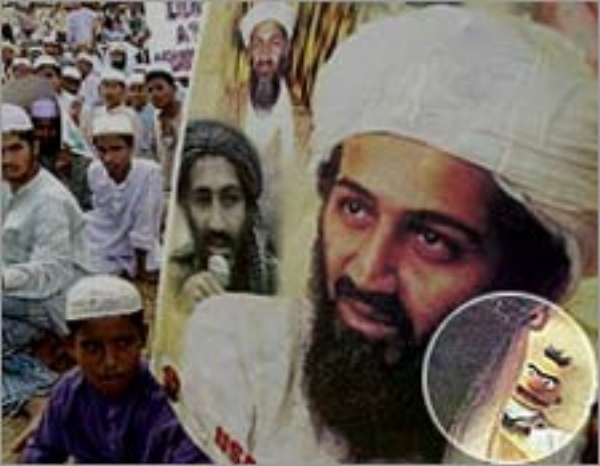
It was a moment of laughter in a month of murder, the return of harmless absurdity to a world gone mad. The background was not promising. Bangladeshi Osamaniacs had gathered in their capital city, Dhaka, to show their support for bin Laden and their hatred for you and me. They marched as such mobs always do, violently, noisily, and under the banners of jihad, an embarrassment, I hope, to their faith and a disgrace, I know, to their country. Posters were brandished, some of them showing pictures of the crowd's hero, that grim symbol of Islamic rage, severe in his white turban and dark beard, with, it was to turn out, a rather surprising companion. Clearly visible on some of the posters, muttering, it would appear, into bin Laden's left ear, is Bert, Sesame Street's grouchiest Muppet, a difficult fellow, to be sure, but not an individual with any previously known links to the al Qaeda network.

Pictures of the demonstration swept across the planet, prompting Fox News to run a piece on "Bin Laden's felt-skinned henchman" and the makers of Sesame Street to issue a rather pompous condemnation of the "abuse" of one of their characters ("Sesame Street has always stood for mutual respect and understanding…this is not at all humorous"), although, as a suspicious Fox correspondent was quick to note, the show's spokeswoman would not be drawn on the yellow Muppet's "current whereabouts." Was there something to hide?

Well, don't worry, Bert, as it happens, is innocent. The real explanation for his appearance with the world's most notorious criminal (which can be found on the invaluable www.snopes2.com) lies elsewhere, in that blend of frivolity and technological superiority that so enrages Muslim fundamentalists about our glittering, tantalizing, ubiquitous civilization. For years now the web has played host to the running joke that "evil Bert" has been the crony and adviser of history's wrongdoers. Search the Internet and you can find doctored photographs of Bert with O. J., Hitler, Kevin Costner (some people really did not like Waterworld) and now, it seems, Osama bin Laden. And this — this joke — was the image that a printer in Bangladesh chose to download when he was surfing the web for a picture of Bin Laden to make into a poster for Osama's devotees. Somehow or other the bungling Bangladeshi either failed to notice Bert or, if he did, he omitted to crop him from the photo.

Symbolically, this fiasco could really not be better: whether it was in the reliance on advanced Western technology to create the propaganda materials for protesters who would abolish the future, or whether it was in the pathetic failure to use it effectively, a failure that led to the elevation of yet another symbol of the decadent West over the heads of its ignorant, benighted foes. It may have been an accidental triumph, but who cares? Western culture, represented in this case by the unlikely standard-bearer, Evil Bert, had once again humiliated its dim, dismal, and demented opponents, fools who would run a world, but cannot operate a PC.

And yes, it is okay to laugh, although if you are a woman in Afghanistan please do so only in private (the Taliban have made it a crime for women to laugh in public). This tale of botched posters is marvelously, gloriously funny, a welcome relief after these weeks of grief. Those demonstrators were made to look ridiculous, and it gave this country a wonderful, mocking picture of a contemptible enemy. We need more of such images. The pampered rich kid bin Laden, a designer tribesman with his laundered robes, Timex Ironman Triathlon ("the watch of choice for top athletes"), and Stone Age certainties is a gift to caricaturists, and yet (with some exceptions, notably The Onion) there seems to be a curious reluctance to make fun of this ludicrous figure. In part, probably, this is a consequence of the exquisite sensitivities of the Politically Correct era (should we not be trying some "mutual respect," should we not be making an effort to understand him?) and in part it is the natural inclination of a sheltered, rather soft generation still uncertain as to how to respond in the aftermath of such an appalling, unexpected onslaught. To take one example, according to press reports, we are, apparently, in for a kinder, gentler Halloween. Bin Laden masks, it is being suggested, would be in poor taste.

In fact, such rude, tasteless gestures are very important, and, insofar as they can contribute to victory, they can help honor our dead. It is possible to belittle bin Laden (in fact, if some tabloid accounts are to be believed, it is very easy indeed), without belittling his crimes. Far from trivializing a conflict, humor can be a very useful weapon in its pursuit. Current reports linking the anthrax attacks on the tabloid press to their less-than-flattering descriptions of bin Laden and his acolytes would, if true, suggest that this is well understood by al Qaeda. Laughing at an enemy boosts morale and reminds us that any adversary, however fearsome-seeming, can be overcome. In the Second World War, Hitler was often portrayed in Anglo-American popular culture as a figure of fun, a laughable, histrionic little man with delusions of grandeur, and yet no one would argue that the Allies were not serious about the evil done by his regime or the importance of, to use a currently fashionable term, 'ending' the Third Reich.

So let's have those bin Laden masks, the nastier the better, and take it from there. This is someone to jeer and to scoff at, a clown in a cave to be mocked, parodied, derided, lampooned, taunted, and ridiculed, a jerk on a jihad that we can only despise. Our laughter will help cheer us up, and, who knows, so great is the reach of the Western media (ask Evil Bert), it may also transmit a message to some of those in the Muslim world who now demonstrate their support for terror, an important message about the man that they so admire.

He's a loser.

Diana, Again

National Review Online, October 6, 2001

Diana.jpg

There is, let's admit it, something grimly satisfying about having a prejudice confirmed. So, if you are one of those people who believe that there is absolutely nothing more to say about Charles and Di, Christopher Andersen's new work, Diana's Boys, is the book for you. Once again weary readers are presented with the same shop-soiled menagerie (mean queen, pained prince, plain Camilla, horrible Hewitt, foolish Fergie, loveable Tiggy, playboy Dodi), the same exhausted anecdotes (hysteria at Highgrove, bulimia in the palace, Charles' confession of adultery, Diana's TV interview, the rudeness at Harry's birth), and, above all, that same doomed, fascinating heroine, bewitching and manipulative, a Sybil in Chanel, with her bewildering, ever-shifting personality leading all those around her to ruin and to despair.

We know how her story will end, of course. We are told again about those last tragic hours in Paris, that speedy departure from the Ritz and the disaster in a tunnel, hours that will be particularly familiar to fans of Mr. Andersen, in that he had already discussed them at some length in an earlier bestseller, The Day Diana Died. Now, Mr. Andersen, the author of two books about Katharine Hepburn, three volumes about the Kennedys, and two works about Princess Diana, is clearly a man who is not too worried about reworking a profitable subject. It is best, however, if such a return to the mother lode can be justified by the claim that something fresh is being discovered. The kindly Ms. Hepburn has, most obligingly for her biographers, been very long-lived, leaving plenty of room for the two, doubtless distinct, efforts by Mr. Andersen, Young Kate and The Remarkable Love Story of Katharine Hepburn and Spencer Tracy. The Kennedys enjoyed far less staying power than the formidable actress, but, in their case Mr. Andersen could, presumably, reduce the risk of repeating himself by moving across, then down, the former First Family tree. He followed Jack and Jackie with Jackie after Jack, and then, in a confirmation of his mortuary franchise, he gave us The Day John Died.

In Diana's case, however, going back to the celebrity seam was not so straightforward. The inconveniently dead princess lacked Ms. Hepburn's powers of survival. A "Young Diana" was all there ever was, and all there ever would be. There were no long decades, just a few short years filled with incident, almost all of which Mr. Andersen had already chronicled. The Kennedy alternative, harvesting the family tree, was also tricky in the case of the gloomy royals. Compared with JFK the poor princess lacked a sellable surviving spouse. Who, other than Camilla, who would go for Charles after Diana?

That only left the sons, William and Harry, in Diana's words, her "one splendid achievement", and so they appear to be. But as camouflage for an opportunistic retelling of the Spencer story, her offspring prove hopelessly inadequate. This is hardly their fault. They may, in the words of Mr. Andersen's publisher be "the world's two most celebrated royals" (eat your heart out, Elizabeth), but they simply have not done enough to carry a biography. This would be true of almost any teenager. Diana's children are no exception, as a quick glance at this book's index reveals.

Entries under "William, Prince" include "backside pinching of… e-mail romances of…formality disliked by… Harry dangled from window by." Take away the story of their parents, and the Windsor princelings' lives are the stuff of trivia. While that is not a bad level for Mr. Andersen's writing style ("Finally, the Princess of Wales leaned forward to see what the boys' found so riveting: steamy photos of the buxom Barbi twins, Playboy centerfold models Shane and Sia") he is astute enough to know that, when it comes to book sales, his best hopes still lie with Diana. So, much of what we get is a tired rehash of a failed marriage and a tragic death, with, on occasion, the only variety coming, quite literally, from the pagination.

On page 43 of Diana's Boys, for instance, we can read that "William's mother indulged in an orgy of self-mutilation. At various times, Diana slashed her wrist with a razor, stabbed herself in the chest with a pocketknife, cut herself with the jagged edge of a lemon peeler, and hurled herself against a glass display case, shattering it." This is a drama that may be familiar to admirers of page 49 of The Day Diana Died where readers are told that "in an orgy of self-mutilation, at various times Diana slashed her wrist with a razor, stabbed herself in the chest with a pocketknife, cut herself with the jagged edge of a lemon peeler, and hurled herself against a glass display case, shattering it."

The only difference between these two accounts lies in the description of its protagonist. In Diana's Boys the lemon-peeler-wielding princess is also, in keeping with the theme of a book allegedly focused on her sons, described as "William's mother," rather than just the "Diana" used in the earlier text.

To be fair, there are some revelations (at least to this Brit) in the more recent book. I was, for example, unaware of the fact that, in an unorthodox variant of the curt handshake generally preferred by the English upper classes, one socialite allegedly prefers to greet Prince William by putting her hand down the front of his trousers. For the most part, however, even those parts of Diana's Boys that relate specifically to the children cover fairly familiar ground, if in ever more excruciating detail. In The Day Diana Died, Mr. Andersen tells us that William once "tried to flush his father's shoe down the toilet", while in Diana's Boys, we learn that they were "four-hundred-dollar" shoes.

More excruciating for William, should he ever look at this book, will be the speculation about his love life, speculation helpfully illustrated by an inspired selection of photographs that manages to include seductive pictures of no fewer than three cuties whose names (Tara Palmer-Tomkinson, Emma Parker Bowles, Davina Duckworth-Chad) seem more substantial than the outfits that they are wearing. For the time being, however, both the young princes seem remarkably well balanced given what they have been through, but it is difficult to read Mr. Andersen's book without wondering whether Diana's boys are destined to share some of the bleaker aspects of their parents' fate.

For, while the source of many of Charles and Diana's problems lay in their own personalities (well summarized in Sally Bedell Smith's Diana in Search of Herself, psychobabble-heavy, but nevertheless the best single account of the whole miserable saga) other factors were also very much to blame. In particular, the royal couple had to contend with the challenge of living in a country that no longer knew what it wanted from its monarchy. Like their predecessors, the prince and princess were public figures, but the public had changed. To their cost, Charles and Diana were to discover that the old deference was dead, taking with it the stuffily comfortable etiquette that once cocooned the inhabitants of Buckingham Palace. It had been replaced by a relentlessly intrusive tabloid-driven agenda that mixed class resentment and prurience with the curiously old-fashioned notion that the Royal Family should set some sort of example, although no one seemed to be able to agree on what that example should be.

It is worth remembering that when, in the bawling, mawkish week that followed Diana's death, the formerly vilified princess was being sanctified for allegedly being able to show her true feelings, the Queen was at the same time coming under attack in the press ("Show us you care") for failing to fake hers. What Fleet Street wanted from Her Majesty ("Speak to us Ma'am — Your people are suffering") was a blubbering expression of regret for a former daughter-in-law she clearly no longer really cared for.

Poor William ("the heir") and, to a lesser extent, Harry ("the spare") face a lifetime of trying to satisfy the conflicting, unclear, and capricious demands of such scrutiny, of which Mr. Andersen's book is an early, and relatively harmless, example.

No wonder William is said to doubt whether he wants to be king.

In a Glass House

National Review Online, October 3, 2001

Amr Moussa.jpg

If there is a word for chutzpah in Arabic, Amr Mussa must know it. Mr. Mussa is the secretary general of that distinguished 22-nation association, the Arab League, and he wants the world to know that he is shocked — shocked — by comments made by Italian Prime Minister Berlusconi last week. This is no small matter; as secretary general of an organization with a membership that includes Syria, Iraq, Libya and Sudan, Mr. Mussa cannot be somebody who it is easy to upset. But Mr. Berlusconi has succeeded, apparently, where Colonel Qaddafi could not. Amr Mussa is, now, at last offended. Like the despots who pay his wages, the butchers' bureaucrat responds badly, it turns out, to a little criticism. The idea of debate is as foreign to him as it is to his masters. After days of controversy, fury and posturing, what Mussa wanted was for us to understand that the lout Berlusconi had gone too far. It was, said Mussa, "dangerous" and unacceptable" for the Italian to have spoken in the way that he did. Take note of those adjectives, "dangerous" and "unacceptable": they have a jailhouse ring to them. They are the language of the secret policeman, not the rhetoric of democracy.

The Italian prime minister's crime, as we all must now know, was to talk about the "superiority" of Western civilization, a culture that, Mr. Berlusconi had the effrontery to claim, consists of a "value system that has given people widespread prosperity in those countries that embrace it, and guarantees respect for human rights and religion," respect, he argued, that was not to be found in Islamic countries.

As Jonah Goldberg noted in Friday's NRO, there is much to be said for this point of view and it is striking that the opposition to it has come neither from democratic Arab parliamentarians (strangely, there do not appear to be any) nor from logic, nor from reasoned argument. Instead all we are offered is the spectacle of a hireling civil servant cleverly brandishing the one word that, in the West, is almost always guaranteed to stop all rational debate: racism. Mr. Berlusconi's comments, were, said Mr. Mussa, "racist." The ploy has seemed to work. Belgium, a country that puts the less in spineless (and is the current holder of the EU presidency) has already apologized.

But Mr. Mussa should be careful. People in glass houses should not throw stones (and, no, before anyone complains, that phrase is a figure of speech: it is not a reference to the rougher edges of Sharia jurisprudence). If he is really so worried about racism, the secretary general of the Arab League should look first to his own membership, to the slaver state Sudan, perhaps, or to Libya, a country where last year's pogrom against black immigrants in the provincial town of Az Zawiyah (50 dead, in case anyone was counting) could initially be described in a government newspaper as no more than a "summer cloud." If not there, perhaps Mr. Mussa would like to look instead to the presses of Egypt and Syria, countries where little that is printed appears without some degree of government approval, countries where there is widespread circulation of the sort of gutter anti-Semitism not generally seen in Europe since the days of the Third Reich.

Mr. Mussa does not even have to leave the confines of his own bureaucracy to find racism, or at least racism in the ludicrous way that he defines it. If the secretary general of the Arab League genuinely believes that Berlusconi's attempt to weigh the relative merits of Western and Islamic cultures really represents some form of racial prejudice he should take a look at the website of his own organization, and check out what is written there about the years of Islam's initial expansion.

"These Muslim believers were not merely conquerors. They rapidly established a new and dynamic civilization that for centuries was the only bright light in an otherwise culturally and intellectually stagnant world."

Oops.