A Very Contemporary King

King Arthur

National Review Online, July 23, 2004
king-arthur-1.jpg

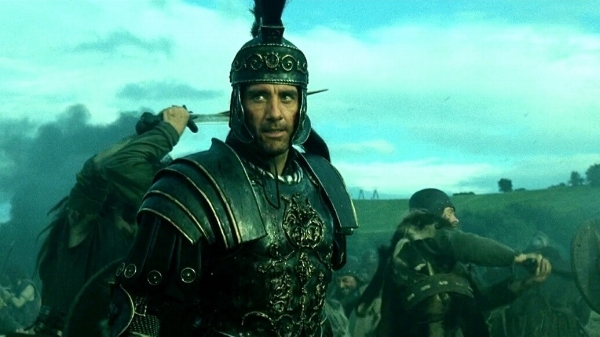
You would need to have a heart of stone to leave out the stone, but that's just what the team behind King Arthur has done. In a year of a Troy without Zeus, Antoine Fuqua has directed a King Arthur without the Lady of the Lake, Uther Pendragon, Morgana la Fey, Mordred, the Holy Grail, Camelot, Avalon, or, yes, even a stone. Not even a pebble. The rationale? Well, this new Arthur, the Roman-British Lucius Artorius Castus, complete with a glum band of Sarmatian knights (a bunch of foreigners—this Brit notes) is, supposedly, the real deal. His is the story that Thomas Malory, Geoffrey of Monmouth, Lord Tennyson, T. H. White, and all those other hacks somehow managed to overlook.

The authenticity is, of course, bogus, but then Hollywood's view of historical reality ("Oh, fight, fight, fight! That's all you ever think of, Dickie Plantagenet!" King Richard and the Crusaders (1954)) usually is. In the age of Oliver Stone, we should be grateful that the only certain Lucius Artorius Castus died no more than a couple of centuries before the events described in the film. Somewhat cautiously, John Matthews, the movie's consultant historian has, been at pains to point out that he is "not saying that the Arthur represented in the movie is 100 per cent true." Matthews is saying, however, "that he represents the Arthurian truth."

Now that that's, um, cleared up, it's still a mystery exactly why commercial filmmakers chose to rewrite a story that has, let's face it, found a pretty good audience for over 1,000 years. Was it all the chivalry that frightened Fuqua off? Check out his Sir Bors, and you might think so. In Sir Thomas Malory's 15th century telling of the tale, Bors was, well, a bit of a bore. "For all women Sir Bors was a virgin save for one, that was the daughter of King Brangoris...Save for her Sir Bors was a clean maiden." Anyone who called King Arthur's Bors a "clean maiden" would not have got out of Britannia alive. Played by the talented Ray Winstone, a former boxer, he's a genial cockney Sarmatian thug, a Dark Ages soccer hooligan, an East End Lothario with a love of birds, the bottle, and a brawl—lock, stock, and two smoking scabbards.

But there was more to Camelot than chivalry. If it was smut that Fuqua fancied, different versions of the saga have plenty to pick from, including incest, illegitimacy, adultery, date-rape Merlin-style, and, unforgettably, naughty Guinevere and her James Hewitt in shining armor. According to Malory, who had already written with some relish about Guinevere "writhing" in frustration on her bed (Lancelot had been neglecting what were meant to be, ahem, Arthur's duties), the moment that the quest for the Holy Grail had come to an end, the queen and her knight "loved together more hotter than they did [before]", so often, it seems, "that many in the court spake of it, and in especial Sir Agravain... for he was ever open-mouthed." And so, after reading that, was I.

King Arthur, by contrast, is disappointingly chaste. Lancelot and Guinevere (played by Keira Knightley as a mix of Xena, and mute, lovely Nova from Planet of the Apes) exchange a smoldering glance or two and a tender battlefield death scene, but that's it. Her relationship with Castus isn't much "hotter," catching light only at the moment that the future king pulls, not a sword out of a stone, but Guinevere's fingers out of their sockets. Even the naughty opportunity presented by the movie's setting—according to some sources, ancient Picts and Celts fought, rather perilously, one would think, in the nude—is neglected. That would, the gorgeous Knightley told the London Daily Telegraph, "have been much too distracting." Well, yes, Keira dear, it would. And that would have been a good thing. King Arthur is a movie that could use some distraction.

A more likely explanation for the decision to abandon the old, familiar narrative was the need to avoid embarrassing comparisons with John Boorman's magical Excalibur, a movie that is likely to remain the definitive Arthur for many years to come. Far easier to capitalize on the post-Gladiator boom (the screenplays for King Arthur and Gladiator were both written by David Franzoni: He's doing Hannibal next) in sword, spear, and shield epics, with a supposedly authentic reworking that conveniently brings a medieval romance back to the days of newly trendy antiquity.

As to that authenticity, I wouldn't worry too much about it. If it's ancient nits you want to pick, there are more in King Arthur than in a dirty Gaul's hair, but who cares? When it comes to the lost lord of Camelot, all claims of authenticity are spurious. We will never know who he was—or if he was. There may, once, have been a great leader whose memory survived, first as recollection, then, later as his last warriors died off, and their children, and their children's children, as a campfire saga, a winter's tale, heroic certainly, exaggerated probably, but strong enough a story that its fragments survived to inspire historians hundreds of years later, starting with Nennius, the eight-century Welsh monk who was the first to tell of Arthur, the dux bellorum, and his twelve victories over the invading Saxons.

Or possibly the great king was just a composite, a blend of the real and the imagined, Artorius and Aurelianus, Artgur, perhaps, and Arcturus too. Maybe he always was what he was to become, nothing more than a dream, a fiction, a symbol, an inspiration, a fantasy. For the truth is that the "authentic" Arthur has long been the Arthur of the myth, his tale an epic first written down in an era when the frontiers between history and legend were shifting, elusive and lacked any border guards. They told the tale of Britain's great king, and they embellished it, and they embellished it again, Welshmen, Frenchmen, Germans, Normans and, yes, even the English, all across that Christendom of castles, cathedrals and chivalry. His was a story defined by monks, explained by knights, sung by poets. He was a man of no precise era, and no exact place.

John Boorman understood this. His extraordinary, beautiful Excalibur floats between epochs. It's a requiem for the Celtic dark ages, and a medieval epic, a pagan tale and a Christian quest. There are knights, to be sure, in armor, but an armor so wonderfully strange that those who wear it transcend any fixed past and become warriors outside of time, playing out their drama against a backdrop of Wagner and Orff, as they thunder towards, to quote Tennyson, that "last dim, weird battle in the west," and a king, the king, passing beneath the setting sun.

Compared with this, Fuqua's muddy, emasculated epic comes across, well, as a little prosaic. It's nicely shot, the battle scenes work, and, even if Clive Owen's gloomy, brooding, darkly handsome Castus sometimes seems more prince of Denmark than King of Britain, he's a compelling screen presence. Pierce Brosnan, be afraid, very afraid. For an audience in the right mood (hard liquor would help), there are worse ways to spend an hour or two.

After all, King Arthur was produced by Jerry Bruckheimer and, like all the cream of the Bruckheimer crop (Top Gun! The Rock! Con Air! Armageddon!), it has moments of loopy magnificence. The problem is that this dank, damp tale of Romans, woad-daubed tribesmen, and proto-genocidal Saxons warring away in the Scottish lowlands is most effective when it refers back to the ancient, grander legend, with the knights' (oddly un-Sarmatian) names, Gawain, Galahad, Lancelot, Bors, with the roundtable at which the Sarmatians sit, or, best of all, with the moment when the young Castus pulls out the sword, Excalibur, that marks the grave of his fallen father.

The most interesting aspect of this latest version of an old, old story is the way in which, like many of the earlier retellings, it is used to reflect the values of its own time. So, for example, Arthur's wayward queen, Tennyson's "stately" monarch, is played by a somewhat feral Knightley as a girl-power Guinevere, all woad, weaponry and attitude. No wonder poor Castus spends so much of the movie looking so anxious. To add to his worries, the poor man also has to contend with the disillusioning discovery that his spiritual inspiration, Pelagius, a holy man (an authentic historical figure, really, of the right time, more or less, and the right place: he was either of British or Irish descent) has been deemed a heretic, and executed by the wicked folk in Rome.

As it happens, Pelagius's heresy seems extremely attractive (I'm no theologian, but so far as I can make out, he rejected the notion of original sin and was a fan of free will), but there's no evidence to justify his place in King Arthur or, for that matter, the report of his execution. He's probably just there for use as a fresh stick with which to beat the Catholic Church (without exception, the priests and the monks who appear in this movie are portrayed unsympathetically) as well as, post-Da Vinci Code, to throw in a fashionably alternative view of Christianity. Under these circumstances, it's no surprise that (spoiler coming, if you care) the film ends with Castus' marriage to the pagan Guinevere in a seaside Stonehenge with more than a touch of Spinal Tap about it.

Contrast that with how, in Tennyson's Idylls of the King, an earlier updating of the legend permeated with high-Victorian romanticism and unafraid of magic and mythology, the poet describes the arrival of the barge that will take the dying Arthur away to Avalon:

Then saw they how there hove a dusky barge,

Dark as a funeral scarf from stem to stern,

Beneath them; and descending they were ware

That all the decks were dense with stately forms,

Black-stoled, black-hooded, like a dream-by these

Three Queens with crowns of gold: and from them rose

A cry that shivered to the tingling stars,

And, as it were one voice, an agony

Of lamentation, like a wind that shrills

All night in a waste land, where no one comes,

Or hath come, since the making of the world.

I know which version I prefer.

Brian's Back

National Review Online, July 1 2004

Life of Brian

Life of Brian.jpg

Do you remember Brian, Brian Cohen? Yes, that Brian. You know, Monty Python's Brian, Life of. Well, 25 years on, he's back—back for his Second Coming. It has been a sly, mocking resurrection, a manifestation confined to a limited number of movie theaters, all timed to take advantage of (a little) this vintage comedy's quarter century and (a lot) Mel Gibson's startlingly savaged Savior. The Pythons themselves have been characteristically reticent about the timing of the film's re-release. Coyly, its director, Terry Jones, merely told the press that it was "just a piece of shameless commercial opportunism on our part. We were just hoping to make a quick buck on the back of Mel's Passion." Well, whatever it took, in a time marked both by the rise of superstitious belief and, worse still, an explosion of religious conflict unthinkable only a few decades ago, the return of sane, gentle Brian Cohen is good news indeed, worthy of a hymn, a hallelujah, or a hosanna or two except for the fact that—as that most modest of men used to say—he was not the Messiah: Perhaps a round of quiet applause will suffice.

It seems strange now, but when Brian's biopic was first released in the U.K., there was furious controversy, angry debate, and (wild language for amiably agnostic Albion) even talk of "blasphemy." Vicars vented, priests prattled, bishops called for a boycott, a few politicians remounted their high horses, and, chicken-hearted EMI pulled its backing (George Harrison stepped in with replacement funding).

In the land of the Pilgrim Fathers, the reaction was, predictably, even harsher. Writing recently in the Village Voice, J. Hoberman recalled how Life of Brian "scored a perfect trifecta—denounced as blasphemy by the Roman Catholic Archdiocese of New York, the Lutheran Council ('a disgraceful assault'), and the Rabbinical Alliance of America ('foul, disgusting')." The movie was picketed, banned in certain places, and, the ultimate seal of approval, condemned by Senator Strom Thurmond (a whitewashed sepulcher if ever I saw one).

The protests took their toll. On both sides of the Atlantic, cinemas hesitated over whether or not to take the film, but a decent number did the decent thing. The movie found an audience and, so far as is known, neither viewers nor projectionists nor popcorn sellers were bothered by boils, struck by lightning, or plagued by locusts, flies, frogs, or any of the other unpleasantness so often associated with annoying the Man Upstairs. Rumors that one ticket vendor was turned into a pillar of salt somewhere in the north of England can safely be discounted.

As usual, God got it right. Despite being born on the appropriate day in the appropriate town (something that briefly confused the three wise men and led to some unpleasantness over the gold, frankincense, and myrrh), Brian was, the movie makes clear, not the Messiah. He was not Him, his mother was Mandy, not Mary, and his Life was not blasphemy. Reinforcing this point, Brian is shown listening—at a distance, and with some interest—to the Sermon on the Mount. Jesus is portrayed with respect. It is only His message that gets garbled ("Blessed are the cheese makers"?) by a crowd too preoccupied by its own bickering to concentrate on what Christ had to say. Come to think of it, that scene would make a fine sermon in its own right.

This is not to claim that Life of Brian is some sort of religious tract. Far from it. If there's any type of belief that runs through the movie, it's disbelief, unbelief, a world-weary skepticism that reaches its height or its depth (take your pick) on a jam-packed Calvary with the massed ranks of the crucified singing a rousing song that, in its blend of nonchalance, nihilism, and slightly deranged Epicureanism, has few peers:

...If life seems jolly rotten

There's something you've forgotten

And that's to laugh and smile and dance and sing.

When you're feeling in the dumps

Don't be silly chumps

Just purse your lips and whistle—that's the thing.

And...always look on the bright side of life...

Always look on the light side of life...

For life is quite absurd

And death's the final word

You must always face the curtain with a bow.

Forget about your sin—give the audience a grin

Enjoy it—it's your last chance anyhow...

It has a pretty good tune too.

To be sure, Life of Brian is unlikely to make it very soon into the Vatican's video collection but, unless the Pythons' secularism is of itself "offensive," there really ought to be little in their film to annoy most people of faith—so long as they have a sense of humor, that is. The real target of the movie's satire is not religion as such, but the unholy baggage that too frequently comes with it—the credulity, the fanaticism, and that very human urge to persecute, well, someone.

Watch, for example, poor Brian as he flees Jerusalem pursued by his "disciples." His frantic attempts to deny that he is the Messiah are ignored by a crowd desperate for someone, anyone, anything, to worship, but also intent on proving their own righteousness in that most pleasurable of ways—at the expense of others. Acolytes of Brian's gourd feud with devotees of his shoe, and all indulge in the nasty joys of schism. If Ingmar Bergman had directed Life of Brian, the rest of the movie would have been a grim depiction of an even grimmer religious war, concluding, doubtless, with a bleak finale in some northern European wasteland. But as Bergman didn't, and Terry Jones did, we get a naked hermit, the "miracle" of the juniper bushes, a Pontius Pilate who can't pronounce his "r"s, and, to end it all, that surprisingly cheerful crucifixion.

But as amusing as this movie is (and it is—despite 25 years in the vaults, it stinketh not), Life of Brian is difficult to watch without a sense of sadness. At the time it was made, the Pythons' "Passion" seemed to be taking aim at a soft target. In the West, at least, centuries of superstition, intolerance, and fanaticism seemed gradually to be receding into the past, mourned by a dwindling few. The established religions appeared reconciled to a comfortable, if decreasingly prominent, niche within the secular states of the post-Enlightenment, and where the West led, the rest of the world would surely follow.

Times change. To take just a few wretched examples from the cornucopia of cant on offer on these fruited plains, the nation created by the revolution that was the Age of Reason's finest hour now finds itself lost in nonsense. It is wrapped up in the Rapture, preyed on by Gantrys, prayed at by Falwells, prayed for by Jacksons, dumbed down by creation scientists, and hectored by ranting First Amendment fundamentalists who react to a cross as if they were vampires. Oh yes, fanaticism can be secular too. Just ask the People's Front of Judea (or was it the Judean People's Front?), zealots content to leave Brian to die on the cross, a handy martyr for their cause.

And when organized religion fades, the disorganized variety rushes in. As we stumble back towards the darkness of that beckoning cave, we let ourselves be spellbound by, to take a selection, pagans, Wiccans, shamans, seers, crystal-gazers, aliens, pieces of red string, table-tappers, Gaia, suburban necromancers, sidewalk psychics, and that blend of bunkum, baloney, science fiction, and Hollywood that calls itself the "religion" of Scientology.

But above all—and compared to which those tatty idiocies are nothing but trivia—the return of militant Islam and its encroachment once more on the people and the territories of the West force us to face, yet again, the horrors of religious war, this time an onslaught from Arabia's seventh-century darkness, in which the promise of heaven will be used as a justification for true believers to create a hell on earth for all those who oppose them. In a time when young men fly planes into office buildings in the hope of earning themselves an eternity with 72 virgins, it's difficult to look at those parts of Life of Brian in which the movie played on the baroque cruelty of (what then seemed) ancient history without as much unease as amusement. The long and originally very funny sequence that culminates in John Cleese being stoned for blasphemy now conjures up images of the Taliban's bestial Kabul. Later on, we see the Judean People's Front planning to kidnap and then behead the wife of Pontius Pilate, and the bloodiness of the scheme only serves to underline the utter incompetence of the conspiracy. We laughed then, back in 1979. Beheading? Ridiculous. We don't laugh so easily in 2004. Not after Daniel Pearl. Not after Nick Berg. Not after Paul Marshall Johnson.

So, to break the mood, turn for some words of wisdom from sensible, doomed, hapless Brian. There's a lovely moment when, appalled by the spectacle of the faithful gathering beneath his window, he tells them that, "you don't need to follow me, you don't need to follow anybody. You've got to think for yourselves, you're all individuals." Simple stuff, but, these days, pretty good advice.

Even if it's not The Greatest Story Ever Told.

The Fall of Troy

Troy

National Review Online, June 2, 2004

Troy.jpg

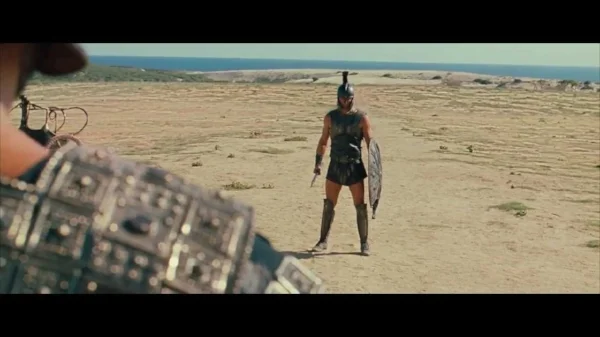
It took three movies to do justice to The Lord of the Rings, five (so far) to tell the tale of Star Wars, two to chronicle the demise of Tarantino's Bill, and three, incredibly, to give us the Matrix saga, a saga with a concept, but no plot at all. In Wolfgang Petersen's new Troy, by contrast, Homer's Iliad, a story that has endured intact for 3,000 years, one of the glories, indeed, of Western culture (or, if you are the reviewer at the Eugene, Oregon Register-Guard, "a dry classroom epic"), is sliced, diced, and distilled into blandness, all so it can fit into the confines of just one film and, presumably, rake in a buck or two. Homer's Troy took ten years to fall, Petersen's collapses in about three weeks, taking most of the ancient epic with it. There's no Cassandra, for example, and there are no gods. Achilles survives long enough to skulk inside the Trojan Horse, Ajax falls in battle rather than (the usual story) by his own hand, and Agamemnon is butchered honorably at war rather than, on his return home by, embarrassingly, his wife's boyfriend. And no, the fact that the film has a bit of the Odyssey tacked on at the end (all that business about a horse) is absolutely no compensation, particularly for those of us who were rooting for the Trojans.

But perhaps this is too harsh. It's never easy to film a much-loved classic. The very success of the original is evidence of its hold over the imagination. The dreams and the images that readers conjure up for themselves are far more powerful than anything the filmmaker can produce. There are exceptions, Jeremy Brett's Sherlock Holmes, perhaps, Schlondorff's Tin Drum, certainly, and, of course, The Lord of the Rings trilogy itself. Against that, who can forget the spectacle of all those querulous tots grumbling that the first Harry Potter movie wasn't "quite right"—even as the ungrateful little swine lined up to see it again and again and again? Adaptations are, by their nature, tricky, and whether it's Dickens or Wharton or Highsmith or Wolfe or any one of countless others, we can all think of authors badly let down by their transfer to the silver screen.

Mention of Wolfe, Tom Wolfe, suggests a kinder way to look at Petersen's epic. Measured against Wolfe's Bonfire of the Vanities, one of the greatest novels of the late 20th century, Bonfire of the Vanities (the movie) was a terrible disappointment. Seen as an entertainment in its own right, however, it really wasn't too bad. No, no, it really wasn't. Perhaps then, to be fair, we should take a step back from the blind poet and his wine-dark seas and just take a look at the merits of Troy in its own right.

Unfortunately, that won't take very long.

Troy is, let's just say this now, a bad movie. It's certainly not Gigli bad, and it's not even Van Helsing bad, but it's still bad, and, and unlike the much underrated Mummy movies (bad in a good way), it is bad in a bad way. The script is more wooden than the horse; the special effects lack the grandeur we have come to expect in our epics and Troy's gimcrack Troy looks like Rome/Babylon/Athens as re-imagined for one of Las Vegas' lesser casinos. And here's something else. One thing those ancients could do was, you know, sculpt. Well, the statues in Petersen's Troy look as if a blind man had carved them with a cheese grater, so much so that when they toppled (a moment of tragedy) it was difficult not to cheer. On the credit side, the battle sequences themselves are fine, if not Zulu, LOTR, or Private Ryan; but it is only the marvelously shot (and performed) hand-to-hand combat between Achilles and Hector that, despite its odd blend of Shaolin and Sparta, really manages to grip.

The cast? Well, leaving aside the fact that so many are blondish and blue-eyed that I kept thinking that it was the Vikings who were storming the beaches of Troy, they do their best. Eric Bana is sympathetic as Hector the prince, the brother, the husband, if slightly unconvincing as the warrior (on a $175 million budget surely the filmmakers should have been able to pull in Viggo Mortensen), Peter O'Toole is ham as much as Priam, but finely cured and well worth watching. Sean Bean (Odysseus) is terrific and much of the criticism of Orlando Bloom's weak and ineffectual Paris seems poorly judged when one remembers that, according to Homer, Paris was weak and ineffectual.

But if Paris has had a rough ride from the critics, that's nothing compared with poor Helen (Diane Kruger). Salon's Stephanie Zacharek, thought she was "pretty enough in a Darien, Connecticut, kind of way—not exactly Helen of Troy, but maybe Helen of Abercrombie & Fitch (Think of her as the face that launched 1,000 golf carts)," while Phillip French of the London Observer thought she looked "more like a waitress than a princess, less a face that launched a thousand ships than a face that served a thousand lunches." The Washington Post's Stephen Hunter rated hers "as a 457-ship face," not generous, but kinder than Slate's David Edelstein who reckoned that this Helen would only be able to raise one hundred ships, "although if you throw in that lithe body and a favorable wind, you could bump the number up to 250." Fussy, fussy, fussy. Diane Kruger is gorgeous. One thousand ships, no question. End of discussion.

And Achilles? Well, given what we know about certain nautical traditions, Brad Pitt's resplendent Achilles could probably have launched a fleet in his own right. Buff, muscled, and tough, "Rachel's" husband looks the part, every inch the warrior, even if his blond mane, mumbled diction, and somewhat simian features are more suggestive of a surf nazi than Zeus's beloved, the best of the Achaeans. Pitt's problem is not his acting, but his script. In Homer's Iliad, Achilles is the central figure around which the drama revolves. Remove too much of that original text, and there's not much of Achilles that remains.

Take the death of Patroclus, the event that brings Achilles back into the war to kill Hector. In the movie, Patroclus is Achilles's teenage protégé and cousin, close, but with nothing not to ask or not to tell about. With Achilles still sulking in his tent, the youngster takes the great man's armor, and is slain by a Hector convinced that he is battling the Greek hero himself, a sad loss to Achilles, doubtless, but one that is difficult to reconcile with the grief, rage and the revenge we are shown in Troy, a revenge that culminates in Achilles attaching Hector's corpse to his chariot, and dragging it around and around the walls of the besieged city, an outrage as much then as it would be now.

With Homer, it all makes so much more sense. Although the Greeks tended to define these matters far less rigidly than we do, Achilles and Patroclus were almost certainly lovers, and, far from being surprised that Patroclus was mistaken for him, that was exactly why Achilles lends him his armor all the while warning Patroclus not to push his luck too far, a temptation, he knew, that his friend would find hard to resist. But carried away by early victory, Patroclus ignores that advice, with terrible results. Hector kills him, strips him of his armor ,and it is only a fierce fight by the Greeks that prevents his body from being left out there for the dogs.

Now we understand Achilles's rage. It is a blend of guilt, love, and, both for him and the lost Patroclus, humiliation. Quite why Petersen chose to PG the relationship between Achilles and Patroclus is anyone's guess. Perhaps he thought that a bisexual warrior (oh yes, Achilles liked girls too. A lot.) would be bad box office in our own, more conventional, era. And it was, I suspect, also convention, and an astonishing lack of imagination, that made Petersen turn his back on the gods. He thought, he said, that they were "silly" and unnecessary to the plot. Well, there's one in the eye for the blind poet who insisted in writing the whole thing in the first place.

Except, of course, that it isn't. The gods were central not only to the arc of Homer's glorious enchantment, but to its meaning. To the Greeks fate was capricious, often unfair and frequently unkind. The good could perish miserably, and the bad could prevail. All that man could do was his best. His best hope was to be remembered well. And it is there we find the tragedy of Hector (a good man despite the rather problematic treatment of the dead Patroclus) as he does battle with Achilles, son of the sea nymph Thetis, a battle he could not win (go for the heel!), a battle against a man who was all but invulnerable (go for the heel! Go for the heel!), a man who was being helped by a goddess. And this tragedy is an echo of the tragedy that lies at the heart of the Iliad, the tragedy of the individual helpless before fate. To be sure, that's not dissimilar to the belief of modern, secular man, recognizing, at last, that we are adrift in an indifferent universe, but even that bleak view has its own bleak comforts. Our universe at least isn't out to get us. The Greeks, believing in fickle gods who turned hostile on a whim, could never be so sure.

If Petersen thinks that's "silly" he should consult Christopher Logue, the man he should have asked to be his scriptwriter. Logue, an English poet, has been working on an "account" of the Iliad for the last 40 years, an adaptation, possibly the finest ever written in the English language. And it has plenty of room for the gods:

Patroclus fought like dreaming

His head thrown back, his mouth-wide as a shrieking mask—

Sucked at the air to nourish his infuriated mind

And seemed to draw the Trojans onto him,

To lock them around his waist, red water, washed across his chest,

To lay their tired necks against his sword like birds.

—Is it a god? Divine? Needing no tenderness?—

Yet instantly they touch, he butts them,

Cuts them back:

—Kill them!

My sweet Patroclus,

—Kill them!

As many as you can,

For

Coming behind you through the dust you felt

—What was it?—felt Creation part, and then

Apollo!

Who had been patient with you

Struck.

Silly? I don't think so. Stripped of its tragic core, and its magic, its necessary, wonderful magic, this pedestrian, pointless, prosaic Troy never involves, never engages. We never care. Achilles, Paris, Hector, Helen, whatever. So, in what looks a lot like desperation, Petersen has tried to inject some invented contemporary "relevance" into a story that, properly filmed, would already have had it.

"Nothing has changed in 3,000 years. People are still using deceit to engage in wars of vengeance. Just as King Agamemnon waged what was essentially a war of conquest on the ruse of trying to rescue the beautiful Helen from the hands of the Trojans, President George W. Bush concealed his true motives for the invasion of Iraq."

Oh whatever, Wolfgang, whatever.

Crushing Mr. Creosote

National Review Online, April 29, 2004

Soso Whaley
Soso Whaley

Soso Whaley is a feisty not quite fiftysomething animal trainer based in New Hampshire, a champion roller skater (a silver medal for her tango!), the hostess of Camo-Country TV's Critter Corner and an adjunct fellow at the Competitive Enterprise Institute, a free-market think tank. (Oh, did I mention that she's a filmmaker with plans to make a documentary about camel-racing in Nevada?) When we ate together the day before Tax Day, in a drably functional midtown Manhattan McDonald's Express filled with surprisingly skinny teens, this is what she chose: six Chicken McNuggets, sweet 'n sour sauce, and two baked apple pies (one for later).

This April that's not unusual fare for Soso. She's eating at McDonald's a lot this month. In fact, she's only eating McDonald's this month. By the 14th, she had dined (I've seen the pile of receipts, neatly collected, dated, and filed) on Crispy Chicken; Chicken McNuggets (six-pack and ten); Chicken McGrill; McChicken; for a touch of the exotic, Hot 'n Spicy McChicken; and, in a welcome break for the nation's poultry, hamburger, double cheeseburger, Quarter Pounder with Cheese, Big Mac, Big N' Tasty with Cheese (no, I have no idea what that is), and Filet-O-Fish; Egg McMuffin, a bewildering selection of McGriddles (bacon, egg and cheese; sausage, egg, and cheese; and the ascetic sausage alone), hash browns, hotcakes, the wildly multicultural sausage breakfast burrito, Fruit 'n Yogurt Parfait ("I love that," sighs Soso), hot fudge sundae, a flurry of McFlurries (Butterfinger, M&M, Oreo—the Nestle Crunch is yet to come) and much, much more.

And, she says, she's feeling "great" (her diary can be viewed on the Competitive Enterprise Institute's website), and she's lost weight (around five pounds by the time we met). Poor, sad Morgan Spurlock didn't do quite so well. Around 20 years younger than Soso, this tall, seemingly robust New Yorker also spent a month eating only at McDonald's and made Super Size Me, a film about the experience. The movie looks as if it will do well, but Spurlock did badly, very badly.

Neither Soso nor I know exactly what Spurlock ate (Super Size Me comes out on May 7), but, as he has described them in numerous interviews, the results were nastier than a four-day-old Bacon Ranch Salad: headaches, vomiting, depression, a super-sized gut and—sad, sad news for his girlfriend (a vegan chef, conspiracy theorists please note)—a shrunken libido. The numbers tell their own terrible story. Spurlock gained 25 pounds and his cholesterol soared (from a modest 165 to a more challenging 230). His body "basically fell apart over the course of thirty days." His face—oh the horror, the horror—turned "splotchy," his knees "started to hurt from the extra weight coming on so quickly," and as for his liver, well, don't ask. O.K., you can ask. Spurlock's liver had, in the less than reassuring words of his doctor, "turned into paté."

Soso, by contrast, is made of sterner, more stoic stuff, a daughter of Eisenhower's Kansas, a creation of a sterner, more stoic time, a woman, I can report, whose face is splotch-free. Our lunch together was marred neither by vomiting, nor depression, nor headaches, and the "gas" that had been a rather distressing feature ("all that extra fiber") of the early days of her McDonald's diet had, mercifully, disappeared. Questions about her sex drive were met with a wry chuckle. This robust Heartland heroine, "a meat and potatoes gal," has even survived a few rounds with Hell's tubers, McDonald's revolting French fries, themselves. "Oh, they're OK," said Soso, smiling over her pile of McNuggets, but she didn't, I noticed, order any fries.

So what was Spurlock's problem? Could it have been something he ate? On his movie's website, Spurlock sets out the ground rules. He was to subsist only on McDonald's products, he had to eat every item on the menu at least once, but he was not allowed to choose Super-sized portions unless they were offered, in which case he had to accept them. More challenging still, his plate or, as we are talking McDonald's, his tray, had to be scraped clean. Completely clean.

And when it comes to his movie, many critics have, appropriately enough, lapped it up. Ebert & Roeper gave Super Size Me "two thumbs up", while Variety found it an "entertaining, gross-out cautionary tale" that "leaves little doubt that eating this stuff on a regular (or even occasional) basis is bad, bad, bad for ya." To the New York Times it was one of a clutch of "entertaining, moving and historically significant" movies at this year's Sundance Film Festival, a festival where Spurlock won the award for best director for what The Hollywood Reporter has dubbed his "brilliantly subversive" work.

Subversive? Hardly. Fashionable? Certainly. Blaming "Big Food" for America's big people is merely the Left's latest big lie. For real rebellion, try Soso. She's an autodidact, an individualist, a contrarian, an ornery soul, someone who likes to find stuff out for herself. "I understood I was being misinformed by the media and that made me mad." It began with animal rights. Soso's work with our furry friends led her to question the frequently uncritical acceptance of the stories being peddled by the likes of PETA, and from there it was a short jump to doubting the gimcrack orthodoxies of "global warming" and after that, provoked by the hype surrounding Super Size Me, a date with destiny under the golden arches.

Spurlock shot a movie about his time at McDonald's, and now Soso is shooting a movie about hers. "Spurlock made his film to make his point and I'm making my film to make mine." The Competitive Enterprise Institute is helping with the publicity, but other than that, Soso has kept her independence. McDonald's has no involvement in her project (and, I was told, is not a CEI donor). When Soso buys a bacon, egg & cheese McGriddle she does so on her own dime.

Soso's ground rules were similar to Spurlock's, but without the compulsory super-sizing, the obligation to finish everything up or, most importantly, the intention of eating, as Soso has put it, "like a troglodyte." She's got a point. Condemning McDonald's on the basis of the kamikaze consumption of Super Size Me makes about as much sense as using Monty Python's Mr. Creosote as an example of typical restaurant dining. Spurlock's bizarre breakfasts, lunatic lunches, and demented dinners added up to some 5,000 calories a day, freak-show feasting that proves nothing about McDonald's. It wasn't what the greedy slob ate, but how much.

Soso feeds where Spurlock fed, but her more modest meals are amounting to a little less than 2,000 calories a day, a still far-from-frugal discipline that leaves room for cheeseburgers, choice, and Fruit 'n Yogurt Parfait. In some ways, it can be argued that her new diet has been an improvement over the old, not much of a feat given its emphasis (the Portsmouth, N.H., Herald reported, a touch disapprovingly) on "lots of meat and too many on-the-go meals like candy bars and doughnuts," something that may have contributed to the rather disappointing cholesterol count with which Soso began the month.

Above all, Soso's long march through Mickey D's menu is an effective demonstration that maligning McDonald's as one uniquely lethal food group is ridiculous in an age when its restaurants offer far more variety than in the past. There's green in those golden arches. Vegetables have been spotted! And by vegetables I don't mean either the wrecks of a Russet that the burger chain calls "fries" or, for that matter, the people prepared to eat them. McDonald's sells salads, lots of them. Two weeks into her big adventure, Soso had already chowed down on side salad, and, scourge of the henhouse that she is, Bacon Ranch Salad with Grilled Chicken, Caesar Salad with Crispy Chicken, and the California Cobb Salad.

But there's no need to feel guilty about sucking down a few burgers as well. They too can be part of a balanced diet, "it's food," adds Soso. "Food is food. Don't eat too much." People, she argues, need to think about what they eat, and then take responsibility for the consequences. Some exercise would also help. "It's just too easy to blame McDonald's."

Not any more.

++++++

Soso went on to make a splendid film,  "Mickey D and Me", about her experience. I appear briefly in the course of this segment. 

Goodbye to All That

National Review Online, April 27, 2004

Irish Pub.jpg

They banned Ulysses, the authorities did, they banned it as "obscene" in Britain, and they banned it as obscene in America, and they banned it as obscene just about anywhere else where English speakers could be shocked, offended, or otherwise appalled by James Joyce's strange, lovely mix of prose poetry, incomprehensibility, genius, and naughty talk. That was then. Nowadays, Leopold Bloom's Dublin odyssey is revered, a masterpiece, a monument, a part of our high culture, but its author would still be in trouble. Not for his book, but for his lunch. Times and taboos change, but killjoys and scolds do not.

Joyce used to eat in Davy Byrne's pub, a meal he later bequeathed to Bloom, a Gorgonzola sandwich, a glass of burgundy and a cigarette. The sandwich? No problem, so long as the cheese had been labeled as required by EU regulations. The Burgundy? Well, "glowing wine on his palate lingered swallowed. Crushing in the winepress grapes of Burgundy. Sun's heat it is." Who's going to argue with that? Not you, not me, not even Brussels. But that cigarette, oh dear, that cigarette.

Since late March, those addictive little sticks of dangerous delight been banned from Davy Byrne's, and every other pub in Ireland. They've been banned in restaurants, they've been banned in offices, they've been banned in factories and they've been banned just about anywhere else the Irish government considers a workplace, even banned, let Willy Loman howl, in company cars. There are exceptions, but most of them are not a lot of fun—prisons, nunneries, the Central Mental Hospital in Dundrum and, with grim, but kindly logic, hospices.

And Micheal Martin, the instigator of the ban? He's the typographically challenging busybody-in-chief, a bore, and a smug, self-righteous zealot. His one experience of a cigarette, as a foolish "teenager" naturally, was "disgusting." While he may have a drink now and then, he never, never gets "tipsy." Of course he doesn't. He's too busy planning his next crusade, pondering ways to restrict the advertising of alcohol. And when he's done thinking about that, this nanny, this ninny, this drone, this nosey, hectoring clown is "very tentatively" mulling a fat tax. Ireland's tragedy is that this monstrous figure has the job of his dreams—and everybody else's nightmares. By being appointed Ireland's Minister for Health and, wait for it, "Children," Martin was given a blank check for bossiness. On January 30, 2003, he cashed it.

On that dark day, Martin made a speech. Citing the findings of an "independent scientific working group," he announced that, "on the best of international scientific evidence...there is harm in Environmental Tobacco Smoke. Proven harm about which there is not only a consensus in the worldwide scientific community, but a significant substantial consensus." What's the difference between a "significant substantial" consensus and an ordinary consensus? Who knows? All we do know is that the Martin consensus evidently does not include all that awkward, inconvenient research showing that the health effect of passive smoking on adults is minimal, nonexistent, or statistically irrelevant. That data does not count.

And while we're talking data, let's chat about dosage. A substance can be perfectly safe, even good for you, in low quantities, but lethal in large amounts. Martin has no time for such quibbling. So far as this Einstein, this Galileo, this prince of precision, was concerned, all that we simpletons needed to be told was that in a smoky room, we'd be breathing in "a load of" dangerous chemicals that "do us enormous damage." This horrifying state of affairs had, Martin explained, led him to take "radical new measures.... I'm banning smoking in the workplace...I am publishing draft regulations.... I'm doing this because—as this report makes inescapably clear—I have no choice. There is no other option open to me...as you know, I've already taken a number of initiatives to reduce tobacco consumption...I've raised the age limit for buying tobacco.... I've stopped tobacco advertising in newspapers and magazines.... I believe that in every decade, we are presented with one major choice where...we change the future for the better.... I'm making the call the way it must be made."

"I", "I", "I", "I", "me", "I", "I", "I", "I", "I". Did I mention that our Mr. Martin is a tad self-important?

To be fair, there wasn't a lot of "we" about it. Martin may have had "no choice," but nor did members of the Irish parliament, let alone their electors. There was no vote approving the ban. The minister simply exercised the discretion given to him by an earlier piece of legislation. It's a well-known trick to anyone familiar with the way that the EU imposes its rules and in a way, that's only fitting. For while, behind the (forgive the phrase) smokescreen of healthcare concern, the real motives behind this move include Martin's ego and the uncontrollable urge of politicians to control their fellow citizens, one critical additional element has been the Irish establishment's determination to prove to the outside world how their country is modern, "European," Communautaire, international.

Turn again to that January 30 speech, with its reference to consensus in "the worldwide scientific community", the "best of international scientific evidence and to "the use of internationally recognized experts on tobacco control." A year later, Martin was boasting (not inaccurately) that his initiative had triggered "significant momentum across Europe." Foreigners impressed! That's what counted. The ban he had earlier described as "a massive cultural change" was (the Belfast News Letter reported) marking Ireland out as a "forward-thinking, modern society." "Ireland had," Martin said, "transformed itself in many ways over the last decade...Irish people have demonstrated their capacity to change and to adapt." Indeed they have, but as anyone familiar with the destruction of Georgian Dublin will know, unthinking modernization, or what passes for modernization, can come at a high price.

Writing in the London Independent late last year, a journalist recalled walking one rainy day into a pub in County Clare:

"A warm miasma...reached over and enfolded us in its arms. It was a heady mélange of smells—of burning turf and spilt beer, of mushroom soup and cigarette smoke and wet tweed slowly drying...The atmosphere was extraordinary—thick and savory and textured, like anchovy toast, like the barmbrack spread with butter that my aunt gave us every teatime. The embracing fog of fragrances was practically visible in the fumes that rose to the murky ceiling from every corner of the room. Fumes of sweet turf-smoke, fumes from our drying clothes, fumes of burning tobacco and exhaled smoke, all of it drifting lazily upward like a sacrifice to the household gods. We stuck around. What else could you do?"

History be hanged. In Micheal Martin's antiseptic, go-ahead Celtic tiger there can be no place for messy, awkward anachronisms such as the fug, the fellowship and the fumes of a country pub on a rainy day. The much-heralded choice, 'diversity' and openness of the New Ireland do not, it turns out, mean very much. If, as is always claimed, most drinkers prefer no-smoking pubs, then the market should be left to provide them with that choice. To argue that some supposed fundamental freedom to hang out in a smoke-free bar means that all pubs have to renounce tobacco is to make a mockery of liberty in a country where generations fought, and died, for the real thing.

You'd think that, in the land of craic, cussedness, conflict, and Cuchulain that there would have been more opposition, but while there was some grumbling, some debate, some jeering, only the splendid Deirdre Healy of John Player & Sons (the manufacturers of Eire's most popular cigarette) struck a note that, in its defiance and its poetry was, somehow, very, very Irish. The impact of the ban on her company's business would, said this warrior queen, be no more than "a slap in the face from a butterfly's wings."

Some butterfly, some wings. Prohibition has been introduced, on schedule and on the lines that Martin wanted. Worse still, like so much nanny state nagging, the new law seems to have been accepted, something that was even acknowledged by two visiting statesmen, two giants of our time, Gerrit Zalm, Holland's finance minister, and Jean-Claude Juncker, the premier of mighty Luxembourg. The two men were in Ireland for an EU summit and, in what was possibly the most supine diplomatic gesture seen in Europe since Neville Chamberlain boarded that plane to Munich, they smoked their cigarettes out in the cold.

But, in Ireland's worst moments a hero usually emerges to inspire, enchant, and Irish history being what it is, come to an unfortunate end. On March 30, John Deasy, a member of the Irish parliament, did just that. He committed an unthinkable act in one of the Dail's bars. He smoked not one cigarette, but three (some say two). The whole story remains, so to speak, cloudy, but it appears that Deasy first asked for a fire door to be opened so he could step outside into an alleyway. Request denied! It had not yet been designated a smoking area (it has now—too late for Deasy). Thwarted, the MP remained at the bar, enjoyed his three (or was it two?) cigarettes regardless, washed down, quite possibly, with three pints of beer (whether the barman served this outlaw, this smoker, is still under investigation). Retribution was inevitable. In Micheal Martin's Ireland, such open defiance could not be left unpunished.

And it wasn't. These days there's no smoking without a firing. Deasy was promptly removed as Fine Gael's justice spokesman. More was to come. On April 13 this wretch, this reprobate, this renegade, this rebel, was questioned for half an hour by officers from Dublin's feared South West Area Health Board. He runs the risk of prosecution and a fine of over $3,000. Yes, yes, yes, I know. As an MP, let alone a justice spokesman, Deasy should, of course, have complied with the law (which, disgracefully, he had done nothing before to oppose). But, when you read how this freedom fighter has refused to apologize and, better still, has told the media ("a bunch of hypocrites") to take "a running jump," it's impossible not to cheer.

James Joyce, I suspect, would have felt the same way.

Veil of Tears

National Review Online, April 21, 2004

Veiled women France.jpg

"Islam," as Samuel Huntington wrote, "has bloody borders." True enough, but in an age of mass immigration where are those borders? Precise numbers are hard to come by, but there are now thought to be at least 12 million Muslims within the EU, territories where, no more than half a century ago, Islam was little more than exotica, a religion of far-off desert places, its presence a distant, if troubling, memory; the faith of the Ottoman empire that, at its peak, reached the gates of Vienna; the faith of the Moors, who swept through Spain, advanced deep into France, and ruled Andalusia for hundreds of years; the faith of the Barbary pirates, slavers and scourge. And then, when a booming postwar Europe started looking south and east for sources of new labor, history went into reverse. Muslims returned, but as immigrants this time, not invaders. Their stories vary from individual to individual and from country to country, but almost everyone can agree on one point: In France, where there are five million Muslims (about 7.5 percent of the population; other estimates are significantly higher), something has gone terribly wrong.

Even by the low standards of Western Europe, the integration of France's Muslim minority (which is predominantly of Arab/North African ancestry) has been patchy, to put it kindly. Isolated in the desolation of the cités, high-rise, dole-queue suburbs generally located a discreet distance from the principal urban centers, many Muslims are cut off from the French mainstream physically, economically, and psychologically. It's no surprise that the primitive—and reassuring—certainties of Islamic fundamentalism have found an audience. How great an audience is a matter of dispute, and, inevitably in the country of Le Pen's National Front, racist mythologizing. Pick an anecdote or a statistic for yourself, but whether it's rising anti-Semitism, or the horrifyingly routine gang rape of Muslim girls who step out of line, or increasingly politicized violence, they all suggest that a catastrophe is in the making.

And successive French governments have not had a clue what to do. The unspoken, and ludicrous, hope was that most immigrants—including, presumably, their French-born children—would return "home," allowing the problem to subside. They haven't and it didn't.

Affirmative action might (or might not) have helped, but it ran contrary to the founding notion of a republic where all citizens were simply French regardless of race or religion, and was never really tried. Equally, France's prickly sense of its own identity left less room for the sloppy sense of diversity that arguably bought (until recently) a broad measure of social peace on the other side of the English Channel. Meanwhile, high rates of ethnic-minority unemployment (25 percent or more in some areas) meant that the workplace was no longer the effective engine of assimilation that it had once been.

Prompted partly by post-9/11 panic, the government has at least acknowledged that all is not well, but its attempts to help have often made things worse. Last year the then interior minister, Nicolas Sarkozy, no bleeding heart, set up a "Muslim Council" (Sarkozy has also been flirting with support for affirmative action) as an equivalent to similar, and long-established, bodies for Roman Catholics, Protestants, and Jews. A suitably safe moderate was selected as chairman, but when the process moved from selection to election, disaster ensued. Depending on how you count them, fundamentalists won at least one third of the seats. Designed to enshrine a moderate "French" Islam, the new council may in fact have helped legitimate extremists as an authentic representative voice of France's Muslims.

The position taken by the French government over the Iraq war only added to the problem. To the extent that Chirac's motive was to appease the country's Muslims, he failed. By radicalizing the debate, and bringing paranoia about America, "the West," and, quelle surprise, Israel onto center stage, France's president succeeded in inflaming the very hatreds his policy was designed to damp down. To be sure, there were signs, as the tanks rolled into Iraq, that even Chirac was becoming alarmed at the tone that the rhetoric, and worse, was taking. His emollient prime minister was dispatched to make a few emollient remarks: anti-Semitism was, Jean-Pierre Raffarin soothed, a bad, bad thing. But by then, it was too late.

When their policies are failing, politicians like to create a diversion. Jacques Chirac is no exception. A commission he set up last July to look at the treatment of religion in an explicitly secular republic came up with 25 recommendations, including, for example, the suggestion that Yom Kippur and Eid al-Kabir should be school holidays, but the French government has chosen to act on only one, that "conspicuous signs of religious adherence" should be banned from public schools. These include yarmulkes and "large" crucifixes but, given that neither Orthodox Jews nor Assyrian-Chaldean Christians (tiny community, large crosses) pose much of a threat to France's established order, adding these items is just so much multiculturalist window dressing. The real target of this legislation is Islamic head covering. In France that's usually a headscarf ("foulard"). Chirac's frequent references to the veil ("voile") are just demagoguery: The burka, I suspect, is rarely seen in Bordeaux. With opinion polls showing 70-percent approval, the new law swept through the national assembly by 494-36 in February, and then, a month later, was approved 276-20 in the senate. The new rules will come into force from the beginning of the school year in September.

Criticism has come from some very predictable sources. Bin Laden's number two, the nutcase doctor Ayman al-Zawahiri (or a mimic pretending to be al-Zawahiri) denounced the ban as "new evidence of the Crusaders' hatred for Muslims." Those comments, of course, should be treated with contempt, as should complaints from those Muslim countries that have themselves proved very hostile to public displays of any religion other than Islam. France, of course, has seen a significant number of protests, almost always featuring women in headscarves, lambs voting for Ramadan. Other critics have included, Human Rights Watch, senior United Nations officials, the United States, and even, obliquely, the pope.

There are indeed obvious—and compelling—libertarian objections to the new law as a restriction of religious freedom, but to characterize it as a simple expression of bigotry is to do it an injustice. In theory at least, the law is merely a principled application of laïcité, the state secularism that is roughly analogous to the separation of church and state in the United States. Seen in those terms the law is certainly no more oppressive than some of the more rigid First Amendment rulings seen in this country in recent years. What's more, if freedom is the issue, what about the freedom of those Muslim girls who choose not to wear the headscarf, a freedom increasingly under threat from fundamentalist bullying.

In a recent article, one member of the presidential commission recalled how, after initial doubts, he was convinced to support a ban. "Since 1989...and especially in the last two to three years, it has become clear that in schools where some Muslim girls do wear the headscarf and others do not, there is strong pressure on the latter to "conform."  This daily pressure takes different forms, from insults to violence...We received testimonies of Muslim fathers who had to transfer their daughters from public to (Catholic) private schools where they were free of pressure to wear the headscarf.... In the increasing number of schools where girls wear the hijab, a clear majority of Muslim girls who do not wear the headscarf...asked the commission to ban all public displays of religious belief. A large majority of Muslim girls do not want to wear the scarf; they too have the right of freedom of conscience. Principals and teachers have tried their best to bring back some order in an impossible situation where pressure, insults, or violence sets pupils against one another, yet where to protest against this treatment is seen as treason to the community."

To read those words is to understand that the post-Enlightenment West, where the principle of religious freedom has carried little cost in societies where religion was either in retreat, or at the very least accepted boundaries set by the state, is ill-equipped to deal with the challenge posed by an aggressive, growing, fundamentalist faith steeped in a very different tradition. In this conflict, Western notions of what is "political" and what is "religious" are next to meaningless. Seen one way, the hijab is nothing more than a simple expression of piety, seen another it is a political statement, no less threatening than the brown shirts and red stars of previous eras.

That said, it's difficult to avoid the conclusion that, even where it does not topple over into absurdity (under certain circumstances, beards too, and even bandanas, can be banned), the new law will make a bad situation worse, radicalizing the previously indifferent, creating flashpoint after flashpoint, confrontation after confrontation and, ironically, turning the hijab, a symbol of repression if ever there was one, into a token of rebellion guaranteed to appeal to the very adolescents the law is designed to govern. Worse still, this move is highly likely to spur the creation of separate Muslim schools (which under French law would be eligible for generous government subsidy) where the headscarf ban would not apply, something that would deepen still further the intellectual isolation of their pupils from the French mainstream. To add to France's predicament, if there's one thing potentially more disastrous than the enforcement of this law, it would be its repeal. Repeal would be seen as an acknowledgement of French weakness in the face of the fundamentalists, empowering them still further, and would add to the mounting unease of the native French, the Français de souche, about the Muslims in their midst. Jean-Marie le Pen could not ask for more.

Yes, it's a mess, but that's the danger of trying to solve a deep-seated, difficult, and sensitive problem with a quick, politically expedient, fix. Halting the spread of Islamic fundamentalism in France is going to take time, determination, generosity, and, just as importantly, a willingness to fight the battle of ideas in a way that won't be easy in a country held in thrall to the PC bogeyman of "Islamophobia."

Don't hold your breath.

Ronald’s Bad Choice

National Review Online, February 5, 2004

Chicago, September 1989 © Andrew Stuttaford

Chicago, September 1989 © Andrew Stuttaford

Whoever thought up the weird blend of menu, sermon, and keep-fit manual that McDonald's has now dubbed "Real Life Choices," he has at least proved one thing. Creepy Ronald is not the only clown working under those famous golden arches. Thanks to this initiative, diners waddling into any branch of the burger chain located in the New York tri-state area can participate in a program designed "to help [them] stay on track with [their] diet regimen and incorporate McDonald's food without feeling guilty." However, before going any further in describing this latest insult to the nation's intelligence, I have one small request. Please get up from your chair and remain standing while incorporating the rest of this article. Thank you. I'll explain later. When a junk-food joint offers a "program" as well as a menu, it should stir suspicion even among its most gullible customers. (You remember them. They were the trusting fools that actually ate a McLean Deluxe.) And when that program is given a name so drenched in corporate saccharine as "Real Life Choices" only two things are certain: It will be a complete fantasy and there will be no additional "choice." An exaggeration? Well, let's look at that "choice." Speaking to MSNBC, a marketing director for McDonalds brightly conceded that, no, the program was not exactly a new menu option, but rather "a new way of ordering." Ah, I see.

This is how it works. Fearful of fat? Cautious about calories? Chary of carbohydrates? Well, the program will allow you to request standard menu items modified to take account of your specific dietary concerns. It really isn't that difficult. Feel free to tuck into six (white meat) Chicken McNuggets(r) and a side salad, but only use half a package of Newman's Own Low Fat Balsamic Vinaigrette Dressing. I feel slimmer already.

The company has said that it is trying to "[teach] consumers how to eat the McDonald's food they love." Just in case any consumers are offended by the notion that they need teaching how to eat, McDonald's has added celebrity glitz to Real Life by recruiting Pamela Smith, "a leader in the wellness movement... best-selling author" and "wellness coach" to Shaq O'Neal, to help design the program.

Full details are set out in a handy leaflet. The advice is straightforward and insulting only to those with an IQ above that of a French fry. So, for example, fatphobic Chicken McGrill Sandwich ® fanciers are told to forget the mayo, but pick Picante, BBQ, or Buffalo sauce instead. The carbohydrate-averse are also allowed a Chicken McGrill Sandwich ® — so long as they drop the lettuce and tomato. But be careful! Dieters who prefer watching fat and calories to casting an eye over carbohydrates should add lettuce and tomato to their sandwiches. And what, you may ask, about desperate diners worried about fat, calories, and carbohydrates? What are they meant to do when confronted with the troubling dilemma posed by lettuce leaf and tomato slice? You may ask, but McDonald's has no answer. Those losers, clearly, are on their own.

But there's more to Real Life Choices than slim pickings. The program also boasts "tips for healthful living." Take advantage of "hum-drum tasks...by doing them with vigor!" Vigorously stand up to take a phone call (vigorously rising to your feet to read this article would, I reckon be just as effective), vigorously park at the far end of the lot, and vigorously wash your car by hand. "Any extra movement boosts the metabolism and burns calories better." There's no word on how many calories would be burned tearing up patronizing propaganda, but, as a service to readers, I'll pass on a few more of the ways in which McDonald's suggests that the hum-drum can be made more vigorous. Make sure you comply.

"Walk to a co-worker's desk, as opposed to calling them."

So, what's behind this nonsense? If we rule out theories that the tri-state McDonald's hierarchy has either descended into a form of collective insanity or been possessed by mischievous demons, the only possible explanation is that the company is trying to formulate a response to chatter about a supposed obesity "epidemic." The lawsuit filed against McDonald's earlier last year by two chunky children may have been dismissed for a second time (the judge barred the plaintiffs from re-filing, saying, rather tactlessly under the circumstances, that they did not deserve "a third bite at the apple"), but no one seriously doubts that there will be others in its wake.

"Use a carry-basket at the supermarket, as opposed to pushing a cart."

Equally ominous is the fact that legislators and bureaucrats are showing mounting interest in this issue. For example, last October Health and Human Services Secretary Tommy Thompson took time out from his doubtless demanding schedule to "commend" McDonald's and Burger King for introducing some lower-fat items on their menus. "It was," he condescended, "a step in the right direction of providing consumers with less fat." Meanwhile, there's draft legislation both in Congress and, locally, the New York state assembly that would oblige fast-food chains to post calorie counts on their menu boards. Over on the left coast, Oakland's mayor Jerry Brown, an always-reliable bellwether of the modishly bizarre, has come out in favor of a tax based on "the unhealthy quality of foods." Even poor old Joe Lieberman has tried to get in on the act. He wants the Federal Trade Commission to investigate the way that fast food and other snacks are marketed.

"Walk to pick up the morning paper instead of having it delivered."

The notion that the increasing rate of obesity is the fault of the capitalists who sell fast food, rather than the consumers who eat it is, has proved popular among many overweight Americans willing to blame anyone other than themselves for the aesthetic tragedies that are their stretch pants. Everyone loves an alibi. The cranks, busybodies, and lovers of self-denial now peering through our restaurant windows are only too happy to oblige. As Mary Wootan, the director of nutrition policy for the deranged, but influential, Center for Science in the Public Interest explained at the American Public Health Association's annual meeting last November, "we have got to move beyond personal responsibility."

"Make several trips up and down the stairs instead of using the elevator."

Happily, judging by the estimated $40 billion a year they spend in the pursuit of one diet or another, there are still plenty of Americans who disagree. Seen in this light, McDonald's Real Life Choices are nothing more than shrewd marketing, a canny attempt to make sure that the chain doesn't lose customers frightened by the flap over flab, and perhaps even to attract a few more. Premium salads introduced by the company last April have reportedly been something of a success. And, to be fair, it is possible to eat perfectly healthily at McDonald's. Contrary to the killjoys' shrill claims, there really is no such thing as "bad" food. What matters is a balanced — and moderate — diet. There's no reason that a cheeseburger (or two) cannot be a part of it.

"Use a push-mower instead of a riding mower to mow the lawn."

Likewise there's probably nothing, other than absurdity (and remember, laughter uses up a few calories), actually wrong with all those hints for a healthier humdrum. Yes, they are irritating, but following them wouldn't hurt. It might even help — a little. However, the irony for McDonald's is that in launching a program surely designed, at least in part, to head off lawsuits it may have actually increased its legal risk.

The company's most effective response to potential plaintiffs is the (entirely reasonable) argument that its meals are safe. If some folk choose to overindulge, the consequences are their responsibility, and theirs alone: It is not up to Mickey D's to police how much people choose to pile onto their trays. To use a legal term, McDonald's does not owe a "duty of care" to its clients' waistlines, arteries, or bathroom scales. Unfortunately, measures such as the Real Life Choices program, or, to take another example, the somewhat surreal decision to hire Oprah's personal trainer as a consultant) muddy the message. They seem, if only implicitly, to acknowledge that the company's critics may have a point. Any trial lawyer worth his salt (forgive the nutritionally incorrect phrase) will portray such steps as an admission by McDonald's that it bears some legal responsibility for the obesity "epidemic."

And even the details of such programs can, in the hands of a skilful attorney, be turned into a courtroom nightmare. If McDonald's believed that the program was necessary, why did it wait until 2004 before introducing it — and then only in three states? Worse still, were some of "the tips for healthful living," to use a dread word, "misleading"? After all, they included the counterintuitive, and undeniably self-serving, suggestion that diners should "plan ahead to have "power snacks" or meals every 3-4 hours, energizing choices such as fruit and yogurt or cheese, tortilla roll with meat or cheese, or sandwich [that] can do the body good!" Now, I'm no expert on the human metabolism, but recommendations that we should all graze our way to good health may raise an eyebrow or two.

There's not much more reason to think that the company's efforts will do anything to lessen the political pressures it is going to face. Indeed, by increasing the perception that the food giant is somehow to blame for our plague of pudginess, it may well worsen them. That the company is apparently so spineless in the face of these threats should be no surprise. All too often, the boardroom answer to ideologically driven criticism (and if you think the attack on fast-food restaurants is really to do with waistlines, I have a bridge to sell you) is appeasement. McDonald's, it seems, is no exception and, as that company is about to discover, appeasement never works.

O.K., you can sit down now.

++++

I talked to MSNBC about this topic here. 

The Fat Police

Kelly Brownell and Katherine Battle Horgen:  Food Fight - The Inside Story of the Food Industry, America's Obesity Crisis, and What We Can Do about It                

National Review, January 26, 2004

Santa Fe, New Mexico, January 1999   ©  Andrew Stuttaford

Santa Fe, New Mexico, January 1999   ©  Andrew Stuttaford

It is difficult to single out what is most objectionable about this hectoring, lecturing, and altogether dejecting piece of work, but perhaps it's the moment when its authors credit the rest of us with the IQs of greedy rodents. Quoting a study that shows that, presented with a cornucopia of carbohydrates and wicked fatty treats, laboratory rats will abandon a balanced, healthy diet in favor of dangerous excess, they draw a rather insulting conclusion: Civilization's success in creating so much abundance has come at a terrible price, a "toxic environment" so overflowing with temptation that, like those Rabelaisian rats, humanity will be unable to resist. We will eat ourselves if not to death, then to diabetes, decrepitude, and stretch pants.

The "obesity epidemic" is becoming a tiresome refrain and Yale professor Kelly Brownell is one of its most tireless advocates. Nevertheless, for those with the stomach for more on the fat threat, Food Fight is worth a look for what it reveals about the motives and objectives of the busybodies pining to police your plate.

But let's start with the "epidemic" itself. With a relish they are unlikely to show at the dinner table, the authors pepper their readers with data purporting to show that roughly two-thirds of Americans are overweight or obese, products of a feeding frenzy that is dangerous medically and drives up health-care costs by tens of billions of dollars. Some of the numbers may need to be taken with a pinch of low sodium salt, but the trends they represent are a matter of concern. In this at least Food Fight is right.

Over the past couple of decades. Americans have indeed put on some pounds. All too often, heavy isn't healthy. The mere fact of being too fat (calculating what is "too" fat takes more, however, than a wistful glance at the pages of Vogue) can cause problems such as arthritis and a range of other, sometimes serious, diseases. Despite this, corpulence should be seen as symptom of ill health as much as a cause: Being fat won't necessarily kill you, but the sloth and the gluttony that got you there just might.

To their credit, the authors do cite research showing that fit fatties are at lower risk that unfit string beans. Still, they tend to concentrate on obesity as a problem in its own right - and, ironically, that's something that may be counterproductive. Befuddled by standardized notions of an ideal weight, Americans spend an estimated $40 billion a year in the generally unsuccessful pursuit of one miracle diet or another. The result is yo-yoing weight - something often less healthful that having a few too many pounds - and unjustified self-congratulation for a population that likes to tell itself that it is "doing something" about its health, when, in fact, it is doing anything but.

Highlighting fatness, that soft, billowing symbol of self-indulgence, reflects an agenda that has expanded beyond legitimate health concerns to embrace asceticism for its own sake. There's a hint of this in the way the authors respond to the idea that all foods can find a place in a properly balanced diet. While conceding that such an approach has "some utility" in individual cases, they see the argument that flows from it (that no food is intrinsically "bad") as a distraction. They are wrong. An emphasis on balance is the best chance of persuading this country to eat more healthily - and, importantly, to stick with this decision. To Brownell and Horgen, more comfortable with proscription and self-denial than compromise and cheeseburgers, this is, doubtless, dismayingly lax.

Their language too is a giveaway. There is tut-tut-ting over the "glorification of candy" and anguish over restaurants "notorious" for their large portions. Under the circumstances, it's no shock that the reliably alarmist "Center for Science in the Public Interest," an organization famous for its efforts to drain away our pleasures, rates frequent and favorable mention.

Asceticism often brings with it a sense of moral superiority and the urge to spread the joys of deprivation amongst the less enlightened masses - by persuasion if possible, by compulsion if necessary, and sometimes by something that falls in between. So Brownell and Horgen lament the lack of "incentive" for recipients of food stamps to purchase "healthy foods." Common sense, apparently, is not enough. Worse, these wretches might even be tempted into "overbuying." Who knew the food-stamp program was so generous?

With tobacco a useful precedent, it's not difficult to see where all this is going. Brimming with tales of carnage, soaring health-care costs, and the threat to "the children," Food Fight follows a familiar script. That's not to say its writers don't make some telling points. The ways, for instance, in which junk food is marketed to America's no-longer-so-tiny tots are troubling, but at its core this book rests on the unpalatable belief that even adults cannot be trusted with a menu. The authors' solutions include regulation, censorship. subsidies, propaganda, public-spending boondoggles, and a faintly totalitarian-sounding "national strategic plan to increase physical activity." Oh, did I mention the "small" taxes on the sale of "unhealthy" food?

Food Fight is a preview of the techniques that will be used to persuade a chubby country to agree to all this. There are scare tactics (death! disease!), a convenient capitalist demon ) "big food"), and, best of all, an alibi. It's not our fault that we are fat. Yes, the importance of getting up off that sofa is fully acknowledged in Food Fight, but the book's soothing subtext is that we are all so helpless in the face of advertising and abundance that we can no longer be held fully responsible for what we are eating. Even the ultimate alibi (food might be addictive!) makes a tentative appearance, but whether this theory is true is, readers are informed, not "yet" clear.

The notion that eating too much is somehow involuntary is ludicrous, but it fits in with the view repeated in this book that "overconsumption has replaced malnutrition as the world's top food problem," a repugnant claim that makes sense only if feast is indeed no more of a choice that famine. Anyone who believes that will have no problem in arguing that, as people cannot reasonably be expected to fend off Colonel Sanders by themselves, government should step in. And "if the political process is ineffective" (voters can be inconveniently ornery), Brownell and Horgen would back litigation. Such cases might be tricky, but even the treat of mass lawsuits "regardless of legal merit" could, they note, help "encourage" the food industry to change its ways.

And that thuggish suggestion is more nauseating that anything Ronald McDonald could ever cook up.

Killjoy Was Here

Eric Burns: The Spirits of America

National Review, December 30, 2003

EndofProhibition.jpg

Abraham Lincoln, a wise man and a brave one too (he was speaking to the sober souls gathered at a meeting of a Springfield temperance society), once said that the damage alcohol can do comes not "from the use of a bad thing, but from the abuse of a very good thing." Drunkenness, not drink, was the real demon. Sensible words; yet, in their dealings with the bottle, his countrymen still lurch between wretched excess and excessive wretchedness. Moderation remains elusive. After the binging, there's always the hangover: dreary years of finger-wagging, sermonizing, and really, really dumb laws. Just ask poor Jenna Bush. Spirits of America, Eric Burns's entertaining history of the impact of an old pleasure on a new world, is rather like a Washington State cabernet sauvignon, unpretentious and thoroughly enjoyable. Burns, the host of Fox News Watch, is not a professional historian. His prose is engaging and relaxed, written in the rhythms of an accomplished raconteur rather than the jargon of the academic. In short, this book is about as dry as a colonial tavern.

To Burns, it's not surprising that the first settlers, as strangers in a strange and not always hospitable land, should have turned to drink: to beer, to whisky, to brandy, to rum, and even to an alarming-sounding series of proto-cocktails. Rattle-skull, anyone? Reading his account, it's easy to conclude that many of these early Americans spent most of the day drunk, proving once again (at least to this Brit) that they cannot have known what they were doing when, after a revolution fomented largely in those same taverns, they broke from the embrace of the mother country.

Needless to say, all this good cheer produced a reaction, and the greater (and most interesting) part of this book is devoted to prohibitionists and their long, far from fine, whine. It's a painfully familiar tale to anyone who has watched the drug war, the excesses of the anti-tobacco movement, or even the gathering fast-food jihad.

The parallels are telling. There's the junk science so shaky that, by comparison, "passive smoking" is as believable as gravity. Dr. Benjamin Rush, "the Hippocrates of [18th-century] Pennsylvania," linked drink to a wide range of health problems including scurvy, stomach rumblings, and, for the truly unlucky, spontaneous combustion. Around a hundred years later—and a century before the nonsense of DARE—the Woman's Christian Temperance Union was distributing an "education" program in schools that included the startling news that alcohol could lead "the coats of the blood vessels to grow thin [making them] liable at any time to cause death by bursting." Boozehounds should also watch out. Children were taught that even a tiny amount of this "colorless liquid poison" would be enough to kill a dog,

Like their successors today, these campaigners understood the uses of propaganda. Even the choice of that soothing word "temperance" (which ought to mean moderation, not abstinence) was, as Burns points out, nothing more than spin before its time. No less disingenuously, the name of the influential Anti-Saloon League camouflaged prohibitionist objectives far broader than an attack on the local den of iniquity, a technique that may ring a bell with those who believe that MADD is now straying beyond its original, praiseworthy, agenda.

Above all, what is striking is how, then as now, the zealots of abstention were unable to resist the temptation of compulsion. Burns is inclined to attribute the best of intentions to the "temperance" campaigners. He's wrong. The fact is that neither persuasion, nor education, nor even psychotic Carry Nation's hatchet was enough to satisfy the urge to control their fellow citizens that played as much a part in the psychology of teetotalitarianism as any genuine desire to improve society. From the Massachusetts law providing that alcohol could not be sold in units of less than fifteen gallons to the grotesque farce of Prohibition, Spirits of America is filled with tales of legislation as absurd as it was presumptuous.

Although he never holds back on a good anecdote (the story of Izzy Einstein, Prohibition Agent and master of disguise, is by itself worth the price of this book), when it comes to the Volstead years themselves. Burns gives a useful and, dare I say it, sober, account. Contrary to machine-gun-saturated myth, the mayhem (if not the corruption) was mostly confined to a few centers, and although Prohibition did clog up the justice system, enforcement, mercifully, usually tended to be less than Ness.

Even more surprisingly, while he doesn't come close to endorsing Prohibition, Bums is able to point to data showing that, in certain respects at least, the killjoy carnival was a success: Per capita alcohol consumption fell sharply, as did the incidence of drink-related health problems. But even these achievements may mean less than is thought. Other evidence (not cited by Burns) would suggest that, after an initial collapse, consumption started to rise again as new (illicit) suppliers got themselves organized, with often disastrous consequences for their customers. Winston Churchill, no stranger to the bottle himself, was told that "there is less drinking, but there is worse drinking," a phrase,  incidentally, that almost perfectly describes the impact on today's young of the increase in the drinking age to 21. As for the alleged health benefits, the 1920s also saw notable reductions in. for example, deaths from alcoholism and cirrhosis of the liver in Britain, a country that saw no need for prohibition.

What Burns underplays, however, is the fact that this debate should be about more than crudely utilitarian calculations. There's a famous comment (cited by Burns, but, sadly, quite possibly a fake) widely attributed to Lincoln that sums this up nicely. Prohibition, "a species of intemperance in itself . . . makes a crime out of things that are not crimes. [It] strikes a blow at the very principles upon which our Government was founded."

Played Out?

National Review Online, December 29, 2003

Playboy50.jpeg

However good the party, the morning after is always depressing. There will be cigarette ash on the carpet, half-empty glasses in the sink, and, usually, a baleful selection of uneaten snacks on the kitchen table, curling and discoloring as they begin to decay. Seen in the unforgiving light of the hangover dawn, even the memories soon start to spoil. Was that conversation truly so witty, that woman really so attractive? And so it is that studying Playboy’s 50th Anniversary Issue (yup, yet another tough assignment for NRO) left me, well, a little bit sad. Oh, Melba Ogle (July 1964, and was that really her name?), where are you now? Don’t get me wrong. For a while, a good long while, old Hefner’s wicked carnival looked a lot like fun. No, it was fun. Yes, as only a quick glance at the anniversary issue will remind readers, it was geeky (a caption tells us that “with thoughtful features on food and drink, Playboy assumed its role as a sophisticated handbook for the urban male”), self-important (“conversations with the likes of Fidel Castro, Frank Sinatra, Martin Luther King Jr., and Malcolm X established the Playboy Interview as the definitive print forum for the world’s most influential figures”), and responsible for more tacky artwork than the nightmare palettes of Hallmark and Thomas Kinkade combined; yet, for a while the brazen bunny’s mag was sorta, well, groovy.

We’ll never know whether Hef was smart or just lucky — probably a bit of both — but the launch, and the format, of his magazine turned out to be perfectly timed to take advantage of an era where declining (some would say) morals and a rising economy had created the ideal climate for aspirational smut. Even Playboy’s name (with its glamorous hint of cocktail, tuxedo, and blonde), changed at the last minute from the tawdry-sounding Stag Party, was inspired. Up to that point, glossier, designer erotica had been the preserve of the glossier, designer few, for Nick and Nora perhaps, for Frankie and Johnny never. Plebs had had to make do with grittier fare — stag films, Tijuana bibles, and the supposedly racy thrills of a range of forgettable magazines that veered between the clinically functional (if you know what I mean) and the nauseatingly coy.

But the man in the gray flannel suit wanted more than that. He wanted a velvet smoking jacket! He wanted silk pajamas! He wanted to know how to cook food on a sword! He wanted, no, he deserved cool jazz, hot women, and a swank apartment in which he could play. “A 12-page layout of the ultimate bachelor pad…generated hundreds of letters inquiring about the furnishings.” Eros had come to Levittown. All work and no Playboy made Jack a dull boy: In a new age of mass affluence, cheerfully promiscuous sex, or at least the goal of cheerfully promiscuous sex, had become another consumer good, succulently packaged in (or out of) that oddly fetishistic bunny costume, up there with the Cadillac and the color TV, all part of that gorgeous, greedy American dream.

For a neat, in all senses, example of this carnal consumer cocktail, check out the reproduction of a diagram from a 1959 issue illustrating a fantasy bed (or was it one of Hef’s?) — more Circuit than Sin City. Not Evelyn Nesbit, but a television set hangs enticingly from the ceiling, while the immaculately made bed itself, a fortress of solitude that will sometimes welcome visitors, is reinforced with hi-fi equipment, space-age speakerphone, fashionable electric clock, as well as the inevitable drinks cabinet, bottle opener at the ready. There’s no actual, um, girl to be seen (perhaps she was put off by what looks to be a small side table — for the booze presumably — strangely separating the his-and-hers pillows), but, in a reminder that this was the bed of a swinger swinging his way through the Eisenhower era, a pair of slippers is placed tidily to one side: his, not hers.

More than 40 years later, the magazine’s advertising is still following a similar theme, with advertisements for cigarettes, cigars, chewing tobacco, beer, whisky, vodka, and for readers who can stay coherent after trying all that, mobile phones, motorbikes, trucks, DVDs, DVD players, a Panasonic DVD recorder for “total control recording,” and for those whose total control may not be what it once was, Testosterole Maximum, a “male hormone enhancement formula” with Wild Yam, Maca, Yohimbe, Avena Sativa, Androstenedione, and, ahem, Horny Goat Weed. The slippers have gone.

But the bachelor pad (“a hedonistic pleasure dome”) is back, designed this time round by Frank Gehry, the architect responsible for dumping clumps of crumpled metal on luckless cities all the way from Bilbao to Seattle. “The top floor is the bedroom,” explains Gehry, “there’s a pool on the roof. When you’re in bed, you look at the glass on the bottom of the pool. My sons did sexy murals for the walls. The whole place is colorful and has a lot of soft forms. If I were a bachelor…this could really work.” Sure, Frank, 15-feet high full-frontal nudes is always the way to pull in the chicks.

Turning with some relief to the soft forms of Playboy’s vanished heyday, (Avis! Terre! China!) it doesn’t take long to discover that other glories of that lost epoch are well represented underneath the shiny black cover of the anniversary issue. The Playboy jet! June “The Bosom” Wilkinson! The martini glasses balanced on June “The Bosom” Wilkinson’s bosoms! Lenny Bruce! The Playmate parties! The swimming pool! The mansion!

But, wait a minute, look who’s back. In a faint echo of Playboy’s storied literary past (Kerouac! Bradbury! Ian Fleming!), the anniversary issue boasts none other than “America’s leading literary light,” Norman Mailer (“the nation’s smartest — and ballsiest — writer”) and his “fearless platform for a brave new world.” “So why did Bush and company go to war?” The fearless, smart, and ballsy Mailer knows. Conspiracy! “The probable answer is that an escape was needed from our problems at home…An easy war looked then to be George W. Bush’s best solution. What he needed and what he got was a media jamboree that provided our sweet dose of patriotic ecstasy….”

Oh well.

But, if you prefer, there’s crazy Hunter S. Thompson ranting about “Richard Nixon and all the evil eggs he laid in the White House: Rumsfeld…Cheney…Kissinger…Schlesinger…Admiral Poindexter. They were all in Nixon’s inner circle. And then Reagan’s. And then Old Man Bush’s. And ye gods!…Now they are the closest advisers to Bush Junior. How long, O Lord, how long?”

Hunter S. Thompson’s unfortunate readers might feel the same way. For more, sigh, even more of the same, there’s Al Franken still talking about his ‘fight’ with Rich Lowry and, of course, the awful behavior of nasty Milhous, who was, for all his faults, “a better president than the one we have now.” David Mamet weighs in with the deep, deep thought that “any crime can and will be committed in the name of freedom. Some, however, you will note, will undergo a name change. Racial arrogance, murder and theft, being words with an unfortunate negative connotation, are often called patriotism…”

And if all this cranky liberalism sounds a little tired, that fits in nicely with a magazine that at times appears absolutely exhausted. The jokes are a snooze (“The soused spouse asked, “You want to know why I’ve come home half loaded? Because I ran out of money, that’s why.”), the cartoons are comatose, and the folks writing to the “Playboy Advisor” are simply asleep at the wheel. Here’s “J.H.” from Montgomery, Alabama: “Let’s say I collect my semen and freeze it. If my girlfriend inserts the cube into her vagina, could she get pregnant?” Let’s say Playboy’s urban sophisticates are not, clearly, quite what they once were.

But that should be no surprise. Playboy climaxed (no laughing in the back of the room, please) around the end of the 1960s. (This took a little while to sink in: Circulation peaked in 1972, but has since fallen by nearly sixty percent.) At its (soft) core, Hefner’s raffish mag was an outpost of Rat Pack hip marooned in the land that Woodstock built, black tie amid the tie-dye, martini more than marijuana (although in keeping with its consistent social libertarianism the magazine has, to its credit, long endorsed the legalization of pot), and by the time the yuppies started pushing the pendulum back towards a little retro chic, it was too late. The pornucopia had long since opened wide up — fans of the naughty no longer had to buy their nudie magazines “for the articles,” or, after the arrival of the VCR, and, later, and even more devastatingly, the Internet, buy any magazines at all.

And so, like ten-time cover girl Pamela Anderson, the Playboy spectacle has frayed a little around the edges. The trademark pinups remain a delight for the Onan set (if with more of the cyborg about them than in the old days), too saucy for Wal-Mart, although tame enough in the age of Abercrombie & Fitch, Jenna Jameson, and the Starr report’s small print, but the rest of its shtick seems just stale.

As for Hefner himself, his pipe is gone and his magazine is fading but, appropriately enough, like the Energizer bunny, the rest of him just keeps on going. Thank you, Viagra. So there he still stands, tatty, tacky, jaded, and, lets admit it, a touch laughable, but an American original nonetheless, 77 years old, an ancient satyr presiding over his anniversary issue — and pictured at a few parties too, no Brande, no Sandy, no Mandy (where did they go?), but Hef with six “girlfriends,” Hef with Tara Reid, Hef with seven “girlfriends,” Hef with Shannen Doherty, Hef with Lucy Liu, Cameron Diaz and Drew Barrymore, Hef with “Bunny Victoria Fuller,” Hef with Thora Birch, Hef with Elizabeth Taylor (you can’t win ‘em all), and Hef with, of course, Pamela Anderson. Yes, yes, it looks very empty and somewhat desperate, and Hefner’s home life seems to leave little to be envied — if a lot to be desired — but, come on, the guy is 77.

It’s difficult not to cheer.