Incendiary Device

Chris Cleave: Incendiary

National Review Online, September 15, 2005

Incendiary.jpg

To British author Chris Cleave, it must have seemed like a dream come true. The rights to Incendiary, his first book, had been snapped up, an unusually large print-run had been prepared, and an extensive promotional campaign was in the works. In a sign of a best-seller to come, glossy posters advertising Incendiary were already up on the walls of London's subway system designed to entice commuters into buying what many thought would be the summer's big read.

And then, on the very day that Cleave's book was released, everything went horribly, tragically wrong. His dream, in a sense, became real, and, for some of those commuters, it became a nightmare, too. They were never to read that book. Their fate was to experience it. Incendiary, you see, is about a suicide-bomb attack on the British capital. The circumstances are different (the bombs are detonated at a soccer game) from what actually happened that terrible morning this July, but the results were very much the same. Read the way in which Cleave's heroine, a working-class woman from the East End of London (thus the ropey grammar), describes the survivors emerging from the massacre that has consumed her husband and her son: "Their eyes were wide and glassy and quite often they stumbled but they never blinked. There must of been hundreds of them shuffling out of the smoke. All of them with their eyes huge and wide like things pulled up from very deep in the sea."

It was pretty much that way in London on July 7, 2005, the day that Cleave's book came out.

In the wake of the Tube and bus bombings, the promotional campaign was largely abandoned, and the posters were taken down. They had shown smoke rising above the skyline and the question, "What if?" London now knew. Fifty-six were dead, hundreds more had been injured. When a few advertisements for Incendiary still appeared in the press (the publications in which they appeared had already gone to print) there were public apologies, and while the novel did not disappear from the shelves (I bought my copy in a shop on London's Victoria Street in early August), it tended to be tucked away in a discreet corner, perhaps with the latest installment of Jeffrey Archer's prison diaries or other embarrassments.

As for its author, judging by recent interviews, he remains appalled by the "sick coincidence" for which his book will always be remembered. "I wrote about something that could happen, and then it did happen," he told the Washington Post, and now I feel that I'm fundamentally tied, probably for the rest of my life, to those events." Even if Cleave occasionally sounds as if he has forgotten that there were others who have suffered far more because of those "events", he's probably right. Still, he should not complain too much. Incendiary was partially inspired by the Madrid bombings and the book's London editor has recalled how the editing process was rushed through before London itself fell victim to an attack.

But even if it's somewhat unseemly for Cleave to grumble about the London bombers' inconvenient timing, the wider accusation against his novel, that it was a crass exploitation of a tragedy that was bound to happen (and had indeed already done so elsewhere) is unfair. The struggle against Islamic extremism is likely to be one of the defining characteristics of this new century. Novelists should not be expected either to ignore it or to treat it only with the softest of kid gloves.

Judging by the response of some critics, it seems, however, that they are. Writing in the New York Times, the perpetually aggrieved Michiko Kakutani was outraged by Incendiary's very structure. The entire novel takes the form of an extended letter to Osama bin Laden from that shattered, grieving East End mother, and to Kakutani the fact it "begins with the words "Dear Osama" and ends with its heroine imploring the Qaeda leader to leave his cave and move in with her" is "simple tastelessness." But that's only true if we succumb to the mistaken desire to make a fetish out of bin Laden, a man who needs, very badly, to be cut down to size, both for our sanity and that of those lunatic enough to idolize him. Bin Laden is a man, nothing more, a murderous crackpot who richly deserves to be the subject of satire and the grim graveyard humor that is so much a feature of Incendiary. It's worth noting too that by the time of the invitation to bin Laden, Cleave's narrator is delusional, exhausted and broken. She just wants bin Laden to stop what he's doing and if that means he has to move in with her, so be it.

Others have faulted Incendiary for excessive bloodiness, but while it is true that the book does occasionally descend into Grand Guignol (and loses some force because of it), Cleave's determination to describe the details of the carnage is an essential corrective to our tendency to gloss over exactly what it is that our enemies want to do to us. In a society so unwilling to deal with reality that we limit the amount of times that images of planes crashing into the World Trade Center (let alone the dismaying, repulsive aftermath) are broadcast, Cleave's visions of horror are a useful antidote against complacency.

Unfortunately, Cleave himself sometimes seems tempted by a close relative of that complacency, the guilt-ridden and absurd idea that we in the West have brought the current troubles upon ourselves—perhaps, even, that we had it coming. There are suggestions of this throughout Incendiary, and they are exacerbated by the way in which Cleave imagines the official response to the suicide attacks in the soccer stadium. While some of his touches are deft (the return of barrage balloons, nauseatingly rechristened "shields of hope," to the London sky for the first time since the Blitz, each one, grotesquely, decorated with a picture of a bombing victim), others only demonstrate the belief in Western viciousness and ubiquitous, sinister conspiracy that is all too common among the chattering classes on both sides of the Atlantic. So, for example, as the story progresses, it becomes clear that when it comes to the suicide bombings, the British government has some dark secrets of its own to hide. Meanwhile the U.K. is shown lurching away from liberty and towards the persecution of its Muslim minority, a malevolent fantasy that has been shown up for the nonsense it is by Tony Blair's stumbling and hesitant response to the slaughter on July 7.

To write this way is to reveal intellectual frivolity in the face of real danger, something that is reinforced by the way in which Cleave allows the tired irrelevancies of Britain's dreary class warfare (the novel's bourgeois protagonists are uniformly venal, snobbish, and, well, you know the script) to share center stage with terrorist mass murder. It's a mark of how low matters have sunk in Britain that even in this respect Cleave is not, alas, alone. In the immediate aftermath of the July 7 attacks the leftist mayor of London, the oddball and unpleasant Ken Livingstone, noted that the terrorists had picked on "working-class" Londoners, a peculiar, and not particularly accurate, comment that made some jaundiced Brits wonder if the mayor would have been less upset if a prominent investment banker or two had been included amongst the dead.

Perhaps Cleave's problem was that, imagination exhausted, he simply had to fall back on the prejudices of contemporary "progressive" orthodoxy. Judging by Incendiary there's plenty of evidence to suggest that its author did indeed run out of ideas. The later part of the novel degenerates into soap opera and is really not worth reading. But this should not detract from the substantial achievement of the first 60 pages or so in which Cleave uses the (famously difficult) epistolatory format to give us a remarkable portrait both of his heroine and of the terrible events that so haunted her:

And the question that will haunt his readers is not "what if?" but "where next?"

No Fear or Loathing

National Review, August 29, 2005

coffeeshop-the-doors-amsterdam.jpg

I was somewhere around Oudezijds Voorburgwal, on the edge of Amsterdam’s Red Light District, when I knew that the drugs would never take hold. My vision was bad, but then it always is; my judgment was no worse than normal; and my usual bleak mood was no better. I had absolutely no interest in tie-dye, Hermann Hesse, granny glasses, world peace, the teachings of the Buddha, or a flower in my hair. I was a loser Leary, a deadbeat De Quincey.

It had all seemed so much simpler just a few hours before. I’d been sitting in an old café on Spuistraat discussing the state of Dutch politics (bad) over a few Dutch beers (good) with my friend Henk. Sixteen biertjes later (between us, between us), it was time to move on. Henk was saying something feeble about a heavily pregnant wife, had to be by her side, baby due any moment, and I, well, I felt the call of investigative journalism. Holland’s reefer madness had to be checked out. Thoroughly.

Cannabis is not exactly legal in the Netherlands. But it’s not exactly illegal either. Finding out exactly what the country’s policy of tolerance (gedoogbeleid) means is about as easy as following stoner logic, but its result is that in certain cities so-called “coffee shops” are allowed to sell small amounts of cannabis (a maximum of five grams at a time) to their customers. Coffee shops are licensed; they pay tax and are regulated: Alcohol is rarely on offer, hard drugs are strictly forbidden, and even soft drugs cannot be advertised. No minors are permitted on the premises, and you have to be 18 before you can graze on the grass (the drinking age in the Netherlands is 16). Finally, in a last, faint, despairing echo of the country’s Calvinist past, a coffee shop can be closed down if it’s a “nuisance.”

And in recent years, many have been. As always, when anything bad happens, France is involved. Concerned by the number of their nationals traveling to the Netherlands to stock up on pot, both France and Germany have been putting pressure on the Dutch to close down the coffee shops, or at least insist that only Dutch citizens be permitted to use them. For the most part, the Dutch have paid no attention, but the purchase limit was reduced to the current five grams (from 30) and other regulations were more strictly enforced. According to the possibly reliable Smokers Guide to Amsterdam (“an unbiased view of Amsterdam for casual party people”) the number of coffee shops in the city fell from 480 in 1990 to 279 in 2001. Once the less permissive center-right Christian Democrats came to power in 2002 this crackdown went further still. A little over 200 coffee shops survive there today.

But that was more than enough to choose from. Even after I had, um, weeded out the coffee shops with names that were either too redolent of the 1960s (The Doors, Flower, Kasbah, the Kashmir Lounge, Mellow Yellow, and Pink Floyd), too scary (Lucifera, Ruthless, Stud, and Xtreme), too derivative (Rick’s Café), too tactless (Midnight-Express), or unacceptably dependent on puns (High School, High Time, Highlander, and Highway), a wide selection still remained. Some were too seedy, others too hip; the place I eventually found was relaxed and welcoming even if some of the people there appeared really, really surprised to see me.

Perhaps my suit, tie, and shirt (Jermyn Street, since you ask) were to blame. Or was the problem my age, a Cruise-Holmes span away from that of the pretty young waitress? Maybe it was just that I quite clearly didn’t know what I was doing. I hadn’t brought any tobacco with me, or any rolling papers, or even a lighter. The menu was meaningless, but vaguely alarming. White Widow? Bubblegum? Domina Haze? Manali Crema? I felt confident that AK47 was not the way to go, but as for the rest . . .

“Have you ever smoked?” asked the young, young, young waitress, anxiously.

“I was at university during the 1970s,” I replied ambiguously, plagiarizing Newt Gingrich.

She laughed, and I bought five pre-rolled joints for twenty euros — dope for beginners, I suspected, a trip with training wheels. I smoked them quietly in a corner, reading The Economist (what did you expect, High Times?), while the other customers sat across the room, puffing on Bubblegum, occasionally glancing over at this misplaced Methuselah and his Economist and wondering, probably, whether the BTK killer had been caught after all. After an hour or so, nothing seemed to be happening. The joints smelled like 1967, but their effect was 1957. Had years of legal intoxicants taken their toll, or had I simply been had? Supplementing my sad-sap spliffs with more potent space cakes (“once you’re on the ride,” cautioned the Smokers Guide, “there’s no immediate way off!”) seemed unwise. It was time to go. So I did.

If space cakes were unwise, Amsterdam’s “smart shops” look really dumb. These stoner apothecaries, a more recent arrival, sell not cannabis, but a wide selection of nature’s naughtier productions: herbs, mushrooms, cacti, and odd, unidentifiable fungi of the type that usually means trouble in sci-fi movies too low-budget to spring for a proper alien. Some of their offerings may not work at all: To believe in a “natural Viagra best boiled in vodka” took, I felt, brains more thoroughly boiled in vodka even than mine. Others may work all too well: After some Salvia, “your balance is completely lost; gravity pulls you in amazing ways.” Oh, okay.

But Holland as a whole has not lost its balance. There’s no room to recite all the arguments here, but if the coffee-shop experiment has not worked quite as well as some of its boosters claim, its critics have fared even worse. Per capita cannabis consumption in the Netherlands is estimated to be at the EU average, and rather below that prevailing in these Altered States of America; and the Dutch, of course, have avoided much of the destruction, despair, and cost of the drug wars. Disappointingly for drug warriors, there’s no evidence either that easy access to cannabis has acted as a “gateway” to more dangerous pastimes: The incidence of heroin consumption is far less than in the U.S. Overall, Holland has one of the lowest rates of problem drug use in Western Europe.

If there is an objection to the coffee shops, it’s aesthetic. Owing to them, Amsterdam has become to cannabis what Bourbon Street is to Hurricanes. This fine old bourgeois city is in danger of turning into a euro-Kathmandu, a druggy destination overwhelmed by day trippers (literally), cannabis kitsch, and counterculture dreck — which could end up destroying the typically civil Dutch compromise that has made this experiment possible.

And then there are the town’s proliferating cannabis snobs, like wine bores only, somehow, even more irritating. You can read what they have to say (Nepal Temple Balls have, apparently, a “buzzy, chatty high that makes you zone”) on coffee-shop menus and in numerous guidebooks. Or go and hear for yourself. I joined the crowd downstairs at the “Cannabis College” on Oudezijdes Achterburgwal to gaze at some outlaw botany and listen to the mumbling, muttering, meandering Yoda who was its custodian. I could take the interminable, rambling discussion of the merits of one plant over another, but when he started referring to them as his “girls,” I knew that it was time for something else: A good, stiff drink.

Stoned in Stepford: Suburbia on high.

Weeds

National Review Online, August 15, 2005

Weeds.jpg

When the New York Times refers to a new show as "transgressive," it's a bad, bad omen, and when the theme song of that new show, Showtime's new series Weeds, a satire of suburban life, is Malvina Reynolds's antique, condescending and trite "Little Boxes," the signs are even worse.

Little boxes on the hillside,
Little boxes made of ticky tacky
Little boxes on the hillside,
Little boxes all the same,
There's a green one and a pink one
And a blue one and a yellow one
And they're all made out of ticky tacky
And they all look just the same.


Oh good grief, not another attack on the suburbs, not again. The supposed horrors, concealments, conformity, and emptiness of suburban life have been the targets of scriptwriters with a grudge but no clue since about the time that the first construction truck rolled into Levittown. And they still are. Beneath the Botox, the wildly over-praised Desperate Housewives is a show about suburban ennui. In the even more wildly over-praised American Beauty, life in the 'burbs was portrayed as being so awful that the movie's whiny hero was still grumbling on about it after his suicide.

Weeds begins in very much the same vein. There's that theme song (Malvina Reynolds was seemingly unaware of the irony implicit in a leftist writing lyrics that attacked conformity), and a clever, if predictable, title sequence of identical SUVs, identical commuters, and shots of the sort of upscale suburban community that you can find across this nation from Nashville's Green Hills to Updike's Connecticut to Fox's OC.

And truth to tell, there's much about Weeds, which is set in the affluent suburb of Agrestic, California, that continues in this all-too-predictable vein. We have the alcohol, we have the Ambien, we have the bored, bitchy, and—let's admit it—desperate housewives, the usual villains of such pieces, and we have their bored, desperate, and hapless husbands, one of whom, needless to say, is enjoying an understandable affair with Helen, his foxy tennis pro. The only family in the show that appears, at least initially, to have any warmth or, even, any honesty is the Jameses, a family of African-American drug dealers.

Drug dealers? In a show set in an upscale suburb? Ah yes, the central conceit of Weeds is that the only way that the recently widowed Nancy Botwin (Mary-Louise Parker) can support her big house, SUV, two kids, and insatiable craving for iced latte is by selling pot to her neighbors. The Jameses are her wholesalers. And if you think that the economics of Nancy's plan are ludicrous, you'd be right. Gas is at $2, iced latte is at $3. Selling a few baggies of grass to the feckless dads of Agrestic is not really going to sort out the financial mess in which Nancy finds herself. And then there are those pesky legal risks...

But all this is to miss the point. The idea of a pillar-of-society pot-selling mom (which owes more than a little, incidentally, to the delightful British movie, Saving Grace) may contribute to what the New York Times's Alessandra Stanley described, rather sternly, as Weeds's "amoral underpinnings," but, in reality, that naughty plant is little more than a handy plot device, of no more real significance than the moonshine in Hazzard County. Not so coincidentally, however, it's a plot device that comes with other advantages. It has attracted plenty of publicity and has also semaphored Showtime's supposed sophistication, edginess, and, most potentially lucrative of all, freedom from the restrictions imposed on luckless broadcast media by the Comstocks at the FCC.

And if the drugs are not too much worry about, nor is the show's somewhat stale critique of suburban life, bourgeois hypocrisy, WASP repression, and all the rest of the routine liberal blah, blah, and liberal blah. Yes, Agrestic (the word "agrestic" actually means rustic, rural, or uncouth, but its suggestion of aggression, majesty, and witless pomposity makes it a believably bogus name for a place such as this) looks pretty nice to me, and characters saying that there is "not enough pot in the world to get these people stoned enough to forget where they live" are both irritating and ungrateful, but these flaws don't really do very much to detract from Weeds's agreeably dark and splendidly dyspeptic comedy. It's not necessary to agree with a satire to enjoy it.

Besides, although the foibles of designer suburbia take a drubbing in Weeds, so does the behavior of that family of drug dealers (not as loveable as it first seems). The scriptwriters enjoy poking fun not just at McMansions and those who live in them, but at just about everyone else as well. This refreshing cynicism paves the way for some nastily entertaining jokes, not all of them in the best of taste (one of the funniest, I fear, indirectly involves Anne Frank) and the wholesale mockery of, well, just about everyone—from over-censorious evangelicals to those who take unseemly advantage of California's medical marijuana laws to treat their "arthritis"—or is it "anxiety"?

When the laughs dry up (as they do from time to time: The scriptwriters are not quite as witty as they clearly imagine themselves to be), there's always the skillful soap operatics of the plot to keep viewers engrossed. Weeds is Soap, and it's Knots Landing too. But any successful drama needs a strong cast, and in this respect Weeds does not disappoint. The delicately pretty Mary-Louise Parker is compelling as a Nancy Botwin who is never too far from the edge, and may, indeed have already crossed over it, but the real scene stealer is Elizabeth Perkins as Celia Hodes, the best friend that Nancy only likes "mostly."

Celia is an uptight controlling bitch, Mrs. Robinson rather than Stifler's mom, who appears to delight in making life miserable for all those around her. One daughter is exiled to boarding school, the other, Isabelle ("Isabelly"), is repeatedly taunted by her mother for being overweight. At the same time, this Mommie Dearest never descends into caricature—Weeds, and Perkins, are too smart for that. There's a sadness—and an intelligence—about Celia that we sense early on and then see fully revealed in the course of later episodes, not least when she dons her old roller-girl duds and wistfully remembers the cheerful hedonism of her life way back when.

Weeds also benefits from its strong supporting cast, notably Saturday Night Live's Kevin Nealon (who knew?) as Nancy's dryly amusing, but hopelessly lost, stoner accountant and Tonye Patano as Heylia, the Jameses' tough matriarch, but above all there's Justin Kirk as the late Mr. Botwin's errant brother Andy. Andy, a handsome Harry Connick Jr. look-alike, at first appears to be a free-spirited charmer of a type generally used in TV drama to show up the emptiness and hypocrisy of the more staid members of his conventional bourgeois family, but that's not how it turns out in this show. Andy is the snake in Agrestic's neatly manicured grass, a louche grifter who shows up to mooch off his widowed sister-in-law, and then distinguishes himself with a bout of cyber-sex with his young nephew's 15-year old girlfriend. Oh yes, the poor girl is deaf as well as underage. Later this paragon tries to muscle in on Nancy's business.

And you thought that your in-laws were bad guests?

It's too much of a stretch to see the worthless Andy as some sort of backhanded endorsement of the proprieties that the upper middle class try so hard (if not always successfully) to sustain, but his appearance in Weeds is yet another reminder that, despite its slips into stereotype, the show's writers understand that there's rather more to suburbanites than the usual clichés would suggest and that, no, Malvina, the inhabitants of those little boxes are "not all the same."

Time for a new theme song, I reckon.

Siren Song of the South

The Dukes of Hazzard

The New  York Sun, August 5, 2005

If, in 2005, a movie about two rednecks, one hottie, and a Dodge Charger emblazoned with the Confederate battle flag turns out to be a hit, it will say a lot for the appeal of nostalgia, the power of marketing, and the prospect of seeing Jessica Simpson in Daisy Dukes. It may even say something about the way this nation has finally come to terms with its bottom right-hand corner. And if it has, just a little of the credit must go to Bo, Luke, and Daisy and a show once described (in the Los Angeles Herald-Examiner) as the "worst thing to happen to the South since Appomattox."

Ah, yes, Appomattox. For a long, long, long time, America didn't quite know what to do about the South. Abraham Lincoln tried tough love. William Tecumseh Sherman burned it down. The land of the free may have owed its creation, at least in part, to Virginia aristocrats, but the way America evolved - more Horatio Alger than Ashley Wilkes - left the South in the role of an awkward, ornery, and embarrassing old relative, complete with nasty habits, eccentric behavior, and mossy, decaying real estate.

But if this country's politicians didn't know what to do with Dixie, its entertainment industry had no such problems. Confronted by a difficult, disconcerting Other that had no easy part to play in America's optimistic notion of itself, Hollywood preferred to either look the other way or, better still, make something up. In "Birth of a Nation" the dolts of the Klan were portrayed as latter-day Lancelots, rescuing white civilization in general, and Lillian Gish in particular, from barbarism. A quarter of a century later, the more decorous "Gone With the Wind" offered up moonlight, magnolias, and a Confederacy fought for by men in gray so noble it seemed rude to mention what, exactly, they were defending.

Times changed. During the years of civil rights protests and, eventually, legislation, Hollywood's South became the site of achingly earnest, eat-your greens dramas about race relations (none better - or more achingly earnest - than "To Kill a Mockingbird") as well as the preferred location for vicious prisons ("Cool Hand Luke"), dubious preachers ("Night of the Hunter"), all-around creepiness ("Hush ... Hush Sweet Charlotte"), or somewhat unsatisfactory vacations ("Deliverance").

Bracing material, but too bracing for the programmers of prime-time television, who took a very different tack. Beginning with "The Real McCoys" (1957-63), the adventures of a family of hicks from West Virginia transplanted to California, Southerness was played for laughs - and by hillbillies. Tara had been replaced by a beat-up shack, a banjo, and cornpone.

People have always laughed at yokels, bumpkins, and hayseeds, but there was something else about the McCoys, the Clampetts, and the heehawing, straw-chewin' rabble that followed them. Treating the South as a source of low, rustic comedy was a way of defusing and avoiding the troubling images coming up from Selma, Birmingham, and Montgomery. At the same time, it was a way for the rest of the country to congratulate itself on being better, and smarter, than those relics, racists, and reactionaries living below the Mason-Dixon Line.

Then something unexpected happened. The rube tube was a smash, but audiences were laughing as much with as at the country folk. Stranger still, no one enjoyed these series more than the hicks who were their supposed target. And, no, it wasn't because they were funny - the leaden, ponderous, and preachy "Andy Griffith Show" (1960-68) has all the humor, pacing, and excitement of a funeral in Fargo. Their real appeal came from the subtext that, however hokey they may have been, the Mayberrys, Hootervilles, and Petticoat Junctions were the last repositories of the values of decent, traditional America.

This subtext became explicit with the arrival of the strait-laced and saccharine "Waltons" (1972-81), a simpering but weirdly compelling drama in which the only laughs were by accident. Compared with the staid, relentlessly moralizing Waltons, the ragtag roustabout Dukes - who burst onto the small screen in 1979, at about the time Olivia Walton mercifully left for the sanatorium - were the Manson Family. Dig a little deeper, however, and the two shows had a surprising amount in common, from a grandfatherly authority figure (Grandpa Walton, Uncle Jesse Duke) to the way that Southern culture was portrayed as blue collar, and, in its essence, Appalachian. The plantation was dead. Hazzard County may have been nominally in Georgia, but its soul was somewhere in Kentucky. The music was bluegrass, the moonlight was moonshine, and the magnolias were, well, Daisies.

Above all, as their names suggest, both shows were about family. In an interview recorded on a "Dukes of Hazzard" DVD (yes, dear reader, I own some), former Rep. Ben Jones ("Cooter") explained how in Hazzard County there was "law" (of a sort), but more importantly there was "order." It was the latter that Uncle Jesse represented, with his insistence on fair play, tradition, and kin. That the law, even when not administered by Sheriff  Rosco P. Coltrane, could be deeply flawed was an idea that ran through Hazzard County but could never be found anywhere on the squeaky-clean Waltons' mountain.

In this, the Dukes were tapping into the disdain for "gummint" that was, understandably enough, an increasingly prominent feature of Carter-era America, and for which CB-toting good ol' boys were a handy, lovable, proxy. The libertarian trucker epic "Convoy" and the more specifically Southern "Smokey and the Bandit" (a clear source of inspiration for "The Dukes of Hazzard") were just two movies that showed the way politics were going.

None of this would have counted for much if the Dukes, in their amiable, ramshackle way, weren't good television. True, the writers didn't bother to vary the story too much from episode to episode - plot by Boss Hogg to frame the Duke boys; car chase; pileup; rural metaphor-strewn conversation; gratuitous Bo and Luke skinny-dipping scene; hopelessly confused Coltrane; explosion; plenty, plenty, plenty of Daisy; failure of Hogg plot - and, yes, we should pass over the unfortunate business of Coy and Vance Duke, the anti-popes of Hazzard. But who's complaining? This was a show, after all, for which more than half the fan letters were addressed to the General Lee, a car.

Hazzard County was a fantasy, an inviting, sunny, bucolic farce, nicely filmed, skillfully played, beautifully embellished by a redneck Farrah and given some vague, very vague, structure by the dry, deadpan narration of Waylon Jennings. And did I mention that the music was great? No wonder so many tuned in each Friday to "visit." In the South, where the Dukes found their most enthusiastic audiences, some still do. The show's on CMT, Dukes Fests featuring a platoon of General Lees and an army of hollering fans (an estimated 40,000 of them this year) are a regular event, and the truly dedicated can travel to Cooter's Place in Gatlinburg, Tenn., for souvenirs and a glimpse of the legendary grease monkey's tow truck.

Back in the real world, sadly, Waylon is gone, Uncle Jesse has passed on, and the Boar's Nest has been turned into a church. But Hazzard County will never change.

Should You See It?

Former Rep. Ben Jones, the original Cooter, has denounced the new "Dukes of Hazzard" for its "profanity laced script" and "blatant sexual situations." But he hasn't seen it. I have. And having sat through this dreary and joyless mess, I can tell old Cooter that in a production this dull, a few more blatant sexual situations would have been very welcome indeed. As for the profanity in the script, it was nothing compared with the expletives really needed to describe a film so dreadful that, by the end, I was hoping the General Lee would be crushed by a Sherman tank - shipped in, perhaps, from a nearby war movie.

The problem is not that this film is dumb (although it is), but that it is mean-spirited, graceless, and lacking in any charm whatsoever. The television series was not exactly egghead fare, but its witless, cheerful joie de vivre and the easy rapport between its characters made it, at its best, a lot of fun.

The movie, by contrast, is oddly harsh (both Rosco and Hogg are far nastier than in the original), and painfully contrived. There's no chemistry at all between Bo and Luke, though they can barely get into a car without hollerin'; poor Daisy is reduced to a rent-a-siren, and even the inevitable brawl at the Boar's Nest comes across as an over-choreographed effort to go one broken bottle further than every other movie bar fight.

On the bright side, there are a few good jokes, some decent car chases, and a delightful performance by Kevin Heffernan as bait salesman, conspiracy theorist, and weirdo. The rest of the cast (including Burt Reynolds, who should have known better) appear to do as little as they can get away with, possibly to avoid embarrassing Jessica Simpson, who is a feast for the eyes but a famine for the brain. Poor dear, she cannot act at all. Nevertheless, she's probably the only reason to see this film.

Sorry, Congressman.

A Package of Spare Parts

The Island

the  New York Sun, July 22, 2005

The Island - Clones.jpg

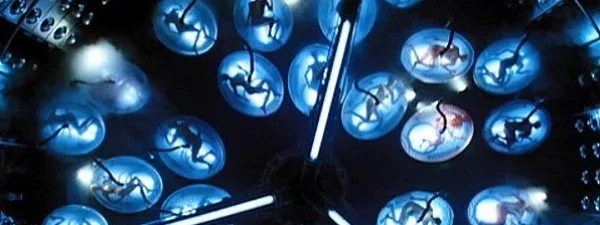
As we all know from the movies, if you're going to clone something, clone something worthwhile: So, for example, don't clone dangerous dinosaurs, and don't clone Adolf Hitler. That's good advice. Unfortunately, Michael Bay, the director of "The Island," hasn't taken it. His new film may not exactly be a clone, but it certainly appears to have borrowed (there's some controversy about this) its central conceit from "Parts: The Clonus Horror," a low-budget, high concept fiasco from 1979 best known these days as a victim of the sarcastic nerds at "Mystery Science Theater 3000." That's a shame. An intelligent film about clones and cloning is long overdue. "The Island" is not it.

What we get instead are parts, so to speak, of "Clonus" minus the Herb Tarlek jackets and pleasantly gratuitous nudity, together with a fairly standard futuristic fleeing couple drama with more than a touch of "Logan's Run" about it, all wrapped up in the flash, dash and pizzazz of a film by Michael Bay, the creator of "Armageddon," "Pearl Harbor," and "The Rock." But while "Clonus" had a desperate, ramshackle charm, "The Island" is too commercial and too slickly packaged for that, something that is only reinforced by shameless product placement, intrusive even by the debased standards of contemporary Hollywood.

It's difficult to say too much about "The Island's" plot without giving the game away, but, for all the film's many faults, there's no doubt that Mr. Bay knows how to put together an entertaining summer movie (full disclosure: I enjoyed "Armageddon"). From the hallucinatory opening sequences, to the virtuoso fast cutting, to the rococo chases and baroque gunplay, to the feeble, and usually unsuccessful, lapses into humor, this is classic Bay, as evanescent, entertaining, and dumb as a day at the beach.

Oh yes, Ewan McGregor and Scarlett Johansson do their best to portray the runaway clones, and Steve Buscemi is convincing as a louse with a heart of gold, but it's not the actors that count in a movie like this.

Hollywood's Hideous Progeny

The New York Sun, July 22, 2005

BladeRunner.jpg

In this time of Dolly, stem cells, and decoded genomes, it should be no surprise that Hollywood has sent in the clones. "The Island," the new genes-and-screams blockbuster that opens this week, may be trite, slight, and none too bright, but the appearance of a big-budget movie premised, however feebly, on the medical promise and moral contradictions of human cloning, is yet another reminder that Xeroxed people are now icons of social, scientific, and cultural unease.

In just the last few months, Kazuo Ishiguro has published the clammy and claustrophobic "Never Let Me Go," a novel that covers very similar ground to "The Island," and Joyce Carol Oates has done pretty much the same in the latest Atlantic Monthly, with "BD 11 1 86," a short story so unsubtle that Dick and Jane, by comparison, look profound: "But you, Danny, your body will survive for decades. As a body donor, you're one of the elite." Poor Danny. Poor readers.

The only real surprise has been how little Hollywood has done with cloning so far. To be sure, clones have played parts in movies, but films that concern their, um, issues are few and far between. That's strange. It's been more than 70 years since Universal Pictures' "Frankenstein" tapped so effectively, and lucratively, into humanity's fear of its own ingenuity, a fear that has since fueled countless films of science gone bad, mad, or both, and made more than a few moviemakers very, very rich. Horror stories about cloning ought to fit nicely into this genre, and what's more, given the fascination of the subject matter, raise its collective IQ.

That hasn't happened. To be fair, "Blade Runner" was an intelligent examination of what cloning could mean, but that's a movie more than two decades old. Mostly we've been given low-budget disasters, such as 1979's "Parts: The Clonus Horror" or big-budget disasters like Schwarzenegger's forgettable "The Sixth Day," and now "The Island." With politicians busy stoking up anxiety over this topic, it's only a matter of time before "The Island" becomes an archipelago. To discover what future movies about cloning will be like, just take a look at what has gone before.

To start with, to boost their scientific credibility, there will almost certainly be a microscope moment when human cells are shown dividing, or forming, or whatever it is they do after the cloning process has begun (see the recent "Godsend," for one) and, to the same end, expect to hear so much meaningless medico-technical babble that the only reasonable assumption is that the late "Bones" McCoy (or, presumably, his clone) is somewhere in the vicinity.

It goes without saying that at least one character will be accused of playing God (as one does in "The Island") and, just to ram home the message that we're talking serious stuff here, there's a good chance that the plot will include someone called Adam (as it does in both "Godsend" and "The Sixth Day") and that Adam will turn out to be a clone (ditto). Likewise, the movie's title may well refer to either the deity ("Godsend") or to His big book ("The Sixth Day"). Those able to sit through "Embryo" (an honorary cloning movie which merits inclusion in this survey - or, indeed any survey - on a number of grounds, not least a naked Barbara Carrera and a surreally entertaining dogfight) can see the religious imagery crowned by shots of Michelangelo's depiction of the Creation.

God matters, because the central conceit of such movies has been, and will be, that, in artificially creating life, man is trespassing on God's domain. At the moment that Victor Frankenstein brings life to his creation, he shouts (this is in the movie; Mary Shelley's Frankenstein would never have been so gauche) that he knows "how it feels to be God." And the moment he says that, we know that he's finished. Frankenstein's saga derives much of its tragic force from the way it follows the rules of an ancient taboo, a taboo that Shelley's book, her "hideous progeny," did much to reinforce: There are some things that are not for man to discover. Ignore that fact and disaster will follow. Adam and Eve were expelled from Eden, Icarus fell from the sky, and Frankenstein caused the destruction of those he loved.

So it is that, in the movies, human cloning is generally portrayed as a bad thing, and its consequences usually malign, even if the clones themselves may not be (hate the cloning, love the clone). But what is it about cloning that is so sinful? In an age when many no longer have any religious beliefs, simply asserting that the creation of life is the monopoly of a god is not enough. Shelley, an atheist, faced this problem by making her Victor realize that his experiment was so unnatural that he came to reject its results. Even so, Frankenstein's repudiation of his creature at the moment of its creation ("the beauty of the dream vanished ... and disgust filled my heart") seems as much aesthetic as moral, and is not entirely convincing. The problems for the modern filmmaker are even trickier: In an age of IVF, who is to say what is, or what is not, natural?

Hollywood has dealt with this intellectual challenge the old-fashioned way: by avoiding it. Usually ("The Sixth Day," "The Island") the people responsible for the cloning are portrayed as so vile, and their methods so vicious, or otherwise flawed ("Godsend"), that deeper questions can be dropped in favor of facile controversy, easy indignation, and junk science jabbering, and don't even get me started on the "Boys From Brazil." Can we all agree now that cloning Adolf Hitler is a really, really, bad idea?

But look carefully behind the ridiculous premises and flimsy plots of some of these movies, and it is possible to get a sense of why human cloning causes quite so much alarm. Narcissistic creatures that we are, it's all about us. Despite the fact that we share our planet with 6 billion others, the notion that homo sapiens generally, and ourselves individually, could be mass-produced appears to be an affront to our sense of self and species. Predictably enough, therefore, a number of movies (even the light-hearted "Multiplicity") include scenes in which clones confront their "parents," or vice versa, and either party (or both) ends up wondering who he or she "really" is - which, if anyone actually stopped to think about it, is something completely unaffected by the existence of a genetic duplicate.

More realistic, perhaps, is another fear that can be discerned beneath the surface of these movies, the fear that the clones aren't monsters, but that we, however, may be. "Blade Runner" is preoccupied by the question of whether clones are truly human (it concludes that they are), but most other movies seem to regard this as beyond dispute. Clones are like you and me (and you and me, and you and me). And they should be treated accordingly. Our dread is that we cannot be trusted to do so. In film after film, clones are abused, exploited, and treated as disposable objects by mankind. The real issue then becomes not their humanity, but ours.

And that's an entirely different question.

Easy Riders

National Review, July 18, 2005

Mongolia, May 2005 © Andrew Stuttaford

Mongolia, May 2005 © Andrew Stuttaford

Look, I’m not Hemingway, Marco Polo, or Lewis or bloody Clark. I don’t kayak, hike, or bike, but I do know I’m not the only traveler in Mongolia to have gone through a moment of despair, regret (what was so wrong with Cancún anyway?), and panic. And why not? We were somewhere remote in the country that defines remote and our guide’s “short cut” had more than a touch of the Donner Party about it. Were those really vultures, dark, enormous, and optimistic, circling over our dusty and exhausted bus as it bounced, creaked, juddered, and shuddered along the unpaved road that wound across an empty plain that made the Mojave look like the Garden of Eden? Yes, they were vultures. Big ones. Mean ones. Hungry ones.

Hours, hours, bouncing and juddering hours later, broken only by a grim little picnic by a grim little lake previously denuded of fish by dynamite-toting Chinese, we arrived at Lun, a Mad Max scrap of a settlement that shared only a syllable with the British capital, in the hope of refueling the bus. Lun’s wreck of a gas station had gas. It had pumps. It had an attendant. What it didn’t have was electricity. No electricity. No pump. No gas. The power was out all over eastern Mongolia, but the attendant thought that a lady who lived nearby might have a stash of gas, and that stash of gas could be for sale. She did, and it was.

Lun, Mongolia, May 2005 © Andrew Stuttaford

Lun, Mongolia, May 2005 © Andrew Stuttaford

The impossible has a way of happening in the land of the Mongols. They are a people too far-flung, too poor, and too strange to survive. And yet they have. They survived the collapse of the khans’ huge empire, they survived the centuries of Chinese oppression that followed, they survived even the brief, brutal, and bizarre rule of a crazed Baltic baron, and, finally, they survived the decades of Communist dictatorship that ended only in 1990.

Now at last this nation of nomads, lamas, herdsmen, shamans, miners, bureaucrats, and trainee city slickers is back in charge of its own destiny. And as in so many other parts of the old Soviet bloc the first sign of a better future is the return of the long-suppressed past. In Mongolia that can only mean one thing: You Know Who is back. Genghis! In the Communist era, Genghis Khan (or, more accurately, Chinggis Khaan) was regarded as a distinctly disreputable figure, a man best not mentioned by the politically prudent. Not anymore.

Brushed, scrubbed, rehabilitated, and thoroughly whitewashed, the old monster has been transformed into a lawgiver, philosopher, and all-round decent guy. “Yes,” I was told, “he was a mass murderer, but that’s how war is.” Besides, he was “provoked” (it’s a long — and utterly unconvincing — story). Butcher no more, Genghis now shines as a symbol of Mongolia’s lost glory and newfound confidence. There’s even talk of moving the capital from Ulan Bator (Ulaanbaatar) to the spot that Genghis picked, Karakorum (Kharkhorin), these days a tumbledown town distinguished only by a magnificent monastery having, awkwardly, no connection to Genghis. In fact, almost nothing in Karakorum has. Well, there is a modern monument — part Trump, part Brezhnev, all disaster — dedicated to the Mongol empire, but, like Mongolian cuisine, it is best passed over in silence.

Karakorum, Mongolia, May, 2005 © Andrew Stuttaford

Karakorum, Mongolia, May, 2005 © Andrew Stuttaford

Fortunately, there’s more in Mongolia for Genghis fans than Karakorum, including Chinggis cigarettes, Chinggis beer, and the alarming Chinggis vodka. In Ulan Bator, Chinggis has given his name to the best hotel, a wide avenue, and a good place to munch some mutton. Over in the national history museum, previously preoccupied with the exploits (stupendous) of the Mongolian Communist party, the Commies are out and Genghis is in.

Genghis Khan, Ulan Bator, Mongolia, May 2005 @ Andrew Stuttaford

Genghis Khan, Ulan Bator, Mongolia, May 2005 @ Andrew Stuttaford

If the great Khan’s tale is embellished, mythologized, and sometimes just plain made up, that’s understandable in a people that still seem a little uncomfortable in the trappings of a modern nation-state. And for this, the country’s complex and often savage 20th century must bear no small share of the blame.

As even a quick glance at Ulan Bator’s glum architecture will reveal, today’s Mongolia is in many ways a creation of the Soviet Union. Russia’s Bolsheviks played an important part in establishing Mongolian independence, and their successors did their best to ensure that that independence was a sham. Ulan Bator (the name means “red hero”) resembles a rundown provincial capital anywhere in the former USSR. Like many such cities, Ulan Bator was embellished with the occasional unconvincing local flourish (its wedding palace is built in the shape of a traditional Mongolian hat), but its true spirit was crushed. Most of Ulan Bator’s monasteries were, like the monks who inhabited them, obliterated, their ornate forms replaced by the slovenly grandeur and gimcrack construction so typical of Soviet rule. Even the mausoleum of Mongolia’s other great hero, the “red hero” himself, Damdiny Sükhbaatar, bears a suspicious resemblance to Lenin’s in Moscow.

Ulan Bator, Mongolia, May 2005 © Andrew Stuttaford

Ulan Bator, Mongolia, May 2005 © Andrew Stuttaford

At least the statue of Stalin that stood outside the national library was finally pulled down, if only in 1990. Other, more disturbing, traces of the murderous Georgian still remain. In 2003, construction workers uncovered a mass grave containing the remains of perhaps a thousand people. Most of the victims were Buddhist monks, shot, bludgeoned, and dumped in a ravine near Khambyn Ovoo: a small portion of the tens of thousands of victims slaughtered, exiled, or imprisoned in the 1920s and 1930s as the Mongolian party leadership, carefully choreographed by Moscow, brought the grim drama then playing in the USSR to their own country. The script is familiar, complete in every disgusting detail, even down to the rise of Horoloogiin Choibalsan, a puppet Stalin all Mongolia’s own.

Memorial Museum of the Victims of Political Persecutions, Ulan Bator, Mongolia, May 2005 © Andrew Stuttaford

Memorial Museum of the Victims of Political Persecutions, Ulan Bator, Mongolia, May 2005 © Andrew Stuttaford

There’s an old wooden house in Ulan Bator that gives a flavor of those days. Once the residence of a Mongolian prime minister murdered in Moscow in 1937, it now hosts a museum dedicated to the victims, complete, as such museums usually are, with the incomplete: the names and the photographs of just a few of the dead. A wax tableau reproduces the scene in an interrogation chamber, while upstairs a small pile of skulls from the Khambyn ravine shows how such interrogations tended to conclude.

Memorial Museum of the Victims of Political Persecutions, Ulan Bator, Mongolia, May 2005, © Andrew Stuttaford

Memorial Museum of the Victims of Political Persecutions, Ulan Bator, Mongolia, May 2005, © Andrew Stuttaford

And as expected in the former Soviet empire, the accounting for the Communist years remains unfinished, ambiguous, and uncertain. A statue of Lenin presides over the prostitutes outside a downtown hotel, and Choibalsan still stands on his pedestal outside Ulan Bator’s university. Choibalsan’s party is in Mongolia’s governing coalition and its candidate recently won the country’s presidential elections. But the Mongolian People’s Revolutionary party is not what it was. It has accepted democracy, the free market (more or less), and, even, alliance with the U.S.; the Mongols are back in Baghdad, if rather less bloodily than in the time of the khans. Ulan Bator may be desperately poor, but there are many outward signs of returning enterprise — bustling shops, sidewalk kiosks, even a stock exchange.

Ulan Bator, Mongolia, May 2005 © Andrew Stuttaford

Ulan Bator, Mongolia, May 2005 © Andrew Stuttaford

Outside Ulan Bator conditions are far tougher. For a couple of days our group stayed in a ger (yurt) camp in a high valley to the north. The valley was lovely, with more than a touch of Shangri-La about it, but even this idyll offered a glimpse of a very hardscrabble Arcadia, where few inhabitants had much in the way of, well, anything. Life in Mongolia is harsh: The climate is merciless, incomes are low, and with little in the way of infrastructure (there are, for example, probably fewer than 5,000 miles of paved road, a miserable figure for a country the size of Alaska) it’s difficult to see how that will change any time soon. But if anyone can make this all work, I like to believe that it will be this tough, resilient people.

Mongolia, May 2005,  ©Andrew Stuttaford

Mongolia, May 2005,  ©Andrew Stuttaford

And before you say that this is a hopeless dream, go to the steppe and watch a lone horseman riding calmly through that vast impossible space, his herd in front of him, and history just behind.

The Return of Novelty Boy

The New York Sun, July 8, 2005

edward-scissorhands.jpg

Once, on a gray hangover Sunday morning quite a few years ago now, I saw Johnny Depp. He was stumbling along Sixth Avenue on the way to that flea market in the 20s, and so was I. He was a wan, disheveled wreck, and so was I. But he had Kate Moss in tow, and I, well ... I did not. Even back then Johnny Depp was a star, a Cary Grant for our ragamuffin times, a tatterdemalion Tom Cruise, James Dean without the car crash, a charmer, an enigma, a talent to watch - even if, judging by the box office of most of his movies, not many people did.

That began to change with "Sleepy Hollow" and "Pirates of the Caribbean," and could change even more with "Charlie and the Chocolate Factory," which opens next week. But there's an excellent opportunity to assess his work right now at "In Deppth" (sigh), a retrospective opening at the Brooklyn Academy of Music today. Over the course of three weeks, BAM will show a selection of movies that convey a real sense of Mr. Depp's range, quality, and charm. Above all, filmgoers will be left with an impression of the extraordinary presence that he brings to even the most mediocre movies ("The Ninth Gate," I'm talking about you), a presence that owes something to Mr. Depp's good looks, but much more to his talent.

The idea that Mr. Depp has achieved what he has while defying Hollywood convention, however, is not quite correct. While he's too smart for red string and Kabbalah gibberish, Mr. Depp has in many other respects stuck to the standard script for a rising star: idiot preachiness ("America is dumb; it's like a dumb puppy that has big teeth that can bite and hurt you, aggressive ... my daughter is four and my boy is one. I'd like them to see America as a toy, a broken toy. Investigate it a little, check it out, get this feeling and then get out."), tabloid scandals, the usual substances, jail time, tragedy (poor River Phoenix twitched his last outside Mr. Depp's Viper Room), an awe-inspiring sequence of girlfriends, and displays of petulance that reached an early peak at the moment when (eat your heart out, Russell Crowe) he set his underpants ablaze on the set of "21 Jump Street": Apparently his motor home hadn't been cleaned for a while. Oh well.

It was on "Jump Street," though, that Mr. Depp's career began to veer in an unexpected direction. The hairstyle, acne, and just-say-no police drama had made his name and bank balance, but the actor felt "lost, shoved down the gullets of America as a young Republican. TV Boy, heartthrob, teen idol, teen hunk ... bound for ... lunch box antiquity. Novelty boy, franchise boy." Fair enough, but it took a truly perverse imagination to believe that Mr. Depp could lose his unwanted teen-idol tag by escaping to the big screen and playing, yes, a teen idol.

Yet in John Waters's delirious, delightful, and ridiculous "Cry-Baby" (screening July 10), he did. As the absurd, delinquent, but strangely appealing Wade "Cry-Baby" Walker, Mr. Depp is a beautiful, low-rent Elvis, shaking, sneering, and seducing his way through a performance that parodies both the heroes of our rockabilly past and the sort of stardom that Mr. Depp himself had been meant to aspire to. After "Cry-Baby," Mr. Depp's face may still have graced People, but his mind, it was clear, was elsewhere.

That movie pointed the way that Mr. Depp's career would go. It showed his endearing willingness to forgo other more commercial projects in exchange for the opportunity to work in films that he found intriguing, even if their directors - like Mr. Waters himself, or Jim Jarmusch ("Dead Man") or, in a sense, Tim Burton ("Edward Scissorhands," "Sleepy Hollow," and "Charlie") were outside the Hollywood mainstream. Also, it's notable (even if it's somewhat obscured by the carnival cast of grotesques, misfits, and oddities with whom, typically, John Waters peoples "Cry-Baby") that Wade Walker was the first of the oddball roles with which Johnny Depp, the boy who didn't want to be "novelty boy," was to make his name.

Until then, Mr. Depp's roles had been routine fare for a star on the make. He appeared without his trousers - or anything else - in a lowbrow sex comedy ("Private Resort"), he was shot at by the Viet Cong in "Platoon," and butchered by Freddie Krueger in "A Nightmare on Elm Street." In Wade's wake, however, he replaced the generic with the exotic, becoming something of a showcase for the peculiar, most notably with his two special Eds, Scissorhands and Wood, and, in "Pirates of the Caribbean," with Jack Sparrow, the weirdest scoundrel ever to sail the Spanish Main.

To Lasse Hallstrom, who directed Mr. Depp in "What's Eating Gilbert Grape," a film in which the actor shone in a more normal role, Mr. Depp's preference for offbeat characters was a way of hiding in plain sight, concealed behind the eccentricities of those he portrayed. Perhaps, but it's more likely that Mr. Depp, a man who once bought the house which was (reputedly) the site of Munchkin orgies during the filming of "The Wizard of Oz," gravitated naturally toward roles that appealed to his well-developed sense of the bizarre, something that he often exploits but never abuses. The strangeness of the characters he plays is not an excuse to descend into pastiche, caricature or ham. Mr. Depp takes them seriously, and so, therefore, should we.

Inevitably, there are omissions at BAM, mainly recent offerings such as "Pirates," "Blow," and, mercifully, the overrated "Finding Neverland" (Ian Holm was a far more convincing Barrie in a BBC version of the same story). Fans of film fiasco will be disappointed that there's no opportunity to judge "The Brave," the only movie that Mr. Depp has ever directed, a project probably doomed from the moment that he decided to bless the beginning of filming with a Native American ritual.

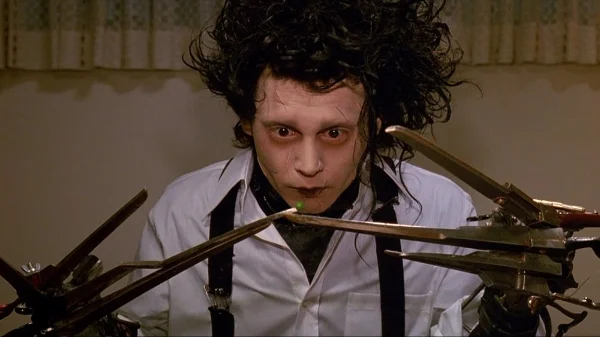
No time to see all that BAM has to offer? Well, for a sense of Mr. Depp's range, try his subtle, sensitive portrayal of the conflicted undercover cop in "Donnie Brasco" (July 15), a character far removed from his usual madcap menagerie. Then there's the hypnotic "Dead Man" (July 30), an extraordinary, slow, slow, slow Western, teetering uneasily between a dream and a joke, with Mr. Depp compelling as he drifts helplessly toward his fate. But if there's only one film you can catch, it has to be "Edward Scissorhands" (July 9), Mr. Burton's masterpiece, and Mr. Depp's, too. A gorgeous fairy tale, this kinder, gentler "Frankenstein" has an almost mute Mr. Depp strapped into a leather bodysuit, those legendary looks lost under stark white makeup and a tangled black wig. Despite these handicaps, Mr. Depp somehow uses minimal dialogue, marvelously expressive eyes, and the tricks of an accomplished mime to convey the very essence of the being he portrays.

It's a performance that he hasn't topped, and there are some signs from his latest work that he may never do so. His Jack Sparrow was a wild, wonderful and inspired comic creation. Sparrow transformed "Pirates of the Caribbean" from dross into gold, but plans for a sequel and the imminent release of "Charlie" may be a harbinger of something altogether less welcome: the return of novelty boy, this time as a licensed, lovable eccentric, good box office certainly but entirely lacking the edge that has made Mr. Depp so great for so long.

Let's hope not.

Chimps, The Cheshire Cat & The Fall of Tony Blair

National Review Online, May 26, 2005

Blair2005GE.jpg

When, after a great victory, a Roman general marched in triumph surrounded by plunder, captives, and, quite probably, hot chicks, he was always accompanied by a slave whose job was to hiss periodically in the great man’s ear the irritating reminder that he was only human, not a god. Something a bit like this (well, I don’t know about the plunder, captives, and hot chicks) happened to Tony Blair in the aftermath of his party’s triumph in the recent British elections. Within hours of victory, numerous Labour politicians lined up to tell Blair to get lost. Former foreign minister Robin Cook took time out from his usual bilious routine to report on the views of the nation’s boulevardiers. “Anyone on the streets knows we were not elected because Tony Blair was popular....” Another former, a former health minister better known for the elections he has lost than those he has won, said it was time for Blair to go. Former actress and current hysteric, the shrilly leftist MP Glenda Jackson chimed in with the claim that the “people have screamed at the top of their lungs. And their message is clear. They want Tony Blair gone.”

Well, Glenda, in case you weren’t paying attention, the people have just made Tony Blair the first Labour prime minister to win three consecutive election victories. While the party’s parliamentary majority was substantially reduced, it remains, well, substantial.

To the novelist and journalist Robert Harris (an old friend of Blair’s Svengali, Peter Mandelson, but a clear-eyed judge of British politics nonetheless), this all looked like madness: “it does not…require a political genius to see…that it is a thoroughly bad idea for a minority party-cabal to bring down an elected prime minister. The Liberals did it to Asquith in 1915 and have never gained power again. The Tories did it to Thatcher… and have since suffered three successive election defeats… Now Labour, like a chimp examining a loaded revolver, shows alarming signs of the same casual attitude to its political extinction.” Harris noted that an opinion poll conducted shortly after the election had shown some 83 percent of those who had voted Labour said that Tony Blair should stay on for at least another twelve months.

The same poll, however, revealed that over 60 percent of Labour voters want Blair out within three years, an indication, perhaps, that all is not rosy for Tony. And it’s not. Take a closer look at the stats: the Labour party’s share of the vote, a dodgy postal ballot or two over 35 percent, was the lowest enjoyed by an incoming government for nearly 200 years, and impressive as Labour’s haul of parliamentary seats undoubtedly was, it came in at well below the total secured in the previous two general elections. The number of votes cast for the party has slumped by a third since the 1997 election that swept Blair into power. For the first time in a decade, many Labour MPs are sweaty, anxious, and paranoid about their parliamentary futures, something that bodes ill for Blair’s.

It seems a long, long while since the bright, confident afternoon that Tony Blair first took possession of 10 Downing Street to the cheers of a supposedly spontaneous jubilant flag-waving crowd (in fact Labour-party workers and their families, but never mind). Years of spin, manipulation, and dishonesty, made all the more grating by relentless prime ministerial preachiness, have made Blair a deeply distrusted figure, part curate, part conman, all charlatan. Of course, there’s nothing new about the British loathing a repeatedly reelected prime minister—there were few politicians so disliked as Mrs. Thatcher at the height of her powers—but Blair has to contend with a threat that never really troubled the Iron Lady: the Labour party.

Once firmly established in Number Ten, Mrs. Thatcher could always rely on the adulation of her party’s rank-and-file and, until the Gadarene meltdown of November 1990, her MPs. Tony Blair cannot. As Labour leader he has filled an abattoir with the slaughtered sacred cows of party orthodoxy. This has won him elections, but lost him the love, affection, and loyalty of his activists. They, poor souls, remain trapped in a mindset that blends traditional working class belligerence with the idiot radicalism of a third-rate provincial university. To them, Tony is the outsider, the toff, Bush’s poodle (pick your insult), a necessary evil to be tolerated only so long as he brought in the votes.

And that means that Blair is now looking very vulnerable indeed. At the election Labour lost most ground in those parts of the U.K. where his emollient appeal had once been greatest. The affluent southeast has largely returned to its Tory roots. In England itself more voters opted for the Conservatives than for Labour. Labour is once again dependent on its traditional heartlands, the industrial north, and those grim socialist satrapies better known as Scotland and Wales, territories where Blair’s message has very limited intellectual, emotional, or electoral appeal.

Compounding his weakness, Blair has already said that he will resign before the next election. Quite why he chose to hobble himself in this way remains unclear. It’s probably best to ask Blair’s chancellor of the exchequer (finance minister) and presumed successor, the sulky, scowling, and increasingly impatient Gordon Brown. In circumstances that have been obscured by controversy, mystery, and mudslinging Blair may (or may not) have promised to step down in favor of Brown at some time during his first term and he may (or may not) have promised to step down in favor of Brown at some time during his second. He may also have sold his chancellor the Brooklyn Bridge, a secondhand Pinto, and a three-dollar bill. Who knows? In any event, it’s 2005 and Blair’s still in office, but the trusting Mr. Brown has finally and painfully come to the same conclusion as the rest of the country. “There's nothing,” he told Blair, “you could ever say to me now that I could ever believe."

Eventually, Blair did what he always does (or may not have done) on the previous occasions that he needed to keep Brown onside: He promised to stand down at some point in his next term, but this time, there was a difference. He made that promise in public. The moment he did, the game was up. Politicians at Westminster, a British journalist told me, know that Blair is mortally wounded, “they can see the trail of blood all across the lobby floor.” Power, sycophants, and the ambitious are all ebbing from the prime minister, as Gordon Brown, whose fondness for some of old Labour’s more numbskull pieties has already made him the party’s darling, painstakingly cements his hold over the constituencies he will need to assure him the premiership, a union leader here, a key MP there, a friendly journalist here, a member of the House of Lords there. According to some estimates there are now three times as many Brownites as Blairites within the ranks of the parliamentary Labour party.

Superficially, Blair’s actions since the election seem to show that the maestro has lost none of his touch. The usual crop of meaningless, destructive, and plain dumb "reforms" have been announced, the House of Lords has been stuffed with another batch of cronies, dubious government appointments have been made and dissidents have been roughed up at a parliamentary-party meeting. But this is all flim-flam, flash, and empty glitter, a show that signifies nothing. A better indication of where power now lies comes from the fact that Blair was unable to push through many of the personnel changes he wanted in his new administration, a deeply humiliating rebuff for any newly reelected prime minister, let alone one who has been in office for the better part of a decade.

And the misery doesn’t end there. Blair has for a long time delegated large amounts of the domestic agenda to his chancellor (that was part of the agreement between them), but now, after Iraq, even his hold over foreign affairs is palsied, feeble, and pointless. Britain’s EU policy is a shambles, and so far as the threat from Islamic extremism is concerned, the idea that Blair could bring his party with him alongside the U.S. in doing anything that lacks the approval of the "international community," Hollywood, the Guardian and the New York Times is absurd. All that is left to Blair now is the peddling of a grandiloquent, if benign, idea—saving Africa—ripped off from a rock star.

The next step in Blair’s decline will be guerrilla warfare> against his government from the Labour Left, but this will not be enough to unseat him, and nor, probably, would Brown want it to. Despite a history of awe-inspiring and entertainingly destructive temper tantrums, Brown, like Harris, clearly understands that a coup could come at a terrible electoral price. He has resisted the temptation to play Brutus in the past, and he will do so again. He wants to inherit a united party. Ideally Brown wants that “smooth and orderly” handover that Blair is always talking about, but sooner, please, please, sooner, please, please, sooner, rather than later. So when might that be? Before the election, conventional wisdom was that Blair would oblige his impatient heir about three years into his final term, now the talk is that he might quit next year.

The problem is that there is still no obvious moment for Blair to go. Given his druthers, the prime minister, who is still only 52, would probably prefer to soldier on up to the last minute or, quite frankly, beyond. If he does have to go, this most theatrical of politicians will want it to be on a high note. The conundrum for Blair—and Brown—is that there aren’t many potential high notes around. It’s long been mooted that Blair should resign after tricking the Brits into voting for the EU’s draft "constitution" in the autumn of 2006, but so far his stubbornly euroskeptic countrymen show few signs of playing along. Of course, a British "no" might also signal the end of Blair’s show, if not quite so gloriously as he would have wished. Needless to say, all this may soon become academic: If the French and the Dutch reject the constitution in the next week any British vote may be shelved indefinitely.

The British economy won’t be much help either. After eight years in office, it looks as if Labour is finally going to have to start paying the price for the way in which it has squandered the golden inheritance of the Thatcher-Major years. Quite how this will reflect on Gordon Brown, as Chancellor the man most responsible for the coming mess, is hard to say, but increasingly unappetizing economic news will mean that Blair’s departure will look more like an exit from the scene of the crime than the glorious finale of which he must dream.

So nothing’s certain other than months, and perhaps, years of intrigue, febrile speculation and plots as Blair’s premiership fades, fades, and fades away until, like a New Labour version of Carroll’s Cheshire Cat, all that will be left is an oddly compelling smile, faint, strained, and insincere.

Potter's Field

Charlie Higson: Silverfin

The New York Sun, May 20, 2015

Silverfin.jpg

With Clint Eastwood reduced to making films about ladies who box, Bond, James Bond, is the last true man's man. He blows smoke in the face of surgeons-general, adds no fruit juice to his martinis, and gives the pieties of feminism a pass. He has survived knives, a wife, bullets, nasty mechanical pincers, beatings, grenades, piranhas, and tortures too beastly to describe in a family newspaper. He's seen off Blofeld, Goldfinger, Scaramanga, No, Drax, and even that impertinent oaf, Austin Powers. He has weathered the challenges of SMERSH, Rosa Klebb's shoes, Roger Moore's safari suits, and the notion that M can be Dame Judi Dench. Now 007 faces his greatest, and potentially most humiliating, threat yet. James Bond - sophisticate, seducer, secret agent - has just been reimagined as a 13-year-old boy.

Charlie Higson's "SilverFin" (Miramax Books, 335 pages, $16.95), the first of five planned "Young James Bond" novels, was published in Britain earlier this year to dark mutterings from the veteran spy's fans, critical approval, and impressively strong sales. Now (don't tell Felix Leiter) it has been released over here. A comic book is also in the works. There is, predictably enough, also talk of a movie, although widespread (and now denied) rumors that the film would star Orlando Bloom as Bond Jr. seemed to ignore the fact that, fresh-faced though he may be, the former elf is well past puberty.

If all this sounds like there is someone somewhere trying to milk an old franchise for all it's worth, that's because it's true. Ian Fleming came from a distinguished, and famously shrewd, Scottish banking family that has never, in all its long history, been known to overlook the chance of making a pound or two. Fleming sold a controlling stake in his literary estate to the publishers, Booker plc, before his death, but the Fleming family bought it back in the late 1990s, and (the London Guardian reports) "a wave of new projects, including Bond merchandising and games, is being prepared."

The early chapters of "SilverFin" show the fine-tuned commercial instincts of those canny Scots at work. Its opening chapters set the scene in a manner that cannot fail to lure in all those potential buyers bored of waiting, waiting, waiting for their next fix of J.K. Rowling. Like Harry Potter, young Bond is an orphan, although mountaineering, not magic, is to blame for his parents' unfortunate demise. Like Potter, Bond is sent off to boarding school. An unconvincingly described Eton stands in for Hogwarts.

Needless to say, poor James has to contend with his very own Draco Malfoy, a villainous fellow pupil with, like Draco, a powerful father behind him. Trapped by the decidedly unsupernatural nature of his hero, Mr. Higson is unable to add the additional excitement of a brutal contact sport played on flying broomsticks: There's no Quidditch at Eton. Bond triumphs, instead, in cross-country running.

Mr. Higson's decision to cast as Bond's best chums two Indian and Chinese boys, rare birds indeed in a "public" school in 1930s England, is probably no less calculated. Pritpal Nandra and Tommy Chong will delight the diversity police always so busy patrolling the world of children's literature, and probably be good boxoffice, too. The same is true of "Red" Kelly, Bond's handily proletarian sidekick, useful in a punch-up and essential for giving young James the street cred that today's market calls for. We are told early on that Kelly thinks the privileged Etonian is "all right" despite being a "toff," and thus a member, we are supposed to understand, of a hated enemy caste.

That such touches are hopelessly anachronistic does not seem to worry the author too much. With the exception of a few pieces of carefully inserted period detail, there is little about this book that gives any real sense of the time in which it is supposedly set. Or, for that matter, the place: The Scotland in which James's adventure comes to its pleasantly savage conclusion is as bogus as "Brigadoon," utterly lacking the beguiling tweedy tartan authenticity that John Buchan brought to his "Thirty-Nine Steps."

Despite these - considerable - flaws, the second half of "SilverFin" gallops splendidly along with a fabulously nutty plot that involves sinister German scientists, carnivorous eels, man-eating pigs, daring escapes, grotesque deaths, a megalomaniac American businessman, and enough steroid abuse to launch a baseball team. Once he gets going, Mr. Higson displays a fine sense of pace, and a genuine ability to write the enjoyably un pleasant descriptions that will delight the small ghouls who will make up so much of his audience:

"James recoiled, but then forced himself to look at what had once been a man. ... The face was wrecked: it looked as if it had been split down the middle and forced apart, so that the nose was flattened and stretched, the teeth had separated and the eyes had curved around almost to the sides of his head. The eyes were the worst part. They were dark and wet, and James saw in them, not murder, but sadness and pain."

That's splendid stuff, but not quite good enough to buy forgiveness for what "SilverFin" (not to mention the annoying anti-smoking infomercials that pop up periodically throughout the book in an attempt, presumably, to dispel the fatal allure of a certain special agent's Balkan- and Turkish-blend cigarettes) could do to the commander's image. Those of his fans brave enough to read it will need to take appropriate steps afterward to banish the idea of 007 as a retro Cody Banks from their heads.

May I suggest a couple of vodka martinis? Shaken, not stirred.