Conspiracies So Immense . . .

National Review, December 3, 2007

To talk to Yuri Felshtinsky is to revisit an era meant to have ended when Boris Yeltsin leapt onto a tank in Moscow. But when Dr. Felshtinsky examines photographs of that heroic August day, he sees something else. Visible just behind the Russian leader is Alexander Korzhakov (he’s the balding man in a gray suit), the bodyguard who later became chief of Yeltsin’s Presidential Security Service. “KGB,” notes Felshtinsky. So he had been.

Something similar could have been observed in St. Petersburg. The city’s mayor was a prominent opponent of the hardliners’ coup — but take a closer look at shots of his entourage, and whom do you see? Vladimir Putin, that’s who. “KGB,” says Felshtinsky. And then he smiles.

Felshtinsky is an historian, Russian-born (but now an American citizen), a graduate of Brandeis, a Ph.D. from Rutgers, and connecting the dots is what historians do. But the animated, intense, and likeable Dr. Felshtinsky doesn’t just enjoy his connections and his dots, he treasures them, and when they begin to reveal the outline of something hidden, something mysterious, something denied, ah well . . .

He is quick to regale me with fascinating tales of murder, attempted murder, and conspiracy from the Soviet epoch, tales that have, shall we say, passed most history books by. But before dismissing them all as fantasy, bear in mind that konspiratsia has been a malign feature of Russian politics since the czar’s Okhrana began its elaborate games of deception with the revolutionaries over a century ago. These were games that, in essence, continued, unchanged but for the players, into Soviet times, and if Yuri Felshtinsky is to be believed, they still do. And maybe he should be. In Russia it’s only cranks that have faith in lone gunmen. In a nation with no agreed narrative of past or present, who is to judge where paranoia ends and history begins?

This place of shadows, contradiction, and lies is where Felshtinsky and a former intelligence officer named Alexander Litvinenko researched their book, Blowing Up Russia. Since it was first published in 2002, Litvinenko has been murdered — poisoned in London last year with radioactive polonium-210 — and the book itself has been banned in Russia. The latter can’t have been a shock: Blowing Up Russia may resemble a somewhat discursive academic treatise, but it is as disturbing as it is dry. It is either a monstrous libel or a horrifying revelation. Neither would be acceptable to the Kremlin.

That’s because the book revolves around the allegation that the devastating bombings in Moscow, Buinaksk, and Volgodonsk in September 1999 were the work not, as is usually assumed, of Chechen terrorists, but of elements within the FSB, the principal successor organization to the KGB. The bombings were, it is claimed, what the Soviets would once have called a “provocation” — a provocation of which, Felshtinsky tells me, choosing his words delicately, Putin was “aware.” According to this thesis, they were designed to provide a justification for a fresh attack on Chechnya and, with that renewed war, a political climate that would favor the election to the presidency of Putin, who had recently quit his job as head of the FSB to become prime minister and Yeltsin’s latest presumed successor. If that was indeed the plan, it worked. Russian troops reentered Chechnya in force, Yeltsin resigned in December, and in March 2000 Putin swept into the presidency.

Putin has described such allegations as “madness.” Even to consider them is “immoral,” an argument with some resonance, especially after the emergence of “Truthers” and other conspiracy theorists intent on proving what “really” happened on 9/11. Making matters muddier still, Litvinenko subsequently ruined his own credibility with a series of increasingly far-fetched tales of Putin’s wrongdoing. Felshtinsky explains this by describing his co-author as an “extremist,” a man on a mission, more interested in discrediting Putin than in the truth of the stories he was peddling.

Felshtinsky had doubts about Litvinenko from early on. For all the cooperation between the two men (including Felshtinsky’s role in Litvinenko’s escape from Russia), he leaves the clear impression that they were never particularly close: “We were not friends.” Litvinenko was former KGB/FSB: Such people, asserts Felshtinsky, can never be trusted. Felshtinsky was, he says, insistent that Litvinenko’s contributions to Blowing Up Russia were carefully checked and, where possible, backed up by documentation. He was “professionally tough” with Litvinenko: “I am a historian.”

But he’s been more than that. In 1998, he recounts, he returned to his native country to “somehow move . . . myself from history to politics.” That led him to Boris Berezovsky (then the leading oligarch, then still in Russia, and then thought by many to be the power in the land), and, through him, to Litvinenko. Felshtinsky now reckons that Berezovsky’s power was, in no small part, illusion (“a legend”), that it was really only effective when exercised on behalf of those in charge of the state. That argument may well be an exaggeration, and its logic is more than a touch circular, but it is true that it didn’t take too long before Berezovsky, an early supporter of Putin (Felshtinsky questions how important that support really was), was forced to flee. This left him as one of Putin’s fiercest — and with his billions, most formidable — opponents. Spreading the word that Putin, or his allies, had something to do with the 1999 bombings was obviously in his interest, and so, therefore, was backing the project that became Blowing Up Russia. And that is what he has done.

Litvinenko was financially supported by Berezovsky for a number of years, something that, Felshtinsky says, ended only shortly before his murder. As for his own past and present arrangements with Berezovsky, Felshtinsky is reluctant to discuss them in much detail. There is, however, a vague, and vaguely patronizing, description included by Alex Goldfarb, another Berezovsky acolyte, in his account (co-written with Litvinenko’s widow) of this saga: “In the late 1990s [Felshtinsky] became a peripheral planet in Boris’ solar system, orbiting once every few months, advising him on various matters.”

The Berezovsky camp may have been busy throwing mud at the Kremlin, but the Russian authorities have hit back hard. They have accused the oligarch, a man with a record murky even by the standards of the Yeltsin years, of involvement with Chechen terrorism (he denies the charge), and many other crimes. Allegations have also surfaced that it was Berezovsky who was responsible for arranging Litvinenko’s death in order to embarrass Putin. If there ever has been an example of konspiratsia too baroque to be believed, this is it. That doesn’t alter the awkward fact, a gift to the obsessive, that Andrei Lugovoy, the former KGB/FSB operative now charged by the British with Litvinenko’s murder, once worked in a senior role for Berezovsky and continued to have some degree of access to him even into 2006.

None of these issues, however, nor the questions they raise, is enough in itself to discredit Blowing Up Russia. Its authors make a strong case (albeit one for the prosecution) and they were (and are) not alone in their suspicions. The fates of three prominent individuals who had come to very similar conclusions are, to say the least, suggestive. There was Sergei Yushenkov, an MP for the Berezovsky-backed Liberal Russia party. He called for an investigation into what happened in that summer of 1999. He was gunned down in 2003. Not long afterward, the journalist and opposition MP Yuri Shchekochikhin, who had arranged for extracts from Blowing Up Russia to be published in Novaya Gazeta, one of Russia’s last remaining independent newspapers, died of an “allergic reaction.” In early 2004, presidential candidate Ivan Rybkin described the bombings as a “crime committed by the security agencies.” He later withdrew from the race after having been poisoned (it appears) by psychotropic drugs.

Felshtinsky regards both the Litvinenko murder and the September bombings as evidence of a wider trend: What counts in Russia now is what the FSB wants. In Soviet times, the security services were powerful, but those who ran them were creatures of the state they policed. Everything they had (in reality rarely that much) could be taken from them on a bureaucratic whim. By contrast, the new Russia offers them the chance of becoming, and staying, rich. It’s a chance they have taken. In Felshtinsky’s opinion, Russia has been reduced to little more than a corporate asset, and the shareholders in the corporation that controls it are, primarily, past and present members of the security services.

It’s a corporation where the shareholders will, Felshtinsky believes, feel (and be) threatened if any one of their number becomes too powerful. Thus, he thinks that Putin will soon be made to give up much of his authority. That’s an assumption that is likely to be severely battered in the next month or so. Felshtinsky is, I suspect, on more secure ground in claiming that this is a corporation with a very low degree of tolerance for any disloyalty. Alexander Litvinenko, former KGB, former FSB, not only quit the team (basically, argues Felshtinsky, as a result of a power play that backfired), but also joined up with the other side. According to Felshtinsky the consequences were inevitable. Only the polonium was a surprise.

If Felshtinsky is right, Russia’s democracy is dying. That he even could be shows how sick it already is.

++++

Courtesy of C-Span, more Yuri (and me) here. 
We Happy Two

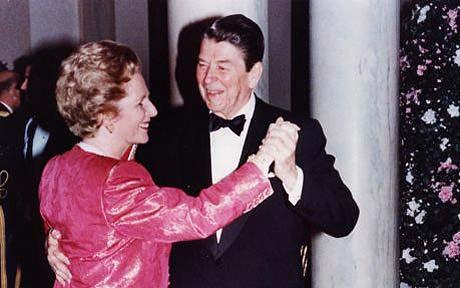
Nicholas Wapshott: Ronald Reagan and Margaret Thatcher: A Political Marriage

The New York Sun, November 5, 2007

One of the more poignant features of the current competition among Republican presidential hopefuls, fiercely fighting for a chance to lose to Senator Clinton in 2008, has been a series of missions to Maggie. Mitt Romney saw Margaret Thatcher, the former British prime minister, late last year in Washington, D.C., while Fred Thompson and Rudy Giuliani were at pains to include meetings with the Iron Lady in the course of their recent trips to London. The political consequences of such encounters will, I'd guess, be minimal, but the briskly written, perceptive, and, ultimately, moving "Ronald Reagan and Margaret Thatcher: A Political Marriage" (Sentinel, 336 pages, $25.95), by The New York Sun's Nicholas Wapshott, helps explain why, nearly two decades after she was driven from office, a frail, elderly Englishwoman still merits visits from American politicians looking to win the most powerful job in the world.

As its title would suggest, the focus of this volume is the personal alliance of Reagan and Mrs. Thatcher, a combination that represented the most productive and historically significant incarnation of the Special Relationship between England and America since that astonishingly effective blend of Anglo-American genes better known as Sir Winston Churchill (whose mother was, of course, from Brooklyn). Well-buttressed by skillfully chosen quotations from letters and telephone records (some previously unpublished), the central story of "Ronald Reagan and Margaret Thatcher" is of a relationship between two politicians of conviction whose friendship, shared goals, and remarkable ability to reinforce and support each other through some very difficult times were key features of international politics in the 1980s — and, so it was to turn out, critical factors in the eventual collapse of the Soviet Union.

Given his subject matter, it's to be expected that Mr. Wapshott has somewhat less to say about the domestic scene on either side of the Atlantic. Yet, American readers may also find that this book makes an excellent, if brief, introduction to Mrs. Thatcher's career as a whole.

There is, however, one aspect of this account that may come as a surprise. These two leaders are often seen as a matching pair, but the tones of their respective biographies differ in some profound ways. To be sure, both came from hardscrabble backgrounds —Mrs. Thatcher's far less so than Reagan's — which they later romanticized, but there was always something sunnier about Reagan and the arc of his rise, something that owed a great deal to the difference in the two leaders' personalities, but also something to the myth and the reality of opportunity in the country in which the Gipper was, as he always knew, lucky enough to be born.

The latter is something Mrs. Thatcher, a lifelong admirer of America, would be presumably quick to admit. Yet, despite her fondness for America — and despite the usual claims from the usual suspects that she was "America's poodle" — this most patriotic of women always put Britain, and its national interests, first. At times, this led to disagreement with Reagan, and, as Mr. Wapshott shows, the conflict could become quite sharp. In the course of one spat, we read how Secretary of State Haig was quick to send Washington an ominous, and urgent, weather advisory: Mrs. Thatcher, he warned, had spoken to him with "unusual" vehemence, a terrifying image, given the intensity of even her usual vehemence. She would, Mr. Haig warned the president, be writing with "her concerns." Yikes.

On that particular occasion, the prime minister had been frustrated by the Reagan administration's attempt to extend the extraterritorial reach of American law. There was more serious trouble between this generally harmonious duo over equivocation within the White House in the run-up to the Falklands War, and, tellingly, horror and bewilderment in Downing Street at Reagan's repeatedly stated belief that it was possible to rid the planet of nuclear weapons. Mrs. Thatcher, correctly and characteristically, thought that this was hopelessly, dreamily, and dangerously "unrealistic." She could not, she explained, foresee a nuke-free future "because there have always been evil people in the world."

Fortunately, shrewd, easygoing "Ron" was usually prepared to listen to his shrewd, hectoring "Margaret." So much so, in fact, that in Mr. Wapshott's not unreasonable view, "Reagan's readiness to take Thatcher's advice ensured that her interventions in American policy [meant that] … she acted as an unofficial, unappointed, but wholly effective additional cabinet member." Under the circumstances, to argue, as Mr. Wapshott does, that Reagan and Mrs. Thatcher had entered into a "political marriage" is no exaggeration. What's more, this was not just any marriage: It was a good one. In a good marriage, the partners are able to disagree, and they continue to pay attention to each other, even when they are at odds. They never forget that, in the end, they are on the same side; the prime minister and the president never did. As Denis Thatcher — an often underrated figure, who is, refreshingly, given his due in this book — was early to recognize, his wife and Nancy's husband shared a vision, a close ideological bond made all the stronger by the fact that both had spent long years as representatives of a minority viewpoint not only within their own countries, but within their own parties.

But the vision thing was not, by itself, enough. The relationship between Reagan and Mrs. Thatcher was political, yes, but it was reinforced and strengthened by ever deepening personal affection. This is visible in much of the material chosen by Mr. Wapshott, and in particular in the charming anecdote with which he concludes his introduction:

One day an insistent call from Thatcher interrupted a meeting in the White House. Reagan mouthed to the assembled company that it was Thatcher, and they waited patiently as the president listened in silence to the force of nature on the other end of the line. Eventually, he placed his hand over the mouthpiece and gushed to everyone in the room, with a broad smile, "Isn't she wonderful."

She is. He was. They were.

False Dawn

Graphic Modernism From the Baltic to the Balkans, 1910–1935

The New  York Sun, November, 1, 2007

Kreslins_Dur-cert-sit.jpg

The disparate, jostling artistic movements grouped together and loosely labeled as "modernist" may have been gathering pace before 1914, but it was the moral, spiritual, and physical devastation left by four years of war that allowed them to play such a prominent role within the cultural avant-garde of what remained of Europe.

"Graphic Modernism From the Baltic to the Balkans, 1910–1935" is a fascinating, striking, and intellectually ambitious exhibition now showing at the New York Public Library. It attempts to demonstrate that the agenda and the aesthetics of modernism had a key part to play in the identity that the nascent states (from Estonia in the north to the future Yugoslavia in the south) that had emerged from the wreckage of the empires destroyed by the war were both trying to create for themselves and, no less critically, project to the outside world. It's an interesting argument, and it gives the library an ideal opportunity to showcase art — in this case, a selection of illustrations and other design work, primarily drawn from periodicals, pamphlets, and other published material — that fully deserves a wider audience.

But while it may be an interesting argument, it's based on a questionable premise. If there was one thing these new countries did not lack, it was a sense of identity. Theirs was frequently focused on a supposed reconnection with their dominant ethnicities' sometimes distant, usually suppressed, and often concocted, past. Its roots lay in the romanticism of the national "revivals" that spread across Europe in the 19th century. Insofar as it found artistic expression in the 1920s and, particularly, the 1930s, it was predominantly backward-looking, a matter more of flaxen-haired peasants and völkisch fantasy than modernist innovation. This is hinted at in only a few pieces, and then only indirectly. These include the pastiche medievalism of a poster produced for a trade fair in Lwów, and two beautifully stylized Bulgarian landscapes by Sirak Skitnik and Dechko Uzunov, who each attempt to reconcile more modern artistic ideas with folk tradition and the imagery of the homeland — attempts typical of this time and these regions.

This ought not come as a surprise, but may. These countries were less of a backwater than half a century of Cold War isolation would later suggest. Modernity did not pass its artists by, but it normally owed more to the playful geometries of Art Deco than to the hectoring Constructivist/Suprematist abstraction that essentially defines this show. Deco was a style with closer links to Hollywood than to Moscow, to commerce than to nation, but it's better representative of this epoch than a modernism more focused on leftist (or, if you prefer, "progressive") ideology. That may explain why, with exceptions (most notably, and most delectably, a sly, characteristically erotic nude by Latvia's Sigismunds Vidbergs), there are so few allusions to Art Deco in this show.

Rather than trying to endow the works on display with a wider political significance than they may actually deserve given the historical realities of their era, it's better to consider them on their own terms, and in all their intriguing artistic (if not ideological) variety. Modernism was a Bauhaus with many mansions. Thus we see outstanding expressionist pyrotechnics, especially two covers, frenetic and fine, designed for the Polish periodical Zdrój, trickster Dadaist typography from Slovenia, some leaden surrealist clichés from Czechoslovakia, and much, much more.

Predictably enough, given the emphasis on Constructivism, El Lissitzky makes several appearances (for some of this period he managed to live a comfortable distance away from the Soviet experiment he was so enthusiastically touting). These include the most directly propagandist item on show, a volume produced for visitors to the USSR's pavilion at the 1928 International Press Exhibition, complete with hammer, sickle, and a willingness to wrap mass murder in the slickest of packages. In other pieces on display, Lissitzky's politics are less overtly signaled, but these works remain what they were always intended to be: undeniably brilliant advertising for an allegedly radiant future.

A similar philosophical subtext — one less concerned with shaping a sense of nationality than in finding new ways to destroy it — can be detected in a good number of the other pieces on view. As it happened, however, old ways of doing this still worked all too well. Within a decade or so, almost all these new nations again found themselves devastated, but in a very traditional manner. They fell prey to rampaging armies, invading from the east, west, or both. Their borders were reduced to abstractions as complete as anything you will see at this show. The consequences were anything but. Until January 27 (42nd Street and Fifth Avenue, 212-593-7730).

The Godfather, Part I: Stalin as a Boy

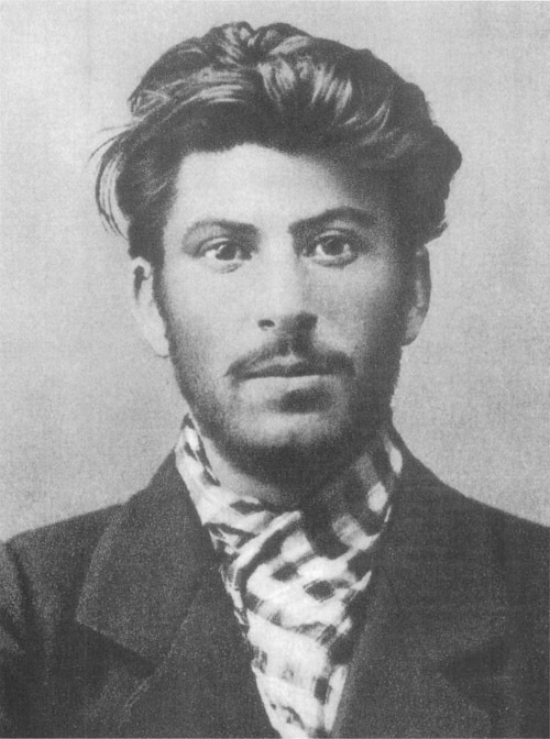
Simon Sebag Montefiore: Young Stalin

The New York Sun, October 24, 2007

Young Stalin
Young Stalin

When Josef Stalin finally succumbed to the stroke he so richly deserved, a distraught Pablo Neruda mourned the death of this "giant. ... the noon, the maturity of man and the peoples." Such attitudes are, mercifully, now rare. Once known genially as "Uncle Joe," Stalin is now regularly reviled as a monster and a despot to be ranked with history's worst.

Despite this, it continues to be the case that, in the popular imagination, the name Stalin fails to deliver anything like the sense of horror conjured up by Hitler. The reasons include the persistence of leftist ideology, the fact of cultural distance, and the recollection of wartime alliance. There's something else, however, that should not be overlooked: Stalin the man is barely known, and what is thought to be known is that he was something of a plodder, a bureaucrat, the embodiment of Soviet drab: in other words, a bore. That's not a quality humanity expects from its enduring villains: Just ask Shakespeare, just ask Milton.

In our memory, Hitler is not only the incarnation of evil but also its most vivid caricature. By contrast, in public Stalin was managerial rather than charismatic, cleverly distanced from the cult of personality that enveloped him. He went to extraordinary lengths to ensure that little of substance was disclosed about his private life. His biography was transformed into pious myth, systematically drained of real interest. Those few people who knew the truth, or part of the truth, managed to survive only if they kept it to themselves.

While this culture of secrecy began to change during the Khrushchev era, the twists, turns and imperatives of Kremlin politics conspired to keep the real Stalin hidden from the historical record. After 1991 this was no longer so, but while the details of Stalin's crimes are now widely available, the individual who inspired them has remained a strangely elusive figure, still scarcely more than the "gray blur" of ancient Menshevik libel. If any historian can bring an end to this relative indifference it is Simon Sebag Montefiore. His bestselling "Stalin: The Court of the Red Tsar" (2003) was a masterful, magnificently readable, and immaculately researched account of the Soviet leader's long rule. As a portrait of ascendant malignance, it has rarely been equaled.

Mr. Sebag Montefiore's new book adds more depth to this picture. "Young Stalin" (Knopf, 460 pages, $30) is a kind of prequel to the earlier volume. It tells the story of the dictator's earlier years, from Georgian boyhood to his (often underrated) role as one of the key organizers of the Bolsheviks' Petrograd coup. Even told badly, this would be fascinating, but the ever-fluent Mr. Sebag Montefiore recounts it with brio, insight, and quite remarkable amounts of additional, never-before published information: I read it in one sitting. In some ways "Young Stalin" comes across as a picaresque, if grim, adventure, a bawdy chronicle of seminary school rebellion, banditry, bank robbery, revolutionary intrigue, jail, piracy, extortion, love, murder, romance, exile, scandal, and, even, hunting trips with the tribesmen of the remote arctic taiga. It doesn't hurt either that Mr. Sebag Montefiore's considerable literary gifts allow him to bring life back to the lost, exotic realm within which his saga unfolds, the brutal mass of contradictions that made up the Romanovs' ramshackle, doomed empire.

The fact that, for most of his youth, Stalin was a fairly marginal figure enables Mr. Sebag Montefiore to focus even more closely on the character of his subject. Young Stalin comes across, like so many psychopaths, as charming, manipulative, and highly intelligent. Musically gifted, an accomplished poet, and a relentless autodidact, he was no less of an intellectual than the revolutionaries he so liked to disdain. But, crucially, he was also what he was proud to call a praktik, a tough guy capable of doing the "black work" of revolution. Stalin was only in his early 20s when he moved to the oil port of Batumi. 'Within three months, the Rothschilds' refinery had mysteriously caught fire ... the town was flooded with Marxist pamphlets; informers were being murdered ... factory managers shot.'

There was, of course, far, far worse to come. For reasons we can only guess at, Stalin not only excelled at black work; he relished it. Part of the blame for this must lie with a dirt-poor childhood spent in a town notorious for its hard-edged and thuggish ethos, a childhood scarred also by violence that extended into the home itself: His father was an abusive drunk. Nobody could be trusted, not even family. Throw in Stalin's psychopathy, his egomania, his seminary-sharpened ability to detect heretics, and his experience of the way the tsarist secret police managed to suborn so many supposedly loyal comrades and we can detect the outlines of the nightmare to come. Vladimir Lenin certainly could, and he was thrilled. "That chef," he commented, "will cook up some spicy dishes." So he did. And with them he poisoned a culture, a nation, and a world.

Saturday Morning Classic Literature

Beowulf

The New  York Sun, November 16, 2007

Mighty Beowulf fought for glory, honor, and immortal renown. If, however, the hero of that ancient Anglo-Saxon epic had been unlucky enough to see three recent movies inspired by his exploits, he would, I reckon, have opted instead for obscurity.

The first, Graham Baker's "Beowulf" (1999), was an incoherent fiasco starring Christopher "Highlander" Lambert, and set in a dank, dismal techno-medieval future. Next came Sturla Gunnarsson's "Beowulf & Grendel" (2005), a movie of such numbing sanctimony (trolls as oppressed minority, or something like that) that not even the beauties of Iceland and Sarah Polley were able to redeem it. And now, well, let's just say that Robert Zemeckis has done to "Beowulf" what Grendel never could.

In discussing a film this bad, it is, as with a particularly unappetizing meal, difficult to know where to start. A good place might be its most distinctive feature: the way it looks. This owes a great deal to the technique, known as "performance capture," first used by Mr. Zemeckis in "The Polar Express." Sensors attached to the actors' faces and bodies enable their movements, gestures, and mannerisms to be stored digitally for later use. With this method at his disposal, Mr. Zemeckis could, quite literally, do what he wanted with his cast. Eat your heart out, Mr. DeMille. He altered their appearance, he dressed or, oh yes, undressed them at will, and then inserted them into the computer-generated backdrop against which the film lurches along its blowsy, hectic, and heedless way.

Sometimes the results are striking: Ray Winstone, an actor of average height, middling age, and respectable stoutness, is turned into six and a half feet of ripped Viking hunk. But usually they are just clumsy: John Malkovich's Unferth resembles one of those annoying Geico cavemen, Anthony Hopkins's King Hrothgar becomes a pudgy Pillsbury satyr, and the lovely Robin Wright Penn (Wealthow) is given the bland prettiness of a lesser Disney princess. It is telling that the most successful transformation is that of Angelina Jolie (Grendel's unsettlingly yummy mummy), an actress whose most distinctive features may already owe a little something to science.

Worse, even if we ignore the obstacle posed by a laughably inept script, these added layers of technological artifice appear to have prevented a talented cast from breathing needed life into their characters. The makers of "Beowulf" might like to claim otherwise, but their actors have largely been reduced to cartoons. This need not have been fatal. Done well, the otherness of animation can be used to spirit audiences away to a parallel world of myth, magic, and the strange. But doing it well is more than a matter of megabytes. The imagery must awe, disturb, and beguile. Here and there, "Beowulf" does. The scenes in Grendel's lair are beautifully done — eerie, majestic, and resonant, the stuff, as they should be, of legend. As for Grendel's gorgeous mom, a nerd-core idol if ever one existed, the dangerous temptation she represents to Hrothgar and Beowulf is easy to understand. She is, insists Hrothgar, "no hag." Indeed she's not.

But these are exceptions, not the rule. Even viewed in their occasionally spectacular (and, in such a doggedly one-dimensional film, decidedly ironic) 3-D format, the visuals in "Beowulf" are, for the most part, shockingly banal. Nowhere is this more the case than in the depiction of Grendel (Crispin Glover), the "grimma gæst" (grim demon), whose repeated murderous onslaughts on Hrothgar's great hall summon Beowulf across the seas, to the rescue, and into the high school English curriculum. In the original text, Grendel is, to borrow descriptions from Seamus Heaney's grand and clever translation, "a shadow-stalker, stealthy and swift … [a] huge marauder … warped in the shape of a man." In this movie, he's little more than a jittery, whiny comic-book grotesque.

Similarly, the source of the fury that drives Grendel's lethal rampage has been dumbed down and jazzed up. It's no longer enough for him to be enraged by his sense of exclusion from God's good graces. Now he has family issues: Dad's the real problem, not God. In some respects, the writers of this film have turned a saga into soap opera, complete with warring spouses, infidelity, jealousy, and an examination of the wreckage left behind by unsuitable couplings. They attempt to justify this by claiming that it's a way to fill in gaps in the original narrative. We'll leave scholars to debate the extent of any such gaps, but it's difficult to avoid the suspicion that the screenwriters' real motive was to sidestep the core themes running through that bleak Anglo-Saxon verse: The implacability of fate and the impermanence of existence don't exactly make for the most promising box-office material.

To the tough-minded pagans of Beowulf's time, the most intelligent response to the inevitability and permanence of death was to try to live on in memory. Back then, the best chance for that was through heroic feats of arms, a concept that the screenwriters clearly understand, but which, I suspect, leaves them uneasy. It's true that some of their dialogue mourns the death of the age of heroes, but those passages seem primarily designed to take a swipe at the impact of newly arrived Christianity (something that does a disservice to the original poem's subtle blend of Norse and biblical mythology). This film's Beowulf is a brute, a liar, and a boor. He's also brave, and he is prepared to sacrifice himself for others. But if he is a hero, he's a hero diminished, if not debunked.

This, then, is not a very heroic film. It's not even a heroic failure.

In Search of the Inner Shaman

Khadak

The New York Sun, October 12, 2007

There once was a glorious, splendid, self-confident epoch, back in the reign of the blessed Eisenhower, when a director from the West could shoot a film about remote, mysterious Mongolia with minimal authenticity, fearless inaccuracy, and cultural crassness so epic that it could feature John Wayne as the young Genghis, Susan Hayward as Bortai, a haughty Tatar princess, and the irradiated Utah desert as the land of the khans. "The Conqueror" (produced, appropriately enough, by remote, mysterious Howard Hughes) may have been a critical and box office disaster in 1955, but there is something about its trashy exuberance, ludicrous script, and unashamed sexism that make it a wild, if naughty, treat. Who could forget those seductive, sinuous dancing girls and the touch of Vegas they brought to that distant, turbulent steppe? Peter Brosens and Jessica Hope Woodworth, the directors of "Khadak," that's who.

If "The Conqueror" is like one of those alluring, amazing, artificial, Technicolor desserts that used to bring a chemical grace to the dinner tables of Ike's America, so "Khadak," which arrives at Cinema Village today, is fat-free and eat-your-greens — appropriate fare for our grimly sensitive and relentlessly sanctimonious era. Be warned that it is, ominously and accurately, also billed as a "magical-realist fable," a description so reliably predictive of imminent tedium that both the Khan and the Duke would have trembled at the thought of the horrors to come.

The movie's confused and fragmentary narrative revolves around Bagi (Batzul Khayankhyarvaa), a young nomad herdsman. Glum, taciturn, and subject to fits, poor Bagi gradually discovers that his seizures are triggered neither by epilepsy nor irritation at this film's stumbling screenplay. Rather, they signify that he is a shaman. In "The Conqueror," that would have earned him a weird clown hat and a prominent role at court. As, however, this particular shaman has found himself trapped in "Khadak," he has to make do with time travel, the companionship of the beautiful Zolzaya (Tsetsegee Byamba), and the opportunity to uncover a possible government conspiracy to trick his fellow nomads into abandoning their traditional lifestyle in favor of jobs with a mining company.

If the storyline in "Khadak" is unconvincing, much of its cinematography is anything but. For all its faults, this is undoubtedly a visually striking movie, at times astonishingly so. Mr. Brosens and Ms. Woodworth (both of whom have backgrounds in documentary film) have been working in Mongolia for a number of years and it shows. The stark, vivid, and contradictory imagery of the Mongolia portrayed in "Khadak" bears little resemblance to the kitschy, made-for-export spectacle presented by the country's best-known director, Byambasuren Davaa. Ms. Davaa's movies ("The Story of the Weeping Camel," "The Cave of the Yellow Dog") may be wonderful to look at, but their underlying aesthetic, picture book prettiness, and superficial samplings of third-world exotica owe more to "Walt Disney's Wonderful World of Color" than the realities of life in Ulaanbaatar (Ulan Bator) or, for that matter, the Gobi.

The beauties of "Khadak" are something more subtle, complex, and disturbing. To be sure, there are the inevitably lovely shots of windswept wilderness and lonely ger, but these are complemented by evocative footage of industrial machinery and the haunting remnants of an old Soviet settlement. Taken together, they make a compelling backdrop both to this movie and, frustratingly, the far better film it might have become.

Something similar could be said of the cast in "Khadak." For the most part, they do their best with the little they've been given (we'll draw a veil over the histrionics of Tserendarizav Dashnyam, an actress who puts the ham in shaman), but, in the end, there's just not enough material for them to work with. It's hard to avoid the impression that Mr. Brosens and Ms. Woodworth viewed their ac tors as little more than additional backdrop, puppets to be manipulated and posed rather than fully realized characters with inner lives all their own.

One reason for this may be these filmmakers' inexperience with fiction, but a more likely explanation is that they were more concerned with the content of their message than its delivery. And that message is routine environmentalist agitprop overlaid with the multiculturalist piety that is, in reality, a form of profoundly insulting condescension. Mongolia is a hideously poor country trying to escape both ancient backwardness and the cruel pastiche of modernization that was communist rule. To deny that this process is difficult, occasionally brutal, and often exploitative would be absurd. Even so, to suggest, as this film appears to, that the solution can be found with the help of eco-babble, ancestral superstition, and premodern agriculture is even worse. It's a point of view that reveals more about the self-loathing of certain sections of the Western intelligentsia than any real understanding of the needs and aspirations of the Mongolian people.

"Khadak" is therefore best seen as an example of an updated form of cultural imperialism, one made all the more egregious by its pretense to be just the opposite. Under the circumstances, why not stick with the honest dishonesty of the original? In Mongolia's case, I'll opt for "The Conqueror" and the pleasures of Susan Hayward's high camp Bortai, an alabaster-skinned, red-haired daughter of Tatary born in Brooklyn, filmed in Utah, and financed by Howard Hughes, that fantasist, fabulist, and jet-age shaman.

Campbell's Soup

Alastair Campbell: The Blair Years - The Alastair Campbell Diaries

The New Criterion, October 1, 2007

It was Henry “Chips” Channon, one of the most entertaining, and informative, of Britain’s twentieth-century political diarists, who asked what was more “dull than a discreet diary.” Quite. Yet in some ways it is the discretion of the diaries just published by Alastair Campbell, Tony Blair’s former press secretary (and much, much more), which makes them so interesting. ]What’s in them, I suspect, matters far less than what’s been left out.

The published diaries amount to “only” 350,000 words out of the more than two million Campbell wrote between starting work for the then-opposition leader Blair in 1994 and resigning some nine years later. The full text is promised for another time, but for now Campbell has, he says, produced a volume focused on Blair himself: “I always intended … to be part of the mix that starts to shape the first draft of historical judgement around him.” Even the admission that this master media manipulator is now spinning history is itself spin. It comes across as candor, refreshing after a decade or so of, well, something else, but he’s only confessing to what everyone had already assumed.

Prior to publication, the diaries were also vetted to ensure that they did not breach secrecy laws or otherwise risk damaging the United Kingdom’s national interest. In addition, Campbell tells us “some conversations so private they will never see the light of day” have been excluded, as have a number of others which “the participants would have assumed to be confidential for some time.” All that’s reasonable enough, but it still leaves hundreds of thousands of words to account for.

Campbell cleverly highlights one area they cover with his claim that he has “no desire” to make the “hard” job of Prime Minister “harder for anyone … let alone Gordon [Brown],”phrasing of such marvelous insincerity that one can only applaud. In writing that, Campbell comes across as public-spirited, loyal, and admirably reticent. At the same time he makes it quite clear that he has the goods on Britain’s new leader, the dour, jealous Chancellor whose Gollum’s quest for the keys to Number 10 Downing Street helped create, define, undermine, and, eventually, destroy Blair’s premiership. Those expecting Campbell to have shed much light on the complex rivalry and partnership between the two men will be disappointed. Worse, bundling Brown offstage destroys any pretensions these diaries may have to offer a properly rounded picture of Blair’s leadership. It’s unfair to compare them to Hamlet without a prince, but less so to say they are an Othellowithout an Iago.

Whatever the sympathy Campbell may claim to feel for the latest holder of that “hard job” he writes so sanctimoniously about, he had none for Blair’s predecessor, the hapless John Major. Campbell was a prominent member of the coterie that orchestrated the destruction of a Conservative government that was nothing like as incompetent or as sleazy as it was smeared, caricatured, and, fatally, believed by the electorate to be. The Labour landslide of 1997 was the culmination of the most brilliant, and the most unscrupulous, election campaign the country had ever seen. Unfortunately, these diaries offer little fresh insight as to how this was done.

In one respect this doesn’t matter. The key element, the transformation of “old” Labour into “New,” has already been explained far better elsewhere. Campbell may have been at the center of these changes, but the portrait he paints of them is partial, admittedly incomplete, and clearly selective. Not for the first time, the reader is simply left to guess at what has been omitted, and why.

A significantly greater disappointment is how (relatively) little Campbell, a former journalist, has to say about the way that he enlisted Britain’s powerful media class as critical allies in the fight against the Major government. Yes, we are told a bit about the wooing of Rupert Murdoch, but there’s almost no discussion of the tactics for which Campbell became infamous, the brutally effective bullying, deception, and intimidation of the media rank and file. Neither does there appear to be much recognition that Campbell was pushing at an open door: a large percentage of the media class wanted the Tories out.

For Campbell to concede this would, I reckon, have meant accepting that his (undeniably enormous) contribution to the 1997 victory was slightly less than he believes. It would also make nonsense of his obsessive contempt, even hatred, for the media that gathered pace, rancid, vitriolic, and increasingly unbalanced, as the years went by. Given the position that Campbell held, this fury and this disdain are deeply disconcerting. What makes it even more remarkable is that media coverage of the Blair government was, as it happens, broadly supportive until the Iraq war.

The real problem, of course, was that any carping was unacceptable to those at the helm of the New Labour “project,” a project that was, at its core, both profoundly authoritarian and tinged with a gimcrack messianism. What must have made this criticism (such as it was) all the more galling was that it persisted despite the extraordinary efforts made to smother, bludgeon, blunt, and derail it. These went beyond the abuses of the opposition years (although those continued in office, unabated and, in these diaries, largely, and absurdly, unmentioned) and extended into the machinery of government itself. Within days of Labour’s win, and with the help of nifty legal and procedural footwork, Campbell was given the authority to tell civil servants what to do. The political impartiality of the civil service was one of the many British traditions to take a battering under the new regime. As one of Campbell’s shrewdest critics, the commentator Peter Oborne, has noted, “within two years of taking power … New Labour had sacked seventeen of the nineteen information chiefs in Whitehall, a staggeringly high turnover.” Draw your own conclusions. In fact, you’ll have to: Campbell has tellingly little to say on the subject.

None of this is to argue that there’s nothing in these diaries worth reading. On the contrary. Neither press secretary nor any of his later, grander titles do full justice to Campbell’s role. He was not only Blair’s principal propagandist and most feared enforcer, but also a key policy adviser, Bobby, in some respects, to Tony’s Jack. He was, therefore, a diarist in the right place at the right time. Whether it’s on Northern Ireland, the Balkans, the Iraq crises, the response to 9/11, or the neatly drawn descriptions of British and international statesmen from Blair to Clinton to Yeltsin to George W. Bush, there’s plenty here to digest, even if not much of it is very new.

Finally, and try as hard as he might to avoid it, by the end of these diaries its author has revealed something of himself, above all that he (a former alcoholic with a history of depressive illness) is a man driven, even if it’s never exactly clear by what. There are the shreds of ancient socialist orthodoxy (a fanatical attachment to Britain’s failed state school system), and, almost certainly related to that, there is the class resentment left over from his misfit youth (which in turn dovetails neatly into the more iconoclastic aspects of the New Labour “modernization” of the United Kingdom). Then there is the delight—wild, baroque, and ecstatic—that he takes in hating those on his enemies list. The poisonous media, the wretched Tories, a Labour minister or two, whoever; it’s the hating that’s the thing. Or perhaps the secret lay in the exercise, and the narcotic, of power. In any event, whatever it was that drove Campbell, Blair saw that he could use it, and he did.

And as to what that says about Tony Blair, once again you’ll have to draw your own conclusions.

Oh Captain, My Captain! Kirk and me.

National Review Online, September, 28, 2007

It wasn’t on some alien world that we saw him, but in a Midtown Manhattan steakhouse. He wasn’t battling Romulans or Klingons, just a gigantic piece of meat; Porterhouse, if I had to guess. My parents had flown in on a Jumbo from England the day before and he, well, he had flown in on a starship from a distant galaxy and my even more distant childhood. “Look,” I said, “there’s Captain Kirk.”

“Who?” asked my father, the only remaining carbon-based life form within one hundred parsecs not to know.

“Oh dear,” sighed my mother, something of a Star Trek watcher herself in an understated, only-if-there’s-nothing-else-on sort of way.

Who was Captain Kirk? Who was Captain Kirk? Good grief. Not since a former girlfriend had disgraced me in the presence of Captain Picard (it’s a long story, but if I tell you that she also managed to “lose” the autographed copy of George Takei’s memoirs I gave her, you’ll understand that those were tricky times indeed) had I known such shame. What if he, The Captain, had heard? I was also alarmed. I know a lot of things about James Tiberius Kirk, and one of them is that it’s never a good idea to get on his bad side: Just ask replica upperclassman Finnegan (Shore Leave).

And then the memories came. Or did their best to. To be frank, I cannot recall the exact date of my first contact with the space ‘n Vegas of the theme tune, the hissing sliding doors, the cheeping, chirping sensors, the burbling transporters, and the choppy, grand rhythms of high Shatner dialog, but it would have been via the BBC around 1969 or 1970. I’d have been eleven or twelve years old and on a break from a British boarding school where the only permitted television fare was a rugby show hosted by an enthusiastic Welshman with very little to be enthusiastic about. If the Sixties were swinging they were swinging by me, by him and, almost certainly, by most of the population.

Olde England was not then as merrie as it once had been said to be. In fact it was, let’s face it, a little on the drab, crabbed and dingy side. And not only the weather was to blame. The postwar economic recovery was running out of steam, the labor unions were running wild, the taxman was running greedy fingers through the nation’s wallets, and we no longer seemed to be running an empire. But by night, television was showing images of another country where the natives spoke English, appeared friendly, and looked to be having a great deal more fun than we were. The Pilgrim Fathers voyaged to America on the Mayflower, I traveled there by TV.

I loved American television for its wild, goofy, frivolous, gadget-and-bullet, candy-colored, exuberantly plastic, manufactured, frivolous non-BBC joy. I thrilled to the exploits of Napoleon and Ilya, those jester James Bonds from U.N.C.L.E, I wore Bruce Wayne’s mask and cape (there was no Robin: my younger brother refused), I laughed along with F-Troop, and I knew that there was something I found very interesting indeed about Samantha the suburban sorceress. When Britons gathered round the telly in their millions to watch Coronation Street, an endless soap (it continues to this day) set in a depressed northern town, all I wanted was to hop on the last train to Clarksville, wherever that might be. If it was good enough for those sun-kissed blissed-out Monkees, it was good enough for me.

Capping it all, glittering, tantalizing, but oddly accessible, was space. If anyone was lost in there, it wasn’t those lucky Robinsons (yes, I envied them), but me. These were the golden years of NASA (and the rocket men of Baikonur too — I followed that program just as enthusiastically) and as I watched those glorious Apollos rehearse, dance and glide their way to, around, and eventually, on, the moon, the USS Enterprise seemed to be just over the horizon, a part of that same dream, and despite the best efforts of all those Vostoks, Sputniks, and Lunokhods, it was a very American dream.

And Star Trek was a very American show. Sure, Mr. Chekhov was up there in the old NCC-1701, along with Spock and the universe’s stagiest Scot, but everything about the Enterprise, from its name to its Iowa-born captain (we won’t mention the Canadian thing), suggested that those ambitious thirteen colonies had just kept on growing. Whatever the legal structure of the Federation (not something I would have thought about much either then, or for that matter, now), it was quite obviously just the United States writ large, Manifest Destiny boldly going where no Manifest Destiny had gone before, and I, sitting staring at the television was paying plenty of attention. This enchanting exciting country called America was not only fun; it also appeared to be going places.

It speaks volumes that the wonderfully entertaining Doctor Who, deservedly British TV’s most popular sci-fi hero of the era, was played as an eccentric vaguely Edwardian gentleman, whose travels through space and time could just as easily take him into the past as the future. While the original Star Trek offered occasional visits to yesteryear (Tomorrow is Yesterday,The City on The Edge of Forever, Assignment Earth, All our Yesterdays), its basic trajectory was always forward-looking : the Enterprise hurtled through the 23rd Century with few signs of the backward glances and nostalgic appeal that made up so much of Doctor Who’s very British charm.

Star Trek was also, at its core, an optimistic, and to me, more attractive, vision of what was to come than anything likely to emerge out of the U.K., a Mission Control future of engineering savvy, technical marvels, and big, impressive machines, something that I was specifically beginning to associate with that land of wonders apparently located on the other side of the Atlantic. Britain’s feeble attempt to send a man into space had been abandoned years before, our manufacturing industry was crumbling, our autos were a joke, and our technological showpiece, the Concorde, was over budget, behind schedule and, most dismayingly of all, a joint project with those unreliable people, the French. America, on the other hand, it was clear, worked, and I was impressed. British-made tricorders? Wasn’t going to happen. If I wanted the future, I knew where I’d have to go to find it. And in the end, I did.

Looking back now at the original Star Trek, it’s striking to see how much of it came freighted with a strong ideological subtext. A veteran of the Pacific War himself, Star Trek’s creator, Gene Roddenberry, brought to the series a strong Greatest Generation sensibility, both sharpened and softened by the tough-minded liberalism of the two murdered Kennedys. Time and time again, the Prime Directive was superseded by Kirk’s willingness to use fists and phasers to push alien societies a little further along the way to life, liberty, and the pursuit of extraterrestrial happiness. This clearly reflected the self-confidence and sense of global mission that had prevailed in America since the Second World War, even if in at least two episodes (A Private Little War, The Omega Glory) it’s possible to detect hints of the way that the gathering Vietnam disaster would shake that faith.

I cannot be sure now how much of this I grasped back then, but I certainly understood that the crewmembers of the Enterprise (and not just those landing on Ekos in Patterns of Force) were descendants of the Yanks who had stormed the beaches of Normandy just a quarter of a century before. They may have been in strange uniforms and carrying ray guns but they were recognizably the American soldiers I knew from countless war movies, brave, profoundly democratic, free spirited, good guys trying to do the right thing. In reality, that wasn’t too much of a myth then, and, for all the flaws, mistakes, blunders and worse, I suspect that if you go to Iraq and Afghanistan today, you’d see that it’s not too much of a myth now.

And nor, I now knew for sure, was Captain Kirk. Not that my father, duly enlightened, informed, educated, and possibly a little bored, appeared quite as impressed as he should have been. To some people, a TV show is just a TV show. The conversation moved on, but then, as it happened, an hour or so later the Stuttaford and the Shatner parties left the restaurant at the same time. As we all walked down Third Avenue, I noticed my father (who is both a doctor and a journalist for the London Times) looking at the lion of Starfleet with sudden interest.

“You know what,” he said, “he’s bow-legged. He walks like a cowboy, not a spaceman. Fascinating. I must write that up.”

And you know what, he did.

Shamed again.

Hearts of Darkness

Robert Gellately: Lenin, Stalin and Hitler : The Age of Social Catastrophe

The New York Sun, September, 19, 2007

soviet_german_brest_1939.jpg

In the course of humanity's long, violent history, there was one brief, happy interlude, a decade or so on either side of 1900, when those fortunate enough to live in the more advanced parts of the planet were able to persuade themselves that barbarism had been banished from their culture, never to return. To those luckiest of men, the last true optimists, the barriers — psychological, political, and technological — that separated them from the savagery of the past were as reassuringly robust as the stout, solid bourgeois architecture then transforming their cities.

This self-satisfaction we now know was pure hubris, a lethal, beautiful, boastful illusion. Confronted in 1914 with the reality of industrialized warfare, that illusion died. As the war progressed, if one can use that word, the social and political restraints keeping man's atavistic ferocity at bay began to fray all across Europe, and nowhere more dangerously than in the Russian Empire. By 1917, this most backward, and therefore most fragile, of the continent's great powers was a society on the precipice. It only took the slightest of shoves, in the form of the Bolsheviks' opportunistic and initially bloodless coup, to topple it over into the abyss. The consequences were worldwide, appalling, and destructive on a scale that had never before been seen.

When in the subtitle of his new book, "Lenin, Stalin, and Hitler" (Knopf, 698 pages, $35), Professor Robert Gellately refers to an age of "social catastrophe," it is no exaggeration. But his use of that phrase also makes a more subtle point. The devastation of the era he describes (roughly 1914–45) went far beyond the physical, far beyond rubble, ruin, and mass graves. The very notion of society itself was torn apart. As for man's idea of himself, it had been changed forever, and not, in any sense, for the better. Man could now be certain that the barbarian within him would always be there, however advanced the civilization — tempting, terrifying and, given an opening, unstoppable.

While Mr. Gellately explicitly narrows the focus of his book to Lenin, Stalin, and Hitler, its title still promises more than he manages to deliver. Rather than devoting himself to the wider implications of what he is discussing, Professor Gellately offers a conventional history within a largely conventional framework. For those in need of a serious, scholarly introduction to the subject, it's an excellent overview of Nazi and Soviet totalitarianism, but despite its great length — with footnotes the book runs to nearly 700 pages — an overview is all that it is. There's not a lot that's new about either the information or the arguments it contains.

Mr. Gellately worries that one aspect of his book may "disturb" some readers — the suggestion that Lenin was a monster to be ranked alongside Stalin and Hitler. As he himself might acknowledge, however, this insight is not particularly original: Historians Dmitri Volkogonov and Richard Pipes (to name but two he cites) have already covered much of this ground, and done so highly effectively. Nevertheless, despite their efforts and those of quite a few others, the real nature of Lenin's ideology remains poorly understood. In repeating the message that the story of Bolshevism is not one of good intentions gone awry, but of an evil that worked all too well, Professor Gellately is performing a very useful public service.

That the Bolsheviks were able to do what they did owed a great deal to the collapse not only of the old order, but of order itself. The rise of the Nazis was made possible by almost exactly the opposite, the desperation of a nation willing to try something, anything, to hang on to what it could of its former way of life. If that meant throwing democracy — and with it, the Jews — to the wolves, too bad.

Hitler's mandate was no blank check, however. As Professor Gellately explains in some of the most intriguing sections of his book, the prewar Third Reich was, in marked contrast with its Soviet rival, a "dictatorship by consent." Compared with what was going on in the USSR at the same time, the use of coercion was limited, largely predictable, and rarely truly murderous. The awful exception, of course, was the ever more hideous persecution of the Jews, but prior to 1939, even that was incremental, a slow-motion pogrom both camouflaged and reinforced by the language of bureaucracy and the law.

That Hitler found it necessary to proceed in this way was a paradox of his earliest years in power. The restoration of social calm was key to his popularity but difficult to reconcile with his long-term agenda of military adventure, unending conquest and relentless genocide. With the invasion of Poland, that paradox became an irrelevance, but neither the frenzy of war nor the intoxication of a victorious blitzkrieg, can fully explain the speed with which so many of the Wehrmacht's "ordinary men" either descended into barbarism or demonstrated their willingness to act as its accomplices. In some cases, it was merely a matter of days. That they did so was a sign that pointed the way to Auschwitz. It also suggested that, even before the tanks had begun to roll, the German people had already moved far, far down that most terrible of roads.

Disappointingly, Professor Gellately never fully succeeds in explaining what it took to make this possible. He takes refuge instead in the observation that, by the time World War II had concluded, it had "raised questions about the very meaning and future of Western civilization." That is right, so far as it goes, but it's too simplistic. The more troubling questions posed by that war are not limited to any one civilization: They concern the essential nature of mankind itself. And there's no comfort to be found in the answer, none at all.

In the Land Of Mammon

Robert Frank: Richistan : A Journey Through the American Wealth Boom and the Lives of the New Rich

The New York Sun, August 15, 2007

Despite unprecedented social, political, economic, and cultural upheaval, there is, still, just a part of this country's vision of itself that is forever Bedford Falls. That was an idea of nation as extended community, diverse, but not too diverse, a land of opportunity, certainly, but one where no one was left too far behind, or ended up too far ahead. There was Potter, but he was an outsider, the moneyed exception that proved the modest rule, the rule that was also an ideal, of an America where everyone was in the same boat.

Robert Frank, the author of the entertaining, provocative, and dryly amusing "Richistan" (Crown, 278 pages, $24.95), was prompted to write his book by the realization that this was, quite literally, no longer the case. As the writer of the Wall Street Journal's "Wealth Report" (the existence of which tells you something about the times in which we live), his beat took him each year to Fort Lauderdale's International Boat Show, a "weeklong celebration of boats, beaches, and billionaires." There he met a Texas yachter who told him that "the American rich seemed to be floating off to their own country," a country that Mr. Frank has dubbed Richistan.

In Mr. Frank's view, today's new rich are busy creating their own virtual, self-contained nation, complete with their "own healthcare system (concierge doctors), travel network (Net Jets, destination clubs), separate economy (double-digit income gains and double-digit inflation), and language...They didn't just hire gardening crews; they hired personal arborists". Yes, there's a touch of hype in that description (if any journalist is going to make it to Richistan, he's got to sell a lot of books), and a touch of the nothing new, too: The very rich have always been different. It's just how that's changed.

That said, there's no doubt that Mr. Frank is on to something. The key, as he explains, is the remarkable growth in the numbers of America's rich. In 1995 there were nearly 4 million households with a net worth of more than $1 million. By 2004, that total had increased to more than 9 million (both tallies are based on 2004 dollars). Now, as Dr. Evil discovered, and as Mr. Frank concedes, $1 million is not what it was. It's not a bad start though.

It's not just that there are more rich folk around. They are also richer, much richer, than they used to be. By 2004, more than 100,000 households enjoyed a net worth of more than $25 million. If you feel like a loser reading those words, it's no better writing them, believe me. Be that as it may, this wild, if uneven, accumulation of wealth is basically a sign of good times, a largely benign side effect of capitalism on the move. Mr. Frank clearly understands this. His description of the wonders, extravagances, and peculiarities of Richistan is essentially travelogue and guidebook, neither indictment nor paean, and despite the mega-yachts, megamansions, and the $899 pair of children's shoes (crocodile-skin Sperry Top-Siders, since you ask), there is no suggestion of Robin Leach.

Mr. Frank may poke some fun, but for the most part he takes Richistan as he finds it. Yet, for all that, it's possible to discern some faint hints of unease. The source of this, I suspect, is partly aesthetic and partly (for want of a better word) patriotic. So much ostentation may not only be in poor taste, but is it also a betrayal of older, more austere American values, a rejection of Bedford Falls?

Above all, it's likely to be the unevenness that worries Mr. Frank the most, an anxiety betrayed by the statistics of rising inequality that occasionally surface in his pages. Not all of these are breaking news: For example, most of the shift in the concentration of wealth in favor of the top 1% took place two decades or so ago. Nevertheless, the fact that the share of national income now held by the top 1% of earners is at a postwar peak is food for thought, especially at a time when the median income of American households is under severe pressure.

The rich may be pulling away from the rest of the population, but "Richistan" shows how the richest are pulling away from those who are just by-their-fingertips rich or, horrors, merely affluent. Mr. Frank explains how this acts as both carrot and stick to the toilers of Lower Richistan (net worths of $1 million to $10,000,000 million as they try to buy, as well as work, their ways to higher status. In 2004, some 20% of these treadmillers spent more than they earned. That's neither sustainable economically, nor is it a recipe for happiness. Where it may lead is major political change.

Politics is, frustratingly, a topic that is largely beyond the scope of this book. To be sure, Mr. Frank makes the obligatory reference to the swerves to the left that followed both the Gilded Age and the Roaring '20s, but there's little discussion of the extent to which the very existence of Richistan (not to forget the threat it represents to social cohesion) may help history repeat itself. Nor does he examine what may be Richistan's most significant, if somewhat perverse, contribution to this country's political development, one that may follow from the increase in inequality within Richistan itself, and, more dangerously still, its approaches. As that trend continues, there's a clear risk that some of society's best, brightest, and most influential will be left feeling that they have missed not only the yacht, but also the boat.