The Lives of Others

Orlando Figes: The Whisperers

Moscow, February 1991 © Andrew Stuttaford

Moscow, February 1991 © Andrew Stuttaford

It has been the worse part of a century since the bloody birth and savage adolescence of the Soviet state, but the events of those years are still obscure — lost in time, muddled by propaganda, and treated, even now, as the stuff of spin. Those terrible decades remain camouflaged, murky and mysterious, glimpsed mainly in shadow or in tantalizing, elusive outline. They have been best illuminated not in nonfiction accounts, but in novels, short stories, and verse — by Solzhenitsyn’s zek grateful for his day “without a dark cloud,” by the deadpan of Shalamov’s spare, unsparing Kolyma Tales, by Ahkmatova’s torn, desperate, eloquent laments:

This was when the ones who smiled
Were the dead, glad to be at rest.
And like a useless appendage,
Leningrad Swung from its prisons.
And when, senseless from torment,
Regiments of convicts marched,
And the short songs of farewell
Were sung by locomotive whistles.
The stars of death stood above us
And innocent Russia writhed Under bloody boots
And under the tires of the Black Marias.


That’s not, of course, to deny that there have been some excellent histories of that era. One of the most notable in recent times was Orlando Figes’sPeople’s Tragedy: The Russian Revolution 1891–1924. Professor Figes, a British historian, is now extending that saga deeper into the nightmare that enveloped the Soviet Union with The Whisperers, a massive, sprawling, and unsettling book billed as a description of “private life in Stalin’s Russia.” In researching it, Figes has made extensive, and extraordinary, use of freshly opened family archives and a large number of personal interviews. As well he might. To understand the founding period of the USSR is tricky enough. To uncover the private lives, and thoughts, of those who lived through it, inhabitants of a society where reticence, conformity, and role-playing could be, even at home, matters of life and death is doubly difficult. Then there is, as Figes writes, this:

People with traumatic memories tend to block out parts of their own past. Their memory becomes fragmentary, organized by a series of disjointed episodes (such as the arrest of a parent or the moment of eviction from their home) rather than by a linear chronology. When they try to reconstruct the story of their life, particularly when their powers of recall are weakened by old age, such people tend to make up for the gaps in their own memory by drawing on what they have read, or what they have heard from others with experiences similar to theirs.

To accept this logic is to accept that seminal accounts of this period, such as The Gulag Archipelago or Eugenia Ginzburg’s Journey into the Whirlwind, have evolved from, respectively, works of collective history and individual recollection into the imagined, or partly imagined, autobiographies of countless victims of the terror. Figes himself claims that “many Gulag survivors insist that they witnessed scenes described in . . . Ginzburg, Solzhenitsyn, or Shalamov, that they recognize the guards or NKVD interrogators mentioned in these works . . . when documentation clearly shows that this could not be so.” Figes never specifies what he means by “many” (the numbers involved are probably, I suspect, less than that adjective implies), but there can be little doubt that the phenomenon is real. Complicating matters further, memories have been distorted not only by trauma and time, but also by wishful thinking:

People who returned from the labor camps . . . found consolation in the . . . idea that, as Gulag laborers, they too had made a contribution to the Soviet economy. Many of these people later looked back with enormous pride at the factories, dams, and cities they had built. This pride stemmed in part from their continued belief in the Soviet system and its ideology, despite the injustices they had been dealt, and in part, perhaps, from their need to find a larger meaning for their suffering.

Additionally, as Figes reminds us, it’s a viewpoint that finds an echo and reinforcement in the widely held opinion that victory in the “Great Patriotic War” can be seen as some sort of justification for the horrors of Stalinist rule.

These ideas are bizarre, but for large numbers of Russians they beat the alternative: facing up to just how much was lost, thrown away, or destroyed in pursuit of a delusion and in the name of a tyrant. This recourse to the comfort of denial and the ease of evasion is of more than academic interest. It helps explain the Putin government’s approach to the Communist past. A definitive reckoning with history, that long-overdue Soviet Nuremberg, is too daunting to contemplate, too potentially demoralizing for the nation as a whole, too incriminating for a still-compromised Kremlin establishment. Speaking last year in support of a new manual designed to help the teaching of Russian history in the country’s schools, Vladimir Putin conceded that aspects of the former dictatorship were “problematic.” Nevertheless, he went on to say that Russia could not allow “other states” to “impose a sense of guilt” upon it. The words he used reveal both unease about the past and, implicitly, a desire to reshape it.

If Figes’s analysis casts doubt on the reliability of some accounts of the Stalin years, those he has unearthed for the purposes of this book add fascinating detail to what we know, or think we know, of that epoch. Nevertheless, to view The Whisperers as a comprehensive survey of “private life in Stalin’s Russia” would be a mistake. For example, there is not a great deal about how it was to experience, and, where possible, endure, the camps and prisons that have come to symbolize the Stalinist order, an aspect of “private life” that Figes appears to believe lies mainly outside the scope of his chosen topic; I’m not so sure.

Meanwhile, at the other end of official approval there is, with one critical exception (the writer Konstantin Simonov, a man who was both too tough and too weak to avoid aligning himself with the system), less than might be expected about those who actively supported the regime or who, in one way or another, flourished under it. As for those “ordinary” Russians who managed, so far as they could, to keep out of the way of history, they feature relatively rarely. Readers looking for more on their lives would do better to turn to the evidence collected in Sheila Fitzpatrick’s Everyday Stalinism, and Stalinism as a Way of Life, edited by Lewis Siegelbaum and Andrei Sokolov.

What Figes offers is something less all-embracing. It is, primarily, a look at lives spent on the edge, neither at the heart of darkness nor untouched by it. The stories he recounts could not, by definition, fail to be interesting, but however skillfully he tries to weave them together (and Figes is a highly accomplished storyteller), the final picture is not as coherent as it might be. It’s difficult to avoid the suspicion that on this occasion this talented author’s reach was greater than his grasp.

As a result, the principal value to be derived from The Whisperers is almost incidental to what is supposed to be its main theme. In particular, the book’s earlier sections are a remarkable evocation of the sheer scale of the Bolshevik project. This was, in reality, nothing less than an attempt to remake man according to the dictates of what was, for all practical purposes, a millennial cult run by a lethal combination of fanatics, sadists, and opportunists. Nothing could be allowed to stand in the way of this task, and, with the resources of the state behind it, nothing was. In such a climate, the family, the most redoubtable bastion against totalitarianism, was bound to be a key target of the regime. And, as the narratives selected by Figes underline, that is what it became. The conflict, persecution, and occasional moments of stubborn resistance that ensued make up the grim, gripping, and horrific drama around which this book revolves.

But if the Bolsheviks proved effective at sweeping away much of what had preceded them, the ramshackle utopia with which they replaced it was a broken-backed wreck. Another striking aspect of the oral histories contained in this book is how often they share a subtext of astonishing material deprivation and hardship. If the Soviet Union was, as its supporters abroad liked to claim, a “new civilization,” it was one with large elements of the pre-modern about it.

And the physical squalor was, as Figes repeatedly demonstrates, matched by the moral; this, indeed, inspired the book’s title. The Stalin years, he writes, left the Russian language with “two words for a whisperer — one for somebody who whispers out of fear for being overheard . . . another for the person who informs or whispers behind people’s backs to the authorities.”

Mr. Putin, I think, would approve.
Spies Like Us

Joseph Weisberg:  An Ordinary Spy

The New York Sun, January 16, 2008

Weisberg.PNG

Mark Ruttenberg, the hero of "An Ordinary Spy" (Bloomsbury, 288 pages, $23.95), Joseph Weisberg's deft, sour, and clever new novel of espionage, bureaucracy, and disenchantment, is — it is true — a spy. But he's no James Bond.

Just read what happens, or doesn't, when he shows up for a celebration at the Russian embassy in the country to which, as a novice CIA agent, he has recently been posted. The poor fellow fails to make any real progress with the general who is the most important target in the room, he gets "tipsy" on two shots of vodka, and when, finally, he runs into a girl he has been trying to recruit, he is not only snubbed, but also floundering:

I had an impulse to rush after her, grab her arm, and spin her back around. But I didn't know what I'd do after that. Did I want to kiss her? I'd always found Daisy attractive … [b]ut I'd wanted to recruit her, not sleep with her.

Good God, man, get a grip! In cloak-and-dagger Valhalla, 007 is, undoubtedly, shaking his head (as well as that third martini). The contrast between his stumblebum spy and Ian Fleming's swashbuckling psychopath is, however, one that evidently amuses Mr. Weisberg. As fans of his debut novel, the lovely and beguiling "10th Grade" (2002), will recall, Mr. Weisberg is a sly, dryly funny writer, and even in the far more downbeat surroundings of his new book, he sporadically allows himself to unleash the occasional fleeting and stealthy joke at the expense of the luckless Ruttenberg and the frustrating, dull, drab routines that make his a life far removed from the spy game's glittering, legendary, and deceptive glamour.

But the disillusion, and not only Ruttenberg's, that permeates this book is generally closer to the "quiet desperation" of old Thoreau's loopy ravings than any profound ideological crisis; there is no hint of the majestic decay and mythic exhaustion that run through le Carré's best, possibly because Mr. Weisberg is describing an agent at the beginning of his career — an agent working, what's more, for a nation that, unlike George Smiley's Great Britain, is unwilling to accept eclipse, humiliation, and relegation to the second tier.

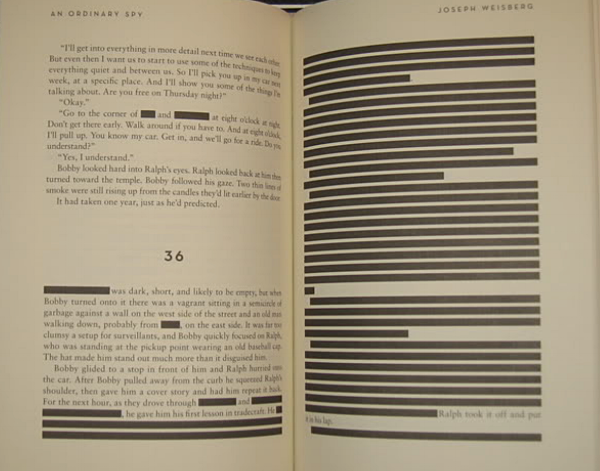
Nevertheless, there are moments when readers of "An Ordinary Spy" may worry that its portrait of the CIA as a cesspit of careerism, groupthink, and deadening conventionality may be a warning that the United States is poised to follow its transatlantic cousin into decline. The fact that the book's author formerly worked for the agency (he was employed there for three years and, by the time he quit, was in training to become a "case officer" much like Ruttenberg) only adds to the concern: Even if he never advanced very far in the intelligence service, Mr. Weisberg must have learned enough to offer up an accurate description of its workings. Whether that is, in fact, what he has done is a different question (I've no idea one way or another), but his writing feels authentic, an impression he tries to reinforce by displaying his text in a "redacted" format that is simultaneously bogus and real. As a former CIA man, he was indeed required to submit his manuscript to Langley's Publications Review Board, but ahead of doing so, he anticipated what the board might ban. Both the board's deletions and his own pre-emptive strikings-out are evidenced by the thick black lines that are the censor's impenetrable spoor, with no way to distinguish between them.

It's a device that sometimes irritates, but it helps transport outsiders into the secret world, at least as they might imagine it, a world made all the more mysterious, all the more opaque, and all the more disturbing by the fact that Mr. Weisberg's readers aren't actually informed where within it they have ended up: The country where the greater part of the drama unfolds is never disclosed. If I had to guess, it's located somewhere in Central Asia, the Middle East, or North Africa, but we're never told for sure.

And maybe that's the most effective device of all. The United States now finds itself enmeshed in a probably endless, possibly apocalyptic struggle against an adversary that knows no limits, no rules, and no borders, a conflict where every diplomatic outpost, but particularly those in countries of the type that Mr. Weisberg doesn't name, is a listening station, a sentry box, and perhaps more. In one form or another, such outposts have existed whenever there have been nations with interests to protect. They have been manned by guards, by observers, and by spies; patriots often, ideologues occasionally, but for the most part, ordinary men doing a job that is rarely extraordinary, and changes history even less.

And it is the story of two of these ordinary men, these ordinary spies, that Mr. Weisberg sets out so skillfully. There's no great message that underpins this novel, no intimations of coming American collapse: just a tale well told of lives that were meant to be spent watching, probing, plotting, guessing, and double-guessing, lives that, it turns out, go somewhat awry, lives that are illuminating only in their insignificance, and yet they are lives on which yours, and mine, may depend.

Rebranding America?

National Review Online, January 10, 2008

Obama.jpg

New Hampshire has gone and done what New Hampshire has gone and done, but it won’t be long before Obamania picks up speed again. As it does, so will the idea, compelling, thrilling, and thoroughly misleading, that an election victory by the junior senator from Illinois will win over that large portion of the world that has, so runs the story, been alienated by the wicked George W. Bush, but which still, even now, wants to love America.

Writing over at “The First Post,” just before the Iowa vote, the distinguished British journalist, Sir Peregrine Worsthorne, a conservative of sorts, had this to say:

In many parts of the world, the United States is now regarded as “the evil empire”. This is entirely President Bush’s fault. Both his actions and his rhetoric have given the impression of a superpower bent on world dominion. If this had happened in any other country it would require decades, if not centuries, to undo this damage. In the case of America, however, it can be put to rights almost at one, or at most two, strokes. Stroke number one would be for the Democrats, starting this week in Iowa, to nominate Barack Obama as their presidential candidate, and stroke number two, for the electors to put him into the White House with a landslide majority. By these two actions America would be rebranded. That the world’s shield and conscience should have a young and handsome black senator, touched with nobility, waiting in the wings at this particular juncture is little short of a miracle. It is exactly what the doctor ordered.

Obama fan Andrew Sullivan, another conservative of sorts, made a similar point last year, arguing as follows:

What does [Obama] offer? First and foremost: his face. It could be an effective potential rebranding of the United States. Such a rebranding is not trivial – it’s central to an effective war strategy. The war on Islamist terror, after all, is two-pronged: a function of both hard power and soft power. We have seen the potential of hard power in removing the Taliban and Saddam Hussein. We have also seen its inherent weaknesses in Iraq, and its profound limitations in winning a long war against radical Islam. The next president has to create a sophisticated and supple blend of soft and hard power to isolate the enemy, to fight where necessary, but also to create an ideological template that works to the West’s advantage over the long haul. There is simply no other candidate with the potential of Obama to do this. Consider this hypothetical scenario. It’s November 2008. A young Pakistani Muslim is watching television and sees that this man – Barack Hussein Obama – is the new face of America. In one simple image America’s soft power has been ratcheted up exponentially. A brown-skinned man whose father was an African, who grew up in Indonesia and Hawaii, who attended a majority-Muslim school as a boy, is now the alleged enemy. If you wanted the crudest but most effective weapon against the demonisation of America that fuels Islamist ideology, Obama’s face gets close. It proves them wrong about America in ways no words can.

Sullivan, understandably enough, began pushing this theme with renewed vigor after Obama’s Iowa win, blogging last week that “the international response to Obama will shock many Americans, because it will be so massive” (and by implication) positive. To underline the point, he excerpted this passage from a piece by a South African journalist: “Damn, I love Americans. Just when you’ve written them off as hopeless, as a nation in decline, they turn around and do something extraordinary, which tells you why the United States of America is still the greatest nation on earth.”

There is, of course, no doubt that the symbolism of an Obama victory this November would resonate. Even the U.K.’s Guardian, not normally a hotbed of support for Uncle Sam,was enchanted by the “remarkable” prospect that “there there could be a black man in the White House, not serving the drinks, but sitting in the Oval Office itself.” It would, naturally, have been too much for someone writing for the Guardian to concede that, to take just one obvious example, Colin Powell did rather more than serve drinks in the course of his visits to the Oval Office. Nevertheless the broader sense of what that editorialist is talking about is clear, and it seems to support the case being made by Andrew Sullivan and Sir Peregrine.

The problem is that, while (rightly or wrongly, for good reasons and bad) there will be genuine relief worldwide at the departure of George W. Bush from that office where Condoleezza Rice was so often to be seen pouring martinis, Miller Lites, and alcohol-free beer, it will be rapidly eclipsed by the return of politics-as-usual. An Obama election victory would certainly give the celebrations an additional boost, as may some of the policies he might choose to take up, but the belief that it would pave the way (at least beyond these shores) for a lasting re-branding of America, is mistaken. There may be many reasons to vote for Obama (most of which, I admit, escape me), but this ought not to be one of them.

To grasp why, it’s necessary to understand that anti-Americanism is something that long predates George W. Bush and it will long outlast him. Yes, Dubya’s foreign policy, his domestic agenda, his environmental stance, even his very demeanor, may have riled up America’s critics abroad and antagonized many of its former friends, but the underlying problem, as a President Obama would be forced to recognize, lies elsewhere. The new president might pull the troops out of Iraq, he might sign the U.S. up for some carbon voodoo, he might prove to be more congenial company at a Turtle Bay cocktail party, but, in the wider scheme of things, none of this will make a great deal of difference, none of it will be enough.

Anti-Americanism is rancid, perennial, barely rational (and sometimes not even that), rooted in mankind’s ancestral primate psychology, in jealousy and in fear, and made all the more potent by the cold calculations of global politics, as well, it must be said, as this nation’s own faults, faults made painfully visible by its position, its power, and its promise. Critiques of America have varied at different times, and in different places, and they have frequently been mutually contradictory, but what, all too often, they share at their core is a resentment at the success of a country that has the ability to make everybody else feel, well, just a little bit threatened, sometimes deservedly so, sometimes not. The result has led to absurdities too numerous to list here, although the grotesque spectacle presented by those millions across the globe who claimed, decade after decade, after decade, to find “moral equivalence” between the Soviet Union and the United States is not a bad place to start.

To suggest that a phenomenon on this scale will simply evaporate when confronted with a black president is to ignore the lessons of history, and recent history at that. Just ask the NAACP, an organization legitimately appalled by some of the commentary and cartoons that appeared in the Arab media at the time of a visit by another powerful, successful and charismatic African-American, Secretary Rice, to the Middle East.

Symbolism alone will not, therefore, do the trick, a point that was taken up by Iranian-born Reza Aslan in the Washington Post.

As someone who once was that young Muslim boy everyone seems to be imagining (albeit in Iran rather than Egypt), I’ll let you in on a secret: He could not care less who the president of the United States is. He is totally unconcerned with whatever barriers a black (or female, for that matter) president would be breaking. He couldn’t name three U.S. presidents if he tried. He cares only about one thing: what the United States will do. That boy is angry at the United States not because its presidents have all been white. He is angry because of Washington’s unconditional support for Israel; because the United States has more than 150,000 troops in Iraq; because the United States gives the dictator of his country some $2 billion a year in aid, the vast majority of which goes toward supporting a police state. He is angry at the United States because he thinks it has hegemony over almost every aspect of his world.

Andrew Sullivan is too shrewd not to realize this, and, in his earlier piece (perhaps significantly it was written before the euphoria of the Iowa victory), he was careful to highlight the potential importance of what Obama might do in Iraq as a key element in any re-branding of America:

The other obvious advantage that Obama has is his record on the Iraq war. He is the only significant candidate to have opposed it from the start. Whoever is in office in January 2009 will be tasked with redeploying forces in and out of Iraq, engaging America’s estranged allies and damping down regional violence. Obama’s interlocutors in Iraq and the Middle East would know that he never had suspicious motives towards Iraq, has no interest in occupying it indefinitely, and foresaw more clearly than most Americans the baleful consequences of long-term occupation.

Reza Aslan went further:

The next president will have to try to build a successful, economically viable Palestinian state while protecting the safety and sovereignty of Israel. He or she will have to slowly and responsibly withdraw forces from Iraq without allowing the country to implode. He or she will have to bring Iraq’s neighbors, Syria and Iran, to the negotiating table while simultaneously reining in Iran’s nuclear ambitions, keeping Syria out of Lebanon, reassuring Washington’s Sunni Arab allies that they have not been abandoned, coaxing Russia into becoming part of the solution (rather than part of the problem) in the region, saving an independent and democratic Afghanistan from the resurgent Taliban, preparing for an inevitable succession of leadership in Saudi Arabia, persuading China to play a more constructive role in the Middle East and keeping a nuclear-armed Pakistan from self-destructing in the wake of Benazir Bhutto’s assassination. That is how the post-Bush “war on terror” must be handled. Not by “re-branding” the mess George W. Bush has made, but by actually fixing it.

You can agree or disagree with the particulars of these prescriptions and diagnoses, but it’s difficult to deny that they do much to rebut suggestions that the symbolism of an Obama victory will in itself be enough to make a significant difference. But if symbolism is not enough, what will be?

Let’s just say the list is a long one. That’s not to argue that the United States cannot, and should not, take steps to put in place a smarter foreign policy designed to win it more friends abroad, while at the same time pursuing a robust defense of the national interest. It can, and it should. I find myself these days, I guess, in a small minority to think so, but I’d argue that a Republican president is best placed to do it. The trouble is that such changes would, I reckon, only alter perceptions of America at the margins. Yes, it’s probably true that, reflecting the different priorities of his or her party, a future Democratic president could do more to ingratiate this country with what is laughably known as the international community, but that can likely only go so far. The pathologies of anti-Americanism run too deep.

To even have a chance of curing them, a President Obama would have to transform America so profoundly that it would no longer be the America in which he had succeeded so gloriously. And which Americans other than the self-hating, the masochistic, or the clinically disturbed, would want to vote for that?

Not Obama, I suspect. I hope.

Fighting for a Lonely Planet

I am Legend

The New York Sun, December 13, 2007

legend.jpeg

Hell may not, whatever Jean-Paul Sartre once wrote, be "other people," but other people, or what's left of them, certainly conspire to mess up the second half of "I Am Legend," a movie that was, until then, developing into one of the finest science fiction movies of recent years.

In his retelling of Richard Matheson's harsh, hallucinatory novel from 1954, director Francis Lawrence is brilliantly successful in re-creating the book's post-apocalyptic vision of a survivor hanging on to life, and the remnants of civilization, in a city that is intact — but not — and where he is alone — but not. It's an extraordinarily compelling idea, and given the relish with which Homo sapiens, that most narcissistic of species, savors the spectacle of its own destruction, it's no great surprise that this is the third movie, after "The Last Man on Earth" (1964) and "The Omega Man" (1971), based on Mr. Matheson's story. However, in the bleak grandeur of its images at least, this latest version is easily the best.

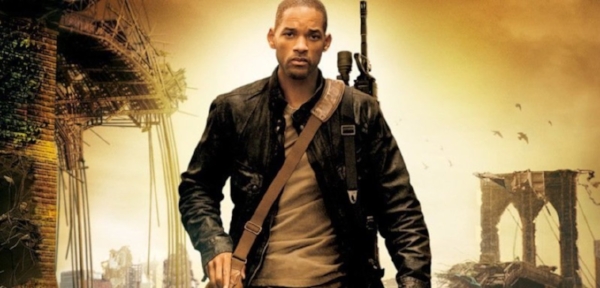
The Brooklyn Bridge is a ruin. Times Square more unkempt even than in the days before Mayor Giuliani. Deer roam through Midtown. We see Manhattan, both Eden and Pompeii, slowly, remorselessly, and with only the occasional cliché (the errant lion last seen in "Twelve Monkeys" makes an appearance) revert to wilderness. But, however beautifully crafted (and in this movie they are), tracking shots of a verdant, abandoned city are not, in themselves, enough to convey the true sense of catastrophe. For that you need a witness: Charlton Heston, say, raging at the sight of the Statue of Liberty toppled, broken, and half-buried in the sands of a planet that now belongs to the apes.

In "The Omega Man," the tireless Mr. Heston, harbinger of global doom, was again that witness. But neither his performance, nor that of the no less grandiloquent Vincent Price as the Last Man on Earth before him, can compare with what Will Smith brings to "I Am Legend" as Robert Neville, Mr. Matheson's bereft and resourceful hero. By definition, this is for long stretches a solo role, and thus not easy to do, but with little more than his dog for support, Mr. Smith skillfully conveys the loneliness, determination, and increasing mental strain of life as a Robinson Crusoe marooned on the island that was once his home, but is now, well, something else.

In part, Neville has adapted by turning Manhattan into his private playground (taking golf swings from the deck of the USS Intrepid, gunning a muscle car down empty avenues), but it's a playground where the pleasures are as transient as they are solitary. What really keeps him going are the routines — obsessive, meticulous, and tough — of the work he carries out while hunkered down in a bunkered-up brownstone on Washington Square. Neville is a military virologist (the novel's Neville is, by contrast, an everyman, which makes his plight as the last man all the more affecting), and he is still, even now, trying to find a cure for the man-made plague that took his world away.

He has to, because the virus didn't finish off everyone else. In Mr. Matheson's book, a number of those infected are transformed into vampires. In Mr. Lawrence's take, these lethal unfortunates are reduced to "dark seekers," feral, albino, debased ex-men who look as if they have escaped from the set of 2005's "The Descent," but behave with the hyperkinetic ferocity of the zombies in "28 Days Later" (a fair enough exchange, one might think: The latter film owed a considerable, and insufficiently acknowledged, debt to Mr. Matheson's tale).

That makes for some undeniably exciting scenes of chase and combat, roaring and head butting, but the decision to dumb the infected down drains much of the intelligence and the horror from the original concept. Once we understand the nature of the threat that the dark seekers represent, the distinctiveness of this movie begins to evaporate. It's still highly entertaining ("I Am Legend will, I reckon, be a massive hit, and deservedly so), but its early promise is frittered away.

The tumble gathers pace after the arrival of two other (healthy) survivors — a young woman (Alice Braga) and a child (Charlie Tahan). Helpfully enough, they extricate Neville from a tricky encounter with some dark seekers, but their key function is to drag the film even further away from the pitiless premise underpinning the novel that inspired it. Indeed, they are used to inject a spiritual, even religious, dimension into a narrative that, as first conceived, had none, and needed none.

If it's not absurd to suggest this about a work involving vampires, Mr. Matheson's book is best seen as a classic of mid-20th-century realism, unflinching in its acceptance of impermanence, chance, and an uncaring universe. We live now in dreamier, less clear-eyed times, and Mr. Lawrence has tailored his movie accordingly. You'll have to see for yourself how it ends, but I will say that it recounts a legend that bears little resemblance to that of Mr. Matheson's original Neville, the man whose destiny was to become a legend of a far darker kind, "a new terror born in death, a new superstition entering the unassailable fortress of forever." To understand how, and why, read the book. Oh yes, see the movie too. It's good, but it should have been — could have been — great.

Don't Worry, You Can Take the Family

The Golden Compass

The New York Sun, December 7, 2007

GoldenCompass.jpg

It is a measure of the genius of the British novelist Philip Pullman that when, less than 30 pages into his book "The Golden Compass," 12-year-old Lyra Belacqua angrily objects to the refusal of her (supposed) uncle Asriel to take her to the frozen, fabled northlands, most readers will understand and agree with her. "I want," protests Lyra, "to see the Northern Lights and bears and icebergs and everything." And so, you just know, do you. Disappointingly, despite some excellent special effects (the bears, a race of gigantic, heavily armored ursine warriors, have to be seen to be believed) and a remarkably assured performance by the no less remarkably named Dakota Blue Richards as Lyra, the new film by Chris Weitz based on Mr. Pullman's novel never manages to generate, or satisfy, that same sense of anticipation.

In part, this was inevitable. When it comes to conjuring another world, the very literalness of computer-generated imagery can conspire against it, especially when it has to compete with author-generated imagery such as this:

…The main interest of the picture lay in the sky. Streams and veils of light hung like curtains, looped and festooned on invisible hooks hundreds of miles high or blowing out sideways in the stream of some unimaginable wind…

When Mr. Pullman is good, he is very good. The film, by contrast, is just okay.

Mr. Pullman also doesn't patronize. He doesn't think of himself as a "children's writer," with all the title can sometimes imply. His portrait of that other, parallel world, is a fascinating, glittering, mixed-up what-might-have-been of ancient and modern, of Charles Dickens, of H.G. Wells, of the brothers Grimm, of the "Edda," and of who knows what else. It is heavily layered, marvelously complex, and described throughout with a madcap erudition that adds to its magic. The movie, however, is far simpler, dumbed-down, even.

This, too, was probably inevitable, both for reasons of pacing (only so much detail can be packed into two hours) and, more critically, commerce. "The Golden Compass" is being marketed as a holiday movie appealing to all youngsters, not just the early-to-mid teenagers who were the original novel's natural readership. It also has to be, to use the dread euphemism, family friendly. Thus, for example, the book's references to castration have been, well, cut, and, in recognition of the fact that butchered tykes haven't been Christmas fare since Herod, so have (more or less) its dead children. Overall, the film is more upbeat than the novel, and its characters less morally ambiguous.

This may relieve some parents, but it doesn't excuse the performances turned in by some key cast members, notably Nicole Kidman, a peculiarly stiff and dismayingly unconvincing principal villain, and the unforgivably hokey Sam Elliott. As aeronaut Lee Scoresby, Mr. Elliott is meant to be this movie's Han Solo, but he comes across as Colonel Sanders with a six-shooter. Then there's Daniel Craig, an oddly bland Asriel, but the blame for that lies with the script, not 007.

Fortunately, these weaknesses are offset by Ms. Richards's Lyra, who is sly, determined, awkward, and brave, a character with just the right hint about her of the first, and finest, of such heroines: the little girl who tumbled down a rabbit hole one-and-a-half centuries and one dazzling imagination ago. And Ms. Richards is not alone. In particular, she is ably assisted, both in her mission (like many works of fantasy, "The Golden Compass," which is the first installment in a trilogy, revolves around a quest) and in helping the movie along by Jim Carter, who is impressive and imposing as John Faa, Lord of the Gyptians.

The Gyptians are a half-tolerated, half-outlawed people who have managed to retain a degree of independence in the constricted, caste-hobbled, and authoritarian England of Pullman's vision. That's no mean feat: The country, and much of the world, is dominated by the sinister Magisterium, an organization determined to enforce its own brand of ideological conformity. Revealingly, Christopher Lee, saturnine and urbane, is its First High Councilor. Sadly, we don't see that much of him. For a fuller idea of the Magisterium's nature, we have to look to Simon McBurney, who is painfully watchable as the insinuating and shifty Fra Pavel. Pavel is a sort-of-priest with more than a suggestion of the Inquisition about him. He's also a reminder of why Mr. Pullman has so enraged such dime-store Savonarolas as the Catholic League (boycott the movie!), Focus on the Family (boycott the movie!), and the Halton (Ontario) Catholic District School Board, which has pulled Mr. Pullman's books from its library shelves for "review."

This is absurd, but predictable. Mr. Pullman is a dogmatic, rather insistent, and very public nonbeliever, and, like most preachers, when it comes to the topic of the big man upstairs, he's a bit of a bore. Mercifully, there's little of this in the first novel (and almost nothing in the film), but the trilogy as a whole does end badly, not only for God, but for the reader, its literary merits overwhelmed by its author's lunatic-on-the-subway determination to get his atheistic message across again and again and again. For this reason, the filmmakers' decision to make the Magisterium much less of a representation (or caricature, take your pick) of the Catholic Church bodes well for the sequels to come.

To be sure, Mr. Weitz's Magisterium still has a whiff of cloister and incense about it, but that's beside the point. It is principally attacked not for what it believes, but for how it believes, for its insistence that it has sole access to the truth, and for its intolerance of dissent. Its scheme to, quite literally, reduce most of mankind to the level of children — pliable, credulous, and incapable of self-determination — makes good sense both as drama and, yes, as warning. We live, after all, in an era when religious fundamentalism is on the march in our world as well as in Lyra's.

Conspiracies So Immense . . .

National Review, December 3, 2007

To talk to Yuri Felshtinsky is to revisit an era meant to have ended when Boris Yeltsin leapt onto a tank in Moscow. But when Dr. Felshtinsky examines photographs of that heroic August day, he sees something else. Visible just behind the Russian leader is Alexander Korzhakov (he’s the balding man in a gray suit), the bodyguard who later became chief of Yeltsin’s Presidential Security Service. “KGB,” notes Felshtinsky. So he had been.

Something similar could have been observed in St. Petersburg. The city’s mayor was a prominent opponent of the hardliners’ coup — but take a closer look at shots of his entourage, and whom do you see? Vladimir Putin, that’s who. “KGB,” says Felshtinsky. And then he smiles.

Felshtinsky is an historian, Russian-born (but now an American citizen), a graduate of Brandeis, a Ph.D. from Rutgers, and connecting the dots is what historians do. But the animated, intense, and likeable Dr. Felshtinsky doesn’t just enjoy his connections and his dots, he treasures them, and when they begin to reveal the outline of something hidden, something mysterious, something denied, ah well . . .

He is quick to regale me with fascinating tales of murder, attempted murder, and conspiracy from the Soviet epoch, tales that have, shall we say, passed most history books by. But before dismissing them all as fantasy, bear in mind that konspiratsia has been a malign feature of Russian politics since the czar’s Okhrana began its elaborate games of deception with the revolutionaries over a century ago. These were games that, in essence, continued, unchanged but for the players, into Soviet times, and if Yuri Felshtinsky is to be believed, they still do. And maybe he should be. In Russia it’s only cranks that have faith in lone gunmen. In a nation with no agreed narrative of past or present, who is to judge where paranoia ends and history begins?

This place of shadows, contradiction, and lies is where Felshtinsky and a former intelligence officer named Alexander Litvinenko researched their book, Blowing Up Russia. Since it was first published in 2002, Litvinenko has been murdered — poisoned in London last year with radioactive polonium-210 — and the book itself has been banned in Russia. The latter can’t have been a shock: Blowing Up Russia may resemble a somewhat discursive academic treatise, but it is as disturbing as it is dry. It is either a monstrous libel or a horrifying revelation. Neither would be acceptable to the Kremlin.

That’s because the book revolves around the allegation that the devastating bombings in Moscow, Buinaksk, and Volgodonsk in September 1999 were the work not, as is usually assumed, of Chechen terrorists, but of elements within the FSB, the principal successor organization to the KGB. The bombings were, it is claimed, what the Soviets would once have called a “provocation” — a provocation of which, Felshtinsky tells me, choosing his words delicately, Putin was “aware.” According to this thesis, they were designed to provide a justification for a fresh attack on Chechnya and, with that renewed war, a political climate that would favor the election to the presidency of Putin, who had recently quit his job as head of the FSB to become prime minister and Yeltsin’s latest presumed successor. If that was indeed the plan, it worked. Russian troops reentered Chechnya in force, Yeltsin resigned in December, and in March 2000 Putin swept into the presidency.

Putin has described such allegations as “madness.” Even to consider them is “immoral,” an argument with some resonance, especially after the emergence of “Truthers” and other conspiracy theorists intent on proving what “really” happened on 9/11. Making matters muddier still, Litvinenko subsequently ruined his own credibility with a series of increasingly far-fetched tales of Putin’s wrongdoing. Felshtinsky explains this by describing his co-author as an “extremist,” a man on a mission, more interested in discrediting Putin than in the truth of the stories he was peddling.

Felshtinsky had doubts about Litvinenko from early on. For all the cooperation between the two men (including Felshtinsky’s role in Litvinenko’s escape from Russia), he leaves the clear impression that they were never particularly close: “We were not friends.” Litvinenko was former KGB/FSB: Such people, asserts Felshtinsky, can never be trusted. Felshtinsky was, he says, insistent that Litvinenko’s contributions to Blowing Up Russia were carefully checked and, where possible, backed up by documentation. He was “professionally tough” with Litvinenko: “I am a historian.”

But he’s been more than that. In 1998, he recounts, he returned to his native country to “somehow move . . . myself from history to politics.” That led him to Boris Berezovsky (then the leading oligarch, then still in Russia, and then thought by many to be the power in the land), and, through him, to Litvinenko. Felshtinsky now reckons that Berezovsky’s power was, in no small part, illusion (“a legend”), that it was really only effective when exercised on behalf of those in charge of the state. That argument may well be an exaggeration, and its logic is more than a touch circular, but it is true that it didn’t take too long before Berezovsky, an early supporter of Putin (Felshtinsky questions how important that support really was), was forced to flee. This left him as one of Putin’s fiercest — and with his billions, most formidable — opponents. Spreading the word that Putin, or his allies, had something to do with the 1999 bombings was obviously in his interest, and so, therefore, was backing the project that became Blowing Up Russia. And that is what he has done.

Litvinenko was financially supported by Berezovsky for a number of years, something that, Felshtinsky says, ended only shortly before his murder. As for his own past and present arrangements with Berezovsky, Felshtinsky is reluctant to discuss them in much detail. There is, however, a vague, and vaguely patronizing, description included by Alex Goldfarb, another Berezovsky acolyte, in his account (co-written with Litvinenko’s widow) of this saga: “In the late 1990s [Felshtinsky] became a peripheral planet in Boris’ solar system, orbiting once every few months, advising him on various matters.”

The Berezovsky camp may have been busy throwing mud at the Kremlin, but the Russian authorities have hit back hard. They have accused the oligarch, a man with a record murky even by the standards of the Yeltsin years, of involvement with Chechen terrorism (he denies the charge), and many other crimes. Allegations have also surfaced that it was Berezovsky who was responsible for arranging Litvinenko’s death in order to embarrass Putin. If there ever has been an example of konspiratsia too baroque to be believed, this is it. That doesn’t alter the awkward fact, a gift to the obsessive, that Andrei Lugovoy, the former KGB/FSB operative now charged by the British with Litvinenko’s murder, once worked in a senior role for Berezovsky and continued to have some degree of access to him even into 2006.

None of these issues, however, nor the questions they raise, is enough in itself to discredit Blowing Up Russia. Its authors make a strong case (albeit one for the prosecution) and they were (and are) not alone in their suspicions. The fates of three prominent individuals who had come to very similar conclusions are, to say the least, suggestive. There was Sergei Yushenkov, an MP for the Berezovsky-backed Liberal Russia party. He called for an investigation into what happened in that summer of 1999. He was gunned down in 2003. Not long afterward, the journalist and opposition MP Yuri Shchekochikhin, who had arranged for extracts from Blowing Up Russia to be published in Novaya Gazeta, one of Russia’s last remaining independent newspapers, died of an “allergic reaction.” In early 2004, presidential candidate Ivan Rybkin described the bombings as a “crime committed by the security agencies.” He later withdrew from the race after having been poisoned (it appears) by psychotropic drugs.

Felshtinsky regards both the Litvinenko murder and the September bombings as evidence of a wider trend: What counts in Russia now is what the FSB wants. In Soviet times, the security services were powerful, but those who ran them were creatures of the state they policed. Everything they had (in reality rarely that much) could be taken from them on a bureaucratic whim. By contrast, the new Russia offers them the chance of becoming, and staying, rich. It’s a chance they have taken. In Felshtinsky’s opinion, Russia has been reduced to little more than a corporate asset, and the shareholders in the corporation that controls it are, primarily, past and present members of the security services.

It’s a corporation where the shareholders will, Felshtinsky believes, feel (and be) threatened if any one of their number becomes too powerful. Thus, he thinks that Putin will soon be made to give up much of his authority. That’s an assumption that is likely to be severely battered in the next month or so. Felshtinsky is, I suspect, on more secure ground in claiming that this is a corporation with a very low degree of tolerance for any disloyalty. Alexander Litvinenko, former KGB, former FSB, not only quit the team (basically, argues Felshtinsky, as a result of a power play that backfired), but also joined up with the other side. According to Felshtinsky the consequences were inevitable. Only the polonium was a surprise.

If Felshtinsky is right, Russia’s democracy is dying. That he even could be shows how sick it already is.

++++

Courtesy of C-Span, more Yuri (and me) here. 

We Happy Two

Nicholas Wapshott: Ronald Reagan and Margaret Thatcher: A Political Marriage

The New York Sun, November 5, 2007

One of the more poignant features of the current competition among Republican presidential hopefuls, fiercely fighting for a chance to lose to Senator Clinton in 2008, has been a series of missions to Maggie. Mitt Romney saw Margaret Thatcher, the former British prime minister, late last year in Washington, D.C., while Fred Thompson and Rudy Giuliani were at pains to include meetings with the Iron Lady in the course of their recent trips to London. The political consequences of such encounters will, I'd guess, be minimal, but the briskly written, perceptive, and, ultimately, moving "Ronald Reagan and Margaret Thatcher: A Political Marriage" (Sentinel, 336 pages, $25.95), by The New York Sun's Nicholas Wapshott, helps explain why, nearly two decades after she was driven from office, a frail, elderly Englishwoman still merits visits from American politicians looking to win the most powerful job in the world.

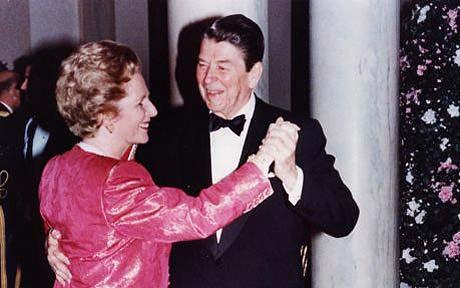
As its title would suggest, the focus of this volume is the personal alliance of Reagan and Mrs. Thatcher, a combination that represented the most productive and historically significant incarnation of the Special Relationship between England and America since that astonishingly effective blend of Anglo-American genes better known as Sir Winston Churchill (whose mother was, of course, from Brooklyn). Well-buttressed by skillfully chosen quotations from letters and telephone records (some previously unpublished), the central story of "Ronald Reagan and Margaret Thatcher" is of a relationship between two politicians of conviction whose friendship, shared goals, and remarkable ability to reinforce and support each other through some very difficult times were key features of international politics in the 1980s — and, so it was to turn out, critical factors in the eventual collapse of the Soviet Union.

Given his subject matter, it's to be expected that Mr. Wapshott has somewhat less to say about the domestic scene on either side of the Atlantic. Yet, American readers may also find that this book makes an excellent, if brief, introduction to Mrs. Thatcher's career as a whole.

There is, however, one aspect of this account that may come as a surprise. These two leaders are often seen as a matching pair, but the tones of their respective biographies differ in some profound ways. To be sure, both came from hardscrabble backgrounds —Mrs. Thatcher's far less so than Reagan's — which they later romanticized, but there was always something sunnier about Reagan and the arc of his rise, something that owed a great deal to the difference in the two leaders' personalities, but also something to the myth and the reality of opportunity in the country in which the Gipper was, as he always knew, lucky enough to be born.

The latter is something Mrs. Thatcher, a lifelong admirer of America, would be presumably quick to admit. Yet, despite her fondness for America — and despite the usual claims from the usual suspects that she was "America's poodle" — this most patriotic of women always put Britain, and its national interests, first. At times, this led to disagreement with Reagan, and, as Mr. Wapshott shows, the conflict could become quite sharp. In the course of one spat, we read how Secretary of State Haig was quick to send Washington an ominous, and urgent, weather advisory: Mrs. Thatcher, he warned, had spoken to him with "unusual" vehemence, a terrifying image, given the intensity of even her usual vehemence. She would, Mr. Haig warned the president, be writing with "her concerns." Yikes.

On that particular occasion, the prime minister had been frustrated by the Reagan administration's attempt to extend the extraterritorial reach of American law. There was more serious trouble between this generally harmonious duo over equivocation within the White House in the run-up to the Falklands War, and, tellingly, horror and bewilderment in Downing Street at Reagan's repeatedly stated belief that it was possible to rid the planet of nuclear weapons. Mrs. Thatcher, correctly and characteristically, thought that this was hopelessly, dreamily, and dangerously "unrealistic." She could not, she explained, foresee a nuke-free future "because there have always been evil people in the world."

Fortunately, shrewd, easygoing "Ron" was usually prepared to listen to his shrewd, hectoring "Margaret." So much so, in fact, that in Mr. Wapshott's not unreasonable view, "Reagan's readiness to take Thatcher's advice ensured that her interventions in American policy [meant that] … she acted as an unofficial, unappointed, but wholly effective additional cabinet member." Under the circumstances, to argue, as Mr. Wapshott does, that Reagan and Mrs. Thatcher had entered into a "political marriage" is no exaggeration. What's more, this was not just any marriage: It was a good one. In a good marriage, the partners are able to disagree, and they continue to pay attention to each other, even when they are at odds. They never forget that, in the end, they are on the same side; the prime minister and the president never did. As Denis Thatcher — an often underrated figure, who is, refreshingly, given his due in this book — was early to recognize, his wife and Nancy's husband shared a vision, a close ideological bond made all the stronger by the fact that both had spent long years as representatives of a minority viewpoint not only within their own countries, but within their own parties.

But the vision thing was not, by itself, enough. The relationship between Reagan and Mrs. Thatcher was political, yes, but it was reinforced and strengthened by ever deepening personal affection. This is visible in much of the material chosen by Mr. Wapshott, and in particular in the charming anecdote with which he concludes his introduction:

One day an insistent call from Thatcher interrupted a meeting in the White House. Reagan mouthed to the assembled company that it was Thatcher, and they waited patiently as the president listened in silence to the force of nature on the other end of the line. Eventually, he placed his hand over the mouthpiece and gushed to everyone in the room, with a broad smile, "Isn't she wonderful."

She is. He was. They were.

False Dawn

Graphic Modernism From the Baltic to the Balkans, 1910–1935

The New  York Sun, November, 1, 2007

Kreslins_Dur-cert-sit.jpg

The disparate, jostling artistic movements grouped together and loosely labeled as "modernist" may have been gathering pace before 1914, but it was the moral, spiritual, and physical devastation left by four years of war that allowed them to play such a prominent role within the cultural avant-garde of what remained of Europe.

"Graphic Modernism From the Baltic to the Balkans, 1910–1935" is a fascinating, striking, and intellectually ambitious exhibition now showing at the New York Public Library. It attempts to demonstrate that the agenda and the aesthetics of modernism had a key part to play in the identity that the nascent states (from Estonia in the north to the future Yugoslavia in the south) that had emerged from the wreckage of the empires destroyed by the war were both trying to create for themselves and, no less critically, project to the outside world. It's an interesting argument, and it gives the library an ideal opportunity to showcase art — in this case, a selection of illustrations and other design work, primarily drawn from periodicals, pamphlets, and other published material — that fully deserves a wider audience.

But while it may be an interesting argument, it's based on a questionable premise. If there was one thing these new countries did not lack, it was a sense of identity. Theirs was frequently focused on a supposed reconnection with their dominant ethnicities' sometimes distant, usually suppressed, and often concocted, past. Its roots lay in the romanticism of the national "revivals" that spread across Europe in the 19th century. Insofar as it found artistic expression in the 1920s and, particularly, the 1930s, it was predominantly backward-looking, a matter more of flaxen-haired peasants and völkisch fantasy than modernist innovation. This is hinted at in only a few pieces, and then only indirectly. These include the pastiche medievalism of a poster produced for a trade fair in Lwów, and two beautifully stylized Bulgarian landscapes by Sirak Skitnik and Dechko Uzunov, who each attempt to reconcile more modern artistic ideas with folk tradition and the imagery of the homeland — attempts typical of this time and these regions.

This ought not come as a surprise, but may. These countries were less of a backwater than half a century of Cold War isolation would later suggest. Modernity did not pass its artists by, but it normally owed more to the playful geometries of Art Deco than to the hectoring Constructivist/Suprematist abstraction that essentially defines this show. Deco was a style with closer links to Hollywood than to Moscow, to commerce than to nation, but it's better representative of this epoch than a modernism more focused on leftist (or, if you prefer, "progressive") ideology. That may explain why, with exceptions (most notably, and most delectably, a sly, characteristically erotic nude by Latvia's Sigismunds Vidbergs), there are so few allusions to Art Deco in this show.

Rather than trying to endow the works on display with a wider political significance than they may actually deserve given the historical realities of their era, it's better to consider them on their own terms, and in all their intriguing artistic (if not ideological) variety. Modernism was a Bauhaus with many mansions. Thus we see outstanding expressionist pyrotechnics, especially two covers, frenetic and fine, designed for the Polish periodical Zdrój, trickster Dadaist typography from Slovenia, some leaden surrealist clichés from Czechoslovakia, and much, much more.

Predictably enough, given the emphasis on Constructivism, El Lissitzky makes several appearances (for some of this period he managed to live a comfortable distance away from the Soviet experiment he was so enthusiastically touting). These include the most directly propagandist item on show, a volume produced for visitors to the USSR's pavilion at the 1928 International Press Exhibition, complete with hammer, sickle, and a willingness to wrap mass murder in the slickest of packages. In other pieces on display, Lissitzky's politics are less overtly signaled, but these works remain what they were always intended to be: undeniably brilliant advertising for an allegedly radiant future.

A similar philosophical subtext — one less concerned with shaping a sense of nationality than in finding new ways to destroy it — can be detected in a good number of the other pieces on view. As it happened, however, old ways of doing this still worked all too well. Within a decade or so, almost all these new nations again found themselves devastated, but in a very traditional manner. They fell prey to rampaging armies, invading from the east, west, or both. Their borders were reduced to abstractions as complete as anything you will see at this show. The consequences were anything but. Until January 27 (42nd Street and Fifth Avenue, 212-593-7730).

The Godfather, Part I: Stalin as a Boy

Simon Sebag Montefiore: Young Stalin

The New York Sun, October 24, 2007

Young Stalin
Young Stalin

When Josef Stalin finally succumbed to the stroke he so richly deserved, a distraught Pablo Neruda mourned the death of this "giant. ... the noon, the maturity of man and the peoples." Such attitudes are, mercifully, now rare. Once known genially as "Uncle Joe," Stalin is now regularly reviled as a monster and a despot to be ranked with history's worst.

Despite this, it continues to be the case that, in the popular imagination, the name Stalin fails to deliver anything like the sense of horror conjured up by Hitler. The reasons include the persistence of leftist ideology, the fact of cultural distance, and the recollection of wartime alliance. There's something else, however, that should not be overlooked: Stalin the man is barely known, and what is thought to be known is that he was something of a plodder, a bureaucrat, the embodiment of Soviet drab: in other words, a bore. That's not a quality humanity expects from its enduring villains: Just ask Shakespeare, just ask Milton.

In our memory, Hitler is not only the incarnation of evil but also its most vivid caricature. By contrast, in public Stalin was managerial rather than charismatic, cleverly distanced from the cult of personality that enveloped him. He went to extraordinary lengths to ensure that little of substance was disclosed about his private life. His biography was transformed into pious myth, systematically drained of real interest. Those few people who knew the truth, or part of the truth, managed to survive only if they kept it to themselves.

While this culture of secrecy began to change during the Khrushchev era, the twists, turns and imperatives of Kremlin politics conspired to keep the real Stalin hidden from the historical record. After 1991 this was no longer so, but while the details of Stalin's crimes are now widely available, the individual who inspired them has remained a strangely elusive figure, still scarcely more than the "gray blur" of ancient Menshevik libel. If any historian can bring an end to this relative indifference it is Simon Sebag Montefiore. His bestselling "Stalin: The Court of the Red Tsar" (2003) was a masterful, magnificently readable, and immaculately researched account of the Soviet leader's long rule. As a portrait of ascendant malignance, it has rarely been equaled.

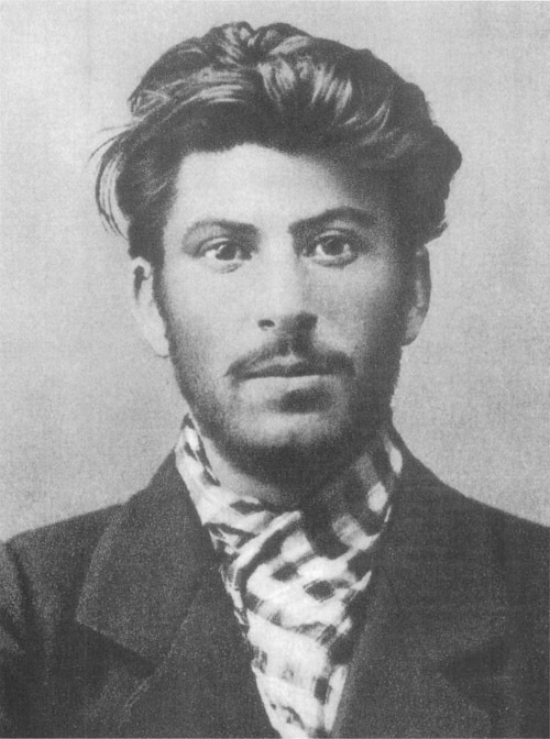
Mr. Sebag Montefiore's new book adds more depth to this picture. "Young Stalin" (Knopf, 460 pages, $30) is a kind of prequel to the earlier volume. It tells the story of the dictator's earlier years, from Georgian boyhood to his (often underrated) role as one of the key organizers of the Bolsheviks' Petrograd coup. Even told badly, this would be fascinating, but the ever-fluent Mr. Sebag Montefiore recounts it with brio, insight, and quite remarkable amounts of additional, never-before published information: I read it in one sitting. In some ways "Young Stalin" comes across as a picaresque, if grim, adventure, a bawdy chronicle of seminary school rebellion, banditry, bank robbery, revolutionary intrigue, jail, piracy, extortion, love, murder, romance, exile, scandal, and, even, hunting trips with the tribesmen of the remote arctic taiga. It doesn't hurt either that Mr. Sebag Montefiore's considerable literary gifts allow him to bring life back to the lost, exotic realm within which his saga unfolds, the brutal mass of contradictions that made up the Romanovs' ramshackle, doomed empire.

The fact that, for most of his youth, Stalin was a fairly marginal figure enables Mr. Sebag Montefiore to focus even more closely on the character of his subject. Young Stalin comes across, like so many psychopaths, as charming, manipulative, and highly intelligent. Musically gifted, an accomplished poet, and a relentless autodidact, he was no less of an intellectual than the revolutionaries he so liked to disdain. But, crucially, he was also what he was proud to call a praktik, a tough guy capable of doing the "black work" of revolution. Stalin was only in his early 20s when he moved to the oil port of Batumi. 'Within three months, the Rothschilds' refinery had mysteriously caught fire ... the town was flooded with Marxist pamphlets; informers were being murdered ... factory managers shot.'

There was, of course, far, far worse to come. For reasons we can only guess at, Stalin not only excelled at black work; he relished it. Part of the blame for this must lie with a dirt-poor childhood spent in a town notorious for its hard-edged and thuggish ethos, a childhood scarred also by violence that extended into the home itself: His father was an abusive drunk. Nobody could be trusted, not even family. Throw in Stalin's psychopathy, his egomania, his seminary-sharpened ability to detect heretics, and his experience of the way the tsarist secret police managed to suborn so many supposedly loyal comrades and we can detect the outlines of the nightmare to come. Vladimir Lenin certainly could, and he was thrilled. "That chef," he commented, "will cook up some spicy dishes." So he did. And with them he poisoned a culture, a nation, and a world.

Saturday Morning Classic Literature

Beowulf

The New  York Sun, November 16, 2007

Mighty Beowulf fought for glory, honor, and immortal renown. If, however, the hero of that ancient Anglo-Saxon epic had been unlucky enough to see three recent movies inspired by his exploits, he would, I reckon, have opted instead for obscurity.

The first, Graham Baker's "Beowulf" (1999), was an incoherent fiasco starring Christopher "Highlander" Lambert, and set in a dank, dismal techno-medieval future. Next came Sturla Gunnarsson's "Beowulf & Grendel" (2005), a movie of such numbing sanctimony (trolls as oppressed minority, or something like that) that not even the beauties of Iceland and Sarah Polley were able to redeem it. And now, well, let's just say that Robert Zemeckis has done to "Beowulf" what Grendel never could.

In discussing a film this bad, it is, as with a particularly unappetizing meal, difficult to know where to start. A good place might be its most distinctive feature: the way it looks. This owes a great deal to the technique, known as "performance capture," first used by Mr. Zemeckis in "The Polar Express." Sensors attached to the actors' faces and bodies enable their movements, gestures, and mannerisms to be stored digitally for later use. With this method at his disposal, Mr. Zemeckis could, quite literally, do what he wanted with his cast. Eat your heart out, Mr. DeMille. He altered their appearance, he dressed or, oh yes, undressed them at will, and then inserted them into the computer-generated backdrop against which the film lurches along its blowsy, hectic, and heedless way.

Sometimes the results are striking: Ray Winstone, an actor of average height, middling age, and respectable stoutness, is turned into six and a half feet of ripped Viking hunk. But usually they are just clumsy: John Malkovich's Unferth resembles one of those annoying Geico cavemen, Anthony Hopkins's King Hrothgar becomes a pudgy Pillsbury satyr, and the lovely Robin Wright Penn (Wealthow) is given the bland prettiness of a lesser Disney princess. It is telling that the most successful transformation is that of Angelina Jolie (Grendel's unsettlingly yummy mummy), an actress whose most distinctive features may already owe a little something to science.

Worse, even if we ignore the obstacle posed by a laughably inept script, these added layers of technological artifice appear to have prevented a talented cast from breathing needed life into their characters. The makers of "Beowulf" might like to claim otherwise, but their actors have largely been reduced to cartoons. This need not have been fatal. Done well, the otherness of animation can be used to spirit audiences away to a parallel world of myth, magic, and the strange. But doing it well is more than a matter of megabytes. The imagery must awe, disturb, and beguile. Here and there, "Beowulf" does. The scenes in Grendel's lair are beautifully done — eerie, majestic, and resonant, the stuff, as they should be, of legend. As for Grendel's gorgeous mom, a nerd-core idol if ever one existed, the dangerous temptation she represents to Hrothgar and Beowulf is easy to understand. She is, insists Hrothgar, "no hag." Indeed she's not.

But these are exceptions, not the rule. Even viewed in their occasionally spectacular (and, in such a doggedly one-dimensional film, decidedly ironic) 3-D format, the visuals in "Beowulf" are, for the most part, shockingly banal. Nowhere is this more the case than in the depiction of Grendel (Crispin Glover), the "grimma gæst" (grim demon), whose repeated murderous onslaughts on Hrothgar's great hall summon Beowulf across the seas, to the rescue, and into the high school English curriculum. In the original text, Grendel is, to borrow descriptions from Seamus Heaney's grand and clever translation, "a shadow-stalker, stealthy and swift … [a] huge marauder … warped in the shape of a man." In this movie, he's little more than a jittery, whiny comic-book grotesque.

Similarly, the source of the fury that drives Grendel's lethal rampage has been dumbed down and jazzed up. It's no longer enough for him to be enraged by his sense of exclusion from God's good graces. Now he has family issues: Dad's the real problem, not God. In some respects, the writers of this film have turned a saga into soap opera, complete with warring spouses, infidelity, jealousy, and an examination of the wreckage left behind by unsuitable couplings. They attempt to justify this by claiming that it's a way to fill in gaps in the original narrative. We'll leave scholars to debate the extent of any such gaps, but it's difficult to avoid the suspicion that the screenwriters' real motive was to sidestep the core themes running through that bleak Anglo-Saxon verse: The implacability of fate and the impermanence of existence don't exactly make for the most promising box-office material.

To the tough-minded pagans of Beowulf's time, the most intelligent response to the inevitability and permanence of death was to try to live on in memory. Back then, the best chance for that was through heroic feats of arms, a concept that the screenwriters clearly understand, but which, I suspect, leaves them uneasy. It's true that some of their dialogue mourns the death of the age of heroes, but those passages seem primarily designed to take a swipe at the impact of newly arrived Christianity (something that does a disservice to the original poem's subtle blend of Norse and biblical mythology). This film's Beowulf is a brute, a liar, and a boor. He's also brave, and he is prepared to sacrifice himself for others. But if he is a hero, he's a hero diminished, if not debunked.

This, then, is not a very heroic film. It's not even a heroic failure.