Politically Incorrect - Not

National Review, March 10, 1997

Bill Maher.jpg

The Inauguration has come and gone, and with it the hopes Washington, D.C., entertained of a tourist bonanza. Receipts were lower than expected, far down from last time. Much like the election, in fact, in which voter turnout fell to 49 per cent, the lowest since 1924. In a way it is a welcome development, a rejection of activism, an indication that people are ready to get on with their own lives rather than those of their neighbors.

To members of the political class, especially on the Left, it is a rejection that hurts. Self-important beyond belief, they need to be taken seriously, not to be ignored. People should "participate" in the "process," whether they want to or not. The media, it is argued, must play their part in what would doubtless be termed our national town meeting. To some, this entails free air time for their speeches ("the broadcasting spectrum is public property'") and patronizingly sanitized "civic journalism" of the type seen in the North Carolina Senate race. To others, this is old politics, too League-of-Women-Voters to be relevant, Post-modernly hip, and leftward naturally, they fuse politics with entertainment, Rock the Vote, and are thrilled when ABC buys the rights to Politically Incorrect with Bill Maher from a cable channel dedicated to comedy.

Believe U.S. News & World Report and Bill Maher is a Will Rogers in the making, a man whose show, according to George, "may change the way America watches politics," ABC hopes so. The network has targeted Politically Incorrect at the Koppel and Sominex crowd, scheduling it just after Nightline.

The format is simple. Think of the Monty Python sketch where Marx and Lenin appear on a game show, to be asked questions on soccer and pop music. Bill Maher reverses the premise. The topics for discussion are often political, and serious(ish), the guests frequently less so. To be sure, you might see an Ed Rollins, Dee Dee Myers, or John O'Sullivan, but they will generally be outnumbered by entertainers: an actor or two, a rock star, or an unclassifiable like Kato Kaelin.

The show is certainly not politically incorrect, in the authentic, which is to say right-wing, sense of the term. Instead, we are told. Politically Incorrect is about "honesty," Is it? Well, in theory Mr. Maher's guests are speaking openly, being encouraged to state their true beliefs, (That this is considered daring, politically incorrect, says a lot about America.) But many do not, of course: they have their agents, their focus groups to think of. Oh sure, the performing seals will bark on cue, Sandra Bernhard is good for a brawl, and G. Gordon Liddy is just good. But that's their schtick; it's what's expected. For the rest, it is all very bland, with even the mildest controversy being greeted by the hoots and whoops of an audience priding itself on its own sophistication.

If the show has a slant, it is that disgruntled populism so easily manipulated by Common Cause, in which "good government" shades imperceptibly into big government. Bill Maher himself prefers to affect a wry "plague on both your houses" bi-partisanship, but it doesn't quite convince.

Whatever its claims. Politically Incorrect still plays by the Left's rules. Conservative positions may be taken, but they must be carefully qualified as exceptions, not the rule, Mr, Maher favors the death penalty, but is also pro-choice and pro-gun control. He will tell risque jokes, call female guests "baby," and talk sensibly about today's poisonous gender politics; but at the same time, says a website for Maher fans, he admires "smart women." A favorite cause, animal rights, is impeccably PC.

So if the show is not politically incorrect, is it even "political," something to be taken seriously? Judging from the recent show devoted to an absurdly gentle interview with Larry Flynt, the answer must be no. One is tempted to dismiss Politically Incorrect as a talk show with pretensions, to grumble, as some guests have done, that the mix of guests and sub-McLaughlin format inhibits proper discussion. It would be easy, perhaps too easy. One hears the sound of a mandarin whine being uncorked, "Comedy Boy," as Maher has described himself, is entitled to his say, and so are the folks on his show. Politics should not be the exclusive preserve of wonks. The idea that it operates (or should operate) independently of the world of entertainment, or the general cultural mix, is nonsense.

But Politically Incorrect won't "change the way America watches politics." It won't change anything. If the discussion can seem trivial and intellectually dishonest, that merely reflects the society from which the show has emerged. Bill Maher once commented that in Bill Clinton the U.S. had chosen an appropriate President, "because he is full of s—" and so are we. Mr. Maher is quite right. And that is why this stand-up comedian, this Carson who wants to be Cronkite, is, as much as anyone else, the pundit we deserve.
Devil's Islands

ARCHANGEL IT may have voted for Yeltsin, but Archangel is still a very Soviet sort of place. There's a Lenin in the main square and another on the way out of town, just to make sure. Seven hundred miles north of Moscow, this once rich port city of 400,000 seems, at a glance, trapped in Brezhnev's dereliction — though there are hints of a commercial revival. There is plenty in the shops, and someone is buying all those Western cars.

Read More

Frozen Future

National Review, September 1, 1996

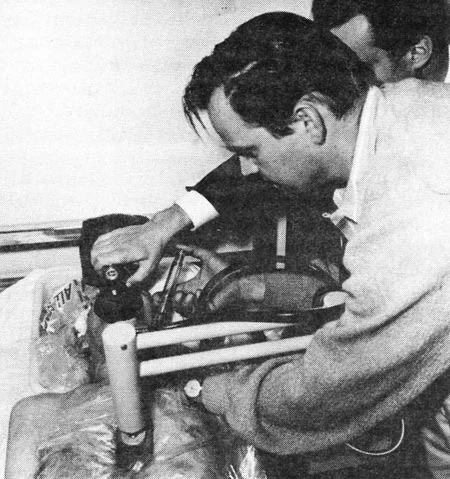
James Bedford, on his way

The stroke of death," claimed Cleopatra, "is as a lover's pinch." Well, perhaps: if you are about to be deposed and taken captive. But for most people the arrival of the grim reaper is a tragedy, a disaster, and, in this most advanced of countries, something of an insult. We eat broccoli, we transplant hearts, but in the end people just keep on dying—more than two million of them each year. Other civilizations have claimed that nothing can be done, but for us to accept this seems, well, un-American. Each death (other than those of the executed, of course) represents a technological failure, a rebuke to Uncle Sam. But it ain't over till it's over and, some say, an answer is at hand. Yankee ingenuity has done it again and come up with cryonics. Put simply, this involves deep-freezing the recently deceased in the hope that some cure for what killed them will be found in the future. The idea is not new. Benjamin Franklin wanted to be "immersed in a cask of Madeira wine, with a few friends, till that time [when he could] be recalled to life by the solar warmth of my dear country."

It was not to be, but Franklin's dream, at least, lived on, to be revived as "cryonics" in the early 1960s. Cryonics: It's a goofy name and a wildly optimistic idea, but one suited to its era. It was the age of the Jetsons and the transistor, a time when science seemed to be sweeping all before it. Freeze people? Why not? James Bedford agreed, and on January 12, 1967 this 73-year-old psychology professor was frozen ("suspended") shortly after his death. Cryonics had found its Henry Hudson, perhaps even its Columbus. Doctor Bedford is, after all, still with us and "apparently" in good shape, ending up with the cryonicists of the Alcor Life Extension Foundation after many years in a mini-warehouse.

This is only appropriate. Alcor is the industry leader. Its Scottsdale, Arizona, facility is home to 32 "patients," almost as many, it estimates, as are held by its three competitors combined. These numbers exclude the occasional freelancer as well as the two Canadians interred in the permafrost, but that, says Steve Bridge, Alcor's likable president, "is just cold burial."

Cyronics is much more than that. To start with, it's a lot less sedate. There is no time to linger weeping around the deathbed. Instead, an Alcor Emergency Response Team will spring into action with CPR support to maintain blood flow to your brain in an attempt to reduce ischemic damage. Your body is rapidly cooled down and unless you have chosen to die in Scottsdale (which is best) you will be put into a special traveling pack (make sure it doesn't leak—this can cause trouble with the authorities) after a procedure involving preservatives, ice, and Maalox. On arrival, a glycerol-based solution will be pumped through your system to reduce the tissue damage caused by freezing. Once you are thoroughly perfused you are ready to be cooled down to -196 degrees Celsius. Oh, there's just one other thing. If you have elected for "neurosuspension" only, this is the moment that they cut off your head.

"Deep cooling" then follows, at the end of which you are lowered head first, or head only, into a large stainless steel cylinder. There, in a quiet back room in Alcor's suburban office block, you await your destiny, a cryonaut in an unmarked metal can, kept cold by occasionally replenished liquid nitrogen. Pére-Lachaise it is not, but then it is not meant to be. Scottsdale is no final resting place, but a way station on the return to life. Or at least that is the idea.

But how good an idea is it? Conventional cryobiologists, the people who freeze sperm or the odd body part, are skeptical. They point to the extensive cell damage associated both with death and the degree of cooling required for a whole body or even a head. As their Darth Vader, Arthur Rowe of NYU's School of Medicine, has explained, "believing cryonics could reanimate somebody who has been frozen is like believing you can turn hamburger back into a cow." In addition, even if enough cells can be revived, it is also far from clear, to say the least, that the patient's mind would have been preserved.

Well, if cryonics is another junk science, its practitioners differ from the parapsychology crowd in one crucial respect: the claims they make are fairly modest. As one Alcor leaflet is careful to say, "we don't know if what we are doing will work." They can, and they do, point to signs of real progress in cryopreservation, while touting a future nanotechnology as the key to repairing damaged cells in, say, the next "5 to 150 years." Even today, they note, we regularly "revive" people who previous generations would have abandoned. Meanwhile, James Bedford sleeps on, and no frozen dogs have yet come back from the dead (that's an urban legend, as is, while we are on the subject, the freezing of Walt Disney). Will Alcor succeed in the end? Talking binarily, Steve Bridge reckons that the odds are "either one or nothing," which sounds better than the New York State Lottery.

The trouble is that betting on cryonics is rather more expensive. There are annual dues to pay and when the, ahem, moment comes, a neurosuspension will set you back $50,000; "whole body" will cost $120,000. Alcor's 390 living members don't seem to mind. Much of the money goes into a patient-care fund, which is essential. Illiquid cryonicists can, as history shows, lead to liquid patients. Alcor itself is not-for-profit and looks it. The facility is spartan, the decor basic (framed pictures of the suspended), the staff underpaid.

To understand what motivates them look no further than the USS Enterprise proudly displayed in one office. These people are science's samurai, gung-ho garage tinkerers in the Orville and Wilbur tradition. The only doctor on the premises is dead, although they do have a veterinary surgeon and a nurse or two to help out. Steve Bridge himself is a librarian by profession. "I know where to look things up," he says brightly. Rationalists by inclination, most cryonicists are not religious. Their faith is the future, an Asimovian dream of scientific progress, often accompanied (this may ring a bell with Newt watchers) by a strong libertarian streak, a blend, in short, of Ayn Rand and Captain Kirk.

Ayn Rand herself "knew about" cryonics (but, no, she's not frozen either). As she would have predicted, officialdom has done its best to be difficult, notably in Riverside, California, where a series of absurd events led to Dora Kent (or at least her head) becoming the movement's Rosa Parks. Meanwhile, right-to-die issues bubble ominously below the surface. The final stages of a disease can destroy the very cells that Alcor is trying to preserve. So, argued one cancer patient, why not end things more quickly and allow the cryonicists to get to work? He lost his case, which reached a California Appellate Court and, fictionalized, an episode of L.A. Law, but, happily, survived.

So, doubtless, will cryonics. And so it should. Its devotees may seem a little nutty, and so pro-life that they want another, but that's their call, even at $120,000 a throw. It will probably never work, but, as cryonicists see it, what is the alternative? As Steve Bridge puts it, "The nice thing about life is that you never know what is going to happen next. The problem with death is that you do know what is going to happen next. Nothing."

And then he smiles. Confidently.

Revenge of the Nerds

National Review, July 28, 1996 

ALIEN-AUTOPSY.jpg

BUFFALO Midsummer. A thousand years ago our ancestors danced around bonfires and, doubtless, slaughtered a maiden or two. These days we like to think we have moved on. True, the scandinavians still throw a good Midsommar, but even there virgins are not sacrificed, at least in the conventional sense of the word. Progress, schmogress. For all our science we still live, as Carl Sagan puts it, in a demon-haunted world. Naturally, there have been changes. The nearest soothsayer is only a 900 line away. Of course we no longer think that ghouls will steal our offspring--but give those creatures space ships and we will believe they are abducting children, carrying out ghastly experiments, and, for all we know, spoiling the crops. Scratch away our sophisticated veneer, and the New Age very quickly goes dark.

All is not lost, however. The epoch of Shirley Maclaine has its opponents, and one thousand of them recently gathered outside Buffalo. The occasion was the first World Skeptics Congress, a four-day-long-discussion of "Science in the Age of (Mis)Information" sponsored by CSICOP—the Committee for the Scientific Investigation of the Claims of the Paranormal. CSICOP does what its name would suggest. Over the past twenty years it has encouraged the exposure of a sorry sequence of spurious spacemen, cranks, and charlatans. CSlCOP's fascinating magazine. Skeptical Inquirer, sells around 50,000 copies across the world, but none, probably, in any supermarkets. Much of the Congress covered familiar ground. Aliens, junk medicine, and psychic detectives all took their knocks, Patriots will be glad to know that this nonsense is not just an American problem. China seems obsessed by Pseudo-Qigong (don't ask), but, hey, that's a country with fifty million Communists, and they will believe anything. Perhaps the Chinese should turn to India, to the monomial Premanand, for help. Confusingly, Premanand's style was high guru (flowing white hair, beard, orange clothing) but his message was not. The fakirs are fakers, and in an entertaining talk Premanand demonstrated just how they do it.

This would not have been news to Skepticism's stars, many of whom were on display. Paleontologist Stephen Jay Gould spoke, preceded by a Darwin impersonator. Magician James ''the Amazing" Randi was on hand, outwardly unscarred by years of litigation with Uri Geller. In between drags on, appropriately enough in this anti-witchcraft crowd, a Salem, Aviation Week and Space Technology's Philip Klass was signing copies of his UFOeuvre. Full refunds ("not just the royalty") were promised in the event of a proved landing.

More surprising was the appearance of X-Files creator Chris Carter as a guest speaker. With his compelling stories of the occult and the alien, often filmed in a pseudo-documentary style, Mr. Carter might have expected a rough ride. He need not have worried. The Skeptics were a pushover, clever to be sure, but with more than a hint, shall we say, of the school chess club about them. They never stood a chance against the sly cool of Chris Carter, media wizard and surfer. Besides, most were fans, shocked only when their guest revealed that he had never watched an entire episode of Star Trek.

Anyway, The X-Files is fiction, nothing more. Much more serious, in the view of the Congress, was media response to paranormal "facts." The wildest claims are accepted at face value, turned into documentaries, and shown on prime time. A scientist may be asked to comment, but for about thirty-seconds, most of which ends up on the cutting-room floor (this may sound familiar to conservatives). In part, this is inevitable. The paranormal is fun. An alien autopsy is great TV, rather more exciting than four chemists gathered round a Bunsen burner. ''What we need," said one speaker, 'is LA Science." He should not hold his breath.

Some knew what to blame: Commercialism, or at least its alleged surrogate on earth. Mention of the name Murdoch generated slightly forced laughter. Murdoch the bringer of joy, the destroyer of words. Scientific types, the skeptics see themselves as high-minded, spelling-bee sorts of people who still give money to NPR. TV was meant to be the great educator: McNeil, not Oprah; Kunta Kinte, not Beavis. Instead, ran the argument, commercial pressures have led to a debased medium, serving only to fuel the prejudices and superstitions of a degenerate mob.

It's a neat explanation, but it is only part of the story. Intellectually, after all, the mob has always been in poor shape. That's why it is the mob. What has changed is the attitude of the opinion-forming classes. Temple University professor John Paulos highlighted part of the problem. The Kaczynski-haired Paulos is, as the title of his most recent work suggests, a mathematician [who] reads the newspaper and, as his acerbically insightful talk made clear, he is not impressed. Numbers are bandied about, he says, but with little understanding even in the media's more upmarket corners. It is not difficult to agree. All too often Right Data are replaced with numerical assertions that are left unchallenged and unanalyzed by a press too slovenly, innumerate, or biased to care.

To the Skeptics, an honest bunch looking for objective, critical thought, this must be anathema. The Joe Fridays of philosophy, all they really want is the facts. Instead they find themselves in a subjective, post-modern world. In the past their fight was straightforward and pleasantly elitist, the enemies trailer-park science and bayou religion. Now the problem is among their own, within the intelligentsia and the academy. History has been abolished, to be replaced by the study of alternative myths, while science itself is suspect, a product, allegedly, of white male power.

Ironically, much of this rubbish comes from the Left, once a reliable source of support for Skeptics, particularly on religious matters. Skeptics, to say, the least, arc unlikely to be great churchgoers, and there was a time when that could imply a sort of leftism. No immortality—except for the Rosenbergs. CSICOP itself has close ties to CODESH (the Council for Democratic and Secular Humanism), an interweaving visible even at the Congress's bookstall. The alien and the paranormal were on display, but so were the great thinkers (Voltaire, Darwin, Kevorkian), the Bad News Bible, The Trouble with Christmas and, most shockingly of all. Lessons of the Locker Room: The Myth of School Sports. Is nothing sacred?

Not much, probably, to many of the Congressgoers. But should that imply a liberal tilt? In an era when the First Lady communes with the dead, conventional political afllliations can truly be said to be breaking down. When what one speaker described as "preposterism" rules, the rationalist can no longer rely on traditional allies. True, the Congress felt vaguely liberal. Naturally enough, the Religious Right took a pounding, and, at a guess, most attendees would still vote Democratic, if a little uneasily. The voice of the Old Left could still be heard in some of the speeches and in a feeble anti-Rush Limbaugh joke or two, but it was fading away, just (to take Matthew Arnold somewhat out of context) another pan of liberalism's "melancholy, long, withdrawing roar."

Thirty years ago the stupidities of the Sixties pushed many social scientists into neo-conservatism. Today's junk intellectuals with their crystals and their shamans, their ludicrous universities and their "politics of meaning,'' may do the same for the skeptical and the scientific. Rationalism can then complete its reconnection with the thought of Washington, Franklin, and Jefferson, a journey which must take it rightward, if never to Ralph Reed. This should be welcomed. Skeptics may be an ornery lot, but their search for that objective truth is somehow very American. Indeed, it is as American as the apple pie that Eve never baked.

A Hemp Museum

National Review, June 3, 1996 

Cannabis  Museum, May 1996  © Andrew Stuttaford

Cannabis  Museum, May 1996  © Andrew Stuttaford

The streets of London, they used to say, were paved with gold. Maybe that is true of the City, the British capital's financial district, but take a walk five minutes to the east, to Shoreditch, and the surroundings are more mundane. Here you will find a theme park of pre-Thatcher Britain. The pub at the end of Redchurch Street is no exception. A drab spot despite its exotic dancer, the White Horse sports a cautious sign noting that Shakespeare is reputed to have drunk there. But if the White Horse is timelessly East End, the East End is itself changing. Not so long ago Redchurch Street was part of that old stereotypical London of the Ealing comedies and the kindly bobby. Now it is also home to a mosque, a Bengali grocery store, and, most recently, a cannabis museum. Located in a nondescript office building, the museum was opened amid some fanfare in April. Howard Marks—a graduate of both Balliol College, Oxford (politics, philosophy, and economics), and the American prison system (cannabis smuggling)—was the guest of honor. The press came, and so did the police. There are, of course, drug laws in Britain, and a wide range of "hemp" products was on display. Hemp? The police were wise to that alias. Hemp is also known as Cannabis sativa, a name it received, somewhat alarmingly, from the Emperor Nero's surgeon. No contraband was found, however. The hemp jeans passed muster. Even the revolting "Hemp 9," a "high energy protein mixed seed bar," was allowed. British law permits the manufacture of hemp products so long as they contain no more than 0.3 per cent tetrahydrocannabinol, hemp's narcotic element. Smoking a hemp T-shirt would be a waste of time; even Bill Clinton could inhale.

The police left satisfied, as well they might. For Redchurch Street is the acceptable face of cannabis. Part Ripley (George Washington grew it! Queen Victoria took it!), part agitprop vehicle, the museum is relentlessly upbeat. It is, after all, run by CHIC, the Cannabis and Hemp Information Club. The aim is to "inform and educate people about the history and many uses of this incredibly versatile plant."

Cheery, if occasionally misspelt (a side effect?), posters accentuate the positive. Cannabis, it seems, can be turned into mighty ropes, excellent paper, and an ecologically sound fuel. It can be used to treat glaucoma and relieve the nausea associated with chemotherapy. Fans of the former British foreign minister will be glad to know that cannabis "hurd" (its inner stalk) can be mixed with lime and water to produce a building material more durable than concrete. Finally, and this is a clinching argument in an era of anxious English mealtimes, hemp might make a healthier animal feed. Given that Britain's maddened cattle seem to have been subsisting on abattoir sweepings, this must be right. There have, after all, been no cases of stoned-cow disease.

Cannabis Museum, May, 1996 @ Andrew Stuttaford

Cannabis Museum, May, 1996 @ Andrew Stuttaford

CHIC makes an impressive case. Cannabis does indeed seem "incredibly versatile." So versatile, in fact, that visitors may feel a vague sense of resentment against this leafy overachiever—until, that is, they discover its little weakness. Cannabis is, as one display notes, also "a social intoxicant," safer perhaps than some of those available at the White Horse, but an intoxicant nonetheless.

And this, of course, is the source of the problem. It is the intoxication that enrages an officialdom that once warned (in a possibly misguided approach), that cannabis could lead to "weird orgies, wild parties, and unleashed passions." It is the intoxication that interests users. No one would risk jail time for something that was just a building material. It is unlikely that there will ever be, say, a stucco museum on Redchurch Street. With consumers enthusiastic and governments appalled, disaster was inevitable.

Cannabis Museum, May 1996  © Andrew Stuttaford

Cannabis Museum, May 1996  © Andrew Stuttaford

Sure enough, the saddest section of the exhibit describes the progress of the American war against cannabis, a miserable saga of mounting ferocity and futility. Prison photographs of the detained line the walls. They pose awkwardly with their families, standing in front of backdrops painted to give an illusion of somewhere, anywhere, other than the penitentiary. The faces, carefully selected no doubt, look innocent, and the injustice on display appears horrifying.

Wisely, perhaps, there is no discussion of cannabis's rougher associates: London will have to wait a while for a crack museum. The connection between the use of cannabis and of other drugs is never explored. Does one lead inexorably to the other, or are rising rates of hard-drug consumption an inevitable consequence of prohibition? NR discussed these sorts of issues a few weeks ago, but its rational approach would not win many friends in Redchurch Street. The museum's amiable staff may have been born too late for Woodstock, but they are hippies pur et dur, albeit with a Nineties twist: "Please respect our No Smoking policy."

Hippies were never too keen on logic. The positive impact of much of the exhibit begins to dissipate the moment one is told that smoking grass is part of the "permaculture." Indian spirituality makes its inevitable appearance. Wasn't that a poster of Ganesha, elephant god and popular head-shop deity, on the wall? Zany politics are also on view, most prominently in the shape of a large, unfinished, papier mâché display, in which a clumsily executed factory appeared to be menacing idyllic pasture. As artworks go, it was a shambles, but the message was clear: Industry is bad. We need to return to a simpler life, and hemp would show the way. "Industry" had, it was argued, played no small part in the banning of cannabis in the first place. There had, surprise, been a conspiracy. DuPont, no less, had been a force behind the original anti-cannabis legislation for commercial motives of its own (bleaching chemicals for pulp—it's a long story). As CHIC explains, "It is only when governments stop protecting the interests of the multinationals that we will be free to benefit fully from cannabis."

Well, maybe, but it is difficult to avoid the conclusion that the museum's case for cannabis is getting muddled at this point. Some environmentally flavored Marxism seems to have been thrown into the mix. It does not belong there. At its core the argument for legalizing cannabis ought to rest on a fairly restrictive view of the rights and capabilities of government. This is not an approach normally associated with the paranoid Left—or the EPA, for that matter. A commissar is still a commissar, even if he does drugs.

Maybe this is just carping and the confusion is to be expected. We live, after all, in an absurd time, when even the medicinal use of cannabis is prohibited. An honest discussion of drug policy seems all but impossible. The Cannabis Museum does at least raise some serious questions. Perhaps it is too much to expect more. Since only the bravest politician will question prohibition, debate has, with notable exceptions, become the preserve of the eccentric and the obsessed. Meanwhile, drug-related problems worsen and the official approach will continue unaltered, unsuccessful and ugly.

Sadly, it will take more than CHIC to change this.

A Degenerate Exhibition

National Review, April 8, 1996

Worker & Kolkhoz Woman, Moscow, February 1991 © Andrew Stuttaford

Worker & Kolkhoz Woman, Moscow, February 1991 © Andrew Stuttaford

London this season has been playing host to two thought-provoking exhibitions. The first, "Africa: The Art of a Continent," has been on display at the Royal Academy since October. Meanwhile, across the Thames, the Hayward Gallery's "Art and Power" attempts to cast a new light on an even darker continent—the totalitarian Europe of 1930-45. The latter exhibit opens promisingly enough, taking advantage of the Hayward's brutalist architecture with an eerily lit antechamber dominated by symbols and monuments of the departed dictators. Pharaonically sinister, the room is compelling, a guilty pleasure on a par with the best horror stories. Writing of fascism in 1936 the philosopher Walter Benjamin commented that mankind's "self-alienation has reached such a degree that it can experience its own destruction as an aesthetic pleasure of the first order." Unintentionally, perhaps, this room proves that point. It is the highlight of the exhibition.

Most of the rest is depressingly unimaginative, an uninspired display of the usual suspects. We see an avuncular Stalin and a pompous Hitler, but so what? The iconography essential for understanding such pictures is missing, and without it they become routine official portraits, no different really from the drab canvases to be found in many an American boardroom.

Unexplained too, is why much of the work on display should be seen as "totalitarian." Hitler's favorite painter, the leaden Adolf Ziegler, may show why he was known as the "master of the German pubic hair," but, at that time, his völkisch style would not have been out of place in many a European museum. In the Italian section, at least, there is some attempt at serious analysis. Embarrassingly, however, it comes from the Fascists, who were deeply divided on how to control art, if at all.

To be sure, many of the paintings on display are irritatingly didactic, but that is only to be expected. They date from the age of Eleanor Roosevelt, an era when the self-important were out of control. Aleksandr Monin's Shock Workers' Avenue may be a product of Stalin's Soviet Union, but it would not be out of place in any WPA-decorated post office. The allegedly totalitarian architecture too was hardly unusual. Across the world big government was dressing for success. In the 1930s that meant chunky statues and neo-classicism. It was true for Berlin, Rome, and Moscow, but it also held good for London and Washington.

These connections are never really explored, but that is hardly surprising. "Art and Power" is itself a bureaucratic product, sponsored by the Council of Europe to "remind" (rather unwisely, I think) Europeans of "their common history and cultural heritage." Far easier, therefore, for it to caricature totalitarian art as a simple blend of dull art and portentous buildings. Hitler's kitsch thus becomes just another round in the Manichean struggle between the figurative (bad) and the abstract (good).

In effect, then, this exhibition reflects the prejudices of a second-rate art faculty. Naturally enough, it also comes steeped in conventional, leftish pieties. No opportunity is missed to take a swipe at the fallen fascists, while the Soviet Union gets off comparatively lightly.

Some of the distortions are simply childish. An accompanying booklet tells us that 12 million Jews perished in the Holocaust, but fudges collectivization's death toll in the Soviet countryside. The Moscow Metro is singled out for praise, not least because it opened ahead of schedule. Making the trains run on time is clearly an achievement—so long, that is, as they are Soviet trains.

So far as the art is concerned the bias is more subtle. "Nazi" art is mainly represented by rural scenes, peasant girls, and Albert Speer, The relatively more cheerful eroticism of what might be called its "Vargas" school is absent. In marked contrast to the Soviet section little of the regime's perniciously effective posterwork is shown. No war paintings are on display—a curious omission, given that war was central both to the Nazis' dreams and to their destiny.

Space cannot have been a constraint, given the presence of a large section dedicated to the opposition to Hitler, itself rather strange in an exhibition allegedly devoted to totalitarian art. Was someone worried that the devil had the best tunes? There was no need. The "opposition" includes some of the most powerful works on display. Felix Nussbaum's concentration-camp paintings give the lie to Otto Dix's remark that "one cannot paint despair," while Ernst Barlach's The Terrible Year of 1937 speaks for itself.

Appropriately enough, the destruction of modern or "Jewish" art—and, all too often, artists—by the Nazis is highlighted. The destruction of religious art by the Soviets is ignored, however. The burned icons and vandalized churches may have ended a tradition stretching back a millennium, but apparently this is not an aspect of Europe's "common heritage" about which we need "reminding."

Naturally the Nazis' grotesque "Exhibition of Degenerate Art" (1937) comes under scrutiny, and it should. That attempt to put modern art into the pillory was a low point of totalitarian Philistinism. However, it was hardly unique. No comparison is made, for example, with the major Moscow and Leningrad exhibitions of 1932, with their one (very small) room for works by artists who "had been infected with all kinds of Formalist diseases and influenced by their bourgeois experiences."

To have made such a comparison would have been to dispel the atmosphere of cozy ambiguity that prevails in discussing the USSR. There is no separate section on the artistic opposition to Stalin. Emigré art is ignored. A wide range of artwork is displayed, but it is often difficult to discern whether it would have been approved or not. Perhaps deliberately, this creates an image of greater tolerance than there really was, particularly in a country where the state was, on the whole, the only client. Various "Stalins" are on display, but they are eclipsed by Rublyov's extraordinary portrait of a wily dictator reading Pravda, a sinister dog at his feet. Could this ever have been shown? We are never told. Rublyov knew. He kept the picture hidden and pursued a successful career as an official artist.

Instead we are given a simplistic picture of a USSR where political and artistic repression marched in lockstep. Modernism is crushed by socialist realism and, by implication, the bright promise of Lenin's revolution is betrayed. Rodchenko turns to painting clowns, while Malevich goes to jail accused of "Cézannism." In reality, of course, whatever the wonders of their art, these men had been paid propagandists for a Soviet regime that had been openly murderous from the outset.

Sadly, they did their work all too well. The Great Utopia still beckons. There has been no Soviet Nuremberg, no final reckoning with Communism. In Russia that failure may lead to disaster. In the West, it merely leads to misleading "reminders" of a "common European history" at the Hayward Gallery and a souvenir shop that sells postcards of Stalin. But not of Hitler. That would be in bad taste.

Grey Zone

John E. Mack: Abduction - Human Encounters With Aliens

C. D. B. Bryan: Close Encounters of the Fourth Kind 

National Review, September 11, 1995

Back in the 1950s space aliens were a straightforward bunch. By and large, they wanted little more than world conquest. Comfortingly, they were also imaginary. To be sure, there were those who claimed they have seen UFOs, but the aliens themselves remained elusive, "space brothers" of interest only to "contactees" such as "Professor" George Adamski, a California hamburger vendor with an extensive Venusian social circle. However, by 1992 the B-movie bogeyman had become real, moving from Hollywood to the even stranger surroundings of a five-day conference at MIT organized by David Pritchard, an MIT physicist, and John E. Mack, professor of psychiatry at Cambridge Hospital, Harvard Medical School. A curious Courtlandt Bryan attended, and Close Encounters of the Fourth Kind recounts what he found. The aliens, it would appear, have been busy. The old stories of global domination have been replaced by tales of abduction "recalled" by hundreds of people and, this time, believed to be true.

Most of these recollections are strikingly similar. The luckless victims are transported to the alien craft, where they are subjected to various unpleasant medical procedures associated with some sort of breeding program. Even worse, the aliens seem to have embraced a lunatic environmentalism worthy of our Vice President, raising once again the question of where Mr. Gore is really coming from. The aliens that have been seen come in a number of shapes and sizes, but, somewhat suspiciously, in the United States they mainly resemble those in Close Encounters of the Third Kind. In general they are spindly creatures, about four feet in height, grey skinned with large, black, tear-shaped eyes. These "small greys" are often said to be supervised by a "doctor," a larger grey skinned humanoid.

The good news, if you are over thirty, is that if you have not been abducted by now, it's not likely to happen. The aliens are said to focus on younger people, with abductions often beginning in childhood. The bad news is that you may already have been abducted but just cannot remember. The aliens, it is believed, tend to "mask" memories of abductions. It is only recently that these memories have begun to surface in significant numbers. Often the stories emerge painfully in therapy sessions such as those conducted by John Mack, sometimes, but not always, using hypnotic regression techniques. The aliens, it is claimed, have abducted hundreds of thousands of people.

Mr. Bryan himself makes little attempt to judge the phenomenon. He simply, and at times vividly, describes the conference sessions and the people he met. The book also features fairly lengthy interviews with some of the participants, as well as all too brief synopses of some of the competing theories. The broader UFO debate is also well covered in passages that range from a discussion of the tantalizing early sightings to the increasingly ornate conspiracy theories that now infest the field. In a book that has room for nor merely one but two supposed UFO crashes near Roswell, New Mexico, it would have been good to hear more from the skeptics, but Close Encounters of the Fourth Kind provides an excellent, if somewhat uncritical, introduction to the whole subject.

The reader also benefits from the fact that, throughout, Bryan managed to retain both his sense of humor and his open mind. Told of an organization of worlds run by "Zar," he had to "fight the steadily growing conviction that [his] abductee dinner companion was crazy as a loon." He steels himself to remain nonjudgmental, for "Zar would want that."

Mr. Bryan, by his own account, wishes to believe that aliens are coming our way. As the abductees call it, however, this may not be a pleasant experience. Their eerie stories dominate his book. In the end Bryan is not convinced that the abductees experienced extraterrestrial visitations, but he did "come away a believer in the sincerity and merit of their quest."

This must be right. Whatever it is, this phenomenon warrants serious, dispassionate investigation. Sadly, this is something that, judging by this book, it did not get at a conference that seems to have been part revival meeting, part Geraldo, and part public therapy. When Dr. Mack declares that "we must rethink our whole place in the cosmos," he is interrupted by a standing ovation.

Abduction, Dr. Mack's best-selling but drearily written book, published in 1994 and recently released in a revised paperback edition, is not much more enlightening. Here abductees tell their stories to the sympathetic Dr. Mack, who turns to metaphysics for a solution. "Western" science, we learn, "relies primarily on the physical senses and rational intellect." As such, concludes the Harvard professor, it is a "restricted way of knowing"' incapable of rising to the challenge posed by the abduction experience. Well, of course. Something about the way Dr. Mack uses the word "Western" signals that he is going to come to that conclusion.

John Mack moves quickly. He started meeting abductees in 1990. By April 1992 he was in India discussing these matters with "Tibetan leaders." A month or two later he told the MIT conference that he had "kind of moved away from trying to persuade the mainstream culture of the validity of this phenomenon." If his scientific forebears had shown such perseverance, we would still be living in caves.

Dr. Mack is careful to state that he is not "presuming that everything [the abductees] say is literally true." Nevertheless he writes of his "growing conviction about the authenticity of these reports . . . No plausible alternative explanation . . . has been discovered." He forgets, however, that these are early days in the exploration of this phenomenon. Alternative explanations, if not as yet entirely satisfactory ones, already abound. It seems, for example, that acute psychotic episodes and temporal-lobe dysfunction can produce impressions akin to those recalled by an abductee, albeit without the generally flimsy corroboration that sometimes exists in the abduction cases.

It is also necessary to look at the relationship between the abductee and his or her therapist. Dr, Mack is clearly sensitive to this point, which he discusses an increased length in the revised, and more cautious, version of his book. Interestingly, a good number of the "hypnosis" or "regression" sessions featured in the original edition arc now described as "relaxation" sessions, while some patients' "trances" have become "altered states of consciousness."

Dr. Mack would disagree, but these are, one suspects, distinctions without much of a difference, in which case the "reality status" (to use his phrase) of the abductees' memories must be even more questionable. In 1985 the American Medical Association's Council on Scientific Affairs warned that "recollections obtained during hypnosis not only fail to be more accurate but actually appear to be generally less reliable than recall." Hypnosis does, however, appear to increase the subject's confidence that something real is being remembered, whether or not it be the case.

Many abductee stories are uncannily similar to one another, something that struck Dr. Mack from the beginning. Charles Mackay, the splendidly acerbic author of Extraordinary Popular Delusions and the Madness of Crowds (1841), would not have been so surprised. Writing of medieval witchcraft trials, noted that "the great resemblance between the confessions of the unhappy victims was regarded as a new proof. . . but this is not astonishing . . . the same questions . . . were put to them all, and torture never failed to educe the answer required by the inquisitor."

"Relaxation" with the undoubtedly kind-hearted Dr. Mack is far removed from a torture session in a European dungeon. Nevertheless the question remains. Do abduction therapists somehow "lead" their patients into giving, consciously or otherwise, the sort of answers the patients think their therapists want to hear? Dr. Mack appears to concede that this could occur, but not in his sessions, even if they sometimes are, as he puts it, "co-creative."

If the impact of "co-creativity" on a "memory" is uncertain, what is the effect of that memory on the rememberer? This is a crucial difference between the UFO controversy and the abduction controversy. The existence of UFOs is generally no more than a fascinating mystery, even to those who may have seen them. However, for those who believe that they, and sometimes their children as well, are being repeatedly abducted for use in an alien breeding experiment, it is difficult to argue that life must simply go on. The therapist who encourages or sustains these beliefs is taking on a heavy responsibility,particularly given the somewhat fragile personalities of some of the abductees. Dr. Mack had two boys under age 3 in his own group of interviewees.

Ominously it was only on the last day of the MIT conference that these issues seem to have been discussed at any length. "We must," said one therapist, "be able to demonstrate . . . that what we are doing is reasonable, safe, and effective." This comment did not, apparently, merit a standing ovation. In fact, not only the abductees but the whole abduction mystery begs, in the words of David Pritchard, "for a careful and multidisciplinary investigation." To John Mack, however, this would be just "fussing over whether we have got something real here."

As Jung noted in his book on UFOs, "the Middle Ages . . . live on merrily." In an increasingly irrational and anti-scientific America, "fussing" about what is real is just what is needed, although it will pro ably end up telling us more about ourselves than about any extraterrestrial visitors, The alternative will not take us to the stars, but it might take us to Salem.

Close Encounter

Roswell, New Mexico, is, as its postcards say. in the middle of nowhere. A hundred miles from the Texas border, this dusty small town is far removed from the chic of Santa Fe and Taos. Once an Air Force town, Roswell's buzz-cut traditions still flourish at the New Mexico Military Institute. Traditional values find further inspiration from the Ten Commandments, carved on a slab just outside the court house—on Main Street, of course. Nearby are a gunsmith, two wedding shops, a shoe store, and, perhaps more surprisingly, The International UFO Museum and Research Center.

Five miles up the road, just across from the old Roswell Army Air Field, is The UFO Enigma Museum. In July 1947, the air base played a central role in the "Roswell Incident," a series of peculiar events that explains why this obscure Southwestern city of fifty thousand people is the site of not one but two UFO museums.

Read More

On the Edge

Anne Applebaum: Borderlands

National Review,  January 23, 1995

Trakai, March 1994  © Andrew Stuttaford

Trakai, Lithuania, March 1994  © Andrew Stuttaford

As Anne Applebaum writes in the introduction to this evocative and entertaining book, "Warsaw gave me a taste for instability." It is no surprise, therefore, that 1991 saw her heading toward the disintegrating Soviet Union. Rather than visit Moscow or Leningrad, however, she chose to journey down the empire's western frontier, from the Baltic to the Black Sea. In earlier times much of this region was known to Poles as the "Kresy," a word for "borderlands" that implies "a lack of demarcation, an endless horizon with nothing certain beyond." A vast flat plain, these borderlands have attracted invaders from east and west for centuries. The only remotely indigenous power capable of resistance was the spectacularly disorganized and short-lived Polish-Lithuanian Commonwealth. As a result the people of the Kresy never developed the sense of nationality enjoyed by their more fortunate neighbors. Most were simply "Tutejszy," a Polish word meaning "people from here."

In time the invaders were followed by settlers. By the turn of the century the region was populated by an extraordinary mix that included Slavs, Balts, Germans, Jews, Hungarians, Rumanians, and many others. It was, as Miss Applebaum points out, thoroughly messy. Such a state of affairs was unacceptable to Hitler and Stalin, who turned the region into a charnel house. By 1945 both the Jewish and German populations had been largely eliminated, and the Poles had been pushed back a long way west. As for those who remained, they were to become "Soviet." "The idea was simple, beautifully clear. Gradually all of the subtle dialects that had been spoken in the borderlands, all of the national variations and differences in costume and taste, all would be submerged in an onslaught of Russification. Difference would be destroyed."

Many, particularly on the embarrassed Left, now prefer to look on the USSR through the prism of the chaotic Gorbachev years. They see it as just another empire, something, perhaps, that might have been run by a socialist Habsburg. Refreshingly, Miss Applebaum is under no such illusion. "The region had been conquered before, but the Soviet empire cast a deeper shadow than any of its predecessors. Whole nations were forgotten: within a few decades the West no longer remembered that anything other than 'Russia' lay beyond the Polish border . . . it was as if the many and various peoples of the region had simply dissolved into . . . the vast, muddy Belarusian swamp."

Appearances can be deceptive, however, and Miss Applebaum wanted to see whether something of the old diversity still remained. At times movingly, the book tells what she found. The approach she took was simple — she let people speak for themselves. Miss Applebaum is clearly a well informed and sympathetic listener. As a result, much of the book is made up of interviews that vividly bring these too long neglected peoples to life. The survivors of the Soviet years are rapidly rediscovering their voice—and pretty cranky it can be, too. In a region of blurred identity and shifting borders, the old divisive obsessions have returned. Poles remind Lithuanians that Vilnius was once Wilno, a Polish city, while a Ruthene compares Ukrainians to wolves, that gather "only in packs, in mobs, at rallies."

It is easy, however, particularly in a book focused on nationality, to overstate these divisions. In fact, as is the case anywhere, people in these parts are generally more preoccupied by their economic circumstances than by their ethnic origins. Fortunately, Miss Applebaum has advanced appreciation of the ridiculous and is largely successful in keeping a sense of proportion about today's often absurd but generally harmless disputes among the peoples of the region. Rumors that records exist of speakers of an archaic form of Lithuanian in "Polish" villages near Vilnius may give rise to "hysteria," but only in "the tiny world of nationalist language studies."

Above all Miss Applebaum does not fall into the contemporary trap of seeing every Eastern European nationalist revival as a prelude to Yugoslavian-style disaster. In words that need to be read in Washington by those who view Russia as this region's policeman, she reminds us that "the stability so beloved of international statesmen had also been a prison." Post-Soviet nationalism may indeed "prove to be dangerous, destabilizing, and uncomfortable for diplomats," but it may be essential if successful and prosperous democracies are to be built in this devastated region. In this she must be right. There is, after all, not much else. Most of the ingredients of civic society have been obliterated. There is little or no history of self-government, and commercial traditions are weak, to say the least.

All that is left is a patchwork of half-remembered traditions that are part myth, part reality. That may not seem like a lot, but if, as Miss Applebaum demonstrates, it was tough enough-just-to withstand Soviet rule, it may be tough enough to provide the foundations of societies in which the people of the borderlands can at last be free do define what it means to be "from here."

Note: I have almost always been lucky in my editors, but not on this occasion: the idea that the Polish-Lithuanian commonwealth was "short-lived" was theirs not mine. In fact it lived on for several hundred years...

A Question of Identity

Methodically, and with just the right amount of blue paint, someone has removed the Cyrillic script from Riga's street signs. Other consequences of the long Soviet occupation remain all too visible. Latvia may have regained its independence, but Russian officers still drive down Elizabetes (formerly Kirov) Street. Riga's skyline is famous for its elegant spires, but the view also includes Stalin gothic and Intourist concrete. In perhaps the ultimate humiliation, half a century of Soviet rule has turned this once affluent Baltic city into a place where visitors are advised not to drink the water. The confused and shifting politics of the immediate post-independence period meant that, with the important exception of a strikingly successful monetary reform, many of the structural changes essential to the rebuilding of the economy were not introduced. In particular, privatization was a shambles. Even today only about 20 per cent of industry is privately owned, although rather more is under private "control."

Read More