Moms Away: The new brand of gun nut

National Review, June 5, 2000

 © Andrew Stuttaford

 © Andrew Stuttaford

IT'S not so much what they said (although that was bad enough), but how they said it. Several hundred thousand gun nuts were gathered on the Mall. They were hectoring, self-righteous, and, when it came to firearms, quite incapable of rational discussion. I'm referring, of course, to the "Million Moms" and their march. It was Mother's Day 2000. The Moms were in D.C. to call for "commonsense" gun control—licensing, registration, the usual thin edges of the wedge. There was opposition from the Second Amendment Sisters, but theirs was only a small rebel encampment, all baseball caps and American flags.

 © Andrew Stuttaford

 © Andrew Stuttaford

This day belonged to the other side, to the pink and white T-shirts of the Million Mom March. It was a triumph for Donna Dees-Thomases, the self-styled "suburban mom" who organized the march. It had taken around nine months to set up. As Mrs. Dees-Thomases, a publicist by trade, likes to say, "women understand what you can create in nine months." The march itself (which was really more of a rally) was impressive, seemingly flush with cash (thanks for the free bottled water!), and well organized. There were tents, placards, posters, pink banners (but rarely the Stars and Stripes) fluttering in the breeze. Charlton Heston didn't show, but there were plenty of other celebrities, all under the command of a stern-faced Rosie O'Donnell. The Moms themselves were a disciplined bunch, standing for hours under a hot early-summer sun, attentive to the speeches coming from a large stage. They could also gaze at a number of giant screens dotted around the Mall that showed images of the audience, the speakers, and, from time to time, misleading statistics of the "if you have a gun in the house you are doomed" variety. This being the United States of Oprah, there were occasional moments of tears and communal hugging, but not too many. This was a disproportionately upscale group, more restrained, Katie Couric rather than Erin Brockovich.

 © Andrew Stuttaford

 © Andrew Stuttaford

It was also a crowd of dupes. The Million Mom March was brilliantly manipulative agitprop, a textbook example of how the Left will find a potentially popular, modest-sounding issue and twist it in a way to help along their agenda.

Not that they will admit it. These campaigns are always portrayed as being above mere politics. Donna Dees-Thomases is at pains to stress that her cause is "bipartisan." It is, of course, unfair, very unfair, to draw any conclusions from the fact that her sister-in- law is Susan Thomases, a longtime confidante of Hillary Rodham Clinton, but if this rally was independent it was only in a very NPR sort of way. Hillary herself attended the march, and her husband videotaped a message of support. Gore 2000 stickers and signs were everywhere. I did see one placard concerning George W, but it suggested that he "wasn't fit to run a laundromat." On the podium the (so to speak) big guns were more discreet. Susan Sarandon briefly slipped the leash with a speech that seemed to be headed in the direction of five-year plans and the collectivization of agriculture, but most speakers stuck to the subject—"commonsense," limited firearms legislation. That was their single issue, they claimed, and "in November" they want it to go the Moms' too. If it is, Al Gore will be in the White House and, ultimately, the Bill of Rights will be in the outhouse.

 © Andrew Stuttaford

 © Andrew Stuttaford

They may succeed. Gun control resonates with all those suburban moms who feel that firearms are, well, icky. Back in the early 1980s, their mothers or aunts or older sisters used to feel the same way about cruise missiles. Disarmament then, and now, is a perfect wedge issue that can be pitched purely at the emotional level. Speaker after speaker talked of an epidemic of gun violence. Singer Melissa Etheridge kept "hearing a lot of fear." Well, yes, Melissa. That's because of events like this march. Death, we were led to believe, stalks the suburbs and the schoolyard, and he's packing heat. In fact, over the last 20 years the murder rate's down and firearms-related accidents have fallen dramatically. All this at a time when gun ownership has greatly expanded. Even schools are safer. But you won't have heard those facts at this rally.

The Moms aren't big on facts or reasoned argument. Their spin kit ("Public Relations 101") has firm instructions for supporters wanting to publicize the march on TV or in the newspaper: "Before your interview, inform the local media contact that you will not engage in debate with others." To discussion, these mothers, like others in the "progressive" camp, prefer the coercive language of crisis (health care, global warming, you name it) to push their agenda. It's an approach that works best when it can be tied in with real tragedies. And so it was on the Mall. Homemade placards bore the pictures of murdered loved ones. Speakers included a teacher from Columbine, grieving mothers, and crippled children, a trail of tears designed to lead to only one conclusion. There was, of course, no mention of those thousands whose lives have been saved by the defensive use of guns.

Yes, thousands, probably far more. But as Mrs. Dees-Thomases understands, what politician is brave enough to raise that point with a teacher from Columbine? Just in case someone does dare, the Moms' leader bas another arrow in her quiver. She bas labeled her march a campaign for "safe kids." As she knows, Americans seem to accept any number of restrictions on their freedom so long as they are allegedly for the benefit of "the children," the Trojan Ponies of our liberty. To this end, the Moms' keynote deceptive statistic (every campaign should have one) is that twelve "kids" are killed every day by gunfire (to reach that number, you have to include tots of 19). At the rally itself, the imagery was child-centered. There was a stroller march down the Mall and a sing-along with Raffi. Up on the stage, it was W. C. Fields's hell; kids making speeches, kids singing songs, and even kids lining up to ring a sort of reverse Liberty Bell (it was made from melted-down guns). For those who had not already had enough of little children, the viewing screens would occasionally show footage of yet more.

The only people able to speak for all these youngsters, it was argued, are mothers. They have to be the right sort of mothers, of course. Pistol-packing mamas need not apply. Dads, of course, didn't rate a mention.

For the Moms, this is seductive stuff. It tells them that they are a uniquely moral force, that they are important, custodians of the future or something like that. No wonder they are lapping it up. The implications for the rest of us are not so great. The underlying message of the march was that society has to be run, first and foremost, in the interests of its children as determined by (approved) moms. And whatever else that means, it means more gun control. To those who ask why, writer Anna Quindlen had one. revealing answer: "because I said so." The crowd went wild—laughing, cheering, and repeating the phrase. They forgot one thing. The American people are not all children.

Or are they?

David Horowitz: Hating Whitey and Other Progressive Causes.

National Review, May 22, 2000

david-horowitz.jpg

WAS there a David Horowitz in Bosnia, a Cassandra warning of the cataclysm to come? For most ethnic conflicts are fairly predictable, and it's not too difficult to identify who is going to start them. The underlying message of this collection of essays is that race relations in this country too are being deliberately poisoned, with potentially disastrous results. The culprits are a grubby group of demagogues and ideological hucksters, given their opportunity by the development of identity politics. It is worth reading what Horowitz has to say. After all, he was once a prominent '60s radical, a "progressive" pur et dur. Now, thankfully, he's a conservative (of sorts), but he still writes like an old-fashioned left-wing polemicist. His prose is splendidly savage and invigoratingly rude. David Horowitz has a message to deliver, and if he offends someone in the process, that's just too bad.

This is an angry book, and with good reason. The "progressive causes" related by the author are full of bullying, career destruction, race baiting, rape, and murder. We may giggle about political correctness, but it is, as Horowitz explains, no less than "the stuff that totalitarian dreams are made of." As a former Leninist, he understands how the Left plays the game and the tactics it uses.

The most worrying of these is the manipulation of ethnic antagonism. Today's diversity politics have often been reduced to little more than the "expression of racial paranoia." The consequences could be terrifying. For as Horowitz warns, "by projecting their fear and aggression onto those around them, paranoids create enemies too."

Sure sounds like Bosnia to me.

Andy, Get Your Gun

National Review, February 21, 2000

S&W.jpg

I DIDN'T want to be Bernie Goetz. I just wanted a handgun. Legally. Something to keep at home. A move within Manhattan had taken me away from the comforts of doorman security (you know how it is). A little extra protection seemed prudent, 911 calls can take a while to answer, and Rudy isn't going to be mayor forever. Should be pretty straightforward, I thought. In my native Britain it would be impossible. But this is the United States, home of the Second Amendment, land of liberty. Government knows its place. They do things differently in America. But then there's New York City, a place where the old constitutional certainties have been replaced by the rules of the NYPD, License Division. If you believe that this is a local problem, a Big Apple nightmare that could never apply to you, think again, A dozen states already insist on handgun permits. Citing as always "the children," it is clear that Candidates Gore and Bradley want to expand on this at the federal level. The Brady Act was not enough. There's earnest talk of licensing, registration, additional checks to which, allegedly, only the unreasonable could object.

But the unreasonable have a point. New York City's licensing system has turned a right into a privilege. Like all privileges, it's enjoyed only by the few. There may be more than 7 million people in the five boroughs, but only 40,000 have valid handgun permits. Licensing isn't the thin end. It is the wedge. If you want to find out what that modest-sounding licensing requirement can mean in the hands of a bureaucracy that doesn't want you to have a handgun, come here, to the City.

It starts with a form, of course—PD 643-041 (Rev. 1-94) h1. Some of the questions are obvious (arrest record and, excitingly, "aliases"). Others are odd ("Have you ever been denied appointment in a civil service system?") or, seemingly, aimed at members of the Clinton administration (list any incidents of "Temporary Loss of Memory"). Watch out for question 19: "Have you ever had or applied for any type of license or permit issued to you by any City, State or Federal agency?" You haven't? Well, if you are a driver you have. Forget to mention your driver's license and you will be rejected and have to start all over again.

Next, submit the form. This, naturally, can be done only in one place, and in person: Room 110 at Police Headquarters, Manhattan. Nowhere else will do—not Room 109, and certainly not Room 111 Anywhere in Brooklyn, Queens, Staten Island, or the Bronx is out of the question (although Queens—and nowhere else— is where you must go for your rifle or shotgun permit). The form needs supporting documentation: yes, including that driver's license. It is not enough, however, merely to present your driver's license. A notarized statement certifying that you did indeed apply for that driver's license is also essential. The fact that your photograph and signature are on the license is irrelevant. No notary, and it's no go.

It's at this point that capitalism comes to the rescue. Even in New York. There is no need to struggle through this process alone. A small industry of license consultants has sprung up. Some, doubtless, add little value, but the repeated official warnings against them are very reminiscent of something chat might have come from a pre-Miranda cop explaining that, no, no, you really don't need that fancy lawyer. I opted for the pistol-consultant equivalent ($395 all-in) of a fancy lawyer, Larry Goodson of License Services, "Specialists in Firearms Licensing, Training, Selection and Safety," an outfit in Queens. We never met. Like Charlie in Charlie's Angels, he was a mysterious voice over the phone. I imagined him as one of those drill sergeants in an old war movie, dispensing the gruff advice that would see his rookies through their grueling ordeal. Much of which, we know, would consist of waiting for that encounter with destiny.

Which can take a while. There aren't many gun-license applications each year (between one and two thousand), but when it comes to processing them, the city that never sleeps, dozes off. The applicant just has to wait, hoping that his home can be a castle even without a cannon. And if the Grandson of Sam came crashing through the door? Well, a friend of mine recently managed to frighten away an intruder from his apartment, but he had a loud voice, a sand wedge, and, crucially, a cowardly burglar. Would I be so lucky? A lifetime of avoiding hand-to-hand combat would mean that any brawl would be likely to turn out badly. The only weapons in my place were kitchen utensils, a Swiss Army knife, and, perhaps, a very heavy book.

The weeks passed, safely, but without any word from Police Headquarters. Finally, after five months, a letter arrived. I had to contact the License Division within "five days of receipt" to fix up an interview in, you guessed it. Room 110. "Failure to respond and/or comply with this notice will result in disapproval of your application." Away on vacation? That, probably, would be too bad. Do not pass Go, do not collect handgun.

The interview is to be taken seriously. This is not just a quick check for drool on the chin or blood on the hands. The police want to be sure that the would-be gun owner knows the law, and they might, warned pistol consultant Larry, try to trip me up. Try they did. The interviewing officer was courteous, friendly even, but it didn't stop him from asking whether I would be taking my gun to the target range every weekend once I received my premises residence license (with target endorsement). It was a trick. As, fortunately, I remembered, holders of such permits can take their guns to the range only twice a month (unloaded, in a locked box). At the end of the interview, there is little clue as to how you have done ("That's to avoid incidents," explained Larry). Next, two more officers have to review the case.

Which they did for another three months. Then, finally, the great day arrived, if not the permit. I had been approved, but the permit has to be picked up in person at Police Headquarters in, for variety, Room 152. Neglect to claim the permit within 30 days and it will he canceled, and the applicant is back to square one, Room 110. With the permit comes a handgun-purchase authorization. This entitles the holder to purchase a gun from another licensee, a licensed dealer, a policeman, or, so long as the deceased held a valid license, a corpse. Fail to buy a gun within 30 days, and the authorization is canceled, along with the pistol license that it took eight months to obtain.

Finding somewhere to buy a gun legally in Manhattan is not much less challenging than looking for a liquor store in Saudi Arabia. Early negotiations with a fellow called "Chop" in a Midtown outlet didn't work out, but a trip to New York Ironworks hit, so to speak, the target. It's a store where the NYPD crowd goes to buy weapons, extra equipment, and fashion essentials such as "Frisk 'Em" gloves. It is also just around the comer from Police Headquarters, which matters, because that is where, for the fourth time in this process, the new gun owner has to return. Within 72 hours and packing heat (so long as the heat is unloaded and in a locked box). It's a quick pass through the metal detectors (yes, they do work) and then back to Room 152 (so long as it's Monday to Friday, between the hours of noon and 2 P.M.). The pistol will be poked and prodded, and the bill of sale perused. Survive this and the process is complete. The gun can be kept at home. So there it sits, gripped by its newly mandatory trigger lock, a last line of defense.

For the time being anyway. The pistol license, of course, is issued subject to certain conditions. And the first of these, listed right at the top of the Police Department's little handbook for licensees? The license "is revocable at any time."

It's Witchcraft

J. K. Rowling: Harry Potter and The Sorcerer's Stone

J. K. Rowling: Harry Potter And The Chamber of Secrets

J.K. Rowling : Harry Potter And The Prisoner of Azkaban

National Review, October 11, 1999

HarryPotter.jpeg

IT’S enough to make you choke on your fava beans. In bookstore new-fiction aisles, this was meant to be the summer of Hannibal Lecter: aesthete. Renaissance scholar, and serial killer. Instead he has had to share the limelight with Harry Potter, the schoolboy hero of a series of British children's books. The second of these, The Chamber of Secrets, was released in the U.S. at about the same time as Thomas Harris's Hannibal. On September 19, more than three months later, it was Number Three on the New York Times bestseller list, five places ahead of the unfortunate Dr. Lecter. The same week, the first Harry Potter (The Sorcerer’s Stone), which has been on the list for the better part of a year, came in at Number Two. That's pretty good for works of very English fantasy, and astonishing for books aimed at children. To add to the cannibal's misery, the most recent Harry Potter, The Prisoner of Azkaban, has now arrived in America, released early by its U.S. publishers as a result of the large number of copies of the British edition that were making their way across the Atlantic. Probably by broomstick. For the Harry Potter books are about witches and wizards. In the finest tradition of children's stories, Harry is an 11-year- old orphan being brought up under appalling conditions by grotesque relatives. But, as always in these tales, our hero discovers that be has another, greater destiny. To find his future Arthur pulled a sword out of a stone. Young Potter just receives letters, hundreds of them, delivered by owls. Harry Potter, it turns out, is a wizard, and he is required to attend Hogwarts School of Witchcraft and Wizardry.

Not least because he has an enemy, Voldemort (the splendidly chosen names are one of the strengths of these books), a great wizard who has gone over, as George Lucas would recognize, to the dark side. Voldemort was responsible for the deaths of Harry's parents and wants to finish off the son. It Harry is to survive, he will need all the training he can get in the magical arts. The books (there will eventually be one for each of the seven years Harry is due to spend at Hogwarts) detail his adventures at the school and the intensifying struggle with the forces of the wicked Voldemort.

So far, so good, but this is unexceptional stuff, not enough to explain why so many people are wild about Harry. Part of the answer, of course, lies in skillful marketing, not only of the novels but their author. And why not? Hers is a story almost as magical as Harry's.

J. K. Rowling was a divorced single mother on welfare at the time she wrote The Sorcerer's Stone, mainly, it is said, in an Edinbugh cafe (her apartment was too cold). A Kinko's Cinderella, she couldn't even afford to photocopy her manuscript. She typed it out twice on, naturally, a battered old typewriter. In interviews she comes across as a pleasant sort, the only worrying note coming when she describes her books as "moral."

Moral? In the sanctimonious world of contemporary children's literature, that's a frightening word, all too often a synonym for "politically correct." Rowling does her best to oblige. Minority characters are carefully included in a saga that is otherwise inescapably Anglo-Saxon. Unusually for an English boarding school, Hogwarts is coeducational. Its principal sport, the enjoyably savage Quidditch (a sort of aerial hockey), can be played by both sexes. Harry's boarding house includes girls on its team; Their unpleasant opponents at Slytherin House do not.

It's no surprise, therefore, when Rowling reveals leftish social prejudices all too typical of the British intelligentsia. Harry's main rival at the school, nasty Draco Malfoy is—two strikes—both rich and aristocratic. Meanwhile, the dysfunctional Dursleys, Harry's ghastly family, are a caricature of the vicious bourgeoisie that would have delighted Vyshinsky. They are contrasted with the poor-but-happy Weasleys, a wizard household that befriends Harry. Old man Dursley is a brutish capitalist, director of a company that makes drills. The Bob Cratchit-like Mr. Weasley, on the other hand, is a good government type, a noble, underpaid bureaucrat at the Ministry of Magic.

But by the standards of our irritating era this is mild. Neither Harry nor any of his circle appears to have two mommies, inner-city malaise is confined to the sinister folk in Knockturn Alley, and no one hugs a Whomping Willow tree (if would hit back). The Potter phenomenon is, in fact, reassuring. The lad's no pinko. There is plenty here for the more traditionally minded, and tradition sells, it would seem. Part of the appeal of these books is that they offer fantasy, but within a reassuring structure. There are rules.

Hogwarts School is strict, and its exams are tough. Strip away the contemporary trimmings, and the reader is left with a rather old-fashioned English boarding-school tale, even down to the feasts. Harry "had never seen so many things be liked to eat on one table: roast beef, roast chicken, pork chops and lamb chops, sausages, bacon steak, boiled potatoes, roast potatoes, fries, Yorkshire pudding, peas, carrots, gravy, ketchup, and for some strange reason, peppermint humbugs." This is not a school for our tofu times.

Nor is it for wimps. There are plenty of challenges for Harry, almost none of which can be resolved by "counseling." Undaunted, he tries to do the Right Thing. This is a boy who sticks by his friends, and they stick by him. There is evil and betrayal, but by the final page, the bad guys are generally in disarray. Children still like a happy ending and a hero to cheer for. And who better than Harry? He is no comic-book savage. Laudably enough, he wants to avenge his parents, but he doesn't want to lose his humanity (if that's the word for a wizard) in so doing.

And Rowling does not lose sight of her principal objective, which is to tell a good story well. The writing is vivid and of high quality—it has to be to hold a child's attention for over 300 pages (books in R. L. Stine's bestselling Goosebumps series are around 150 pages each). The lesson of Harry Potter is that well-crafted, intelligent stories can indeed flourish in the marketplace—if the gatekeepers of our contemporary culture give them a chance. Tellingly, a British publisher that rejected The Sorcerer's Stone did so because it was "too literary."

If this is another way of saying that the author doesn't patronize her readers, it is true. Unlike many writers of children's books, she doesn't talk down to her audience. She is not, however, writing for their parents. Harry's adult fans (so many in the U.K. that the British publisher produced an edition with a more "grown- up" cover to allow them to read it in public) need to get a grip. Comparisons between Harry Potter and the immortals of children's literature should also be treated with care. The greatest of the classics retain their appeal over the years. They are more than a craze. With the much-hyped Harry it is still too early to say, although the signs are good that Hogwarts will stand the test of time. But what's the hurry? We don't yet know how the saga will end. Voldemort still lives.

Dressed To Kill

National Review, September 13, 1999

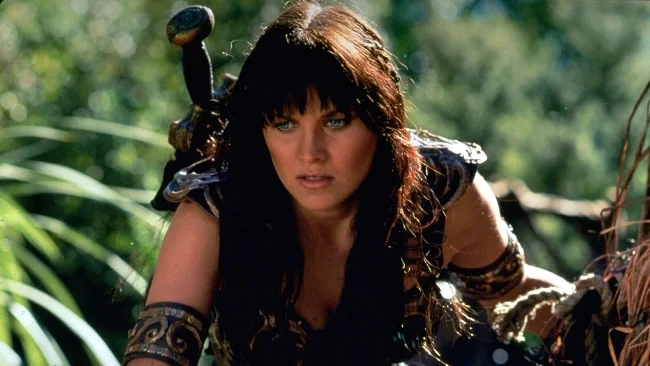
xena_warrior_princess_still.jpg

Tough chicks are in. Check out a poster for Nickleodeon on New York City telephone kiosks, which portrays the cable channel's ideal viewer: A young girl with straight hair and big glasses, she "rides a unicycle . . . [and] picked out the family computer." The clincher? She "can belch on command." A Little Woman no longer, this girl has arrived in Boys' Town, where she will, so the new stereotype goes, beat the guys at their own games: sports, computers, coarseness, and, it would seem from a clutch of TV shows, killing. Of course, dramas about lethal ladies are nothing new. Just ask Hamlet's father. But those earlier murderous models were mere freelancers. The new bunch are organized, trained, and are probably, in some not so subliminal way, advertisements for women in the military. Sigourney Weaver, battling monsters in the four Alien movies, was a prototype. Since then, her character, Ripley, has been joined by an entire regiment. There's Captain Kathryn Janeway of Star Trek: Voyager, ably assisted by Amazons such as the USA Network's La Femme Nikita (secret agent, kills people) and WB's Buffy the Vampire Slayer (high-school senior, kills dead people). Interestingly, the violence on offer is often very hands-on. These women are not afraid of good brawl. There is plenty of fist fighting, kick boxing, and, in Buffy's case, staking through the heart.

But if they took on Xena, the Warrior Princess, they would be crushed. Of all the rough girls, Xena is the roughest. Madeleine Albright claims to have adopted her as a role model—clearly without much success. Xena would have chopped up Saddam and Slobodan years ago. At times the show has been television's highest-rated first-run syndicated drama (which means it would have been watched in about 5 million households). Now beginning its fifth season, it has spawned a Xenaverse of websites, fan fiction, conventions, and Xenarabilia.

Played by Lucy Lawless, a former Miss New Zealand, Xena began life as a character in an episode of another syndicated series, Hercules: The Legendary Journeys. In the space of one hour, she killed six people, was referred to as a "murdering harlot," seduced Hercules' friend Iolaus, and ended up being awarded her own TV show. Xena itself is set in some vaguely classical past, with appearances by Greek gods, centaurs, and Prometheus, but with a time line so wobbly that it would embarrass Johnnie Cochran. As befits a TV heroine in an age with only the vaguest grasp of history, Xena, a person with a presumably normal life span, is at the siege of Troy, finds Moses' tablets of stone, helps David kill Goliath, has sex with Julius Caesar, and runs into the Knights of the Round Table. Widely traveled for a woman from the time of the trireme, Xena even manages to reach China, and, disastrously, India. (A Hindu group complained that, among other offenses, a "snide" warrior princess treated Krishna "in an extremely condescending manner": The episode was later pulled from rebroadcast.)

Through it all --clad, as the statuesque and nearly 6-foot tall Miss Lawless once put it, in a "corset and a whip"—Xena manages to rout all comers. She will use weapons, notably a sharp-edged discus called a chakram. Her favorite approach, however, is a punch-up, generally heralded by somersaults and a war cry of "yi yi yi."

The weaker sex, men, are either feeble, needing Xena's help, or wicked, en route to a drubbing from her. The only man in Xena's regular entourage is a ludicrous, Jar Jar Binks-like figure, Joxer the Mighty. His main function is to wear a stupid hat and to be periodically humiliated. Even Hercules seems a little effete when compared with a heroine who, in one memorable episode, kills a rat with her teeth and then (while still bound in chains) uses the dead rodent as a sort of missile.

In matters of the heart, the male sex likewise comes off as second best. For, it is implied, Xena has given her love to her trusty traveling companion Gabrielle—a petite blonde, girly, certainly, but still someone you'd want to avoid tangling with in hand-to-hand combat. The romance between the two is never explicit. It is, fans like to say, a "subtext." Sub? Episodes of Xena feature enough smoldering looks, "sisterly" kisses, and bathtub scenes to bring a smile even to the grim features of the late Mrs. Roosevelt.

She may have become a lesbian idol, but at least Xena is wittier than Ellen and (much) more attractive than Alice B. Toklas. With episode titles like "A Comedy of Eros" and a supporting cast that could pass muster on Baywatch, Xena doesn't seem to be a program that takes itself too seriously. Yes, yes, there's a message, but we can get over that. The show is fun, with plenty of pretty girls to bring in those vilified, but necessary, male viewers. Even as the Decade of Irony draws to a close, irony is, at least on the surface, the name of Xena’s game. The characters speak in a sub-Melrose patois, interspersed with wisecracks and snatches of dialogue that could be pasted whole into one of those old movies about the Argonauts, Samson, or Richard the Lionhearted.

But sadly, for ail the ironic overay, the Nineties have really been a rather earnest and didactic little era. Women, we are told, need role models to help them overcome the everyday oppression of a brutish patriarchal society. Turning, as always, to the distinguished journal called HUES ("Hear Us Emerging Sisters"), we learn that women "should take the lead from [their] silver screen and TV sisters, and learn to physically defend [themselves], to become women of action rather than passive victims." And what better example than Xena? We should not be surprised that those who propagate one fantasy, that of male oppression, have turned to another for inspiration

Well, in Hollywood, when it comes to the pieties of the age, a certain hushed and opportunistic respect is in the end always the rule. Irony has its limits. So Studios USA, Xena's distributor, claims that the show has become "the preeminent symbol of female empowerment." Meanwhile, in an interview. Miss Lawless solemnly intones that she gets a "lot of letters from women who tell [her] that, after watching Xena, they have bought the Harley-Davidson they always wanted or left an abusive relationship."

Oh, yi yi yi.

Illustrated Men

National Review, august 9, 1999

Tattoo.png

THE German was heavily tattooed, a North Sea Queequeg, but it was when he pulled his trousers down that the crowd finally reacted—with gasps, squeals, nervous laughter. It was not that Theodor—aus Hamburg—was particularly well endowed, just that he was hung like a chandelier designed by Torquemada. There were chains, studs, odd metal piercings, distinguishing characteristics that even Bill Clinton couldn't deny. Theodor's little striptease took place at the Second Annual New York City Tattoo Convention, three inky days in the Roseland Ballroom. Entering that gray, gloomy building you notice a plaque "In Honor of the Married Couples Who First Met Here," a list of names each with the date of that first happy encounter. What, I wondered, would the Lubes (from 1927) or even the Fortgangs (1961) have thought of Theodor?

They would have seen tattoos before. There have been professional tattooists in Manhattan for over 150 years. The Bowery's Sam O'Reilly invented the electric tattoo machine over a century ago. Its descendants were there at the Roseland, the sound of their needles like a swarm of wasps, their sting leaving not venom, but tiny dots of color.

Tattooing was a part of the rough carnival subculture that has long been an American staple, its vaudeville-era stars tattooists with names like "Painless Jack" Tryon, "Sailor George" Fosdick, and Lew "The Jew" Alberts. It may have been banned by God (Leviticus 19:28, since you ask), but in the United States tattooing was a small, half-licensed rebellion, a male-bonding process for tough guys. Marines, the boys in the fleet, even England's George V, a navy veteran, wore one.

The designs reflected tough-guy tastes. Anchors, devils, sailing ships, boxing gloves, daggers, Old Glory, a pair of dice, and, of course, "Mother." Other gals on view might include a busty "Miss Liberty," a bare-breasted mermaid, or a Hawaiian maiden with only a ukulele for modesty.

This brand of macho chic lives on. You could hear it in the Led Zeppelin that thundered through the Roseland's speakers. You could taste it in the Ballroom's bar, where people were drinking Bud and (glorious vision!) smoking. You could see it on the forearms and biceps of the bulky thirtysomethings in the crowd, burly dudes, all ponytails, denim, and tattoo.

But what was Theodor doing here. There was nothing very macho about him. He may have had an Iron Cross hanging from his nipple, but he was pretty weedy, not the sort of man that I'd want in my Wehrmacht. What he was, however, was an illustration of a society in evolution.

We tend to view cultural shifts in terms of some dramatic event: the arrival, say, of Marcel Duchamp at the Armory Show, or Elvis at Sun Records. But history isn't really like that. The greatest changes are, like Theodor's body, marked in countless tiny, mostly unpredictable ways.

And so the endless, tedious campaign against Western values has resulted not in their defeat in some watershed event, but in their gradual transformation, a transformation achieved by innumerable microscopic reevaluations of our culture. Even tattoos have now been reinterpreted. To be sure, there are many for whom a spot of ink is nothing more than what it always was: a bit of fun or, these days, a fashionably naughty gesture. We all know the type, the college girl with a flower above the ankle, the investment banker with enigmatic Chinese calligraphy on his shoulder. According to one estimate, 20 million Americans have been tattooed. But for another, smaller, more self-important crowd, the tattoo means something else. It is part of an imagined "tribal renaissance," an attempt to tap into the (allegedly) superior authenticity of those primitive folk who never left the squalor of the rain forest, mud hut, or atoll.

The problem is that these original noble savages were really just people with too much time on their hands and too few toys. They played with what they had, and what they had was their bodies. Consequently they didn't just tattoo. They pierced, they stretched, they cut, and they scarred.

And so, argue neo-tribalists, should we. At the Roseland, one man posed for gawkers by the door, his bald head a riot of color, his nose, in a nod to headhunter cool, pierced by a bone.

Others milled around inside, the sort of people, I suspected, unable to get through airport metal detectors without drama. Cheek rings glinting in the fluorescent light, these modern primitives searched for specialized merchandise tables, eyeing the latest in septum tusks and nostril screws from Pleasurable Piercings. If you're thinking this sounds more S & M than Samoa, you're probably right. This is not an authenticity that has to be accurate. It just has to annoy, alarm, or provoke. And so tattoos are also creeping across the body, far beyond the point where they can be concealed by a rolled-down sleeve or a buttoned shirt. That would imply discretion, the opposite of this definition of authenticity. The man with a tattooed face is walking graffiti, and we, hopeless conformists, are the bland, blank wall.

Or so he would like to believe. In fact, he's rebelling against an authority that exists only in his imagination. He's messed himself up for nothing. This illustrated man may be a primitive, yes, but only in the sense that he hasn't kept up with the times, in reality, as he fails to understand, nobody really cares what he does to himself. He'll regret it one day. He should get over it.

Oh, that's right. He can't. They don't come off.

Strange Brew

National Review, July 12 1999

Bewitched.jpg

THERE are no atheists, it is said, in a foxhole, but there may, it seems, be witches. Earlier this year, some soldiers at Fort Hood, Texas, the country's largest military base, celebrated the arrival of spring in the way that they, as witches, enjoy. They prayed to the goddess Freya and then leapt over a fire straight into battle with Rep. Bob Barr, the Georgia Republican. In Barr's view, allowing these ceremonies "sets a dangerous precedent that could easily result in all sorts of bizarre practices being supported by the military under the rubric of religion.' What's next? Will armored divisions be forced to travel with sacrificial animals for Satanic rituals?" Democratic congressman Chet Edwards from, riskily, Waco, thinks that's wrong. He is quoted as having "serious differences with the philosophy and practices" of the witches, "but it would be terrible policy to require each installation commander to define what is a religion."

The Army, perhaps remembering the success of earlier pagan militaries (Roman Legions, 300 Spartans, the Mongol Horde), would appear to agree with Edwards. It has worked out an accommodation with the witches, or "Wiccans" as they prefer to be known. Wicca is recognized as a bona fide religion by the Army. Puzzled padres need only turn to the Army chaplain's hand-book. Religious Requirements and Practices of Certain Selected Groups, for guidance on how to deal with recruits who wish to put the war in warlock.

The Army is not alone. Wicca has been recognized as a religion by such authorities as the IRS, Michael Dukakis, and, of course, the courts. In Dettmer v. Landon (1985), the District Court of Virginia noted that Wicca "is clearly a religion for First Amendment purposes," a view that was upheld by the appeals court. That case concerned the right of prisoners to Wiccan ceremonies. More recently, Crystal Seifferly won her legal battle to be allowed to wear her pentacle, a Wiccan symbol, to high school in Michigan. Michael Dukakis? When governor of Massachusetts, he appointed Laurie Cabot the official Witch of Salem.

Which is a safer job than it used to be. In modern America, witchcraft is out of the broom closet and onto the Internet (with over 2,000 websites). The old popular image of Oz's Wicked Witch is melting, melting away, replaced by the sirens of Eastwick, the girls on TV's Charmed, and Nicole Kidman and Sandra Bullock in Practical Magic. ABC has a hit with Sabrina the Teenage Witch. Even Willow, the sensible one in the, er, cult show Buffy the Vampire Slayer, turns out to be a follower of Wicca. Among teenage girls, there's a Generation Hex, with witches becoming something of a role model.

And Wicca is big business. Its books sell well (the Supermarket Sorceress's Enchanted Evenings offers "75 simple spells from supermarket ingredients"). And many cities and towns can boast a supernatural store or two, even Brookland, Ark. (pop: 1,000), where some locals are protesting the opening of Dagda's Cauldron Occult Shop. But don't worry: If Dagda's not around, there's always mail order (Enchantments, Inc., say) for your Hemlock Bark, Twinkle Toes incense, and Squint Oil ("will bring home a straying mate. Secretly sprinkle on clothes").

How many witches are there in America? Accurate calculations are hard to come by (the Canadians, who like to count these sorts of things, recorded 5,500 "pagans" in their last census), but it is generally estimated that there are around 50,000 Wiccans in the United States, a total that is said to be growing fast.

This might surprise poor Bob Barr. Citing an image of George Washington at prayer, the congressman managed to suggest that witchcraft was somehow un-American. He could not be more wrong. For if ever a religion was tailor-made for a contemporary America in full flight from the Enlightenment and the Founding Fathers, it is Wicca.

It is, first of all, bogus. Its origins, we are told, stretch back to the dawn of time, to an age when men worshipped the Goddess. This explains why so many Wiccans communicate in Hobbitspeak, with olde worlde talk of Athanes, Stangs, Runes, Summerland, and scrying-glass. In fact, much of Wicca has a different source; the ancient and fabled culture that was Britain in the 1950s, where numerous Wiccan rites were thought up by one Gerald Gardner, a retired civil servant with a reported interest in nudism and flagellation. (So Wicca is approximately as old as Kwanzaa.)

But there was only so much that Gardner could do. He did put forward a few principles (such as the idea that anything one does, good or bad, will be repaid threefold), a bit of nature worship, and some "magick" (spelled with a k to distinguish it from the David Copperfield variety). In essence, though, he left his religion as something of a blank slate. Transplanted across the Atlantic, it was perfect for a society that attaches a cachet to "spirituality" but where many people don't want the inconvenience of difficult rules or dogma.

So, no coven has a monopoly on Wiccan truth. If you don't like one proposition, just find another, or set out on your own as a "solitary." To be sure, some more general principles are evolving. Lacking much of a structure, Wicca has proved even more susceptible to the fads and fancies of the late 20th century than its more conventional competitors. It tends to be loopily feminist (if you are a man, don't even think about going to the Circle of Aradia's Goddess Campout) and gushingly environmentalist.

And, temptingly, it is a fantasy so much more exciting than humdrum reality. All those Smiths and Browns and Joneses can reinvent themselves as Mountainwaters, Summerwinds, and Willowsongs. Best of all (this is America), new Wiccans become automatic victims, complete with their own personal holocaust. The old European witch manias have been dubbed the "burning times." Of course, most of those killed were not witches in any sense of the word, but no one seems to mind.

What they do care about is the privileged status this supposed victimhood might give them in our grievance society ("warlock," by the way, is held to be a derogatory term, so be careful). The old witch's cackle is being replaced with the litigant's whine. Bill O'Reilly of Fox News ran into complaints from the Military Pagan Network (an actual group, complete with its own website) when, in discussing the Fort Hood controversy, he insensitively referred to a "Bradley Fighting Broomstick."

Aftcr the recent tempest in a cauldron in Massachusetts, he should have known better. There, the unflattering image of a witch contained in a campaign ad run by Gov. Paul Cellucci helped provoke protests (there were, to be fair, more complex issues involved) by the Witches' League for Public Awareness and the attendance of 75 witches at one of the gubernatorial debates. Still, Cellucci won the election.

Contact

Christopher Buckley: Little Green Men

National Review, April 18, 1999

Little_Green_Men.jpg

SPACE aliens are a nasty, bug-eyed lot, always plotting to subjugate the galaxy and firing off death rays. Not much use to us humans, you might think. But you would be wrong. As a plot device, the extraterrestrial can he most useful, a light shone on the peculiarities of this planet. And so, in his latest, and very funny, novel, Christopher Buckley employs a motley and distinctly home-grown bunch of ETs to take a look at a close encounter between two different worlds, both of which happen to be located here on Earth. His hero, John Banion, is a king of the first of these worlds, Beltway Washington: a prince of pundits, a griller of presidents, his Sunday-morning show in D.C.must-see. And the Washington Buckley portrays with his customary collection of one-liners and insightful zingers is a venal, absurd place. He reproduces its portentous language with perfect pitch (an intern program—no, not that one— called "Excellence in Futurity") and its pretentious inhabitants with perfect bitch.

The city described here is salon Washington, the home of power politics at its most trivial, inhabited by a Renaissance Weekend of grotesques, including a widowed hostess who married a fortune and became an ambassador in Europe, and a "suave, immense, baritone-voiced" African-American, the president's "first friend." What of the president himself? He's an "ozone-hugger" who speaks in a "slow, overly patient tone of voice that suggested he wasn't sure English was your first language."

Which may be wise, for as John Banion is soon to discover, it's a different world out beyond the elite enclaves. In The Bonfire of the Vanities, Sherman McCoy arrived there by means of a wrong turn after the Triborough Bridge. For Christopher Buckley's soon-to-fall Master of the Universe, there's no wrong turn—in effect, somebody else grabs the wheel. The luckless pundit is abducted by things, subjected to unpleasant procedures, and then abandoned on a golf course, with a pain down below "that reminded him of how he'd felt after the colonoscopy, a feeling of stretching ..."

It gets worse. A second abduction convinces Banion that the alien threat is real. He has to become the "Paul Revere of the Milky Way" and warn the world. The problem is that his world, the Washington world, doesn't want to know. He quickly becomes an embarrassment, an intergalactic Pierre Salinger. With wicked relish, Buckley shows us how Banion loses wife, contacts, and contracts. Cruel man that he is, the author even makes his Job-like hero go through the ordeal of an AA-style "intervention" by friends.

The inhabitants of another world altogether. Planet Ufology, however, prick up their (wish-they-could-be-pointed) ears when they hear Banion's message. The newsman is just what the saucer crowd has been waiting for. He's famous, possibly even sane, a plausible spokesman far closer to the mainstream than most in the UFO world, a world that Buckley bas obviously researched with care. Its celebrities (with changed names: flying writs are more dangerous than flying saucers) are on parade. And so are its stories, speculations, and just plain hoaxes: Roswell, Area 51, Grays, Nordics, cattle mutilations, even that Richard Nixon/Jackie Gleason business (long story, but, as usual in these matters, it involves alien corpses). And Banion? Well, he's no Sherman McCoy. He refuses to remain fallen but instead picks himself up and becomes a master of this new universe.

Yet even as he is lionized by the crowd at a (marvelously described) UFO conference, our protagonist can't help noting that "there was something lacking in these people's lives." The ultimate insider exchanges his Washington post for plebeian life in the USA today but . . . well, as Egalitarian of the Year he simply does not cut it. Nor does the author, who cheerfully resumes the political incorrectness displayed so enjoyably in his last novel. Thank You for Smoking. Potential offendees include Canada, dwarves, the space program, Eleanor Roosevelt, PBS, electric chairs, Cuban detainees, Indiana housewives, and Sammy Davis Jr.'s missing eye.

As we discover, the UFO nation is not a small one. In fact, you are living in it. Its credulous hordes are large enough to overwhelm John Banion's old Washington kingdom, and the rewards it offers, both financially and in terms of sheer adulation, are far greater. Like one of those Roman generals sent off to deal with the barbarians in the latter days of the empire, Banion is able to return to torment the capital at the head of a vast army of co-opted provincials, in his case a three-million strong "Millennium Man" march.

Then what happens? What can be disclosed without spoiling the plot (the author reveals this detail early on) is the book's underlying premise that the whole UFO business, including Banion's abduction, was a fraud from the very beginning, engineered by Majestic, the most secret of all government departments. Its purpose? Initially, to worry Stalin, but later to keep the U.S. taxpayer sufficiently "alarmed about the possibility of invasion from outer space ... to vote yea for big weapons and space programs."

It's possible (think of the health-care "crisis" or global warming), but X-philes who read this book will find the idea a little far fetched, even for a satire. Conspiratorially, they will talk about the documents that purport to show that Majestic really did exist. Patiently, they will explain that the aim of this real Majestic was not to fabricate UFO evidence, but to conceal it. Darkly, they will tell you that, if these documents are genuine, Buckley's tale can only help to mislead a country that has already been misinformed for far too long.

And why would the author do this? For a clue, check out the career of his hero, the television pundit be puts in the firing line. That's also his father's job. Yes, his father, that same "W. F. Buckley" who was mentioned twice in Jim Marrs's Alien Agenda, last year's expose of the UFO cover-up. Could Buckley the Son be part of the conspiracy?

I don't know, but next time you are in the Buckley neighborhood, watch out for those black helicopters.

Feywatch

The Frick Collection, New York City: Victorian Fairy Painting 

National Review, December 21, 1998

Richard Dadd: The Fairy Feller's Master Stroke (Detail)

Richard Dadd: The Fairy Feller's Master Stroke (Detail)

CONFOUND Victoria, and the slimy inhibitions/She loosed on all us Anglo-Saxon creatures!" That was what the New England poetess Amy Lowell thought back in the 1920s. To judge by a fascinating exhibition (and the response to it) currently on view at New York's Frick Collection, hers is an opinion still with us today. For the Victorian era is the foundation of our town, and, as such, it has now become yet another battleground in the culture wars. Bring the Victorians down to our level, and we can reassure ourselves that our shambles of a society is really not that bad.

The exhibition is called "Victorian Fairy Painting" and it is dedicated to our tiny fluttering friends. The little people hover, frolic, and entice in canvas after canvas, along with a supporting cast of goblins, elves, and imps.

John Anster Fitzgerald: The Captive Robin

John Anster Fitzgerald: The Captive Robin

Strange to us, yes, but in their mid-Victorian heyday, these pictures were popular, in tune with their era. According to reviews of this show, they are also in tune with our own age. Writing in The New Yorker, Peter Schjeldahl notes that "this stuff. . . feels right on time for us." Leslie Camhi at the Village Voice likewise uses the fairies to admit the Victorians to our own idiot carnival. Both periods, apparently, have "seen the revival of druidism, crystal worship, and a host of ancient spiritual practices."

So were the Victorians old-time New Agers? Writing In New York magazine, Mark Stevens claims that the Victorian interest in the occult "honored what could not be explained or ruled." I doubt it. The New Age rejection of the scientific method would have appalled a nineteenth-century culture obsessed with the search for explanations and rules. With their relatively primitive science, the Victorians may have come to some loopy conclusions, but they were at least trying to get at the truth.

Yes, that's right, the truth. Unlike many of us post-moderns, the Victorians believed in an objective truth. But not, for the most part, in fairies. Even in art. To get the supposed pixiemania in proportion, take a glance, for instance, at the leading paintings of the 1846 Royal Academy Exhibition. They're a down-to-earth lot, far from any enchanted glades. Highlights include Mulready's Choosing the Wedding gown, four animal pictures by Landseer, and Redgrave's thrilling Sunday Morning—The Walk from Church.

It is no coincidence that a number of the most striking works on display at the Frick are by painters who were outsiders. The greatest of them all, Richard Dadd, murdered his father. His obsessively detailed masterpiece. The Fairy Feller's Master Stroke, was the product of nine years' work in a lunatic asylum. That's also where Charles Doyle (father of the creator of Sherlock Holmes) ended up. His Self Portrait, A Meditation, shows a man all too aware that the spirits surrounding him are the product of a troubled mind.

Chatles Doyle: Self-Portrait, A Meditation

Chatles Doyle: Self-Portrait, A Meditation

And they were certainly nothing to do with pollution. In a Sierra Club twitch, the Frick tries to explain the fairy paintings as "an escape from the grim elements of an industrial society." Not really. Arcadian fantasy had been around long before the factories of Victorian England. It is a nice irony, however, that the great engineer lsambard Kingdom Brunel was the man responsible for commissioning the only fairy painting by Queen Victoria's favorite artist, Edwin Landseer. Actually, be wanted a Shakespearean theme for his dining room. What he got was A Midsummer Night's Dream, featuring a sultry Titania, and Bottom, of course.

Sir Edwin Landseer: Scene From 'A Midsummer Night's Dream'

Sir Edwin Landseer: Scene From 'A Midsummer Night's Dream'

In fact, quite a number of bottoms. Offbeat nudity was a good part of this genre's appeal—both at the time and to later critics eager to show that the nasty Victorians were both repressed and (bonus!) perverse. To Mr. Schjeldahl these paintings exemplify "Anglo-sexual hysteria." More cautiously, the Frick's own introduction to the show refers to an "indulgence of new attitudes towards sex." "Hysteria," a "new attitude"? Nudie pics were popular long before the appearance of the fey babes now tumbling along the walls of the Frick.

Tumbling, one must admit, in a way not normally associated with Victorian Britain. Yet this was a Britain where John Simmons's Titania, a lissome blonde vaguely draped in the most diaphanous of robes, could be displayed without scandal. For that, thank the butterfly wings sprouting from the fairy queen's shoulders. They took Titania out of the real world and transformed her into something too ethereal for the grubby business of sex. To Michael Kimmelman in the New York Times, all this is "a form of collective sexual denial that is a root of the phrase 'there'll always be in England."

John Simmons: Titania

John Simmons: Titania

Oh, come on (full disclosure: I'm English). Foxy fairies were just an update of an old trick. Earlier artists had used "classical" themes (a "Venus" here, a "Sabine Woman" there) in much the same way. Ultimately, these paintings were just about fun. As Charles Dickens understood, "Fairy tales should he respected. … A nation without fancy, without some romance, never did, never can, never will, hold a great place under the sun." Sentimental and coy they may have been, but to most of their fans, the fairies were just otherworldly entertainment, a very small part of a very rich culture, little more than the science fiction of an era when imagination was lagging behind technology.

If we try to project out own obsessions onto them, it is we, not the Victorians, who are in Never-Never Land.

Joseph Noel Paton: The Quarrel of Oberon and Titania (detail)

Joseph Noel Paton: The Quarrel of Oberon and Titania (detail)

Mug's Game

National Review, December 6, 1998

Starbucks-Logo.jpg

“Ohhh,” Monica e-mailed her boyfriend (no, not that one), "how i long for the time when we can just spend a day together ... starting w/ coffee at Starbucks . . ." Starbucks. It's where an intern bought a mug to give a President, and it's where Nicole Simpson first met Ron Goldman. I go there, and so, probably, do you. By the year 2000, the chain, which started with a single store in Seattle, will have two thousand outlets. We spend $1 billion a year there. When future historians try to conjure up the atmosphere of the Clinton years, they will have to include the faint smell of roasting coffee, preferably a variety— Ethiopia Yergacheffe, perhaps?—from some really Third World part of the Third World.

At first glance this may seem a welcome development in a country once famous for the horror of its coffee. Still, if we are what we eat, then we should also be what we drink. The flight from Folgers must mean that we have changed.

Well, the country is richer. Hardscrabble is so over. So we reject that older Robusta America in favor of a mall-chic coffee where the person behind the counter is a "barista" and the smallest serving is a "tall." Starbucks has become a symbol, a sign of class and a certain refinement. Its coffee is an object of desire at $3 (or more) a shot. Aficionados are "cuppers," bean geeks able to discuss the "tanginess" of a Costa Rica Tres Rios without bursting into laughter.

We shouldn't mock this. Aspiration is the engine that drives America. Yet there is something wrong: consider the music of Starbucks, the CDs lined up for sale by the register.

Not the jazz. That their stores play and sell jazz is no surprise. Starbucks is marketing its coffee as a grown-up pleasure and to many, jazz has always been sophistication’s soundtrack. No, the company's taste in contemporary music hints at the problem. Starbucks urges upon us pop of the most improving, didactic kind. Songs of the Siren, a 1996 "tribute to women's voices," was one finger-tapping choice. Naturally, the feminist rockers of Lilith Fair have not been overlooked. The company is a "proud sponsor" of the tour, in a "perfect blend of coffee, community, and music."

Now take a look at the books on sale amid the Frappuccini. Naturally, an Arabian Mocha Sanani drinker does not Hunt for Red October with Tom Clancy. But Marion Wright Edelman? That's much more like it. One of her offerings is on display at my local Starbucks, near the Van Gogh mugs and that timeless childhood classic. Girls Who Rocked the World: Heroines from Sacagawea to Sheryl Swoopes.

You may also find a recent memoir by Starbucks CEO Howard Schultz, Pour Your Heart Into It. Starbucks is a great American success story and a triumph for Mr. Schultz, a kid from Brooklyn's post-war projects. But the world view revealed in this lugubrious volume (printed, in case you were worried, "on totally chlorine-free paper") sometimes seems more Alger Hiss than Horatio Alger.

Mr. Schultz downplays his formidable business skills, but makes sure to mention his health-care kaffeeklatsch with Bill Clinton. The rest of this drearily "progressive" recital includes some over-excited environmentalism (who could forget the epic struggle over "double cupping," the now-abandoned practice of putting one paper cup into another to protect tender fingers from hot coffee) and cloying reminders that the Starbucks CEO wants "diversity in our management team."

And surely a strong bottom line. As Mr. Schultz is doubtless aware, political correctness sells. In the eyes of pious Boomers, all the NPR-ishness only burnishes the coffee chain's upmarket image.

It's a piety that Starbucks exploits brilliantly, which would be fine, so long as everybody else were not expected to play along.

But they are. And as the success of Starbucks shows, they do. The Boomers may have had the party, but the whole country has to live through the hangover. A generation that never could say no to itself is proving very eager to say it to the younger folk. Like grumpy older neighbors, they want the stereo turned down and the strong drinks put away. As Howard Schultz explains, he is trying to offer a place where students can meet "free from the heavy influence of alcohol."

The only heavy influence around is that of the paternalistic Mr. Schultz. He is the perfect spokesman for an era when "decaf latte" has entered the upper-middle-class lexicon as shorthand for a little self-indulgence.

Indulgence?  Once we knew the true meaning of that word. Indulgences should be decadent, degenerate, altogether de trop. They should not be decaffeinated.

The 1890s swept cheerfully by on a torrent of absinthe, champagne, and opium. Today, smoking is out, sex is "inappropriate," and a few beers will get you branded a "binge drinker" by Harvard's School of Public Health. Which leaves coffee. It's allowed, and pathetically the country is grateful, even excited. Too FDA'd out for real, unvarnished bad-for-you fun, America has defined delight down.

Like the English were once said to do, Starbucks drinkers "take their pleasures sadly." Even the modest pleasure of a little Java has to "mean" something. These days, it's the coffee that has to make us "good to the last drop." So Starbucks steps in with the sip that sanctifies.

Suddenly I want a Maxwell House. Double-cupped.