Gulag Amazonia

Amazons of the Avant-Garde

National Review Online, October  22, 2000

mowers.JPG

Long, long before the NEA's chocolate-smearing Karen Finley, there was Natalia Goncharova. Tall, thin, and living in sin, the occasionally cross-dressing Natalia managed to scandalize turn-of-the-century St. Petersburg. She would cover her body with daubs and designs, a ziggurat, perhaps for the face, naughty drawings (why not?) for her breasts. Imperial Russia was not quite ready for this. Goncharova's "Pink Lantern" cabaret performances ended in riots, and her paintings were condemned as sacrilegious and obscene. They were neither. And, as we are reminded by a current exhibition at New York's Guggenheim Museum, in yet another contrast with the Finleys of today, her work was often very good. The exhibition, "Amazons of the Avant-Garde," is dedicated to Goncharova and five other women artists of early Twentieth Century Russia, Olga Rozanova, Liubov Popova, Alexandra Exter, Varvara Stepanova, and Nadezhda Udaltsova.

Mercifully, despite its name, the show is no work of feminist revisionism. The description of these painters as "Amazons" dates from their own era. It is a quote lifted from the writings of one of their (male) contemporaries. Despite this, Goncharova and her friends were not generally seen as specifically "female" artists. Nor did they seem to have viewed themselves in that way, a dereliction of duty that appears to have disappointed Charlotte Douglas, one of the contributors to the book that accompanies the Guggenheim show. As Ms. Douglas sadly explains, the Amazons " accepted and worked almost completely within the male exhibition-and-sales paradigm." What vulgarity. Ladies, presumably, are not expected to do anything as grubby as selling their paintings. Worse, these traitors to their sex "considered themselves artists first…In this, a gendered identity seems to have played hardly any role at all." How disgraceful.

What the exhibition does do, however, is remind us yet again of the vibrancy of the late-Romanov period, a time too often characterized as a Lara's theme park of troikas, palaces, and pre-industrial peasantry. In reality, it was an age of rapid, and generally positive, economic and social change, and it had the art to match. Strikingly, for those of us used to the Soviet-nurtured notion of Russian "otherness" it was a culture that, at least in its avant-garde, played a full part in the wider European cultural scene.

The Amazons traveled in France and Italy. They moved in the same circles as Picasso, Braque, and Leger. Their art reflects this. There are experiments in Futurism, Rayonnism and Cubism, all part of a dialog with their counterparts in the West. Often, delightfully, these are combined with elements of the painters' own national traditions. In Goncharova's marvelous "Mowers," we see hints not only of Gauguin, but also of Russian vernacular lubok prints, while her "Evangelists" owe an obvious debt to the icon painting of earlier generations.

Evangelists.JPG

But tradition was not really where the Amazons' interests lay. In keeping with the restless spirit of their age they wanted to be innovators, increasingly testing the limits of abstraction along with fellow members of the Russian avant-garde, if sometimes a little derivatively. Some of Olga Rozanova's Suprematist works of 1916 add little to what Kasimir Malevich was doing a year or so before. On the other hand her extraordinary "Green Stripe" (1917) anticipates Mark Rothko's color fields by more than thirty years.

Green_Stripe_(Rozanova,_1917_(Costakis_collection)).jpg

1917, of course, was also the year of the Bolshevik Revolution. This was no coincidence. The red flag and the Green Stripe were connected, both of them symptoms of the collapse in the existing economic, political, and cultural order. It should be no surprise that the Amazons rallied in support of the Communists. For years, they had, like many others in the world of Russian arts, spouted a hysterical Susan Sarandon-style leftism. They saw themselves as part of a more general assault on the ancien régime. These people may have drawn on the rich resources of Russia's heritage, but, when the time came, they were quite prepared to join in its destruction.

Given this political orientation, and the usefully dehumanizing Implications of the Russian avant-garde's "scientific" view of painting, this was welcome support for Lenin's new administration. The parallels with Soviet ideology were obvious. Both these artists and the revolutionary authorities wanted an absolute break with the past. They were determined to impose their own supposedly scientific rules, whether it be at the easel or on the population. The squares, circles, and triangles of the new art became the typeface of the new regime.

To artists this was heady, flattering stuff. Now they could live their revolutionary dream, remaking society on the streets as well as on canvas. To her frustration, Natalia Goncharova was out of the country, but the other Amazons were quick to take up jobs within the new system. They were content, it would appear, to support the work of a government that was already beginning to slaughter any possible opponents including, in the case of Nadezhda Udaltsova, her father. Interestingly, it was not a government that Goncharova was ever to see at first hand. She continued to proclaim leftist beliefs, but at a safe distance. She never returned to the Soviet motherland, opting instead for the West and relative obscurity. It was a wise choice.

Staying in Russia, however, was not. Popova and Rozanova were both to perish of ill-health within a tragically short time, victims of the terrible living conditions that prevailed in the early Bolshevik years. Exter got out in 1924, but, as an emigre, was never to recapture her former glory. Udaltsova, who should have known better, persevered in the workers' paradise, even managing to survive the execution of her husband in 1938. She lingered on, miserably poor, into the Khrushchev years. Stepanova enjoyed a relatively successful career in the USSR, at least for a while, as a propagandist for the regimes of both Lenin and Stalin. However, as Party orthodoxy changed away from her own brand, she found herself increasingly marginalized. Unlike so many discarded activists, however, she avoided the Gulag and died, largely forgotten, but untouched, in 1958.

If there is a certain sadness about this fascinating show, it is because it is a tale of six tremendously talented individuals, each of whose lives were to end in failure, mediocrity and waste. Like many of the cruelest tragedies, it was, at least in part, self-inflicted. It is an irony apparently too awkward to be addressed at the exhibition, but each of these women played a part in the building of the system that was to ruin their lives. In a way they were even lucky. They died in their beds, and in their art they at least have a monument. Millions of Russians were not so fortunate.

This raises another question. It is not a comparison that you will find made at the Guggenheim, but were its Amazons really so morally different from Leni Riefenstahl, the warrior queen of another avant-garde, that of Hitler's Germany? Goncharova may have been a cheerleader from the sidelines, but the other Amazons were active participants in the cultural support system of a Soviet regime that was murderous from the start. Like Riefenstahl, they were brilliant innovators whose talents were put to the work in the creation of a vicious totalitarian state. And so, just as Leni Riefenstahl's work, however spectacular, can never, quite, avoid the stink of Auschwitz, nor should the art of the Amazons be shown without any reference to its Gulag taint.

Sadly, in this exhibition, the Guggenheim is doing just that.

Reefer Madness

National Review Online, October 10, 2000

Hague.JPG

For the Right Honorable William Hague M.P., leader of Her Majesty's Opposition and heir to Margaret Thatcher, the substance abuse never seems to stop. First there was the beer. In an interview with GQ magazine earlier this year, Mr. Hague revealed that as a young man he would occasionally drink as much as an impressive 14 pints a day. It was an announcement that split the nation. Some Britons chose to believe the Conservative leader, others thought that he was making it up. Either way Mr. Hague was in trouble. To prudes he seemed to be endorsing binge drinking. To the UK's tipplers, however, he was a bar-room Al Gore, boasting about imaginary achievements in a vain attempt to impress the crowd. The controversy lasted for weeks, and allowed Tony Blair's increasingly accident-prone Labour government to regain some political momentum.

And now there is the difficulty over cannabis, a problem that arose, rather surprisingly, in the middle of last week's Conservative party conference. These conferences are an annual British political ritual, a gathering of the faithful for each of the main parties. They bear some resemblance to U.S. political conventions. Labour's event, presided over by a Tony Blair literally sweating with tension had not gone that well. Arguments over too high gas taxes, too low pensions and London's ill-fated, expensive and empty Millennium Dome were capped by the publication of a book detailing the poisonous relationship between Mr. Blair and his finance minister. Incredibly, the Socialists had even fallen behind the Tories in the opinion polls, the first time that this had happened since 1992.

The Conservative conference was designed to build on this Labour weakness and, indeed, to demonstrate the very real progress that the Tories have made since their disastrous 1997 defeat. With an election expected next year, the conference was to be a showcase for William Hague's claim that his party was ready for government. Initially, all went well. Then, fatefully, Ann Widdecombe began to talk about reefer. As she spoke, the chances of a Tory government began to recede, dispersing, it seemed, in a puff of smoke. The showcase had turned into a chamber of horrors.

And Miss Widdecombe was the principal exhibit. For what she has to say is important. She is in charge of the Conservatives' domestic policy, one of the two or three most powerful people in a party that has had a weakness for a strong woman since the days of you know who. The spinsterish Ann Widdecombe is also a truly English eccentric. A diminutive figure with a dress sense borrowed from the Janet Reno House of Style, she has a resemblance to Margaret Rutherford and a pudding-bowl haircut straight out of Laurence Olivier's Henry V. A century ago Miss Widdecombe would have been a missionary in some remote corner of the Empire, and she would have been a good one. Hospitals would have been founded, schools would have been built, ancient cultures would have been destroyed. Clever, determined, and decidedly odd, "Doris Karloff" has turned her unconventional appearance into a political weapon, a useful symbol of her plain-speaking image.

It is an image that she uses to push a fairly standard law and order populism, an agenda which, as she explained to the conference, is going to include zero tolerance for cannabis users. Anyone, even a first-time user, caught in possession of marijuana would be given a mandatory $150 fine and, with it, a criminal record. And that is what caused the trouble. For current practice in the UK is rather more laid-back. Of the 100,000 people charged with cannabis possession last year around half (typically first time users) were "cautioned" (a "caution" is an official "don't do it again" police warning, and does not carry a criminal record).

As she spoke the conference applauded, but they were cheering the way to electoral disaster. In an age of largely consensus politics, relatively trivial issues can assume an iconic importance far greater than they deserve. Within a few hours Miss Widdecombe's hard line on pot had come to be seen as a rejection of recent attempts to build a more inclusive party, a party that would also have more appeal to the young (or even the middle-aged — the average paid-up Tory is over 60 years old). Symbolically too, the speech was seen as a clumsy blow to Mr. Hague's efforts to triangulate between the two distinct traditions, libertarian and paternalist, that co-exist rather uneasily within the modern Conservative party.

Worse, various senior policemen weighed in to criticize the mandatory fines as unworkable, not the most encouraging sign for a law and order initiative. No one appeared to have discussed the new policy with the people who would have had to implement it. It also quickly became obvious that the proposed scheme would criminalize too many people, and too many of those people, realized some of the shrewder Tories, would be the children of electorally critical "Middle England."

Within a few more hours the back-pedaling had begun, hastened along by the sudden confessions of eight members of Mr. Hague's cabinet. All eight, it seems, had inhaled at some time in their distant pasts. The Conservatives' culture spokesman had, excitingly, also once had amyl nitrate thrust up his nose. In a refreshing change from politicians' usual 'I tried it once/it made me feel ill/I couldn't see what the fuss was about' one or two of the eight actually admitted to having enjoyed the weed. Their youthful 'experiments' had, it seemed, been a success.

The Labour party, meanwhile, is saying little and its cabinet is admitting to nothing, not even the viewing of a Cheech and Chong movie. This cannot last, but, for the time being, Prime Minister Blair is, I suspect, just enjoying the fun. For, politics being politics, Tory back-pedaling is being accompanied by Tory back-stabbing. Some are now suggesting that Ann Widdecombe was set up for a fall by a rival faction within the party. Others are using the whole fiasco to question William Hague's leadership abilities. Mr. Hague, meanwhile, is backing Miss Widdecombe "150 percent", which is a number that should make her very uneasy. 100 percent would do, William, if you meant it.

All this, of course, will be punished at the polls by a British electorate that has repeatedly shown that it has zero tolerance for dazed, confused, and divided parties. As for the mandatory fines themselves, well, they are now being compared to speeding tickets, and William Hague is praising his team for "starting the debate about drugs." If those words herald the beginning of a re-examination of this issue within the Conservative party so much the better. The current laws, let alone these recent proposals, give too much power to big government. They also do not work. Those are two good, Conservative, reasons to oppose them, and they are reasons that would fit neatly into a wider critique of a Labour government that is as overbearing as it is incompetent.

Realistically, however, the chances that the Tories would be prepared to take the risk of supporting such an approach are remote. Probably not much more, in fact, than 150 percent.

Red Affront

National Review Online, October 3, 2000

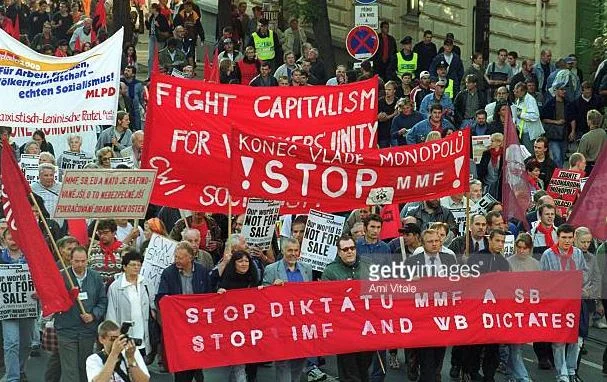
Prague.JPG

In some senses, Prague got off lightly. In London, after all, "anti-capitalist" demonstrators had recently spray-painted the Cenotaph with the suggestion that Britain's principal war memorial would make a good place to urinate. The mainly foreign protesters in Prague last week were far more refined. They merely chose to march into town under red flags and the hammer and sickle, symbols of a regime that not so long ago was murdering and imprisoning tens of thousands of Czechs.

The occasion, of course, was the joint annual meeting of the World Bank and the IMF. Such events now attract the protests of another set of anti-capitalists, the vicious travelling circus of the anti-globalization movement, and the intimidation and violence that it brings with it. This was the case in Seattle and Melbourne. Now it was Prague's turn.

Anti-globalization is the latest manifestation of the Left's seemingly indefatigable attempts to mess things up for the rest of us. Undaunted by the economic, environmental, and human disaster of socialism's last hundred years, they have now turned their angry attention onto free trade, and the supposedly sinister forces behind it, the World Bank and the IMF. There are, of course, differences from the past. This new Left is not as monolithic as its predecessors. The iron discipline of the Comintern has been replaced by a plethora of tiny cells, connected, strengthened, and somehow amplified by the power of an Internet able to create an impression of size even where none exists. So, the Prague action was meant to be supported by demonstrations across the globe, each of which was excitedly previewed on the web. In Melbourne, C.A.C.T.U.S. (Campaign Against Corporate Tyranny United in Struggle) was planning a carnival, while in Bangladesh the Garment Workers Unity Forum and the Revolutionary Unity Front intended "to make a demonstration waving black flags." In these United States, steelworkers in Chicago were apparently preparing to confront Harris Bank with a puppet show.

Harris Bank was left intact. Prague was not so lucky. Six or seven thousand protesters arrived from abroad, determined to shut down the city in the name of their version of global justice. Naturally, they were quick to move on Wenceslas Square, a sacred place for many Czechs, the heart of their Velvet Revolution, but a site of tragedy too: the spot where, in 1969, Jan Palach, a young student who really understood what idealism was, burned himself to death in protest against an earlier generation of invaders that had come to this city. Then, of course, it was the Soviet Army, but, as we have seen, the symbols of the anti-globalizers, those red flags, that hammer and sickle, they are just the same. And so was the message: "Do it our way, or there will be violence."

Of course, no one was ever that explicit. Most of the protesters were quick to come out with statements rejecting any violence, but their websites gave them away. One of the most prominent contained a list of suggested activities that included "occupations of offices, blockades and shutdowns, appropriating and disposing of luxury consumer goods, sabotaging, wrecking or interfering with capitalist infrastructure, appropriating capitalist wealth and returning it to the working people." That does not sound entirely peaceful to me.

The producers of www.destroyimf.org were more straightforward, running with the slogan "Turn Prague into Seattle." Many protesters tried to do just that. In the process they cost the people of what is still a poor country a great deal of money. Demonstrators fought with police, ripped up sidewalks, threw Molotov cocktails, and, in what is rapidly becoming an irritating cliché, stormed McDonalds, the franchised Winter Palace of their gimcrack revolution. The comrades at www.destroyimf.org could barely conceal their excitement at the drama of it all, a re-run, it seemed, of the glorious days of the Bolshevik rising. To one John Reed wannabe, September 26 had been "the day the IMF died." Judging by the breathless commentary on their website, it had been eleven hours that shook the world: "1215: Fighting begins; anarchist column takes the railway below the bridge. 1400: Protest columns fan out to the south and east. 1900: Column surrounds opera house. 2300: Minor running battles and windows smashed."

It seems that the revolutionaries were, at least in part, successful. The IMF and World Bank proceedings wound up a day early, the organizers unconvincingly claiming that they had completed all the work that they had come to Prague to do. Even if that were true, they should have stayed put, sipping champagne to pass the time and to make their point, occasionally, perhaps, hurling a few stale canapés into the baying mob below. The early retreat was a sign of weakness, and it was not the first from the supranational financial institutions. Since the whole anti-globalization movement started gathering pace, official reaction has been a blend of appeasement and apology. We caught a glimpse of this approach at Seattle in Bill Clinton's shifty "defense" of free trade, and we have seen plenty of it since then.

This is strange. It is not as if the foes of globalization have much intellectual force behind them. Their arguments are a blend of Al Gore greenery and Maoist economics, all wrapped up in a sort of sickly sentimentalism about the Third World that would, in fact, further impoverish that luckless part of the world. Bogus, economically illiterate, and potentially catastrophic, it is not a case that should be difficult to rebut, but none of our leaders seems to be trying hard to do so. Instead we see shame-faced equivocations or worse, the Uriah Heep-like pandering of those such as World Bank President Wolfensohn, a man pleased to pronounce that we live in a world "scarred by inequality." In between their bouts of savagery, the protesters in Prague were, he noted, "asking legitimate questions."

What nonsense. Here and there, you may find a true believer. There was the British schoolteacher who confided to Reuters that she was in Prague because her clearly rather odd child "often woke up in the middle of the night, frightened about global warming." For the most part, however, the game being played in the Czech capital was of a different, much nastier kind. It was partly about violence, the sheer Clockwork Orange fun that a punch-up can bring, and it was all about power, the right to boss everybody else around.

For all the talk about the working classes, the dispossessed seamstresses of Latin America, and the impoverished women farmers of Africa, the demonstrators tended to be Western European and university-educated. For such people, protests of this nature reinforce their bourgeois sense of moral and social superiority over the lower orders, the class they feel born to rule. As one of the organizers, Martin Shaw, a "Nottingham University graduate and anarchist" explained to the London Daily Telegraph, "Working people do not have the benefits of an educational system and they are afraid of losing their jobs." Not only that, but these blue-collar saps are couch potatoes, sitting back "in front of their televisions," grumbled another activist, rather than joining the battle against world capitalism. The corollary of this is that the "working people" need the Martin Shaws of this world to put things right for them. If you think that this sounds like the early 20th-century revolutionaries, you would be right. There is the same apocalyptic language, the same overweening sense of self-importance, the same absence of a paying job.

Unfortunately, too, there are the same prospects of some very real success. For, at bottom, these protesters are speaking the language of those very organizations that they claim to oppose. To take one, closely related, example: Environmental activists used to perform the same outsider role as the anti-globalizers do today, but much of their belief in regulation and control proved appealing to the soft-left consensus that prevails in our international institutions. And so, to their barely concealed delight, environmentalists found themselves co-opted into the global bureaucratic process. Their unelected, unaccountable pressure groups were magically transformed into "Non-Governmental Organizations." Better funded, but still unelected and still unaccountable, these NGOs were given consultative seats at the supranational legislative table. The result, at least in part, was the ludicrous Kyoto treaty.

A similar future beckons for some appropriately house-trained anti-globalizers. The cluttered WTO agenda in Seattle was evidence that officialdom is open to some of their ideas, an impression that Mr. Wolfensohn's platitudes will have done nothing to contradict. In Prague, indeed, certain pressure groups were invited to meet and debate with the IMF/World Bank delegates. This will only be the beginning of a prolonged courtship and, as for those other Non-Governmental Organizations, you and me, well, you can be sure that we will not be invited along.

Candida's Camera

National Review, Sept 11 2000

royalle_candida.jpg

WHEN actress Candida Royalle (Legends of Porn, Classic Swedish Erotica 2, Teenage Pony Girls) announces that she is "going to be hard on you," you sit up and pay attention. Not that we needed the warning. We had all paid good money ($49) to see her perform, and we were sure she would not let us down. Nor does she. True to her name, Candida is open, frank, and often very revealing. Miss Royalle knows how to give a good lecture. Yes, lecture. To the crowd gathered in an upstairs room in Manhattan's "School for the Physical City," Candida Royalle is much more than a sex star. She is an entrepreneur, sharing her hard-won practical insights with an eager and ambitious audience. The event has been arranged by The Learning Annex, an "alternative adult-education organization" that offers evening classes at a number of cities across the country. The demand for its "powerful, inspirational, nurturing, and insightful" seminars is in the American tradition, a reminder of the relentless drive for self-improvement that took this nation from log cabin to Martha Stewart. Recent courses have included Spanish, calligraphy, running your own laundromat, the power of persuasion, becoming a medical transcriptionist, and "Breaking into Adult Movies—in front of or behind the camera!"

Candida's pupils are ushered into a large, brightly lit classroom painted in the Pokemon palette that only an educational bureaucrat would choose. It's all very normal—Educating Rita rather than Deep Throat. There's no buzz, no guilty anticipation, just a naughty pile of coarse, er, course materials heaped on a side table: flyers for FOXE ("Fans of X-Rated Entertainment"), an order form for Breaking into XXX—the Porn Stud Handbook. And our teacher? Miss Royalle is a trim fortyish blonde in a short skirt, more Mary Kay than Miss Jean Brodie.

This is not enough to hold two members of the class, who slink off within minutes, disappointed perhaps to discover that the evening will not feature "adult situations." Maybe they will be back for the Tantra lessons ("Reach higher levels of sexual ecstasy than ever!"). The only other source of awkwardness is the presence of a film crew shooting the lecture for National Enquirer’s TV show. Strangely, not everyone wants to appear in front of these particular cameras.

These are shy folks, mostly. One woman, an exotic dancer, is interested in making "bubble-bath-type videos" for her fans, but she is an exception. This mainly male crowd doesn't want to get naked. They want to be "suits," Sam Goldwyns of smut. That's wise, for as our lecturer explains, the life of a wannabe porn stud is far from easy. Performing under conditions that would make even Priapus pause (Viagra helps, apparently), men are props, not star attractions. As such they are not likely to make much money. Most people aren't renting adult movies to gape at the guys. So the women are paid more. As even the EEOC might agree, this is not discrimination, it's the marketplace.

Which is really the theme of the evening. Naughty pictures are now a significant American industry. The Nude Economy is for real: By some estimates, annual sales of pornography in the U.S. alone already exceed $10 billion. That's a Fortune 500, Wall Street Journal kind of number, one that tells us, among other things, that proper management has finally come to this improper trade. And that's where the Learning Annex fits in. As Candida's students earnestly take notes, she briskly runs through the economics of adult video, who gets paid how much to do what to whom, the complexities of copyright, the perils of distribution, and the market in foreign licensing.

It's surprisingly dry stuff, and the ensuing discussion is matter-of-fact. In the United States, business is a serious matter, and while we have come a long way from the Comstock laws, our cheery, upbeat lecturer is subject to an equally demanding set of rules, those of American enterprise. To Candida's obvious delight, it's a tough code and a little austere. And in the way she describes it, with relish and without irony, there's a touch of Cotton Mather, a hint of the old Puritan idea that self-denial is the key to success. The boogie nights are clearly over. The film set should be free of drugs and alcohol and carefully budgeted. The artistic impulse must also be kept firmly under control (only "one-third of the film can be story, with 60 minutes for sex"). There's respect for hard work, suspicion of ripoffs ("Watch everything, watch everyone . . . if it's yours, watch it like a hawk"), and a shrewd appreciation for what counts—the bottom line in every sense.

Unfortunately, these days the bottom line is not enough. Sanctimony has evolved, not died. We live in a time when many businesses, particularly those with a potential image problem, feel they have to go beyond the buck. They like to demonstrate, at least in their advertising, that they have some higher—usually vaguely politically correct—redeeming social purpose. Forestry companies become model environmentalists, brewers natter on about "responsible" drinking, and "the people of Philip Morris" are so busy sheltering abused women and feeding the hungry it's amazing they have any time for making cigarettes.

Candida Royalle is no exception. A few years ago the former "teenage pony girl" founded Femme Productions to make films that, she says, that men too will want to watch. Now she takes herself, well, a little seriously. As her website notes, Candida has "addressed many conferences . . . including the World Congress of Sexology, the Smithsonian Institution, [and] the American Psychiatric Association." Sadly, it's not enough for her films to be dirty, fun, and profitable. In our relentlessly didactic era they must also promote "positive sexual role modeling."

What's that? Well for one thing, something that, as we are clearly expected to know, Republicans oppose. Like most corporate piety, Candida's spiel has a liberal tinge. As some readers may remember ("House of Porn," October 27, 1997), Ms. Royalle is a founding member of Feminists for Free Expression, and presumably someone well able to understand that the principal threat to her business comes from a much larger group, the feminists against free expression and their fellow-travelers in the "progressive" camp. Despite that, her talk is punctuated by moments of leftish political commentary. There's an almost nostalgic swipe at "Reagan/Meese" and a dark warning that if George W. is elected, "we're really in for it."

But her audience doesn't seem worried. This is a Coolidge crowd. Their business is business. They have no more interest in discussing threats to free expression than a moonshiner would have in debating Prohibition. To these aspiring pornographers, the First Amendment is a commercial device, not a human right. They want to concentrate on record-keeping, employee relations, soundtracks, budgets, legal obligations, and the uses of DVD ("save your bloopers"). It's all about the economics of sex. Though far from romantic, it is still a pursuit of another American fantasy, the dream of success. Is it true, asks the exotic dancer, that one porn star makes "as much as $150,000 a year"?

At that, two stockbrokers in the class exchange faintly superior smiles. Still, they understand where she is coming from.

Greed is . . . Sorta OK

Bull

National Review Online, September 10, 2000

Bull.jpg

It could be time to sell. In 1987, Hollywood gave us Wall Street. The market promptly cratered. 1929 saw the release of not one, but two films with Wall Street in the title. They were followed by the Great Crash and the even greater Depression. Well, I don't want to panic anyone but this year we've already had one stockbroker movie, Boiler Room. Now TV is following suit with two Wall Street-themed shows, Fox's The Street (set for November) and TNT's new weekly drama, Bull. There's another reason for the market to be nervous. Wall Street is a place that Hollywood just loves to bash. Just think back to Gordon Gekko or Danny DeVito in Other People's Money. Boiler Room too was hardly flattering. At first glance, Bull seemed certain to follow the same course. Within minutes we have met Corey Granville, a bond salesman at investment bank Merriweather Marx. He is doing well, but behind his back, the firm's WASPily distinguished patriarch wonders aloud whether Granville understands that there's a "glass ceiling in [his] future". Corey, of course, is African-American.

The patriarch, Robert "the Kaiser" Roberts, is quickly set up as a monster, a Skull and Bones savage straight from central casting. We see him compounding his racism with hypocrisy (he loans Corey "his" table at Lutece) and casual sexism, offhandedly delegating this task to his "girl." The term, outraged viewers will know, is "administrative assistant." For extra flavor, there's an echo of Gekko. The Kaiser arranges an insider trade, organizing the transaction in such a way that, if it is discovered, Marissa Rufo, an innocent associate, will take the blame. The innocent associate is, naturally, ethnic, female and from a working class family. To put icing on the bottom of the cake, we discover later that Ms. Rufo's mother has Alzheimer's.

In another episode predatory financiers launch a greenmailing attack on the regular folks in a "real business." This "real business" is a familiar cast member in movies about finance, and is generally used as a proxy for the concerns of Main Street. In the 1987 Wall Street the sacrificial lamb was an aviation firm, while in "Other People's Money," the designated victim was an old New England wire and cable manufacturer. At some point a noble employee of the menaced company always makes a speech about how the investment bankers should "stop going for the easy buck and start producing something."

In Bull the threat was to Ashton Paper, the principal employer in an, of course, idyllic, Bedford Falls, Mayberry sort of town (red, white and blue bunting, Patsy Cline playing in the local diner). The moving speech is made, one of the investment bankers has the obligatory crisis of conscience, but then, and here's the rub, the greenmail succeeds. If that's not surprising enough, the greenmailer, "Lasky the Liquidator" (marvelously played by Stanley Tucci), works for the show's good guys, HSD Capital, a rival firm set up by defectors from Merriweather Marx and led by the patriarch's grandson.

Successful greenmail? Investment bankers as good guys? That's what I call popular capitalism. Bull is a drama for our 401(k) age, a CNBC lite for the new investor class (at times, confusingly so — there's a break in the show for a "Bull Report" containing real financial news). For at least as long as the current prosperity endures, the Oliver Stone, hostile approach to Wall Street is likely to be a hard sell. Bull's producer has been quoted as saying that "sixty percent of Americans own stock. Wall Street is not for the Gordon Gekkos of the world any more. Wall Street is us." Coming from Hollywood, that's pretty encouraging.

On the details, sadly, Bull is not very accurate. Viewers hoping to learn something about the capital markets might as well take up medicine on the basis of watching ER. Vaguely impressive sounding technical terms are thrown into the dialog, and, in one case, a seduction, but, like Star Trek's dilithium crystals, they wouldn't get you anywhere in the real world. The type of business that the firms do is also unclear, as is how they do it. Merriweather Marx is, apparently, a world leader, despite having a trading floor of only about 25 people (some of whom use cellular phones on that trading floor, a no-no in today's era of compulsorily taped calls).

The defectors, meanwhile, are able to open up for business overnight (impossible, given the time-consuming regulatory procedures imposed on new securities businesses). Their firm appears to be an M&A boutique with a sideline in commodities trading, an impressive achievement for a company with a payroll in the single figures. Then there's the wardrobe. Investment bankers these days tend to dress down, each expressing their individuality in chinos, blazers and polo shirts. The men in Bull, by contrast, seem to take their lead from an issue of GQ, circa 1985. Demonstrating the height of Milken-era chic, they wear power suspenders, and in one shocking incident, a yellow tie.

But this is to nitpick. The important thing is that a TV show is being made in which it is not, automatically, a sin to win on Wall Street. Indeed, when the grandson tells his team to go out and "grab some green," the audience is meant to cheer, not jeer. This is real progress. Seen in this light, the portrayal of Patriarch Roberts is a familiar plot device: villains have to be villainous. Of course, the fact that he is a WASP archetype is no coincidence in our PC times, and nor is the decision to make him both racist and sexist. In contemporary Hollywood, there are no greater offenses.

So, which will prevail, Bull's underlying positive message or the annoying political correctness in which it is clothed? Will it remain as entertaining as LA Law or will it descend into the soupy moralizing that wrecked the later M.A.S.H? After only three episodes, it's too early to say, but watching the development of a number of the key characters will give a good idea.

The most important of these is Lasky the Liquidator. Hunter Lasky, brought into the upstart firm as a rainmaker, looks like being the show's equivalent of LA Law's Douglas Brackman, a thinning-on-top older guy with an eye to the bottom line. His cynical observations are a way for Bull's writers to signal that they still have their doubts about Wall Street. If Lasky turns really nasty, that will be a bad sign. As it will be if his mistress, Alison Jeffers, the show's obligatory ambitious blonde, keeps failing to sleep with important clients. Alison dear, that's what ambitious blondes do. Corey Granville, meanwhile, needs to concentrate on his career. We've already had warning of a cliched "what does it mean to be an African-American on Wall Street" sub-plot.

Finally, and worst, potentially, of all, some of the HSD team is shown attending a fundraiser for Hillary Rodham Clinton. If these people are Democrats, Bull is a sell. Fortunately, there could be another explanation. The staff at HSD trade commodities, but not, judging by one episode, very well. Perhaps they were just going to our cattle futures-trading First Lady for advice.

Given her record in that field, that would be just fine, and so, for now, is Bull.

Are You Experienced?

National Review Online, August 27, 2000

© Andrew Stuttaford

© Andrew Stuttaford

"Turn left on Mercer and drive for a few blocks. What you are looking for is the blob at the bottom of the Space Needle." My friend Steve may not be an architect, but he knows a blob when he sees one. A few years ago Microsoft billionaire Paul Allen asked Frank Gehry, the creator of the Guggenheim's extraordinary Bilbao extension, to build him a "swoopy" building for Seattle's new rock 'n' roll museum. What he got was a blob. It sits, shining in its multicolored aluminum skin, a crushed jelly-mold duomo. Its campanile, the Space Needle, is all Jetsons geometry, the product of a time when we thought the 21st century would be straight lines, monorails, and Mission Control order. Now that we are arriving there, we believe in a crumpled, curvier, softer future, more Barbarella than Bauhaus, an age, it seems, when gee-whiz museums feature not atom science, but Atomic Rooster.

As blobs go it's impressive, but I'm not sure that Mr. Gehry's new building is quite as innovative as Paul Allen might have hoped. In the aftermath of Bilbao, the Seattle museum looks suspiciously like a retread, a scrunched-up re-run of the earlier Spanish triumph. Maybe this is only justice, as the idea of a rock 'n' roll museum is not exactly novel either. As miffed folk in Ohio will be pointing out, they've had one in Cleveland for a few years now. Its architect, I. M. Pei, was also associated with a dramatic extension to an existing museum, in his case a pyramid at the Louvre. Mr. Pei's construction is meant to be reminiscent of a turntable, Frank Gehry's is said to be inspired by one of Jimi Hendrix's smashed guitars. The two also share something else much more significant: the problem that rock music is a difficult subject for a museum.

Rock music, any music, is about the moment, the moment that may become a memory. It's that rush as an old familiar riff slides out of the speaker, or the dawning excitement one minute, two minutes into a song, when you realize that this new band is very, very good. And it's nostalgia too. There's a sweet pleasure in listening to those tunes that take you back to your first kiss (Rod Stewart, I'm afraid), university days, a trip abroad, or even that one glorious, delirious night in a Tennessee bar. It's the memories, the associations, and, of course, the sheer joy of the music itself that count. Anything else, like the packaging we used to have on CDs, is just so much clutter. Sure, as VH1's current programming shows, the story of rock 'n' roll can be interesting, but its artifacts, unfortunately, are not. Be warned: The Seattle museum has 80,000. It's the Hard Rock Cafe, but with less emphasis on the cheeseburgers.

There are guitars, hundreds of them, some in pieces (thanks, Jimi!), but most are intact, battered, shiny, painted, Gibson, Fender, and Les Paul, the guitars of the famous, the guitars of the obscure. Near the entrance, there is even a sculptured cascade of guitars. Silent, all these instruments are dull, lifeless totems. Like the stuffed animals in our more depressing natural-history museums, there's not a lot of point to them. It's the same way with the museum's prize architectural exhibit, preserved like the Temple of Dendur in New York's Met, the wooden arch that once led to Moe's Mo' Roc' n Cafe (Seattle, 1994-97) or the tatty finery of bygone rock stars (Janis's feather boa, Heart's sort-of-medieval gowns). I mean, who cares? Only the posters and handbills, visual art of a sort, are really still worth a look, miniature reflections of their respective eras: simple text from the plain Jane 1950s, Haight-Ashbury rococo, the angry sub-Constructivism of punk.

Luckily, however, you get more for your $19.95 than this. Sensing, perhaps, that these exhibits might not quite make it into the Tate, Mr. Allen and his team seem hesitant about calling their blob a museum. No, formally, it is an "experience," the "Experience Music Project" (EMP). The name, of course, is a tribute to Jimi Hendrix, a Seattle native and an idol of the software billionaire's, but it also reflects the fact that this display is (probably inevitably, in a project funded by the new economy) "interactive." Now, when I was a boy an "interactive" (not that we used the word) museum exhibit meant pressing some button on a dingy control panel. A number of bulbs would light up, and you would know just a little bit more about the circulation of the blood or the habitats of some dreary animal. Or you wouldn't. Normally several of the bulbs were out, and to your surprise you would discover that no corpuscle ever reached the foot or that the rabbit was extinct.

We have moved on. The EMP features a "sound lab" which "invites your inner musician to come out and play." We all have one, apparently. My inner musician joined the crowd pounding the "Jam-O-Drum" (it generates rhythms and colors) a few times and made a fool of itself on some machine designed to show that any idiot can play the first few chords of Louie, Louie within a few minutes. Not this idiot, apparently.

The inner egomaniac, meanwhile, could be tempted by "On Stage," a high-tech version of the air guitar you used to play (admit it). The visitor is taken to perform in a virtual arena "complete with smoke, hot lights and screaming fans." The instruments are programmed so that even an novice can "play," and "play" the novices did. Those standing in the real and very long line outside could watch their virtual show on closed- circuit TV.

Then there's MEG, the "Museum Exhibit Guide," an extraordinary upgrade of the battered cassette players that are most galleries' "audio tour." MEG is a device that looks a little like a tricorder from the old Star Trek. Point it at many of the exhibits and a menu will pop up, offering much, much more detailed information, often in the shape of oral history and, crucially, snatches of song. It does its best to bring those dead guitars, and the EMP, to life. Rock 'n' roll nerds can even bookmark areas of particular fascination and, using the ticket I.D. number, download yet more material onto their PCs when they get home to their darkened bedrooms.

Technologically, it's spectacular. It's also spectacularly stupid.

All these megabytes to research Megadeth? Conservatives will, correctly, see the EMP as yet more evidence of a dumbed-down society, but they should get some comfort from the fact that in its vaguely new-agey way, the EMP is a squeaky-clean, family-values sort of place. Much of the interior may be rough and unfinished — an attempt, we're told, to recreate the feel of a rock venue — but it fails. This is the rock in Norman Rockwell. There's no spilled beer, vomit, or smell of reefer. It's "smoke-free." Parents and children wander round together, bland in their khaki shorts and pale polos, checking out the B*tthole Surfers' memorabilia together. The heart of the building, its "gathering place [and] personification," a cavernous space, 85 feet tall at its highest, is even described as a church, the "Sky Church." (Well, I did say new-agey.) EMP is also patriotic — British music hardly rates a mention. Those Beatles will never catch on.

Ultimately, EMP is absurd, of course, a ludicrous allocation of $240 million, but so what? There's no need to worry about that. It was Paul Allen's money, his to spend how he wanted, a great, glorious self-indulgence, his reward to himself for entrepreneurial success. And yes, his museum may be a poor tribute to rock 'n' roll, but as an advertisement for the wild energy of the free market, it's right up there, right at the top of the charts.

Hollywood Ten

National Review Online, August 8, 2000

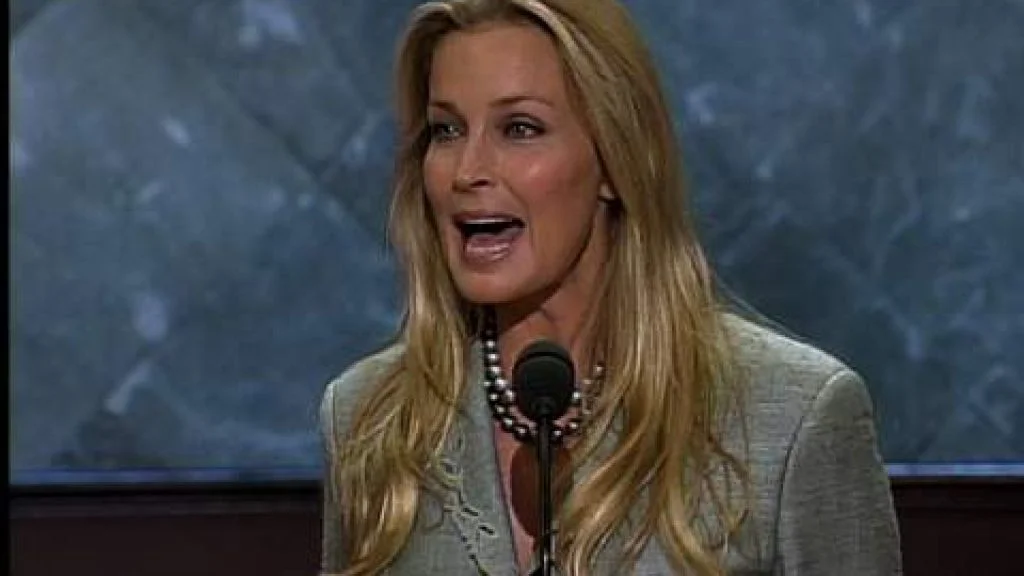
Bo Derek.jpg

Is there no end to the empathy? It's a long, hard GOP convention for the hard-hearted among us, a grim procession of blind mountaineers, teachers, "the children," breast-cancer advocates, diabetic beauty queens, and deaf ones too. Tonight, though, twenty minutes or so after the showing of a "compassion video," the podium will brighten up. As the Republican's convention website boasts, a "film icon" is coming to town. Hepburn? Bacall? Well, no. It's Bo Derek, actually, more of a poster than an icon, perhaps, but a welcome visitor nonetheless. And who'd have thought it? Bo Derek, a cheerleader for George W. Yes, that's right, THE Bo Derek. You know, cornrows, the 10 girl, sex goddess of the later disco era, the seductress clad in a wet swimsuit, and, often, gloriously, much much less.

It turns out that she's on the right, an unlikely star for an all too strait-laced party. She's a Republican and has been for years. Back in 1996, she was quoted as saying that her heroes included General Schwarzkopf and Presidents Reagan and Bush. As for Bob Dole, well, "the man was an absolute superman. His energy wiped me out." And that was before the Viagra.

Bo's no Barbra Streisand, though. Sure, she'll speak at the convention for a minute or two, but for the most part she's happy to play the supporting role. She isn't a Hollywood wonk, with a program for every problem, hectoring and haranguing the peons as to how they should live their lives. As she has explained to Fox News's Bill O'Reilly, "movie stars…live in a bubble…and for me to give my opinions and maybe influence anybody is absurd."

Her Republicanism seems practical, unideological. As a younger woman she saw herself as a Democrat. She thought the Democrats were "nicer people" who cared about people more. Then filming abroad opened her eyes: "You can't help but compare America to other countries the more you travel, and that's when I just realized in looking [at] different issues that I was a Republican." The free market, she realized, works. Welfare is fine "when people really need help, but as a lifestyle, I don't think it's good for the people receiving it…It discourages dignity and incentives."

She is no social conservative. It would be better to see her as a R-rated Christine Todd Whitman. A (generously illustrated) profile in the current issue of Cigar Aficionado describes her as pro-gay rights, pro-choice and, on occasion, anti-clothes. "We're born nude and it just seems like the most natural thing." There's a brief nod in the direction of some feminist piety (something about women voting the same way), but I suspect that Bo is never going to be one of the sisters. She had an unforgivably happy marriage to a much older guy, she took off her clothes in a lot of movies and, let's face it, she just looks too good.

However, her opinions don't make her look good in notoriously liberal Hollywood. It is even hinted that Bo's politics may have held back her career. Well, maybe, but when that career includes Bolero, Tarzan the Ape Man, and Ghosts Can't Do It, there may be another explanation. Nevertheless, when she describes the reaction to her views, her story rings very true. "It's really tough to have a nice, open conversation," she told O'Reilly. Apparently, her entertainment-industry pals "get really angry…and they treat me as though I'm some hateful monster."

Yes, I bet they do. They are liberals, supporters of that other cigar aficionado, the one in the White House. And, as we all know, the Left doesn't have much time, or respect, for anyone who dares to disagree with them. As Bo's clearly discovered, Democrats are not "nicer people." She's brave to speak her mind, but she's going to be lonely. Conservatives in the movie business are few and far between, and they are likely to stay that way. There's Moses, of course, our own Charlton Heston, and some of the more secular action heroes, Willis, Norris, Schwarzenegger, but these guys do have a touch of the last stand about them. TV isn't much better, although it was good to see Rick Schroder, NYPD Blue's Lieutenant Sorenson, at the convention on Tuesday night. He was smart, compelling, and — unlike most of Republican showbiz — under 40. Otherwise, the Right is only left with a presence in country music (and I'm not so sure about that k. d. lang) and wrestling, of course: the Rock, the thinking man's Jesse Ventura, is in the GOP line-up.

Sadly, this isn't going to be enough, and even more sadly, this matters. In our tranquil, ill-educated times, showbiz sets not only the cultural, but the political agenda. The drip, drip, drip of a predominantly liberal message in the movies, TV, and the other entertainment media is bound to wear through to the ballot box. We saw this in Britain, where a hostile cultural scene proved to be the harbinger of the crushing Conservative defeat in the 1997 election. Writing in the London Sunday Times the following year, the newspaper's then-resident leftist, the writer Robert Harris, noted — with, probably, some satisfaction — that he couldn't think of one single "important" British writer or, for that matter, a film director, theater director, composer ("apart from Lord Lloyd Webber"), actor, or painter who was a Conservative.

As Mr. Harris went on to point out, "the entertainment and fashion industries are now two of the biggest economic sectors in the world. Never have we lived in a time more conscious of style, and never in democratic history has it been less stylish to be on the right."

Now, he was writing in a British context, but, like it or not, it's not too difficult to see the same process gathering pace over here. It's not going to be easy to reverse. On this battlefield, the Right are simply too few. Sure, Republicans have got the Rock, but the Democrats have the (Sharon) Stone. Bo Derek may turn some heads, but she's not enough to turn the tide. Suggesting a solution to this problem is beyond the scope of this article, but to those who say that this all doesn't matter, that substance will prevail over style, I have only three words to offer: William Jefferson Clinton.

The British Are Groaning

The Patriot

National Review Online, July 3, 2000

the-patriot-mel-gibson.jpg

I may be slow, but I'm beginning to think that there's something about us Brits that Mel Gibson doesn't like. First there was Gallipoli in which he played a plucky Australian soldier sent to fight the Turks in World War I. Mel and his fellow recruits are portrayed as free spirits, condemned to a tragic death by their snobbish and incompetent colonial masters, the English.

Then came Braveheart and the limeys get libeled again. The dust and sun of the Dardanelles may have been replaced by the rain and mud of medieval Scotland, but the bad guys remain the same, duplicitous, callous and very, very English. In Braveheart a curious, ahistorical fable (strangely described in NR and NRO as a conservative movie) Mr. Gibson, who also directed, plays William Wallace as a tartan reprise of his role in Mad Max The Scottish leader is shown as, you guessed it, a virile free spirit, a broadsword-wielding contrast to the cruel, yet foppish, invaders from the south. The English are bad in battle and worse in bed. To underline his hero's masculine superiority over the effete enemy, Gibson has Wallace successfully romancing a proto-Princess Diana, Princess Isabella (Sophie Marceau). As Isabella was French and her husband, the English king's son, was homosexual, Gibson's audience may see this as less of a coup than the star would have liked. They would be wrong. Such an affair would have been a truly remarkable testament to Wallace's powers of attraction as, in real life, the mutinous Scot never actually met Isabella. Mr. Gibson, however, doesn't always worry too much about real life.

Which brings me to The Patriot, Mel's latest assault on the evil empire (London edition). In this Revolutionary War epic Mr. Gibson plays, yet again, a splendid free spirit, Colonel Benjamin Martin, a South Carolina farmer loosely based on Francis Marion, one of the heroes of the American war of independence. Martin is a good father, industrious farmer and all-round upright citizen. After the usual agonized "war is bad" introspection required of the fighting man in contemporary entertainment culture, he is also a devastatingly effective warrior — Mad Max in a tricorn.

His opponent, Bad Max, is the beastly English colonel, William Tavington. He too is meant to be based on a real person, the ridiculously named Banastre Tarleton. All sneer and saber, Tavington torches churches, burns congregations alive and shoots children in the back. The closest we get to a sympathetic Redcoat is, unpromisingly, Lord Cornwallis, but he, sadly, bears the stigmata of the typical Gibson Englishman. He's a fop (there's a lot of fuss about his clothes), a loser in war, and a loser in love — his two Great Danes are seduced away from him by Colonel Martin. In a manner rather reminiscent of Princess Isabella they then spend the rest of the movie chasing after Mr. Gibson with their tongues hanging out.

There are others, however, on Mel's tail. A small, rather less friendly, posse of British journalists is also in pursuit, citing the numerous historical inaccuracies that litter the movie. Well, why not? The Patriot can easily be seen as a crude caricature of the English. A few snippy comments from London are to be expected. We're used to Mr. Gibson by now, but his film has come at a bad time. In Saving Private Ryan Steven Spielberg wrote the British out of D-Day, and you had to wait until the final credits to discover that the all-American heroics of the recent U-571 were based on a British exploit.

Now there's a movie planned on the German POW camp at Colditz, with some successful American escapees mysteriously added to the historical record. How, I wonder, would America react, if the English treated U.S. history in this way, making, perhaps, a movie about 'Nigel' McCain (played perhaps by Ralph Fiennes), the RAF's man in the Hanoi Hilton? Not well, I think. We English on the other hand, can take this punishment with only a grumble or two. We beat Hitler (by ourselves, actually, according to my latest film script) and we can survive Hollywood.

So, do your worst, trash our past. We don't care. We've got plenty to spare. And it's not just the past, Brits are bad in the most recent Mission Impossible, a Die Hard or two, even Buffy the Vampire Slayer (Spike, the really nasty vampire). And you don't have to stop with villains who are at least nominally English — Josef Mengele, Darth Vader, Hannibal Lecter — we'll take your money and play them all.

Is it a nasty stereotype? You bet, but the English won't complain (much). It's the Americans, who probably should, however. In the culture wars, the movies' constant characterization of the British as venal, effete and vicious is, I suspect, a last kick at the United States' faded WASP ascendancy, a sly reminder that, in Hollywood's view, this country's Anglo roots should no longer count for very much.

But, unsurprisingly, they do with me, which is why I could enjoy The Patriot without too many (English) patriotic qualms. In many ways the American Revolution was a continuation of a long argument over how Britons should be ruled, the second round, if you like, of the seventeenth century civil war in England. Yes, the troops sent across the Atlantic by (German) George III were sent packing — but it was by folks called Washington, Gates and Pickens. It hurt at the time, but when we British consider our history, a defeat only counts when it's to people with names like Schmidt, Watanabe or Depardieu. In the Revolutionary War, you see, we Brits essentially lost to ourselves, and that's not so bad. We just won't mention that Lafayette fellow.

So in The Patriot, you watch two opposing armies, both of which march under the red, white and blue — the English of the Philadelphia regime against the English of the London government. In the end, the better Englishmen won. The away team, my team, left the pitch at Yorktown and went off to establish a second, wider, empire — a remarkable achievement, Mel, for such a feeble race. The victors, meanwhile, went on to build a country that has inspired the world. So, this year, as I always do, I'll celebrate the fourth of July. Drink in hand, I'll toast the men who made this possible, the founding fathers who wrote, in that Declaration of Independence, some of the finest words that have ever been written in the English language.

Yes, that's right, the English language. My language.

Loud and Clear

National Review Online, June 16, 2000

PRDay.jpg

The ‘wolf pack’ attacks in Central Park were a disgrace. The reaction to them — an unappetizing blend of ethnic politics and PC posturing — has not been much better, evidence of a mindset that, if it didn't exactly cause last Sunday's nightmare, certainly paved the way for it. Key to it is the idea that the police are always in the wrong. If they make an arrest they've gone in too hard, probably, it will be alleged, from racist motives. Any mistake will bring vilification, maybe prosecution, and certainly Al Sharpton. As for the cops involved in the Diallo tragedy, their bonus was pre-trial condemnation as murderers by the First Lady of the United States.

If, on the other hand, the police do nothing, they are also to blame. They are lazy bums, we will be told, more interested in their next doughnut than helping the public. And this, of course, became the spin on Central Park. Leftist lawyer Ron Kuby, a newcomer to the law-and-order crowd, worried that the police may have been sitting 'on their fat butts' rather than doing their jobs. Ah, what sweet liberal relief.

Awkward questions over the Puerto Rican parade could be glossed over as the media turned on an easier target — the police. The story became not what the bad boys did do, but what the NYPD didn't do, the "Cop Out" as the Daily News put it. Inevitably, Reverend Al caught the mood, appearing as an adviser to two of the victims in a $5,000,000 lawsuit against, not, naturally, the assailants, but the city.

Of course, much of the criticism was unfair. Rudy Giuliani's claim that 2,500 bottles of beer had been confiscated may have had the ring of desperation about it, but most cops did a good job. Also, it must be remembered that it's not easy to see what's going on in the middle of a huge crowd. Spotted from a couple of hundred yards away wilding can all too easily be mistaken for high jinks, spring-break fun, rather than feral nastiness.

Besides, if the police had moved in and acted pre-emptively, what would have been recorded by all those amateur video cameramen in the park? Not women, naked, humiliated, and in tears, but white cops pushing their way through a minority crowd, and I think we know how the evening news would have played that story. Somebody else would have sued for $5,000,000. The police explanation that the mob was about to get out of control would have been rejected, as being based on derogatory, racist assumptions.

Mind you, it appears that, on this occasion there is something to the criticism: Too many of the police were those crucial couple of hundred yards away, at the perimeter rather than in the action. Police treatment of some of the victims also left much to be desired and added to reports of crowd control that seemed strangely detached, "lackadaisical" in the words of one witness. A disturbing number of New York's Finest just did not want to get involved. In short, NYPD blew it, and if you believe the conspiracy theorists, they did so, because they were told to.

This has been denied, and believably so. There was no need: The police are getting the message. Why take that risk, why go down that darkened alley, when your only reward is Geraldo to Couric to Rosie criticism on the TV? The constant agitation is taking its toll. Cheap shots at the police claim more victims than just the boys in blue. It's no coincidence that Big Apple crime figures are on the rise, and not only in Central Park. Across the Atlantic the Brits have gone down the same anti-police route, culminating in the publication of an official report of absurd political correctness. The consequences? Street crime in London is running at twice last year's levels.

And if there was a day for a cowed New York police force to be careful, restrained and low profile it was last Sunday. At the National Puerto Rican Day Parade there can be no room for anything that could be remotely interpreted as a Sipowicz moment. Ethnic parades are a weird phenomenon, more Serbia than Central Park, yet they are the principal symbols of New York's ruling ideology, the "glorious mosaic" of former mayor David Dinkins, a vision of racial harmony best represented by that old Coke commercial ("I'd like to teach the world to sing"). In reality, of course, such a view is not the real thing. So the police normally take a pretty tough line with parades, confiscating drinks, lining the streets, and generally delivering a message of zero tolerance. Just ask the folks on St. Patrick's Day.

But there wasn't enough of that last Sunday. Zero tolerance was, at times, replaced with anything goes. Revelers may have been 2,500 bottles short, but as one onlooker explained, "alcohol was all over the place." It wasn't supposed to be that way, but then with the Puerto Rican Day parade it rarely is. For the authorities want us to believe that this parade is the jewel in the mosaic, "an annual celebration", as Hillary's website puts it, "of Puerto Rican culture, music and ethnic pride," a happy and enjoyable day for all. In reality, as is inevitable with almost any large gathering, the picture is more tricky than that. Mentioning that fact beyond, perhaps, a coy reference to "exuberance," is not part of the liberal script. It was fascinating to see that, as the first serious reports of trouble emerged, New York politicians were quick to defend the parade. There had been problems, certainly, but they couldn't be allowed to get in the way of the greater 'truth' that they wanted us to hear. The day had been a success, they soothed in the tone of voice that they would have used to tell Mrs. Lincoln that, yes indeed, the play had been a smash.

And sadly, the police had learned their lines too well.

Moms Away: The new brand of gun nut

National Review, June 5, 2000

 © Andrew Stuttaford

 © Andrew Stuttaford

IT'S not so much what they said (although that was bad enough), but how they said it. Several hundred thousand gun nuts were gathered on the Mall. They were hectoring, self-righteous, and, when it came to firearms, quite incapable of rational discussion. I'm referring, of course, to the "Million Moms" and their march. It was Mother's Day 2000. The Moms were in D.C. to call for "commonsense" gun control—licensing, registration, the usual thin edges of the wedge. There was opposition from the Second Amendment Sisters, but theirs was only a small rebel encampment, all baseball caps and American flags.

 © Andrew Stuttaford

 © Andrew Stuttaford

This day belonged to the other side, to the pink and white T-shirts of the Million Mom March. It was a triumph for Donna Dees-Thomases, the self-styled "suburban mom" who organized the march. It had taken around nine months to set up. As Mrs. Dees-Thomases, a publicist by trade, likes to say, "women understand what you can create in nine months." The march itself (which was really more of a rally) was impressive, seemingly flush with cash (thanks for the free bottled water!), and well organized. There were tents, placards, posters, pink banners (but rarely the Stars and Stripes) fluttering in the breeze. Charlton Heston didn't show, but there were plenty of other celebrities, all under the command of a stern-faced Rosie O'Donnell. The Moms themselves were a disciplined bunch, standing for hours under a hot early-summer sun, attentive to the speeches coming from a large stage. They could also gaze at a number of giant screens dotted around the Mall that showed images of the audience, the speakers, and, from time to time, misleading statistics of the "if you have a gun in the house you are doomed" variety. This being the United States of Oprah, there were occasional moments of tears and communal hugging, but not too many. This was a disproportionately upscale group, more restrained, Katie Couric rather than Erin Brockovich.

 © Andrew Stuttaford

 © Andrew Stuttaford

It was also a crowd of dupes. The Million Mom March was brilliantly manipulative agitprop, a textbook example of how the Left will find a potentially popular, modest-sounding issue and twist it in a way to help along their agenda.

Not that they will admit it. These campaigns are always portrayed as being above mere politics. Donna Dees-Thomases is at pains to stress that her cause is "bipartisan." It is, of course, unfair, very unfair, to draw any conclusions from the fact that her sister-in- law is Susan Thomases, a longtime confidante of Hillary Rodham Clinton, but if this rally was independent it was only in a very NPR sort of way. Hillary herself attended the march, and her husband videotaped a message of support. Gore 2000 stickers and signs were everywhere. I did see one placard concerning George W, but it suggested that he "wasn't fit to run a laundromat." On the podium the (so to speak) big guns were more discreet. Susan Sarandon briefly slipped the leash with a speech that seemed to be headed in the direction of five-year plans and the collectivization of agriculture, but most speakers stuck to the subject—"commonsense," limited firearms legislation. That was their single issue, they claimed, and "in November" they want it to go the Moms' too. If it is, Al Gore will be in the White House and, ultimately, the Bill of Rights will be in the outhouse.

 © Andrew Stuttaford

 © Andrew Stuttaford

They may succeed. Gun control resonates with all those suburban moms who feel that firearms are, well, icky. Back in the early 1980s, their mothers or aunts or older sisters used to feel the same way about cruise missiles. Disarmament then, and now, is a perfect wedge issue that can be pitched purely at the emotional level. Speaker after speaker talked of an epidemic of gun violence. Singer Melissa Etheridge kept "hearing a lot of fear." Well, yes, Melissa. That's because of events like this march. Death, we were led to believe, stalks the suburbs and the schoolyard, and he's packing heat. In fact, over the last 20 years the murder rate's down and firearms-related accidents have fallen dramatically. All this at a time when gun ownership has greatly expanded. Even schools are safer. But you won't have heard those facts at this rally.

The Moms aren't big on facts or reasoned argument. Their spin kit ("Public Relations 101") has firm instructions for supporters wanting to publicize the march on TV or in the newspaper: "Before your interview, inform the local media contact that you will not engage in debate with others." To discussion, these mothers, like others in the "progressive" camp, prefer the coercive language of crisis (health care, global warming, you name it) to push their agenda. It's an approach that works best when it can be tied in with real tragedies. And so it was on the Mall. Homemade placards bore the pictures of murdered loved ones. Speakers included a teacher from Columbine, grieving mothers, and crippled children, a trail of tears designed to lead to only one conclusion. There was, of course, no mention of those thousands whose lives have been saved by the defensive use of guns.

Yes, thousands, probably far more. But as Mrs. Dees-Thomases understands, what politician is brave enough to raise that point with a teacher from Columbine? Just in case someone does dare, the Moms' leader bas another arrow in her quiver. She bas labeled her march a campaign for "safe kids." As she knows, Americans seem to accept any number of restrictions on their freedom so long as they are allegedly for the benefit of "the children," the Trojan Ponies of our liberty. To this end, the Moms' keynote deceptive statistic (every campaign should have one) is that twelve "kids" are killed every day by gunfire (to reach that number, you have to include tots of 19). At the rally itself, the imagery was child-centered. There was a stroller march down the Mall and a sing-along with Raffi. Up on the stage, it was W. C. Fields's hell; kids making speeches, kids singing songs, and even kids lining up to ring a sort of reverse Liberty Bell (it was made from melted-down guns). For those who had not already had enough of little children, the viewing screens would occasionally show footage of yet more.

The only people able to speak for all these youngsters, it was argued, are mothers. They have to be the right sort of mothers, of course. Pistol-packing mamas need not apply. Dads, of course, didn't rate a mention.

For the Moms, this is seductive stuff. It tells them that they are a uniquely moral force, that they are important, custodians of the future or something like that. No wonder they are lapping it up. The implications for the rest of us are not so great. The underlying message of the march was that society has to be run, first and foremost, in the interests of its children as determined by (approved) moms. And whatever else that means, it means more gun control. To those who ask why, writer Anna Quindlen had one. revealing answer: "because I said so." The crowd went wild—laughing, cheering, and repeating the phrase. They forgot one thing. The American people are not all children.

Or are they?