Let Them Eat Cake

National Review Online, February 20, 2001

Warren Buffett.jpg

Egalitarianism is a dimwit's doctrine at the best of times, but when we hear it from the very rich, it becomes simply grotesque. With Marie Antoinette it took the form of sheep. She liked to dress up in supposedly rustic clothes and, surrounded by groveling courtiers and gamboling lambs, would pretend that she was a shepherdess. Outside the palace grounds real farm workers lived in real poverty, but their fate was, naturally, of no concern to the queen of France. Now, Warren Buffett is no Marie Antoinette. There are no lambs in his life. Instead, the Sage of Omaha prefers to demonstrate his egalitarianism by supporting grave robbing.

Surrounded by groveling accountants and gamboling leftists, the "aw shucks" billionaire has become a leader of a new campaign to preserve the estate tax. Meanwhile, beyond the Buffett zone of IRS-exempt foundations and well-paid tax lawyers, the levy on dying continues to march onward.

The technical arguments against the estate tax are examined elsewhere in NRO, but it is may be worth taking a closer look at those wealthy folks who are spearheading the latest effort to defend it. The centerpiece of their campaign is a petition drive being organized by Bill Gates's father and the Boston-based lobby group, United for a Fair Economy.

UFE is, according to the New York Times, a "non-partisan" organization. But a quick glance at the UFE website reveals a fairly standard left-wing agenda enlivened by ancillary touches of the absurd that are only to be expected from a body funded by the likes of Resist, the Agape Foundation, and the "Unitarian Universalist Veatch Program at Shelter Rock."

To get an idea of what UFE really stands for, check out its list of recent "accomplishments." These have included the production of "Applying Tzedek to the Economy" (a modification, in case you were wondering, of UFE's "core workshop"), collaborating with the education department of the AFL-CIO, and, unsurprisingly, campaigning against free trade.

Seattle-based Gates Sr. must have been thrilled to see his UFE chums when they came to his hometown for the WTO summit. They "ran teach-ins, coordinated protests and brought smiles to people's faces with [their] street theater antics." Did Gates the Elder invite his son along to share in the fun? One UFE correspondent notes that the Seattle protests — regarded by the rest of the world as a form of vicious mob rule — were, in fact, a "smashing" success — "[M]uch more hopelessness and isolation was broken in Seattle than glass." Oh yes, did I mention that gifts to UFE are, ahem, tax-deductible?

In 2000, UFE campaigned to support Bill Clinton's veto of estate-tax repeal, a precursor to this year's effort. Much of last year's campaign was organized through one of UFE's affiliates, the pompously named "Responsible Wealth." RW targets as potential members those people with an annual household income of more than $145,000 or assets in excess of $650,000. There is no truth in the rumor that they also recruit turkeys for Thanksgiving.

Not the most modest of organizations, RW likes to proclaim that its 450 members are "leaders in business, community, government, philanthropy, academia and finance." Who are we to argue? Members available for media interviews on the estate tax include a stockholder in a paper mill, an assistant professor at the Rochester Institute of Technology, and the proprietor of the White Dog Café in Philadelphia.

RW's rhetoric shares the basic UFE approach, but adds the cringe of the self-hating, yet self-important, wealthy: "As beneficiaries of economic policies that are tilted in our favor, we feel a responsibility to speak out and change the system to benefit the common good." That explains why RW is also opposed to the 1997 capital-gains tax cut, which might come as a surprise to Mr. Buffett's shareholders/disciples in Berkshire Hathaway.

As for RW's latest campaign, the text of the new pro-estate tax petition ran on the op-ed page of last Sunday's New York Times. As is to be expected of a document carrying the RW logo, it is a poor, sad piece of collectivist boilerplate. The only thing more annoying than the petition's text was its list of signatories. There were the usual suspects, prominent members of the bossy families that have been hectoring America for a century or so, foundation-protected Rockefellers, and a Roosevelt or two. Bill Gates, Sr. was there of course, right at the top, still busily promoting himself on the back of his son's success. Other grandees on the list included Paul Newman and Clinton donor Agnes Gund, the Sanka heiress, who is also the president of MoMA. New York was also ably represented by Democrats Henry and Edith Everett, a pair of "ardent anti-smoking activists" whose most entertaining philanthropic moment was the withdrawal of a gift to the Central Park Children's Zoo, reportedly on the grounds that the proposed commemorative plaque was too small. (Some legacies, it seems, do matter.) Finally, of course, there is the name of the genius billionaire investor with all the wacky political ideas. Yes, George Soros has signed.

Warren Buffett has not, however. As far as he is concerned, the petition does not go far enough. Mr. Buffett, the son of a four-term congressman, is worried, you see, terribly, terribly worried, about the dangers of a society where success depends on family rather than on merit, and he wants us all to know it. It is quite unfair to suggest that there is any contradiction between this view and his fundraising for Mrs. Clinton's Senate campaign. Some unkind people have suggested that the only reason that the former First Lady was in a position to run was because her husband was in the White House — in other words, because of her family. Mr. Buffett must have known better. Indeed, he was so enthusiastic a supporter that he told one gathering that he would have liked to have hired her himself. She had everything it took, he said, including, he stressed, "integrity".

And that tells you all you need to know about the political judgment of Warren Buffett and the campaign to preserve the estate tax.

The Untempting Temptation

National Review, February 5, 2001

Temptation Island.jpg

 All those organizations with the word "family" in their names can relax. The Fox network's new Temptation Island is no threat to the American republic, the institution of marriage, or the morals of our young. The first episode was, however, a terrible waste of an hour, 9-10 P.M. on Wednesday evening, quality time that could have been better spent watching World Championship Wrestling, Rivera Live, or—for those in need of cheering up—Surviving, a movie about double teen suicide.

In case you have not seen a newspaper recently, let's start with Temptation Island 's premise. Four "unmarried couples at a crossroads in their relationships" are taken to a tropical island. The lovebirds are then separated, and each of them will be "set up on a variety of dates" with some of the 26 "fantasy" singles who have also been taken there by Fox. The idea, and, allegedly, the drama, is to test the strength of these relationships. "This could rip two people apart," gloats one potential seducer.

Oh, really? Call me old-fashioned, but any couple agreeing to "test" their relationship in this way are not at a crossroads. They are at a dead end. There's no test, no one is going to be "ripped apart." If you want to talk test, talk Gandhi. That iron man of abstinence used to test his commitment (to celibacy, as it happens) by sleeping in the same bed as a naked woman. Nothing, we are told, ever happened. That is what I call a test. Now, I never knew Gandhi, but I did watch the couples of Temptation Island; and Billy, you are no Mahatma. Nor, Taheed, Mandy, Kaya, Valerie, Ytossie, Andy, and Shannon, are any of the rest of you.

If, then, viewers cannot look forward to the vicious destruction of previously strong relationships, can they at least hope for some smut? Once again, the answer is almost certainly no. The first hour featured bikinis, shorts, and a few naughty comments, but on the whole the show was tamer than Baywatch, and the cast, it has to be said, are not as good-looking. To be sure, the initial episode was set up as a teaser, but the same, I suspect, will prove to be true for the rest of a series that is likely to pack about as much erotic excitement as an MTV beach volleyball special.

Of course, subsequent episodes will doubtless feature what the British call a "snog" or two (ask Austin Powers), but much more than that will have to take place behind closed doors. Nudity? Not a chance: This is network TV. We can rely on Fox's killjoy pixels to blur what little voyeuristic fun there is to be had. What will be on display is far more shocking. In a future episode, we can apparently expect to see one of the participants (a grown man!) weeping on the beach. On Wednesday night we already saw some sobs from two of the ladies, Ytossie and, I think. Shannon. If this is what Fox is coming to, I might as well turn to Lifetime. Worse, there is a strong possibility that these early tears were only the overture. It is likely that much of the show will be dedicated to tantrums, wailing, whining, complaining, confessions, hugging, hand holding, insincerity, sincerity, empathetic moments, and men and women telling each other what they really, really feel. In fact, watching Temptation Island will be much like witnessing someone else's marriage-counseling sessions, and about as entertaining. Sartre was wrong; Hell is not other people, it is other people's problems.

What else can we expect after eight years of a president who wants to feel our pain? This is the Age of Oprah. We talk about everything; the notion of a private sphere of behavior is dying. Emotional restraint is considered to be a psychiatric problem rather than a necessary virtue. Publicly baring the body, a respected form of degeneracy since the days of Salome, may be too much for Fox, but baring the soul, it turns out, is quite all right. Of course, the latter is much more of an imposition on the rest of us, as even the most strait-laced should realize. Most strippers (Salome was an exception) ask nothing more from their audience than the dollars in their pockets. Emotional exhibitionists like the gang on Temptation Island are far more demanding, They would like us to share in their drama, and, yes, to feel their pain.

To some critics, this is a degrading spectacle, the show-biz equivalent of tearing the wings off some not very intelligent flies, a callous and potentially destructive exploitation of four supposedly close-knit couples. Unfortunately, the critics would be wrong even if these relationships were as strong as Fox would like us to believe—because, if anyone deserves humiliation, it is Kaya and his friends (yes, Kaya is a he). They will be contaminating my television with their simpering psychobabble and penny ante angst. They should be punished.

Far from being humiliated, however, they will revel in all the attention. They will be praised for their honesty, for "coming to terms" with themselves. If there is any residual embarrassment to the participants, it will be eased by the greatest of all the rewards this country has to offer—not money, but celebrity. If these couples play their cards right on Temptation Island, they could make their way to America's pantheon, right up there with Tonya and Monica, and even (dare to dream) Darva and Rick.

The show's 16 million viewers can either reach for the off switch or remain slumped on the sofa, hypnotized by the sheer tackiness. Those who are fascinated, but mortified, can reassure themselves that none of this is really "real": The island itself is already an alibi, a Robin Leach fantasy of tumbling waterfalls and enchanted beaches, a place where the ordinary rules are suspended. And then there are the players themselves, some with the sort of otherworldly names last heard on the bridge of the USS Enterprise: Kaya, Ytossie, Dano.

As for their jobs, well, let us just say that this is the least representative cross section of America since the Village People. Participants on the show include a singer, a singer/poet, a singer/waitress, an aspiring entertainment reporter, a practicing entertainment reporter, a bartender, the founder of an online dating service, a model/actress, an actor/drummer, the owner of a kayaking company, an artist, a masseur. Miss Georgia 2000, a teen-crisis counselor, and a motocross guy. And then, in a final hint that none of this really matters, there was the network's proviso that none of the parties should be married. It was a curiously old-fashioned gesture: a statement, in effect, that a "relationship," whether at a crossroads or not, is somehow less worth protecting than the real thing, marriage.

What a pity, then, that one of the couples turned out to be parents, the parents of a "real" child. That was against the rules too, and the wicked pair has been thrown off the island. It is on film, of course. We will be able to see it for ourselves in a few weeks. And so, one day, will their child.

A revised version of an article published on National Review Online on January, 14, 2001

Deliver Us from Temptation

Temptation Island

National Review Online, January 14, 2001

temptation-island.jpg

All those organizations with the word 'family' in their name can relax. The Fox Network's new Temptation Island is no threat to the American republic, the institution of marriage, or the morals of our fragile young. It was, however, a terrible waste of an hour, 9-10 p.m. last Wednesday evening, quality time that would, in the New York area, at least, have been better spent watching World Championship Wrestling, Rivera Live or, for those in need of cheering up, Survivors, a movie about double teen suicide. Just in case you have not read a newspaper in the past few days let's start with the premise of the show. Four "unmarried couples at a crossroads in their relationship" are taken to a tropical island. Once they arrive, the lovebirds will be separated and each of them will be "set up on a variety of dates" with some of the 26 'fantasy' singles who have also been taken there by Fox. The idea, and, allegedly, the drama, is to test the strength of these relationships. "This could rip two people apart," gloats one potential seducer.

Oh really? Call me old-fashioned, but any couples agreeing to 'test' their relationship in this way are not at a crossroads. They are at a dead end. There's no test, no one is going to be "ripped apart." If you want to talk test, talk Gandhi. That iron man of abstinence used to test his commitment (to celibacy, as it happens) by sleeping in the same bed as a naked woman. Nothing, we are told, ever happened. That is what I call a test. Now, I never knew Gandhi, but I did watch the couples of Temptation Island and Billy, you are no Mahatma. And nor, Taheed, Mandy, Kaya, Valerie, Ytossie, Andy, and Shannon, are any of the rest of you.

So, if viewers cannot look forward to the vicious destruction of previously strong relationships, can they at least hope for some smut? Once again, the answer is almost certainly no. The first hour featured bikinis, shorts, and a few naughty comments, but on the whole the show is tamer than Baywatch and the cast, it has to be said, are not as good looking. To be sure, the initial episode was set up as a teaser, but the same, I suspect, will prove to be true for the rest of a series that is likely to pack about as much erotic excitement as an MTV beach volleyball special.

Of course, subsequent episodes will doubtless feature what the British call a 'snog' or two (ask Austin Powers), but much more than that will have to take place behind closed doors. Nudity? Not a chance, this is American prime-time TV. We can rely on the network's killjoy pixels to blur what little voyeuristic fun there is to be had. What will be on display, however, is far more shocking, In a future episode, we can, apparently expect to see one of the participants (a grown man!) weeping on the beach. On Wednesday night we already saw some sobs from two of the ladies, Ytossie and, I think, Shannon. If this is what Fox is coming to, I might as well turn to Lifetime. Worse, there is a strong possibility that these early tears were only the overture. It is likely that much of the show will be dedicated to tantrums, wailing, whining, complaining, confessions, hugging, hand holding, insincerity, sincerity, empathetic moments, and men and women telling each other what they really, really, feel. In fact, watching Temptation Island will be much like witnessing someone else's marriage-counseling sessions, and it will be about as relaxing as Party of Five. Sartre was wrong. Hell is not other people, it is other people's problems.

What else we can expect after eight years of a president who wants to feel our pain? We are in the age of Rosie and Oprah. We talk about everything, absolutely everything. The notion of a private sphere of behavior is dying. Emotional restraint is considered to be a psychiatric problem rather than a necessary virtue. Publicly baring the body, a respected form of degeneracy since the days of Salome, may be too much for Fox, but baring the soul, it turns out, is quite all right. Of course, the latter is much more of an imposition on the rest of us, as even the most strait-laced should realize. Most strippers (Salome was an exception) ask nothing more from their audience than the dollars in their pockets. Emotional exhibitionists like Kaya, Mandy, Taheed, and the rest of the gang on Temptation Island are far more demanding.

They would like us to share in their drama, and, yes, to feel their pain. To some critics of the show, this is a degrading spectacle, the showbiz equivalent of tearing the wings off some not very intelligent flies, a callous and potentially destructive exploitation of four supposedly close-knit couples. Unfortunately, the critics would be wrong, even if these relationships were as strong as Fox would like us to believe. For, if anyone deserves humiliation it is Kaya and his friends (yes, Kaya is a he). They will be contaminating my television with their simpering psychobabble and penny ante angst. They should be punished. However, far from being humiliated, these folks will revel in the attention that is coming their way. Temptation Island may be an extreme case, but in our therapeutic society there will be no particular shame about a public airing of some of the 'issues' that will surely come to play in the later episodes of the show. Someone will, inevitably, praise these people for their honesty, and for coming to terms with themselves. If there is any residual embarrassment to the participants, it will be eased by the greatest of all the rewards that this country has to offer, not money (they are not being particularly well paid), but celebrity. Play their cards right on Temptation Island and these couples could make their way to American's pantheon, right up there with the greats, Tonya, Monica, Lorena, Joey, and Amy, and, even (dare to dream) Darva and Rick.

Viewers (there were 16 million on Wednesday night) can either reach for the off switch, or they can remain slumped on the sofa, hypnotized by the sheer tackiness of the event. Those who are fascinated, but mortified, can tell themselves that they do not to have to worry, none of this is really 'real.' Fox makes this an easy option. The island itself is already an alibi, a Robin Leach fantasy of sparkling seas, tumbling waterfalls, and enchanted beaches, a place where the ordinary rules are suspended. And then there are the players themselves, some of them with the sort of strange otherwordly names last heard on the bridge of the USS Enterprise, Kaya, Ytossie, Dano.

As for their jobs, well, let us just say that this was the least representative cross-section of America since the Village People. Participants on the show include a singer, a singer/poet, a singer/waitress, an aspiring entertainment reporter, a practicing entertainment reporter, a bartender, the founder of an online dating service, a model/actress, an actor/drummer, the owner of a kayaking company, an artist, a masseur, Miss Georgia 2000, a teen-crisis counselor, and a motocross guy. And then, in a final hint that none of this really matters, there was the network's proviso that none of the parties should be married, either to their significant others, or, presumably, to anyone else. It was a curiously old-fashioned gesture. In effect it was a statement that a 'relationship,' whether at a crossroads or not, is somehow less worth protecting than the 'real' thing, marriage.

What a pity, then, that one of the couples should have gone and spoiled it all by turning out to be parents, the parents of a 'real' child. That was against the rules too, and the wicked pair has been thrown off the island. It is on film, of course. We will be able to see it for ourselves in a few weeks.

And so, one day, will their child.

Wing Nuts

The  West  Wing

National Review Online, December 10, 2000

Josiah_Bartlett_with_chair.jpg

Aaron Sorkin, the creator of NBC's The West Wing, wants it known that, despite voting twice for Bill Clinton, he has no liberal agenda. Sure, he concedes, his hero, President Josiah "Jed" Bartlet is to the Left, but the show itself is not. Swallow that, and you must also be a believer in Santa, the Tooth Fairy, and fair hand recounts. The West Wing is classic liberal propaganda: insidious, dishonest, and effective. The New York Times seems to approve, noting, for example, that high-minded President Jed (played by a relentlessly folksy Martin Sheen) has, apparently, much to teach us poor peasants about campaign-finance "reform." Time magazine, meanwhile, adopts its high-minded eat-your-greens, count-every-chad persona, grandly describing the show as a "national civics lesson." Naturally, The West Wing plays like ER in D.C. (over 300,000 viewers every week). Bartlet and his crew are civil-service catnip. They make the busybodies of 1600 Pennsylvania Avenue seem sexy and, even more implausibly, useful. Liberal? Of course it is. We should not be surprised that the cast were the stars of this year's Democratic convention. Mr. Sorkin, after all, was previously best known as the writer of The American President, a nauseating movie from the mid-1990s in which a Democrat president rediscovers his soul by returning to the Left. In The West Wing, Mr. Sorkin shows his full range. He gives us a Democratic president, who keeps his soul--by never leaving the Left.

As Dee Dee Myers has said, Bartlet is "the Clinton we wish could have been". Yes that's right, Dee Dee Myers, that Dee Dee Myers. She is one of the show's original political consultants. The other two were Pat Caddell, a former strategist for the, um, Democrats, and Lawrence O'Donnell, who used to work in the Senate for, well, I think you know which party. To be fair, after about, oh, 20 episodes or so it was decided to add Republicans to the roster. Marlin Fitzwater and Peggy Noonan are now on board, the William Cohens of the Sorkin administration.

In one sense, however, the premise of the show is unexceptional. If prime-time TV can feature alien abductions and honest lawyers there is no reason why it cannot have a series dedicated to a successful president who is a liberal Democrat from, er, New Hampshire. As Bartlet is a liberal, there is no point in conservative viewers waiting for him to come out with a speech calling for school vouchers, missile defense, and tax cuts. That would be like expecting Gilligan to get off the island. Of course, it is true that Bartlet is portrayed as a blend of JFK, Will Rogers, and Mahatma Gandhi, but this is showbiz convention, not bias. President Jed is the hero of the show, and heroes have a right to expect their script-writers to be supportive.

The problem, and the real political slant, comes from the context within which Bartlet is presented. Being supportive is one thing, but there is not a button that Sorkin will not press to generate some sympathy for his man. The West Wing's emotional bases are so loaded that any rational discussion of the issues raised in the show becomes quite impossible. It is not enough for Bartlet to be a straight-arrow Nobel laureate with a sense of humor but, no, he also has to have multiple sclerosis (although not too badly). And he is not the only martyr in his team. Leo McGarry, the chief of staff, is a recovering alcoholic/prescription-drug abuser whose dedication to the White House has just cost him his marriage. His deputy, Josh Lyman, has just lost a much-loved father, not unlike Bartlet's assistant, Charlie Young, who has just lost a much-loved mother. We do not know the fate of her, presumably doomed, parents, but the president's secretary, Mrs. Landingham, has managed to lose not one, but two much-loved sons. In Vietnam, of course. On the same day, naturally. Christmas Eve, actually.

We are taught to sympathize with these people, and thus to like them (they are all interesting and quirky in that LA Law, Ally McBeal way) and, from that, to agree with their views. The team are hard-working, patriotic, and the work they do, is, apparently, essential. These folks do not have mere jobs, they are in public service. Their boss is a president who (to stirring music) removes the phrase "the era of big government is over" from his State of the Union speech. This, we are clearly meant to think, is a good thing. D.C. is OK, and poor helpless Americans could not survive without it. In one episode a staffer looks set to outperform the Landingham boys and survive December 24. His plans to go home early, however, are thwarted by an indignant Leo. "What," asks the chief of staff, "the country isn't open on Christmas Eve?" Clinton's real world White House may combine Post Office efficiency with the ethics of Caligula, but you would not know that from Sorkin's version. The corridors of his 1600 Pennsylvania Avenue are filled with the busy, the purposeful, and the good, always walking, it seems, at a tremendous pace as they try to take care of us.

Only dolts and scoundrels would oppose fine people like this. Step forward the G.O.P! One of the boasts of the The West Wing is that all points of view are given a fair shake (Except on the Second Amendment: John Wells, one of the executive producers and clearly something of a constitutional scholar, has explained, that "the only issue we don't do that on is gun control. Frankly no-one involved in the program feels there is a logical reason for streets to be flooded with Saturday night specials and automatic weapons."). We do hear from the Right, but they never quite seem to get the best of the argument. Their debating points are suspiciously muted and their representatives are sadly flawed. So the gay Republican congressman is a hypocrite, the military man wears a medal to which he is not entitled, and as for the Christian activists, well, they are linked with the anti-abortion zealots who mail the president's granddaughter a mutilated Raggedy Ann. The last word is invariably reserved for a member of the Bartlet team, frequently with the help of a sappy soundtrack that kicks in with some sentimental strains to remind us just who is on the side of the angels. Clue: It is not the party of George W. Bush.

Which brings us to Ainsley Hayes, the show's "good Republican." You knowthat role. It is a bit like being the "Good German" in a war movie. We first meet Miss Hayes, a leggy blonde Republican commentator with a striking resemblance to Buffy the Vampire Slayer, on one of those cable channel talkfests. She out-debates White House staffer Sam Seaborn (Rob Lowe as a thinking man's George Stephanopoulos). As a reward the oh so broad-minded President Jed asks Ainsley to join his team. Naturally, she agrees. This is a Republican that West Wing can relate to. She is, to use NPR's favorite word, "bipartisan," prepared to give up her principles in favor of the supposedly greater interests of the country. I seem to recall that the Vichy French used a similar excuse in 1940.

It's all nonsense, of course, but it was enough to bring West Wing nine Emmys earlier this year, the highest number ever won by a series in a single year. There was a problem, however. Viewers were, apparently, "upscale" (that's Network for "too few"). Really bringing in the masses took a familiar, if desperate, device--a cliff-hanging season finale with the lead characters brought down in a hail of bullets. Who shot J.B.? It worked. Ratings nearly doubled. Bartlet, you guessed it, survived. The motive for the attack turned out to be racist outrage at the romance between Bartlet's daughter Zoey and Charlie Young, the president's assistant, who is African-American. Two would-be assassins are quickly gunned down, but we do manage to see that their surviving accomplice is straight out of central casting, an Aryan Nation branch. He's a white male skinhead with a swastika tattoo. Worse than that he is a smoker (we see him stubbing out a cigarette into a fried egg) and a lover of southern cuisine (the wretch is finally apprehended in the Dixie Pig Bar-B-Q).

He is also an extremely useful myth, rare in real life, but ever-present in contemporary liberal demonology (Arlington Road, American History X, and so on), a useful tool that Democrats are increasingly using to browbeat their opposition. Guilt by association is a cheap trick, but it works. Sorkin's decision to add murderous skinheads to the ranks of Bartlet's antagonists is an attempt to make any viewer feel bad about disagreeing with Saint Jed. Worse, such an approach is used to discredit the intellectual legitimacy of any such disagreement. Argue for tax cuts one day, goes the not-so subliminal message, and you are in the same camp as gun-toting skinheads.

Sadly, such propaganda is not confined to the make-believe world of The West Wing. It goes hand-in-hand with the more general Democrat onslaught on the good faith of those who dare to oppose them. It helps create a political climate in which Clinton flack Paul Begala can, in a recent post-election tantrum, attempt to link GOP voting with a number of "hate" crimes that had taken place in Republican-leaning states. As has already been discussed in NRO, such a line of argument only serves to reinforce that liberal sense of moral superiority over the rest of us, a sense of moral superiority that led inevitably to Broward County, Palm Beach, and Miami-Dade.

Oh dear, we had better hope that President Bartlet loses his reelection bid by a really big majority. Especially in Florida.

The Gulag Glitterati

National Review  Online, November 1, 2000

sarandon2-sml_2000_1549210i.jpg

Poor, poor Elizabeth Hurley. As a fembot in The Spy who Shagged Me, she tried to get the best of Austin Powers. Her fate? Blown to pieces by Doctor Evil. Brutal, yes, but quick. Ms. Hurley's latest opponents, Gulag glitterati Tim Robbins and Susan Sarandon, may not be so gentle. The English actress, they say, has done them wrong, and she must be punished. Severely. Her offense dates back to July when she shot a commercial for Estee Lauder. Hurley claims that she was unaware that such filming would be treated as crossing a picket line by her union, SAG, the Screen Actors Guild. Indeed, being based in the U.K., she just "did not know" that the union was on strike. Whatever the explanation, SAGtivist Susan Sarandon was outraged. As for Tim Robbins, her long-time partner, well, he seems to have been channeling Stalin's prosecutor, the late, and much-missed, Andrei Vyshinsky. "We are bringing Hurley to trial," he foamed, "She will not get away with it." Note that "we." As Mr. Robbins, a prominent supporter of the strike, well knows, his comments are likely to resonate with those union officials responsible for deciding the former fembot's fate. The consequences of a "guilty" verdict could be serious. The equally influential Ms. Sarandon has supported calls for a lifetime ban on "scab" actors. If the case goes against Ms. Hurley she may never work in Hollywood again.

This is not a problem that is likely to face her tormentors. The spectacle of two successful stars threatening to destroy the career of a fellow actor, would, you might think, at least raise a flicker of concern or a murmur of protest, but it has not. No one is even asking what it is about Ms Hurley that has so enraged Mr. Robbins. After all, she is not the highest profile performer to have crossed the picket lines. Tiger Woods, for example, broke union rules to shill for Buick (he has since been fined for this offense), while Shaquille O'Neal did the same for Disney. On these cases, however, the exquisitely PC Sarandon and Robbins are not reported as having had much to say. Criticizing Elizabeth Hurley, a foreigner, was one thing. Telling the popular athletes, People of Color after all, where they could or could not work, might have been altogether more awkward.

Awkward questions are not something that Robbins and Sarandon have often had to face. This is despite a history of political activism that has lasted decades and in Robbins's case, even stretches as far back as a "progressive" childhood during which a tiny Tim would occasionally perform on stage with his father, a Greenwich Village folk singer. Susan Sarandon began more conventionally (arrested in Vietnam War protests, worked in a Nicaraguan hospital during the Sandinista dictatorship and so on), but she has now developed a red repertoire equal to that of the great left-wing divas of Hollywood's past. Lillian Hellman may have scribbled for Stalin, and Hanoi Jane was pleased to peer down a gun sight for Uncle Ho, but that was easy. In those days of ideological struggle and clashing armies it was not too difficult to find something dramatic to do. By contrast, until the recent election, the greatest political excitement of our age had revolved around a semen-stained dress, hardly the most glamorous backdrop for an actress who seems to see herself as the most substantial world-historical figure since, oh, I don't know, Vanessa Redgrave.

But that has not stopped our heroine, supported more often than not by Tim Robbins. The couple's causes are many, misguided, and multiplying. It is not difficult to find some recent examples. If Sarandon and Robbins prevail, Hurley is not going to "get away with it," but cop-killer Mumia just might. They are hard on Giuliani, and soft on Saddam (they opposed the Gulf War in 1990, and they oppose the Iraq trade embargo now). However, the Iraqi chamber of commerce should not expect too much business from an America run by these silver-screen dunces: both actors are, of course, anti-free trade and pro-Nader.

There's more. Ms. Sarandon is against sugar, white flour, and dairy products for her kids and against you having a gun to defend yours. Private Ryan, she feels, was a bad thing ("basically tells you if you want to be a guy you now have to kill at point-blank range"), and Dr. Laura is worse. On immigration policy, however, matters are a little confused. Robbins and Sarandon campaigned for the admission to the U.S. of refugees (HIV positive Haitians) from one Caribbean hellhole, while supporting the return of Elian Gonzalez to another.

Nonsense, of course, but unfortunately it matters. Idiots, too, have consequences. Susan Sarandon and Tim Robbins may be more extreme than most, but they certainly contribute to the liberal mood music that the media is giving us as the soundtrack of our times. We know the tune, and we have been taught the words. What is depressing is that so many people should choose to sing along on the basis of a celebrity say-so.

Doing what famous folk tell you to do should not be the American way, and yet, increasingly, it is — just ask the presidential candidates who appeared on Oprah. Susan Sarandon too recognizes the power of her celebrity, and, reasonably enough, sees nothing wrong in using it to promote her own agenda. What is unreasonable is that anyone pays any attention. But, dazzled by her glamour, fame, and, yes, money, they do.

The result is an Old Country deference, a courtiers' crawling like that which used to be seen at the feet of princelings and duchesses, a groveling of a type that people once fled to America to avoid.

A quick glance at some recent media comment is revealing. In the course of a tough discussion on the Lifetime cable channel, interviewer Dana Reeve noted that Ms. Sarandon had been "an advocate for human rights ever since..[Sarandon] could speak." The writer of a rigorous profile in the Los Angeles Times, meanwhile, reported that the actress "does not intimidate; she comforts and inspires…she offers hope." To the clear-thinkers at Variety she is a 'model of civic selflessness'.

It is only fair to point out Susan Sarandon supports some good causes as well as the bad, AIDS research, for example, but this only adds to her resemblance to some Lady Bountiful from feudal times, visiting the grateful, but ignorant, peasants to dispense largesse and give out advice.

Sometimes that advice was sensible, sometimes not, and it always had a sub-text: The nobility were superior, enlightened folk, caring sorts who knew what was best for you. And as the peons always understood, it was best not to get on the wrong side of them.

This is a lesson that the unfortunate Elizabeth Hurley is learning. She was quick to write a Bukharin-in-the-Lubianka-style letter to the union, " If I could undo the situation I would, but I cannot. I did not try to hide the situation: I apologized immediately…but I cannot rewrite history. I was then, and am now deeply sorry about what happened and the pain and disappointment that it has caused the membership…. It will not happen again." She also "gave" $25,000 to SAG's strike fund. Maybe that will do the trick, and the Englishwoman will "get away" with a fine and/or a suspension, but, for the moment, she is still facing an end to her career in Tinseltown. However, she has been humbled in a way that should appeal to the most demanding of Lady Bountifuls. Surely then Susan Sarandon will, in the end, offer Miss Hurley some of that famous "comfort," and call for clemency.

After all, isn't she meant to be an opponent of Hollywood blacklists?

Gulag Amazonia

Amazons of the Avant-Garde

National Review Online, October  22, 2000

mowers.JPG

Long, long before the NEA's chocolate-smearing Karen Finley, there was Natalia Goncharova. Tall, thin, and living in sin, the occasionally cross-dressing Natalia managed to scandalize turn-of-the-century St. Petersburg. She would cover her body with daubs and designs, a ziggurat, perhaps for the face, naughty drawings (why not?) for her breasts. Imperial Russia was not quite ready for this. Goncharova's "Pink Lantern" cabaret performances ended in riots, and her paintings were condemned as sacrilegious and obscene. They were neither. And, as we are reminded by a current exhibition at New York's Guggenheim Museum, in yet another contrast with the Finleys of today, her work was often very good. The exhibition, "Amazons of the Avant-Garde," is dedicated to Goncharova and five other women artists of early Twentieth Century Russia, Olga Rozanova, Liubov Popova, Alexandra Exter, Varvara Stepanova, and Nadezhda Udaltsova.

Mercifully, despite its name, the show is no work of feminist revisionism. The description of these painters as "Amazons" dates from their own era. It is a quote lifted from the writings of one of their (male) contemporaries. Despite this, Goncharova and her friends were not generally seen as specifically "female" artists. Nor did they seem to have viewed themselves in that way, a dereliction of duty that appears to have disappointed Charlotte Douglas, one of the contributors to the book that accompanies the Guggenheim show. As Ms. Douglas sadly explains, the Amazons " accepted and worked almost completely within the male exhibition-and-sales paradigm." What vulgarity. Ladies, presumably, are not expected to do anything as grubby as selling their paintings. Worse, these traitors to their sex "considered themselves artists first…In this, a gendered identity seems to have played hardly any role at all." How disgraceful.

What the exhibition does do, however, is remind us yet again of the vibrancy of the late-Romanov period, a time too often characterized as a Lara's theme park of troikas, palaces, and pre-industrial peasantry. In reality, it was an age of rapid, and generally positive, economic and social change, and it had the art to match. Strikingly, for those of us used to the Soviet-nurtured notion of Russian "otherness" it was a culture that, at least in its avant-garde, played a full part in the wider European cultural scene.

The Amazons traveled in France and Italy. They moved in the same circles as Picasso, Braque, and Leger. Their art reflects this. There are experiments in Futurism, Rayonnism and Cubism, all part of a dialog with their counterparts in the West. Often, delightfully, these are combined with elements of the painters' own national traditions. In Goncharova's marvelous "Mowers," we see hints not only of Gauguin, but also of Russian vernacular lubok prints, while her "Evangelists" owe an obvious debt to the icon painting of earlier generations.

Evangelists.JPG

But tradition was not really where the Amazons' interests lay. In keeping with the restless spirit of their age they wanted to be innovators, increasingly testing the limits of abstraction along with fellow members of the Russian avant-garde, if sometimes a little derivatively. Some of Olga Rozanova's Suprematist works of 1916 add little to what Kasimir Malevich was doing a year or so before. On the other hand her extraordinary "Green Stripe" (1917) anticipates Mark Rothko's color fields by more than thirty years.

Green_Stripe_(Rozanova,_1917_(Costakis_collection)).jpg

1917, of course, was also the year of the Bolshevik Revolution. This was no coincidence. The red flag and the Green Stripe were connected, both of them symptoms of the collapse in the existing economic, political, and cultural order. It should be no surprise that the Amazons rallied in support of the Communists. For years, they had, like many others in the world of Russian arts, spouted a hysterical Susan Sarandon-style leftism. They saw themselves as part of a more general assault on the ancien régime. These people may have drawn on the rich resources of Russia's heritage, but, when the time came, they were quite prepared to join in its destruction.

Given this political orientation, and the usefully dehumanizing Implications of the Russian avant-garde's "scientific" view of painting, this was welcome support for Lenin's new administration. The parallels with Soviet ideology were obvious. Both these artists and the revolutionary authorities wanted an absolute break with the past. They were determined to impose their own supposedly scientific rules, whether it be at the easel or on the population. The squares, circles, and triangles of the new art became the typeface of the new regime.

To artists this was heady, flattering stuff. Now they could live their revolutionary dream, remaking society on the streets as well as on canvas. To her frustration, Natalia Goncharova was out of the country, but the other Amazons were quick to take up jobs within the new system. They were content, it would appear, to support the work of a government that was already beginning to slaughter any possible opponents including, in the case of Nadezhda Udaltsova, her father. Interestingly, it was not a government that Goncharova was ever to see at first hand. She continued to proclaim leftist beliefs, but at a safe distance. She never returned to the Soviet motherland, opting instead for the West and relative obscurity. It was a wise choice.

Staying in Russia, however, was not. Popova and Rozanova were both to perish of ill-health within a tragically short time, victims of the terrible living conditions that prevailed in the early Bolshevik years. Exter got out in 1924, but, as an emigre, was never to recapture her former glory. Udaltsova, who should have known better, persevered in the workers' paradise, even managing to survive the execution of her husband in 1938. She lingered on, miserably poor, into the Khrushchev years. Stepanova enjoyed a relatively successful career in the USSR, at least for a while, as a propagandist for the regimes of both Lenin and Stalin. However, as Party orthodoxy changed away from her own brand, she found herself increasingly marginalized. Unlike so many discarded activists, however, she avoided the Gulag and died, largely forgotten, but untouched, in 1958.

If there is a certain sadness about this fascinating show, it is because it is a tale of six tremendously talented individuals, each of whose lives were to end in failure, mediocrity and waste. Like many of the cruelest tragedies, it was, at least in part, self-inflicted. It is an irony apparently too awkward to be addressed at the exhibition, but each of these women played a part in the building of the system that was to ruin their lives. In a way they were even lucky. They died in their beds, and in their art they at least have a monument. Millions of Russians were not so fortunate.

This raises another question. It is not a comparison that you will find made at the Guggenheim, but were its Amazons really so morally different from Leni Riefenstahl, the warrior queen of another avant-garde, that of Hitler's Germany? Goncharova may have been a cheerleader from the sidelines, but the other Amazons were active participants in the cultural support system of a Soviet regime that was murderous from the start. Like Riefenstahl, they were brilliant innovators whose talents were put to the work in the creation of a vicious totalitarian state. And so, just as Leni Riefenstahl's work, however spectacular, can never, quite, avoid the stink of Auschwitz, nor should the art of the Amazons be shown without any reference to its Gulag taint.

Sadly, in this exhibition, the Guggenheim is doing just that.

Reefer Madness

National Review Online, October 10, 2000

Hague.JPG

For the Right Honorable William Hague M.P., leader of Her Majesty's Opposition and heir to Margaret Thatcher, the substance abuse never seems to stop. First there was the beer. In an interview with GQ magazine earlier this year, Mr. Hague revealed that as a young man he would occasionally drink as much as an impressive 14 pints a day. It was an announcement that split the nation. Some Britons chose to believe the Conservative leader, others thought that he was making it up. Either way Mr. Hague was in trouble. To prudes he seemed to be endorsing binge drinking. To the UK's tipplers, however, he was a bar-room Al Gore, boasting about imaginary achievements in a vain attempt to impress the crowd. The controversy lasted for weeks, and allowed Tony Blair's increasingly accident-prone Labour government to regain some political momentum.

And now there is the difficulty over cannabis, a problem that arose, rather surprisingly, in the middle of last week's Conservative party conference. These conferences are an annual British political ritual, a gathering of the faithful for each of the main parties. They bear some resemblance to U.S. political conventions. Labour's event, presided over by a Tony Blair literally sweating with tension had not gone that well. Arguments over too high gas taxes, too low pensions and London's ill-fated, expensive and empty Millennium Dome were capped by the publication of a book detailing the poisonous relationship between Mr. Blair and his finance minister. Incredibly, the Socialists had even fallen behind the Tories in the opinion polls, the first time that this had happened since 1992.

The Conservative conference was designed to build on this Labour weakness and, indeed, to demonstrate the very real progress that the Tories have made since their disastrous 1997 defeat. With an election expected next year, the conference was to be a showcase for William Hague's claim that his party was ready for government. Initially, all went well. Then, fatefully, Ann Widdecombe began to talk about reefer. As she spoke, the chances of a Tory government began to recede, dispersing, it seemed, in a puff of smoke. The showcase had turned into a chamber of horrors.

And Miss Widdecombe was the principal exhibit. For what she has to say is important. She is in charge of the Conservatives' domestic policy, one of the two or three most powerful people in a party that has had a weakness for a strong woman since the days of you know who. The spinsterish Ann Widdecombe is also a truly English eccentric. A diminutive figure with a dress sense borrowed from the Janet Reno House of Style, she has a resemblance to Margaret Rutherford and a pudding-bowl haircut straight out of Laurence Olivier's Henry V. A century ago Miss Widdecombe would have been a missionary in some remote corner of the Empire, and she would have been a good one. Hospitals would have been founded, schools would have been built, ancient cultures would have been destroyed. Clever, determined, and decidedly odd, "Doris Karloff" has turned her unconventional appearance into a political weapon, a useful symbol of her plain-speaking image.

It is an image that she uses to push a fairly standard law and order populism, an agenda which, as she explained to the conference, is going to include zero tolerance for cannabis users. Anyone, even a first-time user, caught in possession of marijuana would be given a mandatory $150 fine and, with it, a criminal record. And that is what caused the trouble. For current practice in the UK is rather more laid-back. Of the 100,000 people charged with cannabis possession last year around half (typically first time users) were "cautioned" (a "caution" is an official "don't do it again" police warning, and does not carry a criminal record).

As she spoke the conference applauded, but they were cheering the way to electoral disaster. In an age of largely consensus politics, relatively trivial issues can assume an iconic importance far greater than they deserve. Within a few hours Miss Widdecombe's hard line on pot had come to be seen as a rejection of recent attempts to build a more inclusive party, a party that would also have more appeal to the young (or even the middle-aged — the average paid-up Tory is over 60 years old). Symbolically too, the speech was seen as a clumsy blow to Mr. Hague's efforts to triangulate between the two distinct traditions, libertarian and paternalist, that co-exist rather uneasily within the modern Conservative party.

Worse, various senior policemen weighed in to criticize the mandatory fines as unworkable, not the most encouraging sign for a law and order initiative. No one appeared to have discussed the new policy with the people who would have had to implement it. It also quickly became obvious that the proposed scheme would criminalize too many people, and too many of those people, realized some of the shrewder Tories, would be the children of electorally critical "Middle England."

Within a few more hours the back-pedaling had begun, hastened along by the sudden confessions of eight members of Mr. Hague's cabinet. All eight, it seems, had inhaled at some time in their distant pasts. The Conservatives' culture spokesman had, excitingly, also once had amyl nitrate thrust up his nose. In a refreshing change from politicians' usual 'I tried it once/it made me feel ill/I couldn't see what the fuss was about' one or two of the eight actually admitted to having enjoyed the weed. Their youthful 'experiments' had, it seemed, been a success.

The Labour party, meanwhile, is saying little and its cabinet is admitting to nothing, not even the viewing of a Cheech and Chong movie. This cannot last, but, for the time being, Prime Minister Blair is, I suspect, just enjoying the fun. For, politics being politics, Tory back-pedaling is being accompanied by Tory back-stabbing. Some are now suggesting that Ann Widdecombe was set up for a fall by a rival faction within the party. Others are using the whole fiasco to question William Hague's leadership abilities. Mr. Hague, meanwhile, is backing Miss Widdecombe "150 percent", which is a number that should make her very uneasy. 100 percent would do, William, if you meant it.

All this, of course, will be punished at the polls by a British electorate that has repeatedly shown that it has zero tolerance for dazed, confused, and divided parties. As for the mandatory fines themselves, well, they are now being compared to speeding tickets, and William Hague is praising his team for "starting the debate about drugs." If those words herald the beginning of a re-examination of this issue within the Conservative party so much the better. The current laws, let alone these recent proposals, give too much power to big government. They also do not work. Those are two good, Conservative, reasons to oppose them, and they are reasons that would fit neatly into a wider critique of a Labour government that is as overbearing as it is incompetent.

Realistically, however, the chances that the Tories would be prepared to take the risk of supporting such an approach are remote. Probably not much more, in fact, than 150 percent.

Red Affront

National Review Online, October 3, 2000

Prague.JPG

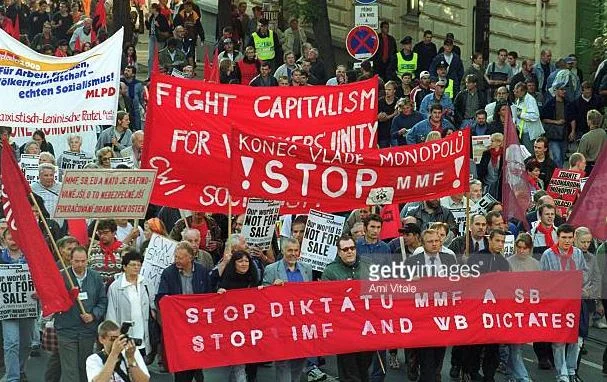
In some senses, Prague got off lightly. In London, after all, "anti-capitalist" demonstrators had recently spray-painted the Cenotaph with the suggestion that Britain's principal war memorial would make a good place to urinate. The mainly foreign protesters in Prague last week were far more refined. They merely chose to march into town under red flags and the hammer and sickle, symbols of a regime that not so long ago was murdering and imprisoning tens of thousands of Czechs.

The occasion, of course, was the joint annual meeting of the World Bank and the IMF. Such events now attract the protests of another set of anti-capitalists, the vicious travelling circus of the anti-globalization movement, and the intimidation and violence that it brings with it. This was the case in Seattle and Melbourne. Now it was Prague's turn.

Anti-globalization is the latest manifestation of the Left's seemingly indefatigable attempts to mess things up for the rest of us. Undaunted by the economic, environmental, and human disaster of socialism's last hundred years, they have now turned their angry attention onto free trade, and the supposedly sinister forces behind it, the World Bank and the IMF. There are, of course, differences from the past. This new Left is not as monolithic as its predecessors. The iron discipline of the Comintern has been replaced by a plethora of tiny cells, connected, strengthened, and somehow amplified by the power of an Internet able to create an impression of size even where none exists. So, the Prague action was meant to be supported by demonstrations across the globe, each of which was excitedly previewed on the web. In Melbourne, C.A.C.T.U.S. (Campaign Against Corporate Tyranny United in Struggle) was planning a carnival, while in Bangladesh the Garment Workers Unity Forum and the Revolutionary Unity Front intended "to make a demonstration waving black flags." In these United States, steelworkers in Chicago were apparently preparing to confront Harris Bank with a puppet show.

Harris Bank was left intact. Prague was not so lucky. Six or seven thousand protesters arrived from abroad, determined to shut down the city in the name of their version of global justice. Naturally, they were quick to move on Wenceslas Square, a sacred place for many Czechs, the heart of their Velvet Revolution, but a site of tragedy too: the spot where, in 1969, Jan Palach, a young student who really understood what idealism was, burned himself to death in protest against an earlier generation of invaders that had come to this city. Then, of course, it was the Soviet Army, but, as we have seen, the symbols of the anti-globalizers, those red flags, that hammer and sickle, they are just the same. And so was the message: "Do it our way, or there will be violence."

Of course, no one was ever that explicit. Most of the protesters were quick to come out with statements rejecting any violence, but their websites gave them away. One of the most prominent contained a list of suggested activities that included "occupations of offices, blockades and shutdowns, appropriating and disposing of luxury consumer goods, sabotaging, wrecking or interfering with capitalist infrastructure, appropriating capitalist wealth and returning it to the working people." That does not sound entirely peaceful to me.

The producers of www.destroyimf.org were more straightforward, running with the slogan "Turn Prague into Seattle." Many protesters tried to do just that. In the process they cost the people of what is still a poor country a great deal of money. Demonstrators fought with police, ripped up sidewalks, threw Molotov cocktails, and, in what is rapidly becoming an irritating cliché, stormed McDonalds, the franchised Winter Palace of their gimcrack revolution. The comrades at www.destroyimf.org could barely conceal their excitement at the drama of it all, a re-run, it seemed, of the glorious days of the Bolshevik rising. To one John Reed wannabe, September 26 had been "the day the IMF died." Judging by the breathless commentary on their website, it had been eleven hours that shook the world: "1215: Fighting begins; anarchist column takes the railway below the bridge. 1400: Protest columns fan out to the south and east. 1900: Column surrounds opera house. 2300: Minor running battles and windows smashed."

It seems that the revolutionaries were, at least in part, successful. The IMF and World Bank proceedings wound up a day early, the organizers unconvincingly claiming that they had completed all the work that they had come to Prague to do. Even if that were true, they should have stayed put, sipping champagne to pass the time and to make their point, occasionally, perhaps, hurling a few stale canapés into the baying mob below. The early retreat was a sign of weakness, and it was not the first from the supranational financial institutions. Since the whole anti-globalization movement started gathering pace, official reaction has been a blend of appeasement and apology. We caught a glimpse of this approach at Seattle in Bill Clinton's shifty "defense" of free trade, and we have seen plenty of it since then.

This is strange. It is not as if the foes of globalization have much intellectual force behind them. Their arguments are a blend of Al Gore greenery and Maoist economics, all wrapped up in a sort of sickly sentimentalism about the Third World that would, in fact, further impoverish that luckless part of the world. Bogus, economically illiterate, and potentially catastrophic, it is not a case that should be difficult to rebut, but none of our leaders seems to be trying hard to do so. Instead we see shame-faced equivocations or worse, the Uriah Heep-like pandering of those such as World Bank President Wolfensohn, a man pleased to pronounce that we live in a world "scarred by inequality." In between their bouts of savagery, the protesters in Prague were, he noted, "asking legitimate questions."

What nonsense. Here and there, you may find a true believer. There was the British schoolteacher who confided to Reuters that she was in Prague because her clearly rather odd child "often woke up in the middle of the night, frightened about global warming." For the most part, however, the game being played in the Czech capital was of a different, much nastier kind. It was partly about violence, the sheer Clockwork Orange fun that a punch-up can bring, and it was all about power, the right to boss everybody else around.

For all the talk about the working classes, the dispossessed seamstresses of Latin America, and the impoverished women farmers of Africa, the demonstrators tended to be Western European and university-educated. For such people, protests of this nature reinforce their bourgeois sense of moral and social superiority over the lower orders, the class they feel born to rule. As one of the organizers, Martin Shaw, a "Nottingham University graduate and anarchist" explained to the London Daily Telegraph, "Working people do not have the benefits of an educational system and they are afraid of losing their jobs." Not only that, but these blue-collar saps are couch potatoes, sitting back "in front of their televisions," grumbled another activist, rather than joining the battle against world capitalism. The corollary of this is that the "working people" need the Martin Shaws of this world to put things right for them. If you think that this sounds like the early 20th-century revolutionaries, you would be right. There is the same apocalyptic language, the same overweening sense of self-importance, the same absence of a paying job.

Unfortunately, too, there are the same prospects of some very real success. For, at bottom, these protesters are speaking the language of those very organizations that they claim to oppose. To take one, closely related, example: Environmental activists used to perform the same outsider role as the anti-globalizers do today, but much of their belief in regulation and control proved appealing to the soft-left consensus that prevails in our international institutions. And so, to their barely concealed delight, environmentalists found themselves co-opted into the global bureaucratic process. Their unelected, unaccountable pressure groups were magically transformed into "Non-Governmental Organizations." Better funded, but still unelected and still unaccountable, these NGOs were given consultative seats at the supranational legislative table. The result, at least in part, was the ludicrous Kyoto treaty.

A similar future beckons for some appropriately house-trained anti-globalizers. The cluttered WTO agenda in Seattle was evidence that officialdom is open to some of their ideas, an impression that Mr. Wolfensohn's platitudes will have done nothing to contradict. In Prague, indeed, certain pressure groups were invited to meet and debate with the IMF/World Bank delegates. This will only be the beginning of a prolonged courtship and, as for those other Non-Governmental Organizations, you and me, well, you can be sure that we will not be invited along.

Candida's Camera

National Review, Sept 11 2000

royalle_candida.jpg

WHEN actress Candida Royalle (Legends of Porn, Classic Swedish Erotica 2, Teenage Pony Girls) announces that she is "going to be hard on you," you sit up and pay attention. Not that we needed the warning. We had all paid good money ($49) to see her perform, and we were sure she would not let us down. Nor does she. True to her name, Candida is open, frank, and often very revealing. Miss Royalle knows how to give a good lecture. Yes, lecture. To the crowd gathered in an upstairs room in Manhattan's "School for the Physical City," Candida Royalle is much more than a sex star. She is an entrepreneur, sharing her hard-won practical insights with an eager and ambitious audience. The event has been arranged by The Learning Annex, an "alternative adult-education organization" that offers evening classes at a number of cities across the country. The demand for its "powerful, inspirational, nurturing, and insightful" seminars is in the American tradition, a reminder of the relentless drive for self-improvement that took this nation from log cabin to Martha Stewart. Recent courses have included Spanish, calligraphy, running your own laundromat, the power of persuasion, becoming a medical transcriptionist, and "Breaking into Adult Movies—in front of or behind the camera!"

Candida's pupils are ushered into a large, brightly lit classroom painted in the Pokemon palette that only an educational bureaucrat would choose. It's all very normal—Educating Rita rather than Deep Throat. There's no buzz, no guilty anticipation, just a naughty pile of coarse, er, course materials heaped on a side table: flyers for FOXE ("Fans of X-Rated Entertainment"), an order form for Breaking into XXX—the Porn Stud Handbook. And our teacher? Miss Royalle is a trim fortyish blonde in a short skirt, more Mary Kay than Miss Jean Brodie.

This is not enough to hold two members of the class, who slink off within minutes, disappointed perhaps to discover that the evening will not feature "adult situations." Maybe they will be back for the Tantra lessons ("Reach higher levels of sexual ecstasy than ever!"). The only other source of awkwardness is the presence of a film crew shooting the lecture for National Enquirer’s TV show. Strangely, not everyone wants to appear in front of these particular cameras.

These are shy folks, mostly. One woman, an exotic dancer, is interested in making "bubble-bath-type videos" for her fans, but she is an exception. This mainly male crowd doesn't want to get naked. They want to be "suits," Sam Goldwyns of smut. That's wise, for as our lecturer explains, the life of a wannabe porn stud is far from easy. Performing under conditions that would make even Priapus pause (Viagra helps, apparently), men are props, not star attractions. As such they are not likely to make much money. Most people aren't renting adult movies to gape at the guys. So the women are paid more. As even the EEOC might agree, this is not discrimination, it's the marketplace.

Which is really the theme of the evening. Naughty pictures are now a significant American industry. The Nude Economy is for real: By some estimates, annual sales of pornography in the U.S. alone already exceed $10 billion. That's a Fortune 500, Wall Street Journal kind of number, one that tells us, among other things, that proper management has finally come to this improper trade. And that's where the Learning Annex fits in. As Candida's students earnestly take notes, she briskly runs through the economics of adult video, who gets paid how much to do what to whom, the complexities of copyright, the perils of distribution, and the market in foreign licensing.

It's surprisingly dry stuff, and the ensuing discussion is matter-of-fact. In the United States, business is a serious matter, and while we have come a long way from the Comstock laws, our cheery, upbeat lecturer is subject to an equally demanding set of rules, those of American enterprise. To Candida's obvious delight, it's a tough code and a little austere. And in the way she describes it, with relish and without irony, there's a touch of Cotton Mather, a hint of the old Puritan idea that self-denial is the key to success. The boogie nights are clearly over. The film set should be free of drugs and alcohol and carefully budgeted. The artistic impulse must also be kept firmly under control (only "one-third of the film can be story, with 60 minutes for sex"). There's respect for hard work, suspicion of ripoffs ("Watch everything, watch everyone . . . if it's yours, watch it like a hawk"), and a shrewd appreciation for what counts—the bottom line in every sense.

Unfortunately, these days the bottom line is not enough. Sanctimony has evolved, not died. We live in a time when many businesses, particularly those with a potential image problem, feel they have to go beyond the buck. They like to demonstrate, at least in their advertising, that they have some higher—usually vaguely politically correct—redeeming social purpose. Forestry companies become model environmentalists, brewers natter on about "responsible" drinking, and "the people of Philip Morris" are so busy sheltering abused women and feeding the hungry it's amazing they have any time for making cigarettes.

Candida Royalle is no exception. A few years ago the former "teenage pony girl" founded Femme Productions to make films that, she says, that men too will want to watch. Now she takes herself, well, a little seriously. As her website notes, Candida has "addressed many conferences . . . including the World Congress of Sexology, the Smithsonian Institution, [and] the American Psychiatric Association." Sadly, it's not enough for her films to be dirty, fun, and profitable. In our relentlessly didactic era they must also promote "positive sexual role modeling."

What's that? Well for one thing, something that, as we are clearly expected to know, Republicans oppose. Like most corporate piety, Candida's spiel has a liberal tinge. As some readers may remember ("House of Porn," October 27, 1997), Ms. Royalle is a founding member of Feminists for Free Expression, and presumably someone well able to understand that the principal threat to her business comes from a much larger group, the feminists against free expression and their fellow-travelers in the "progressive" camp. Despite that, her talk is punctuated by moments of leftish political commentary. There's an almost nostalgic swipe at "Reagan/Meese" and a dark warning that if George W. is elected, "we're really in for it."

But her audience doesn't seem worried. This is a Coolidge crowd. Their business is business. They have no more interest in discussing threats to free expression than a moonshiner would have in debating Prohibition. To these aspiring pornographers, the First Amendment is a commercial device, not a human right. They want to concentrate on record-keeping, employee relations, soundtracks, budgets, legal obligations, and the uses of DVD ("save your bloopers"). It's all about the economics of sex. Though far from romantic, it is still a pursuit of another American fantasy, the dream of success. Is it true, asks the exotic dancer, that one porn star makes "as much as $150,000 a year"?

At that, two stockbrokers in the class exchange faintly superior smiles. Still, they understand where she is coming from.

Greed is . . . Sorta OK

Bull

National Review Online, September 10, 2000

Bull.jpg

It could be time to sell. In 1987, Hollywood gave us Wall Street. The market promptly cratered. 1929 saw the release of not one, but two films with Wall Street in the title. They were followed by the Great Crash and the even greater Depression. Well, I don't want to panic anyone but this year we've already had one stockbroker movie, Boiler Room. Now TV is following suit with two Wall Street-themed shows, Fox's The Street (set for November) and TNT's new weekly drama, Bull. There's another reason for the market to be nervous. Wall Street is a place that Hollywood just loves to bash. Just think back to Gordon Gekko or Danny DeVito in Other People's Money. Boiler Room too was hardly flattering. At first glance, Bull seemed certain to follow the same course. Within minutes we have met Corey Granville, a bond salesman at investment bank Merriweather Marx. He is doing well, but behind his back, the firm's WASPily distinguished patriarch wonders aloud whether Granville understands that there's a "glass ceiling in [his] future". Corey, of course, is African-American.

The patriarch, Robert "the Kaiser" Roberts, is quickly set up as a monster, a Skull and Bones savage straight from central casting. We see him compounding his racism with hypocrisy (he loans Corey "his" table at Lutece) and casual sexism, offhandedly delegating this task to his "girl." The term, outraged viewers will know, is "administrative assistant." For extra flavor, there's an echo of Gekko. The Kaiser arranges an insider trade, organizing the transaction in such a way that, if it is discovered, Marissa Rufo, an innocent associate, will take the blame. The innocent associate is, naturally, ethnic, female and from a working class family. To put icing on the bottom of the cake, we discover later that Ms. Rufo's mother has Alzheimer's.

In another episode predatory financiers launch a greenmailing attack on the regular folks in a "real business." This "real business" is a familiar cast member in movies about finance, and is generally used as a proxy for the concerns of Main Street. In the 1987 Wall Street the sacrificial lamb was an aviation firm, while in "Other People's Money," the designated victim was an old New England wire and cable manufacturer. At some point a noble employee of the menaced company always makes a speech about how the investment bankers should "stop going for the easy buck and start producing something."

In Bull the threat was to Ashton Paper, the principal employer in an, of course, idyllic, Bedford Falls, Mayberry sort of town (red, white and blue bunting, Patsy Cline playing in the local diner). The moving speech is made, one of the investment bankers has the obligatory crisis of conscience, but then, and here's the rub, the greenmail succeeds. If that's not surprising enough, the greenmailer, "Lasky the Liquidator" (marvelously played by Stanley Tucci), works for the show's good guys, HSD Capital, a rival firm set up by defectors from Merriweather Marx and led by the patriarch's grandson.

Successful greenmail? Investment bankers as good guys? That's what I call popular capitalism. Bull is a drama for our 401(k) age, a CNBC lite for the new investor class (at times, confusingly so — there's a break in the show for a "Bull Report" containing real financial news). For at least as long as the current prosperity endures, the Oliver Stone, hostile approach to Wall Street is likely to be a hard sell. Bull's producer has been quoted as saying that "sixty percent of Americans own stock. Wall Street is not for the Gordon Gekkos of the world any more. Wall Street is us." Coming from Hollywood, that's pretty encouraging.

On the details, sadly, Bull is not very accurate. Viewers hoping to learn something about the capital markets might as well take up medicine on the basis of watching ER. Vaguely impressive sounding technical terms are thrown into the dialog, and, in one case, a seduction, but, like Star Trek's dilithium crystals, they wouldn't get you anywhere in the real world. The type of business that the firms do is also unclear, as is how they do it. Merriweather Marx is, apparently, a world leader, despite having a trading floor of only about 25 people (some of whom use cellular phones on that trading floor, a no-no in today's era of compulsorily taped calls).

The defectors, meanwhile, are able to open up for business overnight (impossible, given the time-consuming regulatory procedures imposed on new securities businesses). Their firm appears to be an M&A boutique with a sideline in commodities trading, an impressive achievement for a company with a payroll in the single figures. Then there's the wardrobe. Investment bankers these days tend to dress down, each expressing their individuality in chinos, blazers and polo shirts. The men in Bull, by contrast, seem to take their lead from an issue of GQ, circa 1985. Demonstrating the height of Milken-era chic, they wear power suspenders, and in one shocking incident, a yellow tie.

But this is to nitpick. The important thing is that a TV show is being made in which it is not, automatically, a sin to win on Wall Street. Indeed, when the grandson tells his team to go out and "grab some green," the audience is meant to cheer, not jeer. This is real progress. Seen in this light, the portrayal of Patriarch Roberts is a familiar plot device: villains have to be villainous. Of course, the fact that he is a WASP archetype is no coincidence in our PC times, and nor is the decision to make him both racist and sexist. In contemporary Hollywood, there are no greater offenses.

So, which will prevail, Bull's underlying positive message or the annoying political correctness in which it is clothed? Will it remain as entertaining as LA Law or will it descend into the soupy moralizing that wrecked the later M.A.S.H? After only three episodes, it's too early to say, but watching the development of a number of the key characters will give a good idea.

The most important of these is Lasky the Liquidator. Hunter Lasky, brought into the upstart firm as a rainmaker, looks like being the show's equivalent of LA Law's Douglas Brackman, a thinning-on-top older guy with an eye to the bottom line. His cynical observations are a way for Bull's writers to signal that they still have their doubts about Wall Street. If Lasky turns really nasty, that will be a bad sign. As it will be if his mistress, Alison Jeffers, the show's obligatory ambitious blonde, keeps failing to sleep with important clients. Alison dear, that's what ambitious blondes do. Corey Granville, meanwhile, needs to concentrate on his career. We've already had warning of a cliched "what does it mean to be an African-American on Wall Street" sub-plot.

Finally, and worst, potentially, of all, some of the HSD team is shown attending a fundraiser for Hillary Rodham Clinton. If these people are Democrats, Bull is a sell. Fortunately, there could be another explanation. The staff at HSD trade commodities, but not, judging by one episode, very well. Perhaps they were just going to our cattle futures-trading First Lady for advice.

Given her record in that field, that would be just fine, and so, for now, is Bull.