Looking for Malaparte
The New Criterion, September 1, 2025
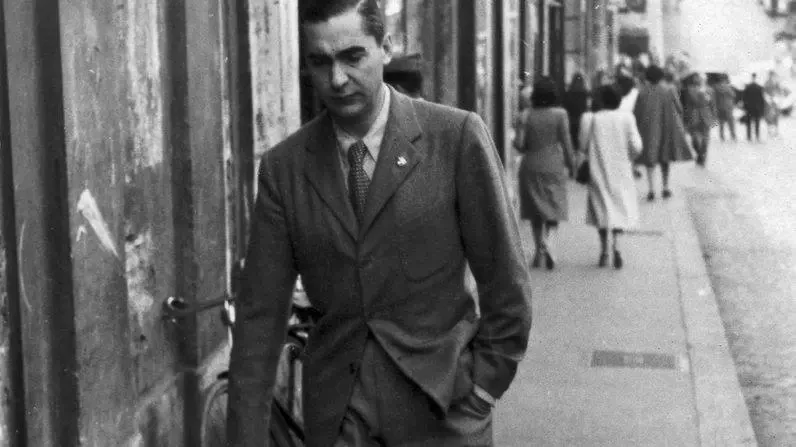
The chameleonic Curzio Malaparte (1898–1957) wore many guises, but it’s as a writer that he is best remembered, so those tackling Maurizio Serra’s impressive Malaparte: A Biography should have read at least Kaputt (1944), the book that is widely considered his masterpiece. Having done so would have been more likely in France, where Malaparte is better known than in the United States and where this biography was first published in 2011 as Malaparte, vies et légendes (“Malaparte, Lives and Legends,” a better title) in response to a proposal by a French publisher. It won the Goncourt prize for biography that year.
Malaparte was a notorious narcissist, so I’ll begin by talking about myself. Nearly a decade and a half ago, I reviewed The Storm of War, a fine history of the Second World War by the English historian Andrew Roberts, no stranger to these pages. Roberts twice quotes from Kaputt. Both extracts were strikingly written, and, although Roberts describes Kaputt as a novel, the quotations appeared to be based on what Malaparte had witnessed. But who was he? Kaputt offers some incomplete clues. Its narrator is a “Malaparte,” and it features a remarkable cast of characters—from a Croatian tyrant to Hans Frank, Hitler’s “king” in Poland (or “Frankreich,” as some in Berlin joke)—many of whom the real Malaparte, an Italian army officer working as a journalist, had indeed met.
Kaputt is episodic, its style dreamlike, surreal, hallucinatory, grotesque, a vision of a world so askew that even the skies have gone mad: “the sky was an eyeless face—a dead white face.” The carcasses of horses remain trapped in a frozen lake, “a vast sheet of white marble . . . . Only the heads stuck out of the crust of ice.” Frank playing Chopin in his castle, “Malaparte” wandering through the Romanian city of Jassy (Iași), just ahead of a pogrom: “It began to rain, a slow warm rain that seemed to drop out of a cut vein.” Occasionally he escapes to high society—Princess This, Count That—adding some Proust to a work that owes much more to Goya.
In Kaputt, Malaparte the novelist uses the credibility, such as it was, of Malaparte the journalist, leaving it up to the reader to decide how much is fact, heavily embellished fact, or entirely made up, an ambiguity not unhelpful for an author rewriting his own past. And by the time of Kaputt’s publication, this is what Malaparte was trying to do. His association with Italy’s Fascist regime had been complicated, but it was close enough to merit a (brief) jailing after Mussolini had been overthrown, and the promise of dangerous questions to come.
Malaparte saw Kaputt as a way of distancing himself from a now-perilous résumé, but his vanity limited how great that distance could be. A quasi-fictional alter ego is the book’s narrator and principal protagonist, and, like his creator, is well-connected enough to be in the right wrong place at the right time. “Malaparte” is unsparing in his description of German and Romanian atrocities on or behind the Eastern Front and was early to describe the Holocaust in ways that came close to its reality. But, like the real-life Malaparte, he owed his vantage point to his being welcome—even if he sometimes wore that welcome out—in a swath of Eastern Europe controlled by the perpetrators, their accomplices, or their enablers. “Malaparte” was a guide to an abyss where he had found a not-uncomfortable niche, whatever his, for the most part, discreetly held doubts.
My edition of Kaputt (New York Review Books, 2005) includes an introduction, “The History of a Manuscript,” by Malaparte, a tale of furtive scribbling and smuggled papers, which he had hidden “in the wall surrounding the woods of my house in Capri” before resuming his travels. After returning to Italy following the fall of Mussolini, he is arrested. Once released, he went back to Capri, and “in September 1943, I finished the last chapter” of this “horribly gay and gruesome book.”
Just the last chapter? NYRB’s Kaputt includes an instructive afterword by the writer Dan Hofstadter in which he cites the assertion by Lino Pellegrini, a former correspondent for Il Popolo d’Italia, the principal Fascist newspaper, that Malaparte—with whom he had worked during the war in the Balkans and Ukraine and whom Pellegrini had visited on his deathbed—had rewritten the first part of Kaputt after deciding that Germany would not prevail. That was only a claim (and a surprising one given how early Malaparte is known to have begun expecting a German defeat). But Hofstadter correctly notes that Malaparte was not in Jassy during the pogrom he so vividly describes, although, contrary to his contention, Malaparte did go to the Warsaw Ghetto, a visit “Malaparte” recounts in a manner that even the most forgiving would regard as tone-deaf.
In some ways this was a recurring flaw. Serra writes that, unlike many prominent Italian intellectuals of the time Malaparte “never signed a line of antisemitic propaganda.” Nor would he have agreed with it. But it is disconcerting to read a reference to a “herd” of Jews, so shortly after the Holocaust, along with some other comments about “Jews” in his Diary of a Foreigner in Paris (mainly written in 1947–48, and which I reviewed in The New Criterion of September 2020), although the same volume also contains “The Ball of Count Pecci-Blunt,” an extraordinarily powerful (though previously unpublished) condemnation of Mussolini’s racial laws.
In 2013, after NYRB announced the release of a new English translation of the sequel to Kaputt, The Skin (La Pelle, 1949), the second of several books by—or in the case of Serra’s biography, about—Malaparte, the company has published, I asked The New Criterion if I could review it. Certainly: eight hundred words, please. By the time I had finished, after falling down rabbit hole after rabbit hole, the review, which appeared in late 2013, had evolved into a lengthy, more general discussion of Malaparte’s, work, life, and changes of costume (see “Himself alone” in The New Criterion of October 2013).
A good number of those who had written about Malaparte in English had either taken him too literally or been content to refer to his unreliability and leave it more or less at that. I turned to the seven hundred exhaustively researched pages of Vies et légendes in an effort to come closer to the truth. In my 2013 article, I referred to Serra’s book as “invaluable and sternly forensic,” which it is, but (since I haven’t had to speak much French for over forty years) the chance to read it now in English has been more enjoyable, and more fruitful too.
The first line of the first chapter begins with the statement that “There are many reasons, all of them excellent, not to like” Malaparte. A private man who liked attention, Malaparte would have been concerned that Serra was digging too deeply into his psyche and the tales he spun while being delighted that, seven decades after his death, people still cared.
And he would have been pleased that his biographer had been a diplomat (as he himself was, at Versailles in 1919 and in Warsaw in 1920, albeit at a low level), and a senior one too, rising to become Italy’s ambassador to UNESCO. And as a long-standing Francophile, Malaparte would not have objected to the book’s having been written in French by someone who later became the first Italian to be elected to the Académie française, although he might have been a little envious. Malaparte “gladly let others think him a bilingual writer,” Serra notes, adding that Malaparte lacked the “persistence” to be rated as such, despite “a facility with languages.” The latter is visible when he drops in a foreign phrase or word into his prose to sometimes powerful effect.
Asked to characterize Malaparte at a talk he gave at NYU earlier this year, Serra used “cold” as one of the first, if not the first (I cannot recall), adjectives to describe Malaparte, a word that matches the chilly detachment so evident in Malaparte’s writing, and not just there; intimacy was not for this “man of ice.” At six feet tall, Malaparte stood out in the Italy of his era. He was good-looking, typically well-dressed, a dandy (“everything to establish the persona, while concealing the man”). He was, purely metaphorically, a Romeo (there was nothing callow about his charm, which was “hard and smooth, inert and feline”), if perhaps a touch disappointing to his many Juliets. “He fornicated easily,” writes Serra, “without foreplay, or decadent gymnastics alla francese, as the expression went at the time,” and preferred not to share a bed. The nearest he came to marriage was to an Agnelli widow. He had “no official heir, in art or in life. Which is to say: No Malaparte before me, no Malaparte after me.”
Malaparte’s “almost pathological aversion to” homosexuality (although not necessarily to homosexuals) was expressed so virulently in The Skin and in some later writings that some (including myself) have wondered whether he was protesting too much. Not so, declares Serra. Moreover, for all Malaparte’s narcissism, “no admission of autoerotic practices has come to light” either. Serra is a very diligent researcher. That said, Malaparte undoubtedly preferred his own company to that of others.
He kept humanity at a distance. He built a house of faintly forbidding beauty on Capri, una casa come me, jutting out into the sea, a fortress of solitude, with guest rooms pointedly lacking in comfort, and with scant refreshment on offer. Emotionally, he may have been closest to his dogs, above all a greyhound, Febo. In a short story, “Dog Like Me,” included in a curious, charming, and uncertainly autobiographical collection entitled Woman Like Me (Donna come me, 1940) (yes, there’s a pattern), he concluded that a dog would be a better, more reliable friend. It could be good copy too. In The Skin, Febo ends up on the vivisection table: quite untrue to life, but another example of the aestheticized cruelty that runs through much of Malaparte’s work.
Malaparte was born in Prato, a textile town in Tuscany, beginning life as Kurt Erich Suckert, the son of a German father, who was a successful businessman (for a while), and an Italian mother. Italian was the language Malaparte spoke at home, and, despite being raised a Protestant, he identified himself as an Italian, merely attributing certain character traits to his Teutonic side.
By 1915, Curzio (Kurt had long gone) was at war with his father’s land, a volunteer with the French Army, and, after Italy joined in, he fought bravely with its Alpine Brigade. The fighting left him with impressive French and Italian medals and, courtesy of German mustard gas, a pulmonary lesion that probably contributed to his death by lung cancer almost forty years later.
After 1918, the pace picked up further for the young lieutenant. There were the stints in Versailles and Warsaw, and he wrote an angry book about the war. He favored a revolution, but to redeem the nation, not to overturn it. He opted for fascism, but, despite twists and turns and some cynical skulduggery, he managed his ultimately unsuccessful political career with less skill than Serra uses to describe it. He remained “a condottiere without troops.” Mussolini, argues Serra, regarded him as a journalist, an agitator, not enough of a believer, and too much of an individualist. In keeping with the regime’s Italianizzazione, Suckert became Malaparte, a suitably memorable choice, but it came with a wink: bad (mal) side rather than good.
Ideologically, he began on the fascist left and was associated with the thuggish squadristi (blackshirts) agitating to overthrow the old bourgeois order. This shifted over time towards something more respectable, if that’s the word for any strain of fascism, but, for all Malaparte’s later nostalgia for an older Europe, his revolutionary instincts never entirely faded, nor his idealization of proletarians, if not always the proletariat. This, and his keen sense of survival, explains his dance with the Communist Party after the war and his final political infatuation with, startlingly, even by Malaparte’s elastic standards, Maoist China, evidence of his continuing fondness for the hard men.
Formally, Malaparte never rose that far in Mussolini’s system, but he was deemed reliable enough to be appointed (the details are—par for the Malapartian course—murky) the editor in chief of La Stampa in Turin in 1929, then a fiefdom of Giovanni Agnelli, the founder of fiat, with instructions to “fascistize” the paper, something that he denied after the war, a Malapartian leitmotif. But fascistize it he did, writes Serra, albeit in his fashion. He was fired two years later, for reasons at which one can only guess but seemingly unconnected with any ideological rupture with the regime (contrary, of course, to his later claims, Malaparte had not resigned from the Fascist Party). Nor was a subsequent spell in Paris any kind of exile. If anything, judging by what he could get away with in print, Malaparte, as one of fascism’s pet intellectuals, was allowed more leeway than most. The underlying cause of his eventual “break” with the regime, to the extent there was any, was frustrated ambition. The trigger for his arrest during a return to Italy in 1933 was a botched palace intrigue made more absurd by the fact that he had no place at court. Malaparte could be a shrewd judge of the political game, but, perhaps blinded by his own reflection, he regularly misplayed his own hand.
In writings and rewritings aimed at a post-war audience, Malaparte mischaracterized why he had been arrested (“Some nerve!” exclaims an exasperated Serra, as he contemplates one dodgy preface: “everything in this paragraph is false”) and exaggerated the conditions under which he was held, in reality for just shy of two months, in prison. He repeatedly overstated the pains of his subsequent confino (internal exile), firstly on Lipari, an island off Sicily, and then on Ischia, already a resort (Malaparte thought about buying a villa there), from where he was, thanks to the help of Count Ciano, Mussolini’s son-in-law, one of Malaparte’s most useful connections, allowed to write for the Corriere della Sera, though under a pseudonym. After Ischia, there was a stint in another resort, this time in Tuscany, and then, twenty months after his arrest, he was granted clemency some three years early. All this was very far from the supposed ordeal he brandished to bolster his anti-fascist credentials once the political weather had changed.
Although Malaparte’s membership in the Fascist Party, stripped from him in the wake of his arrest, was not restored, he was in no sense an opposition figure. Prospettive, the glossy magazine he founded in 1937 devoted to art and literature, received some state funding, and its inclusion of avant-garde material, as well as the inevitable propaganda, reflected, in part, Fascist Italy’s greater cultural openness compared with its counterparts elsewhere in Europe. It had room too for small pieces of sly subversion: the only contemporary German writer to be featured was the poet Gottfried Benn, then out of favor in the Reich.
In 1940, Malaparte was called back to the Alpini, this time as a captain, but he quickly arranged to be accredited as a special correspondent. He had decided, Serra explains, that his role was to write, not to fight—to bear witness in his own way. And this he did, whether in the French Alps, as part of the Italian Dolchstoß applied, as feebly as it was treacherously, to a stricken France, or in filing unflattering copy on Greece, to be deployed when Italy invaded there.
In 1941, Malaparte was with Romanian and then German forces once the attack on the USSR was underway, but for less time and, after a while, in a different place than his reports, destined for the Corriere della Sera, implied. Datelining reports from Ukraine when he was already back in Capri was, well, unorthodox. One reason for this, other than the island’s appeal, especially when compared with the Eastern Front, was that he had what he needed—he was a quick study, with, maintains Serra, a “prodigious capacity for assimilation” (“he would absorb everything like a sponge,” said Pellegrini). This led him, among other insights, to the realization that the Soviets would prove to be tougher opponents than Barbarossa’s overture suggested. Malaparte’s post-war fable that writing this led to his arrest and expulsion from Ukraine by the Gestapo and further disciplinary action in Italy is convincingly dismissed by Serra as nonsense.
The following year, the Germans did object to some of Malaparte’s reporting, but that became moot after he traveled north to the Finnish war against the Soviets, although for a total of five months, not the two years he claimed in Kaputt. Overall, the selection of Malaparte’s dispatches (or a version of them, after some helpful bombs had destroyed the originals) comprise what is, for me, Malaparte’s finest work, The Volga Rises in Europe (Il Volga nasce in Europa, 1943), sometimes oddly lyrical, sometimes deeply unsettling (and sometimes both), such as when he describes the mechanization of warfare:
I could see slowly advancing, not an army, but an immense traveling workshop, an enormous mobile foundry that stretched as far as the eye could reach in either direction. It was as if the thousands of chimneys, cranes, iron bridges and steel towers, the millions of cogwheels, the hundreds and hundreds of blast furnaces and rolling-mills of the whole of Westphalia, of the entire Ruhr, were advancing over the vast expanse of cornfields that is Bessarabia. It was if an enormous . . . steelworks, a gigantic Essen, were preparing to launch an attack on the hills of Zaicani . . . . Yes, that was it: I was looking not at an army but at a colossal steelworks in which a multitude of workmen were setting about their various tasks with a streamlined efficiency.
Kaputt, concludes Serra, was completed in the spring of 1944, some six months after the date given by Malaparte, and close to a year after Mussolini’s fall. Meanwhile, Malaparte struggled to find a path through what was, for him, perilous political terrain, before eventually securing a position as a liaison officer with the American high command.
The Skin, published four years after the end of the war, is a lesser book (“not worth a fingernail of Kaputt,” said its author), despite its making it onto the Vatican’s Index Librorum Prohibitorum. It picks up the story of “Malaparte” in Naples, the same city where Kaputt finishes up, and was written in a climate in which Malaparte perhaps felt freer to shed light on the squalor, physical and otherwise, that accompanied liberation. It also contains these lines, spoken by Jack, an American officer:
It is of no importance . . . whether what Malaparte relates is true or false. That isn’t the question. The question is whether or not his work is art.
That’s a lot of it, but so far as Malaparte was concerned, another question was the political use to which his refashioning of the past could be put, and a third, on occasion, was the fun that he could have with it. He was a trickster as well as a fabulist, and the deeper the trick was buried the better.
And so, Jack’s comment was in response to a French officer taking Malaparte to task over Kaputt’s accuracy, an oddly prescient complaint, as Kaputt had not been published at that point in The Skin’s chronology
It is not surprising that Malaparte’s later career was mostly an anticlimax, if a busy one. But he made up for that with his finale, turning room 32 of Rome’s Sanatrix clinic into a deathbed salon that lasted four months. As Serra tells it, Italy’s “political, cultural and social nomenklatura duly filed in,” looking “to take away a souvenir: a look, a nod, a quip,” or, in some cases, an endorsement, the latter a prize sought, among others, by the Communist Party, but won by the centrist Republicans and, more grandly, the Vatican.
With (who knows?) the shade of Pascal cheering him on, Malaparte, who had previously shown few signs of religious belief, was baptized and confirmed as a Catholic, despite Pope Pius XII declining to talk such matters over with him. “That was expecting a bit much, even for someone like him,” observes the entertainingly sardonic Serra. At the last moment a fortnight later, a determined Jesuit collected the dying man’s Act of Faith, which, “incidentally,” adds Serra, the priest “was the only one to hear.”