Javier Milei Takes Up His Chain Saw
National Review, July 24, 2024 (September Issue)
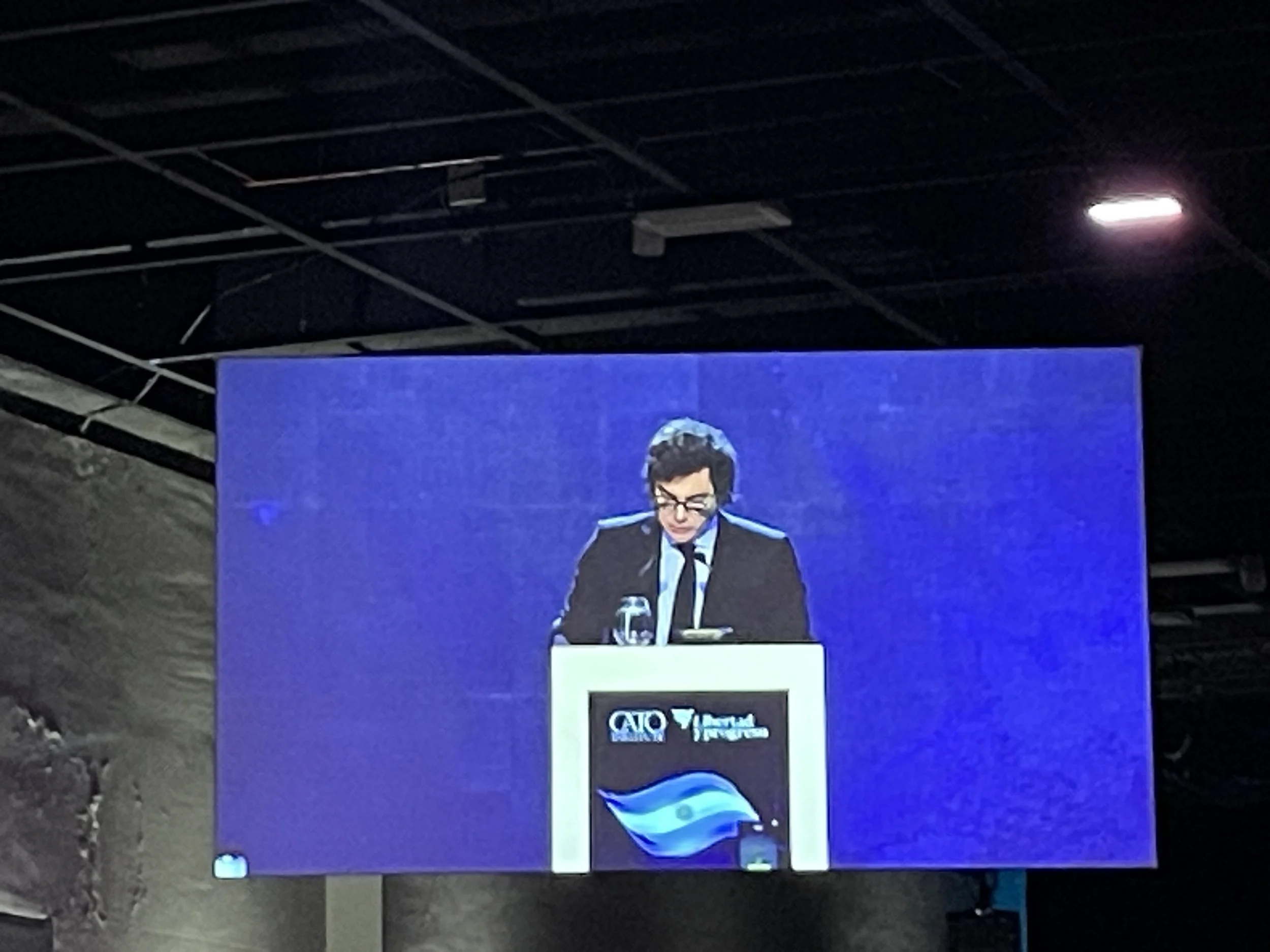
Javier Milei, Buenos Aires, June 2024 © Andrew Stuttaford
Buenos Aires
I was in a large, packed room in the Hilton. A conference held in June by the Cato Institute and an Argentine free-market think tank, Libertad y Progreso, had entered its final hours. Elon Musk had just spoken — remotely. Now self-styled anarcho-capitalist Javier Milei, Argentina’s president since December, had turned up, clad in a suit, not his trademark leather jacket, and, considerably calmer than his reputation, was giving a speech.
He ranged from hard-core economic theory — the translator muttering in my headset struggled a bit with that — to philosophy, to the merits of markets, of liberty, of property, to the demerits of Argentina’s political class — “the caste” — to the governor of Buenos Aires Province, “a communist midget.” At the end, a fiftysomething local told me that he’d been waiting all his life for an Argentine president to make a speech like that.
Milei’s anarcho-capitalism is a direction of travel rather than a destination anytime soon. Much of the journey will involve taking a route through classical liberalism and libertarianism, with — given Milei’s Manichaean view of politics, a product probably of both his psyche and Argentina’s experience — possible detours into rougher territory. Milei takes a firm line on law and order. On social issues, he is (very broadly speaking) a liberal from the era before such beliefs curdled into authoritarian progressivism, but with additional twists stemming, ironically, from his anti-state ideology. Thus he favors drug legalization, but not if taxpayers have to pay for its consequences, a stance that may reassure his conservative supporters. He opposes abortion (a topic on which libertarians can disagree).
Strongly pro-American, he is realigning Argentina to be closer to the West. He canceled plans to enroll the country in the BRICS bloc and backs both Ukraine and Israel. Argentina is the first Latin American state to designate Hamas a terrorist group. Milei’s idea of a West under threat internally and externally likely goes some way (along, presumably, with his antiestablishment sympathies) towards explaining his association with politicians such as Donald Trump and Brazil’s Jair Bolsonaro, two figures not known for their libertarianism.
In the early 20th century, Argentina was one of the richest nations on earth, but it is now, on some measures, a developing country, a decline arguably without equal in the modern world and almost entirely due to misgovernment. Its people would have avoided a lot of misery had they been far quicker to put someone like Milei, an economist drawn to “Austrians” such as Hayek and Mises, with their profound suspicions of the state, into the Casa Rosada, Argentina’s (pink) White House.
But everything else had to fail first. In the later 1940s and the first half of the 1950s, Juan Perón, a popularly elected strongman, swept away the last remnants of the (more or less) classical liberalism of Argentina’s golden age, replacing it intellectually, institutionally, and electorally with a corporatist and clientelist system based on an overmighty interventionist state.
Perón’s legacy has endured, despite the economic damage it caused and sporadic attempts at reform. The most memorable of those (so far) was in the 1990s. It included some deregulation, some privatization, and, crucially, the establishment of a 1:1 dollar–peso peg, backed by a (sub-optimal) currency board. Despite initial success, this ended in catastrophe in 2001–02. The peg, buffeted by budgetary indiscipline and external shocks, was abandoned, devastating the savings of millions. In 2003, Néstor Kirchner, a left-wing Peronist, was elected president. Peronism’s evolution into Kirchnerism seemed to confirm its indestructibility, its inevitability, and its devotion to economic illiteracy. In 2019, Mauricio Macri, a center-right president elected in 2015 to change Argentina’s course, was trounced by Alberto Fernández, a Peronist, naturally (Macri had inherited a mess, but he bequeathed one too).
A presidential run by another libertarian economist got nowhere in 2019. In 2023, accelerating triple-digit inflation, fears that Argentina might run out of money, and Milei’s unusual persona made all the difference. A relentless proselytizer who has now appeared in Davos and other venues outside Argentina, Milei had been a (very) frequent guest on Argentine TV and radio for years. He had also hosted his own radio program. There had even been a stage show in which he played a therapist — Argentina has more psychologists per capita than anywhere else in the world — talking through seven decades of the country’s economic history. El consultorio de Milei was, wrote a critic for the newspaper La Nación, very funny, adding that, given the subject matter, this was “unique.” And so was its star, a deftly self-promoting attack economist increasingly famous/infamous for media appearances in which sharp insights might be accompanied by foulmouthed insults, noisy belligerence, and tirades.
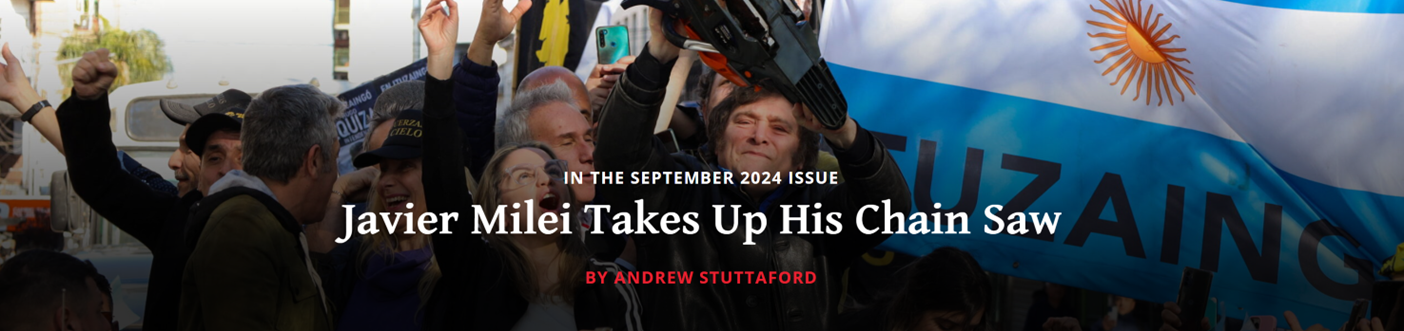
In 2021, Milei was elected to the chamber of deputies, the lower house of Argentina’s legislature, one of two successful candidates from a sort of libertarian (it’s complicated) sort of party (it’s complicated), La Libertad Avanza (LLA). In 2023 he ran for the presidency, talking Hayek here, brandishing a chain saw there. But his message was consistent, and showmanship could be merged with substance. The chain saw symbolized his plans for Argentina’s bloated, corrupt state. To explain what they might include, Milei released a video on, tellingly, TikTok. In it, he points to a whiteboard bedecked with a long line of labels. Each represents a government ministry. One by one, he calls out the name of a ministry he intends to eliminate and, with a shout of “Afuera!” (“Out with you!”), rips off its label. The video went viral, and “Afuera!” became a rallying call. On his first day in office, Milei ordered the number of ministries to be cut from 19 to nine (some were consolidated).
In October, Milei came in second in the first round of voting, sweeping past the establishment anti-Peronist candidate. One month later he beat the Peronist by an impressive 56–44 margin in the runoff, winning notable support from poorer and, especially, younger voters (particularly young men). With persistently anemic growth, inflation (an annual 161 percent in November) hurtling who knew where, and a 40 percent poverty rate, what did they have to lose by voting for an outsider promising to overturn the system that had failed (and was failing) them so spectacularly?
For their part, many young voters were attracted by a rebel praising freedom, carajo (“damn it”; ruder translations available on request), who might also save their futures from the fate of those of previous generations. Milei’s eccentricities — to use a nonclinical term — and disdain for convention may have both amused them and underlined his distance from the wicked caste. Five cloned dogs (his main advisers, he claimed), his past as a tantric sex coach, his past as a singer in a Rolling Stones cover band, and even his hair, a Wolverine/Austin Powers chimera combed only, he said, by “an invisible hand,” were just some badges of his otherness. Milei is odd, but compared with the madness of the way Argentina has been run, El Loco is a beacon of sanity.
People vote against as well as for. With one of his most striking proposals, Milei offered a chance to do both. He has long been a harsh critic of Argentina’s monetary policy: Instead of “burning down” the central bank (an earlier suggestion), he advocated killing off the latest disgraced iteration of the peso (“worth less than excrement”) and replacing it with the greenback, a currency free from local political meddling. That would mean a painful adjustment, but the idea was well received by many. Living with a currency in free fall isn’t so comfortable either.
Argentines tend to regard their currency with contempt, preferring, where possible, to keep their cash in U.S. dollars (perhaps some $250 billion, roughly 40 percent of GDP), either “under the mattress,” in safe-deposit boxes, or abroad. The lack of a reliable domestic store of value has been made worse by byzantine capital controls, which have discouraged business and capital formation. Between 2011 and 2023 the economy went nowhere, but the number of public-sector jobs jumped by 34 percent, ten times the increase in the private sector.
Milei revved up the chain saw straight after taking office — and a wave of regulatory reforms and tough, sometimes crude spending cuts made it possible, in June, for Argentina to record six consecutive monthly fiscal and financial surpluses for the first time in years.
But Milei’s freedom of maneuver has been constrained by his weak position in, to quote his description, that “nest of rats,” Argentina’s congress. LLA, a toddler party, has only 10 percent of the seats in the senate and 15 percent in the lower house. An informal coalition with Macri’s PRO effectively doubles Milei’s strength in both but falls far short of control.
The Argentine presidency is powerful, but Milei has had to compromise — not an easy task for him, either psychologically or ideologically — and work with, even recruit, some of the caste. Taken too far, this shift would risk turning his shock therapy into the gradualism that helped sink Macri. After months of wrangling, a significantly slimmed-down version of Milei’s giant “omnibus” reform bill, which included wide-ranging deregulation, measures designed to encourage foreign investment, and the go-ahead for (a reduced number of) privatizations has received final approval. Enough of the original survived for Milei to declare victory.
Another large deregulatory package, the “Megadecreto,” introduced in December under a procedure that permits the president to change the law in cases of national emergency, will remain in force unless the courts object or it is rejected by the congress. The senate has done so, but the lower house seems (for now) unlikely to follow its lead. One early success was a major deregulation of the rental market. Supply has risen, prices have fallen. Amazing!
Dollarization was too controversial — including, critically, with the IMF, Argentina’s largest creditor — to pursue for now and has been “postponed.” A limit on the amount of foreign currency Argentines can buy — the cepo cambiario — remains in place. Following a 54 percent devaluation in December, the peso depreciates by 2 percent a month against the dollar under a crawling-peg regime. As this has been less than monthly inflation (4.6 percent in June), the peso is, at the official rate, substantially overvalued despite December’s devaluation. The central bank, previously a buyer of dollars to boost inadequate foreign-exchange reserves (currently $29 billion, gross), is now selling them to defend the peso even as its overvaluation hits the competitiveness of exports critical for a sustainable recovery. But a deeper devaluation would bump up inflation. Nevertheless, the IMF is now not so obliquely hinting (publicly) that a higher rate of depreciation would be desirable. A currency crunch may well lie ahead.
Milei is in a race against time. He knew that crushing inflation would mean crushing Argentina’s already fragile economy, and it has. To take two out of many bleak statistics, the poverty rate may be nearing 60 percent, and first-quarter GDP was down 5.1 percent year on year. More encouragingly, economic activity (a proxy for GDP) in May grew by 2.3 percent against expectations of a fall. Not too much should be made of one month’s numbers, but they brought some cheer to the Casa Rosada. Milei needs reform to start yielding some edible fruit before people lose patience. Early on, the government bought some insurance by hiking child benefits and the value of food cards for the poorest. More recently, some subsidy cuts have been postponed. Milei still enjoys the support of more than half the population. His argument (“There is no money”) that there is no alternative continues to resonate, but conditions are very hard, and the formidable Peronist machine is intact, not least in the labor unions. There have been protest strikes. While I sat listening to Milei speak, there was a demonstration (which later turned violent) outside the senate as it debated the omnibus bill, not the only time discontent has spread to the streets.
The slide towards hyperinflation has been halted. June’s 4.6 percent rise in prices was a move up after months of decline, however. Much of it was due, paradoxically, to the effect of subsidy cuts, which are part of a painful cure that will take time to make life better. The edible fruit remains out of reach for now, and there will be midterms in 2025.
Possessing valuable raw materials and many of the elements of a modern economy, Argentina could again be rich. But if the country is to achieve its potential, the deeply entrenched regime that has held it back must be dismantled. Milei, who combines a populist style with core convictions about the role of the state that are anything but, may be its last best chance.