The Black Death’s Economic ‘Dividend’
National Review Online, May 28, 2025
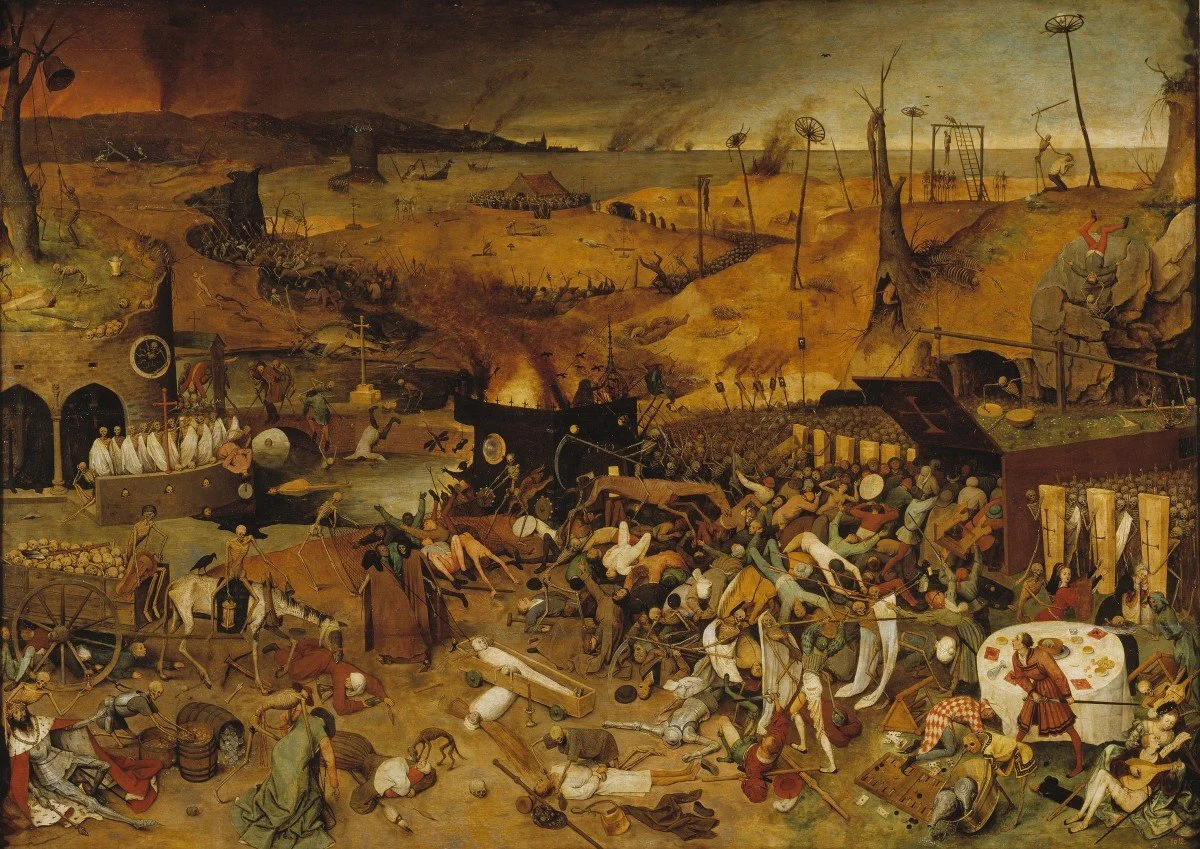
The Black Death, the bubonic plague that tore into England in 1348, was — this should not need saying — a cataclysm. The English had little natural immunity to this terrible disease, which arrived in Europe with the Mongols, either making its debut or for the first time in thousands of years. About 80 percent of those infected died. By the end of this first great wave of infection (others were to follow), England, like many other European countries, had lost around half its population.
The losses were concentrated more heavily among the poorer classes. They lived more closely packed together, and in less hygienic conditions than those higher up the social scale. They were less healthy than their wealthier countrymen and had little or no access to what little care that there was. Historian Robert Tombs notes that, amid the carnage, all but one member of England’s royal family survived. All the earls made it through unscathed. Society functioned more normally than might have been expected. The legal system continued to operate. “Even the dead,” writes the appropriately named Tombs, “were usually buried properly.” “Vacant tenancies and offices were filled,” and — there’s never a bad moment for it — war with France was restarted, albeit on a reduced scale.
Half a century ago, the leading demographic panic was over too many births. Now it’s over too few. Fear of this broadly benign phenomenon (think about the labor surplus that mass automation will create and try to forget the happy legend about the ease of previous technological revolutions) is already contributing to several policy disasters (such as the continued encouragement of mass immigration into richer parts of the world) with others, undoubtedly, to follow. The probable transition to eventual population decline will not be without turbulence, but to believe that it will lead to our doom is, somewhat paradoxically, to take a bet against our species and its capabilities. History suggests that’s a mistake, and, even allowing for the fact that the mid-21st and mid-14th centuries have little in common, that history includes England’s experience after the Black Death.
In 1300 England’s population had been around six million. In 1350, two years after the plague had first struck it was, relates Tombs, some two and a half million. Empty Earthers must surely believe that decline on that scale (with most of it backloaded to a two-year period at the end) led to an economic as well as human catastrophe. But that is not what happened.
Helen Carr, writing in the Daily Telegraph:
[T]he Black Death is an interesting study of humanity in the face of disaster, for where everything was lost, human resilience was demonstrated in abundance. Given the dramatic decrease in population, one might assume that an economic crash, and a medieval depression, fast followed. The evidence suggests that the opposite was true: that Black Death survivors saw a 30 per cent increase in their disposable income compared to the pre-plague years. As the historian James Belich writes, “experts now agree that real wages rose after the Black Death, at least from 1375, and stayed higher than before the plague until about 1500”.
Among the economic winners were those at or near the bottom of the social ladder. Supply and demand kicked in. Fewer workers meant higher wages, despite determined efforts by the ruling establishment to stop markets doing their thing. Labor shortages even spurred a degree of female emancipation (by the undemanding standards of the time). New technologies were adopted or developed to make up for a shrunken labor force.
Carr:
With a smaller workforce to manage the land, technology also had to advance, to save time and energy. Iron replaced wood: the traditional sickle was replaced by the heavy scythe, able to cut through a crop at a much faster rate. Wind and water power were harnessed using wind and water mills. As a result, people moved from grinding grain themselves to using green energy to make flour. Daily bread was now produced in abundance, a relief to many following the hangover of the Great Famine in the late 1310s.
That famine, incidentally, was partly a product of an earlier climate change. The population increase of the previous centuries owed quite a bit to the favorable agricultural conditions created by the Medieval Warm Period (an interlude that climatists mysteriously downplay), which was petering out by the end of the 13th Century, to be replaced (slowly) by the “little ice age.”
Carr’s reference to the greater use of “green” energy is weirdly anachronistic. That’s not how wind and waterpower were seen at the time. Their development and/or wider use was a helpful technological advance, not (as is the case with wind power today) an expensive, unreliable and largely futile form of technological regression.
Families, having lost their in-house workforce, were forced to hire outsiders, offering a new route for people to learn skills or trades, often, adds Carr, “in new crafts.”
Carr:
One of the major advancements of the age, for instance, was horology: clockmaking. Before the plague, the tolling of bells across the parish had been the means of telling the time. Now, in the second half of the 14th century, “horologer” became a new specialist job, with clocks being installed on church towers across the realm to keep track of the working day.
People’s diet and clothing improved, and as their material conditions moved upscale so did their aspirations. This produced an alarmed reaction from those sitting at the top of the heap.
Carr:
It wasn’t long before this new-found freedom was challenged. In Piers Plowman (c 1370s), William Langland’s allegorical exploration of England’s post-plague society, he complains that laborers have become accustomed to finer food and drink, and it’s causing economic problems: “He must be hired at a high rate, else will he chide, / And wail at the time.” Wage inflation had quickly reached untenable levels: a new law was deemed necessary to regulate labor costs. It was called the Ordinance of Laborers, and took aim at those who “will not serve unless they may receive excessive wages.” Men under 60 were forced, by threat of imprisonment, to work for the same wages they’d accepted before 1346.
Employers were also barred from paying higher wages.
Ah yes, price controls!
What is true now, was true then. The controls were unhelpful and much less effective than planned, despite being bolstered by subsidiary restrictions, such as those imposed on changing jobs. The economic facts of life (or death) are what they are. In this case, explains Hart, repeated outbreaks of plague squeezed the size of the workforce. Wages kept rising, and they bought more: Easing population pressure meant cheaper food and rent. According to Tombs, real incomes increased by 250 percent between 1300 and 1450, “reaching a level by1500 that would not be permanently exceeded until the 1880s.” The greater bargaining power of the workforce even led to more leisure time, one by-product of which was the emergence in the mid-15th century of Morris dancing, a questionable development, but even so…
As their disposable income kept rising, people wanted to buy more, creating conditions for an increase in goods to meet that demand and, for some of the more prosperous, the emergence of shopping as a pastime. London’s Cheapside was one popular destination for those looking to splash out. Consumption boomed and extended beyond cakes and ale (much of which was now sold in pubs as women had less time to brew it at home) to items, Tombs recounts, such as furniture, pewter, pottery, and clothing.
Some of these goods were of a quality that marked them out as luxuries and became the subject of a contest that reflected the social and political tensions typical of a period of massive economic upheaval.
Half a millennium later, in his The Theory of the Leisure Class (1899), the American economist Thorsten Veblen coined the term “conspicuous consumption.” “Excessive” consumption could be used to signify social and financial status (thus the labeling of certain products as “Veblen goods,” luxury items for which the demand increases along with the price). But such purchases were not only made by Rockefellers or Vanderbilts. At almost every step on the social ladder there were goods for sale that signaled rising status. Such displays of upward social mobility are rarely welcomed by an established ruling class. And in this respect England’s nobility were no exception.
Hart:
New sumptuary laws were implemented, banning the lower classes from wearing certain furs, like sable, or the colors purple and blue velvet.
Tombs:
Ploughmen were only to wear cheap russet cloth; craftsmen and yeomen were not to have embroidery.
And the diktats extended to hairstyles:
London guilds forbade apprentices to cut their hair “like a gallant or a man of court.”
But these attacks on the superficial signs of upward social mobility were not enough to stop the underlying change, a process accelerated by the way the labor shortage also represented a chance to shatter feudal bonds, another obstacle to economic advance.
Hart:
A new merchant class kept growing, becoming wealthier. The gap slowly closed between the wealthy landed elite, many of whom had come over as part of the Norman Conquest four centuries earlier, and those who were now earning their wealth through trade.
Sooner or later, these manifestations of economic and social dynamism within a strictly hierarchical society were going to lead to confrontation. This began within the ruling class with the “good” parliament of 1376 asserting itself against the elderly, ailing, and distracted (his mistress was nearly forty years his junior) King Edward III.
After some toing and froing, the accession of a boy king and a number of serious military setbacks, discontent broadened into 1381’s “Peasants Revolt.” Despite its name, this was rather more than an uprising by unhappy yokels. It was well planned and drew support in the cities and from (in Tombs’ words) “middle-aged, well-informed people, upwardly mobile and angry at the barriers placed in their way.” Thwarting the educated and ambitious has long been a good recipe for revolution, something worth bearing in mind if (or when?) artificial intelligence scythes through the jobs of the best and the brightest.
The revolt dissolved amid confusion and chaotic violence. A period of harsh repression ensued, but the underlying economic pressures could not be whipped away. The old feudal bonds continued to unravel, and a newly identifiable class (if less numerous than imagined), that of “yeomen” emerged, a leap along the road from serfdom. Tombs describes them as “substantial free peasant landowner[s] or tenant[s].” Stalin would have dubbed them kulaks.
The population grew very slowly (if at all) for a long time (in 1550 it was still only about three million), in part due to the turmoil of 15th century England. This included a long, if intermittent, civil war, a colder climate, and outbreaks of the plague, all made worse by a Europe-wide economic contraction caused by a shortage of silver coinage. Tough times also played their part, as did people marrying later. The latter, it seems, was due to a switch away from the extended to a nuclear family structure, which was itself the result of greater labor mobility and changes in female work patterns. When it came to real wages, sluggish population growth trumped a rocky economy. They kept rising until the 1450s.
Population levels began to expand again from the 1520s on the back of the return of dynastic stability under the Tudors, improved harvests, lower mortality rates, and modest economic growth fueled by, among other factors, increased trade (notably in wool), proto-industrial development, inflows of South American silver, and, in circular fashion, the demand created by a growing population, which by 1600 had risen to a little over four million.
The bad news was that the return of population growth wiped out what was left of the Black Death’s economic “dividend” for those at the lower end of the social scale. Real wages fell, as economic growth was outpaced by population growth, and they were cut still further by rising food prices (food production could not keep up either) and other factors specific to that time and place. Had he been born some two centuries earlier, Thomas Malthus, vicar and economist, would have explained that this mismatch between population growth and the ability to, in all senses, cater for it was all but inevitable: “Population, when unchecked, increases in a geometrical ratio. Subsistence increases only in an arithmetical ratio.”
Contrary to the way his ideas are often portrayed, Malthus thought that a larger population was feasible, but that this would involve first reducing the size of the population to a level that could be sustained and then keeping it at that number. He maintained that food production could, over time, subsequently be increased to a degree sufficient to support a larger population:
I can easily conceive that this country, with a proper direction of the national industry, might, in the course of some centuries, contain two or three times its present population, and yet every man in the kingdom be much better fed and clothed than he is at present.
But first population growth had to be halted. Malthus envisaged two alternative ways in which that could happen. The first was self-control (abstinence before marriage, and even after marriage only having children that you can provide for). He opposed both abortion and contraception, albeit in language so veiled that only a clergyman could have dreamt it up. The second alternative was to let nature take its merciless course. If war didn’t do the trick, “epidemics, pestilence, and plague” would “advance in terrific array, and sweep off their thousands and ten thousands.” If that was not enough, “gigantic inevitable famine stalks in the rear, and with one mighty blow levels the population.”
When Malthus, a father of three, and the sixth of seven children, died (1834), the world’s population was around one billion. Today it is eight times that, a number that would have amazed him, as would how well so many of its inhabitants live. The conclusions he came to were not unreasonable given his era and all the eras that had preceded it. His failing — one that he shares with, among others, empty Earthers, environmental catastrophists, and his own intellectual successors, such as the ideologues of overpopulation doom who came to prominence just as the Green Revolution was beginning to deliver remarkable results — was underestimating human ingenuity, resilience, and adaptability. Malthus has the excuse that he was writing two hundred years ago. The others do not.
Extract from the Capital Letter for the week beginning May 19, 2025