Lost worlds
Walter Kempowski - An Ordinary Youth
Alfred Duff Cooper - Operation Heartbreak
Amor Towles - Table for Two
Mark McCrum - Ghosted
The New Criterion, May 1 2024
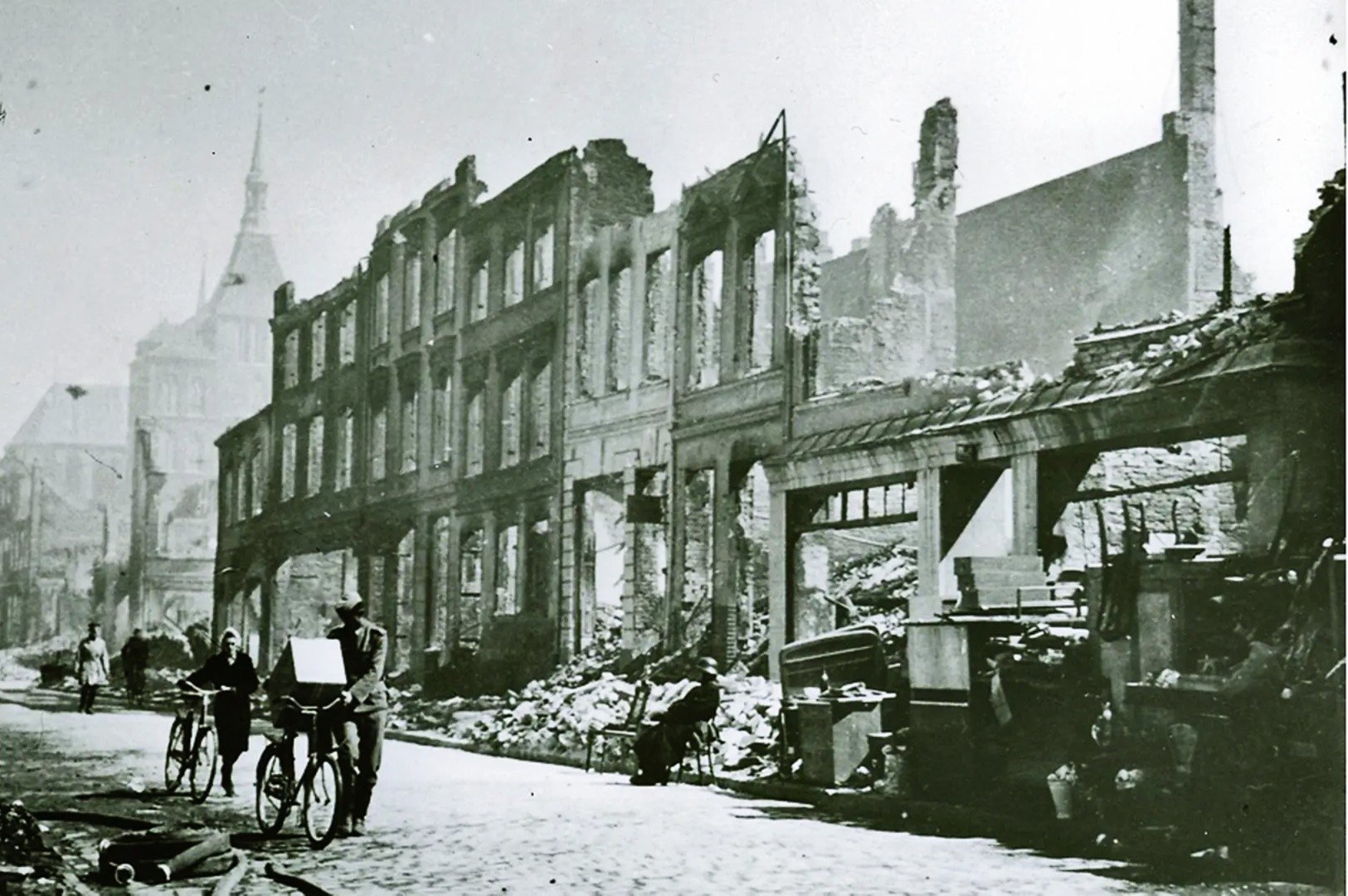
The remarkable An Ordinary Youth (now available for the first time in English in a translation by Michael Lipkin), an autobiographical novel by Walter Kempowski (1929–2007), opens with a fictionalized version of his family moving into its new apartment in Rostock, a formerly Hanseatic port on Germany’s Baltic coast. The plants on the balcony include “Jew’s beard geraniums.” It is 1938.
Judenbart is a name by which Saxifraga stolonifera still goes in Germany. In 1938, no one would have thought about it twice, but Kempowski mentions it again, still on the balcony, as Walter, his mother, and grandfather sit awaiting the Red Army, seven years later.
An Ordinary Youth was first published in West Germany in 1971 as Tadellöser & Wolff, and Kempowski may have seen that plant as one of this book’s equivalents of the Stolpersteine (stumbling stones), the small bronze plaques that since 1992 have been embedded in streets and sidewalks in Germany and many other countries it occupied during the Second World War. They are placed near the last residence of victims of Nazi persecution, typically recording their name, date of birth, deportation, and, if known, death—something to “stumble” across, sudden, jolting reminders of the past.
Kempowski may have considered such Stolpersteine necessary in a novel set on the German home front (it is based on his own childhood and adolescence) and published when many Germans’ thinking about their own wartime suffering took less account of the Holocaust than it does today. On a visit to his grandfather in Hamburg, Walter watches him read the newspaper and then comments:
There were always interesting stories in the Miscellaneous section: a fire in a room caused by neglect; a slip and fall; a story of a little boy in São Paolo who was killed by a wild swarm of bees; and in Auschwitz, at Kattowitz, a bloody marital drama had played out in the street.
This is the sole time Auschwitz is mentioned. Kempowski has explained that he included it as an antidote to any self-pity his readers might feel as they thought of the bombing of Hamburg. The aftermath of a raid—possibly a preamble to the firestorms of Operation Gomorrah—is described shortly afterwards.
The reference to an obscure town near Kattowitz (Katowice in pre- and post-war Poland) is followed by Walter’s grandfather setting out his views of what he saw as Germany’s historic tragedies before concluding: “Hitler really is a piece of good fortune. A fabulous man. What is a country in our position supposed to do without him?” But, “It’s just a shame he can’t leave the Church alone.”
The Holocaust—and what preceded it—is mostly offstage, revealed mainly by occasional physical traces, such as a sign—“jews not welcome!”—and a burned-out synagogue, noted by the young Walter without comment. He passes by a businessman’s villa. “Once in November 1938,” he sees that its windows have been smashed and that its owner Mr. Samuel has “left records strewn across the lawn.” The date ties the vandalism to Kristallnacht, which is neither named nor, it seems, understood by Walter, nine years old at the time: it would not have been Samuel who threw those records around. That was also the night that the synagogue was set ablaze, not that Walter says so.
What is not said matters. Rebuking his elder son for dismissing French culture, Karl, Walter’s father, directs him towards France’s authors including Émile Zola. “J’Accuse is all about the misdeeds in the army and the judiciary.” J’Accuse . . . ! was an open letter, not a book, but it was “about” more than that, as Karl certainly knew.
In October 1944, Karl returns from a posting to Łomża in northeastern Poland. After describing a close escape from the Soviets, “He pushed the pencil under his wedding ring and spoke in French. He no longer mentioned Lomza.” Karl and his wife, Grete, speak French when they don’t want their children to understand. He clearly had more than war stories to tell.
A few ugly remarks aside, Walter’s upper-middle-class parents show no overt signs of anti-Semitism, and this appears to be largely true of their immediate circle. A teacher and his Jewish wife join a small group taking cover in the air-raid shelter in the building where the Kempowskis live. No one objects, even though “she wasn’t really permitted to be there,” relates Walter without, again, any additional comment. As with so much Walter describes, this is just how things are.
His parents go on to hire the teacher, who (we must infer) has lost his job for having the wrong sort of wife, as his math tutor. Quite a bit later still, with Walter’s understanding of his “ordinary” youth growing as he—and the war—grow older, he runs into the wife, “the poor woman,” from time to time. The child of the Third Reich who repeated a malicious story about the (Jewish) founder of Rostock’s streetcar system is changing.
Karl and Grete—cultivated, musical, well-read—look down, however discreetly, upon the Nazis politically, intellectually, and socially (“That bunch can’t even speak German properly. Gauleiter Hildebrandt was just a herder before all this. And he still looks like one.”). Both are conservative. The churchgoing Grete mourns the Kaiserzeit, and Karl is a German nationalist, a proud veteran of the Great War. He tells Sven Sörensen, a Dane who has come to work for his company, that he is “conservative to his bones,” but that doesn’t make him a Nazi:
With that, the difference between a “German” and a “Nazi” was explained to the Dane.
“I understand. Right or wrong, it’s still your country.”
“Exactly.”
“Who’d have thought things would go this far?” muses Karl, but he (more than Grete) has gone along some of the way himself, even having been a member of the SA. This is revealed to have been an opportunistic move in a subsequent book (Tadellöser & Wolff was the first of a series of novels), although it ends with his expulsion—he was a Freemason. That setback does not seem to have affected his shipping business. He prudently displays a picture of Hitler in his office and, in his excitement over Germany’s early victories in the war, considers adding one at home.
Walter never becomes, in any formal political sense, a dissident, but he is a fan of, to use the derogatory terminology of the regime, Negermusik, grows his hair too long, drinks cough syrup for kicks, and, influenced by the “Edelweiss pirates” of Berlin (there were other such groups elsewhere), wears a white scarf and hangs out with the like-minded: “We’d dance ‘hot’ on the pavement. Our booming laughter could be heard streets away. (‘Animals.’).”
This ends with him being transferred to a “mandatory fellowship” with the Hitler Youth, “made up of truants and so-called nancy-boys.”
To an extent, An Ordinary Youth is a kind of collage, its fragmentary nature reinforced by the brevity of many of its paragraphs, and Kempowski’s laconic, if at times unexpectedly poetic, style. The text is frequently punctuated by quotations from songs, poems, books, even signs, and it is made up, in no small part, of talk, itself sometimes not more than a fragment of conversation:
I got a malt beer. The firebombs were passed from table to table. “So this is a firebomb, eh? There’s no chance it will flame up, is there?” asked the cattle dealer. Once he got the all-clear, he took his cigar out of his mouth so as to inspect it.
“You’ll find more than thirty of them on every street,” my father said, addressing the room. “Sometimes they’re just tossed out of the window with a shovel.”
You’ve got no clue,
You little doe, you
“And after the bombs, you get a rain of flak shards at no extra charge . . . Bring them down, my boy.”
“Should I also bring my stamps?” I asked.
“You lovely boy . . .”
(“Isn’t he sweet?”)
This cascade of miscellanea, more than normally might be expected in a book built up of reminiscence, makes An Ordinary Youth a mosaic as well as a collage, one in which the trivial jostles up against the significant, and the things in between: a roll call of film stars—Laurel and Hardy passed the censors, apparently (well, Hitler was a fan)—wartime recipes, lost monuments, the instruction on a road sign swapped from the unacceptably English “Stop” to the Germanic “Halt,” the “nice little bunkers in Lübeck,” mistreated workers shipped in from the stolen lands to the east. “All details completely made up” reads an epigraph at the beginning of the book. I don’t think so.
As a work of collage, An Ordinary Youth anticipates Kempowski’s compilation of the volumes collectively known as Das Echolot (The Echo Sounder). This is often said to have been inspired by his discovery of a pile of papers and pictures in a Göttingen street in the 1960s, “the last legacy of a fallen soldier, photos from Russia, letters to his bride.” To no small degree it was, but there was something else at play.
In 1948, Kempowski was arrested on a visit to Rostock, by then in the Soviet zone, the future East Germany. He and his brother were convicted of spying and handed a quarter of a century term (his mother was sentenced to ten years for failing to denounce them). Kempowski eventually spent eight years in Saxony’s notorious Bautzen prison. There (so the story goes), a guard accompanying him in the prison’s courtyard said that the sound they could hear was of Kempowski’s “comrades in their cells . . . talking among themselves,” prompting Kempowski to spend a great deal of time quizzing fellow inmates about their lives.
Many of these conversations were focused on the war. Such stories, which he came to see as a sort of chorus, should not, he believed, be forgotten. Thus began his lifelong quest to ask Germans about their wartime experience, an investigation supplemented by public requests for letters, diaries, anything, the basis of a gigantic archive. This research was reflected in earlier works, and then resulted in Das Echolot: a vast selection of extracts from letters, diaries, books, some previously published, many not, some German, others not, creating a vast wartime collage, editorialized only by his choice—and juxtaposition—of the items that feature in it. This bore a resemblance to An Ordinary Youth, both in the use of a collage-like technique and as a work, superficially anyway, of observation and listening, rather than judgment.
But the judgment is there, concealed even in An Ordinary Youth’s original title, copied from a piece of Kempowski family argot derived from the German word (tadellos) for impeccable and the name (Loeser & Wolff) of Karl’s favorite brand of cigar. It meant, says Walter, that “everything’s perfect.”
Loeser & Wolff was “Aryanized” in 1937.

Alfred Duff Cooper (1890–1954) is, except for students of his time and place, fading from historical memory, yet he was once seemingly ubiquitous. Turn to the entry in Chips Channon’s diary for October 3, 1938, and there’s Cooper, summed up in a fashion too rough to reproduce even in a magazine as broadminded as this one. Or check out the list of people who in early 1932 participated in a whip-round to buy Winston Churchill a Daimler. There’s Cooper, up there, among others, with the Prince of Wales, Charlie Chaplin, and John Maynard Keynes.
Duff Cooper (he dropped the Alfred) was a war hero, diplomat (most notably as the British ambassador to Paris), parliamentarian, and cabinet minister. He worked for Churchill as a special envoy on various wartime missions. Despite being married to a famous beauty, he rejected monogamy with brio and drank and gambled to excess. And despite, perhaps predictably, dying aged only sixty-three—a sad moment possibly partially ameliorated by being (of course) on a cruise liner—he also found the time to write a number of biographies and a memoir, all well received, although some had reservations about his “biography” of the biblical King David, an unlikely successor to his earlier subjects, Talleyrand and Field Marshal Haig. He wrote a book speculating that Shakespeare had served in the army (Kirkus Reviews: “lightly persuasive”) and he even wrote a novel, Operation Heartbreak (1950). This has now been republished with a perceptive if unhelpfully pugilistic afterword (Brexit bad!) by Michael Hofmann, a writer best known for his brilliant translations from German.
Cooper was inspired to write the book by an elaborate (and successful) operation to deceive the enemy during the Second World War. For some reason it was still officially a secret, although that secrecy had crumbled enough—Churchill would sometimes talk about it after a good dinner—that Cooper felt free to use a version of it, together with an entirely fictional backstory, for his novel. The British government tried to suppress its publication but, once Churchill’s indiscretions were pointed out (he was no longer prime minister, but still . . .), gave up.
To disclose in a review the nature of the operation, lightly disguised or otherwise, and the arrangements that were put in place to make its deception all the more convincing, would be too much of a spoiler. Suffice to say that the book ends on a distinctly bittersweet note.
The story that precedes it is centered on a British army officer, the patriotic, likeable, decent, but none too bright Willie Maryngton, who is ultimately defeated by an opponent more damaging to him than any number of Germans: the world after 1918.
It’s an interesting enough idea, made more so by when it was written, with memories of the Second World War (and some of the events that preceded it) still very fresh. There are descriptions of London in 1940, ready for what may come, and of the divisions over Munich and the Spanish Civil War. Willie’s impression of the Germans he encounters while occupying a slice of the country in 1918/19 is testimony to the sentiments created by Britain’s experience of two very recent world wars: “[A] herd of lumbering louts, subservient and clumsy, sometimes sullen and surly, but more often too anxious to please.” They bore little resemblance, he felt, “to the men who had swept through Belgium almost to the gates of Paris . . . [and] smashed the empire of the Czars.”
Duff Cooper would not have been in a hurry to read An Ordinary Youth.
Cooper’s depiction of Maryngton can tip over into caricature. He is portrayed with far less subtlety than Clive Wynne-Candy, another soldier outrun by those times, in the film The Life and Death of Colonel Blimp (1943). It is not surprising, however, that Maryngton’s command of other tongues is characteristically British. After he complains that he has not been made a military attaché in some congenial neutral country, a friend suggests that “the fact that you can’t speak a single word of any foreign language may have something to do with it.” Willie replies that he has been told
that that doesn’t matter a bit. Foreigners respect you all the more if you can’t speak their beastly language. I agree with the chap who said that anybody can understand English if spoken loud enough.
“The chap” was wrong: as my father once demonstrated (with my mother looking on, appalled) during a family holiday in France in 1975, the key is not volume, but patience, clear diction, and speaking very, very slowly.
Initially, Willie tries to catch up with the twentieth century, eager to join the war that had killed his father in 1914 before it ends. To his dismay, the armistice is agreed just as he is about to embark for France. He frets that he has missed out. A reference to a book called The War to End War “had sent a shiver of horror down his spine.” To cheer Willie up, his foster brother, someone with no military inclinations, reassures him with the thought that there would be another war soon enough and that, as a born soldier, he would get his chance to take part in it, although he hoped that Willie wouldn’t insist on one in Europe. (“They’re a damned sight too dangerous . . . . You’d have much more fun smashing up the old Zulus.”)
Having failed to keep up with the current century, Willie finds that, for a while, life in a cavalry regiment is a good way instead to keep it at bay, and himself on a horse. Having lived somewhat above his means, Willie is pleased to be posted to India, where the past is both more resilient and more affordable: “The days of the British Raj were already numbered, but a British cavalry officer could still be gloriously unconscious of the fact.”
But the 1920s keep creeping in. An officer talks of the need to mechanize (tanks must replace horses), hinting at trouble, which eventually occurs, ahead. Willie loses his pretty fiancée—the colonel’s daughter, no less—to a brother officer, a “rotter” and, when the full depths of his villainy are revealed, a “swine.” Willie is no prude, but this betrayal broke too many codes at once. Back in London, he meets a beautiful, affectionate, but oddly elusive woman. It seems, he concludes, to be his fate “to be a soldier who never went to war, and a lover who never lay with his mistress.” That will change, in different ways, after war breaks out in 1939, but the spoilers are coming too close to continue any further on these pages.

Much of Amor Towles’s deservedly bestselling debut, Rules of Civility (2011), is set in Manhattan in the 1930s among the wealthy or upwardly mobile. In his new book, Table for Two, a collection of short stories and a novella, the short stories, with one striking exception, are mainly set among the well-heeled, or those who want to be, on that same island many decades later. The exception is located in the post-revolutionary Russia in which most of the drama of Towles’s enjoyable, if implausible, A Gentleman in Moscow (2016) took place: house arrest in a (formerly) luxury hotel reserved for the elite and favored foreigners was not the Soviet way. The novella in Table for Two is, to use the television term, a spin-off from Rules of Civility, as—slyly, if obliquely—is the Soviet-set short story. What changes its course (after a considerable delay) is an American magazine that falls from a truck taking it and other forbidden materials to the municipal furnace.
It is picked up by Pushkin, a former peasant, not the long-dead poet. On one of its pages there is a large black-and-white photograph of
a young woman lying on a chaise longue in a long white dress with a double strand of beads draped around her neck. Her hair was blond, her eyebrows thin, her lips delicate and dark. Simply put, she was the most beautiful woman that Pushkin had ever seen.
As Pushkin studies the picture, with the care but without the vulturine scrutiny of an online media user examining a certain picture of the Princess of Wales, he notices additional details, and the description of what he notices leaves no doubt that this photograph is the same as the one that graces the cover of my copy of Rules of Civility.
The short stories are well crafted with moments that range from the melancholy to the moving to the amusing to the didactic, such as the one in which Tommy from Goldman Sachs gets his comeuppance. Many are set on New York City’s Upper East Side. The right hotels, the right clubs, and the right restaurants are name-checked, and there are smaller reminders too: Madeline, exiting the Met with baggies filled with meatballs gathered up from a benefit, has an intensely awkward incident when “an enterprising Buckley boy who walked his neighbors’ dogs for a fee” passes by.
Even in the time when they are set, that “golden era of peace and prosperity” toward the end of the last century, that period before everything since, there are wasps managing the genteel decline that generations of Britons have long made their own. Percival Skinner explains that
for a man in his sixties who is no longer a man of means, the university clubs of Manhattan provide an oasis. The finer clubs . . . like the Union and the Knickerbocker are rather sticklers when it comes to matters of membership.
And their doormen know who’s who, an impossible task for those guarding the entrances to university clubs with members from all over the country. Just wear a jacket and the right tie, and all can be yours: newspapers, nibbles, even an old acquaintance who might buy you a drink.
The novella, Eve in Hollywood, picks up the story of Eve (Evelyn) Ross, perhaps the most go-getting of all the go-getters in Rules of Civility, last seen in those pages go-getting herself to Los Angeles, popping up later in a press item with Olivia de Havilland and making a high-spirited phone call back to Gotham. Would she ever return? “As far as she was concerned, the Rockies weren’t high enough.”
The novella stands up well in its own right, and so, as usual, notwithstanding her limp, does Eve, deft with a Mickey Finn, incisive, still beautiful despite the scar a car crash in Manhattan had left behind (along with that limp). To Jeremiah Litsky, a paparazzo of sorts, “a member of the fourth estate” (he says), she is “the damaged blonde . . . who’d come out of nowhere.” Towles is painting it noir. Well, Raymond Chandler went to a private school, too. And an English one at that.
Someone has sent de Havilland two photographs of the famous actress naked, together with a demand for payment. Gone with the Wind is on the way, and nudie pics were not so very Melanie Wilkes. And there were other photos of other actresses, even Bette, and Luise Rainer, “with a pubic triangle that would have brought a smile to the face of Isosceles.”
But, Eve, now Evelyn, is on the case:
“What happens on Mulholland after dark?” asked Evelyn.
“Car accidents,” replied Finnegan.
As Charlie felt a wave of helplessness, Finnegan smiled at him.
“You know, Charlie, you look more rattled than she does.
“I’ve been in a car accident,” said Evelyn offhandedly.
“Well, there you go,” said Finnegan.

It can be difficult enough to attend a funeral, even more so when it’s your own. But that’s what happens to Adam Albury, the protagonist of Mark McCrum’s Ghosted, a skillfully done, highly amusing blend of two traditional English genres, the murder mystery and the ghost story, even if, less traditionally, a séance actually gets through to the “passed” (maybe). That ought to be enticing enough in itself, but, as told by McCrum, an Englishman, after all, Ghosted offers enough of a glimpse of a certain type of Englishness—the alcohol, the insults (including, I noted, the unseemly compound adjective that appeared in Chips Cannon’s diary on October 3, 1938), a spot of class consciousness, a ridiculous vicar, and all the rest—to thrill any pbs viewer impatiently waiting for the next Masterpiece.
It takes a minute or so for Adam to catch on, but, after looking at the predominantly black-clad congregation (his first wife has, “let’s face it,” chosen something more “elegant and understated” than his second) and seeing his daughter’s tear-stained cheeks, he realizes what he is watching. It’s an unwelcome surprise. Worse is to come. The vicar seems to suggest that Adam committed suicide. Adam, however, has no memory of dying or of how he died, let alone of making the necessary arrangements to end it all.
Adam listens not always without irritation to the addresses from some of the mourners. One talks of “Adam’s pain” (which is the first Adam has heard of it: “I was fine, thank you very much”) and his right to kill himself (“mate, I didn’t do it”). His sister refuses to accept that it was suicide, although we all knew he could be difficult (“Did we? Adam thought”). He notices that Eva, his “colleague, protégé and dark secret” has turned up. The hymns are well chosen, and he is consigned to the earth accompanied by the tough-minded wording from the 1662 Book of Common Prayer. The vicar, reckons Adam, would have preferred something more “relatable” and must have been bribed by the promise of a donation to the restoration fund. “Her church services were so convivial that [he] had found them closer to a kindergarten lesson than anything sacred.”
Adam’s entertainingly acerbic commentary carries on through the wake, where, eavesdropping in the way that only the invisible can, he is pleased to hear that he merited an obituary, in “The Times, no less” (he had been a successful architect), and learns that his dog can either see or smell him. Then there is the matter of Adam’s death. If it wasn’t suicide, it must have been murder.
After this splendid overture, the rest of Ghosted comes to revolve around Adam’s hunt for his killer, a search complicated by the little and not-so-little inconveniences of being dead, inconveniences at least partly mitigated by Adam’s not-altogether-reliable ability to communicate with (and be seen by) a few others, to move long distances, and in most cases to remain invisible.
The tale is consistently enlivened, if it is not “problematic” to use that word when a dead man is involved, by Adam’s acid takes on what he sees and hears (who is this “darling” his second wife talks to on the night of the funeral? He finds out soon enough) and all-around grumpiness, natural enough under the circumstances and exacerbated by feelings of powerlessness and an awareness of people and pleasures lost for good, including, in the case of the latter, pork scratchings—the acme of pub food. The English clergyman Sydney Smith (1771–1845) allegedly described his “idea of heaven” as “eating pâté de foie gras to the sound of trumpets,” which may or may not be accurate, but Adam’s inability even to sample a snack is a reminder that, wherever he is, it is not heaven.
Adam is “in the world, but no longer of it.” Unable to intervene physically or otherwise, he watches his bullying brother-in-law come close to hitting his sister, enraged over the idea that their daughter should go to a private school—in certain circles a very British argument—leaving her sobbing. Adam’s “non-existent heart went out to her.”
As his detective work continues, Adam gains reinforcements, including the ghost of someone else quite likely to have been dispatched by the same killer, and then another ghost, that of a man felled by a heart attack when a haunting by Adam proves too much, even if his jeans and Camper shoes fall rather short of Jacob Marley’s chains. But as Adam explains to his first ghostly assistant, “It had hardly been his fault” that the man had had a preexisting heart condition, an excuse that has its flaws, to put it mildly. Nevertheless, this new ghost is intrigued enough by the whodunit to join the team of spectral sleuths.
I’ll keep to myself what happens next, but this being a very English mystery, a shrewd old lady (who still says “orf” for off ) plays a key role. The police compare her, of course, to Miss Marple, although, “I can’t say that was quite the comparison I’d have chosen, but never mind.”