Those Crazy Cosmonauts
John Strausbaugh: The Wrong Stuff: How the Soviet Space Program Crashed and Burned
The Wall Street Journal, June 10, 2024
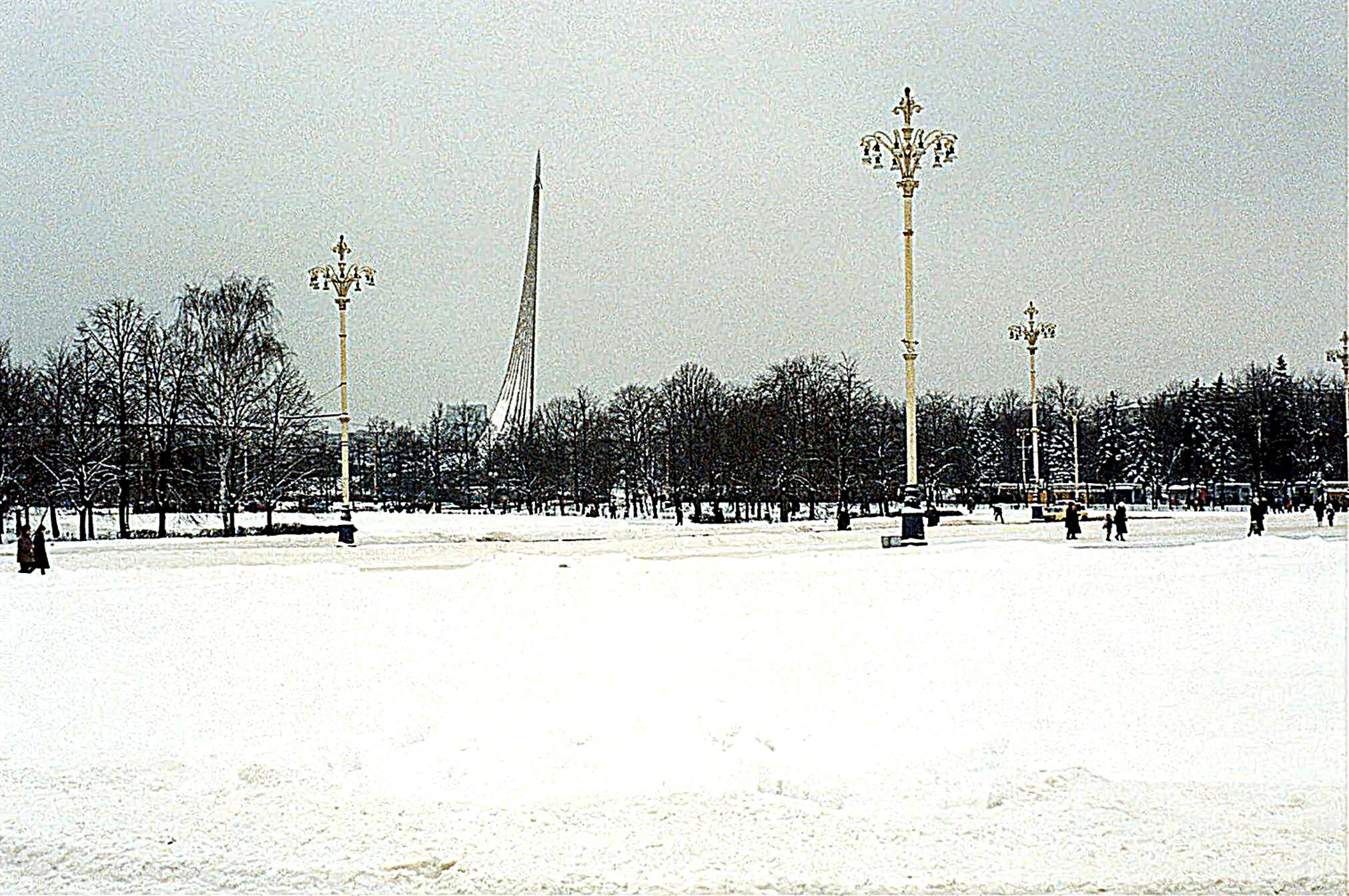
Monument to the Conquerors of Space, Moscow, USSR, February 1991 © Andrew Stuttaford
On Oct. 12, 1964, three smallish men, shrunk still more by a strict diet, squeezed into an aluminum sphere 8 feet in diameter. Earlier in the year, Nikita Khrushchev learned that the Americans were planning to send the first two-man capsule into orbit, and he wanted a Soviet trio in space ahead of them. The red team had neither a three-man craft nor a rocket powerful enough to shoot such a craft into space. The idea that they could quickly build both was ridiculous, but not so ridiculous as thinking that the Soviet leader’s demand could be ignored. So this particular sphere, a Vostok tailored for one (smallish) man, had been all but emptied out, given the minimum necessary refitting and relabeled Voskhod 1. The crew, according to author John Strausbaugh, had to do without bulky space suits and helmets and wore woolen leisure suits instead.
Sent on their way by an R-7, the Soviet space program’s treacherously temperamental workhorse, Voskhod circled the Earth 16 times and returned home safely, much to the relief of Sergei Korolev, the legendary “Chief Designer” (his name was kept secret) who, more than anyone else, was responsible for triumphs from Sputnik to Yuri Gagarin’s flight into history as the first man in space. “Not for the first or last time,” writes Mr. Strausbaugh in “The Wrong Stuff,” his brisk, rip-roaring account of the Soviet side of the space race, Korolev “had pried open the jaws of Defeat, stuck his head in, reached all the way down Defeat’s throat, and yanked out Victory.”
Despite the occasional misfire—not the worst word to use in this context—Mr. Strausbaugh’s style is appealingly sardonic, amusing and a touch gonzo. The author has a sharp eye for the bizarre, which lends itself nicely to a story of remarkable dysfunction and remarkable achievement, told against a background where the darkness is not only that of space.
Korolev had been arrested during the Stalinist purges of the 1930s, tortured, found “guilty” of some absurdity and consigned to the Gulag’s harshest zone. He was later “released” into a prison laboratory, where for a while he was forced to report to the colleague who had denounced him to the secret police. This was the beginning of a career ascent during which Korolev gave the state that had nearly destroyed him (his health never fully recovered from his ordeal) its greatest Cold War propaganda coups, along with some helpful weaponry and spy satellites too.
Korolev had dreamt of space travel for years, and he knew how to play the Soviet game. He got the nod for a space program, Mr. Strausbaugh observes, by explaining that his newly devised R-7 rocket could be used to beat the Americans into space as well as on the ground (an exaggeration, since the original R-7 was not well-suited for deployment as an ICBM). Mr. Strausbaugh’s vivid description of what followed works well, even if it is a little light on the science of rocketry.
Then again, this leaves plenty of room for livelier details, such as Voskhod 2 (and its crew, one of whom had just completed the first, very tricky, space walk) surviving a terrifying re-entry only to touch down in deepest Siberia, over 1,000 miles from the designated landing site, much to the interest of a pack of hungry (if ultimately disappointed) wolves. Other animals feature, too, in “The Wrong Stuff,” mainly those press-ganged into test flights, many never to return.
But Homo sapiens did its bit too. To Mr. Strausbaugh, the space race reversed the stereotypes of free-wheeling Americans and robotic Soviets. For all the fiascoes and setbacks (and worse) along its way, the U.S. advanced “one-small-step-for-man-at-a-time,” methodically and somewhat cautiously. America’s pioneering astronauts knew their work could be extremely dangerous, but they also knew they were backed by the very best technology.
The cosmonauts had no such reassurance. As Mr. Strausbaugh ably demonstrates, Soviet space technology could be unnervingly primitive, and this, at times, had lethal consequences. Soviet shortcomings necessitated highly creative, if often low-tech, improvisation, such as using frozen urine (and a beret) to seal a leaking fuel pipe. This “rash, slapdash, yet undeniably successful” approach, and, I suspect, the knowledge that the Kremlin would not hesitate to sacrifice their lives for the regime’s greater good, contributed to an attitude among the cosmonauts that was more “reckless and fatalistic” than that among the astronauts.
But the differences between American astronauts and Russian cosmonauts should not be overstated. To be sure, the public image in America of the early astronauts was, as Mr. Strausbaugh writes, “bland.” They were depicted as clean-cut examples of how high (literally) an everyman could rise in their society. But much the same could be said of Soviet imagery of wholesome cosmonauts in their happy Soviet homes. In reality, while Cape Canaveral was never Cape Fidelity, some cosmonauts, especially Gagarin and his successor in space, Gherman Titov, took misbehavior much further, taking advantage of their celebrity and relative untouchability to make up for their austere Soviet past, womanizing and drinking on a scale so epic that it had room for farce (Gagarin leaping or falling off a pretty nurse’s balcony to escape his irate wife) and tragedy. Titov was involved in an incident somewhat reminiscent of the events at Chappaquiddick a few years later. It was, of course, covered up.
In January 1966, Korolev died at the age of 59, shortly after a surgeon, bloodily botching a routine procedure in his intestine, discovered a large malignant tumor and started hacking away. Korolev’s name was revealed to the wider world in his obituaries, although not even an oblique reference to his suffering under Stalin was permitted.
The death of the Chief Designer may have been the moment at which the Soviets, already struggling—thanks, in no small part, to bureaucratic in-fighting—finally lost the race to be first to put a man on the moon and, if only symbolically, much more than that. In the end, Sputnik and Gagarin turned out to be harbingers of a false new dawn, leaving only the Wrong Stuff behind.