Too Small To Fail

The Weekly Standard, November 9, 2009

Independence Monument, Riga, Latvia, 2009  © Andrew Stuttaford

Independence Monument, Riga, Latvia, 2009  © Andrew Stuttaford

It's a measure of the tension of the times in which we live that Anders Borg, the finance minister of famously polite Sweden, has been going around threatening Latvia. Yes, Latvia. "The patience of the international community is," he growled on October 2, "very limited, and Latvia has little room to maneuver."

If it's rare for a Swede to lose his cool, it's astonishing that a small Baltic state (Latvia's population is just over 2.2 million) was the cause. But Latvia is in an economic mess that is extraordinarily deep (GDP will fall by nearly 19 percent this year), and the consequences have already spread far beyond its borders. Evidence that it was pushing back at those who have been trying to help is what triggered Borg's explosion--well, that, and the risk posed to three of Sweden's largest banks by their roughly 40 billion euros of Baltic exposure.

The story of the Latvian crisis is, if nothing else, proof of the old maxim that no good deed goes unpunished. While the underlying sources of the country's difficulties can be put down to the devastation of half a century of incarceration in the Soviet domain, the immediate cause can be found in one of the happier events in Latvian history: its 2004 admission, alongside the other Baltic states (Lithuania and Estonia), into the European Union.

The integration of large swaths of Eastern Europe into the wider European economy and, ultimately, the EU is something that even Euroskeptics concede has been a triumph: a fusion of enlightened self-interest, generosity, and strategic vision that has done much to smooth the path away from Soviet rule and Communist ways. Initial flows of capital lured to the region by the collapse of Communism were, as the 1990s progressed, supplemented by waves of investment attracted by the reassuring spectacle of former Soviet satellites rediscovering the pains and pleasures of the free market. The transformation was further accelerated by the prospect of eventual EU membership as a final guarantee that they would not slip back.

This was the way it worked in Hungary, Poland, and other former Warsaw Pact nations, and this was the way it eventually worked for the three Baltic states, the first former Soviet republics to apply for, and be accepted into, EU membership. Thus funds began flowing into Latvia, Lithuania, and Estonia almost as soon as they regained their independence--at a time when the prospect of losing it again to Brussels was still but a distant dream. Much of this money came from the neighboring Nordic countries attracted by an exciting local investment opportunity, historical connections (the Latvian capital, Riga, was once the largest city in greater Sweden), and a keen interest in avoiding the development of three turbulent post-Soviet slums in their backyard.

So far, so benign. But the onrush of Nordic cash overwhelmed the small and rickety enterprises typical of economies emerging from Communist rule. A huge part of the Baltic banking sector ended up in Nordic hands--roughly 70 percent of borrowing in Latvia is now sourced from banks controlled by foreign (primarily Nordic) institutions. What began as a change for the good (the Nordic-run institutions were better managed and capitalized than their local predecessors) degenerated into an unhealthy codependency as the banks financed an unsustainable boom on ultimately disastrous terms. By the time it was all over, they were essentially funding the current accounts of all three Baltic nations.

The bubbles began to inflate as EU membership loomed early this decade and ballooned after the three countries crossed the finish line. Too much money (and too much credit) was pouring into economies too small to absorb it productively, which triggered inflation, speculation, and a consumer binge. Overall government borrowing remained modest in each of the Baltic states, but debt racked up in the private sector--in Latvia it reached 130 percent of GDP in 2008. Imports were sucked into the region, and exporting industries were priced out. (Latvia's textile sector was 12 percent of the country's exports in the early 2000s; it is today only 5 percent.)

Alberta Iela, Riga, Latvia, 2009  © Andrew Stuttaford

Alberta Iela, Riga, Latvia, 2009  © Andrew Stuttaford

As the Baltic economies roared (Latvia's GDP grew by 12 percent in 2006, and 10 percent in 2007), current account deficits soared (Latvia's peaked at some 25 percent in 2007). Fueling the inflationary fire still further, a number of EU countries (notably the U.K. and Ireland) waived the transitional period that has traditionally followed the accession of less-developed countries into the EU and opened up their labor markets to workers from the Baltic, attracting far more immigrants from the region than originally expected. That was good news for employers in London and Dublin, but it siphoned off talent back home, increasing already fierce upward pressure on wage rates and, incidentally, adding to the demographic anxieties of three small peoples that had--only just--succeeded in preserving their ethnic, cultural, and political identity after half a century of Moscow's best efforts to Russianize their countries. Not the least of the ironies facing the Baltic states is the way that their long overdue reintegration into the global economy could, by offering their best and brightest citizens better opportunities abroad, destroy the integrity and the essence of the nations they leave behind.

When economies overheat, real estate prices tend to boil over, and so it was all over the Baltic. In Latvia, house prices jumped by (on some estimates) 300 percent between 2004 and 2007. Never a healthy phenomenon, the real estate bubble had an extra malignant aspect in the Baltics as most of the mortgage lending (a chunk of it distinctly subprime) that financed it was denominated in euros--not yet the Baltic countries' currency. Back in 2004 when Latvia, Lithuania, and Estonia signed up for the EU they took a seat in the waiting room for the monetary union. They were in a strong position to satisfy the Maastricht preconditions for adoption of the euro (subdued inflation, low levels of government debt, and well-managed public spending), and all three local currencies--the Latvian lats, the Estonian kroon, and the Lithuanian litas--had been pegged to the euro by 2005. Forecasts that they would be replaced by Brussels' money in 2008 did not seem out of line. Borrowing in euros looked like the smart thing to do. Euro interest rates were well below those charged for borrowing in lati, krooni, and litai and, with the adoption of the EU's single currency purportedly just around the corner, there was not supposed to be much in the way of foreign exchange risk. International (mainly Nordic) banks keen to minimize their exposure to the small illiquid Baltic currencies were only too happy to oblige: Some 80 percent of all private borrowing in the Baltic countries is in euros.

But the cash that cascaded into the Baltic countries pushed up their inflation rates to levels far in excess of the Maastricht criteria. In Latvia inflation peaked at nearly 18 percent in May 2008--up from 6.2 percent in 2004 and the 2 percent range between 2000-03. Drawn in by the prospect of near-term Baltic adoption of the euro, the flood of new money has perversely done a great deal to delay that switch (the latest predictions cluster at around 2011 for Estonia, 2012-13 for Lithuania, and, fingers crossed, 2014 for Latvia, although the IMF recently suggested that the latter date will slip still further). Foreign exchange risk was back.

And so were tough times. The inevitable bust arrived, gathering pace at roughly the same time as international financial markets were freezing up in 2008, an unhappy coincidence that made bad things worse as the (already slowing) foreign capital inflows that had done so much to sustain the boom came to an abrupt halt. To get an idea of the scale of the disaster that has struck, Latvian retail sales are running at 70 percent of 2008, the nation's real estate prices are down some two-thirds from their levels of two years before, and industrial production slumped 18 percent between June 2008 and June 2009.

The textbook response to this type of boom-and-bust would be a drastic devaluation of the currency to slash the cost of exports, discourage imports, and bring burgeoning current account deficits under some degree of control. If textbooks aren't sufficiently persuasive, markets can usually be expected to help out, and, sure enough, the lats came under strong pressure in June. But the sparse market in Baltic currencies gives them considerable protection against speculative attack. It's almost impossible to short thinly traded lati, krooni, or litai to the extent it would take to break their pegs to the euro. The fact that Estonia, Lithuania, and Latvia all operate currency board systems (in Latvia's case de facto rather than de jure) under which their monetary base is essentially backed up by gold and foreign exchange reserves means it would take an almost complete collapse in domestic confidence to trigger a run on the currency.

Of the three Baltic currencies, the lats has come under the most pressure (the economic and political fundamentals are weaker in Latvia than in Estonia or Lithuania, and the Latvian central bank had to spend around 1 billion euros to defend the currency in June). Yet the Latvian authorities continue to believe that now is not the time for devaluation. Latvian central bankers told me in August that depreciating the currency is simply not the answer to the country's predicament, and they make a good case. Devaluations work best in economies where a good portion of demand can be satisfied domestically, where the export sector has a high value-added component (i.e., not textiles and the like), and when the global economy is in good shape. None of these descriptions applies to the Baltic states or the world in 2009.

The alternative approach being pursued by Latvia is an "internal devaluation" (Lithuania and Estonia have taken a similar tack) designed to rebuild its international competitiveness by purging the inflationary excesses of recent years and, while it's at it, restore badly needed fiscal and budgetary balance--in other words to generate some of the positive effects of a devaluation without abandoning the currency peg. If most countries are trying to reflate their way out of the current economic crisis, Latvia is doing the opposite. Public sector pay is slated to be reduced by as much as 40 percent (though actual cuts appear to have been less so far) as part of a budgetary squeeze that has included the closing of hospitals and schools (admittedly Latvia was oversupplied with both) and sharp reductions in both welfare payments and pensions--payments that weren't generous in the first place. Adding to the misery: Taxes are being increased. As economic cures go, this is about as tough as it is possible to get, and it has already yielded some tentatively positive results. Latvian inflation has been brought to its knees (in September it was running at 0.1 percent), the trade deficit has shrunk dramatically, and the current account is back in surplus (14 percent of GDP in the second quarter).

Advocates of a conventional devaluation retort that any signs of improvement are merely symptoms of an economy where all demand has been crushed and will stay crushed for quite some time. This is not, they argue, the sort of recovery that will persuade the nation's best and brightest to stay at home once the broader European economy has improved enough to resume hiring. Nor will it attract the new capital that Latvia so badly needs, capital that will only be further deterred as the "hopeless" defense of the peg perpetuates uncertainty over the currency's future while underpinning a real effective exchange rate that continues to rise.

Such arguments are too pessimistic--though only just--and they also fail to address the implications of all those foreign currency loans. Repaying them is already difficult within the context of a devastated real estate market and collapsing economy. Increasing the outstanding balances by 30 percent (the percentage generally thought to be by how much the lats would have to be devalued) would generate Sisyphean agony and drive domestic demand even deeper into the hole. Complicating matters still further is the fact that the affected borrowers are drawn disproportionately from the ranks of the young (many older Latvians remain ensconced in the properties they received gratis in the post-Soviet privatizations), the enterprising, and the upwardly mobile, who are the main hope of any lasting revival. (Undoubtedly a good number of them are also to be found in Latvia's governing class. Unsurprisingly they are not that keen to devalue. Would you vote yourself into bankruptcy?)

Crucially it was the harsh medicine of the internal devaluation that secured the international financial support without which Latvia's economy might have already collapsed. The country's key lenders have so far shown themselves willing to assist in propping up the Latvian currency. It's not hard to guess why, despite some rumored disagreements within the lending consortium, this strategy prevailed. The Swedish banks most heavily involved in the Baltic have all made substantial provisions against lending losses in the region (and raised major amounts of capital to replace what has been lost), but neither they nor the Swedish state that has effectively underwritten them would welcome the massive additional hit to balance sheets that would follow a devaluation of the lats--particularly as it would likely trigger devaluations (and further losses) in Lithuania and Estonia. There's also a clear risk (although less than there was a few months ago) of a domino effect--Baltic devaluations pressuring other vulnerable Eastern European currencies with the potential for extremely unpleasant implications for Western banks exposed in the former Soviet empire. To give just one example of what could be at stake, earlier this year outstanding loans by Austrian banks to Eastern Europe were reported to amount to roughly 75 percent of Austria's GDP.

It's this fear of wider contagion that largely explains the willingness of the multinational group that includes the EU, the IMF, the World Bank, and, of course, the Nordic countries to lend Latvia 7.5 billion euros (and that's before counting the indirect help Latvia has received, including critically, Sweden's support for its banks). In the wake of last year's global financial meltdown, those few billions may seem like chump change, but they represent a huge sum for Latvia (whose GDP stood at around 22 billion euros in 2008). For once, the country is benefiting from the size of its economy: It's simply too small to fail. In absolute terms a bailout of Latvia (or for that matter, any of the Baltic countries) does not involve that much money. If such a rescue can stave off catastrophe elsewhere it will be a bargain. Who needs a Baltic Lehman?

But will this support buy enough time for the internal devaluation to work? Talking to Latvian civil servants, it is impossible to miss their unease about what may happen when the bleak Baltic winter descends on a population struggling through economic disaster. Nobody has forgotten the rioting in Riga (and in Lithuania) in January, the low point of a fraught few months that also saw the collapse of Latvia's sitting government. While there was a reasonable level of confidence amongst those to whom I spoke that the social net will hold, a winter of discontent may be difficult to avoid as benefits ratchet down (unemployment benefits fall sharply after five months on the dole and are then eliminated altogether after nine months--although the unemployed remain eligible for other forms of assistance), savings evaporate, and jobs remain scarce. Unemployment now stands at 18 percent, a devastating number in a climate of deteriorating welfare support. There are indications that the economy's fall is slowing (GDP is currently forecast to decline by a mere 4 percent next year), but what few green shoots there are have sprouted too late to make much difference this winter.

Adding to the worries is the fear that the country's economic woes will be used by the ever more revanchist Kremlin to foment discontent among the roughly 30 percent of the population that is of ethnic Russian descent. Maddening symbols of lost empire, and small enough to bully, Latvia and Estonia have long been placed amongst Russia's worst enemies by Vladimir Putin. He may be unable to resist the temptation to make their problems worse.

The Latvian government's strategy appears to be to hang on grimly and hope that the global economy recovers quickly and strongly enough to pull a sensibly deflated Latvia out of the mire and into hailing distance of the allegedly (that's a debate for another time) safe haven of eurozone membership. So far this tough approach enjoys at least a degree of grudging popular support. Some two-thirds of Latvians are thought to support the defense of a currency that is a symbol of both hard-won independence and the ability of ordinary Latvians to build a better future for themselves. They have seen their savings wiped out twice in the last 20 years, first by the Soviet implosion (and the chaos that accompanied it) and then again, after painful rebuilding, by a massive banking crisis in the mid-1990s. Devaluation would look all too much like round three. Latvian officials also put a great deal of faith in the country's flexible labor markets and the resilience of a people with recent memories of times far, far harder than now. Latvians will know, I was repeatedly told, how to cope.

Maybe, but all attempts to measure public opinion are guesswork--bedeviled by societal division (ethnic Latvians and ethnic Russians often see matters in very different ways) and the fact that Latvia's political parties are often little more than collections of a few friends or co-conspirators, sustained by self-interest, shared ethnic identity, and passing eddies of voter enthusiasm. They are bad at reflecting public opinion and worse at shaping it. If overall living conditions deteriorate badly this winter, there may be no one able to speak honestly to the nation or for its concerns. That's not a recipe for social peace.

There will be parliamentary elections next year and the uncertainty about the degree of support the internal devaluation will continue to enjoy helps explain September's unexpected failure of the governing coalition to pass all elements of the austere 2010 budget that was a condition for the continued support of Latvia's international lenders. This was the failure that so angered Anders Borg in early October. His mood will not have been improved by the market tremors that followed both his comments and subsequent press reports in Sweden that he had told Swedish banks to prepare themselves for the worst.

It's difficult to imagine that he would have been cheered up by the almost simultaneous revelation that the Latvian government was contemplating measures limiting the liability of homeowners to their lenders, a move that would have serious implications for a number of Sweden's banks. This proposal may have been an unsubtle attempt to pressure the Swedes into agreeing to go a little easier on the 2010 budget, but, with the furor it stirred up, it backfired. Its most controversial element--the idea that it would have retrospective effect--has been withdrawn, and the budget hiccup has been resolved with a Latvian climb-down. But these spats were a reminder that the realities that define this uncomfortable situation continue to hold true: Latvia is still both highly vulnerable and too small to fail, the codependent relationship between Sweden's banks and their Latvian borrowers continues to be both intact and unhappy, and the durability and extent of popular support for Latvia's harsh economic medicine remains an unknowable, unnerving mystery.

It's going to be a long winter.

Never such innocence again

The Boy's Own Paper

The New Criterion, October 1, 2009

Tom Royden
Tom Royden

Except for the vague impression of a heavily built, benignly gruff, occasionally encountered man with short silver hair, I cannot claim to remember my great-uncle Tom very well. Tom Royden was, I understand, an English country doctor of the old school with a lady friend down the road, a flourishing practice, a keen interest in songbirds, and a shrewd understanding of the practice of medicine that owed as much to common sense as to science. I can remember, just, being told of his death in 1966 (I was eight), and the flock of cheeping, singing, and trilling folk that moved into our house shortly thereafter.

Not so long later, four bulky, musty volumes turned up at home, each stamped with a different date from the first decade of the twentieth century, each smelling of sixty years. Battered and fine, their covers embossed with cowboys, Vikings, and other examples of the formidably tough, they had belonged to my great-uncle all his life. Now, I was informed, they were mine. They still are, artifacts of an era over long before I began, belongings of a man I never really knew, and, in some senses, an introduction to both. To read them was to be transported back from the Beatles on the transistor to Daisy Daisy Bell on the calliope, from phasers on the starship to battles on the veldt, to a time and a place that was no longer sepia, no longer then. To read them was to sit with young Tom turning those same pages on some long-forgotten Edwardian afternoon, and to wonder about the child that the old man had once been.

The four volumes in question were collections (“annuals”) of all the editions of the Boy’s Own Paper issued each week over the course of a given twelve months. Tom’s 1909 annual happened to cover the period from October 3, 1908 to September 25, 1909, but in reality it oozed the ideals, assumptions, and myths of any year plucked from the three or four decades in which imperial Britain slid from its Victorian apogee into an Indian summer of, perversely, even greater splendor. It was a period of rapid social change yet, all things considered, extraordinary social peace, a social peace of which the Boy’s Own Paper was both symptom and, in its own small way, architect.

“The prince of boys’ papers” (as the London Times once described it) was published by, of all people, the Religious Tract Society, an organization founded in 1799 to spread the word of the Lord amongst those with “little leisure and less inclination to peruse entire volumes.” The RTS soon expanded its activities to include the publication of materials designed to save souls overseas but never stopped keeping a sharp eye on those in peril back home. With Britain’s ever more literate population displaying a growing appetite for less than salubrious publications, there was much to look out for. Appalled by the public’s grimy tastes, the society’s committee met in 1878 to discuss “providing healthy boy literature to counteract the vastly increasing circulation of illustrated and other papers and tales of a bad tendency.”

The BOP (as it quickly came to be known) debuted on January 18 the following year. To guess that this worthy committee’s notion of “healthy boy literature” would be glum little pamphlets filled with clerical homilies, Gospel stories, and tales of biblical derring-do is to underestimate the subtlety of the Victorian mind. Despite a cover price (one penny) pitched low enough to put the new paper within the grasp of youngsters from almost all social classes, production values were high, complete with masthead designed by the conqueror (British, naturally) of the Matterhorn, Edward Whymper, and Latin motto: right from the beginning, the creators of the BOP were signaling that they took their paper—and its readers—seriously.

If the BOP’s packaging was good, so too, at their best, were its contents. These were crammed each week into sixteen densely printed pages (there was also a monthly edition which, like the annual, came with some extras) filled with a nicely chosen, well-illustrated blend of story-telling, practical advice, sports coverage, accounts of faraway lands, technological updates, sagas of self-improvement, competitions, puzzles, career opportunities, instructions on how to make various new-fangled devices at home, patriotic tidbits, and informative chat about hobbies, particularly the care and maintenance of pets: the first issue featured “My Monkeys and How I Manage Them” by Frank Buckland, M.A., a touch of Noah in a paper where most of the writing on pets was focused on Britain’s rather pedestrian domestic fauna. The origins of Tom’s aviary may well lie in the practical, unsentimental guide to rearing birds that was a regular feature of the BOP in his youth, and which (in the January 30, 1909 issue) included this typically hard-headed piece of advice for the owners of pigeon lofts: “Don’t keep wasters. Pigeon-pie is good.”

The challenge of the dreaded penny dreadfuls was met head-on. Amongst the stories serialized in the paper’s early editions were Nearly Eaten, Nearly Garrotted, and How I Lost My Finger, all by James Cox, R.N. (M.A., R.N.—at the BOP credentials counted). In the words of G. A. Hutchison, the paper’s founding genius and first managing editor, the BOP had to appeal to “boys not their grandmothers,” an attitude that helps explain a series of not notably grandmother-friendly articles from the 1880s dedicated to “peculiar punishments”:

It is singular that a Chinaman will prefer to die by crucifixion rather than beheading. He has the greatest horror of appearing in the next world without his head and therefore chooses a slow and lingering death rather than a quick one.

That’s the spirit.

But while, as legendary BOP contributor Dr. Gordon Stables, R.N., noted in October 1908, there was no “namby-pambiness” or “silly goody-goodiness” about the stories the paper ran, no “British boy ever found in [them] even the remotest suggestion to do that which was not right and gentlemanly,” reassuring words for the parents and schools whose approval underpinned the paper’s continued success. If the BOP had sermons to preach—it did, sometimes overtly, sometimes not—they were rooted in patriotism, decency, hard work, and fair play (the practice of clubbing seals was, noted the author of one 1887 tale, “too much like hitting a man when he is down”) rather than the peculiar intricacies of theology.

Despite the best efforts of some in the RTS (stoutly resisted by Hutchison), in the pages of the BOP, God was the God of that splendid nineteenth-century hymn, immortal, invisible, and wise, emphasis on the second adjective. He was there—around, reassuring, in charge, and basically British. There simply was no need to go on about Him. Under the circumstances, it’s no surprise to find that of the two articles most directly regarding the church to be found in Tom Royden’s 1909 annual, one (from May 29) concerned the Rev. W. W. Beverage, “ministerial athlete” and unfortunately named temperance campaigner, and the other, “Athletic Parsons,” published the following week, hymned the sporting achievements of a series of sporting clergymen:

The number of parsons who take part in the first rank of games is not, of course, as large as that of those who have given up active participation after taking Holy Orders, but for all that there are some excellent representatives of muscular Christianity in the first flight of several games.

My suspicion is that young Tom will not have lingered too long over this revelation nor, for that matter, over other distinctly eat-your-greens pieces, including—hang onto your hat—a lengthy description (May 8, 1909) of what the London County Council (“a municipal mother of boys”) was doing for young people and, from August 7, 1909, “The Boyhood of Tennyson” (“his father had a delightful library”).

Mercifully, the corner of the BOP inhabited by sporting parsons, bountiful municipalities, and the doings of future poet laureates was a small one. The long-running serials, generally tales of adventure or public school, that constituted the paper’s mainstay were a source of far livelier entertainment. Tom will have begun 1909 with an issue (January 2) that included the fourteenth installment of both In the Heart of the Silent Sea (“The two boys, left unceremoniously by the screaming natives, had nothing for it but to follow in the wake of the fugitives”) and Rowland’s Fortune (“Having seen that two of the ruffians were dead, we returned to where the third lay. This was the fellow Don Carlos had beaten down with the flat of his sword”), as well as the first chapter of The Quenching of the Fiery Tide, a tale of ancient British fighting folk (“Conan, the exquisite, laughed scornfully”). The public schools were represented by The Bluffing of Mason (“Mason was a beast—everyone said so”), Mr. Lattimer’s Tax (“The two boys obeyed, one with a gleam of triumph breaking through a frown of concern; the other, pale and defiant”), and The Doctor’s Double: An Episode at Monkton School.

A large number of these once-ripping yarns now sag badly, and, as anyone who has waded through that fiery tide could tell you, others were not much good to begin with. But it’s impossible not to notice the sophistication of their grammar and vocabulary. The BOP may have had a tendency to patronize its audience, but it usually did so without talking down to them. It says a lot that amongst the writers who wrote for the BOP in its first three decades were Sir Arthur Conan Doyle (the BOP was “one of the first papers that grew tired of returning my MSS and published them instead”), Jules Verne, R. M. Ballantyne, and the great G. A. Henty, the author of a long sequence of novels (Wulf the Saxon, Under Drake’s Flag, The Young Carthaginian, and many, many others) often involving a enterprising young lad, stirring historical times, and a respectable amount of bloodshed.

The formula worked. Precise data are hard to come by, but the paper’s weekly readership probably peaked at around a million in the late 1880s, the highest level reached by any such publication. Thanks not least to competition from the likes of Chums and, later, The Captain, more up-market (and racier) ventures unburdened by the high-mindedness and rich-man-in-his-castle, poor-man-at-his-gate social inclusiveness that were key parts of the BOP’s ethos, the paper’s circulation fell sharply in the following decade, but it continued to boast a readership that ran easily into the hundreds of thousands and a significance in British life that was more than a matter of mere numbers. It had become, and was to remain, a national institution (a 1929 lunch to celebrate the BOP’s fiftieth anniversary was attended by both the prime minister and the leader of the opposition) and deservedly so.

Those who produced the paper clearly felt a genuine responsibility towards their readers, very few of whom would have had any chance to attend the Eton-and-Harrow surrogates where so many of the BOP’s school stories took place, settings that owed as much to the BOP’s ceaselessly aspirational creed as to snobbery. In part, these stories were, like today’s Gossip Girl, an opportunity for vicarious thrills in a privileged, inaccessible world, but, in part, they were also intended to train their readers how to behave like the public schoolboys they could never be. In similar vein, a recurrent theme that ran through stories both factual (“Boys Who Have Risen”; “Dunces Who Became Famous”; “From Wheelwright’s Bench to Academy: the story of George Tinworth’s boyhood”) and fictional (From Powder Monkey To Admiral; From Fisher Lad to Fleet Surgeon) published by the paper was that of the poor boy made good. Not everyone could become an admiral, or even a fleet surgeon, but the BOP would still do what it could to help its readers make something of themselves.

This may be the only charitable way to interpret the paper’s often shatteringly abrasive advice column, much of it written by that fierce foe of namby-pambiness, Dr. Stables, a Scottish “gentleman gypsy” and wildly prolific writer ( From Fisher Lad to Fleet Surgeon was one of his) who spent much of his time traveling the country in a purpose-built caravan accompanied by dog, parrot, coachman, and valet. A tartan-clad, fantastically bewhiskered, counter-intuitively married (he was a father of six) man, Stables was in his sixties by the time that Tom Royden was reading the BOP, but he cannot be said to have mellowed with age. His frequently questionable prescriptions (many of which can be found reprinted in Karl Sabbagh’s marvelous Your Case is Hopeless: Bracing Advice from theBoy’s Own Paper”) placed heavy emphasis on the “cold tub” and the avoidance of a habit too ghastly to be referred to directly (readers’ letters themselves were rarely published) and little in the way of good cheer.

Even when the advice was sensible, the delivery tended to be brusque. In the March 6th, 1909 issue, G. F. D. (VITALITY) was told:

Don’t be a little fool. You are, I suppose, by this time in the hands of these quacks. Your money will go, and you’ll get worse.

But the Edwardian era was predominantly an age of optimism. Like the paper for which he wrote,Stables was no doom-and-gloom reactionary (well, not always). The previous week he had written how “the boy is improving vastly. The ordinary town lad is a gentleman compared to the boys we found in our streets in the early eighties.” Progress!

Those behind Tom Royden’s BOP were comfortable with change, but confident that it would be on the right lines and be able to coexist comfortably with the best of what had gone before. To read those issues from 1909 is to be struck by the strong sense of continuity they convey. The cover price (maintained with difficulty) was the same as it had been thirty years before, the editor Hutchison (“the experienced old captain,” in the words of one advertisement) was still at his post, and Stables was just one of a number of contributors who had been published there for decades.

Even the serials, rambling on for months (In the Heart of the Silent Sea sailed on for an exhausting thirty-three weeks) reflected this notion of permanence, a notion unsurprising in a paper published in the heart of an empire on which the sun was never supposed to set. This was the empire whose past, present, and glorious future permeated almost every issue Tom read that year, whether in poetry (“The Song of the Union Jack”; “Britannia Victrix”) or as a subtext (without much sub about it) of many of the serials or in reports from the imperial territories (“Romance of Surveying: Thrilling Stories Told by the Men Who Are Now Mapping Out Our Possessions”; “Birds’-Nesting in India”; “Rhodesia’s Thin Red Line”; “Our Somaliland Fleet”).

This was, the BOP made clear, a Boy’s Own Empire, one run by the sweet, just, boyish (the last a telling adjective in this connection) masters of George Santayana’s infinitely flattering description. The nation that built it was fair, benevolent, and, in all senses of the word, the best. When foreigners appear in Tom’s annuals, it is usually as objects of curiosity and genial, but unmistakable, disdain—an expression of a feeling of not necessarily unkindly superiority that sharpens noticeably when some of the subject peoples of the empire come into view. The BOP wins no prizes for cultural sensitivity, something that has earned it the not so genial disdain of generations of tut-tutting academic commentators with very little cultural sensitivity of their own.

Of the cataclysm that was to overturn this ordered world only a handful of years later, taking many of the BOP’s former readers with it, the only hint in the 1909 annual is this passage from a real-life account of a camping holiday in Germany by Algernon Blackwood, an author better known for stories of the supernatural than for his vacation reminiscences. On this occasion, however, the problems were caused not by ghosts, but by the Kaiser’s police:

On previous trips, when we camped too near the towns, die Polizei often came to ask us what our business was. Often, too, they were very disagreeable and troublesome, poking about in our tents, searching through our kit in the boat, evidently suspicious that we were spies of some kind.

To be sure, the BOP of the late Victorian and Edwardian ages was somewhat more militaristic in tone than it had been before, but it was so in a way that, more often than not, brings to mind Powell and Pressburger’s Colonel Blimp rather than anything more sinister. Its attitude was a manifestation of the blithe (over)confidence in British might that played such a role in the country’s fatal decision to go to war in August 1914. It was not an anticipation, eager or otherwise, of that conflict or the horrors it would bring.

The BOP made it through both world wars (although the weekly edition had been scrapped in 1913) before finally succumbing to changing tastes and publishers in 1967, just a year after Tom’s own death, to live on in memories that have grown only fonder. And not just memories. Academic disapproval now has to compete with not only indulgent nostalgia but also the implied compliment paid to the old paper—and its disgraceful archaic values—by the success of The Dangerous Book for Boys (2006), which is, in many respects, an affectionate updating of the BOP, a point underlined by the fact that the cover of the British first edition was designed to resemble one of the old annuals.

Even if we don’t cheat (and we shouldn’t—that wouldn’t be the BOP way) by counting this unexpected coda as some sort of resurrection, the length of the paper’s actual lifespan—nearly ninety years —remains a tremendous achievement. The BOP’s remarkable durability was a testimony to the strength of the culture from which it sprang, a testimony to the strength of its own distinctive vision, and also to the way that culture and paper merged within the minds of some sometimes equally remarkable readers. In the introduction to his book The Best of British Pluck—The Boy’s Own Paper Revisited (1976), the author Philip Warner recalled his time as a POW of the Japanese working on the Bangkok-Moulmein railway in 1943:

Food was inadequate and appalling; the work was … exhausting; the … guards seemed scarcely sane; malaria … and a host of other diseases were rife… . Men died with steady regularity. Around was the jungle, hot, oppressive, menacing. There was really no hope of survival… . I remember one day looking round at the scene and saying to myself: “What an extraordinary situation! It’s like some strange adventure in the Boy’s Own Paper.” Suddenly it was less real, more bearable: after all BOP characters lived to tell the tale. Fantasy perhaps, but in certain conditions illusion may be more genuine than reality.

That’s the spirit.

Playing the Joker

National Review Online, August 18, 2009

If the right to vote (or not vote) for our leaders is a sign of a healthy democracy, so is the right not just to criticize, but also to insult them. Jeering, heckling, and rude, impious laughter are no less a part of the democratic process than the force-fed ecstasy of a party convention, the cheers of the shining-eyed faithful, or the complacent applause at rubber-chicken dinners. A statement of the obvious? You’d think so, but judging by some of the more overwrought reactions to a new and notably unflattering portrait of President Obama, some of his supporters need to relearn how to live with an American way of debate that is vigorous, rarely sedate, and often distinctly rough about the edges. That is not to say that this depiction of the president does not raise some troubling issues of its own — part of its force, unfortunately, if probably inadvertently, derives from the fact that it does — but those issues are, on balance, rather less disturbing than the near-hysterical response of a number of those who claim to be offended by it, reactions that suggest that too many of Obama’s disciples still believe their god-king should be allowed to float, untroubled and undisturbed, above the hurly-burly that the rest of us call politics.

The offending image, as most Americans know by now, is a photograph of Obama manipulated into an approximation of Heath Ledger’s Joker character in The Dark Knight. Its origins remain somewhat obscure, but it appears to have been based on an earlier photoshopped Obama-as-Joker created by a Chicago student. That image was not apparently a reflection of its creator’s political views (and was subsequently removed from his Flickr page). The same cannot be said of the new version. Joker-Obama has been given a blue background and a red frame. These colors combine with a chalk-white face and red slash of mouth to conjure up a harsh, scornful retort to the serene red, white, and blue of the legendary “Hope” by Shepard Fairey that did so much to shape and enhance Obama’s electoral magic.

When comparing these two clashing portrayals, we notice that in Fairey’s poster Obama’s mouth is set, serious, determined, while Joker-Obama’s is transformed into a hideous, thoroughly unconvincing smile, a smile made even more disconcerting by the subject’s staring panda eyes. His face, like that of the movie character on which it is based, is that of a madman. Fairey’s Obama by contrast is a saint, a visionary, a leader, his eyes peering out at the radiant future into which, no doubt, he intends to take us, a future summed up in only two words (first “hope” and later “change,” or was it the other way round?) that can be both noun and commanding verb, but are as empty of real meaning as the “socialism” with which the anonymous artist behind Joker-Obama captioned his creation.

Posters of Joker-Obama first appeared a month or so ago, before going viral and becoming the first anti-Obama artifact to attract a mass following in a country still littered with adoring Obamabilia. In a sense, therefore, this brutal little portrait has already done its work. The icon is chipped. A sharp, disrespectful cackle has interrupted the self-satisfied chorus of agreement with which Obama’s skillfully teleprompted sermons are usually received, a cackle made even more dangerous to the administration by the fact that mounting public skepticism over some of the Democrats’ initiatives has, for the first time since the election, created an opening that even the stumblebum GOP might manage to exploit. It is this (as much as any sense of lèse-majesté, although there is that too) that helps explain some of the outrage that this one image has generated, a tantrum rendered grimly amusing by still-fresh memories of the silence, or even approval, with which so many Democrats greeted the cruel renderings (including, naturally, one as the Joker from, naturally, Vanity Fair) of George W. Bush that scarred the political landscape throughout his term in office.

To be fair, some of those who object to Joker-Obama have attempted to clothe their complaints in something more substantive than “You can’t do that to our guy.” The word “socialism” is inaccurate, they grumble, and to the extent that the Democrats do not appear intent on reviving the spirit of Upton Sinclair they are quite right. On the other hand, we live in 2009, and the bundle of resentments, superstitions, and aspirations once dubbed socialism have evolved into a protean collection of ideas that don’t fit comfortably with traditional notions of what that antique ideological label should mean. Who needs common ownership of the means of production? With growing government intervention in the economy (even excluding the current emergency arrangements), in your pocketbook, and in the more general ordering of society, there are worse ways to describe the direction in which this country is sliding. “Socialism” may not be the most precise, the most carefully calibrated, professorially approved term to use, but as shorthand for the understandable fear that a remodeled leftist leviathan is stirring, it will do.

Others have tut-tutted that using the Joker in this fashion makes no sense because (a) the Joker isn’t a socialist and (b) President Obama is not a raving homicidal maniac — criticisms that may suggest that the literalists are now running the asylum. We are after all talking about a caricature. We can, I think, agree that — despite persistent rumors of his earlier involvement in the Biden campaign — the Joker is not even a Democrat, let alone a socialist (he is more of a nihilist, I suppose). Equally, I hope that even the most rabid of those of us on the right can admit that Obama — while not so preternaturally calm as frequently asserted — is very far from being a raving homicidal maniac. We ought also to be able to agree that using the Joker to deface (in two senses of the word) a picture of Obama was, sit down please, a joke — a pointed joke, sure, a nasty joke, maybe, but a joke nonetheless. There’s nothing much to parse here, folks, just move along.

And yet that grotesque image has made more of an impact than might have been expected. Perhaps it’s just because it represents a chance at last — after months of generally worshipful media coverage — to protest and, better, to make fun of our sainted president. And maybe it does come with a certain crude logic. You can at least make a case that the Joker is an agent of chaos, and that Joker-Obama thus taps into fears that chaos (hyperinflation, say) will soon be with us if the Democrats’ policies continue in their present direction. Maybe. But the best bet is that the real power of Joker-Obama is as a mask, a device that plays to the anxiety of many Americans (an anxiety so strong in some cases that it has given birth to the Birthers) that they do not know who Obama is, an anxiety that is the not altogether surprising consequence of his rapid rise, guarded personality, deceptive governing style, and — it’s a shame that this should be perceived as relevant, but it apparently is — an upbringing and ethnic background that differ sharply from what was once considered the American norm.

That last aspect brings us to the regrettably inevitable question as to whether the poster is any way racist. Of course, the manner in which elements in the Obama claque attempt to shut down debate by blaming (it sometimes seems) almost any criticism of the president on racism has become a cliché of contemporary American politics. And in that respect, the reaction to Joker-Obama has not disappointed. Blogging for LA Weekly, Steven Mikulan claimed “the only thing missing” from the poster “is a noose.” Over at the Washington Post, culture critic Philip Kennicott tied himself up in knots as he tried to demonstrate that applying the “urban” make-up of Heath Ledger’s Joker to Obama (rather than that of Jack Nicholson’s supposedly more “urbane” take) was a “subtly coded, highly effective racial and political argument,” an attempt to assert that “Obama, like the Joker and like the racial stereotype of the black man, carries within him an unknowable, volatile and dangerous marker of urban violence, which could erupt at any time.”

Ridiculous, yup, but just because most such allegations of racism are ludicrous, that does not mean that all are. There is something — the whiteface — about Joker-Obama that means this poster is not a banner under which the opposition to the president should rally. To be sure, “clown white” (to use the technical term) makeup is an essential element in the appearance of Batman’s archenemy: it’s impossible to transform anybody — whether George W. Bush, Hillary Clinton, or Barack Obama — into the Joker without it. Nevertheless, even if (as I would guess) the Joker-Obama poster was created without any racist intent, it can still be read in a way that resonates very uncomfortably indeed. However much we might want to, we can wish away neither the uglier parts of history nor their continuing echoes. As a result, therefore, and regardless of the intention behind it, giving Obama the Joker’s stark white skin tone takes what would (in the case of Bush and Clinton) be simple caricature dangerously close to the badlands of minstrelsy.

Of course, most (though not all) minstrel shows featured whites in blackface rather than the other way round, but a key theme that lurked within almost all of them was the use of, to adopt a clumsy phrase, racial cross-dressing to mock and belittle black people. It’s the memory, however vague, however buried, of this, I suspect, that has contributed to both the poster’s offensiveness (to some) and, sadly, its appeal (to others). Yes, About.com (owned by the New York Times!) is, at the time of writing, running a picture of RNC chairman Michael Steele made up to look like a clown, but when I look at it all I see is a depiction of a man (who happens to be African-American) portrayed as a clown. The far more disturbing Joker-Obama is something else. Unlike Steele’s sleek clown, we are shown an unhinged, sinister trickster, with make-up that is not so much costume as (rather poorly executed) camouflage, a disguise that can at least conceivably be interpreted as a suggestion that Obama could not have been elected if he had revealed, so to speak, his true colors, a suggestion that in its most literal sense is deeply demeaning to African-Americans.

Stretching too hard, perhaps, overly “sensitive,” possibly, but both America’s troubled racial history and the current febrile state of our politics call for caution in this area — and so does clear-eyed political calculation of what it will take to beat Obama in 2012. Playing the Joker just isn’t the way to go.

Destination Moon

National Review Online, July 17, 2009

Apollo_11_BBC_Studio

I don’t know where I was when I heard that JFK had been shot, but I can remember where I was at teatime the following day — at home in the east of England, watching the very first episode of Doctor Who. It was the halting, creakily paced beginning of a long, beguiling tumble through time and space that, in the absence of any proper space program of our own, became an eccentric and quintessentially English alternative to Gemini, Apollo, and footsteps on the moon.

Not for the first time, we had sweetened our failure with fantasy. NASA’s Mission Control may have been the acme of American industrial cool, a collection of (Alfred) Sloan Rangers, calm, crew-cut men in white shirts methodically guiding tiny vessels over immense distances, but we had Doctor Who, an almost-perfect embodiment of the chaotic, improvisational genius that Brits like to believe is one of their better national characteristics. The doctor generally appeared to have little control and less interest over where or when his spacecraft might land — but wherever and whenever it was, and whatever the perils he encountered there, he invariably managed to emerge victorious at the end. To be sure, he was an alien from another world, but he was a very British alien, amateurish, surprisingly effective, and clad in vaguely Edwardian clothing, a wistful nod to a lost empire’s last good time.

Yes, the fact that the Union Jack would never preside over some far lunar crater was a disappointment to a nation still proud of its explorers of old, but it was with a certain sardonic, stoic grace that this once-great power came to terms with its role as a space-race spectator and concluded that it performed that role rather well. In addition, the world famous Jodrell Bank Observatory was, Britons told themselves, an essential element in man’s thrust into the unknown, a listening post that provided the Americans with invaluable assistance, not least in eavesdropping on the intriguing Soviet spacecraft that sailed through the heavens. These vehicles were shrouded in mystery and lies, yet were quite capable of delivering a series of spectacular achievements — the first orbit by an artificial satellite, the first man in space, the first space walk, the first successful soft landing of a probe on the moon.

To tell the truth, we were able to take more pleasure in those Soviet triumphs than were our cousins across the Atlantic. Naturally, we were more or less on the side of the Yanks, our allies, “family,” and, don’t say it too loudly, heirs, but we had a touch more room for the idea that the us-versus-them that counted most was man against the dangers of the universe, not man against man.

When, in August 1961, four months or so after his pioneering orbit around the Earth, Yuri Gagarin visited the British capital, the London Times sniffed that he had “received a welcome that sometimes bordered on hysteria” (this was before Beatlemania). At just three years old, I was a part of the frenzy. My parents, no stooges of the Kremlin, decided it was “important” that I was taken to stare at the Soviet spaceman. Sadly, I have no memory of this historic event, but I like to believe that it played a part in triggering my lifelong fascination with what might lie out there among the stars, a fascination only partly attributable to my subsequent abduction by aliens (well, you never know), a fascination rocket-powered throughout my boyhood by the way that science fiction and science fact played off each other in that first great age of space exploration, an era that promised, or so it seemed, to make a reality of the wonders already foretold by Asimov, Clarke, and the best of the rest of the paperback seers.

And as the decade progressed, each new program — Gemini, Apollo, Vostok, Voskhod, Soyuz — seemed to bring that reality ever closer, especially when it became clear that man was at last on the threshold of a visit to his planet's nearest neighbor. By the late summer of 1968, the finish line was coming into view. September saw the Soviet Zond 5 become the first vessel to circle the moon and return safely to earth — complete with a cargo of worms, flies, and a turtle or two. America countered with a sharp ratchet-up of the evolutionary scale, dispatching Apollo 7 into orbit in October, the first successful manned Apollo mission.

That, thought NASA, was practice enough. It had to be. Nobody knew what the Soviets might try next. In December, Apollo 8 headed for the moon — and possibly the most magical Christmas since Charles Dickens first published his tale of Ebenezer, ghosts, and redemption. Britain was enthralled. The moon made stars of science correspondents such as the dignified Peter Fairley from ITV (then the UK’s sole private television network) and the boyishly enthusiastic James Burke of the BBC, and gave an extra boost to the career of Patrick Moore, the marvelously oddball host of The Sky at Night, a show the BBC has operated as a vespers for insomniac astronomers since, astonishingly, 1957 — with Patrick, these days Sir Patrick, Moore always in charge. As for me, in between painstakingly monitoring developments on the telly and painstakingly boring everyone I knew with my command of mission minutiae, I pored over diagrams from the newspapers showing Apollo 8’s tricky trajectory (suitably enough, it resembled a figure eight) and preparing for the tense vigil for to come once Anders, Lovell, and Borman first disappeared behind the dark side of the moon.

Then 1968 evolved into 1969, and Apollo 8 into Apollo 9 and from that into the dress rehearsal that was Apollo 10. The Soviet program ran into difficulties, leaving history to Armstrong, Aldrin, and Collins — and the future to the rest of us. Looking at the diary I kept that year, I can see that I had marked out the projected date — July 16 — for the launch (“US MOON SHOT OFF TODAY”) of Apollo 11 some time before the momentous day itself actually dawned. This launch was something to count the days to, a grand historical happening to which the later entry in my diary didn’t do much justice: “It took off successfully.” True enough, but not enough. I gazed that day delighted and agog at television pictures of the giant rocket rising majestically into a sky then unscarred by memories of the Challenger.

Eventually Apollo 11 vanished from my sight — but not from my mind. Obsessed by thoughts of the moon landing ahead (at last!) and where it might lead (Mars!), I stalked that spacecraft over the next few days. Nothing must go wrong! TV’s designated experts did what they could to explain what was going on, helped by the models and the charts that were the best — not bad — that British television could come up with in a primitive time long before CGI. But it could never be enough: I needed to know more. I scrutinized footage of the three astronauts. How were they doing? Were they okay? I checked out cavernous, disciplined Mission Control for clues. Was all well? Who looked nervous? Between the beeps that became part of Apollo’s soundtrack, I strained to make sense of those exotic, evocative communications between Houston and spaceship that NASA chose to relay to us back “home,” a word itself now given a larger meaning than ever before.

The night of July 20 found me allowed to stay up way past my bedtime and sip from a glass of, strangely, cherry brandy (a sickly drink then mainly associated with a minor scandal involving Prince Charles) that I’d been given so I could toast Armstrong, Aldrin, and, as my mother usually described him, “poor Michael Collins.” We watched as the Eagle slowly (or so it seemed to me then) descended onto the gray surface that I believed would soon (the exciting-sounding year 2000 sounded about right) play host to moon bases and other treats; I listened to the clipped, sparse commentary of a BBC that had the sensitivity to let the descent — and the men from NASA — speak for themselves.

And it was the BBC that we watched. Despite perpetual parental muttering about its (undoubted) left-wing bias, the Stuttafords, like most British families in that era, tended to turn to the Beeb for coverage of anything really significant. July 20, 1969, showed why. ITV’s coverage revolved around hours upon hours of Frost/Moon or, more accurately, David Frost’s Moon Party, a broadcast that drove one guest, Ray Bradbury, to walk off in despair. It was not, grumbled Bradbury later, “a night for Sammy Davis Jr. or Engelbert Humperdinck.” Indeed it wasn’t.

Then finally (nearly 4 a.m., UK time — what had they been doing in there?), Neil Armstrong stepped out of the Eagle and onto the Moon. Sitting in a house in the quiet English countryside, we raised refreshed glasses and exhaustedly contemplated the spectacle of a man walking on a rock some quarter of a million miles away. The images transmitted from the Sea of Tranquility were blurry, shadowy, appropriately dreamlike, but what had taken place was clear, even if I didn’t remain awake long enough to see Aldrin join Armstrong out in that “magnificent desolation” of theirs. No matter. As my diary for that night records: “MAN on MOON.” And so he was. And so they were. And so we were.

There are, of course, those who say that the whole thing was both a waste of money and a blind alley. I don’t agree, but that’s a discussion for another time. For now, I’m waiting for Monday the 20th, and a chance to crack open the cherry brandy in a celebration of that extraordinary night of 40 years ago. Come to think of it, maybe not cherry brandy, but you get the point . . .

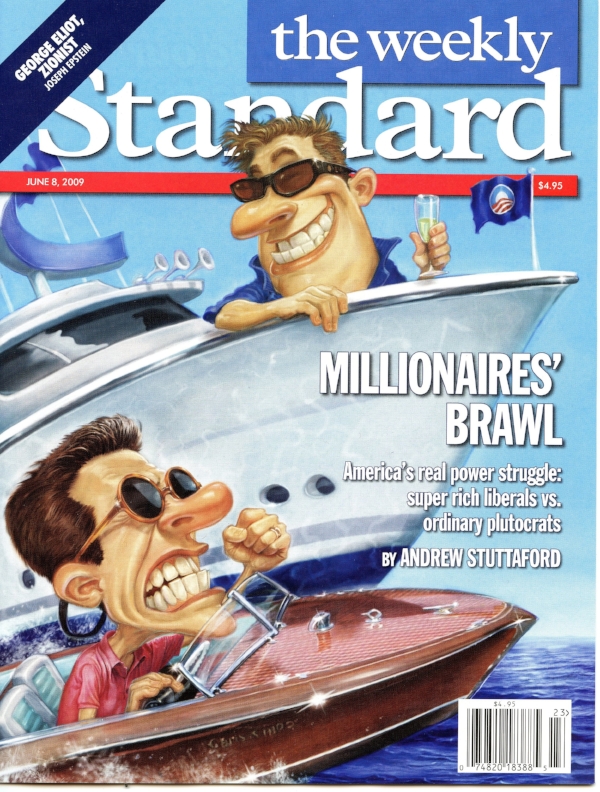
Millionaires' Brawl

the weekly Standard, June 8, 2009

img023.jpg

With the economy floundering, Wall Street in disgrace, and American capitalism facing its most serious ideological challenge in one, two, or three generations (you can take your pick), it's a good moment to remember Lenin.

While the bearded Bolshevik's grasp of economics was never the best and his stock picks remain a mystery, he would have grasped the politics of our present situation all too well. The old butcher would not have found anything especially surprising about the rise of Barack Obama, the nature of his supporters, or the evolution of his policies. He would have simply asked his usual question: Kto/kogo ("Who/whom"). The answer would tell him almost everything he needed to know. Lenin regarded politics as binary--a zero sum game with winners, losers, and nothing in between. For him it was a bare-knuckled brawl that ultimately could be reduced to that single brutal question: who was on top and who was not. Who was giving orders to whom. Hope and Change, nyet so much.

Of course, it would be foolish to deny the role that things like idealism, sanctimony, fashion, hysteria, exhaustion, restlessness, changing demographics, Hurricane Katrina, an unpopular war, George W. Bush, and mounting economic alarm played in shaping last November's Democratic triumph. Nevertheless if we peer through the smug, self-congratulatory smog that enveloped the Obama campaign, the outlines of a harder-edged narrative can be discerned, a narrative that bolsters the idea that Lenin's cynical maxim has held up better than the state he created.

So, who in 2008 was Who, and who Whom?

In a Democratic year, it's no surprise that organized labor emerged as Who and large swaths of the private sector as Whom. Many of the other, sometimes overlapping, constituencies (whether it's minorities, the young, or the gay, to name but three) who saw themselves benefiting from an Obama presidency were equally easy to predict. After all, whether by the accident of his birth or the design of his campaign, Obama's victorious coalition was, even more than most, a creation of meticulously assembled blocks, more pluribus than unum, and each with plenty to gain from his arrival in the White House.

That said, for all the smiles, the reassuring vagueness, and the this-isn't-going-to-hurt (too much) rhetoric, it was somewhat less predictable that a large slice of the upper crust would succumb to Obama's deftly articulated pitch. Yes, it's true that there had been signs that some richer, more upscale voters were being driven into the Democratic camp by the culture wars (and the fact that prosperity had left them free to put a priority on such issues). Nevertheless, even after taking account of the impact of an unusually unpopular incumbent, it's striking how much this process intensified in 2008--a year in which the Democrats were not only running their most leftwing candidate since George McGovern, but also running a leftwing candidate with every chance of winning. Voting for Obama would not be a cost-free virtuecratic nod, but a choice with consequences. At first glance therefore it makes little sense that 49 percent of those from households making more than $100,000 a year (26 percent of the electorate) opted for the Democrat, up from 41 percent in 2004, as did 52 percent of those raking in over $200,000 (6 percent of voters), up from 35 percent last go round.

Yet, this shift in voting patterns is more rational than it initially seems: more Lenin than lemming. Class conflict is inherent in all higher primate societies (even this one). It can manifest itself at every level, right up to the very top, and certain aspects of the 2008 campaign came to resemble a millionaires' brawl--one that was, of course, decorous, sotto voce, and rarely mentioned.

In a shrewd article written for Politico shortly after the election, Clinton adviser Mark Penn tried to pin down who exactly these higher echelon Obama voters were ("professional," corporate rather than small business, highly educated, and so on). Possibly uncomfortable with acknowledging anything so allegedly un-American as class yet politically very comfortable with this obvious class's obvious electoral clout, he eulogized its supposedly shared characteristics: teamwork, pragmatism, collective action, trust in government intervention, a preference for the scientific over the faith-based, and a belief in the "interconnectedness of the world." We could doubtless add an appreciation of NPR and a fondness for a bracing decaf venti latte to the list, and as we did so we would try hard to forget this disquieting passage from George Orwell's Nineteen Eighty-Four: "The new aristocracy was made up for the most part of bureaucrats, scientists, technicians, trade-union organizers, publicity experts, sociologists, teachers, journalists, and professional politicians."

We are not Oceania, and there's a messiah in the White House rather than Big Brother, but it's not hard to read Lenin, Penn, and Orwell, and then decide that Penn's professionals are the coming Who. They have certainly (at least until the current economic unpleasantness) been growing rapidly in numbers. As Penn relates:

 While there has been some inflation over the past 12 years, the exit poll demographics show that the fastest growing group of voters .  .  . has been those making over $100,000 a year. .  .  . In 1996, only 9 percent of the electorate said their family income was that high .  .  . [By 2008] it had grown to 26 percent.

This is a class that is likely to be more ethnically diverse and younger than previous groupings of the affluent--factors that may influence their voting as much as their income. Nevertheless, even if we allow for the fact that there is a limit to how far you can conflate households on $100,000 a year with those on $200,000, there are enough of them with enough in the way of similar career paths, education, and aspirations that together they can be treated as the sort of voting bloc that Penn describes. And it's a formidable voting bloc with a formidable sense of its own self-interest.

That sense of self-interest might seem tricky to reconcile with voting for a candidate likely (and for those making over $200,000 certain) to hike their taxes. In the wake of the long Wall Street boom and savage bust, however, it is anything but. Put crudely, the economic growth of the 1990s and 2000s created the conditions in which this class could both flourish and feel hard done by. Penn hints at one explanation for this contradiction when he refers to the alienating effect of the layoffs that are a regular feature of modern American corporate life. That's true enough. Today's executive may be well paid, sometimes very well paid, but he is in some respects little more than a day laborer. Corporate paternalism has been killed--and the murderer is widely believed to be the Gordon Gekko model of capitalism that Obama has vowed to cut down to size.

But Penn fails to mention (perhaps because it was too unflattering a motive to attribute to a constituency he clearly wants to cultivate) that this discontent stems as much from green eyes as pink slips--as well, it must be added, from a strong sense of entitlement denied. Traces of this can be detected in parts of Robert Frank's Richistan: A Journey through the American Wealth Boom and the Lives of the New Rich (2007), a clever, classically top-of-the-bull-market account of what was then--ah, 2007!--America's new Gilded Age. To read this invaluable travelogue of the territories of the rich (the "virtual nation," complete with possessions, that Frank dubs "Richistan") is to see how the emergence of a mass class of super-rich could fuel growing resentment both within its ranks and, by extension, without. By "without," I refer not to the genuinely poor, who have, sadly, had time to become accustomed to almost immeasurably worse levels of deprivation, but to the not-quite-so-rich eyeing their neighbors' new Lexus and simmering, snarling, and borrowing to keep up. The story of rising inequality in America is a familiar one: What's not so well known is that the divide has grown sharpest at the top. Frank reports that the average income for the top 1 percent of income earners grew 57 percent between 1990 and 2004, but that of the top 0.1 percent raced ahead by 85 percent, a trend that will have accelerated until 2008 and found echoes further down the economic hierarchy.

You might not weep for the mergers-and-acquisition man maddened by the size of an even richer hedge fund manager's yacht, but his trauma is a symptom of a syndrome that has spread far beyond Greenwich, Connecticut. Above a certain level, wealth, and the status that flows from it, is more a matter of relatives than absolutes. The less dramatically affluent alphas that make up the core of Penn's professionals--lawyers, journalists, corporate types, academics, senior civil servants, and the like--suddenly found themselves over the last decade not just overshadowed by finance's new titans but actually priced out of many things they view as the perks of their position: private schools, second homes, and so on. I doubt they enjoyed the experience.

Well educated, articulate and, by any usual measure, successful, they had been reduced to betas--and thus, politically, to a glint in Obama's eye. The decades of prosperity had swollen their numbers, but shrunk their status and their security. Their privileges were mocked or dismantled and their "good" jobs were ever more vulnerable. Wives as well as husbands now had to work, and not just down at the church's charity store either, a change that is more resented than Stepford's children would generally like to admit. Even so, things they felt should have been theirs by rights were still out of reach or, perhaps worse, graspable only by heavily leveraged hands. In a boom-time (July 2006) piece for Vanity Fair, Nina Munk interviewed two women amongst "the worn carpet and faded chintz" of Greenwich's old guard Round Hill Club. They told her how everything had gone downhill, "no one can afford to live here--all our kids are moving to Darien or Rowayton because it's cheaper."

It's a mark of the pressure to keep up that, as Frank noted, in 2004, 20 percent of "Lower Richistanis," those 7.5 million households (the number would be lower now, but it then would have constituted roughly 6-7 percent of the U.S. total) struggling along on a net worth of $1 million to $10 million, spent more than they earned. These poor souls will have included the most prosperous of Penn's professionals, but in an age of "mass luxury" and almost unlimited credit, the compulsion to do whatever it took not to be trumped by the Joneses spread to their less affluent cohorts, with the devastating consequences that were finally visible to all by the middle of last year.

Thus Penn's people had been outbid and outplayed by a rapacious Wall Street swarm of boors, rogues, gamblers, whippersnappers, the plain lucky, and the otherwise undeserving. Then came Wall Street's implosion and these prejudices were reinforced by that hole in the 401(k) and the collapse in the value of that overmortgaged house. Voting left looked better and better.

In 2007, the final financial reckoning was still slouching along waiting to be born. Back then, all they knew was that they had been shoved down the totem pole, which had changed beyond recognition. Nothing that had mattered did, or so it appeared. You can see an echo of this in the opening sections of one of the numerous (and, to be fair, not entirely unmerited) I-told-you-so articles penned by Paul Krugman in recent months:

Thirty-plus years ago, when I was a graduate student in economics, only the least ambitious of my classmates sought careers in the financial world. Even then, investment banks paid more than teaching or public service--but not that much more, and anyway, everyone knew that banking was, well, boring. In the years that followed, of course, banking became anything but boring. Wheeling and dealing flourished, and pay scales in finance shot up, drawing in many of the nation's best and brightest young people (O.K., I'm not so sure about the "best" part).

This social unease bubbled through Tom Wolfe's "The Pirate Pose," a 2007 essay that ran, apparently without irony, in the inaugural edition of Condé Nast's glossy Portfolio magazine, itself a lost artifact of the era when CDOs were still chic. Wolfe's sly--and in its exaggerations accidentally self-revealing--piece opens with an insistent pounding at the door of a Park Avenue apartment. Inside, a genteel lady rises from her "18th-century" (old!) "burled-wood secretary" (tasteful!), "her grandmother's" (old money!), "where she always wrote her thank-you notes" (refined!). Outside rages the absolutely dreadful hedge fund manager with "more money than God" who has just moved into the building:

Ever so gingerly, she opened the door. He was a meat-fed man wearing a rather shiny--silk?--and rather too vividly striped open shirt that paunched out slightly over his waistband. The waistband was down at hip-hugger level because the lower half of his fortyish body was squeezed into a pair of twentyish jeans .  .  . gloriously frayed at the bottoms of the pant legs, from which protruded a pair of long, shiny pointed alligator shoes. They looked like weapons.

Wolfe had fallen out of love with the Masters of the Universe. The ironic detachment that was one of the many pleasures of The Bonfire of the Vanities had been bumped and buffeted by the author's horror at the barbarians not just broken through the gates, but everywhere he would rather be, something that perhaps explains the faintest trace of glee that runs through this passage:

As for the co-op buildings in New York, their residents having felt already burned by the fabulous new money, some are now considering new screening devices. .  .  . The board of a building on Park Avenue is now considering rejecting applicants who have too much money.

Wolfe is angry, not so much because of the money (Sherman McCoy wasn't exactly poor), but because these loutish self-styled freebooters do not care for what he enjoys, what he stands for, even for where he might socialize (in his lists of some of the older Upper East Side hangouts, he throws in a couple of the more recherché names--the Brook, the Leash--as a reminder that he knows what's what). They despise what he favors, and even condescension, that traditional last line of defense against the arriviste who does not know his place, is unavailable. How can you condescend to someone who does not care what you think and is richer than you can imagine? The great writer finds himself sidelined on what is, quite literally, his home turf.

This is the class resentment that twists through recent remarks by another writer, a former academic who argued that it was ridiculous that "25-year-olds [were] getting million-dollar bonuses, [and] they were willing to pay $100 for a steak dinner and the waiter was getting the kinds of tips that would make a college professor envious."

The reference to a "college professor" as the epitome of the individual wronged by this topsy-turvy state of affairs is telling: 58 percent of those with a postgraduate education voted Democratic, up from 50 percent in 1992 (those with just one degree split more evenly). If those comments are telling, so is the identity of the speaker: one Barack Obama, a politician who has explicitly and implicitly promised the managers, the scribblers, the professors, and the now-eclipsed gentry that he would finish what the market collapse had begun. He'd put those Wall Street nouveaux back in their place. Higher taxes will claw at what's left of their fortunes and, no less crucially, their prospects. What taxes don't accomplish, new regulation (some of which even makes some sense) and the direct stake the government has now taken in so much of the economy will. Better still are all the respectably lucrative, respectably respectable jobs that it will take to run, or bypass, this new order: Former derivatives traders need not apply.

In an only slightly tongue-in-cheek February column in the New York Times, David Brooks neatly described what this will mean:

 After the TARP, the auto bailout, the stimulus package, the Fed rescue packages and various other federal interventions, rich people no longer get to set their own rules. Now lifestyle standards for the privileged class are set by people who live in Ward Three .  .  . a section of Northwest Washington, D.C., where many Democratic staffers, regulators, journalists, lawyers, Obama aides and senior civil servants live.

If the price for this is a relatively modest (for now) tax increase on their own incomes, it is one the denizens of Ward Three and their equivalents elsewhere will be happy to pay. For it is they now who are on a roll, and every day the news, carefully crafted by the journalists that make up such an archetypical part of Penn's professional class, gets sweeter.

The humbling of Wall Street has made for great copy, but it's fascinating how much personal animus runs through some of the reporting; from the giddy, gloating, descriptions of excess, of bonuses won and fortunes lost, to the oddly misogynistic trial-of-Marie-Antoinette subgenre devoted to examining the plight of "hedge fund wives" and, more recently, "TARP wives" (who had not, of course, been compelled to work).

In his "Profiles in Panic" a January 2009, article for Vanity Fair, Michael Shnayerson wrote:

The day after Lehman Brothers went down, a high-end Manhattan department store reportedly had the biggest day of returns in its history. "Because the wives didn't want the husbands to get the credit-card bills," says a fashion-world insider.

Not quite the guillotine, but the tricoteuses would have relished the story.

And then there's this from the Washington Post's travel section last month:

For so long, they have been taking Manhattan. They as in the Wall Streeters who counted their bonuses in increments of millions. .  .  . The coveted restaurants, the hotels with infinite thread-count sheets .  .  . the designer shops that sniff at the idea of a sale--it was all theirs. But the times they-are-a-changin'. .  .  . Our moment to reclaim the city has arrived. To shove our wallets forward and say, Yes, we can afford this. In fact, give us two.

To anticipate what (other than Ward Three vacationers to Manhattan) is coming next, listen to the increasing talk of congressional investigations (modelled on the FDR-era Pecora hearings) into Wall Street's workings or for that matter an intriguing, much-discussed piece in the Atlantic Monthly by Simon Johnson, a former chief economist for the IMF (Academic: check! Bureaucrat: check!), in which he drew comparisons, not all of them unfair, between the incestuous relationship between Wall Street and Washington and the more overtly corrupt oligarchies he had witnessed abroad in the course of his work. As this analysis finds wider acceptance (and it's too convenient not to), it presages a far greater overhaul of the financial sector than the moneymen now expect and a permanent shift of the balance of power (and the resulting rewards) back in favor of the political class and those who feed off it.

If you think that leaves some of Obama's Wall Street backers in the role of dupes, you're right. But there is a group who are looking smarter by the moment: the tiny cluster that dwells in Upper Richistan (households with a net worth in excess of $100,000,000). If we look at the admittedly sketchy data, there are clear indications that a majority of the inhabitants of Lower Richistan--with their millions but not their ten millions--voted for McCain. However much they might dislike the GOP's social conservatism or hanker after, say, a greener planet, they know that they are not so rich that they can afford to overlook the damage that a high tax, high regulation, high dudgeon liberal regime could do to their wealth, position, and prospects.

The view from Upper Richistan looks very different. The (again sketchy) data suggest that its occupants voted for Obama, as they may well have done for Kerry. Platinum card and red (well, tastefully pink-accented) flag apparently go well together. Warren Buffett's ideological leanings are well known, as are the donations, causes, and preachings of George Soros. Then there was that campaign a few years back by some richer folk (including Soros, Sanka heiress Agnes Gund, and a nauseatingly named grouplet called Responsible Wealth) in defense of the Death Tax. Describing itself as a "network of over 700 business leaders and wealthy individuals in the top 5% of wealth and/or income in the US who use their surprising voice to advocate for fair taxes and corporate accountability," Responsible Wealth is these days busily calling for New York governor David Paterson to increase the tax on "those who can afford it--which means us."

To be sure, neither self-righteousness nor idiocy is a respecter of income, but taken as a whole such efforts are much more than gesture politics, and much more than an updated version of the radical chic so ably described by a younger Tom Wolfe. Many New Jerseyans might think that the very liberal, very rich (thank you, Goldman Sachs) Jon Corzine has been a joke of a governor, but his political career has been all too serious--easily gliding from Wall Street to the U.S. Senate to the governor's mansion--and he's by no means alone. Colorado's high-profile "Gang of Four" (three tech entrepreneurs and a billionaire heiress) may not quite share the politics of Madame Mao's even more notorious clique, but they have been enormously effective in pushing their state into the Democratic camp, and their tactics are sure to be emulated elsewhere. In Richistan, Frank cited a 2004 study that showed that among candidates who spent more than $4 million on their own campaigns, Democrats outnumbered Republicans three to one. Among candidates that spent $1 million to $4 million, Republicans outspent Democrats two to one: more evidence of the political split between Lower and Upper Richistan.

The notion that some of the very richest Americans (not all, of course) support the Democrats should no longer be seen as a novelty. Backing Obama was just the latest chapter in a well-worn story. And it is not as illogical as it might seem. These Croesuses are rich enough scarcely to notice the worst (fingers-crossed) that an Obama IRS can do. They were thus free to vote for Obama, a candidate whose broader policy agenda clearly resonated with many in this nation's elite and who seemed at the time both plausible and unthreatening. The shrewdest or most cynical amongst them will have realized something else, something that an old Bolshevik might call a class interest. The onslaughts on Lower Richistan and on Wall Street will make it more difficult for others to join them at mammon's pinnacle and thus to compete with them economically, politically (particularly in an era when McCain-Feingold has greatly increased the importance of being able to self-finance a campaign), and socially.

Who/whom indeed.

Tough Times in EUtopia

The Weekly Standard, March 30, 2009

Sometimes truth just has to speak to powerlessness. Addressing the EU's sham parliament in mid-February, the Czech Republic's refreshingly tactless and refreshingly Thatcherite president, Václav Klaus, raised the awkward topic of what the EU euphemistically refers to as its "democratic deficit" and told MEPs that they were part of this problem, not its solution:

 "Since there is no European demos-and no European nation-this defect cannot be solved by strengthening the role of the European parliament either. This would, on the contrary, make the problem worse and lead to an even greater alienation between the citizens of the European countries and Union institutions."


Klaus's listeners were predictably outraged. They ought to have been terrified. With the EU economies falling apart at an unprecedented pace, there is nothing that these toy-town parliamentarians can do-except get out of the way.

The EU's insultingly undemocratic nature is not news (indeed, it is part of its rationale), but it remains the key to grasping how those who run the EU have, for better and worse, had so much success in ramming their agenda through. Not having to bother too much about national electorates has been a great boon to Brussels. As the continent's economies slide ever deeper into the mire, however, that once handy feature could end up crashing the entire system.

An economic debacle on the current scale is going to shake any political structure, however securely moored, but the EU's persistent recourse to a form of soft authoritarianism has left it peculiarly ill suited to weather the storm to come. After decades of routinely bypassing its voters the union may well no longer have what it takes to secure their approval for the harsh medicine and painful sacrifices necessary to bring the EU through this ordeal in one piece. After all, it can barely even get them to vote: Turnout for the most recent (2004) elections for the EU parliament sank to a record low of 45.5 percent. Admittedly that total was dragged down by massively uninterested Eastern Europeans (only 16.7 percent of Slovaks voted and 20.4 percent of Poles), but it was sparse almost everywhere: Only 39 percent of Brits showed up, about the same percentage as made it to the voting booth in the Netherlands, one of the EU's founding nations.

As the history of the union's occasional, grudgingly granted referenda-a sorry saga of chicanery, rejection and do-overs-reminds us, appeals to the supposed solidarity of that imaginary European demos have never really worked. And that was in the good times. They surely won't do the trick now, nor will arguments based on the logic of a free market ideology widely, if inaccurately, said to have failed. Yet to steer a course through what may become hideously hard times without much in the way of popular consent threatens to push already alienated electorates in the direction of the extremist politics of left or right.

The story of this slump is too familiar to need repeating here, but it is worth pausing to consider how the introduction of the euro has left the EU marooned on a circle of economic hell all of its own making. Imposed on most of the European heartland by a characteristic combination of bullying, bribery, conclave, and legerdemain, the single currency was put in place with as little regard for the real world as for the ballot box. To squeeze a wide range of vastly divergent economies (and to do so with few safety nets) into one monetary system made little sense except when understood as a matter of politics, not economics. But economics has a nasty habit of biting back.

Up until the eruption of the present crisis, the European Central Bank's interest rate policy primarily reflected the needs of France and Germany, Euroland's largest economies. This left rates "too" low for naturally faster growing countries like Ireland and Spain, which in turn inflated unsustainable housing bubbles. These have now burst-in Ireland's case taking much of the banking system down with it. On some forecasts Irish GDP may shrink by 10 percent between 2008 and 2010, a dismal number that could eventually prove too optimistic. Gloomsters joke bleakly that the difference between Ireland and Iceland is six months and one consonant. Spain meanwhile now boasts an official (in other words, understated) unemployment rate of 14 percent. Over 600,000 migrant workers have been laid off. This is not a recipe for social peace.

In other countries, most notably a horribly in-hock Italy (public sector debt over 100 percent of GDP and expanding fast), low interest rates allowed governments to put off long overdue structural reforms. Instead of forcing the introduction of the badly needed discipline that was allegedly one of the principal reasons for its adoption, the euro (a hard currency when compared with shabbier predecessors such as the lira or drachma) was treated as a free pass. It has been anything but. Even before the current mess, Italy's crucial export sector was finding it difficult to cope with the brutal combination of rising cost inflation and a currency far stronger than the accommodating, and periodically devalued, lira. On some estimates, this latest recession is the fourth that Italy has suffered in the last seven years. Back in 2005 Silvio Berlusconi described the euro as a "disaster" for his country. He was not exaggerating.

Devaluations are to GDP what steroids are to sport. In the long-term they may be unhealthy, but in the short-term they frequently work miracles. The problem is that the option is no longer so easily available for the nations that adopted the euro. Italy, Ireland, and a number of other countries are in the grip of a one-sized currency that could never fit all, and the euro is now for them little more than a straitjacket or, more accurately, a noose. They have theoretically retained enough sovereignty to quit the euro, but for one of them to do so, especially if other states stick with the common currency, would be to risk something close to complete economic meltdown.

Money would pour out (so much so that capital controls would probably be required), interest rates would soar, and the reborn national currency would plummet. In the absence of a bailout from the eurozone it had just abandoned, the exiting country itself would probably be driven to renege (either de facto or de jure) on its foreign debt-as would much of its private business. In its consequences, this could be a Lehman-plus trauma with possibly devastating effects on already chaotic international capital markets. No less critically, it could set off a crisis in confidence in the credit of those weaker nations that had kept faith with the single currency, not to speak of feebler economies elsewhere. The cure, therefore, could well be worse than the disease.

In the meantime, in a damned-if-you-do, damned-if-you-don't spasm, the markets are fretting that the disease is turning ever more dangerous-and, in a process that feeds upon itself, ever more infectious. Spreads on sovereign debt yields within the eurozone (between German Bunds, say, and paper issued by Spain, Greece, Portugal, Italy, and Ireland) have widened noticeably. This is a warning that investors are beginning to think a once unthinkable thought: that one or more of the zone's less resilient members might go into default. On this logic these countries can neither afford to keep the euro nor to junk it. Rock, meet hard place.

These worries are made even more pressing by concern over the impact of Eastern Europe's spiraling economic woes on the already shattered finances of the western half of the continent. Contrary to some of the more excitable headlines, not all the countries of formerly Warsaw Pact Europe are, yet, in deep trouble, but the problems of those that are (notably Hungary, Ukraine, Romania, and Latvia) threaten to wreck confidence in those that are not. And those problems will not be confined safely behind the Oder-Neisse line: Two of Sweden's largest banks, for instance, are frighteningly overexposed to the faltering Baltic States, while their counterparts in Austria, seemingly lost in nostalgic Habsburg reverie, have reportedly lent out the equivalent of 70 percent of their country's GDP to once Kaiserlich und Königlich territories and parts nearby.

Eastern Europe's problems are Western Europe's and, given Eastern Europe's dependence on Western capital flows, vice versa, a state of affairs that neither side appreciates. Infuriated by the impression that they were being sidelined by the upcoming "G-20+" summit in London, nine of the EU's former Soviet bloc members held their own breakaway meeting earlier this month to discuss what to do. Meanwhile, led by Germany's indignant Angela Merkel in full prudent-Hausfrau, Thatcher-handbag mode, the Westerners have tried to damp down the East's increasingly aggressive demands for assistance. Good luck with that. Demonstrating a keenly cynical awareness of which buttons to press, the Hungarian prime minister warned that a severe slowdown in the East could lead to "a flood of unemployed immigrants traveling to Western Europe in search of jobs."

If you suspect that all this leaves the EU looking somewhat stuck, you would be right. But then this is no accident. The lack of democratic responsiveness so thoroughly ingrained into the union's architecture was always intended to stop the bloc's politicians from succumbing to the temptations of protectionism, beggar-thy-neighbor devaluations, and other questionable devices often found in the toolbox of an economically desperate national government. That's all very well, and all very praiseworthy, but it doesn't do anything about the desperation, a desperation that will be felt all the more sharply by electorates looking for their leaders to do something, anything, in response to this crunch-only to discover to their chagrin (to use too gentle a word) that there is little that the EU will, legally or politically, allow those leaders to do.

To take just one example, earlier this year Britain saw a series of wildcat strikes protesting the importation of cheap foreign workers from elsewhere in the union as a means of undercutting the locals. The facts that triggered the dispute are murky, but what is certain is that even if the British government had wanted to intervene under EU law it could not. Equally, while the opposition Tories grumbled, nobody was fooled. If the Conservatives had been in charge, they would have done just the same as Labour: nothing. If you want to drive voters to the political extremes, stories like this are a good place to start.

Except that "start" is the wrong word. Parties of the extreme, whether of left or right, already have more than a foothold in Germany and France. "Populists" of every description can be found in the legislatures in countries from Belgium to Denmark to Latvia to Austria to Poland to Hungary. Take your pick: There are plenty to choose from. Even in never-so-sedate-as-it-seems Britain, a country that has made a fetish (if not always convincingly) of its moderation, the much-reviled far rightists of the hitherto tiny British National party are showing some signs of evolving from being useful bogeymen for the left into a party with demonstrable political clout within elements of a white working class that has been neglected for too long.

The backgrounds and the prospects of these movements vary widely from country to country, as do the pasts and the resentments that have shaped them, but in recent years their appeal has begun to grow in sections of the electorate pummeled by the dislocations brought about by mass immigration and globalization-dislocations made all the more painful by the realization that the ruling elites who never really asked them for their opinion on these changes, let alone their agreement to them, couldn't give a damn about their plight. This is a perception that will only be sharpened when the populations of these countries, more and more of whom are losing their jobs, are told by that very same political class that protection is off the agenda and that austerity is on, that saving local industries is unacceptable, and that helping out foreign countries is a must. And, oh yes, none of this was our fault-it was all the bankers' doing-and, oh yes, they and their bonuses have got to be rescued too.

So what's next? The leaders of the EU countries will do their best to muddle through in rickety, unpopular unity. Here and there they will cheat both on each other and on the key EU principle of a single market. The warning signs are already there. In February, President Sarkozy attacked the way that French auto companies were supplying their home market from manufacturing facilities in the Czech Republic. The previous month, Britain's Gordon Brown had criticized the amount of overseas lending by the UK's beleaguered bailed-out banks. Nevertheless, however awkwardly, however reluctantly, the EU's members will attempt to hang together-for as long as (or indeed longer than) their domestic politics comfortably permit, an effort that will inevitably further boost the appeal of the wild men of the fringes.

That said, as the EU's leaders are all too well aware, the slump has so far brought down two European governments (in Latvia and non-EU Iceland). Nobody wants to be next, let alone run the risk of political and economic breakdown. The few remaining traces of the budgetary discipline that supposedly still underpins the euro will therefore probably be scrapped. The euro may hang on to its reach, but only at the cost of its integrity. To ordinary Germans this will be seen as a betrayal, a Dolchstoss even. A people haunted by memories of where a debauched currency can lead, they only agreed to part with their much-cherished deutsche mark on the understanding that the euro would be run with Bundesbank-style discipline. That was then.

So money will be thrown around, the imperiled brethren of both East and West will, after much shoving, screaming, and hesitation, be bailed out. Some protectionist measures (directed against those outside the EU) will be brought in and all fingers will be crossed. It won't be pretty, but with luck, it might be enough to stave off catastrophe. Pushing their luck, some glass-is-half-full Europhiles believe that the fact that no country can easily work its way through these tribulations alone will conclusively make the case for still closer European integration to some of the EU's more reluctant federalists. You can be sure that this is a rationalization that Brussels will look to exploit: Rahm Emanuel is not the only politician unwilling to waste a crisis. The EU's policy response to the slump is likely to have two objectives: the reconstruction of member-states' economies and the destruction of what's left of their autonomy. Going for the latter could well drive even more disaffected voters into the extremist fringe, though Brussels is arrogant enough to persist. There are already indications that the eurocrats may be pushing at an open door. In a startling example of mistaking the Titanic for the lifeboat, Poland has become just one of several nations speeding up plans to sign up for the euro-and the safe haven it is meant to represent.

On the other hand if, as appears disturbingly likely, the economic situation grows far darker, it's easy to draw an alternative picture in which both euro and union come under previously unimaginable stress, stress with unpredictable and potentially ominous consequences, stress that will be echoed and intensified by mounting political and social disorder in a Europe that discovers, too late, that there was something to be said for democracy after all.

Another Spectre Is Haunting Europe

The weekly Standard, March 2, 2009

As the worldwide slump deepens so must worries that the economic crisis will spill out onto the streets. In December, France's president Nicolas Sarkozy warned that les évènements of May 1968 could repeat themselves, and not only in the land of the torched auto. That same month IMF chief Dominique Strauss-Kahn used the possibility of social unrest--in rich countries as well as poor--to drum up support for aggressive fiscal expansion. Now it's reported that the leaders of the EU's member states will spend part of their March summit discussing signs of growing disorder across their increasingly embattled union. After weeks in which Greece came close to anarchy, and riots broke out in Bulgaria, Hungary, Latvia, and Lithuania (and, just outside the EU, in newly destitute Iceland), they are right to be concerned.

After roughly three decades of growth, European living standards are imploding, and once-rising expectations are dropping down with them. It's the sense of something lost that hurts the most. People can deal with living without that which they never had (which is why so many dirt poor countries languish without any meaningful regime change), but when prosperity vanishes, rage will go hand-in-hand with disappointment, frustration, and despair. Extra-legal protest, whether it's antiglobalization riots, spasms of racial or ethnic violence, or the repeated recourse to highway blockade, is already a part of the European political landscape, east and west. Under the circumstances it's hard to see how an economic slowdown on the current scale can continue without expanding this miserable tradition. The only question is where. Riga today. London tomorrow? Hamburg? Lille? Madrid? Dublin? A glance at the business pages suggests there are plenty of places to choose from.

It's a sad commentary on the situation Europe's leaders are now contemplating that some of the best clues as to what might happen there can be found in China and Russia. This reflects how the increasing reach of the EU within its member states has left the individual nations less free to respond to the demands of their peoples at a time of distress and imposed upon them a soft authoritarianism that increases the chance of disorder.

Start with China where, despite the extraordinary economic expansion of recent years, the promise of prosperity has spread far further than its achievement. According to some reports, there were nearly 80,000 "major" incidents of unrest in 2007, an inevitable response to the dislocations of helter-skelter growth in a People's Republic where hundreds of millions of the People have been left behind, deprived of what scant security they once enjoyed, and given no legal way of making themselves heard. And that was in the good times.

Since 2007, growth has slowed dramatically to an annualized rate of perhaps 6-7 percent. That's some way below the near double-digit pace usually thought necessary to sustain China's vast army of migrant workers (some 20 million of whom are said to have lost their jobs in the downturn). More ominous still are the large numbers of new university graduates: articulate, ambitious, and now unemployed. There is a good reason that the Chinese regime has put in place a $600 billion stimulus package. It's the same as the one that has led some of the country's elite to worry openly about the prospects for social peace.

There are at least some (faint and fiercely disputed) signs that all those billions might be having an effect, but no such comfort is available in Russia. The ruble is sharply down, and the economic growth that legitimized Putin's rule has dwindled to nothing. This winter has seen protests in Moscow, Vladivostok, and other cities, events largely unthinkable a year ago. Like the Chinese, the Russians are throwing money at the problem. And, like the Chinese, they are tightening up internal security. The rigidities of authoritarian rule may ultimately provoke a violent reaction, but so long as these regimes retain a monopoly of force and a willingness to use it, disorder can generally be stamped out: until, of course, the revolutionary moment. But that moment still seems far away.

In a broad collection of countries to Russia's west, the situation looks more immediately dangerous. These states are all nominally democratic, but the extent to which democracy, and the shared trust that must go with it, have really taken root is not only unclear, but also about to be put to a brutal test. Emerging from beneath the rubble of the Soviet imperium has been a long and wearying process, marked by setbacks and punctuated by crises, but somehow nearly always sustained by the dream of better times to come and, more practically, massive transfusions of Western money, both public and private. That was then. GDPs across the region are in free fall (if you prefer another cliché, the governor of Latvia's central bank has offered up "clinically dead" as a description of his country's economy), a situation that may finally sink the hulks of the Western European banks already perilously exposed to this part of the world and not, therefore, in a position to come up with any fresh cash.

Economic collapse and fragile democracies are a fissile combination, and that's before considering the opportunity they present for geopolitical mischief-making. The Ukrainian state is politically weak, ethnically divided, facing tricky elections, and, many analysts reckon, on the edge of insolvency. Under these promising circumstances Moscow would be most unlikely to object to a destabilizing riot or two in a neighbor whose independence it still resents. And the same holds true for the Baltics. After all, the Kremlin was widely thought to be behind disturbances (unrelated to the economy) in the Estonian capital, Tallinn, in 2007.

But while Kiev, Riga, and Sofia may seem reassuringly remote, believing that the more established democracies in the western half of the continent will necessarily escape disorder is, as Sarkozy, Strauss-Kahn, and those fretting European premiers undoubtedly understand, to ignore the lessons of the past. Optimists like to see Iceland as a special case, and, yes, Greece too. They might also argue that the January protests in France were nothing more than business as usual. But all these supposedly discrete disturbances were beginning to look like a pattern even before a wave of wildcat strikes in the U.K. (protesting the importation of cheap foreign workers from other EU countries). Expectations are being dashed in the west of Europe just as much as they are in the east, and there will be consequences. To be sure, the nations of the EU's heartland are far better off (and, critically, have more generous social security nets) than those that so recently escaped Soviet rule, but a dashed expectation is a dashed expectation wherever it falls to earth.

In some ways the darkening of a once bright future may be more difficult to deal with for populations like those living in Western Europe where truly hard times (and the psychological mechanisms to cope with them) are scarcely more than a folk memory. Making matters worse, social cohesiveness within these countries has been badly battered, most notably by mass immigration and, more happily, the greater opportunities for individual autonomy that affluence has hitherto brought in its wake. The idea that, at some level, "we're all in this together"--a vital safety valve for a society under stress--may no longer be available for use.

Adding further poison to the mix is the catastrophic effect of EU membership on the relationship between Europeans and their political class. The idea that the governing should listen to the governed underpins any successful democracy. It does not underpin the EU--as those naughty no-voting Irish are just the latest to discover. National politicians, neutered by a confederation where most important decisions are taken within an opaque and remote political structure that is subject to but the barest pretense of democratic control, now function as little more than messenger boys or enforcers for the real bosses in Brussels.

This raises rather awkward questions as to what Europe's ballot boxes are actually for, questions that may turn very ugly indeed when the bread has gone stale, the circuses have shut down, and recovery remains elusive. Fortified perhaps both by images of disturbances elsewhere and the knowledge of the spinelessness that is a not-so-guilty not-so-secret of so many European governments, the peoples of the EU might well conclude that the street is a better way to force through change than the voting booth. Throw in the organizing capabilities of the Internet, relatively high levels of unemployment amongst the articulate and well-educated, and the rallying impact of a populist cause, and it's easy to see what will come if the slump lingers on.

No clear thread yet runs through the discontent now rippling across the EU, which remains mostly of the throw-the-bums-out variety. Yet in the midst of a debacle typically blamed (we could debate how fairly) on capitalist excess, a Trotskyite postman is the second most popular political figure in France and a party with its roots in the Communist dictatorship is polling at around 15 percent in Germany. If economies continue to spiral down, anxiety, uncertainty, and anger are bound to assume more concrete ideological forms, forms that are unlikely to be pretty.

Sometimes history repeats itself as tragedy, not farce.

Iceland Without the Fish

National Review Online, February 4, 2009

Gulfoss, Iceland, 2007 © Andrew Stuttaford

Gulfoss, Iceland, 2007 © Andrew Stuttaford

If there’s one thing that can be said in defense of Tony Blair and his successor (and former finance minister), Gordon Brown, it’s that they took longer to squander Margaret Thatcher’s economic legacy than some first expected. But squander it they did, and credit’s Armageddon has at last exposed the full extent of the damage.

As Warren Buffett once observed, “You only find out who is swimming naked when the tide goes out.” That’s not the nicest way to visualize Gordon Brown, but, seen from the vantage point of the markets, the view is not much prettier. Stocks have crashed, of course, as they have across the planet, but so, more ominously, has the pound. The British currency hit record lows against the euro at the turn of the year. And when it comes to the greenback, the pound buys less than a buck and a half (it fetched more than two dollars earlier in 2008). That suggests the United Kingdom’s troubles are nastier than elsewhere, a view echoed by the IMF, which now predicts that Britain is facing the deepest recession of any major industrialized economy.

Yes, yes, the pound has gone through other ugly episodes in the relatively recent past, but the present fall (on a trade-weighted basis, sterling dropped by more than 20 percent last year) is the most dramatic since 1931. For the first time since the Labour-controlled mid-1970s, Brits are wondering if they face a genuinely catastrophic collapse in their currency.

For a country such as Britain, burdened with a large trade deficit, devaluation can be a shot in the arm by making its exports more internationally competitive. But that only holds true if there’s a market for those goods in the first place. In a time of shrinking trade flows, nobody can be sure of that. More worrying still, with the U.K.’s combined external debt (public and private) rising rapidly from a total that already exceeds 400 percent of GDP (a gross number, but even so), the usual cost-benefit analysis may no longer apply. Repaying overseas debt in a devalued currency can be a very tricky business, indeed. Will the sceptr’d isle become Iceland without the fish? (The EU took all those.)

In some respects it was only to be expected (if not by Gordon Brown; he’s saying that he never saw this coming) that the land of the much-vaunted Blair/Brown economic miracle is turning out to be more storm center than safe haven. The global meltdown revolves around the embattled international financial system, a system in which the City of London has become a key hub. That role brought a great deal of cash into the United Kingdom, but with it a great deal of risk. The City’s international business has proved, in a sense, to be hot money–fun while it lasts but with a tendency to evaporate in times of trouble. And trouble has now come calling.

The problem for Britain is that, with the financial sector in disarray (and most of the North  Sea oil gone), eleven years of Blair/Brown have left the country with dangerously little else to fall back upon. This was not how it was meant to be. Back in 1997, Tony Blair had won his way into 10 Downing Street as a representative of “New” Labour, a supposedly reformed party ready to renounce the taxing, spending, and relentless class warfare of previous socialist governments, to support free enterprise, and to do what it could to avoid the “boom and bust” cycles that had characterized so much of the U.K.’s postwar economic history. Oh, well–people believed Bernie Madoff, too.

The Blair and Brown governments were careful not to increase the top income-tax rate, but everything else was up for grabs–and was duly grabbed. Overall taxation has risen by far faster than the OECD average and has been accompanied by regulatory excess (much of it, admittedly, at the behest of the EU) and a public-spending binge that long preceded the current emergency but left the country woefully unprepared to deal with it. Gordon Brown may be the son of a Scottish clergyman (who had, marvelously, the middle name Ebenezer), but the whole preparing-for-the-seven-lean-years thing just doesn’t seem to have sunk in. In the decade that followed the 1996–97 spending year, “managed” public expenditure jumped by roughly 90 percent, and that’s before taking account of liabilities incurred but kept off the books with the help of legerdemain that would have shamed Enron.

Under the circumstances, it’s no surprise that the U.K.’s productivity growth has, at best, been uneven, despite (up until now) broadly respectable increases in GDP. It’s perhaps telling that most (around two thirds) of the new jobs created since 1997 have been located in the public sector. What’s more, in a strikingly high percentage of cases, they have gone to recent immigrants rather than to native-born Brits, too many of whom have remained on the dole for too long. We can debate why that is, but we cannot debate the grim fact that nearly 2 million people are now registered as unemployed, a bad number that is getting rapidly worse. Another 2.7 million (more than 7 percent of the working-age population) live on “incapacity benefit,” a handout that defines them as too sick to work–a statistic that implies either repeated epidemics, a failed National Health Service, or a seriously dysfunctional labor market. I know which explanation I’d pick.

If the British are not working enough, they are not selling enough, either. The trade deficit has continued to deteriorate. For goods (“visibles”) it now stands at well over 6 percent, the highest level since proper records began in the late 17th century. In the past, the overall deficit has been narrowed by the U.K.’s ability to export services (many of them, problematically, financial), but this is just another reminder that the City’s relative preeminence is as much an expression of the weakness of the wider British economy as it is of London’s success in playing host to the choosy and itinerant international financial community.

It would be wrong, however, to blame all the horrors that are pummeling the City on Messrs. Blair and Brown. This is a fiasco with deeper and wider origins than the cack-handed fumbling of two economically illiterate politicians, but Labour’s decision to take responsibility for banking supervision away from the Bank of England (historically the country’s most experienced, and most respected, regulator) helped pave the way for disaster. It was a dumb move, made in the name of modernization but more truthfully explained by the Labour government’s disdain for anything smacking of Britain’s past. In America, the existence of a series of distinct financial regulators, each with agendas and areas of expertise all of their own, played no small part in the failure of regulation that contributed so much to the current debacle. Britain’s new tripartite regulatory system (which splits duties between the Treasury, the Financial Services Authority, and the central bank) has proved a disastrous failure for very similar reasons, a failure made all the more galling by its needlessness: Resentment is not a good basis for public policy.

In any event, the U.K. went through a bubble that in all its excess, shoddy lending practices, and baroque speculative mania bore a depressing resemblance to the horrors here in America. To take two numbers cited by Larry Elliott and Dan Atkinson in Fantasy Island (a broadly leftist, sometimes oddball and often fascinating critique of the Blair years), between January 2000 and December 2005, outstanding consumer-credit balances rose by two thirds, and mortgage debt nearly doubled. The appalling consequences are now all too visible in a shattered housing market, on a shuttering high street, and on what is left of the balance sheets of Britain’s devastated and partially nationalized banking sector.

The damage to Mrs. Thatcher’s legacy has therefore already been bad enough, but the financial cataclysm (or, more accurately, the government’s response to it) may well, ironically, make its final destruction Gordon Brown’s best hope of remaining in power. The political reaction to his early attempts to bring a halt to the developing economic disaster shows why.

So what did Brown do? Unburdened by ideological objections to the idea of the state assuming direct stakes in the nation’s banks, the prime minister was the first to borrow (very loosely) from the successful Swedish precedent of the early 1990s and take this necessary (if regrettable) step. At the same time, his government launched a £20 billion stimulus package with, given the shaky state of public finances, little obvious idea of how to pay for it. As The Economist noted in December, even on the government’s “optimistic” projections, borrowing will hit 8 percent of GDP in 2009–10 and debt 57 percent in 2012–13. America’s budget may be a shambles, but with the dollar an internationally accepted reserve currency (for now), the United States at least has the ability (fingers crossed) to print money and buy its way, however imperfectly, however clumsily, out of the present mess. The U.K. does not–thus the tumbling pound.

Initially Brown’s rapid and decisive response played well with frazzled voters desperate to see the government do something. With the financial crisis widely blamed on three decades of (largely imaginary) laissez faire, Labour rediscovered the electoral allure of unashamedly interventionist government. Dour, stern, and carefully wrapped in an image of egalitarian rectitude, Brown came across, however absurdly, as a serious man for serious times. The Tories jeered, but for a while their advantage in the polls faltered: Their impeccably upper-crust leader (who is burdened both by youth and a past in public relations) was caricatured in ways that made him appear a feckless, callow Wooster to Brown’s shrewd, capable Jeeves.

That moment may have passed for now. Swept along by a torrent of economic bad news, the Conservatives are once again clearly ahead. That probably puts paid to the once widely rumored prospect that Brown would call a snap election before the bills finally fall due. Nevertheless Labour’s brief revival was an early warning that this crisis may yet represent an opportunity for a return of the more full-bodied socialism of the party’s destructive past. If Brown is to win another term (an election has to be held no later than June 2010), he will have to shift left. In frightening times in which capitalism is widely (if inaccurately) believed by voters to have failed, there is an obvious opportunity for the hucksters of big, redistributionist government. The announcement that Labour, if reelected, will hike the top income tax rate from 40 to 45 percent (and that’s before onerous social security levies) is only a beginning.

Somehow I suspect that the pound has far further to fall.

Obama on Everything

National Review Online, January 19, 2009

Union Station, Washington D.C., November 2008 © Andrew Stuttaford

Union Station, Washington D.C., November 2008 © Andrew Stuttaford

There are some on the right who take defeat badly, but I’m not one of them. I’m not a lurk-in-the-bunker-poison-the-dog-shoot-myself kind of guy. And if you’re still in a position to read this, neither are you. But that still leaves open the question as to how, exactly, we should mark the upcoming inauguration.

Sulking is an option, as is picking a fight with a liberal member of the family, obsessively researching birth-certificate rules in Hawaii, repeatedly watching Red Dawn, or kicking the as-yet-unpoisoned dog. But, with the exception of those repeated viewings of Red Dawn, none of these alternatives is very uplifting, particularly if, as seems likely, the new president’s speech will be that–and more. At the same time, to follow the advice of those good sports over at the Wall Street Journal who suggested opening “a fine bottle of American bubbly” is to go too far down the road to reasonability, respectability, and good-hearted bipartisanship–and that’s just not our thing.

cigars-obama-sample4

It’s better, I think, to borrow a few ideas from the Orange Alternative (Pomarańczowa Alternatywa). Fearless prankster surrealists of the Polish sort-of-Left from the 1980s, they used to taunt their country’s crumbling Communist regime with cheers, not jeers, their specialty being sporadic displays of unsettlingly enthusiastic loyalty. These included a reenactment of the storming of the Winter Palace and a procession through the streets of Warsaw by 4,000 people chanting their love for Lenin. Now, I would not want to compare Obama with that other community organizer–no, not for a second!–but the cult of personality now surrounding our next president suggests that hosting an Orange Alternative inauguration dinner would be a perfect counterpoint to the pomp, sincerity, and cynicism on display in Washington. It’ll also be an ideal opportunity to treat friends of all political persuasions to a confused, confusing, and almost certainly annoying celebration that can be read, as Obama has said about himself, in any way they like.

The proceedings should start with a sing-along, possibly the Obama Kids’ We’re Gonna Change the World, a song that brought so many people so much pleasure last summer:

We’re gonna spread happiness

We’re gonna spread freedom

Obama’s gonna change it

Obama’s gonna lead ’em.

We’re gonna change it

And rearrange it

We’re gonna change the world.

After hymning themselves hoarse for Change, your guests will need a drink. They will probably have had enough of clichés by then, so forget the champagne and opt instead for some Obama Limited Edition Reserve (“very detailed features of Barack Obama deep carved into the bottle . . . fit for the Smithsonian!”), a 2005 Merlot from Napa Valley. You’ll want to avoid any suggestions of elitism, however, so slip in some suds, too, perhaps some Obama (formerly “Senator”) beer from Kenya. Cocktail drinkers meanwhile may enjoy a Barackatini (rum, fruit, a splash of club soda) and, since nobody will be excluded from the promise of Obama’s America, teetotalers will be able to join in the fun (if teetotalers ever do join in the fun) with Obama Soda from France–which is, apparently, now a friend.

For food, as for bailouts, turn to Washington. The M Street Bar & Grill has designed a Barack Obama Pizza Burger. If that’s too bland, just add some Barack Obama Inauguration Hot Sauce. For those who fancy something altogether more exotic, blogger and author Veronica Chambers has dreamt up a recipe for a Barack Pie “that would celebrate, in culinary fashion, the hope, promise (and okay, super yummyness) of having Barack Obama as our next president. . . . [It] serves . . . souls hungry for hope, change and a new day in American politics.”

And if that’s not sugary enough, Max and Benny’s of Northbrook, Ill., will supply “Yes We Can!” cookies emblazoned with images of the president-elect, his wife, and the odd-looking individual who will be the next vice president. On the other hand, Obama Waffles taste too much of sour grapes to have any place at such a celebratory table–we’ll prefer the sweetness of Ben & Jerry’s “inspirational’ Yes Pecan! On that note, your guests can get at their beer with the help of a “Yes We Can” Opener. For the wine there’s Corkscrew Bill, an engaging device modeled on the husband of the new secretary of state.

When preparing the food, the Barack Obama cutting board, as versatile as a Panetta, will undoubtedly come in handy: “Can also be used as a hot plate, serving tray, cheese board, bread board . . . place-mat, or director of the CIA.” (I obviously made up the last of those. Running Langley in wartime is a job for specialists. Who could possibly think otherwise? Oh. Anyhoo . . .) When it comes to chopping, cutting, and slicing our feast’s ingredients, the adventurous will be tempted by President Barack Obama’s White House Sword, forged in the heat of a renaissance fair/faire/fayre, pleasingly suggestive of once and future Camelots, and best kept out of the hands of any members of clan Clinton.

And when it’s time at last to chow down, each of your guests should dine off an Obama Historic Victory Plate (“a priceless work of art featuring the triumphant President-Elect surrounded by the American flag and spectacular fireworks celebration”), and, according to taste, drink from a pewter-accented Obama wine glass or an “Obama Will Save Us” beer stein. Alcoholics will appreciate the opportunity to down some federally subsidized ethanol out of a specially engraved Obama Drinking Flask.

To wrap things up, how about freshly brewed Kona Joe’s (Barack O Blend, naturally) swigged out of a Barack “Change” coffee mug while savoring a cigar (Cuban?) wrapped in a commemorative Obama cigar band? Coffee and cigars? This might also be the moment to hand out a few Obama National AchieveMints. Few’s the word. Boost the mood still further by festooning your house with Obama posters, ideally in the fake, yet electorally effective, socialist-realist style pioneered by Shepard Fairey (in the Smithsonian soon!). Your couch, chairs, and any notably slow-moving guests should be draped with a “Believe” throw from NBC.com.

obamatime
obamatime

Wait, there’s more! As the special commemorative clock on the mantelpiece reminds you, “It’s Obama time.” And so it is. Raise a “Yeaaaah! Obama Won! Happy Days are Here Again!” banner. The faintly alarming echoes both of Howard Dean and the (last) Great Depression will probably pass unnoticed. If they don’t, start talking excitedly about Change; that usually does the trick. Meanwhile, Obama balloons and lumi-loons (in red, white, and blue) should be allowed to soar, like hope, hype, and deficits, as high as they can go. And beyond.

It’s not only the house that should be decorated. We will, we are told, be feting the most historic inauguration in the history of history. Formally inclined male guests will want to wear a tie, perhaps one featuring Smithsonian Shepard’s “now iconic portrait of president-elect Barack Obama set in bold reds, whites, and blues.” The more casual of either gender will, perhaps, like the look of a colorful satin Obama jacket. And what woman (apart from the one from Alaska, who doesn’t count) could resist a set of HOPE earrings from www.barackobamajewelry.com (“accessorizing the movement”)?

No child need be left behind: Even the youngest can be part of the Change with an Obama onesie from Irregular Apparel (“We offer politically and socially aware messages on baby clothing that is colorful, inexpensive, covered with sass-filled designing but made without sweatshop labor.”).

obamashirt
obamashirt

Others will want to don a T-shirt. There are more designs from which to pick than there are magically reappearing Al Franken votes in Minnesota. My favorite, featuring Chris Bishop’s portrayal of Obama astride a unicorn, may be cut a little too close to fit: Irony is death to all things Obama. To avoid any open signs of this renegade sensibility ruining your event, I’d recommend punctuating the festivities with a few readings, seder-style, from a devotional book. The Bible might be going too far and the Koran would excite conspiracists (People, please! He’s not a Muslim!) but the hagiographic Barack Obama: Son of Promise, Child of Hope would do very well. This strikingly illustrated children’s book (and New York Times bestseller) by award-winning poetess Nikki Grimes tells the story of Obama from boyhood to presidential campaign. Celebrants might wish to begin with this passage describing Obama’s time in Indonesia:

He caught crickets, flew kites,

and joyed in the jungle

at the end of his new home– a perfect paradise, until

the sight of beggars

broke his heart.

Barry started to wonder,

Will I ever be able

to help people like these?

Hope hummed deep inside of him.

Someday, son.

Someday.

With luck, your guests will rejoice in those words, and also in these, recording Barry-now-Barack’s move to Chicago:

Barack’s eyes saw

the hungry and the homeless,

crying out like beggars in Djakarta,

burning a hole in his heart.

When his classes came to an end,

he raced to Chicago

to join hands with the church,

to learn new lessons:

not how to be black or white,

but how to be a healer,

how to change things,

how to make a difference in the world.

And if those later lines conjure up any awkward thoughts of The Reverend Who Must Not Be Named, they can be dispelled by allowing your guests to gaze at some of the book’s illustrations–a weeping Barack at prayer, maybe, or a butterfly settled on the hands of a praying Barack of Assisi. Best of all is a picture showing Obama acknowledging the cheers of the crowd the night he was elected senator. Haloed by what looks like starlight, he’s smiling, his hands extended in a gesture more normally associated with the Mount of Olives.

Did I mention that Kool-Aid will be served?

Sarko's Bite

National Review, December 15, 2008

It is a ritual as frustrating, as funny, and as familiar as Charlie Brown, Lucy, and the football. A new “right wing” French president is elected, vowing reform, and American conservatives swoon. First there was Jacques Chirac. Older, sadder, and wiser folk may still recall the excited talk about his summer at Harvard, his stint as a soda jerk at Howard Johnson’s, and, naturellement, a girl from South Carolina. The Frenchman liked us! He really liked us! He wasn’t Mitterrand! No, he wasn’t, but . . .

After Chirac, Nicolas Sarkozy. The new president’s first vacation was spent not on the Cote d’Azur, but in Wolfeboro, N.H. A few months later “Sarko l’Americain” addressed a joint session of Congress, spoke warmly of the American dream, and name-checked John Wayne, Marilyn Monroe, and Martin Luther King. The Frenchman likes us! He really likes us! He isn’t Chirac! Sarkozy promised a more robust approach to Islamic extremism both at home and abroad and, more daring still, an assault on the regulations, overspending, taxes, and trade-union privilege that have made France so much less than she could be. America’s conservatives cheered. Fries could be French again.

That was then. Less than a year later, Sarkozy took the opportunity presented by the financial meltdown to announce, with rather too much glee, the death of laissez-faire, a declaration made all the more surprising by the fact that there is little evidence that laissez-faire had been alive in the first place. Perhaps that’s why Sarkozy is so keen to do a Van Helsing on the poor doctrine’s corpse. Like the United States and most other major nations, France has put together a massive (in its case, up to €360 billion) rescue package for its banks, but with a characteristically French twist: It is insisting that the banks that benefit from this largesse increase their lending by a designated amount (3 to 4 percent) over a given twelve-month period, a mandate almost guaranteed to wreak further financial havoc. “The state,” thundered Sarkozy, “is back.”

It had never been away. But the state’s command over the French economy will become even more wide-ranging with the establishment of a new strategic-investment fund (up to €20 billion, although larger numbers have been mentioned) to protect key companies from the unwanted attentions of wicked foreign predators. Somewhat more conventionally, the government will increase what it spends on contrats aides, which will subsidize an additional 100,000 jobs next year. With carrot comes stick: Sarkozy has cautioned companies against using the crisis as a cover for layoffs: “Those who want to play that game be warned: The government will be ruthless.” The state is indeed “back.”

So far, so French. Much more worrying is the extent to which Sarkozy’s revenant state is now looking to expand its reach internationally. Sarkozy is busy telling anyone who will listen (and quite a few who won’t) that the financial crisis has demonstrated the need to establish a “clearly identified economic government” for the eurozone. Quite what that might mean is not easy to identify, but some clues can be found in Sarkozy’s suggestion that equivalents of France’s new strategic-investment fund be set up throughout the zone. As the French president told the EU’s parliament in October, he didn’t “want European citizens to wake up” and find out that their companies had been taken over by wily “non-European” investors who had taken advantage of low share prices to snap up a few bargains. To Europe’s last serving Thatcherite, Czech president Vaclav Klaus, the thinking behind the Sarkozy scheme reeked of “old socialism.” It’s difficult to disagree.

For now the idea of constructing a Maginot Line against foreign capital has found few takers elsewhere in the EU, but an undaunted Sarkozy is taking his crusade against the supposed “dictatorship of the market” even farther afield. The French president was a key figure in pushing for the recent G-20 summit in Washington. In itself, the idea of a meeting involving more than the usual G-8 suspects was no bad thing. Financial panics recognize no borders. That said, final responsibility for managing such crises must remain at the national level for reasons of common sense, practicality, and — critically — sovereignty.

Strengthening international cooperation in this area will be a positive development, but only so long as efforts are organized multilaterally. On that basis, the G-20’s search for a closer consensus on matters such as accounting standards, clearing facilities for credit-default swaps, banks’ capital-adequacy ratios, and the role of rating agencies is something to be welcomed, not feared.

The same is true of the mooted development of an IMF-run early-warning system. Another of the summit’s themes, boosting the existing levels of cooperation between different national regulatory authorities, also makes obvious sense, as do, in theory, plans to create (pompously named) “supervisory colleges” for all major cross-border financial institutions. Staffed by regulators from the various relevant jurisdictions, these bodies would be designed to provide an additional degree of surveillance and, it is hoped (the details are tellingly scant), be in a position to head off crises before they arise. The focus of international coordination in this area would thus shift from the reactive to the proactive. These are all changes that, if sensibly handled, could be useful steps forward.

If Sarkozy gets his way, sensible is one thing they won’t be. In no small respect this is a function of his personality: restless, kinetic, opportunistic, and incapable of resisting either the temptation of la grande geste or, as he sees it, the splendor of his own genius. We are speaking, after all, of the architect of the proposed “Mediterranean Union.” (You’ve never heard of it?) In the endearingly acid words of a woman quoted in Dawn, Dusk or Night (playwright Yasmina Reza’s magnificently offbeat account of a year spent with Sarkozy on the campaign trail): “Nicolas is too high-strung. . . . He is four inches too short and that undermines his charisma on the international level. Mitterrand, you couldn’t tell he was short because he was placid, whereas Nicolas is a fox terrier running everywhere, barking.”

But it’s possible to detect patterns in all that motion, and one of them is the hyperpresident’s bathyscaphe-deep distrust of the free market. Sarkozy’s forlorn American conservative fans would have done well to read his Testimony (2006), a manifesto for the modernization of France that is, at its core, technocratic, profoundly dirigiste (“It seems to me to be perfectly reasonable . . . that a profitable company not be allowed to benefit from a cut in taxes if it does not raise salaries”), Colbertist (“It is not illegitimate for the finance minister to promote the creation of national . . . champions”), neo-protectionist (“I propose that exports from countries that do not respect environmental rules be taxed according to how much they pollute”), and, in its dismissive references to Wal-Mart’s “brutal and unacceptable” business practices, “stock market capitalism,” and “speculators and predators,” not particularly friendly to the American way of making a buck.

Strongly nationalist though he is, Sarkozy is too shrewd to believe that France can go it alone. So, like his predecessors, he tries to manipulate the EU’s structures in ways intended to produce a Europe that looks like France, a Europe where France can be France, a Europe ideally (in Sarkozy’s view) stripped of its “dogmatic commitment to competition” and what he sees as a race to the bottom in fiscal and social policy. Translation: The Irish should be forced to raise their taxes so that the French aren’t forced to cut theirs. All in the name of European unity, of course.

It’s easy to see how the economic crunch has offered France (acting in conjunction with a good number of other nations) a similar opportunity — to remake the world’s financial system in something much closer to its own image (all in the name of ending the crisis, of course), which would have the added bonus of diminishing America’s economic dominance and, with it, Washington’s power to set the global agenda.

Yes, financial reform, tougher domestic regulation, and smarter international coordination are all required, but these should be accomplished through incremental changes. There’s no need to tear up the old rulebook. Any transfers of authority to new transnational authorities should be kept to an absolute minimum, a priority that is difficult to reconcile with all the chatter (from Sarkozy and others) of a new Bretton Woods.

The French president left the G-20 summit reportedly claiming that the “animal spirits” of American capitalism had been tamed and that the days of a single currency (the dollar) are “over.” The hyperpresident has, he undoubtedly believes, got the hyperpower on the run. Rubbing yet more salt in Uncle Sam’s wounds, Sarkozy then surprised everyone (one European diplomat was reported by the International Herald Tribune as describing the announcement as “amazing”) with news that he was convening a conference in Paris (co-hosted by the inevitable Tony Blair) in early January to, in Blair’s words, “define a new model of capitalism.”

The fox terrier, it appears, does not just bark. He bites