Such, Such Were the Joys

Britain’s “public,” which is to say private, schools have been around since at least the 14th century. The controversy over their place in the country’s life sometimes seems to have been raging for almost as long, although it really only took off a couple hundred years ago, the day before yesterday in a land of ancient grievances.

“Gilded Youth,” James Brooke-Smith ’s addition to the sizeable canon of unflattering accounts of these curious establishments, has plenty of room for familiar complaints: bullying, sadism, sexual abuse, emotional repression, entrenching “the privilege of the wealthy few,” and so on. But even those exhausted with this well-worn topic may be intrigued by Mr. Brooke-Smith’s examination of the surprisingly complex history of public school dissent—there were some inmates who struck back against what they saw as asylums.

Read More

Myths, legends & monsters

There’s a passage in Cold Calls (2005), the final volume in Christopher Logue’s magnificent and, fittingly, never-completed “account” of the Iliad, in which the British poet describes Ajax and Nestor calling on Achilles:

They find him, with guitar,

Singing of Gilgamesh.

Read More

Bear with a sore head

Keir Giles: Moscow Rules - What Drives Russia to confront the west

Standpoint, March 28, 2019

Archangel, Russia, August 1996 © Andrew Stuttaford

Archangel, Russia, August 1996 © Andrew Stuttaford

The key message underlying Keir Giles’s trenchant, persuasive and alarming Moscow Rules is that the idea of Russia as a part of the European family is an illusion. In fewer than 200 pages he pulls that notion to pieces and then suggests what the West’s policy towards Moscow should look like if it is to be guided by reality rather than hopes or a pretty dream.

Giles, a senior consulting fellow at Chatham House, explains how Westerners are misled by geography (a portion of Russia is, after all, in Europe), language (Russians may use the same political terminology as their counterparts in the West, but they tend to mean very different things by it), and even appearance: “[T]he majority of [Russians] are outwardly indistinguishable from white members of the Euro-Atlantic community.” The misunderstanding may be deepened by, as Giles notes, the high visibility of a “Westernised” intelligentsia, whose views are not representative of the country as a whole. And there’s something else that I’d add to the pile of deceptive resemblances: The civilisations of both Russia and the West owe much to Christianity. Even the Soviet rejection of religion (based, in no small part, on the writings of a German, which is to say, a Western, philosopher) can be reread as another of the millenarian explosions that have long scarred European history. The distance between Anabaptist Münster and revolutionary Petrograd is not so very far.

The belief, against a great deal of evidence (a good selection of it neatly sketched out in this book), in the essential similarities between Russia and the West is helped, as Giles points out, from the way that “Western minds, especially liberal educated ones, rebel against national stereotypes. The taint of orientalism causes them to reject explanations for personal or national behaviours that are based on psychological constructs or worldviews that are specific to a given people or culture. The notion that a nation will behave in a given way because that is how it has always done is a hard sell in academic circles.”

But “the taint of orientalism” is not the only reason for Western reluctance to accept Russia for what it is. Elsewhere, Giles refers to the manner in which the West “and, in particular, Western Europe, [has] moved on to a postnationalist view of international relations”. That’s true enough, but the blandness of the wording (“moved on”) understates the extent to which this shift is based on a quasi-religious faith in “progress”, rather than any understanding of human nature or, beyond a cosy corner of Europe, how much of the world actually still works.

Russia’s perception of itself is, Giles maintains, “far from unique — plenty of nations have convinced themselves of their special destiny and birthright of leadership”. But, even if the West has now adopted a different interpretation of what that means, Russia has not (and, nor, I suspect, has, China, say, or India). Russia’s claim to great power status may be considerably less convincing than it was in Soviet or imperial times, but the West still needs to deal with its consequences, which can be summarised as a demand for “respect”. In this context that is a more loaded term, as Giles warns, than the English word implies. It conveys a sense that Russia should be feared too. Russia wants to be deferred to both globally (Barack Obama’s jibe that it was a “regional power” stung) and also with regard to its supposed right to control a sphere of influence in its neighbourhood.

And the way that Russia sees itself cannot, Giles argues, be wished away, or blamed on propaganda or, for that matter, on Vladimir Putin. Putin is “enacting, rather than inventing” long-term ambitions which resonate with “ordinary” Russians in a way that should not be underestimated (Giles is clearly not optimistic that Putin’s departure would mean a change for the better). “What has changed” and “dramatically” so is Russia’s “capability to achieve these ambitions”.

That’s not a comforting thought, given Russia’s resentment over the humiliations of the 1990s, its zero sum approach to international relations (something also well covered in this book), and, if necessary, its willingness to resort to violence. The best response, Giles asserts, is to accept that there are profound differences between Russia and the West that cannot be “reset” away, and then find a method to manage them. This will have to include defining “the boundaries of acceptable behaviour” and then policing them, a task that will require the West both to stick more closely together and to increase spending on the various varieties of hard power required to back up its stance.

With President Trump still prone to thinking aloud about Nato and too many European nations still unprepared to take their own defence seriously, that may be a tall order. Under the circumstances, sending a few copies of this book to Berlin and Washington DC would be a good plan.

Optimists, not Madmen

Boris Groys - Russian Cosmism

The New Criterion, February 1, 2019

Monument to the Conquerors of Space, Moscow, March 1993 © Andrew Stuttaford

Monument to the Conquerors of Space, Moscow, March 1993 © Andrew Stuttaford

If nothing else, the Bolshevik Revolution was seen as an absolute break with the past. That is how it was planned, how it was hymned (“We’ll burn up Raphael for our Tomorrow’s sake,” wrote Vladimir Kirillov; he was shot twenty years later), and how many of its opponents understood it. With the exception of those realists who regarded it as a reversion to barbarism, Red October was perceived as something essentially modern, or, even, to some, as rather more than modern, a pathway, to borrow a pre-revolutionary phrase from Trotsky, towards a “radiant future.”

The imagining of that radiant future owed more to ancient fantasies than a Lenin or Trotsky would ever admit, even probably to themselves. But burrow through their verbiage, eliminate the preoccupations of time and place—czars and capital and imperialism— and it becomes obvious that the Bolsheviks, or at least their truest believers, were merely the latest generation of millennialist fanatics to bother our planet, even if they wanted to build rather more of Heaven here on earth (or “earths”—I’ll get to that) than their predecessors. “We are kindling a new eternity,” declaimed the poet Vladimir Mayakovsky shortly after the revolution—and a decade or so before his suicide.

Read the words that follow Trotsky’s reference to “a radiant future” and the breadth of his vision is impossible to miss: “Man, strong and beautiful, will become master of the drifting stream of his history and will direct it towards the boundless horizons of beauty, joy and happiness.” Trotsky returned to this mirage just over twenty years later in some passages in Literature and Revolution (1924). The communist Heaven on earth was to be Promethean, with man moving “rivers and mountains.” Man himself would be its greatest project. “The most complicated methods of artificial selection and psychophysical training” would be used to “create a higher social biologic type, or, if you please, a superman.”

Trotsky clearly anticipated that his superman would be able to live a (very) long time, but he doesn’t seem to have expected him to be immortal. Compared with what the Russian philosopher Nikolai Fedorov (1829–1903) had in mind, Trotsky’s was a narrow, crabbed, shirker’s Prometheanism. Fedorov dreamed bigger dreams. He insisted that humanity’s (compulsory) “common task” should be not the postponement of death but its defeat, a demanding enough objective even without Fedorov’s typically maximalist twist. Immortality was not enough. All the dead must also be brought back to life. In a rare nod to practicality, Fedorov admitted that completing the common task would take a very long while. In the meantime, however, it would provide mankind with a great unifying purpose (under the direction, conveniently, of a Russian autocrat). It would also push our species into space, as we searched for the particles necessary to restore long-perished ancestors, many of whom would have to be re-engineered (in ways infinitely more extensive than anything envisaged by Trotsky) so that they could survive on some distant planet: all those Lazaruses, you see, would be too numerous for earth (by this time transformed into a spaceship, “a great electric boat”) to host.

An eccentric’s eccentric (slept on a trunk, vegetarian, librarian, odd views about sex, mistaken for a beggar in the street, impressed Tolstoy), Fedorov wrote reams and attracted a few devotees but published very little during his lifetime. Nevertheless, he became known as the father of “cosmism,” an ill-defined mishmash of beliefs, convictions, and delusions, not all of which he would have shared. Cosmism, or ideas that could be squeezed into that obligingly elastic pigeonhole, drew growing attention before the revolution, and considerably more in the decade of utopian hysteria that followed it, including, in every probability, from Trotsky. In his introduction to Russian Cosmism, a collection of writings by some of the better-known (in Russia at least; over here, well . . . ) cosmists published last year, the New York University professor Boris Groys observes how many cosmists took Trotsky’s side during his duel with Stalin.

Stalin, who had his own more downbeat take on the future, did not approve of cosmism and would not have been convinced by post-revolutionary efforts to strip it of its mystical baggage. He thought even less of those who sympathized with Trotsky. Under the circumstances, it is unsurprising that a number of cosmists were forced into the queue for resurrection earlier than they might have hoped. Others served long terms in the Gulag. But some “scientific cosmists” (cosmism is a tree with many branches), valuable to the regime in other respects, were tolerated so long as they kept their esoteric philosophizing mainly to themselves. Konstantin Tsiolkovsky (1857–1935) may have been inspired by Fedorov’s visions of space travel, but he was also the father of Russian rocketry, and, despite official unease over some of his views, was supported by the Soviet state.

Other cosmists’ encounters with science were less successful. Alexander Bogdanov (1873–1928), an early associate of Lenin and a revolutionary, doctor, science-fiction writer, and much more besides, recommended blood transfusions from the young to the old as a way of reversing aging. As the appearance of a “blood boy” in an episode of the television show Silicon Valley suggests, this theory is going through a revival, but it killed Bogdanov. He died after an exchange of blood with a student who had been written off by her doctors owing to malaria and tuberculosis. She, amazingly, recovered.

Interest in cosmism within Russia began to pick up again in the waning days of the Soviet Union and has gathered speed since. Anton Vaino, Vladimir Putin’s chief of staff since 2016, no less, has claimed to be the co-inventor of a “Nooscope,” a device designed as a technocratic tool to study humanity’s collective consciousness. This is a questionable proposition at many levels, but it was undoubtedly inspired by the thinking of Vladimir Vernadsky (1863–1945), some sort of cosmist, but a good enough geologist to be awarded a Stalin Prize rather than a stint in the Gulag—or worse. Cosmism’s comeback in post-Soviet Russia is part of a much broader effort to reconnect with an intellectual heritage wrecked by the long communist ascendancy. It has also helped that Fedorov’s preference for autocracy and his belief in a uniquely Russian form of manifest destiny fits into attempts to cobble together an ideological structure for a Putin regime that no longer finds Western liberalism compatible with its ambitions.

Cosmism is a slippery, protean concept. Anyone hoping that Professor Groys’s book will offer anything approaching a precise definition of what cosmism was (and is) will inevitably be disappointed. To be sure, Groys’s introduction does include some useful clues, notably the contrast between the cosmists’ view that science could fulfill the millennialist hopes of the past and the Futurist conviction that the new technologies of the twentieth century represented a chance to start again from scratch. Groys also spells out how Fedorov’s ideas were (at least notionally) rooted in materialism: to Fedorov, the soul had no existence separate from the body, let alone any prospect of outlasting it. But because, as Groys summarizes it, everything was “material, physical, everything [was] technically manipulable,” a properly organized society—a requirement that aligned some initially unsympathetic cosmists with Soviet statism and, in some cases, totalitarianism—should, in the end, be able to bring back the dead. Indeed, it had a moral obligation to do so. Why should admission to Utopia be confined to the (currently) living?

Yes, this was nuts, but it was a nuttiness not so far removed from what some in the Bolshevik hierarchy were saying (Trotsky was not alone), and it was embraced with enthusiasm by zanier elements on the revolutionary fringe. The Biocosmists-Immortalists called for “immortality, resurrection, rejuvenation . . . and the freedom to move in cosmic space.” They were “daring,” one prominent Biocosmist conceded, but “optimists, not madmen.”

After his introduction, Groys throws the reader in at the deep end, leaving him to work his own way through a well-chosen selection of writings (many only recently republished in Russian, and never translated before into English) that are both of scholarly interest and an intriguing glimpse into a certain state of mind. They can be heavy going—“Here I present only sixteen theorems of life”—but are not without their highlights, among them weather control, intra-atomic energy, a worldwide labor army, homes in the ether, the colonization of space, a spot of eugenics, “happy atoms,” and a mad sci-fi story from Bogdanov: “Margarita Anche, a blossoming woman of seven hundred and fifty . . . ” But any newbies relying solely on Groys’s introduction for their understanding of cosmism will be left somewhat bewildered. This book is better read alongside works such as George M. Young’s The Russian Cosmists (2012) and The Occult in Russian and Soviet Culture (1997), edited by Fordham University’s Bernice Glatzer Rosenthal. The title of the latter is yet another much-needed reminder that Soviet history is not always what we have been led to believe.

The Red Ink of Red October

Hassan Malik  - Bankers and Bolsheviks: International Finance & The Russian Revolution

The Wall Street Journal,  January 22, 2019

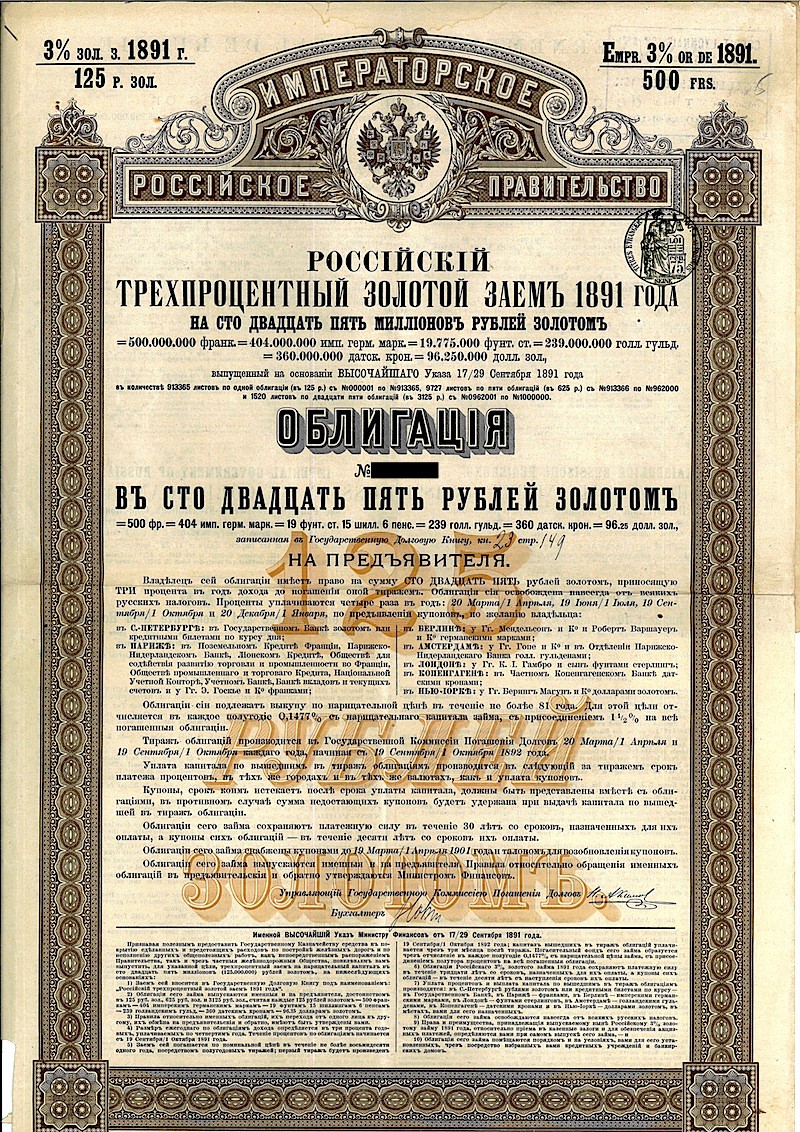
Russian bond.jpg

With “Bankers and Bolsheviks: International Finance and the Russian Revolution,” Hassan Malik has written a fascinating study of an overlooked topic—but not a book for emerging markets investors who like to sleep soundly at night. Mr. Malik chronicles the involvement of foreign capital in Russia before and up to the October Revolution. It ends expensively. Shortly after taking power in 1917, the Bolsheviks repudiated Russia’s debts. Adjusted for inflation, this remains the biggest sovereign default in history, made costlier by its completeness. No debts or obligations were “restructured”: With token exceptions, the money was gone for good.

Mr. Malik’s meticulous, forensic account reveals why late Romanov Russia—for a few years the world’s largest oil producer—had been so successful in attracting funding from abroad. Mr. Malik, an investment strategist and financial historian, is more skeptical than many about the contribution made by Sergei Witte, who was Russian finance minister between 1892 and 1903 (before rising higher still). But the surge in Russia’s economic development during those years is beyond dispute. Net national product grew at an estimated compound annual rate of nearly 5%, “very high” for the time, according to Mr. Malik. Other numbers tell a similar tale.

That Russia turned to foreign bond markets during a wave of financial globalization was not “particularly remarkable,” the author notes. That it would become “the largest net international borrower in the world” was, he believes, a different matter. Given the pace of Russian growth, however, and bankers’ perennially Pavlovian response to the whiff of profit, I am not so sure.

There was also the perception at the time that, for all its faults, Russia was “a responsible member of the European family of civilized nations.” As such, the czar’s government was rewarded with more trust than it probably deserved. In 1906 Russia secured a massive loan despite troubling finances, an economic slowdown, a shaky currency, recent military defeat by the Japanese, and something close to outright revolution. More foreign money followed, drawn in by a return to growth. Nevertheless, Mr. Malik argues that late imperial Russia was more fragile than understood then (and now). Debt was piling up and the political system was unstable. It took a huge build-up in defense spending—the silver lining of a cloud about to burst—to revive an economy that was again faltering.

If the attitude of foreign financiers toward Russia up to 1914 can be defended, their behavior afterward is rather harder to explain. By early 1917 Russia was losing World War I, its finances were crumbling, the economy was buckling and the political climate was deteriorating. Despite this, Mr. Malik notes, “the risk premiums on Russian debt relative to Western benchmarks approached multiyear lows.” Wartime politics played their part, and so did moral hazard, thanks to Russian government guarantees (and vague support from its allies). The liberal revolution that overthrew the czar in early 1917 was broadly welcomed as another step in a transformation in which, as Mr. Malik observes, international financiers considered they had long been participating. Maintaining or increasing their presence in a newly liberal Russia would be a “logical continuation” of that role, so that’s what they did.

What ensued, unfortunately, was not the next stage in a benign evolutionary process, but an abrupt break with the past. Foreign investors anticipated radical change, maintains Mr. Malik, but not the direction it took. This was a mistake more forgivable than he implies: There was nothing inevitable about the Bolshevik triumph that fall. The author is right to highlight the probability that, even if the liberals had held on to power, “a fairly significant default” was on the cards. But a default by a liberal regime would have borne no comparison to the Bolshevik default.

Even had the Bolsheviks been able to honor the debt, they would not have done so. This was a matter of principle (why, asked Lenin, repay lenders who financed “the Cossack whip and sword”?) as well as strategy. Debt repudiation was a weapon in the class war, intended to dismantle the economic strength of the bourgeoisie at home and to foment trouble abroad—specifically in France, where investment in Russian securities had spread a long way down the social scale.

Mr. Malik records the insouciance or even optimism of foreign financiers in the face of late 1917’s political turmoil. This may have peaked with “in hindsight . . . one of the most bizarre business decisions in American banking history”—no mean feat: The forerunner of Citibank opened its Moscow branch “nearly three weeks after the Bolshevik takeover.” This was an extreme example of the consequences of some financiers’ misreading of Lenin’s new order, a phenomenon Mr. Malik handles well. Precedent (Russia had never defaulted) suggested the new regime would see reason, as did a conventional understanding of morality and self-interest. Yet bankers and Bolsheviks defined reason, morality and self-interest in very different ways. Lenin’s oddball sect wanted to remake Russia (and the world). If that meant cutting itself off from international capital, too bad.

Mr. Malik criticizes foreign investors for not grasping “the political dimension” of financial support for the czar’s sometimes savagely repressive rule. But their unpopularity with the opposition was somewhat ironic: It overlooked the way in which “apolitical” foreign financing contributed to a modernization that, however unintentionally, subverted the ancien régime. And investors may have paid too much attention to politics later on. One element in the seemingly complacent reaction of international financiers to the February Revolution was a desire to help the liberal reformers. This may have been too much of a gamble but, given what was to come, it was worth taking. Russia’s tragedy was not that it ran out of money, but that it ran out of time.

Dat's Capital

Alan Greenspan and Adrian Wooldridge - Capitalism in America: A History

National Review, December 20, 2018 (December 31, 2018 issue)

New York City, March 1989 © Andrew Stuttaford

New York City, March 1989 © Andrew Stuttaford

With 29-year-old “democratic socialist” and imminent congresswoman Alexandria Ocasio-Cortez widely seen as the harbinger of a future that, with luck, I may be too aged to see through to Caracas, Capitalism in America may come to be regarded as an obituary as much as a history. Not that its two authors, Adrian Wooldridge, political editor of The Economist — a magazine now closer to Davos liberalism than to the classical kind — and Alan Greenspan, who needs no introduction, would see it that way. Capitalism in America is a celebration — some of it should be read to music, Sousa, say, when the narrative reaches the Gilded Age — of the economic system that took the U.S. to the top of the world and could, maintain Greenspan and Wooldridge, still keep it there. They may warn of “America’s fading dynamism,” but they conclude that the country “is trapped in an iron cage of its own making,” to which it “has all the keys that it needs.” The question is whether it has the “political will” to use them. Indeed.

Messrs. Wooldridge and Greenspan possess a sharp understanding of the political foundations of American growth — as they must. There were, after all, other large countries blessed with rich resources and abundant land, and, as the 19th century drew on, the ability to exploit them. Argentina’s great liberal president, Domingo Sarmiento (1811–88), dreamt of emulating the developing colossus to the north. By the 1890s, Argentina was among the wealthiest places on earth (on one measure, briefly the richest), and European immigrants were pouring in. And yet the U.S. now stands where it now does, and Argentina is, well, Argentina.

“Anyone who regards economic history,” caution Greenspan and Wooldridge, “as history with the politics left out is reading the wrong book.” America’s economics would have been impossible without its politics, and the latter were, the authors emphasize, profoundly shaped by the happy timing of the country’s founding, born in the age of enlightenment. Although they do not explicitly say so, the variant of the Enlightenment that weighed most on the Founding Fathers, for ancestral as well as intellectual reasons, was British, the fruit of an incremental process dating back to (at least) 1688, rather than its more radical French alternative. Moreover, it was buttressed by having inherited what Greenspan and Wooldridge refer to as “many of Britain’s best traditions,” from the common law to a certain respect for individual rights. In that sense, “the American Revolution was only a half revolution.” The nascent republic was marked by a suspicion of both monarchical rule and unrestrained popular government. Commerce was able to slip through the gaps, helped by, as the authors explain, the insights of Adam Smith, the prohibition of internal trade barriers, and — a critical incentive for the enterprising — the strong defense of property (including intellectual-property) rights enshrined in the new Constitution.

This settlement was made easier to sustain by the United States’ birth in “an age of growth — an age when the essential economic problem was to promote the forces of change rather than to divvy up a fixed set of resources,” a summary that is on the crude side — fighting over the proceeds of growth can be ugly enough — but works well enough for a country that, more than anywhere else at that epoch, was a land of opportunity.

And what allowed America’s inventors, innovators, and entrepreneurs to make so much of this opportunity was the extent to which creative destruction (to Greenspan and Wooldridge, “the ‘perennial gale’ that uproots businesses — and lives — but that, in the process, creates a more productive economy”) was allowed free rein. In this heroic retelling — Howard Zinn, avert your eyes — of America’s expansion (the Gilded Age is rechristened “the Age of Giants”), creative destruction — the hammer in the invisible hand — is the mightiest hero of all, “the principal driving force of economic progress.” The government’s job, the authors note approvingly (did I mention that Alan Greenspan was a part of Ayn Rand’s circle?), was to protect property rights and the sanctity of contracts and then, rather than “tame” creative destruction, enable it and get out of the way. Less was more: “The old nations creep on at a snail’s pace,” wrote Andrew Carnegie. “The Republic thunders past with the rush of an express.”

While praising America “as a huge positive” not only for itself, but for what it has given the wider world, the authors don’t gloss over the darker side of “numerous disgraces” that have marred its rise. Slavery was a system resting “on foundations of unfathomable cruelty” that brought riches to the South but condemned it to economic backwardness as well as moral squalor. They also acknowledge that the state played a more active role in America’s economic explosion than it might be polite to mention in Galt’s Gulch. Railways, in many respects the Internet of the era (though, in a testimony to a time of remarkable innovation, there’s also the telegraph to think of), benefited — as, subsequently, did the Internet itself — from Uncle Sam’s largesse. Vast land grants offered railway companies the chance to risk a fortune building rails “in the middle of nowhere” in the hope of making a fortune by turning a “piece of nowhere into a part of the global economy.”

The authors write snappily and memorably, but not at the expense of subtlety. Thomas Edison’s “greatest claim to fame is arguably not as an inventor but as a systematizer of invention.” He created the first industrial laboratory and staffed it with “German PhDs, skilled craftsmen, and ‘absolutely insane men,’” the last category a preview, perhaps, of the pizza-munching Asperger’s army taking a (silicon) valley to fresh peaks.

By outlining the backgrounds of these economic pioneers, an impressively recurrent tale of creativity, social mobility, and sometimes uncontainable energy (Isaac Singer, of sewing-machine fame, sowed very widely, fathering at least 24 children, and, at one point, ran three households simultaneously), Greenspan and Wooldridge highlight the extent to which the American story was one of individual achievement. Those individuals did, Mr. Obama, build this.

But as the country grew richer, its politics changed, reflecting the growing electoral clout of those at the rough end of creative destruction, mounting alarm at escalating oligarchic and corporate power and its abuse (Teddy Roosevelt’s “malefactors of great wealth”), and a broader shift in opinion away from laissez-faire. This transformation in sentiment was accelerated by the Depression and two world wars but was well under way from the beginning of the 20th century, not least due to the size, complexity, and problems — “pollution,” relate Greenspan and Wooldridge, “on a terrifying scale” — of a country growing at an astonishing rate, a new kind of society that, it seemed self-evident, required steering by more than an invisible hand. There was also an early flowering of what has become an endemic phenomenon: “By producing prosperity, capitalism creates its own gravediggers in the form of a comfortable class of intellectuals and politicians” able to use the negative side of creative destruction to sell their own agenda.

The final two-thirds of the book details the evolution of American capitalism since the assault on laissez-faire first gathered speed. Adaptive, protean, and endlessly inventive, capitalism has proved to be more resilient than its early-20th-century champions might have expected. Government activism may have ebbed and flowed (this is not, incidentally, a book for FDR fans), but even if the Constitution acted as a restraint on the state’s encroachments, it never returned to low tide. Nevertheless, America’s private sector remained re­markably productive, famously through the 1920s, but again in the long post-WWII boom. Revived by Ronald Reagan after the stagflation of the 1970s, it flourished during what Greenspan and Wooldridge dub “the age of optimism” until the arrival of lean years marked by the dotcom bust, the runaway spending of the George W. Bush years, and the financial crisis, a catastrophe about which these authors have disappointingly (considering the identity of one of them) little that is novel to say.

Looking, however, beyond the proximate causes of the Great Recession, the authors are right to see signs of a deeper malaise in the economy, a creeping sickness that shows up in many ways, including lower productivity, declining social mobility, and unhealthy concentration in many industries. They attribute much of this to a decline in American exceptionalism. Creative destruction’s wild ride is being replaced by excessive risk aversion and overregulation. And they fret about swelling entitlements, both for their ultimate unaffordability and for the way they encourage consumption over the saving that is essential to fund productivity growth.

In an attempt to bring back a little cheer as their book draws to a close, Greenspan and Wooldridge observe that “America leads in all the industries that are inventing the future,” including artificial intelligence and robotics. But that future comes with a catch that they may have missed. Neither those industries nor their immediate digital predecessors, prime examples of creative destruction, are replacing the jobs or the wage rates to which they are laying waste. That could well account for more of America’s malaise than Greenspan and Wooldridge would care to admit, and may — Donald Trump, Bernie Sanders, or even Ocasio-Cortez could all be straws in a very different gale — herald an era of destruction with nothing creative about it.

Three dystopias and A disappearance

Joyce Carol Oates - Hazards of Time Travel

Varlam Shalamov - Kolyma Stories

Curzio Malaparte  - The Kremlin Ball

Peter Stamm - To The Back of Beyond

The New Criterion, November 1, 2018

handmaids-tale.jpg

One of the symptoms of the hysteria surrounding Donald Trump’s election (a candidate, incidentally, for whom I did not vote) was the conviction that democracy was in danger—“dying in darkness,” the #Resistance, and all that. This led to a revival of interest in the imaginary totalitarian futures of the past, mobilized now against the imaginary Trump terror to come.

Sinclair Lewis’s It Can’t Happen Here (1935) was adapted for the stage in Berkeley, edgy as ever, even before that dread November 2016 night; its title has been looted by countless headline writers and the book itself has appeared on Amazon’s bestseller lists. Nineteen Eighty-Four did its bit for Jeff Bezos, too, and a theatrical version (from 2013) of Orwell’s bleak warning opened not in Berkeley but on Broadway. Elections have consequences. There was also a mass screening of Michael Radford’s 1984, “a thirty-year-old film that suddenly feels new again,” marveled Time magazine. Margaret Atwood’s The Handmaid’s Tale (1985) has been made into a hit TV series, inspiring pink ladies in red to show up at various protests. It hasn’t hurt that, unlike Lewis and Orwell, Atwood is still around, and able to talk up supposed Trump parallels. Gilead is on the way!

All this must have been galling to Joyce Carol Oates, a noisy member of the #Resistance, but a dystopia short. She has now remedied that with Hazards of Time Travel. She previewed the book in this tweet from January:

If this novel—“Hazards of Time Travel”—had been published before 2016 would seem like dystopian future/ sci-fi; now, a just slightly distorted mirroring of actual T***p US sliding, we hope not inexorably, into totalitarianism & white apartheid.

“Just slightly distorted”? As claims go, that tips over from hype into psychosis, but, as a “mirroring” of the prejudices and paranoia of a segment of today’s Left, this book is of some value. Well, there’s also an intriguing, skillfully implied—no more than that—twist in the plot, which it would be bad manners to reveal.

After a brief prelude, the story moves to the 2030s. Seventeen-year-old Adriane Strohl (much of the book is written in her voice—and convincingly so) is about to graduate from a high school in the “Reconstituted North American States,” a far-from-perfect union. It’s repressive (check), stratified by race (check) and class (check). Health benefits are bad (check), and the postal service has been privatized (reviewer perks up). Most of the national parks have been sold, closed off to the plebs, but opened up to fracking (check) and other outrages. History has been rewritten, scientific inquiry is suspect (check), and it’s unwise to stand out as too smart. Unfortunately, Adriane is smart and has a way of asking the wrong sort of questions. She is arrested by “Homeland Security” (check), just after making a valedictorian speech composed of the wrong sort of questions, and found guilty of “Treason-Speech [no dystopia would be complete without ugly neologisms] and Questioning of Authority.”

What happened to the poor old USA is not set out in detail, but the rot set in with the abuse of executive powers after “The Great Terrorist Attacks of 9/11” (check) and was helped along by environmental devastation (check) partly attributable to climate change (check). The Patriot Party (check) “funded by NAS’s wealthiest individuals, which appointed all political leaders as well as the judiciary” (check) is now running the country. Presidents are thought to be “multi-billionaires” (check) or their associates—their names often invented—that citizens are conditioned by the media to “like.” All citizens are “Christian” (check), ethically a meaningless term (fist thrown at hypocritical Trump-voting evangelicals—check) and “no one ever spoke of . . . doing good, helping the less fortunate, being selfless.” Dystopic fiction often contains a satirical strain, but the dagger is generally more effective than the club.

Adriane is handed a lighter sentence than some. Rather than being “deleted” (nasty), she is exiled back in time; and rather than being sent, like the dissidents in Robert Silverberg’s Hawksbill Station (1968), to the Precambrian era, she is allocated a new identity and transported back to a mediocre Wisconsin university in 1959. Her studies at this “excellent” campus will, she is told, be an opportunity to re-educate herself in preparation for a return to nas, an extension, by implication, of the 1950s (check).

Oates uses Wainscotia State University to trash the nostalgic appeal of the “again,” in “Make America Great Again,” taking aim at oafish frat boys, Cold Warriors, the subordination of women, and a certain mid-century American intellectual parochialism (her portrayal of the local poet in residence, a Robert Frost wannabe, is a delight). Then there is the absence of “diversity.”

However gloomy her overall premise, Oates has fun with the idea of someone from the twenty-first century finding herself in Ike’s America. Adriane is shocked by such primitive horrors as smoking—some of our nanny state has evidently hung on into NAS—cyclists without safety helmets, and questionable food (a roommate notices how Adriane won’t touch “glazed doughnuts [or] Cheez-bits”). Then there’s the ancient technology, televisions with their pictures “in tremulous shades of grey,” typewriters, books.

A distinctly less predictable topic covered (at considerable length) in the description of Adriane’s studies at Wainscotia is behaviorism (she is attending psychology classes), and, more specifically, her distaste for its “mechanical, soulless view of consciousness.” Presumably Wainscotia’s fondness for B. F. Skinner is intended by Oates as a proxy for mid-century regimentation, but Adriane’s reaction seems excessive. For all its many flaws, behaviorism suggests some useful, if uncomfortable, truths about human nature, truths that Adriane may or may not recognize, but would, in any case, be unwilling—and this may be what Oates is driving at—to accept (despite or even because of the ability of the NAS regime to condition those who live under it). Adriane is also, tellingly, somewhat skeptical about the influence of genetics on behavior. Oates’s heroine (again, perhaps tellingly) prefers the defiance encapsulated in her truth: “My parents taught me there is free will. There is a soul within.”

It would take a heart of stone not to laugh.

varlam_shalamov-nkvd.jpg

Varlam Shalamov (1907–82), a clearer-eyed observer of our species and a survivor (more or less) of almost the worst an all-too-real dystopia could do to him, would, I reckon, have permitted himself a wintry smile. In 1961 he compiled a list of what he “saw and understood” in the Gulag. It included the observation that people there could not survive by means of free will: “They live by instinct, a feeling of self-preservation, on the same basis as a tree, a stone, an animal.”

Then again, Shalamov was proud he had “never betrayed anyone in the camps, never ratted anyone out.”

Then again, in his introduction to Kolyma Stories, a new and extended English-language edition of Shalamov’s great Gulag story cycle, the stories’ translator Donald Rayfield relates how in “Permafrost” (a story I have yet to read; it will be included in a companion volume), Shalamov is shown to be “responsible for the suicide of a young man whom he refused to allow to go on washing floors in the hospital and dispatched to hard labor back in the mines.”

“The camp,” wrote Shalamov elsewhere, “was a great test of our moral strength . . . and 99 percent of us failed it.”

Rayfield also notes Shalamov’s seeming approval of revolutionary violence—if the motives were idealistic and the perpetrators prepared to die for their cause. In that connection, he refers to Shalamov’s “almost deif[ying]” of Nadia [Natalya] Klimova, a pre-revolutionary terrorist, in “The Gold Medal,” another story to be included in the second volume.

Then again, Klimova’s daughter, Natalia Stolyarova (whom Shalamov knew well), helped smuggle The Gulag Archipelago out of the Soviet Union. Aleksandr Solzhenitsyn praised mother and daughter as representatives of “all the forces of a healthy Russia united.”

Shalamov’s work has been trickling west for years, with the first reliable collection (only a small selection) appearing in English in 1980 as Kolyma Tales. A larger compilation was released in the 1990s under the same title. Now, Kolyma Stories will, with its companion volume, double the amount of Shalamov’s work available in English, going a good way to remedying a gap that should have been filled decades ago.

Shalamov, a priest’s son who had soured on religion (although he maintained that “the only group of people able to preserve a minimum of humanity” in the camps were religious believers), was initially sympathetic to the young Soviet state despite facing discrimination for his “incorrect” social origins. Trouble and his first stint (three years) in a labor camp came with his involvement in the publication of Lenin’s testament, a document containing some unflattering comments about the now-ascendant Stalin. His descent into hell’s lowest circles came with re-arrest in 1937 (for “counterrevolutionary Trotskyist activities”), and years in the Gulag, including long stretches in the mines in the Kolyma region—a territory in Siberia’s far east so remote and inhospitable that it was in itself one of the most formidable of all the Gulag’s many jailers.

Shalamov’s life was saved by a doctor, who arranged for him to be trained as a paramedic. He spent his last few years in the camps as a medical assistant, a relatively soft job. Released in 1951, Shalamov eventually arrived back on “the mainland” in 1953.

Partly autobiographical, partly built on observation and extrapolation, these stories are the product of a specific time, place, and experience, but they also transcend them. They stand at the pinnacle of the literature of the long Soviet night, but to describe them solely in those terms would be akin to labeling the short stories of Chekhov—a writer to whom Shalamov is often compared—as nothing more than superbly taken snapshots of late-Czarist Russia.

The stories are concise, spare, dark, matter-of-fact, and unadorned. “There is no polishing them,” Shalamov explained, “but there is completeness.”

Shalamov was also a poet, and he had a poet’s eye for the right word in the right place, but those looking for lyricism, let alone consciously “fine writing,” will almost invariably be disappointed. The power of these stories comes from something else. It is, maybe, a mark of their exceptional quality that it is hard to identify just what. I do know, however, that even some of their shortest of passages can stay with you for a long, long time:

A whole brigade of one-armed men, who’d mutilated themselves, washed gold in winter and in summer. Then they handed over the specks of metal, the gold grains, to the mine’s till. That’s what the one-armed men were fed for.

The life that Shalamov describes is nastier, more brutish, and far shorter than anything that even Hobbes could have dreamt up. These are not tales of redemption or inspiration, nor do they make any claims about the nobility of suffering. Decency (such as the life-saving act of kindness in the haunting “Handwriting”), or, at least, an unexpected absence of cruelty, occasionally lightens the darkness, but these are exceptions, as are flickers of bone-dry humor: “A Dr. Krasinsky, an old military doctor, a lover of Jules Verne (why?), took over his case.”

Unadorned prose offers up humanity unadorned, refined most frequently in its savagery, whether from guards or “ordinary” criminals, “friends of the people” allowed and encouraged to prey on the lowest of the low, the “politicals” who had incurred the rage of the state.

Survival was a matter not of heroism, but of keeping one’s head down:

We had learned to be meek . . . . We had no pride; no self-esteem or self-respect . . . . It was far more important to learn the skills needed to button up your trousers in sub-zero winter temperatures. Grown men would weep when they found they could not do that.

Survival was a matter of grabbing every chance that came a prisoner’s way. In “Cherry Brandy,” the inmates of a transit camp take two days to disclose that a famous poet (unnamed, but clearly Osip Mandelstam, one of the best known of Stalin’s literary victims) has died in his bunk:

His enterprising neighbors managed to get a dead man’s bread for two days; when it was distributed the dead man’s hand rose up like a puppet’s. Therefore he died earlier than the date of his death, quite an important detail for his future biographers.

In another story, Andreyev (sometimes one of Shalamov’s fictional alter egos) muses that he was “kept alive by indifference and resentment.” Each of his tales, Shalamov wrote, was “a slap in the face to Stalinism.”

Kolyma Stories lacks the grand sweep of The Gulag Archipelago (Shalamov declined Solzhenitsyn’s invitation to co-write the latter). Shalamov did not appreciate the epic style (he was no fan of Tolstoy), or even what he dubbed the “narrative genre.” His stories do not attempt to decipher the Gulag’s origins. Nor, except in echoes, do they track its development: new waves of prisoners, new types of prisoners—Balts, a Hungarian doctor, Russian émigrés caught in Manchuria, Red Army soldiers repatriated after the war—tumble into its maw. Henry Wallace—yes, Vice President Wallace—pays a visit.

In “On Lend-Lease,” a parricide, a respectable, “ordinary” criminal, uses a bulldozer supplied by America to its Soviet ally against Hitler to create a new mass grave—up to then almost an impossibility in the permafrost—for the undecomposed bodies of (to quote from one of Shalamov’s poems) some of his “unrotting brothers.” Previously they had been packed in a stone pit that had, most indecorously, spilled over:

Corpses were crawling across the hillside, exposing a Kolyma secret . . . . Every one of those close to us who perished in Kolyma . . . can still be identified, even after decades. There were no gas ovens in Kolyma. The corpses wait in the stones, in the permafrost.

But not, as Shalamov recounts in another story, before their gold teeth had been knocked out. In Kolyma, it wasn’t only the rock that was mined.

Taken together, these tales, each a small shard in which a glimpse of a greater nightmare is caught, form a pointillist portrait of the worst of the Gulag at the worst of times: “Shalamov’s experience in the camps was,” said Solzhenitsyn, “longer and more bitter than my own . . . to him and not me was it given to touch those depths of bestiality and despair toward which life in the camps dragged us all.”

Some of the stories overlap and collide in ways that do not quite make sense, a reminder that in Kolyma what we fondly imagine to be universal rules counted for nothing:

Any human concept, while still keeping its spelling, its pronunciation, and its usual set of letters and sounds, now meant something different, for which the mainland had no name.

The first volume of Kolyma Stories ends with the freed narrator in Moscow: he “had come back from hell.” He had, but its demons hadn’t finished with him. Shalamov’s poetry was published, but only one of his least-controversial Gulag stories appeared in print in the USSR during his lifetime, and even that led to the dismissal of the editorial board that had approved it. When copies of the Kolyma Tales were published in the West, Shalamov publicly objected, “evidently,” writes Rayfield, “under compulsion.” As a reward, possibly the greatest of all the giants of Russia’s twentieth-century literature was finally admitted to the USSR’s Union of Writers, a necessity if he was to make a living selling the few permissible scraps of his craft.

Shalamov—like his narrator—had emerged from hell, but brought some of it back with him. His health never fully recovered. His memories drove his writing but left him forever an ex-prisoner, cautious, distrustful, and “difficult.” “All my skin has been renewed,” he told a friend, “my soul has not.” By the end of the 1970s, Rayfield writes that Shalamov was “homeless.” That might be an overstatement, but Shalamov was certainly in a very poor way. He was placed into an old people’s home. Conditions were appalling, and he reportedly lost much of his vision and most of what was left of his hearing. In 1982, Shalamov was diagnosed with dementia, and transferred, Rayfield writes, “almost naked [and] in the freezing cold” into a psychiatric hospital where he died a few days later.

Shalamov’s tales about Kolyma began appearing in the Soviet Union in the late 1980s, but, Rayfield relates, it was only in 2013 that a “reasonably complete” collection became available in Russia. Part of Shalamov’s childhood home now houses a museum dedicated to him, and some memorials are scattered across his homeland, including one in the central Russian town of Krasnovishersk on Dzerzhinsky Street, a street still named after the founder of the Bolsheviks’ Secret Police (why?).

Moscow1920s.jpg

Shalamov was trapped in hell for nearly two decades. The Italian writer Curzio Malaparte (1898–1957), best known for Kaputt (1944) and its sequel, The Skin (1949), dropped by there from time to time, sometimes as an observer, sometimes in his imagination. The (in Malaparte’s words) “horribly gay and gruesome” Kaputt is a frolic through the horrors of Nazi-occupied Europe and the war on the Eastern Front. Brilliantly written and strikingly original, it combines a superb evocation of evil with interludes of disturbing frivolity. In The Skin, the narrative resumes in liberated Naples. Like its predecessor, it slips without warning from autobiography to embellishment to outright fiction—a process that Malaparte, a former fascist with much to explain away, also applied to his endlessly rewritten résumé—but this time the confection, even allowing for some remarkable sequences, came across as a little stale.

The sense that the well was running dry is even stronger in The Kremlin Ball. This unfinished work, regardless of chronology (the book is set in Moscow in 1929, a city Malaparte had visited at that time), was intended to conclude the exploration of European catastrophe begun with Kaputt. Malaparte apparently put it to one side to work on cinema and theater projects in 1950, and that is where it stayed. Malaparte being Malaparte, it’s tempting to wonder whether his complicated relationship with the Italian Communist Party influenced his decision not to proceed any further—the book contains largely matter-of-fact references to Stalin’s great purges to come, but plenty of opprobrium for those beyond-the-red-pale Trotskyists. Or maybe Malaparte realized that The Kremlin Ball’s central conceit—a reimagining of the Soviet elite as the beau monde of Belle Époque Paris—was better as political punchline than book.

The Kremlin Ball was published in Italy in 1971 as part of a complete edition of Malaparte’s works. It was released in English for the first time earlier this year, with a foreword by Jenny McPhee, its (excellent) translator who, however, sporadically bends the knee to contemporary pieties with an assiduity that Malaparte would have applauded and a sincerity that he would have mocked. While Malaparte was repelled by Nazi anti-Semitism, his writings are not those of an author preoccupied by Europe’s “toxic misogyny, racism and homophobia,” nor, despite some admiration for Soviet steeliness, was he ever seriously tempted by communism, except as a device to save his skin after Italy had surrendered to, and signed up with, the Allies in 1943.

McPhee is on safer ground when she highlights the way Malaparte used what he called his “novels of biographical reportage” to play games with reality. As she says, he took “the unreliable narrator to a new level.” And by this time in his career he was doing so with teasing, exuberant brio, beginning The Kremlin Ball with the manifestly ludicrous assertion that “everything” in this novel “is true: the people, the events, the things, the places.” Just how ludicrous will rapidly become obvious to Russian history buffs (to take just one example, Prince Lvov, the first head of the provisional government assembled after the fall of the Czar, had died in France four years before Malaparte supposedly encounters him, uh, selling an “enormous” armchair on a Moscow sidewalk). But even those who are not so familiar with the byways of the Soviet past will have their doubts about the accuracy of Malaparte’s account of a meeting with Olga Kameneva (Trotsky’s sister and the ex-wife of a Bolshevik leader who had fallen foul of Stalin—two strikes): “She was a woman who was already dead. A subtle odor of dead flesh spread through the room.”

Yet Malaparte’s greater truth holds. Kameneva was doomed, and she knew it, although she outlived her former husband and their two sons. They were shot before her.

It may be unfair to be too harsh a critic of an unfinished work, but The Kremlin Ball has its longueurs, and they are not confined to Malaparte’s attempt to fashion a Potemkin Belle Époque on the unpromising territory of early Soviet Russia. In particular, the philosophizing (disappointing in such a detached writer), whether it is on Christianity, suffering, Europe, death, whatever, is all too often jejune, wrong-headed, and, most unforgivably, dull.

Nevertheless, sifting through the dross is rewarded by flashes of something that, despite Malaparte’s love of illusion, is more than just gilt:

It was, at the time, Easter week in Russia. But the bells were silent. At the tops of the bell towers of Moscow’s thousands of churches, the church bells hung silently, their thick clappers dangling like tongues from the heads of cows hung out to dry in the sun.

Thousands of churches? No, there were not, not even in Moscow, the “Third Rome” of wishful Russian thinking, but the way that Malaparte (an atheist, as it happens) brackets that exaggeration—a depiction of a stifled Easter reinforced by an image of death rather than of resurrection—points to a more important truth.

Malaparte travels around Moscow, fraternizing with writers, Soviet prominenti, diplomats, and remnants of the past: Prince Lvov and other “well-bred, miserable ghosts,” “former people” in the terminology of the time, a description that became a proscription. As he moves from strange meeting to strange meeting or even indulges in a little macabre tourism—he visits the room where the poet Vladimir Mayakovsky has just committed suicide—Malaparte is often accompanied by his secretary. Marika is a dark-eyed, sixteen-year-old Georgian, an (unrequited?) love interest, echo or preview, perhaps, of the dark-eyed, sixteen-year-old Romanian waitress Marioara from Kaputt, another not-quite dalliance (a pogrom intervenes) in the disintegrating world that Malaparte made his own.

Switzerland+forest+fog.jpg

After three dystopias, Switzerland comes as a relief, but in To the Back of Beyond, Thomas decides to cast himself out of Schwiizertüütsch Eden. Modestly prosperous with a wife and two kids in a pleasant, orderly town, he marks his family’s homecoming from a Spanish vacation by sneaking out on them that night without warning, explanation, or any obvious reason. He hesitates momentarily, then, “with a bewildered smile he was only half aware of,” heads for the garden gate. Then he is gone—for good, it seems.

The only hint—maybe not even that—of trouble ahead had been Thomas’s suggestion that the family stay on in Spain for a year, an idea his wife, Astrid, “the voice of reason in the relationship,” rejects. Later, after Thomas has vanished, Astrid uploads their vacation pictures. The best shot of Thomas is “of the bottom half of [his] face with a rather strange half smile,” an absence repeated in photographs taken on other, recent trips.

First published in German in 2016 and then released in this country (in a fine translation by Michael Hoffman) late last year, this book, by the Swiss writer Peter Stamm, is short, spare, and haunting; it lingers, unsettlingly, in the memory. To return to Shalamov’s adjective, Stamm’s prose is “unadorned,” and yet, even in the book’s first lines, he manages, without any drama, to convey a sense of unease, a sense of waiting, a sense of a coming storm:

By day, you hardly noticed the hedge that separated the yard from that of the neighbors, it just seemed to merge into the general greenness, but once the sun went down and the shadows started to lengthen, it loomed there like an insuperable wall, until all light was gone from the garden and the lawn lay in shadow, an area of darkness from which there was no escape.

Escape.

Sometimes Astrid “asks herself if Thomas would have chosen a different sort of life if they hadn’t been a couple.”

Stamm alternates descriptions of Thomas’s hike towards the mountains and depictions of the reactions and actions of the family that he has left behind. To begin with (later, it’s not so straightforward), it is Thomas’s journey that draws the attention. There at least, there is movement. Back at home, Astrid begins by doing her best to preserve a status quo that has vanished beyond recall. Meanwhile, the farther Thomas trudges from home, the further he breaks, in a mild Swiss way—Apocalypse Now this is not—from the constraints of his old life, accidentally stumbling into a brothel (a first, even if nothing much happens there, although he does steal a coat as he leaves, another first), sleeping rough, scavenging some food. And the further Thomas goes, the greater his sense of distance from where he has been and, even, where he is:

Thomas had the disquieting feeling that all this had been laid on for him, that the people in the village were actors who were merely waiting for him to come by, to assume their roles and speak their lines. It was an artificial world, a model construction under an expansive blue sky.

There is something of the waking dream about both Stamm’s prose and a storyline dominated in its early stages by a pilgrimage with no discernible end in sight. Thomas is a man driven—and his determination to avoid detection indicates that he is driven—but it is unclear by what. Perhaps the answer is buried within Thomas’s observation that none of his clients ever ask, “What was it all for?” The obvious and perfectly satisfactory answer—nothing—will clearly not do.

But To The Back of Beyond goes far beyond being a beautifully written account of yet another middle-aged man’s existential crisis. I won’t say what takes place in the mountains, partly because it would be a spoiler, and partly because I’m not so sure I’ve fully understood it myself, but it is the hinge on which the story—or stories—turns. The pace picks up, but Stamm finds the time to deepen his touching, if still economically drawn, portrait of Thomas and Astrid’s marriage before bringing Thomas’s odyssey to a conclusion that can be taken in different ways but is, I have found, impossible to forget.

A Huckster at the Mic

Mark Jacobson - Pale Horse Rider: William Cooper, the Rise of Conspiracy, and the fall of Trust in America

The Wall Street Journal, September 19, 2018

Bill Cooper.jpg

‘Nonsense,” said the Talmudic scholar Saul Lieberman, referring to the Kabbalah long before its celebrity moment, “is nonsense, but the history of nonsense is scholarship.” In the intriguing if uneven “Pale Horse Rider,” writer and journalist Mark Jacobson takes a primarily biographical approach to the strange, sad tale of the turn-of-the-millennium conspiracy theorist Milton William “Bill” Cooper (1943-2001). In doing so, he has missed an opportunity to take a deeper look at how, what and why we believe.

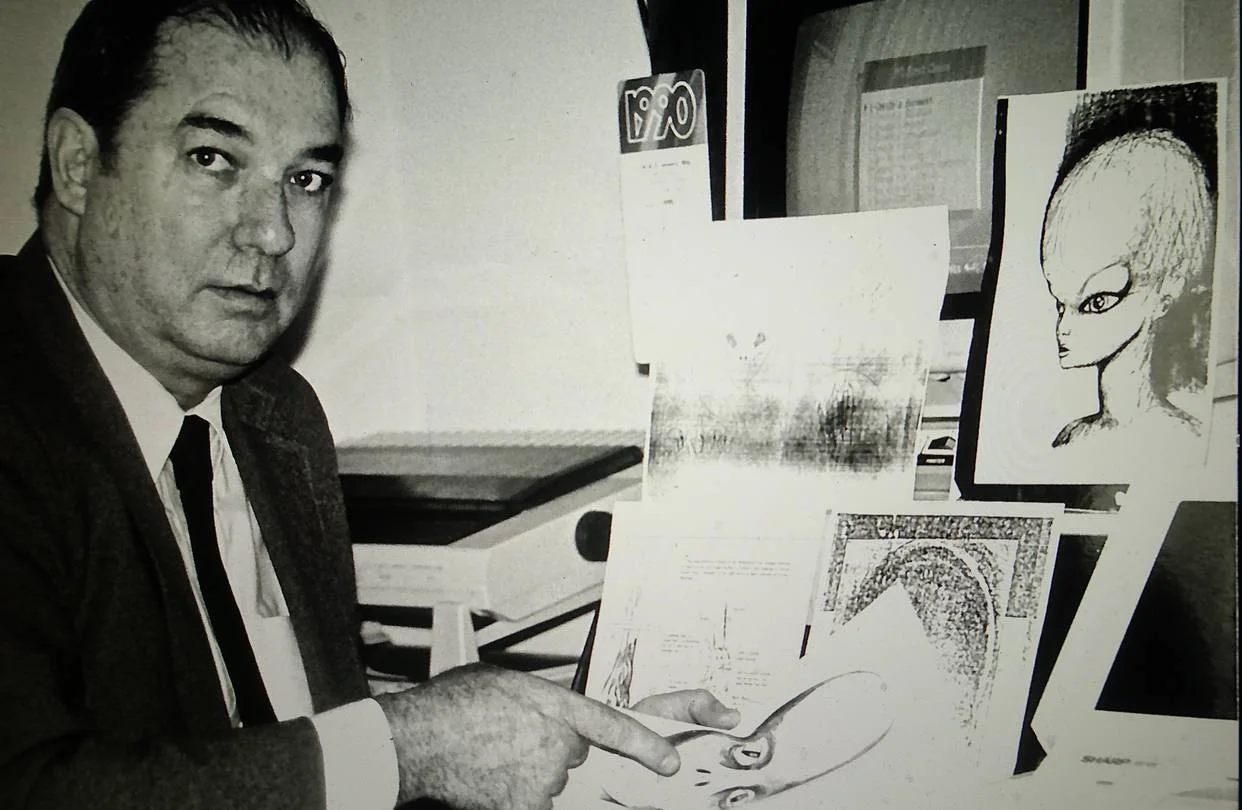
Cooper’s best-known work, “Behold a Pale Horse” (1991), is a dense, meandering and bewildering compendium of conspiracy theories. These include the allegation that JFK was murdered by his driver, the discovery of a plan to blow up Jupiter and the revelation of a treaty between Ike and space aliens. Yet there is also the suggestion that “the whole alien scenario is the greatest hoax in history,” a trick to frighten the “sheeple” (a favorite Cooper term) into submission to a “one-world government” controlled by . . . the Illuminati. Choose your own truth. After all, Cooper himself concedes that “one or more conclusions may be wrong.” This Bedlam medley has sold almost 300,000 copies. Why?

Readers wanting to find out are mainly left to navigate their own way through the fever swamps: Mr. Jacobson describes more than he explains, a flaw mitigated by his sharp eye and keen ear. Scattered through his account are stepping-stones to a partial understanding of Cooper’s appeal. A rapper from the Wu-Tang Clan tells Mr. Jacobson that “everybody gets f— [but] William Cooper tells you who’s f— you,” a near-perfect, if NSFW, summary of conspiracism’s attraction to the powerless or paranoid. It offers a structure for rage, an excuse for failure, a flattering fantasy of being in the know.

Mr. Jacobson dubs Cooper a “P.T. Barnum of dread.” (“The Hour of the Time,” his long-running shortwave-radio show, opened with wailing sirens, a sinister distorted voice, barking dogs, shrieking people and the sound of “tramping . . . feet, growing louder, closing in.”) But Cooper was a huckster who took more than a swig of his own Kool-Aid. The origins of his dreamscape—born at the intersection of creativity and psychiatric disorder, and reinforced by post-Vietnam, post-Watergate disillusionment and the need to make a buck—are easier to understand than its evolution. A saga in perpetual flux (Knights Templar! Freemasons! The aliens really were a hoax!), its backstory stretched across millennia.

Cooper was obsessed with the New World Order and the actions of jackbooted government enforcers against the Branch Davidians in Waco, Texas, and white separatist Randy Weaver at Ruby Ridge, Idaho. He became a part of the “patriot” fringe (Timothy McVeigh was an admirer). But, while his views often inspired theirs (the Clinton administration labeled him America’s “most dangerous” radio host), they did not always coincide. Cooper’s following among some African-Americans, a community targeted in conspiracies he claimed to have uncovered, does not fit the militia mold. On the other hand, Cooper reproduced the notorious anti-Semitic forgery “The Protocols of the Elders of Zion” within “Behold a Pale Horse.” The deception, he maintained, was not that the “Protocols” were a fake, but something else: The plotters were not Jews, but Illuminati. Oh.

Conspiracism seeps through many cultures, nations and eras. It isn’t uniquely American, but it can take distinctively American forms. For example, Americans’ traditional distrust of government can mutate from a sign of rude civic health into a pathology. Cooper, as Mr. Jacobson relates it, tapped into a feeling of alienation fueled (often) by mourning for a vanished, if frequently imagined, past—white picket fences and all that—which he turned into a very American narrative about the betrayal of the promise of liberty contained in the Constitution, a sacred text now disdained.

Mr. Jacobson is not entirely unsympathetic to his subject’s point of view, commenting that there’s “no arguing [Cooper’s] basic insight: that something wasn’t right, that there was something you couldn’t quite put your finger on except . . . that you were a little less free than . . . yesterday.” That’s an extremely generous interpretation of Cooper’s “insight.” In any case, it’s no secret that we live in an ever more controlled, ever more controlling society.

Mr. Jacobson accepts that Cooper said “some of the nuttiest things” yet asserts that what counted was “the journey, the relentless search for truths.” But that was not what Cooper sought. He replaced truths he didn’t like with stories that he did. In June 2001 Cooper discussed threats made against the U.S. by Osama bin Laden. There would indeed, predicted Cooper, be a “major attack.” Bin Laden would be blamed, but “don’t you even believe it.” Within hours of the 9/11 attacks, Cooper was telling listeners that the two jets could not have felled the Twin Towers any more than a truck filled with fertilizer could have brought down Oklahoma City’s Alfred P. Murrah building. He was the first Truther.

Mr. Jacobson attributes the spread of the Truther virus to the need for “explanation . . . [and] something that made sense”—as if, according to its brutal logic, the 9/11 massacre did not. Yet those words work well as a general description of conspiracism’s allure: Unwilling to face life’s arbitrariness, we make connections where none exist.

Cooper ended his days “a madman,” writes Mr. Jacobson, “holed up in his [Arizona] hilltop home.” There was a federal warrant out for his arrest (for tax evasion and bank fraud) but after an altercation with a neighbor, local police took action. An attempted arrest in November 2001 ended with a scramble in the dark. Cooper shot first, leaving a cop paralyzed. A deputy returned fire, handing Cooper a death he had forecast on air—gunned down on his doorstep in the middle of the night, a Truther martyr, some argued.

The most in-depth coverage of Cooper’s death, notes Mr. Jacobson, may have come from “a then relatively unknown twenty-seven-year-old shortwave broadcaster from Austin, Texas: Alex Jones.”

A March of Folly

Ashoka Mody - EuroTragedy: A Drama in Nine Acts

National Review, July 26, 2018 (August 13, 2018 issue)

euroburn.jpg

Near the beginning of his convincing, readable, and satisfactorily acid account of the rise and who-knows-what-now of the euro, Ashoka Mody cites basic monetary theory and grumbles that the European Union’s leaders “should have been aware that a single currency could not [by itself] deliver . . . prosperity.”

The EU owes its existence to the notion that Europe should avoid repeating the catastrophes of its 20th-century past. Yet by imposing a single currency on a large number of very different countries, it was blending elements of two lesser disasters — fixed exchange rates and central planning — into a combination that history (and some distinguished Cassandras) suggested would end very badly indeed.

No matter. Political ambition trumped economic risk on grounds that fail to persuade Mody. After all, the economic tensions built into a shared currency of such scope were more likely to divide than unite. But Mody overlooks the centrality of the three words “ever closer union” in the preamble to the 1957 treaty that paved the way to the EU. They set the course of the European project in only one direction — forward. To Brussels and its allies, the key attribute of monetary union was that it threw away the key: There was no easy way to check out. Under the circumstances, the governments signing up for the new currency should have paid more attention to flaws in its design that added to its already considerable risks. Perhaps most dangerously, in the absence of political support for a fiscal union to act as a safety net, the euro was launched without one. Once again, no matter: If a crisis developed, it would, enough of the right people evidently believed, overwhelm opposition to that fiscal union. The ratchet of integration would turn again.

This was not a novel idea. When the single currency was first formally proposed back in 1970, “falling forward” was to be “its guiding philosophy,” Mody writes. “Crises would make Europeans more determined to move forward. . . . Europe would emerge stronger and more vibrant.” This cynical strategy has worked well for Brussels in other areas, but, with the single currency, it was pushed too far. The EU emerged neither stronger nor more vibrant, but hobbled, embittered, and lopsided.

Mody, an economist and a visiting professor at Princeton, has worked at the World Bank and the International Monetary Fund. At the latter, his role included acting as a deputy director of its European Department, and he was responsible for the Fund’s relationship with Ireland during its euro-zone nadir. He is thus well equipped to describe the euro’s curious political and intellectually indefensible origins, as well as the new currency’s grubby gestation, the bubble the euro facilitated, and the bust that came close enough to breaking the euro zone apart. Mody recounts how the currency union was held together, before turning his attention to a recovery that may be no more than the calm between storms. Overall, he tells a tale of warnings ignored, of groupthink, of deception and denial, of both recklessness and an excess of caution, of myth, magical thinking, and technocratic illusion — and of reality’s relentless revenge.

For all Mody’s meticulous chronicling of events, he has room for broader themes too. These include a sustained attack — not without cause — on the German-led fixation on budgetary targets and, in particular, an overly emphatic insistence on “austerity” as the cure for the euro zone’s troubles. It is not an endorsement of fiscal profligacy to argue that, in certain cases, the screw was turned too tightly too soon. Compelling Greece, in essence, to try to deflate its way back to better days was already to ask a great deal. To be sure, the Baltic states (by then de facto members of the currency union) managed to do just that. But there were specific reasons that they could, just as there were specific reasons that Greece could not. And these were distinctions that could not be given the recognition they deserved, thanks to a one-size-fits-all financial regime that was taken far further in the euro zone — and, after the crisis erupted, applied more harshly — than sharing a currency would already necessarily imply. 

To understand why Berlin wanted the purse strings kept drawn so tight it is necessary to examine what lay behind what at first seems like purely habitual stinginess. Of course, it is unsurprising that German politicians thought that their successful homegrown model — a degree of frugality — was the right one to follow, but there was more to it than that. Berlin simply had no confidence that its partners (notably those in the south of the euro zone) had the willingness or ability to run their finances appropriately, a concern that Mody might have stressed more. This lack of trust may or may not have been merited, but it was a symptom of a monetary union flung together without enough regard for the psychological or political readiness of its member states for such a step. Even the requirement (reflected in the Maastricht Treaty) that they should converge economically turned out to be a joke, at best largely meaningless, at worst a sham.

Germany’s leadership was also nervous about the consequences of their voters’ having to pick up the tab for a currency union they had never wanted, a bill their politicians had assured them they would never have to pay. Mody is clearly conscious of these issues and, pointing to America’s experience during the Great Depression, highlights the fact that the U.S. government had both the “legitimate political authority and the concurrence of sufficient numbers of the country’s citizens” it needed to help struggling states. It still has. Its counterparts in Germany (and the euro zone’s other “creditor” nations) had scant justification for claiming that they had either. There was one other vital distinction: Americans were being asked to help their compatriots. Notwithstanding grand proclamations of a shared EU “citizenship,” the tie between Michigan and Missouri is infinitely more binding than that between Germany and Greece.

Meanwhile, the stakes for countries beyond Germany — especially in the euro zone’s hardest-hit nations — were raised by the legacy of Berlin’s stipulation that the European Central Bank (ECB), like the Bundesbank before it, should (at least nominally) be free of political interference and, unlike the Federal Reserve (which also has to foster employment), focus solely on price stability. That can work, as it did in Germany (where memories of Weimar’s inflation linger), with sufficient popular consent, but, in countries where that consent does not exist, it can be an invitation to radicalization when tough times come calling — and they did come calling. That invitation was made even easier to accept by the way that the unaccountability of the ECB is reinforced — as Mody demonstrates in some of the most disturbing passages in a frequently disturbing book — by the EU’s high-handedly technocratic ethos. It is an essentially post-democratic approach, and as Mody (without resorting to that adjective) shows, it bears no small part of the blame for the euro-zone fiasco.

The effects of this ruinous monetary experiment have not been confined to political radicalization (a phenomenon not reserved to the euro zone’s weaklings) or the stirring up of antagonism between the nations it was designed to bring closer together. The currency union’s laggards have suffered immense economic harm, and the damage, warns Mody, to their potential for growth may endure long after the current trauma has receded. This implies that the chance of genuine economic convergence within the euro zone — never much of a likelihood despite all the promises — will slip even further out of reach. The natural tendency of a currency union to draw economic activity away from its periphery (a topic discussed by Joseph Stiglitz in his 2016 book on the euro) could make matters worse still — not a pretty prospect when that periphery includes entire nations.

The euro-zone drama still has a long way to run. Some months after Mody’s manuscript went to press, a coalition government of populist Right and (sort of; it’s hard to explain) populist Left, with a suspicion of the euro and a distaste for Teutonic austerity in common, took office in Italy. Much larger than Greece, Italy is, Mody contends, the “eurozone’s fault line.” He may well be correct, but don’t expect a cataclysm quite yet. The most impressive thing about this misbegotten currency union is the political will to keep it in one piece.

Mody himself peers into the future towards the end of the book. One supposedly brighter vision features debt forgiveness, a loosening of the euro zone’s fiscal fetters, improved sovereign-bond issuance, and standard panaceas from education to technology. Much more intriguing is a suggestion tucked away in Mody’s description of a (more plausible) downbeat scenario in which, broadly, those steering the currency union do little to change course.

Amid dark talk of sluggish growth and vulnerability to new shocks — not to mention the cascading defaults that could follow an Italian exit from the euro zone — Mody floats the happier alternative that Germany might either readopt the deutschmark or form a new currency bloc with other like-minded “northern” countries. Meanwhile, those states remaining in the old euro zone would still be able to repay their debts in euros, thereby dodging default while benefiting from the increased competitiveness created by a currency that would undoubtedly devalue sharply once the virtuous had left the picture.

Put another way, the best way out of the euro-zone mess remains, as it has been for years, partition. Such a move, however, would represent more than a few steps backwards in what is meant to be a perpetually forward march.

And that would never do. 

Better Dead Than Read

Gregory Claeys - Marx and Marxism

Sven-Eric Liedman - A World To Win: The Life and Works of Karl Marx

The Wall Street  Journal, July 5, 2018

Gustav-Klutsis-Under-the-Baner-of-Marx-Engels-Lenin-and-Stalin-1933.jpg

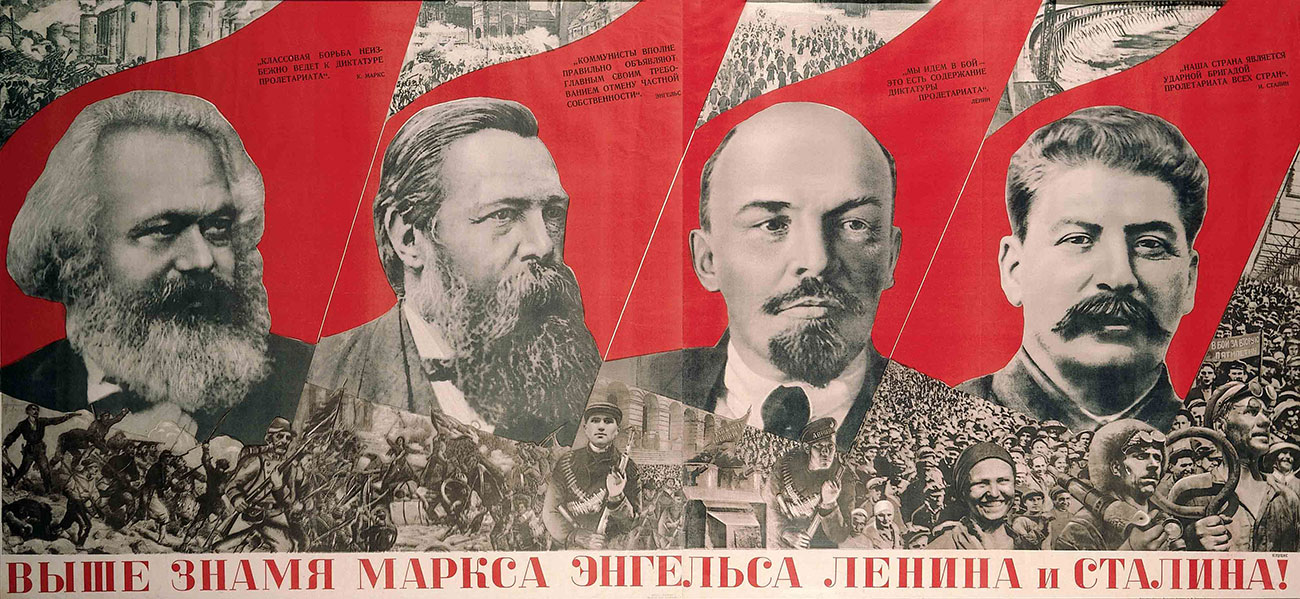
Two centuries after he was born in the otherwise blameless German city of Trier, on May 5, 1818, Karl Marx is enjoying a moment. He and his writings have had such moments before—many other moments, with all too few intervals, since the 1840s. Most recently, the 2008 financial crisis boosted sales of the old revolutionary’s works, if not necessarily the numbers of those who have read them—not the first time that this has been a problem. In “Marx and Marxism,” London-based historian Gregory Claeys reports that “on first encountering” Marx’s “Das Kapital,” Ho Chi Minh used it as a pillow. Fidel Castro, a dictator made of sterner stuff, boasted of having reached page 370, a milestone that Mr. Claeys reckons was “about halfway”—a fair assessment if we ignore volumes two and three of an epic that often reads better with its pages unopened.

Mr. Claeys presumably timed his book to coincide with Marx’s bicentennial. In China President Xi Jinping, an erstwhile Davos guest star, hailed the anniversary by describing Marx as “the greatest thinker of modern times.” Trier marked the birthday of its most notorious citizen with a conference as well as the unveiling of a heroically styled statue, presented by the Beijing government. Luxembourg’s unmistakably bourgeois Jean-Claude Juncker, the president of the European Commission, turned up in, somewhat ironically, a Trier church to praise Marx’s “creative aspirations” and to absolve him of responsibility “for all the atrocity his alleged heirs have to answer for.” So that’s all right then.

Mr. Claeys, although writing from a position quite some way to the left, does not shy away from the horrors committed in Marx’s name. But he never provides a definitive answer—perhaps no one can—to the extent of culpability a 19th-century philosopher can have for tens of millions of 20th-century dead. In the course of the second part of this book—a brisk survey of Marxism after Marx—Mr. Claeys doubts whether Marx would have supported the Bolsheviks beyond the “securing of the revolution.” But he admits that such a claim “remains contentious.” As for there being any continuity between Marx and “the official ideology of the Stalinist epoch”—well, that’s “debatable” for Mr. Claeys, but his acknowledgment that there could even be a debate will be sacrilege to many of today’s Marxists. Stalin? Nothing to do with us, comrade.

“Marx and Marxism” is concerned more with Marx the thinker—a topic Mr. Claeys handles well, given the constraints of a shortish book—than Marx the man. (Those looking for a more conventionally biographical approach could do worse than opt for Francis Wheen’s “Karl Marx: A Life,” a shrewd, sympathetic and entertainingly Dickensian retelling from nearly 20 years ago.) Nevertheless, Mr. Claeys provides enough information to give a good summary of the story.

Marx was descended from a long line of rabbis on both sides; his father, Heinrich (né Hirschel) Marx, had converted to Lutheranism to avoid anti-Semitic restrictions limiting his ability to practice law. His son was, as Mr. Claeys relates it, a so-so student (other accounts are more complimentary). Not long after commencing his university studies, Marx switched from law to philosophy, a regrettable decision both for the world and for his finances.

Despite a happy marriage to an attractive and clever aristocrat—we’ll overlook the child he fathered with their long-serving housekeeper—Marx lived not so much hand to mouth, as hand to will, and hand to other people’s pockets, in particular those belonging to his wealthy cohort and collaborator, Friedrich Engels. An often desperately hardscrabble existence was made trickier still by Marx’s tendency to spend too much of the money he did obtain on less than proletarian niceties—or, more appropriately disreputably, on handouts to fellow revolutionaries, including on one occasion a substantial sum to fund the purchase of arms for discontented German workers in Brussels.

Mr. Claeys tracks both the development of Marx’s thought—a perennially dizzying work in progress—and the evolution of his career: early success as a radical journalist in Germany and France, involvement with new parties of the left, intermittent periods of exile or expulsion from this country or that. The Prussian authorities, increasingly alarmed by the revolutionary activity that had begun spreading across Europe in 1848, banished this troublemaker the following year. He settled in Britain, and London was to be his home for the rest of his life, a safe space from which he could plot, feud, politick and, despite being beset by procrastination and perfectionism, write and write and write, including “Das Kapital,” a pillow for Uncle Ho, perhaps, but a book that changed history.

Reading Mr. Claeys’s description of Marx the man—someone he evidently, if far from unconditionally, admires—it is both easy and reasonable to conclude that Marx’s personality set the tone for some of the most lethal strains in the regimes he inspired: “He was . . . almost totally unwilling to see anyone else’s viewpoint. The essence of democracy—compromise and the acceptance of opposition—was often beyond his capacity.” From his earliest years, Marx would tolerate very little dissent, and the sometimes lengthy, frequently inventive and sporadically repulsive abuse to which he subjected those with whom he disagreed (especially on the left) contain more than a hint of the prosecutors’ diatribes at show trials to come.

Marx died in 1883. Eleven people attended his funeral, but, as Mr. Claeys notes, “a year later . . . some 6,000 marched to the gravesite.” The cult was on the move. Something more than the cult of personality already emerging while he still lived, it came with echoes of earlier eruptions of millenarianism—a term that has long since expanded beyond its original theological definition to include, among other varieties of judgment day, the complete overthrow of society and its replacement with, in essence, heaven on earth. These similarities have been identified by scholars since at least the mid-20th century, but too often ignored.

Mr. Claeys, who is also a historian of Utopianism, is well equipped to avoid that omission. He acknowledges that millenarianism seeped into aspects of Marx’s philosophy, including both his view of history and his conveniently hazy vision of the communist paradise to come. This line of inquiry would have been worth pursuing further: Millenarianism is an ancient, proven formula that will find an audience as long as the credulous, the discontented, the jealous and the unfairly treated are among us—in other words, forever.

As monuments to cults go, another book, written from a perspective seemingly even further to the left than Mr. Claeys’s, the massive “A World to Win: The Life and Works of Karl Marx” would be hard to beat. The University of Gothenburg’s Sven-Eric Liedman “has been reading and writing about Karl Marx for over fifty years” and published this book in Swedish in 2015; it was released in America this year in a translation by Jeffrey N. Skinner.

Those searching for a truly detailed discussion of Marx (nearly three pages are dedicated to a letter young Karl wrote to his father in 1837) should turn here. Mr. Liedman has criticisms of Marx, but his overall opinion is—how to put this—enthusiastic: “No social theory is more dynamic than his.” Yet the fact that Mr. Liedman’s book is something of a shrine (“we need him for the present, and for the future”) isn’t all bad, from this reader’s point of view. A lucid, scholarly guide to an overelaborated, frequently opaque, often misguided but historically important set of ideas is of obvious value. And so is an erudite, closely reasoned defense of those ideas: An apostle can help explain a messiah.

Mr. Liedman’s reverence can, however, cloy: Marx’s “unwillingness to compromise of course had another side: the magnificence of the project.” While Marx undeniably possessed both an astonishing mind and—when he wanted—a brilliant prose style, Mr. Liedman overdoes the hosannas: “a festive pyrotechnic display of words,” “one of his very finest aphorisms,” “a remarkable brightness around these few lines,” to take but a few.

A characteristic of millenarian movements is that when their prophecy proves false, the failure tends to matter far less than it should. Marxism has proved no exception, but maybe with a touch more reason than most. For all his failed predictions, crackpot theories and rococo blind alleys, Marx was also very early to understand the ever-accelerating productivity unleashed by “bourgeois” capitalism as a truly relentless, unprecedentedly revolutionary force. But the consequences of this revolution would, he believed, eventually bring down its own creators. That cataclysm has been a long time coming, and, if it ever arrives, there will be a distinct twist to the script.

In their hunt for (Marxist) promise today, Messrs. Liedman and Claeys emphasize mainly contemporary income inequality. They should pay more attention to technology. As automation grinds through jobs, wages and up the social ladder, a landscape with some disturbing resemblances to that foretold by Marx is coming inexorably into view.