It's Time

National Review Online, November 29, 2004

Orange.jpg

New York City, Saturday—In Manhattan, they say, everyone wears black, but not this Saturday, not in this plaza just across from the U.N. The demonstrators, perhaps 500, perhaps more, have turned up on this briefly glorious late autumn day in orange hats, in orange scarves, in orange coats, in orange sweaters, draped in orange blankets, wearing orange ribbons; anything, however small, will do so long as it is orange. Baseball cap advertising Land Rover? No problem. If it's orange, it's fine. Sweatshirt proclaiming the virtues of Steinway pianos? Why not? It's orange. Orange flags flutter, orange balloons bob against a clear, lovely sky that matches the blue on the other flag, pale blue and yellow, which flies this day. Blue and yellow, the colors of Ukraine, and orange the color of the movement that might, maybe, finally bring the people of that country the decent government they have awaited for far too long. "Pora". "It's time." Indeed it is.

Banners, orange naturally, proclaim the loyalties of the crowd:

"Yuschenko—Yes!"

"A Criminal Should Not Be President."

"Putin, Don't Mess With Ukraine."

"Boston Ukrainians for Yuschenko."

"America and Ukraine Together."

"Kyiv, We're With You."

"Ukrainians Deserve Freedom Just Like You."

Indeed they do. In the 20th century, the people of the Ukraine, a land of two genocides, the country of Hitler's Babi Yar, and the nation of Stalin's broken, emptying starving villages, went through the worst that two totalitarian systems could do to them, the raw death toll, millions after millions after millions, supplemented by decade after decade after decade of more selective, careful purges, a cull of the best and the brightest, generation after generation after generation.

And yet, somehow, Ukraine endured.

But Putin seems to feel little or no remorse for the crimes of his Kremlin predecessors. There have been no real apologies, and no trials of those butchers who still survive. As the Russian president looks at those other far, far larger crowds in orange, the ones gathered for days in Kiev's Independence Square, he sees, doubtless, only irritants, troublemakers, hooligans, obstacles to be removed, perhaps even dupes, according to some in Moscow, of wicked Polish plotters. What he should be seeing are the countless ghosts of those that went before, victims of that Soviet past that even now he seems curiously unwilling to confront. That, however, would take a conscience.

In 1933 (wrote the writer Vasily Grossman) "horses pulled flattop carts through [Kiev], and the corpses of those who had died in the night were collected. I saw one such flattop cart with children on it. They were just as I have described them, thin, elongated faces, like those of dead birds, with sharp beaks...Some of them were still muttering, and their heads still turning. I asked the driver about them, and he just waved his hands and said: "By the time they get where they are being taken they will be silent too." There was, we should remember, more food in Kiev than anywhere else in the Ukraine that year. Five, six, seven million died in that Soviet-made famine, the Holodomor, maybe an even greater number: no one knows for sure.

Standing in that New York plaza I talk to one of the demonstrators, Marko, about what's going on. We touch on the past. "My father," he says, "survived the Holodomor." I look around at some of the older faces in the crowd, and wonder what they had heard back then, what they knew, what they had lived through.

Not inappropriately, perhaps, there is behind us a memorial to Raoul Wallenberg, the Swede who rescued thousands of Jews from wartime Budapest only to disappear into Stalin's hands. A small plaque reads that on "January 17th, 1945 Raoul Wallenberg was detained by the Soviet government. His fate remains unknown." Fate unknown. Just another ghost. Not inappropriately, perhaps, someone in the crowd is carrying a placard showing Putin in a KGB uniform.

Someone else has a sign announcing that she is from Donetsk, the city that is the heart of the Ukraine's mainly Russian-speaking east, an area that is likely to come into sharp focus in coming weeks—exaggerated it may have been, but there is no doubt that Russia's candidate, Viktor Yanukovych, has real support in that part of the country. Taras, a friend of mine who's also at the demonstration, is more optimistic. His father, from Ternopil in western Ukraine (the city where Viktor Yuschenko had studied as a young man) had just returned from Kiev. While he was there he'd talked to a few of the miners who have been shipped in from the East to rally support for Yanukovych, the second-round "winner." They were O.K. guys, he said, enjoying an all-expenses, all-vodka trip to the big city with no plans to stick around for long. We'll see.

But Saturday is not a day for such worries. The likeable crowd, mainly twenty or thirtysomethings, a blend of recent immigrants, visitors, and the diaspora, were festive, optimistic, excited, cheering the speeches, the singers, and the sentiment, pausing only to chant the only name that counted, the name of their president:

"Yushchenko, Yushchenko, Yushchenko."

He's their hero, their man, their champion, and their best hope for the true restoration of a squandered independence. In fact, like many politicians that emerged in the rougher corners of post-Soviet Eastern Europe, Yuschenko is not free from awkward questions about his past, or the nature of some of his support, but this is not something that anyone wants to think about this day.

"Yushchenko, Yushchenko, Yushchenko."

An older woman points to a poster, a standard politician-and-child image, the usual fluff, and shakes her head sadly. "It's terrible what they've done to him." The man in the photograph is healthy, good-looking, fortyish. It's Yuschenko, and the picture was probably taken less than a year ago. His face looks nothing like the terrible, cratered wreck that it has become, the product, almost certainly of a poison attack, an attack that has transformed him into a martyr for the cause, the real cause, he now leads.

The crowd starts to sing a lovely, enchanting tune, verse after verse. They know the words, and they sing them smiling. "The national anthem?" I ask. "No", two women say, "It's like a pledge." "What's it called?" Thought. Pause. Embarrassed looks. "We don't know." And then they start to laugh.

It's time.

How Enlightenment Dies

National Review Online, November 12, 2004

theo_van_gogh_slain.jpg

Amid all the weird, wild wailing in Manhattan, amid the hot air and hysteria in Hollywood, amid all the crazy-lady shrieks of mainstream-media anguish (yes, Maureen, I'm talking about you) and the banshee howling of liberal complaint, Americans heard one overarching theme from the disappointed and distraught left—one meme, one fear, one insult that finally spoke its name. Jesusland (that's what they call it now) had won. The America of Jefferson and Madison had fallen, delivered by Karl Rove into the hands of ranting theocrats, holy rollers and the monstrous ghost of William Jennings Bryan. Writing in the New York Times, an overwrought Garry Wills had this to say:

The secular states of modern Europe do not understand the fundamentalism of the American electorate. It is not what they had experienced from this country in the past. In fact, we now resemble those nations less than we do our putative enemies.

The title of his article? "The Day the Enlightenment Went Out."

Oh really? If it was the fate of the Enlightenment for which Mr. Wills feared, he would have done better looking some 3,000 miles to his east, to lovely, wounded Amsterdam, a city once famed for its brisk, North Sea tolerance, a city that now mourns the death of an artist killed for speaking his mind. On November 2, the very day of the election that was to so sadden Garry Wills, an assassin in Amsterdam murdered the filmmaker Theo Van Gogh—shot him, stabbed him, and then butchered him like a sacrificial sheep. Van Gogh, you see, had transgressed the code of the fanaticism that has now made its home in Holland. And for that he had to die.

The movie that doomed Van Gogh was Submission, a ten-minute film shown on Dutch TV earlier this year. A collaboration with Ayaan Hirsi Ali, a Somali refugee and Muslim apostate who is now a member of the Dutch parliament, the film is a caustic attack on Muslim misogyny. Back in September, Marlise Simons of the New York Times described some of its scenes thus:

As she begins to pray, the woman looks heavily veiled, showing her eyes only, but her long black chador turns out to be transparent. Beneath it, painted on her chest and stomach, there are verses from the Koran. More women appear. A bride is dressed in white lace, but her back is naked. The Koranic verse that says a man may take his woman in any manner time or place ordained by God is written on her skin. The images roll on, now showing a woman lying on the ground, her back and legs marked by red traces of a whip. The Koranic verses on her wounded flesh say that those guilty of adultery or sex outside marriage shall be punished with 100 lashes. There are chilling sounds of a cracking whip; there is the haunting beauty of the Arabic calligraphy and soft music.

In a country in which Muslims account for nearly six percent of the population, there was predictable outrage from predictable sources. Ayaan Hirsi Ali added more death threats to her already substantial collection (she has been living under police protection for some years), and Van Gogh gathered a few of his own. Despite that, he declined the help of the cops. They hadn't, he pointed out, managed to save the rightist politician Pim Fortuyn from assassination back in 2002. Besides, he argued, who would think it worth their while to gun down the "village idiot"? And so this appalling, brave, obnoxious, and foul-mouthed provocateur, an opponent of religious intolerance whatever its source—an ornery chain-smoking contrarian who relished describing himself as a "professional adolescent, a die-hard reactionary"—carried on writing, filming, grumbling, grousing, and cursing.

With a horrible—and ironic—appropriateness, Van Gogh's final film was an investigation into the murder of the equally truculent Fortuyn, a killing that he blamed partly on the demonization of Fortuyn by "leftwing, politically correct...politicians." Like Fortuyn, he too was to die for his views and like, I suspect, Fortuyn, in those final terrifying moments Van Gogh would, despite his often-expressed fears for Holland's future (and, half-seriously, his own), almost certainly have been astonished that matters had really come to this—that the Netherlands had fallen so far. Forget the victim's evocative name (he was the great grandson of the painter's brother); even his mode of transport—the bicycle he was riding when the assassin struck—conjures up images of Holland, of the practical, somewhat earnest civilization that nurtured him: a kindly, almost painfully fair civilization so sensitive to the rights of the accused that the full name of the alleged murderer still cannot be officially disclosed; a tolerant, decent civilization that finds itself now threatened.

And who better to explain that threat, than B, Mijnheer B, Mohammed B? After, allegedly (we must, I suppose, use that word) shooting his victim, B started to stab him. In a last attempt to save his life, a desperate Van Gogh reportedly pleaded with his attacker: "We can," he said, "still talk about it." Talk. Dialog. Reason. In response, savagery. The murderer sawed through Van Gogh's neck and spinal column with a butcher knife, almost severing his head. And that, Mr. Wills, is how Enlightenment dies.

The killer then concluded the desecration by using another knife to pin a letter onto Van Gogh's corpse. This letter, which is addressed to Ayaan Hirsi Ali, is a frenzied blend of superstition, anti-Semitism, and, as this extract shows, morbid obsession:

There is one certainty in the whole of existence; and that is that everything comes to an end. A child born unto this world and fills this universe with its presence in the form of its first life's cries, shall ultimately leave this world with its death cry. A blade of grass sticking up its head from the dark earth and being caressed by the sunlight and fed by the descending rain, shall ultimately whither and turn to dust. Death, Miss Hirsi Ali, is the common theme of all that exists. You, me, and the rest of creation cannot disconnect from this truth. There shall be a day where one soul cannot help another soul. A day with terrible tortures and torments, a day where the unjust shall force from their tongues horrible screams. Screams, Miss Hirsi Ali, that will cause shivers to roll down one's spine; that will make hair stand up from heads. People will be seen drunk with fear while they are not drunk. FEAR shall fill the atmosphere on that great day.

And what's in store for the rest of us?

"I deem thee lost, O America. I deem thee lost, O Europe. I deem thee lost, O Holland."

These, regrettably, do not appear to have been the words of a lone lunatic. A total of nine men, all of Middle Eastern or North African ethnic origin, have so far been arrested in connection with Van Gogh's murder. There is the usual, and not unconvincing, talk of shadowy international terrorist connections, perhaps even with al Qaeda. Meanwhile, two other Dutch Muslims have been detained in connection with the Internet posting of a video promising "paradise" for anyone who managed to behead Geert Wilders, a right-wing politician outspoken in his opposition to immigration.

Mass immigration, of course, played a part in creating the social pathologies that cost Van Gogh his life, but its effects were exacerbated by official Holland's embrace of multiculturalism, a dogma that made integration impossible and alienation a certainty. Crucially, the Dutch appear to have abandoned teaching the mutual tolerance, however rough-and-ready, that is essential to the functioning of a free society. Instead they opted for the walking-on-eggshells sensitivities of multiculturalism, and a state of mind in which open debate, if someone somewhere could deem it offensive, was a danger, not a delight. In a country that was drawing many of its immigrants from traditions where notions of tolerance had little or no part to play, the consequences should have been obvious. If liberal democracy is to survive in all its noisy acrimony, all of its citizens—even the most disaffected, even the most devout, even the B's—need to develop a thick skin. In Holland, nobody showed them how. To Van Gogh, multiculturalism was farcical. And for Van Gogh it was a farce that turned lethal.

In the aftermath of Van Gogh's murder people behaved in ways that were thoughtful, thuggish, moving, and almost certainly quite futile. There was tough talk from the government, an outbreak of arson attacks on a number of mosques, and a spontaneous 20,000-strong protest in central Amsterdam: The crowd banged pots and pans, the crowd blew horns and whistles. The noise symbolized Dutch freedom of speech and had been requested by the Van Gogh family. Silence was not the way to honor their Theo.

But for the responses to this crisis that give the best clue as to what will happen next, look elsewhere—perhaps to the decision by two Dutch TV stations to abandon their plans to broadcast Submission, or, perhaps, to the objections expressed by some leading politicians to the deputy prime minister's declaration of war against Islamic extremism. "We fall too easily into an 'us and them' antithesis with the word war," complained one, the leader of the Greens—words beyond parody that Van Gogh would have enjoyed parodying, had he lived long enough to hear them.

Or go, perhaps, to Rotterdam, and stare at a wall. A few days ago, a local artist reacted to the news of Van Gogh's killing by painting a mural that included the words "Gij zult niet doden" ("Thou Shalt Not Kill"). Fair comment, you might think. Apparently not. The head of a nearby mosque complained. The police showed up and city workers sandblasted the inconvenient text into oblivion. Rotterdam's mayor has since apologized, but the damage had already been done.

"Thou Shalt Not Kill." Erased, obliterated, unacceptable. Much like Theo van Gogh.

Queen of The Desert

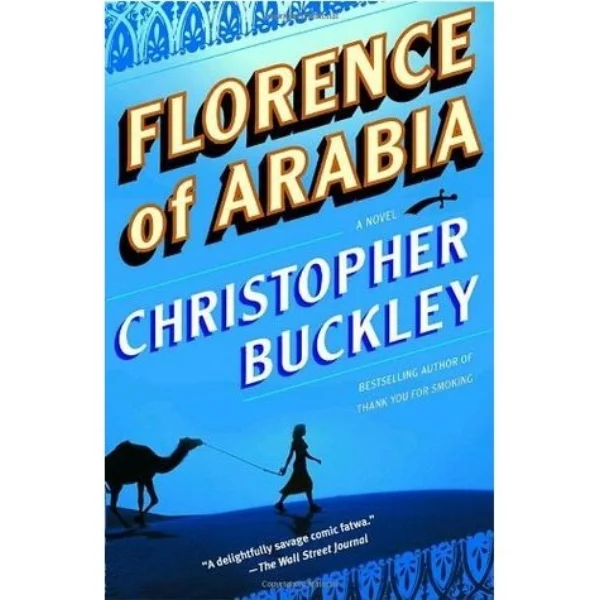
Christopher Buckley: Queen of the Desert

National Review, November 8, 2004

Florence_of_Arabia.jpg

All it takes for evil to prevail, warned Burke, is “for enough good men to do nothing.” True; but that doesn’t mean that the good men cannot occasionally relax with a good laugh or two. It might even help them, especially in a situation of the kind the West faces today: a war with an ideology so dedicated to the destruction of happiness that, in the shape of the Taliban, it made laughing too loud in public a crime. (For women, anyway.)

In Florence of Arabia, his dark, disturbing, and very funny new satire, Christopher Buckley highlights the cruelty of radical Islamism and the contradictions of America’s response to it. He does this against a backdrop not of history at its grimmest or journalism at its most intense, but of jokes, mockery, bouts of wordplay (a State Department bureaucrat is a “desk-limpet,” an Arab potentate has lips that are “oyster-moist from a life- time’s contact with the greatest delicacies the world [has] to offer”), and puns that teeter on the edge of catastrophe: The repressive Arab kingdom that is—along, naturally, with France—the main villain of this book goes by the name of Wasabia.

Wasabia is a sand-swept nightmare marked by oil wealth, joylessness, corruption, and ritualized cruelty, a tyranny where “offenses that in other religions would earn you a lecture from the rabbi, five Hail Marys from a priest, and, for Episcopalians, a plastic pink flamingo on your front lawn” are punished by “beheading, amputation, flogging, blinding, and having your tongue cut out . . . A Google search using the key phrases ‘Wasabia’ and ‘La Dolce Vita’ results in no matches.” Well, Prince Bandar, does that remind you of anywhere?

Gallows humor? Certainly. But insofar as the jihadists—with their car bombs, suicide bombs, and dreams of dirty bombs and worse—wish to shove you and me into mass graves at the earliest possible moment, a touch of Tyburn does not seem amiss. Of course, there are people who will find some of what Buckley has to say distinctly, you know, insensitive. The caliphs of multiculturalism will twitch a little, and this is not a book that will find many fans in Foggy Bottom (“the State Department’s reflexive response to any American in extremis overseas is to hand them a pamphlet—along with a list of incompetent local lawyers—and say, ‘We told you so’”).

But satire should not make comfortable reading for the subscribers to any orthodoxy. Running through this book is the clear implication that the American approach to the Middle East has not worked out quite as well as might have been hoped. And what, exactly, is the role played in Buckley’s drama by the Waldorf Group, an investment company (named, hmmm, after a New York hotel) that has danced a little too long, a little too closely, and a little too profitably with the despots of Wasabia?

But about Buckley’s heroine Florence, at least, there are no doubts. Forced out of the State Department for her unwanted imagination and initiative, she now has a new assignment: using covert funds to set up a TV station to transmit to the Arab masses. This will not, of course, be another Al-Jazeera, glossily repackaging nationalist resentments and religious prejudice 24/7, but nor will it be a source of ticky-tacky U.S. propaganda, ineffectively boasting about multicultural contentment in midwestern suburbs. Instead it will be something altogether more revolutionary, directed at the most excluded and mistreated of all the Arab masses: women. This will be Lifetime for women who really have no lives, its purpose to promote female emancipation as a counterbalance to militant Islam.

Qatar, the home of Al-Jazeera, being presumably unavailable, Florence’s TV station is hosted by the venal but fairly relaxed emirate of Matar (“pronounced, for reasons unclear, Mutter”), a state let created by Churchill at one of those colonial conferences that have done so much to make the Middle East the cheery place that it is today. “One might suspect,” writes Buckley, “that its borders had been drawn so as to deprive . . . Wasabia of access to the sea. One would be right.” The result was to leave Matar rich, permanently grateful to old Winston (spotting Matar’s Churchillian place names is one of the book’s many pleasures), and under the control of a royal family that knows how to handle its mullahs: cash, cars, and “an annual six-week paid sabbatical, which most of them chose to take in the South of France, one of Islam’s holiest sites.”

This relatively tolerant country makes an ideal base for Florence and her offbeat and entertaining team: a delightfully cynical PR man, a State Department employee so camp that he could have been pitching tents with T. E. Lawrence, and a CIA Col. Kurtz lite (a seductive— ask Florence—and effective mix of Esquire and Soldier of Fortune).

Throughout, Buckley’s lightly ironic tone only accentuates the savagery that is his main target, making it somehow all the more terrible when, as in this extract, it comes into clear, brutal focus:

The package turned out to contain a videotape. It showed Fatima buried in sand up to her neck, being stoned to death with small rocks. The tape was twenty minutes long. Everyone who watched it wept. Florence brought the tape to Laila. She could not bring herself to view it again so she left the room while Laila viewed it. She waited outside on the terrace, looking out over the Gulf in the moonlight, her skin misted by salty droplets from the fountain that spouted out the royal crest. Laila emerged, pale and shaken. Neither woman spoke. The two of them stood by the balustrade overlooking the gardens, listening to the waves lap the shore and the onshore breeze rustle the fronds of the date palms.

And then, right at the end of this book, cruel, bleak, awful reality finally comes crashing in. There, in the closing acknowledgments, Buckley pays tribute to Fern Holland, “a real-life Florence of Arabia,” who was assassinated in Iraq on March 9, 2004.

She was trying to help, and that would not do.

The Deer Hunter

National Review Online,  October 26, 2004

kerry-hunting.jpg

Carefully, silent lest he alert his foe, crouching, hunched, sometimes crawling, a camouflaged and heavily armed John Kerry makes his way across the harsh terrain. Later he emerges from this test by fire, this ordeal, to run for the White House on the back of tales of hardship and triumph, tales that some who were not there have the impudence to question, tales like this: "I go out with my trusty 12-gauge double-barrel, crawl around on my stomach. I track and move and decoy and play games and try to outsmart them. You know, you kind of play the wind. That's hunting" Yes, hunting. Did you think that I was talking about something else?

For reasons that have a little to do with the Second Amendment and a lot to do with Serotta John's need to bond with the Cabela's crowd, the Democratic candidate has been at carefully choreographed pains to show what a keen hunter he is—and always has been: "When I was a kid I used to hunt woodchuck, predators on the farm. I started with a BB gun, moved up to a .22, then a .30/30, and a shotgun. And I've shot birds off and on through my life, some game, rabbits, deer—I've been on Massachusetts deer hunts."

Yup. No nuance there, bub, no way.

Ah, but there is. Just in case some of Kerry's more sensitive supporters are offended by the thought of too many carcasses, nuance comes slithering back in: "I once had an incredible encounter with the most enormous buck—I don't know, 16 points or something. It was just huge. And I failed to pull the trigger at the right moment." And if that sounds to you just a teeny bit too much like that moment in The Deer Hunter when Michael Vronsky (a decorated hero of the Vietnam war, you know) gets a deer in his sights and decides not to shoot, well, you should be ashamed of yourself.

But, as Kerry tells it, this encounter seems to have been a rare armistice in his war against wildlife. For as his election campaign has continued, so have the bird bloodbaths and so, as the Washington Post's Laura Blumenfeld had the bad luck to discover, has the gory small talk: "Carve out the heart, he said over dinner, pull out the entrails and cut up the meat."

His victims? Well, there were the poor pheasants that perished in Iowa, a month or two before that state's critical primaries, and, most recently, the hapless geese butchered in Ohio just a few days ago (the New York Times noted that the Massachusetts Nimrod emerged from the fray with a hand "stained with goose blood"). Wisely, perhaps, in the context of a wartime election, Kerry has refrained from dove-shooting, but the senator still has fond memories of gunning down everyone's favorite bird of peace. According to the clearly traumatized Ms. Blumenfeld, this cornfield Krueger likes to watch doves "flutter and dart" before he fires. Then (PETA folk, look away) he will, he says, eat them. "You clean them. Let them hang. It takes three or four birds to have a meal. You might eat it at a picnic, cold roasted. I love dove."

Dove may or may not taste good (like the late President Mitterand, Kerry seems more like an Ortolan fan to me) but in stressing that he at least eats what he kills (the Iowa pheasants were, we were informed, sent to Kerry's home—the one in Boston—and two of the unfortunate Ohio geese, would, an aide told the New York Times, "soon be sent back to Mr. Kerry for consumption") the senator is almost certainly making a, well, let's use the word, nuanced, gesture to supporters such as the Humane Society of the U.S., which has somehow managed to endorse the great hunter despite, ahem, its own stern opposition to hunting and, indeed, its rather dim view of snacking on dove ("minimal sustenance," apparently).

If the Humane Society is comfortable with Kerry, many hunters are not. Some of them have been treating his hunting history with the same lack of respect that other naysayers have shown his stories of Christmas in Cambodia, the Boston marathon, and Chinese assault rifles. Doubtful about those Iowa pheasants? Well, check in with the ambiguously named website Sportsmen for Kerry/Edwards? There you can find Bush-bulge-style analysis of John Kerry's dog, John Kerry's thumb, and, to complete the murky picture, John Kerry's trigger finger. Other skeptics have claimed that no one, no one, would ever "hang" a dove (no, I really have no idea), while at least one blogger has even questioned whether any geese in those Ohio killing fields were really shot by Kerry.

But it was Kerry's claim that he crawled around on his stomach, "playing the wind," in pursuit of deer that stirred up the most suspicions. While this is what you do in Scotland (I write from sodden, scratched, and muddy experience), it is not the approach usually taken in America. To the NRA's executive director, Kerry's description was "so utterly bizarre" it made him "wonder whether Kerry has ever hunted a deer in his life." Anyone thinking of trying his deer-hunting tactics should "at least wear some blaze orange" so other hunters don't confuse him with "a snake slithering through the brush." And then there's Mark Steyn. Neither he nor "any of his New Hampshire neighbors" had "ever heard of anybody deer hunting by crawling around on his stomach, even in Massachusetts. The trick is to blend in with the woods and, given that John Kerry already looks like a forlorn tree in late fall, it's hard to see why he'd give up his natural advantage in order to hunt horizontally."

Sensing trouble over Crawlgate, the Kerry campaign turned for help not to his band of brothers, but, as the Milwaukee Journal-Sentinel explained, to a cousin, one Bruce Droste, "who said he hunted deer with Kerry roughly half-a-dozen times in Massachusetts, most recently about seven years ago... The hunts were tied to an annual house party on private property, and the hunters used buckshot, partly for safety reasons, because of its short range. 'When you see (a deer), you absolutely freeze. Then the game is to see how you can get closer. . . . So you crawl along until you know you have a dead ringer shot.'" The Milwaukee Journal-Sentinel reports. You decide.

In reality, of course, the devil in this case is not in the details, not in the crawling hunter, the hanging dove, or even those notorious geese, but in the broader suspicion that Kerry's hunting fables are yet more evidence of a candidate unable both to be himself and to be elected. It's his awareness of this, more than anything else, that explains those infamous flip-flops, and it's that awareness—plus the understanding that Kerry needs the Hank Hill vote—that explains this odd, awkward, aloof pretense at being one of the boys.

Now, there's nothing too unusual about a politician who panders, but there is something disconcerting about what Kerry's outreach to outdoorsmen reveals about his view of their political sophistication. They are, Kerry appears to think, simpletons who can be won over by sportsman's tales, talk of his "beloved" Red Sox, and the illusion that the senator's supposed fondness for hunting signals a deep belief in the Second Amendment—an amendment that has, in fact, far more to do with the right of self-defense than the ability to chase, or crawl, after deer.

Meanwhile, the candidate's grimly entertaining and appallingly patronizing, pandering pastiche of a regular guy is likely to continue down to the wire. In Pike County, Ohio, the proprietors of the Buchanan Village Store were subjected to the newly dumbed-down grammar of ("Can I get me a hunting license here?") of the Yale intellectual who is fluent in French, but no longer, it seems, his native tongue. What will Kerry say if he goes on the campaign trail into deepest Appalachia?

"Squeal like a pig?"

The Curious Discretion of Teresa Heinz Kerry

national Review Online, October 19, 2004

Teresa.jpg

If there's one thing that we have learned about Teresa Heinz Kerry it is that she is a woman who is not shy, as she repeatedly likes to remind us, about speaking her mind. Over the last few months, this splendidly bizarre, undeniably batty, figure has entertained, appalled, and enthralled Americans with her opinions—and her ignorance—on a startling range of issues. No wars for oil! Bin Laden will be the October surprise! Gin and white raisins cure arthritis!

When it comes to talking about her taxes, however, the voluble—and supposedly fearless—Mrs. Heinz Kerry has been uncharacteristically tongue-tied, preferring instead to hide behind her children. Citing their privacy (thanks to the Heinz trusts, her finances are deeply intertwined with those of her sons) she has held out against full disclosure of her 2003 tax records. As she explained back in April, "What I have and what I receive is not just mine, it is also my children's, and I don't know that I have the right to make public what is theirs...If I could separate it, I would have no problem."

Well, we are unlikely ever to know what attempts were made to separate these interests out for disclosure purposes, but, after a release discreetly timed for last Friday afternoon, we have now discovered how much of her 2003 returns Teresa Heinz Kerry is prepared to share with the rest of us: Two pages. That's about a page for every $2,500,000 in income. Gee, thanks.

As always with such paperwork, what's left out is far, far more interesting than what's left in. Those old, or jaundiced, enough to remember the Clintons' generosity with their used underwear will be disappointed that no details were given of Mrs. Kerry's charitable donations, or even of how much they were. Could it be, who knows, that Teresa was a little stingy last year, or could it be, perhaps, that she gave to some charities that might prove a little embarrassing in an election year?

Baseless innuendo? Very possibly. But there's an easy way to show that these suggestions are completely unfair. Disclose the full form, Teresa. Privacy? Oh, come off it. How can disclosure of any part of Mrs. Kerry's personal 1040 relate to her children, all of whom are now in their thirties?

But then there are the pesky, yet handy, family trusts (widely believed to be worth about around one billion dollars) that must mean so much to Teresa and her boys. As the New York Times noted with, incredibly, a hint of disapproval, nothing, nothing, was disclosed about them: "If the trusts are as large as reported—and the Kerry campaign has not challenged the billion dollar estimate—then even a modest 5 percent return would have generated $50 million of income, 10 times what was on the two pages released by Ms. Heinz Kerry."

Trusts and income this large, even if only partly controlled by a potential future First Lady, matter. We've already seen how Teresa effectively helped finance her husband's campaign, at least in its bleaker moments. How her money is generated is, therefore, of some interest as is its potential, particularly in the context of a campaign that has made so much out of "Halliburton," for conflicts (or the perception of conflicts) of interest.

Teresa, of course, continues to use her family's "privacy" as a justification for this billion-dollar omission. It would be easier to have sympathy for that argument had not John Kerry's campaign manager only recently described Mary Cheney's sexual orientation as "fair game." And then there's Mrs. Edwards. She attributed Lynne Cheney's aversion to political point scoring over her daughter's private life to "a certain degree of shame." Charming.

To follow the sleazy logic of Elizabeth Edwards (oh, why not?) is there something about the Heinz trusts which Teresa finds "shameful"? Are some of their investments insufficiently PC? Could it be that the trusts are embarrassingly tax efficient? Are there any of those dreaded "conflicts"? Maybe the trusts are simply too large for their riches to be spelled out by a populist campaign already burdened with a candidate whose blue collar comes tailored by Turnbull & Asser. We don't know, of course, because they are not before our eyes.

And that privacy defense? Well, it was Mary Cheney's participation in her father's bid for reelection that, apparently, made her "fair game." While a comparison of the two cases cannot be stretched too far (no one is suggesting that Mary Cheney's finances be disclosed), it is worth remembering that two out of Teresa's three sons have been prominent in their stepfather's campaign. Given the exceptional circumstances, couldn't they, and their third brother, have agreed to, at least, some disclosure about the income generated by the trusts in which they and their mother are beneficiaries: It's not as if their wealth will come as a surprise to anyone.

But all this is to play Teresa's game. There is plenty that she could disclose without overly compromising her children's privacy, and, if only to avoid the suspicions that will otherwise inevitably arise, plenty that she should disclose. The reality, however, is that, for whatever reason, she simply isn't prepared to do so. Teresa Heinz Kerry has, instead, a different message for the electorate.

"Shove it."

Other People's Money

Sebastian Mallaby: The World's Banker

The New York Sun, September 30, 2004

Wolfensohn.jpg

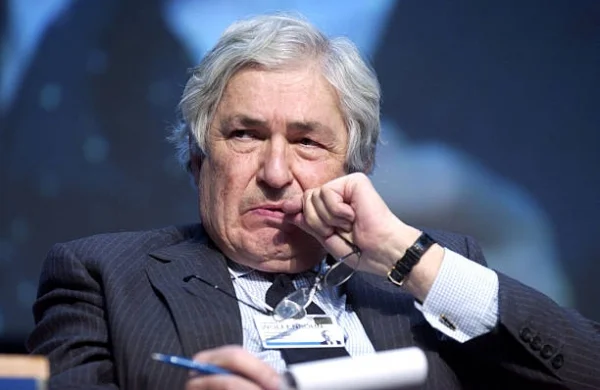
If there's anything more guaranteed to set off my inner sans-culotte than pampered, arrogant Teresa Heinz Kerry, it's a gathering of international bureaucrats, the spoiled, sanctimonious, worthless, and annoying aristocrats of our own sadly yet to be ancien régime. Locusts in limousines, they periodically descend on some unfortunate city, clogging the streets with their retinues, the restaurants with their greed, and the newspapers with their self-importance. Seen from this perspective, and judging by its remarkably unflattering cover photograph, "The World's Banker" (The Penguin Press, 462 pages, $29.95) an account by the Washington Post's Sebastian Mallaby of James Wolfensohn and the World Bank he is president of, promised to be a delightful, malicious treat. Mr. Wolfensohn, thin-lipped and narrow-eyed, glares out from the cover, seemingly disdainful of anyone impudent enough to even pick up the book. There is no attempt at a smile: Why bother to ingratiate? The look is the mask of a predator, a big beast to be avoided in boardroom, brawl, or multilateral institution.

Sadly, it's not always right to judge a book by its cover. While the Wolfensohn portrayed by Mallaby is not an altogether likeable character, "The World's Banker" is far from a hatchet job - either of the man or the institution over which he so imperiously presides. Over the years, both have made themselves into tempting targets for a cheap shot or two, but Mr. Mallaby takes the high road, treating them fairly, if sometimes (deservedly) critically. What's more, with a bright, breezy (occasionally too breezy) and assured style that reflects his years at the Economist, the author takes the complex and (let's admit it), potentially excruciating topic of the World Bank and makes it accessible to the general reader.

That said, the high road comes with a toll. This may be my inner Kitty Kelley surfacing, but this book's narrative would have hung together better with a little more Wolfensohn and a little less bank. Certainly the World Bank, like it or loathe it, is an important, some would say essential, institution. But in trying to tell its story through the partial biography of just one man, Mr. Mallaby has, despite a heroic effort, ended up with a slightly, and probably inevitably, unsatisfactory hybrid. His book does full justice neither to Mr. Wolfensohn nor to his bank.

There's another problem. A book that features the drama that is Mr. Wolfensohn had better be about Mr. Wolfensohn, and only about Mr. Wolfensohn. Anything or anybody else will be hopelessly upstaged. Mr. Mallaby has plenty to say about Bolivia, Uganda, and Indonesia, but much of the significance of what he is writing will be lost as even the most earnest readers find themselves impatiently turning the pages in expectation of the next fabulous, appalling Wolfensohn moment. The goat from Mali! The Frenchman's speech! Rostropovich! Harrison Ford! Um, Paul O'Neill! There are titanic rows, great rages, astonishing coups and, oh yes, that ego, well worth a full biography in its own right.

To describe this magnifico as merely protean would be an insult. He is a force of nature whose talents, personality, chutzpah, and remarkable networking skills took him from a comparatively modest upbringing in the Antipodes to Harvard, the Olympics (fencing for Australia!), Carnegie Hall (he's a cellist!), success in the City of London, Wall Street, and, since 1995, his current role.

As Mr. Wolfensohn ponders the chances of a third term at the bank, it is worth asking how much of a success has he made of the first two. Like many of the titans of high finance, his management skills appear - and this is being kind - rudimentary, a mixture of threats, bluster, overbearing ambition, and impatience. It's perhaps significant that Robert Rubin, whose background at Goldman Sachs must have made him very familiar with such types, was one of those in the Clinton administration most resistant to Mr. Wolfensohn's relentless, and typically skilful, lobbying for the World Bank job. It's no surprise to read that the great man's time in Washington has been marked by staff turmoil, mad fads, vast expenditures, grandiose planning, and feuds with shareholders: All the hallmarks, in short, of a Wall Street grandee at work.

All this sound and fury has signified something, however. In weighing Mr. Wolfensohn's career at the bank, Mr. Mallaby concludes that he can boast of some very real achievements - no small matter in a field where progress can mean a better life for large numbers of the desperately poor and, indirectly, for the rest of the planet. In a world that is ever more complicatedly, and sometimes dangerously, interconnected, it is no longer possible for the West to ignore the less prosperous parts of the globe - even if it wanted to. That is something Mr. Wolfensohn understood well, and that Mr. Mallaby makes clear.

If much of the World Bank's progress has seemed to come uncertainly, awkwardly, in fits and starts and after numerous wrong turns, neither Mr. Wolfensohn nor his employees are wholly to blame. When it comes to development, there is no magic bullet, no one answer, not trade alone or aid alone, not free market fundamentalism, not massive infusions of capital, not 'empowerment', not structural reform, not tough dictates suited to the Victorian workhouse, not the sentimentality and soft targets of the 1970s. And certainly not the leftist prescriptions and cultural imperialism of far too many NGOs. The correct approach probably draws on aspects of most of the above strategies and quite a few others besides.

"The World's Banker" gives a useful introduction to many of these issues, but only an introduction. Nevertheless, given the importance of this neglected topic, it is to Mr. Mallaby's credit that his readers, like the developing countries the World Bank was designed to assist, will be left asking for more.

A Hero of Our Time: Gareth Jones, 20th-century truth-teller.

The notebooks—worn, creased, and drab, but haunting nonetheless—lay carefully set out on a table in the lobby of a New York hotel. Their pages were filled with notes, comments, and calculations, jotted and scribbled in the cursive, spiky script once a hallmark of pre-war Britain's educated classes. Their author had, it seems, wandered through a dying village deep within Stalin's gargoyle empire. "Woman came out and started crying. 'They're killing us. In my village there used to be 300 cows and now we only have 30. The horses have died. How can I feed us all?'" It was the Ukraine, March 1933, a land in the throes of a man-made famine, the latest murderous chapter in Soviet social engineering. Five, six, seven million had died, maybe more. As Khrushchev later explained, "No one was counting."

But how had these notebooks found their way to a Hilton in Manhattan? Some years ago, in a town in Wales, an old, old lady, older than the century in which she lived, was burgled. As a result, she moved out of her home. When her niece, Siriol, came to clear up whatever was left, she found a brown leather suitcase monogrammed "G.V.R.J." and, lying under a thick layer of dust, a black tin box. Inside them were papers, letters, and, yes, those notebooks ("nothing had been thrown away"), the last records of Gareth Jones—"G.V.R.J."—Siriol's "jolly," brilliant Uncle Gareth, a polyglot traveler and journalist. In 1935 he had been killed by bandits in Manchuria, or so it was said. All that was left was grief, his writings, and the memory of a talented man cut down far, far too soon.

Seven decades later, as I sat talking to Siriol Colley in that midtown hotel, looking through Jones's papers, his press clippings, even his passport, it was not difficult to get a sense of the uncle she still mourned. Welsh to his core, he was typical of those clever, energetic Celts who did so well in the British Empire, restless (all those visa stamps, Warsaw, Berlin, Riga . . .), ambitious, and enterprising. Despite his youth, Jones seemed to get everywhere, Zelig with a typewriter. On New Year's Day 1935, for instance, he was in San Simeon, Kane's Xanadu itself, side by side with William Randolph Hearst. Earlier, we find him on a plane with Hitler ("looks like a middle-class grocer"), and, why, there he is, smiling on the White House lawn in April 1931, standing just behind a hopeless, hapless Herbert Hoover.

Above all, this man who reportedly charmed his captors in Manchuria by singing them hymns, was what the Welsh call “chapel”: pious, hardworking, teetotal, a little priggish, and armed with a sense of right and wrong so fierce that it gave him the strength to report the truth of what he saw, at the cost, if need be, of his career and, some would say, his life. Jones’s politics were typically chapel too, steeped as they were in the Liberal traditions of Welsh Nonconformism. Ornery, high-minded, pacifist, egalitarian, a touch goofy, a little bit utopian, Jones was just the sort of Westerner who might have been attracted to the Soviet experiment. And so he was—initially. In a 1933 article for the London Daily Express, Jones recalled how “the idealism of the Bolsheviks impressed me . . . the courage of the Bolsheviks impressed me . . . the internationalism of the Bolsheviks impressed me,” but “then,” he added, “I went to Russia.”

And there, for Jones, everything changed. His accounts of his visits to the USSR (the first was in 1930) are a chronicle of mounting disillusion. Reading them now, particularly the occasional attempts to highlight some Soviet achievement or other, it’s easy to see that this young Welsh liberal, this believer, wanted to trust in Moscow’s promise of a radiant future, but Communist reality—dismal, savage, and hopeless—kept intruding. Unlike many who came to inspect the people’s paradise, he reported on its dark side too. For Jones, there was no choice. It was the truth, you see.

By the autumn of 1932, Jones was sounding the alarm (“Will There Be Soup?” and “Russia Famished Under the Five-Year Plan”) about the catastrophe to come: “The food is not there.” Early the next year, he returned to Moscow to check the situation for himself, took a train to the Ukraine, and then walked out into the wrecked, desperate countryside. Once back in the West, he wasted no time, not even waiting to get back home before telling an American journalist in Berlin what he had seen: Millions were dying.

Soviet denials were to be expected. That they were supported by the New York Times was not. The newspaper’s Moscow correspondent, Walter Duranty, reassured his readers that Jones had been exaggerating. The Welshman was, he condescended, “a man of a keen and active mind . . . but [his] judgment was somewhat hasty . . . It appeared that he had made a forty-mile walk through villages in the neighborhood of Kharkhov and found conditions sad.” Sad—not much of an adjective, really, to describe genocide.

The Times’s man, who had won a Pulitzer the previous year for “the scholarship, profundity, impartiality, sound judgment and exceptional clarity” of his reporting from the Soviet Union, did not share Jones’s sense of “impending doom.” Yes, “to put it brutally,” omelettes could not be made without breaking eggs, but there had been “no actual starvation or deaths from starvation.” Duranty came, he claimed, to this conclusion only after “exhaustive enquiries about this alleged famine situation,” but other discussions probably influenced him more. The big story in Moscow in the spring of 1933—bigger by far than the death of a few million unfortunate peasants—was the pending show trial of six British engineers. Courtroom access and other cooperation from Soviet officialdom would be essential for any foreign journalist wanting to satisfy the news desk back home. That would come at a price. The price was Jones.

Eugene Lyons, another American journalist in Moscow at the time, later explained that “throwing down Jones was as unpleasant a chore as fell to any of us in years of juggling facts to please dictatorial regimes—but throw him down we did, unanimously and in almost identical formulas of equivocation. Poor Gareth Jones must have been the most surprised human being alive when the facts he so painstakingly garnered . . . were snowed under by our denials.” According to Lyons (not always, admittedly, the most reliable of witnesses, but the essence of his tale rings true), a deal was struck at a meeting between members of the American press corps and Konstantin Umansky, the chief Soviet censor. “There was much bargaining in a spirit of gentlemanly give-and-take . . . before a formula of denial was worked out. We admitted enough to soothe our consciences, but in round-about phrases that damned Jones as a liar. The filthy business having been disposed of, someone ordered vodka and zakuski.” Spinning a famine was, apparently, thirsty work.

Undaunted by the attacks on his accuracy, Jones intensified his efforts. There were articles in the Daily Express, the Financial Times, the Western Mail, the London Evening Standard, the Berliner Tageblatt, as well as a lengthy letter to the Manchester Guardian in support of Malcolm Muggeridge, who had, like Jones, told the truth about the famine and, like Jones, been vilified in return (suggestions that there was starvation in the USSR were, said George Bernard Shaw, “offensive and ridiculous”). In a letter published by the New York Times in May 1933, Jones hit back at Walter Duranty. The reports of widespread famine were, he wrote, based not only on what he had seen in the villages of the Ukraine, but also on extensive conversations with other eyewitnesses, diplomats, and journalists. After a few polite remarks about Duranty’s “kindness and helpfulness,” the tone turned contemptuous. Directly quoting from Duranty’s own dispatches, Jones charged that censorship had turned some journalists into “masters of euphemism and understatement . . . [They] give ‘famine’ the polite name of ‘food shortage’ and ‘starving to death’ is softened down to read as ‘widespread mortality from diseases due to malnutrition.’. . . Mr. Duranty says that I saw in the villages no dead human beings nor animals. That is true, but one does not need a particularly nimble brain to grasp that even in the Russian famine districts the dead are buried . . . [T]he dead animals are devoured.”

Moscow responded by barring Jones from the USSR. He was cut off for good from the site of the story he had made his own. Duranty received a rather different reward. Some months later he accompanied the Soviet foreign minister on a trip to America, a journey that was to culminate in FDR’s decision to extend diplomatic recognition to the Communist regime, a decision that was fêted, fêted in that famine year, with a celebration dinner at New York’s Waldorf-Astoria hotel, at which Duranty was honored with cheers and a standing ovation. On Christmas Day 1933 came the greatest prize of all—an interview with Stalin himself. Well, of course. It was a reward for work well done. Duranty had, said the dictator, “done a good job in . . . reporting the USSR.”

But history had not yet finished with Gareth Jones. The young Welshman possessed, explained David Lloyd George, the former prime minister for whom Jones had, some years before, worked as an aide, “a passion for finding out what was happening in foreign lands wherever there was trouble, and in pursuit of his investigations he shrank from no risk.” So, it’s no surprise to find him in Japan in early 1935, interviewing, questioning, snooping, and perhaps attracting the sort of attention that could turn out to be fatal. By July that year he was heading through the increasing chaos of northern China toward Japanese- controlled Manchuria (Manchukuo). On July 26, Jones updated the narrative he was writing for the last time. He was, he wrote, “witnessing the changeover of a big district from China to Manchukuo. There are barbed-wire entanglements just outside the hotel. There are two roads . . . [O]ver one 200 Japanese lorries have traveled; the other is infested by bad bandits.” Two days later, the bandits struck. Jones was kidnapped. He was murdered two weeks later. It was the eve of his 30th birthday.

We will probably never know who was ultimately responsible for Jones’s death. There had been a ransom demand, and so, perhaps, this was just a kidnapping that went horribly wrong. There are, however, other possibilities. The Japanese would certainly not have welcomed a Westerner watching the takeover of yet another Chinese province, and there is some evidence that the kidnappers were under their control. It’s also intriguing to discover that one of Jones’s contacts in those final days was linked to a company now known to have been a front for the NKVD, Stalin’s secret police. To Lloyd George, only one thing was clear: “Gareth Jones knew too much.”

And if he knew too much, the rest of the world understood too little. For decades, like the dead whose story he told, this lost witness to a genocide seemed doomed to be forgotten, a family tragedy, a footnote, but now that’s changing. Jones is at last returning to view, thanks in no small part to the efforts of the indefatigable Siriol Colley, the author of a book about her uncle—and a second is on the way. (Colley’s son Nigel has also set up a website: www.colley.co.uk/garethjones/index.html.)

One thing, however, has not changed. On December 4 last year, not long after the Pulitzer committee decided that Duranty should retain his prize, Colley wrote to the New York Times asking whether the paper could at least issue a public apology for the way in which its Moscow correspondent had smeared Jones. She’s still waiting.

Comfort Zone

National Review Online, September 7, 2004

GOP Convention 2004.jpg

So the GOP convention passed off, to use the bland, blinding bureaucratic phraseology, without major incident. There were many arrests, sure, and on the Sunday before a march involving hundreds of thousands of demonstrators, but these are part of the regular theater, or in the case of some of the protests, the pantomime, of American politics in our age of unease and unusual rancor. But the other possibility, the possibility about which we murmured, we whispered, we speculated and in anticipation of which not a few folk fled town, did not, thank God and, I suspect, good security, come to pass.

But the fear, the unease that has never really left, not here, not in this city, since that beautiful, horrible September morning was all too real. How could it not be? There is the dread of the future, triggered by alerts, color-coded warnings and plain commonsense, and then there are the still raw memories of the past, prompted by that hole in the sky at the southern end of our island, or in endless, countless, smaller ways, the postcards that still sell pictures of those two doomed towers, the fire truck I saw parked near Rockefeller Center on Tuesday with its small metal plaque honoring the "brothers of Ladder 4" who died at Ground Zero: Angelini, Brennan, Haub, Lynch, O'Callaghan, Oitice, Tipping, Wooley....

The convention site itself, ugly, clunky Madison Square Garden, and the faded Beaux-Arts Farley building, together with the streets that surrounded them, were a ring-fenced fortress of foreboding, oddly quiet for Manhattan, cut off from the shove and the push of the streets of Midtown by the still makeshift barricades of our savage new era—vast concrete blocks here, a sand-filled city truck there. In part they were designed to ensure that New York City did not suffer a rerun of Chicago 1968, but as with the barriers outside the Central Synagogue on 55th Street, or those that crowd the Vanderbilt entrance to Grand Central Station, there can be no doubt about what or who they were really intended to deter. In time, as extreme Islam's war against the West endures (and George W. Bush is right, it will) such barriers will be prettied up, will be made to blend, will become just another part of our urban and psychological landscape, but for now they are an open scar, yet another reminder of the price our civilization is being made to pay for its survival.

Access to the convention was, like so much else these days, color-coded. Different colored cards gave admission to different parts of the convention complex, to the media center to some, to the floor to others. We strolled through the security zone that enveloped us, cards hanging from our necks, evidence that we all somehow belonged. We had been checked, approved, authorized, our papers were in order. In this, the land of the First Amendment, these portents of a garrison state were a little spooky, and not a little sad, but the far more significant tragedy is that, in this conflict of sneak attack and mass atrocity, they were indeed necessary.

Needless to say, smiling, unsmiling, friendly, withdrawn, beneath their helmets and their caps, New York's Finest were everywhere, pulled, it seemed from every unit the city had to spare, mounted, on foot, in patrol car, on motorbikes, courteous and watchful, checking out those inside the zone, monitoring those outside, and waiting, waiting, waiting.

By night the drama—and the tension—was, quite literally, highlighted by the searchlights of helicopters hovering above and of the klieg lights rooted below. Between them they seemed to illuminate every sinister nook and each questionable cranny. Elsewhere, looking out from the zone, there were signs that life went on as usual. Broadway shone, as it always shines, the high-rises glittered and shimmered as far as one could see. To the east, the Empire State Building, once again, but tragically now, New York's tallest, was bathed in red, white, and blue. The disconcerting sense of normality—of once what was—was emphasized by the white stars and posters of red white and blue bunting that bedecked Macy's, and the cheery flashing sign over the Garden: Welcome delegates!

Some time, it must have been after midnight on Wednesday, there were a few demonstrators out in the streets beyond the zone. Bush is a murderer! Bush is a liar! Bush will kill for oil! Peace now! Three or four ladies, tackily glamorous in showgirl costume, ran by laughing and giggling, cardboard missiles strapped—How should I put this?—in the place where Hedwig still had that angry inch.

Someone shouts expletive-sodden abuse at a delegate, something about blood-spattered hands and Halliburton, but the delegate walks on, oblivious or unconcerned, protected by the cops who are everywhere, many with glow-sticks that cut red swathes through the air as they point where to go. And where not to. Even here, in the vicinity of the zone, but outside it, we are carefully controlled, move along, move along, allowed to cross the streets only at designated points, not here, no sir, not here, and herded behind red plastic netting until it is the moment to cross.

From time to time, large buses swept by, ferrying delegates to their hotels. Behind darkened windows, they could look out. No one could see in. Later came the vice-presidential cavalcade, motorbikes, a couple of limos, police cars, an SUV bristling with odd-looking antennae. I thought I caught a glimpse of Lynne Cheney through a partly opened window. The speeches had gone well, but she was staring out, pensive, a little anxious it seemed.

Back home, I pulled out Theodore White's history of the 1960 campaign for his description of the conventions that year. Here he is with the Democrats: "Through the Biltmore lobby paraded two rival Puerto Rican delegations, with their steel drums and guitars, making music and dancing in Latin costume. Here floated the pretty girls, almost indistinguishable from one another in their official red-white-and-blue-dresses and skimmer hats, soliciting delegates, giggling, jiggling, pinning badges on anyone who lingered...."

That's all gone now. Ancient history. What a shame.

Bowery Bums

National Review Online, August 31, 2004

Rev Billy.JPG

New York, N.Y.—It was Saturday night. Despite the killjoy sign—"No drugs, weapons or alcohol"—the killjoy heat, the killjoy humidity, the killjoy rabble, and the killjoy location (a church!), I went in through the door. Left-wing agitators, maybe even anarchists, were in town and someone (an assignment our killjoy editor had rather discouragingly told the New York Times was the "short straw") had to keep an eye on them. But, in my Gomorrah, the city I call home, the city of Pinch Sulzberger, Al Sharpton, Susan Sarandon, and the ever-degenerate George Costanza, where to begin?

After detailed research—several minutes at least on the Internet—a meeting hosted by the Reverend Billy and his First Amendment Revival Church & Gospel Choir seemed like a good place to start. The venue, St. Mark's-in-the-Bowery, is often described, ominously, as a center for arts in the East Village, and nothing good, we know, can come from the bohemians who choose to live down there. As for Reverend Billy's topic ("prepare for nonviolent dramatic civil disobedience"), it seemed promisingly, suitably, wickedly subversive. Yes, yes, necessary disclaimer, of course such folks are not part of the Democratic mainstream, but they are, ask Howard Dean, increasingly the source of much of the party's energy, inspiration, and verve.

Needless to say, the sight inside the old church (built, interestingly, on the foundations of the chapel where Peter Stuyvesant once worshiped) was not pretty. But not for the reasons you might think. Blasphemy? It's been done before. Piercings? Who cares? Tattoos? Whatever. The glimpses of post-apocalyptic tailoring? Just local color, normal for the East Village. Worrying about those Mad Max shreds and tatters would make as much sense as going to France and being bothered by berets. Even the occasional, horrifying glimpse of Birkenstock was no great difficulty for me, a veteran of the fashion disaster that was Britain in the 1970s.

No, the problem in that room was the stink of self-righteousness, a smug fug of self-congratulation, stupidity, sanctimony, and bile. Republicans were bad, bad, bad. Ashcroft was evil, and America's rights were under siege. The Patriot Act, hiss, and the Sedition Act, boo, were two centuries apart but one and the same in their iniquity. On the Reverend's word, we raised our hands in the air, each of us clutching a little scrap of paper on which someone had typed that magic, marvelous First Amendment: "Congress shall make no law respecting an establishment of religion, or prohibiting the free exercise thereof; or abridging the freedom of speech, or of the press; or the right of the people peaceably to assemble, and to petition the Government for a redress of grievances."

Fine sentiments indeed, even if I wasn't completely convinced that all those present wanted to allow Republicans their right peaceably to assemble in a city that has, we have been told again and again, no time for them, their opinions, or their yahoo red-state sensibilities.

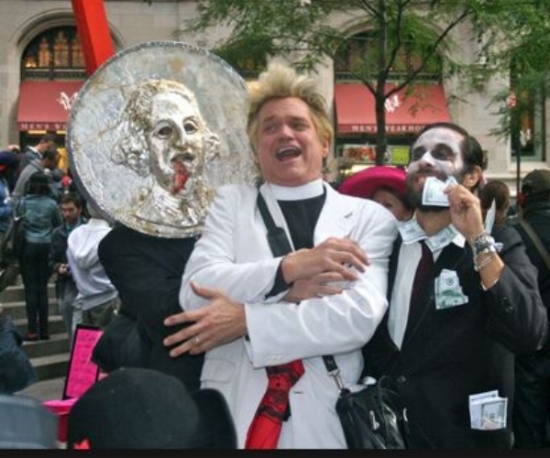
And as for the blonde-dyed, caustic, sarcastic Reverend Billy, he's a star (see his congregation quiver), a celebrity, a snide counterculture darling, a mall-rat Savonarola, a critic of consumerism, a parodist, a prankster, a preacher—but not, I'm afraid, a parson. Dressing up as a vic is just Billy's shtick, a pantomime pastiche as bogus as his logic is faulty, his politics are ludicrous, and his gospel choir is hot.

But if Billy was silly, he was Reverend Rationality compared with the freak show unfolding in the darkness outside. Making my way through the churchyard, over the flagstones that mark the last resting places of poor David Jones (died 1823) and lucky John Wilson (managed to hang on until 1826), past the bust of an outraged Peter Stuyvesant (if a head made of copper could scream, it would, that evening, have been screaming), past the pile of provisions and cooking utensils being assembled for the drama to come, past downtown Kropotkins and trust-fund communards, past suburban shamans and, rare authenticity, a few genuine Bowery bums, I find a large circle of people gathered around two women, shrill of voice, strident of opinion, silver of face makeup, and, well, confusing of message. These ladies' hopes of "magic action in the streets" were clear enough, sort of, but, as we all turned round and round on their shouted instructions, our hands reaching imploringly for the night sky, the "action in the center of the magic of the web" began to seem very, very murky.

And that was before someone told us that we were trees. Yes we were! The trees were rooted in the energy of the earth. We were rooted in the energy of the earth. Trees had branches. We were branches. We had to feel the energy, or something, from the Earth. The Earth, earth! An element, yes, yes, I got it. At last. Others came later. Fire, two sparklers, fizzing and spitting flame into the center of our circle and then, yes, you guessed it, water, poured and re-poured between two plastic glasses (recyclable, I'm sure). The crowd watched on, impressed, enthralled, captivated. Twelve hours later they would be marching through Manhattan because, you know, George W. Bush is, like, dumb.

The irony, I suspect, would have been lost on them.

Cage Heat

National Review Online, July 30 2004

Boston.jpg

Boston, Mass.—It was, said U.S. District Judge Douglas P. Woodlock, a man who has, quite obviously, never seen the inside of a Manhattan apartment, a "grim, mean and oppressive space," but, on a sunny Thursday afternoon, the fenced-in "cage" designed to hold demonstrators protesting at the Democratic National Convention (or, at least, haranguing the delegates as they go to and fro) is practically empty. "Pens are for animals," say the signs, but this is the pen of a Kentucky Fried Chicken's dreams, airy, spacious, an acre to roam where, what's more, the human inhabitants are, I suspect, almost all vegetarians.

Now and again, there are moments of excitement. A small group bears down on the wire barrier with bolt-cutters, bluster, and bravado. "Up with dissent, down with de fence, up with dissent down with de fence." Boston's Finest roll their eyes, smirk, and mutter into radios. Snip. Cut. Chop. More muttering into radios. Snip again, cut again, chop again, and, wild cheering, it's through to the outer boundary. Boston's Finest move in. A tussle, a scuffle, maybe an arrest. Other protesters film the struggle. News media film the protesters filming the struggle. The police prevail. The thin metal line holds. The other, licensed lunatics, the ones, you know, caged inside the Fleet Center, are safe, free to continue plotting and planning for victory unmolested, their dreams and delusions undisturbed by demonstrators.

Drama done, the cage slips back into torpor, the only sound to be heard an old sweet song, "We Shall Overcome," over and over and over again. A choir? Eager activists? No, just a guy at a podium with a cassette player and a mike. The tune echoes through the loudspeakers placed all through that empty space, loudspeakers designed for the crowd that has never turned up, loudspeakers that fail to rally the few faithful who linger and lurk, but do not deign to sing along.

Only the posters and the placards, tied to the wire, stuck to the pillars, and hanging from a gate, are doing their duty, stolidly proclaiming their message, conventional (Repeal The Patriot Act!), inspirational, (Tear Down This Wall!), insulting, and, suitably for the age of Teresa Heinz Kerry, multilingual (Democrats—No Cojones!), anarchistic (Don't Vote, It Only Encourages Them!), paranoid, (Free Speech—The Second Victim of 9/11!), surprising (Bush-Cheney 04!), adventurous (Polygamy Now!), honest (This Is A Farce!), strange (Wilderness!), and desperate (Flee The Pen!).

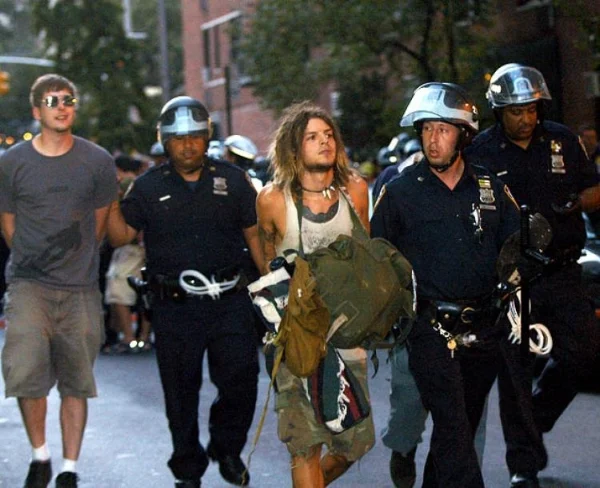
Those who have fled the pen can be found nearby, clad in the cranky clown costume (keffiyehs, alarming piercings, Jesse James face masks, making-a-point make-up, white man's dreadlocks) of anti-globalization street theater everywhere, as they gamely, if a little lamely (there was more enthusiastically vicious trouble later: with my usual keen journalistic instincts I had already left the scene), go through their paces beneath the indifferent gaze of the yuppies sitting in the sports bars that spill out onto the sidewalk. Drums sound, slogans are screamed and cops, stoic in that sci-fi-riot-squad gear that they wear nowadays, are taunted by those that they are sworn to protect. A solemn girl sits cross-legged in the street, wearing a gag. I'd like to ask her why, but....

Others indulge in darker mutterings, drearily familiar accusations from this country's sour, distorted foreign-policy debate, "Halliburton," "oil," and, wait for it, "lies," all make their now customary appearance. As the afternoon warms up, placards dance somewhere out there on the lunatic fringe, denouncing the wickedness of the dollar, announcing the candidacy of Nader, warning of the imminence of Hell, and, weirdly even in this company, discussing some sort of conspiracy involving Yevgeny Primakov, the former KGB agent who rose to be Yeltsin's prime minister. And let's not forget all those occupations (unless they are of Lebanon). End the occupation of Iraq! End the occupation of Palestine! End the occupation of Haiti! Yes, Haiti. Tibet, meanwhile, must be freed. Quite how, however, is not explained.

And in an era of revived, and often highly organized, protest, the activists have support people, an entourage, staff. There are "medics" with paper red crosses and healing bottles of, uh, water, and, scattered throughout the crowd and clad in a green so bright (I think) that it made me grateful to be color-blind, the "legal observers," socialist attorneys, two strikes with a third for self-importance, from the National Lawyers Guild (an "association dedicated to the need for basic change in the structure of our political and economic system") scribbling, scribbling, scribbling mysterious commentary into the notebooks that they all seem to carry.

Suddenly, there's a disturbance, photographers, police, movement. Dennis Kucinich has arrived. Sanity at last.

Well, these things are relative.