A Marvelous Excursion in the Lion's Kingdom

The Lion, The Witch and the Wardrobe

The New York Sun, December 8, 2005

The Lion.jpg

If there's one thing that Brits of the old school didn't appreciate, it was a fuss, and if there's one thing we know about the repressed, eccentric, and misogynistic C.S. Lewis, it's that he was a Brit of the old school. Nevertheless, it's easy to imagine that Lewis, a man who relished vigorous debate, would have enjoyed the fuss that has newly enveloped his Narnia in controversy, rancor, and - from the faithful - fresh adulation. As scolds scold, his vision is sexist, Anglocentric, and - fashionably - maybe even Islamophobic. The Narnia stories are, allegedly, cunning and deceitful propaganda for that nasty Jesus, an insidious trap for generations of unwary secularist tots. Writing in the New Yorker, Adam Gopnik even cast doubts on Lewis' grasp of Christian theology. Aslan should, he wrote, have been something less glorious, a donkey, perhaps, rather than a lion. Aslan an ass? As if.

Meanwhile, on the other side of the culture wars, great hopes have been pinned on the Disney version of the lion's tale. The film was co-produced by a billionaire Christian entrepreneur (Philip Anschutz and his Walden Media) and even endorsed by the odd but oddly influential Focus on the Family. Sensing that this movie may be a second coming of "The Passion of the Christ," other evangelical groups have discreetly dropped the boycott long imposed on Disney for gay days, the Weinstein brothers, and other offenses. Disney has returned the compliment, enlisting evangelicals and Christian marketing groups to help promote the movie.

But all this is to miss the point. The tales of Narnia were always intended as something subtler than allegory. It's easy for a child to read them and miss the Christian resonance altogether (age 8 or 9, I did). As Lewis recalled, the first inspiration for the stories was visual - not spiritual - a picture that came to him "of a faun carrying an umbrella and parcels in a snowy wood," and much of the force, and the wonder, of these books comes from the striking images they contain. These images, especially when reinforced by Pauline Baynes's marvelous illustrations, do so much to bring this fictional world to vivid, memorable, and compelling life.

In this, and not only this, this movie version of "The Lion, the Witch and the Wardrobe," directed by Andrew Adamson of "Shrek" fame, is a terrific interpretation of Lewis's vision. An earlier attempt, the BBC's 1988 version (available on DVD in this country, but don't bother), was shipwrecked by puppet level performances, primitive effects, and a budget that cannot have exceeded £5, 2 pence, and a prayer. Stagy and contrived, it had the conviction of a pantomime horse, or, more accurately, lion, and belongs with Ralph Bakshi's atrocious "Lord of the Rings" in that special hell reserved for those movies that turn Inklings' dreams into dross. By contrast, the CGI that underpins Mr. Adamson's film will transport its audiences into a Narnia of witches, fauns, minotaurs, monsters (younger members of the audience will get a fright or two, which will probably do them good), giants, and talking animals as effectively as the train in the movie's early sequences carries the Pevensie children from the London Blitz into the depths of the lush, green English countryside (New Zealand, actually, once again passing itself off as the Shire), the heart of an Albion where landscape, legend, and history merge into myth.

These effects pass their toughest test in the film's climax, which is, if we're honest about it, a battle between two menageries. Handled incorrectly, this could easily descend into absurdity, but instead we're shown a stirring struggle that matches anything witnessed at Helm's Deep, and which does more than justice to that sense of the epic that plays so large a part in the enchantment that is Narnia.

As even the hapless nerds who plowed their weary way through the three most recent "Star Wars" films could tell you, though, special effects by themselves are not enough. The strength of "The Lion, the Witch and the Wardrobe" is that it not only features animals that can talk, it also boasts actors who can act. Almost without exception, the fine cast (even, such as in the case of Rupert Everett's delightful fox, when we only hear their voices) adds to the pleasure of the film, but it is Tilda Swinton's extraordinary Jadis who succeeds in stealing the movie despite failing to hang on to Narnia. With her almost translucent skin and austere, angular Scots features, Ms. Swinton is a natural to portray Lewis's witch:

"Her face was white - not merely pale, but white like snow or paper or icing-sugar, except for her very red mouth. It was a beautiful face in other respects, but proud and cold and stern."

And she is, as Ms. Swinton's commanding performance leaves no doubt, every inch a queen and in every thought and deed a force for bleak, relentless evil.

The young actors and actresses playing the four children who stand between the White Witch and her winter without end are more than up to the challenge, however. In particular, little Lucy Pevensie (Georgie Henley) is a beguiling, wide-eyed imp whose anarchic enthusiasm lights up the screen whenever she appears. Meanwhile her oldest brother, grave, responsible Peter (William Moseley), will delight the girls with his classic, slightly old-fashioned good looks and faint aura of the doomed subaltern of the trenches that C.S. Lewis so nearly was. And it would be invidious not to mention James McAvoy's charming, delicately touching Mr. Tumnus, the faun who is white rabbit to Lucy's Alice, and her introduction, and ours, to Narnia and the weird, heroic adventure that Lewis set out to describe.

It's a story to which Mr. Adamson and his writers have remained, quite rightly, almost completely faithful. They have, fortunately, avoided reproducing the feel of those passages in the original novel where Lewis comes across as a rather condescending vicar, but any changes or embellishments to the plot itself are minimal and, if it's not heresy to say so, an improvement. What's more, from the snowy wastes of the witch's domain to the glistening, gathering signs of thaw that signal that Aslan is indeed on the move, this unusually beautiful film also looks right: This is the Narnia that I saw when I read this book as a small boy nearly four decades ago, and there will be, I suspect, many others who will succumb to the same delighted nostalgia.

As for the book's message, such as it is, that's in the movie, as it should be, but why that should offend or upset anyone is beyond me. The film is never explicitly preachy, and the story itself stands on its own merits. Lewis, an inveterate (and, complained Tolkien, somewhat indiscriminate) miner of myth, knew that well-told sagas of quest, comradeship, war, self-sacrifice, and even resurrection have long gripped the human imagination. Under the circumstances, it's no great shock that "The Lion, the Witch and the Wardrobe" was not to be the only excursion to Narnia, and it's not much more of a surprise that the combined "Chronicles" have now sold around 90 million copies.

Back to work, Mr. Adamson, your audience is waiting.

An Imperfect Enjoyment

The Libertine

The New York Sun, November 23, 2005

Libertine.jpg

"The Libertine" is a fierce, intelligent, and compelling account of John Wilmot, the Second Earl of Rochester (1647-80). It is also infuriating, not so much for what it is, as for what it could have been.

Perhaps this is inevitable. In the course of his brief, brilliant, dark shambles of a life, Rochester was a poet, a satirist, a wit, a lampoonist, a classicist, a thug, a drunk, a bully, a brawler, a hero, a coward, a lecher, a prankster, a kidnapper, a pimp, a penitent, a politician, an atheist, a jailbird, a courtier, an exile, and, curiously, an occasional importer of dildos. To describe - and explain - all that in two hours was never going to be easy, but, sadly, "The Libertine" (based on the 1994 play of the same name by Stephen Jeffreys) only covers the five years leading up to Rochester's death and never really tries to do so.

Adding to the sense of an opportunity missed, the movie makes little or no effort to show how the wicked earl was the perfect symbol of his torn, troubled age. Yes, with its startling juxtapositions of splendor and squalor, "The Libertine" skillfully portrays the uneven, unsettling, and treacherous surface of Restoration England, but it does too little to show the turmoil that lay beneath, turmoil that played no small part in making Rochester the man he became.

England in the 1670s was febrile, discontented, and restless, scarred by the recent civil war and unsure about what would come next. The monarchy may have returned after the collapse of a short-lived republic, but the old certainties had not. When the English revolutionaries decapitated the first King Charles, they also finally destroyed the idea that a king derived his authority solely from God. And if God's representative was no longer God's, what could hold society together? To the philosopher Thomas Hobbes (like Rochester, an atheist), the only feasible solution was an all-powerful state. To Rochester, the only possible response was "Who cares?"

His indifference extended far beyond political theory. With God a dead myth and the afterlife a shattered illusion, all that remained was to eke what enjoyment he could from an existence that was temporary, random, and pointless. Life was a joke, the punch line was savage, and the laughter hollow. Mr. Jeffreys's play hinted at all this, but the movie adaptation (on which he also collaborated) opts for disconcerting spectacle over troubling speculation, and the real inspiration of Rochester's wild ride is left in shadow.

Where the film does succeed, magnificently, is in its depiction of a man trapped in the obsessive pursuit of pleasures that only reinforced his self-loathing, rage, and despair and left him dead of syphilis at the age of 33. In the movie's deeply disturbing, hypnotic prologue, Johnny Depp's saturnine Rochester (another remarkable performance by this most remarkable of actors) warns the audience that we "will not like" him. It is just as clear that he does not like us. Nor, indeed, does he think very much of himself. His is a baleful vision, and it oozes the weary disgust that saturates the uncomfortable imagery of this bleak, demanding film. Rochester's circle of wits is made up of the corpulent, the malicious, and the grotesque, and his London is a primitive, merciless city, shot in drab, bleached, wan colors, where even the fittest are sick, and few survive for long.

These ideas descend into nightmare during the course of a scene inspired by Rochester's "A Ramble in St. James's Park," a poem of impressive obscenity that begins with the funniest two lines ever written on the subject of gossip - this is a family newspaper, so you will have to look them up yourself - and culminates in sour, desperate fury. A revolted Rochester is filmed stumbling through the mists, miasmas, and degradation of what was then London's naughtiest rendezvous (hopeful tourists should note that the park, these days, is not what it was). The frantic, rococo writhing, coupling, and who knows what is to Rochester yet another brutal reminder that you don't need God to make a hell.

But it's not all gloom, disease, and debauchery. "The Libertine" also offers a romanticized version of the liaison between Rochester and his teenage mistress, the actress Elizabeth Barry (Samantha Morton, in a rather earnest performance), that is part "Pygmalion," part feminist fable, and which conveniently manages to overlook its more, uh, mercenary aspects. To their credit, however, the movie's creators resist the temptation to apply today's dreary orthodoxies to the poet's relationship with the other Elizabeth, his wife, the Countess of Rochester (played to heartbreaking and aristocratic perfection by Rosamund Pike, a lovely actress so poised that she even brought a touch of class to last month's catastrophic "Doom"). While Rochester's girlfriends, boyfriends (oh yes, that too), mistresses, whores, and bastards put their strains on the marriage, the movie correctly leaves little doubt that the earl and his countess shared a real - and loving - affection.

This makes the cruelty of a critical scene in which Rochester humiliates his wife by refusing to stand alongside her for a formal portrait, posing instead with a monkey, all the more puzzling. So far as we know, Elizabeth never attended those sittings, and, typically for Rochester, the painting (it now hangs in London's National Portrait Gallery and shows him crowning a rather dissolute-looking monkey with a poet's wreath) was, primarily, a joke at his own expense. In Mr. Jeffreys's play, if not the movie, the artist understands: "Of all those bewigged men that I painted, bothering posterity with their long faces, he [was] the only one aware of his own absurdity."

On the whole, however, in terms of historical accuracy, "The Libertine's" sins are, unlike those of the earl, minor, mainly of omission, and usually excusable. Even if the idea that Rochester's farce "Sodom" was actually performed in front of an appalled King Charles II (a fine, louche, and cynical cameo by John Malkovich) is a fiction, it's a useful device to help illustrate the way in which the always complicated (and who does complicated better than Mr. Depp?) Rochester relished taunting the man who was his friend, patron, surrogate father, and, much more dangerously, monarch. It also gives "The Libertine's" director, Laurence Dunmore, an entertaining opportunity to demonstrate that there's more to British cinema's barnyard baroque than Ken Russell.

More seriously, the movie is too quick to pass over the intellectual, spiritual, and emotional drama of the poet's once-famous deathbed repentance. Right to his life's wretched, agonizing conclusion, Rochester remained trapped between the past and the future, teetering uneasily between the fear that there was a God and the terror that there was none, before finally toppling back into the faith of his fathers and the arms of his wife. Smug divines all over England were to celebrate the reprobate's return for decades to come.

And somewhere a monkey began to laugh.

Ghosts in The Machine: Spooky looks at the Met.

Metropolitan Museum of Art: The Perfect Medium

National Review Online, October 31, 2005

ghost.jpg

I'm not altogether sure that New York's Metropolitan Museum of Art is taking its new, entertaining, and utterly charming exhibition dedicated to photography and the occult, entirely seriously. At the launch party for "The Perfect Medium" last month, giggling guests sipped smoke-shrouded potions to woo-woo-woo Theremin tunes, as vast projected images of the séances of a century ago shimmered silver-and-gray against the walls of a great hall that could just, just for a moment, have been in Transylvania. Up beyond the sweep of the Met's Norma Desmond staircase, a cheery crowd thronged past antique photographs of spirits, charlatans, and strange, vaguely unsettling, effluvia. As I peered closely, and myopically, at a mess of tweed and ectoplasm, there was a sudden, startling "boo" in my ear, and a pretty girl who had crept up behind me ran off laughing. As I said, unsettling. As I said, charming.

Unfortunately, the exhibition's catalog is, as such volumes have to be, straight-faced, straight-laced, and saturated in the oddball orthodoxies of the contemporary intelligentsia. With truth, these days, relative, and all opinions valid, it would be too much to expect an establishment such as the Met to say boo to a ghost and it doesn't. In the catalog's foreword the museum's director admits that "controversies over the existence of occult forces cannot be discounted," but he is quick to stress how "the approach of this exhibition is resolutely historical. The curators present the photographs on their own terms, without authoritative comment on their veracity."

Fair, if cowardly, enough, but a chapter entitled "Photography and The Occult" sinks into po-mo ooze: "The traditional question of whether or not to believe in the occult will be set aside...the authors' [Pierre Apraxine and Sophie Schmit] position is precisely that of having no position, or, at least not in so Manichean a form...To transpose such Manicheanism to photography would inevitably mean falling into the rhetoric of proof, or truth or lies, which has been largely discredited in the arena of photography discourse today," something, quite frankly, which does not reflect well on the arena of photography discourse today. Still, if you want a nice snapshot of how postmodernism can be the handmaiden of superstition, there it is. Standing up for evidence, logic and reason is somehow "Manichean", no more valid than the witless embrace of conjuring tricks, disembodied voices and things that go bump in the night. It's a world, um "arena," where proof and truth are reduced to "rhetoric," and, thus, are no more than a debating device stripped of any real meaning.

Thankfully the exhibition, principally dedicated to photographs of the spooky from the late 19th and early 20th centuries, is itself free of such idiocies. The images are indeed allowed to stand "on their own terms" and, on their own terms, they fall straight down. They are, quite obviously bogus, balderdash, and baloney, slices of sepia stupidity that are magnificent proof of our species' wonderful curiosity and embarrassing evidence of its hopeless credulity. They were also very much the creations of their own time. After over a century of manipulated images, vanishing commissars and Hollywood magic, we are better at understanding that photography's depiction of reality can often be no more reliable than a half-heard rumor or a whispered campfire tale. One hundred forty years or so ago, we were more trusting in technology, more prepared to believe that the camera could not lie.

And we were wrong to do so. On even a moment's inspection the Met's ghosts, sprites, emanations, and fairies are as ramshackle as they are ridiculous, but all too often they did the trick. The work of the depressingly influential William Mumler, an American photographer operating in the 1860s and 1870s, may include a spectral Abraham Lincoln with his hands resting on the shoulders of Mumler's most famous client, the bereft and crazy Mary Todd Lincoln, but, like the rest of his eerie oeuvre, this insult to John Wilkes Booth was based on crude double exposure (or a variant thereof). Nevertheless, the career of the phantoms' paparazzo flourished for a decade or so, even surviving a trial for fraud (he was acquitted).

Or take a look at the once famous photographs of the Cottingley fairies (1917-20), absurd pictures of wee fey folk frolicking with some schoolgirls in England's Yorkshire countryside. Once you have stopped laughing, ask yourself just why, exactly, the fairies resemble illustrations from magazines. Well, it's elementary, my dear Watson, that's what they were (one of the girls finally confessed in 1981), but to the creator of Sherlock Holmes, Sir Arthur Conan Doyle, a man who dedicated an entire book (The Coming of The Fairies) to the topic, and to many other believers, these fraudulent fairies were the real, fluttering, deal. Fairies were, explained Conan Doyle, a butterfly/human mix, a technically awkward combination that even the great Holmes might have found to be a three-pipe problem.

To be fair, by the 1920s, the possibilities of photographic fakery were no secret to the informed, but this made no difference to Sir Arthur, a convinced spiritualist who was to receive his reward by returning, like Holmes, from the dead (within six hours of his death, the author had popped up in England, moving on later to Vancouver, Paris, New York, Milan and, as ectoplasm, in Winnipeg). Conan Doyle believed what he wanted to believe, and so did his fellow-believers. Photographs could confirm them in their faith, but never overthrow it.

That's a recurrent theme of this exhibition. Yes, back then people were more inclined to give photographs the benefit of the doubt, but again and again we are shown pictures that were demonstrated at the time to be fake, something that did remarkably little to shake the conviction of many spiritualists that the dear departed were just a snapshot away. Even the obvious crudities and photographic inconsistencies could be, and were, explained as a deliberate device of the spirits—apparently they wanted to appear as cut-outs, illustrations, and blurs.

And it wasn't only photographers who egged the susceptible on. The idea that some gifted individual can act as an intermediary between the living and the dead is an idea as old as imbecility, but, after the dramatic appearance of New York State's rapping and tapping Fox sisters in the 1840s, the Victorian era saw a flowering of mediums, only too ready to impress the credulous with mumbo jumbo, materializations, mutterings, Native-American spirit guides (some things never change), transfigurations, grimaces, and tidings from beyond. Some were in it for the money, others for the attention, and a few, poor souls, may have actually believed in what they were doing.

The Met's show includes a fine selection dedicated to those mediums at work. Tables soar, chairs take flight, men in old-fashioned suits levitate, apparitions appear, and ghostly light flashes between outstretched hands. Most striking of all are the visions of ectoplasm snaking out of mouths, nostrils, and other orifices quite unmentionable on a respectable website. These grubby pieces of cotton, giblets, and who knows what were a messy but logical development, manufactured miracles for what was, in essence, a manufactured religion. Like the photographs, like dead Walter's mysterious thumbprint (don't ask), they were evidence. The immaterial had been made material, and in a supposedly more skeptical age, that's what counted. In great part, the enormous popularity of spiritualism in the later 19th century was a response to the threat that science increasingly represented to the certainties of traditional belief. Science had made Doubting Thomases of many, but spiritualism, by purportedly offering definitive proof of an afterlife, enabled its followers to reconcile ancestral faith and eternal superstitions with, they thought, fashionable modernity and the rigors of scientific analysis.

That the science was junk, and the evidence bunk, did not, in the end, matter very much. What counted was that old superstitions had been given a new veneer, and, if that veneer soon warped into a bizarre creed all its own, that's something that ought not to surprise anyone familiar with the nonsense in which mankind has long been prepared to believe—and still is. Any visitor to "The Perfect Medium" tempted to feel superior to the credulous old fogies now making fools of themselves on the walls of the Met should take another look at the metaphysical shambles that surrounds him in our modern America of snake churches, suburban shamans, mainstreet psychics, psychic detectives, pet psychics, psychic hotlines, spirit guides, movie-star scientology, alien abductions, celebrity Kabbalah, Crossing Over, Ghost Hunters, Shirley Maclaine, resentful Wiccans, preachy pagans, and (though I know this won’t be entirely welcome) don't even get me started on Intelligent Design.

Oh yes, "Happy Halloween," one and all...

Mad, Bad & Too Dangerous To Show

Byron

The New York Sun, October 21, 2005

Byron.jpg

There is something a little peculiar about the BBC's advance publicity for "Byron," a half-hidden hint of embarrassment, a discreet cough of discomfort, which suggests it's a touch worried that this glossy, entertaining new biopic might, like the unfortunate Lady Byron, be taken the wrong way.

Could it be that "Byron," which airs at 9 p.m. this Saturday on BBC America, is an unsuitably aristocratic topic for the obligatory, if strained, New Labour egalitarianism of the British broadcaster? Just in case it could, the BBC takes pains to quote earnest claims by "Byron" star Jonny Lee Miller ("Trainspotting" and Angelina Jolie), that the wicked Lord B. - a man who spent a lifetime milking his aristocratic status for all it was worth, and who was ready to use the poetry of social disdain against those who crossed him (such as his wife's governess, "born in the garret, in the kitchen bred") - "wasn't a snob."

Or was the relentlessly preachy and tiresomely progressive BBC worried that this largely sympathetic drama could be seen as condoning the sexism, and worse, of a man all too often capable of the epic cruelty of the incurably selfish? To name just a few of the women left wailing and wrecked in the Byronic wake, his wife was driven to leave him; his daughter Allegra (the mother, alas, was not poor Lady Byron) was neglected; and when naughty Susan Vaughan, one of his servants (and the mother of yet another Byron bastard) was impudent, and tactless, enough to enjoy a quick fling with Robert Rushton, Byron's, ahem, page (Byron, needless to say, had already done the same thing), she was fired.

None of this is likely to endear Byron to a modern audience; it didn't play too well even back then. Once again, the trusty Lee Miller tries to come up with the necessary unguent, but I'm not sure that it does the trick: "I certainly don't like the way he treated some people, but the lighthearted side of him surprised me." Oh well, so long as he was "lighthearted."

As it happens, the page and the maid had finished their frolics before the period covered by "Byron," the last 12 years of the poet's life, a time in which he found celebrity, scandal, exile, and, finally, redemption and an odd sort of martyrdom. Confining the story to Byron's most eventful years makes narrative sense, but it also comes with another advantage: It allows this drama's creators to sidestep the inconvenient fact that a good number of Byron's earlier lovers were too young, and too male, to be altogether seemly in a romantic idol.

The BBC may be intent on selling the idea of "a poet who lived fast and died young," a James Dean with quill pen and social conscience, but the real Byron ignored convention in ways that made Dean seem like a bishop. He also had a predatory side difficult to reconcile with current notions of what a liberal hero should be. Fully told, Byron's exploits would make very uncomfortable viewing indeed - which is probably why the writers of this production don't try to do so.

What we get instead is a glittering, fast-paced, well-written, wonderfully acted, beautifully scored, and entertaining historical drama; classic BBC, in other words. As usual with such productions, its audience of diligent and studious viewers is, as it should be, rewarded with gratuitous sex, landscape, nudity, architecture, and gossip. Yes, yes, with the exception of some coy looks, dark remarks, and a make-out session on a Greek beach, Byron's boys are banned, but that still leaves a lush, pouting parade of noblewomen, prostitutes, bluestockings, and groupies to lift their skirts for the smoldering poet.

Then there are the three women who defined Byron's final years in England. These were the two (principal) mistresses: Augusta (Natasha Little), his (half) sister, who was, awkwardly, related to him and married to someone else (their first cousin, confusingly), and his "wild antelope," brilliant, crazy Lady Caroline Lamb (Camilla Power), a cross-dressing, vengeful psychotic who makes "Fatal Attraction's" Alexis seem like Sandra Dee. And, oh dear, oh dear, there was the Unsuitable Wife, the pious and mathematically gifted Annabella (Julie Cox), who wandered out of Jane Austen's orderly England into the mayhem of Byron's psyche and found herself seduced, sodomized, scandalized, and spurned by the man she so foolishly married.

Natasha Little and Camilla Power both turn in strong performances, but it is the delicately attractive Julie Cox's touching portrayal of the heartbroken Annabella that lingers. Finally, we should not, could not, forget Lady Melbourne, Caroline Lamb's cynical but entertaining mother-in-law, and, typically for this story, Annabella's aunt. Lady Melbourne was never Byron's lover (she was 60-something, and even he drew the line somewhere), but as his confidante, meddler, and provocateuse she is interpreted with brio and malice by an on-form Vanessa Redgrave inspired, quite clearly, by the badly behaved granny she plays on "Nip/Tuck."

As for the sun around which all those pretty planets revolved, old Rhyming Byron himself, Jonny Lee Miller does a terrific job in conveying the charm, neuroses, poses and danger of this extraordinary man. Sick Boy, it turns out, makes a remarkably convincing peer of the realm. If there are any weaknesses, they belong to the script. There are, sadly, few signs of the wit that could flash from those "fluent lips" (check out his letters to see just how funny Byron could be), and we are left with too little sense either of his poetry or of quite why he became the icon that he did. What's more, his brave, significant, and ultimately fatal intervention in Greece's war of independence is downplayed into a muddy, soggy fiasco.

Nevertheless, despite these (and other) historical lapses and all the Bowdlerizing, this enjoyable production is an excellent introduction to Lord Byron, and, as he might have said, that's not a bad way to spend an evening.

Prime-Time Space Invaders

Invasion

Threshold

Surface

The New York Sun, September 20, 2005

invasion3.jpg

Be afraid, very afraid. Someone somewhere, probably in a French newspaper, is soon going to make a big deal out of the fact that all three U.S. television networks are debuting series about extraterrestrial invasions of Earth. Much as the enjoyable, and perfectly straightforward, "Invasion of the Body Snatchers" has long been reinterpreted as a parable of Cold War paranoia (it was nothing of the sort, of course), so "Invasion" (ABC), "Threshold" (CBS), and "Surface" (NBC) will undoubtedly be viewed as an expression of American unease at the threat posed by the alien civilization of Islamic extremism, and, yes, this too will be nonsense.

The coincidence that ABC, NBC, and CBS are offering viewers little green men - or eerie white lights ("Invasion"), or nasty spinning things ("Threshold"), or savage sea monsters ("Surface"), or whatever - owes a great deal to the success of "Lost" and has nothing at all to do with a malevolent and murderous crank firing off fatwas from a cave somewhere in Central Asia. That said, it's also true that since the days that all our species lived in caves, we have enjoyed frightening ourselves with tales of gods, monsters, ghosts, goblins, and ghouls. The evil menace from beyond the stars is just an old bogeyman in a new spacesuit, and as ABC, NBC, and CBS know well, he can still be a good source of chills, thrills, and ratings success.

"Threshold" boasts a hipster hip high dwarf (Peter Dinklage), a beauty who has appeared in both "Sin City" and "Spin City" (Carla Gugino), the return of Lieutenant Commander Data (Brent Spiner), and movie-standard production values. Despite all that, the storyline - involving aliens, secret government agencies, and offbeat protagonists - brought back too many memories of the much-missed Mulder and Scully, and it suffered by comparison. I'll give it another episode, but I'm unconvinced that this threshold is worth crossing. Turning to the next of these three shows, I should confess that I haven't actually seen "Surface," but as, by all accounts, it needs to sink very quickly, that's probably just as well.

That leaves ABC's "Invasion." Its creator, Shaun Cassidy, was responsible for the Mayberry-gone-bad of television's disgracefully underrated "American Gothic," one of the spookier shows of recent years and, as a former teenybopper idol (and the half-brother of another), he's someone who knows a thing or two about the dark side. "Invasion," sadly, does not live up to this promising pedigree, but does have, instead, a certain simple-minded charm. So pull out the popcorn, crack open a beer, and switch off your brain.

"Invasion" is not just cliched, it embraces cliche, and it does so with panache, verve, enthusiastically awful acting, and the hokiest use of sinister background music that I have heard in quite a while. We have the iconically-named American small town (Homestead, Fla.) under threat, we have the "typically" fractured American family (children shuttling between rancorous ex-spouses, new significant others on the scene, and so on), and we have the idiot American conspiracy theorist (played, confusingly, by someone trying to impersonate Jack Black) who is likely to be proved right in the end.

The sense that I had seen this all before didn't stop there. By the end of the first episode, there were dark "Body Snatcher"-style hints that neither the hero's ex-wife nor her current husband may be who she or he seems; the Jack Black impersonator had discovered that it's a bad idea to reach down into the swamp for a mysterious underwater light in the course of a scifi show; and a young child had searched the woods for her missing cat in the middle of a raging, lethal storm to, predictably, the wails - between recriminations - of those estranged parents of hers.

Awkwardly for ABC, that raging, lethal storm was a hurricane. As the devastation caused by Katrina became clear, the network pulled commercials for "Invasion," but ultimately decided that the show must go on. That was fair enough, although, ironically, the devastation portrayed in "Invasion" seems feeble when compared with the real horrors inflicted on the Gulf, and loses much of its power as a result. Equally, any Katrina survivors who see this depiction of a prompt, smooth recovery effort in the aftermath of a hurricane will be under no illusion that what they are watching is anything but fiction.

Nevertheless, while "Invasion" is certainly very far from being the best new sci-fi series now on television (that honor is reserved for the reworked "Battlestar Galactica"), those sparkling lights were intriguing enough to me to merit hanging on for at least one more episode. But be warned: Two weeks ago I took time out of a vacation to visit a UFO watchtower in Colorado, so my standards may be less demanding than yours.

Incendiary Device

Chris Cleave: Incendiary

National Review Online, September 15, 2005

Incendiary.jpg

To British author Chris Cleave, it must have seemed like a dream come true. The rights to Incendiary, his first book, had been snapped up, an unusually large print-run had been prepared, and an extensive promotional campaign was in the works. In a sign of a best-seller to come, glossy posters advertising Incendiary were already up on the walls of London's subway system designed to entice commuters into buying what many thought would be the summer's big read.

And then, on the very day that Cleave's book was released, everything went horribly, tragically wrong. His dream, in a sense, became real, and, for some of those commuters, it became a nightmare, too. They were never to read that book. Their fate was to experience it. Incendiary, you see, is about a suicide-bomb attack on the British capital. The circumstances are different (the bombs are detonated at a soccer game) from what actually happened that terrible morning this July, but the results were very much the same. Read the way in which Cleave's heroine, a working-class woman from the East End of London (thus the ropey grammar), describes the survivors emerging from the massacre that has consumed her husband and her son: "Their eyes were wide and glassy and quite often they stumbled but they never blinked. There must of been hundreds of them shuffling out of the smoke. All of them with their eyes huge and wide like things pulled up from very deep in the sea."

It was pretty much that way in London on July 7, 2005, the day that Cleave's book came out.

In the wake of the Tube and bus bombings, the promotional campaign was largely abandoned, and the posters were taken down. They had shown smoke rising above the skyline and the question, "What if?" London now knew. Fifty-six were dead, hundreds more had been injured. When a few advertisements for Incendiary still appeared in the press (the publications in which they appeared had already gone to print) there were public apologies, and while the novel did not disappear from the shelves (I bought my copy in a shop on London's Victoria Street in early August), it tended to be tucked away in a discreet corner, perhaps with the latest installment of Jeffrey Archer's prison diaries or other embarrassments.

As for its author, judging by recent interviews, he remains appalled by the "sick coincidence" for which his book will always be remembered. "I wrote about something that could happen, and then it did happen," he told the Washington Post, and now I feel that I'm fundamentally tied, probably for the rest of my life, to those events." Even if Cleave occasionally sounds as if he has forgotten that there were others who have suffered far more because of those "events", he's probably right. Still, he should not complain too much. Incendiary was partially inspired by the Madrid bombings and the book's London editor has recalled how the editing process was rushed through before London itself fell victim to an attack.

But even if it's somewhat unseemly for Cleave to grumble about the London bombers' inconvenient timing, the wider accusation against his novel, that it was a crass exploitation of a tragedy that was bound to happen (and had indeed already done so elsewhere) is unfair. The struggle against Islamic extremism is likely to be one of the defining characteristics of this new century. Novelists should not be expected either to ignore it or to treat it only with the softest of kid gloves.

Judging by the response of some critics, it seems, however, that they are. Writing in the New York Times, the perpetually aggrieved Michiko Kakutani was outraged by Incendiary's very structure. The entire novel takes the form of an extended letter to Osama bin Laden from that shattered, grieving East End mother, and to Kakutani the fact it "begins with the words "Dear Osama" and ends with its heroine imploring the Qaeda leader to leave his cave and move in with her" is "simple tastelessness." But that's only true if we succumb to the mistaken desire to make a fetish out of bin Laden, a man who needs, very badly, to be cut down to size, both for our sanity and that of those lunatic enough to idolize him. Bin Laden is a man, nothing more, a murderous crackpot who richly deserves to be the subject of satire and the grim graveyard humor that is so much a feature of Incendiary. It's worth noting too that by the time of the invitation to bin Laden, Cleave's narrator is delusional, exhausted and broken. She just wants bin Laden to stop what he's doing and if that means he has to move in with her, so be it.

Others have faulted Incendiary for excessive bloodiness, but while it is true that the book does occasionally descend into Grand Guignol (and loses some force because of it), Cleave's determination to describe the details of the carnage is an essential corrective to our tendency to gloss over exactly what it is that our enemies want to do to us. In a society so unwilling to deal with reality that we limit the amount of times that images of planes crashing into the World Trade Center (let alone the dismaying, repulsive aftermath) are broadcast, Cleave's visions of horror are a useful antidote against complacency.

Unfortunately, Cleave himself sometimes seems tempted by a close relative of that complacency, the guilt-ridden and absurd idea that we in the West have brought the current troubles upon ourselves—perhaps, even, that we had it coming. There are suggestions of this throughout Incendiary, and they are exacerbated by the way in which Cleave imagines the official response to the suicide attacks in the soccer stadium. While some of his touches are deft (the return of barrage balloons, nauseatingly rechristened "shields of hope," to the London sky for the first time since the Blitz, each one, grotesquely, decorated with a picture of a bombing victim), others only demonstrate the belief in Western viciousness and ubiquitous, sinister conspiracy that is all too common among the chattering classes on both sides of the Atlantic. So, for example, as the story progresses, it becomes clear that when it comes to the suicide bombings, the British government has some dark secrets of its own to hide. Meanwhile the U.K. is shown lurching away from liberty and towards the persecution of its Muslim minority, a malevolent fantasy that has been shown up for the nonsense it is by Tony Blair's stumbling and hesitant response to the slaughter on July 7.

To write this way is to reveal intellectual frivolity in the face of real danger, something that is reinforced by the way in which Cleave allows the tired irrelevancies of Britain's dreary class warfare (the novel's bourgeois protagonists are uniformly venal, snobbish, and, well, you know the script) to share center stage with terrorist mass murder. It's a mark of how low matters have sunk in Britain that even in this respect Cleave is not, alas, alone. In the immediate aftermath of the July 7 attacks the leftist mayor of London, the oddball and unpleasant Ken Livingstone, noted that the terrorists had picked on "working-class" Londoners, a peculiar, and not particularly accurate, comment that made some jaundiced Brits wonder if the mayor would have been less upset if a prominent investment banker or two had been included amongst the dead.

Perhaps Cleave's problem was that, imagination exhausted, he simply had to fall back on the prejudices of contemporary "progressive" orthodoxy. Judging by Incendiary there's plenty of evidence to suggest that its author did indeed run out of ideas. The later part of the novel degenerates into soap opera and is really not worth reading. But this should not detract from the substantial achievement of the first 60 pages or so in which Cleave uses the (famously difficult) epistolatory format to give us a remarkable portrait both of his heroine and of the terrible events that so haunted her:

And the question that will haunt his readers is not "what if?" but "where next?"

No Fear or Loathing

National Review, August 29, 2005

coffeeshop-the-doors-amsterdam.jpg

I was somewhere around Oudezijds Voorburgwal, on the edge of Amsterdam’s Red Light District, when I knew that the drugs would never take hold. My vision was bad, but then it always is; my judgment was no worse than normal; and my usual bleak mood was no better. I had absolutely no interest in tie-dye, Hermann Hesse, granny glasses, world peace, the teachings of the Buddha, or a flower in my hair. I was a loser Leary, a deadbeat De Quincey.

It had all seemed so much simpler just a few hours before. I’d been sitting in an old café on Spuistraat discussing the state of Dutch politics (bad) over a few Dutch beers (good) with my friend Henk. Sixteen biertjes later (between us, between us), it was time to move on. Henk was saying something feeble about a heavily pregnant wife, had to be by her side, baby due any moment, and I, well, I felt the call of investigative journalism. Holland’s reefer madness had to be checked out. Thoroughly.

Cannabis is not exactly legal in the Netherlands. But it’s not exactly illegal either. Finding out exactly what the country’s policy of tolerance (gedoogbeleid) means is about as easy as following stoner logic, but its result is that in certain cities so-called “coffee shops” are allowed to sell small amounts of cannabis (a maximum of five grams at a time) to their customers. Coffee shops are licensed; they pay tax and are regulated: Alcohol is rarely on offer, hard drugs are strictly forbidden, and even soft drugs cannot be advertised. No minors are permitted on the premises, and you have to be 18 before you can graze on the grass (the drinking age in the Netherlands is 16). Finally, in a last, faint, despairing echo of the country’s Calvinist past, a coffee shop can be closed down if it’s a “nuisance.”

And in recent years, many have been. As always, when anything bad happens, France is involved. Concerned by the number of their nationals traveling to the Netherlands to stock up on pot, both France and Germany have been putting pressure on the Dutch to close down the coffee shops, or at least insist that only Dutch citizens be permitted to use them. For the most part, the Dutch have paid no attention, but the purchase limit was reduced to the current five grams (from 30) and other regulations were more strictly enforced. According to the possibly reliable Smokers Guide to Amsterdam (“an unbiased view of Amsterdam for casual party people”) the number of coffee shops in the city fell from 480 in 1990 to 279 in 2001. Once the less permissive center-right Christian Democrats came to power in 2002 this crackdown went further still. A little over 200 coffee shops survive there today.

But that was more than enough to choose from. Even after I had, um, weeded out the coffee shops with names that were either too redolent of the 1960s (The Doors, Flower, Kasbah, the Kashmir Lounge, Mellow Yellow, and Pink Floyd), too scary (Lucifera, Ruthless, Stud, and Xtreme), too derivative (Rick’s Café), too tactless (Midnight-Express), or unacceptably dependent on puns (High School, High Time, Highlander, and Highway), a wide selection still remained. Some were too seedy, others too hip; the place I eventually found was relaxed and welcoming even if some of the people there appeared really, really surprised to see me.

Perhaps my suit, tie, and shirt (Jermyn Street, since you ask) were to blame. Or was the problem my age, a Cruise-Holmes span away from that of the pretty young waitress? Maybe it was just that I quite clearly didn’t know what I was doing. I hadn’t brought any tobacco with me, or any rolling papers, or even a lighter. The menu was meaningless, but vaguely alarming. White Widow? Bubblegum? Domina Haze? Manali Crema? I felt confident that AK47 was not the way to go, but as for the rest . . .

“Have you ever smoked?” asked the young, young, young waitress, anxiously.

“I was at university during the 1970s,” I replied ambiguously, plagiarizing Newt Gingrich.

She laughed, and I bought five pre-rolled joints for twenty euros — dope for beginners, I suspected, a trip with training wheels. I smoked them quietly in a corner, reading The Economist (what did you expect, High Times?), while the other customers sat across the room, puffing on Bubblegum, occasionally glancing over at this misplaced Methuselah and his Economist and wondering, probably, whether the BTK killer had been caught after all. After an hour or so, nothing seemed to be happening. The joints smelled like 1967, but their effect was 1957. Had years of legal intoxicants taken their toll, or had I simply been had? Supplementing my sad-sap spliffs with more potent space cakes (“once you’re on the ride,” cautioned the Smokers Guide, “there’s no immediate way off!”) seemed unwise. It was time to go. So I did.

If space cakes were unwise, Amsterdam’s “smart shops” look really dumb. These stoner apothecaries, a more recent arrival, sell not cannabis, but a wide selection of nature’s naughtier productions: herbs, mushrooms, cacti, and odd, unidentifiable fungi of the type that usually means trouble in sci-fi movies too low-budget to spring for a proper alien. Some of their offerings may not work at all: To believe in a “natural Viagra best boiled in vodka” took, I felt, brains more thoroughly boiled in vodka even than mine. Others may work all too well: After some Salvia, “your balance is completely lost; gravity pulls you in amazing ways.” Oh, okay.

But Holland as a whole has not lost its balance. There’s no room to recite all the arguments here, but if the coffee-shop experiment has not worked quite as well as some of its boosters claim, its critics have fared even worse. Per capita cannabis consumption in the Netherlands is estimated to be at the EU average, and rather below that prevailing in these Altered States of America; and the Dutch, of course, have avoided much of the destruction, despair, and cost of the drug wars. Disappointingly for drug warriors, there’s no evidence either that easy access to cannabis has acted as a “gateway” to more dangerous pastimes: The incidence of heroin consumption is far less than in the U.S. Overall, Holland has one of the lowest rates of problem drug use in Western Europe.

If there is an objection to the coffee shops, it’s aesthetic. Owing to them, Amsterdam has become to cannabis what Bourbon Street is to Hurricanes. This fine old bourgeois city is in danger of turning into a euro-Kathmandu, a druggy destination overwhelmed by day trippers (literally), cannabis kitsch, and counterculture dreck — which could end up destroying the typically civil Dutch compromise that has made this experiment possible.

And then there are the town’s proliferating cannabis snobs, like wine bores only, somehow, even more irritating. You can read what they have to say (Nepal Temple Balls have, apparently, a “buzzy, chatty high that makes you zone”) on coffee-shop menus and in numerous guidebooks. Or go and hear for yourself. I joined the crowd downstairs at the “Cannabis College” on Oudezijdes Achterburgwal to gaze at some outlaw botany and listen to the mumbling, muttering, meandering Yoda who was its custodian. I could take the interminable, rambling discussion of the merits of one plant over another, but when he started referring to them as his “girls,” I knew that it was time for something else: A good, stiff drink.

Stoned in Stepford: Suburbia on high.

Weeds

National Review Online, August 15, 2005

Weeds.jpg

When the New York Times refers to a new show as "transgressive," it's a bad, bad omen, and when the theme song of that new show, Showtime's new series Weeds, a satire of suburban life, is Malvina Reynolds's antique, condescending and trite "Little Boxes," the signs are even worse.

Little boxes on the hillside,
Little boxes made of ticky tacky
Little boxes on the hillside,
Little boxes all the same,
There's a green one and a pink one
And a blue one and a yellow one
And they're all made out of ticky tacky
And they all look just the same.


Oh good grief, not another attack on the suburbs, not again. The supposed horrors, concealments, conformity, and emptiness of suburban life have been the targets of scriptwriters with a grudge but no clue since about the time that the first construction truck rolled into Levittown. And they still are. Beneath the Botox, the wildly over-praised Desperate Housewives is a show about suburban ennui. In the even more wildly over-praised American Beauty, life in the 'burbs was portrayed as being so awful that the movie's whiny hero was still grumbling on about it after his suicide.

Weeds begins in very much the same vein. There's that theme song (Malvina Reynolds was seemingly unaware of the irony implicit in a leftist writing lyrics that attacked conformity), and a clever, if predictable, title sequence of identical SUVs, identical commuters, and shots of the sort of upscale suburban community that you can find across this nation from Nashville's Green Hills to Updike's Connecticut to Fox's OC.

And truth to tell, there's much about Weeds, which is set in the affluent suburb of Agrestic, California, that continues in this all-too-predictable vein. We have the alcohol, we have the Ambien, we have the bored, bitchy, and—let's admit it—desperate housewives, the usual villains of such pieces, and we have their bored, desperate, and hapless husbands, one of whom, needless to say, is enjoying an understandable affair with Helen, his foxy tennis pro. The only family in the show that appears, at least initially, to have any warmth or, even, any honesty is the Jameses, a family of African-American drug dealers.

Drug dealers? In a show set in an upscale suburb? Ah yes, the central conceit of Weeds is that the only way that the recently widowed Nancy Botwin (Mary-Louise Parker) can support her big house, SUV, two kids, and insatiable craving for iced latte is by selling pot to her neighbors. The Jameses are her wholesalers. And if you think that the economics of Nancy's plan are ludicrous, you'd be right. Gas is at $2, iced latte is at $3. Selling a few baggies of grass to the feckless dads of Agrestic is not really going to sort out the financial mess in which Nancy finds herself. And then there are those pesky legal risks...

But all this is to miss the point. The idea of a pillar-of-society pot-selling mom (which owes more than a little, incidentally, to the delightful British movie, Saving Grace) may contribute to what the New York Times's Alessandra Stanley described, rather sternly, as Weeds's "amoral underpinnings," but, in reality, that naughty plant is little more than a handy plot device, of no more real significance than the moonshine in Hazzard County. Not so coincidentally, however, it's a plot device that comes with other advantages. It has attracted plenty of publicity and has also semaphored Showtime's supposed sophistication, edginess, and, most potentially lucrative of all, freedom from the restrictions imposed on luckless broadcast media by the Comstocks at the FCC.

And if the drugs are not too much worry about, nor is the show's somewhat stale critique of suburban life, bourgeois hypocrisy, WASP repression, and all the rest of the routine liberal blah, blah, and liberal blah. Yes, Agrestic (the word "agrestic" actually means rustic, rural, or uncouth, but its suggestion of aggression, majesty, and witless pomposity makes it a believably bogus name for a place such as this) looks pretty nice to me, and characters saying that there is "not enough pot in the world to get these people stoned enough to forget where they live" are both irritating and ungrateful, but these flaws don't really do very much to detract from Weeds's agreeably dark and splendidly dyspeptic comedy. It's not necessary to agree with a satire to enjoy it.

Besides, although the foibles of designer suburbia take a drubbing in Weeds, so does the behavior of that family of drug dealers (not as loveable as it first seems). The scriptwriters enjoy poking fun not just at McMansions and those who live in them, but at just about everyone else as well. This refreshing cynicism paves the way for some nastily entertaining jokes, not all of them in the best of taste (one of the funniest, I fear, indirectly involves Anne Frank) and the wholesale mockery of, well, just about everyone—from over-censorious evangelicals to those who take unseemly advantage of California's medical marijuana laws to treat their "arthritis"—or is it "anxiety"?

When the laughs dry up (as they do from time to time: The scriptwriters are not quite as witty as they clearly imagine themselves to be), there's always the skillful soap operatics of the plot to keep viewers engrossed. Weeds is Soap, and it's Knots Landing too. But any successful drama needs a strong cast, and in this respect Weeds does not disappoint. The delicately pretty Mary-Louise Parker is compelling as a Nancy Botwin who is never too far from the edge, and may, indeed have already crossed over it, but the real scene stealer is Elizabeth Perkins as Celia Hodes, the best friend that Nancy only likes "mostly."

Celia is an uptight controlling bitch, Mrs. Robinson rather than Stifler's mom, who appears to delight in making life miserable for all those around her. One daughter is exiled to boarding school, the other, Isabelle ("Isabelly"), is repeatedly taunted by her mother for being overweight. At the same time, this Mommie Dearest never descends into caricature—Weeds, and Perkins, are too smart for that. There's a sadness—and an intelligence—about Celia that we sense early on and then see fully revealed in the course of later episodes, not least when she dons her old roller-girl duds and wistfully remembers the cheerful hedonism of her life way back when.

Weeds also benefits from its strong supporting cast, notably Saturday Night Live's Kevin Nealon (who knew?) as Nancy's dryly amusing, but hopelessly lost, stoner accountant and Tonye Patano as Heylia, the Jameses' tough matriarch, but above all there's Justin Kirk as the late Mr. Botwin's errant brother Andy. Andy, a handsome Harry Connick Jr. look-alike, at first appears to be a free-spirited charmer of a type generally used in TV drama to show up the emptiness and hypocrisy of the more staid members of his conventional bourgeois family, but that's not how it turns out in this show. Andy is the snake in Agrestic's neatly manicured grass, a louche grifter who shows up to mooch off his widowed sister-in-law, and then distinguishes himself with a bout of cyber-sex with his young nephew's 15-year old girlfriend. Oh yes, the poor girl is deaf as well as underage. Later this paragon tries to muscle in on Nancy's business.

And you thought that your in-laws were bad guests?

It's too much of a stretch to see the worthless Andy as some sort of backhanded endorsement of the proprieties that the upper middle class try so hard (if not always successfully) to sustain, but his appearance in Weeds is yet another reminder that, despite its slips into stereotype, the show's writers understand that there's rather more to suburbanites than the usual clichés would suggest and that, no, Malvina, the inhabitants of those little boxes are "not all the same."

Time for a new theme song, I reckon.

Siren Song of the South

The Dukes of Hazzard

The New  York Sun, August 5, 2005

If, in 2005, a movie about two rednecks, one hottie, and a Dodge Charger emblazoned with the Confederate battle flag turns out to be a hit, it will say a lot for the appeal of nostalgia, the power of marketing, and the prospect of seeing Jessica Simpson in Daisy Dukes. It may even say something about the way this nation has finally come to terms with its bottom right-hand corner. And if it has, just a little of the credit must go to Bo, Luke, and Daisy and a show once described (in the Los Angeles Herald-Examiner) as the "worst thing to happen to the South since Appomattox."

Ah, yes, Appomattox. For a long, long, long time, America didn't quite know what to do about the South. Abraham Lincoln tried tough love. William Tecumseh Sherman burned it down. The land of the free may have owed its creation, at least in part, to Virginia aristocrats, but the way America evolved - more Horatio Alger than Ashley Wilkes - left the South in the role of an awkward, ornery, and embarrassing old relative, complete with nasty habits, eccentric behavior, and mossy, decaying real estate.

But if this country's politicians didn't know what to do with Dixie, its entertainment industry had no such problems. Confronted by a difficult, disconcerting Other that had no easy part to play in America's optimistic notion of itself, Hollywood preferred to either look the other way or, better still, make something up. In "Birth of a Nation" the dolts of the Klan were portrayed as latter-day Lancelots, rescuing white civilization in general, and Lillian Gish in particular, from barbarism. A quarter of a century later, the more decorous "Gone With the Wind" offered up moonlight, magnolias, and a Confederacy fought for by men in gray so noble it seemed rude to mention what, exactly, they were defending.

Times changed. During the years of civil rights protests and, eventually, legislation, Hollywood's South became the site of achingly earnest, eat-your greens dramas about race relations (none better - or more achingly earnest - than "To Kill a Mockingbird") as well as the preferred location for vicious prisons ("Cool Hand Luke"), dubious preachers ("Night of the Hunter"), all-around creepiness ("Hush ... Hush Sweet Charlotte"), or somewhat unsatisfactory vacations ("Deliverance").

Bracing material, but too bracing for the programmers of prime-time television, who took a very different tack. Beginning with "The Real McCoys" (1957-63), the adventures of a family of hicks from West Virginia transplanted to California, Southerness was played for laughs - and by hillbillies. Tara had been replaced by a beat-up shack, a banjo, and cornpone.

People have always laughed at yokels, bumpkins, and hayseeds, but there was something else about the McCoys, the Clampetts, and the heehawing, straw-chewin' rabble that followed them. Treating the South as a source of low, rustic comedy was a way of defusing and avoiding the troubling images coming up from Selma, Birmingham, and Montgomery. At the same time, it was a way for the rest of the country to congratulate itself on being better, and smarter, than those relics, racists, and reactionaries living below the Mason-Dixon Line.

Then something unexpected happened. The rube tube was a smash, but audiences were laughing as much with as at the country folk. Stranger still, no one enjoyed these series more than the hicks who were their supposed target. And, no, it wasn't because they were funny - the leaden, ponderous, and preachy "Andy Griffith Show" (1960-68) has all the humor, pacing, and excitement of a funeral in Fargo. Their real appeal came from the subtext that, however hokey they may have been, the Mayberrys, Hootervilles, and Petticoat Junctions were the last repositories of the values of decent, traditional America.

This subtext became explicit with the arrival of the strait-laced and saccharine "Waltons" (1972-81), a simpering but weirdly compelling drama in which the only laughs were by accident. Compared with the staid, relentlessly moralizing Waltons, the ragtag roustabout Dukes - who burst onto the small screen in 1979, at about the time Olivia Walton mercifully left for the sanatorium - were the Manson Family. Dig a little deeper, however, and the two shows had a surprising amount in common, from a grandfatherly authority figure (Grandpa Walton, Uncle Jesse Duke) to the way that Southern culture was portrayed as blue collar, and, in its essence, Appalachian. The plantation was dead. Hazzard County may have been nominally in Georgia, but its soul was somewhere in Kentucky. The music was bluegrass, the moonlight was moonshine, and the magnolias were, well, Daisies.

Above all, as their names suggest, both shows were about family. In an interview recorded on a "Dukes of Hazzard" DVD (yes, dear reader, I own some), former Rep. Ben Jones ("Cooter") explained how in Hazzard County there was "law" (of a sort), but more importantly there was "order." It was the latter that Uncle Jesse represented, with his insistence on fair play, tradition, and kin. That the law, even when not administered by Sheriff  Rosco P. Coltrane, could be deeply flawed was an idea that ran through Hazzard County but could never be found anywhere on the squeaky-clean Waltons' mountain.

In this, the Dukes were tapping into the disdain for "gummint" that was, understandably enough, an increasingly prominent feature of Carter-era America, and for which CB-toting good ol' boys were a handy, lovable, proxy. The libertarian trucker epic "Convoy" and the more specifically Southern "Smokey and the Bandit" (a clear source of inspiration for "The Dukes of Hazzard") were just two movies that showed the way politics were going.

None of this would have counted for much if the Dukes, in their amiable, ramshackle way, weren't good television. True, the writers didn't bother to vary the story too much from episode to episode - plot by Boss Hogg to frame the Duke boys; car chase; pileup; rural metaphor-strewn conversation; gratuitous Bo and Luke skinny-dipping scene; hopelessly confused Coltrane; explosion; plenty, plenty, plenty of Daisy; failure of Hogg plot - and, yes, we should pass over the unfortunate business of Coy and Vance Duke, the anti-popes of Hazzard. But who's complaining? This was a show, after all, for which more than half the fan letters were addressed to the General Lee, a car.

Hazzard County was a fantasy, an inviting, sunny, bucolic farce, nicely filmed, skillfully played, beautifully embellished by a redneck Farrah and given some vague, very vague, structure by the dry, deadpan narration of Waylon Jennings. And did I mention that the music was great? No wonder so many tuned in each Friday to "visit." In the South, where the Dukes found their most enthusiastic audiences, some still do. The show's on CMT, Dukes Fests featuring a platoon of General Lees and an army of hollering fans (an estimated 40,000 of them this year) are a regular event, and the truly dedicated can travel to Cooter's Place in Gatlinburg, Tenn., for souvenirs and a glimpse of the legendary grease monkey's tow truck.

Back in the real world, sadly, Waylon is gone, Uncle Jesse has passed on, and the Boar's Nest has been turned into a church. But Hazzard County will never change.

Should You See It?

Former Rep. Ben Jones, the original Cooter, has denounced the new "Dukes of Hazzard" for its "profanity laced script" and "blatant sexual situations." But he hasn't seen it. I have. And having sat through this dreary and joyless mess, I can tell old Cooter that in a production this dull, a few more blatant sexual situations would have been very welcome indeed. As for the profanity in the script, it was nothing compared with the expletives really needed to describe a film so dreadful that, by the end, I was hoping the General Lee would be crushed by a Sherman tank - shipped in, perhaps, from a nearby war movie.

The problem is not that this film is dumb (although it is), but that it is mean-spirited, graceless, and lacking in any charm whatsoever. The television series was not exactly egghead fare, but its witless, cheerful joie de vivre and the easy rapport between its characters made it, at its best, a lot of fun.

The movie, by contrast, is oddly harsh (both Rosco and Hogg are far nastier than in the original), and painfully contrived. There's no chemistry at all between Bo and Luke, though they can barely get into a car without hollerin'; poor Daisy is reduced to a rent-a-siren, and even the inevitable brawl at the Boar's Nest comes across as an over-choreographed effort to go one broken bottle further than every other movie bar fight.

On the bright side, there are a few good jokes, some decent car chases, and a delightful performance by Kevin Heffernan as bait salesman, conspiracy theorist, and weirdo. The rest of the cast (including Burt Reynolds, who should have known better) appear to do as little as they can get away with, possibly to avoid embarrassing Jessica Simpson, who is a feast for the eyes but a famine for the brain. Poor dear, she cannot act at all. Nevertheless, she's probably the only reason to see this film.

Sorry, Congressman.

A Package of Spare Parts

The Island

the  New York Sun, July 22, 2005

The Island - Clones.jpg

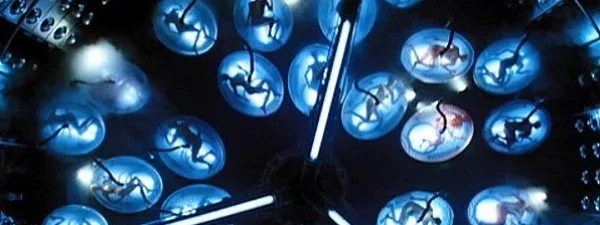
As we all know from the movies, if you're going to clone something, clone something worthwhile: So, for example, don't clone dangerous dinosaurs, and don't clone Adolf Hitler. That's good advice. Unfortunately, Michael Bay, the director of "The Island," hasn't taken it. His new film may not exactly be a clone, but it certainly appears to have borrowed (there's some controversy about this) its central conceit from "Parts: The Clonus Horror," a low-budget, high concept fiasco from 1979 best known these days as a victim of the sarcastic nerds at "Mystery Science Theater 3000." That's a shame. An intelligent film about clones and cloning is long overdue. "The Island" is not it.

What we get instead are parts, so to speak, of "Clonus" minus the Herb Tarlek jackets and pleasantly gratuitous nudity, together with a fairly standard futuristic fleeing couple drama with more than a touch of "Logan's Run" about it, all wrapped up in the flash, dash and pizzazz of a film by Michael Bay, the creator of "Armageddon," "Pearl Harbor," and "The Rock." But while "Clonus" had a desperate, ramshackle charm, "The Island" is too commercial and too slickly packaged for that, something that is only reinforced by shameless product placement, intrusive even by the debased standards of contemporary Hollywood.

It's difficult to say too much about "The Island's" plot without giving the game away, but, for all the film's many faults, there's no doubt that Mr. Bay knows how to put together an entertaining summer movie (full disclosure: I enjoyed "Armageddon"). From the hallucinatory opening sequences, to the virtuoso fast cutting, to the rococo chases and baroque gunplay, to the feeble, and usually unsuccessful, lapses into humor, this is classic Bay, as evanescent, entertaining, and dumb as a day at the beach.

Oh yes, Ewan McGregor and Scarlett Johansson do their best to portray the runaway clones, and Steve Buscemi is convincing as a louse with a heart of gold, but it's not the actors that count in a movie like this.