Mutilating Mr. Bean

The Hills Have Eyes

The New York Sun, March 10, 2006

Hills.jpg

To understand the origins of the mutant mayhem that is Alexandre Aja's new version of "The Hills Have Eyes," it helps to begin with a detour into the old, nasty Scottish legend, the legend of Sawney Bean. Like the finest old, nasty Scottish legends, it's certainly old, probably bogus, and undoubtedly nasty. Sawney, it's said, was a brigand who lived in a cave with a large, feral, and incestuous brood that only emerged from their lair to rob, murder, and, well, eat, innocent passers-by, unseemly behavior even in Scotland, a country not noted for its refined cuisine.

Many hundred years later, Wes Craven, a young American filmmaker then known mainly for "The Last House on the Left" (1972), a sleazy and regrettably sadistic slasher pic (inspired by, of all things, a Bergman movie) decided to update Sawney's savage saga for an America that was already, you would think, more than sufficiently traumatized by the fall of Saigon, the rise of Jimmy Carter, and the persistence of disco. The result, the original "The Hills Have Eyes" (1977), was a bloody, if exuberantly directed, mess of gore, the grotesque, the glib, and the gloating, marked by graveyard humor, graveyard acting, a crucifixion, a corpse used as bait, cruelty to dogs, cruelty to a parakeet, cruelty to an old codger, cruelty to a young mother, cruelty to a retired cop, and way, way too many people eyeing a "tenderloin" of baby as the source of a good dinner.

Over in ancient Ayrshire, Sawney and his clan were, so the story goes, eventually caught and made to pay a high price for their meals (limbs lopped off, left to bleed to death, burned alive, the usual). By contrast, Mr. Craven's orgy of murder and cannibalism brought him fame and box office success, and paved the way for a career that introduced us to, among others, Freddy Krueger ("A Nightmare on Elm Street"), a bunch of frightening cellar dwellers with a left-wing message ("The People Under the Stairs"), and, most sickening of all, the spectacle of Meryl Streep (in 1999's "Music of the Heart") as an inspirational inner-city teacher. Accused by some of dumbing down the horror genre, Mr. Craven is praised by others for smartening it up ("Wes Craven's New Nightmare," and all those "Screams"). He has become a brand ("Wes Craven Presents ..."), a sage, a self-congratulatory icon, and a cult, and there's every reason to think his devotees will be thrilled by what they find lurking in the new "Hills."

This time around, Mr. Craven is only a producer, but the selection of Alexandre Aja to direct the new "The Hills Have Eyes" was a clear signal that the remake would not spare cast, or audience, or parakeets. In some ways, Mr. Aja, who is clearly something of a Craven disciple, was an appropriate choice. His last film, the revoltingly cruel, if skillfully made, "Haute Tension" (2003), was, like "The Last House on the Left" all those years ago, a brutal demonstration of just how low an exploitation flick can stoop. Sure enough, Mr. Aja's "Hills" are alive with the sound (and sight) of appalling violence, and while a depiction of mutants sexually assaulting a young hottie (in this case Emilie de Ravin of "Lost") was never likely to be in the best of taste, there is something about the way in which Mr. Aja prolongs this particular scene (which repeats, and elaborates, on a sequence from the original movie) that vividly demonstrates the depths he is prepared to plumb: You will not feel better about yourself for having watched it. It's no surprise that Mr. Aja's epic struggled to avoid an NC-17 rating, but ghouls, completists, and any surviving members of the Manson family can relax: An "uncut" version is promised for release on DVD.

That said, before the film degenerates, as such exercises tend to do, into the standard, somewhat repetitive charnel-house chopping, slashing, ripping, dismembering, burning, slicing, gouging, and impaling, its earlier portions are effective, genuinely creepy, and will be successful in maintaining the suspense, even among those already familiar with Mr. Craven's original. As for the storyline, it has enough in common with the 1977 version to reassure the faithful, but enough that is different to delight and entrance them. The killer hillbillies of the first movie, products of nothing more than unlucky genetics, have been transformed, fashionably, into victims, their shambles of a DNA the product of atomic testing rather than careless backcountry coupling. However, as in the original, their devolved and debased clan is compared and contrasted with that of its targets and intended menu, the flawed and bickering Carters. As in the original, the most sensible Carters are their dogs.

This is in keeping with the theme of troubled and inadequate family that runs through much of Mr. Craven's work. While Mr. Craven's observations on this topic usually hover somewhere among the banal, the trite, and the tedious, Mr. Aja develops them the best he can in striking scenes set amid the remnants of an Eisenhower-era atomic test village, the Pleasantville from hell. There we witness examples of not one but three distinct and, each in their own way, distinctly problematic families, as a surviving member (the nerdy son-in-law) of the Carter family hunts down members of the mutant clan (thanks to the effects of radiation, a literally "nuclear" family) against the backdrop of what's left of yet another vi sion of domesticity, the cookie-cutter housing, "Leave It to Beaver" decor, and mannequin moms, pops, and kids of the test village, fake from the beginning and doomed to destruction.

That's cute (spot the obvious analogy!), but such ideas, and another (no less routine) subtext that, if that's what it takes to defend our own, even the most civilized among us will descend into barbarism, have less to do with this film's undeniable grip than the way it manages to tap into the deep-rooted American dread of what might be waiting out there in the hinterland. Unlike in overcrowded, long-settled Europe, where the horror film tends to focus inward, into the haunted house, into the mind, into the past, on this side of the Atlantic there is still some sense of living on the edge of the uncompleted, the uncharted, the empty, and the dangerous. The unease and the fear this can bring in its wake haunt countless American movies ("Deliverance," "The Blair Witch Project," "The Texas Chainsaw Massacre," to name just three), and this one, too, even if ironically, its most unsettling moments are those that echo terrors from farther afield than Flyoverland. Contrary to some speculation at the time, the first "The Hills Have Eyes" was not a Vietnam parable, and, so far as I am aware, Mr. Aja's version is not about Iraq, but it's impossible to see the Carters' vehicle optimistically heading, Stars and Stripes fluttering, deep into a hostile, mysterious, and treacherous desert without thinking of all too real horrors elsewhere.

And, at the moment, there ought to be nothing more disturbing than that.

The Great Danes

National Review Online, February 14, 2006

mohammed.jpg

It's been a rough, tough, dismaying week for those Europeans who like to believe that the pen is mightier than the scimitar. Yes, an additional number of publications reprinted those pesky cartoons, one selling out its print run when it did so, but these were brave, temporary gestures, as evanescent as the paper on which they were printed, as futile as fists waved in the face of a storm.

While the Danish prime minister was stubbornly sticking to the principles of free speech and a free press, principles which he had, perhaps naively, and certainly optimistically, thought would find support from governments across Europe, his words were nearly drowned out by hints, murmurings, and shouts of appeasement from the gray, shrunken statesmen of Brussels, Paris, London, Stockholm, and many other capitals—take your pick—of a continent that once saw itself as the home of Enlightenment.

Of course, there were exceptions to the dismal, despairing rule, and, naturally, one of them was the Somali-born Dutch MP, Ayaan Hirsi Ali, fearless and furious, one of the few politicians in Europe who still says how things really are:

"Shame on those papers and TV channels who lacked the courage to show their readers the caricatures in the cartoon affair. These intellectuals live off free speech but they accept censorship. They hide their mediocrity of mind behind noble-sounding terms such as "responsibility" and " sensitivity. " Shame on those politicians who stated that publishing and re-publishing the drawings was " unnecessary, "" insensitive, "" disrespectful" and " wrong." I am of the opinion that Prime Minister Anders Fogh Rasmussen of Denmark acted correctly when he refused to meet with representatives of tyrannical regimes who demanded from him that he limit the powers of the press. Today we should stand by him morally and materially. He is an example to all other European leaders. I wish my prime minister had Rasmussen's guts... I do not seek to offend religious sentiment, but I will not submit to tyranny. Demanding that people who do not accept Mohammed's teachings should refrain from drawing him is not a request for respect but a demand for submission."
 

Indeed it is, and judging by the reaction of Dutch prime minister Balkenende, he's ready to grovel. He didn't, he sniffed, have "much use" for Hirsi Ali's contribution, a view that would not have been shared by Theo van Gogh, the director with whom she worked on the movie, Submission. Of course, van Gogh is dead now, butchered by a Muslim extremist offended (ah, that word again) by his film. Interestingly, if one recent poll on a related matter is any indication, the Dutch people themselves are likely to take a very different line from their prime minister. Eighty-four percent, apparently, believe that Hirsi Ali should make a sequel to Submission, even if many of them were far from being fans of the original movie. They are smart enough to understand that, if it is to mean anything, free speech must include freedom of speech about those with whom you disagree.

It was this freedom that van Gogh was testing, it was this freedom that Jyllands-Posten is testing, and it is this freedom that the Dutch foreign minister will be compromising when he travels this week to the Middle East alongside Javier Solana, the EU's foreign policy chief, for talks aimed at reducing the tension over the cartoons, a pointless and humiliating exercise that can only reinforce the dangerous impression held by many of the region's Muslims that Europe's governments somehow control Europe's newspapers and can thus be blamed for their contents.

The fact that such a mission is unlikely to take much account of the opinions of Dutch voters should surprise nobody. Europe's leaders have long tended to prefer the top-down and the technocratic to the views of electorates they see as atavistic, irrational, and prone to disturbing nationalist enthusiasms. This is why they had the arrogance to prescribe multiculturalism as an appropriate response to mass immigration, an idea of remarkable stupidity that goes a long way toward explaining the predicament in which Europe now finds itself.

Of course, we don't yet know what this delegation to the Middle East will be saying, but comments made in an interview with the London Daily Telegraph by the EU's sinisterly named Commissioner for Freedom, Security and Justice reveal some clues. Saying that millions of Muslims felt "humiliated" by the cartoons, and referring to a supposed "real problem" faced by the EU in reconciling freedom of expression with freedom of religion (actually, there's no "problem" at all, unless fanatics choose to make one), he suggested that the press should adopt a voluntary code of conduct. By agreeing to this "the press will give the Muslim world the message: we are aware of the consequences of exercising the right of free expression, we can and we are ready to self-regulate that right." Why the "Muslim world" outside Europe, much of which is represented by dictatorships, mullah-states and kleptocracies, should have any say in the contents of the continent's supposedly free press was not discussed.

In fairness it should be mentioned that the commissioner, Franco Frattini, subsequently put out a vague, ambiguous, and confusing press release purportedly intended to clarify his remarks, but once you have cut through the waffle, checked out the full text of the original interview, and grasped the fact that he was already talking about some sort of code before the current crisis, the commissioner's intentions become all too clear. One way or another, he wants the press muzzled.

And Frattini is not alone. The president of the EU's "parliament," and thus a man supposedly dedicated to the freedom of debate, could bring himself to defend free expression only "within the boundaries of respect for the religious beliefs and cultural sensitivities of others." Javier Solana meanwhile, paved the way for his trip by telling Al-Arabiya television that "respect does not stop at countries' borders and it includes all religions and specifically what concerns us here, our respect for the Islamic religion." As so often in the last week, the idea that "respect," if it is to mean anything other than capitulation, has to flow both ways, seems not to have merited a mention.

Of course, there is something more than a little disingenuous about the manner in which European politicians like to portray themselves as defenders of the right of free speech even as they reduce it to rubble. The Swedish government, at least, was being more straightforward when, just before the weekend, it arranged to shut down a website that had run one rather innocuous cartoon of the Prophet Mohammed. Tellingly, the website belonged to the newspaper of a political party of the hard right, yet another sign of how the establishment's refusal to enter into any serious debate over multiculturalism has handed the issue over to Europe's rougher fringe, who can only gain as a result. It's telling too to read how the Swedish foreign minister reportedly excused her government's actions: "We are already seeing reactions in certain countries who have responded to the Swedish Democrats [the political party in question] having these pictures on their website, and this could naturally have grave consequences for Swedish people and Swedish interests." What, I wonder, is the Swedish for "submission"?

The Swedish authorities are unusual only in the directness of the measures that they have taken, and in the frankness with which they have explained the motives behind them. Other, more discreet, governments are probably content to let their laws take their course, something that will come as cold comfort to anyone who still believes in controversy, debate, and the free exchange of ideas. The development of Europe's state-sponsored multiculturalism has gone hand-in-hand, as it had to, with the enactment of laws that chip away at free speech (and have gone further, far further, than understandable restrictions on direct incitements to violence), but which have, ironically, encouraged and inflamed those that they were meant to appease.

Jacques Chirac was quick to condemn the republication of the Danish cartoons in Charlie Hebdo, an iconoclastic French weekly, as an "overt provocation", but was able to leave the dirty work to others. The French Council of Muslims, a body set up with official support, is reported to be organizing the prosecution of poor Charlie, quite for what remains unclear, but doubtless the Council's lawyers will be able to find something useful in France's laws against "hate speech" or any number of other offenses dreamt up by the enforcers of multiculturalism. The prosecution, like that of the author Michel Houellebecq may well end in failure, but any prosecution, successful or otherwise, comes with a cost in time, worry, and lawyers' fees, a cost that will make other authors, editors, and publishers think twice before publishing anything that might irritate the imams. And France is by no means alone in this respect. Many European countries can boast, if that's the word, similar laws on their own statute books, and even in Britain, traditionally a defender of free speech, the House of Commons recently came within one vote of passing a law that would almost certainly have made publishing the cartoons a criminal offense.

If the law doesn't do the trick, perhaps intimidation will. The threat of violence, and sometimes more than the threat, has run through the hysteria and bombast of recent days, and it has involved far more than the torching of a few embassies, appalling though that was. Sometimes the threats, usually of trouble from Europe's Muslim minorities, were explicit, and sometimes they were more subtle, a hint here, a comment there, that "provocations" such as the cartoons could further radicalize Islamic populations worldwide, further complicating the war on terror, and bringing the prospect of a terrifying "clash of civilizations" ever closer. If European governments are incapable of resisting such pressure, and, after the last week, it seems clear that they are, how many writers and artists can be expected to run the risk of Muslim wrath? Underlining that point, The Liberal, a small British political periodical, withdrew one of the Danish cartoons from its website after being warned by the police that they could not guarantee the safety of the magazine's staff.

At least the magazine was able to acknowledge what had happened by leaving a blank space marked "censored" on its website. After the events of these last days, we can be sure that other acts of censorship or self-censorship will pass insidiously and in silence, unnoticed, un-mourned, or, at best, explained away as a gesture of that "respect" that Europe's elites are now so eager to proclaim.

And as for the Danes, they must be feeling very, very alone. The notion of European solidarity has been revealed as the myth it always was. Denmark, and its tradition of free speech, has been left to twist in the wind, trashed, abused, and betrayed. An article published in Jyllands-Posten (yes, them again) on Friday revealed clear frustration over the way that the country is being treated. It's in Danish only, but one phrase ("Ytringsfrihed er ytringsfrihed er ytringsfrihed. Der er intet men.") stands out, and it deserves to be translated and repeated again, and again, and again: "Free speech is free speech is free speech. There is no but."

Fine words. Is anyone listening?

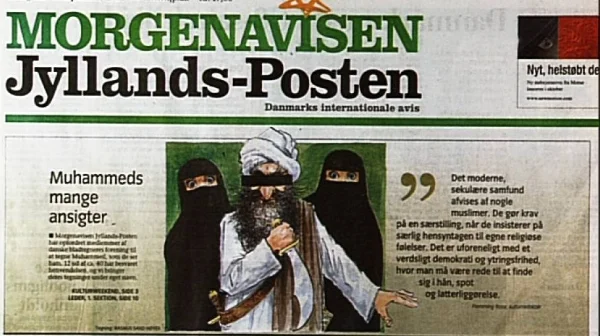
Drawing Fire

National Review Online, February 6, 2006

Jyllands.jpeg

It says something for the cowardice, duplicity, and wishful thinking of too many of the West's politicians (and much of its media) that one of the most striking illustrations of the crisis in its relations with the Islamic world has come from twelve mediocre cartoons.

The broad outlines of this saga ought to be familiar, wearily, painfully familiar, but they are still worth tracing back to the beginning, both to clear up some of the distortions that have grown up around it, and to see what the very nature of the controversy itself can tell us. The whole thing began when the Danish children’s writer, Kåre Bluitgen, complained last autumn that he was unable to find anyone willing to illustrate his forthcoming book about the Prophet Mohammed. He had, he said, been turned down by a number of artists frightened by the prospect of reprisal if they ignored the traditional Muslim prohibition on pictorial depictions of Islam’s founder. Twenty or thirty years ago, such fears would have been no more than paranoia, but that was before Denmark, like elsewhere in Europe, found itself with a large, and incompletely integrated, Muslim population. Back then Salman Rushdie had not yet been driven underground by an Ayatollah’s death warrant. Back then Theo Van Gogh was still alive.

Self-censorship is tyranny's sorry, trembling little helper, and so it's to its credit that the right-of-center (which, in Denmark, is not very right at all) Jyllands-Posten, one of the country's major newspapers, picked up Bluitgen's story. What it did with it was ornery, well-intentioned and somewhat naïve. Forty cartoonists were invited to give their own interpretation of the prophet. Twelve, a little more than a third, accepted, for 800 Danish crowns (roughly $125) apiece. As we now know, the result was a storm of protest in the Muslim world, and in recent days, pushback in the West. The cartoons have been republished all over Europe and the twelve cartoonists are now, like Geert Wilders, Ayaan Hirsi Ali, and Salman Rushdie before them, learning what it is to live in hiding. They have reportedly opposed the republication of their work. It's difficult to blame them. They have been given a terrible demonstration of what it takes to survive in an era rapidly tumbling back into the pre-modern.

As for the cartoons themselves, they come from all perspectives. One satirizes Jyllands-Posten, another Mr. Bluitgen. None are very funny, or, by Western standards, remarkable. It's telling that the delegation of Danish Muslims who visited a number of Middle Eastern countries to stir up trouble over the cartoons, had to boost their dossier of grievance with three additional (and genuinely disgusting) pictures that Jyllands-Posten had never even seen and whose provenance remains, let's be polite, unclear. To try and compare the actions of Jyllands-Posten, as Bill Clinton effectively did, with the race-baiting traditions of Der Stürmer   is to reveal an ignorance of history and a disdain for free speech that disgraces the office he once held. Even the most notorious of the cartoons, the one that shows Mohammed with a bomb decorated with Islamic text in his turban, can be seen not as an insult, but as a challenge to Muslims to demonstrate that (as is indeed certainly the case) there is far more to their faith than the atrocities that have recently defaced it. Harsh? Maybe, but it was also in the Western tradition of vigorous, free discussion. And as such it should be defended.

Ideally, the publication of these cartoons would have prompted Muslims to ask themselves why Islam, one of the world's great religions, could come to be seen in such a bad light. It hasn't worked out that way. Protests have been followed by boycotts, bluster and, now, violence. The protests and the boycotts are fine. They are all part of the debate. Violence, and the threat of violence, is something else, and, as many more moderate Muslims understand, it is doing far more damage to the reputation of Islam than a few feeble caricatures.

Needless to say, the theocracies, kleptocracies, and autocracies of the Middle East, always anxious for something, anything, to distract attention from their own corruption, uselessness, and thuggery, have played their own, typically malign, part in whipping up anger. Ambassadors have been recalled. Denunciations thunder down. Angry resolutions are passed. But amid all these calls for "respect" is there any acknowledgement that many Islamic countries could do more, much more, to respect the rights of those of different faiths to their own? To take just one example, Egypt's ambassador to Copenhagen is recommending that diplomatic action against Denmark should continue, but her own country's persecuted Christian minority would be grateful indeed if their troubles were confined to a few cartoons. Respect, it seems, is a one-way street.

But that's what too many in the Muslim world have been taught to believe, by multiculturalism as much as the mosque. In the cowed, cowering Europe of recent years the idea that religious minorities have a right not to be "offended," a nonsense notion that gives veto power to the fanatic with the thinnest skin, has increasingly been allowed to trump the far more fundamental right of others to speak their mind. Writers have been prosecuted, plays have been tampered with, and works of art withdrawn. Last week, the British House of Commons came within one vote of passing a law that would almost certainly have made U.K. publication of the Danish cartoons a criminal offense. It is a sign of how far matters have been allowed to degenerate that the initial blunt refusal of Denmark's prime minister to even hold a meeting with a number of ambassadors from Islamic countries over the incident ("I will not meet with them...it is so crystal clear what principles Danish democracy is built upon that there is no reason to do so...As prime minister, I have no power whatsoever to limit the press—nor do I want such power.") was seen as shocking as it was.

Needless to say, there were others who did their best to ensure that normal servility was resumed. While most Danes backed the prime minister, a former foreign minister, a once-respected figure who has long since become a flack for the Brussels establishment, donned Neville Chamberlain's black jacket and pinstripes to denounce the cartoons "as a pubescent demonstration of freedom of expression." The U.N.'s High Commissioner for Human Rights wrote to the Organization of Islamic Conferences (which, as it was perfectly entitled to do, had complained about the cartoons) saying that she understood the OIC's concerns, if not, it appeared, the right of free speech, and she was far from being the only senior international bureaucrat to do so (and, yes, naughty Kofi made sure to throw in a few weasel words of his own). Closer to home, the EU's commissioner for Freedom, Security and Justice denounced the cartoons as "inappropriate," an adjective as Orwellian as his job description, an adjective that can only have encouraged those out to bully the Danes.

In the end, it was left to other newspapers to rally round. With the republication of the cartoons in the Christian journal, Magazinet, the Norwegians were the first to support the Danes, a gesture understandable in a country where the local publisher of Rushdie's Satanic Verses had been fortunate to survive an assassination attempt in 1993, but which was bound to inflame matters still further. And when it did, other newspapers across Europe, in France, in Germany, in the Netherlands, in Spain and elsewhere joined in, either republishing the offending cartoons or, notably in the case of France's left-of-center Le Monde, adding more of their own.

So, what now? Like it or not, the cozy, consensual, homogenous Denmark of half a century ago has vanished, never to return, and, like it or not, the old Europe shaped by Christianity, the Reformation, the Renaissance and the Enlightenment now plays host to a large and growing population with a very different intellectual and spiritual tradition. And, in an age of global communication, the idea that these problems of coexistence can be confined to one continent is an illusion. An insult in Århus can reverberate in Damascus and Amman, and for that matter, Kabul, Basra, and Baghdad too. It's this that explains why the Bush administration, with hearts, minds and a war to win, condemned the cartoons, and it's this, far less forgivably, that explains why Turkey's (supposedly moderate) Islamist prime minister feels that he has the right to tell the Danish press what it may or may not publish.

Of course the publication of those cartoons was (quite explicitly) a provocation, but the furor that followed shows that it was an acceptable thing to do. The editors of Jyllands-Posten wanted to draw attention to the fact that fears for the freedom of expression were both real and realistic. They have succeeded on both counts. Europeans realize now, if they were dim enough not to understand before, that they are faced with two very different ways ahead. The first, and better, alternative is to recognize that, to many, freedom of speech is a value as important as religious belief may be to the faithful, and to give it the protection it deserves. Reestablishing this badly eroded principle will not be easy, but to fail to do so will be to empower the fanatic to legislate for all.

The second alternative is, broadly speaking, for Europe to attempt to buy social peace by muddling along as it does now, muzzling a little speech here, rooting out a little liberty there. But this approach isn't working now. There's no reason to think that doing more of the same will prove any more effective in the future. Besides, at its heart, this is a policy of surrender, submission and despair. It is a refusal to accept that people can agree to disagree, and it is a refusal to confront those who cannot. It foreshadows an era of neutered debate, anodyne controversy, and intellectual stagnation. It will lead, inevitably, to societies irrevocably divided into immovable blocs of ethnicity and creed, carving up the spoils, waiting to take offense and thirsting for the fight, which will one day come.

Despite some of the stirring statements in favor of free speech that have been made over the last week the best bet is that Europe will continue to slide into that second, dismal, alternative. The warning signs are already there to see. Tony Blair's Labour government (again, due partly to the presence of British troops in Iraq and Afghanistan but, doubtless, due also to the presence of Muslim voters in many key parliamentary constituencies) has been at pains to condemn the cartoons, and Norway's governing left-wing coalition wasted no time in distancing itself from Magazinet. Even Magazinet's editor has now stumbled down the same sad route: "If I had dreamt of something like this happening I would not have done it. It's out of control.'' Meanwhile, a number of the newspapers that have chosen not to run the cartoons have done so explicitly on grounds of self-censorship, or, rather, they claim, "restraint," or maybe "respect": Choose your own alibi.

Even more ominously, at the prompting of our old friend, the EU's commissioner for Freedom, Security and Justice, Brussels bureaucrats are arranging a meeting for "experts" and "community leaders" (to be held no later than the end of April) that will discuss some of the issues arising out of this controversy. It is reported that, "proposals to counter race and religious hatred [may be] dusted off." We can guess where that might lead.

And as for where it all started, Jyllands-Posten has now announced that it regrets having published the cartoons: "If we had known that it would end with death threats and that the lives of Danish people could be put at risk, we would have naturally not have published the drawings." The paper apologized only for having underestimated the extent to which Muslims revere their prophet, but then it added this, "fundamentalist powers have prevailed over the freedom of speech...Danish media will now be careful about expressing attitudes that fundamentalists can misuse to create hate and bitterness."

Whip cracked. Lesson learned.

Quiet Hero

David Leavitt: The Man Who Knew Too Much

National Review, January 30, 2006

Turing.jpg

If you have ever needed reminding of a nation’s capacity for ingratitude, the story of Alan Turing ought to do the trick. And if you have never heard of Alan Turing, that only proves the point. Born in 1912 into the cheese-paring and snobbery of Britain’s colonial administrative class, Turing emerged from a traditionalist family and an old-school education with a wild, unorthodox mind, and a record of achievement that establishes him as one of the most important mathematicians of the last century.

In not much more than one astonishing decade, this extraordinary individual would not only play a critical part in paving the way for the development of the laptop on which I am now typing, but also, through his wartime code-breaking at Bletchley Park, help ensure that this article didn’t have to be written in German. His tragedy, and ours, was that there was too little in the way of an encore. Within a few years of his greatest triumphs, Turing was a convicted criminal, guilty of “gross indecency” with another man, an embarrassment, if not exactly an outcast. Not so long afterwards he was dead, a suicide at 41 with the help of an apple dipped in cyanide.

With the secrecy that surrounded Turing’s wartime activities now lifted, the essential facts of his life are well established and more than adequately covered in this new biography. After walking his readers briskly through the early years, David Leavitt presents them with the considerable challenge of Turing’s first major work, the catchily named “On Computable Numbers, with an application to the Entscheidungsproblem” (1937), a paper that was, in essence, the blueprint for the modern computer. “Computable Numbers” is, in Leavitt’s words, a “curious blend of humbly phrased, somewhat philosophical speculation and highly technical mathematics,” something, he concedes, that is “disconcerting” for the “general reader” (that’s you and me) since, invariably, easier passages “segue immediately into dense bogs of unfamiliar symbols, German and Greek letters, and binary numbers.”

Well, when it comes to navigating those “dense bogs,” Leavitt is, in keeping with one of the tasks of this biography (the book is part of Norton’s Great Discoveries series, designed “to tell the stories of crucial scientific breakthroughs”), a pretty good guide. As someone confused by an abacus and in awe of a pocket calculator, I admit that my knowledge of computing is, or was, practically zero. After a re-reading or two of the chapters devoted to Turing’s “universal machine” and its revolutionary implications, this level of understanding had been raised to somewhere between hazy and confused: no small achievement, and a tribute to Leavitt’s powers of explanation.

Leavitt is no less deft in describing Turing’s critical role in breaking the Germans’ Enigma codes. His writing leaves the mysteries of cryptanalysis less mysterious and, as a result, we can begin to grasp the remarkable intellectual feat involved in Turing’s penetration of the secrets of Hitler’s Reich. We’ll never know how many Allied lives were saved by “the Prof” and his work, or by how many years his effort shortened the war, but Churchill never doubted its importance. Turing and his team were, he wrote, to have “all they want.” And so they did. More material rewards were to prove elusive. Stinginess and secrecy meant that the only official recognition of Turing’s achievements was a bonus of a few hundred pounds and a rather minor medal. So far as is known, he never complained, and, to the end of his life, Turing kept the secrets of Bletchley Park to himself. He and his colleagues were, said Churchill, “the geese who laid the golden eggs and never cackled.”

But there’s more to The Man Who Knew Too Much than formulae, ciphers, and the click-click-click of the device that savaged Enigma. While his efforts inevitably fall short of the portrait contained in Andrew Hodges’s groundbreaking, and epic, biography, Alan Turing: The Enigma (1983), Leavitt nevertheless succeeds in drawing a wonderfully vivid picture of his shy, dry, brilliant hero, an eccentric boffin with chaotic, shabby tailoring, uncertain hygiene, an unsettling resemblance to Rudolf Hess, and a yen for long-distance running.

What works less well is Leavitt’s tendency to treat Turing’s homosexuality as a lens through which his whole life must be seen, sometimes ridiculously so. Thus in discussing a later work, “Intelligent Machinery,” a paper focused, as its name would suggest, on the possibility of building a truly “intelligent” machine, Leavitt notes how Turing’s strategy of opening with a summary of the views of those who disagreed with him “foreshadows the gay rights manifestos of the 1950s and 1960s, which often used a rebuttal of traditional arguments against homosexuality as a frame for its defense” — a comparison that is both accurate and pointless. A little later, we find “Computing Machinery and Intelligence,” Turing’s “most famous and in many ways most perverse paper,” described as a stew of anxiety over gender and sexuality, a reading that might have surprised Turing, a man comfortable with his sexual identity in a way that was, as so often with him, years ahead of his time.

Perhaps this was inevitable. Norton boasts that Great Discoveries will feature “writers from diverse backgrounds.” It’s that dodgy word “diverse” that should set the alarm bells ringing and that explains, undoubtedly, why Professor Leavitt, who teaches creative writing and is best known for novels focused on homosexual themes (The Lost Language of Cranes, While England Sleeps, among others), was chosen to write the biography of a mathematician.

The result, ironically, of his approach is somehow to diminish the horror of the unjust laws that largely confined Turing’s sex life to an emotional wasteland punctuated by furtive fumblings and discreet trips abroad. Nobody will ever know why he chose to kill himself (there were clear signs that he was going mad), but it’s impossible to imagine that the ordeal of prosecution and the humiliation of punishment (in essence, chemical castration) did not play their disgraceful part. That is not enough for Leavitt, who dilutes tragedy with absurdity by suggesting that the way in which Turing (a somewhat obsessive fan of Disney’s Snow White) committed suicide was designed to deliver an erotically symbolic message: “In the fairy tale the apple into which Snow White bites doesn’t kill her. It puts her to sleep until the Prince wakes her up with a kiss.”

Oh please.

A Humorous Performance

Tristram Shandy: A Cock and Bull Story

The New York Sun, January 27, 2006

Tristram.jpg

There were some who thought Michael Winterbottom's last movie, "9 Songs" (2004) - a dreary, pointless exercise involving a British glaciologist, an American student, and very explicit (and very real) sex scenes - should not be made. They were right. There were others who thought his latest effort, "Tristram Shandy: A Cock and Bull Story," could not be made. They were wrong.

Mr. Winterbottom's new film is based, sort of, on "The Life and Opinions of Tristram Shandy" (1759-67), nine bewildering, bawdy, discursive, and chaotic volumes written over eight years by Laurence Sterne, a middle-aged Yorkshire vicar who wrote, he said, "not to be fed, but to be famous." He succeeded. The early volumes were bestsellers, blessed with high society approval ("from morning to night my Lodgings ... are full of the greatest Company ... Tristram is the Fashion.") and critical praise remarkable in a book so confused and confusing that, by comparison, "Ulysses" reads like "Dick and Jane." It was, as a character in Mr. Winterbottom's multilayered, clever, and delightful movie (a film about trying to film Sterne's notoriously unfilmable novel) explains, "postmodern before there was even a modern."

If the book is difficult to read, it's even more of a challenge to describe. If asked, Sterne, whose work is filled with typographical jokes, asterisks, dashes, squiggles, and harum-scarum punctuation, might have proffered a blank page. One of the first unfortunates (a luckless writer for the London Critical Review) to be given the job of commenting upon it simply abandoned the task: "This is a humorous performance, of which we are unable to convey any distinct ideas to our readers." Unfortunately, that's not an approach that would satisfy the difficult and demanding editors of The New York Sun, so I will just have to do my best.

A good way to start is to think of "Tristram Shandy" as the equivalent of the eccentric and beguiling chambers of curiosities that preceded today's earnest, orderly, and disciplined museums.To open one of its chapters is to peer into a collection of randomly assembled facts, falsehoods, anecdotes, histories,tales,fables,yarns,observations,and digressions that have little or no obvious connection to each other or to the book's underlying narrative, such as it is. And as for the nature of the reminiscences byTristram that are supposed to provide the novel's structure, if I tell you that young master Shandy is not even born until the third volume, well, you see the problem with which Mr. Winterbottom was confronted.

He could, I imagine, have tried cobbling together a few choice bits and pieces from the book in a way that told a vaguely coherent story, but that would have made a nonsense of Sterne's nonsense. Or he could, maybe, have dispensed with narrative altogether and simply assembled a series of period tableaux in the flamboyant but interminable style of a Terry Gilliam. Mercifully, he did neither.The approach Mr. Winterbottom actually took not only pays tribute to the fact that the original "Tristram Shandy" was in some ways a book about writing a book, but also offers audiences both the anarchy and the feel of Sterne's work, as well as the order and the comfort of a reasonably conventional plot line; something, of course, that Sterne neglected to provide.

As the movie progresses, we are tantalizingly shown (far too few) beautifully shot extracts from the "Tristram Shandy" film that is busily being made in the depths of the English countryside. These include Tristram's accidental circumcision (by a window, since you ask), muddled conception, and chaotic birth. Fans of the novel will be glad to know that Uncle Toby (a wonderful and oddly moving performance by British comedian Rob Brydon), his elaborate scale model reproduction of the siege of Namur, his embarrassing war wound, and his possible seduction (by a widow, since you ask) are also all thrown into Mr. Winterbottom's wild mix. In a nice, typically sly touch, the music that accompanies a number of these scenes is drawn from "The Draughtman's Contract" (1982), evoking memories of Peter Greenaway's dark, gorgeous antiquarian frolic while reminding us yet again that we are watching a performance within a performance.

In an industry as pleased, and fascinated, with itself as the movie business, a film about a film could easily sink into the self-importance, sentimentality, and self-indulgence of those little tributes you sometimes see on Oscar night. But Mr. Winterbottom avoids the temptation.The picture he paints is acerbic, affectionate, and funny, with a good-natured sense of the absurd that nicely reflects the antic spirit and ramshackle creativity of those original nine volumes. The project is riddled with problems: It is bedeviled by money worries (as was Mr. Winterbottom's "Tristram Shandy" in real life), has a big American star (a luminous Gillian Anderson, playing herself) flown in only to have her scene cut out, the army of reenactors recruited to fight over Namur runs amok in a war nerd Walpurgisnacht, and, above all, the actors bicker, preen, booze, grumble, and flirt.

Out of a strong cast, two, in particular, stand out. Mr. Brydon not only plays Uncle Toby, but also "Rob Brydon," a fictionalized version of himself. In the same way another well-known British comedian, Steve Coogan, plays Tristram, Tristram's father, and, naturally, "Steve Coogan," a delirious blend of role, reality, fact, and fiction that Sterne would have relished. This "Coogan," a masterpiece of self-parody, shares the real Mr. Coogan's resume, talents, and tendency to tabloid scandal. Despite the presence of his girlfriend (Kelly Macdonald), baby, and an ominously circling journalist (Kieran O'Brien) with a tale of lap dancers to tell, he is closing in on his sexy production assistant, Jennie (Naomie Harris). She's a distressingly obsessive cineaste (it says something for the cheery cynicism of this film that an enthusiasm for cinema is reduced to a joke) but so attractive that "Coogan" contemplates bluffing his way through the meaning of Fassbinder if that's what it takes.

But the relationship that matters most to him is his with star billing. Is he the lead, or is "Brydon"? The two exchange jibes, banter, insults, and insecurities in a ridiculous, marvelously played comic rivalry that lies at the heart of this film and which, incidentally, generates the finest exchange about teeth - a tricky topic in Britain - since the first "Austin Powers." In the end, it's "Brydon" who gets to play opposite Ms. Anderson, and and, yes, he steals the movie too.

But with a film this good, who's keeping score?

Up From The Badlands

The New York Sun, January 20, 1996

Malick.jpg

Legends that appear only rarely need to make sure that when they do so, it's special. Halley's comet pulls this off. Barbra Streisand does not. The brilliant but reclusive filmmaker Terrence Malick falls somewhere in between. Since first attracting attention with his debut feature, the spare and unsettling "Badlands" (1973), the enigmatic Mr. Malick has developed a reputation as a director of genius that, remarkably, rests on just four films, each of which divided critics and, assuming (as seems likely) "The New World" goes the same way, disappointed at the box office.You can see the whole lot in less time than it takes for Frodo finally to throw away that wretched ring: A full Malick retrospective could be finished in less than a day.

The Brooklyn Academy of Music is taking a more leisurely approach. Its "Month of Malick" began January 18 and will last until February 1. It includes the key elements in the canon - "Badlands,""Days of Heaven" (1978),"The Thin Red Line" (1998), and "The New World" (2005) - as well as, for completists only, "Pocket Money"(1972),a piece of dreary 1970s picaresque for which Mr. Malick wrote the script, and Carole King, God help us, the theme song. Don't bother with "Pocket Money," but any of the others is enough to prove that Mr. Malick's is a unique talent, while two of them, "Badlands" and "Days of Heaven," are unquestionably the product of an extraordinary vision that has rarely been matched in American or, indeed, any cinema.

To be sure, a good part of the Malick mystique stems from a rambling,eccentric resume almost guaranteed to generate the label of genius. Start with the fact that his first work was an English translation of Heidegger's "Vom Wesen des Grundes" (Mr. Malick studied philosophy at Harvard and Oxford and taught at M.I.T.) published by Northwestern University Press, throw in the 20 years of silence, Paris, rumor, and abandoned projects that followed "Days of Heaven," add a reluctance to give interviews, be photographed, or disclose very much about himself, and it's no surprise that comparisons with J.D. Salinger or Thomas Pynchon (actually, any hermit icon will do) were quick to be made.

The notion of Mr. Malick as a man apart is only reinforced by the way in which his movies so often maintain an emotional distance from their subjects. In "Badlands," his masterpiece, a film loosely inspired by Charles Starkweather, Caril Ann Fugate, and their Eisenhower-era killing spree, there is no judgment and little passion, just unblinking, meticulous observation as bleak, unyielding, and remorseless as the landscape in which it is shot.

Its deadly, deadpan protagonists, Kit (Martin Sheen, never better) and his young girlfriend, spooky, strange Holly (Sissy Spacek, weirder by far than in "Carrie") reveal little about themselves, not that there is a great deal to reveal. Our own involvement in their fate is further limited by the use Mr. Malick makes of voice-over (something heard in all his movies) to tell their story, another device that reminds us that we are not there in the badlands: We are just part of an audience, spectators, nothing more.

This sense of detachment continued into "Days of Heaven," a love triangle set amid the wheat fields of early-20th-century Texas. Once again framed (and held at a distance) by the words of a narrator, this time in the haunting, scratchy voice of a disconcerting urchin (Linda Manz) from the slums of Chicago, the story unfolds against the astonishing, gorgeously shot landscapes that are the director's trademark. But, just as typically for Mr. Malick, these also serve to underline the grubbiness and insignificance of the human drama that transpires. We may be gripped by the doomed relationship between Bill (Richard Gere), Abby (Brooke Adams),and "the farmer"(tellingly, this character, played by Sam Shepard, is never even given a name), but in the greater scheme of things, their tragedy counts for nothing.

Judging by "The Thin Red Line," the beautiful, intriguing, but ultimately absurd movie that marked the director's long-awaited comeback, not much changed for Mr. Malick in those two intervening decades. As usual, his film looks lovely (even if it occasionally topples over into Sierra Club kitsch), but its protagonists have to take a distant third place behind first-rate cinematography and fourthrate philosophizing.

With the exception of a ravaged, raging lieutenant colonel (Nick Nolte) and the saintly, selfsacrificing Private Witt (Jim Caviezel, limbering up to be Jesus), the members of the cast are barely differentiated and serve largely as examples of certain stock types: the cynic, the softie, and so on. Still, they shouldn't be offended. Even World War II (the film is set during the battle for Guadalcanal) is reduced to a generic conflict, little more really than a platform for Mr. Malick's musings on war (he's against), mankind (not a fan), and the meaning of life itself (quoting Witt's maudlin speculation about whether "all men got one big soul" is as much as I can stomach writing down, but it tells you all you need to know).

In one respect, at least, on this occasion Mr. Malick qualifies his general misanthropy with the rather biblical suggestion that we are a fallen species instead of one that was bad from the beginning. Early in the movie, Guadalcanal's native inhabitants are shown living harmonious (literally, there's a lot of singing), happy, unspoiled lives in marked contrast to the brutish, supposedly civilized men who descend upon them and then proceed to wreck Eden. In essence, this is also the theme (along with yet more dollops of the reheated transcendentalism that casts its sickly pall over "The Thin Red Line") at the heart of "The New World," Mr. Malick's latest film.

This muddled but sometimes mesmerizing movie is far more evenhanded in its treatment of Jamestown's English settlers than some critics have suggested, but its highly romanticized depiction of an American Indian culture that is all Rousseau and no Hobbes again shows Mr. Malick to be a director too ready to abandon subtlety for cheesy hippie didacticism. That's not to say it's a bad film. Far from it (among other achievements, Mr. Malick has coaxed surprisingly touching performances out of both Q'orianka Kilcher as Pocahontas and Christian Bale as the man she ultimately marries).

But it would have been a much, much better movie had Mr. Malick been able to abandon his fantasy of an Eden that never was: Humanity lives in the badlands. Always has. Always will. And we need Mr. Malick back there with us to show how it's going to be.

Wonkette Jumps the Snark

Ana Marie Cox: Dog Days

New York Sun, January 6, 2006

Dog Days.jpg

If you need any confirmation that the glum little town that passes for this nation's capital is hopelessly obsessed with itself, take a look at "Dog Days" (Riverhead Books, 288 pages, $23.95), the Washington frolic and first novel by Ana Marie Cox, the below-the-Beltway blogger better known as Wonkette.

To get the most out of this book, you need to know beforehand what Ms. Cox has been up to on her blog. Sleazy, sarcastic, funny, and salacious ("Politics for People With Dirty Minds"), Wonkette first began lurking around computer terminals back in January 2004, a remote era lost in blogging antiquity when Assad's goons were still hanging out in Lebanon, Jennifer was still hanging with Brad, and John Kerry had not yet been hung out to dry. Following hot, and not a little sweaty, in the wake of Gizmodo (gadgets), Gawker (gossip), and Fleshbot (porn),Wonkette became the latest in a stable of blogs set up by British entrepreneur Nick Denton, its shtick an oddball mess of politics, D.C. rumor, sex, and satire. Throw in the excitement of an election season, along with Ms. Cox's striking good looks, and it's no surprise Wonkette soon shone as a blogosphere star.

The site reached some kind of peak, or nadir (take your pick) in mid-2004 with the saga of naughty Jessica Cutler. She was the senatorial staffer who chronicled her exhausting, grubby - but sometimes financially rewarding - romantic adventures on a Web site,Washingtonienne.com. Wonkette catnip! Ms. Cutler lost her job, but won notoriety, a book contract, and a Playboy spread, and, as she did so, Wonkette reported the disgraceful details to an overexcited world. It was a perfect, if slutty, symbiosis: Wonkette helped make Ms. Cutler a celebrity, and Ms. Cutler attracted readers to Wonkette.

Since then, despite continued critical acclaim (winner of a 2005 "Bloggie" as "best political weblog!"), Wonkette has jumped the snark: Washingtonienne was a one-off, there's a while to go until the presidential election, and, worst of all, the anarchic spirit that characterizes Ms. Cox's blog at its best has all too often been drowned in dully predictable Democratic spin. Unfortunately, the same weakness sometimes surfaces in "Dog Days," a generally very funny book, where the feeblest jokes - more Carter, alas, than Carville - are those aimed at making fools of the Republicans, something the GOP is quite capable of doing for itself.

If nods to contemporary liberal orthodoxy are one problem with "Dog Days," a related flaw is the way in which Ms. Cox takes pains to observe other pieties of our prim and proper era. Given Wonkette's wicked reputation, "Dog Days" is a strangely moralistic tale that concludes (spoiler ahead, but the book's plot, loosely inspired by that loose Washingtonienne, really doesn't matter that much) with Melanie, its once-promising heroine, appearing to abandon adulterous sex and binge drinking in favor of a wholesome return to the Heartland.

As if that's not bleak enough, anyone so obsessive (yes, yes, I was) as to read this book's "acknowledgments" section will be shocked to stumble across the eat-your-greens, Jim Lehrer moment when its supposedly hard-boiled author takes the time to thank political campaign types "for working so hard for so little when so much was at stake. Campaigns can be foolish; what you're fighting for isn't. "Oh, please. Cynics, however, will note that, in exchange for a deal reportedly "in the mid-six figures," Ms. Cox will soon be quitting Wonkette to write what sounds like an eat-your-greens, Jim Lehrer book about the next generation of political activists. Maybe she just needs to ensure that some of them will actually be prepared to speak to her.

But if you're after filth unsoiled by repentance (and who isn't?), a better option is the bracing, brazen smut of Jessica Cutler's (fictionalized) account of her rise to infamy. With its hints of "Fanny Hill," "Heathers," and, so, so distantly, "Mr. Smith Goes to Washington," "The Washingtonienne" is a shamefully compelling read, its seamy attraction best understood, perhaps, as the literary equivalent of a lap-dance.

For all its crumpled sheets and dodgy assignations, "Dog Days" is something very different, even if we forget its sporadic descents into liberal jabber and Puritan guilt. At times it's as much a work of anthropology as of fiction. Ms. Cox cleverly, and entertainingly, dissects the workings of some of the capital's competing power brokers, hustlers, losers, and drones. And if the detail can occasionally be too much (believe me, it can), it will doubtless delight all those on the Potomac who like nothing better than reading about themselves. Adding to their insider fun, the book is peopled by more lightly disguised D.C. personalities than an Abramoff indictment, but, even if the rest of us won't catch all the references, there's plenty here to enjoy.

As for the story's flow, it is what it is: pleasantly readable, frequently implausible, and enough to lure the reader on to the next page. More important, despite managing to confine her own role (as the "blogger girl") in her own book to a modest minimum, an unusual achievement in any volume coming out of Washington, Ms. Cox also pulls off the trick, rare in a comic work of this nature, of bringing a number of her principal players to life. Melanie, an aide to a stiff, awkward presidential candidate with a suspicious resemblance to John Kerry ("He looks human!" someone had exclaimed. Kind of a low bar, Melanie had thought ... "), and her co-conspirator, Julie, a political consultant of some kind, are believable both as individuals and representatives of a type. Meanwhile, the wanton waitress who poses as the skanky, scandalous blogger "Capitolette" is enough of a character to be performed by Marilyn Monroe at her best, or Jessica Simpson at her worst.

But the greatest pleasures of "Dog Days" are the laugh-out-loud insults, terrific jokes, splendid one-liners, brutal asides, and unkind descriptions that reveal the telegram talents of a blogger in top form. Sure, it's an uneven read, but who could fail to be charmed by the cheerful tastelessness of a novel that describes the mating rituals in a city where "standards of attractiveness ... tracked to availability and not physical beauty" as being "like the Special Olympics of sex ... everyone's a winner!"

Jessica Cutler, that's who. On her (new) Web site, she has written that she did not "love" the book "as much as I thought I would."

Oh well.

A Legendary Lover, Brought Down to Size

Casanova

The New York Sun, December 23, 2005

New Mexico, August 2016  © Andrew Stuttaford

New Mexico, August 2016  © Andrew Stuttaford

Even his name, Giacomo Casanova, with its lovely rhythms and hint of a sigh, sounds like seduction. Try saying it without smiling as you savor the memory or, more precisely, the legend of this trickster Romeo, bogus aristocrat, and genuine original, a man (perhaps character is a more appropriate word) about whom nothing was ever quite as it seemed, but who deserves better than the lame, preachy mess that is Lasse Hallstrom's dreadful new movie.

To start with, Mr. Hallstrom's "Casanova" fails miserably in its attempts to be sexy, which is, given its subject matter, a remarkable achievement, roughly akin to making a gladiator movie without swords, togas, or thumbs down. Secondly, with the exception of the occasional merciful interlude, usually involving the splendid Oliver Platt, it's simply not amusing: an embarrassing fault in something billed as a comedy. And while we're on the subject, Mr. Hallstrom, Mack Sennett is dead: Pratfalls are no longer funny.

All this is bad enough, but the greatest disappointment is that this Casanova is never allowed to be Casanova. The opportunity to represent the weird, wild, and, all too often, imaginary "real" life of a man more interesting, challenging, and bizarre than anyone encountered in this movie is wasted. The historical Casanova's confused, and confusing, shifts in identity ought to resonate in our own era of experiment, paradox, and uncertain attachment to the notion of objective truth. They ought to, but in this film they are not given the chance.

What we are subjected to instead is a plodding morality tale saturated with the Hallmark treacle and dismal contemporary pieties that ensure that "Casanova" will one day find a natural berth on television's Lifetime channel. To cut a short story shorter, after a few feeble twists, twitches, and turns of what passes for a plot, Casanova loses his heart to Francesca Bruni, an annoying protofeminist played by Sienna Miller, who is much more than one "n" away from being a believable Italian, let alone a feisty thinker centuries ahead of her time. It would, I suppose, be too much of a spoiler to reveal whether the legendary libertine finally succumbs to the questionable pleasures of monogamy, but, suffice to say, the real Casanova, who once announced that marriage was "the tomb of love," is now rolling around in his.

That's not to say this movie is without its pleasures. Reasserting his heterosexual credibility after the recent cowboy interlude, Heath Ledger is charming in the title role, a pleasure to watch, and a fine leading man, but slightly too young, hugely too nice, and way too uxorious to be convincing as the brilliant, complex, and cynical charlatan that he is meant to be playing. For better Casanovas, try Vincent Price's cameo in Bob Hope's ludicrous "Casanova's Big Night" (yes, really) or, if dim memory serves me well, Frank Finlay in the BBC series from the 1970s. Oliver Platt, meanwhile, ever the vaudevillian, steals every scene he appears in as Paprizzio, the lard king of Genoa, and Jeremy Irons doesn't come far behind. He does his usual saturnine thing with his usual saturnine competence, this time as Bishop Pucci, an agent of the Inquisition who combines Clouseau's skills with Beria's charm. Naturally, a beautifully filmed Venice, the Garbo of cities, does its usual thing, both as exquisite backdrop and, in its gorgeous, mysterious way, as an essential protagonist in the drama that unfolds.

And the overwhelming sense of this film as an opportunity missed is only sharpened by the occasional tantalizing hint that its makers did indeed have some idea of the enigma that explains (yes, yes, along with all that sex) why, more than 200 years after his death, naughty, elusive Giacomo remains a scandal, a legend, and an enchantment. In one clever scene, Mr. Hallstrom's hero ambles unrecognized by a puppet show dedicated to his purported exploits and rumored intrigues. It's a sly, effective reminder, reiterated in a different way later on in the movie, that the man was not the myth. It's a nice touch and one that the old rogue, writing his unreliable memoirs in the Bohemian castle that was his last refuge, would have appreciated.

Those memoirs, the extraordinary creation of a man who was, ironically, in all other respects a failure as a writer, have done more than anything else to make the idea of Casanova what it is today. Beginning with the fake, vaguely aristocratic, name that Casanova added to his own on the title page, they are a hilarious, disturbing, shameless confection of fact, fantasy, fiction, recollection, confession, philosophy, pornography, wisdom, stupidity, and mischief that throw history off balance and leave morality who knows where.

And as they do, they introduce us to the man that Mr. Hallstrom overlooks, to the man who became Casanova, rake, romantic, con man, entrepreneur, gambler, cleric, spy, jailbird, magician, snob, rebel, and so much more, or, perhaps, so much less. As for Casanova, he simply claimed, more than a little disingenuously, that the joke was on him: He wrote about Casanova to "laugh at myself" and, he said, he succeeded.

Mr. Hallstrom's "Casanova" would have reduced him to tears.

Never Forget

The New York Sun, December 22, 2005

Memorial Museum of Victims of Political Persecution, Ulan Bator, Mongolia, May 2005   © Andrew Stuttaford

Memorial Museum of Victims of Political Persecution, Ulan Bator, Mongolia, May 2005   © Andrew Stuttaford

In the end, perhaps, communism will be remembered not so much for what it left behind as for what it didn't. The decades of totalitarian rule annihilated cultures, brutalized civilizations, and crushed the hopes of generations. These were the plague years, a time of slaughter on a scale never seen before: The authoritative "Black Book of Communism" (1999) puts the death toll at around 100 million, and the tally of those who passed through the Gulag, the Lao Gai, and other lesser-known hells exceeds that.

While these horrors are generally acknowledged, it is grudgingly and tacitly; there has been no Soviet Nuremberg and has never been a proper reckoning. Wander today through the cities of the old communist bloc, and there is an uneasy sense that something is not quite right. It's even there in the architecture, haunting those buildings that have managed to hang on since the time before the red flag flew. Often now beautifully restored, they stand isolated and incongruous amid the stained concrete of communism and the gimcrack glitter of the cut-and-paste capitalism that followed. Elderly, elegant mourners at a slapdash, shabby funeral, these relics are quiet, reproachful reminders of the way of life annihilated by the builders of the radiant future. They are hints of a tragedy that deserves far more explicit commemoration.

In Russia itself, now presided over by a former secret policeman, recognition of the crimes of the past is a sporadic, compromised, and listless affair. Here and there, the determined visitor can certainly find an exhibit, a statue, a tumbledown camp barracks, but these are mere scraps of mourning, an insult to the dead, apallingly compounded by the current government's nostalgia for the communist era. Earlier this fall, a bust of "Iron Felix" Dzerzhinsky, the mass murderer who founded the Cheka - what became the KGB - was reinstalled in front of the Interior Ministry building in Moscow. He was being honored, one police spokesman said, for his work with orphans and street children. How nice.

Outside Russia, matters are often more straightforward. Communism can be portrayed, sometimes not quite accurately, as something imposed, some thing foreign. Thus newly freed Latvia was among the first to establish an occupation museum, while in Lithuania the cells of the Vilnius KGB were quickly opened up to give their dank, depressing glimpse of atrocity. In many other parts of the fallen empire, too, there are memorials, museums, archives, each designed to extract something, anything, from the wreckage of history.

It's a measure of the Kremlin's reach that one of these museums is located in an old, shabby wooden house, tucked away in a corner of Ulan Bator (Ulaanbataar), the capital of faraway Mongolia.And it's a measure of its nature that what's found inside is a record of cruelty that Genghis himself would have appreciated. The house once belonged to Peljidiin Genden, a Mongolian prime minister executed in Moscow on Stalin's orders in November 1937. (Genden's successor was to meet the same fate in the same city, just four years later.) Russia's Bolsheviks may have played a critical part in bolstering Mongolia's independence from China in the struggles of 1920-21, but within a short time, Mongolian self-determination was reduced to a lethal and contemptuously transparent sham.

In the 1920s and 1930s this nation at the ends of the earth found itself subjected to the prescriptions, psychoses, and millennial fantasies of a gang of revolutionary despots thousands of miles to the west. Class enemies had to be eliminated, the kulak threat dealt with, and agriculture collectivized. In Mongolia at that time, class enemies in the usual sense were few and far between, no capitalists were to be found, kulaks were inconveniently scarce, and collectivization would destroy a pastoral, nomadic culture that had endured for thousands of years. No matter.The plan had to be fulfilled. And it was.

Memorial Museum of Victims of Political Persecution, Ulan Bator, Mongolia, May 2005   © Andrew Stuttaford

Memorial Museum of Victims of Political Persecution, Ulan Bator, Mongolia, May 2005   © Andrew Stuttaford

A large, angry painting on the first floor of Genden's house shows just how. It's a series of vignettes - part Bosch, part Bayeux - painted against a characteristic landscape of high plains and bright blue sky. In each, soldiers in the flat caps and jackboots of another country's revolution are shown, at times in unbearable detail, beating, shooting, interrogating, raping. A monastery is ablaze. A ger (a Mongolian yurt) is ran sacked. Death comes from hatchet, firing squad, or bullet in the back of the head. Bodies are left unburied, a feast for the vultures that wait. It is no surprise to be told that the artist's father perished during those years.The old order had little with which it could defend itself against the rage of the state. Weapons used in uprisings against the authorities are displayed in a glass case: pikes, some swords, a few old rifles and pistols; not much use,really,against machine guns, artillery, and tanks.

Elsewhere, the typical detritus of communist rule is on display: copies of long-forgotten edicts, photographs of long-forgotten trials, and, as always in such exhibits, the images of those who disappeared into the 100 million. Sometimes these are mug shots of the newly arrested - shock, terror, resignation. On other occasions the victims are recorded in earlier life, in a smart suit, at a conference, resplendent in the robes of a Buddhist priest - unaware of what fate had in store.

Memorial Museum of Victims of Political Persecution, Ulan Bator, Mongolia, May 2005   © Andrew Stuttaford

Memorial Museum of Victims of Political Persecution, Ulan Bator, Mongolia, May 2005   © Andrew Stuttaford

The centerpiece of the Genden house is a waxwork tableau of an interrogation. An officer in the security forces sits facing a prisoner. The interrogator's face is harsh and unforgiving. The prisoner is slumped in his chair, head bowed. Skulls on display upstairs demonstrate where such interrogations often led. They were uncovered during the excavation of a ravine near Ulan Bator two or three years ago. In all, the remains of around 1,000 people were found, just a small portion of the tens of thousands butchered or imprisoned at this time. Buddhist monks were a particular target. In August 1938 one Soviet "adviser" wrote happily that "the top ecclesiastics had been eliminated" and that most of the country's temples had been reduced to "ash heaps." There are good reasons why Ulan Bator is today a formulaically drab Soviet city.

Memorial Museum of Victims of Political Persecution, Ulan Bator, Mongolia, May 2005   © Andrew Stuttaford

Memorial Museum of Victims of Political Persecution, Ulan Bator, Mongolia, May 2005   © Andrew Stuttaford

The dictatorship fell in 1990, taking with it the statue of Stalin that had, incredibly, remained outside the national library until then (it later reappeared in a disco), but the murderous Georgian's local surrogate, Marshal Choibalsan, still preens on his plinth outside Ulan Bator's university, inspiring the youth of Mongolia to who knows what. Choibalsan's Mongolian People's Revolutionary Party, scrubbed, buffed, and brought tactfully up to date, is prominent in the country's government.

Memorial Museum of Victims of Political Persecution, Ulan Bator, Mongolia, May 2005   © Andrew Stuttaford

Memorial Museum of Victims of Political Persecution, Ulan Bator, Mongolia, May 2005   © Andrew Stuttaford

Still, Mongolia has made a better job of coming to terms with the realities of communism than most. Even here in the United States, the country that patiently, marvelously, and miraculously wore down the evil empire, the crimes of communism's past are regularly played down in a way that, if it were those of the Third Reich that were under discussion, would rightly be condemned.

And communism was never just a foreign scourge, irrelevant to those fortunate enough to live on this side of the Atlantic.Thousands of Americans died fighting the Cold War's hot wars in Southeast Asia, Korea, or the more shadowy conflicts elsewhere. Millions of others either fled the execution chambers and concentration camps of the Great Utopia or had family members who managed the same feat, if they were lucky, or found themselves trapped, or worse, if they were not.

Defeating this system was an American triumph. That it took so long was an American tragedy.Yet it is a part of the past that many in this country seem oddly unwilling either to acknowledge or, even, to understand. So, for example, the nonprofit Victims of Communism Memorial Foundation was established by Congress as long ago as 1993, but it's only now that construction has started in Washington, D.C., on the memorial it has commissioned, a 10-foot bronze replica of the statue to democracy that so briefly graced Tiananmen Square. And it's a second-best solution. Plans for a $100 million museum similar to the U.S. Holocaust Memorial Museum have long since been abandoned: The necessary funds could not be raised.

A dollar for each of the dead was, it seems, too much to ask.

Ladies' Man: Kong and his women.

National Review Online, December 16, 2005

Kong.jpg

As all too many of us have discovered, to be unlucky in love is unlovely, but it’s only the saddest of suitors who ends up in a heap at the bottom of a skyscraper, riddled with bullets and circled by gawpers. Poor, mighty, helpless Kong. When he fell for Ann Darrow all those years ago, he fell hard: “It wasn’t the airplanes. It was Beauty killed the Beast.”

So it was, but who can blame an ape for trying? Life on Skull Island was dull, dull, dangerous and dull. Sure, there was a constant supply of comely native girls to snack upon, tear apart, or do whatever it was he did with those sacrificial brides of his, but for the most part his existence was foraging for food and fighting off dinosaurs and nasty spider-like things. The arrival of a blonde deco goddess must have been a welcome distraction.

But who, exactly, was she? We’ll see how Naomi Watts fares in Peter Jackson’s new film, but screaming Fay Wray was never quite up to the Darrow of her creators’ dreams. For that, look to the 1932 novelization of the first Kong’s screenplay. In this eccentric epic, as in the movie, Carl Denham rescues Darrow from the shop where she had been caught stealing an apple. Miracle! She was the girl he needed for his new film: “Large eyes of incredible blueness looked out at him from shadowing lashes; the ripe mouth had passion and humor…Her skin was transparently white. That marvelous kind of skin belongs with the kind of hair which foamed up beneath her shabby hat. This was of pure gold. If Denham had been poetical, which he was not, he might have pictured it spun out of sunlight.”

Phew.

But if it is clear how audiences were expected to react to Ann Darrow what exactly was Kong meant to think about her “bright hair, her perfect face, [and] graceful well proportioned figure”? In a sequence so naughty it vanished for nearly 40 years, Kong gently peels off Ann’s clothes, piece by flimsy piece, pausing only to smell one delectable scrap, before returning to ogle, sniff, and toy with the prize lying prostrate and nearly naked in his hand. In his enthralling, entertaining, and essential history of the Kong movies, Ray Morton notes that director Meriam Cooper always claimed that the scene was purely playful, while Willis O’Brien, the special effects maestro who was, with Cooper, the creative genius behind the film, argued Kong saw Darrow “as a beautiful object”. The “removal of her clothes was akin to plucking the petals off a flower.”

Perhaps, in a more straitlaced time they just had to say that, but to be fair, the Kong novelization does back them up. Sort of. “Ann screamed again, Kong snatched at her. His hand caught in her dress and the dress tore in his huge fingers. More whiteness was revealed. Kong touched the smooth revelation. He pulled again at the torn dress. Then holding Ann tightly, he began to pluck her clothes away as a chimpanzee might undress a doll. As each garment came free into his hand, he felt it excitedly, plainly trying to find some connection between the frail tissue and the whiteness he had exposed.”

As I said, sort of. As I said, phew.

But a world able to accept the marriage of Julia Roberts and Lyle Lovett ought to be sophisticated enough to recognize Kong’s feelings for what they really were. Understanding his besotted gaze, we can see how he protects the object of his impractical adoration and, ultimately, we warm to the sacrifice he makes. We may not have asked, but he has told. And those cynics who claim that Kong’s infatuation was no more than pre-Neanderthal lust need to remember the moment that Kong hurled a woman to her death when he discovered she wasn’t Ann. This was a one-girl gorilla.

Or at least he was before he got to Tokyo. Undaunted by his death, the King turned up three decades later in two Japanese movies for which no appropriate adjective has yet been devised. In the first, King Kong versus Godzilla (1962), he’s found on the Pacific island of Faro, where a tribe of Japanese in dark make-up had found a suitably Sixties way to keep him happy: narcotic red berries. Narcotic red berries are the only possible explanation for the confusing narrative that follows, but there is a poignant hint of Kong’s more majestic past when he takes foxy Fumiko Sakurai to the top of Tokyo’s capitol building. She escapes, but only after a narcotic berry spray knocks Kong into the merciful unconsciousness to which the movie’s audience has long, long since succumbed.

For all the turmoil on that tower, however, there was something a touch desultory about the fling with Fumiko. Apes prefer blondes. The makers of Kong’s next Japanese excursion, King Kong Escapes (1967) threw Susan Watson, a blonde lieutenant in the U.N.’s submarine fleet (who knew?), into the mix. It worked. As soon as Casanova Kong, by now living on yet another remote Pacific Island, saw the minx from Turtle Bay, it was love. He demonstrated this in ways sometimes reminiscent of the original King Kong, but sometimes, notably when rescuing Susan from a robot Kong, not. Mie Hama, the former Fumiko (who had in the meantime also been pawed by cinema’s other rampaging id, James Bond, in You Only Live Twice) also returned to the fray in this movie, this time as the villainous Madame Piranha, an agent for Red China whose presence was, I like to think, a reproach to Kong for the way in which he had now taken to playing the field.

If there was a touch of Teddy Roosevelt about the attitudes underpinning the first King Kong, so the movie that marked the franchise’s return to America in 1976 mirrored a suspicion of big business that was, along with an environmentalist subtext, hints of corruption in the White House, and refreshing honesty about the real nature of Kong’s interest in his latest blonde, very characteristic of its time. In the same way, the blonde, played by a Jessica Lange hot enough to bring Godzilla to his knees, was, in contrast to the passive Ann Darrow, an emancipated woman of the ERA era perfectly capable of telling her simian seducer what for. Hear her roar, monkey boy. More than that, the erotic attraction went both ways. Kong’s earlier sweethearts may have felt sorry for the big lunk, but that was it; with Dwan, there was, in the end, something…else. And if you think I’m wrong, just check out the look on her face when Kong, ahem, dries her off.

But Dwan may have been too forward for Kong, something of a reactionary when it came to the fair sex. In King Kong Lives (1986), he retreated to the safety of his own species, even fathering a little Kong with Lady Kong (who had, conveniently, been discovered living in Borneo) before dying his now traditional death at the hands of the US military. The potential human love interest, although blonde only to her highlights, was pretty Amy Franklin (Linda Hamilton), the doctor who gave Kong his artificial heart (don’t ask), but as the ungrateful ape seemed not to notice, the lovely Linda fled to CBS to play Beauty to a lugubrious lion-man, a Beast who actually paid her some attention.

Kong shunned Amy, audiences shunned Kong. Without the girl, the monkey was just a monster. And without much of a screenplay the monster was just an oaf. King Kong Lives died, but its classic predecessor remains unscathed, intoxicating, and immortal. With its groundbreaking effects, beguiling score, glorious cinematography and haunting clash of primitive and modern, the original King Kong will always endure, but it was the doomed, hopeless love for Ann Darrow that turned movie into myth and Kong into you, somehow, and me. That myth was so strong it could survive and even sustain the ludicrous liaisons and absurd exploits of the Japanese years, and it flourishes still: Any King Kong that ignores its lessons, its passion, and its tragedy will be in deep, deep trouble.

Over to you, Naomi.