Democratic Muslims: Denmark’s Naser Khader and his band
The restaurant, unpretentious and vaguely chic, and the weather, cold and rainy, were as they should have been in northerly, elegant Copenhagen.
Read MoreThe restaurant, unpretentious and vaguely chic, and the weather, cold and rainy, were as they should have been in northerly, elegant Copenhagen.
Read More
I can't imagine it's much fun being a passenger stuck on a cruise liner that has just flipped upside down, but, according to Wolfgang Petersen, the director of "Poseidon," the sense of confinement makes it even worse. "This is not something a person can run away from. Trapped within a closed environment where there is no escape, no help, and very little time, they are forced to deal with it by themselves." Trust me, Wolfgang, any audience unfortunate or unwise enough to be trapped in a cinema watching this movie will know exactly how those passengers might feel. Well, perhaps not exactly. One of the problems with this film is not that there is too little time, but that there is too much: the last journey of the Poseidon is the most excruciatingly interminable sea voyage since that embarrassing garbage barge left New York all those years ago.
Perhaps we shouldn't be surprised. In "Troy" (2004), Mr. Petersen took an ancient and much loved story, stripped it of its presiding deities, and left moviegoers with dross, disappointment, and a vague sense of sacrilege. In "Poseidon," he's done it again. In filming his riff on legendary producer Irwin Allen's ("Lost in Space," "Voyage to the Bottom of the Sea," "The Towering Inferno," you name it) ancient and much loved "The Poseidon Adventure" (1972), he's stripped the story of Mike Rogo, Linda Rogo, Fallon from "Dynasty," Manny, fat Mrs. Rosen, the Reverend Scott, Nonnie, the annoying boy, and anyone else we might remember and replaced them with a cast of characters so insipid that I found myself rooting for the ocean so busily engulfing their vessel.
To be fair, an earlier, and more literal, remake of "The Poseidon Adventure," a made-for-TV shipwreck from 2005, did no better. Memorable only for the appearance of a startlingly hangdog Steve Guttenberg (evidently still traumatized by "Police Academy 4") and the remarkable restraint of scriptwriters who, despite their obvious desperation, contented themselves with only adding terrorism, adultery, and the Department of Homeland Security to the volatile mix aboard the Poseidon, the film was a fiasco, both in its own right and when compared with the first "Poseidon," which was still seaworthy, if sunk, after more than three decades.
Taking on Allen's old rust bucket was never going to be easy, as even Allen discovered when he tried in 1979's the lesss-aid-about-it-the-better "Beyond the Poseidon Adventure." His original movie may have been schlock, but it was schlock made with a verve and madcap enthusiasm that hasn't been easy to match. It wasn't the first of the disaster movies - essential escapism in an unsettling age - that helped define American cinema in that era (that honor should be reserved for "Airport") but it was the greatest, and it is the one that resonates most today. There's even (God help us) a fan club, complete with reunions, a Web site, and in the venerable figure of the nonagenarian Ronald Neame, the film's director, its own private Roddenberry.
Of course, some of its appeal is purely nostalgic, and the passing of the years has also helped transform the film's fashion tragedies, rococo death scenes, and soap opera melodramatics into a wickedly camp treat, but there's something more to it than that. With the exception of its capsized concept, Paul Gallico's "The Poseidon Adventure," the novel on which Neame's movie was based, was a feeble, sour creation: the only thing worse than the writing was the unwieldy religious allegory that came with it. The film benefited by being a good deal cheerier, taking itself far less seriously, and confining the scripture lesson to the Reverend Scott's uncomplicatedly noble, useful, and entertaining death: a Passion, in fact, with a touch of "MacGyver" about it.
For a film set on a cruise liner, it was also an oddly egalitarian movie, something that still plays well in the country that once belonged to Frank Capra. The Poseidon, like its passengers, had known better days; its glitz was all paste. The stiffs that littered the shattered Grand Ballroom had been regular working stiffs, and so were a good number of the people clambering and scrambling up to the top of the ship's bottom to survive: the cop, the retired hardware store owner, the haberdasher, all of them showing the wear and tear of a more hardscrabble past. The ship's hierarchy proves largely useless in the crisis: it's left to Scott's team of grumbling schlubs to do the right thing. And so they do. In short, the movie is a display of Americana at its most madly, endearingly self-confident, even down to the malign, greedy presence of Linarcos: rich man, jerk, foreigner.
The arrival of Mr. Petersen at the helm of "Poseidon" signals a different approach and, so to speak, a clean deck. The old girl has been transformed into a luxury liner, with passengers to match. Even the plucky band of survivors appears to be culled on snobbish lines (I don't want to spoil what plot there is, but this is not a movie in which you want to play a waiter). At least, the wave (banished from the Gutenberg edition) is back and it's suitably spectacular, as are the repeated images of water, snaking, bubbling, and surging its way through the ship in what appears to be an almost conscious pursuit of its prey. If nothing else, Mr. Petersen (the director of "Das Boot" and "The Perfect Storm") can do H2O.
But his screenwriters can't do dialogue. The game old stagers of the original movie would have compensated for this with an extra portion of ham, but, with the exceptions of stolid Kurt Russell - former fireman, ex-mayor, protective dad of the pretty Jennifer (Emmy Rossum) - and a wonderfully anarchic Kevin Dillon - pencil moustache, drunk - most of the cast is left, like their vessel, hopelessly, helplessly adrift. The only remaining excitement involves the front of Jennifer's dress, which, for a few glorious moments, manages to evoke fond memories of the nail-biting suspense provided by Stella Stevens's plunging decolletage in the first "Poseidon." As for Jennifer herself, she's a pre-Raphaelite delight of pale beauty and dark curls, doomed, I suspect, to die of TB in countless period dramas.
After this film, however, that will seem like a merciful release.
There’s a bright, shining, merciful moment, right towards the end of this infuriating, odd, but occasionally perceptive polemic, when its author, Claire Berlinski, says what needs saying about the rancid and rabid anti-Americanism now disgracing Europe’s public discourse:
“[It] is a cultist system of faith, rather than a set of rational beliefs, and as such is impervious to revision upon confrontation with facts, logic, evidence, gestures of good will, public relations campaigns, or attempts on the part of the American secretary of state to be a better, more sensitive listener.”
Accurate enough, but her observation that there is nothing Americans can do to change this, “short of dying politely en masse,” suggests that Ms. Berlinski, a lively writer always happy to hype up the snark and the spark of her prose, is taking her readers not to France, or Germany, but to Planet Coulter. When, in another all-too-typical passage, Europe’s past is described as “one of nearly uninterrupted war and savagery,” it’s impossible to avoid thinking that while American anti-Europeanism is comparatively rare, given reason to flower — I note without further comment that Ms. Berlinski studied French literature at the Sorbonne — it can be just as irrational as the hatred for America stewing in the cafés of the Left Bank.
Oh, and while we’re on the topic, it may be quite true that Europe’s history is scarred by slaughter, but it’s quite false to suggest that this is something specific to that part of the world. Mass murder, butchery, invasion, and conquest are what humans do. All races. All cultures. Always have done. Always will do. Europe stands out only because of the extraordinary achievement that is the best of its civilization. It is not the corpses that surprise, but the contrasts: the juxtaposition of the charnel house and the cathedral, the victims trudging to the ovens to the sounds of an orchestra.
But this is not the sort of analysis you’ll find in Menace in Europe (lurid title, lurid book), a work dedicated to the wider, wilder, and highly marketable thesis of a possibly doomed, probably desperate, and certainly dangerous continent drifting into a gathering storm of economic failure, demographic crisis, and ethno-religious strife. Now, while Europe is undoubtedly facing (or, more accurately, failing to face) some very profound problems, it’s way too soon to be writing its obituaries. Claire Berlinski is careful to hedge her hints of apocalypse with caveats (“I do not prophesy the imminent demise of European democratic institutions, nor do I predict imminent catastrophe on European soil”), but there’s a clear sense that she, for one, is preparing for the funeral (“I don’t rule out these possibilities. . . . It is possible and reasonable to imagine a very ugly outcome”).
And, as has been the case with a number of other recent books on the Old World’s predicament (George Weigel’s The Cube and the Cathedral is a striking example), the logic of Berlinski’s thesis leads her to exaggeration. It has to, because the facts alone will not do the trick. So, for instance, it’s not enough for her to insinuate (with appropriate disclaimers) that the nastier ghosts of Europe’s past may be slouching towards rebirth, she also has to throw in the claim that “Europeans . . . sense in their lives a cultural, spiritual, and ideological void.” Good heavens (or not).
Certainly Europeans generally, and for excellent reasons, tend to be less optimistic than their counterparts across the Atlantic, but there’s no particular reason to think that (at least outside the more neurasthenic sections of the intelligentsia) they are wandering around their cities enveloped in black mists of angst, ennui, and existential despair. Quite how you measure a continent’s contentment, I do not know, but for what it’s worth, one recent (2004) Eurobarometer poll revealed that 85 percent of EU citizens were either fairly (54 percent) or very (31 percent) satisfied with their lives. Existence in a cultural, spiritual, and ideological void is not, it seems, quite as dreadful as some commentators appear to believe.
Far too often, Berlinski’s need to stick to her Chicken Little line forces her narrative in a direction that it should not take. A brutally effective demolition of French “peasant” leader José Bové (the clown who trashed a McDonald’s) dissipates into a discussion of the holy fools, cranks, fanatics, and zealots who have been bothering the continent for generations. It makes for some interesting history, but it’s irrelevant, and, if it is designed to demonstrate that susceptibility to psychopaths, charlatans, and madmen is (like war, genocide, and the rest of the rap sheet) a particularly European vice, it’s thoroughly misleading.
Similarly, the author passes over the opportunity to look at the (admittedly slim) prospects of a much-needed patriotic revival within Europe’s nations in favor of a lengthy and rather overwrought examination of the meaning of Rammstein, a popular German heavy-metal band that combines the style of Spinal Tap with the aesthetics of Albert Speer. Yes, this makes for good, alarming copy, and it’s a convenient device to bring up yet again the subject of that miserable Reich, but, in the end, Claire Berlinski’s horrified descriptions of leather, sleaze, bombast, and kitsch do little more than remind us that German rock is, like German cuisine, usually best avoided.
There are times too when she appears to have drunk too deeply of her own Kool-Aid. Suitably enough, given the doom and gloom that permeates this book, some of its strongest, and most convincing, sections relate to an area where some panic is indeed called for: Europe’s failure to integrate its growing Muslim minorities. It’s a problem that will only be made worse by additional inflows from the Islamic world, yet Berlinski’s overblown fears about the viability of an aging society mean that that mass immigration is, apparently, an “economic necessity.” (It’s anything but.) Equally, while she understands that the EU is no more than “a marriage of convenience” (a gross oversimplification, actually, but it will do), her nightmare vision of a feeble and feral continent leads her to describe this ill-starred union as “politically and economically imperative.” It is neither: It is, rather, both a symptom and a cause of Europe’s current impasse.
What makes Menace in Europe all the more frustrating is that, amidst the shouts of alarm, cries of disaster, and howls of invective, there are some very valuable insights, and, particularly in a sharp analysis of how Marseilles manages its multicultural population, some excellent reporting. In the end, however, they only compound the impression that this book is an opportunity missed.
How very European.
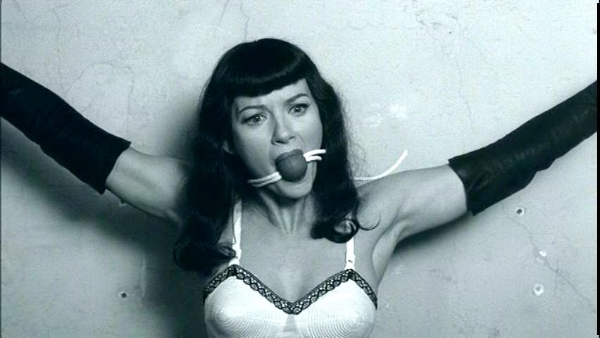
Whoever said moral decadence, perversion, and cultural decline couldn't be fun? There was a time - a serious, earnest time - when the women of Hollywood's biopics were history's greats: They were queens, empresses, Marie Curie. And now? Well, let's just say England's Bess has been joined by Tennessee's Bettie. She's a queen, yes, but of the pinups, a bondage icon and retro cheesecake, and now she's the subject of Mary Harron's delightful, witty, and touching new movie, "The Notorious Bettie Page."
Bettie Page? Oh yes, you know her. You've seen her face, and maybe much more.
Half a century ago, you might have caught her picture in one of those mags that your dad used to hide from your mom. Blue eyes, black bangs, hokey scowl, sweet smile, succulent figure: She was the most photographed girl next door in the world, some said. You could gaze at her in Gaze and get an eyeful in Eyeful and many, many, other naughty places, even Playboy (January 1955, Santa's cap, nothing else).
There were movies too, three burlesque films, "Striporama," "Varietease," and "Teaserama": The dancing is bad, the comedy acts worse. And then, under the counter, plain brown envelope please, there were those specialty flicks, "Domineering Roz Strikes Again," "Captured Jungle Girl," "In Chains," "Hobbled in a Kid Leather Harness," you get the picture. If you don't, some of the most amusing, if slightly alarming, sequences in "The Notorious Bettie Page" will give you some guidance. Gently, of course. There's no need to be afraid. Trust me.
In the end, the ropes, harnesses, jungle girls, and ball gags were too much of a temptation for Estes Kefauver, an ambitious senator and fashion disaster (coonskin hats, I'm afraid) from Bettie's home state, who'd already trashed comic books in an earlier bout of national hysteria. Hearings were held in 1955. They were the usual grandstanding farce, but were enough to ensure that, not so long afterward, Bettie Page disappeared into obscurity. Her image lingered on without her, and decades later, burnished by nostalgia, and safely lodged at the intersection of camp and carnal, her whips, her smile, and her curves began to resurface. Her visage appeared in comic books (sorry, Senator), fashion shoots, archive collections, posters, T-shirts, photos, souvenirs, any number of tchotchkes (a "tigress" air freshener will cost you $2.95), and, of course, the Internet. As I said, you've seen her.
This film will only add fuel to the fire and sweat to the brow. Its director, Ms. Harron, was previously best known for the perceptive and clever "I Shot Andy Warhol" (1996), the story of Valerie Solanas, the lady who did just that. In "The Notorious Bettie Page," Ms. Harron takes on the story of another woman who was both of, and ahead of, her era. Her Bettie (beautifully played by Gretchen Mol) is a classic American heroine, intelligent, spunky, driven, and good-hearted. No virgin queen (sorry, Bess), she bares with a grin, and maintains her decency, and more remarkably, her dignity, even amid the manacles, catfights, and hog-tied poses ("just silliness," she says) of her more bizarre photographic adventures. "God gave me the talent to pose for pictures ... and it seems to make people happy." She doesn't drink, she doesn't smoke, she gives the casting couch a miss, and when she eventually returns to Jesus, she doesn't have far to go.
This is an America (shot mainly in evocative black-and-white, with bursts of lush, overripe color) that is, like Bettie, both innocent and not. The gawking shutterbugs for whom Bettie poses in session after session after session don't touch, but they do stare. How they stare. Irving and Paula Klaw (sinister name, nice people), the brother-and-sister team that produced many of her pinups and all her bondage work, are pictured as lovable entrepreneurs, hard-working, honest, and careful to avoid falling afoul of the law (no nudity, two sets of underwear in case anything, you know, shows).They are examples of good business practice at its disgraceful, amoral best. Irving (Chris Bauer) is a busy, endearing schlub in shirtsleeves, and Paula (a lovely performance by Lili Taylor, who also played Solanas for Ms. Harron) the shrewd den-of-vice mother that Bettie still remembers with affection: "She never tied any ropes too tight."
Ms. Harron shows this America to be, as indeed it was, a rough, tough place - its noir-and-neon sophistication no more than surface sheen, delusion, opportunity, and trap. Bettie was a survivor (her ordeals included abuse as a child and, later, an appalling sexual assault), but she remained a true child of the Great Depression, unable to escape the hardscrabble life, even when things were going well. Her brush with glamour was only at the edges of fame, her gimcrack stardom (if that's the word) cheap, tawdry, and ill-paid.
Ms. Harron is too smart to avoid the flaws in Bettie's 15 minutes, but her desire to package the Tennessee Tease as a prophet of tolerance and female empowerment glosses over Bettie's darker pages. In particular, we are never shown the miserable later years, the bleak truth of the legendary "disappearance" that in reality was a descent into schizophrenia and a decade in a California asylum, a fate that inevitably raises disturbing questions about her true state of mind throughout that lost pinup heyday.
The director's silence is probably just fine with Ms. Page, out and about now, an old woman so wrapped up in her myth that she almost never agrees to be photographed. "I want to be remembered," she has recently said, "as I was when I was young and in my golden times."
Golden? There wasn't even much glitter. But I'm not sure that Ms. Harron wants us to know that.

With the dangerous and complex struggle against Islamic extremism stretching relentlessly, terrifyingly, and, seemingly, endlessly ahead, there's plenty of room for an intelligent movie that shows how fear, disaster, and fury could lead us all into totalitarian temptation. "V for Vendetta" is not that movie.
To be sure, as should be expected of a film produced by the maestros behind "The Matrix" and based on the ideas and imagery of a pioneering graphic novel, "V for Vendetta" is visually stunning. Even better, instead of some handsome, hapless Keanu stumbling and mumbling through his role, there's the rumpled, brilliant Stephen Rea as a sad-eyed cop and the soothing and sinister voice of Hugo Weaving. These two terrific performances are enough to take this movie a good way beyond comic-book flash or the empty look-at-that of the Wachowskis' CGI conjuring.What's more, after the exhaustingly talky tedium of the latter two Matrix movies, it's a relief, and something of a surprise, to discover that "V for Vendetta" (which is directed by James McTeigue, yet another "Matrix" alumnus) does what thrillers often promise, but rarely deliver: It thrills.
The problem is that this movie is meant to do more than that. It is, we are being told - drum roll, Oscar buzz, Natalie Portman buzz cut - a film with a big, important message, but that, I'm afraid, is where it fails. And it doesn't just fail. It collapses, crumbles, implodes, and melts down, its credibility thoroughly sabotaged by nitwit politics, numbskull preaching, and an understanding of history so feeble it would embarrass a high school student, so peculiar it would delight Oliver Stone.
To no small extent, these flaws flow from the beginnings of "V is for Vendetta" as an overwrought and overrated 1980s British comic strip by two men, Alan Moore and David Lloyd, who were upset, very upset, with that nasty Magaret Thatcher. Their confused, dystopian tale eventually developed into a full-fledged graphic novel, but it never outgrew the paranoia, alienation, and hysteria so often found among Britain's leftists during the long, bleak, Thatcher terror. As that savage tyranny ground to the end of its first decade, a gloomy Mr. Moore warned readers of the initial (1988) American edition of his work that the United Kingdom's "new riot police wear black visors, as do their horses ... The government has expressed a desire to eradicate homosexuality, even as an abstract concept, and one can only speculate as to which minority will be the next legislated against." Blimey.
Mr. Moore wrote that he was thinking of quitting his "cold" and "mean-spirited" country very soon. He "didn't like it anymore." I suppose it's meanspirited of me to mention that, nearly 20 years later, he's, well, still there.
Poor Mr. Moore may not have moved far in all that time, but his hero, the terrorist (freedom-fighter, insurgent, take your pick), V, the enigmatic and deadly prankster in a Guy Fawkes mask (we never see his face), has enjoyed something of a change in image. Played by Hugo Weaving, former elf (from "Lord of The Rings") and current Australian, with the most silkily seductive English accent since the late James Mason, V is now being touted as a libertarian of sorts, an antic and unpredictable Thomas Jefferson playfully throwing blood all over the liberty tree. That's quite some makeover, comparable, perhaps, to suggesting that the historical Guy Fawkes (in reality, a religious zealot and former Spanish mercenary) only plotted to blow up England's Parliament in the interests of liberty. But then, of course, that, absurdly, is another thing this film tries to do.
The V of Messrs. Moore and Lloyd (Mr. Moore was the writer, Mr. Lloyd the illustrator) was more malign, less marketable, and more interesting than the one-dimensional and relatively favorably drawn character shown in the film. Beneath the polished, erudite, and occasionally compassionate exterior, their V was certainly psychotic, undeniably murderous, and very possibly insane. He was also an anarchist,an obvious fanatic (even if his views were portrayed fairly sympathetically) to whom blowing up symbols of the democratic dream came naturally: Like that dream itself, they had never meant much, dictatorship or no dictatorship. Stuck within the crudely drawn and conventional liberal pieties of Mr. McTeigue's self-satisfied morality play, however,such acts of destruction make little intellectual sense. They add nothing to the debate over terrorism (and the response to terrorism) that this movie was supposedly designed to provoke, but who cares? Their real function is as gratuitous pyrotechnic spectacle, an opportunity for Western audiences to cheer on a parable of their own annihilation. If, in the wake of September 11 and so much more, I find that a little strange, I guess that's just me.
The background against which the movie's plot unfolds is just as much of a mess. Worse, by keeping the bad guys as, quite literally, comic book villains, they are left with no meaningful role to play in any discussion about the justifications for terrorist violence. The last time I checked, fighting Nazis wasn't exactly controversial. Nazis? Yup, they're back yet again. The starting point for "V for Vendetta" is the generic fascist regime (black shirts, ranting dictator, ethnic nationalism, "internment" camps, persecuted minorities, bone-headed propaganda, the usual) described in the original graphic novel. Back in the 1980s, such dark, forbidding imagery was routine grist for the anti-Thatcher mill, but even then it came across as loopy, over the top, and more than a touch retro. There was an obvious danger that by 2006, 60 years after Adolf, Benito, and the rest of the gang, it would just look absurd. Thanks to the filmmakers' insistence on pushing the story even further into the future (mainly so they could insert numerous ham-fisted references to the war on terror), it does.
It didn't have to be that way. While I hesitate to mention Orwell's bleak masterpiece in this company, his "1984" was also very much a product of its times. But when Michael Radford filmed it in, well, you can guess which year, he clearly understood that retaining the book's period flavor could actually underpin the power, and the timelessness, of Orwell's terrible warning. And he was right. Watching that movie (it's excellent, by the way, and available on DVD) will do more to make you think about the way that perpetual conflict, whether it's with militant Islam or the hordes of Eurasia, can be used to control public opinion, than anything you'll see in "V for Vendetta."
To be fair, Mr. McTeigue had much less to work with than Mr. Radford, but his screenplay (written by the Wachowskis, and denounced by the reliably ornery Mr. Moore as "rubbish") strips the original storyline of what little subtlety it once had. For that, turn to Mr. Rea's haunting portrayal of Chief Inspector Finch. Finch is a man with a sense of justice working for a regime that he knows to have none.Throughout the film, Mr. Rea dominates the screen in a way that eludes Ms. Portman, even with her shaven skull.
She's in the key role of Evey, the girl rescued by V who becomes pupil, victim, and accomplice, but her missing locks are the most dramatic aspect of a performance only marginally more persuasive than her English accent, an odd confection teetering uncertainly between Posh Spice and the queen. As an imperiled waif, Ms. Portman is believable (just look at her, the poor mite) but, as the film progresses, Evey's evolution into something more forceful simply fails to convince.
Much like this movie, in fact.

To understand the origins of the mutant mayhem that is Alexandre Aja's new version of "The Hills Have Eyes," it helps to begin with a detour into the old, nasty Scottish legend, the legend of Sawney Bean. Like the finest old, nasty Scottish legends, it's certainly old, probably bogus, and undoubtedly nasty. Sawney, it's said, was a brigand who lived in a cave with a large, feral, and incestuous brood that only emerged from their lair to rob, murder, and, well, eat, innocent passers-by, unseemly behavior even in Scotland, a country not noted for its refined cuisine.
Many hundred years later, Wes Craven, a young American filmmaker then known mainly for "The Last House on the Left" (1972), a sleazy and regrettably sadistic slasher pic (inspired by, of all things, a Bergman movie) decided to update Sawney's savage saga for an America that was already, you would think, more than sufficiently traumatized by the fall of Saigon, the rise of Jimmy Carter, and the persistence of disco. The result, the original "The Hills Have Eyes" (1977), was a bloody, if exuberantly directed, mess of gore, the grotesque, the glib, and the gloating, marked by graveyard humor, graveyard acting, a crucifixion, a corpse used as bait, cruelty to dogs, cruelty to a parakeet, cruelty to an old codger, cruelty to a young mother, cruelty to a retired cop, and way, way too many people eyeing a "tenderloin" of baby as the source of a good dinner.
Over in ancient Ayrshire, Sawney and his clan were, so the story goes, eventually caught and made to pay a high price for their meals (limbs lopped off, left to bleed to death, burned alive, the usual). By contrast, Mr. Craven's orgy of murder and cannibalism brought him fame and box office success, and paved the way for a career that introduced us to, among others, Freddy Krueger ("A Nightmare on Elm Street"), a bunch of frightening cellar dwellers with a left-wing message ("The People Under the Stairs"), and, most sickening of all, the spectacle of Meryl Streep (in 1999's "Music of the Heart") as an inspirational inner-city teacher. Accused by some of dumbing down the horror genre, Mr. Craven is praised by others for smartening it up ("Wes Craven's New Nightmare," and all those "Screams"). He has become a brand ("Wes Craven Presents ..."), a sage, a self-congratulatory icon, and a cult, and there's every reason to think his devotees will be thrilled by what they find lurking in the new "Hills."
This time around, Mr. Craven is only a producer, but the selection of Alexandre Aja to direct the new "The Hills Have Eyes" was a clear signal that the remake would not spare cast, or audience, or parakeets. In some ways, Mr. Aja, who is clearly something of a Craven disciple, was an appropriate choice. His last film, the revoltingly cruel, if skillfully made, "Haute Tension" (2003), was, like "The Last House on the Left" all those years ago, a brutal demonstration of just how low an exploitation flick can stoop. Sure enough, Mr. Aja's "Hills" are alive with the sound (and sight) of appalling violence, and while a depiction of mutants sexually assaulting a young hottie (in this case Emilie de Ravin of "Lost") was never likely to be in the best of taste, there is something about the way in which Mr. Aja prolongs this particular scene (which repeats, and elaborates, on a sequence from the original movie) that vividly demonstrates the depths he is prepared to plumb: You will not feel better about yourself for having watched it. It's no surprise that Mr. Aja's epic struggled to avoid an NC-17 rating, but ghouls, completists, and any surviving members of the Manson family can relax: An "uncut" version is promised for release on DVD.
That said, before the film degenerates, as such exercises tend to do, into the standard, somewhat repetitive charnel-house chopping, slashing, ripping, dismembering, burning, slicing, gouging, and impaling, its earlier portions are effective, genuinely creepy, and will be successful in maintaining the suspense, even among those already familiar with Mr. Craven's original. As for the storyline, it has enough in common with the 1977 version to reassure the faithful, but enough that is different to delight and entrance them. The killer hillbillies of the first movie, products of nothing more than unlucky genetics, have been transformed, fashionably, into victims, their shambles of a DNA the product of atomic testing rather than careless backcountry coupling. However, as in the original, their devolved and debased clan is compared and contrasted with that of its targets and intended menu, the flawed and bickering Carters. As in the original, the most sensible Carters are their dogs.
This is in keeping with the theme of troubled and inadequate family that runs through much of Mr. Craven's work. While Mr. Craven's observations on this topic usually hover somewhere among the banal, the trite, and the tedious, Mr. Aja develops them the best he can in striking scenes set amid the remnants of an Eisenhower-era atomic test village, the Pleasantville from hell. There we witness examples of not one but three distinct and, each in their own way, distinctly problematic families, as a surviving member (the nerdy son-in-law) of the Carter family hunts down members of the mutant clan (thanks to the effects of radiation, a literally "nuclear" family) against the backdrop of what's left of yet another vi sion of domesticity, the cookie-cutter housing, "Leave It to Beaver" decor, and mannequin moms, pops, and kids of the test village, fake from the beginning and doomed to destruction.
That's cute (spot the obvious analogy!), but such ideas, and another (no less routine) subtext that, if that's what it takes to defend our own, even the most civilized among us will descend into barbarism, have less to do with this film's undeniable grip than the way it manages to tap into the deep-rooted American dread of what might be waiting out there in the hinterland. Unlike in overcrowded, long-settled Europe, where the horror film tends to focus inward, into the haunted house, into the mind, into the past, on this side of the Atlantic there is still some sense of living on the edge of the uncompleted, the uncharted, the empty, and the dangerous. The unease and the fear this can bring in its wake haunt countless American movies ("Deliverance," "The Blair Witch Project," "The Texas Chainsaw Massacre," to name just three), and this one, too, even if ironically, its most unsettling moments are those that echo terrors from farther afield than Flyoverland. Contrary to some speculation at the time, the first "The Hills Have Eyes" was not a Vietnam parable, and, so far as I am aware, Mr. Aja's version is not about Iraq, but it's impossible to see the Carters' vehicle optimistically heading, Stars and Stripes fluttering, deep into a hostile, mysterious, and treacherous desert without thinking of all too real horrors elsewhere.
And, at the moment, there ought to be nothing more disturbing than that.

It's been a rough, tough, dismaying week for those Europeans who like to believe that the pen is mightier than the scimitar. Yes, an additional number of publications reprinted those pesky cartoons, one selling out its print run when it did so, but these were brave, temporary gestures, as evanescent as the paper on which they were printed, as futile as fists waved in the face of a storm.
While the Danish prime minister was stubbornly sticking to the principles of free speech and a free press, principles which he had, perhaps naively, and certainly optimistically, thought would find support from governments across Europe, his words were nearly drowned out by hints, murmurings, and shouts of appeasement from the gray, shrunken statesmen of Brussels, Paris, London, Stockholm, and many other capitals—take your pick—of a continent that once saw itself as the home of Enlightenment.
Of course, there were exceptions to the dismal, despairing rule, and, naturally, one of them was the Somali-born Dutch MP, Ayaan Hirsi Ali, fearless and furious, one of the few politicians in Europe who still says how things really are:
"Shame on those papers and TV channels who lacked the courage to show their readers the caricatures in the cartoon affair. These intellectuals live off free speech but they accept censorship. They hide their mediocrity of mind behind noble-sounding terms such as "responsibility" and " sensitivity. " Shame on those politicians who stated that publishing and re-publishing the drawings was " unnecessary, "" insensitive, "" disrespectful" and " wrong." I am of the opinion that Prime Minister Anders Fogh Rasmussen of Denmark acted correctly when he refused to meet with representatives of tyrannical regimes who demanded from him that he limit the powers of the press. Today we should stand by him morally and materially. He is an example to all other European leaders. I wish my prime minister had Rasmussen's guts... I do not seek to offend religious sentiment, but I will not submit to tyranny. Demanding that people who do not accept Mohammed's teachings should refrain from drawing him is not a request for respect but a demand for submission."
Indeed it is, and judging by the reaction of Dutch prime minister Balkenende, he's ready to grovel. He didn't, he sniffed, have "much use" for Hirsi Ali's contribution, a view that would not have been shared by Theo van Gogh, the director with whom she worked on the movie, Submission. Of course, van Gogh is dead now, butchered by a Muslim extremist offended (ah, that word again) by his film. Interestingly, if one recent poll on a related matter is any indication, the Dutch people themselves are likely to take a very different line from their prime minister. Eighty-four percent, apparently, believe that Hirsi Ali should make a sequel to Submission, even if many of them were far from being fans of the original movie. They are smart enough to understand that, if it is to mean anything, free speech must include freedom of speech about those with whom you disagree.
It was this freedom that van Gogh was testing, it was this freedom that Jyllands-Posten is testing, and it is this freedom that the Dutch foreign minister will be compromising when he travels this week to the Middle East alongside Javier Solana, the EU's foreign policy chief, for talks aimed at reducing the tension over the cartoons, a pointless and humiliating exercise that can only reinforce the dangerous impression held by many of the region's Muslims that Europe's governments somehow control Europe's newspapers and can thus be blamed for their contents.
The fact that such a mission is unlikely to take much account of the opinions of Dutch voters should surprise nobody. Europe's leaders have long tended to prefer the top-down and the technocratic to the views of electorates they see as atavistic, irrational, and prone to disturbing nationalist enthusiasms. This is why they had the arrogance to prescribe multiculturalism as an appropriate response to mass immigration, an idea of remarkable stupidity that goes a long way toward explaining the predicament in which Europe now finds itself.
Of course, we don't yet know what this delegation to the Middle East will be saying, but comments made in an interview with the London Daily Telegraph by the EU's sinisterly named Commissioner for Freedom, Security and Justice reveal some clues. Saying that millions of Muslims felt "humiliated" by the cartoons, and referring to a supposed "real problem" faced by the EU in reconciling freedom of expression with freedom of religion (actually, there's no "problem" at all, unless fanatics choose to make one), he suggested that the press should adopt a voluntary code of conduct. By agreeing to this "the press will give the Muslim world the message: we are aware of the consequences of exercising the right of free expression, we can and we are ready to self-regulate that right." Why the "Muslim world" outside Europe, much of which is represented by dictatorships, mullah-states and kleptocracies, should have any say in the contents of the continent's supposedly free press was not discussed.
In fairness it should be mentioned that the commissioner, Franco Frattini, subsequently put out a vague, ambiguous, and confusing press release purportedly intended to clarify his remarks, but once you have cut through the waffle, checked out the full text of the original interview, and grasped the fact that he was already talking about some sort of code before the current crisis, the commissioner's intentions become all too clear. One way or another, he wants the press muzzled.
And Frattini is not alone. The president of the EU's "parliament," and thus a man supposedly dedicated to the freedom of debate, could bring himself to defend free expression only "within the boundaries of respect for the religious beliefs and cultural sensitivities of others." Javier Solana meanwhile, paved the way for his trip by telling Al-Arabiya television that "respect does not stop at countries' borders and it includes all religions and specifically what concerns us here, our respect for the Islamic religion." As so often in the last week, the idea that "respect," if it is to mean anything other than capitulation, has to flow both ways, seems not to have merited a mention.
Of course, there is something more than a little disingenuous about the manner in which European politicians like to portray themselves as defenders of the right of free speech even as they reduce it to rubble. The Swedish government, at least, was being more straightforward when, just before the weekend, it arranged to shut down a website that had run one rather innocuous cartoon of the Prophet Mohammed. Tellingly, the website belonged to the newspaper of a political party of the hard right, yet another sign of how the establishment's refusal to enter into any serious debate over multiculturalism has handed the issue over to Europe's rougher fringe, who can only gain as a result. It's telling too to read how the Swedish foreign minister reportedly excused her government's actions: "We are already seeing reactions in certain countries who have responded to the Swedish Democrats [the political party in question] having these pictures on their website, and this could naturally have grave consequences for Swedish people and Swedish interests." What, I wonder, is the Swedish for "submission"?
The Swedish authorities are unusual only in the directness of the measures that they have taken, and in the frankness with which they have explained the motives behind them. Other, more discreet, governments are probably content to let their laws take their course, something that will come as cold comfort to anyone who still believes in controversy, debate, and the free exchange of ideas. The development of Europe's state-sponsored multiculturalism has gone hand-in-hand, as it had to, with the enactment of laws that chip away at free speech (and have gone further, far further, than understandable restrictions on direct incitements to violence), but which have, ironically, encouraged and inflamed those that they were meant to appease.
Jacques Chirac was quick to condemn the republication of the Danish cartoons in Charlie Hebdo, an iconoclastic French weekly, as an "overt provocation", but was able to leave the dirty work to others. The French Council of Muslims, a body set up with official support, is reported to be organizing the prosecution of poor Charlie, quite for what remains unclear, but doubtless the Council's lawyers will be able to find something useful in France's laws against "hate speech" or any number of other offenses dreamt up by the enforcers of multiculturalism. The prosecution, like that of the author Michel Houellebecq may well end in failure, but any prosecution, successful or otherwise, comes with a cost in time, worry, and lawyers' fees, a cost that will make other authors, editors, and publishers think twice before publishing anything that might irritate the imams. And France is by no means alone in this respect. Many European countries can boast, if that's the word, similar laws on their own statute books, and even in Britain, traditionally a defender of free speech, the House of Commons recently came within one vote of passing a law that would almost certainly have made publishing the cartoons a criminal offense.
If the law doesn't do the trick, perhaps intimidation will. The threat of violence, and sometimes more than the threat, has run through the hysteria and bombast of recent days, and it has involved far more than the torching of a few embassies, appalling though that was. Sometimes the threats, usually of trouble from Europe's Muslim minorities, were explicit, and sometimes they were more subtle, a hint here, a comment there, that "provocations" such as the cartoons could further radicalize Islamic populations worldwide, further complicating the war on terror, and bringing the prospect of a terrifying "clash of civilizations" ever closer. If European governments are incapable of resisting such pressure, and, after the last week, it seems clear that they are, how many writers and artists can be expected to run the risk of Muslim wrath? Underlining that point, The Liberal, a small British political periodical, withdrew one of the Danish cartoons from its website after being warned by the police that they could not guarantee the safety of the magazine's staff.
At least the magazine was able to acknowledge what had happened by leaving a blank space marked "censored" on its website. After the events of these last days, we can be sure that other acts of censorship or self-censorship will pass insidiously and in silence, unnoticed, un-mourned, or, at best, explained away as a gesture of that "respect" that Europe's elites are now so eager to proclaim.
And as for the Danes, they must be feeling very, very alone. The notion of European solidarity has been revealed as the myth it always was. Denmark, and its tradition of free speech, has been left to twist in the wind, trashed, abused, and betrayed. An article published in Jyllands-Posten (yes, them again) on Friday revealed clear frustration over the way that the country is being treated. It's in Danish only, but one phrase ("Ytringsfrihed er ytringsfrihed er ytringsfrihed. Der er intet men.") stands out, and it deserves to be translated and repeated again, and again, and again: "Free speech is free speech is free speech. There is no but."
Fine words. Is anyone listening?
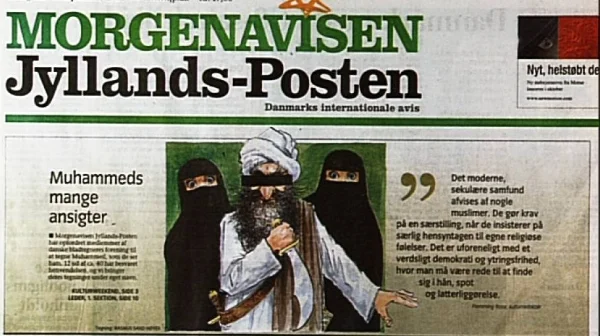
It says something for the cowardice, duplicity, and wishful thinking of too many of the West's politicians (and much of its media) that one of the most striking illustrations of the crisis in its relations with the Islamic world has come from twelve mediocre cartoons.
The broad outlines of this saga ought to be familiar, wearily, painfully familiar, but they are still worth tracing back to the beginning, both to clear up some of the distortions that have grown up around it, and to see what the very nature of the controversy itself can tell us. The whole thing began when the Danish children’s writer, Kåre Bluitgen, complained last autumn that he was unable to find anyone willing to illustrate his forthcoming book about the Prophet Mohammed. He had, he said, been turned down by a number of artists frightened by the prospect of reprisal if they ignored the traditional Muslim prohibition on pictorial depictions of Islam’s founder. Twenty or thirty years ago, such fears would have been no more than paranoia, but that was before Denmark, like elsewhere in Europe, found itself with a large, and incompletely integrated, Muslim population. Back then Salman Rushdie had not yet been driven underground by an Ayatollah’s death warrant. Back then Theo Van Gogh was still alive.
Self-censorship is tyranny's sorry, trembling little helper, and so it's to its credit that the right-of-center (which, in Denmark, is not very right at all) Jyllands-Posten, one of the country's major newspapers, picked up Bluitgen's story. What it did with it was ornery, well-intentioned and somewhat naïve. Forty cartoonists were invited to give their own interpretation of the prophet. Twelve, a little more than a third, accepted, for 800 Danish crowns (roughly $125) apiece. As we now know, the result was a storm of protest in the Muslim world, and in recent days, pushback in the West. The cartoons have been republished all over Europe and the twelve cartoonists are now, like Geert Wilders, Ayaan Hirsi Ali, and Salman Rushdie before them, learning what it is to live in hiding. They have reportedly opposed the republication of their work. It's difficult to blame them. They have been given a terrible demonstration of what it takes to survive in an era rapidly tumbling back into the pre-modern.
As for the cartoons themselves, they come from all perspectives. One satirizes Jyllands-Posten, another Mr. Bluitgen. None are very funny, or, by Western standards, remarkable. It's telling that the delegation of Danish Muslims who visited a number of Middle Eastern countries to stir up trouble over the cartoons, had to boost their dossier of grievance with three additional (and genuinely disgusting) pictures that Jyllands-Posten had never even seen and whose provenance remains, let's be polite, unclear. To try and compare the actions of Jyllands-Posten, as Bill Clinton effectively did, with the race-baiting traditions of Der Stürmer is to reveal an ignorance of history and a disdain for free speech that disgraces the office he once held. Even the most notorious of the cartoons, the one that shows Mohammed with a bomb decorated with Islamic text in his turban, can be seen not as an insult, but as a challenge to Muslims to demonstrate that (as is indeed certainly the case) there is far more to their faith than the atrocities that have recently defaced it. Harsh? Maybe, but it was also in the Western tradition of vigorous, free discussion. And as such it should be defended.
Ideally, the publication of these cartoons would have prompted Muslims to ask themselves why Islam, one of the world's great religions, could come to be seen in such a bad light. It hasn't worked out that way. Protests have been followed by boycotts, bluster and, now, violence. The protests and the boycotts are fine. They are all part of the debate. Violence, and the threat of violence, is something else, and, as many more moderate Muslims understand, it is doing far more damage to the reputation of Islam than a few feeble caricatures.
Needless to say, the theocracies, kleptocracies, and autocracies of the Middle East, always anxious for something, anything, to distract attention from their own corruption, uselessness, and thuggery, have played their own, typically malign, part in whipping up anger. Ambassadors have been recalled. Denunciations thunder down. Angry resolutions are passed. But amid all these calls for "respect" is there any acknowledgement that many Islamic countries could do more, much more, to respect the rights of those of different faiths to their own? To take just one example, Egypt's ambassador to Copenhagen is recommending that diplomatic action against Denmark should continue, but her own country's persecuted Christian minority would be grateful indeed if their troubles were confined to a few cartoons. Respect, it seems, is a one-way street.
But that's what too many in the Muslim world have been taught to believe, by multiculturalism as much as the mosque. In the cowed, cowering Europe of recent years the idea that religious minorities have a right not to be "offended," a nonsense notion that gives veto power to the fanatic with the thinnest skin, has increasingly been allowed to trump the far more fundamental right of others to speak their mind. Writers have been prosecuted, plays have been tampered with, and works of art withdrawn. Last week, the British House of Commons came within one vote of passing a law that would almost certainly have made U.K. publication of the Danish cartoons a criminal offense. It is a sign of how far matters have been allowed to degenerate that the initial blunt refusal of Denmark's prime minister to even hold a meeting with a number of ambassadors from Islamic countries over the incident ("I will not meet with them...it is so crystal clear what principles Danish democracy is built upon that there is no reason to do so...As prime minister, I have no power whatsoever to limit the press—nor do I want such power.") was seen as shocking as it was.
Needless to say, there were others who did their best to ensure that normal servility was resumed. While most Danes backed the prime minister, a former foreign minister, a once-respected figure who has long since become a flack for the Brussels establishment, donned Neville Chamberlain's black jacket and pinstripes to denounce the cartoons "as a pubescent demonstration of freedom of expression." The U.N.'s High Commissioner for Human Rights wrote to the Organization of Islamic Conferences (which, as it was perfectly entitled to do, had complained about the cartoons) saying that she understood the OIC's concerns, if not, it appeared, the right of free speech, and she was far from being the only senior international bureaucrat to do so (and, yes, naughty Kofi made sure to throw in a few weasel words of his own). Closer to home, the EU's commissioner for Freedom, Security and Justice denounced the cartoons as "inappropriate," an adjective as Orwellian as his job description, an adjective that can only have encouraged those out to bully the Danes.
In the end, it was left to other newspapers to rally round. With the republication of the cartoons in the Christian journal, Magazinet, the Norwegians were the first to support the Danes, a gesture understandable in a country where the local publisher of Rushdie's Satanic Verses had been fortunate to survive an assassination attempt in 1993, but which was bound to inflame matters still further. And when it did, other newspapers across Europe, in France, in Germany, in the Netherlands, in Spain and elsewhere joined in, either republishing the offending cartoons or, notably in the case of France's left-of-center Le Monde, adding more of their own.
So, what now? Like it or not, the cozy, consensual, homogenous Denmark of half a century ago has vanished, never to return, and, like it or not, the old Europe shaped by Christianity, the Reformation, the Renaissance and the Enlightenment now plays host to a large and growing population with a very different intellectual and spiritual tradition. And, in an age of global communication, the idea that these problems of coexistence can be confined to one continent is an illusion. An insult in Århus can reverberate in Damascus and Amman, and for that matter, Kabul, Basra, and Baghdad too. It's this that explains why the Bush administration, with hearts, minds and a war to win, condemned the cartoons, and it's this, far less forgivably, that explains why Turkey's (supposedly moderate) Islamist prime minister feels that he has the right to tell the Danish press what it may or may not publish.
Of course the publication of those cartoons was (quite explicitly) a provocation, but the furor that followed shows that it was an acceptable thing to do. The editors of Jyllands-Posten wanted to draw attention to the fact that fears for the freedom of expression were both real and realistic. They have succeeded on both counts. Europeans realize now, if they were dim enough not to understand before, that they are faced with two very different ways ahead. The first, and better, alternative is to recognize that, to many, freedom of speech is a value as important as religious belief may be to the faithful, and to give it the protection it deserves. Reestablishing this badly eroded principle will not be easy, but to fail to do so will be to empower the fanatic to legislate for all.
The second alternative is, broadly speaking, for Europe to attempt to buy social peace by muddling along as it does now, muzzling a little speech here, rooting out a little liberty there. But this approach isn't working now. There's no reason to think that doing more of the same will prove any more effective in the future. Besides, at its heart, this is a policy of surrender, submission and despair. It is a refusal to accept that people can agree to disagree, and it is a refusal to confront those who cannot. It foreshadows an era of neutered debate, anodyne controversy, and intellectual stagnation. It will lead, inevitably, to societies irrevocably divided into immovable blocs of ethnicity and creed, carving up the spoils, waiting to take offense and thirsting for the fight, which will one day come.
Despite some of the stirring statements in favor of free speech that have been made over the last week the best bet is that Europe will continue to slide into that second, dismal, alternative. The warning signs are already there to see. Tony Blair's Labour government (again, due partly to the presence of British troops in Iraq and Afghanistan but, doubtless, due also to the presence of Muslim voters in many key parliamentary constituencies) has been at pains to condemn the cartoons, and Norway's governing left-wing coalition wasted no time in distancing itself from Magazinet. Even Magazinet's editor has now stumbled down the same sad route: "If I had dreamt of something like this happening I would not have done it. It's out of control.'' Meanwhile, a number of the newspapers that have chosen not to run the cartoons have done so explicitly on grounds of self-censorship, or, rather, they claim, "restraint," or maybe "respect": Choose your own alibi.
Even more ominously, at the prompting of our old friend, the EU's commissioner for Freedom, Security and Justice, Brussels bureaucrats are arranging a meeting for "experts" and "community leaders" (to be held no later than the end of April) that will discuss some of the issues arising out of this controversy. It is reported that, "proposals to counter race and religious hatred [may be] dusted off." We can guess where that might lead.
And as for where it all started, Jyllands-Posten has now announced that it regrets having published the cartoons: "If we had known that it would end with death threats and that the lives of Danish people could be put at risk, we would have naturally not have published the drawings." The paper apologized only for having underestimated the extent to which Muslims revere their prophet, but then it added this, "fundamentalist powers have prevailed over the freedom of speech...Danish media will now be careful about expressing attitudes that fundamentalists can misuse to create hate and bitterness."
Whip cracked. Lesson learned.

If you have ever needed reminding of a nation’s capacity for ingratitude, the story of Alan Turing ought to do the trick. And if you have never heard of Alan Turing, that only proves the point. Born in 1912 into the cheese-paring and snobbery of Britain’s colonial administrative class, Turing emerged from a traditionalist family and an old-school education with a wild, unorthodox mind, and a record of achievement that establishes him as one of the most important mathematicians of the last century.
In not much more than one astonishing decade, this extraordinary individual would not only play a critical part in paving the way for the development of the laptop on which I am now typing, but also, through his wartime code-breaking at Bletchley Park, help ensure that this article didn’t have to be written in German. His tragedy, and ours, was that there was too little in the way of an encore. Within a few years of his greatest triumphs, Turing was a convicted criminal, guilty of “gross indecency” with another man, an embarrassment, if not exactly an outcast. Not so long afterwards he was dead, a suicide at 41 with the help of an apple dipped in cyanide.
With the secrecy that surrounded Turing’s wartime activities now lifted, the essential facts of his life are well established and more than adequately covered in this new biography. After walking his readers briskly through the early years, David Leavitt presents them with the considerable challenge of Turing’s first major work, the catchily named “On Computable Numbers, with an application to the Entscheidungsproblem” (1937), a paper that was, in essence, the blueprint for the modern computer. “Computable Numbers” is, in Leavitt’s words, a “curious blend of humbly phrased, somewhat philosophical speculation and highly technical mathematics,” something, he concedes, that is “disconcerting” for the “general reader” (that’s you and me) since, invariably, easier passages “segue immediately into dense bogs of unfamiliar symbols, German and Greek letters, and binary numbers.”
Well, when it comes to navigating those “dense bogs,” Leavitt is, in keeping with one of the tasks of this biography (the book is part of Norton’s Great Discoveries series, designed “to tell the stories of crucial scientific breakthroughs”), a pretty good guide. As someone confused by an abacus and in awe of a pocket calculator, I admit that my knowledge of computing is, or was, practically zero. After a re-reading or two of the chapters devoted to Turing’s “universal machine” and its revolutionary implications, this level of understanding had been raised to somewhere between hazy and confused: no small achievement, and a tribute to Leavitt’s powers of explanation.
Leavitt is no less deft in describing Turing’s critical role in breaking the Germans’ Enigma codes. His writing leaves the mysteries of cryptanalysis less mysterious and, as a result, we can begin to grasp the remarkable intellectual feat involved in Turing’s penetration of the secrets of Hitler’s Reich. We’ll never know how many Allied lives were saved by “the Prof” and his work, or by how many years his effort shortened the war, but Churchill never doubted its importance. Turing and his team were, he wrote, to have “all they want.” And so they did. More material rewards were to prove elusive. Stinginess and secrecy meant that the only official recognition of Turing’s achievements was a bonus of a few hundred pounds and a rather minor medal. So far as is known, he never complained, and, to the end of his life, Turing kept the secrets of Bletchley Park to himself. He and his colleagues were, said Churchill, “the geese who laid the golden eggs and never cackled.”
But there’s more to The Man Who Knew Too Much than formulae, ciphers, and the click-click-click of the device that savaged Enigma. While his efforts inevitably fall short of the portrait contained in Andrew Hodges’s groundbreaking, and epic, biography, Alan Turing: The Enigma (1983), Leavitt nevertheless succeeds in drawing a wonderfully vivid picture of his shy, dry, brilliant hero, an eccentric boffin with chaotic, shabby tailoring, uncertain hygiene, an unsettling resemblance to Rudolf Hess, and a yen for long-distance running.
What works less well is Leavitt’s tendency to treat Turing’s homosexuality as a lens through which his whole life must be seen, sometimes ridiculously so. Thus in discussing a later work, “Intelligent Machinery,” a paper focused, as its name would suggest, on the possibility of building a truly “intelligent” machine, Leavitt notes how Turing’s strategy of opening with a summary of the views of those who disagreed with him “foreshadows the gay rights manifestos of the 1950s and 1960s, which often used a rebuttal of traditional arguments against homosexuality as a frame for its defense” — a comparison that is both accurate and pointless. A little later, we find “Computing Machinery and Intelligence,” Turing’s “most famous and in many ways most perverse paper,” described as a stew of anxiety over gender and sexuality, a reading that might have surprised Turing, a man comfortable with his sexual identity in a way that was, as so often with him, years ahead of his time.
Perhaps this was inevitable. Norton boasts that Great Discoveries will feature “writers from diverse backgrounds.” It’s that dodgy word “diverse” that should set the alarm bells ringing and that explains, undoubtedly, why Professor Leavitt, who teaches creative writing and is best known for novels focused on homosexual themes (The Lost Language of Cranes, While England Sleeps, among others), was chosen to write the biography of a mathematician.
The result, ironically, of his approach is somehow to diminish the horror of the unjust laws that largely confined Turing’s sex life to an emotional wasteland punctuated by furtive fumblings and discreet trips abroad. Nobody will ever know why he chose to kill himself (there were clear signs that he was going mad), but it’s impossible to imagine that the ordeal of prosecution and the humiliation of punishment (in essence, chemical castration) did not play their disgraceful part. That is not enough for Leavitt, who dilutes tragedy with absurdity by suggesting that the way in which Turing (a somewhat obsessive fan of Disney’s Snow White) committed suicide was designed to deliver an erotically symbolic message: “In the fairy tale the apple into which Snow White bites doesn’t kill her. It puts her to sleep until the Prince wakes her up with a kiss.”
Oh please.

There were some who thought Michael Winterbottom's last movie, "9 Songs" (2004) - a dreary, pointless exercise involving a British glaciologist, an American student, and very explicit (and very real) sex scenes - should not be made. They were right. There were others who thought his latest effort, "Tristram Shandy: A Cock and Bull Story," could not be made. They were wrong.
Mr. Winterbottom's new film is based, sort of, on "The Life and Opinions of Tristram Shandy" (1759-67), nine bewildering, bawdy, discursive, and chaotic volumes written over eight years by Laurence Sterne, a middle-aged Yorkshire vicar who wrote, he said, "not to be fed, but to be famous." He succeeded. The early volumes were bestsellers, blessed with high society approval ("from morning to night my Lodgings ... are full of the greatest Company ... Tristram is the Fashion.") and critical praise remarkable in a book so confused and confusing that, by comparison, "Ulysses" reads like "Dick and Jane." It was, as a character in Mr. Winterbottom's multilayered, clever, and delightful movie (a film about trying to film Sterne's notoriously unfilmable novel) explains, "postmodern before there was even a modern."
If the book is difficult to read, it's even more of a challenge to describe. If asked, Sterne, whose work is filled with typographical jokes, asterisks, dashes, squiggles, and harum-scarum punctuation, might have proffered a blank page. One of the first unfortunates (a luckless writer for the London Critical Review) to be given the job of commenting upon it simply abandoned the task: "This is a humorous performance, of which we are unable to convey any distinct ideas to our readers." Unfortunately, that's not an approach that would satisfy the difficult and demanding editors of The New York Sun, so I will just have to do my best.
A good way to start is to think of "Tristram Shandy" as the equivalent of the eccentric and beguiling chambers of curiosities that preceded today's earnest, orderly, and disciplined museums.To open one of its chapters is to peer into a collection of randomly assembled facts, falsehoods, anecdotes, histories,tales,fables,yarns,observations,and digressions that have little or no obvious connection to each other or to the book's underlying narrative, such as it is. And as for the nature of the reminiscences byTristram that are supposed to provide the novel's structure, if I tell you that young master Shandy is not even born until the third volume, well, you see the problem with which Mr. Winterbottom was confronted.
He could, I imagine, have tried cobbling together a few choice bits and pieces from the book in a way that told a vaguely coherent story, but that would have made a nonsense of Sterne's nonsense. Or he could, maybe, have dispensed with narrative altogether and simply assembled a series of period tableaux in the flamboyant but interminable style of a Terry Gilliam. Mercifully, he did neither.The approach Mr. Winterbottom actually took not only pays tribute to the fact that the original "Tristram Shandy" was in some ways a book about writing a book, but also offers audiences both the anarchy and the feel of Sterne's work, as well as the order and the comfort of a reasonably conventional plot line; something, of course, that Sterne neglected to provide.
As the movie progresses, we are tantalizingly shown (far too few) beautifully shot extracts from the "Tristram Shandy" film that is busily being made in the depths of the English countryside. These include Tristram's accidental circumcision (by a window, since you ask), muddled conception, and chaotic birth. Fans of the novel will be glad to know that Uncle Toby (a wonderful and oddly moving performance by British comedian Rob Brydon), his elaborate scale model reproduction of the siege of Namur, his embarrassing war wound, and his possible seduction (by a widow, since you ask) are also all thrown into Mr. Winterbottom's wild mix. In a nice, typically sly touch, the music that accompanies a number of these scenes is drawn from "The Draughtman's Contract" (1982), evoking memories of Peter Greenaway's dark, gorgeous antiquarian frolic while reminding us yet again that we are watching a performance within a performance.
In an industry as pleased, and fascinated, with itself as the movie business, a film about a film could easily sink into the self-importance, sentimentality, and self-indulgence of those little tributes you sometimes see on Oscar night. But Mr. Winterbottom avoids the temptation.The picture he paints is acerbic, affectionate, and funny, with a good-natured sense of the absurd that nicely reflects the antic spirit and ramshackle creativity of those original nine volumes. The project is riddled with problems: It is bedeviled by money worries (as was Mr. Winterbottom's "Tristram Shandy" in real life), has a big American star (a luminous Gillian Anderson, playing herself) flown in only to have her scene cut out, the army of reenactors recruited to fight over Namur runs amok in a war nerd Walpurgisnacht, and, above all, the actors bicker, preen, booze, grumble, and flirt.
Out of a strong cast, two, in particular, stand out. Mr. Brydon not only plays Uncle Toby, but also "Rob Brydon," a fictionalized version of himself. In the same way another well-known British comedian, Steve Coogan, plays Tristram, Tristram's father, and, naturally, "Steve Coogan," a delirious blend of role, reality, fact, and fiction that Sterne would have relished. This "Coogan," a masterpiece of self-parody, shares the real Mr. Coogan's resume, talents, and tendency to tabloid scandal. Despite the presence of his girlfriend (Kelly Macdonald), baby, and an ominously circling journalist (Kieran O'Brien) with a tale of lap dancers to tell, he is closing in on his sexy production assistant, Jennie (Naomie Harris). She's a distressingly obsessive cineaste (it says something for the cheery cynicism of this film that an enthusiasm for cinema is reduced to a joke) but so attractive that "Coogan" contemplates bluffing his way through the meaning of Fassbinder if that's what it takes.
But the relationship that matters most to him is his with star billing. Is he the lead, or is "Brydon"? The two exchange jibes, banter, insults, and insecurities in a ridiculous, marvelously played comic rivalry that lies at the heart of this film and which, incidentally, generates the finest exchange about teeth - a tricky topic in Britain - since the first "Austin Powers." In the end, it's "Brydon" who gets to play opposite Ms. Anderson, and and, yes, he steals the movie too.
But with a film this good, who's keeping score?