Lifting the Veil?

It was, I feel certain, the first time that an article in the Lancashire Evening Telegraph ever triggered a national debate. In the article, written in October, its author, Jack Straw, the leader of the House of Commons and a former foreign secretary, disclosed that he asked any visitor who came to his office wearing a full Muslim veil to uncover her face when she spoke to him.

Read More

Cultural Suicide

Ian Buruma: Murder in Amsterdam: The Death of Theo van Gogh and the limits of Tolerance

National Review, December 4, 2006

theo-van-goh.jpg

It’s far too soon to know if the 2004 murder of Dutch filmmaker Theo van Gogh by a Muslim fanatic will turn out to be a warning heeded in time, or if it will prove to be just another episode in the decline of a country wrecked by the mixing of multiculturalism with mass immigration. Judging by the nature of the debate ahead of Holland’s upcoming elections, judging by the departure of parliamentarian Ayaan Hirsi Ali to the safer, more welcoming haven of America, and judging by this perceptive, misguided, depressing, and (sometimes unconsciously) revealing book, it will be the latter. If Murder in Amsterdam is a grim read, it’s not only because of the events its author recounts, but also because of the way he recounts them. Born in 1951, a child of the Dutch upper-middle class (“blazers and pearls and Hermès scarves”), and now a professor at Bard College, Ian Buruma is a distinguished man of letters, a gifted cultural historian, a skilled writer of impeccably refined sensibility: It’s no surprise to see his byline occasionally popping up in The New Yorker. This background makes him both one of the best possible guides to van Gogh’s murder and one of the worst.

Buruma’s Dutch upbringing and well-traveled later years have left him nicely placed to help us understand a small, clubby country that can be tricky to penetrate and even more difficult to decode. With his help, we mingle with intellectuals, with politicians, and with Muslims, young and not so young, pious and not so pious. We meet Hirsi Ali herself, and we visit van Gogh’s parents, still mourning the brilliant provocateur that was their wild, loutish, infuriating, and endearing son.

When it comes to describing the two protagonists in this terrible drama, Buruma rarely misses a trick. His vividly drawn portrait of Theo is made painful, not only by our knowledge of the slaughter to come, but also by the hideous irony that a man astute enough to realize that the old easygoing Holland was under lethal assault was too careless, too stubborn, and too confident to realize that he too was in danger. Nobody would harm him, said blithe, foolish Theo: He was just “the village idiot.” But that familiar comfortable village had been torn down, replaced by a multicultural shantytown, yet another miserable utopia in which there would be no room for rowdy jesters, rude pranksters, or free spirits of any kind.

As for van Gogh’s murderer, Mohammed Bouyeri, Buruma tracks his descent from minor misfit to holy warrior step by deluded step until that murderous November morning comes to seem inevitable, ordained, as logical as the carnage that concludes a Shakespearean tragedy. But if the how is made grippingly clear, Buruma leaves the why something of a mystery. Worse still, when it comes to suggesting how such horrors can be avoided in future, the best he can come up with is a bit more appeasement (he wouldn’t use the word, of course), yet more “tolerance” and acceptance of the fact that “Islam is a European religion,” a grand-sounding observation that is as obvious as it is unhelpful.

As always seems to be the case, some of the killer’s squalid why can be explained by personal inadequacies and, almost certainly, severe psychological problems, but to dismiss Bouyeri as Lee Harvey Oswald on a prayer mat is to miss the point. Buruma knows this perfectly well. He chooses to stress the unhappiness of the “immigrant” (Bouyeri is Dutch-born) marooned in a country where he will always be considered an alien. Fair enough, but it’s only part of the story.

Buruma has far less to say about the extent to which the Dutch themselves (or, more precisely, the Dutch elite) dug van Gogh’s grave. After all, these were the people who as a result of political correctness, indifference, and complacency did nothing to combat Islamic extremism. Not only that, but they went out of their way to vilify those who were prepared to do so (check out how Pim Fortuyn and van Gogh were described both before and after their murders). These people have spent decades denigrating their own history, their own culture, and their own traditions; to them, nationalism was among the gravest of sins. No wonder Bouyeri was unimpressed.

Buruma is too smart, and too honest, an observer to ignore these issues altogether, but his reluctance to spend much time on them shows that he has not moved as far from the attitudes of bien-pensant Holland as he would like us to think. Readers will look in vain for much sympathy for the ethnic Dutch, citizens of a state turned upside down with little discussion and less consent (raising these issues was “racist,” “Islamophobic,” choose your bogeyword) — omissions that go some way toward explaining why integration has been such a failure.

It’s also pretty clear that the author of Murder in Amsterdam, like so many other secular Europeans, has little idea of quite how dangerous truly fundamentalist religion can be. It’s telling that Buruma can find time to grumble that “conservatives” have appropriated the idea of the Enlightenment as a last redoubt from which they can defend their (presumably reprehensible) values. That’s a shot that’s not only cheap but also aimed at the wrong target. Standing up for reason is too important a task to be regarded as something reserved only for Europe’s Left or, for that matter, its Right. It’s going to be hard work and, yes, it may be a little uncomfortable at times: Café debates, ecumenical babble, and generous welfare payments won’t be enough to do the trick. Voltaire would have understood this. So, I’m sure, does Buruma; he just can’t face admitting it.

Holland’s establishment consensus is so stifling that it ought to be no surprise that the most prominent dissidents have emerged from outside the mainstream: the immigrant, Ayaan Hirsi Ali (now in exile); the homosexual, Pim Fortuyn (murdered); and the clown, Theo van Gogh (murdered). It ought to be no surprise, but maybe to Buruma it is. To read his descriptions of all three is to detect a certain distancing, a touch of disapproval, and perhaps even a little distaste. They rocked the boat, you see, in a way that was not very Dutch, no, not at all.

Logue’s Odyssey

The New Criterion, December 1, 2006

helmet.jpg

I was waiting to hear what the English poet Christopher Logue had done to the Iliad, and I was worried. The omens, threatening an evening of eat-your-greens earnestness, would have troubled the most phlegmatic of soothsayers. As for the theater in which I found myself, it was more depressing than Ford’s after Booth. A long way off Broadway in all but the most geographical sense, it was a hard-seat hall a few minutes’ walk from those now-vanished towers. The only thing emptier than the bleak, Beckett-bare stage was an auditorium begging for tumbleweed. We had been told that the entire cast (the performance was a dramatization of some of Logue’s verse) would number exactly three: three actresses, to be precise.

The plains of Troy. The end of a long siege. Great armies clash. Achilles. Ajax. Hector. New York City. Three girls. T-shirts. No armor. Not a chariot in sight. An evening, I thought, of modernist austerity, dreary iconoclasm, and banal feminist resentment loomed grimly ahead.

I was wrong. What followed was simply remarkable, an hour or so of extraordinary, compelling drama, beautifully played by the three actresses I had been too ready to malign in a work (produced by Verse Theatre Manhattan) that had the class—and the modesty—to allow Homer’s tale and Logue’s lyricism to weave their own enchantment. And so they did.

Here’s Achilles setting off to avenge Patroclus:

The chariot’s basket dips. The whip

Fires in between the horses’ ears.

And as in dreams, or at Cape Kennedy, they rise,

Slowly it seems, their chests like royals, yet

Behind them in a double plume the sand curls up,

Is barely dented by their flying hooves,

And wheels that barely touch the world,

And the wind slams shut behind him.

The reference to Cape Kennedy is characteristic of Logue’s “account” of the Iliad (he doesn’t pretend to understand classical Greek, and has never described what he is doing as translation), a rendering peppered with allusions to the millennia that have passed since Homer first told his story of bickering gods, warring men, and a doomed city. These references don’t jar; there’s nothing crass, no stretching to be hip about them. They remind us that some of the force of this epic derives from its own no less epic antiquity, and they do so sometimes obliquely, sometimes specifically: Achilles’s “helmet screams against the light;/ Scratches the eye; so violent it can be seen/ Across three thousand years.”

This playfulness with chronology extends to the way in which Logue shuffles Homer’s narrative, chopping here, adding there, and then (sometimes, it seems) simply throwing up the pieces into the air for the sheer fun of seeing where, and how, they land. In part, this reflects the way that Logue’s odyssey through the Iliad began back in 1959, with an invitation to contribute a passage to a new BBC version of Homer’s poem (a classier Maecenas then than now). This set in motion a process that led Logue to his Patrocleia (based on the Iliad’s sixteenth book) and Pax (inspired by the nineteenth). With those completed, Logue “realized that conflating Books 17 and 18 as GBH (Grievous Bodily Harm, an English legal term for serious forms of criminal assault) would allow me to try my hand at something new—600-odd lines devoted almost entirely to violent, mass action—which would unite Patrocleia and Pax.” Packaged together as War Music (1981), they did so triumphantly.

Naturally enough, this most cinematic (he has worked in the movies) and leisurely (it took ten years) of poets next offered up a prequel, Kings (1991), his account of the Iliad’s first two books. This was followed by The Husbands (1994) (Books 3 and 4), and, in 2003, All Day Permanent Red (the title is, typically for this magpie-writer, stolen from an advertisement for Revlon lipstick), a blood-drenched rewriting of Homer’s first battle scenes:

Slip into the fighting.

Into a low-sky site crammed with huge men,

Half-naked men, brave, loyal, fit, slab-sided men,

Men who came face to face with gods, who

spoke with gods,

Leaping onto each other like wolves

Screaming, kicking, slicing, hacking, ripping,

Thumping their chests:

  “I am full of the god!”

Blubbering with terror as they beg for their lives:

  “Laid his trunk open from shoulder to hip—

Like a beauty-queen’s sash.”

Falling falling

Top-slung steel chain-gates slumped onto concrete,

Pipko, Bluefisher, Chuckerbutty, Lox:

  “Left all he had to follow Greece.”

  “Left all he had to follow Troy.”

Clawing the ground calling out for their sons in revenge.

It’s easy to discern that this poet of war and heroism is also something of a pacifist. Logue may be a former soldier, but his military service culminated with a spell in a British army jail located, with vaguely appropriate panache, in a crusader castle in Palestine. Later, he was involved with the UK’s Campaign for Nuclear Disarmament, a prominent, mercifully ineffective organization that misunderstood the Cold War for decades, and probably still does.

Nowadays, Logue, a man who remains, I imagine, a creature of 1950s bohemia (Soho, Paris, knew Samuel Beckett and Henry Miller, was—as Count Palmiro Vicarion—a writer of pornography for Maurice Girodias, the mid-century’s most interesting publisher of naughty books), modestly and immodestly tells journalists that marching against nuclear weapons was a good way to pick up chicks.

The latest chapter in Logue’s Homeric saga is Cold Calls (2005), a work more subdued in tone than what preceded it. Thanks to its winning, to widespread surprise, Britain’s prestigious Whitbread Poetry Prize earlier this year, it has drawn more attention than anything he has written since War Music. Ironically, Cold Calls is far from the finest installment in Logue’s ongoing masterpiece. Like an Oscar given to one of Hollywood’s ancient, the award was probably a reward for longevity (Logue was born in 1926) as well as an admission that he should have received such recognition many years before.

This suspicion is only reinforced by the Whitbread judges’ comment that Logue had brought the Iliad “bang up to date.” Oh dear. They seem not to have noticed that there is nothing very much in that saga that needs renovation, a makeover, or a lick of fresh paint. As Logue himself has said, “It’s more modern than modern.” The Iliad is timeless. It always has been and, unless something very unexpected happens to human nature, it always will be. Four days after I saw that performance, those two towers were dust. The play was forced to close. When it re-opened, after a hiatus that only added to its force, American troops were in Afghanistan. Bang up to date? I think so.

If, in the end, Cold Calls disappoints, it is only slightly, and only when compared with some of the earlier volumes. Logue has set himself a high bar, and the piecemeal way in which his work appears does this latest chapter no favors. Within the context of his wider enterprise, Cold Calls is a success; it just has trouble standing alone in the spotlight. Scattered through its pages are hints that Prospero’s bag of tricks is emptying. The starburst similes are beginning to stale, talk, yet again, of the Russian Front is a little tired, old hat, old helmet.

But it’s too soon to write off the aged magician as he works away, chopping, changing, messing with, yet somehow never losing sight of his source. Cold Calls is billed as “War Music Continued,” yet by beginning with a long battle sequence rooted in the events of the Iliad’s fifth book, Logue abandons the nod to Homer’s narrative contained in War Music’s more or less sequential rendering of books 16 to 19. He then returns (briefly, sort of) to the chronological fold by using the Greek hero Diomed’s (Diomedes) impious attack on Aphrodite (Homer, book 5) as an introduction to a passage inspired by the episode (Homer, book 21) in which the river god Scamander battles Achilles. It’s neatly done, it’s characteristic of the way that Logue weaves his way through Homer, and it paves the way for yet more games with the Iliad’s original plot.

According to Homer, Scamander’s support for Troy was a matter of simple theopolitics. Fine, but a touch dull. Logue, still channeling Wardour Street, prefers something more seductive. Wounded by Diomed, the teary goddess of love (“her towel retained by nothing save herself”) makes her way to the river to ask for its water’s healing touch. Naughty Scamander (“astonished by his luck”) is only too pleased to help. When, after a sexy, bawdy, teasing, imploring exchange, that towel finally “goes curling off” into the flow (as we, and wicked Count Palmiro Vicarion, always understood it would), we know that the smitten Scamander will oblige his Aphrodite by sweeping the Greeks away. And so the river does:

Almost without a sound

Its murmuring radiance became

A dark, torrential surge

Clouded with boulders, crammed with trees,

         as clamorous as if it were a sea,

That lifted Greece, then pulled Greece down,

Cars gone, masks gone, gone under, reappearing, gone

That whole passage is, typically for Logue, of the Iliad, yet not in it.

The same, broadly speaking, is true of what follows a little later, a foul-mouthed slanging-match between Athena, Hera, and Aphrodite, each dressed like celebrity trash, and behaving not like the goddesses of Olympus, but its fishwives. It leaves an impression, coarse and more than a little grotesque, that doesn’t gel too well with the way that Logue has, in his earlier volumes, succeeded in conveying the beauty, power, willfulness, and menace of the gods, but the fault lies not with the Englishman, but (dare I say it) with the Greek. One of the more puzzling aspects of the Theomachy, the battle between the gods in Books 20 and 21, is the way that it begins in elemental grandeur but ends in a brawl and an exchange of insults, something that Homer presumably inserted as a respite, a moment of comic relief amid the relentless slaughter, Keystone muddled in with the carnage. Logue’s take, for all its faults, works a great deal better.

If, after this, the concluding sections of Cold Calls are mildly disappointing, it’s not so much for what they are as for what they might have been. In a book described as a continuation of War Music, Logue might have been expected to be building towards the death and desecration of Hector, the Iliad’s tragic climax and a subject worthy of his skills. Instead this volume, which ends with the delegation of the desperate Greek leaders visiting the sulking Achilles, turns out to be set much earlier in Homer’s narrative:

They find him, with guitar,

Singing of Gilgamesh.

“Take my hands. Here they are.”

You cannot take your eyes away from him.

His own so bright they slow you down.

His voice so low, and yet so clear.

You know that he is dangerous.

Patroclus has yet to die, let alone Hector.

Logue has said that Cold Calls is the penultimate chapter of his epic, and, judging by an interview he gave the London Independent last year, it appears that the last chapter (“this bit isn’t in the Iliad at all”) will not take readers much closer to the destruction of Priam’s noblest son. Instead, he is planning to describe an assault by the Trojans on the Greek camp that will, in the end, decide nothing.

In a way though, perhaps it’s fitting that he will leave this ancient, ageless cycle of revenge, glory, bravery, and violence, of Troy, Gilgamesh, and Stalingrad, uncompleted, still alive, still alluring, still with us:

And now the light of evening has begun

To shawl across the plain:

Blue gray, gold gray, blue gold,

Translucent nothingnesses

Readying our space,

Within the deep, unchanging sea of space,

For Hesper’s entrance, and the silver wrap.

Covered with blood, mostly their own,

Loyal to death, reckoning to die

Odysseus, Ajax, Diomed, 

Idomeneo, Nestor, Menelaos

And the King.

Scribble, scribble, scribble, Mr. Logue.

Defying Death To Save A Life

The Fountain

The New York Sun, November 22, 2006

Fountain.jpg

Darren Aronofsky's "Pi" was, for all its indie buzz and critical approval, muddled, pretentious, and, at roughly 80 minutes in length, roughly 80 minutes too long. His no less pretentious second effort, the morbid "Requiem for a Dream," won even more awards (and, to be fair, a deserved Oscar nomination for Ellen Burstyn) but combined dazzling direction with leaden storytelling, preachiness that would embarrass the Drug Enforcement Administration, and, most unforgivably, ghastly treatment of pretty Jennifer Connelly.

Mr. Aronofsky's latest film,"The Fountain," has so far faced a more mixed reception from the critics (it was booed at the press screening of the Venice Film Festival earlier this year), but for his audience, at least, it may be third time luckier (lucky would be too strong). If an hour and a half of "Pi" called for cocktails, the only reasonable response to "Requiem for a Dream" was a stiff hemlock. By contrast, this latest Aronofsky should leave you soothed, relaxed, and mellow. Think nap. Think Windham Hill Records circa 1986. Think marijuana.

The plot may be as ludicrous as it is ambitious, and the philosophical premise that underpins it is ultimately a downer, but as gorgeous image follows gorgeous image and Clint Mansell's mesmerizing score pulls you in, it's difficult not to be beguiled. Needless to say, it doesn't hurt that the movie's stars, Hugh Jackman and Rachel Weisz, are exceptionally easy on the eyes.

Of the two, Mr. Jackman has the meatier role (or, more precisely, roles).To start with, he's Tomas, a 16th-century conquistador sent to New Spain by the embattled Queen Isabel ( Ms. Weisz) to find the legendary Fountain of Youth. Inconveniently enough, this turns out to be a tree located somewhere in the jungles of the Mayan hinterland, leaving poor Tomas the task of finding a very small needle in a very large and dangerous haystack. All he has to help him are a peculiar map, a determined friar, and the questionable support of fellow conquistadors clearly appalled by the prospect that Mr. Aronofsky's soft-edged movie might be turning into a remake of Werner Herzog's "Aguirre: The Wrath of God." Throw in an onslaught by those few Mayan warriors not already enrolled in Mel Gibson's forthcoming "Apocalypto," and it all becomes a little awkward for our luckless Spaniard.

Fast forward more than 400 years and Mr. Jackman reappears, this time as Tommy Creo, a scientist desperately looking for a cure for the brain tumor that is killing his wife, Izzi ( Ms. Weisz, again). As I understand this movie, Tommy is not the same person as Tomas, although Mr. Aronofsky has suggested, a touch ambiguously, that they represent different aspects of the same character. It is true that for two people living hundreds of years apart they do seem to, well, overlap a lot.

Yup, it's a puzzle, but let's not let that stop us from skipping on another 500 years and renewing our acquaintance with Tommy, except now he's Tom, kitted out like Grasshopper from "Kung Fu" (shaved head and all), and hurtling through the galaxies in a transparent globe that seems more Christmas decoration than spaceship. It appears that Tommy Creo did indeed discover the secret of eternal life (Guatemalan tree bark), but not in time to save Izzi, and, no, that's not a spoiler: From the moment we first encounter her, she has photogenic death written all over her photogenic features. Now, 500 years later, for reasons I can't be bothered to go into, Tommy/Tom is set on transporting a sickly Tree of Life to the Xibalba nebula, an equally sickly nebula that may or may not be the site of the Mayan underworld. I did mention, didn't I, that this movie's plot is ludicrous.

Other than the ailing tree, Creo's only other companion in his globe is an apparition that is either Izzi's ghost, an extremely persistent hallucination, or, who knows, both. Either way it involves Ms. Weisz standing around looking beautiful, wise, and mysterious, which is very much how she also plays the living Izzi and the long since perished Queen Isabel. As roles go, these are not the most demanding, but as they are considerably more flattering than what Ms. Connelly was put through in "Requiem for a Dream" (significantly, perhaps, Ms. Weisz is the director's fiancée and has thus, presumably, managed to keep on his good side), Ms. Weisz will probably have kept any complaints to herself.

But if the dying tree, or dead Izzi, or immortal Tom don't have much to say (he's too busy meditating and munching on Guatemalan tree bark) that leaves us free to concentrate on the bewitching, sparkling, glorious black and gold of Mr. Aronofsky's vision of deep space, a black and gold that echoes the candle-lit chiaroscuro of Queen Isabel's court. It's a color scheme that recurs throughout the film, providing a welcome note of continuity for a movie in which the narrative repeatedly jumps backward and forward in and out of three eras.

As visions of space go, it is, like so much of "The Fountain," simply lovely to look at, but Mr. Aronofsky's Hubble-influenced, almost organic spirals and clouds (suitably enough, the director dispensed with CGI and arranged for the special effects for these sequences to be brewed in a petri dish) also fits nicely into what passes as this film's overall message, a message that might owe something to its director having listened a little too often to the simpering mysticism of the Beatles' "Across the Universe."

More specifically, Mr. Aronofsky wants us to feel better about dying. This film seems to reflect his belief that modern man spends too much time, effort, and spiritual energy dodging the coffin. He offers us instead the role model of the saintly Izzi, calm, accepting, and perfectly content to ignore Dylan Thomas and instead "go gentle into that good night." Frantic Tommy's insistence that science can somehow devise an alternative, less fatal, solution is portrayed as grossly insensitive, and is obviously designed to show that, when it comes to confronting the Grim Reaper, our technological society has its priorities badly skewed.

If it does, this hardly makes us unique. So far as I'm aware, a keen interest in staying alive has been present in every culture since things went so wrong at Eden, and I believe that, with the exception of the lemming, the rest of the animal kingdom feels much the same way. Judging by this movie, Mr. Aronofsky, however, does not, preferring instead to believe, like Peter Pan, that death is "an awfully big adventure."

But then, he's still on the right side of 40.

A Character Sketch Gone Crazy

Stranger Than Fiction

The New York Sun, November, 10, 2006

Stranger.jpg

There are some desserts, just a few, that are perfection itself. There are plenty more, glutinous, sticky, cloying, annoying, that tip over into a sickly sweetness and simply disgust. Then, trickiest of all, there are those that teeter uncertainly along the edge, promising delight on one side, threatening nausea on the other. They generally end up delivering both. In this respect they resemble nothing so much as Marc Forster's sharp, saccharine, original, clichéd "Stranger Than Fiction," a film that infuriates and enchants, and is, without doubt, the best date movie I've seen this year.

So far as saccharine is concerned, a quick glance at the advance publicity materials turned up danger signs by the sachet load. The movie was not just funny, but "sweetly funny." It was also "heartfelt," "deeply moving," and "deeply emotional. "When, to top it all off, I read that Ana the love interest (Maggie Gyllenhaal) was billed as a "free-spirited," "anarchist" baker, there was nothing to do but be apprehensive about the prospect that lay ahead. Deeply.

Sure enough, if it's syrup you're looking for, "Stranger Than Fiction" is a movie splattered with gobs of the stuff, above all in a final sequence that equals, and may even exceed, the repulsive aspartame-saturated conclusion of "Love Actually." The producer of "Stranger Than Fiction" has claimed that the last moments of his film are "a beautiful tribute to the little things in life that are, in the end, our salvation" — a grim boast that tells you all you need to know.

As for clichéd, let's just say we've all been down the boring-corporate-stiff-transformed by-love-for-free-spirited-girl route many times before, even if making the free-spirited girl an anarchist baker is something of a novelty. But if the core love story itself is not particularly original, the same cannot be said of the context within which it is set. Harold Crick (Will Ferrell) is not just a boring corporate stiff (IRS actually, but you get the point), he's also the hero of the latest novel ("Death and Taxes") by reclusive author Karen Eiffel (Emma Thompson), something he only discovers after hearing the disembodied voice of the novelist narrating exactly what the unfortunate taxman is up to. This would be disconcerting at the best of times, but these are not the best of times. As Crick comes to discover, Karen is busily working out how she can kill him off in the final chapter. Somehow Crick, fictional, yet real, has to contact his creator and persuade her to end "Death and Taxes" on a less lethal note.

The script may not be quite as clever as writer Zach Helm likes to think ("From Pirandello, to Brecht, to Wilder, to Stoppard, to Woody Allen, to Wes Anderson," he writes in the press material,"we an see the progression of a contemporary, self-aware, reality-bending and audience-involving wave in dramatic literature … ‘Stranger than Fiction' is simply my abstraction of it."), and the logic of the plot falls apart from time to time, but the premise is so interesting that it cannot fail to intrigue. This is less because of the collision of author and character — an old conceit that is not by itself enough to carry a movie ("Monkeybone," anyone?) — than for what the film has to say (or, just as often, imply) about the way we all have to struggle with the uncertainty of life and the inevitability of death.

As if that weren't substance enough, "Stranger than Fiction" also addresses the question of what exactly the big man upstairs (if He exists) thinks He is doing. The clue that this somewhat meaty topic is part of the movie's agenda comes in a brief aside from Karen, barely audible, and over in a second or two, in which she tells a TV interviewer that she doesn't believe in God. It's a moment that is easy to overlook (perhaps deliberately so), but it's surely a hint that this film's meditations on the nature and responsibilities of creation are intended to take its audience into a more provocative place than the self-indulgence of most Hollywood musings on the creative process.

Karen, unlike certain other creators I could mention, is finally forced to dispense with the dishonest alibi of free will and come to terms both with her creation — her Harold — and with the actual human cost of the destiny she has sketched out for him. She might look at what she has written and see that it is good, but will that be enough for her to live with Harold's tragic, but artistically pleasing, death?

If all this sounds, you know, a little heavy for a date movie, don't worry. Like the far better "Groundhog Day," it's perfectly possible to enjoy popcorn, hormones, and "Stranger Than Fiction" without being bothered too much by the deeper issues lurking just below the sheen of its romantic comedy surface. Besides, like "Groundhog Day," this film offers audiences the engrossing spectacle of a comedy icon (then Bill Murray, now Mr. Ferrell) delivering a performance of unexpected delicacy, subtlety, and depth. Mr. Ferrell disdains the lazy cliché of the solitary, dried-up, and obsessively compulsive tax drone in favor of a far richer, sometimes even tragic portrait. As a result, Harold's growth and transformation (bolstered by terrific set design and clever cinematography) is all the more convincing and, yes, touching.

The former Ron Burgundy is not let down by the supporting cast. Ms. Gyllenhaal's Ana (the anarchist baker) may come across, initially at least, as being as smug, self-righteous, and preachy as all the other anarchist bakers you've ever met, but her warmth, smile, and not-quite-explicable sexiness make it easy to understand just why Harold is so smitten. Ms. Thompson, meanwhile, is splendid as usual, even if, as usual, it's impossible to avoid the impression that her acting is Acting with a capital "A," acting that is trying just that little bit too hard. By contrast, as Jules Hilbert, the professor of English who helps Harold work his way through this most unusual of literary conundrums, Dustin Hoffman's seemingly effortless performance purrs along like the smoothest and most expensive of engines. Even if it's fueled by occasional pieces of ham, it's so entertaining that it would be churlish to complain.

In fact, on balance much the same could be said for "Stranger than Fiction" as a whole, so go and see it, but if you — or your date — are diabetic, cynical, or just lacking a sweet tooth, it might be just as well to leave before the sugary excess of that final scene.

Eat, Drink, and Wait for the Revolution

Marie Antoinette 

The New York Sun, October 20, 2006

Marie.jpg

There's a strangely wise conversation in 1971's "Harold and Maude," when ancient, youthful Maude explains her radical past to youthful, ancient Harold: "Big issues. Liberty. Rights. Justice. Kings died, kingdoms fell.I don't regret the kingdoms, but I miss the kings."

Sofia Coppola, I suspect, feels much the same way. Her bewitching, delirious, pastels-and-candy "Marie Antoinette" combines a sardonic critique of the Versailles system with a wry, understanding portrait of those kings, queens, and courtiers who were supported, ensnared and, ultimately, doomed by it.

We catch our first glimpse of the great palace as Marie Antoinette (Kirsten Dunst) arrives from Austria to take up residence as bride to Louis (Jason Schwartzman), the dauphin of France. The architectural wonders (lovingly, lavishly photographed, this movie is a treat for the eyes, and flatters a court that was far grubbier than anything Ms. Coppola permits us to see) are an illusion, however, nothing more than camouflage for a complex instrument of social control, carefully sustained by baroque protocol, ornate coercion, and elaborately manipulated human nature. This idea of the court as a mechanism is one that Ms. Coppola underpins with frequent long distance shots of its massive architecture and immense gardens. They dwarf the few humans visible, reducing them all, even that lovely, bewildered queen, to dots, tiny, insignificant, nothing more than cogs in a machine.

But it's a machine that is unable to adapt. Like the fountains we see dancing their perfect dance in deserted gardens deep into the Versailles dusk, the passing of time has reduced the court's immaculate choreography to a wasteful irrelevance. Louis XIV had designed this system as a way of harnessing the pre-modern appeal of monarchy, an institution as old as the apes, to the construction of a recognizably modern, centralized French state, but after 100 years, modernity itself has become the enemy. In an enormously more developed society l'état could no longer be Louis, any Louis. Louis XVI may have been an awkward, amiable dunderhead (Mr. Schwartzman's performance, channeling Robert Morley from the 1938 version of this tale, is sympathetic, touching, and, ultimately heart-breaking), but even the Sun King would have struggled to shine in the France of the 1780s.

If Ms. Coppola's depiction of the consequences is something of a caricature (it is), there's more than a touch of truth in the way she depicts these ill-fated, oblivious aristocrats as up-market, somewhat bitchy Eloi playing their games amid the relics of a civilization that has long since had its day. Their rituals and rules have descended into self-parody and farce, something beautifully illustrated by a (historically accurate) scene in which a naked Marie Antoinette stands shivering as various ladies-in-waiting work out among themselves who has the right to hand the queen her shift. Likewise, while the director exaggerates the extent to which the queen's set lived apart from the rest of the world, she only does so to emphasize just how dangerously isolated they had become from what was going on outside their self-absorbed, parasitical, magical court.

A sequence filmed at the chateau that played host to Marie Antoinette's rural idylls makes this point perfectly: Surrounded by golden greenery, golden friends, and golden sunlight, the golden queen, gorgeous in white muslin, sits happily reading Rousseau's paeans to the simple life, the glories of nature, and, for all I know, the general niceness of mankind. The idea that the writings of that same Jean-Jacques might inspire the revolutionaries who were later to execute her, her husband, and, for that matter, tear one of those golden friends quite literally apart did not, could not, occur to her.

Of course, it's important to understand that this film is not, as Ms. Dunst has admitted, "a ‘Masterpiece Theatre,' educational Marie Antoinette biopic." It is, the actress said, "kind of like a history of feelings rather than a history of facts," a description which is kind of like nauseating, but is also kind of like right.

If anything, Ms. Dunst is too modest. By Hollywood standards, this movie is well researched, its sins mainly those of omission (although not entirely: Contrary to what's shown in the movie, the real queen drank very little), not that those are trivial. This is a Marie Antoinette without the necklace (that scandal is never mentioned), but who keeps her neck. The last three to four years of her life, years in which she finally achieved a certain tragic dignity, don't feature at all, but perhaps they don't need to.After all, we witness her refusal to abandon Louis as the revolution grew, and we see the bravery with which she faced the mob that had stormed Versailles.The rest is history.

This movie is best seen as a wild, inventive and inspired riff, stylized and stylish, on the life and legend of Marie Antoinette. At times it's playful: There's enough cake in this film to reduce even Monty Python's Mr. Creosote to jelly; but purists should relax — it's made clear that she never said, you know, that. At times it's moving, as Ms. Coppola depicts the plight of a young girl (14 when she married), lost in translation (sound familiar?), wrenched from her home and dumped into a strange and sporadically hostile land, a future queen maybe, but a pawn in Europe's dynastic game, and a queen who would have to wait seven years to mate with a king who just didn't know how (his Habsburg brother-in-law, played by Danny Huston, eventually explains). And at times, often involving appearances by the splendid Asia Argento as Madame Du Barry, that most rococo of royal mistresses, it's very funny indeed.

And yes, Ms. Coppola's maligned decision to add 1980s rock music to the soundtrack works surprisingly well. We remember the 1980s, if not always accurately, as an age of abandon, extravagance, reaction, and revolution, impressions conjured by hearing those old tunes again, impressions that do rather well for the 1780s, too. But for all this film's cleverness, it would have not succeeded without the extraordinary, almost hypnotic, performance by Ms. Dunst (her best since, well, Ms. Coppola's "The Virgin Suicides") as the fabulously indulged, fabulously abused Marie Antoinette of Ms. Coppola's vision, driven quite literally to distraction by the weird predicament in which she found herself.

Oh, don't worry that this film was booed at Cannes earlier this year. It means nothing. The French aren't the French unless they have Marie Antoinette to kick around.

Reign Storm

The Queen

The New York Sun, September, 29, 2006

Queen.jpg

Within a few weeks, American moviegoers will be given the chance to wallow in the glitz, glamour, and guillotines of Sofia Coppola's "Marie Antoinette." For now they will have to make do with a dowdier, more discreet queen, the one who has been reigning in England for more than half a century now, a monarch who shows every sign of hanging on to her crown and, thankfully, the head on which it sits.

In all the decades of Elizabeth II's painstakingly (and sometimes painfully) dutiful, conscientious, and, yes, tenacious reign, there has only really been one brief, bizarre period, of just about a week, when there was the slightest danger that the Windsors might, like so many of their less fortunate relatives in so many less fortunate countries, be asked to pack their bags. It's that interlude, the disturbing, absurd and even slightly frightening days that followed the death of Princess Diana that is the focus of "The Queen," a compelling new docudrama by British director Stephen Frears that opens the 44th New York Film Festival on Saturday. It's easily the best film I've seen this year.

From that tunnel in Paris to Earl Spencer in Westminster Abbey, these events are still so familiar that Mr. Frears is left free to concentrate on the most interesting aspect of the story: the plight of a monarch at bay, puzzled, hurt, and confused by the behavior of a nation, her nation, that appeared to have changed, almost overnight, beyond all recognition. The quiet, disciplined, loyal, stoical Brits of the Queen's youth, of the Blitz, of so much more, had vanished, to be replaced by a volatile, hysterical, and vindictive mob caught up in a self-indulgent bacchanalia of grief for a princess they never really knew. Suddenly Elizabeth's virtues — restraint, self-control, that famous sense of duty — had come to be seen as vices by a population baying for her to show that she "cared" by faking tears over the death of the more "genuine" Diana.

The movie itself begins about four months earlier, setting the scene with Tony Blair's 1997 landslide election victory and then the first audience between the novice prime minister (a puppyish Michael Sheen) and the veteran queen (Helen Mirren), coolly charming, intimidating, and on top of her game. It's beautifully observed and very funny (Peter Morgan's script is a consistent delight, meticulously researched and, I suspect, largely accurate), but Dame Helen really comes into her own (Oscar! Oscar!) as events begin to engulf the embattled monarch.

Helped by the hairdo that launched a million stamps, her own surprisingly strong facial resemblance to the Queen and, dare I say it, more than a little padding (there goes my knighthood), the former Inspector Tennison turns out to make an uncannily realistic Elizabeth II. More precisely, Dame Helen plays a woman playing the Queen, an approach that goes a long way to explaining why she is so remarkably convincing. Monarchy is a performance. The Queen's tragedy is that it's a role she almost certainly never wanted. The Queen's genius is that she does it so well.

Nevertheless, watch Her Majesty carefully enough (as many of us English tend to do) and it's just possible to detect that the smile, the wave, the small talk, and all the rest of it are acts of will, the work of an actress, a pro, trapped in a role that will last a lifetime. And in her performance, Dame Helen catches this perfectly. Every now and then she lets glimpses of the real Elizabeth, that long-vanished Lilibet, peep through, and then, abruptly, deliberately, the face freezes, the mask is put back on, and safe, comfortable distance returns.

When, in the middle of the crisis, she lets her guard drop just enough to ask her mother (Sylvia Syms, who rather surprisingly chooses to portray the Queen Mum as a sitcom gran) for advice, that advice is, like that of her husband (James Cromwell playing Prince Philip as a caricature of himself, which of course, he really is) absolutely hopeless. An agonized, nervous Prince Charles (Alex Jennings, splendidly twitchy) and her principal adviser have the right instincts, but are too intimidated by her to do much good. The old pro is, she discovers, isolated, alone, adrift. The script no longer works, and the audience is out of control.

Eventually, help, and a new scriptwriter, shows up in the shape of an increasingly assured Tony Blair, a master politician with an instinctive understanding of the new Britain and, critically, what the royals would have to do to win back public favor. He's the self-proclaimed modernizer on a mission to transform what was left of the Queen's old England, but he's also astute enough to want the monarchy to survive, and, despite the gibes of his colleagues and his wife, fair enough to appreciate all that the Queen had done for her realm.

As for the woman whose death triggered the whole crisis, her image flits and flickers through the movie in clip after clip of archive footage, the only one of the film's protagonists not to be played by an actor. It's a clever device: It adds to the sense of authenticity and serves also as a pointed reminder of just how much that lost princess was fantasy, creation, accomplice, and victim. The texture of that footage — faded, grainy, herky-jerky, recognizably different from the rest of the film, almost ghostlike in impact — only serves to underline that Diana had gone, never to return.

In the end, as we all know, the fever broke. The film concludes as it began with Mr. Blair visiting Buckingham Palace. No longer the novice, he is confident, too confident, perhaps, a politician at the peak of his popularity, and angling, maybe, for a word of thanks for all his help. What he gets instead is a warning on the fickleness of our age. "One day," the Queen says, "quite suddenly and without warning, the same thing will happen to you." And now, of course, it has. Meanwhile, the monarchy itself endures and Diana's memory fades. On the fifth anniversary of her death, one writer noted that the gardens of Althorp (the Spencer family home) and Kensington Palace were "deserted."

"The public," he wrote, "had moved on. They were now too busy 'never forgetting' other people."

Burnt Offering

The Wicker Man

National Review Online, September  18, 2006

wickerman.jpg

A remake, yup, another remake: first Miami Vice, now this. To the jeers, hoots, catcalls and snickers of critics across the country, the latest hashed rehash, The Wicker Man, writer-director Neil LaBute’s reworking of a cult British movie from 1973, limped into cinemas over that Hollywood graveyard better known as Labor Day weekend. Clumsy, poorly plotted, and scarred by performances closer to catalepsy than acting, this unintentionally funny film is more Scary Movie than horror pic. The story, such as it is, revolves around Edward Malus (Nicolas Cage), a California highway patrolman left traumatized and tranquilizer-dependent after witnessing a hideous traffic accident. Adding to his gloom, and ours, he’s summoned by Willow (Kate Beahan), his former fiancée, to help find her missing, and equally rustically named, daughter, Rowan. Dutifully enough, Malus shows up at Willow’s home, a beautiful, creepy and very private island somewhere in the Puget Sound. Unfortunately for our haggard hero, this is run by goddess-worshippers with a thing for retro fashion, bee keeping, sinister glances and (it’s hinted) nasty eugenic practices. Poor Malus, things turn out very badly for him indeed, but save your sympathy: It’s even worse for the audience.

It needn’t have been this way. That dismal spot in contemporary culture where feminism, ignorance and superstition collide can always use a little more mockery. In theory, spooky, sanctimonious Summersisle, a place where the likes of Sisters Violet, Thorn, Rose, Beech, Willow, Honey, and Moss preside over mute helot males, might have been the perfect place to do it, and Neil LaBute its ideal chronicler. There’s a bracing streak of misanthropy running through much of his work. As his In The Company of Men did for misogyny what McDonalds does for cattle, his take on matriarchy could have made for an evening of brutal, disturbing fun.

It could have, but it didn’t. Despite an encouragingly irate review in a Seattle (where else?) alternative newspaper describing the movie as “obscene anti-feminist propaganda [in which] the women are mysterious and tricky and beguiling, like evil vaginas [and] Malus is strong and thrusty and straightforward, like a hero-penis,” Mr. LaBute fails, and fails miserably. The script is too crude, and its parable too labored (O.K., Neil, we get the queen bee/drone thing, we really do) to be effective, and with the notable exceptions of Molly Parker (as twin sisters Rose and Thorn) and Diane Delano (Sister Beech), the cast fails to rise to what little challenge there is.

Let’s face it. Neil LaBute doesn’t know how to make a horror movie; the film neither shocks nor thrills nor chills. When the storyline is not chaotic it is cockamamie. Perhaps this was inevitable. An allegory of matriarchal oppression has no place within anything resembling the original The Wicker Man, a film in which the relations between the sexes are, to say the least, amicable. Mr. LaBute would have done better to start afresh, saying what he wanted to say on his own terms rather than trying to squeeze his theme into a new, and unconvincing, reinterpretation of someone else’s idea. What’s more, by taking the remake route, LaBute ensures comparison with what has gone before. When that’s a film good enough to be described by one overexcited critic as “the Citizen Kane of horror”, that’s asking for trouble. If the recent Miami Vice was stalked by the ghost of Crockett past, so LaBute’s Wicker Man is menaced by memories of the original, and its extraordinarily compelling tale of an ardently Christian policeman (Edward Woodward, best known in America as the Equalizer) and his search for a missing girl on a remote Scottish island swept up in pagan enchantment.

the-wicker-man.jpg

It’s true that the troubled circumstances of the first The Wicker Man’s release (there are three different cuts out there) by a cash-strapped, owner-swapping British film company that not only seemed ashamed of what had been shot, but managed to lose much of the original footage (buried, it’s claimed, like some celluloid Hoffa, but under a highway), have added to the mystique of a masterpiece that, if not exactly lost, was certainly abused, neglected and mislaid. However, Robin Hardy’s original (in all senses) The Wicker Man needs neither hype nor its “missing minutes” to be judged a significant work. It comfortably stands on its own merits and deserves a far wider audience (the “long” version has just had its U.S. release on DVD).

Helped by the remarkable performances of Woodward as the agonized Sergeant Howie and Christopher Lee (he continues to believe that it was the finest performance of his long, long career) as the suavely menacing Lord Summerisle (“A heathen, conceivably, but not, I hope, an unenlightened one.”), possibly the greatest naked dancing sequence ever seen in British cinema (thank you, Britt Ekland, thank you) and, critically, a musical score that brilliantly conjured up that Arcadian idyll of a vanished Albion that is among the most persistent of English myths, The Wicker Man is a dream-like evocation of one man’s destruction and a thought-provoking meditation on the nature, purpose and consequences of religious belief.

The script itself operates at two levels (warning: spoilers ahead). The basic plot is conventional enough. The hunter, Howie, becomes the hunted as he descends deeper and deeper into a labyrinth of deception designed to lure him to the savage rendezvous that earns this (difficult to categorize) film its label as horror. More profoundly, however, The Wicker Man contrasts and compares two very different religious traditions. The first, Christianity, is the very essence of Howie: central both to how he sees himself, and how he believes the world should be. He’s devout, and he’s devout in a killjoy, finger wagging, all too Scottish way. Ordinarily, this could have been expected to pave the way for a clichéd contest between dreary old Christianity and bucolic fun-loving free-loving music-loving pagans (the film was shot, after all, at the tail-end of the hippy era). That it doesn’t is a tribute to the subtlety of this movie’s creators.

For all his narrow-mindedness, the censorious and rather whiny Howie is portrayed as a good man, romantic in his inhibited way (in a test that would have tried St. Anthony, he puts fidelity to his fiancée above succumbing to lovely Britt’s naughty advances), and brave too, as he risks his life to, he thinks, save Rowan. For all his charisma and charm Lord Summerisle, the pagan-in-chief, is altogether different and, ultimately, much less likeable. His ‘love’ for his islanders is, at best, the cold affection of a benevolent despot for his dullard but devoted subjects. The paganism he peddles is, he knows, nonsense, nothing more than an expedient mishmash of old traditions revived by his grandfather as a way to manipulate his workforce. As opiates of the people go, it appears benign on the surface and it’s certainly effective, but from fairly early on in the film, there are hints of a darker undertow.

Before we discover quite how dark it can get (very), director Robin Hardy, and his scriptwriter, Anthony Shaffer, men presumably well-schooled in The Golden Bough, take care to emphasize the strong underlying similarities between Howie’s Christianity and Summerisle’s paganism, as well as the obvious distinctions between them. That’s smart. Mankind appears to have evolved with a need to believe in, and worship, some form of supernatural authority, a need that has found expression in almost every culture. The key question that remains is not as much what we worship, as how. The devil, or God, take your pick, is in the details. Contrary to the claims of ecumenical parsons, all religions are not the same.

The Wicker Man makes it clear that Sergeant Howie’s Christianity is, despite its fervor, house-trained, reasonably civilized and adequately compatible with a modern, humane society. For all its easygoing appeal, Summerisle’s alternative is not. While we see (particularly in the movie’s ‘long’ version) that ritual has a vital role to play in both religions, it is a ritual (specifically a sacrificial ritual) that ultimately exposes the crucial difference between them. Holy Communion (a ceremony pointedly included in the movie) may make some anthropologists shudder, but for practical purposes (I’ll leave the theology to others), it’s a symbolic, life-affirming ceremony, designed to commemorate a single sacrifice intended to suffice for all time. By contrast, Summerisle’s rites reduce a human life to a bribe to be paid to greedy and temperamental gods. Such gods need feeding, and usually more than once (just ask the Aztecs). As Sergeant Howie is dragged off to be sacrificed, he warns Lord Summerisle that, if the crops fail again, it’s he, the laird, who will be the next offering. And we know that he’s right.

The worst of the horrors of this film’s famous final scenes is that none of this will make any difference. A giant wicker effigy has been set ablaze, with Howie imprisoned high up inside it. As the smoke and flames rise, the desperate policeman, pious to the end, shouts out prayers and a psalm, but to no avail. His God is nowhere to be seen. Imprisoned, meanwhile, in the prison that is their creed, the islanders counter the dying man’s cries with an ancient song they dedicate to their sun god. As they sway, and as they sing and as they smile with a joy that looks a lot like desperation, fire consumes the wicker man, and the film ends with a long shot of the setting sun, gorgeous, magnificent, and utterly indifferent to all that has gone on below.

Look but Don't Touch

David Thomson: Nicole Kidman

The New York Sun, September 5, 2006

Eyes.jpg

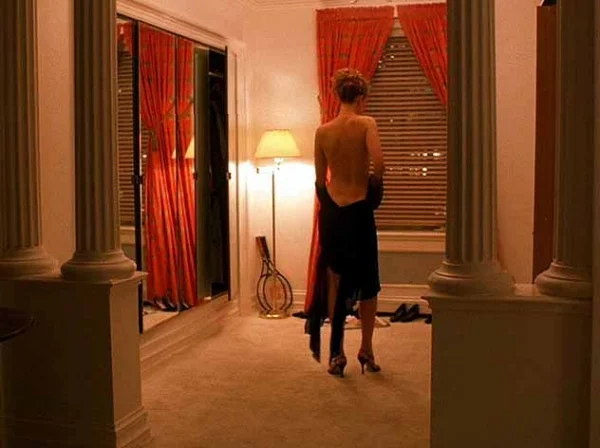
Right at the beginning of this mad, maddening, provocative, and sometimes beautifully written book, "Nicole Kidman" (Alfred A. Knopf, 304 pages, $24.95), David Thomson admits that he "loves" Nicole Kidman, a confession that is both essential and superfluous. Skeptical as we all should be about long-distance psychoanalysis, Mr. Thomson's book is more love letter than biography, both a meditation on obsession and a monument to it. He writes:

There she is in profile, her right shoulder raised, her chin lowered … with just a flap of brown cloth covering her breasts and a considerable expanse of white skin … a white that has a streak of icy blue in it, a rare milky hue. ... It is the quality of flesh you find in Ireland still, and in religious paintings of the Renaissance, and it is a mysterious fusion of the spiritual and the erotic — as pale as Cranach.

To read those words is to feel a twinge of sympathy for poor Mrs. Thomson, a frisson of anxiety for pretty Nicole, and a moment of worry for President Bush — 25 years after John Hinckley, we all know that love letters to actresses can sometimes have alarming consequences. But it's too soon to call the FBI or issue a restraining order: Mr. Thomson stresses that his love for Ms. Kidman will endure only so long as they don't meet.

That may be just as well. When eventually they do make contact (mercifully, only by phone), Ms. Kidman comes across as "a languid, superior, but amused prefect who had called a naughty boy to her study to see what he had been up to," an image that conjures up a mixture of repression, guilt, and vaguely masochistic peculiarity that may strike some (if not me — I am, like Mr. Thomson, British-born) as very English. It is an image that is, he supposes, deliberate: "[S]he tries to be what you want her to be."

Mr. Thomson is simply (so to speak) projecting, but in doing so, he nicely illustrates one of his book's wider themes. Movies are collective fantasy, their stars empty vessels into which audiences pour their dreams, longings, and delusions, a role far more demanding than any performed up on that beguiling, gorgeous screen. When Mr. Thomson claims that his love would not survive a face-to-face with his "fragrant," "ripe," "sexy," "elegant," "hot," "glorious," "ravishing" heroine, we almost trust him: He understands the danger of letting reality collide with fantasy, and he believes that cinema celebrity turns its creatures into people incapable of normal interaction.

If you think all this might be way, way too much of a stretch, you may have a point. Sometimes a trip to the cinema is just popcorn and 90 minutes in the dark, sometimes stardom is just a job. Regardless, don't let that you put you off buying this book, which is a wild, berserk ride, swerving here, careering there, and narrowly missing the ditch on more occasions than I can count. But as with "The Whole Equation," Mr. Thomson's garrulous, insistent, and unashamedly eccentric history of Hollywood, it's well worth hanging on until the end. Author of the wonderful, essential, and captivating "Biographical Dictionary of Film," Mr. Thomson has a profound knowledge of the movies and a love for them that exceeds even his adoration of the goddess from Down Under. It's impossible to read " Nicole Kidman" (how he must revel in the fact that the two of them will be linked forever, if only bibliographically) without learning far more about film, and looking at film, than the notion of a work dedicated to the life and times of a "sexy beanpole" with "commas for breasts" would suggest.

With its odd mix of biography, sharp cultural commentary, acute film criticism, and not so concealed longing, " Nicole Kidman," as should be evident by now, is neither conventional showbiz bio, nor tabloid exposé. With the exception of one deliciously prurient detail about the filming of "Eyes Wide Shut," gossip-hounds will be disappointed. If its writer is occasionally pretentious (he is), immodest (all those pages where he suggests how scripts could have been improved), and too prone to drool over Nicole's "very lovely, supple body," it only adds to this book's ramshackle, discursive, opinionated, and besotted charm. Besides, even when spouting nonsense, Mr. Thomson is more informative and entertaining than most writers. Far removed from the arid monotony of film-school Bauhaus, the sparkling rococo of his prose is a joy to read.

Above all, don't miss his sly, clever summaries of Ms. Kidman's oeuvre, particularly of those shockers he believes to be unworthy of his muse's talents, such as "Malice," a fiasco he describes as ending up shipwrecked "on the wilder shores of denouement." That's a phrase so neat that I can even forgive Mr. Thomson for disclosing his dream of Nicole as Belle de Jour being toyed with by a Gestapo officer and an "elderly Chinaman."

But can Mrs. Thomson?

Something in the Air

Miami Vice

National Review Online, August 15, 2006

Miami Vice.jpg

Michael Mann’s somewhat disappointing new movie may be called Miami Vice and the names of some of its characters may trigger recollections of explosions, pastel, linen suits, stubble, wisecracks, gunplay, and music-video brio, but it has little to do with the ground-breaking television series of 20 years ago. And no, the tawdry remake of Phil Collins’s Michelob anthem that accompanies the film’s closing credits won’t fool anyone that using the old title is anything other than an attempt to cash in on a legendary brand. This movie is Miami Vice in name only. Accept no imitations.

For the real thing, there’s the DVD player (the first two seasons of the original are available), the random enchantment of reruns or, for those of us who were around back in the day, fond memories of the evening we first saw those speedboats dance to Jan Hammer and two cops escape from the monotone restraints of conventional detective drama into the bright sun and subtropical colors of a city that didn’t quite seem to be part of America, not back then, and was like nothing else we had ever seen on television, not back then.

Quite where the idea sprung from is lost in time and competing reminiscence. Most credit the TV executive who had the idea about “MTV cops,” but Anthony Yerkovich, the show’s creator, has reportedly said that the inspiration was a magazine article on how law-enforcement agencies could use booty confiscated from the bad guys in other, unrelated, investigations. That would explain, just, the Ferraris, the powerboat, and the yacht: the threads always remained something of a mystery. What is clear is that Miami Vice would never have made the impact it did without the highly stylized vision of Michael Mann, something that was already taking shape way before (check out his 1981 movie, Thief) Ricardo Tubbs agreed to take up a “career in southern law enforcement.” As to where it came from, well, maybe there really was something in the air.

Even amid the wastelands of taste that were the 1970s there were sporadic signs of a sleeker aesthetic struggling to be born, and with the end of that decade, the end of Carter, the end of earth tones, and the beginning of better times, the country was finally ready for designer hedonism, Bright Lights, Big City, and the profound pleasures of a materialism without shame, guilt, or hair-shirt carping. The ersatz Appalachian sanctimony of the Walton clan was replaced by the glitz, bitches, and riches of those big feuding, big-spending Carringtons, and TV was all the better for it: Good riddance Mary-Ellen. Well, hi there, Fallon. Alex P. Keaton became a national icon and everyone went to the mall. The Eighties, thank God, had arrived. It was the perfect moment for Crockett’s Armani to replace Colombo’s raincoat, and thanks to Michael Mann it did. With its flash, dash, and images of consumer delight, music that was part of the script, and wildly eclectic celebrity guest stars (Lee Iacocca! G. Gordon Liddy! Little Richard! Ted Nugent!), Miami Vice reflected, shaped, and, ultimately helped define the best of all decades (oh yes, it was), and, while it was at it, transformed notions of what television could do.

But for all its innovation, the show also drew its strength and, I suspect, much of its success, from older traditions. Its hard-edged, gleeful, glittering, and sardonic portrait of a city of hoods, hoodlums, hookers and not quite hookers, crooks, cops, dames, sleaze, death, graft, and excess marked a triumphant reworking of classic film noir, the genre that, perhaps more than any other, reminds us that this country has traditions far darker than apple pie and white picket fence. For all its pastel shades, blue skies and architectural splendor, Miami Vice had much of the look, feel, and, sometimes, dialogue of a show from the gat, gal, and gumshoe days.

Crockett: “What a mess…and for what?”

Tubbs: “It’s just a job man. You’re telling me you’d rather be pushing papers in some white-collar cubicle?

Crockett: “This stuff keeps rolling in. We’re just a tollbooth on the highway.”

Tubbs: “Singing the vice cop blues again.”

Philip Marlowe would have understood.

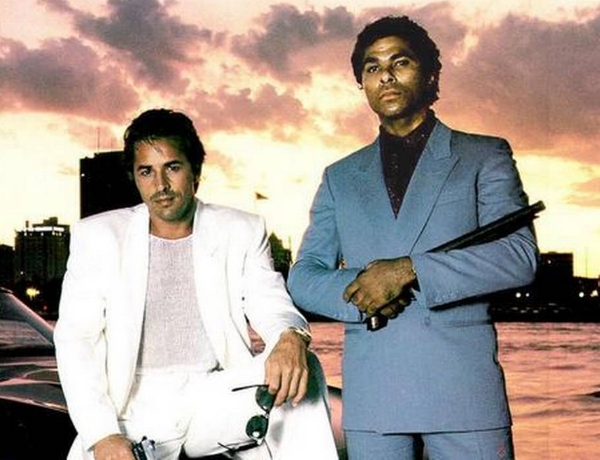
But for all the tough talk, it was never just a job. Tubbs (Philip Michael Thomas) and Crockett (Don Johnson) may have inhabited noir’s corrupt, morally ambiguous, fallen world, but, like that world’s occasionally upstanding heroes, the two detectives were ultimately on the side of the angels, knights in designer armor, with, needless to say, hints too of the old west about them: Crockett’s white suit, the cowboy’s white hat.

And then there was the buddy thing, another American staple, Butch and Sundance, Starsky and Hutch, Turner and Hooch … well, you know what I mean. True to the conventions of that amiable tradition, Ricardo and Sonny were often defined by the differences between them: Tubbs, for example, seemed so much happier than the perennially haunted Crockett (Vietnam, Sheena Easton, amnesia, there were plenty of traumas for the poor fellow to choose from), but there was never any question about the bond they shared. In Michael Mann’s new take, by contrast, Farrell and Foxx are chillier than Charles and Diana and more distant than a pair of Garbos. There’s no hint of Johnson and Thomas’s sly, affectionate joshing, and the movie’s the poorer for it.

But if Miami Vice reflected and helped shape its times, it also foreshadowed what was to come. There will be some schlubs in Sears suits who still curse them for it, but there’s no doubt that, heterosexuality pointedly buttressed by guns, girls, and macho banter, Miami-Dade PD’s two clotheshorses both anticipated the metrosexual moment and did their bit to pave the way for it. Even more interestingly, their show was an early primetime acknowledgement that America’s ethnic kaleidoscope, so long usually reduced (however inaccurately) to stark, simplistic black and white, was again being changed. From the night clubs, to the streets, to the drug lord’s high-walled mansion, Crockett and Tubbs found themselves strangers in an increasingly strange land, lawmen operating in a disconcertingly alien territory, the country’s latest frontier, where old, familiar ideas of American identity were melting, shifting, and disappearing into Miami’s new mix, the exception that became a precedent.

Good times never last. Perhaps it was inevitable in so distinctive a show, but it wasn’t too long before Miami Vice began to succumb just a little too often to its own clichés, and it wasn’t much longer before Johnson and Thomas got a bad case of the Shatners and decided to record Heartbeat and Living The Book of My Life respectively, a couple of clunkers that gave early warning of hubris and trouble to come. Budgets began to be cut, fashion sense started to fall apart. A mullet was spotted. Michael Mann reduced his involvement. By then he’d already started work on the sadly underrated Crime Story, and served up a first helping of Hannibal Lecter in Manhunter. Miami Vice itself lingered on until July 1989, and not without some grace notes, but the Eighties were petering out, the Gipper had gone, George H. W. Bush was mumbling about a kinder, gentler America, and, since February of that year Columbo’s shabby raincoat, rumpled harbinger of a more earnest era, had again been disgracing network TV.

Later, the gorgeous disillusionment of Miami Vice was extended into the darkness and depth of Mann’s three neon-flecked neo-noir epics, the elegiac Heat, the preachy The Insider and the almost faultless Collateral, three reminders that moral murk still plays well in a country that, beneath the prosperous veneer, is as restless, uneasy and uncertain as the nation to which the troops returned six decades ago. As for the rest of the old crew, only Edward James Olmos, the dauntingly dour Lieutenant Castillo, has, after a depressing run of inspirational movies, found himself the perfect role as Battlestar Galactica’s dauntingly dour Admiral Adama. Perhaps he could find a berth somewhere in his rag-tag armada for the man who was Tubbs, the highlight of whose later career was, take your pick, either acting as spokesman for the Philip Michael Thomas Psychic Connection or supplying the voice for Lance Vance in Grand Theft Auto: Vice City. Don Johnson did a little better, gamely returning to police work in Nash Bridges, a pleasure, but no Vice. Nevertheless, proving that you take the boy out of the Eighties but not the Eighties out of the boy, he did manage to marry a Getty. Well done, pal.

Satisfactory though that is, it’s somehow even better that, for all Miami Vice’s impact on television in general, and the cop show in particular, its most obvious successor on our screens today is located not in a police precinct, but in a plastic surgeon’s office, somewhere they really know that it’s surface beauty that counts. With its photogenic cast (headed by the love/hate buddy duo of McNamara and Troy), high production values, inspired use of music, and seductive mix of sex, scenery, cynicism, and scalpel, Nip/Tuck is an elegant, compelling, and thoroughly trashy tribute to the myth that Mann built.

And of course it’s set in Miami.