Making the Modern Iron Man

The New York Sun, April 25, 2008

iron man crimson dynamo

With its dusty Humvees, violent Afghan battlefields, and worries about the munitions business, the upcoming "Iron Man" is a film set firmly in 2008. That'll do, I suppose, but what was wrong with 1963? If there's any tale that deserves the chance to return to the sheen, swank, and soul of its Rat Pack, space-age, pay-any-price-bear-any-burden origins, it's Iron Man's. Conceived by comic maestro Stan Lee and launched by Marvel Comics in the final year of the Kennedy administration, "Iron Man" was Bond-in-a-can, a doughty cold warrior manufactured in the jungles of a Vietnam that still could be won. Fearless, noble, and smart, he was a mighty, mechanized embodiment of the belief that there were no limits to what the combination of American spirit and know-how could achieve.

But that sentiment, however admirable, has since found somewhat mixed consequences abroad.

You won't find any trace of such reservations in "Tales of Suspense," no. 39. That's the issue in which Marvel's readers were first introduced to Tony Stark, the man who became Iron. He's a millionaire industrialist and scientific genius, a member of the military-industrial complex so patriotic that even President Eisenhower would have approved, an inventor and supplier of the high-tech armaments needed to defend America from the communist menace: Within a few frames of the book, Stark is in South Vietnam testing some miniature mortars.

They work ("the reds never knew what hit them!"), but the mission collapses into chaos when Stark steps into a booby trap. He regains consciousness to find himself desperately wounded (fragments of shrapnel are edging ever nearer his heart) and a captive of "red guerilla tyrant" Wong-Chu. Drafted by this "grinning, smirking, red terrorist" to design armaments for communism, Stark secretly builds an armored suit instead. Crucially, it includes a gizmo to fire up his faltering ticker. Lethally, it includes weapons to fire on the enemy. Stark dons the armor. Iron Man is born. Wong-Chu dies.

Once back in America, Iron Man does what superheroes once did: rough up a series of monsters, creatures, mutants, and villains with a wild, grand, uncomplicated élan. And it's striking that there are more Marxists than Martians in their midst. This was a time when Americans knew who the real bad guys were:

"A telegram for you, Mr. Stark...from behind the Iron Curtain!"

"From Commieland? Sounds like trouble, Pepper!"

Spy rings are dismantled, and the gap-toothed, near-Neanderthal Red Barbarian ("A top red general ... noted for his brutality!") is thwarted. "Pudgy, scowling" Nikita Khrushchev sends the Crimson Dynamo ("vast electrical powers") to destroy Iron Man, but the Dynamo fizzles. The Unicorn ("Back, you capitalist fool!") is blunted, and the beautiful Madame Natasha ("I only serve the cause of international peace!") turns out to be insufficiently seductive. Slab-faced Boris ("Boris does not walk around obstacles ... it is easier to hurl them aside ... so!!") fails, too, gunned down by the former Crimson Dynamo — who had earlier been won over to the American Way. But the American Way is not only stronger; it's also kinder. When, after a three-issue-long struggle in "the tiny, neutral nation of Alberia," Iron Man defeats Bullski The Merciless (Titanium Man), he is, naturally, merciful: "Lucky for you, I'm not a red! I can't continue to attack a helpless enemy!"

No, he couldn't. A sense of America's essential decency runs through Marvel's depiction of the country that Iron Man risks so much to defend. It has its rough edges, sure, but at its core, Iron Man's America is a socially cohesive, hardworking, and fundamentally good-hearted place. It's neither sappy nor nostalgic enough to be Bedford Falls, but it's still a notion of nation that Frank Capra would have appreciated, one made all the more compelling by its distance from, and closeness to, the truth. It's a we-the-people fantasy that helps explain why Stark agrees to appear before a congressional committee that could compel him to disclose that he and Iron Man are one and the same: "No one has the right to defy the wishes of his government ... not even Iron Man!"

Howard Roark, he's not. Howard Hughes, on the other hand, well, the saturnine, pencil-mustached Stark, a regular at El Morocco and the Stork Club, "is rich, handsome ... constantly in the company of beautiful, adoring women ... linked with every actress and society beauty from Hollywood to Rome ... the dreamiest thing this side of Rock Hudson." When Mr. Lee subsequently acknowledged the similarities between the 20th century's two greatest playboy-industrialist-scientists, he wasn't giving too much away.

But, in a twist that would delight Cotton Mather, if not Howard Hughes, Stark's need to conceal his life-sustaining iron chest plate means that there's a limit to how far he can go with the ladies. His relentless partying only emphasizes what was taken from him in Vietnam. It's a sort-of-disguise, and it's a sort-of-distraction. It's also an effective device to keep pretty Pepper, his loyal, adoring secretary, at arm's length: A truly tragic hero, Stark has lost what remains of his heart to her, but he cannot risk a relationship: "Marriage is for other men, not for a fella who lives in the shadow of death!"

Back in the real world, however, an infinitely greater tragedy was unfolding. America, too, was being horribly wounded in, and by, Vietnam, wounds that changed it in ways so profound and pervasive that comic book red-white-and-blue no longer found so many takers. Stark's thinking, as the smug saying goes, "evolved": The old Iron Man is — like El Morocco, the Stork Club, and South Vietnam — no more.

But he, like they, and their world, should be remembered and, sometimes, mourned.

Cops Gone Wild

Street Kings

The New York Sun, April, 11, 2008 

"People sleep peaceably in their beds at night," George Orwell once wrote, "only because rough men stand ready to do violence on their behalf."

That society sanctions the use of force to protect itself is neither surprising nor controversial. What we debate instead is how rough those men can be and how, exactly, they can be controlled. We live, so the story goes, in a nation of laws, but we also seem to accept, if quietly, that some laws will occasionally have to be broken if others — the laws we really care about — are to be enforced. When that rough Dirty Harry went a little too far, nobody, other than unlucky punks, persnickety lawyers, and senior policemen, seemed to mind too much. Nor, over the course of five movies, did his audience.

Sometimes, of course, a rogue cop is just a rogue cop. The difficulty of distinguishing between good policemen and bad is, I suppose, the theme trying to survive the splattering gore, rampaging clichés, and flying bullets that otherwise define the noisy, nasty, but sporadically watchable "Street Kings," by the sophomore director David Ayer (who made his debut in 2005 with the oppressive and pretentious "Harsh Times").

Mr. Ayer has explored the world of the police before, but he did so as a screenwriter on the excellent "Training Day," the appalling "Dark Blue," and the idiotic "S.W.A.T." On this occasion, the screenwriting credits are divided among, encouragingly, the author James Ellroy (who also wrote the original story), ominously, Kurt Wimmer (a writer-director best known for two pieces of dreary sci-fi sludge, "Ultraviolet" and "Equilibrium"), and, mysteriously, Jamie Moss (who is, apparently, now slated to work on an upcoming manga epic).

Whatever the hopes and fears stirred by the thought of Messrs. Ellroy, Wimmer, and Moss, "Street Kings" remains a distinctive Ayer production, starting with its location. As he seemingly rarely misses an opportunity to mention, Mr. Ayer spent part of his teens in South Central Los Angeles, and it is becoming to him what the Upper East Side has been to Woody Allen — trademark, canvas, and, if he's not careful, dead end. "Street Kings" features the usual menacing streetscapes of a gang-ruled Los Angeles, the usual elite unit-turned-rancid, the usual stash of concealed dollars, the usual banality masquerading as profundity, and the usual pantomime machismo. The film is too one-dimensional to be noir: Any ambiguities are illusory, all conundrums easy to decipher, and the view taken of the police is too predictably jaundiced to be of any real interest.

That said, "Street Kings" is partly redeemed by the performances of those few members of the cast allowed to develop their roles beyond stereotype, notably Forest Whitaker as the manipulative, clever captain in charge of Ad Vice, this particular film's rogue unit. His Captain Wander is an officer who appears to barely remember why he joined the force in the first place. He may still cling to some notions of frontier justice or, at least, frontier rationalizations ("At the end of the day it's order that counts. Why sweat the details? Gotta break some eggs to make an omelet"), but for the most part, Wander's preoccupations are power and control; even the money he has accumulated is just a means to those ends.

Cool, self-possessed, and restrained, his lazy eye only serving to emphasize his vigilant, calculating authority, Mr. Whitaker is all too believable as a leader able to forge a fierce loyalty among his men — a loyalty that has transformed them into something between a cult and a tribe, a brotherhood that sets its own rules.

As weary viewers of Mr. Ayer's early films will know, male bonding is part of the shtick, along with sporadic suggestions that the police themselves are, in a sense, just another gang (something in this case also implied by the title). In this movie, though, these ideas are handled more subtly than usual, and from time to time, they even persuade. Thus we note that there's nothing distinctively LAPD about Ad Vice's style. Neatly groomed and smartly dressed, they look like the ambitious middle management (check out Jay Mohr's performance) of a successful corporation, albeit one that's gone feral. The winning's the thing. The group's the thing.

But it's a group that's under suspicion. Internal Affairs, in the form of Hugh Laurie's insinuating, tricky, and nicely observed Captain Biggs, is circling. Biggs realizes that a shooting witnessed by Ad Vice's Tom Ludlow (Keanu Reeves) may present an opportunity to break the unit open. The embattled Ludlow may be the roughest of the rough ("the tip of the f---ing spear"), but he is crumbling. His wife is dead, he's drinking too much, he may be the target of a frame-up, and, most discouraging of all, he's played by Mr. Reeves, the king of coma. Referred to at one point as a "guided missile," Mr. Reeves's Ludlow is better described as a piece of wood. The movie is meant to revolve around Ludlow's struggle to do the right thing (he's basically one of the good guys), but with a near-catatonic Keanu in the role, it's difficult either to care or, indeed, to notice.

Yes, "Street Kings" has its moments, but on the whole, it's better to move along: There's nothing (much) to see here.

Children of the Revolution

Catriona Kelly: Children's World

National Review, March 5, 2008

It is fair to assume that any volume with space for a discussion of the "crisis" in mid-20th-century Soviet children's theater is aimed at a specialist audience. That said, if the subject of "Children's World" (Yale University Press, 736 pages, $45), Oxford professor Catriona Kelly's immense, imaginative, and thoroughly researched new book — a history of child-rearing in Russia between the twilight of the tsars and the fall of Gorbachev — is somewhat academic, her prose style is not.

She writes clearly, keeps her use of pedagogic jargon to a minimum, and even leaves room for occasional flashes of dry, donnish humor. Describing the shabbily manufactured playthings of the inter-war years, she recounts how "smudgy and ungainly wooden figures passed for dolls, shaggy and savage-looking hairy lumps for toy animals." Meanwhile, locating a kindergarten on the top floor of an elevator-less Moscow building was evidence of the way that "the eccentricities of centralized planning made themselves felt."

High Table witticisms aside, this book's real value for the lay reader comes from the unusual perspective it offers on the wider Soviet experience, a perspective sharpened by its author's eye for the telling detail. Lenin's wife, Nadezhda Krupskaya, educationalist, scold, and harridan, was, Ms. Kelly records, opposed to birthday parties (they served no educational purpose and, horrors, emphasized a child's individuality). Opposed to birthday parties! That tells you almost everything you need to know about the elaborate fanaticism of the dreary Mrs. Lenin. It also says quite a bit about the cause she served: The Bolshevik revolution was designed not only to remake Russia, but to transform human nature itself.

Not all aspects of the approach taken by the fledgling Soviet bureaucracy to the treatment, education, and upbringing of children were, as Ms. Kelly shows, negative. That's not to claim (and she wouldn't) that the early period of communist rule was a time of educational liberalism — at least in any meaningful sense. Youngsters may have been given more opportunity to express themselves than in either the typical tsarist or Stalinist school, but only within strict ideological limits. What's more, many of the reforms of that era, and even some of the freedoms, must primarily be understood as devices to promote the state's assault on the family, an institution the Bolsheviks regarded with deep suspicion. Under the circumstances, it's easy to imagine that the return to social conservatism (and, with it, more regimented schools and a more conventionally organized curriculum) that accompanied Stalin's rise to supreme power in the 1930s was welcomed by many parents: One of this book's rare weaknesses is that we are never really told if that was indeed the case.

The inspiration for the change in direction under Stalin was, of course, neither philanthropic nor democratic. It merely reflected his willingness to use the appeal of both restored order and, for that matter, revived Russian nationalism (something that would have been taboo in Lenin's Kremlin) to shore up support for his dictatorship. In schools, as elsewhere, the revolution's egalitarianism — or, more accurately, collectivism — was overlaid with the cult of state and leader. The collective had been transformed into a congregation. Egalitarianism evolved into patriotic obligation as much as moral duty. The primary function of the educational system became the production of docile, loyal and subservient citizens. In some of the most interesting passages in her book, Ms. Kelly explains how this effort was orchestrated — and, often, how subtly. Its traces could be detected even in the way that children were portrayed in fiction, reportage, and textbooks. They were demoted from being the spunky, assertive heroes of revolutionary lore into altogether more passive creatures, forerunners of the dutiful and deferential Homo Sovieticus they were being molded to become.

Now, it could be argued, quite reasonably, that most schools in most countries try to churn out good citizens, however they define the term. Furthermore (as Ms. Kelly also acknowledges) what may seem like extreme regimentation to us would have appeared far less startling to the Western observer of, say, half a century ago — an epoch when schools on either side of the former Iron Curtain would have generally been much more disciplined than they are today.

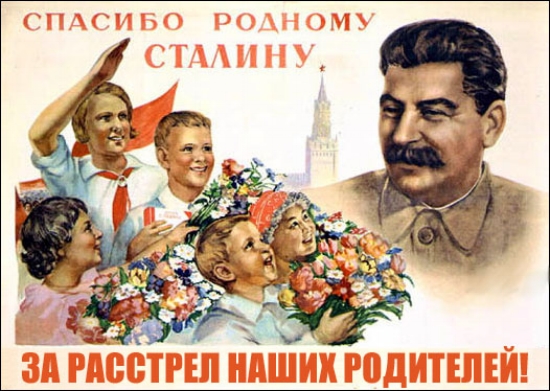
Nevertheless, this book leaves no doubt that Soviet regimentation was indeed extreme. While Professor Kelly doesn't dwell on the cruelties of communist despotism, she never succumbs to the usual bien-pensant temptation of trying to find a supposed moral equivalence between East and West. This is demonstrated most strikingly, perhaps, by her decision to include (among a consistently well-chosen range of illustrations) a page of mug shots taken from the archives of a secret police home for "Family Members of Traitors to the Motherland." These particular family members cannot have been more than 9 or 10 years old. Their faces stare out, bewildered, haunted, trying to please, victims of a tyranny that could not, would not, forgive their genes.

In the end, ironically, the successes of Soviet education — standards rose, facilities were upgraded, some degree of independent thinking came to be acceptable — helped foment the widespread disillusion that contributed so much to the regime's eventual implosion. "In a pattern that comes up again and again in Soviet history," Ms. Kelly writes, "rising standards brought rising expectations." She might have noted the additional irony that those rising standards also taught the Soviet population that its expectations would never be met by the system in which they had been trained for so long, so hard, and so cynically to believe.

The rest is history.

Fixin' Nixon

Conrad Black: Richard M. Nixon - A Life in Full

The New Criterion, March 1, 2008

Nixon.jpg

Judging by the tone and the content, if not the length, of his epic, sprawling, and (on several levels) fascinating new biography of Richard Nixon, Conrad Black is not inclined to attempt much analysis of what, ultimately, made Tricky Dick tick.. There have, he snorts, “been many amateur psychoanalyses of Nixon, [but] none of any apparent validity or value.” None? When Black refers to the “psycho-media speculation” contained within press coverage of the various medical disasters that befell the former president in the immediate aftermath of his resignation, he doesn’t mean it as a term of approbation.

Now it is true that Nixon did have to put up with more than his fair share of long-distance psychoanalysis (so much so, in fact, that when David Greenberg wrote Nixon’s Shadow [2003], a valuable study of shifting perceptions of the thirty-seventh president, he devoted an entire chapter to “the psychobiographers”), and more than a fair share of that was nonsense, make-a-buck flimflam, or propaganda masquerading as science. At the same time, there can have been few presidents whose behavior did more to attract this sort of attention. Nobody should expect the occupants of the Oval Office to be regular folks, and few of them have been. Nevertheless, even when compared with other members of this often eccentric fraternity, there’s something about Nixon’s psyche that makes it stand out in its strangeness, its melancholy, its noir, and its mystery.

In part, of course, this reflects Nixon’s misfortune (for a man who achieved so much, Nixon was, as Black demonstrates, remarkably unlucky) to be living at a time when increasing (and frequently hostile) media scrutiny combined with the mid-century infatuation with psychiatry to ensure that almost no aspect of his career or character was not picked apart. If his predecessors had received similar treatment, Nixon would not have seemed quite so peculiar.

Nixon himself understood that he was something of a puzzle, and rather relished it. In President Nixon—Alone in the White House (2001), his intriguing account of the Nixon presidency, Richard Reeves recounts how Bob Dole once told Nixon “that he was destined to be misunderstood because he was too complicated a man to be totally understood.” Nixon had responded to that with enthusiasm, saying, “Aha! Now you’re getting somewhere.” Reeves then goes on to argue that Nixon “did not want to be understood. If other men thought he was unreadable, then they must think there was a great deal more inside him than just a powerful mind voyaging alone in anger and self-doubt.”

You can debate the second part of that diagnosis, but not the first: Nixon clearly did not want to be understood. That doesn’t mean, however, that a biographer should avoid trying to do so. Black doesn’t, but his efforts too often come across as more a matter of (deftly chosen) adjectives than anything more substantial. Even if one makes allowance for Black’s distaste for such analysis, his failure to deliver more of it diminishes the roundedness of his book, and is, in such a perceptive author, a disappointment. What his readers are offered instead is a biography where, with the notable exception of the canny, and feline, depiction of Kissinger, politics tend to be handled more convincingly than personality, a chronicle where the emphasis is on the event rather than the individual. Black, the author of a notable biography of FDR, is evidently a writer who prefers to focus his attention on the external, on great men, on momentous events and the grandest of themes. The rest, I’d guess, he sees as trivia, little more than gossip. Nixon would approve.

To read Black’s book is to be treated like the guest at a lavish dinner party presided over by an opinionated, brilliant, mordantly amusing, powerful, and loquacious host. As the port is passed round and the cigars light up, the host holds forth—for hours and hours (this work is easily over a thousand pages long) and hours. Glasses are drained and doubts drowned. Stories tumble out, anecdotes cascade. Portentous verdicts are cast: the opening to Communist China“was an imaginative diplomatic initiative of great geopolitical consequences … but to the extent it was sold, then and subsequently, as a combination of Columbian exploration, Bismarckian diplomacy, and Jesuitical missionary work, it was a confidence trick to reelect the president, pad the CVs of the two ex- plorer/diplomat/pilgrims, and garnish the post-governmental wallet of Kissinger.” Lapidary pronouncements are made: “Nixon’s trousers were slightly too short (often the case with Americans).” Widespread rumors are discounted: Nixon tells the author that “Edgar [Hoover] had a lot of files, but I had a lot of files too, and there was nothing in them about Edgar in a red dress.” Erudite digressions are explored: “Disraeli was rivaled only by Churchill as the greatest wit of all British prime ministers.” And insidery recollections are shared:

His office was another Nixonian classic. It was reached by walking through a large travel agency on the ground floor of a building on a suburban boulevard, then taking an elevator up two floors, opening a box with a bronze eagle on it, and announcing oneself on the telephone receiver within.

All this is filtered through, and often illuminated by, our host’s distinctive, distinctly orotund, use of language. He deploys a startling, imposing, and baroque phraseology. Black’s language is never dull, but it does teeter between the enlightening (the Democratic-led “assault on Nixon” had become “the rape of the executive”), the arch (“the influx of newcomers to California … tended to be conventional southerners well to the right politically of the egalitarian EPIC group, which had believed in collective economics and the absence of complexional distinctions”), the absurd (“malignant Nibelungen within the IRS”), the Agnew (“It was another herniating levitation of pandemic hypocrisy”), the sly (“Kissinger tried a fully gymnastic range of explanations”), and occasionally the bizarre (Jesse Jackson as “rutting panther”).

And, no, as enjoyable as the occasion may be, the magnate’s guests at this splendid feast will never entirely be able to shake off the sense that they are receiving a message de haut en bas. Black, Conrad Black, Lord Black of Crossharbour, was a newspaper mogul in the old style, a mover, a shaker, a macher, and it shows. Nixon gives “the annual Atlantic Richfield Dinner address in London in the autumn of 1992, and dazzle[s] the most eminent dinner audience that city could produce,” a dinner audience that included Lord Black, but not me, or in all probability, dear reader, you.

None of this is to detract from Black’s ability to spin a “rocking, socking” (to borrow a term Nixon used to describe his more vigorous campaigns) yarn. A thousand pages, maybe, but they don’t pall, and they are dauntingly thoroughly researched. The narrative is comprehensive, detailed, generally judicious and, in its careful assessment of Watergate, is closer to a plea in mitigation than an outright case for the defense. Overall, it’s almost impossible and largely pointless to highlight any particular topic covered in those thousand pages, but if I have to choose one, it would be the subtle and sympathetic way in which Black handles Nixon’s tortured and complex dealings with a truly masterful trickster, the enigmatic, cunning, and ruthless Eisenhower.

Where the book fails is in “The Transfiguration,” the book’s ambitiously titled final chapter. The picture Black paints is of the painstaking, carefully crafted step-by-step creation of the last “new Nixon”—a largely rehabilitated figure, a much consulted, highly respected foreign policy sage, the grandfatherly “most successful ex-president in the country’s history,” a figure whose fate was apparently beginning to prick what Black refers to with characteristic melodrama as the “Great American Puritanical Conscience.” This overstates matters. With the passing of the years, we have indeed witnessed the emergence of a fairer, more balanced assessment of Nixon (and this biography will help in that process). Some of the wilder accusations of the Watergate era have now been shown up for the ludicrous overreaction they always were, and as they have faded, so some of the luster has, at last, been restored to Nixon’s reputation.

At the same time, it remains unclear just how seriously people really took Nixon’s advice in those final years. Not so much, I reckon. As for the circles in which he was allegedly regarded as either martyred or, well, transfigured, they are, in their very different way, unlikely to have been much more representative than those of Pauline Kael; the New Yorker critic was supposedly unable to work out how Nixon could have won his 1972 landslide when “no one she knew” had voted for him (as it happens, she didn’t actually say that, but the story’s too good not to repeat). What works for Atlantic Richfield will not work so well in Atlantic City or, for that matter, anywhere else in America outside, perhaps, the Beltway and, certainly, Yorba Linda. The restoration of Nixon’s image is far less complete than Black would have us believe.

It may not be the most scientific of tests, but the fact that, as David Greenberg records, masks of Nixon were the top-selling Halloween costumes in October 2000, over a quarter of a century after his resignation, must mean something. In the American popular imagination Nixon will always be seen primarily as a villain, albeit one who can sometimes be played for laughs, or pathos, or both. There were traces of that in Frank Langella’s enthralling performance as the fallen president in the play Frost/Nixon, but Nixon fans may not find it entirely reassuring that Langella was previously best known as a notably effective Dracula.

It’s difficult not to think that, in writing the final chapter in the way he did, Black may have allowed himself to be swayed by his hopes for his own future. In a still-disputed verdict, Black was found guilty last year of defrauding Hollinger International, the company he used to lead, as well as of obstruction of justice. He is currently appealing. Under the circumstances, the idea that Nixon (who was a friend of Black’s) was able to pull off a comeback may well be a source of comfort, inspiration, and, Black might hope, precedent. The author himself has preferred to downplay the extent to which he identifies, or should be identified, with his subject, but choosing, while under indictment, to write a supportive (if still critical) life of a public figure whose most well-known line was that he was “not a crook” may be revealing and is indisputably provocative.

What Black cannot surely deny is that his understanding of what happened to Nixon has been colored by his own problems, whether it’s on the reluctance of Henry Kissinger (once an appointee of Black’s to the Hollinger International board, but now, it seems, somewhat estranged) to stand by the beleaguered Nixon or on the way that the use by prosecutors of plea bargains and whistleblowers has“encouraged a system of suborned or intimidated perjury, or at least spontaneous clarity of recollection, to move upwards in the inculpation of officials in any organization where wrongdoing is alleged.” As so often, Black makes a good, if over-elaborately expressed, point.

It’s worth adding that whatever else this volume reveals about Black’s state of mind, its completion under what in the introduction are referred to as “very distracting circumstances” is also a phenomenal demonstration of discipline, willpower, and self-control. Yet again, Nixon would approve.

The Lives of Others

Orlando Figes: The Whisperers

Moscow, February 1991 © Andrew Stuttaford

Moscow, February 1991 © Andrew Stuttaford

It has been the worse part of a century since the bloody birth and savage adolescence of the Soviet state, but the events of those years are still obscure — lost in time, muddled by propaganda, and treated, even now, as the stuff of spin. Those terrible decades remain camouflaged, murky and mysterious, glimpsed mainly in shadow or in tantalizing, elusive outline. They have been best illuminated not in nonfiction accounts, but in novels, short stories, and verse — by Solzhenitsyn’s zek grateful for his day “without a dark cloud,” by the deadpan of Shalamov’s spare, unsparing Kolyma Tales, by Ahkmatova’s torn, desperate, eloquent laments:

This was when the ones who smiled
Were the dead, glad to be at rest.
And like a useless appendage,
Leningrad Swung from its prisons.
And when, senseless from torment,
Regiments of convicts marched,
And the short songs of farewell
Were sung by locomotive whistles.
The stars of death stood above us
And innocent Russia writhed Under bloody boots
And under the tires of the Black Marias.


That’s not, of course, to deny that there have been some excellent histories of that era. One of the most notable in recent times was Orlando Figes’sPeople’s Tragedy: The Russian Revolution 1891–1924. Professor Figes, a British historian, is now extending that saga deeper into the nightmare that enveloped the Soviet Union with The Whisperers, a massive, sprawling, and unsettling book billed as a description of “private life in Stalin’s Russia.” In researching it, Figes has made extensive, and extraordinary, use of freshly opened family archives and a large number of personal interviews. As well he might. To understand the founding period of the USSR is tricky enough. To uncover the private lives, and thoughts, of those who lived through it, inhabitants of a society where reticence, conformity, and role-playing could be, even at home, matters of life and death is doubly difficult. Then there is, as Figes writes, this:

People with traumatic memories tend to block out parts of their own past. Their memory becomes fragmentary, organized by a series of disjointed episodes (such as the arrest of a parent or the moment of eviction from their home) rather than by a linear chronology. When they try to reconstruct the story of their life, particularly when their powers of recall are weakened by old age, such people tend to make up for the gaps in their own memory by drawing on what they have read, or what they have heard from others with experiences similar to theirs.

To accept this logic is to accept that seminal accounts of this period, such as The Gulag Archipelago or Eugenia Ginzburg’s Journey into the Whirlwind, have evolved from, respectively, works of collective history and individual recollection into the imagined, or partly imagined, autobiographies of countless victims of the terror. Figes himself claims that “many Gulag survivors insist that they witnessed scenes described in . . . Ginzburg, Solzhenitsyn, or Shalamov, that they recognize the guards or NKVD interrogators mentioned in these works . . . when documentation clearly shows that this could not be so.” Figes never specifies what he means by “many” (the numbers involved are probably, I suspect, less than that adjective implies), but there can be little doubt that the phenomenon is real. Complicating matters further, memories have been distorted not only by trauma and time, but also by wishful thinking:

People who returned from the labor camps . . . found consolation in the . . . idea that, as Gulag laborers, they too had made a contribution to the Soviet economy. Many of these people later looked back with enormous pride at the factories, dams, and cities they had built. This pride stemmed in part from their continued belief in the Soviet system and its ideology, despite the injustices they had been dealt, and in part, perhaps, from their need to find a larger meaning for their suffering.

Additionally, as Figes reminds us, it’s a viewpoint that finds an echo and reinforcement in the widely held opinion that victory in the “Great Patriotic War” can be seen as some sort of justification for the horrors of Stalinist rule.

These ideas are bizarre, but for large numbers of Russians they beat the alternative: facing up to just how much was lost, thrown away, or destroyed in pursuit of a delusion and in the name of a tyrant. This recourse to the comfort of denial and the ease of evasion is of more than academic interest. It helps explain the Putin government’s approach to the Communist past. A definitive reckoning with history, that long-overdue Soviet Nuremberg, is too daunting to contemplate, too potentially demoralizing for the nation as a whole, too incriminating for a still-compromised Kremlin establishment. Speaking last year in support of a new manual designed to help the teaching of Russian history in the country’s schools, Vladimir Putin conceded that aspects of the former dictatorship were “problematic.” Nevertheless, he went on to say that Russia could not allow “other states” to “impose a sense of guilt” upon it. The words he used reveal both unease about the past and, implicitly, a desire to reshape it.

If Figes’s analysis casts doubt on the reliability of some accounts of the Stalin years, those he has unearthed for the purposes of this book add fascinating detail to what we know, or think we know, of that epoch. Nevertheless, to view The Whisperers as a comprehensive survey of “private life in Stalin’s Russia” would be a mistake. For example, there is not a great deal about how it was to experience, and, where possible, endure, the camps and prisons that have come to symbolize the Stalinist order, an aspect of “private life” that Figes appears to believe lies mainly outside the scope of his chosen topic; I’m not so sure.

Meanwhile, at the other end of official approval there is, with one critical exception (the writer Konstantin Simonov, a man who was both too tough and too weak to avoid aligning himself with the system), less than might be expected about those who actively supported the regime or who, in one way or another, flourished under it. As for those “ordinary” Russians who managed, so far as they could, to keep out of the way of history, they feature relatively rarely. Readers looking for more on their lives would do better to turn to the evidence collected in Sheila Fitzpatrick’s Everyday Stalinism, and Stalinism as a Way of Life, edited by Lewis Siegelbaum and Andrei Sokolov.

What Figes offers is something less all-embracing. It is, primarily, a look at lives spent on the edge, neither at the heart of darkness nor untouched by it. The stories he recounts could not, by definition, fail to be interesting, but however skillfully he tries to weave them together (and Figes is a highly accomplished storyteller), the final picture is not as coherent as it might be. It’s difficult to avoid the suspicion that on this occasion this talented author’s reach was greater than his grasp.

As a result, the principal value to be derived from The Whisperers is almost incidental to what is supposed to be its main theme. In particular, the book’s earlier sections are a remarkable evocation of the sheer scale of the Bolshevik project. This was, in reality, nothing less than an attempt to remake man according to the dictates of what was, for all practical purposes, a millennial cult run by a lethal combination of fanatics, sadists, and opportunists. Nothing could be allowed to stand in the way of this task, and, with the resources of the state behind it, nothing was. In such a climate, the family, the most redoubtable bastion against totalitarianism, was bound to be a key target of the regime. And, as the narratives selected by Figes underline, that is what it became. The conflict, persecution, and occasional moments of stubborn resistance that ensued make up the grim, gripping, and horrific drama around which this book revolves.

But if the Bolsheviks proved effective at sweeping away much of what had preceded them, the ramshackle utopia with which they replaced it was a broken-backed wreck. Another striking aspect of the oral histories contained in this book is how often they share a subtext of astonishing material deprivation and hardship. If the Soviet Union was, as its supporters abroad liked to claim, a “new civilization,” it was one with large elements of the pre-modern about it.

And the physical squalor was, as Figes repeatedly demonstrates, matched by the moral; this, indeed, inspired the book’s title. The Stalin years, he writes, left the Russian language with “two words for a whisperer — one for somebody who whispers out of fear for being overheard . . . another for the person who informs or whispers behind people’s backs to the authorities.”

Mr. Putin, I think, would approve.

Spies Like Us

Joseph Weisberg:  An Ordinary Spy

The New York Sun, January 16, 2008

Weisberg.PNG

Mark Ruttenberg, the hero of "An Ordinary Spy" (Bloomsbury, 288 pages, $23.95), Joseph Weisberg's deft, sour, and clever new novel of espionage, bureaucracy, and disenchantment, is — it is true — a spy. But he's no James Bond.

Just read what happens, or doesn't, when he shows up for a celebration at the Russian embassy in the country to which, as a novice CIA agent, he has recently been posted. The poor fellow fails to make any real progress with the general who is the most important target in the room, he gets "tipsy" on two shots of vodka, and when, finally, he runs into a girl he has been trying to recruit, he is not only snubbed, but also floundering:

I had an impulse to rush after her, grab her arm, and spin her back around. But I didn't know what I'd do after that. Did I want to kiss her? I'd always found Daisy attractive … [b]ut I'd wanted to recruit her, not sleep with her.

Good God, man, get a grip! In cloak-and-dagger Valhalla, 007 is, undoubtedly, shaking his head (as well as that third martini). The contrast between his stumblebum spy and Ian Fleming's swashbuckling psychopath is, however, one that evidently amuses Mr. Weisberg. As fans of his debut novel, the lovely and beguiling "10th Grade" (2002), will recall, Mr. Weisberg is a sly, dryly funny writer, and even in the far more downbeat surroundings of his new book, he sporadically allows himself to unleash the occasional fleeting and stealthy joke at the expense of the luckless Ruttenberg and the frustrating, dull, drab routines that make his a life far removed from the spy game's glittering, legendary, and deceptive glamour.

But the disillusion, and not only Ruttenberg's, that permeates this book is generally closer to the "quiet desperation" of old Thoreau's loopy ravings than any profound ideological crisis; there is no hint of the majestic decay and mythic exhaustion that run through le Carré's best, possibly because Mr. Weisberg is describing an agent at the beginning of his career — an agent working, what's more, for a nation that, unlike George Smiley's Great Britain, is unwilling to accept eclipse, humiliation, and relegation to the second tier.

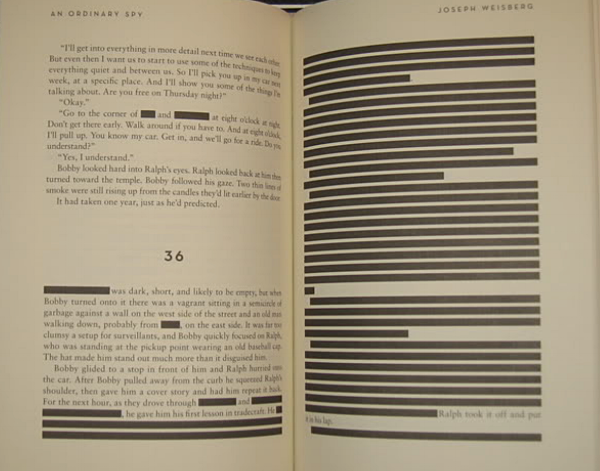
Nevertheless, there are moments when readers of "An Ordinary Spy" may worry that its portrait of the CIA as a cesspit of careerism, groupthink, and deadening conventionality may be a warning that the United States is poised to follow its transatlantic cousin into decline. The fact that the book's author formerly worked for the agency (he was employed there for three years and, by the time he quit, was in training to become a "case officer" much like Ruttenberg) only adds to the concern: Even if he never advanced very far in the intelligence service, Mr. Weisberg must have learned enough to offer up an accurate description of its workings. Whether that is, in fact, what he has done is a different question (I've no idea one way or another), but his writing feels authentic, an impression he tries to reinforce by displaying his text in a "redacted" format that is simultaneously bogus and real. As a former CIA man, he was indeed required to submit his manuscript to Langley's Publications Review Board, but ahead of doing so, he anticipated what the board might ban. Both the board's deletions and his own pre-emptive strikings-out are evidenced by the thick black lines that are the censor's impenetrable spoor, with no way to distinguish between them.

It's a device that sometimes irritates, but it helps transport outsiders into the secret world, at least as they might imagine it, a world made all the more mysterious, all the more opaque, and all the more disturbing by the fact that Mr. Weisberg's readers aren't actually informed where within it they have ended up: The country where the greater part of the drama unfolds is never disclosed. If I had to guess, it's located somewhere in Central Asia, the Middle East, or North Africa, but we're never told for sure.

And maybe that's the most effective device of all. The United States now finds itself enmeshed in a probably endless, possibly apocalyptic struggle against an adversary that knows no limits, no rules, and no borders, a conflict where every diplomatic outpost, but particularly those in countries of the type that Mr. Weisberg doesn't name, is a listening station, a sentry box, and perhaps more. In one form or another, such outposts have existed whenever there have been nations with interests to protect. They have been manned by guards, by observers, and by spies; patriots often, ideologues occasionally, but for the most part, ordinary men doing a job that is rarely extraordinary, and changes history even less.

And it is the story of two of these ordinary men, these ordinary spies, that Mr. Weisberg sets out so skillfully. There's no great message that underpins this novel, no intimations of coming American collapse: just a tale well told of lives that were meant to be spent watching, probing, plotting, guessing, and double-guessing, lives that, it turns out, go somewhat awry, lives that are illuminating only in their insignificance, and yet they are lives on which yours, and mine, may depend.

Rebranding America?

National Review Online, January 10, 2008

Obama.jpg

New Hampshire has gone and done what New Hampshire has gone and done, but it won’t be long before Obamania picks up speed again. As it does, so will the idea, compelling, thrilling, and thoroughly misleading, that an election victory by the junior senator from Illinois will win over that large portion of the world that has, so runs the story, been alienated by the wicked George W. Bush, but which still, even now, wants to love America.

Writing over at “The First Post,” just before the Iowa vote, the distinguished British journalist, Sir Peregrine Worsthorne, a conservative of sorts, had this to say:

In many parts of the world, the United States is now regarded as “the evil empire”. This is entirely President Bush’s fault. Both his actions and his rhetoric have given the impression of a superpower bent on world dominion. If this had happened in any other country it would require decades, if not centuries, to undo this damage. In the case of America, however, it can be put to rights almost at one, or at most two, strokes. Stroke number one would be for the Democrats, starting this week in Iowa, to nominate Barack Obama as their presidential candidate, and stroke number two, for the electors to put him into the White House with a landslide majority. By these two actions America would be rebranded. That the world’s shield and conscience should have a young and handsome black senator, touched with nobility, waiting in the wings at this particular juncture is little short of a miracle. It is exactly what the doctor ordered.

Obama fan Andrew Sullivan, another conservative of sorts, made a similar point last year, arguing as follows:

What does [Obama] offer? First and foremost: his face. It could be an effective potential rebranding of the United States. Such a rebranding is not trivial – it’s central to an effective war strategy. The war on Islamist terror, after all, is two-pronged: a function of both hard power and soft power. We have seen the potential of hard power in removing the Taliban and Saddam Hussein. We have also seen its inherent weaknesses in Iraq, and its profound limitations in winning a long war against radical Islam. The next president has to create a sophisticated and supple blend of soft and hard power to isolate the enemy, to fight where necessary, but also to create an ideological template that works to the West’s advantage over the long haul. There is simply no other candidate with the potential of Obama to do this. Consider this hypothetical scenario. It’s November 2008. A young Pakistani Muslim is watching television and sees that this man – Barack Hussein Obama – is the new face of America. In one simple image America’s soft power has been ratcheted up exponentially. A brown-skinned man whose father was an African, who grew up in Indonesia and Hawaii, who attended a majority-Muslim school as a boy, is now the alleged enemy. If you wanted the crudest but most effective weapon against the demonisation of America that fuels Islamist ideology, Obama’s face gets close. It proves them wrong about America in ways no words can.

Sullivan, understandably enough, began pushing this theme with renewed vigor after Obama’s Iowa win, blogging last week that “the international response to Obama will shock many Americans, because it will be so massive” (and by implication) positive. To underline the point, he excerpted this passage from a piece by a South African journalist: “Damn, I love Americans. Just when you’ve written them off as hopeless, as a nation in decline, they turn around and do something extraordinary, which tells you why the United States of America is still the greatest nation on earth.”

There is, of course, no doubt that the symbolism of an Obama victory this November would resonate. Even the U.K.’s Guardian, not normally a hotbed of support for Uncle Sam,was enchanted by the “remarkable” prospect that “there there could be a black man in the White House, not serving the drinks, but sitting in the Oval Office itself.” It would, naturally, have been too much for someone writing for the Guardian to concede that, to take just one obvious example, Colin Powell did rather more than serve drinks in the course of his visits to the Oval Office. Nevertheless the broader sense of what that editorialist is talking about is clear, and it seems to support the case being made by Andrew Sullivan and Sir Peregrine.

The problem is that, while (rightly or wrongly, for good reasons and bad) there will be genuine relief worldwide at the departure of George W. Bush from that office where Condoleezza Rice was so often to be seen pouring martinis, Miller Lites, and alcohol-free beer, it will be rapidly eclipsed by the return of politics-as-usual. An Obama election victory would certainly give the celebrations an additional boost, as may some of the policies he might choose to take up, but the belief that it would pave the way (at least beyond these shores) for a lasting re-branding of America, is mistaken. There may be many reasons to vote for Obama (most of which, I admit, escape me), but this ought not to be one of them.

To grasp why, it’s necessary to understand that anti-Americanism is something that long predates George W. Bush and it will long outlast him. Yes, Dubya’s foreign policy, his domestic agenda, his environmental stance, even his very demeanor, may have riled up America’s critics abroad and antagonized many of its former friends, but the underlying problem, as a President Obama would be forced to recognize, lies elsewhere. The new president might pull the troops out of Iraq, he might sign the U.S. up for some carbon voodoo, he might prove to be more congenial company at a Turtle Bay cocktail party, but, in the wider scheme of things, none of this will make a great deal of difference, none of it will be enough.

Anti-Americanism is rancid, perennial, barely rational (and sometimes not even that), rooted in mankind’s ancestral primate psychology, in jealousy and in fear, and made all the more potent by the cold calculations of global politics, as well, it must be said, as this nation’s own faults, faults made painfully visible by its position, its power, and its promise. Critiques of America have varied at different times, and in different places, and they have frequently been mutually contradictory, but what, all too often, they share at their core is a resentment at the success of a country that has the ability to make everybody else feel, well, just a little bit threatened, sometimes deservedly so, sometimes not. The result has led to absurdities too numerous to list here, although the grotesque spectacle presented by those millions across the globe who claimed, decade after decade, after decade, to find “moral equivalence” between the Soviet Union and the United States is not a bad place to start.

To suggest that a phenomenon on this scale will simply evaporate when confronted with a black president is to ignore the lessons of history, and recent history at that. Just ask the NAACP, an organization legitimately appalled by some of the commentary and cartoons that appeared in the Arab media at the time of a visit by another powerful, successful and charismatic African-American, Secretary Rice, to the Middle East.

Symbolism alone will not, therefore, do the trick, a point that was taken up by Iranian-born Reza Aslan in the Washington Post.

As someone who once was that young Muslim boy everyone seems to be imagining (albeit in Iran rather than Egypt), I’ll let you in on a secret: He could not care less who the president of the United States is. He is totally unconcerned with whatever barriers a black (or female, for that matter) president would be breaking. He couldn’t name three U.S. presidents if he tried. He cares only about one thing: what the United States will do. That boy is angry at the United States not because its presidents have all been white. He is angry because of Washington’s unconditional support for Israel; because the United States has more than 150,000 troops in Iraq; because the United States gives the dictator of his country some $2 billion a year in aid, the vast majority of which goes toward supporting a police state. He is angry at the United States because he thinks it has hegemony over almost every aspect of his world.

Andrew Sullivan is too shrewd not to realize this, and, in his earlier piece (perhaps significantly it was written before the euphoria of the Iowa victory), he was careful to highlight the potential importance of what Obama might do in Iraq as a key element in any re-branding of America:

The other obvious advantage that Obama has is his record on the Iraq war. He is the only significant candidate to have opposed it from the start. Whoever is in office in January 2009 will be tasked with redeploying forces in and out of Iraq, engaging America’s estranged allies and damping down regional violence. Obama’s interlocutors in Iraq and the Middle East would know that he never had suspicious motives towards Iraq, has no interest in occupying it indefinitely, and foresaw more clearly than most Americans the baleful consequences of long-term occupation.

Reza Aslan went further:

The next president will have to try to build a successful, economically viable Palestinian state while protecting the safety and sovereignty of Israel. He or she will have to slowly and responsibly withdraw forces from Iraq without allowing the country to implode. He or she will have to bring Iraq’s neighbors, Syria and Iran, to the negotiating table while simultaneously reining in Iran’s nuclear ambitions, keeping Syria out of Lebanon, reassuring Washington’s Sunni Arab allies that they have not been abandoned, coaxing Russia into becoming part of the solution (rather than part of the problem) in the region, saving an independent and democratic Afghanistan from the resurgent Taliban, preparing for an inevitable succession of leadership in Saudi Arabia, persuading China to play a more constructive role in the Middle East and keeping a nuclear-armed Pakistan from self-destructing in the wake of Benazir Bhutto’s assassination. That is how the post-Bush “war on terror” must be handled. Not by “re-branding” the mess George W. Bush has made, but by actually fixing it.

You can agree or disagree with the particulars of these prescriptions and diagnoses, but it’s difficult to deny that they do much to rebut suggestions that the symbolism of an Obama victory will in itself be enough to make a significant difference. But if symbolism is not enough, what will be?

Let’s just say the list is a long one. That’s not to argue that the United States cannot, and should not, take steps to put in place a smarter foreign policy designed to win it more friends abroad, while at the same time pursuing a robust defense of the national interest. It can, and it should. I find myself these days, I guess, in a small minority to think so, but I’d argue that a Republican president is best placed to do it. The trouble is that such changes would, I reckon, only alter perceptions of America at the margins. Yes, it’s probably true that, reflecting the different priorities of his or her party, a future Democratic president could do more to ingratiate this country with what is laughably known as the international community, but that can likely only go so far. The pathologies of anti-Americanism run too deep.

To even have a chance of curing them, a President Obama would have to transform America so profoundly that it would no longer be the America in which he had succeeded so gloriously. And which Americans other than the self-hating, the masochistic, or the clinically disturbed, would want to vote for that?

Not Obama, I suspect. I hope.

Fighting for a Lonely Planet

I am Legend

The New York Sun, December 13, 2007

legend.jpeg

Hell may not, whatever Jean-Paul Sartre once wrote, be "other people," but other people, or what's left of them, certainly conspire to mess up the second half of "I Am Legend," a movie that was, until then, developing into one of the finest science fiction movies of recent years.

In his retelling of Richard Matheson's harsh, hallucinatory novel from 1954, director Francis Lawrence is brilliantly successful in re-creating the book's post-apocalyptic vision of a survivor hanging on to life, and the remnants of civilization, in a city that is intact — but not — and where he is alone — but not. It's an extraordinarily compelling idea, and given the relish with which Homo sapiens, that most narcissistic of species, savors the spectacle of its own destruction, it's no great surprise that this is the third movie, after "The Last Man on Earth" (1964) and "The Omega Man" (1971), based on Mr. Matheson's story. However, in the bleak grandeur of its images at least, this latest version is easily the best.

The Brooklyn Bridge is a ruin. Times Square more unkempt even than in the days before Mayor Giuliani. Deer roam through Midtown. We see Manhattan, both Eden and Pompeii, slowly, remorselessly, and with only the occasional cliché (the errant lion last seen in "Twelve Monkeys" makes an appearance) revert to wilderness. But, however beautifully crafted (and in this movie they are), tracking shots of a verdant, abandoned city are not, in themselves, enough to convey the true sense of catastrophe. For that you need a witness: Charlton Heston, say, raging at the sight of the Statue of Liberty toppled, broken, and half-buried in the sands of a planet that now belongs to the apes.

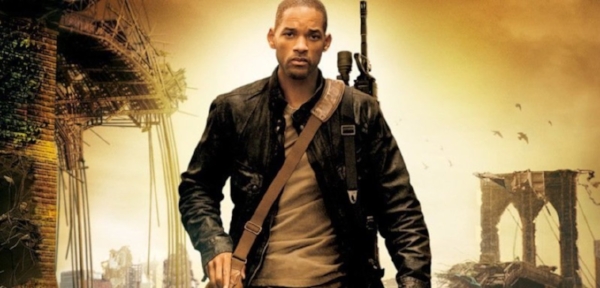
In "The Omega Man," the tireless Mr. Heston, harbinger of global doom, was again that witness. But neither his performance, nor that of the no less grandiloquent Vincent Price as the Last Man on Earth before him, can compare with what Will Smith brings to "I Am Legend" as Robert Neville, Mr. Matheson's bereft and resourceful hero. By definition, this is for long stretches a solo role, and thus not easy to do, but with little more than his dog for support, Mr. Smith skillfully conveys the loneliness, determination, and increasing mental strain of life as a Robinson Crusoe marooned on the island that was once his home, but is now, well, something else.

In part, Neville has adapted by turning Manhattan into his private playground (taking golf swings from the deck of the USS Intrepid, gunning a muscle car down empty avenues), but it's a playground where the pleasures are as transient as they are solitary. What really keeps him going are the routines — obsessive, meticulous, and tough — of the work he carries out while hunkered down in a bunkered-up brownstone on Washington Square. Neville is a military virologist (the novel's Neville is, by contrast, an everyman, which makes his plight as the last man all the more affecting), and he is still, even now, trying to find a cure for the man-made plague that took his world away.

He has to, because the virus didn't finish off everyone else. In Mr. Matheson's book, a number of those infected are transformed into vampires. In Mr. Lawrence's take, these lethal unfortunates are reduced to "dark seekers," feral, albino, debased ex-men who look as if they have escaped from the set of 2005's "The Descent," but behave with the hyperkinetic ferocity of the zombies in "28 Days Later" (a fair enough exchange, one might think: The latter film owed a considerable, and insufficiently acknowledged, debt to Mr. Matheson's tale).

That makes for some undeniably exciting scenes of chase and combat, roaring and head butting, but the decision to dumb the infected down drains much of the intelligence and the horror from the original concept. Once we understand the nature of the threat that the dark seekers represent, the distinctiveness of this movie begins to evaporate. It's still highly entertaining ("I Am Legend will, I reckon, be a massive hit, and deservedly so), but its early promise is frittered away.

The tumble gathers pace after the arrival of two other (healthy) survivors — a young woman (Alice Braga) and a child (Charlie Tahan). Helpfully enough, they extricate Neville from a tricky encounter with some dark seekers, but their key function is to drag the film even further away from the pitiless premise underpinning the novel that inspired it. Indeed, they are used to inject a spiritual, even religious, dimension into a narrative that, as first conceived, had none, and needed none.

If it's not absurd to suggest this about a work involving vampires, Mr. Matheson's book is best seen as a classic of mid-20th-century realism, unflinching in its acceptance of impermanence, chance, and an uncaring universe. We live now in dreamier, less clear-eyed times, and Mr. Lawrence has tailored his movie accordingly. You'll have to see for yourself how it ends, but I will say that it recounts a legend that bears little resemblance to that of Mr. Matheson's original Neville, the man whose destiny was to become a legend of a far darker kind, "a new terror born in death, a new superstition entering the unassailable fortress of forever." To understand how, and why, read the book. Oh yes, see the movie too. It's good, but it should have been — could have been — great.

Don't Worry, You Can Take the Family

The Golden Compass

The New York Sun, December 7, 2007

GoldenCompass.jpg

It is a measure of the genius of the British novelist Philip Pullman that when, less than 30 pages into his book "The Golden Compass," 12-year-old Lyra Belacqua angrily objects to the refusal of her (supposed) uncle Asriel to take her to the frozen, fabled northlands, most readers will understand and agree with her. "I want," protests Lyra, "to see the Northern Lights and bears and icebergs and everything." And so, you just know, do you. Disappointingly, despite some excellent special effects (the bears, a race of gigantic, heavily armored ursine warriors, have to be seen to be believed) and a remarkably assured performance by the no less remarkably named Dakota Blue Richards as Lyra, the new film by Chris Weitz based on Mr. Pullman's novel never manages to generate, or satisfy, that same sense of anticipation.

In part, this was inevitable. When it comes to conjuring another world, the very literalness of computer-generated imagery can conspire against it, especially when it has to compete with author-generated imagery such as this:

…The main interest of the picture lay in the sky. Streams and veils of light hung like curtains, looped and festooned on invisible hooks hundreds of miles high or blowing out sideways in the stream of some unimaginable wind…

When Mr. Pullman is good, he is very good. The film, by contrast, is just okay.

Mr. Pullman also doesn't patronize. He doesn't think of himself as a "children's writer," with all the title can sometimes imply. His portrait of that other, parallel world, is a fascinating, glittering, mixed-up what-might-have-been of ancient and modern, of Charles Dickens, of H.G. Wells, of the brothers Grimm, of the "Edda," and of who knows what else. It is heavily layered, marvelously complex, and described throughout with a madcap erudition that adds to its magic. The movie, however, is far simpler, dumbed-down, even.

This, too, was probably inevitable, both for reasons of pacing (only so much detail can be packed into two hours) and, more critically, commerce. "The Golden Compass" is being marketed as a holiday movie appealing to all youngsters, not just the early-to-mid teenagers who were the original novel's natural readership. It also has to be, to use the dread euphemism, family friendly. Thus, for example, the book's references to castration have been, well, cut, and, in recognition of the fact that butchered tykes haven't been Christmas fare since Herod, so have (more or less) its dead children. Overall, the film is more upbeat than the novel, and its characters less morally ambiguous.

This may relieve some parents, but it doesn't excuse the performances turned in by some key cast members, notably Nicole Kidman, a peculiarly stiff and dismayingly unconvincing principal villain, and the unforgivably hokey Sam Elliott. As aeronaut Lee Scoresby, Mr. Elliott is meant to be this movie's Han Solo, but he comes across as Colonel Sanders with a six-shooter. Then there's Daniel Craig, an oddly bland Asriel, but the blame for that lies with the script, not 007.

Fortunately, these weaknesses are offset by Ms. Richards's Lyra, who is sly, determined, awkward, and brave, a character with just the right hint about her of the first, and finest, of such heroines: the little girl who tumbled down a rabbit hole one-and-a-half centuries and one dazzling imagination ago. And Ms. Richards is not alone. In particular, she is ably assisted, both in her mission (like many works of fantasy, "The Golden Compass," which is the first installment in a trilogy, revolves around a quest) and in helping the movie along by Jim Carter, who is impressive and imposing as John Faa, Lord of the Gyptians.

The Gyptians are a half-tolerated, half-outlawed people who have managed to retain a degree of independence in the constricted, caste-hobbled, and authoritarian England of Pullman's vision. That's no mean feat: The country, and much of the world, is dominated by the sinister Magisterium, an organization determined to enforce its own brand of ideological conformity. Revealingly, Christopher Lee, saturnine and urbane, is its First High Councilor. Sadly, we don't see that much of him. For a fuller idea of the Magisterium's nature, we have to look to Simon McBurney, who is painfully watchable as the insinuating and shifty Fra Pavel. Pavel is a sort-of-priest with more than a suggestion of the Inquisition about him. He's also a reminder of why Mr. Pullman has so enraged such dime-store Savonarolas as the Catholic League (boycott the movie!), Focus on the Family (boycott the movie!), and the Halton (Ontario) Catholic District School Board, which has pulled Mr. Pullman's books from its library shelves for "review."

This is absurd, but predictable. Mr. Pullman is a dogmatic, rather insistent, and very public nonbeliever, and, like most preachers, when it comes to the topic of the big man upstairs, he's a bit of a bore. Mercifully, there's little of this in the first novel (and almost nothing in the film), but the trilogy as a whole does end badly, not only for God, but for the reader, its literary merits overwhelmed by its author's lunatic-on-the-subway determination to get his atheistic message across again and again and again. For this reason, the filmmakers' decision to make the Magisterium much less of a representation (or caricature, take your pick) of the Catholic Church bodes well for the sequels to come.

To be sure, Mr. Weitz's Magisterium still has a whiff of cloister and incense about it, but that's beside the point. It is principally attacked not for what it believes, but for how it believes, for its insistence that it has sole access to the truth, and for its intolerance of dissent. Its scheme to, quite literally, reduce most of mankind to the level of children — pliable, credulous, and incapable of self-determination — makes good sense both as drama and, yes, as warning. We live, after all, in an era when religious fundamentalism is on the march in our world as well as in Lyra's.