Iceland Without the Fish

National Review Online, February 4, 2009

Gulfoss, Iceland, 2007 © Andrew Stuttaford

Gulfoss, Iceland, 2007 © Andrew Stuttaford

If there’s one thing that can be said in defense of Tony Blair and his successor (and former finance minister), Gordon Brown, it’s that they took longer to squander Margaret Thatcher’s economic legacy than some first expected. But squander it they did, and credit’s Armageddon has at last exposed the full extent of the damage.

As Warren Buffett once observed, “You only find out who is swimming naked when the tide goes out.” That’s not the nicest way to visualize Gordon Brown, but, seen from the vantage point of the markets, the view is not much prettier. Stocks have crashed, of course, as they have across the planet, but so, more ominously, has the pound. The British currency hit record lows against the euro at the turn of the year. And when it comes to the greenback, the pound buys less than a buck and a half (it fetched more than two dollars earlier in 2008). That suggests the United Kingdom’s troubles are nastier than elsewhere, a view echoed by the IMF, which now predicts that Britain is facing the deepest recession of any major industrialized economy.

Yes, yes, the pound has gone through other ugly episodes in the relatively recent past, but the present fall (on a trade-weighted basis, sterling dropped by more than 20 percent last year) is the most dramatic since 1931. For the first time since the Labour-controlled mid-1970s, Brits are wondering if they face a genuinely catastrophic collapse in their currency.

For a country such as Britain, burdened with a large trade deficit, devaluation can be a shot in the arm by making its exports more internationally competitive. But that only holds true if there’s a market for those goods in the first place. In a time of shrinking trade flows, nobody can be sure of that. More worrying still, with the U.K.’s combined external debt (public and private) rising rapidly from a total that already exceeds 400 percent of GDP (a gross number, but even so), the usual cost-benefit analysis may no longer apply. Repaying overseas debt in a devalued currency can be a very tricky business, indeed. Will the sceptr’d isle become Iceland without the fish? (The EU took all those.)

In some respects it was only to be expected (if not by Gordon Brown; he’s saying that he never saw this coming) that the land of the much-vaunted Blair/Brown economic miracle is turning out to be more storm center than safe haven. The global meltdown revolves around the embattled international financial system, a system in which the City of London has become a key hub. That role brought a great deal of cash into the United Kingdom, but with it a great deal of risk. The City’s international business has proved, in a sense, to be hot money–fun while it lasts but with a tendency to evaporate in times of trouble. And trouble has now come calling.

The problem for Britain is that, with the financial sector in disarray (and most of the North  Sea oil gone), eleven years of Blair/Brown have left the country with dangerously little else to fall back upon. This was not how it was meant to be. Back in 1997, Tony Blair had won his way into 10 Downing Street as a representative of “New” Labour, a supposedly reformed party ready to renounce the taxing, spending, and relentless class warfare of previous socialist governments, to support free enterprise, and to do what it could to avoid the “boom and bust” cycles that had characterized so much of the U.K.’s postwar economic history. Oh, well–people believed Bernie Madoff, too.

The Blair and Brown governments were careful not to increase the top income-tax rate, but everything else was up for grabs–and was duly grabbed. Overall taxation has risen by far faster than the OECD average and has been accompanied by regulatory excess (much of it, admittedly, at the behest of the EU) and a public-spending binge that long preceded the current emergency but left the country woefully unprepared to deal with it. Gordon Brown may be the son of a Scottish clergyman (who had, marvelously, the middle name Ebenezer), but the whole preparing-for-the-seven-lean-years thing just doesn’t seem to have sunk in. In the decade that followed the 1996–97 spending year, “managed” public expenditure jumped by roughly 90 percent, and that’s before taking account of liabilities incurred but kept off the books with the help of legerdemain that would have shamed Enron.

Under the circumstances, it’s no surprise that the U.K.’s productivity growth has, at best, been uneven, despite (up until now) broadly respectable increases in GDP. It’s perhaps telling that most (around two thirds) of the new jobs created since 1997 have been located in the public sector. What’s more, in a strikingly high percentage of cases, they have gone to recent immigrants rather than to native-born Brits, too many of whom have remained on the dole for too long. We can debate why that is, but we cannot debate the grim fact that nearly 2 million people are now registered as unemployed, a bad number that is getting rapidly worse. Another 2.7 million (more than 7 percent of the working-age population) live on “incapacity benefit,” a handout that defines them as too sick to work–a statistic that implies either repeated epidemics, a failed National Health Service, or a seriously dysfunctional labor market. I know which explanation I’d pick.

If the British are not working enough, they are not selling enough, either. The trade deficit has continued to deteriorate. For goods (“visibles”) it now stands at well over 6 percent, the highest level since proper records began in the late 17th century. In the past, the overall deficit has been narrowed by the U.K.’s ability to export services (many of them, problematically, financial), but this is just another reminder that the City’s relative preeminence is as much an expression of the weakness of the wider British economy as it is of London’s success in playing host to the choosy and itinerant international financial community.

It would be wrong, however, to blame all the horrors that are pummeling the City on Messrs. Blair and Brown. This is a fiasco with deeper and wider origins than the cack-handed fumbling of two economically illiterate politicians, but Labour’s decision to take responsibility for banking supervision away from the Bank of England (historically the country’s most experienced, and most respected, regulator) helped pave the way for disaster. It was a dumb move, made in the name of modernization but more truthfully explained by the Labour government’s disdain for anything smacking of Britain’s past. In America, the existence of a series of distinct financial regulators, each with agendas and areas of expertise all of their own, played no small part in the failure of regulation that contributed so much to the current debacle. Britain’s new tripartite regulatory system (which splits duties between the Treasury, the Financial Services Authority, and the central bank) has proved a disastrous failure for very similar reasons, a failure made all the more galling by its needlessness: Resentment is not a good basis for public policy.

In any event, the U.K. went through a bubble that in all its excess, shoddy lending practices, and baroque speculative mania bore a depressing resemblance to the horrors here in America. To take two numbers cited by Larry Elliott and Dan Atkinson in Fantasy Island (a broadly leftist, sometimes oddball and often fascinating critique of the Blair years), between January 2000 and December 2005, outstanding consumer-credit balances rose by two thirds, and mortgage debt nearly doubled. The appalling consequences are now all too visible in a shattered housing market, on a shuttering high street, and on what is left of the balance sheets of Britain’s devastated and partially nationalized banking sector.

The damage to Mrs. Thatcher’s legacy has therefore already been bad enough, but the financial cataclysm (or, more accurately, the government’s response to it) may well, ironically, make its final destruction Gordon Brown’s best hope of remaining in power. The political reaction to his early attempts to bring a halt to the developing economic disaster shows why.

So what did Brown do? Unburdened by ideological objections to the idea of the state assuming direct stakes in the nation’s banks, the prime minister was the first to borrow (very loosely) from the successful Swedish precedent of the early 1990s and take this necessary (if regrettable) step. At the same time, his government launched a £20 billion stimulus package with, given the shaky state of public finances, little obvious idea of how to pay for it. As The Economist noted in December, even on the government’s “optimistic” projections, borrowing will hit 8 percent of GDP in 2009–10 and debt 57 percent in 2012–13. America’s budget may be a shambles, but with the dollar an internationally accepted reserve currency (for now), the United States at least has the ability (fingers crossed) to print money and buy its way, however imperfectly, however clumsily, out of the present mess. The U.K. does not–thus the tumbling pound.

Initially Brown’s rapid and decisive response played well with frazzled voters desperate to see the government do something. With the financial crisis widely blamed on three decades of (largely imaginary) laissez faire, Labour rediscovered the electoral allure of unashamedly interventionist government. Dour, stern, and carefully wrapped in an image of egalitarian rectitude, Brown came across, however absurdly, as a serious man for serious times. The Tories jeered, but for a while their advantage in the polls faltered: Their impeccably upper-crust leader (who is burdened both by youth and a past in public relations) was caricatured in ways that made him appear a feckless, callow Wooster to Brown’s shrewd, capable Jeeves.

That moment may have passed for now. Swept along by a torrent of economic bad news, the Conservatives are once again clearly ahead. That probably puts paid to the once widely rumored prospect that Brown would call a snap election before the bills finally fall due. Nevertheless Labour’s brief revival was an early warning that this crisis may yet represent an opportunity for a return of the more full-bodied socialism of the party’s destructive past. If Brown is to win another term (an election has to be held no later than June 2010), he will have to shift left. In frightening times in which capitalism is widely (if inaccurately) believed by voters to have failed, there is an obvious opportunity for the hucksters of big, redistributionist government. The announcement that Labour, if reelected, will hike the top income tax rate from 40 to 45 percent (and that’s before onerous social security levies) is only a beginning.

Somehow I suspect that the pound has far further to fall.
Obama on Everything

National Review Online, January 19, 2009

Union Station, Washington D.C., November 2008 © Andrew Stuttaford

Union Station, Washington D.C., November 2008 © Andrew Stuttaford

There are some on the right who take defeat badly, but I’m not one of them. I’m not a lurk-in-the-bunker-poison-the-dog-shoot-myself kind of guy. And if you’re still in a position to read this, neither are you. But that still leaves open the question as to how, exactly, we should mark the upcoming inauguration.

Sulking is an option, as is picking a fight with a liberal member of the family, obsessively researching birth-certificate rules in Hawaii, repeatedly watching Red Dawn, or kicking the as-yet-unpoisoned dog. But, with the exception of those repeated viewings of Red Dawn, none of these alternatives is very uplifting, particularly if, as seems likely, the new president’s speech will be that–and more. At the same time, to follow the advice of those good sports over at the Wall Street Journal who suggested opening “a fine bottle of American bubbly” is to go too far down the road to reasonability, respectability, and good-hearted bipartisanship–and that’s just not our thing.

cigars-obama-sample4

It’s better, I think, to borrow a few ideas from the Orange Alternative (Pomarańczowa Alternatywa). Fearless prankster surrealists of the Polish sort-of-Left from the 1980s, they used to taunt their country’s crumbling Communist regime with cheers, not jeers, their specialty being sporadic displays of unsettlingly enthusiastic loyalty. These included a reenactment of the storming of the Winter Palace and a procession through the streets of Warsaw by 4,000 people chanting their love for Lenin. Now, I would not want to compare Obama with that other community organizer–no, not for a second!–but the cult of personality now surrounding our next president suggests that hosting an Orange Alternative inauguration dinner would be a perfect counterpoint to the pomp, sincerity, and cynicism on display in Washington. It’ll also be an ideal opportunity to treat friends of all political persuasions to a confused, confusing, and almost certainly annoying celebration that can be read, as Obama has said about himself, in any way they like.

The proceedings should start with a sing-along, possibly the Obama Kids’ We’re Gonna Change the World, a song that brought so many people so much pleasure last summer:

We’re gonna spread happiness

We’re gonna spread freedom

Obama’s gonna change it

Obama’s gonna lead ’em.

We’re gonna change it

And rearrange it

We’re gonna change the world.

After hymning themselves hoarse for Change, your guests will need a drink. They will probably have had enough of clichés by then, so forget the champagne and opt instead for some Obama Limited Edition Reserve (“very detailed features of Barack Obama deep carved into the bottle . . . fit for the Smithsonian!”), a 2005 Merlot from Napa Valley. You’ll want to avoid any suggestions of elitism, however, so slip in some suds, too, perhaps some Obama (formerly “Senator”) beer from Kenya. Cocktail drinkers meanwhile may enjoy a Barackatini (rum, fruit, a splash of club soda) and, since nobody will be excluded from the promise of Obama’s America, teetotalers will be able to join in the fun (if teetotalers ever do join in the fun) with Obama Soda from France–which is, apparently, now a friend.

For food, as for bailouts, turn to Washington. The M Street Bar & Grill has designed a Barack Obama Pizza Burger. If that’s too bland, just add some Barack Obama Inauguration Hot Sauce. For those who fancy something altogether more exotic, blogger and author Veronica Chambers has dreamt up a recipe for a Barack Pie “that would celebrate, in culinary fashion, the hope, promise (and okay, super yummyness) of having Barack Obama as our next president. . . . [It] serves . . . souls hungry for hope, change and a new day in American politics.”

And if that’s not sugary enough, Max and Benny’s of Northbrook, Ill., will supply “Yes We Can!” cookies emblazoned with images of the president-elect, his wife, and the odd-looking individual who will be the next vice president. On the other hand, Obama Waffles taste too much of sour grapes to have any place at such a celebratory table–we’ll prefer the sweetness of Ben & Jerry’s “inspirational’ Yes Pecan! On that note, your guests can get at their beer with the help of a “Yes We Can” Opener. For the wine there’s Corkscrew Bill, an engaging device modeled on the husband of the new secretary of state.

When preparing the food, the Barack Obama cutting board, as versatile as a Panetta, will undoubtedly come in handy: “Can also be used as a hot plate, serving tray, cheese board, bread board . . . place-mat, or director of the CIA.” (I obviously made up the last of those. Running Langley in wartime is a job for specialists. Who could possibly think otherwise? Oh. Anyhoo . . .) When it comes to chopping, cutting, and slicing our feast’s ingredients, the adventurous will be tempted by President Barack Obama’s White House Sword, forged in the heat of a renaissance fair/faire/fayre, pleasingly suggestive of once and future Camelots, and best kept out of the hands of any members of clan Clinton.

And when it’s time at last to chow down, each of your guests should dine off an Obama Historic Victory Plate (“a priceless work of art featuring the triumphant President-Elect surrounded by the American flag and spectacular fireworks celebration”), and, according to taste, drink from a pewter-accented Obama wine glass or an “Obama Will Save Us” beer stein. Alcoholics will appreciate the opportunity to down some federally subsidized ethanol out of a specially engraved Obama Drinking Flask.

To wrap things up, how about freshly brewed Kona Joe’s (Barack O Blend, naturally) swigged out of a Barack “Change” coffee mug while savoring a cigar (Cuban?) wrapped in a commemorative Obama cigar band? Coffee and cigars? This might also be the moment to hand out a few Obama National AchieveMints. Few’s the word. Boost the mood still further by festooning your house with Obama posters, ideally in the fake, yet electorally effective, socialist-realist style pioneered by Shepard Fairey (in the Smithsonian soon!). Your couch, chairs, and any notably slow-moving guests should be draped with a “Believe” throw from NBC.com.

obamatime
obamatime

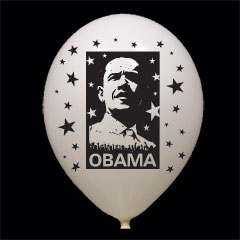
Wait, there’s more! As the special commemorative clock on the mantelpiece reminds you, “It’s Obama time.” And so it is. Raise a “Yeaaaah! Obama Won! Happy Days are Here Again!” banner. The faintly alarming echoes both of Howard Dean and the (last) Great Depression will probably pass unnoticed. If they don’t, start talking excitedly about Change; that usually does the trick. Meanwhile, Obama balloons and lumi-loons (in red, white, and blue) should be allowed to soar, like hope, hype, and deficits, as high as they can go. And beyond.

It’s not only the house that should be decorated. We will, we are told, be feting the most historic inauguration in the history of history. Formally inclined male guests will want to wear a tie, perhaps one featuring Smithsonian Shepard’s “now iconic portrait of president-elect Barack Obama set in bold reds, whites, and blues.” The more casual of either gender will, perhaps, like the look of a colorful satin Obama jacket. And what woman (apart from the one from Alaska, who doesn’t count) could resist a set of HOPE earrings from www.barackobamajewelry.com (“accessorizing the movement”)?

No child need be left behind: Even the youngest can be part of the Change with an Obama onesie from Irregular Apparel (“We offer politically and socially aware messages on baby clothing that is colorful, inexpensive, covered with sass-filled designing but made without sweatshop labor.”).

obamashirt
obamashirt

Others will want to don a T-shirt. There are more designs from which to pick than there are magically reappearing Al Franken votes in Minnesota. My favorite, featuring Chris Bishop’s portrayal of Obama astride a unicorn, may be cut a little too close to fit: Irony is death to all things Obama. To avoid any open signs of this renegade sensibility ruining your event, I’d recommend punctuating the festivities with a few readings, seder-style, from a devotional book. The Bible might be going too far and the Koran would excite conspiracists (People, please! He’s not a Muslim!) but the hagiographic Barack Obama: Son of Promise, Child of Hope would do very well. This strikingly illustrated children’s book (and New York Times bestseller) by award-winning poetess Nikki Grimes tells the story of Obama from boyhood to presidential campaign. Celebrants might wish to begin with this passage describing Obama’s time in Indonesia:

He caught crickets, flew kites,

and joyed in the jungle

at the end of his new home– a perfect paradise, until

the sight of beggars

broke his heart.

Barry started to wonder,

Will I ever be able

to help people like these?

Hope hummed deep inside of him.

Someday, son.

Someday.

With luck, your guests will rejoice in those words, and also in these, recording Barry-now-Barack’s move to Chicago:

Barack’s eyes saw

the hungry and the homeless,

crying out like beggars in Djakarta,

burning a hole in his heart.

When his classes came to an end,

he raced to Chicago

to join hands with the church,

to learn new lessons:

not how to be black or white,

but how to be a healer,

how to change things,

how to make a difference in the world.

And if those later lines conjure up any awkward thoughts of The Reverend Who Must Not Be Named, they can be dispelled by allowing your guests to gaze at some of the book’s illustrations–a weeping Barack at prayer, maybe, or a butterfly settled on the hands of a praying Barack of Assisi. Best of all is a picture showing Obama acknowledging the cheers of the crowd the night he was elected senator. Haloed by what looks like starlight, he’s smiling, his hands extended in a gesture more normally associated with the Mount of Olives.

Did I mention that Kool-Aid will be served?

Notes of a drink-man

Kingsley Amis: Everyday Drinking: The Distilled Kingsley Amis

The New Criterion, January 1, 2009

There are, I suppose, various possible things I might do after failing to reconcile with an estranged wife because of my refusal to give up alcohol. Becoming a drink columnist for a national newspaper is not one of them. Then I’m not Kingsley Amis. Then again, Elizabeth Jane Howard soon ceased to be Mrs. Kingsley Amis. Oh well. Some or all of those columns later re-appeared, clean-shaven, refreshed, and tidied-up as Every Day Drinking (“Being paid twice for the same basic work is always agreeable”), the second of three books (the other two are On Drink and How’s Your Glass?) that differ from much of Amis’s oeuvre in that they are specifically about drink rather than being merely drink-sodden.

Don’t misunderstand that “merely.” An immense torrent of alcohol surged through much of Amis’s work, sweeping his novels and their protagonists on their bleary, boozy, too British to be Bacchanalian, way, and, as it did so, it shaped our view of their creator. As Amis complained/boasted in his Memoirs, he had “the reputation of being one of the great drinkers, if not one of the great drunks, of our time.” Part of the blame lay with the characters with whom he peopled his fiction: “A link is set going and is reinforced every time one of my chaps raises a glass to his mouth, and I have to admit that some of them do so rather often.” Somewhat defensively, and after allowing for the necessary journalistic exemption, Amis goes on to warn that writing and drinking don’t mix: “Whatever part drink may play in the writer’s life, it must play none in his or her work.”

By many accounts, Amis stuck fairly strictly to this rule. Alcohol was his theme, not his muse. Even in his extraordinarily bibulous, and, under the circumstances, remarkably productive, later years, he would write for a few disciplined, Mojave-dry hours in the morning before calling it quits and plunging into a liquid lunch, wet afternoon, and thoroughly saturated evening. Influenced, doubtless, by Dixon’s most memorably dreadful morning in Lucky Jim, Martin Amis has described his father as “the laureate of the hangover,” and so the Old Devil was—but, surely, in both senses of the phrase.

Every Day Drinking, On Drink, and How’s Your Glass? are now available in one volume, with, perhaps unsurprisingly, Christopher Hitchens (a friend of Amis, that’s all I mean by that “unsurprisingly”—really) providing a new introduction. He does so deftly, with charm and insight. It’s even less of a surprise that a highlight of this collection is frequently said to be Amis’s discussion of the hangover. Grand stuff it is too: amusing, certainly, but also awash with patent cures, long-marinated advice, and the details of “three notable breakfasts.” Unfortunately, it is also chock-full of bunkum, and pretentious bunkum (“the metaphysical hangover”: come on) at that.

Hangovers are a bad business, but they are (fairly) easily seen off with Veganin (a take-no-prisoners painkiller, long available over-the-counter in the U.K.), Coca-Cola, and, once things have calmed down intestinally, an Egg McMuffin. There’s no need to make a big deal about them, but that is exactly what Amis is doing, disappointing behavior from a man so skilled at deflating mystification, humbug, and fuss, from the writer who so relished repeating (in the Memoirs) Brendan Behan’s approval of the way that Parisians (allegedly) ordered wine:

You don’t catch ’em saying “Have you a nice full Burgundy with a good big body?” … Christ, it’s “D’ya want the ten, the twelve or the fourteen percent and d’ya want the label with the sluts dancing or the bastard with the big hat?—What d’ya want?”

That’s, so to speak, the spirit, and that, I suspect, is also the spirit in which Every Day Drinking and On Drink were designed to be read (How’s Your Glass?, a dull series of quizzes of interest only to drink nerds, is something else altogether).  Amongst Amis’s targets are wine snobs, reverse snobs, “authenticity,” the “no-reds-with-fish superstition,” Paris, “curiously shaped” bottles, and dancing (“ridiculous and shameful”). Food (“irrelevant rubbish” with no place in a “drink-man’s” refrigerator) is, as often with Amis, an object of disdain. Amis’s later career as a restaurant critic was one of his better jokes.

And if it’s good jokes and convivial writing that you’re looking for, there’s plenty to be found in Every Day Drinking and On Drink, as well as, amongst other treats, generous portions of splendidly forthright advice (good and bad) and an endearingly eclectic selection of cocktail recipes (good and bad): tomato ketchup has no place in a Bloody Mary, Sir Kingsley.

But it’s not just the thought of Stolichnaya colliding with Heinz that may leave some readers a touch queasy. Complicated undercurrents swirl beneath the breezy, blokey surface. At one level, with his references to wine merchants, drinks parties, waiter wars, and the pub, Amis is presenting himself as one of the “chaps” (even then, a mildly arch, somewhat dated term to use so repeatedly in print), a modestly prosperous, immodestly reactionary everyman (and I mean man: “females” are generally relegated to annoyances, totty, or comic relief), but on closer inspection this proves to be a confidence trick.  With their name dropping, vacation dropping (“Should you find yourself in Athens, you seriously should make the trip to Naxos”), and condescendingly matey intellectual ostentation (Goethe’s Harzreise im Winter is, “between you and me, rather crappy”), the conceit that these writings reflect the lives of their intended readers is, between you and me, nonsense—flattering nonsense, but nonsense all the same.

In truth, Every Day Drinking and On Drink are aspirational, and what its readers are meant to aspire to be is Amis. Back in 1965, Amis (lightly disguised as Lieutenant-Colonel William “Bill” Tanner) had written The Book of Bond or Every Man His Own 007, a “how to” guide for would-be Bonds, extremely funny (find it if you can), but firmly tongue-in-cheek.  As Books of Amis, Every Day Drinking and On Drink were intended a little more seriously, and that, ultimately, is the tragedy they represent. Drink was Kingsley’s (other) Thing, a prop, a pleasure, a crutch, a social lubricant, and, I’d guess, a means of “getting away … from this body … from this person … from attending to my own thoughts.” These last words are borrowed from The Green Man’s Maurice Allington, an alcoholic, and, of all Amis’s numerous fictional alter egos, the one who may have come closest to reality.  Allington is contemplating the relief that only death will bring, but, in the meantime, we know that he will make do with the bottle.

In his invaluable Life of Kingsley Amis, Zachary Leader observes that the question of alcoholism is given “short shrift” in On Drink (Amis wrote there that he had “little to offer” on the topic). Plausibly enough, Leader suggests that for Amis the distinction between drinker and alcoholic rested on whether the drinking was a social activity. Quite possibly: it’s questionable science, but as a rationalization it could work. Amis’s writings can thus be interpreted as an attempt to redefine his own drinking in a way that made it seem, if only to himself, as a normal expression of sociability—and therefore nothing to fear. Snarling Garrick get-togethers are transformed into something jovially Pickwickian; binges and pratfalls are just what any chap might to do; a compulsion becomes a respectable intellectual interest, and, what’s more, a nice little earner: all under control, then.

Except that, as Amis must have been too sharp not to realize, it wasn’t. As Hitchens recalls, “the booze got to him in the end, and robbed him of his wit and charm.” There’s nothing particularly social, or sociable, about that. In the end, of course, it helped kill him. He’d got away at last.

Sarko's Bite

National Review, December 15, 2008

It is a ritual as frustrating, as funny, and as familiar as Charlie Brown, Lucy, and the football. A new “right wing” French president is elected, vowing reform, and American conservatives swoon. First there was Jacques Chirac. Older, sadder, and wiser folk may still recall the excited talk about his summer at Harvard, his stint as a soda jerk at Howard Johnson’s, and, naturellement, a girl from South Carolina. The Frenchman liked us! He really liked us! He wasn’t Mitterrand! No, he wasn’t, but . . .

After Chirac, Nicolas Sarkozy. The new president’s first vacation was spent not on the Cote d’Azur, but in Wolfeboro, N.H. A few months later “Sarko l’Americain” addressed a joint session of Congress, spoke warmly of the American dream, and name-checked John Wayne, Marilyn Monroe, and Martin Luther King. The Frenchman likes us! He really likes us! He isn’t Chirac! Sarkozy promised a more robust approach to Islamic extremism both at home and abroad and, more daring still, an assault on the regulations, overspending, taxes, and trade-union privilege that have made France so much less than she could be. America’s conservatives cheered. Fries could be French again.

That was then. Less than a year later, Sarkozy took the opportunity presented by the financial meltdown to announce, with rather too much glee, the death of laissez-faire, a declaration made all the more surprising by the fact that there is little evidence that laissez-faire had been alive in the first place. Perhaps that’s why Sarkozy is so keen to do a Van Helsing on the poor doctrine’s corpse. Like the United States and most other major nations, France has put together a massive (in its case, up to €360 billion) rescue package for its banks, but with a characteristically French twist: It is insisting that the banks that benefit from this largesse increase their lending by a designated amount (3 to 4 percent) over a given twelve-month period, a mandate almost guaranteed to wreak further financial havoc. “The state,” thundered Sarkozy, “is back.”

It had never been away. But the state’s command over the French economy will become even more wide-ranging with the establishment of a new strategic-investment fund (up to €20 billion, although larger numbers have been mentioned) to protect key companies from the unwanted attentions of wicked foreign predators. Somewhat more conventionally, the government will increase what it spends on contrats aides, which will subsidize an additional 100,000 jobs next year. With carrot comes stick: Sarkozy has cautioned companies against using the crisis as a cover for layoffs: “Those who want to play that game be warned: The government will be ruthless.” The state is indeed “back.”

So far, so French. Much more worrying is the extent to which Sarkozy’s revenant state is now looking to expand its reach internationally. Sarkozy is busy telling anyone who will listen (and quite a few who won’t) that the financial crisis has demonstrated the need to establish a “clearly identified economic government” for the eurozone. Quite what that might mean is not easy to identify, but some clues can be found in Sarkozy’s suggestion that equivalents of France’s new strategic-investment fund be set up throughout the zone. As the French president told the EU’s parliament in October, he didn’t “want European citizens to wake up” and find out that their companies had been taken over by wily “non-European” investors who had taken advantage of low share prices to snap up a few bargains. To Europe’s last serving Thatcherite, Czech president Vaclav Klaus, the thinking behind the Sarkozy scheme reeked of “old socialism.” It’s difficult to disagree.

For now the idea of constructing a Maginot Line against foreign capital has found few takers elsewhere in the EU, but an undaunted Sarkozy is taking his crusade against the supposed “dictatorship of the market” even farther afield. The French president was a key figure in pushing for the recent G-20 summit in Washington. In itself, the idea of a meeting involving more than the usual G-8 suspects was no bad thing. Financial panics recognize no borders. That said, final responsibility for managing such crises must remain at the national level for reasons of common sense, practicality, and — critically — sovereignty.

Strengthening international cooperation in this area will be a positive development, but only so long as efforts are organized multilaterally. On that basis, the G-20’s search for a closer consensus on matters such as accounting standards, clearing facilities for credit-default swaps, banks’ capital-adequacy ratios, and the role of rating agencies is something to be welcomed, not feared.

The same is true of the mooted development of an IMF-run early-warning system. Another of the summit’s themes, boosting the existing levels of cooperation between different national regulatory authorities, also makes obvious sense, as do, in theory, plans to create (pompously named) “supervisory colleges” for all major cross-border financial institutions. Staffed by regulators from the various relevant jurisdictions, these bodies would be designed to provide an additional degree of surveillance and, it is hoped (the details are tellingly scant), be in a position to head off crises before they arise. The focus of international coordination in this area would thus shift from the reactive to the proactive. These are all changes that, if sensibly handled, could be useful steps forward.

If Sarkozy gets his way, sensible is one thing they won’t be. In no small respect this is a function of his personality: restless, kinetic, opportunistic, and incapable of resisting either the temptation of la grande geste or, as he sees it, the splendor of his own genius. We are speaking, after all, of the architect of the proposed “Mediterranean Union.” (You’ve never heard of it?) In the endearingly acid words of a woman quoted in Dawn, Dusk or Night (playwright Yasmina Reza’s magnificently offbeat account of a year spent with Sarkozy on the campaign trail): “Nicolas is too high-strung. . . . He is four inches too short and that undermines his charisma on the international level. Mitterrand, you couldn’t tell he was short because he was placid, whereas Nicolas is a fox terrier running everywhere, barking.”

But it’s possible to detect patterns in all that motion, and one of them is the hyperpresident’s bathyscaphe-deep distrust of the free market. Sarkozy’s forlorn American conservative fans would have done well to read his Testimony (2006), a manifesto for the modernization of France that is, at its core, technocratic, profoundly dirigiste (“It seems to me to be perfectly reasonable . . . that a profitable company not be allowed to benefit from a cut in taxes if it does not raise salaries”), Colbertist (“It is not illegitimate for the finance minister to promote the creation of national . . . champions”), neo-protectionist (“I propose that exports from countries that do not respect environmental rules be taxed according to how much they pollute”), and, in its dismissive references to Wal-Mart’s “brutal and unacceptable” business practices, “stock market capitalism,” and “speculators and predators,” not particularly friendly to the American way of making a buck.

Strongly nationalist though he is, Sarkozy is too shrewd to believe that France can go it alone. So, like his predecessors, he tries to manipulate the EU’s structures in ways intended to produce a Europe that looks like France, a Europe where France can be France, a Europe ideally (in Sarkozy’s view) stripped of its “dogmatic commitment to competition” and what he sees as a race to the bottom in fiscal and social policy. Translation: The Irish should be forced to raise their taxes so that the French aren’t forced to cut theirs. All in the name of European unity, of course.

It’s easy to see how the economic crunch has offered France (acting in conjunction with a good number of other nations) a similar opportunity — to remake the world’s financial system in something much closer to its own image (all in the name of ending the crisis, of course), which would have the added bonus of diminishing America’s economic dominance and, with it, Washington’s power to set the global agenda.

Yes, financial reform, tougher domestic regulation, and smarter international coordination are all required, but these should be accomplished through incremental changes. There’s no need to tear up the old rulebook. Any transfers of authority to new transnational authorities should be kept to an absolute minimum, a priority that is difficult to reconcile with all the chatter (from Sarkozy and others) of a new Bretton Woods.

The French president left the G-20 summit reportedly claiming that the “animal spirits” of American capitalism had been tamed and that the days of a single currency (the dollar) are “over.” The hyperpresident has, he undoubtedly believes, got the hyperpower on the run. Rubbing yet more salt in Uncle Sam’s wounds, Sarkozy then surprised everyone (one European diplomat was reported by the International Herald Tribune as describing the announcement as “amazing”) with news that he was convening a conference in Paris (co-hosted by the inevitable Tony Blair) in early January to, in Blair’s words, “define a new model of capitalism.”

The fox terrier, it appears, does not just bark. He bites

Endless Intervention?

National Review, November 17, 2008

It’s a measure of the predicament in which we find ourselves that merely keeping the banking system going now seems like something of a triumph. It’s even more of a measure that, despite the spending of once-unimaginable amounts of money (or the agreement to spend them), the outcome is still uncertain.

Nevertheless, there have been a few tentative signs that the system may be on the mend. LIBOR (the London Interbank Offered Rate, a key indicator of the interest rates at which banks lend to each other) has been edging down. The TED spread (the difference between three-month LIBOR and the yield on notionally risk-free three-month Treasury bills — a good basis for weighing nervousness in the interbank market) has narrowed. It appears that lending between banks is beginning to revive. It’s a start. Fingers crossed.

None of this is to suggest that a severe recession can be avoided. It cannot. The United States looks set to join many other nations in what may well be the most brutal economic downturn since the 1970s. Saving the banking system, however, will help keep the specter of Joad at bay (a depression, or anything approaching a depression, remains unlikely) and is, obviously, an essential precondition of an eventual recovery, a recovery that would be impossible if the credit markets were allowed to fail. That’s something that market fundamentalists fretting about the “nationalization” of America’s banks need to remember. Risking the ruin of this country’s financial system would have been an absurdly dangerous way to make an ideological point. Yes, part of the genius of capitalism is the “creative destruction” so famously described by Joseph Schumpeter, but sometimes destruction is just destruction.

Watching a Republican Treasury secretary orchestrate the government’s acquisition of significant shareholdings in America’s leading banks has been a disconcerting experience for many of us on the right. Secretary Paulson himself correctly described the whole notion of the government’s taking a stake in private companies as “objectionable.” No less correctly, if a touch belatedly, he recognized that he was left with little alternative. As originally formulated, his TARP (Troubled Asset Relief Program) was too complex and, in a sense, too indirect to provide the reassurance and support that were needed. Confidence in the banks was collapsing, and without confidence there are no banks, and without banks, well, you get the picture. Only a straightforward injection of new money — and with it, more crucially still, the suggestion that the banks were now effectively underwritten by Uncle Sam, the biggest ATM of them all — would have any chance of halting the slide.

The need to restore confidence lay, I suspect, at the heart of Paulson’s controversial decision not only to offer America’s nine largest banks an infusion totaling $125 billion in taxpayer cash, but also to “force” them to accept it. It’s certainly consistent with the usually reported justification for the Treasury’s bullying: Apparently, the feds didn’t want participation in the program (at least by a major bank) to be seen as a potentially lethal admission of weakness. Maybe, but that argument discounts the comfort that ought to come from government support, and it’s not entirely convincing. It’s more likely the Treasury took the view that in a credit market where pricing had broken down, no bank, however impressive its supposed strength, could be said to be completely safe. In the event of the potential fire sale that, in the days before the announcement of the Paulson purchase, lurked in the future of almost every bank, what would assets really be worth? To ask that question is to answer it. Under the circumstances, preemptively reinforcing the most important players was the right thing to do.

Injecting new capital into the banks is, of course, meant to do more than shore up confidence. By filling some of the craters left in their balance sheets in the wake of the subprime and other fiascos, it is also designed to bolster the banks’ ability to extend credit (put very crudely, banks can lend out only a given multiple of their capital). The Fed has been pumping extra liquidity into the broader system for a while now, but until now this has failed to do much to stimulate lending. The new money has, so to speak, been trapped under the debris of shattered confidence and crumbling financial institutions. The banks were too panicked and too capital-constrained to put this cash properly to work. Direct investment in them by the government is meant to deal with both concerns.

What the banks do with these fresh resources will be a critical test of how Paulson’s program is working. Equally, the response in Washington to the banks’ actions will be an excellent early signal of the extent to which this country’s politicians can be trusted with the power that the bailout has, potentially, now given them. In a way, America’s bankers find themselves in a position resembling that of Eastern Europeans “liberated” by the Red Army in 1944–45: grateful that one evil is being seen off but anxious about what their rescuers might want and, for that matter, how long they plan on staying.

In this respect, Paulson’s comments have been reassuring: “We don’t want to run banks.” And if he’s talking the talk, he’s walking the walk too. The government is buying preferred shares with (basically) no voting rights attached. There is no entitlement to board representation, and after three years the shares can be bought back by the banks that issued them. A dividend that increases sharply after five years gives the banks some (but possibly not enough) incentive to do just that, as do a number of restrictions on compensation, share buybacks, and common-stock dividends. It is true that the government also receives warrants to buy common stock, but giving the taxpayers the opportunity to profit from their investment seems only fair — and may also have been a political necessity. It’s to be hoped that the Treasury will not hang on to any such common stock for too long. Hoped? Yup, I’m afraid that’s the best we can expect.

The Treasury’s scheme thus envisages a relationship that is, as it should be, both at arm’s length and, for the most part, strictly temporary. That’s a far cry from what is popularly understood by “nationalization” and is, of itself, something to watch carefully (and skeptically) but not, necessarily, to dread. Unfortunately, this might not continue to be the case. With the economy tanking, any prudent bank should tighten lending standards; not to do so is asking for trouble. To do so, however, might enrage the politicians who have just approved giving these banks a great deal of public money. The French have already faced this issue head-on, and the banks blinked. Any French bank that accepted a recent infusion of subordinated debt from the French government had to agree to increase its total lending by 3 to 4 percent over a designated twelve-month period. The Brits are stumbling in the same direction. Gordon Brown’s government, which now finds itself owner or part-owner of a quite remarkable collection of banks, has promised to keep its distance from its new charges while simultaneously insisting (to borrow the words of Brown’s chancellor of the exchequer) that “the availability of lending to homeowners and small businesses will be maintained to at least 2007 levels.” Quite what “availability,” a word of vintage New Labour ambiguity, actually means is anyone’s guess.

Similar issues will arise over here. Sen. Chris Dodd, the Connecticut Democrat who is chairman of the Senate Banking Committee, has warned that if the banks are “hoarding [cash] . . . there will be hell to pay.” Meanwhile, New York’s Chuck Schumer and two other Democratic senators have been busy arguing that the Treasury ought to set lending goals based on “previous lending activity,” a recommendation (echoed, incidentally, by the committee’s highest-ranking Republican, Alabama’s Richard Shelby) that shows that they understand little about the economics of banking and even less about the undesirability of political meddling in this area. The lessons of Fannie Mae, Freddie Mac, and the Community Reinvestment Act have, it seems, yet to be learned.

With the economy facing an alarming deflationary threat, there is a good case to be made for another round of pump-priming by Washington, but any such moves should be arranged directly, openly, and accountably. Messing yet again with the way banks lend is an invitation to repeat the catastrophic errors of recent years, at a time when a fragile financial system has scant room for more disasters. America’s banks need a more unified, more realistic, and smarter regulatory regime, and that’s a proper area for government action, but the allocation of credit should be left to bankers and the market. Given some time, bank lending will again reach the levels that the business cycle dictates it should, and we will then be closer to a healthy, and lasting, recovery.

Whether a new administration is prepared to give banks that time is a completely different, and profoundly worrying, question.

Raising Hackles

Black  Watch

National Review Online, November 14, 2008

BlackWatch.jpg

Of all the remarkable aspects of Tony Blair’s personality, one of the strangest is the absence of any noticeable feeling (other than a prim, preachy technocratic disdain) for Britain’s past. From countless questionable constitutional “reforms” to his continuous attempts to integrate the U.K. ever deeper within the European Union, he demonstrated an indifference to the history of the nation he led that is so profound that it raises disturbing questions as to why he wanted the job in the first place. But if British history meant little to Mr. Blair, the British military meant even less. Blair may have deployed the U.K.’s armed forces far and wide, but he starved them of the resources they needed and the respect they deserved.

To realize this is to grasp why, in October 2004, the decision to divert Scotland’s legendary Black Watch away from the British army’s area of operations around Basra and into Iraq’s American zone (specifically, in and around the notorious “Triangle of Death”) was greeted in Britain with an anger that stretched far beyond the usual critics of the Iraq war. To many Brits, the mission made scant military sense, but was easy to explain politically as an electorally helpful gesture of support to a Bush administration intent on showing that the Coalition of the Willing was indeed just that. To add insult to the likelihood of injury it had recently emerged that, as part of the Labour government’s ongoing “rationalization” of the British army, the Black Watch, the oldest Highland regiment (it was founded in 1725), was likely to be reincorporated as a battalion within a larger Scottish formation. Like its soldiers, this formidable regiment was, it appeared, disposable.

This forms the background to Gregory Burke’s extraordinary, innovative, and elegiac Black Watch. Dating from 2006, this fine, fierce, but flawed play is now running at Brooklyn’s St. Ann’s Warehouse (it closes December 21; veterans of the Afghanistan and Iraq wars are admitted free of charge) in a strikingly staged, beautifully acted production by the National Theatre of Scotland. Some of the more extravagant plaudits this play has attracted may spring from its critique (“the biggest western foreign policy disaster ever”) of an unpopular war, but only some. Black Watch is a work of a quality that transcends ideology.

Jumping back and forth between a grim Scottish pub and an even grimmer Iraq (Camp Dogwood and its environs, 20 miles west of Mahmudiyah) — and interspersed with song, music-hall moments, reminders of Edinburgh’s military tattoo, and sequences that tip over into evocatively choreographed dance — Black Watch has little that is new or interesting to say either about war in general (bad) or the Iraq war in particular (very bad). Where it fascinates is as a portrait of the clash between the men (and I mean men, the only glimpses of women in Black Watch are as centerfold and DVD porn) of a venerable warrior tradition wrestling with a difficult war, political betrayal, and — hardest of all — themselves.

The opening monologue by Cammy (compellingly played by Paul Rattray), one of the unit’s soldiers, reveals the originality of the play’s vision, the vigor of its script, and the banality of its politics:

A’right. Welcome to this story of the Black Watch.

At first, I didnay want tay day this.

I didnay want tay have tay explain myself tay people ay.

See, I think people’s minds are usually made up about you if you were in the army.

They are though, ay?

They poor f***ing boys. They cannay day anything else. They cannay get a job. They get exploited by the army.

Well I want you to f***ing know. I wanted to be in the army. I could have done other stuff. I’m not a f***ing knuckle-dragger.

And people’s minds are made up about the war that’s on the now ay?

They are. It’s no right. It’s illegal. We’re just big bullies.

Well, we’ll need to get f***ing used tay it. Bullying’s the f***ing job. That’s what you have a f***ing army for.

“Bullying”? In all its pride, prickly defensiveness, and profanity (if un-FCC speech is a problem for you, don’t go to see Black Watch: The largely liberal audience may have come prepared for wartime horror, but a noticeable number flinched every time — and it was often — that the “c word” ricocheted across the narrow stage) Cammy’s language sounds authentic, but, as for its content, well, the idea that a soldier steeped in the lore and mystique of a regiment with hundreds of years of experience of counter-insurgency and “police” work would regard his work as “bullying” beggars belief.

But to Mr. Burke it’s that lore and that mystique, the fabled “Golden Thread” of regimental history that has linked successive generations of the Black Watch, which beggars belief. In a dazzlingly structured, darkly funny (like much of this play) and sardonically narrated sequence, Cammy hints that the thread is really a garrote:

[W]e fought the French and Indians. In America and India. And the French again in Egypt and Portugal and Spain. And at Waterloo in our squares. And somewhere along the way, George the Third decided we deserved tay wear a red vulture feather in our hats.

The Red Hackle.

We got it for the recapture of two cannons in a little village in Flanders in 1795. Which didnay seem like a big deal at the time. But George the Third must ay thought so.

The British Army likes little touches like that. It calls them force multipliers. Gets the cannon fodder hammering down the recruitment doors.

Even if we allow for the traditional gallows humor of the serviceman, that’s too glib, too slick, and too easy. The regiment’s heritage, and the pride its soldiers take in it, may be drummed into new recruits, but it is organic, not manufactured, as real as three centuries. What counts is not the feather, but what that feather symbolizes — something that goes far, far beyond a king’s whim and a couple of cannon.

But, as Mr. Burke (who based his drama on a series of interviews with former members of the Black Watch, semi-fictionalized versions of which frame and punctuate his intricately organized play) clearly understands, history forms just one of the threads, golden or otherwise, that bind the regiment together:

Macca: It was the regimental system ay. It was perfect.

Granty: You got tay go way the people you kent.

Rossco: And you get to fight.

Nabsy: That’s what we’re trained for.

Cammy: That’s what we joined the army tay day.

Rossco: Fight.

Cammy: No for our government.

Macca: No for Britain.

Nabsy: No even for Scotland.

Cammy: I fought for my regiment.

Rossco: I fought for my company.

Granty: I fought for my platoon.

Nabsy: I fought for my section.

Stewarty: I fought for my mates.

Cammy: F***ing s****e fight tay end way though.

Writing in the introduction to a published edition of the play, Burke explains this phenomenon in terms that might startle readers more familiar with America’s distinctly different recruiting tradition:

Even today, in our supposedly fractured, atomized society, the regiment exists on a different plane. In Iraq there were lads serving alongside their fathers. There were groups of friends from even the smallest communities. Four from the former fishing village of St. Monans. Seven from the former mining village of High Valleyfield. Dozens from Dundee and Dunfermline, Kirkaldy and Perth. Friends and family. Uncles, brothers, cousins, fathers, sons, schoolmates. . . . [T]he army does not recruit well in London or any other big city. Metropolitanism and multiculturalism are not the things that are welded into a cohesive fighting force. Fighting units tend to be more at home with homogeneity. Not that there aren’t other nationalities in the Black Watch. There are Fijians and Zimbabweans, even a few Glaswegians. However, the central core of the regiment has always been the heartland of Perthshire, Fife, Dundee and Angus. . . . The Black Watch is a tribe.

Yet despite Burke’s cynicism about the use to which the Black Watch’s history is put, and despite the ways in which this play, and Burke’s bleak portrayal of how the troops viewed their stint in Iraq, is colored by his obvious opposition to the war (and possibly also by the fact that he only appears to have talked to men who chose not to re-enlist) he is too honest to conceal his respect for the way that this tribe works together, sticks together, and fights together right “tay end.” It’s no surprise to learn that Burke, a college dropout brought up in Fife, has relatives who had fought in the regiment.

At the same time, for all Burke’s sympathy for the troops, it is impossible not to detect a touch of condescension in the way he depicts them. Like Rudyard Kipling before him, he is for the soldiers, but not of them. The lovingly reproduced, sharply observed, and spectacularly obscene Scots vernacular of Burke’s dialogue is a comprehensive-schooled sequel to the carefully dropped aitches and delicately coarse language of Kipling’s Barrack Room Ballads. The social gap between Burke and the men of the Black Watch (a theme that the playwright cleverly turns against himself in some acutely uncomfortably exchanges in that acutely uncomfortable pub) is dauntingly wide, if nothing like the vast class chasm that divided Kipling from the army rank and file that he, in his turn, hymned so well.

The suspicion that Burke may view his subjects de haut en bas — as puppets to be positioned to make a point — is only reinforced by the banality, the aggression, and the repetitiveness of so much of their conversation. This depiction occasionally comes close to turning them into caricatures of masculinity, belligerence, and ignorance — cut-outs where depth is replaced by testosterone-fueled display. It’s probably significant that with the exception of one hypnotic, heart-breaking scene — part dance, part mime — in which the men receive letters from home, only one of the soldiers, the upper class officer (Peter Forbes, in a finely judged performance), is shown to have a family life.

Or perhaps the playwright was just reaching his way to a truth about the brave, tough troops who defend the rest of us, a truth that is not (as Kipling recognized) always quite as straightforward as our myths tell us it ought to be:

We aren’t no thin red ’eroes, nor we aren’t no blackguards too,

But single men in barricks, most remarkable like you;

An’ if sometimes our conduck isn’t all your fancy paints,

Why, single men in barricks don’t grow into plaster saints:

Wise man, Kipling. Wise man Burke.

Imagining the Chairman

Art and China's Revolution

National Review, November 3, 2008

Park Avenue, New York City, September 2008  © Andrew Stuttaford

Park Avenue, New York City, September 2008  © Andrew Stuttaford

The sculpture (by Sui Jianguo) squats, a weird piece of a whole that was never made, on a median bisecting one of the more affluent slices of Manhattan’s Park Avenue. It’s of a distinctive, very distinctive, jacket, nothing more, but it’s oddly bulky, as if the colossus who once wore it were, impossibly, somewhere within. And because the shape and the cut of that jacket are so distinctive, the onlooker is encouraged to fill it with his own image of the only individual (out of hundreds of millions once clothed in such garments) it could possibly represent.

He’s a man (“monster” is too easy an alibi for you and for me) whose deeds heaped further disgrace on an already savage century, yet who now finds himself with a place in the collective imagination that is strangely, and disquietingly, ambivalent. If, on the other hand, you’re just puzzled by the sight of an oversized piece of metal tailoring in the middle of Park Avenue, glance across at the building that houses the Asia Society. A banner emblazoned with Chairman Mao — ah, that’s whose jacket it is — flutters, advertising the society’s latest exhibition. Art and China’s Revolution is a remarkable collection (it runs until January 11) of works dating mainly from the first three decades of the People’s Republic. To see it is to be left in little doubt about the nature of the man in that jacket.

And that’s probably why the Chinese government refused to lend art to this show. The party’s authority is still meant to flow, somehow, from Mao. To admit too much of the past would be awkward. “Thirty percent wrong, 70 percent right” and leave it at that. The killer’s corpse belongs in a criminal’s grave, but rests instead, honored, cherished, embalmed in chemicals and lies, housed on a Tiananmen Square defaced by his image and wrapped in his myth. The state that Mao made has mutated in ways that the People’s Liberator would have detested, but when that increasingly prosperous people buys once-undreamt-of consumer goods they do so with currency carrying the picture of the dictator who consigned 30 million, 40 million, 50 million, who knows, of their compatriots to their deaths: blood money of a sort.

With so much cruelty to choose from, it’s difficult to identify the moment when Mao’s long despotism reached its appalling nadir, but there is something about the Great Proletarian Cultural Revolution that makes, to use the official euphemism, its “ten-year turbulence” (roughly 1966–76) a repulsively unique period in Chinese history. Far fewer perished (perhaps somewhere between 500,000 and a million; others reckon far more) than in the course of some of Communist China’s earlier horrors, but the scale of its ambitions were more total, and their implications more sinister, than anything seen before or (outside the Khmer Rouge’s copycat Kampuchea) since. Yes, it’s true that the early years of the Soviet revolution were marked by a similar belief that the very essence of man could be refashioned, but, with the exception of the onslaught against religion, the attempts of the Bolshevik intelligentsia to turn millennial delusion into quotidian reality did not survive the ascendancy of Stalin, a cynic who saw a return to cultural conservatism as a way of buttressing his power.

The no-less-cynical Mao took the opposite tack, inciting a revolution from below (“bombard the headquarters”) to eliminate any possible opposition within a leadership increasingly concerned that the Great Helmsman was steering their regime onto the rocks. To the tough Communist apparatchiks at the top of the Chinese party, a charnel-house was, within limits, perfectly acceptable; a mad house was not. Mao appealed over their heads to the educated and semi-educated young with a manipulative rhetoric that combined a dramatic rejection of the past (destroy the “four olds”: old ideas, old culture, old habits, old customs) with the promise of permanent revolution (“to rebel is justified”) and ecstatic mayhem (“be violent”) in one intoxicating, exhilarating mix. The result was a hysterical spasm that devastated an already-ruined nation and, in its wildest extremes, looked to complete the transformation (zàoshén yùndòng) of the Chairman into the living god he was so clearly already becoming. Communism had, for all practical purposes, always been a religion, just never quite so openly.

Like all religions Maoism boasted an iconography, an iconography that is at the heart of the Asia Society show. We see traditional Chinese inkwork superseded by more “modern” painting in oil, its ancient subtleties replaced by the heavy (if occasionally wonderfully executed) didacticism of imported Soviet-style socialist realism. The arrival of the Cultural Revolution is summoned up by a series of fierce woodblock prints (often, interestingly, in the red, white, and black of Hitler’s swastika flag; those colors do the tyrant’s work so well), urgent, violent, inflammatory, deranged, the paper trail of a nation spinning, and being spun, into the abyss: Smash the Cultural Ministry! Smash the Dog Head of Soviet Revisionists! Smash. Struggle. Destroy. Obliterate. Even buildings were not spared: Seventy percent of Peking’s officially designated “places of historical and cultural interest” were destroyed in the frenzy.

Socialist realism meanwhile merged with, in Mao’s approving words, “revolutionary romanticism,” “red, bright, and shining” depictions of a dream world (sometimes almost literally so; check out Zheng Shengtian, Zhou Ruiwen, and Xu Junxuan’s Man’s Whole World is Mutable, Seas Become Mulberry Fields: Chairman Mao Inspects Areas South and North of the Yangtze River), that was, in truth, nightmare, lie, and something far, far stranger still. And as the Red Guards rose and darkness fell, images of that dream, and instructions on how to dream it, were repeated again and again across all media, from paintings, posters, and photography, to opera, to song, to “loyalty dance,” to film, and, most definitely, to the exclusion of everything else. Again and again and again: On some estimates 2.2 billion “official” portraits of Mao were reproduced in one format or another during these years. The print runs of the Christ-Mao of Liu Chunhua’s Chairman Mao Goes to Anyuan (1969) are thought to have amounted to 900 million alone. Mao, always Mao: “The world’s red sun” was the focal point of the paintings in which he appeared, glowing with an inner light, an unmistakable hint of the divine reinforced by mists, mountaintops, and suggestions of the miraculous.

And as icons tend to do, these materials offer their viewers a glimpse of an alternative, fantastic reality, in this case a heaven right here on earth. Many are undeniably, if eerily, beautiful. To their credit, the exhibition’s curators supplement them with commentary (as well as some extraordinary, and long-hidden, photography from that era by Li Zhensheng) that leaves little room for ambiguity about what these artworks both represent and disguise. Despite this, the Asia Society’s gift shop still sells bits and pieces of Maoist junk, revolutionary tote bags, enameled portraits of the great man, and a stack of Little Red Books. That’s equivalent to selling Nazi paraphernalia at a museum show dedicated to the art of the Third Reich, but, as is generally the case when it comes to insulting the memory of the victims of Communism, few seem to care: Mao killed millions and all I got was this lousy T-shirt.

The realization that those uncounted tens of millions of Chinese dead do not count for very much is reinforced by the presence in the Asia Society’s foyers of a group of Qu Guangci’s identical stainless-steel statues of Mao. Simultaneously clueless, knowing, and saturated in a borrowed pop-cultural sensibility, these works wink at atrocity. And they are not alone in doing so. They are reminders of the way that China’s younger generation of artists has appropriated Maoist imagery for its own purposes, sometimes satirical, sometimes antic, and sometimes serious, but almost always with an eye on the marketplace. That they find buyers in China is evidence of a country in denial about its past. That they find buyers in London, Paris, and New York reveals something almost as bad, a West where too many are willing to use somebody else’s revolution as a means of self-expression — at a comfortable distance, of course.

To own the latest Maoist pastiche by Wang Guangyi may merely be a matter of status, a refreshingly vulgar assertion of both wealth and (less obviously) taste. Too often, however, it is accompanied by the stale stink of radical chic, a noxious whiff of ’68 that conjures up memories of Berkeley, the Sorbonne, and Western students “carrying pictures,” as the Beatles so acidly sang, “of Chairman Mao.” But to do so was, usually, no more than exhibitionism, less gesture of support for the Cultural Revolution than fashion statement, a painless public proclamation of modish rebelliousness, trendy utopianism, and the hidden self-loathing that lurked within the notion that the West had to look beyond itself for authenticity (whatever that meant). It wasn’t about Mao. It was about “me.” And all those deaths, repressions, and wrecked lives, oh, safely offstage.

They still are.

Ride of the Regulators

National Review, November 3, 2008

Georgetown, November 2008 © Andrew Stuttaford

Georgetown, November 2008 © Andrew Stuttaford

First fire, then brimstone, then collateralized debt obligations: Both Nicaragua’s Daniel Ortega and Iran’s Ayatollah Ahmad Jannati (a hardliner’s hardliner) are arguing that the 2008 crash is down to the Big Fellow upstairs. Ortega reportedly maintains that the Almighty is using the chaos on Wall Street as a scourge to punish America for imposing flawed economic policies on developing countries. The ayatollah, meanwhile, insists that it is Uncle Sam’s unspecified “ugly doings” that have brought down the wrath of Allah, and with it the housing market. I’m not entirely convinced either way.

I am, however, sure that the crash is a godsend for regulators, meddlers, and big-government types of every description, nationality, and hypocrisy. Speaking on behalf of his famously clean administration, Russia’s president, Dmitri Medvedev, has called for stricter regulation of financial markets, as has the EU’s top bureaucrat (the mean-spirited might interject that the EU is about to have its accounts rejected by its auditors for the 14th consecutive year). They are joined by the green-eyeshade types at the United Nations Conference on Trade and Development and the always-understated Nicolas Sarkozy, who pronounced: “Laissez-faire is finished.” Sacre bleu! 

Closer to depreciated home, Democratic congressman Barney Frank has blamed the crisis on a “lack of regulation,” a gap that he obviously plans to fill and more with the eager assistance of Nancy Pelosi. In the now-infamous speech she made ahead of the first, calamitous House vote on the bailout package, Pelosi claimed, ludicrously, that the source of our problems lay in the fact that there had been “no” regulation and “no” supervision. Even if we make necessary allowance for hyperbole, dishonesty, and ignorance, Speaker Pelosi’s revealing choice of adjective indicates that an extremely heavy-handed, destructive, and counter-productive regulatory regime lies ahead.

The ideological winds have shifted. With free markets generally, and Wall Street specifically, being blamed for an economic predicament that is grim and getting grimmer, it’s going to be a struggle for those of us on the right to convince the rest of the country that the solution is not a financial system micromanaged by the feds. Nevertheless, we must try.

It was too much to expect John McCain to contribute anything to this effort, and, with his diatribes against “greed and corruption” on Wall Street, he hasn’t. But if, to use a vintage insult, demonizing “banksters” is unhelpful (full disclosure: I work in the international equity markets, but I am writing here in a purely personal capacity), trying to pin the blame on the Democrats’ uncomfortably cozy relationship with Freddie Mac and Fannie Mae won’t do the trick either. It is true that this unlovely couple was running amok and that the Democrats helped them do so. But the conceit that the failure to regulate them appropriately is in itself an argument against wider financial regulation is absurd. Equally, to proclaim that free markets are always their own best regulator is not only to fly in the face of history and common sense but also to ensure that the debate will be lost.

As we survey an economic landscape littered with shattered 401(k)s, broken banks, and anxious businesses, the idea of leaving the free market to clean up after itself comes perilously close to the old notion that it was sometimes necessary to destroy a Vietnamese village in order to save it. The free market is a very powerful engine for economic growth, the best we have, but it is that power that makes it too dangerous to be left solely to its own devices. Adam Smith certainly understood as much. To face this reality is to recognize that the sensible debate is not whether financial markets should be regulated, but how much and in what manner.

As a starting point, we must accept (as if there could now be any reasonable doubt about it) that the interconnectedness and scale of today’s markets mean that far more institutions than had been previously thought are, as the cliche goes, “too big to fail.” (I’d add that this country’s fragmented regulatory structure has now clearly shown itself too small to succeed.) Market fundamentalists will hate it, but it’s time to be honest about this. Bear Stearns was too big to fail, but so, quite possibly, was Lehman Brothers. And if an institution is indeed too big to fail, that means it is effectively underwritten by the poor conscripted taxpayer. Under the circumstances, it’s neither unreasonable nor inconsistent with free-market principle to insist that the price of that privilege (which can bring with it a competitive advantage) be a more cautious approach to risk. Not to do so would, in fact, provide a perverse incentive to do the opposite, creating the notorious “moral hazard” about which we read so much these days.

Now that they have become conventional banking companies, this more closely supervised world is where Morgan Stanley and Goldman Sachs will, justifiably, find themselves. The question, then, is which other institutions should be brought within a tighter regulatory net. The answer is, I suspect, to be deduced from facts of size, function, and client base, but it is difficult to avoid the conclusion that the category of “too big to fail” will include at least some money-market funds and — remembering the Long-Term Capital Management fiasco — perhaps others on the buy side.

Getting this right is crucial because the corollary is that we will then know which firms are not too big to fail, and can ensure they are allowed to carry on business with minimal government interference. Traditionally, establishing a sleep-at-night risk profile has been a matter of closer regulatory scrutiny and ever-tougher capital requirements, but in the wake of this trauma we must ask whether certain instruments are simply too complex, too leveraged, and too thinly traded to be permitted anywhere near a “too big to fail” balance sheet. I may not share Warren Buffett’s politics, but it’s impossible to deny that his 2003 warning about the dangers of derivatives (“financial weapons of mass destruction”) was, to say the least, prescient.

Yes, the Chicago Mercantile Exchange is establishing a facility for the centralized trading and, critically, clearing of credit-default swaps (on some estimates a $58 trillion market, although that number may be swollen by double counting), something that, if successful, should enhance both liquidity and pricing transparency. Additionally, attempts are being made to come up with a mark-to-market rule that accurately reflects risk without triggering unnecessary disaster (although it is essential that any such change be accompanied by greater disclosure of “off balance sheet” exposure). The role of the ratings agencies is also being subjected to long-overdue reappraisal. These are all steps in the right direction, but they are no panacea. For a different approach, go to Spain. The Spanish central bank discouraged the banks it supervised from participating in the structured-credit markets. This had the virtue of simplicity and, it seems, some degree of success. It’s not a perfect precedent (some of these banks were playing around with structured-credit products), but it is a start.

Even though Spanish banks largely kept clear of America’s subprime swamp, they could not escape their own. Spain too had a real-estate bubble. Manias, like panics, are global. But we do learn from them. The Bank of Spain’s relatively tough line has its origin in a major Spanish banking crisis some three decades ago. America’s real-estate lenders are unlikely to repeat the mistakes they have made (at least on the same scale) for many years: burned fingers and all that. Lending standards have tightened and will probably stay tight for a long time. This is not to suggest that the regulation of housing finance should be left untouched. Writing in the Wall Street Journal, George Soros (I know, I know) has argued that we should look at the Danish mortgage-bond market for inspiration, and there’s something to that. There’s no space here to go into the details, but suffice it to say that the Danish system aligns, prices, and manages risk far more effectively than anything we have in the United States. It would be nice to report that, as a result, the descendants of Polonius (“Neither a borrower nor a lender be”) had avoided gambling on Danish real estate. Unfortunately, they didn’t. To speculate is human.

But the housing crisis is also a cautionary tale of political mismanagement (or it would be if anyone were paying attention). While promoting a home-ownership society is a legitimate function of government (thus the tax deductibility of mortgage interest should be retained), it must be exercised openly and honestly — and it must be properly costed. The misuse of the Community Reinvestment Act and, even more, the odd, anomalous, and unhealthy existence of Fannie Mae and Freddie Mac (they should be broken up and privatized as soon as possible, which in current conditions may be a while) played malign parts in this whole miserable saga. They are a reminder that excess, overreach, and worse can be as much a feature of the public sector as of the private. Preventing such abuses in the coming age of regulatory fervor will be the next challenge.

Kitsch in Cabinets

An opportunity to listen to Robert Kennedy Jr. promoting his new book blaming Republicans for just about everything was not my notion of a fun time. But an old friend needed someone to accompany her to the event, which might, she said doubtfully, "do you some good." More realistically, she also threw in the enticements of free food, free drink, and an interesting crowd; besides, she added, "You'll get on well with our hosts, particularly Jordan. The two of you have a lot in common. A lot." As usual, Mimi was mostly right.

Read More

A Tool, Not a Fetish

In the wake of Sept. 29’s dramatic House vote, the prospects, nature, and chances for success of any revived Paulson plan were, to say the least, uncertain. What remained certain was that some sort of rescue, bailout, pick the euphemism or pejorative of your choice, was still needed, and needed quickly. That this could ever have been a matter of serious debate is remarkable. Even more remarkable is the fact that a good number of those seemingly opposed to the very idea of a plan have come from the GOP. Washington’s Republicans are supposedly the flag bearers, however tatty, torn, and stained their flag, of what little economic literacy there is within the nation’s capital. Witnessing some of their recent pronouncements, not to speak of their votes, has been a depressing exercise.

As a starting point, we need to discard the distinction so often and so misleadingly drawn between Main Street (good) and Wall Street (bad), and its close cousin, the Pollyanna chatter about the “real” economy (healthy) and the financial world (sick). In fact, Wall Street and Main Street are just different points along the same road. Those who operate within the financial markets do so in the pursuit of their own economic interests, and there are occasional, inevitable, and sometimes spectacular speculative excesses; however, those operations generally facilitate the (reasonably) efficient allocation of capital to the rest of America. It shouldn’t be necessary to remind Republican congressmen that capital is the lifeblood of any economy. It’s worth adding that if anyone really thinks the vital principle of moral hazard — the notion that rescuing failing financiers will encourage others to take excessive risks — has been junked, or that the Paulson plan would have meant that Wall Street had “gotten away” with this mess, I can probably find some Lehman stock to sell him.

And that’s why referring to that plan, an initiative designed to defend this system, as (to quote various House and Senate Republicans) “financial socialism,” “un-American,” and an example of the “Leviathan state” at work is absurd. A belief in the effectiveness of free markets is one thing. Market fundamentalism is another.

Free markets are, to steal Winston Churchill’s famous comment about democracy, the worst way of running an economy “except for all those other forms that have been tried from time to time.” Free markets work better than the alternatives because no one person, organization, or government has the smarts to allocate resources more efficiently than can the collective wisdom of the crowd. But the free market should be a tool, not a fetish, and as with all tools, there are instructions for its use. To think that it can operate in Galt’s Gulch isolation is to ignore history and psychology, and to confuse the economics of Hayek with those of Mad Max.

Free markets need a financial, legal, and regulatory structure to provide the element of trust — without which they cannot work very well, as we saw in Boris Yeltsin’s chaotic Russia. And that basic structure, experience shows us, has to come from the state. The only real question is how extensive it should be. As the failures of socialism demonstrate, too much state intervention is counterproductive. But too little can also be disastrous, especially when it comes to preserving the trust that (for example) enables banks to borrow short and lend long, thereby ensuring the free flow of funds on which the economy relies.

A breakdown in trust has been all too evident in recent months, both to those of us in the financial markets (I work in international equities, but should stress that I am writing in a purely personal capacity) and, increasingly, to those working outside them. In the more insular political arena, there seems to have been rather less understanding. When, on Sept. 23, Sen. Richard Shelby (R., Ala.) suggested that the U.S. should make sure it has “exhausted all reasonable alternatives” before proceeding with the Paulson plan, it was impossible to avoid wondering what, at that late stage, he had in mind. And then there was the first House vote.

Whether it’s the slowdown in interbank lending, the drastic contraction in the commercial-paper market, or even the fact that in late September the U.S. Mint ran out of its one-ounce “American Buffalo” gold coins owing to a surge in investor demand, the signs of collapsing trust and mounting panic in the credit markets (gyrations in the stock market matter much less) are unmistakable — and profoundly disturbing.

And when panic takes over, it is indiscriminate. Sound institutions can fail along with those that deserve to. It’s not only exuberance that’s irrational; free markets may rely on the collective wisdom of crowds, but as Charles Mackay (the 19th-century author of Extraordinary Popular Delusions and the Madness of Crowds) reminds us, crowds can go crazy. That’s why on some occasions the Fed has to take away the punchbowl, and on others come to the rescue.

Unfortunately, the problems this time are so great that the Fed’s interventions have not so far done the trick. At this point, government, the only institution with possibly enough resources (financial and otherwise) to halt this particular panic, has to step in with something very drastic indeed. It’s not pretty, or particularly ideologically comfortable for those of us on the right, but, like the free-market system, it’s pragmatic and, as such, thoroughly American. The Japanese delayed doing what they needed to do for years; the consequences are too well-known to need reciting here.

None of this is to claim that the original Paulson plan was perfect. It was very far from that (I’d have preferred a scheme with more direct equity investment in the troubled institutions). Equally, it must be acknowledged that the congressional Republicans’ criticisms improved the package’s terms prior to the first vote, if insufficiently to convince enough of them to vote yes. The problem is that, in the course of a panic on this scale, time is of the essence (this is not some bogus emergency on the usual Washington model). There is limited room for fine-tuning, with the markets waiting for a move.

As Rep. Henry Steagall (yes, that Steagall, and yes, he was a Democrat) wrote in 1932 about a fix proposed for an economic crisis:

Of course, it involves a departure from established policies and ideals, but we cannot stand by when a house is on fire to engage in lengthy debates over the methods to be employed in extinguishing the fire. In such a situation we instinctively seize upon and utilize whatever method is most available and offers assurance of speediest success.

No bailout, however deftly structured, offers any “assurance” of success. The situation is too treacherous for that. A bailout is a gamble, but not a stupid or extravagant one (banking crises never come cheap), and the stakes are too high to avoid it. To do little or nothing, or to rely on the free market alone, would be to display reckless optimism of the type that got us into this trouble in the first place.

The free market simply cannot do its job in a climate of rising and highly infectious financial panic, hysteria, and risk aversion. A bailout offers a chance of restoring the confidence needed for its normal operation, and with this the semblance of a normal economic cycle.

The alternative could well be systemic collapse, and it is that, not Hank Paulson, that will pave the way for Leviathan.