A Proper Revolution?

Steve Pincus: 1688 - The First Modern Revolution

National Review, October 15, 2009

Infuriated by the high-church, high-Tory critiques of a British historian impertinent enough to suggest that the tercentenary of England’s Glorious Revolution of 1688 was not worth celebrating, Mrs. Thatcher’s then Lord Chancellor jibed that “academic historians never make their money by saying that the established truth is true.” I’m not sure what the late Baron Hailsham of St. Marylebone would have made of a new account of that same revolution by Yale professor Steve Pincus. Meticulously researched and deftly written, Pincus’s book demolishes established truths (actually untruths) about the Glorious Revolution only to cram 1688 into a corset (“the first modern revolution”) that might be meant to be sexy, but ultimately doesn’t fit. That said, this is so evidently serious a book that old Hailsham might have been not only forgiving but even, maybe, something of a fan.

The 1688 revolution was traditionally believed to derive much of its gloriousness from its absence of significant bloodshed, except in Ireland (which, revealingly, was not thought to count), a blessing usually put down to the fact that its central drama — the overthrow of James II, England’s last Roman Catholic king — was an essentially conservative affair. According to this version of events, the replacement of James with the dual monarchy of the Dutch prince William and his wife (and James’s daughter) Mary was an easy sell, a restoration as much as a revolution, intended by a good number of its supporters to return hallowed (if sometimes fictional) English liberties to their central place in a constitution threatened by the newfangled ways of a monarch in thrall to a foreign religion and, no less sinisterly, to the absolutist ideology of “Lewis XIV” (to use the contemporary, splendid, and unapologetically English spelling), the foreign tyrant who was the wretched James’s ally, mentor, and paymaster. Yes, the Glorious Revolution may have paved the way to more radical changes in the way England was run, but so far as possible (even during the tricky 1688–89 hiatus) it did so in a way that was in accord with existing law — and who could object to that?

The distinction between this happy tale and the chaos and slaughter of subsequent revolutions abroad is obvious and, for those remaining Britons who know their history, a source of pride, clinching proof of a sensible people’s innate talent for moderation. When, in a classic exposition of both this view and her indomitable tactlessness, Mrs. Thatcher took advantage of the bicentenary of the French revolution to remind Le Monde that the Glorious Revolution was an example of the way that English liberties had evolved in a process marked by “continuity, respect for law, and a sense of balance,” the Iron Lady was making the point that the French Revolution was everything that 1688 was not — and that it was all the worse for it.

Ironically, the survival of this “Whig interpretation” of (to borrow Mrs. Thatcher’s description) 1688’s “quiet revolution” has been helped by the persistent disappointment of leftist British historians that, despite a possible near miss in the 1640s, their country has never enjoyed the imagined benefits of a “proper” revolution. Lord Macaulay and Edmund Burke, the two most influential exponents of the Whig analysis, may have shaped their narratives in a manner designed to persuade their countrymen that the revolutionary upheavals then raging on the Continent (Macaulay’s The History of England from the Accession of James the Second was published in 1848, while Burke was writing when the guillotine was at its busiest) were not the British way, but it was an approach that played into the hands of later, lesser writers only too keen to dismiss James’s dethroning as just another aristocratic putsch. The 1688 revolution was, sniffed Engels in 1892, a “comparatively puny event.”

That’s not Professor Pincus’s view. He maintains that the 1688 upheaval was not only enormously significant (which it was), but that it should be considered — dubious compliment — the first “modern revolution.” Sadly, he never quite succeeds in satisfactorily establishing what that term means, coming closest when he writes about “a structural and ideological break with the previous regime . . . and a new conception of time, a notion that they [revolutionary regimes] are beginning a new epoch in the history of the state and . . . society,” an idea of Year Zero that is, awkwardly, difficult to square with the painstaking quest for precedent that was such a feature of 1688.

These definitional problems should come as no surprise. Stripped of its already imprecise chronological sense, “modern” is in this context too vague and too broad an adjective to mean very much: Even the most archetypically “modern” revolution — the Russian, with its strong strains of murderous millennial fantasy and traditional peasant Jacquerie — came with distinctly medieval aspects.

If there’s one thing we do know about modern revolutions, it’s their tendency to extreme violence. Unfortunately, Pincus’s determination to demonstrate the modernity of 1688 occasionally appears to have led him to paint a portrait of its convulsions in colors somewhat closer to the blood-drenched hues of revolutionary France than to the discreet, largely decorous tones that this most proper of revolutions really deserves. Even if we include (as we should) the Irish campaign and the fighting in Scotland, the Glorious Revolution can be blamed for perhaps some 20,000 deaths, almost none of them in England. By contrast, the revolution that tore England apart in the 1640s cost 190,000 lives in England alone (as a percentage of the population, a total higher than that accounted for by World War I — and in Scotland and Ireland the relative toll was even worse). It was a catastrophe so terrible, and in its social implications so potentially dangerous, that it goes a long way toward explaining the restraint displayed by the revolutionaries of 1688. That earlier conflict had come close to being a “modern revolution” — and there was little appetite to repeat the experience.

Pincus makes much of the rancorous controversies, sharp ideological divisions, and (in an attempt to debunk the argument that the revolution was little more than the maneuverings of shifting aristocratic cabals) popular enthusiasms that characterized England’s politics in the aftermath of the revolution and on deep into the 1690s. He demonstrates that these struggles had revolutionary consequences. Nevertheless, those who fought in them generally did so within well-established legal and political structures. 1688 was indeed a proper revolution, but in both senses of the word.

Another element in Pincus’s definition of a modern revolution is that it typically represents a clash not between the old order and the new, but between two conflicting visions of modernity. That’s a contention that could be disputed when it comes to some of history’s later revolutions, but it works well for 1688, in particular as an explanation of why so many conservatives were prepared to throw in their lot with the revolutionaries. As Pincus shows, by 1688 James had taken England a long way down the road to Versailles. The machinery of a Continental-style centralized absolutist state was being put in place. To add insult to injury, this was linked to an aggressive recatholicizing effort (albeit often camouflaged by bogus calls for wider religious toleration) that left little doubt that James’s ultimate ambition was to impose upon England a “national” Catholicism equivalent to the Gallicanism then being preached from French pulpits. Under the circumstances, many traditionalists, however deep their philosophical (and, not infrequently, religious) scruples about turning against their lawful king, felt that their vision of England left them with no choice other than revolt or (almost as devastating to James) sullen neutrality.

But with James consigned to history by his 1690 defeat (at the Battle of the Boyne, in the Roman Catholic Ireland that was his last redoubt), what next for England? Many studies of the 1688 revolution conclude with the former king’s final flight to France and a quick canter through the Bill of Rights (sound familiar?) and the other legislation most associated with the post-revolutionary settlement. If the biggest weakness of Pincus’s book (other than sporadically subjecting 1688 to the Eisenstein treatment) is an at times elliptical approach to narrative, its biggest strength is the way that the author takes the story far deeper into the 1690s than is customarily the case. We could argue about whether, as Pincus claims, the changes seen in those years constituted a continuing revolution, but that they were revolutionary is indisputable.

While these changes bear strong hallmarks of the improvisation and desire for compromise that are a characteristic of English political history, Pincus makes a forceful case that they were more cohesive than is usually understood. They were certainly comprehensive. By 1697, England had reset its foreign policy. Equally, attitudes to political and religious freedom had been altered in ways almost unimaginable a decade or so before, and the financial system had been restructured in a manner that was a death knell to the ancient aristocratic ideal of land as the source of wealth. The bourgeois trading and manufacturing Britain that was to dominate the planet was very clearly taking shape. Perhaps the greatest pleasure to be found in reading this book, however, comes from the prominence that Pincus gives to the debates that accompanied this transformation: often overlooked and almost always fascinating discussions that, in their sophistication, breadth, depth, and cleverness, foreshadow the brilliance of the thinking that was to emerge in America during the course of the third, and most glorious, English revolution of all — the one that caught fire in 1776.

The Borgomeister

Nosferatu the Vampyre

National Review Online, October 30, 2009

There’s a long, unrespectable tradition of vampires’ being unable to decide whether we humans are lunch, lovers, or a bite of both. My irritation at coming across a pile of Twilights and their no-less-sensitive kin heaped under the heading “undying love” in a neighborhood Barnes & Noble was thus curmudgeonly and somewhat unfair. For those who can understand my reaction (well, you are reading NRO, so you just might), and are themselves getting a little sick of the simpering-emo-tofu undead, here’s a recommendation: This weekend, celebrate both Halloween and the 30th anniversary of the release of the finest — and grandest — vampire movie of them all by watching Nosferatu the Vampyre. It’s a 1979 film by the German director Werner Herzog that transforms genre into art and an old story into something new. It never goes near a high school and rarely goes bump in the night.

Blood is sucked, not shed, there’s no gore, and there’s none of the ripping and tearing so characteristic of another type of modern vampire, those ill-bred ones oafs who choose to adopt the revolting table manners of their loutish zombie counterparts. (If you saw 30 Days of Night, you know what I mean.) The sentiments that run through Herzog’s film owe nothing to either psychotic rage or prom-night angst, but a great deal to German Romanticism, ancient profound weariness, exhausted fatalism, and hysteria — complete with a grotesquely parodied danse macabre--in the face of onrushing death. Naturally there’s also a moment of supremely noble, erotically charged self-sacrifice. Inevitably it is pointless. Yes, Nosferatu is a German film, a very German film.

Shot in Holland, Czechoslovakia, West Germany, and, in its eerie opening sequence, Mexico, Herzog’s film, which was made on a budget — under $1 million — almost as incredible as its subject matter, is a slow, stately, hallucinatory, unexpectedly lavish, unexpectedly lovely “free version” of the first filmed Nosferatu (1922’s Nosferatu, eine Symphonie des Grauens, Friedrich Murnau’s German expressionist masterpiece).

Owing to his studio’s failure to secure the rights to Bram Stoker’s then-still-within-copyright classic, Murnau’s movie was itself something of a reinterpretation. The count lost all his hair and all his wives but gained long, claw-like fingernails, the B-movie-alien name of Orlok, and a face that was part bat, part rat, and all ugly. Unlike Dracula, Orlok’s bite lacked even the gift of twisted immortality: It was permanently fatal to others and, in what was to become a familiar addition to vampire lore, sunlight was fatal to him. Additionally, some of Stoker’s characters were edited out or jumbled around, and the narrative was shifted in time (to the 1830s from the 1890s) and place (from England to the fictional Wisborg, a blend of Wismar and Lübeck, in north Germany).

These changes were not enough. The widow Stoker successfully sued the studio (which promptly went bankrupt), and all prints of the film were ordered destroyed. By then, however, copies had already circulated across the world. The film lived on, legendary, indestructible, and illicit, ready to reappear in the form of Herzog’s allusive, elusive, and dreamlike reworking.

In Herzog’s view, Murnau’s Nosferatu is the greatest German movie ever shot. Remaking it was his attempt to reconnect with an earlier generation of German filmmakers, the “grandfathers” untainted by the Third Reich (Murnau died two years before Hitler rose to power), and, through them, to an older, better national cultural heritage. Herzog may have borrowed much of Murnau’s storyline, but the earlier Nosferatu was merely a starting point for what the later director was trying to achieve. To be sure, some of Herzog’s shots are almost exact recreations of Murnau’s, and there are instances when the modern cast adopts the mannered acting style of Weimar expressionism, but the later film has a grandeur almost entirely missing from the slightly crabbed original.

Herzog’s Dracula (“Orlok” could now be safely dispensed with) may resemble Murnau’s in his loathsome appearance, but (as played by a mesmerizing Klaus Kinski) he is a predator — not vermin, never remotely a hero, but an oddly tragic figure nonetheless: “Time is an abyss a thousand nights deep. Centuries come and go. To be unable to grow old is terrible. . . . Can you imagine enduring centuries, experiencing the same futility each day?”

Herzog’s Nosferatu is, in its very specifically German way, a highly romantic film. Defined by an extraordinarily beautiful cinematography, much of it of mountain, mist, forest, and waterfall (Herzog hails from Alpine Bavaria), it is frequently reminiscent of nothing so much as the vast, visionary landscapes of Caspar David Friedrich, the leading artist in Germany’s 19th-century Romantic movement, even as its eerie, not-quite-right grays pay tribute to Stoker’s own swirling imagery:

Everything is grey — except the green grass, which seems like emerald amongst it; grey earthy rock; grey clouds, tinged with the sunburst at the far edge, hang over the grey sea, into which the sand-points stretch like grey fingers. The sea is tumbling in over the shallows and the sandy flats with a roar, muffled in the sea-mists drifting inland. The horizon is lost in a grey mist. All is vastness; the clouds are piled up like giant rocks, and there is a “brool” over the sea that sounds like some presage of doom.

Yet Herzog is too smart to believe that history’s dark ghosts can be kept at bay for long. When Jonathan Harker (nicely played by Bruno Ganz, a gifted actor best known in the United States, ironically under the circumstances, as Adolf Hitler in Downfall) makes his way through the thin space of the Borgo Pass into the nightmare that lies beyond, he does so to the cascading, tumbling prelude to Wagner’s Das Rheingold. It’s a choice that appears designed to extricate the composer from the clammy adoration of his most notorious fan, but it cannot help reminding us that Wagner’s work was the musical accompaniment to a people’s descent into a pagan intoxication — an intoxication that was in many respects an extreme, perverse expression of the German Romantic tradition that Herzog so loves.

It’s equally worth noting that before she turned to Nazi propaganda, Leni Riefenstahl, the most infamous exemplar of the film-making generation Herzog wished to bypass, was best known for starring in Bergfilme (mountain films), a typically German genre in which the mountainous landscape was as much a star as the actors and that finds some strong echoes in Nosferatu. Riefenstahl’s debut as a director was a mountain film named The Blue Light. The next movie she directed was Triumph of the Will. It is, it seems, almost impossible to return to the roots of Germany’s cultural heritage without acknowledging the evil shapes into which they were to grow.

So it’s perhaps fitting that the consequences of that evil resonate in the very locations where Herzog’s movie was shot. The sequences filmed in then-Communist Czechoslovakia were a reminder of an Eastern Europe torn apart and cut off by the catastrophes of the 1930s and 1940s. In 1979, this region seemed irrevocably lost as, in a different way, so much of the Lübeck and Wismar of Murnau’s Nosferatu were; many of those cities’ centuries-old buildings had been devastated by Allied bombing and, in Wismar’s case, the malice of the East German state. Despite one notable sequence featuring the same row of Lübeck buildings that Murnau had, Herzog’s Wismar (he dropped the idea of “Wisborg”) was largely represented by the Dutch city of Delft — gorgeous, intact, and, by its very architectural survival, a pointed comment on all that Germany had lost.

But destruction isn’t only physical. When Dracula brings an army of rats (Herzog imported 11,000 of them from Hungary, painting each of them gray) and, with them, plague, into Wismar, its buildings endure as the city empties out. Among the most striking characteristics of Herzog’s Nosferatu is the way the director uses images of great beauty to tell a story of great horror. This is never more so than in the film’s depiction of Wismar’s losing its elegance as its people lose their lives; the shreds of their civilization are shown unraveling in astounding, merciless sequences of ravishing desolation.

Up until and including its finale — a glimpse of apocalypse complete with a pale rider disappearing into an immense horizon of sand and cloud — Nosferatu is saturated with a sense of impending, relentless doom. The atmospheric and impeccably chosen soundtrack features a repeating motif redolent of a death knell, while the film’s heroine, Lucy (a marvelous Isabelle Adjani in a role closer to that of Stoker’s Mina) has a pallor that hints at the grave. Her languor is echoed by almost all the rest of the cast in a series of subdued, sotto performances that underpin the sense of helpless, hopeless melancholy that persists throughout the movie.

Even Dracula himself is soft-spoken, his words slow, deliberate, and almost hesitant, his voice sometimes caressing, sometimes menacing, and always weary. He comes across as an exhausted figure, still powerful, yes, but tired of his own power. He is at the crossroads of human, demon, animal, and even insect, but he is still painfully conscious of the traces of humanity within him; he is alienated, isolated, lonely, envious, and resentful. Check out the scene in a night-struck Wismar where Dracula (illuminated an almost electric blue) peers through a window that reveals a cozy, candle-lit domestic scene: Satan gazing at a Vermeer interior, and mourning, and wanting and craving. To watch Kinski’s evocative face for just those few moments is to understand how the loneliness that envelops Dracula will lead this iron-willed predator into vulnerability and danger, and to watch Kinski in this role is also to be rewarded with the sight of one legend playing, and transforming, another. If Lugosi is operetta, Kinski is opera.

And best enjoyed, I think, with a little . . . wine.

Never such innocence again

The Boy's Own Paper

The New Criterion, October 1, 2009

Tom Royden
Tom Royden

Except for the vague impression of a heavily built, benignly gruff, occasionally encountered man with short silver hair, I cannot claim to remember my great-uncle Tom very well. Tom Royden was, I understand, an English country doctor of the old school with a lady friend down the road, a flourishing practice, a keen interest in songbirds, and a shrewd understanding of the practice of medicine that owed as much to common sense as to science. I can remember, just, being told of his death in 1966 (I was eight), and the flock of cheeping, singing, and trilling folk that moved into our house shortly thereafter.

Not so long later, four bulky, musty volumes turned up at home, each stamped with a different date from the first decade of the twentieth century, each smelling of sixty years. Battered and fine, their covers embossed with cowboys, Vikings, and other examples of the formidably tough, they had belonged to my great-uncle all his life. Now, I was informed, they were mine. They still are, artifacts of an era over long before I began, belongings of a man I never really knew, and, in some senses, an introduction to both. To read them was to be transported back from the Beatles on the transistor to Daisy Daisy Bell on the calliope, from phasers on the starship to battles on the veldt, to a time and a place that was no longer sepia, no longer then. To read them was to sit with young Tom turning those same pages on some long-forgotten Edwardian afternoon, and to wonder about the child that the old man had once been.

The four volumes in question were collections (“annuals”) of all the editions of the Boy’s Own Paper issued each week over the course of a given twelve months. Tom’s 1909 annual happened to cover the period from October 3, 1908 to September 25, 1909, but in reality it oozed the ideals, assumptions, and myths of any year plucked from the three or four decades in which imperial Britain slid from its Victorian apogee into an Indian summer of, perversely, even greater splendor. It was a period of rapid social change yet, all things considered, extraordinary social peace, a social peace of which the Boy’s Own Paper was both symptom and, in its own small way, architect.

“The prince of boys’ papers” (as the London Times once described it) was published by, of all people, the Religious Tract Society, an organization founded in 1799 to spread the word of the Lord amongst those with “little leisure and less inclination to peruse entire volumes.” The RTS soon expanded its activities to include the publication of materials designed to save souls overseas but never stopped keeping a sharp eye on those in peril back home. With Britain’s ever more literate population displaying a growing appetite for less than salubrious publications, there was much to look out for. Appalled by the public’s grimy tastes, the society’s committee met in 1878 to discuss “providing healthy boy literature to counteract the vastly increasing circulation of illustrated and other papers and tales of a bad tendency.”

The BOP (as it quickly came to be known) debuted on January 18 the following year. To guess that this worthy committee’s notion of “healthy boy literature” would be glum little pamphlets filled with clerical homilies, Gospel stories, and tales of biblical derring-do is to underestimate the subtlety of the Victorian mind. Despite a cover price (one penny) pitched low enough to put the new paper within the grasp of youngsters from almost all social classes, production values were high, complete with masthead designed by the conqueror (British, naturally) of the Matterhorn, Edward Whymper, and Latin motto: right from the beginning, the creators of the BOP were signaling that they took their paper—and its readers—seriously.

If the BOP’s packaging was good, so too, at their best, were its contents. These were crammed each week into sixteen densely printed pages (there was also a monthly edition which, like the annual, came with some extras) filled with a nicely chosen, well-illustrated blend of story-telling, practical advice, sports coverage, accounts of faraway lands, technological updates, sagas of self-improvement, competitions, puzzles, career opportunities, instructions on how to make various new-fangled devices at home, patriotic tidbits, and informative chat about hobbies, particularly the care and maintenance of pets: the first issue featured “My Monkeys and How I Manage Them” by Frank Buckland, M.A., a touch of Noah in a paper where most of the writing on pets was focused on Britain’s rather pedestrian domestic fauna. The origins of Tom’s aviary may well lie in the practical, unsentimental guide to rearing birds that was a regular feature of the BOP in his youth, and which (in the January 30, 1909 issue) included this typically hard-headed piece of advice for the owners of pigeon lofts: “Don’t keep wasters. Pigeon-pie is good.”

The challenge of the dreaded penny dreadfuls was met head-on. Amongst the stories serialized in the paper’s early editions were Nearly Eaten, Nearly Garrotted, and How I Lost My Finger, all by James Cox, R.N. (M.A., R.N.—at the BOP credentials counted). In the words of G. A. Hutchison, the paper’s founding genius and first managing editor, the BOP had to appeal to “boys not their grandmothers,” an attitude that helps explain a series of not notably grandmother-friendly articles from the 1880s dedicated to “peculiar punishments”:

It is singular that a Chinaman will prefer to die by crucifixion rather than beheading. He has the greatest horror of appearing in the next world without his head and therefore chooses a slow and lingering death rather than a quick one.

That’s the spirit.

But while, as legendary BOP contributor Dr. Gordon Stables, R.N., noted in October 1908, there was no “namby-pambiness” or “silly goody-goodiness” about the stories the paper ran, no “British boy ever found in [them] even the remotest suggestion to do that which was not right and gentlemanly,” reassuring words for the parents and schools whose approval underpinned the paper’s continued success. If the BOP had sermons to preach—it did, sometimes overtly, sometimes not—they were rooted in patriotism, decency, hard work, and fair play (the practice of clubbing seals was, noted the author of one 1887 tale, “too much like hitting a man when he is down”) rather than the peculiar intricacies of theology.

Despite the best efforts of some in the RTS (stoutly resisted by Hutchison), in the pages of the BOP, God was the God of that splendid nineteenth-century hymn, immortal, invisible, and wise, emphasis on the second adjective. He was there—around, reassuring, in charge, and basically British. There simply was no need to go on about Him. Under the circumstances, it’s no surprise to find that of the two articles most directly regarding the church to be found in Tom Royden’s 1909 annual, one (from May 29) concerned the Rev. W. W. Beverage, “ministerial athlete” and unfortunately named temperance campaigner, and the other, “Athletic Parsons,” published the following week, hymned the sporting achievements of a series of sporting clergymen:

The number of parsons who take part in the first rank of games is not, of course, as large as that of those who have given up active participation after taking Holy Orders, but for all that there are some excellent representatives of muscular Christianity in the first flight of several games.

My suspicion is that young Tom will not have lingered too long over this revelation nor, for that matter, over other distinctly eat-your-greens pieces, including—hang onto your hat—a lengthy description (May 8, 1909) of what the London County Council (“a municipal mother of boys”) was doing for young people and, from August 7, 1909, “The Boyhood of Tennyson” (“his father had a delightful library”).

Mercifully, the corner of the BOP inhabited by sporting parsons, bountiful municipalities, and the doings of future poet laureates was a small one. The long-running serials, generally tales of adventure or public school, that constituted the paper’s mainstay were a source of far livelier entertainment. Tom will have begun 1909 with an issue (January 2) that included the fourteenth installment of both In the Heart of the Silent Sea (“The two boys, left unceremoniously by the screaming natives, had nothing for it but to follow in the wake of the fugitives”) and Rowland’s Fortune (“Having seen that two of the ruffians were dead, we returned to where the third lay. This was the fellow Don Carlos had beaten down with the flat of his sword”), as well as the first chapter of The Quenching of the Fiery Tide, a tale of ancient British fighting folk (“Conan, the exquisite, laughed scornfully”). The public schools were represented by The Bluffing of Mason (“Mason was a beast—everyone said so”), Mr. Lattimer’s Tax (“The two boys obeyed, one with a gleam of triumph breaking through a frown of concern; the other, pale and defiant”), and The Doctor’s Double: An Episode at Monkton School.

A large number of these once-ripping yarns now sag badly, and, as anyone who has waded through that fiery tide could tell you, others were not much good to begin with. But it’s impossible not to notice the sophistication of their grammar and vocabulary. The BOP may have had a tendency to patronize its audience, but it usually did so without talking down to them. It says a lot that amongst the writers who wrote for the BOP in its first three decades were Sir Arthur Conan Doyle (the BOP was “one of the first papers that grew tired of returning my MSS and published them instead”), Jules Verne, R. M. Ballantyne, and the great G. A. Henty, the author of a long sequence of novels (Wulf the Saxon, Under Drake’s Flag, The Young Carthaginian, and many, many others) often involving a enterprising young lad, stirring historical times, and a respectable amount of bloodshed.

The formula worked. Precise data are hard to come by, but the paper’s weekly readership probably peaked at around a million in the late 1880s, the highest level reached by any such publication. Thanks not least to competition from the likes of Chums and, later, The Captain, more up-market (and racier) ventures unburdened by the high-mindedness and rich-man-in-his-castle, poor-man-at-his-gate social inclusiveness that were key parts of the BOP’s ethos, the paper’s circulation fell sharply in the following decade, but it continued to boast a readership that ran easily into the hundreds of thousands and a significance in British life that was more than a matter of mere numbers. It had become, and was to remain, a national institution (a 1929 lunch to celebrate the BOP’s fiftieth anniversary was attended by both the prime minister and the leader of the opposition) and deservedly so.

Those who produced the paper clearly felt a genuine responsibility towards their readers, very few of whom would have had any chance to attend the Eton-and-Harrow surrogates where so many of the BOP’s school stories took place, settings that owed as much to the BOP’s ceaselessly aspirational creed as to snobbery. In part, these stories were, like today’s Gossip Girl, an opportunity for vicarious thrills in a privileged, inaccessible world, but, in part, they were also intended to train their readers how to behave like the public schoolboys they could never be. In similar vein, a recurrent theme that ran through stories both factual (“Boys Who Have Risen”; “Dunces Who Became Famous”; “From Wheelwright’s Bench to Academy: the story of George Tinworth’s boyhood”) and fictional (From Powder Monkey To Admiral; From Fisher Lad to Fleet Surgeon) published by the paper was that of the poor boy made good. Not everyone could become an admiral, or even a fleet surgeon, but the BOP would still do what it could to help its readers make something of themselves.

This may be the only charitable way to interpret the paper’s often shatteringly abrasive advice column, much of it written by that fierce foe of namby-pambiness, Dr. Stables, a Scottish “gentleman gypsy” and wildly prolific writer ( From Fisher Lad to Fleet Surgeon was one of his) who spent much of his time traveling the country in a purpose-built caravan accompanied by dog, parrot, coachman, and valet. A tartan-clad, fantastically bewhiskered, counter-intuitively married (he was a father of six) man, Stables was in his sixties by the time that Tom Royden was reading the BOP, but he cannot be said to have mellowed with age. His frequently questionable prescriptions (many of which can be found reprinted in Karl Sabbagh’s marvelous Your Case is Hopeless: Bracing Advice from theBoy’s Own Paper”) placed heavy emphasis on the “cold tub” and the avoidance of a habit too ghastly to be referred to directly (readers’ letters themselves were rarely published) and little in the way of good cheer.

Even when the advice was sensible, the delivery tended to be brusque. In the March 6th, 1909 issue, G. F. D. (VITALITY) was told:

Don’t be a little fool. You are, I suppose, by this time in the hands of these quacks. Your money will go, and you’ll get worse.

But the Edwardian era was predominantly an age of optimism. Like the paper for which he wrote,Stables was no doom-and-gloom reactionary (well, not always). The previous week he had written how “the boy is improving vastly. The ordinary town lad is a gentleman compared to the boys we found in our streets in the early eighties.” Progress!

Those behind Tom Royden’s BOP were comfortable with change, but confident that it would be on the right lines and be able to coexist comfortably with the best of what had gone before. To read those issues from 1909 is to be struck by the strong sense of continuity they convey. The cover price (maintained with difficulty) was the same as it had been thirty years before, the editor Hutchison (“the experienced old captain,” in the words of one advertisement) was still at his post, and Stables was just one of a number of contributors who had been published there for decades.

Even the serials, rambling on for months (In the Heart of the Silent Sea sailed on for an exhausting thirty-three weeks) reflected this notion of permanence, a notion unsurprising in a paper published in the heart of an empire on which the sun was never supposed to set. This was the empire whose past, present, and glorious future permeated almost every issue Tom read that year, whether in poetry (“The Song of the Union Jack”; “Britannia Victrix”) or as a subtext (without much sub about it) of many of the serials or in reports from the imperial territories (“Romance of Surveying: Thrilling Stories Told by the Men Who Are Now Mapping Out Our Possessions”; “Birds’-Nesting in India”; “Rhodesia’s Thin Red Line”; “Our Somaliland Fleet”).

This was, the BOP made clear, a Boy’s Own Empire, one run by the sweet, just, boyish (the last a telling adjective in this connection) masters of George Santayana’s infinitely flattering description. The nation that built it was fair, benevolent, and, in all senses of the word, the best. When foreigners appear in Tom’s annuals, it is usually as objects of curiosity and genial, but unmistakable, disdain—an expression of a feeling of not necessarily unkindly superiority that sharpens noticeably when some of the subject peoples of the empire come into view. The BOP wins no prizes for cultural sensitivity, something that has earned it the not so genial disdain of generations of tut-tutting academic commentators with very little cultural sensitivity of their own.

Of the cataclysm that was to overturn this ordered world only a handful of years later, taking many of the BOP’s former readers with it, the only hint in the 1909 annual is this passage from a real-life account of a camping holiday in Germany by Algernon Blackwood, an author better known for stories of the supernatural than for his vacation reminiscences. On this occasion, however, the problems were caused not by ghosts, but by the Kaiser’s police:

On previous trips, when we camped too near the towns, die Polizei often came to ask us what our business was. Often, too, they were very disagreeable and troublesome, poking about in our tents, searching through our kit in the boat, evidently suspicious that we were spies of some kind.

To be sure, the BOP of the late Victorian and Edwardian ages was somewhat more militaristic in tone than it had been before, but it was so in a way that, more often than not, brings to mind Powell and Pressburger’s Colonel Blimp rather than anything more sinister. Its attitude was a manifestation of the blithe (over)confidence in British might that played such a role in the country’s fatal decision to go to war in August 1914. It was not an anticipation, eager or otherwise, of that conflict or the horrors it would bring.

The BOP made it through both world wars (although the weekly edition had been scrapped in 1913) before finally succumbing to changing tastes and publishers in 1967, just a year after Tom’s own death, to live on in memories that have grown only fonder. And not just memories. Academic disapproval now has to compete with not only indulgent nostalgia but also the implied compliment paid to the old paper—and its disgraceful archaic values—by the success of The Dangerous Book for Boys (2006), which is, in many respects, an affectionate updating of the BOP, a point underlined by the fact that the cover of the British first edition was designed to resemble one of the old annuals.

Even if we don’t cheat (and we shouldn’t—that wouldn’t be the BOP way) by counting this unexpected coda as some sort of resurrection, the length of the paper’s actual lifespan—nearly ninety years —remains a tremendous achievement. The BOP’s remarkable durability was a testimony to the strength of the culture from which it sprang, a testimony to the strength of its own distinctive vision, and also to the way that culture and paper merged within the minds of some sometimes equally remarkable readers. In the introduction to his book The Best of British Pluck—The Boy’s Own Paper Revisited (1976), the author Philip Warner recalled his time as a POW of the Japanese working on the Bangkok-Moulmein railway in 1943:

Food was inadequate and appalling; the work was … exhausting; the … guards seemed scarcely sane; malaria … and a host of other diseases were rife… . Men died with steady regularity. Around was the jungle, hot, oppressive, menacing. There was really no hope of survival… . I remember one day looking round at the scene and saying to myself: “What an extraordinary situation! It’s like some strange adventure in the Boy’s Own Paper.” Suddenly it was less real, more bearable: after all BOP characters lived to tell the tale. Fantasy perhaps, but in certain conditions illusion may be more genuine than reality.

That’s the spirit.

Playing the Joker

National Review Online, August 18, 2009

If the right to vote (or not vote) for our leaders is a sign of a healthy democracy, so is the right not just to criticize, but also to insult them. Jeering, heckling, and rude, impious laughter are no less a part of the democratic process than the force-fed ecstasy of a party convention, the cheers of the shining-eyed faithful, or the complacent applause at rubber-chicken dinners. A statement of the obvious? You’d think so, but judging by some of the more overwrought reactions to a new and notably unflattering portrait of President Obama, some of his supporters need to relearn how to live with an American way of debate that is vigorous, rarely sedate, and often distinctly rough about the edges. That is not to say that this depiction of the president does not raise some troubling issues of its own — part of its force, unfortunately, if probably inadvertently, derives from the fact that it does — but those issues are, on balance, rather less disturbing than the near-hysterical response of a number of those who claim to be offended by it, reactions that suggest that too many of Obama’s disciples still believe their god-king should be allowed to float, untroubled and undisturbed, above the hurly-burly that the rest of us call politics.

The offending image, as most Americans know by now, is a photograph of Obama manipulated into an approximation of Heath Ledger’s Joker character in The Dark Knight. Its origins remain somewhat obscure, but it appears to have been based on an earlier photoshopped Obama-as-Joker created by a Chicago student. That image was not apparently a reflection of its creator’s political views (and was subsequently removed from his Flickr page). The same cannot be said of the new version. Joker-Obama has been given a blue background and a red frame. These colors combine with a chalk-white face and red slash of mouth to conjure up a harsh, scornful retort to the serene red, white, and blue of the legendary “Hope” by Shepard Fairey that did so much to shape and enhance Obama’s electoral magic.

When comparing these two clashing portrayals, we notice that in Fairey’s poster Obama’s mouth is set, serious, determined, while Joker-Obama’s is transformed into a hideous, thoroughly unconvincing smile, a smile made even more disconcerting by the subject’s staring panda eyes. His face, like that of the movie character on which it is based, is that of a madman. Fairey’s Obama by contrast is a saint, a visionary, a leader, his eyes peering out at the radiant future into which, no doubt, he intends to take us, a future summed up in only two words (first “hope” and later “change,” or was it the other way round?) that can be both noun and commanding verb, but are as empty of real meaning as the “socialism” with which the anonymous artist behind Joker-Obama captioned his creation.

Posters of Joker-Obama first appeared a month or so ago, before going viral and becoming the first anti-Obama artifact to attract a mass following in a country still littered with adoring Obamabilia. In a sense, therefore, this brutal little portrait has already done its work. The icon is chipped. A sharp, disrespectful cackle has interrupted the self-satisfied chorus of agreement with which Obama’s skillfully teleprompted sermons are usually received, a cackle made even more dangerous to the administration by the fact that mounting public skepticism over some of the Democrats’ initiatives has, for the first time since the election, created an opening that even the stumblebum GOP might manage to exploit. It is this (as much as any sense of lèse-majesté, although there is that too) that helps explain some of the outrage that this one image has generated, a tantrum rendered grimly amusing by still-fresh memories of the silence, or even approval, with which so many Democrats greeted the cruel renderings (including, naturally, one as the Joker from, naturally, Vanity Fair) of George W. Bush that scarred the political landscape throughout his term in office.

To be fair, some of those who object to Joker-Obama have attempted to clothe their complaints in something more substantive than “You can’t do that to our guy.” The word “socialism” is inaccurate, they grumble, and to the extent that the Democrats do not appear intent on reviving the spirit of Upton Sinclair they are quite right. On the other hand, we live in 2009, and the bundle of resentments, superstitions, and aspirations once dubbed socialism have evolved into a protean collection of ideas that don’t fit comfortably with traditional notions of what that antique ideological label should mean. Who needs common ownership of the means of production? With growing government intervention in the economy (even excluding the current emergency arrangements), in your pocketbook, and in the more general ordering of society, there are worse ways to describe the direction in which this country is sliding. “Socialism” may not be the most precise, the most carefully calibrated, professorially approved term to use, but as shorthand for the understandable fear that a remodeled leftist leviathan is stirring, it will do.

Others have tut-tutted that using the Joker in this fashion makes no sense because (a) the Joker isn’t a socialist and (b) President Obama is not a raving homicidal maniac — criticisms that may suggest that the literalists are now running the asylum. We are after all talking about a caricature. We can, I think, agree that — despite persistent rumors of his earlier involvement in the Biden campaign — the Joker is not even a Democrat, let alone a socialist (he is more of a nihilist, I suppose). Equally, I hope that even the most rabid of those of us on the right can admit that Obama — while not so preternaturally calm as frequently asserted — is very far from being a raving homicidal maniac. We ought also to be able to agree that using the Joker to deface (in two senses of the word) a picture of Obama was, sit down please, a joke — a pointed joke, sure, a nasty joke, maybe, but a joke nonetheless. There’s nothing much to parse here, folks, just move along.

And yet that grotesque image has made more of an impact than might have been expected. Perhaps it’s just because it represents a chance at last — after months of generally worshipful media coverage — to protest and, better, to make fun of our sainted president. And maybe it does come with a certain crude logic. You can at least make a case that the Joker is an agent of chaos, and that Joker-Obama thus taps into fears that chaos (hyperinflation, say) will soon be with us if the Democrats’ policies continue in their present direction. Maybe. But the best bet is that the real power of Joker-Obama is as a mask, a device that plays to the anxiety of many Americans (an anxiety so strong in some cases that it has given birth to the Birthers) that they do not know who Obama is, an anxiety that is the not altogether surprising consequence of his rapid rise, guarded personality, deceptive governing style, and — it’s a shame that this should be perceived as relevant, but it apparently is — an upbringing and ethnic background that differ sharply from what was once considered the American norm.

That last aspect brings us to the regrettably inevitable question as to whether the poster is any way racist. Of course, the manner in which elements in the Obama claque attempt to shut down debate by blaming (it sometimes seems) almost any criticism of the president on racism has become a cliché of contemporary American politics. And in that respect, the reaction to Joker-Obama has not disappointed. Blogging for LA Weekly, Steven Mikulan claimed “the only thing missing” from the poster “is a noose.” Over at the Washington Post, culture critic Philip Kennicott tied himself up in knots as he tried to demonstrate that applying the “urban” make-up of Heath Ledger’s Joker to Obama (rather than that of Jack Nicholson’s supposedly more “urbane” take) was a “subtly coded, highly effective racial and political argument,” an attempt to assert that “Obama, like the Joker and like the racial stereotype of the black man, carries within him an unknowable, volatile and dangerous marker of urban violence, which could erupt at any time.”

Ridiculous, yup, but just because most such allegations of racism are ludicrous, that does not mean that all are. There is something — the whiteface — about Joker-Obama that means this poster is not a banner under which the opposition to the president should rally. To be sure, “clown white” (to use the technical term) makeup is an essential element in the appearance of Batman’s archenemy: it’s impossible to transform anybody — whether George W. Bush, Hillary Clinton, or Barack Obama — into the Joker without it. Nevertheless, even if (as I would guess) the Joker-Obama poster was created without any racist intent, it can still be read in a way that resonates very uncomfortably indeed. However much we might want to, we can wish away neither the uglier parts of history nor their continuing echoes. As a result, therefore, and regardless of the intention behind it, giving Obama the Joker’s stark white skin tone takes what would (in the case of Bush and Clinton) be simple caricature dangerously close to the badlands of minstrelsy.

Of course, most (though not all) minstrel shows featured whites in blackface rather than the other way round, but a key theme that lurked within almost all of them was the use of, to adopt a clumsy phrase, racial cross-dressing to mock and belittle black people. It’s the memory, however vague, however buried, of this, I suspect, that has contributed to both the poster’s offensiveness (to some) and, sadly, its appeal (to others). Yes, About.com (owned by the New York Times!) is, at the time of writing, running a picture of RNC chairman Michael Steele made up to look like a clown, but when I look at it all I see is a depiction of a man (who happens to be African-American) portrayed as a clown. The far more disturbing Joker-Obama is something else. Unlike Steele’s sleek clown, we are shown an unhinged, sinister trickster, with make-up that is not so much costume as (rather poorly executed) camouflage, a disguise that can at least conceivably be interpreted as a suggestion that Obama could not have been elected if he had revealed, so to speak, his true colors, a suggestion that in its most literal sense is deeply demeaning to African-Americans.

Stretching too hard, perhaps, overly “sensitive,” possibly, but both America’s troubled racial history and the current febrile state of our politics call for caution in this area — and so does clear-eyed political calculation of what it will take to beat Obama in 2012. Playing the Joker just isn’t the way to go.

Lord Ha-Ha

Peter Dickinson: Lord Berners - Composer, Writer, Painter

The Weekly Standard, August 9, 2009

It is easier to describe the appearance of Gerald Tyrwhitt (1883-1950), the 14th, and strangest, Lord Berners, than the man himself. In his short story The Love-Bird, Osbert Sitwell gave his hero (a version of Berners) a "natural air of quiet, ugly distinction." Cecil Beaton thought that Berners resembled "a bald wax figure in a cheap clothes shop," while the cat-loving author Beverley Nichols was suitably feline, claiming that there was "a legend that nobody who has ever seen Gerald in his bath [was] ever quite the same again."

The mismatch between this once-renowned aesthete's disappointing looks and his lifelong pursuit of beauty was too much fun to overlook.Understanding the elusive, talented, and complex Lord Berners is altogether more difficult. He was a composer, a painter, and a writer, sometimes of merit, sometimes less so. He was a creative force who created, in the end, not that much. He was a prankster--on occasion tiresomely so--and a parodist, a satirist, a dryly laconic, sporadically cutting wit, a surrealist in a buttoned-up suit, a modernist in a country house, and he may (or may not) have had lunch with Hitler. An introvert who knew "everyone," Berners, a lover, appropriately, of masks, manipulated his own famously eccentric image so skillfully that in many respects his public persona was, three or four decades before Andy Warhol, both protective shield and his most successful, and possibly most enduring, artistic achievement.

Under the circumstances, it's fitting that this life of Berners by the British composer, pianist, and critic Peter Dickinson is not a conventional biography--for that, turn to Mark Amory's marvelous Lord Berners: The Last Eccentric (1998), essential reading for anyone looking to fill in the gaps left by Dickinson's patchy, distinctly non-narrative approach--but a fascinating collage of impressions, recollections, and analysis of different aspects of this multi-faceted individual's life, work, and career. It's impressively buttressed by a well-researched discography, a nicely reproduced selection of his paintings, some of his poems, a few unpublished writings, and even details of Berners's record collection.

Partly funded by the Berners Trust, this is Berners for completists. If you think that there's a touch of the Trekkie about the whole project, you'd be right. Dickinson "has been interested in Lord Berners for over thirty years." He has written a great deal about him, he arranged for an important revival concert of Berners's work, he was "prominently involved" in events to mark Berners's centenary, and he has done much else besides to focus attention on his lordship's career.

The book's intriguing core is made up of interviews conducted over the years with a clutch of ancients who had known Berners well, including Sir Harold Acton, the choreographer Sir Frederick Ashton, the widow of Britain's would-be Führer, Berners's chauffeur, and Robert ("mad boy") Heber-Percy, the much younger man with whom Berners lived for the final quarter of his life, despite the inconvenience posed by the mad boy marrying and, adding issue to injury, fathering a child.

The usual place to begin for those who agree that Berners deserves scholarly treatment of this sort is his music. Music was the art form that meant the most to him, and musically he was at the very least a minor talent from a country unable to boast much in the way of the major. He was dubbed the "English Satie" (Satie objected); he worked with Diaghilev and Balanchine. Stravinsky praised a youngish Berners as "a composer of unique talent," but it was a talent that was not exercised as much as it might have been: There was simply too much else that interested and entertained him.

In any event, as a rich man, Berners never had to produce anything. To be sure, he was an artist, but he wasn't confined to a garret--he owned a number of properties in England and abroad--nor did he starve: His table was legendary. Maybe this shrewd and remarkably (although largely self-taught) knowledgeable judge of good music just knew his limitations. (For what it's worth, his compositions do nothing for me, but then I'm no expert, nor am I an enthusiast for the serious music of that period. For those who are, I suspect that Dickinson makes a convincing case that Berners still matters.)

As for his paintings, they are a mixed bunch, competent enough, pleasant enough, but with exceptions, not enough. Kindly comparisons have been made with Corot, but the reaction of the reliably unkind Evelyn Waugh to the news that a 1931 exhibition of Berners's work had sold well was, for once, only slightly unfair: "[This] shows what a good thing it is to be a baron."

By contrast, if we discount (and we must) The Girls of Radcliff Hall (1937), a high camp roman à clef, Berners's writing, at its best, merits more than a second look. That said, to claim, as some have done, that his Far from the Madding War (1941) ranks somewhere close to Waugh's Put Out More Flags is, notwithstanding moments of sharp insight and a good joke or two, a stretch. Berners's short stories lurch from sub-par Saki to interminable whimsy.

His memoirs, however, are a delight. Taken as a whole, First Childhood (1934) and A Distant Prospect (1945) are, with the posthumously published Dresden and The Château de Résenlieu, a charming, engrossing, and frequently very funny portrait of a late-Victorian/Edwardian upper-class upbringing that is too knowing to fit comfortably into the prelapsarian myth-making so typical of many of the reminiscences of that epoch, yet is made poignant by our sense, and Berners's sense, of the civilization that was so carelessly and yet so carefully destroyed in 1914.

Tellingly, as the 20th century ground relentlessly on, the outbreak of a second world war drove Berners to the edge of psychological collapse. Not even the ruins of what had already been lost were, he feared, to be spared destruction.

These characteristically slight, slyly profound autobiographical scraps also come as near as Berners ever came to really revealing something of himself, the aesthete who came of age in a society of hearties, the Englishman with, for his time and island, an astonishing appreciation of Europe far grander, and far finer, than anything now likely to emerge from the gimcrack European Union, the fabulist who understood the loveliness, the escape, and the magic of absurdity. Not for nothing did Nancy Mitford give the lightly fictionalized Berners who appears in The Pursuit of Love the name Lord Merlin, proprietor of a hallucinatory, fabulous estate where a "flock of multi-coloured pigeons tumbl[ed] about like a cloud of confetti in the sky" and the dogs wore diamonds.

With Lord Merlin, it was impossible to know where "jokes ended and culture began." And not for nothing had Berners himself conjured up a similarly resplendent menagerie (more or less, in reality the canine jewelry came from Woolworth's) for his own estate at Faringdon. PETA types may relax: The dye used on the pigeons was harmless. And with Lord Berners, too, the border between the art and the jokes was ill-defined and unpoliced, each in their own way aspects of a far greater composition.

Determined, perhaps, to secure his hero's place in the cultural pantheon, Dickinson seems almost embarrassed by the stunts, japes, and trickster exploits that underpin Berners's reputation, but prefers, instead, to downplay them in favor of the music which, "everybody agrees .  .  . was his most important single contribution."

Everybody? This misses the point that Mitford, if imperfectly, grasped: "Lord Berners" was Berners's finest creation, that greater composition, a brilliant, if accidental, anticipation of our era, and a gentle rebuke to the conventions, pretensions, and the horrors of his own.

And that's something for which Dickinson should give this most gifted of amateurs a little more credit.

Destination Moon

National Review Online, July 17, 2009

Apollo_11_BBC_Studio

I don’t know where I was when I heard that JFK had been shot, but I can remember where I was at teatime the following day — at home in the east of England, watching the very first episode of Doctor Who. It was the halting, creakily paced beginning of a long, beguiling tumble through time and space that, in the absence of any proper space program of our own, became an eccentric and quintessentially English alternative to Gemini, Apollo, and footsteps on the moon.

Not for the first time, we had sweetened our failure with fantasy. NASA’s Mission Control may have been the acme of American industrial cool, a collection of (Alfred) Sloan Rangers, calm, crew-cut men in white shirts methodically guiding tiny vessels over immense distances, but we had Doctor Who, an almost-perfect embodiment of the chaotic, improvisational genius that Brits like to believe is one of their better national characteristics. The doctor generally appeared to have little control and less interest over where or when his spacecraft might land — but wherever and whenever it was, and whatever the perils he encountered there, he invariably managed to emerge victorious at the end. To be sure, he was an alien from another world, but he was a very British alien, amateurish, surprisingly effective, and clad in vaguely Edwardian clothing, a wistful nod to a lost empire’s last good time.

Yes, the fact that the Union Jack would never preside over some far lunar crater was a disappointment to a nation still proud of its explorers of old, but it was with a certain sardonic, stoic grace that this once-great power came to terms with its role as a space-race spectator and concluded that it performed that role rather well. In addition, the world famous Jodrell Bank Observatory was, Britons told themselves, an essential element in man’s thrust into the unknown, a listening post that provided the Americans with invaluable assistance, not least in eavesdropping on the intriguing Soviet spacecraft that sailed through the heavens. These vehicles were shrouded in mystery and lies, yet were quite capable of delivering a series of spectacular achievements — the first orbit by an artificial satellite, the first man in space, the first space walk, the first successful soft landing of a probe on the moon.

To tell the truth, we were able to take more pleasure in those Soviet triumphs than were our cousins across the Atlantic. Naturally, we were more or less on the side of the Yanks, our allies, “family,” and, don’t say it too loudly, heirs, but we had a touch more room for the idea that the us-versus-them that counted most was man against the dangers of the universe, not man against man.

When, in August 1961, four months or so after his pioneering orbit around the Earth, Yuri Gagarin visited the British capital, the London Times sniffed that he had “received a welcome that sometimes bordered on hysteria” (this was before Beatlemania). At just three years old, I was a part of the frenzy. My parents, no stooges of the Kremlin, decided it was “important” that I was taken to stare at the Soviet spaceman. Sadly, I have no memory of this historic event, but I like to believe that it played a part in triggering my lifelong fascination with what might lie out there among the stars, a fascination only partly attributable to my subsequent abduction by aliens (well, you never know), a fascination rocket-powered throughout my boyhood by the way that science fiction and science fact played off each other in that first great age of space exploration, an era that promised, or so it seemed, to make a reality of the wonders already foretold by Asimov, Clarke, and the best of the rest of the paperback seers.

And as the decade progressed, each new program — Gemini, Apollo, Vostok, Voskhod, Soyuz — seemed to bring that reality ever closer, especially when it became clear that man was at last on the threshold of a visit to his planet's nearest neighbor. By the late summer of 1968, the finish line was coming into view. September saw the Soviet Zond 5 become the first vessel to circle the moon and return safely to earth — complete with a cargo of worms, flies, and a turtle or two. America countered with a sharp ratchet-up of the evolutionary scale, dispatching Apollo 7 into orbit in October, the first successful manned Apollo mission.

That, thought NASA, was practice enough. It had to be. Nobody knew what the Soviets might try next. In December, Apollo 8 headed for the moon — and possibly the most magical Christmas since Charles Dickens first published his tale of Ebenezer, ghosts, and redemption. Britain was enthralled. The moon made stars of science correspondents such as the dignified Peter Fairley from ITV (then the UK’s sole private television network) and the boyishly enthusiastic James Burke of the BBC, and gave an extra boost to the career of Patrick Moore, the marvelously oddball host of The Sky at Night, a show the BBC has operated as a vespers for insomniac astronomers since, astonishingly, 1957 — with Patrick, these days Sir Patrick, Moore always in charge. As for me, in between painstakingly monitoring developments on the telly and painstakingly boring everyone I knew with my command of mission minutiae, I pored over diagrams from the newspapers showing Apollo 8’s tricky trajectory (suitably enough, it resembled a figure eight) and preparing for the tense vigil for to come once Anders, Lovell, and Borman first disappeared behind the dark side of the moon.

Then 1968 evolved into 1969, and Apollo 8 into Apollo 9 and from that into the dress rehearsal that was Apollo 10. The Soviet program ran into difficulties, leaving history to Armstrong, Aldrin, and Collins — and the future to the rest of us. Looking at the diary I kept that year, I can see that I had marked out the projected date — July 16 — for the launch (“US MOON SHOT OFF TODAY”) of Apollo 11 some time before the momentous day itself actually dawned. This launch was something to count the days to, a grand historical happening to which the later entry in my diary didn’t do much justice: “It took off successfully.” True enough, but not enough. I gazed that day delighted and agog at television pictures of the giant rocket rising majestically into a sky then unscarred by memories of the Challenger.

Eventually Apollo 11 vanished from my sight — but not from my mind. Obsessed by thoughts of the moon landing ahead (at last!) and where it might lead (Mars!), I stalked that spacecraft over the next few days. Nothing must go wrong! TV’s designated experts did what they could to explain what was going on, helped by the models and the charts that were the best — not bad — that British television could come up with in a primitive time long before CGI. But it could never be enough: I needed to know more. I scrutinized footage of the three astronauts. How were they doing? Were they okay? I checked out cavernous, disciplined Mission Control for clues. Was all well? Who looked nervous? Between the beeps that became part of Apollo’s soundtrack, I strained to make sense of those exotic, evocative communications between Houston and spaceship that NASA chose to relay to us back “home,” a word itself now given a larger meaning than ever before.

The night of July 20 found me allowed to stay up way past my bedtime and sip from a glass of, strangely, cherry brandy (a sickly drink then mainly associated with a minor scandal involving Prince Charles) that I’d been given so I could toast Armstrong, Aldrin, and, as my mother usually described him, “poor Michael Collins.” We watched as the Eagle slowly (or so it seemed to me then) descended onto the gray surface that I believed would soon (the exciting-sounding year 2000 sounded about right) play host to moon bases and other treats; I listened to the clipped, sparse commentary of a BBC that had the sensitivity to let the descent — and the men from NASA — speak for themselves.

And it was the BBC that we watched. Despite perpetual parental muttering about its (undoubted) left-wing bias, the Stuttafords, like most British families in that era, tended to turn to the Beeb for coverage of anything really significant. July 20, 1969, showed why. ITV’s coverage revolved around hours upon hours of Frost/Moon or, more accurately, David Frost’s Moon Party, a broadcast that drove one guest, Ray Bradbury, to walk off in despair. It was not, grumbled Bradbury later, “a night for Sammy Davis Jr. or Engelbert Humperdinck.” Indeed it wasn’t.

Then finally (nearly 4 a.m., UK time — what had they been doing in there?), Neil Armstrong stepped out of the Eagle and onto the Moon. Sitting in a house in the quiet English countryside, we raised refreshed glasses and exhaustedly contemplated the spectacle of a man walking on a rock some quarter of a million miles away. The images transmitted from the Sea of Tranquility were blurry, shadowy, appropriately dreamlike, but what had taken place was clear, even if I didn’t remain awake long enough to see Aldrin join Armstrong out in that “magnificent desolation” of theirs. No matter. As my diary for that night records: “MAN on MOON.” And so he was. And so they were. And so we were.

There are, of course, those who say that the whole thing was both a waste of money and a blind alley. I don’t agree, but that’s a discussion for another time. For now, I’m waiting for Monday the 20th, and a chance to crack open the cherry brandy in a celebration of that extraordinary night of 40 years ago. Come to think of it, maybe not cherry brandy, but you get the point . . .

Heart of Darkness

James Palmer: The Bloody White Baron: The Extraordinary Story of the Russian Nobleman Who Became the Last Khan of Mongolia

National Review, June 18, 2009

To find even a quick allusion to the White Russian civil-war commander Baron Roman Nikolai Maximilian von Ungern-Sternberg (1886–1921) is to be pulled into a past too strange to be believable and too terrible not to be. Three years ago, I was working on an article on Mongolia for National Review. When the text I’d submitted for editing was returned, a reference to the country’s “brief, brutal, and bizarre rule [by] a crazed Baltic baron” was questioned: “Are you certain about this?” As James Palmer’s absorbing, wonderfully written new biography of this gargoyle khan, exterminationist anti-Semite, paranoid mystic, and (some thought) reincarnated god shows, when it comes to Ungern, certainty has a way of vanishing into myth, rumor, and whispered campfire tale: There is much about the baron that remains, in Palmer’s perfect adjective, “elusive.”

An earlier, and profoundly influential, biographer (of sorts), the Franco-Russian Communist Vladimir Pozner, came to the same conclusion (Ungern “kept on escaping me”) but took a different tack in response. His Bloody Baron (1938) openly blended fact with fiction and, more surreptitiously, well-crafted Soviet propaganda, to recreate the baroquely cruel baron of legend — but not just legend. There was indeed an Ungern, a killer, a torturer, a burner-alive, who battled the Bolsheviks with a heedless bravery and primitive ferocity so devastating that he was able to turn a corner of Siberia into a charnel-house realm all his own. And yes, he later did the same with a swathe of Mongolia that he transformed into an anticipation of Babi Yar and a reminder of Genghis.

But that was not enough for Pozner. His baron is, almost, a creature of nightmare seemingly lurking in the thin space between reality and the darker side of the human imagination, yet not without a certain atavistic grandeur that was, in fact, entirely lacking from Ungern’s shabby, psychotic, ragtag crusade: “From a distance came a call of trumpets. The street filled with Ungern’s squadrons, riding slowly. The Baron leant out of the window. A stream of horsemen flowed along the roadway. On their shoulder-straps two-headed eagles were foreshortened: legions of silver eagles ready to wing northwards.”

This is the baron who can be glimpsed in comic book (in one of Hugo Pratt’s Corto Maltese series), in video game (Iron Storm), and even in the lyrics of “Ungern-Sternberg,” a song by French punk rockers Paris Violence: “Ungern-Sternberg, chevalier romantique / Tu attends la mort comme un amant sa promise . . .” (“Ungern-Sternberg, romantic knight / You wait for death like a lover . . .”)

Faced with, and fascinated by, epic monstrosity, we — as a species — seem disturbingly willing to keep ourselves at a comfortable emotional and intellectual distance from its deeper, even more hideous implications. In The Bloody White Baron, Palmer does not hold back from detailing the horrors (this is not a book for the faint-hearted) for which that chevalier romantique was responsible, but he does so clinically, analytically, immune to their dark spell: “Ungern’s sadism . . . was appalling and inexcusable, but also explicable. The obsession with . . . whipping was an exaggerated version of the discipline of the old Russian imperial army, where fifty lashes were considered a light punishment. Ungern favored ‘a hundred blows to each part of the body.’ . . . ‘Did you know,’ he mused, ‘that men can still walk when the flesh and bone are separated?’”

By contrast, when Ungern makes an appearance in Buddha’s Little Finger, a 1996 novel by the Russian writer Victor Pelevin, it is as the stern, laconic guardian of an infinite, coldly beautiful Valhalla, and if anything, an oddly admirable figure. Of the maniac there is barely a suggestion; of the chevalier romantique, there is all too much.

It’s no surprise that the other two best-known biographical accounts of the baron are themselves “elusive.” In Beasts, Men and Gods (1922), Ferdinand Ossendowski, a Polish adventurer, writer, and Munchausen detained by the baron in Urga (today’s Ulaanbaatar), paints a vivid portrait of a soldier lost to mysticism, madness, and massacre, a warlord startlingly reminiscent of Apocalypse Now’s Colonel Kurtz. Ossendowski’s accuracy is as disputed as the role he came to play in Ungern’s entourage, and Palmer jeers that the Pole “was not always the most reliable of storytellers.” No, he was not; but — notwithstanding Palmer’s use of an impressive range of archival material — Ossendowski’s flawed, sometimes fantastical yarn remains a significant, and unavoidable, influence on this latest biography of a man who seemed to relish the speculation he provoked: “My name is surrounded with such hate and fear that no one can judge what is the truth and what is false, what is history and what myth.” Naturally, the source for that quotation is Ossendowski.

There’s more than a trace of Ossendowski in Dmitri Alioshin’s Asian Odyssey (1940), a memoir by one of Ungern’s veterans, and another major (possibly even reasonably accurate) resource for Palmer. Typically for some of Ungern’s earlier chroniclers, little is known about Alioshin: We cannot even be sure that that was his real name. This lurid, frequently stomach-churning volume is also, if unintentionally, a revealing account of its author’s own moral disintegration: “A few days later we caught a Bolshevik commissar, a former army officer. We tied him to a pole and marched a detachment past him. Each man struck him as hard as he could in the face. He died in fifteen minutes. The next commissar we caught was beaten to death with a nagaika, a strong army whip which tears the flesh from the bones.”

Note the echo of Ungern’s obsessions. Note too that “we”: The once-idealistic officer was descending into barbarism, a process that ground on as the young Russian’s odyssey unfolded on its dreadful course. Tragically, his was a story not so different from that of many others swept into the maelstrom of an empire collapsing into revolution, ruin, and civil war of an atrocity that might have shocked even Hobbes. It’s also a story that helps us peer deeper into the abyss into which Ungern so ecstatically jumped.

But unlike Alioshin, Ungern did not have to fall so very far to leave civilization behind. The baron may have been the scion of one of those ancient German families that retained their hold over Russia’s Baltic provinces until almost the last days of the czars, but arguably the most important thing he inherited from his forebears was a streak of insanity. Violent, charmless, impulsive, and uncontrollable, the baron, as Palmer demonstrates, was from the beginning a Junker amok, noblesse with no hint of oblige. He made a nonsense of his education, and his career in the imperial army was a stop-go fiasco redeemed, and then only partly, by World War I.

It was the Bolshevik revolution that finally gave Ungern his chance to shine, if that’s the word. Within months of Lenin’s coup, the baron’s bravery, energy, and fanatical opposition to a new order that he believed to be literally demonic had allowed him to carve out a prominent role in the White forces ranged against the Red Army in Siberia’s Transbaikalia. Russia’s Calvary was Ungern’s opportunity. Like Conrad’s Mr. Kurtz in the Heart of Darkness on which Apocalypse Now was modeled, the baron had “immense plans”: He dreamt of building a great Asiatic empire as bulwark and spearhead against the revolutionaries (and anyone else) who “threaten[ed] the Divine Spirit” in mankind. And like Conrad’s Kurtz, Ungern appears to have been beguiled, emboldened, and inspired by the wilderness in which he found himself, far from home, far from convention, far from conscience.

Palmer deftly and briskly (this is not a long book) guides his readers through a conflict that raged throughout southeast Siberia and, ultimately, Mongolia. Given the remoteness of time and place, not to mention the bewildering range of characters, factions, and causes, Palmer’s success in telling this tale as clearly as he does is no small achievement. More than that, he brilliantly conveys a sense of the savagery, scope, and strangeness of this war, a war of telegraphy and sorcery, a war at the intersection of ancient and modern, of European and Asian, a war fought in a distant ghastly nowhere, a blood-drenched free-for-all where the most effective forces included huge armored trains, mounted cavalry, and lethal squads of Tibetan dobdobs, “monk-enforcers, their clothes lightly smeared with butter and their faces painted with soot to strike fear into the enemies of the faith.”

But of all the images that crowd this evocative book, there is none more haunting than one that Palmer borrows from Alioshin, a description of Ungern leading his troops during their final retreat: “[He] rode silently with bowed head in front of the column. [He] had lost his hat and most of his clothes. On his naked chest numerous Mongolian talismans and charms hung on a bright yellow cord. He looked like the reincarnation of a prehistoric ape-man. People were afraid to look at him.”

And so they should have been — but as much for what Ungern says about all of us as for what he might have done to them.

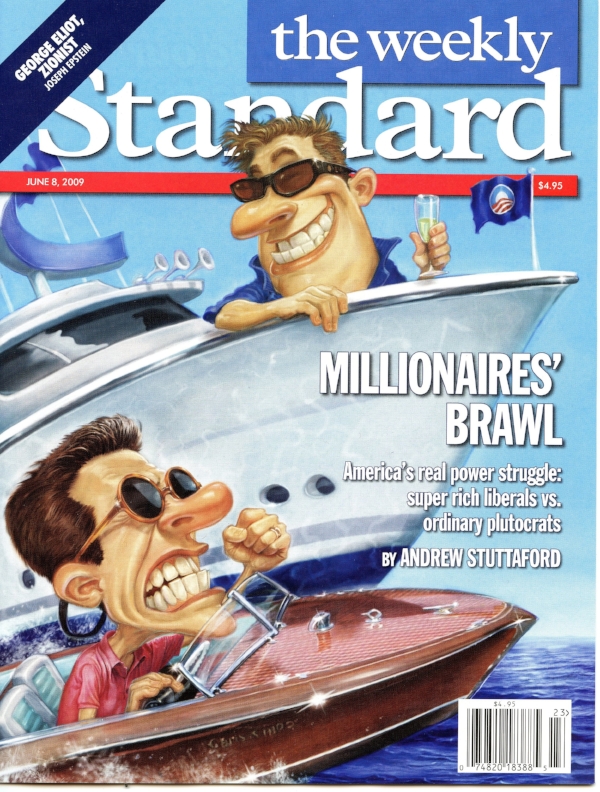
Millionaires' Brawl

the weekly Standard, June 8, 2009

img023.jpg

With the economy floundering, Wall Street in disgrace, and American capitalism facing its most serious ideological challenge in one, two, or three generations (you can take your pick), it's a good moment to remember Lenin.

While the bearded Bolshevik's grasp of economics was never the best and his stock picks remain a mystery, he would have grasped the politics of our present situation all too well. The old butcher would not have found anything especially surprising about the rise of Barack Obama, the nature of his supporters, or the evolution of his policies. He would have simply asked his usual question: Kto/kogo ("Who/whom"). The answer would tell him almost everything he needed to know. Lenin regarded politics as binary--a zero sum game with winners, losers, and nothing in between. For him it was a bare-knuckled brawl that ultimately could be reduced to that single brutal question: who was on top and who was not. Who was giving orders to whom. Hope and Change, nyet so much.

Of course, it would be foolish to deny the role that things like idealism, sanctimony, fashion, hysteria, exhaustion, restlessness, changing demographics, Hurricane Katrina, an unpopular war, George W. Bush, and mounting economic alarm played in shaping last November's Democratic triumph. Nevertheless if we peer through the smug, self-congratulatory smog that enveloped the Obama campaign, the outlines of a harder-edged narrative can be discerned, a narrative that bolsters the idea that Lenin's cynical maxim has held up better than the state he created.

So, who in 2008 was Who, and who Whom?

In a Democratic year, it's no surprise that organized labor emerged as Who and large swaths of the private sector as Whom. Many of the other, sometimes overlapping, constituencies (whether it's minorities, the young, or the gay, to name but three) who saw themselves benefiting from an Obama presidency were equally easy to predict. After all, whether by the accident of his birth or the design of his campaign, Obama's victorious coalition was, even more than most, a creation of meticulously assembled blocks, more pluribus than unum, and each with plenty to gain from his arrival in the White House.

That said, for all the smiles, the reassuring vagueness, and the this-isn't-going-to-hurt (too much) rhetoric, it was somewhat less predictable that a large slice of the upper crust would succumb to Obama's deftly articulated pitch. Yes, it's true that there had been signs that some richer, more upscale voters were being driven into the Democratic camp by the culture wars (and the fact that prosperity had left them free to put a priority on such issues). Nevertheless, even after taking account of the impact of an unusually unpopular incumbent, it's striking how much this process intensified in 2008--a year in which the Democrats were not only running their most leftwing candidate since George McGovern, but also running a leftwing candidate with every chance of winning. Voting for Obama would not be a cost-free virtuecratic nod, but a choice with consequences. At first glance therefore it makes little sense that 49 percent of those from households making more than $100,000 a year (26 percent of the electorate) opted for the Democrat, up from 41 percent in 2004, as did 52 percent of those raking in over $200,000 (6 percent of voters), up from 35 percent last go round.

Yet, this shift in voting patterns is more rational than it initially seems: more Lenin than lemming. Class conflict is inherent in all higher primate societies (even this one). It can manifest itself at every level, right up to the very top, and certain aspects of the 2008 campaign came to resemble a millionaires' brawl--one that was, of course, decorous, sotto voce, and rarely mentioned.

In a shrewd article written for Politico shortly after the election, Clinton adviser Mark Penn tried to pin down who exactly these higher echelon Obama voters were ("professional," corporate rather than small business, highly educated, and so on). Possibly uncomfortable with acknowledging anything so allegedly un-American as class yet politically very comfortable with this obvious class's obvious electoral clout, he eulogized its supposedly shared characteristics: teamwork, pragmatism, collective action, trust in government intervention, a preference for the scientific over the faith-based, and a belief in the "interconnectedness of the world." We could doubtless add an appreciation of NPR and a fondness for a bracing decaf venti latte to the list, and as we did so we would try hard to forget this disquieting passage from George Orwell's Nineteen Eighty-Four: "The new aristocracy was made up for the most part of bureaucrats, scientists, technicians, trade-union organizers, publicity experts, sociologists, teachers, journalists, and professional politicians."

We are not Oceania, and there's a messiah in the White House rather than Big Brother, but it's not hard to read Lenin, Penn, and Orwell, and then decide that Penn's professionals are the coming Who. They have certainly (at least until the current economic unpleasantness) been growing rapidly in numbers. As Penn relates:

 While there has been some inflation over the past 12 years, the exit poll demographics show that the fastest growing group of voters .  .  . has been those making over $100,000 a year. .  .  . In 1996, only 9 percent of the electorate said their family income was that high .  .  . [By 2008] it had grown to 26 percent.

This is a class that is likely to be more ethnically diverse and younger than previous groupings of the affluent--factors that may influence their voting as much as their income. Nevertheless, even if we allow for the fact that there is a limit to how far you can conflate households on $100,000 a year with those on $200,000, there are enough of them with enough in the way of similar career paths, education, and aspirations that together they can be treated as the sort of voting bloc that Penn describes. And it's a formidable voting bloc with a formidable sense of its own self-interest.

That sense of self-interest might seem tricky to reconcile with voting for a candidate likely (and for those making over $200,000 certain) to hike their taxes. In the wake of the long Wall Street boom and savage bust, however, it is anything but. Put crudely, the economic growth of the 1990s and 2000s created the conditions in which this class could both flourish and feel hard done by. Penn hints at one explanation for this contradiction when he refers to the alienating effect of the layoffs that are a regular feature of modern American corporate life. That's true enough. Today's executive may be well paid, sometimes very well paid, but he is in some respects little more than a day laborer. Corporate paternalism has been killed--and the murderer is widely believed to be the Gordon Gekko model of capitalism that Obama has vowed to cut down to size.

But Penn fails to mention (perhaps because it was too unflattering a motive to attribute to a constituency he clearly wants to cultivate) that this discontent stems as much from green eyes as pink slips--as well, it must be added, from a strong sense of entitlement denied. Traces of this can be detected in parts of Robert Frank's Richistan: A Journey through the American Wealth Boom and the Lives of the New Rich (2007), a clever, classically top-of-the-bull-market account of what was then--ah, 2007!--America's new Gilded Age. To read this invaluable travelogue of the territories of the rich (the "virtual nation," complete with possessions, that Frank dubs "Richistan") is to see how the emergence of a mass class of super-rich could fuel growing resentment both within its ranks and, by extension, without. By "without," I refer not to the genuinely poor, who have, sadly, had time to become accustomed to almost immeasurably worse levels of deprivation, but to the not-quite-so-rich eyeing their neighbors' new Lexus and simmering, snarling, and borrowing to keep up. The story of rising inequality in America is a familiar one: What's not so well known is that the divide has grown sharpest at the top. Frank reports that the average income for the top 1 percent of income earners grew 57 percent between 1990 and 2004, but that of the top 0.1 percent raced ahead by 85 percent, a trend that will have accelerated until 2008 and found echoes further down the economic hierarchy.

You might not weep for the mergers-and-acquisition man maddened by the size of an even richer hedge fund manager's yacht, but his trauma is a symptom of a syndrome that has spread far beyond Greenwich, Connecticut. Above a certain level, wealth, and the status that flows from it, is more a matter of relatives than absolutes. The less dramatically affluent alphas that make up the core of Penn's professionals--lawyers, journalists, corporate types, academics, senior civil servants, and the like--suddenly found themselves over the last decade not just overshadowed by finance's new titans but actually priced out of many things they view as the perks of their position: private schools, second homes, and so on. I doubt they enjoyed the experience.

Well educated, articulate and, by any usual measure, successful, they had been reduced to betas--and thus, politically, to a glint in Obama's eye. The decades of prosperity had swollen their numbers, but shrunk their status and their security. Their privileges were mocked or dismantled and their "good" jobs were ever more vulnerable. Wives as well as husbands now had to work, and not just down at the church's charity store either, a change that is more resented than Stepford's children would generally like to admit. Even so, things they felt should have been theirs by rights were still out of reach or, perhaps worse, graspable only by heavily leveraged hands. In a boom-time (July 2006) piece for Vanity Fair, Nina Munk interviewed two women amongst "the worn carpet and faded chintz" of Greenwich's old guard Round Hill Club. They told her how everything had gone downhill, "no one can afford to live here--all our kids are moving to Darien or Rowayton because it's cheaper."

It's a mark of the pressure to keep up that, as Frank noted, in 2004, 20 percent of "Lower Richistanis," those 7.5 million households (the number would be lower now, but it then would have constituted roughly 6-7 percent of the U.S. total) struggling along on a net worth of $1 million to $10 million, spent more than they earned. These poor souls will have included the most prosperous of Penn's professionals, but in an age of "mass luxury" and almost unlimited credit, the compulsion to do whatever it took not to be trumped by the Joneses spread to their less affluent cohorts, with the devastating consequences that were finally visible to all by the middle of last year.

Thus Penn's people had been outbid and outplayed by a rapacious Wall Street swarm of boors, rogues, gamblers, whippersnappers, the plain lucky, and the otherwise undeserving. Then came Wall Street's implosion and these prejudices were reinforced by that hole in the 401(k) and the collapse in the value of that overmortgaged house. Voting left looked better and better.

In 2007, the final financial reckoning was still slouching along waiting to be born. Back then, all they knew was that they had been shoved down the totem pole, which had changed beyond recognition. Nothing that had mattered did, or so it appeared. You can see an echo of this in the opening sections of one of the numerous (and, to be fair, not entirely unmerited) I-told-you-so articles penned by Paul Krugman in recent months:

Thirty-plus years ago, when I was a graduate student in economics, only the least ambitious of my classmates sought careers in the financial world. Even then, investment banks paid more than teaching or public service--but not that much more, and anyway, everyone knew that banking was, well, boring. In the years that followed, of course, banking became anything but boring. Wheeling and dealing flourished, and pay scales in finance shot up, drawing in many of the nation's best and brightest young people (O.K., I'm not so sure about the "best" part).

This social unease bubbled through Tom Wolfe's "The Pirate Pose," a 2007 essay that ran, apparently without irony, in the inaugural edition of Condé Nast's glossy Portfolio magazine, itself a lost artifact of the era when CDOs were still chic. Wolfe's sly--and in its exaggerations accidentally self-revealing--piece opens with an insistent pounding at the door of a Park Avenue apartment. Inside, a genteel lady rises from her "18th-century" (old!) "burled-wood secretary" (tasteful!), "her grandmother's" (old money!), "where she always wrote her thank-you notes" (refined!). Outside rages the absolutely dreadful hedge fund manager with "more money than God" who has just moved into the building:

Ever so gingerly, she opened the door. He was a meat-fed man wearing a rather shiny--silk?--and rather too vividly striped open shirt that paunched out slightly over his waistband. The waistband was down at hip-hugger level because the lower half of his fortyish body was squeezed into a pair of twentyish jeans .  .  . gloriously frayed at the bottoms of the pant legs, from which protruded a pair of long, shiny pointed alligator shoes. They looked like weapons.

Wolfe had fallen out of love with the Masters of the Universe. The ironic detachment that was one of the many pleasures of The Bonfire of the Vanities had been bumped and buffeted by the author's horror at the barbarians not just broken through the gates, but everywhere he would rather be, something that perhaps explains the faintest trace of glee that runs through this passage:

As for the co-op buildings in New York, their residents having felt already burned by the fabulous new money, some are now considering new screening devices. .  .  . The board of a building on Park Avenue is now considering rejecting applicants who have too much money.

Wolfe is angry, not so much because of the money (Sherman McCoy wasn't exactly poor), but because these loutish self-styled freebooters do not care for what he enjoys, what he stands for, even for where he might socialize (in his lists of some of the older Upper East Side hangouts, he throws in a couple of the more recherché names--the Brook, the Leash--as a reminder that he knows what's what). They despise what he favors, and even condescension, that traditional last line of defense against the arriviste who does not know his place, is unavailable. How can you condescend to someone who does not care what you think and is richer than you can imagine? The great writer finds himself sidelined on what is, quite literally, his home turf.

This is the class resentment that twists through recent remarks by another writer, a former academic who argued that it was ridiculous that "25-year-olds [were] getting million-dollar bonuses, [and] they were willing to pay $100 for a steak dinner and the waiter was getting the kinds of tips that would make a college professor envious."

The reference to a "college professor" as the epitome of the individual wronged by this topsy-turvy state of affairs is telling: 58 percent of those with a postgraduate education voted Democratic, up from 50 percent in 1992 (those with just one degree split more evenly). If those comments are telling, so is the identity of the speaker: one Barack Obama, a politician who has explicitly and implicitly promised the managers, the scribblers, the professors, and the now-eclipsed gentry that he would finish what the market collapse had begun. He'd put those Wall Street nouveaux back in their place. Higher taxes will claw at what's left of their fortunes and, no less crucially, their prospects. What taxes don't accomplish, new regulation (some of which even makes some sense) and the direct stake the government has now taken in so much of the economy will. Better still are all the respectably lucrative, respectably respectable jobs that it will take to run, or bypass, this new order: Former derivatives traders need not apply.

In an only slightly tongue-in-cheek February column in the New York Times, David Brooks neatly described what this will mean:

 After the TARP, the auto bailout, the stimulus package, the Fed rescue packages and various other federal interventions, rich people no longer get to set their own rules. Now lifestyle standards for the privileged class are set by people who live in Ward Three .  .  . a section of Northwest Washington, D.C., where many Democratic staffers, regulators, journalists, lawyers, Obama aides and senior civil servants live.

If the price for this is a relatively modest (for now) tax increase on their own incomes, it is one the denizens of Ward Three and their equivalents elsewhere will be happy to pay. For it is they now who are on a roll, and every day the news, carefully crafted by the journalists that make up such an archetypical part of Penn's professional class, gets sweeter.

The humbling of Wall Street has made for great copy, but it's fascinating how much personal animus runs through some of the reporting; from the giddy, gloating, descriptions of excess, of bonuses won and fortunes lost, to the oddly misogynistic trial-of-Marie-Antoinette subgenre devoted to examining the plight of "hedge fund wives" and, more recently, "TARP wives" (who had not, of course, been compelled to work).

In his "Profiles in Panic" a January 2009, article for Vanity Fair, Michael Shnayerson wrote:

The day after Lehman Brothers went down, a high-end Manhattan department store reportedly had the biggest day of returns in its history. "Because the wives didn't want the husbands to get the credit-card bills," says a fashion-world insider.

Not quite the guillotine, but the tricoteuses would have relished the story.

And then there's this from the Washington Post's travel section last month:

For so long, they have been taking Manhattan. They as in the Wall Streeters who counted their bonuses in increments of millions. .  .  . The coveted restaurants, the hotels with infinite thread-count sheets .  .  . the designer shops that sniff at the idea of a sale--it was all theirs. But the times they-are-a-changin'. .  .  . Our moment to reclaim the city has arrived. To shove our wallets forward and say, Yes, we can afford this. In fact, give us two.

To anticipate what (other than Ward Three vacationers to Manhattan) is coming next, listen to the increasing talk of congressional investigations (modelled on the FDR-era Pecora hearings) into Wall Street's workings or for that matter an intriguing, much-discussed piece in the Atlantic Monthly by Simon Johnson, a former chief economist for the IMF (Academic: check! Bureaucrat: check!), in which he drew comparisons, not all of them unfair, between the incestuous relationship between Wall Street and Washington and the more overtly corrupt oligarchies he had witnessed abroad in the course of his work. As this analysis finds wider acceptance (and it's too convenient not to), it presages a far greater overhaul of the financial sector than the moneymen now expect and a permanent shift of the balance of power (and the resulting rewards) back in favor of the political class and those who feed off it.

If you think that leaves some of Obama's Wall Street backers in the role of dupes, you're right. But there is a group who are looking smarter by the moment: the tiny cluster that dwells in Upper Richistan (households with a net worth in excess of $100,000,000). If we look at the admittedly sketchy data, there are clear indications that a majority of the inhabitants of Lower Richistan--with their millions but not their ten millions--voted for McCain. However much they might dislike the GOP's social conservatism or hanker after, say, a greener planet, they know that they are not so rich that they can afford to overlook the damage that a high tax, high regulation, high dudgeon liberal regime could do to their wealth, position, and prospects.

The view from Upper Richistan looks very different. The (again sketchy) data suggest that its occupants voted for Obama, as they may well have done for Kerry. Platinum card and red (well, tastefully pink-accented) flag apparently go well together. Warren Buffett's ideological leanings are well known, as are the donations, causes, and preachings of George Soros. Then there was that campaign a few years back by some richer folk (including Soros, Sanka heiress Agnes Gund, and a nauseatingly named grouplet called Responsible Wealth) in defense of the Death Tax. Describing itself as a "network of over 700 business leaders and wealthy individuals in the top 5% of wealth and/or income in the US who use their surprising voice to advocate for fair taxes and corporate accountability," Responsible Wealth is these days busily calling for New York governor David Paterson to increase the tax on "those who can afford it--which means us."

To be sure, neither self-righteousness nor idiocy is a respecter of income, but taken as a whole such efforts are much more than gesture politics, and much more than an updated version of the radical chic so ably described by a younger Tom Wolfe. Many New Jerseyans might think that the very liberal, very rich (thank you, Goldman Sachs) Jon Corzine has been a joke of a governor, but his political career has been all too serious--easily gliding from Wall Street to the U.S. Senate to the governor's mansion--and he's by no means alone. Colorado's high-profile "Gang of Four" (three tech entrepreneurs and a billionaire heiress) may not quite share the politics of Madame Mao's even more notorious clique, but they have been enormously effective in pushing their state into the Democratic camp, and their tactics are sure to be emulated elsewhere. In Richistan, Frank cited a 2004 study that showed that among candidates who spent more than $4 million on their own campaigns, Democrats outnumbered Republicans three to one. Among candidates that spent $1 million to $4 million, Republicans outspent Democrats two to one: more evidence of the political split between Lower and Upper Richistan.

The notion that some of the very richest Americans (not all, of course) support the Democrats should no longer be seen as a novelty. Backing Obama was just the latest chapter in a well-worn story. And it is not as illogical as it might seem. These Croesuses are rich enough scarcely to notice the worst (fingers-crossed) that an Obama IRS can do. They were thus free to vote for Obama, a candidate whose broader policy agenda clearly resonated with many in this nation's elite and who seemed at the time both plausible and unthreatening. The shrewdest or most cynical amongst them will have realized something else, something that an old Bolshevik might call a class interest. The onslaughts on Lower Richistan and on Wall Street will make it more difficult for others to join them at mammon's pinnacle and thus to compete with them economically, politically (particularly in an era when McCain-Feingold has greatly increased the importance of being able to self-finance a campaign), and socially.

Who/whom indeed.

The Prince

Il Divo

National Review Online, April 24, 2009

To listen to what is not said is often as informative as hearing what is. Absence can reveal as much as presence, the opaque more than the clear. It is this idea, brilliantly conveyed, that runs through the performance that dominates Il Divo, transforming this bravura, epic, and wildly imaginative new film by the Italian director Paolo Sorrentino (released last year in Italy, it opens at selected U.S. venues this weekend) from the merely great into something very close to a masterpiece.

An acerbic, allusive depiction of Giulio Andreotti (born 1919), the acerbic, elusive statesman who served seven times as Italy’s prime minister between 1972 and 1992, and who was for decades its most powerful politician, Il Divo is not a movie with obvious appeal to a wide American audience. It monkeys with time, reality, and genre, jumping to and fro between decades, between fact and fiction, between comedy, tragedy, satire, and philippic. The events it purports to describe are little known over here. The political figures that prowl through its lethal funhouse narrative will be unfamiliar and, in their urbane cynicism and sardonic Realpolitik, almost indistinguishable from one another. Was that Franco Evangelisti we just saw, or Salvo Lima? Does it matter?

If it’s any consolation, Italians also struggle to understand their country’s post-war political history. It’s a half-century-long saga of cabals, conspiracy, and faction, of collusion with organized crime, of governments that fell but never changed, of guilty verdicts that were not, of murky Masonic lodges and devious Vatican bankers, and, always, the fear that the country’s deep ideological divisions would ultimately lead to violent conflict. Finally, hideously and, except to the dead, ambiguously, they did. The “years of lead” between the late 1960s and the early 1980s were the years of the Red Brigades, of fascist bombings, of a Mafia that appeared ready to take on the state, but also of a growing suspicion that much of this was the result of a deliberately engineered “strategy of tension” designed to whip up support for a more openly authoritarian regime. It’s no surprise that Italians have a word, dietrologia (“the science of what’s behind”), to describe the quest to discover who is really responsible for what goes on in that country of theirs. Up until recently, the answer, more often than not, or so it is repeatedly claimed, was Andreotti.

Paranoia? To a degree, but amongst the members of the faction that Andreotti led within Italy’s Christian Democratic party, and who feature in Il Divo, Salvo Lima used his connections to la Cosa Nostra to deliver large numbers of crucial Sicilian votes (he was eventually murdered by the Mafia in a response to government moves against it), Franco Evangelisti was a self-confessed recipient of large amounts of illicit campaign-finance “contributions,” Paolo Pomicino was convicted for his role in a major bribery scandal (naturally he still sits in parliament, where he has served as a member of the commission responsible for investigating organized crime), and Giuseppe Ciarrapico was found guilty of involvement in the same Banco Ambrosiano affair that saw the bank’s chairman “suicided” from London’s Blackfriars Bridge. Ciarrapico became a senator in 2008. Under these circumstances, does it matter who exactly is who?

As for another Christian Democrat leader, Aldo Moro, a former prime minister, who haunts this film and, it implies, what’s left of Andreotti’s conscience, he ended up broken, “tried” and murdered by the Red Brigades in 1978 after a kidnapping in which efforts to rescue him may have been hampered by the same establishment of which he once believed himself to be an indispensable part.

Then there’s Mino Pecorelli, a prominent muckraking journalist with a sideline in blackmail. He’s gunned down at the beginning of the movie. Back in what passes for real life, he was reported to have had damaging information about Andreotti, information that may have proved fatal — though not to Andreotti. In 1999 Andreotti was tried for his alleged involvement in Pecorelli’s murder and acquitted, only to be found guilty by a court of appeal in 2002, a verdict that was itself overturned the following year. Andreotti continues to be a senator-for-life. Pecorelli continues to be dead.

Pecorelli’s is just one of many violent deaths to punctuate this movie. The most striking is that of Salvo Lima. Filmed in a cleverly cross-cut sequence strikingly reminiscent of the murderous finale to TheGodfather, Part II, it is just one of several nods to Coppola’s trilogy (which featured, incidentally, a character thought to be partly based on Andreotti). In another scene we watch Andreotti handing out small gifts to some of his humbler constituents. It’s impossible not to remember Marlon Brando’s Don Corleone dispensing a favor here and a favor there, and, if you’re me, to be struck by the similarities between the patronage state and a successful criminal enterprise.

But compared with Andreotti, Brando’s Godfather is a mumbling, incoherent lout. As depicted by Sorrentino’s biting, perversely witty, slyly winking script and Toni Servillo’s extraordinary (and in the view of many, remarkably accurate) performance, the reserved, melancholy Italian prime minister is a black hole, enigmatic, all-consuming and irresistible, his nature illuminated only by tiny inflections of his hunched, tightly held-in body and flashes of bleak, knowing humor. He’s devoutly religious (famously so), but we soon come to realize that he has embraced the idea of a fallen humanity so fully that it has become for him both inspiration and alibi.

Servillo’s soft-spoken, deadpan Andreotti makes the screen his own. Even if you have no interest in this film’s subject matter, go for Servillo, a maestro depicting a master with a subtlety and intensity that defy description. At times he seems almost inhuman, his narrow frame and bat-ears hinting at Max Schreck’s Nosferatu, particularly in a sequence in which he practically glides down the corridors of power, corridors that, Italy being Italy, are as architecturally glorious as they are politically treacherous. Its story of murder, corruption, and betrayal may be ugly, but Il Divo is frequently gorgeous to look at. It’s a contrast that reinforces the message that Sorrentino is trying to deliver. This is underscored by scene after scene shot in that perfect chiaroscuro where light and darkness play off each other with neither quite prevailing. Even the times when Andreotti walks slowly and stiffly down a quiet Roman street, completely, hauntingly alone yet accompanied by a heavily armed police escort, are filmed with a somber noir beauty all their own.

To be sure, in some respects Il Divo’s Andreotti is a caricature (the real Andreotti, no surprise, is no fan). Sorrentino is not looking for balance. He is making the case for the prosecution: Look out for the sequence in which Andreotti is interviewed by a journalist who recites a long list of distinctly awkward “coincidences” for which Andreotti has no easy exculpatory explanation. On another occasion Andreotti is filmed confessing, if only to himself, to terrible wrongdoing.

Sorrentino does at least allow his Andreotti to refer briefly to the Communist threat that had threatened to overwhelm the young, fragile Italian republic. Fair enough. To head that off required tactics unlikely to pass muster in safer, more complacent times. “Trees,” observes Servillo/Andreotti on another occasion, “need manure in order to grow.” Andreotti takes a similar tack in the course of his “confession,” referring to “the deeds that power must commit to ensure the well-being and development of the country,” and the “monstrous . . . contradiction [of] perpetuating evil to guarantee good.” Maybe, but these “deeds” became an end, not the means. The excesses that ensued, and the scandals they brought in their wake, brought both the First Republic and Andreotti tumbling down, even if, the film’s coda suggests, neither fell quite as far, or as hard, as they deserved.

One notable commentator on Italian politics has written that a leader “must not flinch from being blamed for vices which are necessary for safeguarding the state . . . Some of the things that appear to be virtues will, if he practices them, ruin him, and some of the things that appear to be wicked will bring him security and prosperity.”

Somehow I don’t think that Machiavelli would have liked Il Divo. See it nonetheless.

Tough Times in EUtopia

The Weekly Standard, March 30, 2009

Sometimes truth just has to speak to powerlessness. Addressing the EU's sham parliament in mid-February, the Czech Republic's refreshingly tactless and refreshingly Thatcherite president, Václav Klaus, raised the awkward topic of what the EU euphemistically refers to as its "democratic deficit" and told MEPs that they were part of this problem, not its solution:

 "Since there is no European demos-and no European nation-this defect cannot be solved by strengthening the role of the European parliament either. This would, on the contrary, make the problem worse and lead to an even greater alienation between the citizens of the European countries and Union institutions."


Klaus's listeners were predictably outraged. They ought to have been terrified. With the EU economies falling apart at an unprecedented pace, there is nothing that these toy-town parliamentarians can do-except get out of the way.

The EU's insultingly undemocratic nature is not news (indeed, it is part of its rationale), but it remains the key to grasping how those who run the EU have, for better and worse, had so much success in ramming their agenda through. Not having to bother too much about national electorates has been a great boon to Brussels. As the continent's economies slide ever deeper into the mire, however, that once handy feature could end up crashing the entire system.

An economic debacle on the current scale is going to shake any political structure, however securely moored, but the EU's persistent recourse to a form of soft authoritarianism has left it peculiarly ill suited to weather the storm to come. After decades of routinely bypassing its voters the union may well no longer have what it takes to secure their approval for the harsh medicine and painful sacrifices necessary to bring the EU through this ordeal in one piece. After all, it can barely even get them to vote: Turnout for the most recent (2004) elections for the EU parliament sank to a record low of 45.5 percent. Admittedly that total was dragged down by massively uninterested Eastern Europeans (only 16.7 percent of Slovaks voted and 20.4 percent of Poles), but it was sparse almost everywhere: Only 39 percent of Brits showed up, about the same percentage as made it to the voting booth in the Netherlands, one of the EU's founding nations.

As the history of the union's occasional, grudgingly granted referenda-a sorry saga of chicanery, rejection and do-overs-reminds us, appeals to the supposed solidarity of that imaginary European demos have never really worked. And that was in the good times. They surely won't do the trick now, nor will arguments based on the logic of a free market ideology widely, if inaccurately, said to have failed. Yet to steer a course through what may become hideously hard times without much in the way of popular consent threatens to push already alienated electorates in the direction of the extremist politics of left or right.

The story of this slump is too familiar to need repeating here, but it is worth pausing to consider how the introduction of the euro has left the EU marooned on a circle of economic hell all of its own making. Imposed on most of the European heartland by a characteristic combination of bullying, bribery, conclave, and legerdemain, the single currency was put in place with as little regard for the real world as for the ballot box. To squeeze a wide range of vastly divergent economies (and to do so with few safety nets) into one monetary system made little sense except when understood as a matter of politics, not economics. But economics has a nasty habit of biting back.

Up until the eruption of the present crisis, the European Central Bank's interest rate policy primarily reflected the needs of France and Germany, Euroland's largest economies. This left rates "too" low for naturally faster growing countries like Ireland and Spain, which in turn inflated unsustainable housing bubbles. These have now burst-in Ireland's case taking much of the banking system down with it. On some forecasts Irish GDP may shrink by 10 percent between 2008 and 2010, a dismal number that could eventually prove too optimistic. Gloomsters joke bleakly that the difference between Ireland and Iceland is six months and one consonant. Spain meanwhile now boasts an official (in other words, understated) unemployment rate of 14 percent. Over 600,000 migrant workers have been laid off. This is not a recipe for social peace.

In other countries, most notably a horribly in-hock Italy (public sector debt over 100 percent of GDP and expanding fast), low interest rates allowed governments to put off long overdue structural reforms. Instead of forcing the introduction of the badly needed discipline that was allegedly one of the principal reasons for its adoption, the euro (a hard currency when compared with shabbier predecessors such as the lira or drachma) was treated as a free pass. It has been anything but. Even before the current mess, Italy's crucial export sector was finding it difficult to cope with the brutal combination of rising cost inflation and a currency far stronger than the accommodating, and periodically devalued, lira. On some estimates, this latest recession is the fourth that Italy has suffered in the last seven years. Back in 2005 Silvio Berlusconi described the euro as a "disaster" for his country. He was not exaggerating.

Devaluations are to GDP what steroids are to sport. In the long-term they may be unhealthy, but in the short-term they frequently work miracles. The problem is that the option is no longer so easily available for the nations that adopted the euro. Italy, Ireland, and a number of other countries are in the grip of a one-sized currency that could never fit all, and the euro is now for them little more than a straitjacket or, more accurately, a noose. They have theoretically retained enough sovereignty to quit the euro, but for one of them to do so, especially if other states stick with the common currency, would be to risk something close to complete economic meltdown.

Money would pour out (so much so that capital controls would probably be required), interest rates would soar, and the reborn national currency would plummet. In the absence of a bailout from the eurozone it had just abandoned, the exiting country itself would probably be driven to renege (either de facto or de jure) on its foreign debt-as would much of its private business. In its consequences, this could be a Lehman-plus trauma with possibly devastating effects on already chaotic international capital markets. No less critically, it could set off a crisis in confidence in the credit of those weaker nations that had kept faith with the single currency, not to speak of feebler economies elsewhere. The cure, therefore, could well be worse than the disease.

In the meantime, in a damned-if-you-do, damned-if-you-don't spasm, the markets are fretting that the disease is turning ever more dangerous-and, in a process that feeds upon itself, ever more infectious. Spreads on sovereign debt yields within the eurozone (between German Bunds, say, and paper issued by Spain, Greece, Portugal, Italy, and Ireland) have widened noticeably. This is a warning that investors are beginning to think a once unthinkable thought: that one or more of the zone's less resilient members might go into default. On this logic these countries can neither afford to keep the euro nor to junk it. Rock, meet hard place.

These worries are made even more pressing by concern over the impact of Eastern Europe's spiraling economic woes on the already shattered finances of the western half of the continent. Contrary to some of the more excitable headlines, not all the countries of formerly Warsaw Pact Europe are, yet, in deep trouble, but the problems of those that are (notably Hungary, Ukraine, Romania, and Latvia) threaten to wreck confidence in those that are not. And those problems will not be confined safely behind the Oder-Neisse line: Two of Sweden's largest banks, for instance, are frighteningly overexposed to the faltering Baltic States, while their counterparts in Austria, seemingly lost in nostalgic Habsburg reverie, have reportedly lent out the equivalent of 70 percent of their country's GDP to once Kaiserlich und Königlich territories and parts nearby.

Eastern Europe's problems are Western Europe's and, given Eastern Europe's dependence on Western capital flows, vice versa, a state of affairs that neither side appreciates. Infuriated by the impression that they were being sidelined by the upcoming "G-20+" summit in London, nine of the EU's former Soviet bloc members held their own breakaway meeting earlier this month to discuss what to do. Meanwhile, led by Germany's indignant Angela Merkel in full prudent-Hausfrau, Thatcher-handbag mode, the Westerners have tried to damp down the East's increasingly aggressive demands for assistance. Good luck with that. Demonstrating a keenly cynical awareness of which buttons to press, the Hungarian prime minister warned that a severe slowdown in the East could lead to "a flood of unemployed immigrants traveling to Western Europe in search of jobs."

If you suspect that all this leaves the EU looking somewhat stuck, you would be right. But then this is no accident. The lack of democratic responsiveness so thoroughly ingrained into the union's architecture was always intended to stop the bloc's politicians from succumbing to the temptations of protectionism, beggar-thy-neighbor devaluations, and other questionable devices often found in the toolbox of an economically desperate national government. That's all very well, and all very praiseworthy, but it doesn't do anything about the desperation, a desperation that will be felt all the more sharply by electorates looking for their leaders to do something, anything, in response to this crunch-only to discover to their chagrin (to use too gentle a word) that there is little that the EU will, legally or politically, allow those leaders to do.

To take just one example, earlier this year Britain saw a series of wildcat strikes protesting the importation of cheap foreign workers from elsewhere in the union as a means of undercutting the locals. The facts that triggered the dispute are murky, but what is certain is that even if the British government had wanted to intervene under EU law it could not. Equally, while the opposition Tories grumbled, nobody was fooled. If the Conservatives had been in charge, they would have done just the same as Labour: nothing. If you want to drive voters to the political extremes, stories like this are a good place to start.

Except that "start" is the wrong word. Parties of the extreme, whether of left or right, already have more than a foothold in Germany and France. "Populists" of every description can be found in the legislatures in countries from Belgium to Denmark to Latvia to Austria to Poland to Hungary. Take your pick: There are plenty to choose from. Even in never-so-sedate-as-it-seems Britain, a country that has made a fetish (if not always convincingly) of its moderation, the much-reviled far rightists of the hitherto tiny British National party are showing some signs of evolving from being useful bogeymen for the left into a party with demonstrable political clout within elements of a white working class that has been neglected for too long.

The backgrounds and the prospects of these movements vary widely from country to country, as do the pasts and the resentments that have shaped them, but in recent years their appeal has begun to grow in sections of the electorate pummeled by the dislocations brought about by mass immigration and globalization-dislocations made all the more painful by the realization that the ruling elites who never really asked them for their opinion on these changes, let alone their agreement to them, couldn't give a damn about their plight. This is a perception that will only be sharpened when the populations of these countries, more and more of whom are losing their jobs, are told by that very same political class that protection is off the agenda and that austerity is on, that saving local industries is unacceptable, and that helping out foreign countries is a must. And, oh yes, none of this was our fault-it was all the bankers' doing-and, oh yes, they and their bonuses have got to be rescued too.

So what's next? The leaders of the EU countries will do their best to muddle through in rickety, unpopular unity. Here and there they will cheat both on each other and on the key EU principle of a single market. The warning signs are already there. In February, President Sarkozy attacked the way that French auto companies were supplying their home market from manufacturing facilities in the Czech Republic. The previous month, Britain's Gordon Brown had criticized the amount of overseas lending by the UK's beleaguered bailed-out banks. Nevertheless, however awkwardly, however reluctantly, the EU's members will attempt to hang together-for as long as (or indeed longer than) their domestic politics comfortably permit, an effort that will inevitably further boost the appeal of the wild men of the fringes.

That said, as the EU's leaders are all too well aware, the slump has so far brought down two European governments (in Latvia and non-EU Iceland). Nobody wants to be next, let alone run the risk of political and economic breakdown. The few remaining traces of the budgetary discipline that supposedly still underpins the euro will therefore probably be scrapped. The euro may hang on to its reach, but only at the cost of its integrity. To ordinary Germans this will be seen as a betrayal, a Dolchstoss even. A people haunted by memories of where a debauched currency can lead, they only agreed to part with their much-cherished deutsche mark on the understanding that the euro would be run with Bundesbank-style discipline. That was then.

So money will be thrown around, the imperiled brethren of both East and West will, after much shoving, screaming, and hesitation, be bailed out. Some protectionist measures (directed against those outside the EU) will be brought in and all fingers will be crossed. It won't be pretty, but with luck, it might be enough to stave off catastrophe. Pushing their luck, some glass-is-half-full Europhiles believe that the fact that no country can easily work its way through these tribulations alone will conclusively make the case for still closer European integration to some of the EU's more reluctant federalists. You can be sure that this is a rationalization that Brussels will look to exploit: Rahm Emanuel is not the only politician unwilling to waste a crisis. The EU's policy response to the slump is likely to have two objectives: the reconstruction of member-states' economies and the destruction of what's left of their autonomy. Going for the latter could well drive even more disaffected voters into the extremist fringe, though Brussels is arrogant enough to persist. There are already indications that the eurocrats may be pushing at an open door. In a startling example of mistaking the Titanic for the lifeboat, Poland has become just one of several nations speeding up plans to sign up for the euro-and the safe haven it is meant to represent.

On the other hand if, as appears disturbingly likely, the economic situation grows far darker, it's easy to draw an alternative picture in which both euro and union come under previously unimaginable stress, stress with unpredictable and potentially ominous consequences, stress that will be echoed and intensified by mounting political and social disorder in a Europe that discovers, too late, that there was something to be said for democracy after all.