Tango Lesson

The Weekly Standard, December 12, 2011

Casa Rosada, Buenos Aires, August 2011 © Andrew Stuttaford

Casa Rosada, Buenos Aires, August 2011 © Andrew Stuttaford

There are good days and bad days, but even on the good days the abyss is never too far away. The eurozone’s dangerously original mix of innovation, incoherence, and unaccountability makes it difficult to identify a single event that could finally push it over the edge. But, with confidence already shot, there is one obvious contender, a series of old-fashioned bank runs given a brutal new twist by the logic of currency union as cash pours out of the stricken banks and the country (or countries) that hosts them. Unless the European Central Bank could show that it has what it really takes, fear would feed on itself, credit markets would seize up, and that, quite possibly, would be that.

The extra liquidity offered by the Fed and other central banks on November 30 was a sensible precautionary move, but its extent and its timing were clear signs of anxiety that, while the eurozone’s leadership moves from grand plan to grand plan, the building blocks of disaster are falling into place. U.S. institutions are wary about extending short-term funding to many European banks. European banks are wary about lending to each other.

Of all the sickly banks surviving on the Rube Goldberg life support systems now being deployed in the eurozone’s grisly ER, Greece’s are probably (and the implications of that “probably” are appalling) the most vulnerable to the panic that could set everything off. Their country is the closest to default. If Greece goes under, its banks will, without fresh capital, go under too. So what are their depositors doing?

They are not yet running. But they are walking away at an ever quicker pace (deposits have fallen by over 20 percent since January 2010) that can only have accelerated since the moment in early November when Angela Merkel and Nicolas Sarkozy first conceded that a country’s eurozone membership might not be irrevocable after all.

To understand just how bad things could get, the best place to look is Argentina in early 2001. In 1991, just 10 years before, Latin America’s most gorgeously faded republic had decided to turn over its latest new leaf. It linked its peso to the dollar at a 1:1 exchange rate. This peg was backed by reserves held by a currency board. Despite its distinctly permissive, distinctly Argentine, characteristics, it was designed to use external market pressure to force the country into the tough financial discipline that it had found impossible to impose upon itself. Those Greeks who regarded the EU’s single currency as something more than a free lunch supported signing up for the euro for pretty much the same reason.

At first, the Argentine experiment worked well. The economy grew briskly, and foreign lenders were pleased to feed its growth in a manner well beyond the capability of Argentina’s relatively small banking sector. After all, they told themselves, the country had changed its ways, and, thanks to the peg, exchange risk had been hugely reduced. What could go wrong? If you think that sounds a lot like the talk that accompanied the prolonged surge in international lending to Hungary, Latvia, Greece, Ireland, and all the other future catastrophes crowded into the euro’s waiting room (and, subsequently in some cases, the eurozone itself) just a few years later, you’d be quite right.

What could go wrong, did: Deep-seated structural flaws within the local economy, a series of external shocks (starting with the Mexican crisis of 1994), weaker commodity prices, and stresses flowing from the fact that the dollar and the peso were an ill-matched pair all combined to push the country into difficulties made cataclysmic by ultimately unsustainable levels of foreign debt. Private lenders shied away. Private capital fled. Taxpayers hid. Ratings agencies screamed. The cost of borrowing soared. The resemblance to Greece in 2011 is unmistakable. Interestingly, the Argentine storm was gathering strength at the same time as Greece was being accepted, not without controversy, into the eurozone, raising the question what in Hades the EU’s leadership was playing at. The implicit warning for Greece contained in the Argentine disaster was as clear as Cassandra, and just as ignored.

In any event, as the 20th century lurched into the 21st, Buenos Aires previewed Athens. There were differences, of course, not least the fact that Argentina had hung on to its own national currency, but that meant less than it might have done. By the end of the 1990s, 90 percent of Argentina’s public debt was denominated in a foreign currency, marginally better than Greece’s 100 percent (for these purposes the euro is a “foreign” currency everywhere), but not by enough to give any comfort. And it wasn’t just the debt: Wide swaths of the economy had been dollarized.

And so had the banks: According to the IMF, close to 60 percent of the Argentine banking system’s assets and liabilities were denominated in dollars throughout the second half of the 1990s, leaving the banks horribly exposed in the event that the peg broke. Indeed, the potentially enormous cost of breaking the peg was a good part of why it was maintained, a logic similar to that now keeping the embattled PIIGS (Portugal, Italy, Ireland, Greece, and Spain) on the euro’s leash. This should come as no surprise: The stability that such mechanisms can bring largely rests on the absence of any obvious exits. Countries that sign up for them need to be sure that they have what it takes to stay the course. Slinking in on fudged numbers and, ludicrously, expected to maintain some sort of pace with Germany’s Porsche economy, the Greek jalopy stood even less of a chance than had far-better-intentioned Argentina.

Argentine headlines in 2000-01 must have read much like those in Greece today. The country accepted billions in international assistance (from the IMF) in exchange for the imposition of austerity measures that pummeled an already faltering economy. There was a voluntary debt swap (on terms as absurdly expensive as those proposed for Greece earlier this year) that bought time, but no confidence.

Massively widening spreads between peso and dollar debt signaled the market’s fear that the peg was doomed. But, to quote the IMF’s invaluable Lessons from the Crisis in Argentina (approved by one Timothy Geithner), it was “the resumption [in July 2001] of large scale withdrawals from Argentine banks [that was] perhaps the clearest sign of the system’s impending collapse.” Indeed it was.

The banks—and, of course, the country itself—were quite literally running out of the dollars that made up a monetary base already depleted by previous capital flight, and a growing current account deficit. The rules of a currency board (even in its looser Argentine variant) meant that it was not possible simply to print money to fill the gap. This is a problem familiar to those of today’s PIIGS who have to watch the money drain out of their economies, yet are blocked from direct access to the printing press by the European Central Bank. Argentina’s more sinuous treasuries (provincial and then national) tried to meet this challenge by issuing a series of evocatively named quasi-monies (IOUs, basically), but these pataconesporteñosquebrachos, and lecops were harbingers of doom, not a solution.

And when the dominoes of finance finally fall, they fall quickly. To return to the IMF’s grim textbook: “The crisis broke with a run [on] private sector deposits, which fell by more than $3.6 billion (6 percent of the deposit base) during November 28-30.” At that point the game was up. The authorities’ response (notably the introduction of the corralito) should alarm depositors throughout the PIIGS as they mull how their governments might stop precious euros escaping to safe havens abroad in the wake of bank runs at home.

The corralito limited cash withdrawals from individual bank accounts to the equivalent of $250 a week (the dollar value would soon fall sharply). And the response to it should worry those now running the PIIGS. Argentinians took to the streets and reduced the country’s political order to chaos. Depending on how you define the term, Argentina had five presidents in less than a month, but none could change the inevitable. The country defaulted on its debt, the peg was scrapped, the peso tanked, and the corralito was replaced by the corralón, the centerpiece of an even tougher regime. Depositors were allowed to withdraw a little more money than before, but only in heavily depreciated pesos. Term deposits were frozen, and transfers of money out of the country heavily restricted. Not so long after, dollar deposits were switched into pesos, and the ruin of Argentine savers, many of whom lost their jobs as the economy crashed, was complete.

History does not always repeat itself. Maybe those remaining Greek depositors are confident that, however battered their nation’s finances, its guarantee of bank deposits up to some $135,000 will hold up through the toughest times. Maybe they have faith that Greece will stick with the euro. And maybe they trust that, should the walk from Greek banks turn into a run, the European Central Bank will do what it takes to put things right. But if they do have any doubts, they can, for now, easily move their euros to a part of the eurozone—Germany, say—where there is no currency risk and bank deposits are blessed with a guarantor that is, you know, solvent. Thinking like that is how a run on the banks can begin. Paranoid? Well, if you were a depositor with a Greek bank, what would you do?

And, if you were a depositor in an Italian bank, watching all this and aware that money is ebbing away from Italy too, what would you do?

I know what the Argentine advice would be. Run.

And if the Greeks run, and the Italians run, who will be next?

Cristina’s Whirl

National Review, November 10, 2011 (November 28, 2011 issue)

Montserrat, Buenos Aires, August 2011 © Andrew Stuttaford

Montserrat, Buenos Aires, August 2011 © Andrew Stuttaford

If you want to understand why Argentina’s Cristina Fernandez de Kirchner triumphed quite so conclusively (with 54 percent of the vote against 17 percent for her nearest challenger) in October’s presidential election, the University of Buenos Aires’s Museum of Foreign Debt is a splendid place to start. That such an institution exists says nothing good about Argentine financial history. What it contains suggests yet more turbulence ahead.

San Telmo, Buenos Aires, August 2011 © Andrew Stuttaford

San Telmo, Buenos Aires, August 2011 © Andrew Stuttaford

The museum is a showplace for an unconvincing national alibi. Argentina is innocent and maligned, its tale not one of squandered wealth, but of victimhood, as it is repeatedly plundered by Anglo-Saxon (of course!) financiers, helped in later years by their stooges at the IMF. Under Juan Peron, however, things had been different. During the Peronato, the foreign debt was repaid. Indeed it was, but (as is not explained in the museum) that owed more to the capital surpluses built up during World War II than to Peronism’s autarkic economic model, which was in deep trouble by the time its creator was deposed in 1955. No matter, Peron’s curious mix of fascism, corporatism, and Evita has never quite lost its grip on a nation forever searching for a magical solution to its largely self-inflicted woes. And now, a decade of growth under a new generation of Peronists has convinced many Argentinians that the conjurer-caudillo was on to something.

It’s hard to blame them. Just ten years ago, the botched free-market experimentation of the 1990s had pushed Argentina into the abyss. It began well enough, but pegging the peso to the U.S. dollar (a key part of the process, and the wrong currency to choose) without sufficient structural reform left Argentina increasingly uncompetitive. Lower export prices and successive emerging-markets crises in the latter part of the decade made matters worse. The country’s budget swung wildly off-kilter. Spending was too high, tax revenues too low. Foreign lenders filled much of the gap. Today’s Greeks know how the story ends. They should also note this: Billions in additional borrowing and belated attempts at austerity were not enough to put things right. The economy plunged. Capital fled. In December 2001, the government introduced the corralito (later toughened into the corralon), a measure that (more or less) froze all bank accounts. Argentina went into default shortly thereafter.

This remains (fingers crossed) the largest sovereign-debt default ($95 billion) in history. The dollar peg was dropped a few weeks later; the peso crumpled. Dollar deposits in Argentine banks were swapped into hugely depreciated pesos, a precedent that ought to alarm savers in the eurozone’s PIIGS. If the drachma and its feeble kin are to return, there will be corralitos first. Depositors have been abandoning their banks in Greece, Ireland, and elsewhere. Who can blame them?

Image of Nestor Kirchner outside Casa Rosada, Buenos Aires, August  2011 © Andrew Stuttaford

Image of Nestor Kirchner outside Casa Rosada, Buenos Aires, August  2011 © Andrew Stuttaford

San Telmo, Buenoa Aires, August 2011 © Andrew Stuttaford

San Telmo, Buenoa Aires, August 2011 © Andrew Stuttaford

Argentina’s financial breakdown had been accompanied by trouble in the streets and chaos in the corridors of power. Depending on how the term “president” is defined, the country had as many as five of them within two weeks. The last was Eduardo Duhalde, appointed interim president by the legislative assembly. After elections 16 months later, he was succeeded by Nestor Kirchner, a Left-Peronist governor from refreshingly distant Patagonia. The fever had broken. Argentina took a mulligan. Private savers had been crushed, and much of the middle class was pushed into poverty, but many businesses were saved by the effective “devaluation” of their debt. Peso collapse bailed out exporters and local manufacturers battered by the once-overvalued currency, as did a reviving economy fueled by the accelerating global commodity boom (Argentina is a major food exporter) and increased government spending. That spending was financed by the fruits of recovery, the windfall from taxes on those ever-more-valuable food exports and, in a sense, the lower debt burden that was default’s naughty reward. In 2005, Argentina repaid its IMF loans ahead of schedule. Kirchner no longer intended to listen to the organization’s nasty “neo-liberal” advice.

Growth continued to soar. Kirchner would have won comfortable reelection in 2007, but stood aside for his wife, Cristina, an abrasive would-be Evita, but without her cult appeal. Only a few months after taking office, she lost a brutal fight with farmers over plans to hike export taxes, a defeat that contributed to her allies’ taking a hit in nationwide legislative elections in 2009. In a tango variant of the Putin-Medvedev waltz, Nestor Kirchner was due to succeed his wife as their party’s candidate in the presidential elections in 2011, but ended up doing something even more useful for the cause: He died last year, aged only 60.

Eternauta Kirchner, Buenos Aires, August 2011 © Andrew Stuttaford

Eternauta Kirchner, Buenos Aires, August 2011 © Andrew Stuttaford

Tragedy is often a vote winner, and particularly so in a place like enthusiastically morbid, histrionic Argentina. Cristina’s approval ratings jumped 25 points. As a character in a novel by Argentine author Tomas Eloy Martinez once said, “Every time a corpse enters the picture in this country, history goes mad.” A black-clad Cristina threw her widow’s weeds into the political battle with aplomb, gusto, and tears. Nestor (“he is watching, he is here, isn’t he?”) haunted her speeches and her rallies, transformed into the lost leader who sacrificed all. It worked. Wander around Buenos Aires, a city more skeptical about the Kirchners than most, and you will see numerous stenciled graffiti of Nestor as El Eternauta, an iconic Argentine cartoon figure who traveled through time and space, and to the left. Cristina, already Evita, also became Juan to Nestor’s Evita, keeper of the martyr-spouse’s flame.

Nestor Kirchner, Buenos Aires, August 2011 © Andrew Stuttaford

Nestor Kirchner, Buenos Aires, August 2011 © Andrew Stuttaford

The economy lent a large hand. By year’s end, GDP will have grown by over 90 percent since its 2002 nadir. The spoils of success have been spread around. Thanks to better times, unemployment has been more than halved from 2002’s 20 percent. The number of those in poverty has fallen sharply. Income inequality has shrunk. Social spending has leapt. The descendants of Evita’s descamisados (the shirtless) knew whom to thank. Throw in a divided and uninspiring opposition, and the rest was victory.

The worry is what comes next. Growth is forecast to ease to a still impressive 4–5 percent in 2012 (after a little over 8 percent this year), but envious PIIGS should be aware that there’s plenty of snake oil in the Kirchner cure, and danger too. Revving up the demand side can work (and has worked), as can devaluation, but, like steroids, such policies are best not overdone. And they have been overdone. Officially running at a fantasy-math 10 percent, inflation is now thought to stand at around 25 percent, a level that has been eroding the devaluation advantage (the trade balance has deteriorated in recent years). Price controls, whether direct (such as those on utilities) or indirect (export taxes), have merely forced this inflation to express itself through shortages and underinvestment, a variant of the distortions now emerging as a result of the country’s growing protectionist tilt.

Buenos Aires, August 2011 © Andrew Stuttaford

Buenos Aires, August 2011 © Andrew Stuttaford

Recoleta, Buenos Aires, August 2011 © Andrew Stuttaford

Recoleta, Buenos Aires, August 2011 © Andrew Stuttaford

With public spending still roaring ahead, a cash crunch is drawing closer, exacerbated by the way that the 2001 default and its heavily litigated aftermath have (and perhaps this is just as well) constrained access to international capital markets. The government has taken to raiding the central bank’s foreign-currency reserves to pay those overseas debts it does acknowledge. In a different smash-and-grab, private pension funds worth $24 billion were nationalized in 2008 (in the pensioners’ best interest, of course), a move that also boosted the state’s ability to meddle in some of the country’s largest companies, a temptation that it will probably find difficult to resist: The Kirchner years have already seen the outright nationalization of a number of enterprises.

The markets have read the runes: Foreign direct investment in Argentina has slowed sharply and the locals have followed suit. Capital flight is accelerating and is now estimated at $3 billion per month, something that has provoked a draconian response, even if reserves (for now) remain reasonably healthy. Just after the election, Kirchner launched a new series of initiatives designed to bring dollars back home. These included ordering the country’s energy and mining businesses to repatriate their export revenues, and compelling insurance companies to cash in their foreign investments by year’s end.

These diktats were another display of an authoritarianism that has become more visible as the economic miracle comes under pressure. Economists have been fined for publishing inflation data that differ from the official spin. The inconveniently independent president of the central bank was forced out with the assistance of questionably legal maneuvers. The tactics deployed in the long struggle against the giant Clarín media group have become ever rougher, and show little respect for the idea of a free press. Under the circumstances, Kirchner’s fondness for Hugo Chávez is no surprise, nor is her recourse to conjuring up a handy foreign devil: that “crude colonial power in decline,” Malvinas-stealing Britain.

This is unlikely to end well.

Eastern Reproaches

Max Egremont: Forgotten Land - Journey Among the Ghosts of East Prussia

The Wall Street Journal, November 11, 2011

In 1945, Stalin seized East Prussia, Germany's venerable redoubt on the Baltic Sea, as a spoil of war. A portion went to the "People's Republic" that the Soviets had just created in Poland. He kept the rest. The last surviving Germans were killed or deported. The cozy old Königsberg of the Teutonic Knights—the home, during the Enlightenment, of no less than Immanuel Kant—was transformed into Kaliningrad—a bleak Soviet place named after Mikhail Kalinin, the token peasant who was titular head of Stalin's USSR.

Nearly 70 years later, the countries behind these borders have changed, but the frontiers have not, and will not. The Polish part is finally and truly Polish; the sliver of East Prussia given to the Lithuanian Soviet Socialist Republic is now a part of independent Lithuania; the rest of the old Soviet slice is a seedy Russian exclave surrounded by the European Union. The only Germans there are tourists, in search of an elusive land that lingers on in family lore and in the dreams of the dispossessed for a vanished, fondly imagined, past.

Max Egremont's idiosyncratic, disjointed and beautifully written volume makes an ideal guide to this shifting, shadowy realm. In part a piecemeal history of the final half-century of German East Prussia, in part a travelogue through what was left behind, "Forgotten Land" is gently elegiac. Shifting constantly between present and a variety of pasts, it is as wistful as a flick-through of an old photo album, as melancholy as a rain-spattered northern autumn afternoon.

From East Prussia's tangled history Mr. Egremont extracts the one essential fact: To the Germans who lived there, this was the frontier, a vulnerable salient pierced deep into Slavic and Baltic realms. The Teutonic Knights of the Medieval Northern Crusades brought Christianity to the Eastern Baltic, and Germans into the region. Those who followed in their wake settled territories that became the Duchy of Prussia in the 16th century, then part of the larger Kingdom of Prussia in the 18th, before being absorbed into the German empire in the 19th. For all that, East Prussia was never quite able to shake off a vaguely colonial economy and a vaguely colonial unease, an unease exacerbated when the Treaty of Versailles left it separated from the Fatherland by a slice of newly reconstituted Poland.

The mansions of the Junkers that anchored this world—and this worldview—seemed frozen in a pre-industrial age, on occasion boasting moldering grandeur and aristocratic eccentricity on an English scale—Carol Lehndorff, owner between the wars of an ancestral pile that dominated Steinort (now Sztynort, Poland) rejoiced in alcohol, rejected vegetables and "when alone . . . lived in two rooms on the warm south side of the house, contemplating his collection of Prussian coins." Mr. Egremont grants us glimpses of an austerely gorgeous idyll, of untamed forests and wide Masurian lakes, of a "softly lit horizon . . . [and] the pale-blue East Prussian sky," of ice-sailing regattas and sleigh rides, of marzipan at Christmas.

The central tragedy of this book is the arrival of the Red Army in late 1944, raping, butchering and smashing its way through a civilization more than half a millennium old in a bloodbath that was both berserker vengeance and cold ethnic cleansing. But he does not let mourning for what was so cruelly lost obscure the edge to the old East Prussian idyll, the harshness that came from the hardscrabble rural life, an authoritarian culture and, always, the anxious politics of a borderland. Versailles turned this mix toxic; Hitler made it murderous.

And Mr. Egremont is unsparing in his account of the consequences. Thus he describes a massacre of Jews on the beach at Palmnicken (now Yantarny, Russia) just before the Soviets came, a killing field that, like so much in this area, came to be stripped of its story. When bodies were discovered in the 1960s, they were assumed to have been slaughtered Russian soldiers. A memorial went up. There was a wreath-laying each year and a parade. Decades later, a former Hitler Youth, returning to the scene of the crime, put the record straight.

Then there's the tale of Walter Frevert, senior forest master for Herman Goering at the kaiser's old hunting grounds at Rominten (now Krasnolesye, Russia). Asked to extend the estate into conquered Poland, Frevert complied, evicting inconvenient locals, a comparatively mild rehearsal for his subsequent transformation of another Polish forest, an exercise that involved the destruction of 35 villages and killing or deporting their inhabitants. After the war, Frevert published "Rominten" (1957), an evocative, if evasive, book about the "paradise" from which he—and Germany—had been expelled. It was a hit. And then the investigations began. The hunter shot himself. An accident, some said.

For others, confronting the past was easier. In early 1945, Marion Dönhoff, a countess long opposed to Hitler, jumped onto her horse and rode west, stopping off at the Bismarck estate at Varzin (now Warcino, Poland: Old Otto would not be pleased) to stay with the widow of the iron chancellor's youngest son. Dönhoff remained for two days listening to reminiscences of empire "as the refugees trailed by outside and an ancient butler served bottles of vintage wine." Then she rode on.

Dönhoff next saw her homeland 44 years later. In 1989, she gave Kaliningrad a statue of Kant, a symbol of reconciliation between old city and new. It was well-received. She was well-received. But the friendliness could not mask what everyone knew. East Prussia's mournful coda was coming to an end. The dwindling band of exiles grows smaller, and their sorrows, at last acknowledged, give off an ever fainter sound. Some buildings, some ruins and some tourists will soon be all that there is to show for the grand Teutonic centuries.

On visiting Kaliningrad in the 1960s, the poet Joseph Brodsky wrote that the trees "whisper in German." They don't any more. But Max Egremont heard their last words.

Right but Repulsive

Peter Oborne and Frances Weaver: Guilty Men


The Weekly Standard, October 31, 2011

Guilty Men.jpg

A doctor ignored by a smoker won’t celebrate if lung cancer strikes. Britain’s euroskeptics are generally too worried about the consequences of the Eurozone’s thoroughly predictable crisis to submit to the temptations of I told you so.

Well, most of them are. The United Kingdom may be outside the Eurozone, but some British Banquos have managed to crash its beggar’s banquet nonetheless. One, Foreign Secretary William Hague, has compared the currency union to “a burning building with no exits.” He can be forgiven his bluntness. As Tory leader, he had said the same and much more besides when that ill-fated building was still under construction. The reward for his prescience was to have his words used against him as part of a vicious and deceptive campaign that failed in its specific objective, yet succeeded in a wider task: contributing to a political and cultural climate that doomed Hague to vilification and defeat in the 2001 general election, and Britain to years more of Tony Blair.

That campaign—to persuade Britons to adopt the euro—has now been retrieved from the memory hole and made the subject of Guilty Men (Centre for Policy Studies), a brutal, brilliant new pamphlet by Frances Weaver, a freelance writer and researcher, and Peter Oborne, the Daily Telegraph’s chief political commentator. The title is provocation and insult. Published in 1940, the original Guilty Men was a savage, if not always accurate, attack on British politicians of the appeasement era. To revive its name was to hurl down a gauntlet.

Guilty Men should be seen as the third in an Oborne trilogy that began with The Rise of Political Lying (2005). That volume and The Triumph of the Political Class (2007) are two of the finest books on British politics in recent years. Their titles speak for themselves, and their message ought to resonate far beyond Britain. The same is true of Guilty Men. Within its covers you will find the description of an elite unimpressed by its homeland, enthralled by transnationalism, seduced by the main chance, and buttressed by a mistaken conventional wisdom that it chose to defend by any means possible. None of this, of course, could ever happen here.

Like all the best thrillers, Guilty Men begins with a dastardly foreign plot. In its introduction, Peter Jay, a distinguished journalist and a former British ambassador to the United States, describes a lunch in Paris he attended as a 15-year-old in 1952. The guest of honor was the French diplomat Jean Monnet, the man who launched what eventually became the European Union. Dismayed by the spectacle of a France now eclipsed by the United States and Soviet Union, Monnet apparently explained that the only way that la gloire could return to France was within a Greater Europe. But this would have to be a superpower created gradually and by indirection, “by zig and by zag,” until, as Jay puts it, “the walls of old-fashioned national sentiment collapsed in favor of a new focus of national unity, Europe itself.”

In the nearly 60 years that have followed, there has been plenty of zig, and plenty of zag, and rather too much European Union, but the United States of Europe has yet to emerge. And as for “the dimension of empire” that EU Commission president José Manuel Barroso claimed to detect within Brussels’s realm back in 2007, well. . . .

Critically, there is, to borrow the unkind observation of Václav Klaus, the Czech Republic’s splendidly Thatcherite president, “no European demos—and no European nation.” There are, of course, the institutions—the parliament, the Commission, and so on—and the pretensions and the massive regulatory overreach. There’s a pretty flag and, via Beethoven and Rhodesia, a nice enough anthem, but that’s about it. To the extent that there is any European patriotism beyond the expensively furnished lairs of the upscale and, let’s concede the point, some genuine enthusiasm for Europe’s Ryder Cup golf team, it finds its most powerful expression in, significantly, something negative—distaste for the United States. These are too-flimsy foundations on which to build a challenge to the world’s colossi.

Thus it was not some atavistic dream of empire that persuaded so many of Britain’s best and brightest to rally behind the campaign to sign their country up for a shoddily constructed currency that was, whatever Paul Volcker (oh yes) might have said, clearly ill-suited to the U.K. economy. For some, career was the motive, and not only in an obvious way. Brussels can pay well, directly and indirectly, but, more than that, opposition to the euro had been cleverly smeared as a badge of the bizarre, an ornament to no résumé worth having.

The sharply told tale of how the opponents of the Eurozone’s madhouse money came to be regarded as nuts takes up some of the most interesting sections of Guilty Men, but it’s worth pausing to note how the structure of Britain’s politics and media makes it easier to manipulate public opinion there than in the United States. Power is much more centralized. There are fewer movers and shakers who need to be convinced. There are no awkward states to cajole. The press is ideologically diverse, but television and radio matter far more, and in broadcast the loudest voice is that of the officially nonpartisan, taxpayer-funded BBC, a megaphone for the pieties and prejudices of the soft left. There is no meaningful equivalent to Fox News or America’s gung-ho Genghis talk radio to bite back. And at the time when the euro wars were at their most intense, the blogosphere was still being born, and Twitter had yet to hatch.

The BBC had therefore an immense advantage, and it abused it. In the course of one nine-week period in 2000 on BBC Radio 4’s influential Today program, Oborne and Weaver record, “the case for the euro was represented by twice as many [speakers], interviews, and soundbites [as] the case against.” That’s not the end of it. A controversy can be defined by the way that it is framed by the media. When euroskeptics were heard on the BBC, it was often in the context of hugely exaggerated reports of splits within Conservative ranks over the single currency. A divided party is electoral poison, and the splits became the story. The argument against abandoning the pound was shelved for another day.

Word games of a type all too familiar from America’s mainstream media were deployed (it was euroskeptics who were the “hardliners”). Scare stories of the terrible fate that awaited Britain outside the Eurozone made headlines, inconvenient statistics that cast doubt upon them were buried. If you think that sounds a lot like much of the American media’s treatment of the global warming debate, you’re correct.

The BBC was not the only prominent media institution to play these tricks. The Financial Times is widely perceived as authoritative, serious, informed, the voice of British business, the house journal of the City. It is meant to be something more than a mere newspaper. Oborne and Weaver demonstrate how, when it came to the euro, it was very much less. Not all its writers played along, but too often the Financial Times resorted to a camouflaged advocacy journalism that may even, ironically, have contributed to the Eurozone’s present mess. How many bankers will have read the paper’s ecstatic accounts of the euro’s progress and felt just that much better about lending to Greece, Ireland, or Portugal? What could go wrong? On May 26, 2008, the FT ran a leading article with a headline that included these words: “Europe’s currency union has been a remarkable success.” Remarkable indeed. Less than two years later the first Greek bailout was under way.

With such purportedly fair-minded grandees lending weight to the cause of the euro, and the Tories burdened by the irrational popular loathing that had swept them out of office, the vitriol of more openly partisan journalists came to be treated by many as something approaching gospel. In its viciousness their work anticipated the high-minded nastiness seen in the coverage of the Tea Party a decade or so later. Weaver and Oborne have plenty of examples showing just how low reputedly respectable detractors of “euroskeptic pus” could stoop. The euroskeptics were a “menagerie of has-beens, never-have-beens, and loony tunes.” They were “a sect” of “intellectual violence . . . [stoking] the phobic fire.” They were keen on “Hun-bashing,” yet had something to do with the Latvian SS. They were liars, they were hatemongers. They were a “paradigm of menace and defeat,” “extremist,” “dogmatic,” and “hysterical.” Surely someone somewhere must have said that they were “bitter.” They were “maniacs.” Their opponents were “sane,” a loaded adjective frequently abused in American polemics too.

This dark mood music was deftly conducted by Prime Minister Blair and an entourage skilled in the blackest arts of politics. What was there to lose? An economic illiterate, Blair didn’t grasp how destructive dumping the pound could be, but as an iconoclast he appreciated the break with the past. And campaigning for the euro could bring its own rewards. The Conservatives’ opposition to a change supported by some of the country’s smartest could be used to reinforce the image of the know-nothing Tories, out of touch and not even “sane.” The assault was relentless: Addressing the Labour party conference in 1999, Blair launched into an attack upon the “forces of conservatism,” a faintly totalitarian diatribe that implicitly linked the jailers of Nelson Mandela to the euroskeptic threat. The idea was to push the electorate’s perception of the Tories to a point where the Conservatives would be viewed as oddballs who deserved to be driven out of parliament and, indeed, polite society altogether: Under former Conservative prime minister John Major, explained Blair, “it was weak, weak, weak. Under William Hague, it’s weird, weird, weird. Far right, far out. . . . The more useless they get, the more extreme they get.”

Naturally, a place in the respectability room would be found for those “sane” Conservatives who would sign up for the “cross-party” crusade for the euro. Quite a few did just that.

Polite society paid attention. Conventional wisdom builds upon itself, especially when self-interest is greasing the way. It wasn’t just individuals on the make who discovered their faith in currency union; it was companies too, dancing the corporatist waltz. Obama’s GE would understand. Firmly in the pocket of big business interests confident of their ability to play the EU game, the influential Confederation of British Industry (CBI) threw itself behind the campaign, lending it further credibility and then, less helpfully, incredibility. The CBI’s polling data showed that 84 percent of British business supported the euro. Once this distinctly Soviet result was revealed (thanks to the work of yet another determined euroskeptic “crank”) to have been arrived at by distinctly Soviet math, the pushback slowly began. Within a few years the CBI found itself (in the words of one well-known journalist) “tugged towards the new extremism and europhobia.” In other words, it adopted a neutral stance on the euro.

But don’t see this saga as evidence of some giant conspiracy. There were a few plotters to be sure, notably in the Labour party and, doubtless, Brussels, but for the most part the surge of support for the euro among the U.K.’s chattering classes was the result of something more insidious and less planned: This was a scheme they simply felt to be right. For many British intellectuals, the cultured Europe of their vacations and their imaginations has long been a finer place than their grubby, greedy, and in all senses insular homeland. The weather is nicer, the food is better, and the ambience is both pleasingly picturesque and refreshingly sophisticated. Most alluring of all, Continentals treat the intelligentsia with a respect rarely to be found in unruly, ill-read Blighty.

To such folk, confident in the inadequacies of what they prefer to describe as their midsized nation (then perhaps the fifth-largest economy in the world, with nukes to boot, but let that pass), the EU was a safe haven that only the mad or the bad would disdain. The fact that it had evolved, not into the superpower of Peter Jay’s fears but into the vaguely utopian, proudly progressive post-national technocracy that was Monnet’s greater vision, only added to its appeal. If signing up for the euro was the price of admission to the EU’s inner circle, why would any civilized, “sane” individual want to object? And who knew anyone who had?

There was a lady called Pauline Kael who once asked a question much like that.

In the end, the thin red line held, maintained by politicians of integrity (and, yes, sometimes eccentricity), the caution of British voters, and, crucially, the venom of Gordon Brown, the finance minister, too jealous of the upstart Blair to allow him to take the U.K. into the Eurozone. Britannia stayed out, and has weathered the current economic storms far better than she could have done with the euro around her neck. Signing up for the single currency will be off the agenda for quite a while.

A happy ending then? No, it’s more a “to be continued.” As Weaver and Oborne understand, the opprobrium heaped on the Conservative party for being, as it turned out, right about the euro helped derail the careers of three Tory leaders and paved the way for “modernizers” such as Prime Minister David Cameron, determined to avoid “banging on about Europe” at a time when that’s just what he needs to be doing. The increasingly desperate attempts to resolve the Eurozone crisis are likely to include proposals to change the EU’s legal framework in ways that will require the approval of all member-states. That will be a good moment (if Cameron can be persuaded to seize it) for the U.K. to finally play hardball with its European partners over the repatriation of powers that should never have been transferred to Brussels in the first place. Britain’s euro-claque will noisily object. A reminder to the rest of the country of just how hard that still largely unapologetic claque worked to shove Britain into the Eurozone’s abyss is just what such a debate could use. And that’s what Guilty Men is designed to provide.

Oborne and Weaver give plenty of indications of how much it will be needed. One of the guilty, former EU commissioner Lord Patten, chairs the BBC’s governing body. His vice chairwoman, Diane Coyle, is a lady once deeply concerned about the “gut anti-Europeanism and Little Englandism” of the pound’s “elderly” defenders. This dismal duo will find little in the Beeb’s current EU coverage to disturb them. The Financial Times is now edited by its former Brussels chief, another cheerleader for currency union. He is in charge of a newspaper that appears sadder these days, if not much wiser. Waiting, perhaps, for a fresh euro-dawn, former CBI boss Adair Turner is currently using another collective mania to hobble the British economy. He’s chairman of Britain’s Committee on Climate Change, a perch from which he can admire similar efforts by Britain’s destructively green energy minister, Liberal Democrat Chris Huhne, a europhile who has lost none of his vim. And then there’s Tony Blair, continuing to pontificate to anyone who will pay attention or, at least, pay. He’s not the only member of the Labour party who still believes that Britain should sign up for the single currency—when the time is right, of course.

Zig and zag.

The Euro Endgame

The  Weekly Standard, August 1, 2011

Billion by billion by billion, showdown by argument by ultimatum, Greece’s latest bailout is being put together by those who run the eurozone. The country’s finances are so bad, and its prospects so poor, that even the new $159 billion rescue package announced on Thursday will (assuming it comes into effect) probably only prove to be a reprieve.

Never mind. Buying time is the name of the game. If Greece can be kept going, and Portugal and Ireland too, financial markets might, fingers crossed, calm down, and the threat that panic might engulf Spain and Italy—two economies too big to bail out—and the banks that have lent to them might recede. Then, come July 2013, the $1.1 trillion European Stability Mechanism will spring to life. It will be backed by the 17 members of the eurozone, be policed by Brussels, and it will inherit the proto-IMF powers now being proposed for the European Financial Stability Facility that it will succeed. Well, that is the plan (at the time of writing), complete with a hint of Ponzi, a dash of Micawber, and dire warnings of what the alternative might be.

There’s a lot that needs not to go wrong, but of all the elements that could, the most dangerous may come from a source that Brussels has long tried to write out of the plot: the ballot box. There’s an irony to that. If there was anything (other than misplaced Carolingian nostalgia) at the heart of the project for a European union it was the idea that, after the wars of the first half of the twentieth century, the peoples of the old world could no longer be trusted with their own sovereignty. It’s never been much of an argument, but it’s worked well enough for the EU’s emerging technocratic elite.

The establishment of the euro is thus best understood as just another stage in the progressive disenfranchisement of Europe’s voters. The replacement of domestic currencies with what was, in effect, foreign money meant that, as a practical matter, the countries (and particularly the weaker countries) of the eurozone lost much of what was left of their fiscal and economic autonomy. Previously a nation with subpar finances and/or an uncompetitive cost base could allow the depreciation of its lira, its drachma, or its escudo to restore some balance. Its standard of living might fall relative to its international competitors’, but it could usually muddle along in the fashion that its people had, one way or another, chosen.

Now that option was closed. Forget the voters; once a country could no longer print its own money it had to run itself in ways that ensured it could keep international creditors—which is to say all creditors—happy. More generally, it had to manage itself in a manner that allowed it to keep reasonably close to the pacesetters of the monetary union in which it now dwelt—and if that country was Greece and the pacesetter was Germany, that was only going to be possible (if at all) with wrenching political and cultural change. That change might have been desirable, but to think that external discipline alone would be enough to set it in motion was a fatal conceit.

After 10 years in the currency union, Greece needs to devalue its currency by perhaps 50 percent. With no drachma to debauch, the only alternative is drastic austerity, and that is where politics may spoil the unlovely technocratic party that is now being thrown for the Hellenic Republic. In early July, Jean-Claude Juncker, the Luxembourger who presides over the organizing committee of the eurozone’s finance ministers, announced that Greece’s “economic sovereignty” would be “massively limited.” But what if the Greeks say no?

So far, their parliament has voted through what it has to, but the opposition is not on board, and the economy is being pulled down ever further by debts that cannot be repaid and a currency that Greece cannot afford. With unemployment at an official 16 percent (or 43 percent of those under 24) and further street disturbances a certainty, how long will it be before Greece decides that it has less to lose than its creditors from the “selective” default it is now to be permitted? The crisis has already brought down the Irish and Portuguese governments and contributed to the humiliation of Spain’s ruling Socialists in recent local elections. For all the Brussels chatter of additional “structural funds” to be deployed in the “relaunch” of the Greek economy, how much do Greece’s politicians really have to lose by calling Juncker’s bluff?

Faced with a future that offers, at best, a bleak and humiliating road ahead, their counterparts in other PIIGS (Portugal, Ireland, Italy, Greece, and Spain) may come to feel the same. Thus the Irish are reexamining the wisdom of guaranteeing the liabilities of their broken banking system to the extent that they have—a promise that, at this stage, may be worth more to foreign creditors than anyone at home.

Those who have found themselves feeding PIIGS are unhappy too, nowhere more so than in Germany, the country that is effectively underwriting the euro, a currency that—true to Brussels form—its electorate was never truly asked to endorse. As for the risks, they were barely discussed with voters, and when they were discussed, they were denied. German taxpayers would not be on the hook for anyone else, oh no. But that’s not how it has turned out for them, and they are not well pleased.

This has put German chancellor Angela Merkel in a spot. Without German support for the eurozone’s crumbling periphery, decidedly unselective defaults will trigger the financial contagion that policymakers are trying to avoid. For all her disapproval of PIIGS sty failings, the pragmatic Merkel understands this perfectly well, but her power to force through another round of assistance is not what it was. She still commands a comfortable majority in the Bundestag, but, in part thanks to the controversy over German participation in earlier bailouts, she has lost her grip over her country’s upper house. There may be worse to come. Polls taken before the announcement of the latest rescue plan showed that over 60 percent of Germans opposed extending further money to Greece, and this discontent is penetrating her governing coalition.

And opposition to bailouts has been mounting amongst voters elsewhere in the eurozone’s richer north for quite some time. That’s ominous. The new Greek package, and the changes to the European Financial Stability Facility that accompany it, require the approval of every member of the coalition of the unwillingthat is meant to be providing the funds. Earlier bailouts have already riled voters in Austria, divided the ruling Dutch coalition, and helped propel the True Finns, a once-small populist party, to third place in April’s Finnish general election with 19 percent of the vote. Under the circumstances the notion that the Greek rescue plan will sail smoothly through all the national parliaments involved looks like fantasy.

The politics will be rough, and they will get rougher. Neither this bailout, nor the expanded European Financial Stability Facility, nor its successor, will be enough to unwind the imbalances now ravaging the eurozone’s periphery. The best chance of achieving that will be to move on to a quasi-federal budgetary, fiscal, and “transfer” union. That will be a hard sell to electorates in those countries that will be footing the bill (probably in excess of an annual $150 billion), and after the fiascos of the last year or so it will be politically too dangerous to try, once again, to bypass them.

Voters may well start to count after all.

When the Silver Screen Went Red

Jason Zinoman : Shock Value

The Wall Street Journal, July 23, 2011

Like the ideal victim in the rougher sort of slasher flick, the Motion Picture Production Code was clean-cut, gradually gutted and took a while to die. But there's no need to mourn. Its slow passing (the code was finally scrapped in 1968) threw open a door through which tumbled the horror that turned the 1970s into a golden decade for the darkest of cinema. Born again in "Rosemary's Baby" (1968), the Devil became a superstar in "The Exorcist" (1972). Meanwhile, monsters terrified the multiplex in movies such as "Night of the Living Dead" (1968), "The Hills Have Eyes" (1977) and "Alien" (1979), and Michael Myers established himself as the first of a series of serial killers busily butchering their way to a franchise.

Jason Zinoman's "Shock Value" chronicles the rise of what is sometimes called "The New Horror," telling its story through the films of the group of directors at its center, including George Romero, John Carpenter, Wes Craven, Tobe Hooper, the often overlooked Dan O'Bannon and, slightly to one side, Brian De Palma.  The originality and intelligence of the best of these directors were remarkable. As Mr. Zinoman points out, they benefited from an interlude in which censorship was ending but the domination of special effects had yet to begin. They filled that gap with their imagination, creating spaces in which fear could grow and myths could thrive, most notably in Mr. Hooper's "The Texas Chain Saw Massacre" (1974), hallmark and herald of a new American gothic:

"The last look on [Sally's] face sums up the spirit of the New Horror: crying, exhausted and terrified, she stares at the monster from the back of a pickup truck. . . . Raising his buzzing chain saw to the sky, Leatherface, wearing a jacket and tie, spins around under the blazing sun, thrilling to the madness of the moment."

Didn't we all?

Even if Mr. Zinoman's gossipy and engaging book won't teach students of horror much that they don't already know, it will serve as a fine introduction to the revival of a genre whose popularity had plummeted from peaks once crowned by Castle Dracula and Frankenstein's Tower, if not quite so far as its author would like you to believe.

As Mr. Zinoman tells it, outside grubby grindhouse and the drive-in's exuberant wasteland, the cinema of terror found few takers in the America that Eisenhower left behind, but that's to exaggerate. The genre had no cachet, so the h-word was probably more rarely deployed than it should have been, but how else to describe movies such as 1962's "Whatever Happened to Baby Jane?" More horror was out there than Mr. Zinoman admits, but it hid in plain sight.

Indeed, if "Shock Value" has one key flaw, it is that its author sometimes forces the facts to fit his thesis—of horror's death and rebirth—rather than the other way around. Mr. Zinoman thus makes almost no reference to television, a medium with room for twilight zones amid the Cleavers and their Munster kin.

Equally, with some savage Italian exceptions (films by Mario Bava and Dario Argento), foreign influences on horror's revival are largely overlooked. Mr. Zinoman regards "Psycho" (1960), with its brutality, killer's-eye perspective and avoidance of the supernatural, as a precursor of what was to come. He has nothing to say, however, about Michael Powell's "Peeping Tom": a contemporaneous British film that covered similar  territory with greater sophistication.

Mr. Zinoman's thesis of a horror resurrection is greatly helped by the argument that what came back was not the same as what went before. "New Horror" is an elusive term, but the author does his best to distinguish it from both its predecessors and pure exploitation fare, not least by highlighting the way its directors liked to play with cinema and its lore. Cinematically literate movie-makers like Mr. Craven relished the self-congratulation implicit in making films that were often "about" film. The scenes in which the power-tool-assisted killer of "The Texas Chain Saw Massacre" is bullied by his family, for instance, are meant to evoke the pathos that enveloped Frankenstein's original monster. Similarly, themes of voyeurism run through Mr. De Palma's work, challenging movie audiences to ask what it was that they were really doing in those auditoriums.

Such arguments can only be pushed so far. Mr. Craven's 1972 "The Last House on the Left" may (loosely) be based on Ingmar Bergman's "The Virgin Spring," but the involvement of a chain saw reveals more the nature of this unlovely shocker than its vaguely Nordic antecedents. John Carpenter may have sprinkled "Halloween" with allusions to film history, but it was the panache, style and cleverness with which his tale of a lethal spree was directed (and, yes, that soundtrack) that made it a movie to take seriously. Above all, there was the nature of the killer, Michael Myers himself. He stood for nothing. He was nothing. He had no motive. He had no meaning. As Mr. Zinoman understands, it is this that makes him so terrifying. The audience is left in the dark. And that darkness is a frightening place.

But even this was anticipated, as Mr. Zinoman concedes, by the sniper in Peter Bogdanovich's "Targets" (1968), a strikingly smart film, co-starring Boris Karloff, that elegizes the passing of horror's old guard. As such, it signaled the arrival of the New Horror a little ahead of Mr. Zinoman's schedule, something that returns us to the question of what was so new. Mr. Zinoman never quite pins that down. Maybe that's just as well. To do so would be to create too narrow a framework for the sprawling survey of 1970s fright movies that this book really is.

And, unlike Mr. Zinoman, don't read too much into the success of these films. Humans have a taste for the grotesque and the gruesome. Our fairy stories, folk tales and literature are filled with ghouls, ghosts and slaughter most foul. The horror film has been around since the dawn of the movies. It should come as no surprise that the fortunes of the genre took a dramatic turn for the better by taking a blood-drenched turn to the worse.

Masters of the Dark Arts

Igor Golomstock: Totalitarian Art

The Wall Street Journal, June  25, 2011

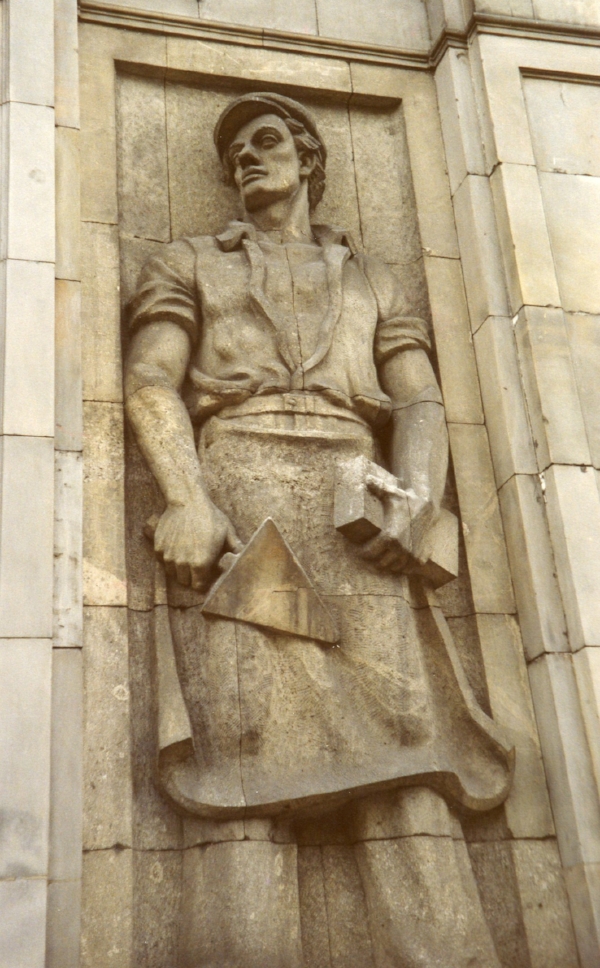
Marszalkowska 1, Warsaw, September 1988  © Andrew Stuttaford

Marszalkowska 1, Warsaw, September 1988  © Andrew Stuttaford

Twentieth-century totalitarian art did not just gild the cage; it helped to build it. Paintings, movies, sculpture, architecture and festivals of choreographed joy were vital elements in the Nazi and Communist attempts to remake man. It is key to our understanding of the nightmare states that resulted, argues Igor Golomstock, and deserves to be classified as a distinctive artistic genre alongside Modernism, of which it was both byway and heir. Like Modernism, totalitarian art was intended to help sweep away what had gone before, but unlike Modernism it was prepared to steal from the past to do so. The style of the 19th-century "bourgeois" academy was thus conscripted into the service of Reich and eventually revolution, as hallmark, teacher and, to us, cliché.

In his newly updated (it was first published in 1990) "Totalitarian Art in the Soviet Union, the Third Reich, Fascist Italy and the People's Republic of China," Mr. Golomstock convincingly demonstrates how the overlapping aesthetic values of these superficially disparate regimes underlined how much they had in common. This was never clearer than at the Paris exhibition of 1937.  In an unsettling preview of the Molotov-Ribbentrop pact, the Eiffel Tower found itself squeezed between massive Nazi and Soviet pavilions. Conceived as fusions of sculpture and architecture, both were expressions of brute power that played Neanderthal tribute to ancient Rome and were guarded by giant images, of the master race on the one hand, the master class on the other.

The strongest sections of the book concern the Soviet Union, as one might expect from an author whose career included membership in the Union of Soviet Artists and direct encounters with Stalinist brutality. Mr. Golomstock's father was sent to the camps in 1934, and then, some years later, his mother, taking the young Igor with her, signed up to work as a doctor at Kolyma, one of the worst of the Gulag's outposts.

Mr. Golomstock tracks the way that the smash-it-all-up trial-and-error of late imperial Russia's avant-garde (experiments that were paralleled, revealingly enough, by Italy's proto-fascist Futurists) initially meshed with the ecstatic starting-from-scratch of the Bolshevik revolutionary intelligentsia.

The extraordinary artistic innovation of the early Soviet years was rapidly replaced, however, by the stodgy conservatism of high Stalinist culture. The revolutionary past was sanitized, then mythologized. The hardscrabble present was transformed into a time of abundance by what Mr. Golomstock marvelously calls the "magic mirror" of Socialist Realism. The didactic, neo-Victorian paintings, the monumental if clumsily neoclassical architecture and, after 1941, the numerous evocations of martial valor and national pride, were all manifestations of an ersatz traditionalism that resonated with a people exhausted by decades of upheaval and were, of course, perfectly suited to the maintenance of a tightly controlled, rigidly hierarchical new order.

That said, for all Mr. Golomstock's experience and erudition, he falls some way short of conveying the ambition, allure and, well, totality of totalitarianism's cultural projects. While his examination of Nazi art takes useful detours away from the time-worn trudge through lumpen Arcadias and leaden Valhallas to include discussion of the centralized (Soviet-style) control of artistic production, he devotes relatively little space to the party's sometimes brilliant manipulation of design, its use of spectacle—Albert Speer's cathedrals of light—or, even, the films of Leni Riefenstahl. The whole picture never quite comes into view, and it was the whole picture that was the point.

It is no less frustrating that Mr. Golomstock allocates such a small portion of his book to China, the third of the 20th century's great totalitarian empires—particularly as he does find room for an addendum on Saddam Hussein's Iraq, a revoltingly bloody but basically traditional despotism that left little behind it of artistic interest to anyone other than connoisseurs of peculiarly servile kitsch. By contrast, as Mao's Cultural Revolution gathered pace from 1966 on, the mounting political hysteria was reflected, channeled and amplified in and by the arts in ways still terrifying today.

There were the dazibao, the giant-lettered, largely hand-made "big character" wall posters that signaled its beginning. There was the hectoring banality of revolutionary opera. And there were the images—sometimes reproduced in their millions—that both drew upon Socialist Realism and transcended it, a process that culminated in the depiction of Mao as essentially divine. As a demonstration of the fundamentally religious nature of communism, the deification of the Great Helmsman is hard to beat, and it represents the logical conclusion of totalitarian art. Unfortunately, you won't find any direct reference to it in Mr. Golomstock's fascinating, painstaking but ultimately incomplete book.

Q&A: Stieg Larsson's Ghost Speaks

Bookforum, June  21, 2011

Stockholm, November 2010 © Andrew Stuttaford

Stockholm, November 2010 © Andrew Stuttaford

STIEG LARSSON: What model Ouija board are we on?

BOOKFORUM: Hasbro.

SL: I like to know the hardware. I always kept my readers informed about the technology Lisbeth was using. Always.

BF: They certainly liked something that you were doing. More than thirty million copies sold. Shocked?

SL: Well, we Swedes try to be modest. Still, read the books carefully. You can see that I liked what I had written. I’d planned ten Salander books in all, you know.

BF: She’d have been your Miss Marple. Some say—how can I put this?—that your death, nearly seven years ago now, boosted sales.

SL: Like Elvis?

BF: Elvis? Well, you both liked junk food, but I was thinking about the freedom that unpleasant event gave international publishers to toy with your text—and to scrap that terrible first title. You must agree that The Girl with the Dragon Tattoo sounds better than Men Who Hate Women.

SL: But there are plenty of men who hate women, no? That’s not fiction, even in that Swedish paradise everyone so likes to talk about, and I wanted to remind my readers of that with a fact or two.

BF: Like the unsourced statistic that “eighteen percent of the women in Sweden have at one time been threatened by a man”? Whatever that vague term threatened may mean . . .

SL: What are you saying?

BF: You’re the investigative journalist. Something doesn’t add up. And the same could be said about some other tales you are said to have spun, about training the Eritrean lady guerrillas, say, or even the one about the gang rape of a “Lisbeth” that allegedly so influenced your development as a feminist. There’s even a book, The Larsson Scandal, that focuses on some of these, uh, inconsistencies.

SL: Jävlar! As you pointed out, I was an investigative journalist myself. I exposed threats, dangerous conspiracies, but this . . .

BF: Let’s return to the pleasanter topic of all those royalties—and, comrade, the contradiction they might represent. You are on the far left, a former Trotskyist, no less.

SL: Well, it was my estate that hit the jackpot, not me. Sure, I hoped to make a bit of money, but all Stieg wanted was a stuga—a cottage—in the country, and maybe to set aside a bit for retirement, the usual. I wasn’t one of those greedy financial types, overpaid for trading bits of paper with their yuppie pals. I created a product that people liked. No one was exploited. Taxes were paid. I have more than done my bit for the welfare state.

BF: And for a lot of other Nordic writers, too. The hunt for the next Stieg Larsson is proving lucrative.

SL: That’s fine. Per Wahlöö and Maj Sjöwall started it all decades ago, not me. They were leftists too, I might add, opposed to the Vietnam War. They made America tremble. Still, I wish that the first Stieg Larsson was still around. Fifty was too young to die.

BF: That’s why you never made a valid will?

SL: Yes, that was a mistake. Swedish intestacy laws hate unmarried partners. Eva deserves more than she’s getting. Then again, the law’s designated legatees, my father and brother, aren’t monsters.

BF: How do you rate the movie versions of your books?

SL: They cut too much of my story, but the girl who played Salander was terrific. As for the Hollywood remake, Mikael Blomkvist, who is, of course, me, will be played by Daniel Craig, James Bond himself. Makes sense, if not to our Mr. Fleming. That snob just laughed when he heard the news. Here he comes now. I’d better go. He can be rough.

BF: Stieg, wait! One more question: Is there really a fourth book, the one they say is on your laptop?

SL: Well, let’s just say if it appears, a ghostwriter will have been involved [laughs, fades].

Greater Europe, Lesser Europe

National Review, June 2, 2011 (June 20, 2011 Issue) 

By the time you read this, Greece may have defaulted on its debt. Or it may be preparing to default, but without the D-word. Most likely it will be negotiating another rescue package, but it may still be fighting to secure the latest payment under its existing bailout. Only one thing looks certain as I write. The eurozone crisis will not be over.

It’s been a long, hard journey since the first Greek bailout just over a year ago, a €110 billion loan package from the European Union (€80 billion) and International Monetary Fund (€30 billion) secured by pledges of drastic austerity. A €750 billion European Financial Stability Facility was announced a little later. The prospect of its billions’ being available to any eurozone country that ran into difficulties was intended to “shock and awe” (yes, that term again) the financial markets into calm.

It did not work out. Both Ireland and Portugal have since had to be bailed out. The destructive contradictions of the one-size-fits-all currency remain unresolved. The damage they caused is unrepaired. Then there’s the fact that the very nature of the eurozone leaves its weaker members vulnerable to fears of default. Most of their debt is in euros, and, for all practical purposes, the euro is a foreign currency. Once investors move out of, say, Irish bonds to safer euro debt elsewhere, all that Ireland can do to lure them back is increase interest rates and tighten its belt yet again. If that doesn’t work, the cash will run out.

Belgian economist Paul de Grauwe argues that a liquidity crunch of this type could force an otherwise solvent country into default. Maybe; but in Greece’s case that’s beside the point. The country has, financially speaking, ceased to be a going concern. Neither the 2010 bailout nor the (partial) introduction of austerity measures that are already at the limit of the politically possible have been enough to do the trick. Indeed, by depressing domestic demand, the latter have — at least in the short term — made the budgetary situation even worse. Tax revenues have been hit by the slump in an economy that shrank by over 4 percent last year, and will likely dwindle by another 3.5 percent this year. The conventional response — a massive devaluation designed to restore international competitiveness — is unavailable so long as Greece remains yoked to the euro.

And it’s not easy to break free. Capital controls would be introduced overnight. The Lazarus drachma would collapse in the morning. Inflation would surge the day after. The country would, de facto or de jure, default on its debt (as would a sizeable slice of its private sector). Greek industry would face a painful funding squeeze. Payrolls would plunge, a brutal blow with the official Greek unemployment rate already at 16 percent or so — and rising.

Beyond Greece’s borders, there would be panic selling of debt issued by some or all of the other PIIGS. With a number of EU banks heavily exposed to the PIIGS, an uncontrolled Greek default, and, more dangerous still, its consequences, could conjure up sweaty memories of the financial crisis. And those affected might include the European Central Bank itself. The ECB has been an active buyer of PIIGS debt. Writing down those holdings could be awkward, especially since the eurozone’s embattled taxpayers would be left holding the tab.

But if Greece’s departure from the euro is too risky to consider, that does not change the fact that the May 2010 financing has not worked. And default would be default whether inside the eurozone or out. It’s all very well criticizing the dodgy process by which Greece was admitted into the currency union, and there are few words ugly enough to describe the squalid state of Greek public finances. Nevertheless, for creditors to insist that the country can cut, privatize, and tax enough quickly enough to stave off disaster is to allow indignation to prevail over financial and political reality. Greece lacks the social cohesion (and shared memory of recent hardship) required to weather the kind of drastic “internal devaluation” that (fingers crossed) took the Baltic countries through their recent debt crises.

According to the EU Commission, Greece’s debt/GDP ratio will rise to 166 percent next year. The annual budget deficit will stand at just under 10 percent of GDP. Under the terms of the May 2010 bailout, that number is supposed to fall to 3 percent by 2014. Dream on. On May 30, Greece’s two-year bonds were yielding over 26 percent. The market’s message was clear. Without substantial additional external financing, default was on the way.

Adding to the concern have been worries that Greece might not satisfy the conditions necessary to allow the IMF (more rule-bound, it is speculated, in the wake of Dominique Strauss-Kahn’s departure) or EU lenders to release their next portions of the original bailout funds. You may know if they have agreed to do so by now, but the best guess must be that these monies will somehow reach Athens, even if it takes a new bailout agreement to get them there. If they don’t, that could, within weeks, trigger the “hard” default that no one wants.

Arranging a fresh bailout will be an unpleasant process, thanks not least to politics. After years of restraint at home, financing the feckless abroad has proved highly unpopular in Germany, the EU’s principal paymaster. The single currency has been a boon for the country’s exporters, but its voters don’t seem to care. They never wanted the euro, and the events of the last twelve months have only reinforced their suspicion that their beloved Deutsche mark was replaced with an extremely expensive dud. Forcing through the earlier support for the PIIGS was a nightmare for Chancellor Merkel. To ask this most cautious of politicians to demand yet more from restless German taxpayers is to ask a great deal. And lender discontent, a useful reminder of how little grassroots appeal EU “solidarity” really enjoys, is not confined to Germany. The Austrians are unhappy, the Dutch government is floundering, and anger in Finland over its participation in eurozone rescue parties has helped propel the populist-nationalist True Finns to the top of the polls. A new bailout will only add fuel to these fires. Merkel, it seems, may be preparing to walk through them. On May 31 markets surged on reports that Germany had dropped its insistence that any new bailout should be conditional on bondholders’ sharing in the taxpayers’ pain.

But despite, doubtless, additional austerity measures and fierce mechanisms to enforce them, new rescue packages will do little to solve the underlying structural problem in Greece and, for that matter, elsewhere. They may buy time but, in the end, there is simply too much debt for some PIIGS to repay. If an honest, old-fashioned default is too terrible to contemplate, that leaves three routes to a theoretically more permanent solution.

The first is, basically, what Merkel wants, “restructuring,” a default in sheep’s clothing, albeit one timed later than she would like. This would be designed in a way that allows banks to dodge the write-downs that could bring them low. The ECB is fiercely opposed to this approach, arguing that it will inevitably set off a fresh wave of financial contagion, even a new Lehman. Nouriel Roubini, Doctor Doom himself, disagrees. It is impossible to say who is right. Both sides are, in the end, making guesses about the mood of a perpetually manic marketplace. That said, the ECB’s stance implies the PIIGS will eventually be able to repay all their debt: an idea as implausible as the notion that they might fly.

More probably, the ECB is relying on Brussels to push forward with the closer fiscal and economic union without which no large monetary union can succeed. This has always been on the European Commission’s agenda, but until this thoroughly predictable and most convenient crisis, it had been politically impossible. That’s changing. Fiscal and economic integration has gone farther and faster over the last 18 months than would have been imaginable just a few years ago. The Eurocracy may, despite current traumas, even see this all as a vindication of the great gamble that was taken when the euro was launched half-done. The problem for Brussels is that the events of the last year have left voters in the eurozone core free from any illusion as to how costly such deeper integration — which would essentially establish a permanent funds-transfer regime from north to south — would be. Will they go along? Will they even be asked?

The third, and, I’d argue, best alternative for now — the split of the euro into two, a strong “core” euro and a weaker euro for the PIIGS — is not without its difficulties, but it ought to work. It would give the PIIGS both the devaluation they need and a chance of avoiding default, and, in addition, it should trim some of the “excess” German surplus. This may be the best alternative, but it’s also the least likely. To Brussels such a velvet divorce would represent an unacceptable step back, and that would never do.

Estonia’s anti-euro campaigners compare the single currency to the Titanic. It’s easy to see why.

The Province of Chance

Andrew  Roberts: The Storm of War: A New History of the Second World War

National Review, June 2, 2011 (June  20, 2011 issue) 

West Berlin, August 1977  © Andrew Stuttaford

West Berlin, August 1977  © Andrew Stuttaford

The fall of Singapore is not news, the Rattenkrieg in Stalingrad’s ruins is not news, the grotesque theater of arrival at the Auschwitz railway siding is not news, but Andrew Roberts’s narrative gifts are such that it is almost impossible to read his retelling of these nightmares without some feeling of encountering the new. Almost: World War II is too familiar a saga for that. Still, Mr. Roberts, a distinguished British military historian, has produced a volume that serves as a comprehensive and clear (good maps too) introduction to this most sprawling of conflicts while adding fresh insights for those already well-versed in its twists, turns, and minutiae. Who knew that Hitler, ever the mystic, held the belief — ominous in the light of Russian winters to come — that “human barometers . . . gifted with a sixth sense” could predict the weather more accurately than mere meteorologists?

This is also, in the best meaning of the word, a balanced book, up to date (its author has made good use of recent research) without being faddish. That’s rarer than it should be. Clio is a restless, untrustworthy muse. History is malleable. Initial impressions count. That’s why Winston Churchill was so quick to write his account of the war: He wanted to set the mold. And he wasn’t the only leader to play this game. Their memoirs are valuable, but partial: Scores are settled, excuses are made, credit is claimed.

Later, when the professional historians moved in, they often seemed to do so in waves, all too frequently driven by fashion, opportunism, contrariness, and ideology. Magisterial in tone and spirit, The Storm of War rises above all that. No history book can ever truly be definitive, but this comes close.

There’s little that rewrites the past more than the release of once-hidden files. Roberts emphasizes the contribution made by the codebreakers of Bletchley Park; yet 40 years ago, their deeds were still classified. The opening of many archives in the former Soviet Union since 1991 ought to have eliminated any remaining traces of doubt about the nature of the Western democracies’ vile, essential, and dangerous ally: “The SS had been using gas vans to kill . . . since 1939: It was an idea borrowed from Stalin’s purges of the 1930s, during which people had been gassed in specially converted trucks.” “Uncle Joe”? Not so much.

Sometimes, the evidence was already available for all to see, even if not too many wished to look. The Holocaust was hardly a secret, yet it was decades before it assumed the central role it now does in our understanding of the European war. Roberts chronicles the darkness that descended in a chapter written with fewer rhetorical flourishes than its title — “The Everlasting Shame of Mankind” — might suggest. He lets the horrors speak for themselves: “Oswald ‘Papa’ Kaduk — his nickname came from his ‘love for children’ — gave Jewish children balloons just before they were squirted (abspritzen) in the heart with phenol injections at the rate of ten per minute.”

The conflict in Europe was, of course, about more than the Holocaust. The Allies did not go to war to rescue the Jews. Many Germans fought for reasons that owed little or nothing to Hitler’s anti-Semitic obsession. Nevertheless, Roberts doesn’t wall off the slaughter of the 6 million into one discrete chapter. As he rightly grasps, it infected everything. Roberts is an enthusiast and expert (as this book repeatedly demonstrates) of battle, campaign, tactics, and strategy, of tanks and planes and all the rest. That said, despite his appreciation of the fighting qualities of the German military — and the skills of its officer corps — he rejects the argument that the “decent” Wehrmacht was quite so different from the wicked SS as many have liked to maintain.

That myth may have helped build the peaceful postwar Bundesrepublik, but myth it was, and a highly successful one at that: An exhibition depicting some of the regular army’s fouler activities outraged a surprising number of Germans as late as the 1990s. But Roberts finds the Wehrmacht guilty as charged. He names the deeds, and he names the names: “After [the massacre of tens of thousands of Jews at] Babi Yar, Field Marshal Walther von Reichenau issued an order celebrating the ‘hard but just punishment for the Jewish sub-humans’ and [Field Marshal Gerd von] Rundstedt signed a directive to senior officers along much the same lines.”

More damning yet, if the experience of the “middle-aged, respectable working- and middle-class citizens of Hamburg” who made up Reserve Police Battalion 101 (the subjects of Christopher Browning’s devastating 1992 book Ordinary Men, and a force responsible for the killing or deportation of 83,000 people in German-occupied eastern Europe) is anything to go by, there would have been little risk of serious punishment for those who opted out of mass murder. It would have been a bad career decision, that’s all, but one that too few were willing to take. We can only wonder why. Ingrained prejudice? The effects of Nazi propaganda? Wartime brutalization?  Military discipline? Peer pressure (not all bands of brothers are benign)? Others simply enjoyed killing. Some were indifferent. Human nature is what it is. Our species had much to be ashamed about before Auschwitz. It has had even more to be ashamed about since.

And the disgrace was not confined to the Reich. Roberts devotes a good portion of his book to the war in the Far East and Pacific (with the Nationalist Chinese justly receiving more praise than usual, and Mao’s Communists, quite correctly, less), but, again, never lets his admiration for the martial get in the way of his grip on the moral. He describes Japanese cruelty in the Philippines in revolting detail, but, in a commendable display of respect, holds back on the even worse (“there were many other scenes . . . not denied by the perpetrators that are simply too disgusting to recount here”). The victims have already been degraded enough. In this war, however, there was plenty of savagery to go around: Roberts does not skate over the darker side of the Allies’ long march to victory. That he never falls into the platitudes of moral equivalence speaks volumes.

All this is typical of a book that is, at its core, deeply humane — and is so at several different levels. Roberts clearly relishes history’s wide sweep, which he relates in grand style; yet, no determinist, he is particularly fascinated by the missteps of those who shaped the war’s course. If you want to read a fascinating discussion of the sometimes idiotic decisions that led to the Axis defeat, The Storm of War is for you. Roberts is an author who never loses sight of the human side of this epic: His sketches of the extraordinary collection of bickering warlords who constituted the Anglo-American command, and of quite a few other senior officers besides (the Chindits’ inspirational, onion-munching Maj.-Gen. Orde Wingate — failed suicide, nudist, devout Christian, and ardent Zionist — for one), are worth the price of admission in themselves. But he doesn’t forget those in humbler roles, the millions of innocent dead, the millions left bereft, and, perhaps above all, the millions of soldiers whose feet filled those muddy, dusty, broken, bloody boots on the ground.

“Armchair strategists,” wrote George MacDonald Fraser, creator of the wonderful Flashman books and author of a fine memoir of the war in Burma, “can look at the last stages of a campaign and say there’s nothing left but mopping up, but if you’re holding the mop it’s different.”

Naturally, Mr. Roberts includes that quote.