Cameron Cornered

The Weekly Standard, June 23, 2014

David Cameron.jpg

A time bomb does not have to be elegant; it just has to be lethal, primed, and in the right place when the moment comes. Britain’s next general election is set for May 7, 2015. That is likely the day when David Cameron will pay the full price for failing to have defused the revolt on his right.

Britain’s Euroskeptic U.K. Independence party (UKIP) is a poorly run protean mess, unhealthily dependent on the wit, zest, and charisma of its leader, Nigel Farage. And yet in the spirit of Farage (who has survived a plane crash, cancer, and being hit by a VW Beetle), UKIP keeps confounding those who so eagerly draft and redraft its obituary.

The run-up to the election to the European parliament in May was not the party’s most glorious stretch. Sustained battering by mainstream media and mainstream parties—much of it galvanized by UKIP’s heretical emphasis on immigration control—took a toll, and was reinforced by campaign missteps (Google “steel band,” “Croydon,” and “UKIP” for one notably ludicrous instance), including a pre-election radio interview of Farage that went so badly that his spin doctor tried—on air—to bring it to a close.

Less than a week after that interview, Britons went to the ballot box, voting both in the EU poll and, in some regions, local elections too. Results for the latter were counted first. UKIP took 16.5 percent of the popular vote, down from the remarkable 23 percent the party had scored the preceding year, but a reasonable tally considering that these elections were held in less UKIP-friendly territory than in 2013.

The election for the European parliament, however, involved the whole country, and UKIP topped the poll with 27.5 percent, well up from the 16.5 percent it secured in the 2009 EU vote. UKIP may have been assisted by a low turnout (34 percent), but it nonetheless became the first party other than Labour or Conservative to win a national election in over a century. Labour had to make do with regaining (and more) the ground it had lost in 2009 (a Labour government had been presiding over Britain’s slice of the financial crisis), boosting its score from 15.7 percent to 25.4 percent. The Conservatives slumped from first to third place with 23.9 percent. Their coalition partners, the hopelessly Europhile Liberal Democrats, saw their vote cut by roughly half and their team of EU parliament members reduced from 11 to 1, a richly deserved fate marred only by its incompleteness.

But a few days later UKIP ran into a reminder that one barrier remains unbroken. On June 5, it failed yet again to win a seat in the House of Commons. On paper, the constituency—Newark, a pleasant Conservative-voting market town unlikely to be confused with its namesake in New Jersey—looked promising. UKIP had done well there in local elections in 2013 and had headed the poll in that part of Britain in the EU vote. Helping still further, Newark’s (robustly right-wing) Tory MP had just resigned following a lobbying scandal that fit neatly into the UKIP narrative of establishment misrule. Typically, UKIP did not make the most of its opportunity. Perhaps tellingly, Farage opted not to run. Instead the party chose as its candidate a (robustly right-wing) septuagenarian member of the European parliament all too easy to caricature as UKIP at its most primitive.

The result was far from disgraceful: UKIP took over a quarter of the vote, up from the 3 percent or so its candidate managed in 2010. This was despite a concentrated Tory blitz (party workers, activists, and MPs by the hundred were shipped into Newark) that a hollowed-out Conservative party could not hope to reproduce on the national scale that a general election would require. Nevertheless UKIP’s second place (the Tory candidate romped home) meant that the party still had no MPs, a failing frequently cited as a mark of UKIP’s fundamental lack of seriousness. This was only underlined by the convivial Farage’s decision to spend the day before the Newark vote at a tourism conference in Malta. And, yes, he was photographed there in the early hours with a blonde who was not Mrs. Farage. There was a respectable explanation, but .  .  .

Bellowing at Brussels and, for that matter, 10 Downing Street is an unsurprising response to both EU overreach and the metropolitan liberalism of David Cameron’s government. There are numerous infuriated traditionally Conservative supporters who are prepared to “lend” a vote to UKIP in European and, increasingly, local elections, but will balk at doing anything that risks helping “Red Ed” Miliband’s unsettlingly left-wing Labour party into government.

As they fully understand, voting for UKIP could easily do just that. Under Britain’s first-past-the-post voting system, a protest vote can prove expensive. There’s good evidence to suggest that UKIP ballots (around 3 percent of the total) cost the Tories an absolute majority in the 2010 general election. With UKIP now attracting growing numbers of former Labour voters, the math is trickier than it was, but a higher UKIP percentage would undoubtedly do even greater damage to the Conservatives in 2015.

Making the choice sharper still, David Cameron has committed to an in/out referendum on Britain’s EU membership if he is reelected. Euroskeptics ought to remain, well, skeptical about this, not least because Cameron (a politician too unimaginative to contemplate a breach with Brussels) will try to gull Brits into the pro-EU camp with largely meaningless “concessions” allegedly wrung from the U.K.’s European partners. And he will probably succeed, meaning that Britain’s long European nightmare will continue. On the other hand, Cameron’s referendum would represent a chance, however remote, of a withdrawal, which is better than what Brussels-friendly Labour has on offer: nothing.

And right-of-center voters have another reason to be wary of voting for UKIP next year. “Europe” has evolved as an encapsulation of the broader discontent that many Tories (or former Tories) feel for Cameron’s mushy brand of conservatism, a discontent brilliantly exploited by Farage, playing Mrs. Thatcher’s finest tunes and meaning it. That has taken him a long way. The UKIP leader’s conundrum now is somewhat similar, ironically, to that faced by Cameron a little under a decade ago. Modern Britain is no longer the country that voted (often grudgingly) for the Iron Lady. Cameron tried to deal with that change by dragging the Conservative party to the center, calculating that the Tory right had nowhere else to go. Had it not been for Nigel Farage he might have gotten away with it.

The not unrelated difficulty for Farage is that he has harvested about as much of the right as he can, and thanks to the brutal math of first-past-the-post, that will not be enough to deliver the MPs to make the breakthrough he needs. So UKIP’s leader has attempted to widen his support by reaching out to what he has described as “patriotic old Labour” (put less diplomatically, the white working class), using immigration (Britain has received huge numbers of immigrants from elsewhere in the EU, immigrants that under EU law it is powerless to turn away) as the bridge to get there.

This has been a success, but it has involved downplaying UKIP’s earlier free market vim. The evolution of “red UKIP” is less of a problem for the party’s Conservative refugees than some of UKIP’s intellectual cheerleaders might imagine: Standing up for socialized medicine and generous state pensions plays pretty well with an older, often far from affluent crowd. But throw in some other leftish sub-currents, add the harsher edge to the party’s immigration rhetoric, and subtract some Thatcherite grace notes (talk of a flat tax has, for example, disappeared), and it becomes easy to suspect that a good number (especially on the upscale side of the social divide) of UKIP’s once-Conservative or libertarian-inclined voters will return to the Tory fold, particularly with Ed dread to push them there.

But neither this, nor the unappealing Miliband’s failure to click with the wider British electorate, nor the U.K.’s improving economic performance is likely to save Cameron. Britain’s embarrassingly outdated constituency boundaries favor Labour, which only has to win some 35 percent of the national vote to prevail. With the Liberal Democrats floundering, that modest target ought to be one Labour can hit despite recent stumbles in the opinion polls. UKIP meanwhile can expect to win few (if any) actual MPs once the general election comes round, but the party’s share of the poll will not sink back to that 3 percent grabbed by UKIP in 2010: UKIP—and the loyalty it can expect—is now entrenched too deep for that. And it is still the Conservative party that will miss its defectors most. At this late stage, it’s not clear what the Tories can do to entice enough of them back in time.

A Feast of Fools

National Review Online, May 27, 2014

That-s-All-Folks.jpg

Europe has long played host to strange, exuberant celebrations, from Roman Saturnalia to medieval Feasts of Fools to the bean-feasts of old Twelfth Night, when hierarchy was upended and decorum trashed. Master played slave, slave played master, and cook pretended to be king. But when the festivities ended, all was as before. Master and slave, cook and king returned to their stations. Order was restored, strengthened, and tacitly affirmed by a brief period of license that began with its end already agreed.

And that brings me to the elections to the EU parliament. These have always been a pastiche of democracy, rendered absurd by the absence of a European demos. Europe’s voters have always understood that their role in these elections was to perform as extras in a carefully choreographed drama, pay for the whole thing, pretend it was real, and then go away. A good number decided that they would rather not show up at all. There is no European nation, so why vote as if there was?

Back in 1979, the turnout for the first direct elections to the parliament was 61.99 percent. It then fell for each of the next six, reaching 43 percent in 2009. At the time of writing, the turnout for 2014 is calculated at 43.1 percent, an improvement desperately described as “historic” by one of the parliament’s spokesmen. If it was, it was only historic in the depth of the indifference that 43.1 percent represented. The EU parliament is far more powerful than it was in the past, and the catastrophe wrought by the euro has brought the EU to the center of European political debate as never before. That ought to have been worth more than an extra tenth of a percentage point. That it wasn’t says everything.

From the perspective of Brussels, this year’s show must appear to have gotten a little out of hand. An alarming number of the extras ignored their lines and noisily rewrote the script. They did so in ways too varied to list them all. Nevertheless, there were some standouts.

Over in the Sceptic Isle, Nigel Farage’s UKIP swept to the top of the poll with 27.5 percent, the first time for more than a century that a party that was neither Labour nor Conservative had prevailed in a nationwide contest. This was despite an unprecedented battering by the media and the other political parties and, it has to be said, a few own goals.

Across the English Channel, France’s Front National, a pariah for generations, won with 25 percent. In Denmark, the (somewhat) UKIP-like Danish People’s party took the top prize with 26.7 percent, and in Hungary, the conservative-nationalist Fidesz, the ruling party that Brussels most likes to hate, romped home with over half the vote, while the sinister Jobbik clung to 14.3 percent of the poll. That was a higher score than that achieved by the neo-Nazis of Greece’s Golden Dawn, who had to make do with 9.4 percent, not a bad haul nonetheless, considering that its leader and a number of its MPs are in jail. The gold medal in Greece meanwhile was grabbed by the far-left Syriza, with 26.6 percent, a result that could point to a Syriza victory at the next general election and ought to alarm Greece’s creditors. A win by Syriza in the EU elections would, its leader explained shortly before the vote, be a message to Greece’s current government “to take the memorandums [setting out the terms under which Greece received its bailouts], take the troika [the EU Commission, the European Central Bank, and the IMF, which supervise the austerity program], and go.”

And Syriza’s language found an echo in crisis-struck Spain. Establishment parties of center-left and center-right saw sharp declines in their support. Podemos, a brand-new party of the far left, and an offshoot of sorts of the anti-austerity Indignados protests, came from nowhere to take 8 percent of the vote. We will work, said its leader, “together with other partners from southern Europe to say that we don’t want to be a colony of Germany and the troika,” words that should make German taxpayers shudder.

Still, that vulnerable constituency finally has proper representation in the European parliament in the form of a young, pro-EU but anti-euro party, the center-right Alternative für Deutschland, which took 7 percent of the vote. It remains to be seen whether AfD’s success will be enough of a warning shot to stop Chancellor Merkel from selling her country down the river in the event of a revolt against austerity in the periphery and now, quite possibly, France. Probably not, if I had to guess.

Not everything went badly for those in charge in Brussels. In two “creditor” nations, Finland and the Netherlands, prominent Euroskeptic parties did far less well than expected, while in Italy comedian Beppe Grillo’s populist, and not always coherent, Five Star Movement was eclipsed by the center-left PD, now led by the charismatic Matteo Renzi, its supposedly Blair-like (be warned, Italy) new prime minister. That said, the Grillini still managed to account for 21.15 percent of the votes cast. It may be too soon to say that they have peaked.

But Brussels does not have to look as far as Rome for comfort. To start with, the low turnout almost certainly exaggerated the Euroskeptic portion of the vote when compared with the likely outcome in national elections. To be sure, a reluctance to turn up at the polling station may not show much engagement with the European project and that will distress more idealistic Eurocrats. But their more cynical counterparts know very well that apathy is not only better than outright opposition, but is, for the most part, also an ally. Large elements of the superstate-in-waiting have been able to be put in place only thanks to the unwillingness or inability of the electorate to understand where the often complex, often deliberately obscure process of European construction will lead. That still seems unlikely to change.

More than that, the European Parliament will continue to be a Euro-federalist redoubt. As José Manuel Barroso, the former Maoist who is now the EU’s top bureaucrat, announced on Sunday night, “The political forces represented in the European Commission have overall won once again. . . . They share a fundamental consensus for Europe that should now be reinforced.”

The Open Europe think tank has calculated that anti-EU and anti-establishment parties are “on course to win 229 out of 751 seats in the new European Parliament (30.5%), up from 164 out of 766 seats in the current parliament (21.4%).” That’s impressive, but in itself it is not enough to change anything. The parliament will be likely run by some sort of coalition of the center-left and -right, perhaps with an added Green tinge to make it all the more sickening. That won’t be much of a change. In an earlier piece of research, Open Europe noted that “the center-right European People’s Party (EPP) and center-left Socialist and Democrat (S&D) party families voted the same way 74% of the time in the 2009-14 parliament.” A de facto coalition will become de jure, that’s all. And its preferred approach will continue to be “more Europe” buttressed even more than before by the paranoid argument, and often paranoid belief, that Euroskepticism is some sort of fascism. After all, look at that Marine Le Pen.

The outsider parties not only lack the numbers to challenge this consensus, they lack the cohesion to do so. That reflects the fact that they spring from far more authentic — and thus more diverse — national political traditions than the unaccountable nothingness of the acronyms now in charge. The differences between the Euroskeptic parties and the nations they spring from mean that even a marriage of convenience between them (the parliament’s rules favor groupings of a certain breadth and size) can be fraught with danger. A mooted association with Le Pen’s Front National proved very damaging for Geert Wilders in the Netherlands and would be poison for Nigel Farage. The best hope is that the Euroskeptics can at least cast enough light on the workings of the parliament and the rest of the Brussels machine to stir up yet more discontent, but that will take time, perseverance, and a media that is willing to pay attention. Don’t hold your breath.

That’s not to deny that there will be talk of reform, and maybe even talk of the transfer of some power away from Brussels. There will be talk, plenty of it, but its main function will be to mask the whirring of the engine of ever-closer union, an engine that continues to drive integration along whatever the voters may say. To change that will take a revolt of the centrist parties in their domestic legislatures, provoked, perhaps, by the reality of the economic grind that continues to lie ahead and by fear of the political parties that may someday be strong enough to take advantage of it.

Until then, well, clear up the empty bottles; take down the balloons and bunting. È finita la commedia: Those in charge are back in charge, as, indeed, they always were.

Playing The Verdun Card

The Weekly Standard, May 26, 2014

Verdun.jpg

In the curious pantomime that is the EU parliament, the French politician Joseph Daul is a star. He’s the president of the European People’s party (the principal center-right bloc in the parliament), an apparatchik with impeccable EU establishment credentials. He has euro-federalist beliefs, a funding scandal in his past, and a willingness to warn that Brussels is all that stands between the continent and a reversion to its warring ways. He’s also a little twitchy about the elections to the EU parliament later this month.

“I am convinced,” he announced recently, “that if Europe succumbs to the siren voices of populists and Euroskeptics, there will be a turning back towards chaos and war.”

This is an all too familiar eurocratic refrain, but it is heard even more frequently on those rare occasions when Europe’s voters are given a chance to slow down the march to a superstate. Trying to cajole his compatriots into choosing the euro in a 2003 referendum, Swedish prime minister Göran Persson recalled how Germany’s “weeping” Chancellor Kohl had told him that he did not want his sons to die in a third world war, an understandable sentiment, but an unpersuasive argument. Swedish voters stuck with the krona.

Two years later, another Swede, Margot Wallström, then the EU commissioner charged with selling the proposed EU constitution to a somewhat doubtful continent, took the opportunity presented by a visit to the Nazi concentration camp at Theresienstadt (Terezin) to observe that “there are those today who want to scrap the supranational idea. They want the European Union to go back to the old purely intergovernmental way of doing things. .  .  . Those people should come to Terezin and see where that old road leads.”

With this month’s election falling within a few weeks of the hundredth anniversary of a certain shooting in Sarajevo, the dire warnings now tend to refer to a different dark chapter in Europe’s tumultuous 20th century. Last year, José Manuel Barroso, the EU’s top bureaucrat, implied that those “who want to roll back our integration” were risking a regression to “the war [and] the trenches” of the past, a ludicrous variation on an already ludicrous theme.

If all this scaremongering were a matter of cynical calculation it might be possible to treat it with a degree of admiration. As a political tool, it has, after all, proved very effective: Fear works. And so does the manipulation of historical memory, another integral element in Brussels dezinformatsiya. If Europeans could be persuaded to blame the nation-state for their wars, they could be talked into distrusting their own patriotism and buying into the bogus made-in-Brussels “European” identity.

And, indeed, this is what we have seen over recent decades. As it came to be widely accepted that a united Europe was the key to peace, those who persisted in dissenting from the principle of a broader federalist agenda, except, perhaps, in reliably stubborn Britain, were pushed into uncomfortable and ultimately self-segregating corners far from
the electoral mainstream. Outside the skeptic isle, almost the only political parties prepared, until lately, to reject “ever closer union” were those drawn from the rougher ends of the political spectrum, an uninviting destination for centrist voters. That, in turn, made it easier to claim that Euroskepticism was, by definition, evidence of extremism and, maybe, a screw loose too.

The mantra that the EU was staving off a return to the hecatombs also operated as an unsubtle reminder to the Germans that they had a moral obligation to confine their role in the new Europe to keeping quiet and footing a large chunk of the bill. Meanwhile the rest of the continent—and, such is the power of guilt, much of Germany too—was led to believe that only Brussels could keep the Hun on the leash, a notion that rested on the absurd premise that panzers still prowled through Teutonic dreams. Such is the power of history.

The passing of time and the reemergence of German economic power have eroded some of the Bundesrepublik’s willingness to follow the demeaning postwar script, but by less than might be expected. Introducing the euro over the objections of most Germans made a mockery of their democracy. Preserving the single currency has stretched the country’s much-prized constitutional order and now threatens to become a permanent drain on its coffers, but the conservative, gently Euroskeptic (anti-euro, but pro-EU) Alternative für Deutschland is only likely to score 6-7 percent in the upcoming election, and no small portion of that support will owe more to the AfD’s mildly restrictive immigration policy than to its opposition to the single currency. Most of the rest of Germany’s political class remains in thrall to the tired myth that to retreat from ever closer union would be to advance into danger and, quite possibly, war.

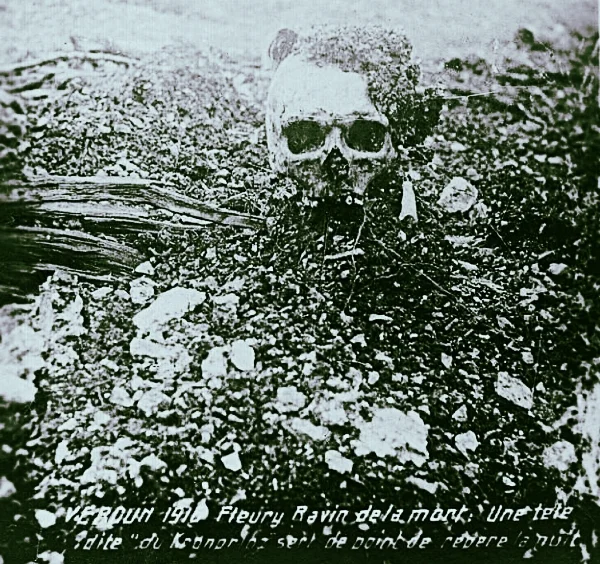
But a myth it is. What kept the peace in Europe was, yes, in part, memories of Auschwitz and Verdun, but it was also, much more so, the product of the savage ethnic cleansing of Eastern Europe’s awkward German minorities, and, above all, the discipline imposed by the Cold War—by Soviet hegemony over half of the continent and American leadership of the other. The evolution of the EU was the consequence of this new, rather chilly peace, not the creator of it. Brussels subsequently performed an invaluable role in shepherding Moscow’s former European colonies back to the West after the Soviet collapse, but on foundations built by the Atlantic alliance.

Those who used and abused this myth to drive the EU forward were in many cases not so much Machiavellis as priests who had faith in a tale they themselves spun. And it proved to be a highly convenient myth. The insistence that nationalism is inherently dangerous is an extrapolation from a totally defeated, especially toxic, and specifically German form of nationalism. But it gave those in charge of the European project an ever-expanding license to remove more and more of anything that marked out the distinctiveness of a nation from the regular democratic process: The voters, poor creatures, so susceptible to “populists,” you see, could not be trusted to do the right thing.

Slice by slice, sovereignty has been transferred from democratic nation-states to a largely unaccountable supranational technocratic elite which in turn has become dangerously disconnected from the reality that encounters with the electorate might have brought, and dangerously emboldened as a result. And so the euro was put together with little regard for its own rule book, common sense, or anything resembling informed popular consent. Once launched, the currency union was run in a way that was, if anything, worse. After hubris, nemesis, and with it, old demons began to stir.

The long economic crisis has shattered the never completely convincing illusion of a continent that was leaving nationality behind. Northern Europeans resent being compelled to bail out nations of a eurozone periphery for which they feel little affinity and less respect. The eurozone’s laggards detest what they see as harsh rule by foreign diktat. Vintage stereotypes are dusted off. Greeks are thieves. Chancellor Merkel is a Nazi. Trapped in the jaws of a dysfunctional currency union, and lacking the democratic legitimacy to fix it and either the imagination or the courage to try something else, the establishment parties have little to offer but more of the same. And so the hard times grind on.

And as hard times tend to do, they are persuading increasing numbers of voters to turn to alternatives they once would never have considered. While the effect may be magnified by low turnout (which fell—the sixth consecutive drop—to 43 percent in 2009), this month’s European election is likely to see something that looks a lot like a Euroskeptic wave. Some 25 percent  of the vote could go to Euroskeptics  of one description or another, up from 15 percent or so (it’s difficult to be precise) in the current parliament. As waves go it will be choppy: This is a ragtag group, drawing from left and right and ranging from the benign (such as Britain’s UKIP) to the sinister (Greece’s neo-Nazi Golden Dawn, given its big break by the failures of an EU that once claimed it had consigned black shirts to history). It will be neither numerous nor cohesive enough to change very much in the short term. But what these parties do have in common is a determination to wrest back control of their countries’ destinies from what is rightly seen as remote, micromanaging, and alien bureaucratic control.

This month’s vote will be followed by noisy, angry, and overwrought polemics, but not by dramatic transformation or the guns of August. That said, as the Barrosos and the Dauls push on—and they will—with the trudge towards ever closer European integration, doubtless claiming that the rise of “dangerous” Euroskepticism makes it even more imperative than before, they will be ignoring a nastily inconvenient truth from Europe’s past: Imposed multinational federations don’t end well.

Sarajevo learned that a century ago. And then it learned it again.

The Kremlin Mountaineer

Paul Johnson: Stalin - The Kremlin Mountaineer

The Wall Street Journal, May 23, 2014

Stalin.jpg

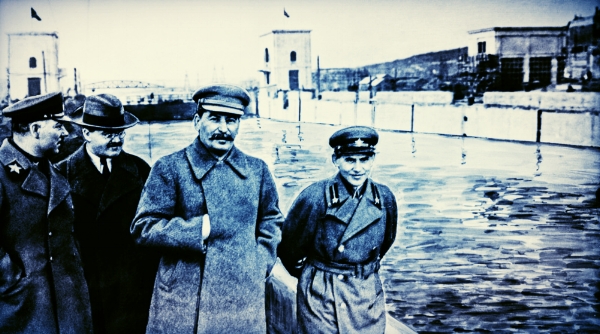
In the months leading up to the Bolshevik Revolution, Joseph Stalin was, recalled one fellow revolutionary, no more than a “gray blur.” The quiet inscrutability of this controlled, taciturn figure eventually helped ease his path to some murky place in the West’s understanding of the past, a place where memory of the horror he unleashed was quick to fade. Pete Seeger sang for Stalin? Was that so bad?

This bothers Paul Johnson, the British writer, historian and journalist. Hitler, he notes with dry understatement, is “frequently in the mass media.” Mao’s memory “is kept alive by the continuing rise . . . of the communist state he created.” But “Stalin has receded into the shadows.” Mr. Johnson worries that “among the young [Stalin] is insufficiently known”; he might have added that a good number of the middle-aged and even the old don’t have much of a clue of who, and what, Stalin was either.

Mr. Johnson’s “Stalin: The Kremlin Mountaineer” is intended to put that right. In this short book he neatly sets out the arc of a career that took Soso Dzhugashvili from poverty in the Caucasus to mastery of an empire. We see the young Stalin as an emerging revolutionary, appreciated by Lenin for his smarts, organizational skills and willingness to resort to violence. Stalin, gushed Lenin, was a “man of action” rather than a “tea-drinker.” Hard-working and effective, he was made party general secretary a few years after the revolution, a job that contained within it (as Mr. Johnson points out) the path to a personal dictatorship. After Lenin’s 1924 death, Stalin maneuvered his way over the careers and corpses of rivals to a dominance that he was never to lose, buttressed by a cult of personality detached from anything approaching reason.

Mr. Johnson does not stint on the personal details, Stalin’s charm (when he wanted), for example, and dark humor, but the usual historical episodes make their appearance: collectivization, famine, Gulag, purges, the Great Terror, the pact with Hitler, war with Hitler, the enslavement of Eastern Europe, Cold War, the paranoid twilight planning of fresh nightmares and a death toll that “cannot be less than twenty million.” That estimate may, appallingly, be on the conservative side.

Amid this hideous chronicle are unexpected insights. Lenin’s late breach with Stalin, Mr. Johnson observes, was as much over manners as anything else: “a rebuke from a member of the gentry to a proletarian lout.” And sometimes there is the extra piece of information that throws light into the terrible darkness. Recounting the 1940 massacre of Polish officers at Katyn, Mr. Johnson names the man responsible for organizing the shootings—V.M. Blokhin. He probably committed “more individual killings than any other man in history,” reckons Mr. Johnson. Ask yourself if you have even heard his name before.

To be sure, Mr. Johnson’s “Stalin” will not add much new to anyone already familiar with its subject’s grim record. It is a very slender volume—a monograph really. Inevitably in a book this small on a subject this large, the author paints with broad strokes, sweeping aside some accuracy along the way. Despite that, this book makes a fine “Stalin for Beginners.”

As Mr. Johnson’s vivid prose rolls on, the gray blur is replaced by a hard-edged reality. Stalin’s published writings were turgid, and he was no orator, but there was nothing dull about his intellect or cold, meticulous determination. As for his own creed, Mr. Johnson regards him as “a man born to believe,” one of the Marxist faithful, and maybe Stalin, the ex-seminarian, was indeed that: Clever people can find truth in very peculiar places.

But what he was not, contrary to the ludicrous, but persistent, myth of good Bolshevik intentions gone astray, was the betrayer of Lenin’s revolution. As Mr. Johnson explains, Stalinist terror “was merely an extension of Lenin’s.” Shortly before the end of his immensely long life, Stalin’s former foreign minister (and a great deal else besides), Vyacheslav Molotov, reminisced that “compared to Lenin” his old boss “was a mere lamb.” Perhaps even more so than those of Stalin, Lenin’s atrocities remain too little known.

Over to you, Mr. Johnson.

A Vulnerable Equilibrium

Jens Nordvig: The Fall of The Euro

National Review Online, April 29, 2014

Euro.jpg

He ate poisoned cakes and he drank poisoned wine, and he was shot and bludgeoned just to make sure, but still Rasputin lived on. And that gives me just enough of an excuse to use the mad, almost indestructible monk to begin an article about a mad, possibly indestructible currency. The euro has crushed economies, wrecked lives, toppled governments, broken its own rule book, made a mockery of democracy, defied market economics, and yet it endures, kept alive by the political will of the EU’s elite, fear of the alternative, and the magic of a few words from Mario Draghi, the president of the European Central Bank (ECB) back in July 2012.

Speaking to an investment conference, Draghi said that, “within our mandate” (a salute to watchful Germans), the ECB was “ready to do whatever it takes to preserve the euro.” “Believe me,” he added, “it will be enough.” Those few words, and their implication of dramatic market intervention, did the trick. Financial markets calmed down, and there are now even faint hints of economic recovery in the worst corners of the euro zone’s ER. And all this has happened without the ECB’s actually doing anything. Simply sending a signal sufficed.

The crisis has been declared over by the same Brussels clown posse that always declares the crisis over. They may be right, they may be wrong, but a calm of sorts has descended on the euro zone — not peace exactly, but quiet, punctuated occasionally by tremors that may be aftershocks, but could be omens of fresh chaos ahead.

That makes this a good time to take a look at The Fall of the Euro, a guide to the EU’s vampire currency by Jens Nordvig, global head of currency strategy for the Japanese investment bank Nomura Securities. If you are looking for a quick, clear, accessible account, free from financial mumbo-jumbo, that explains how the euro came to be, why trouble was always headed its way, what was done when the storm broke, and what might happen next, this book (which was published last autumn) is an excellent place to start.

It is written from the point of view of a market practitioner. Nordvig is not too fussed about the deeper European debate. He mainly wants to know what works. Here and there he will nod politely to democratic niceties, but this is a book where worries over lost sovereignty are dismissed as “sentimental.” Overall, Nordvig is a supporter of closer European integration (“a noble ideal,” he maintains — it isn’t, but that’s another story), but one with considerably less time for illusions than most in his camp.

And the euro, he argues, was built — and run — on illusions, the illusion that Germany was Italy, Italy was Portugal, and Portugal was Finland, the illusion that one size would fit all. Its creation was a “reckless gamble.” Politics prevailed over economics. No one made any preparations for the rainy day that could never come. The foundations for catastrophe were laid, and then built on by regulators, policymakers, and financial-market players only too happy to believe that the impossible was possible. Imbalance was piled on imbalance, and a shared currency masked the nightmare developing underneath. Employed by Goldman Sachs at the time, Nordvig saw how markets viewed the euro zone as an indivisible whole. But Greece was still Greece. And Germany was still Germany.

“Policy makers,” writes Nordvig, “can attempt to circumvent the basic laws of economics, but over time, the core economic truths take their revenge.” Unsustainable boom was followed by what has seemed, until recently, like permanent bust.

Nordvig does a fine job of explaining how the euro zone has been kept intact since the storm first broke, but he focuses more on the how than on the implications. Thus he relates how some of what has been done appears to “circumvent” a clear legal prohibition on European Central Bank financing of public-sector deficits, but seems to see that as more of a curiosity than cause for concern. But concern is called for: The EU’s combination of lawlessness at the top (remember how the Lisbon Treaty was used to “circumvent” those French and Dutch referenda) and tight control over everyone else has been a hallmark of tyranny through the ages.

Then again, financial types generally focus, understandably enough, on the financial rather than the political. But when the two look to be at risk of colliding, market attention shifts. Nordvig suspects that the euro zone may be getting closer to one of those moments.

He sees the euro zone as having emerged from its travails into what is now a state of “vulnerable equilibrium.” But to work properly, it needs substantially deeper fiscal and budgetary integration — something resembling the set-up that underpins monetary union in the U.S. He’s right about that, and that he is goes a long way toward explaining why euroskeptics are so opposed to the single currency. A realist, Nordvig concedes that the political support for such a step is simply not there, and he’s right about that too. New Yorkers might grumble about the way that, courtesy of the federal government, they effectively send cash to Mississippi, but they accept that their two states are in the same American boat. Germans look across at the Greeks (and other mendicants) and realize that they have been conned into bailing out a bunch of foreigners. That’s why, when Germany accepted the need for some sort of fiscal union to keep the euro zone in one piece, it insisted (as Nordvig explains) on an arrangement that falls far short of how such a union is usually understood. The Fiscal Compact that ensued is intended to minimize deficit spending in euro-zone member states rather than give Brussels additional spending power, spending power that could have been used to help out the battered periphery. It is no “transfer union.”

All that is left for the euro zone’s weaker performers is yet more austerity (sensibly enough, Nordvig sees the current currency regime as akin to a gold standard, and not in a good way), adding further bite to the deflationary crunch which these countries face. And it’s a crunch made worse by the perception, both fair and unfair, that it is being imposed on them from “abroad.” Greece is not Germany. And nor is France.

With bailouts resented in the euro zone’s more prosperous north, and austerity loathed elsewhere, it’s surprising how passive voters have been. There are plenty of explanations for this, but Nordvig is right to stress fear of the turbulence that abandoning the euro might unleash (a fear reinforced by establishment propaganda and the failure of many of the euro’s critics to articulate a credible alternative). A residual attachment to that “noble idea” of closer European union has also played a part as has, Nordvig notes, the determination of the dominant parties of center right and center left to hang onto the single currency. That’s something that has left anti-euro, but otherwise mainstream, voters struggling to find an outlet for their discontent.

That said, the prolonged economic grind is increasingly forcing voters in the direction of less respectable parties (such as France’s Front National) that believe that the euro zone and EU need much more than a mild course correction (the FN would pull France out of the euro). If these parties gain significant ground in May’s elections to the EU parliament (the betting is that they will), the danger (or opportunity) is not that they will overthrow the prevailing consensus in the EU parliament (they have neither the numbers nor the cohesion to do that), but that their success will shove their mainstream opponents in a more euroskeptic direction back home. Credibly enough, Nordvig identifies the possibility of a revolt within the political center (which could take very different forms: The Finns, say, may decline to support another bailout, while the Greeks might eventually turn away from austerity) as another potential block on the road to the closer integration that the single currency needs.

Even if the euro zone’s leadership does manage to fumble its way to agreeing on how closer integration could be secured — a deal that would inevitably involve massive transfers of sovereignty to Brussels — it will not be easy to push such a package through without the approval of a referendum or two. On past form, and in the electorate’s present mood, that will not be easy.

But, warns Nordvig, “if further integration is not feasible, some form of breakup is inevitable.” Nordvig may be sympathetic to the European project, but he is too much of a realist to pay too much attention to the Brussels myth that there is no alternative to preserving the euro “as is.” Specifically, he rejects the argument that, just because a “full-blown” breakup would be cataclysmic (as Nordvig convincingly shows, it could well be), all forms of breakup must be too. That’s a claim he heretically and correctly regards as little more than “a convenient tool to bind the euro zone together” and one, moreover, that has been used to stifle any proper analysis of what the costs and benefits of, say, a particular country’s quitting the euro might be. Such a departure, he believes, could be engineered “without intolerable pain.”

In understanding what Nordvig means by this, pay attention to his observation that “the cost of exit may be more concentrated around the transition phase, while the cost of sticking with the euro accumulates gradually over time.” Jumping out of a burning building is never easy, but it often beats the alternative.

Nordvig deftly summarizes what the costs and benefits of that jump might be, concluding that quitting the euro would be very tough for Ireland, Greece, Portugal, and Spain, easier than perhaps expected for France and Italy, and easiest (although far from problem-free) for Germany (I’d agree). That’s a position that logically takes him not too far (although he doesn’t quite arrive there) from support for a division of the single currency into northern and southern euros, something that has, in my view, long been the way to go. According to Nordvig, however, the most likely quitter is a country reduced to a state of such excruciating agony (not only in that burning building, but on fire) that exiting the euro finally comes onto the agenda. That is highly unlikely to be Germany, the nation most able to cope, inside the euro and out.

So what happens next? Suitably cautious in the face of such an uncertain environment, Nordvig lays out a number of different scenarios. While accepting, as he should, that political turmoil could upend everything, Nordvig appears, on balance, to conclude that the German austerity model will prevail, that a transfer union will be avoided, and that the euro zone’s laggards will trudge their way to an excruciatingly slow recovery. My own suspicion is that this assumes too much patience on the part of the periphery. Pushed both by common sense and fear of an increasingly unruly electorate, its governments will start a slow-motion revolt against what remains of the hard-money ECB that the Germans were once promised. Still in thrall to the cult of “ever closer union,” and terrified of the alternatives, Germany’s leadership will acquiesce. In fact there are clear signs that this process may be well underway.

This will lead to another of the scenarios sketched out by Nordvig. Loose money will try to fill some of the gap left by the transfer union that never was, and will do so just well enough to enable the euro to survive, but as a currency that is more lira than deutsche mark. That will be yet another betrayal of taxpayers in Europe’s north, while leaving the continent’s south still trapped in a system that does not fit.

And for what?

Hunger For Truth

Ray Gamache: Gareth Jones - Eyewitness to the Holodomor

The Weekly Standard, March 24, 2014

Gareth Jones.jpg

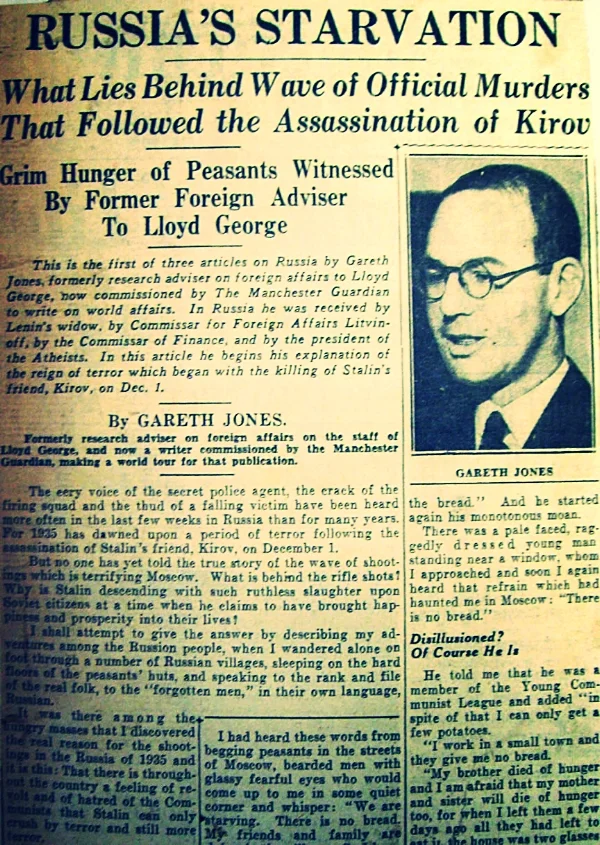
For decades, the notebooks of Gareth Jones (1905-35), a brilliant young Welshman murdered in Japanese-occupied Manchuria, were stashed away in his family’s house in South Wales, only to be retrieved by his niece, Siriol Colley, in the early 1990s. By that time, Jones, once a highly promising journalist and an aide to a rather better-known Welshman, David Lloyd George, had largely vanished from history.  But two books that appeared around then, Robert Conquest’s The Harvest of Sorrow (1986) and Sally J. Taylor’s Stalin’s Apologist (1990), gave a hint of what was to come.

In the first, a groundbreaking account of the manufactured famine that devastated Soviet Ukraine in 1932-33, Conquest told how Jones had gotten off a Kharkov-bound train, tramped through the broken Ukrainian countryside, and, on his return to the West, sounded the alarm about what Ukrainians now call the Holodomor (literally, to “kill by hunger”). Conquest explained how Jones’s “honorable and honest reporting” was trashed not only by Soviet officialdom, but also by Western journalists in the Soviet capital, a squalid episode discussed in more depth in Stalin’s Apologist, a biography of Walter Duranty, the New York Times’s Pulitzer Prize-winning correspondent in Moscow.

Duranty, whose relationship with the Stalin regime fueled a very well-paid career, took the lead in discrediting Jones. Claims of famine were “exaggeration” or, worse, “malignant propaganda.” Jones hit back, but to little avail. With just two years of life remaining to him, the path for his descent into historical oblivion was set. As for those three, four, five, maybe more, million deaths—well, so far as the West was concerned, nothing on that scale had happened. Sure, something bad had taken place, but to borrow Duranty’s term, there’s no omelet without breaking eggs; that’s how it goes.

It says something about the extent to which the Ukrainian genocide had been erased from Western memory that when Colley went through her uncle’s notebooks—the scribbled source material for the best English-language eyewitness reports of the famine—what caught her eye most (admittedly it had long been the source of family speculation) were later sections relating to what would ultimately be his murder in Manchuria. That was the topic that became the subject of Colley’s first book, Gareth Jones—A Manchukuo Incident (2001), a privately published volume in which only a page or two was reserved for Ukraine.

Times change. The reappearance of Gareth Jones was accelerated by the determination of many Ukrainians—free at last from imposed Soviet silence—to understand their own history. The investigation of a family tragedy broadened into an effort, helped by supportive members of the Ukrainian diaspora, to rediscover a journalist whose long-forgotten writing could be used to shape this newly independent nation’s sense of self and, more specifically, to help pull it away from Russia’s grip. It is no coincidence that Gareth Jones was posthumously awarded Ukraine’s Order of Merit at a time when Viktor Yushchenko, the most pro-Western of Ukraine’s presidents up until now, was in charge. 

By then, Siriol Colley had written More Than a Grain of Truth (2005), a biography (again self-published) of her uncle, offering a fuller portrait of a man who was a blend of Zelig—on a plane with Adolf Hitler, at San Simeon with William Randolph Hearst, you name it—and Cassandra, warning of nightmares to come. Meanwhile, a website (Garethjones.org) developed by Colley’s son Nigel had evolved into an invaluable online resource for anyone wanting to know more. Interest in Jones has continued to grow. A steady flow of stories in the British press, a documentary for the BBC, an exhibition at his old Cambridge college, and much else besides, were evidence that Jones was re-entering history beyond the frontiers of Ukraine—history that (as related in the West) finally had room for the Holodomor. This shift boosted interest in Jones, but was also, in a virtuous circle, partly the product of the rediscovery of his account of that hidden genocide, an account written in accessible English rather than a Slavic tongue.

But the reemergence of Jones does not diminish the darkness that accompanied his original eclipse, a darkness that runs through Gareth Jones: Eyewitness to the Holodomor. Ray Gamache’s work does not pretend to be a comprehensive biographical study, although it features enough helpful detail to act as a reasonable introduction to Jones’s extraordinary life. And it handily knocks down a few myths along the way. To name but two, the notion of a plot by the Moscow correspondents (such as it was) should not be overstated. And Jones did not sneak onto that train to Kharkov (his journey had official approval); it was where he got off—in the middle of nowhere, into the middle of hell—that was unauthorized.

That said, this fine book’s central focus is something more specific, a perceptive, methodical, and diligently forensic examination of the articles that Gareth Jones wrote about the Soviet Union, the circumstances in which they were written, the message they were designed to deliver, and, critically, their overall reliability. The reader is left in no doubt that this courageous, intensely moral man, an exemplar of the Welsh Nonconformist conscience at its best, saw the horrors he so meticulously chronicled in his notebooks and to which he then bore witness in his journalism: “This ruin I saw in its grim reality. .  .  . I saw children with swollen bellies.”

This is an academic book and thus not entirely free of jargon (“journalism texts are linguistic representations of reality”) or the contemplation of topics, such as the journalistic ethics of Jones’s giving food to the starving, likely to be of scant interest off-campus. That said, Gamache’s shrewd, careful work gives an excellent sense of Jones’s powerful analytical skills and the layers of meaning contained in his plain, unvarnished prose.

Above all, this book forcefully conveys Jones’s foreboding that something wicked was headed towards the peasantry. A leftish liberal in that early-20th-century way, he had had a degree of sympathy with the professed ideals of the Bolshevik Revolution; but then, as he wrote later, “I went to Russia.” And while he found things to admire in the Soviet Union, the underlying structure of its society appalled him. He saw a ruthless Communist party astride a hierarchy of which the peasantry—relics of the past who were of use, mainly, to feed the industrial proletariat—were at the bottom. With the dislocation, the fanaticism, and the failures of the first Five Year Plan becoming increasingly obvious, Jones knew who would pay the price. References to the danger of famine begin to surface in his reporting, and by October 1932, he was writing two pieces for Cardiff’s Western Mail under the headline “Will there be soup?” In March 1933, Jones returned to the Soviet Union to find out. The rest is history.

That it took so long to be recognized as such, however, was due to more than Soviet disinformation and Walter Duranty’s lies. For as dishonest and influential as that campaign by Duranty was, some of it, even on its face, did not ring quite true—not least the tortured circumlocutions with which he buttressed his denials of famine. Writing in theNew York Times, Duranty conceded that, yes, there had been an increase in the death rate, but “not so much from actual starvation as from manifold disease due to lowered resistance.”

Phraseology like that is only sufficient to fool those who wanted to be fooled, and there were plenty in the West ready to give the Soviet Union the benefit of the doubt. Many more simply did not care. The broad outline of what was happening, if not its details, was there for anyone prepared to look. To take just a few examples, there was the reporting of Jones and a handful of others (including Malcolm Muggeridge, whose role vis-à-vis Jones was, as Gamache reminds us, a complex one); there were the stories filtering out through the diaspora; there was the relief effort being attempted by Austria’s Cardinal Innitzer. But few took much interest. After all, said Duranty later, the dead were “only Russians,” a faraway, alien people who didn’t, apparently, count for a great deal.

And there was something else. Gamache records how the Foreign Office, which had access to good information of its own about the famine, deliberately kept quiet, worried about some British engineers then being held by the Soviets—by July 1933, all had been released—and, more broadly, about damaging Britain’s relations with the USSR, a concern sharpened, Gamache suggests (perhaps too charitably), by Hitler’s arrival in power earlier that year.

Looking across the Atlantic, Gamache notes, it has been argued that plans by the Roosevelt administration to extend diplomatic recognition to the Soviet Union may well have led Washington to downplay the famine. In any event, the United States and the Soviet Union agreed to establish formal diplomatic relations in November 1933, an event fêted with a lavish dinner at the Waldorf-Astoria, where Walter Duranty was a guest of honor. In a nod to the cuisine of the Soviet homeland, borscht, a traditional Ukrainian dish as it happens, was on the menu. That evening, at least, there was soup.

Through A Glass, Very Darkly

Mark Schrad : Vodka Politics - Alcohol, Autocracy, and the Secret History of the Russian State.

National Review, March 24, 2014

erofeev-venedikt4.jpg

If you cannot face going to Russia to see the real thing — in a dank Moscow underpass perhaps, or a broken attempt at a village — the best introduction to that nation’s drinking culture is to meet up with Venya, the narrator of Venedikt Erofeev’s Moscow to the End of the Line, a strange, bleakly comic, forbidden masterpiece of the early Brezhnev era. In the course of its first page, he drinks four vodkas, two beers, port “straight from the bottle,” and then, more vaguely, “something else.” It’s downhill from there.

In meandering, chaotic prose, Erofeev describes a drink-sodden, phantasmagoric train journey, punctuated by depictions of decay, echoes of Russia’s past, and recipes for cocktails that would make Appalachia blanch. With luck, no Russians ever drank “The Spirit of Geneva” (White Lilac, athlete’s foot remedy, Zhiguli beer, and alcohol varnish), but, as Mark Schrad, an assistant professor at Villanova University, notes in his absorbing, no less drink-sodden, not much less meandering, and even more horrifying Vodka Politics, they came close, not least during the time when Mikhail Gorbachev was cracking down on alcohol production:

“The most hard-up drinkers turned to alcohol surrogates: from mouthwash, eau de cologne, and perfume to gasoline, cockroach poison, brake fluid, medical adhesives, and even shoe polish on a slice of bread [a recipe that requires some additional preparation]. In the city of Volgodonsk, five died from drinking ethylene glycol, which is used in antifreeze. In the military, some set their thirsty sights on the Soviet MiG-25, which — due to the large quantities of alcohol in its hydraulic systems and fuel stores — was affectionately dubbed the “flying restaurant.”

It’s difficult not to smile at that, but then thoughts turn to those five dead in Volgodonsk, just a tiny fraction of a death toll from alcohol poisoning that ran into the tens of thousands, casualties of the burgeoning zapoi (a binge that lasts days or weeks) that finally lurched out of control during the economic implosion that followed the Soviet collapse. Post-Soviet Russia had little realistic alternative to the principle of shock therapy (how it was carried out is a different matter), but Schrad is right to stress the depths to which the country sank. The bottle, often filled with dubious black-market hooch, was one of the few sources of solace left. This, rather literally, added further fuel to the fire already raging through Russia’s demographics: “Average life expectancy for men — 65 at the height of [Gorbachev’s] anti-alcohol campaign in 1987 — plummeted to only 62 in 1992. Two years later, it dipped below 58.”

According to Schrad, “the best estimates are that in the 1990s, Russians quaffed some 15 to 16 liters of pure alcohol annually,” a figure that, tellingly, does not appear to be so different today, and is well above the “eight-liter maximum the World Health Organization deems safe.” These are per capita data, kindly averages that mask the extent to which it is mainly men who are drinking to excess, a fact that helps explain why Ivan can expect to live some ten years less than Natasha.

All those liters might alarm even skeptics legitimately suspicious of the WHO’s nannyish side, but the results for other nations offer context, if not reassurance. According to the WHO, Russia’s alcohol consumption in 2011 was near the top of the international  range, but it was far from the only country to cross the eight-liter threshold (the U.S. clocked in at 9.44 liters, the U.K. at 13.37). Beyond obvious differences in standards of health care, Russia’s catastrophe was clearly due to something subtler than the overall volume of alcohol consumed. What may have mattered more is that so much (6.88 liters) of the Russian tally was accounted for by spirits (the U.K., no stranger to the binge, came in at 2.41). That suggests that what is drunk (and, more specifically, how it is drunk) counts. Schrad quotes another Erofeev, the contemporary writer Viktor: “The result, not the process, is what’s important. You might as well inject vodka into your bloodstream as drink it.”

A disaster of this magnitude — on some estimates as many as half a million Russians each year are dying as a consequence, directly or indirectly, of alcohol abuse — was not the product of economic implosion alone. Other hard-drinking countries in the former Soviet space went through comparable traumas in the 1990s. But none, with the possible exception of Ukraine, a land long exposed to the worst pathologies of Russian rule, tippled quite so far over the edge. There was something that singled Russia out, and it predated the collapse of Communism by a very long time. As early as 1967, the rapid growth of alcohol consumption in the post-war years — something helped along by growing prosperity and a state that had replaced the anti-alcohol militancy of the earlier Soviet period with a sharp appreciation for the revenues that vodka brought in — had taken annual per capita consumption of pure alcohol (exclusive of bootleg samogon) to 9.1 liters. Drinking was an accessible pleasure for a society that had cash, but — in a still-austere Soviet Union — not much to spend it on. There was also something else: Vodka may have been used to soothe the pain associated with the collapse of Communism, but it had also been a way of anaesthetizing people through the dreary decades that preceded that long-overdue change, decades in which aspiration was stifled, life was hard, and futility was the norm. Under the circumstances, why not drink up?

But boozing one’s way through Brezhnev was also a reversion to older patterns of behavior that the early Bolsheviks — in some respects a puritanical bunch — believed they had swept away for good. In 1913, the wicked old empire’s per capita consumption stood at just under that perilous eight liters, and that was less of a gulp than the swigging that had preceded it a few years before. Vodka was not only a familiar presence in the Russian troika, it had also become one of its drivers, a wild, erratic, and destructive driver, to be sure, but one so powerful that attempts to unseat it contributed to the fall of both Gorbachev and (Schrad makes the case well) quite possibly the last czar too.

How demon drink grabbed the reins is the question that lies at the heart of Vodka Politics, which comes with the subtitle “Alcohol, Autocracy, and the Secret History of the Russian State.” That “secret” is something of an overstatement (as Schrad acknowledges, this is far from being the first work on this topic), but it is a claim not inconsistent with his occasionally excitable style (“While the cold wind howled beyond the Kremlin walls . . . ”). As told by a chatty and engaging author, this is Russia’s past seen, one might say, through the bottom of a glass, a perspective that is certainly skewed (sometimes too much so — the liberal Decembrist rebels of 1825 were rather more than an “inebriated Petersburg mob”) but is undeniably fascinating and often enlightening.

Schrad’s central thesis is simple enough: It is the tale of vodka as a “dramatic technological leap” (like a cannon, it has been said, compared with the “bows and arrows” of wine, beer, and more traditional drinks) that was adopted by Russia’s rulers (and how — if it’s epics of alcoholic excess that you are after, this is the book for you) and then ruthlessly exploited by them, a story that, with brief interruptions, has continued essentially unchanged for more than half a millennium.

Ivan III (reigned 1462–1505) was the first to establish a state monopoly on distillation, but Schrad prefers to credit his grandson, a rather more terrible Ivan, with “being perhaps the first to realize the tremendous potential of the liquor trade.” In between debauches and atrocities (if you are on the hunt for Grand Guignol, chronicled with faintly unseemly relish, this is also the book for you), he outlawed privately held taverns and replaced them with state-run kabaks. This was the next stage in, as Schrad describes it, the evolution of a system of “macabre beauty” under which the state built itself up by using mechanisms designed to increase the dependence of its subjects on a product — cheap to produce, profitable to sell, potent to consume — that gave them the illusion of release only to enslave them still further.

The catch was that the state itself became dependent on this dependency. At the height of the Russian empire, vodka funded a third of what became known as the state’s “drunken budget.” Toward the end of Soviet rule, vodka’s contribution was roughly a quarter. And vodka was a pleasure too tempting to be confined to those at the bottom of the heap. It seeped through all social classes, high and low, at immense cost to the country’s progress then and now, its spread facilitated by the unwillingness of the czarist and Soviet regimes to allow room for a civil society strong enough to push back, not to speak of their failure to nurture a nation in which the bottle would not seem like quite such an attractive escape.

So what now? With Russia’s economy in somewhat better shape and (thanks, primarily, to higher oil prices) vodka’s percentage contribution to the state’s income having shrunk to comparatively modest mid single digits, the chances — one might think — ought to be good that something serious could be done to address a public-health cataclysm that has not gone away. After all, the ostentatiously sober Vladimir Putin is at the helm. Some measures have indeed been taken, but this is still Russia, a top-down place where the people come last, where vodka profits accrue to the state and to the well-connected, a country where outside, maybe, some metropolitan centers, hope remains in short supply.

Moscow to the End of the Line draws to a close with the drunken Venya missing his stop and returning to the point at which he began.

And then things get worse.

Four-Ring Circus

National Review Online, February 9, 2014

sochi_olympics_rings.jpg

Organized Fun, the Olympic Games, parades, the aesthetics of the Cirque du Soleil, fireworks (face it, they are dull), and just about anything to do with sport are about as low as it is possible to get on the list of things I enjoy. I was, therefore, a natural pick to write about the opening ceremony for the Sochi Games. Thank you, NRO!

So there I was on Friday evening, not in Sochi (thank you, NRO travel budget!), but on my sofa in New York City, watching as NBC showed America the recording of an event that everyone else had seen hours before. No matter; we had already shared in an enjoyable prelude played out through Twitter, BuzzFeed, that friend who e-mails you stupid photographs, and the rest of today’s media giants — double toilets, unfinished hotel rooms, bugged showers, the slaughter of stray dogs, epic corruption, a $51 billion price tag, and the announcement from Sochi’s mayor that there were no gays in his town — that suggested that these Olympics might be more entertaining than most. Who now remembers Albertville?

The evening began with Bob Costas chatting away in what looked like a room in a Golan-Globus Fortress of Solitude. There was an Obama interview. For those in the dark about Russia’s history, an NBC narrator described seven decades of Soviet despotism, mass murder, gulag, and evil empire as a “pivotal experiment,” a mealy-mouthed, carefully neutral description that made Walter Duranty’s infamous omelets look like a fearless exercise in speaking truth to power.

The ceremony itself opened rather nicely with a young girl running through the Cyrillic alphabet, using each letter to introduce someone or something from Russia’s past. Let’s be fair; this would not have been the moment for Russia — or any nation — to air its dirty Lenin, and Russia did not. Stalin’s C (as I said, Cyrillic) would have to wait for another night. Instead we were treated to a recital of some of the best of Russia’s heritage, including Chekhov, Malevich, Kandinsky, Nabokov (Nabokov!), and some icons of my own space-obsessed childhood, Gagarin and Lunokhod, that plucky little motorized bathtub that crawled across a small slice of the moon in 1970. More disreputably, the organizers slipped in a boast that the Russians had invented television, a claim that did not slip past half-Scottish me and would have annoyed John Logie Baird, the Scotsman whose achievement this really was.

Let Scotland’s Daily Record take up the tale:

“During a video taking viewers through Russia’s alphabet, a row of TV screens appeared next to the letter T and a picture of Russian-American inventor and engineer Vladimir Zworykin . . . Scots commentator Hazel Irvine was quick to reassure viewers that the achievement still belonged to her home country immediately after the clip finished.”

This view of history, at ease with elements of both the Soviet past and what preceded — and indeed opposed it — and happy to play fast and loose with accuracy was a foretaste of what was to come.

Yes, there were fireworks. Whatever.

The young girl was duly hoisted up for a flight across an impressive representation of Russia’s vast and varied landscape. In a remarkable display of diplomatic restraint, it did not include any stretches of landscape currently belonging to any other country.

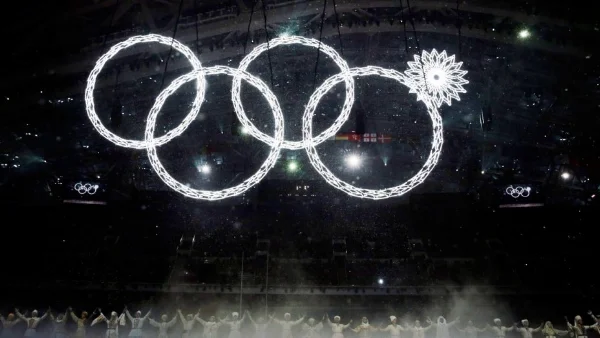
Finally came the technical glitch (or, if you prefer, the last hurrah of determined Trotskyite wreckers) that schadenfreudians — out in force for these Olympics — had been so eagerly waiting for. One of the five giant snowflakes that were meant to flower into Olympic rings, well, flaked, although not, reportedly, on the Potemkin footage that played on Russian TV (oh come on, you knew there was going to be a reference to that village somewhere in this piece).

The athletes emerged (I think) from some underground lair into the stadium, each team led by a snow hottie topped with a kokoshnik (look it up; I did), as they sauntered in, nation after nation after nation after nation, Lithuanians in two shades of sharpie green, mighty San Marino, some euphemism for Taiwan, and, of course, USA! USA! decked out in Ralph Lauren cardigans that would have made Betsy Ross wish that she had just stuck to plain blue.

And what were the Germans wearing?

It sounded to me like the bunch from Belarus got a very big cheer and the Ukrainians, too. Russians have a very expansive definition of home team.

The centerpiece of the show was a pageant meant to represent the sweep of the latest approved version of Russian history. And some of it was very striking, even lovely, not least a giant, silvery troika, so evocative of the country’s vast, snowy landscapes, and, for that matter, the finest of all descriptions of Russia, “speeding like a troika” in Gogol’s Dead Souls, a passage that ends, a little ominously for the rest of us, like this:

Whither then, are you speeding, O Russia of mine? Whither? Answer me! But no answer comes — only the weird sound of your collar-bells. Rent into a thousand shreds, the air roars past you, for you are overtaking the whole world, and shall one day force all nations, all empires to stand aside, to give you way!

Nikolai Gogol (1809–1852), of course, was Ukrainian-born.

Nobody ever said that Russian history was uncomplicated, but the spectacle in Sochi was clearly designed to smooth things out a bit — no, a lot — something very much in keeping with the wider Putin project in which all of Russian history, Czarist, Soviet, and whatever it is now, is crammed into a single, supposedly unifying past in which all Russians, regardless of ideology, did the right, patriotic thing for a nation that was always a force for good.

Thus we witnessed onion domes, Cossacks, Peter the Great, the ballroom scene (beautifully done) from War and Peace, followed by glimpses of turn-of-the century technological progress cleverly used to pave the way for the passage dedicated to that “pivotal experiment.” This was presented primarily as an acceleration — continuity, you see — of the country’s drive to industrialization and modernity all drenched in red (light, not blood) and crowned by the shapes of constructivism’s bold geometry, including what looked like fragments of Tatlin’s Tower, the monument to the Third International that — like communism’s radiant future — never made it past a very rough draft.

And what was this? Two giant heads, an enormous hammer, a vast sickle, excerpted, as it were, from the sculptress Vera Mukhina’s massive, sinister and, in its way, magnificent, Worker and Kolkhoz Woman (1937). To look at, it was wonderful, to think about, not so much. Imagine if Germans hosting a (modern) Olympics had included some of the iconography that their countrymen had used back in Berlin the first time round. That it is unthinkable in a way that Sochi’s sexed-up Soviet design was not speaks volumes — volumes filled with nothing good.

Later there was a sequence showing the supposedly kinder, gentler, Soviet Union that evolved after the tyrant whose name was not mentioned had left the scene, a sort of Russian Graffiti with music that somehow, I suspect, was not entirely representative of the early Brezhnev years.

Speeches? Of course there were speeches. The president of the International Olympic Committee said something about the Olympics embracing diversity (well, there had already been a performance by the fake lesbian pop duo t.A.T.u.) and explained that the games were “never about erecting walls to keep people apart,” which may or may not also have been a reference to Sochi’s eccentric restroom construction. After that, some Swan Lake danced by what seemed to be electric jellyfish, and a confusing sequence involving escapees from the set of Tron.

The Olympic torch arrived on the last leg of its long relay, a tradition since, ahem, Berlin, and was handed over by Maria Sharapova to a posse that included Alina Kabaeva, holder of an Olympic gold medal in rhythmic gymnastics, holder of a Russian parliamentary seat, and, if the rumors are true, holder of Vladimir Putin too. Yes, that’s right, rhythmic gymnastics . . .

The flame itself was lit by another parliamentarian, Irina Rodnina, three-time winner of an Olympic gold medal for figure skating and the author of a racist tweet about Barack Obama.

The gold medal for trolling was awarded to Vladimir Putin

Vlad The Conservative

National Review, January 9, 2014 (January 27, 2014 issue)

Putin Pop-Up Store, East 20th St, NYC, October, 2014 ©  Andrew Stuttaford

Putin Pop-Up Store, East 20th St, NYC, October, 2014 © Andrew Stuttaford

Back in the mid 1980s, Pat Buchanan was the communications director for the Reagan White House, and Vladimir Putin was a KGB officer in East Germany. Times change: The former Soviet secret policeman — if there is such a thing as a “former” Soviet secret policeman — is, after a bogus intermission, now serving a third term as Russia’s president, and the old Cold Warrior seems to have become something of a fan. Writing in his syndicated column in December, Buchanan wondered whether, “in the culture war for mankind’s future,” Putin was in fact “one of us.”

The immediate trigger for Buchanan’s comments was Putin’s state-of-the-nation address just a few days before. Stung, probably, by criticism of gay-bashing legislation in Russia, Putin had taken aim at “the destruction of traditional values” elsewhere in the world — by which he meant the West — and, just so there could be no doubt about what he was referring to, had thrown in a reference to “so-called tolerance, neutered and barren.” No stranger to chutzpah, Putin, an unlikely champion of the ballot box, noted that these changes to “moral values and ethical norms” had come “from above” and were “contrary to the will of the majority.” As such, they were “essentially anti-democratic.”

After years of aggressive judicial activism and dramatic social change at home, those were words likely to appeal to quite a few American conservatives, some of whom might perhaps already have found themselves in unexpected agreement with the Kremlin not so long ago. After all, it was only last summer when Republican congressmen Steve King and Dana Rohrabacher made it clear that Buchanan was by no means the only figure on the American right to be offended by what he has somewhat histrionically described as “half-naked” (by Iranian standards, perhaps) and “obscene” (not so much) protest in Moscow’s Cathedral of Christ the Savior by the feminist punk-rock group Pussy Riot.

It is, of course, hardly surprising that a protest by an altar — even if brief, and largely mimed (a soundtrack was recorded later for a music video using footage from the protest) — would appall many, and not just the religious, in this country. But Pussy Riot’s critics should have taken a closer look before jumping onto Putin’s sleigh. America is not Russia, a country where an authoritarian regime has suborned the national church for its own purposes, and where that church, bribed with privilege (ask bullied Russian Baptists how that works), a degree of power, and no small amount of mammon, has for the most part gone along. That is why Pussy Riot was protesting in a cathedral. Theirs was an infinitely lesser blasphemy.

Putin may well be a Christian of sorts (the influence of his supposed dukhovnik — spiritual father — Archimandrite Tikhon Shevkunov is a source of much speculation), but then again so were the Borgias. Divorce and all the rest aside, Putin might even quite genuinely, if in a rather rough-and-ready fashion, be a social conservative, but his public declarations on these topics are likely more a matter of political calculation than moral conviction. Corruption, economic slowdown, and increasingly dictatorial rule have eroded Putin’s support among the intelligentsia and in the more metropolitan centers, and so, Orthodox Church in tow, he has — what’s the term these days? — “pivoted” toward Russia’s “silent majority” (Pussy Riot didn’t have too many local fans), a maneuver that the Buchanan of the Nixon White House would have both recognized and appreciated for its savvy.

It was also a move that dovetailed neatly with a longer-term theme running through the Putin years. The defining mistake of post-Communist Russia has been an unwillingness to come to terms with the reality of its Soviet past. Putin himself infamously referred to the break-up of the USSR as “the greatest geopolitical catastrophe” of the 20th century. Historical truth — uncomfortable, divisive, and shameful — has been replaced with a patriotic confection designed to reconcile the irreconcilable and soothe the national ego. Some excesses and mistakes — too mild words, those — are included, but other horrors are downplayed or have simply gone missing. There is, however, room for both the preservation (or restoration) of Soviet iconography and a lavish biopic about Admiral Kolchak, one of the most prominent of the anti-Bolshevik commanders in the Russian Civil War. In a large national poll organized in 2008, Stolypin, the tough, authoritarian reformer who was the last czar’s most effective prime minister (significantly, Putin gave him a shout-out during his speech), was rated the second-greatest Russian of all time. Stalin (a Georgian and a mass murderer, but no matter) came in third.

It is a narrative intended to put together what history in reality has torn apart, a fable in which czar and commissar can coexist, united in their love for the motherland and a shared sense of the messianic destiny that Holy Russia — home of Moscow, the “Third Rome,” and also the birthplace of Lenin’s radiant future — has long felt is its due, a fantasy reinforced by physical as well as intellectual distance from the Enlightenment West. The fact that such ideas have proved most congenial to authoritarian rule has not escaped Putin’s notice.

Regardless of the nods to the country’s Soviet heritage, the Commies — fear not — will not be coming back anytime soon. Too much loot is being amassed by those in charge for that. Instead, the philosophy that underpins the current regime (an admission of crude self-interest wouldn’t really do the trick) looks more and more like an updated, more subtle, more capitalist variant of the “Orthodoxy, autocracy, and nationality” first devised as a Russian state ideology for Czar Nicholas I (1825–55) as a response to the liberal challenge at home and abroad.

Well, Orthodoxy is back, what’s left of Russia’s nascent democracy is under pressure, and “nationality” never went away. In his speech Putin acknowledged the multi-ethnic nature of the Russian Federation (albeit with a swipe at “rowdy, insolent people from certain southern Russian regions”), but he went on to emphasize “the all-encompassing, unifying role of Russian culture, history, and language,” terminology that harks back both to czarist-era Russification and to the brutal Soviet approach to “lesser” nationalities.

But as he hymned the rebirth of a strong Russian state, Putin was careful (as Buchanan noted approvingly) to stress that Russia “does not encroach on anyone’s interests . . . or try to teach others how to live their lives.” Unfortunately, the first of those claims is nonsense. To take just a few instances, Russia has been throwing its weight about in northeastern Europe, it has grabbed a slice of Georgia, it is bullying Moldova, and, in what may be Putin’s most impressive coup yet, it may just have “bought” Ukraine. Russia is on a roll, with sporadic humiliations of a directionless America — from Snowden to Syria — for added spice. Yes, Putin’s grip may well be more fragile than it looks, but when Forbes magazine recently designated him as the most powerful person in the world, it was not without reason. The recent release of two Pussy Rioters and Mikhail Khodorkovsky was a declaration of strength, not weakness.

For a retro great power to behave like a retro great power is not particularly shocking, but it is essential to remember that Russia (even more than the U.S.) is a nation that considers that it has the right to play by its own rules. Thus Putin’s insistence that his country is not interested in trying to “teach others how to live their lives” is not only a rebuke (as Buchanan correctly notes) to Western universalism, but also a reminder that Russia has no intention of yielding its sovereignty to the emerging supranationalist order. That’s a reasonable, even commendable, position, but it is no reason for those on the foreign-policy right to think that they have found a friend in Putin. There are areas where American and Russian interests overlap (something that Buchanan has also highlighted). The fault for not taking better advantage of them lies on both sides and so far as is possible should be remedied, but a degree of rivalry, sharpened by Russia’s refusal to accept its loss of empire, is inevitable, natural, and, if handled with an appropriate degree of realism, not particularly dangerous.

And (hesitant as I am to give advice to this constituency) social conservatives should be warier still. To Buchanan, Putin “is seeking to redefine the . . . world conflict of the future as one in which conservatives, traditionalists, and nationalists of all continents and countries stand up against the cultural and ideological imperialism of what he sees as a decadent west,” a piece of wishful thinking on Buchanan’s part that gives Putin’s pronouncements an international significance that they do not deserve and could not sustain.

History, Mark Twain is said to have observed, doesn’t repeat itself, but it rhymes. Almost exactly two centuries ago, the devout if possibly unhinged Czar Alexander I (1801–25) was peddling the notion of a reactionary “Holy Alliance” between the nations that had seen off Napoleon. When the czar explained this idea to Lord Castlereagh, Britain’s conservative foreign minister (the no less conservative Duke of Wellington was also in the room), the meeting did not go well. “It was not without difficulty,” wrote Castlereagh later, “that we went through the interview with becoming gravity.”

Translation: It was difficult to keep a straight face.

There’s a lesson there.

Republicans Cannot Go On As 'The Party of No'

Standpoint, January 1, 2014

Times Square, New York City, October 2013 © Andrew Stuttaford

Times Square, New York City, October 2013 © Andrew Stuttaford

Wakes are not only for rainy days. The weather outside was glorious in that New England fall way, but the mood inside a room in Yale’s Linsly-Chittenden Hall was a touch funereal. We were a bunch of rightwingers there for a conference on the future of conservatism but, to quite a few of those attending, the past seemed altogether more promising.

The timing was not the best. Just a few days before, the ill-conceived and unpopular effort by congressional Republicans to defund Obamacare, a ploy that made the charge of the Light Brigade look well thought-out, had collapsed in an eminently predictable fiasco. This stoked fears that the 2014 midterm elections were now doomed to end in disaster. Always implausible hopes of retaking the Senate looked delusional and even GOP control of the House of Representatives appeared to be at risk.

But not long after, Republican hopes began to rise. The end of the shutdown left the Obamacare website, launched a week or two earlier amid general derision, alone in the coconut shy. As I write, healthcare.gov is a gift that is still giving. Obama’s approval ratings have sunk below 40 per cent.

But the site’s issues are being ironed out, and with the help of  supportive media, will be reclassified as teething problems to be rapidly forgotten. Nevertheless, there is a decent chance that lingering recollections of the cack-handed roll-out will poison the way in which many voters will still be viewing Obama’s signature legislation when the mid-term elections come round next November. That might give the GOP a helping hand then, but the idea that this will also be enough to propel a Republican into 1600 Pennsylvania Avenue in the 2016 elections is a stretch.

That said, Obamacare — never a particularly popular plan — may give Republicans something they can exploit in their campaign to retake the White House. The Obama administration shies away from the word, but the Affordable Care Act (ACA) is redistributionist, not only in the narrow sense (higher taxes on the wealthy), but in its broader operation: it directly or indirectly transfers healthcare resources away from a majority of Americans and reallocates them to the much smaller number previously shut out of the system. Crudely understood, there will be more losers than winners.

Simply undertaking to repeal Obamacare will not be enough to do the trick. The system being transformed by the ACA may have been better than usually understood in the UK, but it was nonetheless restrictive, bureaucratic and expensive and, thanks to the way it was often linked to employment, alarmingly tenuous to the millions of Americans who worry how secure their jobs really are. If Obamacare is to go, the GOP will have to explain what it will put in its place. Journalists and think-tank denizens on the Right have been offering up their suggestions for a while, but as two of the most recent to do so, Ramesh Ponnuru, a senior editor at National Review, and a visiting fellow at the American Enterprise Institute (AEI), and Yuwal Levin, the editor of National Affairs and a fellow at the Ethics and Public Policy Center, observed in a November article in the Wall Street Journal, congressional Republicans have “with a few honourable exceptions” failed to join in.

That’s a problem. Bobby Jindal, the governor of Louisiana and something of a Republican star, warns that the GOP cannot just be the “party of no”. Maybe, but to attempt to define what it is for is, for the Republican politician who dares to try, dangerous ground indeed.

To start with, it will involve recognising that there is rather less remaining of the America that elected Ronald Reagan than many Republicans seem prepared to accept. The US population has ballooned by more than 90 million since 1980. It has changed in ways that reflect more than the passing of the years. Usefully didactic memories of the 1970s have faded. Recollections of the Lehman collapse are all too fresh. New generations have reached voting age after a lifetime immersed in the soft-left certainties of the American education system. Meanwhile, stagnating household incomes and what look like permanently higher levels of unemployment or underemployment threaten to chip away at support for America’s free market(ish) model. Democrat Bill de Blasio’s success in winning the mayoralty of New York City was (mostly) a Gotham thing, but obvious public concern over rising inequality — the Occupy movement was an early harbinger — signals a coming shift in the ideological landscape that will not help the Republicans one bit.

Above all, decades of mass immigration have transformed the country’s ethnic, cultural and political make-up in ways that pose an enormous challenge to the GOP. It says something that if the America of 2012 had had the demographics of 1980, Mitt Romney would have won by a wider margin than did Ronald Reagan back then.

What to do? To begin with, the conventional wisdom is that Republicans need to scale back their opposition (much of it driven by the Right) to current efforts to “regularise” the position of the nearly 12 million illegal immigrants now thought to be present in the country. The argument — made with varying degrees of enthusiasm and cynicism both by the party establishment and erstwhile Tea Party darlings such as freshman Florida senator (and possible presidential candidate) Marco Rubio — is that an anti-immigration stance makes it easy for the GOP’s opponents to caricature the Republicans as a “white” party hostile to minorities. With Democrats and the media trumpeting just that tune, it’s an argument that has some weight.

Throw in some of the more inflammatory talk sometimes heard from the Tea Party and other sections of the “nativist” Right, as well as the clumsy language of Republicans often tone-deaf to ethnic sensitivities (Mitt Romney’s 2012 reference to “self-deportation” for one) and it’s easy to understand why the Republican share of the growing Latino vote fell from some 40 per cent in 2004 to 27 per cent in 2012 (Asian-Americans were even less enthusiastic: only 26 per cent voted for Romney). That minorities are more sceptical about immigration than often assumed only reinforces the point that what matters is not the policy itself, but the message that it is believed to deliver.

Yet the electoral mathematics will deteriorate still further if anti-immigration Republican congressmen who, for now, are holding the line, agree to an amnesty for illegals. For all the talk about Latinos’ attachment to enterprise and family values (more nuanced than the stereotype would suggest), their votes will tilt heavily Democratic for decades, just as did those of the Italian-Americans with whom they are so often compared. The same is true of the other immigrant groups now reshaping America, a disturbing prospect for the GOP given that the country is accepting something like one million new legal immigrants a year. That’s an inflow that the Democrats have every reason to welcome, but there is little sign that many Republicans will be prepared to stand in the way of those arriving legally, quite possibly even if that total is — as is also being proposed — significantly bumped up. The idea of the nation of immigrants has an emotional appeal that stretches across America’s ideological divide. More prosaically, there is also a bipartisan understanding that business donors appreciate the cheaper workers and increased demand that immigration brings in its wake.

Republicans are thus running up an escalator that is moving down. Resisting amnesty will slow the pace somewhat, but the longer-term trend is clear: to win, the party will have to win over more minority voters. Quite how to do so remains a mystery. The greater number of high-profile GOP leaders (Jindal, Texas senator Ted Cruz, Rubio, South Carolina governor Nikki Haley and New Mexico’s promising Susanna Martinez, to name a few) drawn from ethnic minorities is a start, but no more than that.

To be sure, the Taft-sized Chris Christie — in the derogatory sense of the word — secured re-election as Republican governor of strongly Democratic New Jersey with some 60 per cent of the vote in November, a tally boosted by his success in attracting the support of over 50 per cent of Hispanic and (it’s sad that this counts as an achievement) around 20 per cent of African-American voters.

This was a feat that owed as much to his refreshingly blunt persona as to his attempt to steer his state in a more frugal direction. For while there is still a very distinctively American constituency for smaller government — check out the “don’t tread on me” flags brandished at any Tea Party rally — it is unlikely to be enough to return the White House to Republican management. In part, this reflects the fact that the country’s finances have deteriorated to a point that leaves little room to make a good case for Reagan-style tax cuts. The number is distorted by a sluggish economy, but federal tax receipts as a percentage of GDP (approaching 17 per cent) are lower than when the Gipper left office. Meanwhile publicly- held federal debt as a percentage of GDP has risen from 26 per cent in 1980 to around 73 per cent today, nearly half of which is now held by intrinsically more jittery international investors.

Total federal debt (roughly $17 trillion) is calculated before factoring in the contingent liabilities arising out of underfunded entitlement programmes such as Social Security and Medicare that, according to Republican deficit hawks such as Oklahoma senator Tom Coburn or former vice-presidential candidate Congressman Paul Ryan, could amount to four, five or more times that figure. To be fair, those estimates are hotly disputed, but still . . .

On the other side of the ledger, that the sequester (a crude budget-bludgeoning device triggered by the current impasse in Washington) has so far not proved anything like as damaging as the Obama administration originally predicted should not be allowed to conceal the fact that any attempts to take America back to fiscal respectability on the back of expenditure cuts alone would involve taking a chainsaw to entitlements. According to a Bloomberg News poll last February, most Americans accept (or claim to accept) that Medicare and Social Security must be overhauled, but they view tax increases as part of the solution.

That’s anathema to many on the Right, an attitude enshrined in, and enforced through, the “Taxpayer Protection Pledge” designed by Americans for Tax Reform, a pressure group formed by the influential libertarian-leaning Republican activist Grover Norquist. The pledge is essentially an undertaking to reject any net increases in tax, and it has been signed by the overwhelming majority of Republicans in the Senate and House. Sadly, even if the pledge has sometimes been interpreted more sinuously than its stern wording might suggest, it no longer is in tune with economic reality, but the political reality is that declining to sign it (let alone reneging on it) is likely to cause trouble for any Republican at primary time. That will change, probably at about the time that seniors (56 per cent of the over-65s voted for Romney in 2012) realise that their benefits are in jeopardy, but that moment has not arrived.

All this almost certainly dooms the faint chances of a bipartisan grand bargain over the federal budget at least for now. Given the current balance of political forces, this may not be such a bad thing. But it also discourages Republicans from mounting any serious effort to redesign America’s archaic and destructive tax system in ways that would make it generate more revenues while inflicting, at least in some respects, less pain. In that connection, one avenue worth exploring is the introduction of some sort of federal consumption tax, partially offset by a lower, flatter, simpler income tax. From time to time, some Republican leaders have floated variants of this, including Ryan and former Indiana governor Mitch Daniels (one of the more disappointing absentees from the 2012 race). Even Mitt Romney refused to rule out the introduction of a value added tax, a position that led a staffer from the reliably shrill Newt Gingrich campaign to snipe that Romney had been looking at “European socialist ideas”. A somewhat more subtle critique has come from Norquist, long suspicious of a tax that he believes to be too efficient a money-raising machine to be trusted.

So what else is there? Republican Senator Mike Lee (Utah), cheered on by the likes of Ponnuru and the AEI’s James Pethokoukis (someone, incidentally, open to a consumption tax) is arguing for a redrawing of the tax system that incorporates a very substantial expansion of child tax credit. This family-friendly move, part of a broader drive in, to quote Ponnuru, a more “communitarian” direction, is unlikely to fly this time round, but it points to a possible future for the GOP as something closer to Western Europe’s Christian Democrats. Such an evolution in my view is not particularly desirable, but given America’s changing political environment, may be wise.

A better guide to what may come next comes from Pethokoukis’s observation in National Review Online that the 2012 campaign saw a plethora of tax-cutting proposals by Republican hopefuls seemingly “more interested in signalling their supply-side bona fides to primary voters than in offering realistic blueprints for governance”.

Ah yes, the primaries: the road to the nomination runs, of course, right through them, and I mean Right. White evangelicals and Tea Party supporters (they are not always the same people) represent a very large percentage — well over a half — of the primary vote. They are not in the mood for compromise. According to a July 2013 Pew Center survey, 69 per cent of Tea Partiers believe that the best course of action for the GOP is to move in an even more conservative direction. To design an alternative to Obamacare and a plausible budgetary fix that both manage to appeal to those voters and have a chance of convincing the wider national electorate is a very tall order, and that’s before we have begun to look at the question of the so-called “social issues” (primarily abortion and same-sex marriage) that weigh so heavily in Republican primaries.

The rise of the Tea Party was a classic populist insurgency, a revolt of country against court, propelled by disgust over the bailouts that followed the financial crisis, anxiety over the state of America’s finances, contempt for the Republican establishment and fear of what Obama might be planning. It revitalised a party sunk in deep depression after Obama’s trouncing of John McCain, and made an enormous contribution to the GOP’s bounce in the 2010 midterms. The contrast with the not entirely dissimilar folk at UKIP “pissing into” (to borrow LBJ’s entertaining terminology) the Tory tent is one that British Conservatives tut-tutting over the Tea Party would do well to note. As revolts tend to do, however, the Tea Party has not infrequently overshot, most notably by promoting candidates more on the basis of their ideological purity than their ability to win.

In doing so, they were encouraged by a segment of the conservative hierarchy already, ironically, well entrenched in Washington. To a degree unimaginable in the UK, the Right in America has a lively, powerful and well-financed intellectual, media and political infrastructure. That’s generally to the good, but it has come at a price. One or two speakers at the Yale conference complained about conservative neglect of that most essential of political skills — persuasion. Instead of reaching out to the unconvinced, conservatives have primarily been pursuing a conversation with themselves. Such conversations have a way of degenerating into a contest designed primarily to show who can be more pur and who more dur.

There was no better example of this than conservative (and famously socially conservative) South Carolina Senator Jim DeMint’s comment in early 2009 that he “would rather have 30 Republicans in the [100-strong] Senate who really believe in principles of limited government, free markets, free people, than to have 60 that don’t have a set of beliefs”, an expression not of conviction, but of a fanaticism unmoored to any realistic plan for winning back power. When the Tea Party moment dawned, DeMint and others like him jumped in front of the parade, reinforcing the revolutionaries’ zeal to purge so-called RINOs (Republicans In Name Only) and throwing some money their way too. To be sure, this has led to the injection of useful new blood into the party’s ranks, but it has also led to the selection of some candidates so inept, unsuitable or outright strange that the GOP threw away hopes of winning or retaining a series of crucial senate seats — from Nevada to Delaware to Indiana and beyond — that could have transformed the political calculus of recent years. Regrettably, there are signs — not least in the aftermath of DeMint’s move to the Heritage Foundation, formerly the most influential of all the conservative think-tanks — that excesses are not yet through.

No less destructively, some of the more outlandish candidates on the Right have tarnished the broader Republican image, especially when they have sounded off on social issues. Would-be senator Todd Akin blew his chances of winning a Missouri seat in 2012 when, in defending his opposition to abortion in cases of rape, he explained that victims of “legitimate rape” rarely became pregnant, a view that held some sway in the Middle Ages, but is today something, shall we say, of an outlier in obstetric circles.

Social issues have for years been essential to the Republican party’s ability to compete (there is no majority for the socially liberal, economically conservative programme favoured by libertarian-leaning or many moderate Republicans) but they have come with costs, hitting the party’s capacity to attract elite support and its appeal to women (particularly single women), the young and voters in the north-east and west. These costs are likely to rise. Same-sex marriage has won the acceptance of roughly half of all voters, and in another reminder of how the country is changing, roughly a third of all under-30s describe themselves as “religiously unaffiliated” (Pew Research, October 2012), the highest total ever. On the other hand, roughly 50 per cent of Americans now claim to be “pro-life” (Gallup, May 2012), although that’s a stance that comes with plenty of loopholes: more than half of these pro-lifers believe that abortion is acceptable under certain circumstances.

What seems to matter to centrist voters is how social issues are framed. They are prepared to vote for anti-abortion candidates, say, but not for those who push the issue beyond what is rather mistily defined as reasonable, or if they detect a wider agenda at work, such as the distaste for contraception displayed by former senator Rick Santorum, an oddball Beltway Savonarola who enjoyed a brief and alarming surge in the 2012 primaries. When they notice executive competence, as so often they do in the ranks of the GOP’s expanding tally of governors (30 in all, close to the record set in the 1920s), they appear to be willing to live with a conservative social agenda so long as it is not pushed à l’outrance.

So what now? More budget fights in 2014 will enable the Democrats to rekindle memories of this past autumn’s shutdown and, with them, images of the Republicans as mad, bad and dangerous to vote for. A dose of class warfare is sure to be on the agenda too. Against that, the fallout from Obamacare’s uncertain launch may still be reverberating and the programme’s deeper problems may be coming into sharper focus. The economy is likely to be walking rather than running-the labour force participation rate is the number to watch-and a foreign policy foul-up cannot be eliminated. The best guess at the moment is that the midterms will leave matters pretty much as they are now.

The ideological divisions between and within the Right and the remaining “moderates” in the Republican Party, stirred up further by would-be presidential candidates out for primary votes, will mean that a credible alternative to Obamacare and a sound fiscal plan will both remain elusive even after the midterms. Being the “party of no” may well have to do. The longer-term outlook for the GOP will continue to deteriorate, but if “events” co-operate, nay-saying buttressed by at least some ideas on what might replace the ACA could, fingers-crossed, just possibly be enough to do the trick in 2016 if the primary process can avoid the own goals of 2010 and 2012. At the presidential level, the primaries need to avoid attracting the clown posse that we saw last time (Santorum is said to be contemplating another run), or selecting a candidate (Cruz, say, or Kentucky’s Senator Paul) too hardline to have any prospect of winning back the White House, a temptation made more difficult to resist (what’s to lose?) by the failures of establishment Romney and establishment McCain. Even a more conventionally viable candidate will have to avoid being dragged into unelectability by the positions he has to take to prevail at the primaries. Despite conservative suspicion, some baggage from his past, and an occasionally spiky and difficult personality, Chris Christie might just be tough enough to pull it off.

But 2016 is a long way off. And then there is Hillary.

 Note: Bridgegate broke about two days after this article went to press in late December, but before the issue appeared on newsstands. Them’s the breaks.