Loch Roswell?

National Review, September 15, 1997

Loch Ness, 1997, © Andrew Stuttaford

Loch Ness, 1997, © Andrew Stuttaford

You don't believe that a saucer crashed at Roswell, New Mexico? After all, there were, they say, witnesses. Sort of. Military men, a rancher, maybe some archaeologists. Well, to the folks over by Loch Ness that is nothing. They have got a saint, Columba no less, who allegedly saved a swimmer from a "savage beast" in the loch over a thousand years ago.

And it doesn't stop there. The legend survived, and so did the monster—or its descendants—to reappear before John Mackay and his wife in March 1933. Interestingly, they were the proprietors of the Drumnadrochit Hotel, which overlooks the loch. Other sightings soon followed. The world press picked up the story, and the Drumnadrochit Hotel filled its empty rooms.

Loch Ness, 1997 © Andrew Stuttaford

Loch Ness, 1997 © Andrew Stuttaford

The sightseers have never really gone away. Drumnadrochit is today still Nessteria's epicenter, visited by well over one hundred thousand people each year. That's not bad for a little Scottish village. To find it, take the hopelessly inadequate A82 west from Inverness. Be prepared to drive slowly behind tour buses, and wait until you see that Barney profile and long green neck rising from the waters. Not inappropriately, it's a fake, a concrete creature wallowing in a Pond Ness rather than the more majestic loch nearby. Nevertheless, it signals arrival at the "Official" Loch Ness Monster Exhibition Centre.

Loch Ness, 1997, © Andrew Stuttaford

Loch Ness, 1997, © Andrew Stuttaford

Official it may be (who says?), but it is not alone. The Original Loch Ness Visitor Centre is just down the road. Relations between the Loch Ness pair are not too good. Asking at the Official for the way to the Original is as well received as asking a Montague for directions to the Capulet place.

Loch Ness, 1997, © Andrew Stuttaford

Loch Ness, 1997, © Andrew Stuttaford

After all, why go elsewhere when the Official Centre is, it claims, the home of the authoritative exhibition? It is certainly impressive, a multi-media presentation with spooky music, "authentic relics of the search" (if not of the monster), clever illuminations, and tantalizing talk of creatures that may, just, perhaps, have survived the Ice Age. Showroom dummies with ZZ top beards are dressed as ancient Celts. Was the monster their folk memory of dragon-prowed Viking longships? Other mannequins, similar faced but with late disco-era hair, prefer to be more scientific, crouching in a bathysphere or standing on the deck of a research vessel. They stare out blankly - at the tourists, who gaze vacantly back.

Perhaps they should go and see the movie at the Original. There's speculation, scenery, and a good collection of eyewitnesses. A sturdy lot they are too: a priest, honest-looking men in tweed caps, slightly old-fashioned rural faces out of an episode of Miss Marple. Exactly the sort of people that Agatha Christie warns us not to trust.

And how right she was. The Loch Ness story is a handbook of human error, more damaging to the notion of eyewitness evidence than Johnnie Cochran. Some people see what they want to believe. An otter becomes a monster's neck, a wave a plesiosaur's wake. Others just make it up. Baron Muenchausen should have settled in Drumnadrochit. He'd have found plenty of hoaxers only too pleased to lend his tales a hand. Or a hippopotamus foot (the 1934 "tracks"). Even the "Surgeon's picture" (the famous one, with what looks like an umbrella handle coming out of the water) was probably a model attached to a toy submarine. Or so says one confession. Which may itself be a hoax.

But there have been serious attempts at research as well, if often of a rather British kind. Cameras have gone adrift and negatives been lost. American money has been asked for (and criticized). Nevertheless, the loch has been surveyed, scrutinized, and sonared. And little has been found. To be sure, there has been an ambiguous photo or two, even a mysterious echo, but little more - Less conventional approaches have done no better. Everything has been tried — psychics, a wizard, bacon. All failures. Perhaps an earlier exorcism was to blame.

We may never find out. The science may be against Nessie, but proving a negative (in this case, that the monster does not exist) is never easy. And the nature of the loch does not help. More than 800 feet deep, 24 miles long, and a mile wide. Loch Ness contains the greatest volume of fresh water in the United Kingdom. The waters themselves are dark, stained with peat. Visibility is poor. To some, underwater photographs from the 1970s can show a flipper, a gargoyle-like head, or "anal folds." To others the pictures merely reveal a tree stump or other debris. But, in Loch Ness finding nothing proves nothing. No one has even been able to locate the remains of the one monster that is certainly there: a mechanical Nessie sunk, tragically, during the filming of The Private Life of Sherlock Holmes.

If Sherlock cannot find the beast, neither, probably, can we. And that is just fine with Drumnadrochit. The tourists will keep coming to the centers, the restaurants, the shops, and the pubs. They will buy their "monster" ices at the Coffee House and their groceries at Nessie's Nessessities. At the Nessie Shop, the bagpipe muzak will continue to play. There will be T-shirts to buy, plesiosaur-shaped shortbread to munch, and "Monster's Choice" whiskey to drink.

Loch Ness, 1997 © Andrew Stuttaford

Loch Ness, 1997 © Andrew Stuttaford

Serious? No, not very. And this Is how It should be. Whether she exists or not, Nessie is indeed a survivor, a relic from an earlier, better era. Mysteries used to be fun, tales for late at night. We enjoyed believing them, even if we knew, deep down, that they were not really true. From the Yeti to Eldorado, they brought fun to millions, but were an obsession of only a few. Now, with rationalism under fire, we want more from our myths. They have to mean something and be, in some way. real. Yet proper research is far too much trouble, and may lead to a disappointing result. So we turn legends into a pseudoscientific, paranoid cosmology, with a Roswell just another focus for a vague, superstitious unease.

Lucky Nessie has escaped all this. She swims on, Moby without Ahab, an enjoyable outing, a pleasant fantasy. And only one conspiracy theory.

Just what was the real reason for Inverness-shire County Council's refusal, allegedly on zoning grounds, to allow the Loch Ness Investigation Bureau to maintain its headquarters at nearby Achnahannet? We should be told.

Loch Ness, 1997 © Andrew Stuttaford

Loch Ness, 1997 © Andrew Stuttaford

Lost in Space

Jim Marrs: Alien Agenda

National Review, July 28,1997

Red Planet Diner, Sedona, Arizona, 1997  © Andrew Stuttaford

Red Planet Diner, Sedona, Arizona, 1997  © Andrew Stuttaford

So now we know. The controversy is over. UFOs are real, and never mind the latest Air Force denial, hopefully entitled The Roswell Report: Case Closed. Armed with the credibility that comes from a previous book that was "a major source for Oliver Stone's film JFK." Jim Marrs's "monumental undertaking" is, in the opinion of his publishers, "no less than the last word on the subject." Even for those members of the "smug . . . intelligentsia" who persist in their disbelief, this could make for an interesting read. For, as Mr. Marrs makes clear, UFOs are now part of our culture. That is why HarperCollins publishes this book, and why NR reviews it. Aliens infest our airwaves and our bookstores. "Documentary" footage of the autopsy performed on one unlucky extraterrestrial has been shown on prime time. UFOs have been the subject of congressional hearings, and a President (well, Jimmy Carter) has reported a sighting. According to Gallup, more than 40 per cent of American college graduates believe that our planet has been visited by UFOs. Not always successfully. July sees the fiftieth-anniversary celebrations of the saucer "crash" at Roswell, New Mexico.

So a cogent presentation of current beliefs about UFOs, even if from a partisan viewpoint, would be welcome. Alien Agenda doesn't fit that particular bill, though it begins well enough. There is interesting speculation about the real nature of the moon ("The greatest UFO"), followed by a brisk discussion of the von Daniken "God was an astronaut" school of ufology. But then we enter hyperspace.

As so often happens, the first sign of trouble comes with the "black-clad" SS. Can the 1947 UFO wave be explained by Nazi work on saucer technology? Mr. Marrs never really says. He merely leaves open the possibility, a possibility that he buttresses with anecdote and hearsay. True, he concedes that the idea of a secret Nazi base in Antarctica "stretches belief to the breaking point." But this is a pseudo-skepticism, typical of the somewhat unconvincing "objectivity" that permeates this book in the hope, doubtless, of giving it some faint plausibility. It is a clever approach, not too dissimilar from that used in other, less savory, areas of revisionist history, A defender of Stalin, for example, might "concede" that there were "excesses," while denying the existence of a deliberately murderous Gulag. In Alien Agenda Mr. Marrs may reveal his doubts about the Third Reich's Antarctic extension, but "there can be no question that the business and financial network created by Bormann wields a certain amount of power even today."

Note too the way that statement is carefully qualified. Writing that the Bormann crowd enjoys only a "certain" amount of power makes the assertion more difficult to challenge. The author manages to sound even-handed while at the same time leaving the impression of a still effective Nazi network. This is typical of a book where the author often will affect a studied neutrality over a particular UFO incident while leaving no doubt as to the general conclusion his reader should be drawing.

To be fair, Mr. Marrs never conceals his agenda. Moreover, his choice of evidence seems selective, to say the least. Inconvenient facts tend to be treated cursorily, if at all. His language is just as revealing. The waspishly pedantic Philip Klass, whose skeptical writings are the best in the field, is little more than a "debunker." By contrast Linda Moulton Howe, the best-known proponent of the theory that aliens are experimenting on Western cattle, is an "expert."

Well, Mr. Marrs does not appear to be one. There have been sightings that are genuinely difficult to explain, but the details are lost as the author hurtles on in search of ever wilder stories. Even Jacques Vallée,  one of the more prominent ufologists and no skeptic, will on occasion concede that a given UFO case runs into a "wall of absurdity," To Mr. Marrs, this seems to be no problem. He just jumps right over it into the arms of people like "Billy" Meier (or rather, arm—Billy has only the one), the Swiss handyman allegedly in touch with a civilization from the Pleiades. The other side of the wall is a place where our science (too puny, too materialistic) is deemed not to apply and the idea of objective truth is a mirage. It sounds, in fact, a bit like the United States.

Which is why this book has found a mainstream publisher. In a saner time. Alien Agenda would have been a crudely mimeographed pamphlet, pushed into your hand by a disheveled gentleman on a street corner. In the America of 1997 it will probably be a hit. And there is a sting in this campfire tale. The UFO myth mingles with and reinforces the other folk beliefs that increasingly shape a country where reason has gone quiet. Stories of alien abduction can easily shade into a belief in ritual child abuse. "Memories" can be recovered, families shattered, and innocents jailed.

This, taken to an extreme, can even lead to a Timothy McVeigh. In a way, this is not surprising. Saucer buffs have long reflected America's healthy distrust of government. When ufologist Stanton Friedman describes Roswell as a "cosmic Watergate," he can strike a chord with reasonable people, which Mr. Marrs then amplifies, Governrrient becomes a monstrously untrustworthy, threatening presence. "If they lied about one thing [in the context of Roswell], it stands to reason they would lie about another." Really?

But Mr. Marrs is not so much a militiaman in the making as a potential leader of ufology's Buchananite wing. There is dark talk of the ruling elite. The alien agenda itself seems, by the way, to be something New Agely spiritual, but Jim Marrs is much more interested in the conspiracy down here. There is a cover-up, naturally. "They" don't want us to know what is going on. Even the "notorious" Trilateral Commission rates a mention. Silly stuff, yes. But of itself, not dangerous, just another drop in an ocean of nonsense. Why the cover-up? Oh, the usual. Monopoly of alien technology, that sort of thing. Buy the book if you still care. But here's a clue. WFB is mentioned not once, but twice.

Now are you scared?

Off Center

James Gardner: The Age of Extremism

National review,  June 30, 1997

Age of Extremism.jpg

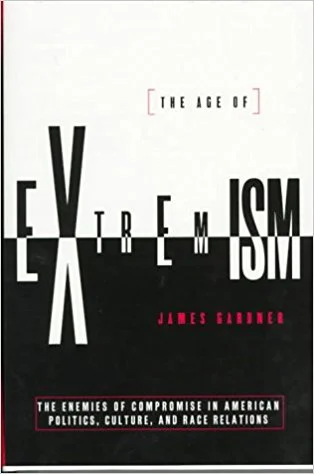
"It will not," writes James Gardner, "be obvious to everyone why O. J. Simpson's name should appear at the head of a chapter that touches upon Darwinism, the Holocaust, and French post-structuralist philosopy." Quite. But, as The Age of Extremism makes clear, we live in an age of doubt. If nothing can be proved absolutely, then nothing can be absolutely true. But this is a flawed skepticism, one that paves the way for extremism. For, as Mr. Gardner explains, its corollary is a willingness to believe anything—" as long as it is at variance with received opinion or unadorned common sense." The Holocaust never happened, O.J. is innocent, and the world was put together in seven days. The French post-structuralist? Oh, he believes the Gulf War never really took place. To be sure, there's nothing new about nonsense, but now the extremes seem omnipresent and no one is arguing back. This thought-provoking book gives us the Kooks' Tour. It is a sharply written and often amusing guide. Klansmen, we learn, are old hood, Shriners from Hell lacking that "manic, Nietzschean edge to which the neo-Nazis and certain militia groups aspire." Perhaps these should look to the Church of Satan, "whose quest for self-actualization suggests vaguely right-wing, yuppie leanings."

But it is when he turns to his specialty, the arts, that Mr. Gardner, NR's art critic, hits his stride. By the time he has finished, our "extremist culture" is eviscerated, dismantled as effectively as the corpse in a Joel-Peter Witkin photograph. What's left is not pretty; it is little more, the author concludes, than a childish attempt to "gross out" the audience. "Performance artist" Mike Kelley probably achieves this when he defecates onto stuffed animals, but so what? As a gesture in the tradition of the rebel artist it's pretty lame, an angry shoving at an open door. For we live in a society where the Center (a term that Mr. Gardner uses to mean the broad consensus) accepts these gestures. Mr. Witkin's photographs were at the Guggenheim, Reservoir Dogs (torture, burnings to death) wows the film critics, and American Psycho (torture again, cannibalism, Grey Poupon) is in a bookstore near you. In Mr. Gardner's view, this artistic "rebellion against the Center has become one of the fixtures of the Center, and thus, in the final analysis, it is really no rebellion at all."

So we can all relax, then? The United States, Mr. Gardner feels, is becoming more cohesive, not less, as society assimilates those it once marginalized. The remaining outsiders, driven as much by their psyches as by any political or social concerns, are forced to ever greater shrillness just to he heard. But it will not matter. In tones worthy of Star Trek's all-consuming Borg, Mr. Gardner concludes that the Center will probably absorb what it wants from its opponents and move on reinvigorated. "Through its encounter with these extreme voices, the Center will arrive at a stronger and more confident sense of its identity than it had before."

That is unusual optimism from a contributor to NR. Just what is it that the Center is absorbing? Are there any side-effects? With the exception of the arts, Mr. Gardner never really says. Partly this is a function of his definition of extremists as, roughly speaking, those whose sole raison d'etre is a rejection of the Center. This is too narrow. So far as politics is concerned, it leads him to focus on an irrelevant and truly lunatic fringe. The extremists who really matter largely escape his gaze, simply because they have chosen, to some extent at least, to work within the system. They are relentlessly balkanizing America by race and by sex, dopily "spiritual" and nastily closed-minded. But don't look for them in some East Village squat. Try elsewhere: the universities, the media, the White House.

These people are now setting the Center's agenda, and therefore, they cannot really, by James Gardner's definition, be extremists. But, to the extent that they have internalized the attitudes of the Sixties, that is just what they are. Citing the rows over political correctness, Mr. Gardner concedes that the Center has been going through some rough patches, but he sees this as unsurprising in a time of change. He is too sanguine. In refashioning the Center, the new establishment is wrecking it, alienating it from its past, its traditions, and its identity. Elsewhere, the author writes of "that sense of malaise and lingering sadness" that permeates our society. Well, this is why.

And it is going to get worse. A culture fixated on the twin goals of half understood diversity and bogus assimilation is unlikely to succeed, particularly when what core values its elite has are the shifting prejudices and inchoate leftism of thirty years ago. Lacking any degree of real intellectual certainty, it has proved hopelessly incapable of dealing with the extremes. For the Center, therefore, the notion of "inclusion" becomes little more than the formula for an orderly surrender.

Mr. Gardner seems to find this bearable, part of the price we must pay as society progresses towards "a wealth of diversity within a context of a common interest and a common culture." And pigs might fly. Yes, the extremes are ever noisier, but these are bellows of triumph, not cries of despair. Society is moving on, but toward a malevolent shambles truly worthy of Mr. Gardner's descriptive talents.

Gaga Gurus

Adrian Wooldridge & John Micklethwait: The Witch Doctors: Making Sense of the Management Gurus

National Review, April 7, 1997

Drucker-portrait-bkt_1014.jpg

Witch doctors! It's an engaging title, promising bile, sarcasm, and maybe, just perhaps, a sneer or two. After all, this is a book about management gurus, those experts whose ever-changing theories fill bookstores and empty factories. Well paid and annoying, they scream out for a little abuse. In this book, they don't get it. As the authors note, somewhat smugly (they do write for The Economist), "it would have been much easier (and often far more pleasurable) to have trashed the industry." But they reject the hatchet in favor of a "scalpel job." In many respects they succeed. Often drily funny. The Witch Doctors is a succinct guide. If something can be said in a couple of pages, that's all the authors use, an approach that could put Tom Peters in the poorhouse. There are longueurs, but this is a management book that the reader will actually be able to finish. It even has a hero, the "ever-prescient" Peter Drucker.

Born, like so many other terrifying polymaths, in Habsburg Austria, Drucker was one of the first to take management theory beyond the mechanical approach developed by time and motion men such as Frederick Taylor or GM's Alfred Sloan. He also realized that he could make a living out of this. He became, in short, an early "knowledge worker," a Druckerism, typical in both its ugliness and its accuracy, which describes what he saw as a rising class of employees, valued more for brains than for brawn.

Like many Druckerisms it is also rather obvious. Drucker took some genuine insights, added a little nonsense and a bit of hype, and transformed his profession. Shamans to the suits, the management theorists (and their consultant spawn) are now everywhere. Messrs. Micklethwait and Wooldridge summarize the wares on offer. Much is bogus. Yet American managers currently spend $15 billion a year on outside, well, management.

Are they mad? No, say the authors. In a competitive world, a manager has to be seen to be doing something, anything, to keep ahead. Management theory feeds on this fear. Consult dull books with punchy titles, bring in McKinsey, go whitewater rafting with the guys from marketing: it will all help create an image of dynamism. As The Witch Doctors shows, this is all based on the illusion that there is a magic bullet, a permanent solution to problems of management. There is not, of course. For the management industry this is just fine. "The beauty of the system is that none of the formulas work—or at least they do not work as completely as the anguished or greedy buyers hope. The result is enormous profits for the gurus but confusion for their clients." As the authors write about "re-engineering," management theory "is less than it was originally cracked up to be. But that does not mean it is useless."

It is also less important than this book would have us believe. True, the how of today's restructurings may have been thought up by a Bain or McKinsey, but to call management theorists "the unacknowledged legislators of mankind" goes too far. As the authors themselves partly concede, the whys lie elsewhere, in capitalism's relentless process of creative destruction. The consultants may prefer to mask this, to cloak their function with talk of "empowerment," but for the most part this is just chatter. Gradgrinds in Guccis, they are really selling systems intended to motivate employees to be highly productive, but very cheap. Messrs. Micklethwait and Wooldridge probably grasp this, but at times even they can be taken in: "Teams . . . can be vital for innovation. . . Firms lay on special facilities to encourage them. Sun Microsystems offers laundry and dry-cleaning services. . . to members of teams who work round the clock." How generous.

To the NR reader, checking stock prices with quiet satisfaction, this hypocrisy may sound splendid, reassuring even, but it comes with a cost. The happytalk is starting to sink in, something that this book does not really consider. All those sharing, mushy, left-wing sorts of words are beginning to have their effect. The modern corporation is, after all, a soft target. Ownership is diffused, parceled out in tiny units across mutual funds and pension plans. These may have their own agendas, like the state pension funds happy to divest from a Texaco or a Philip Morris, pleased to make a political point with their retirees' savings. Meanwhile, management wants its bien-pensant approval too. Action is affirmative, daughters are taken to work, and everyone recycles. Before too long, people feel free to ask what a company for.

It's a stupid question. One of the answers, what this book calls "that stakeholder thing," is even worse. It takes a village, goes this argument, to run a corporation. A duty is owed to all "stakeholders": employees, consumers, the "community," and, oh yes, even shareholders. The authors are too clear-eyed to agree. German stakeholder capitalism is creaky, and the best way to deal with some of the problems in the Anglo-Saxon model "is to give more power to shareholders, not less."

And then the authors quote Gordon Gekko (Olivet Stone's, not NR's) in eloquent support. This is a bit like inviting David Duke to speak in favor of CCRI. Are the authors ashamed of their own conclusions? Perhaps. They are at pains, after all, to distance themselves from that rough Milton Friedman. He does know what a company is for. One thing only: to make money legally. This, we are grandly told, "looks ever less defensible."

This is not quite political correctness, but more a lofty Bill Bradleyism. It pops up throughout the book and reaches its irritating nadir in a discussion of management "diversity."

This, naturally, is a Good Thing. "America's WASP elite," whatever that may be, is singled out for the usual abuse. It is dominated by men, you see, and it simply lacks the multicultural "experience" essential (did the author ask the Japanese about this?) to mastermind the conquest of world markets. These "middle-aged, blue-suited, white shirted men" are clearly doomed to repeat the failures of their WASP predecessors. Failures, presumably, like the British Empire, the Industrial Revolution, Coca-Cola, and Ford.

Ludicrous of course, but just tough it out. Unlike most books on management. The Witch Doctors is enlightening. And worth finishing.

Politically Incorrect - Not

National Review, March 10, 1997

Bill Maher.jpg

The Inauguration has come and gone, and with it the hopes Washington, D.C., entertained of a tourist bonanza. Receipts were lower than expected, far down from last time. Much like the election, in fact, in which voter turnout fell to 49 per cent, the lowest since 1924. In a way it is a welcome development, a rejection of activism, an indication that people are ready to get on with their own lives rather than those of their neighbors.

To members of the political class, especially on the Left, it is a rejection that hurts. Self-important beyond belief, they need to be taken seriously, not to be ignored. People should "participate" in the "process," whether they want to or not. The media, it is argued, must play their part in what would doubtless be termed our national town meeting. To some, this entails free air time for their speeches ("the broadcasting spectrum is public property'") and patronizingly sanitized "civic journalism" of the type seen in the North Carolina Senate race. To others, this is old politics, too League-of-Women-Voters to be relevant, Post-modernly hip, and leftward naturally, they fuse politics with entertainment, Rock the Vote, and are thrilled when ABC buys the rights to Politically Incorrect with Bill Maher from a cable channel dedicated to comedy.

Believe U.S. News & World Report and Bill Maher is a Will Rogers in the making, a man whose show, according to George, "may change the way America watches politics," ABC hopes so. The network has targeted Politically Incorrect at the Koppel and Sominex crowd, scheduling it just after Nightline.

The format is simple. Think of the Monty Python sketch where Marx and Lenin appear on a game show, to be asked questions on soccer and pop music. Bill Maher reverses the premise. The topics for discussion are often political, and serious(ish), the guests frequently less so. To be sure, you might see an Ed Rollins, Dee Dee Myers, or John O'Sullivan, but they will generally be outnumbered by entertainers: an actor or two, a rock star, or an unclassifiable like Kato Kaelin.

The show is certainly not politically incorrect, in the authentic, which is to say right-wing, sense of the term. Instead, we are told. Politically Incorrect is about "honesty," Is it? Well, in theory Mr. Maher's guests are speaking openly, being encouraged to state their true beliefs, (That this is considered daring, politically incorrect, says a lot about America.) But many do not, of course: they have their agents, their focus groups to think of. Oh sure, the performing seals will bark on cue, Sandra Bernhard is good for a brawl, and G. Gordon Liddy is just good. But that's their schtick; it's what's expected. For the rest, it is all very bland, with even the mildest controversy being greeted by the hoots and whoops of an audience priding itself on its own sophistication.

If the show has a slant, it is that disgruntled populism so easily manipulated by Common Cause, in which "good government" shades imperceptibly into big government. Bill Maher himself prefers to affect a wry "plague on both your houses" bi-partisanship, but it doesn't quite convince.

Whatever its claims. Politically Incorrect still plays by the Left's rules. Conservative positions may be taken, but they must be carefully qualified as exceptions, not the rule, Mr, Maher favors the death penalty, but is also pro-choice and pro-gun control. He will tell risque jokes, call female guests "baby," and talk sensibly about today's poisonous gender politics; but at the same time, says a website for Maher fans, he admires "smart women." A favorite cause, animal rights, is impeccably PC.

So if the show is not politically incorrect, is it even "political," something to be taken seriously? Judging from the recent show devoted to an absurdly gentle interview with Larry Flynt, the answer must be no. One is tempted to dismiss Politically Incorrect as a talk show with pretensions, to grumble, as some guests have done, that the mix of guests and sub-McLaughlin format inhibits proper discussion. It would be easy, perhaps too easy. One hears the sound of a mandarin whine being uncorked, "Comedy Boy," as Maher has described himself, is entitled to his say, and so are the folks on his show. Politics should not be the exclusive preserve of wonks. The idea that it operates (or should operate) independently of the world of entertainment, or the general cultural mix, is nonsense.

But Politically Incorrect won't "change the way America watches politics." It won't change anything. If the discussion can seem trivial and intellectually dishonest, that merely reflects the society from which the show has emerged. Bill Maher once commented that in Bill Clinton the U.S. had chosen an appropriate President, "because he is full of s—" and so are we. Mr. Maher is quite right. And that is why this stand-up comedian, this Carson who wants to be Cronkite, is, as much as anyone else, the pundit we deserve.

Devil's Islands

ARCHANGEL IT may have voted for Yeltsin, but Archangel is still a very Soviet sort of place. There's a Lenin in the main square and another on the way out of town, just to make sure. Seven hundred miles north of Moscow, this once rich port city of 400,000 seems, at a glance, trapped in Brezhnev's dereliction — though there are hints of a commercial revival. There is plenty in the shops, and someone is buying all those Western cars.

Read More

Frozen Future

National Review, September 1, 1996

James Bedford, on his way

The stroke of death," claimed Cleopatra, "is as a lover's pinch." Well, perhaps: if you are about to be deposed and taken captive. But for most people the arrival of the grim reaper is a tragedy, a disaster, and, in this most advanced of countries, something of an insult. We eat broccoli, we transplant hearts, but in the end people just keep on dying—more than two million of them each year. Other civilizations have claimed that nothing can be done, but for us to accept this seems, well, un-American. Each death (other than those of the executed, of course) represents a technological failure, a rebuke to Uncle Sam. But it ain't over till it's over and, some say, an answer is at hand. Yankee ingenuity has done it again and come up with cryonics. Put simply, this involves deep-freezing the recently deceased in the hope that some cure for what killed them will be found in the future. The idea is not new. Benjamin Franklin wanted to be "immersed in a cask of Madeira wine, with a few friends, till that time [when he could] be recalled to life by the solar warmth of my dear country."

It was not to be, but Franklin's dream, at least, lived on, to be revived as "cryonics" in the early 1960s. Cryonics: It's a goofy name and a wildly optimistic idea, but one suited to its era. It was the age of the Jetsons and the transistor, a time when science seemed to be sweeping all before it. Freeze people? Why not? James Bedford agreed, and on January 12, 1967 this 73-year-old psychology professor was frozen ("suspended") shortly after his death. Cryonics had found its Henry Hudson, perhaps even its Columbus. Doctor Bedford is, after all, still with us and "apparently" in good shape, ending up with the cryonicists of the Alcor Life Extension Foundation after many years in a mini-warehouse.

This is only appropriate. Alcor is the industry leader. Its Scottsdale, Arizona, facility is home to 32 "patients," almost as many, it estimates, as are held by its three competitors combined. These numbers exclude the occasional freelancer as well as the two Canadians interred in the permafrost, but that, says Steve Bridge, Alcor's likable president, "is just cold burial."

Cyronics is much more than that. To start with, it's a lot less sedate. There is no time to linger weeping around the deathbed. Instead, an Alcor Emergency Response Team will spring into action with CPR support to maintain blood flow to your brain in an attempt to reduce ischemic damage. Your body is rapidly cooled down and unless you have chosen to die in Scottsdale (which is best) you will be put into a special traveling pack (make sure it doesn't leak—this can cause trouble with the authorities) after a procedure involving preservatives, ice, and Maalox. On arrival, a glycerol-based solution will be pumped through your system to reduce the tissue damage caused by freezing. Once you are thoroughly perfused you are ready to be cooled down to -196 degrees Celsius. Oh, there's just one other thing. If you have elected for "neurosuspension" only, this is the moment that they cut off your head.

"Deep cooling" then follows, at the end of which you are lowered head first, or head only, into a large stainless steel cylinder. There, in a quiet back room in Alcor's suburban office block, you await your destiny, a cryonaut in an unmarked metal can, kept cold by occasionally replenished liquid nitrogen. Pére-Lachaise it is not, but then it is not meant to be. Scottsdale is no final resting place, but a way station on the return to life. Or at least that is the idea.

But how good an idea is it? Conventional cryobiologists, the people who freeze sperm or the odd body part, are skeptical. They point to the extensive cell damage associated both with death and the degree of cooling required for a whole body or even a head. As their Darth Vader, Arthur Rowe of NYU's School of Medicine, has explained, "believing cryonics could reanimate somebody who has been frozen is like believing you can turn hamburger back into a cow." In addition, even if enough cells can be revived, it is also far from clear, to say the least, that the patient's mind would have been preserved.

Well, if cryonics is another junk science, its practitioners differ from the parapsychology crowd in one crucial respect: the claims they make are fairly modest. As one Alcor leaflet is careful to say, "we don't know if what we are doing will work." They can, and they do, point to signs of real progress in cryopreservation, while touting a future nanotechnology as the key to repairing damaged cells in, say, the next "5 to 150 years." Even today, they note, we regularly "revive" people who previous generations would have abandoned. Meanwhile, James Bedford sleeps on, and no frozen dogs have yet come back from the dead (that's an urban legend, as is, while we are on the subject, the freezing of Walt Disney). Will Alcor succeed in the end? Talking binarily, Steve Bridge reckons that the odds are "either one or nothing," which sounds better than the New York State Lottery.

The trouble is that betting on cryonics is rather more expensive. There are annual dues to pay and when the, ahem, moment comes, a neurosuspension will set you back $50,000; "whole body" will cost $120,000. Alcor's 390 living members don't seem to mind. Much of the money goes into a patient-care fund, which is essential. Illiquid cryonicists can, as history shows, lead to liquid patients. Alcor itself is not-for-profit and looks it. The facility is spartan, the decor basic (framed pictures of the suspended), the staff underpaid.

To understand what motivates them look no further than the USS Enterprise proudly displayed in one office. These people are science's samurai, gung-ho garage tinkerers in the Orville and Wilbur tradition. The only doctor on the premises is dead, although they do have a veterinary surgeon and a nurse or two to help out. Steve Bridge himself is a librarian by profession. "I know where to look things up," he says brightly. Rationalists by inclination, most cryonicists are not religious. Their faith is the future, an Asimovian dream of scientific progress, often accompanied (this may ring a bell with Newt watchers) by a strong libertarian streak, a blend, in short, of Ayn Rand and Captain Kirk.

Ayn Rand herself "knew about" cryonics (but, no, she's not frozen either). As she would have predicted, officialdom has done its best to be difficult, notably in Riverside, California, where a series of absurd events led to Dora Kent (or at least her head) becoming the movement's Rosa Parks. Meanwhile, right-to-die issues bubble ominously below the surface. The final stages of a disease can destroy the very cells that Alcor is trying to preserve. So, argued one cancer patient, why not end things more quickly and allow the cryonicists to get to work? He lost his case, which reached a California Appellate Court and, fictionalized, an episode of L.A. Law, but, happily, survived.

So, doubtless, will cryonics. And so it should. Its devotees may seem a little nutty, and so pro-life that they want another, but that's their call, even at $120,000 a throw. It will probably never work, but, as cryonicists see it, what is the alternative? As Steve Bridge puts it, "The nice thing about life is that you never know what is going to happen next. The problem with death is that you do know what is going to happen next. Nothing."

And then he smiles. Confidently.

Revenge of the Nerds

National Review, July 28, 1996 

ALIEN-AUTOPSY.jpg

BUFFALO Midsummer. A thousand years ago our ancestors danced around bonfires and, doubtless, slaughtered a maiden or two. These days we like to think we have moved on. True, the scandinavians still throw a good Midsommar, but even there virgins are not sacrificed, at least in the conventional sense of the word. Progress, schmogress. For all our science we still live, as Carl Sagan puts it, in a demon-haunted world. Naturally, there have been changes. The nearest soothsayer is only a 900 line away. Of course we no longer think that ghouls will steal our offspring--but give those creatures space ships and we will believe they are abducting children, carrying out ghastly experiments, and, for all we know, spoiling the crops. Scratch away our sophisticated veneer, and the New Age very quickly goes dark.

All is not lost, however. The epoch of Shirley Maclaine has its opponents, and one thousand of them recently gathered outside Buffalo. The occasion was the first World Skeptics Congress, a four-day-long-discussion of "Science in the Age of (Mis)Information" sponsored by CSICOP—the Committee for the Scientific Investigation of the Claims of the Paranormal. CSICOP does what its name would suggest. Over the past twenty years it has encouraged the exposure of a sorry sequence of spurious spacemen, cranks, and charlatans. CSlCOP's fascinating magazine. Skeptical Inquirer, sells around 50,000 copies across the world, but none, probably, in any supermarkets. Much of the Congress covered familiar ground. Aliens, junk medicine, and psychic detectives all took their knocks, Patriots will be glad to know that this nonsense is not just an American problem. China seems obsessed by Pseudo-Qigong (don't ask), but, hey, that's a country with fifty million Communists, and they will believe anything. Perhaps the Chinese should turn to India, to the monomial Premanand, for help. Confusingly, Premanand's style was high guru (flowing white hair, beard, orange clothing) but his message was not. The fakirs are fakers, and in an entertaining talk Premanand demonstrated just how they do it.

This would not have been news to Skepticism's stars, many of whom were on display. Paleontologist Stephen Jay Gould spoke, preceded by a Darwin impersonator. Magician James ''the Amazing" Randi was on hand, outwardly unscarred by years of litigation with Uri Geller. In between drags on, appropriately enough in this anti-witchcraft crowd, a Salem, Aviation Week and Space Technology's Philip Klass was signing copies of his UFOeuvre. Full refunds ("not just the royalty") were promised in the event of a proved landing.

More surprising was the appearance of X-Files creator Chris Carter as a guest speaker. With his compelling stories of the occult and the alien, often filmed in a pseudo-documentary style, Mr. Carter might have expected a rough ride. He need not have worried. The Skeptics were a pushover, clever to be sure, but with more than a hint, shall we say, of the school chess club about them. They never stood a chance against the sly cool of Chris Carter, media wizard and surfer. Besides, most were fans, shocked only when their guest revealed that he had never watched an entire episode of Star Trek.

Anyway, The X-Files is fiction, nothing more. Much more serious, in the view of the Congress, was media response to paranormal "facts." The wildest claims are accepted at face value, turned into documentaries, and shown on prime time. A scientist may be asked to comment, but for about thirty-seconds, most of which ends up on the cutting-room floor (this may sound familiar to conservatives). In part, this is inevitable. The paranormal is fun. An alien autopsy is great TV, rather more exciting than four chemists gathered round a Bunsen burner. ''What we need," said one speaker, 'is LA Science." He should not hold his breath.

Some knew what to blame: Commercialism, or at least its alleged surrogate on earth. Mention of the name Murdoch generated slightly forced laughter. Murdoch the bringer of joy, the destroyer of words. Scientific types, the skeptics see themselves as high-minded, spelling-bee sorts of people who still give money to NPR. TV was meant to be the great educator: McNeil, not Oprah; Kunta Kinte, not Beavis. Instead, ran the argument, commercial pressures have led to a debased medium, serving only to fuel the prejudices and superstitions of a degenerate mob.

It's a neat explanation, but it is only part of the story. Intellectually, after all, the mob has always been in poor shape. That's why it is the mob. What has changed is the attitude of the opinion-forming classes. Temple University professor John Paulos highlighted part of the problem. The Kaczynski-haired Paulos is, as the title of his most recent work suggests, a mathematician [who] reads the newspaper and, as his acerbically insightful talk made clear, he is not impressed. Numbers are bandied about, he says, but with little understanding even in the media's more upmarket corners. It is not difficult to agree. All too often Right Data are replaced with numerical assertions that are left unchallenged and unanalyzed by a press too slovenly, innumerate, or biased to care.

To the Skeptics, an honest bunch looking for objective, critical thought, this must be anathema. The Joe Fridays of philosophy, all they really want is the facts. Instead they find themselves in a subjective, post-modern world. In the past their fight was straightforward and pleasantly elitist, the enemies trailer-park science and bayou religion. Now the problem is among their own, within the intelligentsia and the academy. History has been abolished, to be replaced by the study of alternative myths, while science itself is suspect, a product, allegedly, of white male power.

Ironically, much of this rubbish comes from the Left, once a reliable source of support for Skeptics, particularly on religious matters. Skeptics, to say, the least, arc unlikely to be great churchgoers, and there was a time when that could imply a sort of leftism. No immortality—except for the Rosenbergs. CSICOP itself has close ties to CODESH (the Council for Democratic and Secular Humanism), an interweaving visible even at the Congress's bookstall. The alien and the paranormal were on display, but so were the great thinkers (Voltaire, Darwin, Kevorkian), the Bad News Bible, The Trouble with Christmas and, most shockingly of all. Lessons of the Locker Room: The Myth of School Sports. Is nothing sacred?

Not much, probably, to many of the Congressgoers. But should that imply a liberal tilt? In an era when the First Lady communes with the dead, conventional political afllliations can truly be said to be breaking down. When what one speaker described as "preposterism" rules, the rationalist can no longer rely on traditional allies. True, the Congress felt vaguely liberal. Naturally enough, the Religious Right took a pounding, and, at a guess, most attendees would still vote Democratic, if a little uneasily. The voice of the Old Left could still be heard in some of the speeches and in a feeble anti-Rush Limbaugh joke or two, but it was fading away, just (to take Matthew Arnold somewhat out of context) another pan of liberalism's "melancholy, long, withdrawing roar."

Thirty years ago the stupidities of the Sixties pushed many social scientists into neo-conservatism. Today's junk intellectuals with their crystals and their shamans, their ludicrous universities and their "politics of meaning,'' may do the same for the skeptical and the scientific. Rationalism can then complete its reconnection with the thought of Washington, Franklin, and Jefferson, a journey which must take it rightward, if never to Ralph Reed. This should be welcomed. Skeptics may be an ornery lot, but their search for that objective truth is somehow very American. Indeed, it is as American as the apple pie that Eve never baked.

A Hemp Museum

National Review, June 3, 1996 

Cannabis  Museum, May 1996  © Andrew Stuttaford

Cannabis  Museum, May 1996  © Andrew Stuttaford

The streets of London, they used to say, were paved with gold. Maybe that is true of the City, the British capital's financial district, but take a walk five minutes to the east, to Shoreditch, and the surroundings are more mundane. Here you will find a theme park of pre-Thatcher Britain. The pub at the end of Redchurch Street is no exception. A drab spot despite its exotic dancer, the White Horse sports a cautious sign noting that Shakespeare is reputed to have drunk there. But if the White Horse is timelessly East End, the East End is itself changing. Not so long ago Redchurch Street was part of that old stereotypical London of the Ealing comedies and the kindly bobby. Now it is also home to a mosque, a Bengali grocery store, and, most recently, a cannabis museum. Located in a nondescript office building, the museum was opened amid some fanfare in April. Howard Marks—a graduate of both Balliol College, Oxford (politics, philosophy, and economics), and the American prison system (cannabis smuggling)—was the guest of honor. The press came, and so did the police. There are, of course, drug laws in Britain, and a wide range of "hemp" products was on display. Hemp? The police were wise to that alias. Hemp is also known as Cannabis sativa, a name it received, somewhat alarmingly, from the Emperor Nero's surgeon. No contraband was found, however. The hemp jeans passed muster. Even the revolting "Hemp 9," a "high energy protein mixed seed bar," was allowed. British law permits the manufacture of hemp products so long as they contain no more than 0.3 per cent tetrahydrocannabinol, hemp's narcotic element. Smoking a hemp T-shirt would be a waste of time; even Bill Clinton could inhale.

The police left satisfied, as well they might. For Redchurch Street is the acceptable face of cannabis. Part Ripley (George Washington grew it! Queen Victoria took it!), part agitprop vehicle, the museum is relentlessly upbeat. It is, after all, run by CHIC, the Cannabis and Hemp Information Club. The aim is to "inform and educate people about the history and many uses of this incredibly versatile plant."

Cheery, if occasionally misspelt (a side effect?), posters accentuate the positive. Cannabis, it seems, can be turned into mighty ropes, excellent paper, and an ecologically sound fuel. It can be used to treat glaucoma and relieve the nausea associated with chemotherapy. Fans of the former British foreign minister will be glad to know that cannabis "hurd" (its inner stalk) can be mixed with lime and water to produce a building material more durable than concrete. Finally, and this is a clinching argument in an era of anxious English mealtimes, hemp might make a healthier animal feed. Given that Britain's maddened cattle seem to have been subsisting on abattoir sweepings, this must be right. There have, after all, been no cases of stoned-cow disease.

Cannabis Museum, May, 1996 @ Andrew Stuttaford

Cannabis Museum, May, 1996 @ Andrew Stuttaford

CHIC makes an impressive case. Cannabis does indeed seem "incredibly versatile." So versatile, in fact, that visitors may feel a vague sense of resentment against this leafy overachiever—until, that is, they discover its little weakness. Cannabis is, as one display notes, also "a social intoxicant," safer perhaps than some of those available at the White Horse, but an intoxicant nonetheless.

And this, of course, is the source of the problem. It is the intoxication that enrages an officialdom that once warned (in a possibly misguided approach), that cannabis could lead to "weird orgies, wild parties, and unleashed passions." It is the intoxication that interests users. No one would risk jail time for something that was just a building material. It is unlikely that there will ever be, say, a stucco museum on Redchurch Street. With consumers enthusiastic and governments appalled, disaster was inevitable.

Cannabis Museum, May 1996  © Andrew Stuttaford

Cannabis Museum, May 1996  © Andrew Stuttaford

Sure enough, the saddest section of the exhibit describes the progress of the American war against cannabis, a miserable saga of mounting ferocity and futility. Prison photographs of the detained line the walls. They pose awkwardly with their families, standing in front of backdrops painted to give an illusion of somewhere, anywhere, other than the penitentiary. The faces, carefully selected no doubt, look innocent, and the injustice on display appears horrifying.

Wisely, perhaps, there is no discussion of cannabis's rougher associates: London will have to wait a while for a crack museum. The connection between the use of cannabis and of other drugs is never explored. Does one lead inexorably to the other, or are rising rates of hard-drug consumption an inevitable consequence of prohibition? NR discussed these sorts of issues a few weeks ago, but its rational approach would not win many friends in Redchurch Street. The museum's amiable staff may have been born too late for Woodstock, but they are hippies pur et dur, albeit with a Nineties twist: "Please respect our No Smoking policy."

Hippies were never too keen on logic. The positive impact of much of the exhibit begins to dissipate the moment one is told that smoking grass is part of the "permaculture." Indian spirituality makes its inevitable appearance. Wasn't that a poster of Ganesha, elephant god and popular head-shop deity, on the wall? Zany politics are also on view, most prominently in the shape of a large, unfinished, papier mâché display, in which a clumsily executed factory appeared to be menacing idyllic pasture. As artworks go, it was a shambles, but the message was clear: Industry is bad. We need to return to a simpler life, and hemp would show the way. "Industry" had, it was argued, played no small part in the banning of cannabis in the first place. There had, surprise, been a conspiracy. DuPont, no less, had been a force behind the original anti-cannabis legislation for commercial motives of its own (bleaching chemicals for pulp—it's a long story). As CHIC explains, "It is only when governments stop protecting the interests of the multinationals that we will be free to benefit fully from cannabis."

Well, maybe, but it is difficult to avoid the conclusion that the museum's case for cannabis is getting muddled at this point. Some environmentally flavored Marxism seems to have been thrown into the mix. It does not belong there. At its core the argument for legalizing cannabis ought to rest on a fairly restrictive view of the rights and capabilities of government. This is not an approach normally associated with the paranoid Left—or the EPA, for that matter. A commissar is still a commissar, even if he does drugs.

Maybe this is just carping and the confusion is to be expected. We live, after all, in an absurd time, when even the medicinal use of cannabis is prohibited. An honest discussion of drug policy seems all but impossible. The Cannabis Museum does at least raise some serious questions. Perhaps it is too much to expect more. Since only the bravest politician will question prohibition, debate has, with notable exceptions, become the preserve of the eccentric and the obsessed. Meanwhile, drug-related problems worsen and the official approach will continue unaltered, unsuccessful and ugly.

Sadly, it will take more than CHIC to change this.

A Degenerate Exhibition

National Review, April 8, 1996

Worker & Kolkhoz Woman, Moscow, February 1991 © Andrew Stuttaford

Worker & Kolkhoz Woman, Moscow, February 1991 © Andrew Stuttaford

London this season has been playing host to two thought-provoking exhibitions. The first, "Africa: The Art of a Continent," has been on display at the Royal Academy since October. Meanwhile, across the Thames, the Hayward Gallery's "Art and Power" attempts to cast a new light on an even darker continent—the totalitarian Europe of 1930-45. The latter exhibit opens promisingly enough, taking advantage of the Hayward's brutalist architecture with an eerily lit antechamber dominated by symbols and monuments of the departed dictators. Pharaonically sinister, the room is compelling, a guilty pleasure on a par with the best horror stories. Writing of fascism in 1936 the philosopher Walter Benjamin commented that mankind's "self-alienation has reached such a degree that it can experience its own destruction as an aesthetic pleasure of the first order." Unintentionally, perhaps, this room proves that point. It is the highlight of the exhibition.

Most of the rest is depressingly unimaginative, an uninspired display of the usual suspects. We see an avuncular Stalin and a pompous Hitler, but so what? The iconography essential for understanding such pictures is missing, and without it they become routine official portraits, no different really from the drab canvases to be found in many an American boardroom.

Unexplained too, is why much of the work on display should be seen as "totalitarian." Hitler's favorite painter, the leaden Adolf Ziegler, may show why he was known as the "master of the German pubic hair," but, at that time, his völkisch style would not have been out of place in many a European museum. In the Italian section, at least, there is some attempt at serious analysis. Embarrassingly, however, it comes from the Fascists, who were deeply divided on how to control art, if at all.

To be sure, many of the paintings on display are irritatingly didactic, but that is only to be expected. They date from the age of Eleanor Roosevelt, an era when the self-important were out of control. Aleksandr Monin's Shock Workers' Avenue may be a product of Stalin's Soviet Union, but it would not be out of place in any WPA-decorated post office. The allegedly totalitarian architecture too was hardly unusual. Across the world big government was dressing for success. In the 1930s that meant chunky statues and neo-classicism. It was true for Berlin, Rome, and Moscow, but it also held good for London and Washington.

These connections are never really explored, but that is hardly surprising. "Art and Power" is itself a bureaucratic product, sponsored by the Council of Europe to "remind" (rather unwisely, I think) Europeans of "their common history and cultural heritage." Far easier, therefore, for it to caricature totalitarian art as a simple blend of dull art and portentous buildings. Hitler's kitsch thus becomes just another round in the Manichean struggle between the figurative (bad) and the abstract (good).

In effect, then, this exhibition reflects the prejudices of a second-rate art faculty. Naturally enough, it also comes steeped in conventional, leftish pieties. No opportunity is missed to take a swipe at the fallen fascists, while the Soviet Union gets off comparatively lightly.

Some of the distortions are simply childish. An accompanying booklet tells us that 12 million Jews perished in the Holocaust, but fudges collectivization's death toll in the Soviet countryside. The Moscow Metro is singled out for praise, not least because it opened ahead of schedule. Making the trains run on time is clearly an achievement—so long, that is, as they are Soviet trains.

So far as the art is concerned the bias is more subtle. "Nazi" art is mainly represented by rural scenes, peasant girls, and Albert Speer, The relatively more cheerful eroticism of what might be called its "Vargas" school is absent. In marked contrast to the Soviet section little of the regime's perniciously effective posterwork is shown. No war paintings are on display—a curious omission, given that war was central both to the Nazis' dreams and to their destiny.

Space cannot have been a constraint, given the presence of a large section dedicated to the opposition to Hitler, itself rather strange in an exhibition allegedly devoted to totalitarian art. Was someone worried that the devil had the best tunes? There was no need. The "opposition" includes some of the most powerful works on display. Felix Nussbaum's concentration-camp paintings give the lie to Otto Dix's remark that "one cannot paint despair," while Ernst Barlach's The Terrible Year of 1937 speaks for itself.

Appropriately enough, the destruction of modern or "Jewish" art—and, all too often, artists—by the Nazis is highlighted. The destruction of religious art by the Soviets is ignored, however. The burned icons and vandalized churches may have ended a tradition stretching back a millennium, but apparently this is not an aspect of Europe's "common heritage" about which we need "reminding."

Naturally the Nazis' grotesque "Exhibition of Degenerate Art" (1937) comes under scrutiny, and it should. That attempt to put modern art into the pillory was a low point of totalitarian Philistinism. However, it was hardly unique. No comparison is made, for example, with the major Moscow and Leningrad exhibitions of 1932, with their one (very small) room for works by artists who "had been infected with all kinds of Formalist diseases and influenced by their bourgeois experiences."

To have made such a comparison would have been to dispel the atmosphere of cozy ambiguity that prevails in discussing the USSR. There is no separate section on the artistic opposition to Stalin. Emigré art is ignored. A wide range of artwork is displayed, but it is often difficult to discern whether it would have been approved or not. Perhaps deliberately, this creates an image of greater tolerance than there really was, particularly in a country where the state was, on the whole, the only client. Various "Stalins" are on display, but they are eclipsed by Rublyov's extraordinary portrait of a wily dictator reading Pravda, a sinister dog at his feet. Could this ever have been shown? We are never told. Rublyov knew. He kept the picture hidden and pursued a successful career as an official artist.

Instead we are given a simplistic picture of a USSR where political and artistic repression marched in lockstep. Modernism is crushed by socialist realism and, by implication, the bright promise of Lenin's revolution is betrayed. Rodchenko turns to painting clowns, while Malevich goes to jail accused of "Cézannism." In reality, of course, whatever the wonders of their art, these men had been paid propagandists for a Soviet regime that had been openly murderous from the outset.

Sadly, they did their work all too well. The Great Utopia still beckons. There has been no Soviet Nuremberg, no final reckoning with Communism. In Russia that failure may lead to disaster. In the West, it merely leads to misleading "reminders" of a "common European history" at the Hayward Gallery and a souvenir shop that sells postcards of Stalin. But not of Hitler. That would be in bad taste.