To Kampuchea and Beyond →
Sean McMeekin - To Overthrow the World: The Rise and Fall and Rise of Communism
National Review, November 21, 2024 (January 2025 Issue)
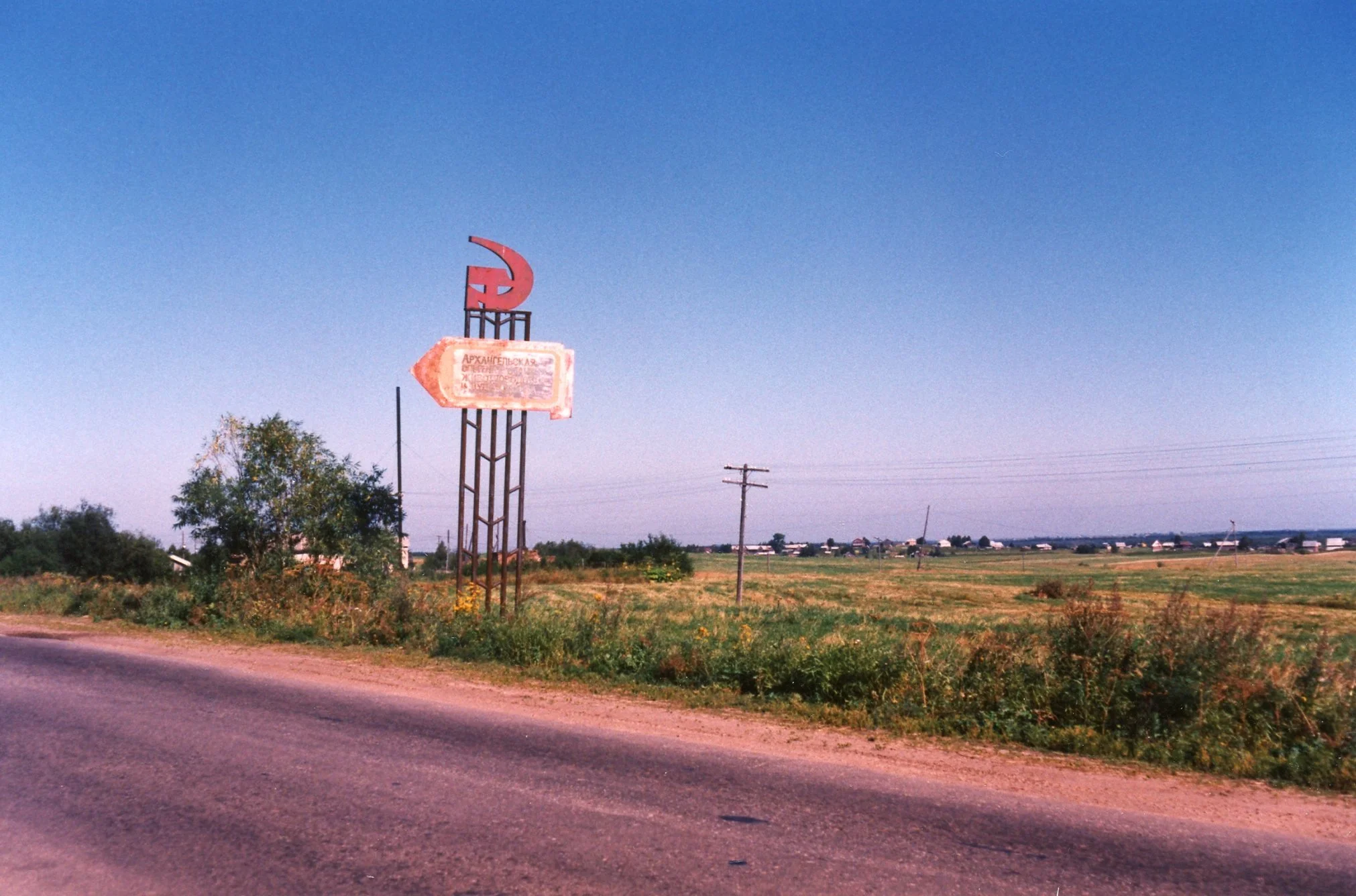
Archangel Region, Russia, August 1996 © Andrew Stuttaford
Sean McMeekin is a historian perhaps best known for his revisionist accounts of the Russian Revolution and World War II. He’s not afraid of a challenge. Nevertheless, while his thought-provoking new book, To Overthrow the World: The Rise and Fall and Rise of Communism, is well worth reading, it does not quite deliver — presumably, in part, for reasons of space — on the immense promise implicit in its subtitle. Moreover, the second “rise” of communism (if that’s what it is) turns out to be far from its second coming, which would otherwise be a not inappropriate phrase to use. Even in the secular form it has taken since Karl Marx’s time, communism is a religion in all but name, and one with obvious millenarian overtones.
That implies that a good history of communism ought to begin well before Marx and his contemporaries. And so McMeekin briskly traces an intellectual lineage that stretches back a very long way. Thus Étienne-Gabriel Morelly, a French 18th-century writer, who, records McMeekin, advocated “a propertyless commonwealth of radical social equality . . . and later became a staple of the Marxist-Leninist canon” under the Soviets, appears at a relatively late stage in its development.
Morelly, a religious man, was profoundly influenced by the early church’s rejection of material goods and by the Old Testament’s prelapsarian Eden, the essential truth of which, he believed, had been reinforced by the seeming simplicity of the life led by the seemingly “noble savages” Europeans had encountered in the Americas. Morelly ascribed the Fall to greed, “the desire to possess” that had induced humanity to stray from the way in which it had been intended to live.
The clock has further back to run. The proto-communism of various Christian sects over the centuries is well known. McMeekin highlights the Anabaptist takeover of Münster in Germany, as well he might. Millenarian Münster (which was declared to be the New Jerusalem) hung on between 1534 and 1535 (longer than McMeekin suggests) and was an early example of radical egalitarian rule in practice, a clear warning of totalitarian nightmares to come and so extreme that it is better regarded as a preview of Maoism than of Bolshevism.
Marx’s defenders, of whom there are still too many, will sometimes (often?) attempt to exonerate him from blame for the violence with which communists have seized and wielded power and the methods used to maintain it. He was just a philosopher, a talker, and so on. But McMeekin damns Marx with his own words. “Total revolution,” Marx proclaimed, would be a “matter of combat or death: bloody struggle or extinction.” Revolutions are rarely velvet, but the way Marx writes of the battle to come — “almost,” observes McMeekin, “with gleeful anticipation” — is a reminder of Marx the millenarian. Delete that “almost.”
This “last word in human affairs,” as McMeekin, alluding to Marx’s historical determinism, neatly encapsulates it, was to be a cleansing, a judgment day, and the guilty were to be punished. Marx’s economic thinking was mostly nonsense, a recipe for ruin and frequently a dull read too, but the promise contained in his work of, as McMeekin puts it, “apocalyptic revolutionary violence” was “hypnotic.” A good part of millenarianism’s persistent appeal — and by extension communism’s — is the license it gives to the “righteous” to indulge in atrocity, a license made infinitely more dangerous in the 20th century by the availability of technologies, from machine guns to the railway, that made the killing or repression of millions so much easier.
But the heaven on earth outlined by Marx and Friedrich Engels in The Manifesto of the Communist Party would, like its antecedent, that 16th-century New Jerusalem, be hellish. It would be all-controlling, with policies that included forced labor, meddling in family life, and the end of private enterprise. This was a system so antithetical to human nature that only the “new man” that the Bolsheviks and their successors tried to forge could fit in. In the 1960s, China’s Maoists took this effort to even more horrific lengths, but they were overtaken a few years later by the Khmer Rouge, who, McMeekin explains, reduced communism “to its essentials, as a negation of everything existing.”
The corollary of the creation of the new man was the erasure of the old one, the slaughter or imprisonment of tens of millions who did not fit in (or who might not fit in) for their beliefs, their social origins, their ethnicity, their just about anything. Culture too was purged, artworks destroyed. Books were burned by the ton in communist Shanghai. In “Democratic Kampuchea,” Khmer Rouge soldiers, many in their early teens, works in progress from the countryside, emptied the suspect cities of the former Cambodia.
The Russian anarchist Mikhail Bakunin (1814–1876), who, as McMeekin recounts, had fallen out with Marx and been expelled from the first international workers movement, predicted what communist rule would look like. If those in charge had originally been workers, they would “cease to be workers and will begin to look upon the whole workers’ world from the heights of the state.” It was more likely, however, that its leaders would be drawn from the intelligentsia, “scientific socialists” of Marx’s type. Theirs would be an extraordinarily oppressive dictatorship, operated by “a new privileged . . . class” — in the interests of the people of course.
The first such regime was established by Vladimir Lenin’s Bolsheviks. Rather than relying on Marx’s expectations of a historically inevitable development of revolutionary proletarian consciousness, they saw themselves as a “vanguard” party, ready to give history a nudge and the proletariat proper direction. What mattered, wrote Lenin in mid 1917, was not the “will of the majority” (a term that he put in scare quotes) but being “stronger at the decisive moment in the decisive place.” That moment was a few months later; that place was Petrograd. The Bolsheviks took power, albeit tenuously, through a coup, not a revolution.
But the consequences were revolutionary, and, starting with an account of how the Bolsheviks consolidated their rule in those parts of the former Russian empire that did not escape them, they fill much of the rest of To Overthrow the World, as the story moves from the nascent Soviet state to Pol Pot’s Kampuchea and beyond. The end of communism, or at least its consignment to irrelevance, was, it was widely thought, signaled by the breakup of the USSR, the culmination of a process that began with the end of its sway over a large swath of Eastern Europe. But, counsels McMeekin, pushing back against liberal historical determinism, “there was nothing fated” about the Soviet collapse. “Much as we like to imagine” that it occurred “because of a cascading groundswell of heroic popular opposition from below, it was actually the disappearance of coercion from above that counted.”
That’s true, although it understates the extent to which the growing pressure for political change, (accidentally) set in motion by reforms launched by Mikhail Gorbachev to overhaul the ailing Soviet economy, had heightened the cost of a reversion to the repression of earlier years. The greater that pressure became, the more brutal any crackdown would have to be. The more brutal the crackdown, the higher the economic and diplomatic price Moscow would have to pay. There were times when the authorities did resort to lethal violence — in Riga, Vilnius, Baku, and elsewhere — but they were relatively isolated and were not enough to stop the unraveling that was under way. “Once the regime’s sword was lifted,” writes McMeekin, “Communist parties crumbled quickly; if the sword remained, the party did too.”
In China, poorer when Mao died in 1976 than it had been before the Communist Party takeover (communism is what it is), the party held on. Under Deng Xiaoping, it abandoned Maoism’s lethal pauperizing lunacy and embarked on the reforms that triggered and then underpinned decades of extraordinary growth. Deng had seen the problems engulfing Gorbachev and was determined to ensure that the Chinese party retained its leading role. When confronted with massive pro-democracy demonstrations in Tiananmen Square in 1989, Deng waited until Gorbachev, who had been visiting, had departed and then waited some more as the number of protesters in the square shrank. Then he sent in the army.
“Communist rule in China,” observes McMeekin, “would endure.”
But did it? McMeekin argues that China can still be described as communist. Its ascent is that second “rise” in the book’s subtitle. But the CCP’s governing ideology is better described as fascism with Chinese characteristics. It combines one-party control, aggressive nationalism (with a strong ethnic component to it), and an approach to the economy that includes harnessing capitalist energy to the interests of an all-powerful state. It calls itself communist mainly for (to oversimplify) practical and (domestic) propaganda reasons.
But the threat posed to the West by “traditional” communism, or some variant of it, has not disappeared: Its long history (Plato shows up in To Overthrow the World) is evidence that there is something within communism to which much of humanity (the thinking or instincts on which it draws can be found in cultures across the planet) is attracted. On the other hand, there is also something about it that much of humanity appears hardwired to reject. This has led to the (somewhat) comforting paradox that although communist ideas seem forever to be with us, no country has ever freely chosen a communist government other than Nepal, although Chile (arguably) and San Marino merit footnotes in that respect.
Given the breadth and complexity of his topic, there are, as alluded to above, inevitably omissions in McMeekin’s narrative, but it is vividly told and illuminated by well-chosen detail and should appeal to the general reader. That matters. Communism is not going away, but the truth about it is being forgotten at a pace and on a scale remarkable even in our own era of ignorance about the past. Communism’s horrors and catastrophic failures, and, in light of their recurrence, their inevitability, may well be falling into the category of inconvenient history that too many on the left are too willing to see swept away.
Meanwhile, millenarianism, communism’s magic ingredient, repackaged on this occasion as climate fundamentalism, is being used to promote agendas in which the deeper the red and the deeper the green the harder they are to tell apart. Efforts are being made to reinvent Marx as an eco-warrior. To Overthrow the World is a warning of where this too could lead.
This article appears as “To Kampuchea And Beyond” in the January 2025 print edition of National Review.