Tariffs: 'Liberation' Day
National Review Online, April 2, 2025
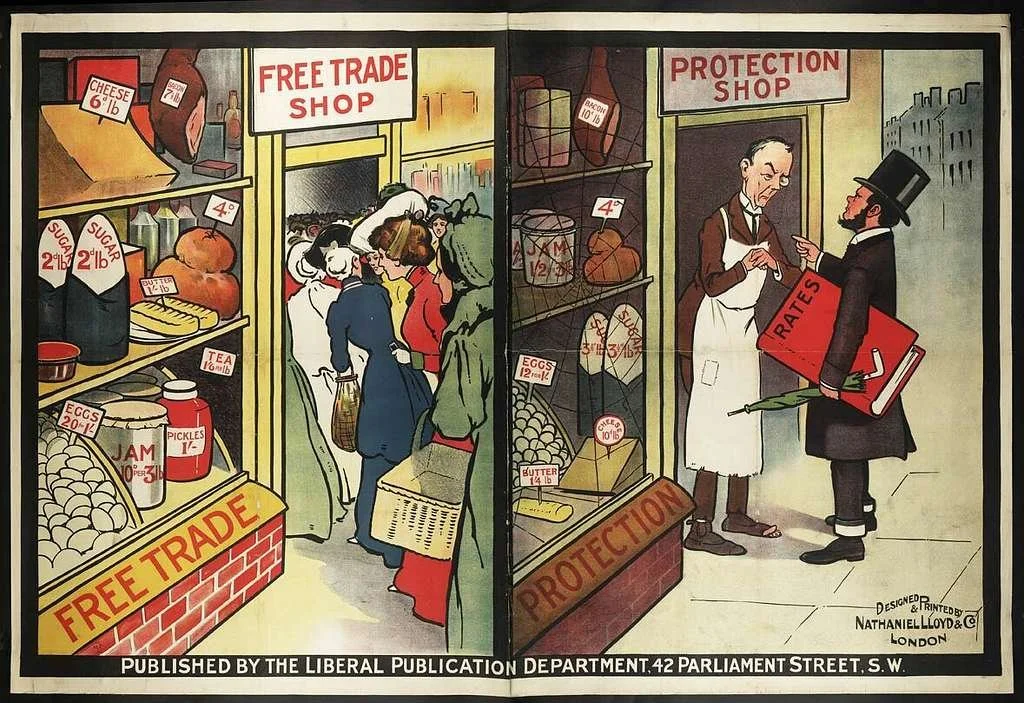
April 2 will be “liberation day for America” as President Donald Trump unveils his tariff hikes, he promised — one of the “most important days in modern American history,” according to Press Secretary Karoline Leavitt.
Trump will say what he’s going to say, but the basic picture he paints has not changed for decades, although the role of principal villain may do so (in the 1980s, it was Japan). Leavitt sets it out again: A lack of reciprocity has contributed to a “large and persistent annual trade deficit that’s gutted out industries and hollowed out key workforces.” This, the president says, will now change.
Leavitt: “He is always up to take a phone call, always up for a good negotiation, but he is very much focused on fixing the wrongs of the past.”
On the topic of “gutting,” it’s worth noting (as Dominic Pino does in his new article on free trade for the magazine) that “imports of goods and services equaled only 14 percent of U.S. GDP in 2024, one of the lowest rates of any developed country.”
The new U.S. tariffs will be followed by retaliatory tariff increases. Negotiations will follow. Even if the new tariffs are suspended pending any negotiations, at best they will only provide temporary relief from the uncertainty that makes it close to impossible for any large company either within the U.S. or (to a lesser extent) selling to the U.S. to make any significant business decisions.
Companies that serve as bellwethers for broader economic performance have started to suffer. When FedEx, a logistics company, lowered its full-year profit forecasts on March 20th, it cited “uncertainty in the US industrial economy”. On March 10th Delta Airlines said “macro uncertainty” was reducing consumer and corporate confidence…
The chill extends beyond the manufacturing industry, too. David French of the National Retail Federation notes that his members would like to nail down their sourcing arrangements. Can they rely on production networks that run through Mexico? Or are factories in South-East Asia a safer bet? Purchasing managers do not want to make any rash moves until the dust settles on the new tariff landscape, whenever that might be. The uncertainty is delaying other investment decisions, too. “Tariffs on building materials and consumer goods add uncertainty to opening new stores,” says Mr. French.
So, let’s see what happens.
But back to Pino’s article. That he opposes protectionism is not exactly a surprise, but some readers may be taken aback by one of his lines of attack, which is that protectionism is a utopian position. This is the opposite of the usual argument: Free traders are the dreamers, while those who favor protection are hard-headed types, pragmatists, deal-makers, realists who know how the world works, akin, perhaps, to the “practical men” mentioned by John Maynard Keynes in the concluding paragraph of his General Theory: “Practical men, who believe themselves to be quite exempt from any intellectual influences, are usually the slaves of some defunct economist.” In the case of the current administration that would include those who still cling to mercantilist ideas or to the notion that trade must always be a zero-sum game, with every winner matched by a loser.
Perhaps the most utopian aspect of the protectionist creed is the belief that government can be relied upon to manage trade — because that, at its core, is what protectionism is about — in the national interest. It rests on the idea that, as Pino puts it, “government transcends the concerns of individual people and businesses and looks out for the good of everyone. It lacks self-interest and holds national security and prosperity as its aims.” That, writes Pino, “is a very romantic view of government.”
It certainly is. Tariff regimes are gifts to those running the government, to politicians with favors to sell (or their careers after holding elective office to think of), to lobbyists who make their living persuading people in government how to vote and how to act, and to lawyers, accountants, and other consultants helping companies navigate the rules and regulations of Tariffnation, something that will not be straightforward. To take an example, assessing the tariff payable on complex pieces of machinery with components sourced from different countries (possibly with different tariff arrangements with the U.S.) may well turn out to be fiendishly complicated. Perhaps a waiver could be agreed here or a derogation. Is there anyone who could, you know, help?
There once was a presidential candidate who used to refer to that ecosystem as a swamp that needed draining. He was right about that. I wonder where he has gone. When the Department of Government Efficiency (DOGE) started gearing up, there were stories online about Washington, D.C.-area real estate going on sale. Put in place a harsh enough tariff regime, and that will reverse, at least in the ritzier neighborhoods where swamp-dwellers live.
Of course, it may be that Trump’s tariff hikes will be much less onerous than feared or are designed only as a (hopefully) temporary measure to pressure America’s trading partners to reduce their tariffs (and, no, VATs and GSTs are not tariffs on any reasonable understanding of the word, but the European Union’s Carbon Border Adjustment Mechanism is). If so, and if handled sensibly (not an assumption that can be safely made, unfortunately), that’s not the worst thing.
Moreover, there is nothing particularly terrible about modest, light-touch tariffs here and there, or higher, more carefully targeted levies aimed primarily at avoiding strategic vulnerabilities, particularly — let’s name names — where China is involved. But be careful: The claim that some good is “strategic” can be abused. It is an invitation to influence peddlers or to the right politician to get to work. After all, who’s to say what is strategic, and what is not?
Take wool and mohair, helped out by subsidies established under the National Wool Act of 1954, on the grounds that they were “strategic” and needed for uniforms. Well done, those lobbyists, senators, or congressmen. The years passed. By 1993 (1993!) the subsidies, particularly the mohair, had become a punchline. The cost of the program had risen to $200 million per year, big money then.
The New York Times, July 27, 1993:
The General Accounting Office, the Government’s chief auditor, has found that the program does not encourage production of wool and mohair or improve their quality. Consumers benefit little.
Most of the money — about $55 million for mohair and the rest for wool — goes to a few large producers. For example, in 1991, less than 1 percent of the wool and mohair ranchers received more than half of all the Government’s payments under the program. At the other end of the scale, one-third of the ranchers received payments of less than $100.
“A 39-year raid on the Treasury is long enough,” said Senator Richard H. Bryan, the Nevada Democrat who offered the amendment in the Senate today to kill the program.
“This program,” Mr. Bryan continued, “should have what all too few Government programs have: a going away party.”
Better days.
The subsidies were phased out, only to be partially resurrected a few years later (the swamp is what it is), but, at least not on strategic grounds.
Naturally the program failed to achieve its aims and naturally it mainly benefited a few large players. And while it is true that a tariff is not, strictly speaking, a subsidy, for all practical purposes it operates as one. In many respects the strategic wool and mohair subsidies checked the tariff box. Bogus rationale. Check. Failed to meet its notional purpose. Check. Economically inefficient. Check. Profitable for the right people. Check. Paid for by others. Check.
The current wave of higher tariffs will push up prices, but it is widely claimed that this will be, well, transitory, a bump, not something “properly” defined as inflation, a view that the Fed has as its base case, although with reservations. But this is little more than a guess. We don’t really know what tariff-driven price increases will do to inflationary expectations but it is unhelpful that underlying inflation is still running somewhat high. That increases the chances that expectations will be driven further up than would otherwise be the case.
That’s for the short term, but there’s a structural reason why tariffs have a longer term effect on prices, which I mentioned last week, quoting the Wall Street Journal’s Matt Grossman:
[T]ariffs can add to inflation pressure in other ways. By reducing competition, trade barriers allow domestic producers to raise prices more. The gap between U.S. and world steel prices has risen sharply since January because of tariffs, for instance. With less foreign competition, domestic producers feel less pressure to adopt the latest technology or boost worker productivity, adding to cost pressures over the long term.
This will matter less if, as mentioned above, the administration is intending to administer a short, sharp shock to scare America’s trading partner straight. But while the final level of tariffs may be reduced in a negotiating process, it does appear that Trump would like to see establishment of a permanent tariff regime, with tariffs set high enough to offer real “protection” to American business.
For all tariff fans’ talk of Alexander Hamilton, we are a long way from the minimalist state of America’s early years. Leviathan has been headquartered within the beltway for years. A permanent tariff regime gives it yet more teeth, yet more pockets to pick, and yet more opportunities to demonstrate its technocratic flair. Tariffs will become instruments of state power at home as well as abroad. They will be used by those in government to reward, to punish, and to pressure.
Corporations will find this hard to resist. We saw hints of that in reports that Trump had (absurdly) warned U.S. carmakers not to take advantage of the new 25 percent tariffs on imported cars and car parts by hiking prices. A while later, the president said that he couldn’t care less “because if the prices on foreign cars go up, they’re going to buy American cars.” And then that statement was “clarified”: When Trump had said he could not care less about higher prices, he was referring to imported cars, not American ones. But the signal sent by the first message still lingers. Trump has made it clear that car pricing is something in which he will take an interest. Sorry, shareholders! The thought of, so to speak, back-seat driving on pricing from the Oval Office is appalling. It also risks discouraging car manufacturers from establishing or increasing their production in the U.S.
Meanwhile, via the New York Times:
Peter Navarro, a senior trade adviser to Mr. Trump, defended the tariffs and said they would raise about $100 billion, which would translate to tax credits for people who buy American cars.
Ah, tax credits, of course. Another subsidy. I’m glad the U.S. has money to spare for this. As mentioned above, tariffs are subsidies, and in this case, they are subsidies that may create a need for additional subsidies. Distorting the price mechanism can have expensive ripple effects.
But what is an American car?
The New York Times:
While the White House sought to emphasize foreign-made vehicles, the tariffs will affect American companies like Ford Motor and General Motors, which build many of their vehicles in Canada and Mexico. Nearly half of the vehicles sold in the United States are imported, according to S&P Global Mobility data, and almost 60 percent of auto parts in cars assembled in the country.
A study by the Yale Budget Lab, a nonpartisan research center, forecast that tariffs would cause vehicle prices to increase by an average of 13.5 percent — an additional $6,400 to the price of an average new 2024 car.
So long, presumably, as the president does not object too loudly. Once companies are behind a high tariff wall, they will find that they have moved unpleasantly close to becoming wards of the state, treacherous territory as the state will have other wards or interests to think about too. That the United Auto Workers has been supportive of the administration’s car tariffs should be a warning, and so should the comment from the union’s president that “if jobs are going to be brought back to the U.S.,” they need to be “good paying union jobs that set standards.”
It’s a sad irony that all this is coming from an administration that has been committed to continuing (and even speeding up) the deregulatory efforts that were such an impressive feature of Trump’s first term. The regulatory burden imposed on carmakers (and other companies) based in the U.S. will be increased by the tariff regime. Not only that, when retaliatory tariffs from other countries start biting, so will the regulatory demands.
To its credit, the Trump administration has been looking with unfriendly eyes at ESG and DEI, two sets of ideas that get in the way of company managements’ duty to maximize shareholder return. Deregulation and pushing back against ESG/DEI take big government (or its surrogates) out of the C-suite. High tariffs, however, bring the state (or, in the event of retaliatory tariffs, states) right back in. Managements will have to manage with an eye on governments that could transform their companies’ business landscape with a flick of the tariff switch.
But, as Trump’s tariff regime gets more fully established, companies will learn to work within it, even to derive extra profits from it, cutting costs here, diverting cash away from innovation there, all the while making sure that they keep on the right side of the government. Many of those that once opposed high tariffs will, if they manage to flourish behind them, become their defenders. Bad luck, consumers!
Republicans cheering the administration on should remember that the extra powers and practices left in the wake of higher tariffs will one day — the pendulum swings — be in the hands of the left, which will be likely to use, not scrap, tariffs. Imagine, say, the use that eco-zealots could make of tariffs should greenery return to the helm in Washington. They could put obstacles on mining in the U.S. and then levy heavy taxes on the import of substitutes. Or maybe just slap huge tariffs on the “wrong” sort of car. The possibilities are endless.
And even when tariff policy is not being shaped by the right word in the right ear, or the right donation to the right candidate, even when it is being formed with the best intentions in the world, it will be being administered by the state, in pursuit of an industrial policy based, as most industrial policies are, on the conviction that the planners know best.
And those who believe that will work out are not naïve. They are, well . . . choose your adjective.
Extracted from the Capital Letter for the week beginning March 24, 2025