Net Zero: Fantasy Island
National Review Online, February 3, 2025
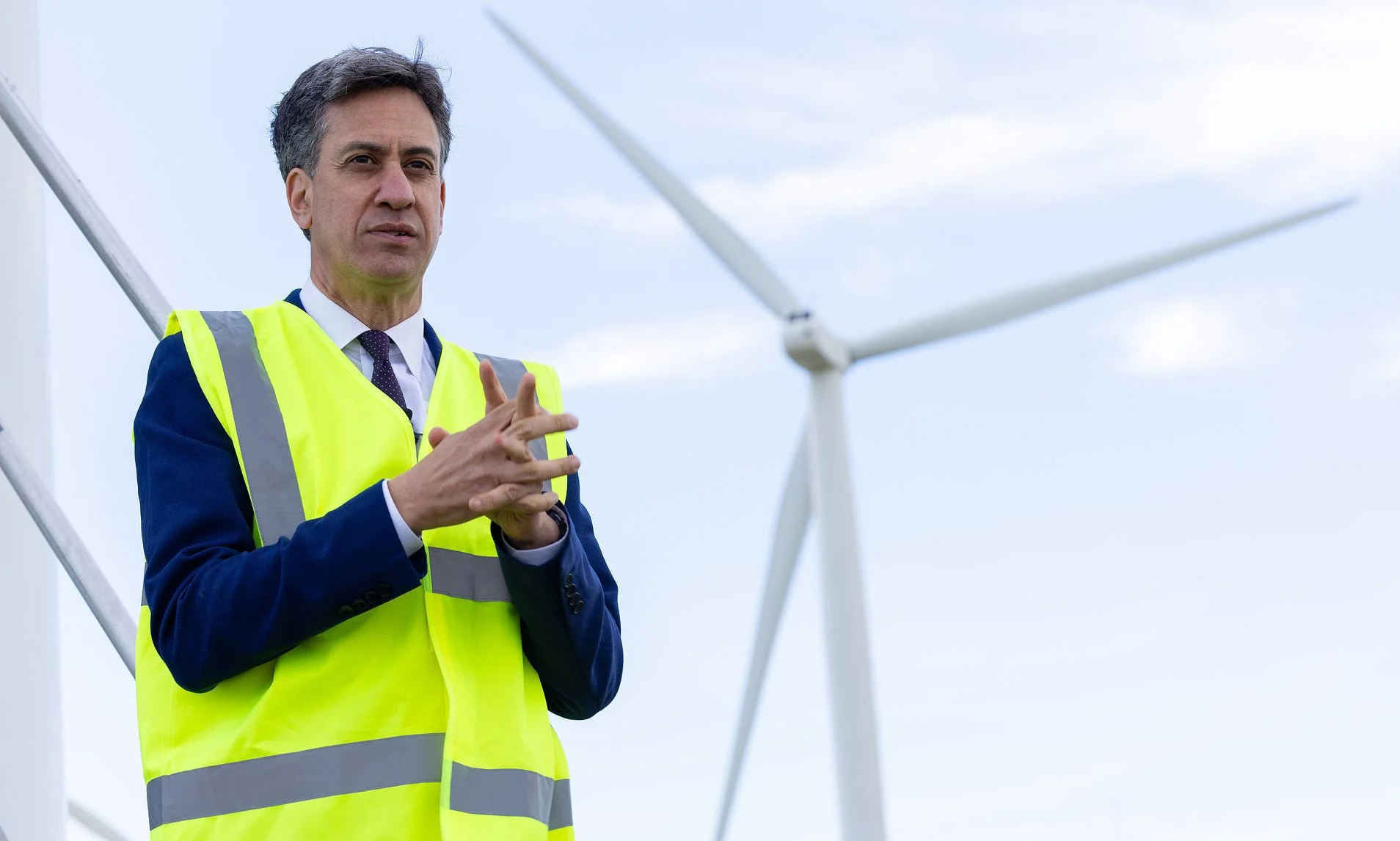
Britain’s Secretary of State for Energy Security and Net Zero (good luck with combining those) Ed Miliband has been working to accelerate the rate at which Britain runs the “race” to net zero since assuming office after the Labour party’s election victory in July 2024. Part of that acceleration will involve decarbonizing 95 percent of the U.K.’s electricity grid by 2030, an impossible objective. The people, equipment, and resources are not there. Nevertheless, the disconcertingly exuberant Miliband exudes the confidence of a Soviet central planner of the high Stalinist era, convinced that determination, coercion, and the arc of history will overcome all obstacles.
To Miliband, America’s withdrawal from the Paris Climate Accord was but a scratch. Speaking a week before President Donald Trump’s inauguration, he argued that America’s withdrawal would have little effect. It would not alter the signatories’ belief that “it was in their national self-interest to remain in the Paris Agreement … They saw both the advantages of moving forward … and the dangers for them of not moving forward.”
Miliband concluded that “the transition [to net zero] is unstoppable, not fast enough, but unstoppable,” a statement with more than a whiff of determinism about it. Is it unfair to mention that his father was a prominent Marxist intellectual? Determinism bears no relation to reality, and suspicions that Miliband inhabits a dreamworld are reinforced by his “analysis” of the reasons most countries signed up for Paris. “Self-interest,” sure, but (with exceptions) unconnected to any fears of a boiling planet.
Poorer countries wanted handouts, China and Russia looked for geopolitical advantage. Other nations wanted to demonstrate their good standing in the “international community,” as well as the cash rewards that might come from that. As China and India show, few signatories will hesitate to jettison their commitments if they get in the way of their economic development. Indonesia, probably the world’s sixth largest emitter of greenhouse gases (GHG), took advantage of America’s planned exit to raise the possibility of its own exit.
The exceptions — up to a point — have been the Europeans. Some regard climatism as a substitute religion for the Christianity their societies left behind, others succumb to the drama that climate millenarianism brings to their life. Others feel guilty about prosperity or colonial pasts. The list goes on. In many cases, these true believers will — some since they were youngsters — have had their views reinforced by frequent helpings of propaganda, unleavened by any dissent. Dissent is denial, spreading it too widely can be misinformation, and the reward is obloquy. There is no First Amendment in Europe.
Others, more opportunistically, see the tightly controlled, ascetic collectivism of a net zero society as the fulfilment, by other means, of leftwing ideological objectives (and quite a few reckon that they will be running that society). Eco-grifters feast in the green trough. Retro-types, from Britain’s neo-feudalist King Charles to elements of the far right (nostalgic for the precursors of today’s environmental fundamentalists who flourished in the 1930s) to eco-leftists, anti-consumerists, and latter day hippies, carve out their dreams of different Arcadias in the world they imagine that net zero will bring.
For all that, Miliband knows that making a more selfish case to his countrymen won’t come amiss and that it will have to involve more than boasting about the good example (in reality a ghastly warning) that Britain is setting the world or bluster about being a “clean energy superpower.” When Labour was coming closer to power there was talk of falling energy bills and hundreds of thousands of green jobs, but that — how strange — has gone quiet.
Now Miliband’s pitch is more defensive:
In the last few years, every family, every business in this country, has seen their energy bills rocket after Russia invaded Ukraine.
This has taught us something really important about the dangers of our dependence on fossil fuel markets controlled by Petro states and dictators.
The reality is that Britain is at the mercy of the rollercoaster [nature] of these markets, not just in power, but when it comes to how we heat our homes, fuel our transport and power our industry.
That is why we are moving to clean energy because it’s the right choice for energy security.
Miliband’s “dictators” will be delighted by the way the costs of net zero (including foregone growth and massive malinvestment) will make it more difficult for Britain to pay for the increases to defense spending (as the Bank of England has recently explained) in an age when Vladimir Putin and Xi Jinping are on the offensive, and Americans are losing patience.
Writing in The Spectator about the European Union, the AEI’s Dalibor Rohac observed that:
The hundreds of billions of euros from the Next Generation EU program, adopted in the wake of the pandemic and spent largely on a decarbonisation agenda, could have bought Europe of a lot of artillery shells, drones, and tanks.
Shutting down or otherwise discouraging Western hydrocarbon production (as is happening in the U.K.) will increase the dependency of the West (at least for a while) and much of the rest of the world on “fossil fuel markets controlled by Petro states and dictators,” of the type that Miliband wants to escape. Fossil fuels still account for around 80 percent of the world’s energy. Renewables do more to power the increase in the demand for energy than to replace existing “dirty” energy. The transition is (so far) better seen as an addition.
If dependency on dictators is a concern, Miliband does not appear to be concerned that China makes most of the solar panels and many of the wind turbines on which the U.K.’s commitment to net zero rests, often with the help of coal power, sometimes with the help of slave labor, and usually with the help of dollops of mercantilist cash. Omelet, eggs, I suppose.
The U.K.’s dependency on the Beijing regime will be further deepened by the coerced transition to electric vehicles, which, if maintained, will leave the U.K. and continental Europe dependent on China’s auto sector. European auto manufacturers building their own EVs are likely to be dependent on a Chinese-controlled supply chain, above all, for batteries.
Miliband claims that a renewables-based system will deliver security of energy supply, but that’s not how it looks, especially at this time of year.
The Daily Telegraph (January 22):
Wind power has collapsed to less than 1pc of Britain’s electricity supply as some of the stillest weather in years hits the UK and Europe.
The “dunkelflaute” spell sent winter wind farm output to what is thought to be its lowest since 2015 – when there were far fewer turbines.
Near-zero wind speeds and low temperatures have left the UK dependent on France, Norway, Belgium and Denmark to keep the lights on through much of today, with the countries collectively supplying more than 10pc of the UK’s electricity through undersea cables.
This was an extreme case, but not that extreme. In northern Europe, Dunkelflauten (periods, which can last for days, during which wind speeds are subdued and there isn’t much light) typically occur in the autumn and winter (I wrote about them here, here, and here) and can stay that way for a while. During such times, the U.K. is meant to be able to increase its reliance on “interconnectors,” electric cables running along the seabed (so long as the Russians don’t cut them) from the continent. But what if Britain’s European neighbors are running short of electricity, too? Dunkelflauten are no respecters of borders.
The Daily Telegraph (January 22):
Britain is at risk of entering a bidding war with Europe for electricity, as countries race to lock in supplies after a sharp drop in wind power. Cold temperatures combined with calm weather have increased energy pressures across Europe, as dwindling domestic generation has led to traders competing to buy electricity.
Power prices had surged from £90 to £400, a “roller-coaster” of the type that Miliband claims that decarbonization will end. And if volatility is a function of short-term shortages, worse may be on the way. Anger over how far domestic electricity prices have been pushed up by demand from elsewhere has now brought down the Norwegian government. Norway will probably switch off its interconnector with Denmark in 2026. And a renegotiation of the terms under which the interconnectors between Norway and Germany, and Norway and the U.K., are operated may well be on the cards.
Racing to net zero is already increasing the instability of Britain’s grid. And thus increasing the need to turn to the interconnectors. As the country’s gas-powered electricity plants are phased out, renewables will be left with a share of the burden that they, as “intermittent” sources of power, cannot be realistically expected to bear: The sun doesn’t always shine, and the wind doesn’t always blow. Britain’s aging nuclear power plants can help meet shortfalls, but, within a year or two, their ability to do so will shrink dramatically. There will be a long gap between the decommissioning of old plants and the time their replacements come online.
So, what will happen on days when the contribution made by nuclear power is shrinking, the wind and sun have gone quiet, and Miliband’s phaseout of gas is well underway? The only remaining sources of extra help will be some hydro, wood pellets (long story), and the interconnectors. The country recently came close to power cuts, and it won’t be long before they hit, and then become regular events. So much for energy security. Affordability has already disappeared. Emergency top-ups can be costly, but Britain’s everyday prices are extremely expensive, too. British households pay 80 percent more for their electricity than the average in the developed world. Unsurprisingly, they consume far less of it than their European neighbors. Energy poverty is on the rise.
Meanwhile, unhappiness with net zero is growing on the European mainland. The center-right EPP, the largest grouping in the EU parliament, still supports the bloc’s climate targets, and carbon pricing mechanism, but it has recently called for a pause on certain new climate related legislation and the removal of rules stipulating the percentage of power to be produced by renewables, an initiative clearly designed to create more room for nuclear energy.
Romania’s center-right energy minister wants to go further. He is arguing (reports EurAktiv) that “Romania’s coal-fired power plants should not be phased out before viable alternatives are fully operational.” In the short- and medium-term, these could be gas-fired. Over the long-term, he wants nuclear power. Imagine not closing coal powered plants until “a viable” replacement is ready. That is not the climate policy way. As I noted earlier this year “for all the billions that the U.K. has “invested” in renewables, it produces 25 percent less electricity than in 2000, despite an increase in its nominal generating capacity of about the same amount.” The culprit? Intermittency.
Meanwhile, Germany is sinking under the heavy regulation and high energy costs characteristic of climate policy. The race to net zero is a race to deindustrialize, unhelpful anywhere, but especially in the EU’s industrial powerhouse. Germany’s economy has shrunk for two consecutive years, and for what?
[Joe] Kaeser [the former CEO of Siemens, who is now chairman of the supervisory boards of Siemens and Daimler Truck] says Germany should keep in mind its “relative emissions” compared to other nations like the US and China. He points out that China doesn’t plan to reach net zero until 2060, compared with 2045 in Germany.
“There’s no point in trying to be the first one to arrive there if the big nations say we are going to be 10 years later.”
Moving too fast could “screw up the whole export industrial model in Germany,” which accounts for a quarter of all the country’s output…
“Relative emissions in Germany are less than 2pc of global emissions. Now if you set a target where you want to cut your emissions in half by 2030 no matter what, and assuming that nobody else in the world is going to grow emissions, it’s a target that will be long forgotten by the time you reach it.
“So what’s the point?”
Unlike Miliband, The Spectator’s Rohac sees Trump’s repudiation of the Paris Accords as something that ought to change the debate in Europe:
Whatever their views on climate change, Europeans and British would do well to realize that decades-long effort to reduce emissions through multilateral deals is over. Continuing on one’s own – after America’s explicit repudiation of the COP framework, and in light of the track record of economies such as China and India – is worse than embracing a cargo cult. It means sacrificing Europe’s prosperity and security in exchange for quite literally nothing.
In 2023 alone, the Chinese economy emitted over 12 billion metric tons of CO2, almost three times as much as the United States and five times as much as the EU.
The EU accounts for about 6 percent of global GHG emissions.
For some Europeans, a category in which I include the Brits, the pointlessness, along with the discomfort that net zero brings, is the point, part of the penance for living too well, a penance that is the essential precondition of redemption.
For others, enough is enough. As established parties will not give them the answer they want, they are turning to populist parties that will. A number of Europe’s rising populists include Britain’s Reform U.K. party (now topping a national poll for the first time), France’s RN, and in Germany parties of both the populist right and populist left. None of these parties reached their current levels of support due to their opposition to net zero, but it hasn’t hurt them, and, as economies falter it may become a source of significant support. That some of these parties are rather too understanding of Putin is another knock to Miliband’s claim that net zero is a pathway to security.
Britons have long been sympathetic to net zero. But the idea is one thing, the reality — high energy costs, low growth, and the growing intrusion of net zero into other aspects of everyday life, such as buying a car — is quite another.
In a recent survey British voters were presented with Donald Trump’s policies but not told that they were his. Forty-eight percent opposed net zero and what comes with it. The IEA’s Robert Colville highlights the latter:
‘End Net Zero’ isn’t just NZ, it’s wider framing: ‘We will end NZ and revoke the electric vehicle mandate, saving our domestic car industry and protect our great British workers. In other words, you’ll be able to buy the car of your choice. We will build cars in the UK again.’
An outlier? Maybe. A vibe shifting? Maybe.
And the extent to which Britain’s deteriorating economic position can be blamed on net zero is hardly going to win it support. Deindustrialization drags on. Manufacturing has shrunk by 8 percent since the beginning of 2021, chemicals are down by over 37 percent, and oil and gas by 44 percent. British car production may sink to seventy-year lows in 2025.
Matthew Lynn in The Spectator:
Make UK, the trade body for the manufacturing industry, recently revealed that the UK has, for the first time, dropped out of the top ten countries for making stuff. We have fallen behind Mexico, which has been helped by a wave of Chinese investment looking for ways into the US market, and even by Russia, which moved up to eighth spot globally, helped by Vladimir Putin’s outlay on arms. With total manufacturing output worth $259 billion, we have also fallen behind Italy ($283 billion) and France ($265 billion). Of all the major countries, we are deindustrialising most rapidly.
High energy costs, which affect industry as well as households, can be blamed for much of this. Industrial users pay 40-50 percent more for their electricity than in infamously expensive Germany, and four times as much as in the U.S.
And still Miliband presses on.
Steel, glass and chemical manufacturers have warned they will be driven out of business if they are forced to pay swingeing net zero taxes under Ed Miliband’s clean power plans.
In a letter to ministers, the Energy Intensive Users Group said climate levies designed to cut factory emissions were forecast to almost triple by 2030.
The group warned businesses “will not be able to bear these costs” without significant technology breakthroughs and changes to the emissions regime, risking “damaging potential impacts on many energy-intensive industries.”
Deindustrialization is a chronic problem rapidly turning acute, adding force to the argument that net zero is a luxury gesture that the British economy cannot afford. It crushes growth, it destroys jobs, it will cost a fortune, but no one knows how much — $500 billion by 2050 (?) — or where it will come from.
Thanks to Covid, the financial crisis, and government by a Conservative party that had swung towards Merkelism, Labour inherited a country where the debt/GDP ratio stood at 100 percent and the state had swollen. Real wages had been stagnant since 2008, and real per capita GDP has not fared much better. The tax burden was the heaviest it has been in seven decades and the budget deficit was somewhat over 4 percent.
Labour looked at this legacy and decided to make it worse, increasing taxes, regulation, spending, and borrowing. Business confidence is sharply down, and growth slumped in the first six months of Labour rule. The government has an overwhelming parliamentary majority and does not have to hold an election until 2029, but that timetable may protect Miliband less than he hopes. A brief panic in the financial markets in early January was a warning shot. More sustained market turbulence may be the crisis that trips up Miliband’s race. Beyond that, Britons’ growing awareness of (and disquiet over) net zero’s costs, intrusiveness, and pointlessness, will soar if other countries follow Trump’s Paris exit or if the EU starts, however discreetly, to head in the same direction. And then there will be the power cuts…
Labour is already deeply unpopular, and there are signs that some in the party are beginning to realize that its promises of growth are irreconcilable with the dream of net zero.
Sooner or later, Miliband’s “unstoppable” transition will be stopped.
Extracted from the Capital Letter for the week beginning January 25, 2025