Twelve Months of Milei
National Review Online, December 18, 2024
Wait, what?
In the third quarter Argentina’s GDP grew by 3.9 percent over the previous quarter, more than the 3.4 percent that was expected. This follows earlier signs of improvement and reinforces hopes of strong growth next year, albeit from a deep trough. Year-on-year, the quarterly numbers still show a decline of 2 percent (compared with the third quarter of 2023), but recovery must start somewhere.
According to the Financial Times, the expansion was driven by a rebound in consumer spending and capital investment after a sharp decline earlier this year, as well as by continued strong growth in agriculture and mining exports. Manufacturing and construction remain deeply depressed. To put it another way, Argentina is doing well where it has traditionally enjoyed a strong comparative advantage (it would be interesting to know how much those numbers have been held back by the increasingly expensive peso), while companies supplying the domestic economy are still under pressure and may take another battering as the economy opens up to international competition.
Meanwhile, the premium over U.S. Treasuries at which dollar-denominated Argentine bonds trade has been shrinking. After the GDP data was released, it fell to 677 basis points. When Milei took office, it was over 2,000.
It’s been quite a year….
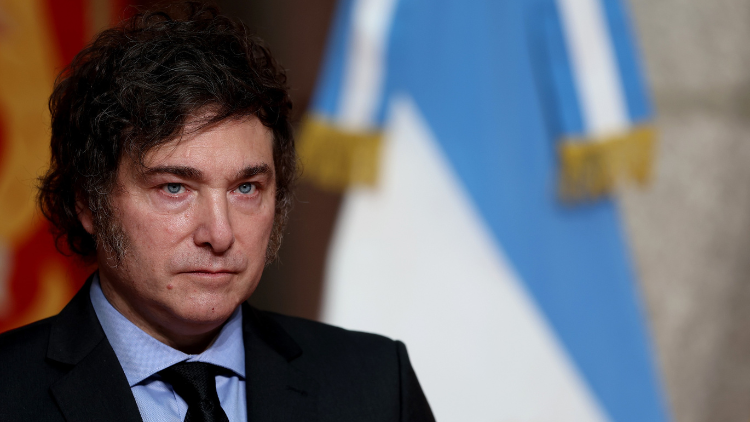
When inflation starts hurtling towards hyperinflation, old rules and expectations collapse in line with the currency. And so, in Argentina in the summer of 2023, an eccentric libertarian economist perhaps best known for his raucous appearances on television won 30 percent of the vote in primary elections and established himself as the front-runner in the contest for the presidency. There was the hair (“[It] isn’t quite a mullet, moptop or mohawk but some complex combination of the three,” wrote the Wall Street Journal’s Jacob Gallagher), there were the cloned dogs named after libertarian economists, and there was a lot more besides (Tantric sex skills? So they say) which only reinforced Milei’s image as an outsider, distinct from an establishment (la casta, the caste) that had brought a once rich country down.
Writing in August 2023, I argued that “the vote for Milei is in no small part a vote against a disintegrating status quo, rather than a sudden embrace of free-market radicalism among Argentines.” To quite a few, their vote was a “leap into the void.” But why not? What did they have to lose?
In November 2023, monthly inflation reached 12.8 percent (an annualized 161 percent) and Milei waselected president by 56-44 percent, the largest majority won by any successful candidate since the return of democracy in the early 1980s. He promised a better future but warned that getting there would be hard. In June 1940, Winston Churchill became Britain’s prime minister with “nothing to offer but blood, toil, tears and sweat.” In December 2023, the less poetic Milei told the crowdattending his inauguration “no hay plata” (“there is no money”).
The peso was promptly devalued by 50 percent, and the process of slowing money printing began (in September 2023, Argentina’s total money supply stood at 22 trillion pesos: the government had expanded the money supply nearly tenfold in less than four years). Hyperinflation was not far off, and there was no time to lose. There was something else too. Argentina’s last attempt at free market reform had been sunk (partly) by “gradualism.” For both practical and ideological reasons Milei had no interest in that. Shock therapy, which had, contrary to its reputation, worked well in the Baltic States and Poland (what Russia did in the 1990s was something very far from the market fundamentalism of current myth) was the way to go.
Milei has proved to be more pragmatic than his rhetoric had suggested. While he enjoys describing himself as an “anarcho-capitalist,” anarcho-capitalism is at most a direction of travel (if even that). As a practical matter, he is (as he explains) a classical liberal with libertarian accents. Not only that, his team includes a good number of people drawn from la casta. He takes talent from where he can find it. What’s more, recognizing that his weak position in the legislature has limited some of what he can do, he has taken half a loaf when that was all that there was. Not that he’s always had to make to with that: Under the Argentine constitution, the presidency is a strong one, and Milei has used its powers to push through an ambitious program of spending cuts and deregulation.
Ministries were scrapped and merged, but one new one was created, a ministry of deregulation. Some of the story of that deregulation is well known, not least how well it worked in the rental market (there’s a lesson there, which will be ignored), but in an article for the Financial Times late last month, Walter Molano added some extra detail, arguing that it was Milei’s micro level policies (deregulation and institutional reform), rather than grander macro level plans that might finally change Argentina’s “historically awful economic trajectory.” Molano explained that Argentina had had “a dozen” stabilization plans since 1952. One of the reasons, he maintained, that they had failed was that they had not addressed “the inflationary biases embedded in a network of byzantine rules and regulations.” Milei and deregulation minister Federico Sturzenegger, by contrast “has begun to dismantle decades-old webs of regulation, intermediaries, middlemen and tariffs that stymied innovation, productivity and competition.”
Molano:
Political organisations such as La Campora, a Peronist youth organisation co-founded by the son of former president Cristina Fernández de Kirchner, administered many social assistance schemes, building a clientelist relationship with the poor. Milei’s reforms have taken the Campora out of the loop and distributed benefits directly, increasing the net amount that people received. This approach, enacted at the micro level rather than the macro, has been replicated throughout the country, eliminating many of the bottlenecks that have made life so difficult and expensive for millions of ordinary Argentines.
The way that La Campora operated in this area fit neatly into the Peronist model in which clientelism had always played an important role. Thus, Eva Perón had a lavishly funded foundation which was used to hand out grants, build schools, and so on, and helped create the legend of Evita, the saintly friend of the poor.
Molano:
Throughout Argentina’s history, and everywhere from insurance to notaries to import approvals, officials, sometimes even presidents, have demanded kickbacks, bribes and mark-ups in exchange for the provision of basic goods and services. The resulting inefficiencies have left the culture, society and economy at the mercy of a political class dominated by the Peronist Justicialist party.
That, writes Molano, is what Milei wants to end.
Milei has gotten rid of legally sanctioned hereditary positions at numerous government agencies (yes, you read that right). The government has permitted Starlink and Amazon to provide satellite internet service in the country, providing connectivity to vast swaths of Argentina that until now had no such connection.
Undoing the mess created by decades of corporatism will take a long time and it is way, way too soon to declare victory even over the economic collapse that propelled Milei into office. JP Morgan is now expecting GDP to grow by 5.2 percent next year, but as the Financial Times reports, “that would only return per capita GDP to the level of 2021, however, when the economy was emerging from the pandemic.”
Inflation has fallen sharply. Last December, it peaked at a monthly 25.5 percent (an annualized 211 percent), numbers that reflect the rush toward hyperinflation and the effects of the peso devaluation. It has fallen almost every month since then, to 2.4 percent in November (166 percent year-on-year). The poverty rate had risen sharply prior to Milei’s election, to 41.7 percent. It reached 53 percent in the first half of this year and is now starting to decline. It currently stands at some 47 percent and is falling. The increase in poverty was an inevitable consequence of sharp cuts in government spending (perhaps by about a third) including to a (still) massive subsidy regime that governed energy, bus fares, you name it, that the country could not afford. While higher poverty levels have meant even greater hardship, it’s worth asking how high they would have been had the country reached hyperinflation.
GDP will fall by around three percent this year. Unemployment has risen by 1.4 points to 7.6 percent, real wages in the (formal) private sector have now almost made up the ground lost since November, but public sector wages are down nearly a fifth.
And then there’s this: Argentina is now running a fiscal surplus, and that is even (probably) after adjusting for the fact that some of the interest of its debt (that payable on LECAPs, a type of treasury bond issued at a discount to face value) is effectively capitalized. Admittedly it has taken slash-and-burn to get there, a process that can mean “good” spending gets cut with the bad, but a more sophisticated triage would have taken time and fiscal space that Argentina did not have. As the country’s new finance minister, Luis Caputo, noted in December 2023, it had run a deficit for 113 out of the previous 123 years. In May, Fernando Garcia and Lucila Venturi, writing for Economics Observatory, listed a few bleak statistics:
Persistent fiscal deficits and chronic inflation are longstanding issues in Argentina. The inflation rate averaged 190% between 1944 and 2023, and the government defaulted on its sovereign debt nine times (of which three occurred during the past two decades). More recently, the size of the consolidated government increased by almost 15 percentage points of GDP: from 23.2% in 2003 to 37.8% of GDP in 2022.
One year on from the beginning of Milei’s presidency, the progress that Argentina has made has not only astonished those who dismissed him as a crank on a crank’s errand (and probably disappointed some of them) but also far exceeded the expectations of those who thought that his ideas (or some version of them) were what it would take to get the country moving in the right direction. But however beneficial the reforms, they would not have had the effect they have had unless Argentines had stuck with Milei. According to a November survey, Milei had a 56 percent approval rating, the same as his support at the election. Other surveys have shown lower numbers, but even those have been around the 50 percent level, kept up by his offbeat charisma, disarray among the opposition, early signs of economic recovery and the same argument that had gotten him elected: There is no alternative.
In an article for America’s Quarterly, Benjamin Gedan notes that despite investor enthusiasm for what Milei has achieved (and the passing of a law to attract foreign investment), there has been little new investment, outside the energy and mining sectors, from abroad. Gedan puts this down, reasonably enough, to Argentina’s grim economic history, outstanding legal issues from an earlier default, the persistence of capital controls and the fear that Milei’s reforms will be reversed.
Those worries may be eased (somewhat) if Milei’s party, La Libertad Avanza (LLA) increases its representation in Congress in midterms due in October. It’s not impossible that, if it can continue its somewhat shaky cooperation with the center-right PRO, the two could either win or come close to a majority in Congress, something that would ease the path of further reform once Milei’s powers to rule by decree in many areas come to an end. Such a victory would also be a significant step towards forging a Mileiism that becomes embedded in Argentina’s political and institutional structures, a difficult task for many reasons, not least the way that Milei’s success is rooted in his own distinctive persona.
One of Milei’s most popular pledges had been to replace the peso with the dollar. Voters were enraged by the debased state of the national currency, and they liked the thought that dollarization would permanently extricate the country’s money from mismanagement by la casta. This would be a change that the Peronists could not reverse if they were re-elected. Perhaps, perhaps not — and there’s a strong case to be made that the dollar is not the “right” currency for Argentina. But this is a purely academic issue for the foreseeable future. Milei has walked away from dollarization. It could not win the support that he needed among that section of la casta with whom he could work, and maybe, just maybe (ssshhhh) he realized that the practical obstacles to dollarization were too great.
The peso is likely to be in focus in the next few months. Currently it is linked by a crawling peg to the U.S. dollar, under which it depreciates by 2 percent a month. As that’s below the inflation rate, the currency has been left increasingly overvalued, at least in theory. Interestingly, however, the spread between the principal official rate and the “unofficial” Dólar blu has narrowed over recent months. The latter trades at roughly 1,100 to the U.S. dollar, the former at 1,000. The peso has been helped by an inflow of around $20 billion into Argentines’ bank accounts thanks to a tax amnesty, making it possible for banks to lend dollars to investors to buy pesos for a carry trade. Additionally, the shutting down of the peso printing press means that there are now fewer pesos on circulation. Milei has rejected requests for a devaluation to help out local companies: Devaluation would boost inflation, which would be unhelpful as the midterms grow closer. He maintains that inflation ought to fall below a monthly 2 percent before too long. This would mean that the crawling peg should then start to depreciate the “real” value of the peso.
Milei has always said that he wants the peso to trade freely, not only as a matter of principle and basic economics but to end Argentina’s economic isolation and to encourage foreign investment. But the central bank has no dollars with which it could defend a freely floating currency in the event of a crisis. In fact, after taking account of a loan payable in January, it is some $10 billion short. Adding to the worries about the vulnerability of a convertible peso, there is a massive (reportedly $100 billion) overhang of pesos, currently held by local companies in the form of treasury and central bank bonds. If the holders started selling those to take advantage of the peso’s return to convertibility that could sink the currency. It’s hard to see any short-term route past these problems, meaning that the peso won’t freely trade any time soon, and that “official” rate might need defending too. Under the circumstances, Argentina’s ability to secure a further loan from the IMF will be key.
Milei’s success so far, along with his active proselytizing of free markets has meant that his importance now extends beyond Argentina. DOGE, for example, has been partly influenced by Milei’s deregulation ministry. If Milei succeeds, that might help stop the drift to big government within the right on both sides of the Atlantic. One of the more interesting aspects of where Milei stands within the right globally has been his association with Donald Trump, Brazil’s Jair Bolsonaro, and the Italian prime minister, Giorgia Meloni (who the other day made Milei, who is mainly of Italian descent, an Italian citizen). None of those three could be described as classical economic liberals, but Milei is in tune with their populist style rather than their more statist economic policies. He is, for example, no “tariff man,” and remains dedicated to the principle of the smaller state. Having seen your homeland wrecked by corporatism (for the “common good” of course) and the ecosystem of cronies and rent-seekers it spawns will ensure that. The only time I have seen Milei in person was at a conference in Buenos Aires earlier this year. He gave the closing speech. Interestingly, he was preceded by Elon Musk, speaking remotely from Texas. There was plenty of Mars talk (nothing wrong with that!), but Musk also took the time to describe himself as a classical liberal. The Right contains multitudes…
Extract from the Capital Letter for the week of December 9, 2024