Constitutionally Indisposed

National Review Online, February 22, 2005
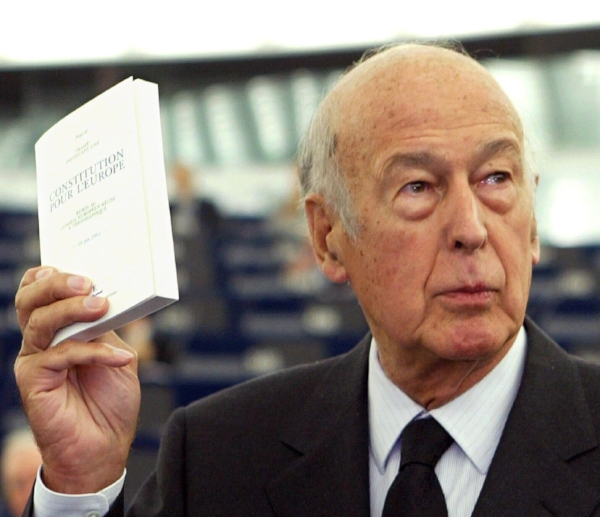
Giscard.jpg

A little over two centuries ago, a small group of planters, landowners, merchants, and lawyers met in Philadelphia to decide how their new country was to be run. Within four months this remarkable collection of patriots, veterans, pragmatists, geniuses, oddballs and the inspired succeeded in agreeing the extraordinary, beautiful document that, even with its flaws, was to form the basis of the most successful nation in history.

On February 28, 2002, another constitutional convention began its work, in Brussels this time, not Philadelphia. Its task was to draw up a constitution for the European Union. The gathering in Brussels was chaired by Giscard D'Estaing, no Hamilton or Madison, but a failed, one-term president of France best known for his unseemly involvement with Jean-Bedel Bokassa, the cannibal "emperor" of central Africa. Giscard's convention was packed with placemen, cronies, creeps, and has-beens to make up a body where to be called second rate would have been an act of grotesque flattery. Only a fool, a braggart, or a madman would have compared this rabble with the gathering in Philadelphia. Needless to say, Giscard managed to do just that. The rabble returned the compliment. At ceremonies held to celebrate the conclusion of the convention's work, one over-excited Austrian delegate compared Giscard to Socrates, a remark that would undoubtedly have reduced that ancient, and unfortunate, Greek to yet another swig of hemlock.

Once the convention had completed the draft constitution, there was further haggling over the text by the governments of the EU member states. A final version was agreed in June 2004, and what a sorry, shabby work it is, an unreadable mish-mash of political correctness, micromanagement, bureaucratic jargon, artful ambiguity, deliberate obscurity, and stunning banality that somehow limps its way through some 500 pages with highlights that include "guaranteeing" (Article II-74) a right to "vocational and continuing training," "respect" (Article II-85) for the "rights of the elderly... to participate in social and cultural life," and the information (Article III-121) that "animals are sentient beings." On the status of spiders, beetles, and lice there is, unusually, only silence.

All that now remains is for this tawdry ragbag to be ratified in each member state, a process that is already well underway. In some countries ratification will depend on a parliamentary vote, in others a referendum. The final outcome remains difficult to predict, and it is a measure of the current uncertainty over the constitution's ultimate fate that there is now open discussion of the idea that the document may be forced through even without ratification by one or two of the smaller countries. In an editorial over the weekend, the Financial Times, a generally reliable mouthpiece for the latest Brussels's orthodoxy explained, "in theory, one state's rejection is enough to kill [the constitution]. In practice, it will depend on the state." Within the EU, it seems, some nations are more equal than others. Rejection by one of the union's larger members, however, will be enough to throw the whole process into richly deserved chaos. We can only hope.

And it is at this point that, rather surprisingly, the Bush administration has come into the picture. Speaking a few days ago to the Financial Times, Condoleezza Rice appeared, weirdly, to give the constitution some form of endorsement: "As Europe unifies further and has a common foreign policy—I understand what is going to happen with the constitution and that there will be unification, in effect, under a foreign minister—I think that also will be a very good development. We have to keep reminding everybody that there is not any conflict between a European identity and a transatlantic identity..."

In a later interview with the Daily Telegraph, President Bush himself appeared to steer discussion away from the proposed constitution, but he did have this to say: "I have always been fascinated to see how the British culture and the French culture and the sovereignty of nations can be integrated into a larger whole in a modern era," he said. "And progress is being made and I am hopeful it works because one should not fear a strong partner."

How can I put this nicely? Well, there is no way to put it nicely. Even allowing for the necessity to come out with diplomatically ingratiating remarks ahead of a major presidential visit to the EU, the comments from Bush and Rice are either delightfully insincere or dismayingly naïve.

The project of a federal EU has long been driven, at least in part, by a profound, and remarkably virulent anti-Americanism, with deep roots in Vichy-era disdain for the sinister "Anglo-Saxons" and their supposedly greedy and degenerate culture. Throw in the poisonous legacy of soixante-huitard radicalism, then add Europe's traditional suspicion of the free market, and it's easy to see how relations between Brussels and Washington were always going to be troubled. What's more, the creation of a large and powerful fortress Europe offered its politicians something else, the chance to return to the fun and games of great power politics.

They have jumped at the opportunity. Speaking back in 2001, some time before 9/11 and the bitter dispute over Iraq, Swedish Prime Minister Göran Persson (who then also held the EU's rotating presidency) provided a perfect example of the paranoia and ambition that underpins this European dream. The EU was, he claimed "one of the few institutions we can develop as a balance to U.S. world domination."

Brandishing the American bogeyman was always inevitable. Condoleezza Rice may claim to have discovered a European "identity," but outside the palaces, parliaments, and plotting of the continent's politicians such an identity is a frail, feeble, synthetic thing. The preamble to the EU constitution refers to a Europe "reunited after bitter experiences," a phrase so bogus that it would embarrass Dan Brown. Unless I missed something in my history classes "Europe" has never been one whole. There is nothing to reunite. A Swede, even Göran Persson, is a Swede long before he is a "European." Naturally, the framers of the constitution have done their best to furnish a few gimcrack symbols of their new Europe (there's (Article I-8) a flag, a motto ("United in Diversity), an anthem, and, shrewdly in a continent that likes its vacations, a public holiday ("Europe Day") and perhaps in time these will come to mean something, but for now they are poor substitutes for that emotional, almost tribal, idea of belonging that is core to an authentic sense of national identity.

But if the EU has had only limited success in persuading its citizens what they are, it has done considerably better in convincing them as to what they are not: Americans. Writing in 2002 about the "first stirrings" of EU patriotism, EU Commissioner Chris Patten could only come up with two examples: "You can already feel [it], perhaps, in the shared indignation at US steel protection...You can feel it at the Ryder Cup, too." It's significant that when Patten gave examples of this supposed European spirit, he could only define it by what it was against (American tariffs and American golfers) rather than by what it was for. It is even more striking that in both cases the "enemy" comes from one place—the U.S. If Patten had been writing in 2005 he would, doubtless, have added opposition to the war in Iraq to his list—and he would have been right to do so.

This is psychologically astute: The creation of a common foe (imagined or real) is a good way to unify a nation, even, possibly, a bureaucratically constructed "nation" like the EU. Choosing the U.S. as the designated rival comes with two other advantages. It fits in nicely with the existing anti-American bias of much of the EU's ruling class and it will strike a chord with those many ordinary Europeans who are genuinely skeptical about America, its ambitions and, yes, what it stands for.

Insofar, therefore, as it represents another step forward in the deeper integration of the EU, the ratification of the constitution cannot possibly, whatever Secretary Rice might say, be good news for the U.S. How deep this integration will be remains a matter of dispute. In Euro-skeptic Britain, Tony Blair's government has denied that the document has much significance at all, but without much success. At the same time, claims that the ratification of the EU constitution will of itself represent the creation of a European superstate are overblown. It won't, but it will be another step in that direction, and, based on past precedent, we can be sure that the EU's fonctionnaires will use the vacuum created by all those helpful ambiguities in the constitution's text to push forward the federalizing project as fast and as far as possible.

It is, of course, up to Europeans to decide if this is what they want. Any attempt by the Bush White House to derail the ratification process would backfire, but that does not mean that the administration should be actively signaling its support for this dreadful and damaging document. Secretary Rice argues that the integration represented by the passing of the constitution would be a "good development." The opposite is true. If the EU (which has a collective agenda primarily set by France and Germany) does increasingly speak with one voice, Washington is unlikely to enjoy what it hears.

The constitution paves the way for the transfer of increasing amounts of defense and diplomatic activity from Europe's national capitals to Brussels. Article 1-16 commits all member states to a "common foreign and security policy." "Member states" are required to "actively and unreservedly support the Union's common foreign and security policy in a spirit of loyalty and mutual solidarity and shall comply with the Union's actions in this area. They shall refrain from action contrary to the Union's interests or likely to impair its effectiveness." In a recent radio interview, Spanish prime minister Jose Zapatero explained how this might work: "we will undoubtedly see European embassies in the world, not ones from each country, with European diplomats and a European foreign service...we will see Europe with a single voice in security matters. We will have a single European voice within NATO."

And the more that the EU speaks with that one voice, the less will be heard from those of its member states more inclined to be sympathetic to America. And as to what this would mean, well, French Green politician Noel Mamère put it best in the course of an interview last week: "The good thing about the European constitution is that with it the United Kingdom will not be able to support the United States in a future Iraq."

And would that, Secretary Rice, be a "good development"?
Waving The Bloody Shirt

National Review OnlineJanuary 18, 2005

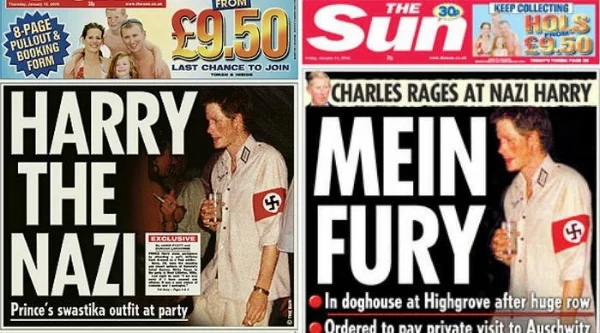
Prince Harry.jpg

Gott im Himmel, what was Harry thinking? If you are a public figure, the great grandson of the last emperor of India no less, and you live in censorious—and camera-phone-saturated—times, attending a "Native and Colonial" party is almost certainly unwise. To do so in Nazi uniform is absolute madness. And after days of high drama, low farce, and massed denunciations, we all know the result. The "Clown Prince" and the Circus

To take just a brief selection of the criticism, Harry is now the "Hitler Youth" (the Sun, a newspaper that dilutes its moments of moral indignation with bouts of manic punning), "the most tasteless fool in the country" (London Times), and "an idiot" (Independent). Perhaps more worrying for the "clown prince" (Sun, again), the principal prominenti to rally to his support were David Irving (a historian often accused of Holocaust revisionism), a disgraced Tory MP, and Fergie.

It would have done nothing for the Night Porter, but Harry's has been the shirt seen 'round the world, the mother of all wardrobe malfunctions, a poor, sad scrap of bad taste, a feeble facsimile of an Afrika Korps tunic, garnished with a swastika armband, a touch that the late Field Marshal Erwin Rommel would, I suspect, have found somewhat vulgar.

And yes, it was a dumb, dumb thing to do. Stupid rather than malicious, but, particularly given Harry's status, it was clearly inappropriate—and genuinely offensive to many. Quite rightly, the prince was quick to issue an apology. That should have been an end to the matter. That it was not says plenty about modern Britain and contemporary Europe, little of it good.

To be sure, the British press was always going to keep the story alive for as long as it could. Royal scandals shift newspapers, and so do the Nazis. Combining the two was a circulation manager's dream. Even allowing for this, however, the torrent of humbug, hypocrisy, and hysteria that has engulfed the hapless Harry has been remarkable and, in some ways, rather more repellent than the wretched regalia that sparked the uproar in the first place. It also ignores the fact, critical to understanding this incident, that for many Brits, the Nazis have long been good for a laugh.

Now, Harry is not, by most accounts, much of an intellectual, so to claim that his brown-shirted burlesque was somehow a deliberate Producers-style satire is a stretch too far. At the same time, his dreadful choice of costume, however dimly, however unconsciously, reflected a national fondness for making a mockery of the pretensions of the Third Reich. On occasion this can be tasteless, but ridicule is not a bad way to strip the swastika of some of its malign power. The failure of neo-fascists ever to make much progress in the U.K. (unlike in some other European countries) can at least partly be put down to the fact that voters have been too busy laughing to take them very seriously.

Some press comment in Britain did allude to this tradition, but a good number of journalists took the chance to indulge in royal-bashing and class warfare. It was a wonderful opportunity to give the toffs a good kicking, while appearing to remain on the moral high ground. The Guardian is usually a good source for this sort of thing. It didn't disappoint. To take just a quick dip into the venom, we find John O'Farrell frantic and foaming over "pro-hunting upper-class twits," sly hints from Mark Lawson that the evil Tories are far more likely to dress up in Nazi uniform than their political opponents and a reminder from Duncan Campbell that Edward VIII had "admired what Hitler was doing in Germany."

In Germany itself, reactions were no less vitriolic, and, reflecting exasperation at the U.K.'s endless, and frequently crass, obsession with the Second World War, included some Brit-bashing for added flavor. The most weirdly entertaining response, however, came from a commentator in the mass-circulation Bild who scribbled this message to Harry. "You are...about as disgusting as a moldy piece of food. I vomit. It is high time that you were given serious medical treatment. You are a traumatized child."

Getting it exactly wrong, meanwhile, Der Spiegel described the uniform of the Afrika Korps as being "hated" in the U.K. because of British casualties in the desert war. In fact, the reverse is true. The soldiers of Rommel's army have traditionally been seen as the "good" Germans, worthy opponents beaten in a fair fight. If, as was apparently nearly the case, Harry had opted, God help us, for a SS uniform, the row would have been far, far worse.

Adding to the frenzy, and showing that, even now, after nearly six decades of democratic government, they do not fully understand the occasionally uncomfortable realities of free speech, some German politicians used Harry's gaffe to lobby for a Europe-wide ban on the display of Nazi symbols. Such a ban would be a mistake on a number of grounds, but it is interesting to see that there was no suggestion that it should also cover Communist insignia. Why not? Do the tens of millions who died under the hammer and sickle count for any less than those butchered by the Hitler regime? To look at this point another way, ask yourself if there would have been such uproar if Harry had come dressed as a Stalin-era commissar or clutching Mao's Little Red Book. You know the answer.

As if that level of hypocrisy was not enough, it seems that even some fascists, real ones, may be regarded as less of a scandal than the wayward Windsor. Le Monde has reportedly suggested that the furor over Harry may hit London's chances of winning the right to host the 2012 Olympics over rivals such as Paris, the capital of a country where some15 percent of voters regularly give their support to the National Front, a party headed by a man who has described the Holocaust as a "detail."

More ominously still, this wave of indignation over a spoiled and irrelevant young prince makes a revealing contrast with Europe's supine response to Islamic extremists, the brownshirts of our own era. But, perhaps we should not be surprised. How much simpler, and politically more convenient, to condemn one moronic 20-year-old, his unpopular social class, and (internationally) his countrymen, than to confront the real danger to freedom now developing among a section of the EU's Muslim minority. Facing this challenge will be a tricky task not easily reconciled with the multicultural pieties of Europe's ruling establishment, or, arguably, the pockets of anti-Semitism that may lurk within it. Symbolic solidarity with the vanished victims of the past is so, so much less demanding.

Ironically, however, these politics of the empty gesture reached their nadir with the suggestion by the Simon Wiesenthal Center (an organization which should know better) that Harry should be made to attend the commemoration at Auschwitz of the 60th anniversary of the camp's liberation. Such a grotesque stunt, both morbid and meaningless, would have been an insult to those murdered in that terrible place. Thankfully, the idea was rejected.

In this squalid and sorry saga, it was a rare moment of dignity.

Dead Zone

National Review Online, December 8, 2004

Lily Dale, September, 2004 © Andrew Stuttaford

Lily Dale, September, 2004 © Andrew Stuttaford

If the painter Thomas Kinkade has redesigned Heaven—and who’s to say that he hasn’t?—it might look a little like Lily Dale, a tiny community about an hour south of Buffalo. On a gentle-breeze, blue-sky, no-cares, endless-summer sort of day, gingerbread Victorian cottages doze alongside tranquil, flag-festooned streets. The houses’ colors—white, yellow, gray—are, like their inhabitants, mainly muted, gentle by design or faded by the years. Only occasional flashes of eccentricity—an unexpected plague of stone angels here, a rash of concrete cherubs there—signal to visitors that there’s something not quite right, not Shyamalan wrong, but odd nonetheless, about this idyllic village nestled so prettily against a quiet lake.

Even Lily Dale’s visitors (those that are visible anyway—I’ll explain that remark later) seem more subdued than the typical vacationing hordes, more Trappist than tourist, chatting among themselves in low tones as they stroll towards their destinations. Once—over a century ago—there was a Ferris wheel here, a bowling alley, dances, even (oh, the thrill!) speeches by Susan B. Anthony, but those excitements have passed, vanished into history and stiff sepia images. But guests can still wander under the shade of trees more than a hundred years old now, and, if they choose, across a series of small, perfectly kept parks—immaculately green as they sweep down in the direction of the lake, itself smooth, untroubled, and inviting, gently lapping up against the eastern edge of town.

And the sense that there’s something celestial about this place is only reinforced by a small white-pillared “Forest Temple” half-hidden amid some trees and by the “Healing Temple” that can be found nearby (yes, yes, I was “healed,” blue light discovered burning within me, long story). Bells toll at certain times of day summoning the faithful to meditation, ritual, and to quavering old tunes played on a quavering old organ, the singing of quavering old hymns of spirit messages and eternal light.

These people are, quite clearly, not Baptists.

To find out more, enter the cool, dark Leolyn Woods. Like so much in Lily Dale, they are unexpected survivors, a rare scrap of old-growth forest. Walk straight ahead. Don’t be tempted by the questionable attractions of the pet cemetery. Look instead for an ancient tree stump—Inspiration Stump, they call it here—and the people gathered there to hear from the hereafter. They have turned up for the daily “message service,” a séance, stand-up style, at the stump, starring the quick (a rapid succession of mediums) and the dead (a host of the dear departed—dads, moms, a brother or two).

If you’re ex, Lily Dale is in.

People have been bothering the dead in Lily Dale since 1879. That was the year in which a handful of pioneers, enthusiastic participants in the great wave of spookery and table tapping that gripped those supposedly sensible Victorians, first bought property here. It was to be a permanent site (only Spiritualists can own property in “the Dale,” even today) for enlightenment, and communication with corpses—a “White Acre,” wrote Mrs. Abby Louise Pettengill (its 1903 president), “where all may receive the benediction of the unseen world.”

She would have been pleased to see (and perhaps she did, who knows?) the small but expectant crowd waiting one Friday evening in Lily Dale’s Assembly Hall for a benediction from another world, in their case a chinwag with ET. Like Spiritualism before it, much UFO mythology is an attempt to reconcile mystical and superstitious impulses with the unwelcome realities of an age of science. And like Spiritualism it soon descends into mush-mutterings of otherworldly visitors, enlightened beings, and contact with the mysterious, thrilling unknown, talk which the late (or not) Mrs. Pettengill would surely have relished.

And when it comes to enlightened beings, there’s no better guide than the human speaker that night, writer and soulapath (don’t ask) Lisette Larkins. She’s the author of Listening to Extraterrestrials: Telepathic Coaching by Enlightened Beings; Talking to Extraterrestrials: Communicating with Enlightened Beings; and, alarmingly for those of us familiar with the work of Fox Mulder, Calling on Extraterrestrials: 11 Steps to Inviting Your Own UFO Encounters. After an hour or so of New Age banality and musical interludes that would have insulted Yanni, an alien turns up, but, dismayingly, via Ms. Larkins rather than in person. Repeatedly shaking her head from side to side, alien Lisette starts speaking in a slow, faintly mechanical voice slightly reminiscent of Hillary Rodham Clinton. She is purportedly channeling messages from our extraterrestrial visitor, but the vague beatitudes and something about “connecting” reveal only that this particular alien is from Planet Hallmark. That’s not worth the price of admission. For 30 bucks I expect Klaatu barada nikto or, at least, sexy Sil from Species.

Where flying saucers hover, other nonsense is never far behind. Sure enough, the Crystal Cove, Lily Dale’s gift shop, is a supermarket of superstitions, a casbah for the credulous, its pick-’n’-mix spirituality a perfect symbol of the intellectual confusions of our age. It’s all there: the supernatural bric-a-brac (Celtic crosses, misting bowls, chalices, spell books, fortune-telling kits, candles, Ouija boards, strange hanging things); the tarot (tarot of love, fairy-tale tarot, universal Waite tarot, basic tarot, spiral tarot, Lord of the Rings tarot, unicorn tarot, dragon tarot, tarot of the Sephirot, herbal tarot, renaissance tarot, quest tarot, tarot of a moon garden, Morgan-Greer tarot); cosmic kitsch (fairies, angels, fairies, unicorns, fairies, various goddesses, fairies, the goddess, yet more fairies, wizards); and the inevitable Native Americana, complete, naturally, with Native American tarot.

Despite that very contemporary willingness to accept any reassuring mumbo-jumbo, however ludicrous, so long as it can be wrapped in vaguely mystical garb, in its core Lily Dale clings to the traditions of its slightly off, determined founders, those earnest Victorians convinced that table-tapping, séances, and other conjuring tricks could give them what generations had dreamed of: proof, scientific proof, that we all enjoy an encore in a place some called Summerland. According to Spiritualism, nobody dies. We “pass,” we don’t die. There is no death, only a “transition.” Nevertheless, for a faith that revolves around eternal life, Spiritualism has always had a rather morbid fixation with that dicey moment that, as a pessimist, I still call, well, death. In all its prettiness, there’s a touch of the funeral parlor about Lily Dale, something a little oppressive, something too hushed, too over-scented, too much.

In a way this is inevitable. It’s death that brings the living to Lily Dale. Offer the grief-stricken and the lonely the chance, any chance, to talk to those that they have lost, and some will try their luck. And where there are the desperate, there will be those who take advantage of them. You can see their traces in Lily Dale’s museum, most strikingly in a collection of relics from the Gilded Age, a golden age, quite clearly, of bunkum. There are the slates on which the spirits allegedly scrawled their enigmatic messages, the spirit trumpets that floated through the air, even the peculiar, strangely compelling paintings that supposedly materialized onto canvas untouched by (living) human hand, paintings of the passed, paintings of spirit guides, even, helpfully, a painting of the spirit world to come. It looks, yes, a little like something Thomas Kinkade might have done, but since its artist was dead at the time, it’s churlish to carp.

In our scientific age, our time of reason and progress, our era of Kabbalah, crystals, alien abductions, Wicca, homeopathy, goddess worship, Al Gore, past-life regression, astral travel, psychic hotlines, recovered memories, Feng Shui, and creation “science,” all that old sideshow spiritualism seems somehow something of a relic, too crass, too embarrassing, too crude for an epoch so spiritually sophisticated that Madonna is a major religious figure. The trumpets have been stilled: “physical mediumship” is rarely practiced in Lily Dale these days, but the hunger that nourished it still remains.

You can see it—neurotic, compulsive, relentless, and not a little sad—in the capacity crowd packed into the Dale’s auditorium to listen to the medium James van Praagh “Making The Psychic Connection” between, ambitiously, “Heaven and Earth.” We’ve each paid $80 to hear him.

That’s more than twice the price of an extraterrestrial, but, in the dim galaxy of contemporary superstition, James Van Praagh is a star. Like Amy Fisher and Adolf Hitler, he too has been the subject of a TV miniseries (played by Ted Danson!), a cultural accolade matched only by his multiple appearances on Larry King Live. He’s a best-selling author and recording artist and a man who, judging by his website, survived a childhood that combined the worst of Jeffrey Dahmer (“an average child, he remembers having a tremendous fascination with death”) with the best of Joan of Arc (“an open hand appeared through the ceiling…emitting radiant beams of light”). Despite a weakness for the saccharine (“When a bright smile overcomes tears, it becomes a smile that can light up the world”), Van Praagh is also highly entertaining. He’s John Edward with good jokes, a Frank Cannon moustache, and a way with the ladies who make up the bulk of his beguiled and besotted audience.

Some are there just to gawp at the dead men talking (many spirits, yikes, are “here with us today”), while others have come to be soothed by Van Praagh’s soft-soap sermons. “Death” is painless, everybody’s immortal, and we all end up in Heaven. “Step into that world,” he purrs, “there’s no judgment.” It’s a perfect gospel for a society in full flight from the notion that we should ever have to account for our actions. Some spectators, sadder, unhinged, pleading, are there for the answers, and the comfort, that reality cannot provide. Sharon has survived “a couple of terminal illnesses” but is not satisfied with the advice of her doctors (she’s led away to speak to a “medical intuitive”), while others, weeping, choking up, voices cracking, tell of sick friends, of children killed in motorcycle accidents, of relatives lost to cancer, and the rest of the carnage we call daily life.

These are people who want to believe. When Van Praagh starts tossing out ambiguous communiqués from beyond, it doesn’t take long before someone can be found who thinks that these messages might be for her. Another quick succession of references, names, and clues follow, all seemingly precise, but in reality vague enough to allow the respondent to find something in it for herself and, in replying, give Van Praagh further, invaluable guidance for his next step, and, ultimately, “validation”: the supposedly specific factoid needed to prove that long-dead dad is indeed with us that day. It looks to me a lot like an old technique known as “cold reading.” All it takes is a quick mind, intuition, and (no problem here) an audience that has lost connection with reality.

Still, Van Praagh manages, there’s no denying, some remarkable hits: coincidence, or, perhaps, well…

Whatever the explanation, none of my dead relatives shows up. Much as I would like it to, this proves nothing. They were a reserved lot and none of them would have been seen dead in a place like the auditorium. With the thought that somewhere more discreet might be more inviting, I decide on an individual consultation with one of the many mediums that have set up shop in Lily Dale. She’s a kindly soul, a late middle-aged woman with twinkling eyes, a jolly smile, and 40 of my dollars. Within a few minutes, and, shall we say, some gentle prompting on my part, she has proof that both (a twofer!) my grandmothers are with us in the room. As they’ve been dead for nearly 30 years, that’s quite a family get-together, like a childhood Christmas back in England, even if I can’t actually see the guests.

And if I believe that, I’m the Christmas turkey.

It's Time

National Review Online, November 29, 2004

Orange.jpg

New York City, Saturday—In Manhattan, they say, everyone wears black, but not this Saturday, not in this plaza just across from the U.N. The demonstrators, perhaps 500, perhaps more, have turned up on this briefly glorious late autumn day in orange hats, in orange scarves, in orange coats, in orange sweaters, draped in orange blankets, wearing orange ribbons; anything, however small, will do so long as it is orange. Baseball cap advertising Land Rover? No problem. If it's orange, it's fine. Sweatshirt proclaiming the virtues of Steinway pianos? Why not? It's orange. Orange flags flutter, orange balloons bob against a clear, lovely sky that matches the blue on the other flag, pale blue and yellow, which flies this day. Blue and yellow, the colors of Ukraine, and orange the color of the movement that might, maybe, finally bring the people of that country the decent government they have awaited for far too long. "Pora". "It's time." Indeed it is.

Banners, orange naturally, proclaim the loyalties of the crowd:

"Yuschenko—Yes!"

"A Criminal Should Not Be President."

"Putin, Don't Mess With Ukraine."

"Boston Ukrainians for Yuschenko."

"America and Ukraine Together."

"Kyiv, We're With You."

"Ukrainians Deserve Freedom Just Like You."

Indeed they do. In the 20th century, the people of the Ukraine, a land of two genocides, the country of Hitler's Babi Yar, and the nation of Stalin's broken, emptying starving villages, went through the worst that two totalitarian systems could do to them, the raw death toll, millions after millions after millions, supplemented by decade after decade after decade of more selective, careful purges, a cull of the best and the brightest, generation after generation after generation.

And yet, somehow, Ukraine endured.

But Putin seems to feel little or no remorse for the crimes of his Kremlin predecessors. There have been no real apologies, and no trials of those butchers who still survive. As the Russian president looks at those other far, far larger crowds in orange, the ones gathered for days in Kiev's Independence Square, he sees, doubtless, only irritants, troublemakers, hooligans, obstacles to be removed, perhaps even dupes, according to some in Moscow, of wicked Polish plotters. What he should be seeing are the countless ghosts of those that went before, victims of that Soviet past that even now he seems curiously unwilling to confront. That, however, would take a conscience.

In 1933 (wrote the writer Vasily Grossman) "horses pulled flattop carts through [Kiev], and the corpses of those who had died in the night were collected. I saw one such flattop cart with children on it. They were just as I have described them, thin, elongated faces, like those of dead birds, with sharp beaks...Some of them were still muttering, and their heads still turning. I asked the driver about them, and he just waved his hands and said: "By the time they get where they are being taken they will be silent too." There was, we should remember, more food in Kiev than anywhere else in the Ukraine that year. Five, six, seven million died in that Soviet-made famine, the Holodomor, maybe an even greater number: no one knows for sure.

Standing in that New York plaza I talk to one of the demonstrators, Marko, about what's going on. We touch on the past. "My father," he says, "survived the Holodomor." I look around at some of the older faces in the crowd, and wonder what they had heard back then, what they knew, what they had lived through.

Not inappropriately, perhaps, there is behind us a memorial to Raoul Wallenberg, the Swede who rescued thousands of Jews from wartime Budapest only to disappear into Stalin's hands. A small plaque reads that on "January 17th, 1945 Raoul Wallenberg was detained by the Soviet government. His fate remains unknown." Fate unknown. Just another ghost. Not inappropriately, perhaps, someone in the crowd is carrying a placard showing Putin in a KGB uniform.

Someone else has a sign announcing that she is from Donetsk, the city that is the heart of the Ukraine's mainly Russian-speaking east, an area that is likely to come into sharp focus in coming weeks—exaggerated it may have been, but there is no doubt that Russia's candidate, Viktor Yanukovych, has real support in that part of the country. Taras, a friend of mine who's also at the demonstration, is more optimistic. His father, from Ternopil in western Ukraine (the city where Viktor Yuschenko had studied as a young man) had just returned from Kiev. While he was there he'd talked to a few of the miners who have been shipped in from the East to rally support for Yanukovych, the second-round "winner." They were O.K. guys, he said, enjoying an all-expenses, all-vodka trip to the big city with no plans to stick around for long. We'll see.

But Saturday is not a day for such worries. The likeable crowd, mainly twenty or thirtysomethings, a blend of recent immigrants, visitors, and the diaspora, were festive, optimistic, excited, cheering the speeches, the singers, and the sentiment, pausing only to chant the only name that counted, the name of their president:

"Yushchenko, Yushchenko, Yushchenko."

He's their hero, their man, their champion, and their best hope for the true restoration of a squandered independence. In fact, like many politicians that emerged in the rougher corners of post-Soviet Eastern Europe, Yuschenko is not free from awkward questions about his past, or the nature of some of his support, but this is not something that anyone wants to think about this day.

"Yushchenko, Yushchenko, Yushchenko."

An older woman points to a poster, a standard politician-and-child image, the usual fluff, and shakes her head sadly. "It's terrible what they've done to him." The man in the photograph is healthy, good-looking, fortyish. It's Yuschenko, and the picture was probably taken less than a year ago. His face looks nothing like the terrible, cratered wreck that it has become, the product, almost certainly of a poison attack, an attack that has transformed him into a martyr for the cause, the real cause, he now leads.

The crowd starts to sing a lovely, enchanting tune, verse after verse. They know the words, and they sing them smiling. "The national anthem?" I ask. "No", two women say, "It's like a pledge." "What's it called?" Thought. Pause. Embarrassed looks. "We don't know." And then they start to laugh.

It's time.

How Enlightenment Dies

National Review Online, November 12, 2004

theo_van_gogh_slain.jpg

Amid all the weird, wild wailing in Manhattan, amid the hot air and hysteria in Hollywood, amid all the crazy-lady shrieks of mainstream-media anguish (yes, Maureen, I'm talking about you) and the banshee howling of liberal complaint, Americans heard one overarching theme from the disappointed and distraught left—one meme, one fear, one insult that finally spoke its name. Jesusland (that's what they call it now) had won. The America of Jefferson and Madison had fallen, delivered by Karl Rove into the hands of ranting theocrats, holy rollers and the monstrous ghost of William Jennings Bryan. Writing in the New York Times, an overwrought Garry Wills had this to say:

The secular states of modern Europe do not understand the fundamentalism of the American electorate. It is not what they had experienced from this country in the past. In fact, we now resemble those nations less than we do our putative enemies.

The title of his article? "The Day the Enlightenment Went Out."

Oh really? If it was the fate of the Enlightenment for which Mr. Wills feared, he would have done better looking some 3,000 miles to his east, to lovely, wounded Amsterdam, a city once famed for its brisk, North Sea tolerance, a city that now mourns the death of an artist killed for speaking his mind. On November 2, the very day of the election that was to so sadden Garry Wills, an assassin in Amsterdam murdered the filmmaker Theo Van Gogh—shot him, stabbed him, and then butchered him like a sacrificial sheep. Van Gogh, you see, had transgressed the code of the fanaticism that has now made its home in Holland. And for that he had to die.

The movie that doomed Van Gogh was Submission, a ten-minute film shown on Dutch TV earlier this year. A collaboration with Ayaan Hirsi Ali, a Somali refugee and Muslim apostate who is now a member of the Dutch parliament, the film is a caustic attack on Muslim misogyny. Back in September, Marlise Simons of the New York Times described some of its scenes thus:

As she begins to pray, the woman looks heavily veiled, showing her eyes only, but her long black chador turns out to be transparent. Beneath it, painted on her chest and stomach, there are verses from the Koran. More women appear. A bride is dressed in white lace, but her back is naked. The Koranic verse that says a man may take his woman in any manner time or place ordained by God is written on her skin. The images roll on, now showing a woman lying on the ground, her back and legs marked by red traces of a whip. The Koranic verses on her wounded flesh say that those guilty of adultery or sex outside marriage shall be punished with 100 lashes. There are chilling sounds of a cracking whip; there is the haunting beauty of the Arabic calligraphy and soft music.

In a country in which Muslims account for nearly six percent of the population, there was predictable outrage from predictable sources. Ayaan Hirsi Ali added more death threats to her already substantial collection (she has been living under police protection for some years), and Van Gogh gathered a few of his own. Despite that, he declined the help of the cops. They hadn't, he pointed out, managed to save the rightist politician Pim Fortuyn from assassination back in 2002. Besides, he argued, who would think it worth their while to gun down the "village idiot"? And so this appalling, brave, obnoxious, and foul-mouthed provocateur, an opponent of religious intolerance whatever its source—an ornery chain-smoking contrarian who relished describing himself as a "professional adolescent, a die-hard reactionary"—carried on writing, filming, grumbling, grousing, and cursing.

With a horrible—and ironic—appropriateness, Van Gogh's final film was an investigation into the murder of the equally truculent Fortuyn, a killing that he blamed partly on the demonization of Fortuyn by "leftwing, politically correct...politicians." Like Fortuyn, he too was to die for his views and like, I suspect, Fortuyn, in those final terrifying moments Van Gogh would, despite his often-expressed fears for Holland's future (and, half-seriously, his own), almost certainly have been astonished that matters had really come to this—that the Netherlands had fallen so far. Forget the victim's evocative name (he was the great grandson of the painter's brother); even his mode of transport—the bicycle he was riding when the assassin struck—conjures up images of Holland, of the practical, somewhat earnest civilization that nurtured him: a kindly, almost painfully fair civilization so sensitive to the rights of the accused that the full name of the alleged murderer still cannot be officially disclosed; a tolerant, decent civilization that finds itself now threatened.

And who better to explain that threat, than B, Mijnheer B, Mohammed B? After, allegedly (we must, I suppose, use that word) shooting his victim, B started to stab him. In a last attempt to save his life, a desperate Van Gogh reportedly pleaded with his attacker: "We can," he said, "still talk about it." Talk. Dialog. Reason. In response, savagery. The murderer sawed through Van Gogh's neck and spinal column with a butcher knife, almost severing his head. And that, Mr. Wills, is how Enlightenment dies.

The killer then concluded the desecration by using another knife to pin a letter onto Van Gogh's corpse. This letter, which is addressed to Ayaan Hirsi Ali, is a frenzied blend of superstition, anti-Semitism, and, as this extract shows, morbid obsession:

There is one certainty in the whole of existence; and that is that everything comes to an end. A child born unto this world and fills this universe with its presence in the form of its first life's cries, shall ultimately leave this world with its death cry. A blade of grass sticking up its head from the dark earth and being caressed by the sunlight and fed by the descending rain, shall ultimately whither and turn to dust. Death, Miss Hirsi Ali, is the common theme of all that exists. You, me, and the rest of creation cannot disconnect from this truth. There shall be a day where one soul cannot help another soul. A day with terrible tortures and torments, a day where the unjust shall force from their tongues horrible screams. Screams, Miss Hirsi Ali, that will cause shivers to roll down one's spine; that will make hair stand up from heads. People will be seen drunk with fear while they are not drunk. FEAR shall fill the atmosphere on that great day.

And what's in store for the rest of us?

"I deem thee lost, O America. I deem thee lost, O Europe. I deem thee lost, O Holland."

These, regrettably, do not appear to have been the words of a lone lunatic. A total of nine men, all of Middle Eastern or North African ethnic origin, have so far been arrested in connection with Van Gogh's murder. There is the usual, and not unconvincing, talk of shadowy international terrorist connections, perhaps even with al Qaeda. Meanwhile, two other Dutch Muslims have been detained in connection with the Internet posting of a video promising "paradise" for anyone who managed to behead Geert Wilders, a right-wing politician outspoken in his opposition to immigration.

Mass immigration, of course, played a part in creating the social pathologies that cost Van Gogh his life, but its effects were exacerbated by official Holland's embrace of multiculturalism, a dogma that made integration impossible and alienation a certainty. Crucially, the Dutch appear to have abandoned teaching the mutual tolerance, however rough-and-ready, that is essential to the functioning of a free society. Instead they opted for the walking-on-eggshells sensitivities of multiculturalism, and a state of mind in which open debate, if someone somewhere could deem it offensive, was a danger, not a delight. In a country that was drawing many of its immigrants from traditions where notions of tolerance had little or no part to play, the consequences should have been obvious. If liberal democracy is to survive in all its noisy acrimony, all of its citizens—even the most disaffected, even the most devout, even the B's—need to develop a thick skin. In Holland, nobody showed them how. To Van Gogh, multiculturalism was farcical. And for Van Gogh it was a farce that turned lethal.

In the aftermath of Van Gogh's murder people behaved in ways that were thoughtful, thuggish, moving, and almost certainly quite futile. There was tough talk from the government, an outbreak of arson attacks on a number of mosques, and a spontaneous 20,000-strong protest in central Amsterdam: The crowd banged pots and pans, the crowd blew horns and whistles. The noise symbolized Dutch freedom of speech and had been requested by the Van Gogh family. Silence was not the way to honor their Theo.

But for the responses to this crisis that give the best clue as to what will happen next, look elsewhere—perhaps to the decision by two Dutch TV stations to abandon their plans to broadcast Submission, or, perhaps, to the objections expressed by some leading politicians to the deputy prime minister's declaration of war against Islamic extremism. "We fall too easily into an 'us and them' antithesis with the word war," complained one, the leader of the Greens—words beyond parody that Van Gogh would have enjoyed parodying, had he lived long enough to hear them.

Or go, perhaps, to Rotterdam, and stare at a wall. A few days ago, a local artist reacted to the news of Van Gogh's killing by painting a mural that included the words "Gij zult niet doden" ("Thou Shalt Not Kill"). Fair comment, you might think. Apparently not. The head of a nearby mosque complained. The police showed up and city workers sandblasted the inconvenient text into oblivion. Rotterdam's mayor has since apologized, but the damage had already been done.

"Thou Shalt Not Kill." Erased, obliterated, unacceptable. Much like Theo van Gogh.

The Deer Hunter

National Review Online,  October 26, 2004

kerry-hunting.jpg

Carefully, silent lest he alert his foe, crouching, hunched, sometimes crawling, a camouflaged and heavily armed John Kerry makes his way across the harsh terrain. Later he emerges from this test by fire, this ordeal, to run for the White House on the back of tales of hardship and triumph, tales that some who were not there have the impudence to question, tales like this: "I go out with my trusty 12-gauge double-barrel, crawl around on my stomach. I track and move and decoy and play games and try to outsmart them. You know, you kind of play the wind. That's hunting" Yes, hunting. Did you think that I was talking about something else?

For reasons that have a little to do with the Second Amendment and a lot to do with Serotta John's need to bond with the Cabela's crowd, the Democratic candidate has been at carefully choreographed pains to show what a keen hunter he is—and always has been: "When I was a kid I used to hunt woodchuck, predators on the farm. I started with a BB gun, moved up to a .22, then a .30/30, and a shotgun. And I've shot birds off and on through my life, some game, rabbits, deer—I've been on Massachusetts deer hunts."

Yup. No nuance there, bub, no way.

Ah, but there is. Just in case some of Kerry's more sensitive supporters are offended by the thought of too many carcasses, nuance comes slithering back in: "I once had an incredible encounter with the most enormous buck—I don't know, 16 points or something. It was just huge. And I failed to pull the trigger at the right moment." And if that sounds to you just a teeny bit too much like that moment in The Deer Hunter when Michael Vronsky (a decorated hero of the Vietnam war, you know) gets a deer in his sights and decides not to shoot, well, you should be ashamed of yourself.

But, as Kerry tells it, this encounter seems to have been a rare armistice in his war against wildlife. For as his election campaign has continued, so have the bird bloodbaths and so, as the Washington Post's Laura Blumenfeld had the bad luck to discover, has the gory small talk: "Carve out the heart, he said over dinner, pull out the entrails and cut up the meat."

His victims? Well, there were the poor pheasants that perished in Iowa, a month or two before that state's critical primaries, and, most recently, the hapless geese butchered in Ohio just a few days ago (the New York Times noted that the Massachusetts Nimrod emerged from the fray with a hand "stained with goose blood"). Wisely, perhaps, in the context of a wartime election, Kerry has refrained from dove-shooting, but the senator still has fond memories of gunning down everyone's favorite bird of peace. According to the clearly traumatized Ms. Blumenfeld, this cornfield Krueger likes to watch doves "flutter and dart" before he fires. Then (PETA folk, look away) he will, he says, eat them. "You clean them. Let them hang. It takes three or four birds to have a meal. You might eat it at a picnic, cold roasted. I love dove."

Dove may or may not taste good (like the late President Mitterand, Kerry seems more like an Ortolan fan to me) but in stressing that he at least eats what he kills (the Iowa pheasants were, we were informed, sent to Kerry's home—the one in Boston—and two of the unfortunate Ohio geese, would, an aide told the New York Times, "soon be sent back to Mr. Kerry for consumption") the senator is almost certainly making a, well, let's use the word, nuanced, gesture to supporters such as the Humane Society of the U.S., which has somehow managed to endorse the great hunter despite, ahem, its own stern opposition to hunting and, indeed, its rather dim view of snacking on dove ("minimal sustenance," apparently).

If the Humane Society is comfortable with Kerry, many hunters are not. Some of them have been treating his hunting history with the same lack of respect that other naysayers have shown his stories of Christmas in Cambodia, the Boston marathon, and Chinese assault rifles. Doubtful about those Iowa pheasants? Well, check in with the ambiguously named website Sportsmen for Kerry/Edwards? There you can find Bush-bulge-style analysis of John Kerry's dog, John Kerry's thumb, and, to complete the murky picture, John Kerry's trigger finger. Other skeptics have claimed that no one, no one, would ever "hang" a dove (no, I really have no idea), while at least one blogger has even questioned whether any geese in those Ohio killing fields were really shot by Kerry.

But it was Kerry's claim that he crawled around on his stomach, "playing the wind," in pursuit of deer that stirred up the most suspicions. While this is what you do in Scotland (I write from sodden, scratched, and muddy experience), it is not the approach usually taken in America. To the NRA's executive director, Kerry's description was "so utterly bizarre" it made him "wonder whether Kerry has ever hunted a deer in his life." Anyone thinking of trying his deer-hunting tactics should "at least wear some blaze orange" so other hunters don't confuse him with "a snake slithering through the brush." And then there's Mark Steyn. Neither he nor "any of his New Hampshire neighbors" had "ever heard of anybody deer hunting by crawling around on his stomach, even in Massachusetts. The trick is to blend in with the woods and, given that John Kerry already looks like a forlorn tree in late fall, it's hard to see why he'd give up his natural advantage in order to hunt horizontally."

Sensing trouble over Crawlgate, the Kerry campaign turned for help not to his band of brothers, but, as the Milwaukee Journal-Sentinel explained, to a cousin, one Bruce Droste, "who said he hunted deer with Kerry roughly half-a-dozen times in Massachusetts, most recently about seven years ago... The hunts were tied to an annual house party on private property, and the hunters used buckshot, partly for safety reasons, because of its short range. 'When you see (a deer), you absolutely freeze. Then the game is to see how you can get closer. . . . So you crawl along until you know you have a dead ringer shot.'" The Milwaukee Journal-Sentinel reports. You decide.

In reality, of course, the devil in this case is not in the details, not in the crawling hunter, the hanging dove, or even those notorious geese, but in the broader suspicion that Kerry's hunting fables are yet more evidence of a candidate unable both to be himself and to be elected. It's his awareness of this, more than anything else, that explains those infamous flip-flops, and it's that awareness—plus the understanding that Kerry needs the Hank Hill vote—that explains this odd, awkward, aloof pretense at being one of the boys.

Now, there's nothing too unusual about a politician who panders, but there is something disconcerting about what Kerry's outreach to outdoorsmen reveals about his view of their political sophistication. They are, Kerry appears to think, simpletons who can be won over by sportsman's tales, talk of his "beloved" Red Sox, and the illusion that the senator's supposed fondness for hunting signals a deep belief in the Second Amendment—an amendment that has, in fact, far more to do with the right of self-defense than the ability to chase, or crawl, after deer.

Meanwhile, the candidate's grimly entertaining and appallingly patronizing, pandering pastiche of a regular guy is likely to continue down to the wire. In Pike County, Ohio, the proprietors of the Buchanan Village Store were subjected to the newly dumbed-down grammar of ("Can I get me a hunting license here?") of the Yale intellectual who is fluent in French, but no longer, it seems, his native tongue. What will Kerry say if he goes on the campaign trail into deepest Appalachia?

"Squeal like a pig?"

The Curious Discretion of Teresa Heinz Kerry

national Review Online, October 19, 2004

Teresa.jpg

If there's one thing that we have learned about Teresa Heinz Kerry it is that she is a woman who is not shy, as she repeatedly likes to remind us, about speaking her mind. Over the last few months, this splendidly bizarre, undeniably batty, figure has entertained, appalled, and enthralled Americans with her opinions—and her ignorance—on a startling range of issues. No wars for oil! Bin Laden will be the October surprise! Gin and white raisins cure arthritis!

When it comes to talking about her taxes, however, the voluble—and supposedly fearless—Mrs. Heinz Kerry has been uncharacteristically tongue-tied, preferring instead to hide behind her children. Citing their privacy (thanks to the Heinz trusts, her finances are deeply intertwined with those of her sons) she has held out against full disclosure of her 2003 tax records. As she explained back in April, "What I have and what I receive is not just mine, it is also my children's, and I don't know that I have the right to make public what is theirs...If I could separate it, I would have no problem."

Well, we are unlikely ever to know what attempts were made to separate these interests out for disclosure purposes, but, after a release discreetly timed for last Friday afternoon, we have now discovered how much of her 2003 returns Teresa Heinz Kerry is prepared to share with the rest of us: Two pages. That's about a page for every $2,500,000 in income. Gee, thanks.

As always with such paperwork, what's left out is far, far more interesting than what's left in. Those old, or jaundiced, enough to remember the Clintons' generosity with their used underwear will be disappointed that no details were given of Mrs. Kerry's charitable donations, or even of how much they were. Could it be, who knows, that Teresa was a little stingy last year, or could it be, perhaps, that she gave to some charities that might prove a little embarrassing in an election year?

Baseless innuendo? Very possibly. But there's an easy way to show that these suggestions are completely unfair. Disclose the full form, Teresa. Privacy? Oh, come off it. How can disclosure of any part of Mrs. Kerry's personal 1040 relate to her children, all of whom are now in their thirties?

But then there are the pesky, yet handy, family trusts (widely believed to be worth about around one billion dollars) that must mean so much to Teresa and her boys. As the New York Times noted with, incredibly, a hint of disapproval, nothing, nothing, was disclosed about them: "If the trusts are as large as reported—and the Kerry campaign has not challenged the billion dollar estimate—then even a modest 5 percent return would have generated $50 million of income, 10 times what was on the two pages released by Ms. Heinz Kerry."

Trusts and income this large, even if only partly controlled by a potential future First Lady, matter. We've already seen how Teresa effectively helped finance her husband's campaign, at least in its bleaker moments. How her money is generated is, therefore, of some interest as is its potential, particularly in the context of a campaign that has made so much out of "Halliburton," for conflicts (or the perception of conflicts) of interest.

Teresa, of course, continues to use her family's "privacy" as a justification for this billion-dollar omission. It would be easier to have sympathy for that argument had not John Kerry's campaign manager only recently described Mary Cheney's sexual orientation as "fair game." And then there's Mrs. Edwards. She attributed Lynne Cheney's aversion to political point scoring over her daughter's private life to "a certain degree of shame." Charming.

To follow the sleazy logic of Elizabeth Edwards (oh, why not?) is there something about the Heinz trusts which Teresa finds "shameful"? Are some of their investments insufficiently PC? Could it be that the trusts are embarrassingly tax efficient? Are there any of those dreaded "conflicts"? Maybe the trusts are simply too large for their riches to be spelled out by a populist campaign already burdened with a candidate whose blue collar comes tailored by Turnbull & Asser. We don't know, of course, because they are not before our eyes.

And that privacy defense? Well, it was Mary Cheney's participation in her father's bid for reelection that, apparently, made her "fair game." While a comparison of the two cases cannot be stretched too far (no one is suggesting that Mary Cheney's finances be disclosed), it is worth remembering that two out of Teresa's three sons have been prominent in their stepfather's campaign. Given the exceptional circumstances, couldn't they, and their third brother, have agreed to, at least, some disclosure about the income generated by the trusts in which they and their mother are beneficiaries: It's not as if their wealth will come as a surprise to anyone.

But all this is to play Teresa's game. There is plenty that she could disclose without overly compromising her children's privacy, and, if only to avoid the suspicions that will otherwise inevitably arise, plenty that she should disclose. The reality, however, is that, for whatever reason, she simply isn't prepared to do so. Teresa Heinz Kerry has, instead, a different message for the electorate.

"Shove it."

A Hero of Our Time: Gareth Jones, 20th-century truth-teller.

The notebooks—worn, creased, and drab, but haunting nonetheless—lay carefully set out on a table in the lobby of a New York hotel. Their pages were filled with notes, comments, and calculations, jotted and scribbled in the cursive, spiky script once a hallmark of pre-war Britain's educated classes. Their author had, it seems, wandered through a dying village deep within Stalin's gargoyle empire. "Woman came out and started crying. 'They're killing us. In my village there used to be 300 cows and now we only have 30. The horses have died. How can I feed us all?'" It was the Ukraine, March 1933, a land in the throes of a man-made famine, the latest murderous chapter in Soviet social engineering. Five, six, seven million had died, maybe more. As Khrushchev later explained, "No one was counting."

But how had these notebooks found their way to a Hilton in Manhattan? Some years ago, in a town in Wales, an old, old lady, older than the century in which she lived, was burgled. As a result, she moved out of her home. When her niece, Siriol, came to clear up whatever was left, she found a brown leather suitcase monogrammed "G.V.R.J." and, lying under a thick layer of dust, a black tin box. Inside them were papers, letters, and, yes, those notebooks ("nothing had been thrown away"), the last records of Gareth Jones—"G.V.R.J."—Siriol's "jolly," brilliant Uncle Gareth, a polyglot traveler and journalist. In 1935 he had been killed by bandits in Manchuria, or so it was said. All that was left was grief, his writings, and the memory of a talented man cut down far, far too soon.

Seven decades later, as I sat talking to Siriol Colley in that midtown hotel, looking through Jones's papers, his press clippings, even his passport, it was not difficult to get a sense of the uncle she still mourned. Welsh to his core, he was typical of those clever, energetic Celts who did so well in the British Empire, restless (all those visa stamps, Warsaw, Berlin, Riga . . .), ambitious, and enterprising. Despite his youth, Jones seemed to get everywhere, Zelig with a typewriter. On New Year's Day 1935, for instance, he was in San Simeon, Kane's Xanadu itself, side by side with William Randolph Hearst. Earlier, we find him on a plane with Hitler ("looks like a middle-class grocer"), and, why, there he is, smiling on the White House lawn in April 1931, standing just behind a hopeless, hapless Herbert Hoover.

Above all, this man who reportedly charmed his captors in Manchuria by singing them hymns, was what the Welsh call “chapel”: pious, hardworking, teetotal, a little priggish, and armed with a sense of right and wrong so fierce that it gave him the strength to report the truth of what he saw, at the cost, if need be, of his career and, some would say, his life. Jones’s politics were typically chapel too, steeped as they were in the Liberal traditions of Welsh Nonconformism. Ornery, high-minded, pacifist, egalitarian, a touch goofy, a little bit utopian, Jones was just the sort of Westerner who might have been attracted to the Soviet experiment. And so he was—initially. In a 1933 article for the London Daily Express, Jones recalled how “the idealism of the Bolsheviks impressed me . . . the courage of the Bolsheviks impressed me . . . the internationalism of the Bolsheviks impressed me,” but “then,” he added, “I went to Russia.”

And there, for Jones, everything changed. His accounts of his visits to the USSR (the first was in 1930) are a chronicle of mounting disillusion. Reading them now, particularly the occasional attempts to highlight some Soviet achievement or other, it’s easy to see that this young Welsh liberal, this believer, wanted to trust in Moscow’s promise of a radiant future, but Communist reality—dismal, savage, and hopeless—kept intruding. Unlike many who came to inspect the people’s paradise, he reported on its dark side too. For Jones, there was no choice. It was the truth, you see.

By the autumn of 1932, Jones was sounding the alarm (“Will There Be Soup?” and “Russia Famished Under the Five-Year Plan”) about the catastrophe to come: “The food is not there.” Early the next year, he returned to Moscow to check the situation for himself, took a train to the Ukraine, and then walked out into the wrecked, desperate countryside. Once back in the West, he wasted no time, not even waiting to get back home before telling an American journalist in Berlin what he had seen: Millions were dying.

Soviet denials were to be expected. That they were supported by the New York Times was not. The newspaper’s Moscow correspondent, Walter Duranty, reassured his readers that Jones had been exaggerating. The Welshman was, he condescended, “a man of a keen and active mind . . . but [his] judgment was somewhat hasty . . . It appeared that he had made a forty-mile walk through villages in the neighborhood of Kharkhov and found conditions sad.” Sad—not much of an adjective, really, to describe genocide.

The Times’s man, who had won a Pulitzer the previous year for “the scholarship, profundity, impartiality, sound judgment and exceptional clarity” of his reporting from the Soviet Union, did not share Jones’s sense of “impending doom.” Yes, “to put it brutally,” omelettes could not be made without breaking eggs, but there had been “no actual starvation or deaths from starvation.” Duranty came, he claimed, to this conclusion only after “exhaustive enquiries about this alleged famine situation,” but other discussions probably influenced him more. The big story in Moscow in the spring of 1933—bigger by far than the death of a few million unfortunate peasants—was the pending show trial of six British engineers. Courtroom access and other cooperation from Soviet officialdom would be essential for any foreign journalist wanting to satisfy the news desk back home. That would come at a price. The price was Jones.

Eugene Lyons, another American journalist in Moscow at the time, later explained that “throwing down Jones was as unpleasant a chore as fell to any of us in years of juggling facts to please dictatorial regimes—but throw him down we did, unanimously and in almost identical formulas of equivocation. Poor Gareth Jones must have been the most surprised human being alive when the facts he so painstakingly garnered . . . were snowed under by our denials.” According to Lyons (not always, admittedly, the most reliable of witnesses, but the essence of his tale rings true), a deal was struck at a meeting between members of the American press corps and Konstantin Umansky, the chief Soviet censor. “There was much bargaining in a spirit of gentlemanly give-and-take . . . before a formula of denial was worked out. We admitted enough to soothe our consciences, but in round-about phrases that damned Jones as a liar. The filthy business having been disposed of, someone ordered vodka and zakuski.” Spinning a famine was, apparently, thirsty work.

Undaunted by the attacks on his accuracy, Jones intensified his efforts. There were articles in the Daily Express, the Financial Times, the Western Mail, the London Evening Standard, the Berliner Tageblatt, as well as a lengthy letter to the Manchester Guardian in support of Malcolm Muggeridge, who had, like Jones, told the truth about the famine and, like Jones, been vilified in return (suggestions that there was starvation in the USSR were, said George Bernard Shaw, “offensive and ridiculous”). In a letter published by the New York Times in May 1933, Jones hit back at Walter Duranty. The reports of widespread famine were, he wrote, based not only on what he had seen in the villages of the Ukraine, but also on extensive conversations with other eyewitnesses, diplomats, and journalists. After a few polite remarks about Duranty’s “kindness and helpfulness,” the tone turned contemptuous. Directly quoting from Duranty’s own dispatches, Jones charged that censorship had turned some journalists into “masters of euphemism and understatement . . . [They] give ‘famine’ the polite name of ‘food shortage’ and ‘starving to death’ is softened down to read as ‘widespread mortality from diseases due to malnutrition.’. . . Mr. Duranty says that I saw in the villages no dead human beings nor animals. That is true, but one does not need a particularly nimble brain to grasp that even in the Russian famine districts the dead are buried . . . [T]he dead animals are devoured.”

Moscow responded by barring Jones from the USSR. He was cut off for good from the site of the story he had made his own. Duranty received a rather different reward. Some months later he accompanied the Soviet foreign minister on a trip to America, a journey that was to culminate in FDR’s decision to extend diplomatic recognition to the Communist regime, a decision that was fêted, fêted in that famine year, with a celebration dinner at New York’s Waldorf-Astoria hotel, at which Duranty was honored with cheers and a standing ovation. On Christmas Day 1933 came the greatest prize of all—an interview with Stalin himself. Well, of course. It was a reward for work well done. Duranty had, said the dictator, “done a good job in . . . reporting the USSR.”

But history had not yet finished with Gareth Jones. The young Welshman possessed, explained David Lloyd George, the former prime minister for whom Jones had, some years before, worked as an aide, “a passion for finding out what was happening in foreign lands wherever there was trouble, and in pursuit of his investigations he shrank from no risk.” So, it’s no surprise to find him in Japan in early 1935, interviewing, questioning, snooping, and perhaps attracting the sort of attention that could turn out to be fatal. By July that year he was heading through the increasing chaos of northern China toward Japanese- controlled Manchuria (Manchukuo). On July 26, Jones updated the narrative he was writing for the last time. He was, he wrote, “witnessing the changeover of a big district from China to Manchukuo. There are barbed-wire entanglements just outside the hotel. There are two roads . . . [O]ver one 200 Japanese lorries have traveled; the other is infested by bad bandits.” Two days later, the bandits struck. Jones was kidnapped. He was murdered two weeks later. It was the eve of his 30th birthday.

We will probably never know who was ultimately responsible for Jones’s death. There had been a ransom demand, and so, perhaps, this was just a kidnapping that went horribly wrong. There are, however, other possibilities. The Japanese would certainly not have welcomed a Westerner watching the takeover of yet another Chinese province, and there is some evidence that the kidnappers were under their control. It’s also intriguing to discover that one of Jones’s contacts in those final days was linked to a company now known to have been a front for the NKVD, Stalin’s secret police. To Lloyd George, only one thing was clear: “Gareth Jones knew too much.”

And if he knew too much, the rest of the world understood too little. For decades, like the dead whose story he told, this lost witness to a genocide seemed doomed to be forgotten, a family tragedy, a footnote, but now that’s changing. Jones is at last returning to view, thanks in no small part to the efforts of the indefatigable Siriol Colley, the author of a book about her uncle—and a second is on the way. (Colley’s son Nigel has also set up a website: www.colley.co.uk/garethjones/index.html.)

One thing, however, has not changed. On December 4 last year, not long after the Pulitzer committee decided that Duranty should retain his prize, Colley wrote to the New York Times asking whether the paper could at least issue a public apology for the way in which its Moscow correspondent had smeared Jones. She’s still waiting.

Comfort Zone

National Review Online, September 7, 2004

GOP Convention 2004.jpg

So the GOP convention passed off, to use the bland, blinding bureaucratic phraseology, without major incident. There were many arrests, sure, and on the Sunday before a march involving hundreds of thousands of demonstrators, but these are part of the regular theater, or in the case of some of the protests, the pantomime, of American politics in our age of unease and unusual rancor. But the other possibility, the possibility about which we murmured, we whispered, we speculated and in anticipation of which not a few folk fled town, did not, thank God and, I suspect, good security, come to pass.

But the fear, the unease that has never really left, not here, not in this city, since that beautiful, horrible September morning was all too real. How could it not be? There is the dread of the future, triggered by alerts, color-coded warnings and plain commonsense, and then there are the still raw memories of the past, prompted by that hole in the sky at the southern end of our island, or in endless, countless, smaller ways, the postcards that still sell pictures of those two doomed towers, the fire truck I saw parked near Rockefeller Center on Tuesday with its small metal plaque honoring the "brothers of Ladder 4" who died at Ground Zero: Angelini, Brennan, Haub, Lynch, O'Callaghan, Oitice, Tipping, Wooley....

The convention site itself, ugly, clunky Madison Square Garden, and the faded Beaux-Arts Farley building, together with the streets that surrounded them, were a ring-fenced fortress of foreboding, oddly quiet for Manhattan, cut off from the shove and the push of the streets of Midtown by the still makeshift barricades of our savage new era—vast concrete blocks here, a sand-filled city truck there. In part they were designed to ensure that New York City did not suffer a rerun of Chicago 1968, but as with the barriers outside the Central Synagogue on 55th Street, or those that crowd the Vanderbilt entrance to Grand Central Station, there can be no doubt about what or who they were really intended to deter. In time, as extreme Islam's war against the West endures (and George W. Bush is right, it will) such barriers will be prettied up, will be made to blend, will become just another part of our urban and psychological landscape, but for now they are an open scar, yet another reminder of the price our civilization is being made to pay for its survival.

Access to the convention was, like so much else these days, color-coded. Different colored cards gave admission to different parts of the convention complex, to the media center to some, to the floor to others. We strolled through the security zone that enveloped us, cards hanging from our necks, evidence that we all somehow belonged. We had been checked, approved, authorized, our papers were in order. In this, the land of the First Amendment, these portents of a garrison state were a little spooky, and not a little sad, but the far more significant tragedy is that, in this conflict of sneak attack and mass atrocity, they were indeed necessary.

Needless to say, smiling, unsmiling, friendly, withdrawn, beneath their helmets and their caps, New York's Finest were everywhere, pulled, it seemed from every unit the city had to spare, mounted, on foot, in patrol car, on motorbikes, courteous and watchful, checking out those inside the zone, monitoring those outside, and waiting, waiting, waiting.

By night the drama—and the tension—was, quite literally, highlighted by the searchlights of helicopters hovering above and of the klieg lights rooted below. Between them they seemed to illuminate every sinister nook and each questionable cranny. Elsewhere, looking out from the zone, there were signs that life went on as usual. Broadway shone, as it always shines, the high-rises glittered and shimmered as far as one could see. To the east, the Empire State Building, once again, but tragically now, New York's tallest, was bathed in red, white, and blue. The disconcerting sense of normality—of once what was—was emphasized by the white stars and posters of red white and blue bunting that bedecked Macy's, and the cheery flashing sign over the Garden: Welcome delegates!

Some time, it must have been after midnight on Wednesday, there were a few demonstrators out in the streets beyond the zone. Bush is a murderer! Bush is a liar! Bush will kill for oil! Peace now! Three or four ladies, tackily glamorous in showgirl costume, ran by laughing and giggling, cardboard missiles strapped—How should I put this?—in the place where Hedwig still had that angry inch.

Someone shouts expletive-sodden abuse at a delegate, something about blood-spattered hands and Halliburton, but the delegate walks on, oblivious or unconcerned, protected by the cops who are everywhere, many with glow-sticks that cut red swathes through the air as they point where to go. And where not to. Even here, in the vicinity of the zone, but outside it, we are carefully controlled, move along, move along, allowed to cross the streets only at designated points, not here, no sir, not here, and herded behind red plastic netting until it is the moment to cross.

From time to time, large buses swept by, ferrying delegates to their hotels. Behind darkened windows, they could look out. No one could see in. Later came the vice-presidential cavalcade, motorbikes, a couple of limos, police cars, an SUV bristling with odd-looking antennae. I thought I caught a glimpse of Lynne Cheney through a partly opened window. The speeches had gone well, but she was staring out, pensive, a little anxious it seemed.

Back home, I pulled out Theodore White's history of the 1960 campaign for his description of the conventions that year. Here he is with the Democrats: "Through the Biltmore lobby paraded two rival Puerto Rican delegations, with their steel drums and guitars, making music and dancing in Latin costume. Here floated the pretty girls, almost indistinguishable from one another in their official red-white-and-blue-dresses and skimmer hats, soliciting delegates, giggling, jiggling, pinning badges on anyone who lingered...."

That's all gone now. Ancient history. What a shame.

Bowery Bums

National Review Online, August 31, 2004

Rev Billy.JPG

New York, N.Y.—It was Saturday night. Despite the killjoy sign—"No drugs, weapons or alcohol"—the killjoy heat, the killjoy humidity, the killjoy rabble, and the killjoy location (a church!), I went in through the door. Left-wing agitators, maybe even anarchists, were in town and someone (an assignment our killjoy editor had rather discouragingly told the New York Times was the "short straw") had to keep an eye on them. But, in my Gomorrah, the city I call home, the city of Pinch Sulzberger, Al Sharpton, Susan Sarandon, and the ever-degenerate George Costanza, where to begin?

After detailed research—several minutes at least on the Internet—a meeting hosted by the Reverend Billy and his First Amendment Revival Church & Gospel Choir seemed like a good place to start. The venue, St. Mark's-in-the-Bowery, is often described, ominously, as a center for arts in the East Village, and nothing good, we know, can come from the bohemians who choose to live down there. As for Reverend Billy's topic ("prepare for nonviolent dramatic civil disobedience"), it seemed promisingly, suitably, wickedly subversive. Yes, yes, necessary disclaimer, of course such folks are not part of the Democratic mainstream, but they are, ask Howard Dean, increasingly the source of much of the party's energy, inspiration, and verve.

Needless to say, the sight inside the old church (built, interestingly, on the foundations of the chapel where Peter Stuyvesant once worshiped) was not pretty. But not for the reasons you might think. Blasphemy? It's been done before. Piercings? Who cares? Tattoos? Whatever. The glimpses of post-apocalyptic tailoring? Just local color, normal for the East Village. Worrying about those Mad Max shreds and tatters would make as much sense as going to France and being bothered by berets. Even the occasional, horrifying glimpse of Birkenstock was no great difficulty for me, a veteran of the fashion disaster that was Britain in the 1970s.

No, the problem in that room was the stink of self-righteousness, a smug fug of self-congratulation, stupidity, sanctimony, and bile. Republicans were bad, bad, bad. Ashcroft was evil, and America's rights were under siege. The Patriot Act, hiss, and the Sedition Act, boo, were two centuries apart but one and the same in their iniquity. On the Reverend's word, we raised our hands in the air, each of us clutching a little scrap of paper on which someone had typed that magic, marvelous First Amendment: "Congress shall make no law respecting an establishment of religion, or prohibiting the free exercise thereof; or abridging the freedom of speech, or of the press; or the right of the people peaceably to assemble, and to petition the Government for a redress of grievances."

Fine sentiments indeed, even if I wasn't completely convinced that all those present wanted to allow Republicans their right peaceably to assemble in a city that has, we have been told again and again, no time for them, their opinions, or their yahoo red-state sensibilities.

And as for the blonde-dyed, caustic, sarcastic Reverend Billy, he's a star (see his congregation quiver), a celebrity, a snide counterculture darling, a mall-rat Savonarola, a critic of consumerism, a parodist, a prankster, a preacher—but not, I'm afraid, a parson. Dressing up as a vic is just Billy's shtick, a pantomime pastiche as bogus as his logic is faulty, his politics are ludicrous, and his gospel choir is hot.

But if Billy was silly, he was Reverend Rationality compared with the freak show unfolding in the darkness outside. Making my way through the churchyard, over the flagstones that mark the last resting places of poor David Jones (died 1823) and lucky John Wilson (managed to hang on until 1826), past the bust of an outraged Peter Stuyvesant (if a head made of copper could scream, it would, that evening, have been screaming), past the pile of provisions and cooking utensils being assembled for the drama to come, past downtown Kropotkins and trust-fund communards, past suburban shamans and, rare authenticity, a few genuine Bowery bums, I find a large circle of people gathered around two women, shrill of voice, strident of opinion, silver of face makeup, and, well, confusing of message. These ladies' hopes of "magic action in the streets" were clear enough, sort of, but, as we all turned round and round on their shouted instructions, our hands reaching imploringly for the night sky, the "action in the center of the magic of the web" began to seem very, very murky.

And that was before someone told us that we were trees. Yes we were! The trees were rooted in the energy of the earth. We were rooted in the energy of the earth. Trees had branches. We were branches. We had to feel the energy, or something, from the Earth. The Earth, earth! An element, yes, yes, I got it. At last. Others came later. Fire, two sparklers, fizzing and spitting flame into the center of our circle and then, yes, you guessed it, water, poured and re-poured between two plastic glasses (recyclable, I'm sure). The crowd watched on, impressed, enthralled, captivated. Twelve hours later they would be marching through Manhattan because, you know, George W. Bush is, like, dumb.

The irony, I suspect, would have been lost on them.