Drawing Fire

National Review Online, February 6, 2006
Jyllands.jpeg

It says something for the cowardice, duplicity, and wishful thinking of too many of the West's politicians (and much of its media) that one of the most striking illustrations of the crisis in its relations with the Islamic world has come from twelve mediocre cartoons.

The broad outlines of this saga ought to be familiar, wearily, painfully familiar, but they are still worth tracing back to the beginning, both to clear up some of the distortions that have grown up around it, and to see what the very nature of the controversy itself can tell us. The whole thing began when the Danish children’s writer, Kåre Bluitgen, complained last autumn that he was unable to find anyone willing to illustrate his forthcoming book about the Prophet Mohammed. He had, he said, been turned down by a number of artists frightened by the prospect of reprisal if they ignored the traditional Muslim prohibition on pictorial depictions of Islam’s founder. Twenty or thirty years ago, such fears would have been no more than paranoia, but that was before Denmark, like elsewhere in Europe, found itself with a large, and incompletely integrated, Muslim population. Back then Salman Rushdie had not yet been driven underground by an Ayatollah’s death warrant. Back then Theo Van Gogh was still alive.

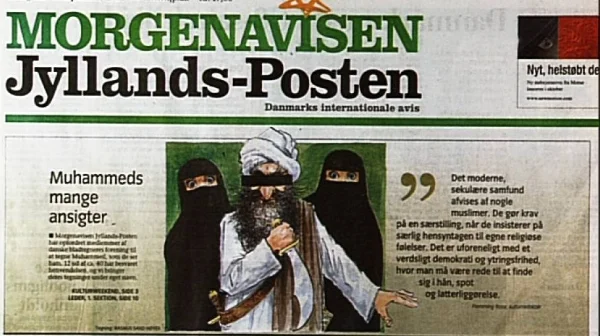
Self-censorship is tyranny's sorry, trembling little helper, and so it's to its credit that the right-of-center (which, in Denmark, is not very right at all) Jyllands-Posten, one of the country's major newspapers, picked up Bluitgen's story. What it did with it was ornery, well-intentioned and somewhat naïve. Forty cartoonists were invited to give their own interpretation of the prophet. Twelve, a little more than a third, accepted, for 800 Danish crowns (roughly $125) apiece. As we now know, the result was a storm of protest in the Muslim world, and in recent days, pushback in the West. The cartoons have been republished all over Europe and the twelve cartoonists are now, like Geert Wilders, Ayaan Hirsi Ali, and Salman Rushdie before them, learning what it is to live in hiding. They have reportedly opposed the republication of their work. It's difficult to blame them. They have been given a terrible demonstration of what it takes to survive in an era rapidly tumbling back into the pre-modern.

As for the cartoons themselves, they come from all perspectives. One satirizes Jyllands-Posten, another Mr. Bluitgen. None are very funny, or, by Western standards, remarkable. It's telling that the delegation of Danish Muslims who visited a number of Middle Eastern countries to stir up trouble over the cartoons, had to boost their dossier of grievance with three additional (and genuinely disgusting) pictures that Jyllands-Posten had never even seen and whose provenance remains, let's be polite, unclear. To try and compare the actions of Jyllands-Posten, as Bill Clinton effectively did, with the race-baiting traditions of Der Stürmer   is to reveal an ignorance of history and a disdain for free speech that disgraces the office he once held. Even the most notorious of the cartoons, the one that shows Mohammed with a bomb decorated with Islamic text in his turban, can be seen not as an insult, but as a challenge to Muslims to demonstrate that (as is indeed certainly the case) there is far more to their faith than the atrocities that have recently defaced it. Harsh? Maybe, but it was also in the Western tradition of vigorous, free discussion. And as such it should be defended.

Ideally, the publication of these cartoons would have prompted Muslims to ask themselves why Islam, one of the world's great religions, could come to be seen in such a bad light. It hasn't worked out that way. Protests have been followed by boycotts, bluster and, now, violence. The protests and the boycotts are fine. They are all part of the debate. Violence, and the threat of violence, is something else, and, as many more moderate Muslims understand, it is doing far more damage to the reputation of Islam than a few feeble caricatures.

Needless to say, the theocracies, kleptocracies, and autocracies of the Middle East, always anxious for something, anything, to distract attention from their own corruption, uselessness, and thuggery, have played their own, typically malign, part in whipping up anger. Ambassadors have been recalled. Denunciations thunder down. Angry resolutions are passed. But amid all these calls for "respect" is there any acknowledgement that many Islamic countries could do more, much more, to respect the rights of those of different faiths to their own? To take just one example, Egypt's ambassador to Copenhagen is recommending that diplomatic action against Denmark should continue, but her own country's persecuted Christian minority would be grateful indeed if their troubles were confined to a few cartoons. Respect, it seems, is a one-way street.

But that's what too many in the Muslim world have been taught to believe, by multiculturalism as much as the mosque. In the cowed, cowering Europe of recent years the idea that religious minorities have a right not to be "offended," a nonsense notion that gives veto power to the fanatic with the thinnest skin, has increasingly been allowed to trump the far more fundamental right of others to speak their mind. Writers have been prosecuted, plays have been tampered with, and works of art withdrawn. Last week, the British House of Commons came within one vote of passing a law that would almost certainly have made U.K. publication of the Danish cartoons a criminal offense. It is a sign of how far matters have been allowed to degenerate that the initial blunt refusal of Denmark's prime minister to even hold a meeting with a number of ambassadors from Islamic countries over the incident ("I will not meet with them...it is so crystal clear what principles Danish democracy is built upon that there is no reason to do so...As prime minister, I have no power whatsoever to limit the press—nor do I want such power.") was seen as shocking as it was.

Needless to say, there were others who did their best to ensure that normal servility was resumed. While most Danes backed the prime minister, a former foreign minister, a once-respected figure who has long since become a flack for the Brussels establishment, donned Neville Chamberlain's black jacket and pinstripes to denounce the cartoons "as a pubescent demonstration of freedom of expression." The U.N.'s High Commissioner for Human Rights wrote to the Organization of Islamic Conferences (which, as it was perfectly entitled to do, had complained about the cartoons) saying that she understood the OIC's concerns, if not, it appeared, the right of free speech, and she was far from being the only senior international bureaucrat to do so (and, yes, naughty Kofi made sure to throw in a few weasel words of his own). Closer to home, the EU's commissioner for Freedom, Security and Justice denounced the cartoons as "inappropriate," an adjective as Orwellian as his job description, an adjective that can only have encouraged those out to bully the Danes.

In the end, it was left to other newspapers to rally round. With the republication of the cartoons in the Christian journal, Magazinet, the Norwegians were the first to support the Danes, a gesture understandable in a country where the local publisher of Rushdie's Satanic Verses had been fortunate to survive an assassination attempt in 1993, but which was bound to inflame matters still further. And when it did, other newspapers across Europe, in France, in Germany, in the Netherlands, in Spain and elsewhere joined in, either republishing the offending cartoons or, notably in the case of France's left-of-center Le Monde, adding more of their own.

So, what now? Like it or not, the cozy, consensual, homogenous Denmark of half a century ago has vanished, never to return, and, like it or not, the old Europe shaped by Christianity, the Reformation, the Renaissance and the Enlightenment now plays host to a large and growing population with a very different intellectual and spiritual tradition. And, in an age of global communication, the idea that these problems of coexistence can be confined to one continent is an illusion. An insult in Århus can reverberate in Damascus and Amman, and for that matter, Kabul, Basra, and Baghdad too. It's this that explains why the Bush administration, with hearts, minds and a war to win, condemned the cartoons, and it's this, far less forgivably, that explains why Turkey's (supposedly moderate) Islamist prime minister feels that he has the right to tell the Danish press what it may or may not publish.

Of course the publication of those cartoons was (quite explicitly) a provocation, but the furor that followed shows that it was an acceptable thing to do. The editors of Jyllands-Posten wanted to draw attention to the fact that fears for the freedom of expression were both real and realistic. They have succeeded on both counts. Europeans realize now, if they were dim enough not to understand before, that they are faced with two very different ways ahead. The first, and better, alternative is to recognize that, to many, freedom of speech is a value as important as religious belief may be to the faithful, and to give it the protection it deserves. Reestablishing this badly eroded principle will not be easy, but to fail to do so will be to empower the fanatic to legislate for all.

The second alternative is, broadly speaking, for Europe to attempt to buy social peace by muddling along as it does now, muzzling a little speech here, rooting out a little liberty there. But this approach isn't working now. There's no reason to think that doing more of the same will prove any more effective in the future. Besides, at its heart, this is a policy of surrender, submission and despair. It is a refusal to accept that people can agree to disagree, and it is a refusal to confront those who cannot. It foreshadows an era of neutered debate, anodyne controversy, and intellectual stagnation. It will lead, inevitably, to societies irrevocably divided into immovable blocs of ethnicity and creed, carving up the spoils, waiting to take offense and thirsting for the fight, which will one day come.

Despite some of the stirring statements in favor of free speech that have been made over the last week the best bet is that Europe will continue to slide into that second, dismal, alternative. The warning signs are already there to see. Tony Blair's Labour government (again, due partly to the presence of British troops in Iraq and Afghanistan but, doubtless, due also to the presence of Muslim voters in many key parliamentary constituencies) has been at pains to condemn the cartoons, and Norway's governing left-wing coalition wasted no time in distancing itself from Magazinet. Even Magazinet's editor has now stumbled down the same sad route: "If I had dreamt of something like this happening I would not have done it. It's out of control.'' Meanwhile, a number of the newspapers that have chosen not to run the cartoons have done so explicitly on grounds of self-censorship, or, rather, they claim, "restraint," or maybe "respect": Choose your own alibi.

Even more ominously, at the prompting of our old friend, the EU's commissioner for Freedom, Security and Justice, Brussels bureaucrats are arranging a meeting for "experts" and "community leaders" (to be held no later than the end of April) that will discuss some of the issues arising out of this controversy. It is reported that, "proposals to counter race and religious hatred [may be] dusted off." We can guess where that might lead.

And as for where it all started, Jyllands-Posten has now announced that it regrets having published the cartoons: "If we had known that it would end with death threats and that the lives of Danish people could be put at risk, we would have naturally not have published the drawings." The paper apologized only for having underestimated the extent to which Muslims revere their prophet, but then it added this, "fundamentalist powers have prevailed over the freedom of speech...Danish media will now be careful about expressing attitudes that fundamentalists can misuse to create hate and bitterness."

Whip cracked. Lesson learned.

No Fear or Loathing

National Review, August 29, 2005

coffeeshop-the-doors-amsterdam.jpg

I was somewhere around Oudezijds Voorburgwal, on the edge of Amsterdam’s Red Light District, when I knew that the drugs would never take hold. My vision was bad, but then it always is; my judgment was no worse than normal; and my usual bleak mood was no better. I had absolutely no interest in tie-dye, Hermann Hesse, granny glasses, world peace, the teachings of the Buddha, or a flower in my hair. I was a loser Leary, a deadbeat De Quincey.

It had all seemed so much simpler just a few hours before. I’d been sitting in an old café on Spuistraat discussing the state of Dutch politics (bad) over a few Dutch beers (good) with my friend Henk. Sixteen biertjes later (between us, between us), it was time to move on. Henk was saying something feeble about a heavily pregnant wife, had to be by her side, baby due any moment, and I, well, I felt the call of investigative journalism. Holland’s reefer madness had to be checked out. Thoroughly.

Cannabis is not exactly legal in the Netherlands. But it’s not exactly illegal either. Finding out exactly what the country’s policy of tolerance (gedoogbeleid) means is about as easy as following stoner logic, but its result is that in certain cities so-called “coffee shops” are allowed to sell small amounts of cannabis (a maximum of five grams at a time) to their customers. Coffee shops are licensed; they pay tax and are regulated: Alcohol is rarely on offer, hard drugs are strictly forbidden, and even soft drugs cannot be advertised. No minors are permitted on the premises, and you have to be 18 before you can graze on the grass (the drinking age in the Netherlands is 16). Finally, in a last, faint, despairing echo of the country’s Calvinist past, a coffee shop can be closed down if it’s a “nuisance.”

And in recent years, many have been. As always, when anything bad happens, France is involved. Concerned by the number of their nationals traveling to the Netherlands to stock up on pot, both France and Germany have been putting pressure on the Dutch to close down the coffee shops, or at least insist that only Dutch citizens be permitted to use them. For the most part, the Dutch have paid no attention, but the purchase limit was reduced to the current five grams (from 30) and other regulations were more strictly enforced. According to the possibly reliable Smokers Guide to Amsterdam (“an unbiased view of Amsterdam for casual party people”) the number of coffee shops in the city fell from 480 in 1990 to 279 in 2001. Once the less permissive center-right Christian Democrats came to power in 2002 this crackdown went further still. A little over 200 coffee shops survive there today.

But that was more than enough to choose from. Even after I had, um, weeded out the coffee shops with names that were either too redolent of the 1960s (The Doors, Flower, Kasbah, the Kashmir Lounge, Mellow Yellow, and Pink Floyd), too scary (Lucifera, Ruthless, Stud, and Xtreme), too derivative (Rick’s Café), too tactless (Midnight-Express), or unacceptably dependent on puns (High School, High Time, Highlander, and Highway), a wide selection still remained. Some were too seedy, others too hip; the place I eventually found was relaxed and welcoming even if some of the people there appeared really, really surprised to see me.

Perhaps my suit, tie, and shirt (Jermyn Street, since you ask) were to blame. Or was the problem my age, a Cruise-Holmes span away from that of the pretty young waitress? Maybe it was just that I quite clearly didn’t know what I was doing. I hadn’t brought any tobacco with me, or any rolling papers, or even a lighter. The menu was meaningless, but vaguely alarming. White Widow? Bubblegum? Domina Haze? Manali Crema? I felt confident that AK47 was not the way to go, but as for the rest . . .

“Have you ever smoked?” asked the young, young, young waitress, anxiously.

“I was at university during the 1970s,” I replied ambiguously, plagiarizing Newt Gingrich.

She laughed, and I bought five pre-rolled joints for twenty euros — dope for beginners, I suspected, a trip with training wheels. I smoked them quietly in a corner, reading The Economist (what did you expect, High Times?), while the other customers sat across the room, puffing on Bubblegum, occasionally glancing over at this misplaced Methuselah and his Economist and wondering, probably, whether the BTK killer had been caught after all. After an hour or so, nothing seemed to be happening. The joints smelled like 1967, but their effect was 1957. Had years of legal intoxicants taken their toll, or had I simply been had? Supplementing my sad-sap spliffs with more potent space cakes (“once you’re on the ride,” cautioned the Smokers Guide, “there’s no immediate way off!”) seemed unwise. It was time to go. So I did.

If space cakes were unwise, Amsterdam’s “smart shops” look really dumb. These stoner apothecaries, a more recent arrival, sell not cannabis, but a wide selection of nature’s naughtier productions: herbs, mushrooms, cacti, and odd, unidentifiable fungi of the type that usually means trouble in sci-fi movies too low-budget to spring for a proper alien. Some of their offerings may not work at all: To believe in a “natural Viagra best boiled in vodka” took, I felt, brains more thoroughly boiled in vodka even than mine. Others may work all too well: After some Salvia, “your balance is completely lost; gravity pulls you in amazing ways.” Oh, okay.

But Holland as a whole has not lost its balance. There’s no room to recite all the arguments here, but if the coffee-shop experiment has not worked quite as well as some of its boosters claim, its critics have fared even worse. Per capita cannabis consumption in the Netherlands is estimated to be at the EU average, and rather below that prevailing in these Altered States of America; and the Dutch, of course, have avoided much of the destruction, despair, and cost of the drug wars. Disappointingly for drug warriors, there’s no evidence either that easy access to cannabis has acted as a “gateway” to more dangerous pastimes: The incidence of heroin consumption is far less than in the U.S. Overall, Holland has one of the lowest rates of problem drug use in Western Europe.

If there is an objection to the coffee shops, it’s aesthetic. Owing to them, Amsterdam has become to cannabis what Bourbon Street is to Hurricanes. This fine old bourgeois city is in danger of turning into a euro-Kathmandu, a druggy destination overwhelmed by day trippers (literally), cannabis kitsch, and counterculture dreck — which could end up destroying the typically civil Dutch compromise that has made this experiment possible.

And then there are the town’s proliferating cannabis snobs, like wine bores only, somehow, even more irritating. You can read what they have to say (Nepal Temple Balls have, apparently, a “buzzy, chatty high that makes you zone”) on coffee-shop menus and in numerous guidebooks. Or go and hear for yourself. I joined the crowd downstairs at the “Cannabis College” on Oudezijdes Achterburgwal to gaze at some outlaw botany and listen to the mumbling, muttering, meandering Yoda who was its custodian. I could take the interminable, rambling discussion of the merits of one plant over another, but when he started referring to them as his “girls,” I knew that it was time for something else: A good, stiff drink.

Easy Riders

National Review, July 18, 2005

Mongolia, May 2005 © Andrew Stuttaford

Mongolia, May 2005 © Andrew Stuttaford

Look, I’m not Hemingway, Marco Polo, or Lewis or bloody Clark. I don’t kayak, hike, or bike, but I do know I’m not the only traveler in Mongolia to have gone through a moment of despair, regret (what was so wrong with Cancún anyway?), and panic. And why not? We were somewhere remote in the country that defines remote and our guide’s “short cut” had more than a touch of the Donner Party about it. Were those really vultures, dark, enormous, and optimistic, circling over our dusty and exhausted bus as it bounced, creaked, juddered, and shuddered along the unpaved road that wound across an empty plain that made the Mojave look like the Garden of Eden? Yes, they were vultures. Big ones. Mean ones. Hungry ones.

Hours, hours, bouncing and juddering hours later, broken only by a grim little picnic by a grim little lake previously denuded of fish by dynamite-toting Chinese, we arrived at Lun, a Mad Max scrap of a settlement that shared only a syllable with the British capital, in the hope of refueling the bus. Lun’s wreck of a gas station had gas. It had pumps. It had an attendant. What it didn’t have was electricity. No electricity. No pump. No gas. The power was out all over eastern Mongolia, but the attendant thought that a lady who lived nearby might have a stash of gas, and that stash of gas could be for sale. She did, and it was.

Lun, Mongolia, May 2005 © Andrew Stuttaford

Lun, Mongolia, May 2005 © Andrew Stuttaford

The impossible has a way of happening in the land of the Mongols. They are a people too far-flung, too poor, and too strange to survive. And yet they have. They survived the collapse of the khans’ huge empire, they survived the centuries of Chinese oppression that followed, they survived even the brief, brutal, and bizarre rule of a crazed Baltic baron, and, finally, they survived the decades of Communist dictatorship that ended only in 1990.

Now at last this nation of nomads, lamas, herdsmen, shamans, miners, bureaucrats, and trainee city slickers is back in charge of its own destiny. And as in so many other parts of the old Soviet bloc the first sign of a better future is the return of the long-suppressed past. In Mongolia that can only mean one thing: You Know Who is back. Genghis! In the Communist era, Genghis Khan (or, more accurately, Chinggis Khaan) was regarded as a distinctly disreputable figure, a man best not mentioned by the politically prudent. Not anymore.

Brushed, scrubbed, rehabilitated, and thoroughly whitewashed, the old monster has been transformed into a lawgiver, philosopher, and all-round decent guy. “Yes,” I was told, “he was a mass murderer, but that’s how war is.” Besides, he was “provoked” (it’s a long — and utterly unconvincing — story). Butcher no more, Genghis now shines as a symbol of Mongolia’s lost glory and newfound confidence. There’s even talk of moving the capital from Ulan Bator (Ulaanbaatar) to the spot that Genghis picked, Karakorum (Kharkhorin), these days a tumbledown town distinguished only by a magnificent monastery having, awkwardly, no connection to Genghis. In fact, almost nothing in Karakorum has. Well, there is a modern monument — part Trump, part Brezhnev, all disaster — dedicated to the Mongol empire, but, like Mongolian cuisine, it is best passed over in silence.

Karakorum, Mongolia, May, 2005 © Andrew Stuttaford

Karakorum, Mongolia, May, 2005 © Andrew Stuttaford

Fortunately, there’s more in Mongolia for Genghis fans than Karakorum, including Chinggis cigarettes, Chinggis beer, and the alarming Chinggis vodka. In Ulan Bator, Chinggis has given his name to the best hotel, a wide avenue, and a good place to munch some mutton. Over in the national history museum, previously preoccupied with the exploits (stupendous) of the Mongolian Communist party, the Commies are out and Genghis is in.

Genghis Khan, Ulan Bator, Mongolia, May 2005 @ Andrew Stuttaford

Genghis Khan, Ulan Bator, Mongolia, May 2005 @ Andrew Stuttaford

If the great Khan’s tale is embellished, mythologized, and sometimes just plain made up, that’s understandable in a people that still seem a little uncomfortable in the trappings of a modern nation-state. And for this, the country’s complex and often savage 20th century must bear no small share of the blame.

As even a quick glance at Ulan Bator’s glum architecture will reveal, today’s Mongolia is in many ways a creation of the Soviet Union. Russia’s Bolsheviks played an important part in establishing Mongolian independence, and their successors did their best to ensure that that independence was a sham. Ulan Bator (the name means “red hero”) resembles a rundown provincial capital anywhere in the former USSR. Like many such cities, Ulan Bator was embellished with the occasional unconvincing local flourish (its wedding palace is built in the shape of a traditional Mongolian hat), but its true spirit was crushed. Most of Ulan Bator’s monasteries were, like the monks who inhabited them, obliterated, their ornate forms replaced by the slovenly grandeur and gimcrack construction so typical of Soviet rule. Even the mausoleum of Mongolia’s other great hero, the “red hero” himself, Damdiny Sükhbaatar, bears a suspicious resemblance to Lenin’s in Moscow.

Ulan Bator, Mongolia, May 2005 © Andrew Stuttaford

Ulan Bator, Mongolia, May 2005 © Andrew Stuttaford

At least the statue of Stalin that stood outside the national library was finally pulled down, if only in 1990. Other, more disturbing, traces of the murderous Georgian still remain. In 2003, construction workers uncovered a mass grave containing the remains of perhaps a thousand people. Most of the victims were Buddhist monks, shot, bludgeoned, and dumped in a ravine near Khambyn Ovoo: a small portion of the tens of thousands of victims slaughtered, exiled, or imprisoned in the 1920s and 1930s as the Mongolian party leadership, carefully choreographed by Moscow, brought the grim drama then playing in the USSR to their own country. The script is familiar, complete in every disgusting detail, even down to the rise of Horoloogiin Choibalsan, a puppet Stalin all Mongolia’s own.

Memorial Museum of the Victims of Political Persecutions, Ulan Bator, Mongolia, May 2005 © Andrew Stuttaford

Memorial Museum of the Victims of Political Persecutions, Ulan Bator, Mongolia, May 2005 © Andrew Stuttaford

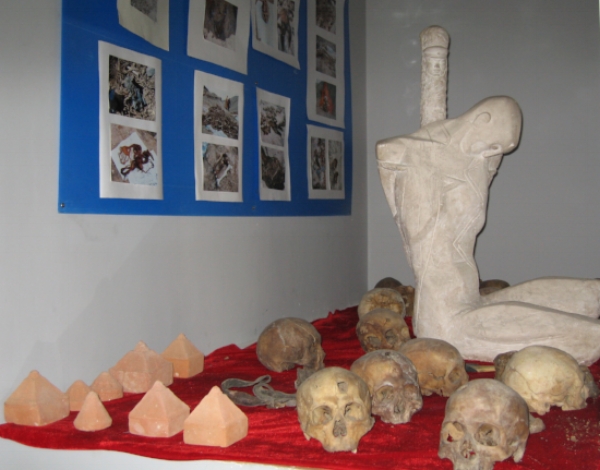
There’s an old wooden house in Ulan Bator that gives a flavor of those days. Once the residence of a Mongolian prime minister murdered in Moscow in 1937, it now hosts a museum dedicated to the victims, complete, as such museums usually are, with the incomplete: the names and the photographs of just a few of the dead. A wax tableau reproduces the scene in an interrogation chamber, while upstairs a small pile of skulls from the Khambyn ravine shows how such interrogations tended to conclude.

Memorial Museum of the Victims of Political Persecutions, Ulan Bator, Mongolia, May 2005, © Andrew Stuttaford

Memorial Museum of the Victims of Political Persecutions, Ulan Bator, Mongolia, May 2005, © Andrew Stuttaford

And as expected in the former Soviet empire, the accounting for the Communist years remains unfinished, ambiguous, and uncertain. A statue of Lenin presides over the prostitutes outside a downtown hotel, and Choibalsan still stands on his pedestal outside Ulan Bator’s university. Choibalsan’s party is in Mongolia’s governing coalition and its candidate recently won the country’s presidential elections. But the Mongolian People’s Revolutionary party is not what it was. It has accepted democracy, the free market (more or less), and, even, alliance with the U.S.; the Mongols are back in Baghdad, if rather less bloodily than in the time of the khans. Ulan Bator may be desperately poor, but there are many outward signs of returning enterprise — bustling shops, sidewalk kiosks, even a stock exchange.

Ulan Bator, Mongolia, May 2005 © Andrew Stuttaford

Ulan Bator, Mongolia, May 2005 © Andrew Stuttaford

Outside Ulan Bator conditions are far tougher. For a couple of days our group stayed in a ger (yurt) camp in a high valley to the north. The valley was lovely, with more than a touch of Shangri-La about it, but even this idyll offered a glimpse of a very hardscrabble Arcadia, where few inhabitants had much in the way of, well, anything. Life in Mongolia is harsh: The climate is merciless, incomes are low, and with little in the way of infrastructure (there are, for example, probably fewer than 5,000 miles of paved road, a miserable figure for a country the size of Alaska) it’s difficult to see how that will change any time soon. But if anyone can make this all work, I like to believe that it will be this tough, resilient people.

Mongolia, May 2005,  ©Andrew Stuttaford

Mongolia, May 2005,  ©Andrew Stuttaford

And before you say that this is a hopeless dream, go to the steppe and watch a lone horseman riding calmly through that vast impossible space, his herd in front of him, and history just behind.

Chimps, The Cheshire Cat & The Fall of Tony Blair

National Review Online, May 26, 2005

Blair2005GE.jpg

When, after a great victory, a Roman general marched in triumph surrounded by plunder, captives, and, quite probably, hot chicks, he was always accompanied by a slave whose job was to hiss periodically in the great man’s ear the irritating reminder that he was only human, not a god. Something a bit like this (well, I don’t know about the plunder, captives, and hot chicks) happened to Tony Blair in the aftermath of his party’s triumph in the recent British elections. Within hours of victory, numerous Labour politicians lined up to tell Blair to get lost. Former foreign minister Robin Cook took time out from his usual bilious routine to report on the views of the nation’s boulevardiers. “Anyone on the streets knows we were not elected because Tony Blair was popular....” Another former, a former health minister better known for the elections he has lost than those he has won, said it was time for Blair to go. Former actress and current hysteric, the shrilly leftist MP Glenda Jackson chimed in with the claim that the “people have screamed at the top of their lungs. And their message is clear. They want Tony Blair gone.”

Well, Glenda, in case you weren’t paying attention, the people have just made Tony Blair the first Labour prime minister to win three consecutive election victories. While the party’s parliamentary majority was substantially reduced, it remains, well, substantial.

To the novelist and journalist Robert Harris (an old friend of Blair’s Svengali, Peter Mandelson, but a clear-eyed judge of British politics nonetheless), this all looked like madness: “it does not…require a political genius to see…that it is a thoroughly bad idea for a minority party-cabal to bring down an elected prime minister. The Liberals did it to Asquith in 1915 and have never gained power again. The Tories did it to Thatcher… and have since suffered three successive election defeats… Now Labour, like a chimp examining a loaded revolver, shows alarming signs of the same casual attitude to its political extinction.” Harris noted that an opinion poll conducted shortly after the election had shown some 83 percent of those who had voted Labour said that Tony Blair should stay on for at least another twelve months.

The same poll, however, revealed that over 60 percent of Labour voters want Blair out within three years, an indication, perhaps, that all is not rosy for Tony. And it’s not. Take a closer look at the stats: the Labour party’s share of the vote, a dodgy postal ballot or two over 35 percent, was the lowest enjoyed by an incoming government for nearly 200 years, and impressive as Labour’s haul of parliamentary seats undoubtedly was, it came in at well below the total secured in the previous two general elections. The number of votes cast for the party has slumped by a third since the 1997 election that swept Blair into power. For the first time in a decade, many Labour MPs are sweaty, anxious, and paranoid about their parliamentary futures, something that bodes ill for Blair’s.

It seems a long, long while since the bright, confident afternoon that Tony Blair first took possession of 10 Downing Street to the cheers of a supposedly spontaneous jubilant flag-waving crowd (in fact Labour-party workers and their families, but never mind). Years of spin, manipulation, and dishonesty, made all the more grating by relentless prime ministerial preachiness, have made Blair a deeply distrusted figure, part curate, part conman, all charlatan. Of course, there’s nothing new about the British loathing a repeatedly reelected prime minister—there were few politicians so disliked as Mrs. Thatcher at the height of her powers—but Blair has to contend with a threat that never really troubled the Iron Lady: the Labour party.

Once firmly established in Number Ten, Mrs. Thatcher could always rely on the adulation of her party’s rank-and-file and, until the Gadarene meltdown of November 1990, her MPs. Tony Blair cannot. As Labour leader he has filled an abattoir with the slaughtered sacred cows of party orthodoxy. This has won him elections, but lost him the love, affection, and loyalty of his activists. They, poor souls, remain trapped in a mindset that blends traditional working class belligerence with the idiot radicalism of a third-rate provincial university. To them, Tony is the outsider, the toff, Bush’s poodle (pick your insult), a necessary evil to be tolerated only so long as he brought in the votes.

And that means that Blair is now looking very vulnerable indeed. At the election Labour lost most ground in those parts of the U.K. where his emollient appeal had once been greatest. The affluent southeast has largely returned to its Tory roots. In England itself more voters opted for the Conservatives than for Labour. Labour is once again dependent on its traditional heartlands, the industrial north, and those grim socialist satrapies better known as Scotland and Wales, territories where Blair’s message has very limited intellectual, emotional, or electoral appeal.

Compounding his weakness, Blair has already said that he will resign before the next election. Quite why he chose to hobble himself in this way remains unclear. It’s probably best to ask Blair’s chancellor of the exchequer (finance minister) and presumed successor, the sulky, scowling, and increasingly impatient Gordon Brown. In circumstances that have been obscured by controversy, mystery, and mudslinging Blair may (or may not) have promised to step down in favor of Brown at some time during his first term and he may (or may not) have promised to step down in favor of Brown at some time during his second. He may also have sold his chancellor the Brooklyn Bridge, a secondhand Pinto, and a three-dollar bill. Who knows? In any event, it’s 2005 and Blair’s still in office, but the trusting Mr. Brown has finally and painfully come to the same conclusion as the rest of the country. “There's nothing,” he told Blair, “you could ever say to me now that I could ever believe."

Eventually, Blair did what he always does (or may not have done) on the previous occasions that he needed to keep Brown onside: He promised to stand down at some point in his next term, but this time, there was a difference. He made that promise in public. The moment he did, the game was up. Politicians at Westminster, a British journalist told me, know that Blair is mortally wounded, “they can see the trail of blood all across the lobby floor.” Power, sycophants, and the ambitious are all ebbing from the prime minister, as Gordon Brown, whose fondness for some of old Labour’s more numbskull pieties has already made him the party’s darling, painstakingly cements his hold over the constituencies he will need to assure him the premiership, a union leader here, a key MP there, a friendly journalist here, a member of the House of Lords there. According to some estimates there are now three times as many Brownites as Blairites within the ranks of the parliamentary Labour party.

Superficially, Blair’s actions since the election seem to show that the maestro has lost none of his touch. The usual crop of meaningless, destructive, and plain dumb "reforms" have been announced, the House of Lords has been stuffed with another batch of cronies, dubious government appointments have been made and dissidents have been roughed up at a parliamentary-party meeting. But this is all flim-flam, flash, and empty glitter, a show that signifies nothing. A better indication of where power now lies comes from the fact that Blair was unable to push through many of the personnel changes he wanted in his new administration, a deeply humiliating rebuff for any newly reelected prime minister, let alone one who has been in office for the better part of a decade.

And the misery doesn’t end there. Blair has for a long time delegated large amounts of the domestic agenda to his chancellor (that was part of the agreement between them), but now, after Iraq, even his hold over foreign affairs is palsied, feeble, and pointless. Britain’s EU policy is a shambles, and so far as the threat from Islamic extremism is concerned, the idea that Blair could bring his party with him alongside the U.S. in doing anything that lacks the approval of the "international community," Hollywood, the Guardian and the New York Times is absurd. All that is left to Blair now is the peddling of a grandiloquent, if benign, idea—saving Africa—ripped off from a rock star.

The next step in Blair’s decline will be guerrilla warfare> against his government from the Labour Left, but this will not be enough to unseat him, and nor, probably, would Brown want it to. Despite a history of awe-inspiring and entertainingly destructive temper tantrums, Brown, like Harris, clearly understands that a coup could come at a terrible electoral price. He has resisted the temptation to play Brutus in the past, and he will do so again. He wants to inherit a united party. Ideally Brown wants that “smooth and orderly” handover that Blair is always talking about, but sooner, please, please, sooner, please, please, sooner, rather than later. So when might that be? Before the election, conventional wisdom was that Blair would oblige his impatient heir about three years into his final term, now the talk is that he might quit next year.

The problem is that there is still no obvious moment for Blair to go. Given his druthers, the prime minister, who is still only 52, would probably prefer to soldier on up to the last minute or, quite frankly, beyond. If he does have to go, this most theatrical of politicians will want it to be on a high note. The conundrum for Blair—and Brown—is that there aren’t many potential high notes around. It’s long been mooted that Blair should resign after tricking the Brits into voting for the EU’s draft "constitution" in the autumn of 2006, but so far his stubbornly euroskeptic countrymen show few signs of playing along. Of course, a British "no" might also signal the end of Blair’s show, if not quite so gloriously as he would have wished. Needless to say, all this may soon become academic: If the French and the Dutch reject the constitution in the next week any British vote may be shelved indefinitely.

The British economy won’t be much help either. After eight years in office, it looks as if Labour is finally going to have to start paying the price for the way in which it has squandered the golden inheritance of the Thatcher-Major years. Quite how this will reflect on Gordon Brown, as Chancellor the man most responsible for the coming mess, is hard to say, but increasingly unappetizing economic news will mean that Blair’s departure will look more like an exit from the scene of the crime than the glorious finale of which he must dream.

So nothing’s certain other than months, and perhaps, years of intrigue, febrile speculation and plots as Blair’s premiership fades, fades, and fades away until, like a New Labour version of Carroll’s Cheshire Cat, all that will be left is an oddly compelling smile, faint, strained, and insincere.

The Trouble with Tony

National Review OnlineMay 3, 2005

Blair.jpg

It can be a lonely business being a critic of Tony Blair in this country — outside, at least, the fever swamps of the far Left. Speaking at a crowded debate in downtown Manhattan last week, my myopic eyes could only find one brave individual who agreed that the British prime minister did not deserve reelection As my solitary supporter (thanks Myrna!) writes for NRO, I suspect kindness to a beleaguered colleague played no small part in this welcome gesture of support. Perhaps my feeble, muttered oratory was to blame, or was it the arguments skillfully marshaled by my opponent?

Maybe, but it’s just as likely that this result was mainly a reflection of the American infatuation with Tony, the saint, the hero, the Churchill with hair, but no cigar. Whenever I post any criticism of Blair over on The Corner a few angry e-mails usually come my way. Their gist: Blair is a great, great man, America’s ally; don’t bother us with the internal squabbles of your miserable little islands. This misses the point. In understanding why Tony Blair deserves to lose, remember that he’s the prime minister, not of the world, but only of those unfortunate specks in the sea. He may have been good for America, but he’s been bad for Britain.

And yet, when Britain votes on May 5 Blair will win. The only question will be by how much. But this seemingly inevitable success will owe little or nothing to Blair the international statesman (it will not be a referendum on the war, which, however unfairly, has done little for Blair other than to bolster his reputation for untrustworthiness) and almost everything to an economy that appears, however deceptively, still to be ticking over quite nicely. Critically too, Blair benefits from the weakness of an opposition seen by most voters as unprepared for prime time.

Beyond the usual ragbag of Celtic nationalists, single-issue campaigners, maniacs, madhats, and cranks, there are two opposition parties that count, one worse than Labour, and one better. The one that is worse, the Liberal Democrats, is the successor of a party that has not won an election since it dragged Britain into the First World War (thanks guys!) and it is not going to now. Nowadays it is a pro-tax party of the left that calls itself centrist, defines itself by its opposition to the liberation of Iraq, and has an alarming tendency to appeal to the sort of men who like to wear socks with their sandals.

The Conservatives would, at least, be an improvement on Labour. They aren’t much, but they’ll do (come to think of it, that should be their slogan). After the traumas of recent years, they have been reduced to a rather tatty rump, led by a man sometimes compared to a vampire (well he has been endorsed by Christopher Lee), but, given the obstacles they face, this is inevitable. Nobody entirely normal would agree to take on the task of toppling Labour. That this is such a challenge is a measure of the Conservatives’ failure. Labour rule has been marked by sleaze, spin, economic mismanagement, relentless political correctness and a chaotic immigration policy, a record that, given more effective opposition, should be enough to ensure defeat.

Of all the blots on Labour, it’s the sleaze that is the most ironic. Accusations of "Tory sleaze" played a very large part in helping Blair to his 1997 landslide. These were often unfair, but sometimes deserved. The Conservatives had shown themselves increasingly prone to the petty — and occasionally not so petty — corruption that characterizes political parties in power for a long time. Throw in John Major’s ill-advised, and impertinent, family-values campaign (which opened the door to a relentless procession of revelations about naughty Tory MPs), and Tory sleaze, whether it was payments in brown envelopes, numerous adulteries, dodgy foreign donations or, even, an autoerotic disaster, became the media story of the day, the month and the year.

Labour was going to be different — and so it was if not quite in the way (“purer than pure”) that the electorate had been led to believe. Labour scandals may have actually exceeded anything associated with the Conservatives, and might even include the electoral process itself. In an attempt to boost turnout by its supporters Labour has made it much easier to vote by post. To the judge presiding over an election court (the first to be summoned to investigate corruption for more than a century), the new system is an “open invitation to fraud” — an invitation apparently accepted by a number of Labour politicians in Birmingham. And if it’s happening there, where else?

But the most important thing to understand about Labour sleaze is not that the entire national party is corrupt (it’s not), but what it reveals about a government that became too used too quickly to the exercise — and abuse — of power. In eight years in office it has wrecked civil-service neutrality, taken a chainsaw to the constitution, packed the House of Lords with its cronies, and never seen a freedom anywhere that it did not want to crush. Worried about overreach by the "religious Right" over here? Well, take a look at Blair’s plans to make incitement to "religious hatred," whatever that might be, a crime. Salman Rushdie is horrified and he is right so to be.

And then there’s Britain’s economic performance since 1997, supposedly the definitive proof that "new" Labour has shed the caveman economics of the party’s past. Writing a panegyric to Blair in a recent edition of the New York Times, Tom Friedman managed to conjure up a portrait of Britain so misleading that Baron Munchausen would have been proud to call it one of his own. In between sips of Kool-Aid, Friedman gushed about the strong economy “engineered” by Blair and his “deft” finance minister, Gordon Brown. New Labour had, he argued, embraced the free market with such gusto that the resulting prosperity had enabled the government to deliver much-needed improvements to public services: “And these improvements, which still have a way to go, have all been accomplished so far with few tax increases. The vibrant British economy and welfare-to-work programs have, in turn, resulted in the lowest unemployment in Britain in 30 years. This has led to higher tax receipts and helped the government pay down its national debt.”

Oh really?

Now, it is certainly true that Britain has continued to prosper since Labour took over, but with one exception — the bold decision to give the Bank of England operational independence — this is despite Labour, not because of it. In 1997, Blair and Brown took over an economy that was already in excellent shape. The only surprise has been how long it has taken them to mess it up. Contrary to the fears of many skeptics (including this one), they had learned from the failures of previous Labour governments. The traditional smash and grab has been replaced by something subtler, but the consequences will, in the end, be just as poisonous.

Much of the blame for this lies with that “deft” Gordon Brown, the oddball Scot to whom Blair has delegated control of the British economy. Brown is living, snarling, and sulking proof of P. G. Wodehouse’s observation that it is “never very difficult to distinguish between a Scotsman with a grievance and a ray of sunshine.” To cut a (very) long story short, Brown believes that Blair reneged on a promise to hand over the premiership to him at some point during his second term and, while he bides his time, impatiently waiting to play Brutus to you-know-who’s Caesar, he is taking out his rage and disappointment on the luckless British taxpayer.

Brown is an intense, slightly loopy son of the manse, a weird blend of Karl Marx and Ken Lay, whose term in office has been marked by messianic egalitarianism, exciting accounting and resistance to the real reforms needed to bring Britain’s crumbling public services into the 21st century. Rather than challenge the existing model (which dates back to the 1940s) his only remedy is to throw people and pay rises into what has become a bottomless pit. Overall public spending has increased by over a quarter in real terms since 1999, and there’s much, much more to come. Half the new jobs created since 1997 have been in the public sector, twice the rate of job-creation in the economy as a whole. The state now employs one in four Britons, a handy constituency, doubtless, for future Labour governments, but a powerful brake on future attempts at reform. Needless to say, Brown is beloved by Labour party loyalists and he will almost certainly be Blair’s successor. A vote for Blair now is a vote for Brown in a year or so.

Paying the bill for Brown so far has sent Britain’s tax burden heading for its highest levels in 25 years and government borrowing is accelerating alarmingly. In 2001 Brown forecast he would borrow 12 billion pounds over the following six years, the actual figure will be (touch wood) 112 billion pounds. Include Brown’s, um, off-balance sheet financing, and government debt has increased by 13.4 percent of GDP under Labour, a dismal achievement at a time of consistent economic growth. The tragedy is that all this spending has produced little in the way of results. Education standards have barely budged and productivity in the National Health Service may have actually declined. That’s not a lot to show for all those taxpayer billions.

And the cracks are beginning to show: crippled by one of Brown’s stealth taxes, the occupational pension system is in crisis, private savings have fallen by a half, inflation is rising (the day Brown took over it was 2.6 percent; it is 3.2 percent today) and the trade balance has deteriorated. Allocating all those resources to the public sector has taken its inevitable toll, made even worse by the imposition of a massive regulatory burden (now priced at £75 billion): productivity growth is slowing (2 percent to 1.5 percent), and GDP growth is slightly lower (2.75 percent) than in the Major years (3 percent).

And if, as Blair intends, Britain signs up for the draft EU "constitution," matters will only get worse. The U.K. will be forced to give up what is left of Thatcherite deregulation in favor of micromanagement by Brussels and the adoption of the Franco-German economic model, a sure route to economic stagnation.

Just as damagingly, once enmeshed within the EU’s constitutional system, Britain will rapidly lose the right to an independent foreign policy. It’s this freedom that has enabled Blair to stand so resolutely alongside the U.S. over the last few years, the stance that has won him so many admirers over here. To his credit, the prime minister has been prepared to react to the threat represented by Islamic fundamentalism far more forcefully than most European politicians and to his credit, and at considerable political cost, he also understood what had to be done in Iraq.

But taking such positions will be all but impossible once the UK is subject to the disciplines of the EU constitution. Article 1-16 commits all member states to a "common foreign and security policy." Member states are required to "actively and unreservedly support the Union's common foreign and security policy in a spirit of loyalty and mutual solidarity and shall comply with the Union's actions in this area. They shall refrain from action contrary to the Union's interests or likely to impair its effectiveness." This is quite clearly designed to pave the way for a European defense capability owing little to the Atlantic alliance, and everything to the agenda of Paris, Berlin, and Brussels.

For Brits, that’s another good reason to reject Blair, and it even ought to make his American fans pause for thought.

Yelling Stop

National Review, April 25, 2005

Wilders.jpg

Holland was once known for its freedom, not its fanatics. It was seen as a kindly oasis in an unkind world, famous as a fair, broadminded country, a tolerant land where anyone could speak his mind without fear of retribution or the midnight knock on the door. Not now. Not after the assassination in 2002 of Pim Fortuyn, an outspoken opponent of Holland’s ruling multicultural orthodoxy. That wild, extravagant aristocrat was demonized by the political establishment, denied (some say) proper police protection, and, finally, gunned down in the street. Tolerant? Not after the slaughter in Amsterdam last November of another heretic, Theo van Gogh, filmmaker, gadfly, and controversialist, shot, stabbed, and butchered like a sacrificial animal for daring to attack Muslim fundamentalism. Free? No, not really. Not anymore.

In the days after van Gogh’s murder, the Dutch government at last began to act. To lose one public figure might have been unlucky; to have lost another looked like carelessness. Ayaan Hirsi Ali and Geert Wilders, two members of parliament loathed by Holland’s Islamic extremists, were whisked off to heavily guarded safe houses. In February, the Somalian-born Hirsi Ali emerged to complain that the authorities appeared incapable of making permanent arrangements for Wilders’s and her security. It turned out that she had been camped out in a naval base. As for Wilders, a fortysomething MP from the southeast of the country, well, he had been housed in a location that could only have been picked by someone with no sense of irony or, perhaps, with too much. He’s been living in a prison: to be precise, the jail within a jail where the Lockerbie bombers once awaited their trial. Those who threaten him remain outside, free to do their worst.

Stoic Dutchman that he is, Wilders doesn’t like to grumble. “I have to make the best of it,” he told me in a recent interview. “I have a kind of living room, which is quite okay. On either side, there are the cells where the two Libyans were held. In one cell I have my clothing . . . In the other cell there is my bed.” The prison is, “of course, a terrible place,” but his hosts have done what they can. “They put some lamps in and a TV,” small consolation, I suspect, for a life under siege.

We were chatting, not in the prison, but over coffee in a small, cramped office tucked away at the end of a long corridor somewhere in the depths of the building that houses the Dutch parliament in The Hague. A number of bodyguards sat nearby. Outside, it was a bright, brisk early spring morning, freshened by a North Sea breeze, the slightly surprising quiet punctuated mainly by the cries of the occasional seagull. The Hague looked its best, the understated capital of the timeless, civilized Holland of popular imagination, souvenir shops crammed with its symbols, Delftware, windmills, tulips, clogs, and Sint-Niklaas. Inside, Wilders, symbol of Holland’s new, more uncomfortable reality, describes the way that he is now kept alive.

The death threats, which, needless to say, include that latest cliché of a resurgent barbarism, calls for his beheading, are relentless, increasing, and chilling. “I would be lying if I said I was never afraid.” In an age of freelance jihad, even those rants that consist, probably, of little more than Internet bravado have to be taken seriously as possible incitements for someone somewhere to reach for knife and gun. The result is a life under constant guard, a “crazy, tough” life, a life with little privacy and less spontaneity, a life punctuated by visits to the police “five or six times a week,” a life where Wilders, in short, no longer feels free. It is almost impossible to see friends. Dining out occasionally is “better than eating in prison every evening,” but with a number of guards in tow, it is, inevitably, a “circus,” something, he explains, smiling, that can remove the romance from an evening out with his wife. “You have to whisper, or everyone from security can hear.”

Somehow Wilders has retained his sense of humor. A wry, thoughtful, somewhat intense man, he can still manage a laugh at the absurdities of his predicament. It’s only the occasional nervous gesture or the fleeting traces of tension that sometimes cross his face that betray a hint of the appalling pressure with which he has to cope. At the same time he obviously relishes the remarkable challenge he faces in attempting to build up a new political organization (Wilders broke with his old party, the free-market VVD, in September 2004), a difficult enough task under any circumstances, let alone those under which he now has to operate. No matter: “I have a lot of adrenalin going through my veins.”

Wilders’s new political group has, he believes, “a lot of possibilities.” Like most politicians, he is ambitious, “I’m not there yet . . . but I’m on my way.” It’s clear that he has sensed that the unease now enveloping the Netherlands could be his route to the top. As we chat, he proudly prints out new poll findings showing that the “Wilders Group” could expect to win around 10 percent of seats in the Dutch parliament’s lower house.

It would be a mistake, though, to see Wilders as an opportunist cashing in on thecurrent turmoil: His opposition to Holland’s seemingly perpetual soft-left consensus, stifling corporatism, and multiculturalist muddle can be traced back at least a decade, to his time as a speechwriter for Frits Bolkestein, the then VVD leader, who was one of the first to sound the alarm over the country’s failure to integrate its Muslim minority, a minority that is now about a million strong (out of a total population of a little over 16 million). Wilders himself went on to flourish within the VVD, rising to become its foreign-affairs spokesman. His departure from the party — the catalyst was his opposition to any invitation to Turkey to join the EU — might indeed turn out to be a shrewd move, but equally it could be nothing more than a leap into the wilderness.

His background in mainstream politics means, however, that Wilders is no outsider, and thus, unlike Fortuyn or van Gogh, he is not easy to caricature as a crank, a fascist, a racist, or a joker. He’s a pro, one of the grownups, respected (if not exactly universally loved) in parliament. Yes, it’s true that, despite his extraordinary hairdo, a pompadour in Billy Idol peroxide, Wilders doesn’t have the eccentric charisma of his two murdered predecessors: He has neither the extraordinary camp élan of Fortuyn nor the bad-boy charm of van Gogh (who never stood for elective office), but he more than makes up for this with a résumé that means that he has to be taken seriously.

And that’s exactly what he wants. During the course of the interview, Wilders is at pains to distinguish himself from Jean-Marie Le Pen and others on the darker side of the European “Right.” He is, he says, simply a “Tocquevillian conservative,” but a glance at his recent manifesto (the somewhat bombastically named “Declaration of Independence”) reveals a more complex mix, an eclectic blend of small-government conservatism, Atlanticism, free-market liberalism, Euroskepticism, and populism. But, above all, Wilders will be judged by his response to Holland’s failed and feckless experiment in multiculturalism. Sometimes this is subtle: He likes to connect the dots between the increasingly intrusive federalism of the EU and the dangerous consequences of the enfeebled sense of national identity within its member states. Sometimes it is not. Wilders is unapologetic in proclaiming the superiority of Western values. He is not, as he puts it, a “cultural relativist.” In an era of PC platitudes, Wilders can be bracingly blunt: “I don’t believe in a European Islam, in a moderate Islam . . . Islam and democracy are incompatible.” He is careful, however, to draw “a distinction between the religion and the people . . . Islam and democracy are incompatible, but Muslims and democracy are compatible.” Trying to change Islam is, in his view, a hopeless task; trying to win over its followers in the Netherlands is not.

To achieve this, he is recommending a program that features carrots and, unusually for Holland, sticks. It includes a five-year moratorium on immigration from “non-Western” countries, deportation of dual nationals convicted of criminal offenses, extra public spending to aid in the assimilation process, the closing down of extremist mosques, and preventive detention of some of those in the small hard core (“a few hundred”) reasonably believed to be planning terrorist attacks. Saving lives must, Wilders believes, come ahead of extending the full protection of Dutch law to those who would overthrow it. And no, he concedes, “this is not an easy concept.” Indeed, it isn’t.

Talking to Wilders, I was left with the impression of a work in progress, of a man still trying to think through the full ramifications both of the complex and threatening situation now facing his country and of the remedies he is proposing to resolve it. He does not have all the answers, and some of those he has may well be wrong, perhaps very wrong. But to his credit, Wilders is at least asking the right questions, something that few in Holland have been brave enough to attempt before. And, no, this stubborn, determined, man is not going to give up anytime soon. “That’s what the people who threaten me want me to do.”

Powder Keg

National Review Online, March 24, 2005

salt.jpg

There's a menace abroad in the land, a lethal white powder that is being consumed by sensation-seekers all across America. And like meth and other fashionable horrors, this scourge is not confined to the mean streets of the big city, but can be found in the small towns, big malls and red states of the heartland. Worse still, there's disturbing evidence that many otherwise responsible people are being tricked into taking this substance; horrifying report after horrifying report of innocent and unsuspecting individuals swallowing food cynically spiked with this silent and seductive killer, a killer which is, some say, responsible for the loss of 150,000 Americans—that's nearly forty times the battlefield death toll at Antietam—each year.

The name of this killer? Salt. That's right. SALT. As in shakers. As on plates. As on fries. Good old, familiar, deceitful sodium chloride, unmasked at last as a Dahmer at dinner and a Bundy at breakfast, a smooth-flowing serial killer found lurking even in our morning cereal. And who has done the unmasking? Somehow I think that you can already know the answer. Yup, once again that bizarre collection of neurotics, nannies, killjoys, hysterics, and scolds better, if misleadingly, known as the Center for Science in the Public Interest, has dreamt up yet another way to poison the pleasure that Americans take in their food.

At the end of February, CSPI published a new report, "Salt: The Forgotten Killer," and announced legal action against the FDA. Its lawsuit is designed to compel the agency to declare salt a "food additive", something that could be the prelude to mandating lower sodium levels in processed and restaurant foods. There is "no way", claimed CSPI executive director Michael Jacobson, that the "FDA can look at the science and say with a straight face that salt is 'generally recognized as safe'".

To be fair, there is slightly more justification for the assault on salt than many earlier campaigns against just about anything that might cheer up a meal (caffeine, frozen desserts, fried mozzarella sticks, garlic bread, General Tso's chicken, alcohol, fettuccine Alfredo, meatloaf, cookie dough, the Cold Stone Creamery's Mud Pie Mojo, and so, so much more). Most medical professionals do indeed believe that too much salt in the diet can lead to high blood pressure (high blood pressure is a major contributory factor in cardiovascular disease), but there are dissenters. To Jacobson, those who disagree with his views are nothing more than noisy "contrarians" basing their conclusions on "flawed, misinterpreted" or "fragmentary" research, harsh words that, coming from CSPI, conjure up thoughts of stones and glass houses.

In fact, the science is somewhat less clear-cut than the Center's researchers would like you to know. Their report has nothing to say about a 2002 study published in The British Medical Journal that showed no decrease in either the death rate or the incidence of cardiovascular disease among the subjects of the study who reduced their salt intake. Jacobson is also silent about the fact that, despite years of research, links between lower sodium intake and improved health in the general population remain awkwardly elusive. As for those noisy "contrarians," their ranks include former presidents of the American Heart Association and the American Society of Hypertension, and, just last year, a number of Canadian medical groups including the Canadian Hypertension Society, the Canadian Coalition for High Blood Pressure Prevention and Control, and the College of Family Physicians of Canada.

Jacobson does, however, find time to bring his readers the good news about the Yanomami, rainforest Indians, who consume only 20 mg of sodium a day (less than one percent of the average American's intake) and "are healthy, do not gain weight as they age, and are totally free of high blood pressure." Curiously, he does not bother to explain that the Yanomami live in miserable Stone Age squalor, eat the powdered bones of their dead (mixed in with a banana soup, since you ask), and on average only just make it past the age of 40. Call me fussy, Dr. Jacobson, but I'll look elsewhere for nutritional inspiration.

Perhaps it's best to sidestep this controversy for now and just take time to savor Jacobson's jeremiad as yet another sample of how the CSPI's chow-time Comstocks manipulate the media, the science and the public in the interest of taking aim, yet again, at their real foe: fun.

As is its usual practice, CSPI begins this latest onslaught with tales of a spectacular death toll (those 150,000 hardy, but unfortunate, Americans who manage to escape the carnage brought by passive smoking, obesity and the Second Amendment only to succumb to a condiment) and then piles on from there. "This innocent-looking white substance" may, says Jacobson, a man clearly unaware of what anchovy can do to pizza, "be the single deadliest ingredient in our food supply."

And as usual, the language of these latter-day puritans resembles nothing so much as the darker, more lurid sermons of their stern black-hat/black-suit predecessors of three centuries before. The report is morbid and overblown; its author appears fixated on the horrible fate that awaits those who have sinned: "[T]he salt in our diets has turned our hearts and arteries into ticking time bombs, time bombs that explode in tens of thousands of Americans every year."

That's not to say that reading this grim, grating report is entirely without its rewards. The CSPI is justly celebrated for its obsessive exploration of the wilder regions of American food rococo, and, in this respect at least, Salt: The Forgotten Killer does not disappoint. While the appearance of that notorious repeat offender, General Tso's chicken (with rice, 3,150 mg of sodium), on CSPI's salty rap sheet won't come as much of a surprise, fans of extreme cuisine will be delighted to learn of the existence of two salt-mountainous treats from Denny's—the robust Lumberjack Slam (two eggs, three hotcakes with margarine and syrup, ham, two strips of bacon, two sausage links and 4,460 mg of Lot's wife), and the disturbingly-named Moons Over My Hammy (ham and egg sandwich with Swiss and American cheese on sourdough and a mere 2,700 mg of the deadliest single ingredient in our food supply).

Jacobson argues that those who feast on such delicacies are unaware quite how much salt they are consuming, an argument that dovetails neatly with CSPI's longstanding campaign to compel chain restaurants to list nutritional data on their menus. Eating out is, writes Jacobson, "basically a nutritional crap shoot", a statement that implies that most people are too dumb to understand that Moons Over My Hammy may not exactly pass muster as health food. But Jacobson's claims should come as no surprise. Without the assumption that Americans are incapable of deciding for themselves what to eat, there would be no room for the big government paternalism so relentlessly advocated by CSPI.

But, ironically, if consumers are unclear as to what they ought to be munching, it is organizations such as CSPI that must take their share of the blame. Jacobson half-acknowledges this when, in the course of bemoaning the fact that Americans seem less worried about sodium than they were some years ago, he notes that "the public's concern about salt's harmfulness has steadily diminished, as controversies over low-carb diets, trans fats, genetically engineered foods, and other topics have dominated the headlines," controversies (which Jacobson might have said, but didn't) in which his own center has played no small part. The constant food scares generated by the health mullahs at a time when average life expectancy in the U.S. has just reached a new high have done nothing other than increase consumers' confusion, cynicism, and the chance that genuinely good advice gets junked as junk science.

The best counsel remains, as it always has been, a balanced diet, moderate exercise and, good news, maybe a drink or two, but then that's the sort of common sense that would leave no room for a CSPI, let alone the overbearing measures that Jacobson would like to see imposed on the rest of us. It's revealing that the center is trying to bully the FDA through litigation rather than by more democratic measures, but its lawsuit against the government agency is doubtless only the beginning. If salt were to be no longer "generally recognized as safe" by the FDA, it would only be a matter of time before the usual cabal of "public interest" lawyers and the tort bar turn their attention to the food companies and restaurant chains and dig up a salt-scarred plaintiff or two.

And that would not be the end of it. Jacobson's report concludes with "an agenda for action" that includes mandatory sodium limits in processed food, and consideration of a "salt tax" (in addition, presumably, to the proposed Twinkie tax we have all read so much about). In short, therefore, the policy recommendations from an organization often misdescribed as a consumer group would, if implemented, mean less choice, not more.

They need to be taken with a pinch of you know what.

Constitutionally Indisposed

National Review Online, February 22, 2005

Giscard.jpg

A little over two centuries ago, a small group of planters, landowners, merchants, and lawyers met in Philadelphia to decide how their new country was to be run. Within four months this remarkable collection of patriots, veterans, pragmatists, geniuses, oddballs and the inspired succeeded in agreeing the extraordinary, beautiful document that, even with its flaws, was to form the basis of the most successful nation in history.

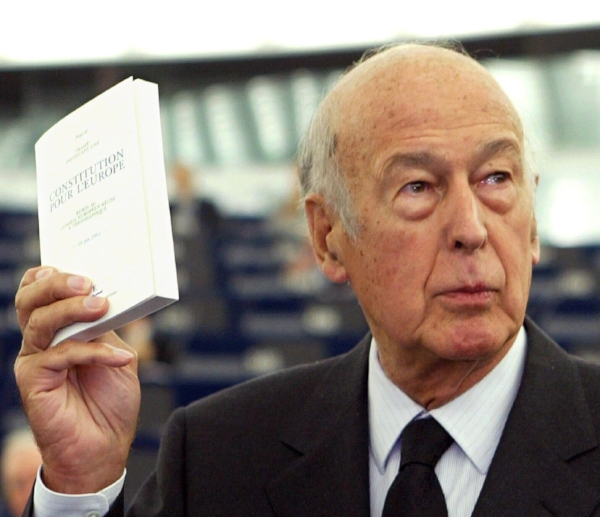
On February 28, 2002, another constitutional convention began its work, in Brussels this time, not Philadelphia. Its task was to draw up a constitution for the European Union. The gathering in Brussels was chaired by Giscard D'Estaing, no Hamilton or Madison, but a failed, one-term president of France best known for his unseemly involvement with Jean-Bedel Bokassa, the cannibal "emperor" of central Africa. Giscard's convention was packed with placemen, cronies, creeps, and has-beens to make up a body where to be called second rate would have been an act of grotesque flattery. Only a fool, a braggart, or a madman would have compared this rabble with the gathering in Philadelphia. Needless to say, Giscard managed to do just that. The rabble returned the compliment. At ceremonies held to celebrate the conclusion of the convention's work, one over-excited Austrian delegate compared Giscard to Socrates, a remark that would undoubtedly have reduced that ancient, and unfortunate, Greek to yet another swig of hemlock.

Once the convention had completed the draft constitution, there was further haggling over the text by the governments of the EU member states. A final version was agreed in June 2004, and what a sorry, shabby work it is, an unreadable mish-mash of political correctness, micromanagement, bureaucratic jargon, artful ambiguity, deliberate obscurity, and stunning banality that somehow limps its way through some 500 pages with highlights that include "guaranteeing" (Article II-74) a right to "vocational and continuing training," "respect" (Article II-85) for the "rights of the elderly... to participate in social and cultural life," and the information (Article III-121) that "animals are sentient beings." On the status of spiders, beetles, and lice there is, unusually, only silence.

All that now remains is for this tawdry ragbag to be ratified in each member state, a process that is already well underway. In some countries ratification will depend on a parliamentary vote, in others a referendum. The final outcome remains difficult to predict, and it is a measure of the current uncertainty over the constitution's ultimate fate that there is now open discussion of the idea that the document may be forced through even without ratification by one or two of the smaller countries. In an editorial over the weekend, the Financial Times, a generally reliable mouthpiece for the latest Brussels's orthodoxy explained, "in theory, one state's rejection is enough to kill [the constitution]. In practice, it will depend on the state." Within the EU, it seems, some nations are more equal than others. Rejection by one of the union's larger members, however, will be enough to throw the whole process into richly deserved chaos. We can only hope.

And it is at this point that, rather surprisingly, the Bush administration has come into the picture. Speaking a few days ago to the Financial Times, Condoleezza Rice appeared, weirdly, to give the constitution some form of endorsement: "As Europe unifies further and has a common foreign policy—I understand what is going to happen with the constitution and that there will be unification, in effect, under a foreign minister—I think that also will be a very good development. We have to keep reminding everybody that there is not any conflict between a European identity and a transatlantic identity..."

In a later interview with the Daily Telegraph, President Bush himself appeared to steer discussion away from the proposed constitution, but he did have this to say: "I have always been fascinated to see how the British culture and the French culture and the sovereignty of nations can be integrated into a larger whole in a modern era," he said. "And progress is being made and I am hopeful it works because one should not fear a strong partner."

How can I put this nicely? Well, there is no way to put it nicely. Even allowing for the necessity to come out with diplomatically ingratiating remarks ahead of a major presidential visit to the EU, the comments from Bush and Rice are either delightfully insincere or dismayingly naïve.

The project of a federal EU has long been driven, at least in part, by a profound, and remarkably virulent anti-Americanism, with deep roots in Vichy-era disdain for the sinister "Anglo-Saxons" and their supposedly greedy and degenerate culture. Throw in the poisonous legacy of soixante-huitard radicalism, then add Europe's traditional suspicion of the free market, and it's easy to see how relations between Brussels and Washington were always going to be troubled. What's more, the creation of a large and powerful fortress Europe offered its politicians something else, the chance to return to the fun and games of great power politics.

They have jumped at the opportunity. Speaking back in 2001, some time before 9/11 and the bitter dispute over Iraq, Swedish Prime Minister Göran Persson (who then also held the EU's rotating presidency) provided a perfect example of the paranoia and ambition that underpins this European dream. The EU was, he claimed "one of the few institutions we can develop as a balance to U.S. world domination."

Brandishing the American bogeyman was always inevitable. Condoleezza Rice may claim to have discovered a European "identity," but outside the palaces, parliaments, and plotting of the continent's politicians such an identity is a frail, feeble, synthetic thing. The preamble to the EU constitution refers to a Europe "reunited after bitter experiences," a phrase so bogus that it would embarrass Dan Brown. Unless I missed something in my history classes "Europe" has never been one whole. There is nothing to reunite. A Swede, even Göran Persson, is a Swede long before he is a "European." Naturally, the framers of the constitution have done their best to furnish a few gimcrack symbols of their new Europe (there's (Article I-8) a flag, a motto ("United in Diversity), an anthem, and, shrewdly in a continent that likes its vacations, a public holiday ("Europe Day") and perhaps in time these will come to mean something, but for now they are poor substitutes for that emotional, almost tribal, idea of belonging that is core to an authentic sense of national identity.

But if the EU has had only limited success in persuading its citizens what they are, it has done considerably better in convincing them as to what they are not: Americans. Writing in 2002 about the "first stirrings" of EU patriotism, EU Commissioner Chris Patten could only come up with two examples: "You can already feel [it], perhaps, in the shared indignation at US steel protection...You can feel it at the Ryder Cup, too." It's significant that when Patten gave examples of this supposed European spirit, he could only define it by what it was against (American tariffs and American golfers) rather than by what it was for. It is even more striking that in both cases the "enemy" comes from one place—the U.S. If Patten had been writing in 2005 he would, doubtless, have added opposition to the war in Iraq to his list—and he would have been right to do so.

This is psychologically astute: The creation of a common foe (imagined or real) is a good way to unify a nation, even, possibly, a bureaucratically constructed "nation" like the EU. Choosing the U.S. as the designated rival comes with two other advantages. It fits in nicely with the existing anti-American bias of much of the EU's ruling class and it will strike a chord with those many ordinary Europeans who are genuinely skeptical about America, its ambitions and, yes, what it stands for.

Insofar, therefore, as it represents another step forward in the deeper integration of the EU, the ratification of the constitution cannot possibly, whatever Secretary Rice might say, be good news for the U.S. How deep this integration will be remains a matter of dispute. In Euro-skeptic Britain, Tony Blair's government has denied that the document has much significance at all, but without much success. At the same time, claims that the ratification of the EU constitution will of itself represent the creation of a European superstate are overblown. It won't, but it will be another step in that direction, and, based on past precedent, we can be sure that the EU's fonctionnaires will use the vacuum created by all those helpful ambiguities in the constitution's text to push forward the federalizing project as fast and as far as possible.

It is, of course, up to Europeans to decide if this is what they want. Any attempt by the Bush White House to derail the ratification process would backfire, but that does not mean that the administration should be actively signaling its support for this dreadful and damaging document. Secretary Rice argues that the integration represented by the passing of the constitution would be a "good development." The opposite is true. If the EU (which has a collective agenda primarily set by France and Germany) does increasingly speak with one voice, Washington is unlikely to enjoy what it hears.

The constitution paves the way for the transfer of increasing amounts of defense and diplomatic activity from Europe's national capitals to Brussels. Article 1-16 commits all member states to a "common foreign and security policy." "Member states" are required to "actively and unreservedly support the Union's common foreign and security policy in a spirit of loyalty and mutual solidarity and shall comply with the Union's actions in this area. They shall refrain from action contrary to the Union's interests or likely to impair its effectiveness." In a recent radio interview, Spanish prime minister Jose Zapatero explained how this might work: "we will undoubtedly see European embassies in the world, not ones from each country, with European diplomats and a European foreign service...we will see Europe with a single voice in security matters. We will have a single European voice within NATO."

And the more that the EU speaks with that one voice, the less will be heard from those of its member states more inclined to be sympathetic to America. And as to what this would mean, well, French Green politician Noel Mamère put it best in the course of an interview last week: "The good thing about the European constitution is that with it the United Kingdom will not be able to support the United States in a future Iraq."

And would that, Secretary Rice, be a "good development"?

Waving The Bloody Shirt

National Review OnlineJanuary 18, 2005

Prince Harry.jpg

Gott im Himmel, what was Harry thinking? If you are a public figure, the great grandson of the last emperor of India no less, and you live in censorious—and camera-phone-saturated—times, attending a "Native and Colonial" party is almost certainly unwise. To do so in Nazi uniform is absolute madness. And after days of high drama, low farce, and massed denunciations, we all know the result. The "Clown Prince" and the Circus

To take just a brief selection of the criticism, Harry is now the "Hitler Youth" (the Sun, a newspaper that dilutes its moments of moral indignation with bouts of manic punning), "the most tasteless fool in the country" (London Times), and "an idiot" (Independent). Perhaps more worrying for the "clown prince" (Sun, again), the principal prominenti to rally to his support were David Irving (a historian often accused of Holocaust revisionism), a disgraced Tory MP, and Fergie.

It would have done nothing for the Night Porter, but Harry's has been the shirt seen 'round the world, the mother of all wardrobe malfunctions, a poor, sad scrap of bad taste, a feeble facsimile of an Afrika Korps tunic, garnished with a swastika armband, a touch that the late Field Marshal Erwin Rommel would, I suspect, have found somewhat vulgar.

And yes, it was a dumb, dumb thing to do. Stupid rather than malicious, but, particularly given Harry's status, it was clearly inappropriate—and genuinely offensive to many. Quite rightly, the prince was quick to issue an apology. That should have been an end to the matter. That it was not says plenty about modern Britain and contemporary Europe, little of it good.

To be sure, the British press was always going to keep the story alive for as long as it could. Royal scandals shift newspapers, and so do the Nazis. Combining the two was a circulation manager's dream. Even allowing for this, however, the torrent of humbug, hypocrisy, and hysteria that has engulfed the hapless Harry has been remarkable and, in some ways, rather more repellent than the wretched regalia that sparked the uproar in the first place. It also ignores the fact, critical to understanding this incident, that for many Brits, the Nazis have long been good for a laugh.

Now, Harry is not, by most accounts, much of an intellectual, so to claim that his brown-shirted burlesque was somehow a deliberate Producers-style satire is a stretch too far. At the same time, his dreadful choice of costume, however dimly, however unconsciously, reflected a national fondness for making a mockery of the pretensions of the Third Reich. On occasion this can be tasteless, but ridicule is not a bad way to strip the swastika of some of its malign power. The failure of neo-fascists ever to make much progress in the U.K. (unlike in some other European countries) can at least partly be put down to the fact that voters have been too busy laughing to take them very seriously.

Some press comment in Britain did allude to this tradition, but a good number of journalists took the chance to indulge in royal-bashing and class warfare. It was a wonderful opportunity to give the toffs a good kicking, while appearing to remain on the moral high ground. The Guardian is usually a good source for this sort of thing. It didn't disappoint. To take just a quick dip into the venom, we find John O'Farrell frantic and foaming over "pro-hunting upper-class twits," sly hints from Mark Lawson that the evil Tories are far more likely to dress up in Nazi uniform than their political opponents and a reminder from Duncan Campbell that Edward VIII had "admired what Hitler was doing in Germany."

In Germany itself, reactions were no less vitriolic, and, reflecting exasperation at the U.K.'s endless, and frequently crass, obsession with the Second World War, included some Brit-bashing for added flavor. The most weirdly entertaining response, however, came from a commentator in the mass-circulation Bild who scribbled this message to Harry. "You are...about as disgusting as a moldy piece of food. I vomit. It is high time that you were given serious medical treatment. You are a traumatized child."

Getting it exactly wrong, meanwhile, Der Spiegel described the uniform of the Afrika Korps as being "hated" in the U.K. because of British casualties in the desert war. In fact, the reverse is true. The soldiers of Rommel's army have traditionally been seen as the "good" Germans, worthy opponents beaten in a fair fight. If, as was apparently nearly the case, Harry had opted, God help us, for a SS uniform, the row would have been far, far worse.

Adding to the frenzy, and showing that, even now, after nearly six decades of democratic government, they do not fully understand the occasionally uncomfortable realities of free speech, some German politicians used Harry's gaffe to lobby for a Europe-wide ban on the display of Nazi symbols. Such a ban would be a mistake on a number of grounds, but it is interesting to see that there was no suggestion that it should also cover Communist insignia. Why not? Do the tens of millions who died under the hammer and sickle count for any less than those butchered by the Hitler regime? To look at this point another way, ask yourself if there would have been such uproar if Harry had come dressed as a Stalin-era commissar or clutching Mao's Little Red Book. You know the answer.

As if that level of hypocrisy was not enough, it seems that even some fascists, real ones, may be regarded as less of a scandal than the wayward Windsor. Le Monde has reportedly suggested that the furor over Harry may hit London's chances of winning the right to host the 2012 Olympics over rivals such as Paris, the capital of a country where some15 percent of voters regularly give their support to the National Front, a party headed by a man who has described the Holocaust as a "detail."

More ominously still, this wave of indignation over a spoiled and irrelevant young prince makes a revealing contrast with Europe's supine response to Islamic extremists, the brownshirts of our own era. But, perhaps we should not be surprised. How much simpler, and politically more convenient, to condemn one moronic 20-year-old, his unpopular social class, and (internationally) his countrymen, than to confront the real danger to freedom now developing among a section of the EU's Muslim minority. Facing this challenge will be a tricky task not easily reconciled with the multicultural pieties of Europe's ruling establishment, or, arguably, the pockets of anti-Semitism that may lurk within it. Symbolic solidarity with the vanished victims of the past is so, so much less demanding.

Ironically, however, these politics of the empty gesture reached their nadir with the suggestion by the Simon Wiesenthal Center (an organization which should know better) that Harry should be made to attend the commemoration at Auschwitz of the 60th anniversary of the camp's liberation. Such a grotesque stunt, both morbid and meaningless, would have been an insult to those murdered in that terrible place. Thankfully, the idea was rejected.

In this squalid and sorry saga, it was a rare moment of dignity.

Dead Zone

National Review Online, December 8, 2004

Lily Dale, September, 2004 © Andrew Stuttaford

Lily Dale, September, 2004 © Andrew Stuttaford

If the painter Thomas Kinkade has redesigned Heaven—and who’s to say that he hasn’t?—it might look a little like Lily Dale, a tiny community about an hour south of Buffalo. On a gentle-breeze, blue-sky, no-cares, endless-summer sort of day, gingerbread Victorian cottages doze alongside tranquil, flag-festooned streets. The houses’ colors—white, yellow, gray—are, like their inhabitants, mainly muted, gentle by design or faded by the years. Only occasional flashes of eccentricity—an unexpected plague of stone angels here, a rash of concrete cherubs there—signal to visitors that there’s something not quite right, not Shyamalan wrong, but odd nonetheless, about this idyllic village nestled so prettily against a quiet lake.

Even Lily Dale’s visitors (those that are visible anyway—I’ll explain that remark later) seem more subdued than the typical vacationing hordes, more Trappist than tourist, chatting among themselves in low tones as they stroll towards their destinations. Once—over a century ago—there was a Ferris wheel here, a bowling alley, dances, even (oh, the thrill!) speeches by Susan B. Anthony, but those excitements have passed, vanished into history and stiff sepia images. But guests can still wander under the shade of trees more than a hundred years old now, and, if they choose, across a series of small, perfectly kept parks—immaculately green as they sweep down in the direction of the lake, itself smooth, untroubled, and inviting, gently lapping up against the eastern edge of town.

And the sense that there’s something celestial about this place is only reinforced by a small white-pillared “Forest Temple” half-hidden amid some trees and by the “Healing Temple” that can be found nearby (yes, yes, I was “healed,” blue light discovered burning within me, long story). Bells toll at certain times of day summoning the faithful to meditation, ritual, and to quavering old tunes played on a quavering old organ, the singing of quavering old hymns of spirit messages and eternal light.

These people are, quite clearly, not Baptists.

To find out more, enter the cool, dark Leolyn Woods. Like so much in Lily Dale, they are unexpected survivors, a rare scrap of old-growth forest. Walk straight ahead. Don’t be tempted by the questionable attractions of the pet cemetery. Look instead for an ancient tree stump—Inspiration Stump, they call it here—and the people gathered there to hear from the hereafter. They have turned up for the daily “message service,” a séance, stand-up style, at the stump, starring the quick (a rapid succession of mediums) and the dead (a host of the dear departed—dads, moms, a brother or two).

If you’re ex, Lily Dale is in.

People have been bothering the dead in Lily Dale since 1879. That was the year in which a handful of pioneers, enthusiastic participants in the great wave of spookery and table tapping that gripped those supposedly sensible Victorians, first bought property here. It was to be a permanent site (only Spiritualists can own property in “the Dale,” even today) for enlightenment, and communication with corpses—a “White Acre,” wrote Mrs. Abby Louise Pettengill (its 1903 president), “where all may receive the benediction of the unseen world.”

She would have been pleased to see (and perhaps she did, who knows?) the small but expectant crowd waiting one Friday evening in Lily Dale’s Assembly Hall for a benediction from another world, in their case a chinwag with ET. Like Spiritualism before it, much UFO mythology is an attempt to reconcile mystical and superstitious impulses with the unwelcome realities of an age of science. And like Spiritualism it soon descends into mush-mutterings of otherworldly visitors, enlightened beings, and contact with the mysterious, thrilling unknown, talk which the late (or not) Mrs. Pettengill would surely have relished.

And when it comes to enlightened beings, there’s no better guide than the human speaker that night, writer and soulapath (don’t ask) Lisette Larkins. She’s the author of Listening to Extraterrestrials: Telepathic Coaching by Enlightened Beings; Talking to Extraterrestrials: Communicating with Enlightened Beings; and, alarmingly for those of us familiar with the work of Fox Mulder, Calling on Extraterrestrials: 11 Steps to Inviting Your Own UFO Encounters. After an hour or so of New Age banality and musical interludes that would have insulted Yanni, an alien turns up, but, dismayingly, via Ms. Larkins rather than in person. Repeatedly shaking her head from side to side, alien Lisette starts speaking in a slow, faintly mechanical voice slightly reminiscent of Hillary Rodham Clinton. She is purportedly channeling messages from our extraterrestrial visitor, but the vague beatitudes and something about “connecting” reveal only that this particular alien is from Planet Hallmark. That’s not worth the price of admission. For 30 bucks I expect Klaatu barada nikto or, at least, sexy Sil from Species.

Where flying saucers hover, other nonsense is never far behind. Sure enough, the Crystal Cove, Lily Dale’s gift shop, is a supermarket of superstitions, a casbah for the credulous, its pick-’n’-mix spirituality a perfect symbol of the intellectual confusions of our age. It’s all there: the supernatural bric-a-brac (Celtic crosses, misting bowls, chalices, spell books, fortune-telling kits, candles, Ouija boards, strange hanging things); the tarot (tarot of love, fairy-tale tarot, universal Waite tarot, basic tarot, spiral tarot, Lord of the Rings tarot, unicorn tarot, dragon tarot, tarot of the Sephirot, herbal tarot, renaissance tarot, quest tarot, tarot of a moon garden, Morgan-Greer tarot); cosmic kitsch (fairies, angels, fairies, unicorns, fairies, various goddesses, fairies, the goddess, yet more fairies, wizards); and the inevitable Native Americana, complete, naturally, with Native American tarot.

Despite that very contemporary willingness to accept any reassuring mumbo-jumbo, however ludicrous, so long as it can be wrapped in vaguely mystical garb, in its core Lily Dale clings to the traditions of its slightly off, determined founders, those earnest Victorians convinced that table-tapping, séances, and other conjuring tricks could give them what generations had dreamed of: proof, scientific proof, that we all enjoy an encore in a place some called Summerland. According to Spiritualism, nobody dies. We “pass,” we don’t die. There is no death, only a “transition.” Nevertheless, for a faith that revolves around eternal life, Spiritualism has always had a rather morbid fixation with that dicey moment that, as a pessimist, I still call, well, death. In all its prettiness, there’s a touch of the funeral parlor about Lily Dale, something a little oppressive, something too hushed, too over-scented, too much.

In a way this is inevitable. It’s death that brings the living to Lily Dale. Offer the grief-stricken and the lonely the chance, any chance, to talk to those that they have lost, and some will try their luck. And where there are the desperate, there will be those who take advantage of them. You can see their traces in Lily Dale’s museum, most strikingly in a collection of relics from the Gilded Age, a golden age, quite clearly, of bunkum. There are the slates on which the spirits allegedly scrawled their enigmatic messages, the spirit trumpets that floated through the air, even the peculiar, strangely compelling paintings that supposedly materialized onto canvas untouched by (living) human hand, paintings of the passed, paintings of spirit guides, even, helpfully, a painting of the spirit world to come. It looks, yes, a little like something Thomas Kinkade might have done, but since its artist was dead at the time, it’s churlish to carp.

In our scientific age, our time of reason and progress, our era of Kabbalah, crystals, alien abductions, Wicca, homeopathy, goddess worship, Al Gore, past-life regression, astral travel, psychic hotlines, recovered memories, Feng Shui, and creation “science,” all that old sideshow spiritualism seems somehow something of a relic, too crass, too embarrassing, too crude for an epoch so spiritually sophisticated that Madonna is a major religious figure. The trumpets have been stilled: “physical mediumship” is rarely practiced in Lily Dale these days, but the hunger that nourished it still remains.

You can see it—neurotic, compulsive, relentless, and not a little sad—in the capacity crowd packed into the Dale’s auditorium to listen to the medium James van Praagh “Making The Psychic Connection” between, ambitiously, “Heaven and Earth.” We’ve each paid $80 to hear him.

That’s more than twice the price of an extraterrestrial, but, in the dim galaxy of contemporary superstition, James Van Praagh is a star. Like Amy Fisher and Adolf Hitler, he too has been the subject of a TV miniseries (played by Ted Danson!), a cultural accolade matched only by his multiple appearances on Larry King Live. He’s a best-selling author and recording artist and a man who, judging by his website, survived a childhood that combined the worst of Jeffrey Dahmer (“an average child, he remembers having a tremendous fascination with death”) with the best of Joan of Arc (“an open hand appeared through the ceiling…emitting radiant beams of light”). Despite a weakness for the saccharine (“When a bright smile overcomes tears, it becomes a smile that can light up the world”), Van Praagh is also highly entertaining. He’s John Edward with good jokes, a Frank Cannon moustache, and a way with the ladies who make up the bulk of his beguiled and besotted audience.

Some are there just to gawp at the dead men talking (many spirits, yikes, are “here with us today”), while others have come to be soothed by Van Praagh’s soft-soap sermons. “Death” is painless, everybody’s immortal, and we all end up in Heaven. “Step into that world,” he purrs, “there’s no judgment.” It’s a perfect gospel for a society in full flight from the notion that we should ever have to account for our actions. Some spectators, sadder, unhinged, pleading, are there for the answers, and the comfort, that reality cannot provide. Sharon has survived “a couple of terminal illnesses” but is not satisfied with the advice of her doctors (she’s led away to speak to a “medical intuitive”), while others, weeping, choking up, voices cracking, tell of sick friends, of children killed in motorcycle accidents, of relatives lost to cancer, and the rest of the carnage we call daily life.

These are people who want to believe. When Van Praagh starts tossing out ambiguous communiqués from beyond, it doesn’t take long before someone can be found who thinks that these messages might be for her. Another quick succession of references, names, and clues follow, all seemingly precise, but in reality vague enough to allow the respondent to find something in it for herself and, in replying, give Van Praagh further, invaluable guidance for his next step, and, ultimately, “validation”: the supposedly specific factoid needed to prove that long-dead dad is indeed with us that day. It looks to me a lot like an old technique known as “cold reading.” All it takes is a quick mind, intuition, and (no problem here) an audience that has lost connection with reality.

Still, Van Praagh manages, there’s no denying, some remarkable hits: coincidence, or, perhaps, well…

Whatever the explanation, none of my dead relatives shows up. Much as I would like it to, this proves nothing. They were a reserved lot and none of them would have been seen dead in a place like the auditorium. With the thought that somewhere more discreet might be more inviting, I decide on an individual consultation with one of the many mediums that have set up shop in Lily Dale. She’s a kindly soul, a late middle-aged woman with twinkling eyes, a jolly smile, and 40 of my dollars. Within a few minutes, and, shall we say, some gentle prompting on my part, she has proof that both (a twofer!) my grandmothers are with us in the room. As they’ve been dead for nearly 30 years, that’s quite a family get-together, like a childhood Christmas back in England, even if I can’t actually see the guests.

And if I believe that, I’m the Christmas turkey.