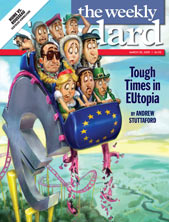
Tough Times in EUtopia

The Weekly Standard, March 30, 2009
Sometimes truth just has to speak to powerlessness. Addressing the EU's sham parliament in mid-February, the Czech Republic's refreshingly tactless and refreshingly Thatcherite president, Václav Klaus, raised the awkward topic of what the EU euphemistically refers to as its "democratic deficit" and told MEPs that they were part of this problem, not its solution:

 "Since there is no European demos-and no European nation-this defect cannot be solved by strengthening the role of the European parliament either. This would, on the contrary, make the problem worse and lead to an even greater alienation between the citizens of the European countries and Union institutions."


Klaus's listeners were predictably outraged. They ought to have been terrified. With the EU economies falling apart at an unprecedented pace, there is nothing that these toy-town parliamentarians can do-except get out of the way.

The EU's insultingly undemocratic nature is not news (indeed, it is part of its rationale), but it remains the key to grasping how those who run the EU have, for better and worse, had so much success in ramming their agenda through. Not having to bother too much about national electorates has been a great boon to Brussels. As the continent's economies slide ever deeper into the mire, however, that once handy feature could end up crashing the entire system.

An economic debacle on the current scale is going to shake any political structure, however securely moored, but the EU's persistent recourse to a form of soft authoritarianism has left it peculiarly ill suited to weather the storm to come. After decades of routinely bypassing its voters the union may well no longer have what it takes to secure their approval for the harsh medicine and painful sacrifices necessary to bring the EU through this ordeal in one piece. After all, it can barely even get them to vote: Turnout for the most recent (2004) elections for the EU parliament sank to a record low of 45.5 percent. Admittedly that total was dragged down by massively uninterested Eastern Europeans (only 16.7 percent of Slovaks voted and 20.4 percent of Poles), but it was sparse almost everywhere: Only 39 percent of Brits showed up, about the same percentage as made it to the voting booth in the Netherlands, one of the EU's founding nations.

As the history of the union's occasional, grudgingly granted referenda-a sorry saga of chicanery, rejection and do-overs-reminds us, appeals to the supposed solidarity of that imaginary European demos have never really worked. And that was in the good times. They surely won't do the trick now, nor will arguments based on the logic of a free market ideology widely, if inaccurately, said to have failed. Yet to steer a course through what may become hideously hard times without much in the way of popular consent threatens to push already alienated electorates in the direction of the extremist politics of left or right.

The story of this slump is too familiar to need repeating here, but it is worth pausing to consider how the introduction of the euro has left the EU marooned on a circle of economic hell all of its own making. Imposed on most of the European heartland by a characteristic combination of bullying, bribery, conclave, and legerdemain, the single currency was put in place with as little regard for the real world as for the ballot box. To squeeze a wide range of vastly divergent economies (and to do so with few safety nets) into one monetary system made little sense except when understood as a matter of politics, not economics. But economics has a nasty habit of biting back.

Up until the eruption of the present crisis, the European Central Bank's interest rate policy primarily reflected the needs of France and Germany, Euroland's largest economies. This left rates "too" low for naturally faster growing countries like Ireland and Spain, which in turn inflated unsustainable housing bubbles. These have now burst-in Ireland's case taking much of the banking system down with it. On some forecasts Irish GDP may shrink by 10 percent between 2008 and 2010, a dismal number that could eventually prove too optimistic. Gloomsters joke bleakly that the difference between Ireland and Iceland is six months and one consonant. Spain meanwhile now boasts an official (in other words, understated) unemployment rate of 14 percent. Over 600,000 migrant workers have been laid off. This is not a recipe for social peace.

In other countries, most notably a horribly in-hock Italy (public sector debt over 100 percent of GDP and expanding fast), low interest rates allowed governments to put off long overdue structural reforms. Instead of forcing the introduction of the badly needed discipline that was allegedly one of the principal reasons for its adoption, the euro (a hard currency when compared with shabbier predecessors such as the lira or drachma) was treated as a free pass. It has been anything but. Even before the current mess, Italy's crucial export sector was finding it difficult to cope with the brutal combination of rising cost inflation and a currency far stronger than the accommodating, and periodically devalued, lira. On some estimates, this latest recession is the fourth that Italy has suffered in the last seven years. Back in 2005 Silvio Berlusconi described the euro as a "disaster" for his country. He was not exaggerating.

Devaluations are to GDP what steroids are to sport. In the long-term they may be unhealthy, but in the short-term they frequently work miracles. The problem is that the option is no longer so easily available for the nations that adopted the euro. Italy, Ireland, and a number of other countries are in the grip of a one-sized currency that could never fit all, and the euro is now for them little more than a straitjacket or, more accurately, a noose. They have theoretically retained enough sovereignty to quit the euro, but for one of them to do so, especially if other states stick with the common currency, would be to risk something close to complete economic meltdown.

Money would pour out (so much so that capital controls would probably be required), interest rates would soar, and the reborn national currency would plummet. In the absence of a bailout from the eurozone it had just abandoned, the exiting country itself would probably be driven to renege (either de facto or de jure) on its foreign debt-as would much of its private business. In its consequences, this could be a Lehman-plus trauma with possibly devastating effects on already chaotic international capital markets. No less critically, it could set off a crisis in confidence in the credit of those weaker nations that had kept faith with the single currency, not to speak of feebler economies elsewhere. The cure, therefore, could well be worse than the disease.

In the meantime, in a damned-if-you-do, damned-if-you-don't spasm, the markets are fretting that the disease is turning ever more dangerous-and, in a process that feeds upon itself, ever more infectious. Spreads on sovereign debt yields within the eurozone (between German Bunds, say, and paper issued by Spain, Greece, Portugal, Italy, and Ireland) have widened noticeably. This is a warning that investors are beginning to think a once unthinkable thought: that one or more of the zone's less resilient members might go into default. On this logic these countries can neither afford to keep the euro nor to junk it. Rock, meet hard place.

These worries are made even more pressing by concern over the impact of Eastern Europe's spiraling economic woes on the already shattered finances of the western half of the continent. Contrary to some of the more excitable headlines, not all the countries of formerly Warsaw Pact Europe are, yet, in deep trouble, but the problems of those that are (notably Hungary, Ukraine, Romania, and Latvia) threaten to wreck confidence in those that are not. And those problems will not be confined safely behind the Oder-Neisse line: Two of Sweden's largest banks, for instance, are frighteningly overexposed to the faltering Baltic States, while their counterparts in Austria, seemingly lost in nostalgic Habsburg reverie, have reportedly lent out the equivalent of 70 percent of their country's GDP to once Kaiserlich und Königlich territories and parts nearby.

Eastern Europe's problems are Western Europe's and, given Eastern Europe's dependence on Western capital flows, vice versa, a state of affairs that neither side appreciates. Infuriated by the impression that they were being sidelined by the upcoming "G-20+" summit in London, nine of the EU's former Soviet bloc members held their own breakaway meeting earlier this month to discuss what to do. Meanwhile, led by Germany's indignant Angela Merkel in full prudent-Hausfrau, Thatcher-handbag mode, the Westerners have tried to damp down the East's increasingly aggressive demands for assistance. Good luck with that. Demonstrating a keenly cynical awareness of which buttons to press, the Hungarian prime minister warned that a severe slowdown in the East could lead to "a flood of unemployed immigrants traveling to Western Europe in search of jobs."

If you suspect that all this leaves the EU looking somewhat stuck, you would be right. But then this is no accident. The lack of democratic responsiveness so thoroughly ingrained into the union's architecture was always intended to stop the bloc's politicians from succumbing to the temptations of protectionism, beggar-thy-neighbor devaluations, and other questionable devices often found in the toolbox of an economically desperate national government. That's all very well, and all very praiseworthy, but it doesn't do anything about the desperation, a desperation that will be felt all the more sharply by electorates looking for their leaders to do something, anything, in response to this crunch-only to discover to their chagrin (to use too gentle a word) that there is little that the EU will, legally or politically, allow those leaders to do.

To take just one example, earlier this year Britain saw a series of wildcat strikes protesting the importation of cheap foreign workers from elsewhere in the union as a means of undercutting the locals. The facts that triggered the dispute are murky, but what is certain is that even if the British government had wanted to intervene under EU law it could not. Equally, while the opposition Tories grumbled, nobody was fooled. If the Conservatives had been in charge, they would have done just the same as Labour: nothing. If you want to drive voters to the political extremes, stories like this are a good place to start.

Except that "start" is the wrong word. Parties of the extreme, whether of left or right, already have more than a foothold in Germany and France. "Populists" of every description can be found in the legislatures in countries from Belgium to Denmark to Latvia to Austria to Poland to Hungary. Take your pick: There are plenty to choose from. Even in never-so-sedate-as-it-seems Britain, a country that has made a fetish (if not always convincingly) of its moderation, the much-reviled far rightists of the hitherto tiny British National party are showing some signs of evolving from being useful bogeymen for the left into a party with demonstrable political clout within elements of a white working class that has been neglected for too long.

The backgrounds and the prospects of these movements vary widely from country to country, as do the pasts and the resentments that have shaped them, but in recent years their appeal has begun to grow in sections of the electorate pummeled by the dislocations brought about by mass immigration and globalization-dislocations made all the more painful by the realization that the ruling elites who never really asked them for their opinion on these changes, let alone their agreement to them, couldn't give a damn about their plight. This is a perception that will only be sharpened when the populations of these countries, more and more of whom are losing their jobs, are told by that very same political class that protection is off the agenda and that austerity is on, that saving local industries is unacceptable, and that helping out foreign countries is a must. And, oh yes, none of this was our fault-it was all the bankers' doing-and, oh yes, they and their bonuses have got to be rescued too.

So what's next? The leaders of the EU countries will do their best to muddle through in rickety, unpopular unity. Here and there they will cheat both on each other and on the key EU principle of a single market. The warning signs are already there. In February, President Sarkozy attacked the way that French auto companies were supplying their home market from manufacturing facilities in the Czech Republic. The previous month, Britain's Gordon Brown had criticized the amount of overseas lending by the UK's beleaguered bailed-out banks. Nevertheless, however awkwardly, however reluctantly, the EU's members will attempt to hang together-for as long as (or indeed longer than) their domestic politics comfortably permit, an effort that will inevitably further boost the appeal of the wild men of the fringes.

That said, as the EU's leaders are all too well aware, the slump has so far brought down two European governments (in Latvia and non-EU Iceland). Nobody wants to be next, let alone run the risk of political and economic breakdown. The few remaining traces of the budgetary discipline that supposedly still underpins the euro will therefore probably be scrapped. The euro may hang on to its reach, but only at the cost of its integrity. To ordinary Germans this will be seen as a betrayal, a Dolchstoss even. A people haunted by memories of where a debauched currency can lead, they only agreed to part with their much-cherished deutsche mark on the understanding that the euro would be run with Bundesbank-style discipline. That was then.

So money will be thrown around, the imperiled brethren of both East and West will, after much shoving, screaming, and hesitation, be bailed out. Some protectionist measures (directed against those outside the EU) will be brought in and all fingers will be crossed. It won't be pretty, but with luck, it might be enough to stave off catastrophe. Pushing their luck, some glass-is-half-full Europhiles believe that the fact that no country can easily work its way through these tribulations alone will conclusively make the case for still closer European integration to some of the EU's more reluctant federalists. You can be sure that this is a rationalization that Brussels will look to exploit: Rahm Emanuel is not the only politician unwilling to waste a crisis. The EU's policy response to the slump is likely to have two objectives: the reconstruction of member-states' economies and the destruction of what's left of their autonomy. Going for the latter could well drive even more disaffected voters into the extremist fringe, though Brussels is arrogant enough to persist. There are already indications that the eurocrats may be pushing at an open door. In a startling example of mistaking the Titanic for the lifeboat, Poland has become just one of several nations speeding up plans to sign up for the euro-and the safe haven it is meant to represent.

On the other hand if, as appears disturbingly likely, the economic situation grows far darker, it's easy to draw an alternative picture in which both euro and union come under previously unimaginable stress, stress with unpredictable and potentially ominous consequences, stress that will be echoed and intensified by mounting political and social disorder in a Europe that discovers, too late, that there was something to be said for democracy after all.


Another Spectre Is Haunting Europe

The weekly Standard, March 2, 2009

As the worldwide slump deepens so must worries that the economic crisis will spill out onto the streets. In December, France's president Nicolas Sarkozy warned that les évènements of May 1968 could repeat themselves, and not only in the land of the torched auto. That same month IMF chief Dominique Strauss-Kahn used the possibility of social unrest--in rich countries as well as poor--to drum up support for aggressive fiscal expansion. Now it's reported that the leaders of the EU's member states will spend part of their March summit discussing signs of growing disorder across their increasingly embattled union. After weeks in which Greece came close to anarchy, and riots broke out in Bulgaria, Hungary, Latvia, and Lithuania (and, just outside the EU, in newly destitute Iceland), they are right to be concerned.

After roughly three decades of growth, European living standards are imploding, and once-rising expectations are dropping down with them. It's the sense of something lost that hurts the most. People can deal with living without that which they never had (which is why so many dirt poor countries languish without any meaningful regime change), but when prosperity vanishes, rage will go hand-in-hand with disappointment, frustration, and despair. Extra-legal protest, whether it's antiglobalization riots, spasms of racial or ethnic violence, or the repeated recourse to highway blockade, is already a part of the European political landscape, east and west. Under the circumstances it's hard to see how an economic slowdown on the current scale can continue without expanding this miserable tradition. The only question is where. Riga today. London tomorrow? Hamburg? Lille? Madrid? Dublin? A glance at the business pages suggests there are plenty of places to choose from.

It's a sad commentary on the situation Europe's leaders are now contemplating that some of the best clues as to what might happen there can be found in China and Russia. This reflects how the increasing reach of the EU within its member states has left the individual nations less free to respond to the demands of their peoples at a time of distress and imposed upon them a soft authoritarianism that increases the chance of disorder.

Start with China where, despite the extraordinary economic expansion of recent years, the promise of prosperity has spread far further than its achievement. According to some reports, there were nearly 80,000 "major" incidents of unrest in 2007, an inevitable response to the dislocations of helter-skelter growth in a People's Republic where hundreds of millions of the People have been left behind, deprived of what scant security they once enjoyed, and given no legal way of making themselves heard. And that was in the good times.

Since 2007, growth has slowed dramatically to an annualized rate of perhaps 6-7 percent. That's some way below the near double-digit pace usually thought necessary to sustain China's vast army of migrant workers (some 20 million of whom are said to have lost their jobs in the downturn). More ominous still are the large numbers of new university graduates: articulate, ambitious, and now unemployed. There is a good reason that the Chinese regime has put in place a $600 billion stimulus package. It's the same as the one that has led some of the country's elite to worry openly about the prospects for social peace.

There are at least some (faint and fiercely disputed) signs that all those billions might be having an effect, but no such comfort is available in Russia. The ruble is sharply down, and the economic growth that legitimized Putin's rule has dwindled to nothing. This winter has seen protests in Moscow, Vladivostok, and other cities, events largely unthinkable a year ago. Like the Chinese, the Russians are throwing money at the problem. And, like the Chinese, they are tightening up internal security. The rigidities of authoritarian rule may ultimately provoke a violent reaction, but so long as these regimes retain a monopoly of force and a willingness to use it, disorder can generally be stamped out: until, of course, the revolutionary moment. But that moment still seems far away.

In a broad collection of countries to Russia's west, the situation looks more immediately dangerous. These states are all nominally democratic, but the extent to which democracy, and the shared trust that must go with it, have really taken root is not only unclear, but also about to be put to a brutal test. Emerging from beneath the rubble of the Soviet imperium has been a long and wearying process, marked by setbacks and punctuated by crises, but somehow nearly always sustained by the dream of better times to come and, more practically, massive transfusions of Western money, both public and private. That was then. GDPs across the region are in free fall (if you prefer another cliché, the governor of Latvia's central bank has offered up "clinically dead" as a description of his country's economy), a situation that may finally sink the hulks of the Western European banks already perilously exposed to this part of the world and not, therefore, in a position to come up with any fresh cash.

Economic collapse and fragile democracies are a fissile combination, and that's before considering the opportunity they present for geopolitical mischief-making. The Ukrainian state is politically weak, ethnically divided, facing tricky elections, and, many analysts reckon, on the edge of insolvency. Under these promising circumstances Moscow would be most unlikely to object to a destabilizing riot or two in a neighbor whose independence it still resents. And the same holds true for the Baltics. After all, the Kremlin was widely thought to be behind disturbances (unrelated to the economy) in the Estonian capital, Tallinn, in 2007.

But while Kiev, Riga, and Sofia may seem reassuringly remote, believing that the more established democracies in the western half of the continent will necessarily escape disorder is, as Sarkozy, Strauss-Kahn, and those fretting European premiers undoubtedly understand, to ignore the lessons of the past. Optimists like to see Iceland as a special case, and, yes, Greece too. They might also argue that the January protests in France were nothing more than business as usual. But all these supposedly discrete disturbances were beginning to look like a pattern even before a wave of wildcat strikes in the U.K. (protesting the importation of cheap foreign workers from other EU countries). Expectations are being dashed in the west of Europe just as much as they are in the east, and there will be consequences. To be sure, the nations of the EU's heartland are far better off (and, critically, have more generous social security nets) than those that so recently escaped Soviet rule, but a dashed expectation is a dashed expectation wherever it falls to earth.

In some ways the darkening of a once bright future may be more difficult to deal with for populations like those living in Western Europe where truly hard times (and the psychological mechanisms to cope with them) are scarcely more than a folk memory. Making matters worse, social cohesiveness within these countries has been badly battered, most notably by mass immigration and, more happily, the greater opportunities for individual autonomy that affluence has hitherto brought in its wake. The idea that, at some level, "we're all in this together"--a vital safety valve for a society under stress--may no longer be available for use.

Adding further poison to the mix is the catastrophic effect of EU membership on the relationship between Europeans and their political class. The idea that the governing should listen to the governed underpins any successful democracy. It does not underpin the EU--as those naughty no-voting Irish are just the latest to discover. National politicians, neutered by a confederation where most important decisions are taken within an opaque and remote political structure that is subject to but the barest pretense of democratic control, now function as little more than messenger boys or enforcers for the real bosses in Brussels.

This raises rather awkward questions as to what Europe's ballot boxes are actually for, questions that may turn very ugly indeed when the bread has gone stale, the circuses have shut down, and recovery remains elusive. Fortified perhaps both by images of disturbances elsewhere and the knowledge of the spinelessness that is a not-so-guilty not-so-secret of so many European governments, the peoples of the EU might well conclude that the street is a better way to force through change than the voting booth. Throw in the organizing capabilities of the Internet, relatively high levels of unemployment amongst the articulate and well-educated, and the rallying impact of a populist cause, and it's easy to see what will come if the slump lingers on.

No clear thread yet runs through the discontent now rippling across the EU, which remains mostly of the throw-the-bums-out variety. Yet in the midst of a debacle typically blamed (we could debate how fairly) on capitalist excess, a Trotskyite postman is the second most popular political figure in France and a party with its roots in the Communist dictatorship is polling at around 15 percent in Germany. If economies continue to spiral down, anxiety, uncertainty, and anger are bound to assume more concrete ideological forms, forms that are unlikely to be pretty.

Sometimes history repeats itself as tragedy, not farce.

Iceland Without the Fish

National Review Online, February 4, 2009

Gulfoss, Iceland, 2007 © Andrew Stuttaford

Gulfoss, Iceland, 2007 © Andrew Stuttaford

If there’s one thing that can be said in defense of Tony Blair and his successor (and former finance minister), Gordon Brown, it’s that they took longer to squander Margaret Thatcher’s economic legacy than some first expected. But squander it they did, and credit’s Armageddon has at last exposed the full extent of the damage.

As Warren Buffett once observed, “You only find out who is swimming naked when the tide goes out.” That’s not the nicest way to visualize Gordon Brown, but, seen from the vantage point of the markets, the view is not much prettier. Stocks have crashed, of course, as they have across the planet, but so, more ominously, has the pound. The British currency hit record lows against the euro at the turn of the year. And when it comes to the greenback, the pound buys less than a buck and a half (it fetched more than two dollars earlier in 2008). That suggests the United Kingdom’s troubles are nastier than elsewhere, a view echoed by the IMF, which now predicts that Britain is facing the deepest recession of any major industrialized economy.

Yes, yes, the pound has gone through other ugly episodes in the relatively recent past, but the present fall (on a trade-weighted basis, sterling dropped by more than 20 percent last year) is the most dramatic since 1931. For the first time since the Labour-controlled mid-1970s, Brits are wondering if they face a genuinely catastrophic collapse in their currency.

For a country such as Britain, burdened with a large trade deficit, devaluation can be a shot in the arm by making its exports more internationally competitive. But that only holds true if there’s a market for those goods in the first place. In a time of shrinking trade flows, nobody can be sure of that. More worrying still, with the U.K.’s combined external debt (public and private) rising rapidly from a total that already exceeds 400 percent of GDP (a gross number, but even so), the usual cost-benefit analysis may no longer apply. Repaying overseas debt in a devalued currency can be a very tricky business, indeed. Will the sceptr’d isle become Iceland without the fish? (The EU took all those.)

In some respects it was only to be expected (if not by Gordon Brown; he’s saying that he never saw this coming) that the land of the much-vaunted Blair/Brown economic miracle is turning out to be more storm center than safe haven. The global meltdown revolves around the embattled international financial system, a system in which the City of London has become a key hub. That role brought a great deal of cash into the United Kingdom, but with it a great deal of risk. The City’s international business has proved, in a sense, to be hot money–fun while it lasts but with a tendency to evaporate in times of trouble. And trouble has now come calling.

The problem for Britain is that, with the financial sector in disarray (and most of the North  Sea oil gone), eleven years of Blair/Brown have left the country with dangerously little else to fall back upon. This was not how it was meant to be. Back in 1997, Tony Blair had won his way into 10 Downing Street as a representative of “New” Labour, a supposedly reformed party ready to renounce the taxing, spending, and relentless class warfare of previous socialist governments, to support free enterprise, and to do what it could to avoid the “boom and bust” cycles that had characterized so much of the U.K.’s postwar economic history. Oh, well–people believed Bernie Madoff, too.

The Blair and Brown governments were careful not to increase the top income-tax rate, but everything else was up for grabs–and was duly grabbed. Overall taxation has risen by far faster than the OECD average and has been accompanied by regulatory excess (much of it, admittedly, at the behest of the EU) and a public-spending binge that long preceded the current emergency but left the country woefully unprepared to deal with it. Gordon Brown may be the son of a Scottish clergyman (who had, marvelously, the middle name Ebenezer), but the whole preparing-for-the-seven-lean-years thing just doesn’t seem to have sunk in. In the decade that followed the 1996–97 spending year, “managed” public expenditure jumped by roughly 90 percent, and that’s before taking account of liabilities incurred but kept off the books with the help of legerdemain that would have shamed Enron.

Under the circumstances, it’s no surprise that the U.K.’s productivity growth has, at best, been uneven, despite (up until now) broadly respectable increases in GDP. It’s perhaps telling that most (around two thirds) of the new jobs created since 1997 have been located in the public sector. What’s more, in a strikingly high percentage of cases, they have gone to recent immigrants rather than to native-born Brits, too many of whom have remained on the dole for too long. We can debate why that is, but we cannot debate the grim fact that nearly 2 million people are now registered as unemployed, a bad number that is getting rapidly worse. Another 2.7 million (more than 7 percent of the working-age population) live on “incapacity benefit,” a handout that defines them as too sick to work–a statistic that implies either repeated epidemics, a failed National Health Service, or a seriously dysfunctional labor market. I know which explanation I’d pick.

If the British are not working enough, they are not selling enough, either. The trade deficit has continued to deteriorate. For goods (“visibles”) it now stands at well over 6 percent, the highest level since proper records began in the late 17th century. In the past, the overall deficit has been narrowed by the U.K.’s ability to export services (many of them, problematically, financial), but this is just another reminder that the City’s relative preeminence is as much an expression of the weakness of the wider British economy as it is of London’s success in playing host to the choosy and itinerant international financial community.

It would be wrong, however, to blame all the horrors that are pummeling the City on Messrs. Blair and Brown. This is a fiasco with deeper and wider origins than the cack-handed fumbling of two economically illiterate politicians, but Labour’s decision to take responsibility for banking supervision away from the Bank of England (historically the country’s most experienced, and most respected, regulator) helped pave the way for disaster. It was a dumb move, made in the name of modernization but more truthfully explained by the Labour government’s disdain for anything smacking of Britain’s past. In America, the existence of a series of distinct financial regulators, each with agendas and areas of expertise all of their own, played no small part in the failure of regulation that contributed so much to the current debacle. Britain’s new tripartite regulatory system (which splits duties between the Treasury, the Financial Services Authority, and the central bank) has proved a disastrous failure for very similar reasons, a failure made all the more galling by its needlessness: Resentment is not a good basis for public policy.

In any event, the U.K. went through a bubble that in all its excess, shoddy lending practices, and baroque speculative mania bore a depressing resemblance to the horrors here in America. To take two numbers cited by Larry Elliott and Dan Atkinson in Fantasy Island (a broadly leftist, sometimes oddball and often fascinating critique of the Blair years), between January 2000 and December 2005, outstanding consumer-credit balances rose by two thirds, and mortgage debt nearly doubled. The appalling consequences are now all too visible in a shattered housing market, on a shuttering high street, and on what is left of the balance sheets of Britain’s devastated and partially nationalized banking sector.

The damage to Mrs. Thatcher’s legacy has therefore already been bad enough, but the financial cataclysm (or, more accurately, the government’s response to it) may well, ironically, make its final destruction Gordon Brown’s best hope of remaining in power. The political reaction to his early attempts to bring a halt to the developing economic disaster shows why.

So what did Brown do? Unburdened by ideological objections to the idea of the state assuming direct stakes in the nation’s banks, the prime minister was the first to borrow (very loosely) from the successful Swedish precedent of the early 1990s and take this necessary (if regrettable) step. At the same time, his government launched a £20 billion stimulus package with, given the shaky state of public finances, little obvious idea of how to pay for it. As The Economist noted in December, even on the government’s “optimistic” projections, borrowing will hit 8 percent of GDP in 2009–10 and debt 57 percent in 2012–13. America’s budget may be a shambles, but with the dollar an internationally accepted reserve currency (for now), the United States at least has the ability (fingers crossed) to print money and buy its way, however imperfectly, however clumsily, out of the present mess. The U.K. does not–thus the tumbling pound.

Initially Brown’s rapid and decisive response played well with frazzled voters desperate to see the government do something. With the financial crisis widely blamed on three decades of (largely imaginary) laissez faire, Labour rediscovered the electoral allure of unashamedly interventionist government. Dour, stern, and carefully wrapped in an image of egalitarian rectitude, Brown came across, however absurdly, as a serious man for serious times. The Tories jeered, but for a while their advantage in the polls faltered: Their impeccably upper-crust leader (who is burdened both by youth and a past in public relations) was caricatured in ways that made him appear a feckless, callow Wooster to Brown’s shrewd, capable Jeeves.

That moment may have passed for now. Swept along by a torrent of economic bad news, the Conservatives are once again clearly ahead. That probably puts paid to the once widely rumored prospect that Brown would call a snap election before the bills finally fall due. Nevertheless Labour’s brief revival was an early warning that this crisis may yet represent an opportunity for a return of the more full-bodied socialism of the party’s destructive past. If Brown is to win another term (an election has to be held no later than June 2010), he will have to shift left. In frightening times in which capitalism is widely (if inaccurately) believed by voters to have failed, there is an obvious opportunity for the hucksters of big, redistributionist government. The announcement that Labour, if reelected, will hike the top income tax rate from 40 to 45 percent (and that’s before onerous social security levies) is only a beginning.

Somehow I suspect that the pound has far further to fall.

Obama on Everything

National Review Online, January 19, 2009

Union Station, Washington D.C., November 2008 © Andrew Stuttaford

Union Station, Washington D.C., November 2008 © Andrew Stuttaford

There are some on the right who take defeat badly, but I’m not one of them. I’m not a lurk-in-the-bunker-poison-the-dog-shoot-myself kind of guy. And if you’re still in a position to read this, neither are you. But that still leaves open the question as to how, exactly, we should mark the upcoming inauguration.

Sulking is an option, as is picking a fight with a liberal member of the family, obsessively researching birth-certificate rules in Hawaii, repeatedly watching Red Dawn, or kicking the as-yet-unpoisoned dog. But, with the exception of those repeated viewings of Red Dawn, none of these alternatives is very uplifting, particularly if, as seems likely, the new president’s speech will be that–and more. At the same time, to follow the advice of those good sports over at the Wall Street Journal who suggested opening “a fine bottle of American bubbly” is to go too far down the road to reasonability, respectability, and good-hearted bipartisanship–and that’s just not our thing.

cigars-obama-sample4

It’s better, I think, to borrow a few ideas from the Orange Alternative (Pomarańczowa Alternatywa). Fearless prankster surrealists of the Polish sort-of-Left from the 1980s, they used to taunt their country’s crumbling Communist regime with cheers, not jeers, their specialty being sporadic displays of unsettlingly enthusiastic loyalty. These included a reenactment of the storming of the Winter Palace and a procession through the streets of Warsaw by 4,000 people chanting their love for Lenin. Now, I would not want to compare Obama with that other community organizer–no, not for a second!–but the cult of personality now surrounding our next president suggests that hosting an Orange Alternative inauguration dinner would be a perfect counterpoint to the pomp, sincerity, and cynicism on display in Washington. It’ll also be an ideal opportunity to treat friends of all political persuasions to a confused, confusing, and almost certainly annoying celebration that can be read, as Obama has said about himself, in any way they like.

The proceedings should start with a sing-along, possibly the Obama Kids’ We’re Gonna Change the World, a song that brought so many people so much pleasure last summer:

We’re gonna spread happiness

We’re gonna spread freedom

Obama’s gonna change it

Obama’s gonna lead ’em.

We’re gonna change it

And rearrange it

We’re gonna change the world.

After hymning themselves hoarse for Change, your guests will need a drink. They will probably have had enough of clichés by then, so forget the champagne and opt instead for some Obama Limited Edition Reserve (“very detailed features of Barack Obama deep carved into the bottle . . . fit for the Smithsonian!”), a 2005 Merlot from Napa Valley. You’ll want to avoid any suggestions of elitism, however, so slip in some suds, too, perhaps some Obama (formerly “Senator”) beer from Kenya. Cocktail drinkers meanwhile may enjoy a Barackatini (rum, fruit, a splash of club soda) and, since nobody will be excluded from the promise of Obama’s America, teetotalers will be able to join in the fun (if teetotalers ever do join in the fun) with Obama Soda from France–which is, apparently, now a friend.

For food, as for bailouts, turn to Washington. The M Street Bar & Grill has designed a Barack Obama Pizza Burger. If that’s too bland, just add some Barack Obama Inauguration Hot Sauce. For those who fancy something altogether more exotic, blogger and author Veronica Chambers has dreamt up a recipe for a Barack Pie “that would celebrate, in culinary fashion, the hope, promise (and okay, super yummyness) of having Barack Obama as our next president. . . . [It] serves . . . souls hungry for hope, change and a new day in American politics.”

And if that’s not sugary enough, Max and Benny’s of Northbrook, Ill., will supply “Yes We Can!” cookies emblazoned with images of the president-elect, his wife, and the odd-looking individual who will be the next vice president. On the other hand, Obama Waffles taste too much of sour grapes to have any place at such a celebratory table–we’ll prefer the sweetness of Ben & Jerry’s “inspirational’ Yes Pecan! On that note, your guests can get at their beer with the help of a “Yes We Can” Opener. For the wine there’s Corkscrew Bill, an engaging device modeled on the husband of the new secretary of state.

When preparing the food, the Barack Obama cutting board, as versatile as a Panetta, will undoubtedly come in handy: “Can also be used as a hot plate, serving tray, cheese board, bread board . . . place-mat, or director of the CIA.” (I obviously made up the last of those. Running Langley in wartime is a job for specialists. Who could possibly think otherwise? Oh. Anyhoo . . .) When it comes to chopping, cutting, and slicing our feast’s ingredients, the adventurous will be tempted by President Barack Obama’s White House Sword, forged in the heat of a renaissance fair/faire/fayre, pleasingly suggestive of once and future Camelots, and best kept out of the hands of any members of clan Clinton.

And when it’s time at last to chow down, each of your guests should dine off an Obama Historic Victory Plate (“a priceless work of art featuring the triumphant President-Elect surrounded by the American flag and spectacular fireworks celebration”), and, according to taste, drink from a pewter-accented Obama wine glass or an “Obama Will Save Us” beer stein. Alcoholics will appreciate the opportunity to down some federally subsidized ethanol out of a specially engraved Obama Drinking Flask.

To wrap things up, how about freshly brewed Kona Joe’s (Barack O Blend, naturally) swigged out of a Barack “Change” coffee mug while savoring a cigar (Cuban?) wrapped in a commemorative Obama cigar band? Coffee and cigars? This might also be the moment to hand out a few Obama National AchieveMints. Few’s the word. Boost the mood still further by festooning your house with Obama posters, ideally in the fake, yet electorally effective, socialist-realist style pioneered by Shepard Fairey (in the Smithsonian soon!). Your couch, chairs, and any notably slow-moving guests should be draped with a “Believe” throw from NBC.com.

obamatime
obamatime

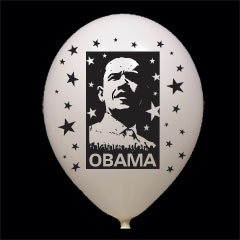
Wait, there’s more! As the special commemorative clock on the mantelpiece reminds you, “It’s Obama time.” And so it is. Raise a “Yeaaaah! Obama Won! Happy Days are Here Again!” banner. The faintly alarming echoes both of Howard Dean and the (last) Great Depression will probably pass unnoticed. If they don’t, start talking excitedly about Change; that usually does the trick. Meanwhile, Obama balloons and lumi-loons (in red, white, and blue) should be allowed to soar, like hope, hype, and deficits, as high as they can go. And beyond.

It’s not only the house that should be decorated. We will, we are told, be feting the most historic inauguration in the history of history. Formally inclined male guests will want to wear a tie, perhaps one featuring Smithsonian Shepard’s “now iconic portrait of president-elect Barack Obama set in bold reds, whites, and blues.” The more casual of either gender will, perhaps, like the look of a colorful satin Obama jacket. And what woman (apart from the one from Alaska, who doesn’t count) could resist a set of HOPE earrings from www.barackobamajewelry.com (“accessorizing the movement”)?

No child need be left behind: Even the youngest can be part of the Change with an Obama onesie from Irregular Apparel (“We offer politically and socially aware messages on baby clothing that is colorful, inexpensive, covered with sass-filled designing but made without sweatshop labor.”).

obamashirt
obamashirt

Others will want to don a T-shirt. There are more designs from which to pick than there are magically reappearing Al Franken votes in Minnesota. My favorite, featuring Chris Bishop’s portrayal of Obama astride a unicorn, may be cut a little too close to fit: Irony is death to all things Obama. To avoid any open signs of this renegade sensibility ruining your event, I’d recommend punctuating the festivities with a few readings, seder-style, from a devotional book. The Bible might be going too far and the Koran would excite conspiracists (People, please! He’s not a Muslim!) but the hagiographic Barack Obama: Son of Promise, Child of Hope would do very well. This strikingly illustrated children’s book (and New York Times bestseller) by award-winning poetess Nikki Grimes tells the story of Obama from boyhood to presidential campaign. Celebrants might wish to begin with this passage describing Obama’s time in Indonesia:

He caught crickets, flew kites,

and joyed in the jungle

at the end of his new home– a perfect paradise, until

the sight of beggars

broke his heart.

Barry started to wonder,

Will I ever be able

to help people like these?

Hope hummed deep inside of him.

Someday, son.

Someday.

With luck, your guests will rejoice in those words, and also in these, recording Barry-now-Barack’s move to Chicago:

Barack’s eyes saw

the hungry and the homeless,

crying out like beggars in Djakarta,

burning a hole in his heart.

When his classes came to an end,

he raced to Chicago

to join hands with the church,

to learn new lessons:

not how to be black or white,

but how to be a healer,

how to change things,

how to make a difference in the world.

And if those later lines conjure up any awkward thoughts of The Reverend Who Must Not Be Named, they can be dispelled by allowing your guests to gaze at some of the book’s illustrations–a weeping Barack at prayer, maybe, or a butterfly settled on the hands of a praying Barack of Assisi. Best of all is a picture showing Obama acknowledging the cheers of the crowd the night he was elected senator. Haloed by what looks like starlight, he’s smiling, his hands extended in a gesture more normally associated with the Mount of Olives.

Did I mention that Kool-Aid will be served?

Sarko's Bite

National Review, December 15, 2008

It is a ritual as frustrating, as funny, and as familiar as Charlie Brown, Lucy, and the football. A new “right wing” French president is elected, vowing reform, and American conservatives swoon. First there was Jacques Chirac. Older, sadder, and wiser folk may still recall the excited talk about his summer at Harvard, his stint as a soda jerk at Howard Johnson’s, and, naturellement, a girl from South Carolina. The Frenchman liked us! He really liked us! He wasn’t Mitterrand! No, he wasn’t, but . . .

After Chirac, Nicolas Sarkozy. The new president’s first vacation was spent not on the Cote d’Azur, but in Wolfeboro, N.H. A few months later “Sarko l’Americain” addressed a joint session of Congress, spoke warmly of the American dream, and name-checked John Wayne, Marilyn Monroe, and Martin Luther King. The Frenchman likes us! He really likes us! He isn’t Chirac! Sarkozy promised a more robust approach to Islamic extremism both at home and abroad and, more daring still, an assault on the regulations, overspending, taxes, and trade-union privilege that have made France so much less than she could be. America’s conservatives cheered. Fries could be French again.

That was then. Less than a year later, Sarkozy took the opportunity presented by the financial meltdown to announce, with rather too much glee, the death of laissez-faire, a declaration made all the more surprising by the fact that there is little evidence that laissez-faire had been alive in the first place. Perhaps that’s why Sarkozy is so keen to do a Van Helsing on the poor doctrine’s corpse. Like the United States and most other major nations, France has put together a massive (in its case, up to €360 billion) rescue package for its banks, but with a characteristically French twist: It is insisting that the banks that benefit from this largesse increase their lending by a designated amount (3 to 4 percent) over a given twelve-month period, a mandate almost guaranteed to wreak further financial havoc. “The state,” thundered Sarkozy, “is back.”

It had never been away. But the state’s command over the French economy will become even more wide-ranging with the establishment of a new strategic-investment fund (up to €20 billion, although larger numbers have been mentioned) to protect key companies from the unwanted attentions of wicked foreign predators. Somewhat more conventionally, the government will increase what it spends on contrats aides, which will subsidize an additional 100,000 jobs next year. With carrot comes stick: Sarkozy has cautioned companies against using the crisis as a cover for layoffs: “Those who want to play that game be warned: The government will be ruthless.” The state is indeed “back.”

So far, so French. Much more worrying is the extent to which Sarkozy’s revenant state is now looking to expand its reach internationally. Sarkozy is busy telling anyone who will listen (and quite a few who won’t) that the financial crisis has demonstrated the need to establish a “clearly identified economic government” for the eurozone. Quite what that might mean is not easy to identify, but some clues can be found in Sarkozy’s suggestion that equivalents of France’s new strategic-investment fund be set up throughout the zone. As the French president told the EU’s parliament in October, he didn’t “want European citizens to wake up” and find out that their companies had been taken over by wily “non-European” investors who had taken advantage of low share prices to snap up a few bargains. To Europe’s last serving Thatcherite, Czech president Vaclav Klaus, the thinking behind the Sarkozy scheme reeked of “old socialism.” It’s difficult to disagree.

For now the idea of constructing a Maginot Line against foreign capital has found few takers elsewhere in the EU, but an undaunted Sarkozy is taking his crusade against the supposed “dictatorship of the market” even farther afield. The French president was a key figure in pushing for the recent G-20 summit in Washington. In itself, the idea of a meeting involving more than the usual G-8 suspects was no bad thing. Financial panics recognize no borders. That said, final responsibility for managing such crises must remain at the national level for reasons of common sense, practicality, and — critically — sovereignty.

Strengthening international cooperation in this area will be a positive development, but only so long as efforts are organized multilaterally. On that basis, the G-20’s search for a closer consensus on matters such as accounting standards, clearing facilities for credit-default swaps, banks’ capital-adequacy ratios, and the role of rating agencies is something to be welcomed, not feared.

The same is true of the mooted development of an IMF-run early-warning system. Another of the summit’s themes, boosting the existing levels of cooperation between different national regulatory authorities, also makes obvious sense, as do, in theory, plans to create (pompously named) “supervisory colleges” for all major cross-border financial institutions. Staffed by regulators from the various relevant jurisdictions, these bodies would be designed to provide an additional degree of surveillance and, it is hoped (the details are tellingly scant), be in a position to head off crises before they arise. The focus of international coordination in this area would thus shift from the reactive to the proactive. These are all changes that, if sensibly handled, could be useful steps forward.

If Sarkozy gets his way, sensible is one thing they won’t be. In no small respect this is a function of his personality: restless, kinetic, opportunistic, and incapable of resisting either the temptation of la grande geste or, as he sees it, the splendor of his own genius. We are speaking, after all, of the architect of the proposed “Mediterranean Union.” (You’ve never heard of it?) In the endearingly acid words of a woman quoted in Dawn, Dusk or Night (playwright Yasmina Reza’s magnificently offbeat account of a year spent with Sarkozy on the campaign trail): “Nicolas is too high-strung. . . . He is four inches too short and that undermines his charisma on the international level. Mitterrand, you couldn’t tell he was short because he was placid, whereas Nicolas is a fox terrier running everywhere, barking.”

But it’s possible to detect patterns in all that motion, and one of them is the hyperpresident’s bathyscaphe-deep distrust of the free market. Sarkozy’s forlorn American conservative fans would have done well to read his Testimony (2006), a manifesto for the modernization of France that is, at its core, technocratic, profoundly dirigiste (“It seems to me to be perfectly reasonable . . . that a profitable company not be allowed to benefit from a cut in taxes if it does not raise salaries”), Colbertist (“It is not illegitimate for the finance minister to promote the creation of national . . . champions”), neo-protectionist (“I propose that exports from countries that do not respect environmental rules be taxed according to how much they pollute”), and, in its dismissive references to Wal-Mart’s “brutal and unacceptable” business practices, “stock market capitalism,” and “speculators and predators,” not particularly friendly to the American way of making a buck.

Strongly nationalist though he is, Sarkozy is too shrewd to believe that France can go it alone. So, like his predecessors, he tries to manipulate the EU’s structures in ways intended to produce a Europe that looks like France, a Europe where France can be France, a Europe ideally (in Sarkozy’s view) stripped of its “dogmatic commitment to competition” and what he sees as a race to the bottom in fiscal and social policy. Translation: The Irish should be forced to raise their taxes so that the French aren’t forced to cut theirs. All in the name of European unity, of course.

It’s easy to see how the economic crunch has offered France (acting in conjunction with a good number of other nations) a similar opportunity — to remake the world’s financial system in something much closer to its own image (all in the name of ending the crisis, of course), which would have the added bonus of diminishing America’s economic dominance and, with it, Washington’s power to set the global agenda.

Yes, financial reform, tougher domestic regulation, and smarter international coordination are all required, but these should be accomplished through incremental changes. There’s no need to tear up the old rulebook. Any transfers of authority to new transnational authorities should be kept to an absolute minimum, a priority that is difficult to reconcile with all the chatter (from Sarkozy and others) of a new Bretton Woods.

The French president left the G-20 summit reportedly claiming that the “animal spirits” of American capitalism had been tamed and that the days of a single currency (the dollar) are “over.” The hyperpresident has, he undoubtedly believes, got the hyperpower on the run. Rubbing yet more salt in Uncle Sam’s wounds, Sarkozy then surprised everyone (one European diplomat was reported by the International Herald Tribune as describing the announcement as “amazing”) with news that he was convening a conference in Paris (co-hosted by the inevitable Tony Blair) in early January to, in Blair’s words, “define a new model of capitalism.”

The fox terrier, it appears, does not just bark. He bites

Endless Intervention?

National Review, November 17, 2008

It’s a measure of the predicament in which we find ourselves that merely keeping the banking system going now seems like something of a triumph. It’s even more of a measure that, despite the spending of once-unimaginable amounts of money (or the agreement to spend them), the outcome is still uncertain.

Nevertheless, there have been a few tentative signs that the system may be on the mend. LIBOR (the London Interbank Offered Rate, a key indicator of the interest rates at which banks lend to each other) has been edging down. The TED spread (the difference between three-month LIBOR and the yield on notionally risk-free three-month Treasury bills — a good basis for weighing nervousness in the interbank market) has narrowed. It appears that lending between banks is beginning to revive. It’s a start. Fingers crossed.

None of this is to suggest that a severe recession can be avoided. It cannot. The United States looks set to join many other nations in what may well be the most brutal economic downturn since the 1970s. Saving the banking system, however, will help keep the specter of Joad at bay (a depression, or anything approaching a depression, remains unlikely) and is, obviously, an essential precondition of an eventual recovery, a recovery that would be impossible if the credit markets were allowed to fail. That’s something that market fundamentalists fretting about the “nationalization” of America’s banks need to remember. Risking the ruin of this country’s financial system would have been an absurdly dangerous way to make an ideological point. Yes, part of the genius of capitalism is the “creative destruction” so famously described by Joseph Schumpeter, but sometimes destruction is just destruction.

Watching a Republican Treasury secretary orchestrate the government’s acquisition of significant shareholdings in America’s leading banks has been a disconcerting experience for many of us on the right. Secretary Paulson himself correctly described the whole notion of the government’s taking a stake in private companies as “objectionable.” No less correctly, if a touch belatedly, he recognized that he was left with little alternative. As originally formulated, his TARP (Troubled Asset Relief Program) was too complex and, in a sense, too indirect to provide the reassurance and support that were needed. Confidence in the banks was collapsing, and without confidence there are no banks, and without banks, well, you get the picture. Only a straightforward injection of new money — and with it, more crucially still, the suggestion that the banks were now effectively underwritten by Uncle Sam, the biggest ATM of them all — would have any chance of halting the slide.

The need to restore confidence lay, I suspect, at the heart of Paulson’s controversial decision not only to offer America’s nine largest banks an infusion totaling $125 billion in taxpayer cash, but also to “force” them to accept it. It’s certainly consistent with the usually reported justification for the Treasury’s bullying: Apparently, the feds didn’t want participation in the program (at least by a major bank) to be seen as a potentially lethal admission of weakness. Maybe, but that argument discounts the comfort that ought to come from government support, and it’s not entirely convincing. It’s more likely the Treasury took the view that in a credit market where pricing had broken down, no bank, however impressive its supposed strength, could be said to be completely safe. In the event of the potential fire sale that, in the days before the announcement of the Paulson purchase, lurked in the future of almost every bank, what would assets really be worth? To ask that question is to answer it. Under the circumstances, preemptively reinforcing the most important players was the right thing to do.

Injecting new capital into the banks is, of course, meant to do more than shore up confidence. By filling some of the craters left in their balance sheets in the wake of the subprime and other fiascos, it is also designed to bolster the banks’ ability to extend credit (put very crudely, banks can lend out only a given multiple of their capital). The Fed has been pumping extra liquidity into the broader system for a while now, but until now this has failed to do much to stimulate lending. The new money has, so to speak, been trapped under the debris of shattered confidence and crumbling financial institutions. The banks were too panicked and too capital-constrained to put this cash properly to work. Direct investment in them by the government is meant to deal with both concerns.

What the banks do with these fresh resources will be a critical test of how Paulson’s program is working. Equally, the response in Washington to the banks’ actions will be an excellent early signal of the extent to which this country’s politicians can be trusted with the power that the bailout has, potentially, now given them. In a way, America’s bankers find themselves in a position resembling that of Eastern Europeans “liberated” by the Red Army in 1944–45: grateful that one evil is being seen off but anxious about what their rescuers might want and, for that matter, how long they plan on staying.

In this respect, Paulson’s comments have been reassuring: “We don’t want to run banks.” And if he’s talking the talk, he’s walking the walk too. The government is buying preferred shares with (basically) no voting rights attached. There is no entitlement to board representation, and after three years the shares can be bought back by the banks that issued them. A dividend that increases sharply after five years gives the banks some (but possibly not enough) incentive to do just that, as do a number of restrictions on compensation, share buybacks, and common-stock dividends. It is true that the government also receives warrants to buy common stock, but giving the taxpayers the opportunity to profit from their investment seems only fair — and may also have been a political necessity. It’s to be hoped that the Treasury will not hang on to any such common stock for too long. Hoped? Yup, I’m afraid that’s the best we can expect.

The Treasury’s scheme thus envisages a relationship that is, as it should be, both at arm’s length and, for the most part, strictly temporary. That’s a far cry from what is popularly understood by “nationalization” and is, of itself, something to watch carefully (and skeptically) but not, necessarily, to dread. Unfortunately, this might not continue to be the case. With the economy tanking, any prudent bank should tighten lending standards; not to do so is asking for trouble. To do so, however, might enrage the politicians who have just approved giving these banks a great deal of public money. The French have already faced this issue head-on, and the banks blinked. Any French bank that accepted a recent infusion of subordinated debt from the French government had to agree to increase its total lending by 3 to 4 percent over a designated twelve-month period. The Brits are stumbling in the same direction. Gordon Brown’s government, which now finds itself owner or part-owner of a quite remarkable collection of banks, has promised to keep its distance from its new charges while simultaneously insisting (to borrow the words of Brown’s chancellor of the exchequer) that “the availability of lending to homeowners and small businesses will be maintained to at least 2007 levels.” Quite what “availability,” a word of vintage New Labour ambiguity, actually means is anyone’s guess.

Similar issues will arise over here. Sen. Chris Dodd, the Connecticut Democrat who is chairman of the Senate Banking Committee, has warned that if the banks are “hoarding [cash] . . . there will be hell to pay.” Meanwhile, New York’s Chuck Schumer and two other Democratic senators have been busy arguing that the Treasury ought to set lending goals based on “previous lending activity,” a recommendation (echoed, incidentally, by the committee’s highest-ranking Republican, Alabama’s Richard Shelby) that shows that they understand little about the economics of banking and even less about the undesirability of political meddling in this area. The lessons of Fannie Mae, Freddie Mac, and the Community Reinvestment Act have, it seems, yet to be learned.

With the economy facing an alarming deflationary threat, there is a good case to be made for another round of pump-priming by Washington, but any such moves should be arranged directly, openly, and accountably. Messing yet again with the way banks lend is an invitation to repeat the catastrophic errors of recent years, at a time when a fragile financial system has scant room for more disasters. America’s banks need a more unified, more realistic, and smarter regulatory regime, and that’s a proper area for government action, but the allocation of credit should be left to bankers and the market. Given some time, bank lending will again reach the levels that the business cycle dictates it should, and we will then be closer to a healthy, and lasting, recovery.

Whether a new administration is prepared to give banks that time is a completely different, and profoundly worrying, question.

Ride of the Regulators

National Review, November 3, 2008

Georgetown, November 2008 © Andrew Stuttaford

Georgetown, November 2008 © Andrew Stuttaford

First fire, then brimstone, then collateralized debt obligations: Both Nicaragua’s Daniel Ortega and Iran’s Ayatollah Ahmad Jannati (a hardliner’s hardliner) are arguing that the 2008 crash is down to the Big Fellow upstairs. Ortega reportedly maintains that the Almighty is using the chaos on Wall Street as a scourge to punish America for imposing flawed economic policies on developing countries. The ayatollah, meanwhile, insists that it is Uncle Sam’s unspecified “ugly doings” that have brought down the wrath of Allah, and with it the housing market. I’m not entirely convinced either way.

I am, however, sure that the crash is a godsend for regulators, meddlers, and big-government types of every description, nationality, and hypocrisy. Speaking on behalf of his famously clean administration, Russia’s president, Dmitri Medvedev, has called for stricter regulation of financial markets, as has the EU’s top bureaucrat (the mean-spirited might interject that the EU is about to have its accounts rejected by its auditors for the 14th consecutive year). They are joined by the green-eyeshade types at the United Nations Conference on Trade and Development and the always-understated Nicolas Sarkozy, who pronounced: “Laissez-faire is finished.” Sacre bleu! 

Closer to depreciated home, Democratic congressman Barney Frank has blamed the crisis on a “lack of regulation,” a gap that he obviously plans to fill and more with the eager assistance of Nancy Pelosi. In the now-infamous speech she made ahead of the first, calamitous House vote on the bailout package, Pelosi claimed, ludicrously, that the source of our problems lay in the fact that there had been “no” regulation and “no” supervision. Even if we make necessary allowance for hyperbole, dishonesty, and ignorance, Speaker Pelosi’s revealing choice of adjective indicates that an extremely heavy-handed, destructive, and counter-productive regulatory regime lies ahead.

The ideological winds have shifted. With free markets generally, and Wall Street specifically, being blamed for an economic predicament that is grim and getting grimmer, it’s going to be a struggle for those of us on the right to convince the rest of the country that the solution is not a financial system micromanaged by the feds. Nevertheless, we must try.

It was too much to expect John McCain to contribute anything to this effort, and, with his diatribes against “greed and corruption” on Wall Street, he hasn’t. But if, to use a vintage insult, demonizing “banksters” is unhelpful (full disclosure: I work in the international equity markets, but I am writing here in a purely personal capacity), trying to pin the blame on the Democrats’ uncomfortably cozy relationship with Freddie Mac and Fannie Mae won’t do the trick either. It is true that this unlovely couple was running amok and that the Democrats helped them do so. But the conceit that the failure to regulate them appropriately is in itself an argument against wider financial regulation is absurd. Equally, to proclaim that free markets are always their own best regulator is not only to fly in the face of history and common sense but also to ensure that the debate will be lost.

As we survey an economic landscape littered with shattered 401(k)s, broken banks, and anxious businesses, the idea of leaving the free market to clean up after itself comes perilously close to the old notion that it was sometimes necessary to destroy a Vietnamese village in order to save it. The free market is a very powerful engine for economic growth, the best we have, but it is that power that makes it too dangerous to be left solely to its own devices. Adam Smith certainly understood as much. To face this reality is to recognize that the sensible debate is not whether financial markets should be regulated, but how much and in what manner.

As a starting point, we must accept (as if there could now be any reasonable doubt about it) that the interconnectedness and scale of today’s markets mean that far more institutions than had been previously thought are, as the cliche goes, “too big to fail.” (I’d add that this country’s fragmented regulatory structure has now clearly shown itself too small to succeed.) Market fundamentalists will hate it, but it’s time to be honest about this. Bear Stearns was too big to fail, but so, quite possibly, was Lehman Brothers. And if an institution is indeed too big to fail, that means it is effectively underwritten by the poor conscripted taxpayer. Under the circumstances, it’s neither unreasonable nor inconsistent with free-market principle to insist that the price of that privilege (which can bring with it a competitive advantage) be a more cautious approach to risk. Not to do so would, in fact, provide a perverse incentive to do the opposite, creating the notorious “moral hazard” about which we read so much these days.

Now that they have become conventional banking companies, this more closely supervised world is where Morgan Stanley and Goldman Sachs will, justifiably, find themselves. The question, then, is which other institutions should be brought within a tighter regulatory net. The answer is, I suspect, to be deduced from facts of size, function, and client base, but it is difficult to avoid the conclusion that the category of “too big to fail” will include at least some money-market funds and — remembering the Long-Term Capital Management fiasco — perhaps others on the buy side.

Getting this right is crucial because the corollary is that we will then know which firms are not too big to fail, and can ensure they are allowed to carry on business with minimal government interference. Traditionally, establishing a sleep-at-night risk profile has been a matter of closer regulatory scrutiny and ever-tougher capital requirements, but in the wake of this trauma we must ask whether certain instruments are simply too complex, too leveraged, and too thinly traded to be permitted anywhere near a “too big to fail” balance sheet. I may not share Warren Buffett’s politics, but it’s impossible to deny that his 2003 warning about the dangers of derivatives (“financial weapons of mass destruction”) was, to say the least, prescient.

Yes, the Chicago Mercantile Exchange is establishing a facility for the centralized trading and, critically, clearing of credit-default swaps (on some estimates a $58 trillion market, although that number may be swollen by double counting), something that, if successful, should enhance both liquidity and pricing transparency. Additionally, attempts are being made to come up with a mark-to-market rule that accurately reflects risk without triggering unnecessary disaster (although it is essential that any such change be accompanied by greater disclosure of “off balance sheet” exposure). The role of the ratings agencies is also being subjected to long-overdue reappraisal. These are all steps in the right direction, but they are no panacea. For a different approach, go to Spain. The Spanish central bank discouraged the banks it supervised from participating in the structured-credit markets. This had the virtue of simplicity and, it seems, some degree of success. It’s not a perfect precedent (some of these banks were playing around with structured-credit products), but it is a start.

Even though Spanish banks largely kept clear of America’s subprime swamp, they could not escape their own. Spain too had a real-estate bubble. Manias, like panics, are global. But we do learn from them. The Bank of Spain’s relatively tough line has its origin in a major Spanish banking crisis some three decades ago. America’s real-estate lenders are unlikely to repeat the mistakes they have made (at least on the same scale) for many years: burned fingers and all that. Lending standards have tightened and will probably stay tight for a long time. This is not to suggest that the regulation of housing finance should be left untouched. Writing in the Wall Street Journal, George Soros (I know, I know) has argued that we should look at the Danish mortgage-bond market for inspiration, and there’s something to that. There’s no space here to go into the details, but suffice it to say that the Danish system aligns, prices, and manages risk far more effectively than anything we have in the United States. It would be nice to report that, as a result, the descendants of Polonius (“Neither a borrower nor a lender be”) had avoided gambling on Danish real estate. Unfortunately, they didn’t. To speculate is human.

But the housing crisis is also a cautionary tale of political mismanagement (or it would be if anyone were paying attention). While promoting a home-ownership society is a legitimate function of government (thus the tax deductibility of mortgage interest should be retained), it must be exercised openly and honestly — and it must be properly costed. The misuse of the Community Reinvestment Act and, even more, the odd, anomalous, and unhealthy existence of Fannie Mae and Freddie Mac (they should be broken up and privatized as soon as possible, which in current conditions may be a while) played malign parts in this whole miserable saga. They are a reminder that excess, overreach, and worse can be as much a feature of the public sector as of the private. Preventing such abuses in the coming age of regulatory fervor will be the next challenge.

A Tool, Not a Fetish

In the wake of Sept. 29’s dramatic House vote, the prospects, nature, and chances for success of any revived Paulson plan were, to say the least, uncertain. What remained certain was that some sort of rescue, bailout, pick the euphemism or pejorative of your choice, was still needed, and needed quickly. That this could ever have been a matter of serious debate is remarkable. Even more remarkable is the fact that a good number of those seemingly opposed to the very idea of a plan have come from the GOP. Washington’s Republicans are supposedly the flag bearers, however tatty, torn, and stained their flag, of what little economic literacy there is within the nation’s capital. Witnessing some of their recent pronouncements, not to speak of their votes, has been a depressing exercise.

As a starting point, we need to discard the distinction so often and so misleadingly drawn between Main Street (good) and Wall Street (bad), and its close cousin, the Pollyanna chatter about the “real” economy (healthy) and the financial world (sick). In fact, Wall Street and Main Street are just different points along the same road. Those who operate within the financial markets do so in the pursuit of their own economic interests, and there are occasional, inevitable, and sometimes spectacular speculative excesses; however, those operations generally facilitate the (reasonably) efficient allocation of capital to the rest of America. It shouldn’t be necessary to remind Republican congressmen that capital is the lifeblood of any economy. It’s worth adding that if anyone really thinks the vital principle of moral hazard — the notion that rescuing failing financiers will encourage others to take excessive risks — has been junked, or that the Paulson plan would have meant that Wall Street had “gotten away” with this mess, I can probably find some Lehman stock to sell him.

And that’s why referring to that plan, an initiative designed to defend this system, as (to quote various House and Senate Republicans) “financial socialism,” “un-American,” and an example of the “Leviathan state” at work is absurd. A belief in the effectiveness of free markets is one thing. Market fundamentalism is another.

Free markets are, to steal Winston Churchill’s famous comment about democracy, the worst way of running an economy “except for all those other forms that have been tried from time to time.” Free markets work better than the alternatives because no one person, organization, or government has the smarts to allocate resources more efficiently than can the collective wisdom of the crowd. But the free market should be a tool, not a fetish, and as with all tools, there are instructions for its use. To think that it can operate in Galt’s Gulch isolation is to ignore history and psychology, and to confuse the economics of Hayek with those of Mad Max.

Free markets need a financial, legal, and regulatory structure to provide the element of trust — without which they cannot work very well, as we saw in Boris Yeltsin’s chaotic Russia. And that basic structure, experience shows us, has to come from the state. The only real question is how extensive it should be. As the failures of socialism demonstrate, too much state intervention is counterproductive. But too little can also be disastrous, especially when it comes to preserving the trust that (for example) enables banks to borrow short and lend long, thereby ensuring the free flow of funds on which the economy relies.

A breakdown in trust has been all too evident in recent months, both to those of us in the financial markets (I work in international equities, but should stress that I am writing in a purely personal capacity) and, increasingly, to those working outside them. In the more insular political arena, there seems to have been rather less understanding. When, on Sept. 23, Sen. Richard Shelby (R., Ala.) suggested that the U.S. should make sure it has “exhausted all reasonable alternatives” before proceeding with the Paulson plan, it was impossible to avoid wondering what, at that late stage, he had in mind. And then there was the first House vote.

Whether it’s the slowdown in interbank lending, the drastic contraction in the commercial-paper market, or even the fact that in late September the U.S. Mint ran out of its one-ounce “American Buffalo” gold coins owing to a surge in investor demand, the signs of collapsing trust and mounting panic in the credit markets (gyrations in the stock market matter much less) are unmistakable — and profoundly disturbing.

And when panic takes over, it is indiscriminate. Sound institutions can fail along with those that deserve to. It’s not only exuberance that’s irrational; free markets may rely on the collective wisdom of crowds, but as Charles Mackay (the 19th-century author of Extraordinary Popular Delusions and the Madness of Crowds) reminds us, crowds can go crazy. That’s why on some occasions the Fed has to take away the punchbowl, and on others come to the rescue.

Unfortunately, the problems this time are so great that the Fed’s interventions have not so far done the trick. At this point, government, the only institution with possibly enough resources (financial and otherwise) to halt this particular panic, has to step in with something very drastic indeed. It’s not pretty, or particularly ideologically comfortable for those of us on the right, but, like the free-market system, it’s pragmatic and, as such, thoroughly American. The Japanese delayed doing what they needed to do for years; the consequences are too well-known to need reciting here.

None of this is to claim that the original Paulson plan was perfect. It was very far from that (I’d have preferred a scheme with more direct equity investment in the troubled institutions). Equally, it must be acknowledged that the congressional Republicans’ criticisms improved the package’s terms prior to the first vote, if insufficiently to convince enough of them to vote yes. The problem is that, in the course of a panic on this scale, time is of the essence (this is not some bogus emergency on the usual Washington model). There is limited room for fine-tuning, with the markets waiting for a move.

As Rep. Henry Steagall (yes, that Steagall, and yes, he was a Democrat) wrote in 1932 about a fix proposed for an economic crisis:

Of course, it involves a departure from established policies and ideals, but we cannot stand by when a house is on fire to engage in lengthy debates over the methods to be employed in extinguishing the fire. In such a situation we instinctively seize upon and utilize whatever method is most available and offers assurance of speediest success.

No bailout, however deftly structured, offers any “assurance” of success. The situation is too treacherous for that. A bailout is a gamble, but not a stupid or extravagant one (banking crises never come cheap), and the stakes are too high to avoid it. To do little or nothing, or to rely on the free market alone, would be to display reckless optimism of the type that got us into this trouble in the first place.

The free market simply cannot do its job in a climate of rising and highly infectious financial panic, hysteria, and risk aversion. A bailout offers a chance of restoring the confidence needed for its normal operation, and with this the semblance of a normal economic cycle.

The alternative could well be systemic collapse, and it is that, not Hank Paulson, that will pave the way for Leviathan.

Angela’s Ashes?

National Review OnlineJune 16, 2008

LisbonNO1
LisbonNO1

If there were any last, few, pitiful remaining scraps of doubt about the depth of the disdain felt by the European Union’s leaders for the people of their wretched union, they ought, surely, to have been dispelled by the miserable saga of the Treaty of Lisbon, the sly, squalid, and cynical pact that has just been rejected by Irish voters, the only mass electorate given the chance to do so.

From its very beginnings, the Treaty of Lisbon was an exercise in deception, deliberately designed to deny the EU’s voters any more chances to slow down the construction of a European superstate that relatively few, outside an elite chasing power, privilege, and the chance to say “boo” to America, actually appear to want. Its origins can be found in the 2005 decision by some of those voters, the ones in France and Holland, to take the opportunity presented by two referenda to say non and nee respectively to the draft EU constitution that had been prepared so meticulously, so proudly, and so expensively on their behalf. Lesson learned: The voters were never again to be trusted. In future they would have to be bypassed.

Nevertheless, in a pantomime of responsiveness to that non and that nee, the constitution’s ratification process was suspended in the late spring of 2005. What ensued was officially described as a “period of reflection,” but was, for the most part, a period of frantic scheming. Its aim: To investigate how the draft constitution could be revived and, this time, be ratified. Sure enough, just about a year later German chancellor Angela Merkel announced that one of the objectives of her country’s upcoming EU presidency (the presidency currently rotates between different member states every six months) would be to “review” the constitution’s status. The message was clear: The people had spoken, and they were to be ignored. Chancellor Merkel was brought up in East Germany — and sometimes it shows.

Within two weeks of Germany assuming the presidency on January 1, 2007, Merkel declared the period of reflection to be over. She wanted, she said, a “road map” for the adoption of the constitution to be completed by the conclusion of the German presidency. And so it was, but with a clever twist. By the end of June, the EU’s governments had agreed to hold a conference to amend the union’s existing treaties in ways that mimicked much of the rejected constitution but without the bother of reintroducing the constitution itself, a bother that might run the risk of an extra referendum or two.

In essence, a number of largely cosmetic alterations were made (thus the proposed EU foreign minister was now re-dubbed a “High Representative”), and the new document generally avoided repeating those provisions of the old draft constitution already enshrined within EU law (why remind voters of what they had already given up?). Most of the changes were meaningless, flimflam designed to minimize the risk that ratification might be subject to the whims of a popular vote. Meanwhile, the “substance” of the rejected constitution had, boasted Merkel, been “preserved.” Indeed it had. The constitution was dead, long live the “Reform Treaty.” Six months and a few concessions later, the treaty was signed in Lisbon at a ceremony notable mainly for the absence of British prime minister Gordon Brown. He signed the paperwork a discreet few hours later.

For a while it looked as if Merkel’s coup would proceed without too much democratic interruption. This time around the French and Dutch governments were able to avoid consulting the electorates they supposedly represented. Holland’s Council of State, its government’s highest advisory body, helpfully decided that a referendum was not legally required. The Reform Treaty did not, apparently, contain sufficient “constitutional” elements, a ruling that undoubtedly pleased a large majority of Holland’s establishment politicians on both left and right: Off the hook! The lower house of parliament approved the Treaty of Lisbon earlier this month. The senate was expected to follow suit later in the year. In France, President Sarkozy made it quite clear that, whatever French voters might want (opinion polls suggested that a majority favored a referendum), he had no intention of consulting them. Last November he warned that a referendum “would bring Europe into danger. There [would] be no treaty if we had a referendum in France.” There was no referendum. Both national assembly and senate approved the treaty in February.

As for Britain, that perennial member of the EU’s awkward squad, departing Prime Minister Tony Blair was unable to resist giving one more kick to the country he had already done so much to trash. He announced that there would be no referendum, and so did his successor, Gordon Brown. Sure, a referendum had been promised in Labour’s 2005 manifesto, but only in the event of a revived constitution. The new treaty didn’t count. The argument was, typically for both men, absurd, dishonest, and insulting, something later highlighted by two parliamentary committees, not that it made any real difference.

In October 2007, the (cross-party) European Scrutiny Committee concluded that the Reform Treaty was “substantially equivalent” to the original constitution, a statement of the obvious – but one, under the circumstances, well worth making. Additionally, the committee had a few tart observations about the way that Merkel’s team had handled the crucial June negotiations. It highlighted their secrecy and timing: “texts [were] produced at the last moment before pressing for an agreement.” Meanwhile the compressed timetable then being arranged for the discussions in Portugal “could not have been better designed to marginalize” national parliaments. In January 2008, the Labour-dominated foreign-affairs committee concluded “that there is no material difference between the provisions on foreign affairs in the Constitutional Treaty, which the government made subject to approval in a referendum, and those in the Lisbon Treaty, on which a referendum is being denied.” Not to worry, soothed Britain’s glib young foreign minister, the Reform Treaty would “giv[e] Britain a bigger voice in Europe and enshrin[e] children’s rights for the first time.”

Ireland’s leading politicians behaved better. Under Irish law, significant changes to EU treaties require an amendment to the Irish constitution and all amendments to the Irish constitution have to be approved by referendum. No serious attempts were made to argue that the changes encompassed within the Treaty of Lisbon were too trivial to warrant a referendum. The “substance” of the rejected EU constitution had, admitted Prime Minister Bertie Ahern, survived. He added later that it was “a bit upsetting . . . to see so many countries running away from giving their people an opportunity [to vote]. . . . If you believe in something . . . why not let your people have a say in it?” That’s easy to answer. Those who now direct the EU project believe in it too much to accept placing the union’s future in the hands of its voters.

Mind you, when Ahern made those comments, he was probably confident that his electorate would approve the treaty. Despite a bout of recalcitrance a few years back (Irish voters had rejected an earlier EU treaty in 2001 before being bullied into changing their minds the following year), his countrymen were, and are, reasonably enthusiastic supporters of the EU. The EU has been good for – and to – Ireland, and the Irish know it. But gratitude is not a blank check and that, increasingly, is what the electorate came to believe that it was being asked to sign. In many respects, such as its notorious passerelle clauses (it’s a long story), that’s what the treaty is, but growing suspicions that the whole thing was nothing more than an elaborate con were also sharpened (sometimes unfairly) by the complexity of the treaty’s language.

Ironically, the treaty’s supporters had once regarded that complexity as an asset. As one of them, former Irish Prime Minister Garret FitzGerald, put it in June 2007:

The most striking change [between the failed EU constitution and the Reform Treaty] is perhaps that in order to enable some governments to reassure their electorates that the changes will have no constitutional implications, the idea of a new and simpler treaty containing all the provisions governing the Union has now been dropped in favor of a huge series of individual amendments to two existing treaties. Virtual incomprehensibility has . . . replaced simplicity as the key approach to EU reform.

At a meeting in, tactlessly, London the following month, another former premier, Italy’s Giuliano Amato reiterated the advantages of incomprehensibility: “If it is unreadable, it is not constitutional, that was the sort of perception. Where they got this perception from is a mystery to me. . . .  But, there is some truth [in it]. . . . the U.K. prime minister can go to the Commons and say “Look, you see, it’s absolutely unreadable, it’s the typical Brussels treaty, nothing new, no need for a referendum.” Amato may have been speaking fairly light-heartedly, but he was also quite right. Legislators everywhere are accustomed to approving laws they don’t understand. The man in the street is not. The opaque language of Merkel’s deceptively crafted treaty was a brilliant device to help those politicians looking to dodge a referendum, but a disaster for those who had no choice but to win one.

But last Thursday’s Irish “no” was a rejection of more than elaborately misleading drafting. As the EU’s bureaucracy has extended its reach deeper and deeper into territory once reserved to the nation state, it is bound to provoke opposition, even among many of those who broadly support European integration. Much of that opposition is reasonable, but much of it is not, and who is to blame for that? The EU’s political class has made a mockery of truth for so long that we should not be surprised that some Irish “no” voters preferred to believe (as, reportedly, some did) that the Treaty of Lisbon would pave the way for a pan-European draft.

The “no” coalition was wide, messy, crazy, sane, pragmatic, romantic, all-embracing, and self-contradictory, sometimes well-informed, sometimes not, sometimes paranoid, sometimes prescient, sometimes socialist, sometimes free market, sometimes high tax, sometimes low tax, sometimes honest, sometimes not, sometimes more than a little alarming (Sinn Fein was the only official party of any size to lend their support) and sometimes more than a little inspiring. Marvelously, miraculously, they won, and they won well, 53.4 percent to 46.6 percent (on a respectable turnout of 53.1 percent). If you think that sounds like democracy, you’d be right. And if you think that sounds like a nation, you’d be right too.

But if you think that it’s too soon to declare victory, you’d also be right. Early indications are that the ratification process will continue. As Jose Barroso, the EU’s chief bureaucrat, announced within minutes of the Irish result, “the treaty is not dead.”

And that tells you much of what you need to know about the EU.

Rebranding America?

National Review Online, January 10, 2008

Obama.jpg

New Hampshire has gone and done what New Hampshire has gone and done, but it won’t be long before Obamania picks up speed again. As it does, so will the idea, compelling, thrilling, and thoroughly misleading, that an election victory by the junior senator from Illinois will win over that large portion of the world that has, so runs the story, been alienated by the wicked George W. Bush, but which still, even now, wants to love America.

Writing over at “The First Post,” just before the Iowa vote, the distinguished British journalist, Sir Peregrine Worsthorne, a conservative of sorts, had this to say:

In many parts of the world, the United States is now regarded as “the evil empire”. This is entirely President Bush’s fault. Both his actions and his rhetoric have given the impression of a superpower bent on world dominion. If this had happened in any other country it would require decades, if not centuries, to undo this damage. In the case of America, however, it can be put to rights almost at one, or at most two, strokes. Stroke number one would be for the Democrats, starting this week in Iowa, to nominate Barack Obama as their presidential candidate, and stroke number two, for the electors to put him into the White House with a landslide majority. By these two actions America would be rebranded. That the world’s shield and conscience should have a young and handsome black senator, touched with nobility, waiting in the wings at this particular juncture is little short of a miracle. It is exactly what the doctor ordered.

Obama fan Andrew Sullivan, another conservative of sorts, made a similar point last year, arguing as follows:

What does [Obama] offer? First and foremost: his face. It could be an effective potential rebranding of the United States. Such a rebranding is not trivial – it’s central to an effective war strategy. The war on Islamist terror, after all, is two-pronged: a function of both hard power and soft power. We have seen the potential of hard power in removing the Taliban and Saddam Hussein. We have also seen its inherent weaknesses in Iraq, and its profound limitations in winning a long war against radical Islam. The next president has to create a sophisticated and supple blend of soft and hard power to isolate the enemy, to fight where necessary, but also to create an ideological template that works to the West’s advantage over the long haul. There is simply no other candidate with the potential of Obama to do this. Consider this hypothetical scenario. It’s November 2008. A young Pakistani Muslim is watching television and sees that this man – Barack Hussein Obama – is the new face of America. In one simple image America’s soft power has been ratcheted up exponentially. A brown-skinned man whose father was an African, who grew up in Indonesia and Hawaii, who attended a majority-Muslim school as a boy, is now the alleged enemy. If you wanted the crudest but most effective weapon against the demonisation of America that fuels Islamist ideology, Obama’s face gets close. It proves them wrong about America in ways no words can.

Sullivan, understandably enough, began pushing this theme with renewed vigor after Obama’s Iowa win, blogging last week that “the international response to Obama will shock many Americans, because it will be so massive” (and by implication) positive. To underline the point, he excerpted this passage from a piece by a South African journalist: “Damn, I love Americans. Just when you’ve written them off as hopeless, as a nation in decline, they turn around and do something extraordinary, which tells you why the United States of America is still the greatest nation on earth.”

There is, of course, no doubt that the symbolism of an Obama victory this November would resonate. Even the U.K.’s Guardian, not normally a hotbed of support for Uncle Sam,was enchanted by the “remarkable” prospect that “there there could be a black man in the White House, not serving the drinks, but sitting in the Oval Office itself.” It would, naturally, have been too much for someone writing for the Guardian to concede that, to take just one obvious example, Colin Powell did rather more than serve drinks in the course of his visits to the Oval Office. Nevertheless the broader sense of what that editorialist is talking about is clear, and it seems to support the case being made by Andrew Sullivan and Sir Peregrine.

The problem is that, while (rightly or wrongly, for good reasons and bad) there will be genuine relief worldwide at the departure of George W. Bush from that office where Condoleezza Rice was so often to be seen pouring martinis, Miller Lites, and alcohol-free beer, it will be rapidly eclipsed by the return of politics-as-usual. An Obama election victory would certainly give the celebrations an additional boost, as may some of the policies he might choose to take up, but the belief that it would pave the way (at least beyond these shores) for a lasting re-branding of America, is mistaken. There may be many reasons to vote for Obama (most of which, I admit, escape me), but this ought not to be one of them.

To grasp why, it’s necessary to understand that anti-Americanism is something that long predates George W. Bush and it will long outlast him. Yes, Dubya’s foreign policy, his domestic agenda, his environmental stance, even his very demeanor, may have riled up America’s critics abroad and antagonized many of its former friends, but the underlying problem, as a President Obama would be forced to recognize, lies elsewhere. The new president might pull the troops out of Iraq, he might sign the U.S. up for some carbon voodoo, he might prove to be more congenial company at a Turtle Bay cocktail party, but, in the wider scheme of things, none of this will make a great deal of difference, none of it will be enough.

Anti-Americanism is rancid, perennial, barely rational (and sometimes not even that), rooted in mankind’s ancestral primate psychology, in jealousy and in fear, and made all the more potent by the cold calculations of global politics, as well, it must be said, as this nation’s own faults, faults made painfully visible by its position, its power, and its promise. Critiques of America have varied at different times, and in different places, and they have frequently been mutually contradictory, but what, all too often, they share at their core is a resentment at the success of a country that has the ability to make everybody else feel, well, just a little bit threatened, sometimes deservedly so, sometimes not. The result has led to absurdities too numerous to list here, although the grotesque spectacle presented by those millions across the globe who claimed, decade after decade, after decade, to find “moral equivalence” between the Soviet Union and the United States is not a bad place to start.

To suggest that a phenomenon on this scale will simply evaporate when confronted with a black president is to ignore the lessons of history, and recent history at that. Just ask the NAACP, an organization legitimately appalled by some of the commentary and cartoons that appeared in the Arab media at the time of a visit by another powerful, successful and charismatic African-American, Secretary Rice, to the Middle East.

Symbolism alone will not, therefore, do the trick, a point that was taken up by Iranian-born Reza Aslan in the Washington Post.

As someone who once was that young Muslim boy everyone seems to be imagining (albeit in Iran rather than Egypt), I’ll let you in on a secret: He could not care less who the president of the United States is. He is totally unconcerned with whatever barriers a black (or female, for that matter) president would be breaking. He couldn’t name three U.S. presidents if he tried. He cares only about one thing: what the United States will do. That boy is angry at the United States not because its presidents have all been white. He is angry because of Washington’s unconditional support for Israel; because the United States has more than 150,000 troops in Iraq; because the United States gives the dictator of his country some $2 billion a year in aid, the vast majority of which goes toward supporting a police state. He is angry at the United States because he thinks it has hegemony over almost every aspect of his world.

Andrew Sullivan is too shrewd not to realize this, and, in his earlier piece (perhaps significantly it was written before the euphoria of the Iowa victory), he was careful to highlight the potential importance of what Obama might do in Iraq as a key element in any re-branding of America:

The other obvious advantage that Obama has is his record on the Iraq war. He is the only significant candidate to have opposed it from the start. Whoever is in office in January 2009 will be tasked with redeploying forces in and out of Iraq, engaging America’s estranged allies and damping down regional violence. Obama’s interlocutors in Iraq and the Middle East would know that he never had suspicious motives towards Iraq, has no interest in occupying it indefinitely, and foresaw more clearly than most Americans the baleful consequences of long-term occupation.

Reza Aslan went further:

The next president will have to try to build a successful, economically viable Palestinian state while protecting the safety and sovereignty of Israel. He or she will have to slowly and responsibly withdraw forces from Iraq without allowing the country to implode. He or she will have to bring Iraq’s neighbors, Syria and Iran, to the negotiating table while simultaneously reining in Iran’s nuclear ambitions, keeping Syria out of Lebanon, reassuring Washington’s Sunni Arab allies that they have not been abandoned, coaxing Russia into becoming part of the solution (rather than part of the problem) in the region, saving an independent and democratic Afghanistan from the resurgent Taliban, preparing for an inevitable succession of leadership in Saudi Arabia, persuading China to play a more constructive role in the Middle East and keeping a nuclear-armed Pakistan from self-destructing in the wake of Benazir Bhutto’s assassination. That is how the post-Bush “war on terror” must be handled. Not by “re-branding” the mess George W. Bush has made, but by actually fixing it.

You can agree or disagree with the particulars of these prescriptions and diagnoses, but it’s difficult to deny that they do much to rebut suggestions that the symbolism of an Obama victory will in itself be enough to make a significant difference. But if symbolism is not enough, what will be?

Let’s just say the list is a long one. That’s not to argue that the United States cannot, and should not, take steps to put in place a smarter foreign policy designed to win it more friends abroad, while at the same time pursuing a robust defense of the national interest. It can, and it should. I find myself these days, I guess, in a small minority to think so, but I’d argue that a Republican president is best placed to do it. The trouble is that such changes would, I reckon, only alter perceptions of America at the margins. Yes, it’s probably true that, reflecting the different priorities of his or her party, a future Democratic president could do more to ingratiate this country with what is laughably known as the international community, but that can likely only go so far. The pathologies of anti-Americanism run too deep.

To even have a chance of curing them, a President Obama would have to transform America so profoundly that it would no longer be the America in which he had succeeded so gloriously. And which Americans other than the self-hating, the masochistic, or the clinically disturbed, would want to vote for that?

Not Obama, I suspect. I hope.