Can Cameron Lose?

The Weekly Standard, March 22, 2010
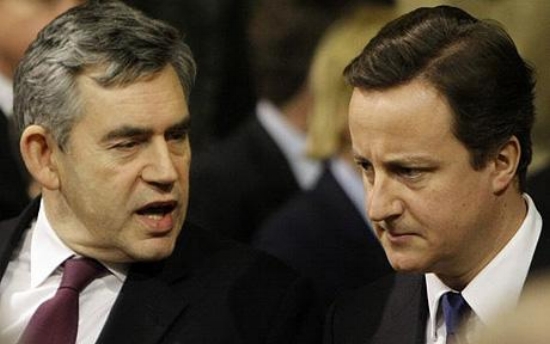
For a country to have its currency marked down against the Zimbabwean dollar is not generally a good sign. But that is what has been happening to Britain this year. And it got worse in the immediate aftermath of an early March opinion poll showing that the governing Labour party had pulled to within 2 percentage points of the Conservatives. For quite a while now, there’s been a widespread assumption—backed by opinion polls, local election results, the 2009 vote for the EU parliament, and the feeling that enough was enough—that the Tories after 13 years out of power would win a decent majority in the general election due no later than June.

That wasn’t unreasonable. The U.K. has been wrecked by Labour. For Britons to give Gordon Brown a new term would be about as sensible as Pharaoh inviting the locusts back for another snack. The Conservatives meanwhile had been given a fresh lick of paint by David Cameron, the young (43), loudly modernizing politician who took over the Tory leadership in 2005. They were revived. They were ready. What could go wrong?

Well, Cameron suddenly has a shot at being Britain’s Thomas Dewey. That March poll was just the most dramatic of a series showing that the robust Tory lead of last year—usually well into double digits—had dwindled to a toss-up. Thanks to the peculiarities of the U.K.’s electoral system, the Conservatives need to be around 10 points ahead of Labour to achieve the sort of parliamentary majority that they will need if they are to form a workable government. Not only would a 2-point lead not do the trick, it would actually result in Labour being the largest party in the House of Commons and, almost certainly, holding onto power.

The most common expectation of the chattering classes is now of a “hung parliament” in which the Conservatives would win the most seats, but fall short of an absolute majority. They still might be able to form a minority government, but it would be a weak, fragile thing, and in no position to do what needs to be done to restore Britain’s battered finances. The uncertainty that this would bring may spook the markets even more than a clear Labour win. A reelected Labour government ought at least to have the authority needed to tackle a budget deficit that threatens to set the bailiffs on Blighty. It might even use it.

But if international investors were alarmed by the turn in the polls, they were equally bewildered. To outsiders, not least in the United States, the thought that Gordon Brown could be allowed to continue in office beggars belief. That he might highlights just how much the reality of British politics differs from the fond Atlanticist myth. That reality is the reason David Cameron, new Tory, has done what he has done. It’s the reason he may yet fail.

The roots of America’s attachment to the free market and to individual liberty may be traced back to the sceptr’d isle, but the Old Country is today a nation of the center-left and has been for over six decades. Class resentment, greater respect for authority, the all too visible failures of British capitalism, and intellectual and physical proximity to the continent, have all helped push the U.K. in a direction very far from Adam Smith’s ideal, a process buttressed by the institutions, habits, and ways of thinking put in place by Labour after its landslide victory in 1945.

Browbeaten by memories of the scale of that defeat, postwar Tory governments preferred to focus their efforts on the more efficient management of the social democratic state rather than its replacement. That began to change with the election of Margaret Thatcher in 1979, but it’s telling how close that happy day came to never dawning.

Bought and paid for by the trade unions and blinkered by ancient leftist ideology, the Labour government of the 1970s presided over soaring inflation, penal taxation, rising unemployment, and endemic industrial disorder. Its crowning humiliation (there are many choices) was the moment it was compelled to go cap-in-hand to the IMF for a bailout in 1976. Despite all this, it might have won reelection had it gone to the polls in 1978—a fact that should make David Cameron shudder. Mercifully, Prime Minister James Callaghan blinked, and the strikebound “winter of discontent” was enough to hand Mrs. Thatcher a solid, if unspectacular win the next year. Her later majorities were far more substantial but, thanks to splits on the left side of the political fence, they were exaggerated by similar electoral dynamics to those that now operate against the Tories. She never won more than the 44 percent of the popular vote she received in 1979 (her narrowest victory in terms of parliamentary seats, incidentally), a showing that may explain why her reforms were more cautious and incremental than hagiographers now like to claim.

Her successor, John Major, had a less-successful encounter with the realities of a center-left nation. While his government made more than the usual number of blunders, the extent of its 1997 defeat by Tony Blair’s “New Labour” revealed a more profound phenomenon. It was almost as if the Tories had no legitimate role within the British body politic, a sensation magnified by extraordinarily antagonistic media coverage and the wholesale rejection of the Conservatives by the cultural elite, either highbrow or low. The journalist and novelist Robert Harris, a Blair supporter, reported with evident satisfaction in 1998 how he couldn’t think of one single “important” British writer, film director, theater director, composer, actor, or painter (“apart from Lord Lloyd Webber”) who was a Conservative.

Under the circumstances, it’s no great surprise that the Tories have struggled ever since. Britain’s natural center-left majority reasserted itself—bolstered by the favorable economy bequeathed to Labour by the Conservatives, basking in the approval of its amen corner in the media  and benefiting from the assumption running through popular culture that there was something not quite acceptable about the Tories. Blair was also hugely helped by Britain’s electoral arithmetic. In the 2005 election, for instance, Labour won some 35 percent of the vote, but took 55 percent of the seats. This was the period in which the candidacies of the three Conservative leaders to follow John Major were destroyed almost as soon as they began.

Basking in the memory of the Ronnie and Maggie show, and reassured by the continuing (if fraying) willingness of the U.K. to stand alongside the United States in battle overseas (Britain’s still living martial tradition is one of the key respects in which it differs from its social democratic neighbors), many on the American right either don’t know or prefer to downplay just how different things are across the pond. That makes it difficult for them to appreciate what Cameron has been trying to do.

To get a feel for the challenge he faced in 2005, imagine what it would be like to be a Republican politician in an America where the mainstream media dictated a largely unchallenged liberal political agenda but where there was no Fox News, no Tea Parties, no libertarians, Perotistas, Second Amendment vigilantes, Club for Growth types, religious rightists, Reagan Democrats, NASCAR folk, country music fans, and .  .  . well, you get the picture.

Cameron felt the only hope of getting his message out was to “decontaminate the brand.” This meant tackling the media. And so he did—in a Winston Smith way. Two plus two did indeed add up to five. The caricature of the Tories as elderly, racist, reactionary bitter-enders was, Cameron implicitly conceded, true. He would, he said, put that right. The result was a slew of policies—some good, some bad—designed to show that the party had mended its ways. It was now younger, kinder, gentler, “compassionate” (yes, there were distinct echoes of the 1999 vintage George W. Bush in all this), and more inclusive. It was an approach epitomized by the Conservative leadership’s ostentatious embrace (the party logo is now a tree) of environmentalism—the secular religion of the recycling classes of Middle England and a pervasive finger-wagging cult among Britain’s showbiz “luvvies.” And it worked. While the media (with the exception of sections of Fleet Street) and entertainment worlds remain almost entirely estranged from the Conservative camp, the hatred ebbed enough that the Tory message to the wider British public was no longer drowned out.

But appeasing the media in essence reduced the Tory strategy to the twin pillars of inoffensiveness and not being Labour. As the country careened into financial catastrophe and historic recession that ought to have been enough, especially against a government divided by infighting and led by a morose, uncharismatic figure with, as the phrase goes, “issues.” But with the party very publicly remaking its image, this reticence has begun to look a lot like incoherence—a perception only amplified by signs of disorganization at the top of the Conservative hierarchy.

That this is an election that will revolve around the economy is, moreover, not the straightforward winner for the Tories that one might suppose. Debilitated by years of Labour misrule, Britain’s economy was exhibiting severe signs of strain even before the financial meltdown. But the 2008 crisis provided a perverse alibi for Blair and Brown’s bungling. The slump is not Labour’s fault, you see, but the work of those wicked, overpaid bankers—sleek, pinstriped, prosperous predators who look a lot like the Tories of socialist legend. It’s no great stretch for Brown to argue from there that the Great Recession is the logical consequence and conclusion of Thatcherism. And it will be no great stretch for many voters to agree. The problems with that analysis are complicated to explain in the course of an election campaign, especially for a party trying very hard not to appear disagreeable.

The Tories have to get over themselves. They need to pin the blame for the mess on Labour—where it largely belongs—but they also need to demonstrate that they have the competence and the ideas to manage Britain’s way out of this jam. The last few weeks of the Conservative campaign have not been reassuring on the competence front.

The ideas haven’t been too great, either. For all their talk of restoring a measure of control to the nation’s finances, the Tories have spelled out relatively little in the way of expenditure cuts. That Cameron has also vowed to “protect” spending on the National Health Service, a cost that already represents around 18 percent of public expenditure and is set to rise higher, merely reinforces the idea that the Tories are not serious about the deficit. Yet Cameron really had no choice. To advocate cutting back the NHS is an act of political suicide in Britain. The NHS, a source of national pride for all its shortcomings, is the third rail of British politics, the great creation of Labour’s postwar settlement, and a powerful mechanism forever pulling Britain’s politics to the left and its people into ever deeper dependency on the state whether as employee (the NHS payroll is over 1.3 million strong) or patient.

Yet Britain’s growing budgetary crisis (government debt is slouching towards 100 percent of GDP by 2014) presents the Tories with a conundrum. An austerity program will be essential, and it will be painful, particularly in a nation where so many work for the public sector. For the Tories to give more details of how they plan to come to grips with the budget deficit is essential if they are to be believed as offering a credible alternative to Labour’s botching of the economy. At the same time, it could be electoral poison in a country where the (wildly exaggerated) “Thatcher cuts” of the 1980s still fester in political folklore.

Labour knows this. The government is doing everything it can to create the illusion that the U.K. can somehow muddle through this crisis without too much pain. Putting party before country, Chancellor of the Exchequer Alastair Darling has left spending plans broadly unchanged over the last year, a stance that owes more to political calculation than to the more respectable concern that domestic demand is too depressed for cuts now. That’s a stance that could easily be reconciled with detailing plans for the more frugal future that the markets want to see, but this is not the course that Darling has taken. His pragmatic irresponsibility has been rewarded: An ICM poll earlier this month showed that when it comes to trust in their ability to handle the recession, the Tories’ lead over Labour had fallen to 2 percentage points—down from 15 in October.

The sense that there is something missing from what the Conservatives are saying is not confined to the economy. Just take the example of immigration. One of the hallmarks of the Blair-Brown years has been the failure to control the U.K.’s borders, through negligence, indifference, and worse: Recently uncovered documents appear to suggest that some of the increase was the product of a deliberate effort to reshape the British population. The welcome mat was noticed. Immigrants have poured in a net annual rate that quadrupled between 1997 (the year of Blair’s first election victory) and 2007, bad news for an overcrowded island wrestling with endemic (if often disguised) unemployment and a sometimes volatile multicultural mix. Unsurprisingly, this issue is a major source of unease to many Britons. According to a DailyMail/BPIX poll of swing constituencies in early March, 45 percent of voters would be “more likely” to vote Conservative if the party were to take a tougher line on immigration, yet Cameron has said next to nothing on the topic. Reports last weekend that the leadership would no longer have any objections to Conservative candidates’ using the I-word in their election literature show just how far things had been allowed to slide. To some critics, the reason for such hesitation, which is by no means confined to the immigration issue, is that the Tories are still preoccupied with fighting a battle they have already won: the fight to show that they are indeed no longer the nasty party.

But there are other critics with a different explanation. Cameron’s policy shifts have won him few real friends among the Tory base. There is respect for his political skills and a grudging recognition that much of what he has done had to be done if the Conservatives were, after three consecutive general election defeats, ever to win power again. The party’s right-wingers accept that their guys had their chance in the 2001 and the 2005 elections and that it didn’t work out. They also know that British voters typically don’t opt for parties where the divisions are too obvious. So, if through frequently gritted teeth, the right has gone along, soothed by the prospect of victory.

As that prospect fades, there’s revived anxiety that Cameron is not, to borrow Mrs. Thatcher’s phrase, “one of us.” Are his attempts to drive the party in another direction as much a matter of conviction as of tactics? These fears have been boosted by a series of recent moves that made no electoral sense, or at the very least were evidence of a leadership that was badly out of touch.

They include an attempt by the Cameron clique (and it is a clique) to force local constituency associations to pick female parliamentary candidates through the use of women-only shortlists. This flew in the face of Tory meritocracy, made a mockery of Cameron’s alleged commitment to grassroots politics, and risked alienating the activists who need to be enthused ahead of the hard slog of a general election campaign. Adding to the irritation on the right has been the leadership’s refusal to use the obvious opportunity presented by the various Climategates to make clear that its commitment to Gore’s war against climate change was not, contrary to earlier impressions, a blank check.

And then, inevitably, there’s Europe. The decision last November by Cameron to renege on his “cast iron” pledge to hold, if elected, a referendum on the EU’s -Lisbon Treaty was logical (the treaty had since come into effect: A British rejection would not be enough to undo it) but dreadful politically. The Tory lead in the polls began to slide shortly thereafter. Making matters worse to a party and a country that is far from friendly to the EU’s ever-expanding reach, in February it emerged that the Conservatives were sending Ken Clarke, the last serving senior Tory still in the grip of europhilia, on a discreet mission to Brussels. Its presumed purpose? To reassure the EU elite that the Conservatives were suitably house-trained.

Cameron is running on a program of—wait for it—“change.” But the electorate is asking just what sort of change this would really be. While the Conservatives would be a considerable improvement on the sleazy and incompetent gang now running Britain, many voters suspect that voting for the Tories will simply mean swapping “progressive” rule by one metropolitan faction with that by another. This view has only been reinforced by the expenses scandals that have roiled parliament and shamed the entire political class. It’s a reasonable bet that small non-establishment parties will, along with “none of the above,” increase their share of the vote this time round. Nevertheless, not being Labour is still probably going to be enough—just—to hand Cameron the keys to 10 Downing Street. After 13 years of Blair/Brown, too much sewage has flowed under Westminster Bridge for voters to want to risk giving Labour another go.

The problem for Cameron is that, in the absence of a massive financial crisis breaking between now and election day, his majority will be small. This will leave him vulnerable when things start to turn rough. And the U.K.’s desperate financial straits ensure that they will. Britain is already brutally taxed. Sooner rather than later the next prime minister will have to slash government spending, and he will have do so against a backdrop of high unemployment, sustained economic underperformance, and the rising opposition of a center-left nation. You can guess where the media will stand on all this.

Mrs. Thatcher found herself in a not dissimilar predicament within a year or so of taking office in 1979. Many of her senior colleagues panicked, but what saved her was the loyalty of much of the Conservative base, a base that the parliamentary party could not risk defying, however much they might want to. She, party loyalists knew, was one of them.

As things are currently going, they won’t feel the same way about David Cameron in 2011.

EUbris

National Review, February 18, 2010 (March 8 2010, issue) 

It’s a cliche to use the word “hubris” in an article involving Greece, but when that article is about the single European currency, what else will do? From its very beginning, the euro was a project of monstrous bureaucratic ar­rogance, a classically dirigiste scheme cooked up by an elite confident that it could ignore the laws of economics, the realities of politics, and the lessons of history. While the exact contours of the current crisis could not have been foreseen, the certainty that there would be a crisis could have. To build a monetary union without a political union (or something close to it), or, failing that, an extraor­dinarily high degree of economic con­vergence, was asking for, to use another Greek word, catastrophe.

But that’s what the Eurocrats did. And instead of having the humility to launch their new currency on a relatively small scale in, say, the genuinely converging economies of northwestern Europe — of Germany, say, and the Bene­lux — they redefined convergence. Any EU country that satisfied certain economic tests — the Maastricht criteria — would be eligible to sign up. In the first round (1999), eleven countries did, to be followed later by Greece and four others. The tests were tough, but not entirely unreasonable; yet in applying them as mechanically as they did, the architects of the single currency were in effect arguing that all it took to gauge an economy was something akin to a snapshot. This had the virtue of simplicity, but then so did Five-Year Plans.

Largely uninvestigated suspicions that some of those snapshots may have been photoshopped (there have long been doubts about the quality of the data submitted by Italy and, yes, Greece) were an early warning that the Maastricht criteria, which were also meant to be rules by which countries would continue to play once ensconced within the eurozone, would be enforced less vigorously than first agreed. As it turned out, there was little choice in the matter. The new rules were too rigid for the uncomfortable realities of the ordinary economic cycle, let alone the financial meltdown of the last two years. As things currently stand, they rank somewhere between a promise and a dream. That said, the revelation that Greece may have paid Wall Street’s sav­viest financial engineers to pretty up its national accounts is unlikely to play well in Brussels, except as ammunition for the claim that “speculators” are to blame for the mess in which the eurozone now finds itself.

The real culprits are closer to hand. The most important were those who in­sisted that convergence had been achieved when plainly it had not. The interest rates set by the European Cen­tral Bank were about right for the eurozone’s core, but they were too low for the nations on its periphery. The econ­o­mies of the latter may have had more capacity for growth, but they were also more vulnerable to inflation. One size did not fit all. Bubbles ballooned, then burst. Making matters worse was the damaging effect that the historically unusual combination of in­flation and a strong currency has had on the already shaky competitiveness of these countries’ industries. Nations with high inflation traditionally try to maintain their competitive position by devaluing their currency, but that option was not open to those now yoked to the euro. On some reckonings, Italy, Greece, and the other “Club Med” countries need to de­value by at least 30 percent to return to the competitive positions they held at the end of the 1990s. They need to, but they cannot.

If the hit to private business has been bad, that to the state sector has been worse, albeit to some degree self-inflicted. For countries with weaker public finances, the euro offered both carrot and stick. The carrot was the lower borrowing cost that came from adopting a currency im­plicitly backed by the stronger econo­mies at the eurozone’s core. The stick was the fact that debt could no longer be repaid by the printing press. Un­fortunately, a number of governments, most notably Greece’s, ate the carrot and ignored the stick, but even those that tried to improve or maintain budget­ary discipline found their best efforts swept away in the financial tsunami of 2008–09.

The immediate trigger for the current crisis was panic over the prospect of a Greek default. That’s understandable. Greece’s debt-to-GDP ratio stands at 125 percent (more than double the notional Maastricht ceiling). The budget deficit is now projected at 12.7 percent (more than four times the Maastricht cap), compared with the mysteriously “low” 6 percent claimed by the outgoing government in October. It may still be understated. Nevertheless, however dysfunctional the Augean Greek state may be (did I mention the endemic tax evasion?), it is not alone in its woes, nor — despite the fact that it accounts for just 2 percent of the EU’s GDP — can it be treated as some inconsequential Balkan outpost.

If Greece defaults, a crisis of confidence in the credit of the eurozone’s other highly indebted nations is inevitable. Even in the unlikely event that default could be confined to Greece, a financial collapse in Athens would bring further devastation to Europe’s already battered banking system, both directly and, as sovereign debt was marked to market across the continent, indirectly. Ger­many’s banks have loaned a total of perhaps 20 percent of Germany’s GDP to Greece, Por­tu­gal, Spain, Italy, and Ireland, and French banks have loaned even more of France’s. “Con­ta­gion” is back. Greek withdrawal from the eurozone is legally possible, but it is no solution. The result would almost certainly be default.

Whatever the legal issues (a direct EU rescue may be illegal under the Union’s law), political complications (hard-pressed Eu­ro­pe­an taxpayers do not relish the thought of paying up for Greece), and risks of a dangerous pre­ce­dent (how will the other debt-struck countries react?), the only feasible short-term solution will be some sort of bailout, ideally involving the IMF (whatever the supposed blow to EU pride) acting in conjunction with the EU or a group of some of its richer member-states. For now, nemesis will not be allowed to follow hubris. The legalities will be dubious, the politics a charade, and the deal last-minute, but that’s EU business as usual. “In­ter­na­tion­al spec­ulators” will be blamed for just about everything. Angela Mer­kel will make the necessary fierce speeches re­fusing to pay and will then pay. The Greeks will agree to the necessary fierce cuts in public spending and will then be paid. Whether these cuts (currently targeted at 4 percent) could, should, or will be made in a climate of collapsing domestic demand will be a decision left for another day.

The euro will endure, somewhat de­bauched (it has already weakened since the Greek panic began), but not all Ger­mans will be upset by that. Germany’s economy is driven by its export sector, and in tough economic times a little devaluation can come in very handy indeed.

Looking farther ahead, the Greek crisis and the fragility of the balance sheets of so many countries within the eurozone suggest that, absent some dramatic re­covery in the global economy, the single currency is reaching a point where muddling along is no longer an option. One alternative might be for Germany and some of the other strong­er countries to quit the euro, leaving it as a currency more suited to the needs of the eurozone’s weaker breth­ren. What’s more likely is that those in charge in Brussels will grab the opportunity presented by this mess to move forward with two items on their long-term agenda. The first will be to push for stricter controls on global finance. The second will be to forge the closer fiscal union without which their monetary union cannot endure. If they succeed in the latter, the European superstate will be even closer to birth.

What was it that someone once said about a crisis being a terrible thing to waste?

Do Mention the War

The Weekly Standard, March 8, 2010

Tolstoy was wrong. Every unhappy family is not unhappy in its own way. Scratch the surface of a foundering relationship, and you’ll often find that money is, if not the sole source of the misery, undeniably the most poisonous. This is certainly true within the “ever closer” family that the European Union is meant to be. Some of the EU’s most savage fights have been about cash, an awkward fact that can equally be read as underlining just how far from familial this most unnatural of unions really is. The different nations of the EU remain, emotionally at least, nations. They continue to be foreign to each other. And who wants to give their money to a bunch of foreigners?

So it shouldn’t be any surprise that Germans are infuriated at the thought of having to stump up for a rescue of Greece’s Augean state. Their own economy is faltering. They have held back labor costs for years. They have, often painfully, maintained budgetary discipline. That’s not the way it’s been in Greece. With Greek government debt at 125 percent of GDP, a budget deficit of 12.7 percent, and distinctly shaky public support for any sort of austerity program, there is little, beyond beaches, about that country to appeal to citizens of the thrifty Bundesrepublik. Opinion polls show that over two-thirds of Germans reject the idea of contributing to a Greek bailout, and the venom with which that opposition is expressed suggests that exasperation has drifted into contempt.

To give more money to the Greeks would be akin to giving schnapps to an alcoholic, argued Frank Schaeffler, deputy finance spokesman for the Free Democrats, the junior partner in Germany’s governing coalition. Focus magazine ran a cover story on “The Fraudster in the Euro-Family” (a reference to the more creative aspects of the Greek government’s accounting) and illustrated it with the Venus de Milo, one-armed and flipping the bird. The tabloid Bild raged at the “proud, cheating, profligate” Greeks. A writer for the rather more heavyweight Frankfurter Allgemeine Zeitung asked whether Germans should have to retire at 69 rather than 67 to pay for Greek workers striking against proposals to increase their retirement age from 61 to 63. The mood in Germany was not improved by Greece’s deputy prime minister. Stung by all the criticism of his country, he grumbled that, having made off with Greece’s gold during the war, the Germans were in no position to complain “about stealing and not being very specific about economic dealings.”

Germany has long paid the largest share (currently around 20 percent) of the cost of Europe’s trudge towards union. Its annual payments into the EU now exceed what it gets back by over $10 billion. In part this has been viewed as a fair price for Germany’s readmission into polite society. It was also an expression of the once widespread belief—deluded if understandable—among Germany’s political class that an ersatz European patriotism could take the place of the German nationalism that had turned out so unfortunately just a few years before. Over six decades after Hitler perished in his bunker, however, these arguments are running a little thin.

Making matters worse is the debt (in all senses) that the Greek crisis owes to the establishment of the euro, the single currency for which German politicians ignored their voters and junked the deutsche mark in a two-stage process ending in January 2002. The deutsche mark had been one of the great successes of postwar Germany, a symbol of renewed prosperity and bulwark against any return of the hyperinflation that stalks that country’s historical memory. But, to those that counted—i.e., not German voters—the European Union mattered more. The deutsche mark perished, and the economic and budgetary rules—the Maastricht Criteria—designed to preserve the integrity of its successor (and reassure the twitchy German electorate) have not been kept in much better shape.

The new currency proved both an enabler of Greece’s profligacy and an agent of its economic troubles—a double whammy not confined to Greece. From the first, the euro’s interest rates were primarily determined by economic conditions in the eurozone’s core—Germany, the Benelux, and France—which meant that rates were too low for the nations on the periphery. One size did not fit all. The low interest rates fueled inflation, speculative bubbles, and, in some cases, excessive government borrowing in Portugal, Ireland, Greece, and Spain, the four “PIGS” in the financial markets’ insulting jargon. (You’re welcome to throw in another I for Italy.) The usual response to disruptions of this nature is devaluation. Signing up for a single currency, however, has removed that option.

Despite German voters’ hopes, this mess cannot safely be confined within the PIIGS’ sties. Drastic austerity programs by the debt-struck might in theory do the trick—although the wisdom of this is debatable at a time of deeply depressed domestic demand—but to succeed they require a degree of consent. Consent, however, is not the message that all those Greek strikes are delivering. So far, Brussels appears to be resting its hopes on the idea that talk of austerity, promises of support, and the prospect of closer economic supervision will be enough to persuade markets to keep funding the PIIGS’ budget deficits. Greece will for now be the sharpest test of that idea, but ultimately the country will not be allowed to fail. Even if it did not destroy confidence in the surviving PIIGS, a Greek collapse would, just as a start, trigger mark-to-market downgrades across the battered balance sheets of Europe’s largest financial institutions. German banks, for instance, have loaned the equivalent of 20 percent of their country’s GDP to the PIIGS, and their French counterparts even more.

Throwing Greece out of the eurozone might be emotionally satisfying (over half of German voters are in favor, though it probably isn’t even legally possible), but inevitably the result, pushing the country into default, would achieve nothing constructive. What would make sense is for Germany and the other countries at the eurozone’s core to abandon the currency. The euro would slump, giving the nations that still use it the devaluation they so badly need. But that’s not going to happen either. The European elites have sunk too much political capital into the single currency to give it up now. They will plough forward regardless of the current crisis. If the logic of that course provides the rationale, or at least an excuse, for the even deeper EU integration that most European voters do not want, then so much the better.

But the opinions of the electorate no longer count for that much anywhere within the EU. With feelings running as they are in her country, Chancellor Angela Merkel has to be seen to be talking tough and doing everything she can to avoid Germany being stuck with the Greeks’ bills. At one level she may mean it, but she knows it is just theater. Merkel will huff and Merkel will puff, but she will not risk bringing down what is left of Athens’s ruins. If a rescue party has to be put together, Germany will be a prominent part of it.

To be fair, it’s not all bad news for Germany. If Greece is indeed bailed out by some or all of its EU partners, the longer-term impact will be both to weaken the euro (which will help Germany’s important export sector) and, by preserving the eurozone as it is, keep many of Germany’s competitors within the eurozone most helpfully hobbled. The combination of higher levels of cost inflation, lower levels of efficiency, and a shared, hard currency has eroded much of the price advantage that was once the main selling point for the industries of Europe’s less-advanced economies. It is estimated that the PIIGS would have to devalue by more than 30 percent to restore their competitive position against Germany, a situation that is only going to get worse.

Like so much to do with Brussels’s strange imperium, this story is a lot less straightforward than it first appears.

King & the Commissars

David King: Red Star over Russia

The New Criterion, March 1, 2010

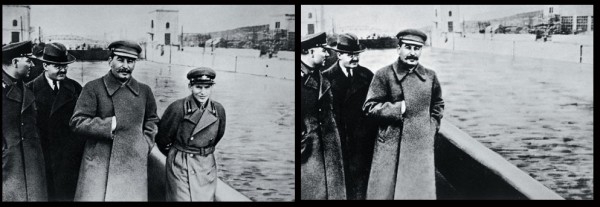
Yezhov and stalin.jpg

To be asked to pick the best book that you have read in the past year is usually an invitation to equivocation, but that was not the case on one evening in the late 1990s when my interrogator—and that’s the word—was the Baroness Thatcher of Kesteven. “Well,” I replied, “The Commissar Vanishes.”

She hadn’t heard of it. Good. Liked the book’s concept. Better. Told an aide to write down the title. Better still. Didn’t know that it was written by an unreconstructed lefty. Ah, just as well.

David King’s The Commissar Vanishes: The Falsification of Photographs and Art in Stalin’s Russia (1997) remains one of the finest and most unusual pieces of Sovietology ever produced. To start with, it is based on photographs, posters, and illustrations drawn from its author’s massive 250,000-piece collection of images relating to Russia, the former Soviet Union and “Communist movements everywhere,” a unique resource that King has been assembling for decades. This reddest of hoards is a monument to King’s political leanings—he has published more than is entirely healthy on the topic of Leon Trotsky—but, thanks to its range, it has ended up as something far grander than that. The same might be said of The Commissar Vanishes. Inspired by the way in which the Soviets wrote Trotsky out of history, King’s command of his material transforms what might have been a mildly interesting Fourth Internationalist lament into a startlingly original evisceration of the Stalinist method.

Specifically, the book revolves around the way that images and, in particular, photographs were repeatedly chopped, changed, juggled, retouched, altered, and manipulated by a regime determined to remove inconvenient traces of inconvenient people from the historical record. Execution was not enough. The lives that had gone before that concluding bullet in the skull had to be retrospectively reshaped to fit Stalin’s Procrustean view of how the Soviet story should be told.

It was a campaign that recognized no distinction between public and private, and it was a campaign that nobody could safely ignore. King highlights the precision with which the famous artist and photographer Alexander Rodchenko inked out the faces of the purged from his personal copy of a book he had himself produced. Blackly blank-faced, these remnants, these apparitions, these Banquos at the apparatchiks’ dangerous feast, linger on the page alongside those still in favor, a warning, a reproach, an act of insurance. As the countless scribblings over, hacked-out heads, and other precautionary mutilations of books from this era bear witness, such ad hoc self-censorship was commonplace, if too crude and small-scale for the needs of a modern totalitarian state. To fill that gap, specialists emerged, dedicated to the wholesale reengineering of history into a malleable, constantly reedited narrative.

But it was not enough to lie about the past. Those lies had to work. They had to be buttressed and reinforced. They had to be illustrated. In one characteristic sequence, King shows how Trotsky, the commissar of King’s tellingly elegiac title, was among those subsequently “vanished” from a frequently published photograph of the second anniversary of the October revolution. With tinkering such as this, history could be continuously (the party line was always changing) reshaped, reinvented, and manufactured in a process only occasionally—and incompletely—redeemed by the archetypically Soviet slovenliness of those who sliced and diced their way through the past but sometimes allowed the faintest suggestion of the truth to slip through. In another photograph of those same celebrations republished in 1987, most of Trotsky has been edited out, but his elbow survives, unexplained, unidentified, somebody’s elbow, nobody’s elbow.

As an explanation of history through its manipulation, The Commissar Vanishes is a technical tour de force. As an examination of the wider pathologies of the Stalinist state it is a masterpiece. It was followed by Ordinary Citizens: The Victims of Stalin (2003), a collection of over a hundred mugshots from the NKVD/KGB archives, glimpses of the doomed hours or days from their annihilation.

Compared with the narrower focus of those two earlier works, Red Star over Russia is an unruly sprawling epic, “a fast-forward visual history of the Soviet Union” from 1917 until just after the death of Stalin. Based again on King’s archive, this book is another extraordinary creation, but to understand it properly it helps to look at the reasons King gives for concluding his narrative when he does:

The subsequent “period of stagnation”, when Leonid Brezhnev was in charge, was generally as dull and sluggish on the visual front as it was politically, and for this reason has been left out. So too have the final years of collapse under Mikhail Gorbachev and Boris Yeltsin.”

Perhaps the perestroika era was omitted because the break in the narrative would have been too tricky to manage. Perhaps. Given his ideological orientation, it is difficult to avoid the suspicion that King might have found this terminal renunciation of 1917’s once radiant future just too awful a development to contemplate. That said, his assertion that it was largely aesthetic considerations that led him to pass over the stodgy Brezhnev era rings true. As the art editor of the London Sunday Times’s magazine between 1965–75, he was at the helm during the magazine’s creative zenith, a time when its striking layout was, none too coincidentally, often highly suggestive of the early Soviet and pre-Soviet avant-garde, an approach successfully repeated in Red Star over Russia.

King has a good eye and a Fleet Street–sharpened sense of how to lure the reader in. Red Star over Russia’s cover is of a dramatically charging Red cavalryman, designed in civil war–era Kiev but anticipating Roy Lichtenstein by four decades. Meanwhile the beautiful Tamara Litsinskaya graces the cover of Ordinary Citizens. Pause for a moment to remember her: she was twenty-seven years old, “non-party,” and, on August 25, 1937, she was shot. Inevitably, there is the suspicion that King’s pursuit of the aesthetically (and commercially) effective could tempt him to ignore other, higher, considerations. A mugshot is not a pin-up. Then again, human nature is what is. To the observer—and that’s what buying Ordinary Citizens makes us—the loveliness of this young woman only adds to the poignancy to us of her terrible fate, and thus to the power of King’s message. Now we will remember Tamara Litsinskaya. And so we should.

To take another example of how the search for the right image risks clashing with the dictates of good taste, consider the inclusion in Red Star over Russia of the best-known of Dmitri Baltermans’s photographs of peasant women grieving over the victims of a Nazi massacre near Kerch. It is one of the greatest war photographs ever taken. It helped define the conflict for many Soviets. It belongs in the book. Nevertheless, thanks to the passing of time and to Red Star over Russia’s superior production values, Baltermans’s bleak, unforgivably beautiful image also becomes an objet d’art, glossily packaged for our contemplation, but increasingly disconnected from the tragedy it records. More troublingly still, the relatively poorly and rarely photographed Holodomor (1932–3), the genocidal man-made famine in which as many as seven million Ukrainians may have died, merits just one small photo, a snapshot really. Seven million dead. One photograph.

Red Star over Russia is also a volume that, however inadvertently (it was clearly not King’s intent), forces its readers to ponder their reaction to beauty deployed in the service of evil. That’s a topic that can generate a safely academic debate when it comes, say, to the artistic qualities of artifacts used by the Aztecs in their rites of human sacrifice. It becomes rather less comfortable the closer we come to our own time. Too often the response is denial or evasion. The Nazis never produced anything of aesthetic interest. The creative successes of Fascist Italy were always a despite, never a because. The artistic explosion of the early Soviet era was a gorgeous false dawn, tragic symbol of the nascent Utopia that Stalin cut down. None of these claims is true.

So far as the best of that Soviet art is concerned, the extent of its creators’ achievement should be acknowledged—many of the works reproduced by King are first rate—but so should the fact that this was art knowingly put at the disposal of a regime set on mass murder from the very beginning. That’s an ugliness King is unwilling to confront, quite possibly because this long-time admirer of Trotsky retains some allegiance to the conceit of the Revolution Betrayed, and thus to the assertion (to use a polite word) that the Bolshevik experiment was a glorious dream that went astray—an assertion that would, had it any connection with reality, do much to get many of the regime’s early cheerleaders off the moral hook.

It’s an attitude that can also be detected in King’s handling of some of the mugshots included in Red Star over Russia: those of the defendants in the first and second great Moscow show trials of the late 1930s. To be left unmoved by these portraits (and they are portraits—the NKVD used natural light, eliminating the frozen artificiality of the flashbulb photo) of these broken, terrified, furious, stunned individuals would be monstrous. At the same time, it’s impossible not to wonder over what horrors these members of the old Bolshevik elite had themselves presided. King never tells us. It’s perhaps no less significant that while King puts together a vivid indictment of the Stalin regime, most of the images he deploys to illustrate the early years of the revolution (with the exception of some harrowing photographs of the Volga famine of 1920–1) convey a sense of dynamism, of progress on the move. Where atrocity is depicted, it is only obliquely, in a few posters and in a civil war photograph of captured Red Army soldiers held, naturally, on a White “death ship.” To be sure the Whites frequently reverted to a near-primeval savagery in their fight against Bolshevism, but of the almost unimaginable, almost ecstatic cruelty unleashed on Russia by the revolutionaries we are shown nothing.

For all that, no page of Red Star over Russia is wasted: there is enough in this book to sustain more than one interpretation both of the revolution and of what it became. Many of the images, most notably the reproductions and photographs of the regime’s initially utopian, increasingly deranged, and ultimately surreal iconography, can, if read properly, be used to help pinpoint Communism for the millennial cult that it really was. At its core, there was nothing progressive about it. I doubt that King would agree with this diagnosis. He concludes Red Star over Russia with the snide observation that the fall of the Soviet Union brought “a united sigh of relief” to “the capitalists of the world.” The liberation, however imperfect, of tens of millions of ordinary citizens by that collapse doesn’t rate a mention. Some people never learn. Faith can be like that.

A Most Uncomfortable Parallel

National Review, January 25, 2010

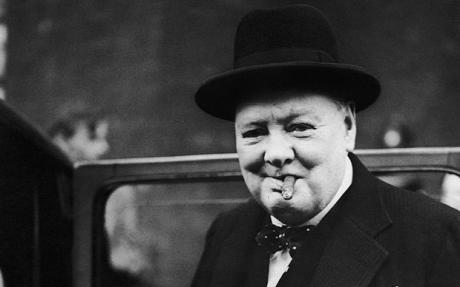
Let’s just agree that if you are looking for someone with whom to compare Barack Obama, the mid-20th-century British prime minister Clement Attlee does not come immediately to mind. Some might opt for FDR, some the Messiah, others the Antichrist or, harsher still, Jimmy Carter. Attlee? Not so much.

To start with, there’s the whole charisma thing. Attlee was the Labour leader who humiliated Winston Churchill in Britain’s 1945 election, but that victory (one of the most sweeping in British history) was more dramatic than the victor. No Obama, the new prime minister was shy, understated, and physically unprepossessing. Balding, sober-suited, and with an unshakeable aura of bourgeois respectability, Attlee resembled a senior bureaucrat, a provincial bank manager, or one of the more upscale varieties of traditional English murderer. If you want an adjective, “dull” will do nicely. As the jibe went, an empty taxi drew up, and out stepped Attlee. His speeches were dreary, largely unmemorable, and marked mainly by a reluctance to deploy the personal pronoun: Not for Attlee the “I”s and “me”s of Obama’s perorations. Clem was a modest man, but then, said some, he had much to be modest about.

That’s an insult that’s often attributed to Winston Churchill, but almost certainly incorrectly: Churchill had considerable respect for the individual who defeated him. Realize why and comparisons between the stiff, taciturn Englishman and America’s president begin to make sense. For the GOP, they are good reason to be alarmed.

There are the superficial similarities, of both character and résumé. Despite their very distinct camouflages both men are best understood as being cool and calculating, not least in their use of an unthreatening public persona to mask the intensity of their beliefs and ambitions. The two even have in common their pasts as “community organizers,” in Attlee’s case as a charity worker amid the poverty of Edwardian London’s East End, a harrowing and intoxicating experience that drove him to socialism. More important still is their shared eye for the main chance. In a private 1936 memo, Attlee (by then leader of his party) noted how any future European war would involve “the closest regimentation of the whole nation” and as such “the opportunity for fundamental change of the economic system.” Never let a crisis go to waste.

Attlee was right. In 1940 the Labour party was asked to join Churchill’s new national coalition government (with Attlee serving as deputy prime minister), and it wasn’t long before Britain had been reengineered into what was for all practical purposes a command economy. The extension of the state’s grasp was theoretically temporary and realistically unavoidable, but it quickly became obvious that the assault on laissez faire would outlive the wartime emergency. The crisis had overturned the balance of power between the public and private sectors. It was a shift that, when combined with Britons’ widespread perception of prewar economic, military, and diplomatic failure, also shattered the longstanding political taboos that would once have ensured a return to business as usual when the conflict came to an end. With Britain’s ancien régime discredited (it’s debatable quite how fairly), there was irresistible demand for “change.” Prevailing over the Axis would, most Britons hoped, mean that they could finally turn the page on the bad old days and build the fairer, more egalitarian society they felt they deserved.

It is a measure of how far the political landscape had been altered that by March 1943 Winston Churchill was announcing his support for the establishment after the war of “a National Health Service . . . [and] national compulsory insurance for all classes for all purposes from the cradle to the grave,” a stance that echoed an official report published to extraordinary acclaim the previous year. Churchill did, however, take time to warn that it would be necessary to take account of what the country could afford before these schemes were implemented.

Such concerns were alien to Attlee. The abrupt end of American aid in the form of the Lend-Lease program within a month of the Labour victory had left the U.K. facing, in Keynes’s words, a “financial Dunkirk.” The clouds cleared a little with the grant of a large, if tough-termed, U.S. loan, but the risk of national bankruptcy remained real for some years. Attlee pressed on regardless. The creation of the welfare state was his overwhelming moral and political priority. He had been presented with a possibly unrepeatable opportunity to push it through, and that’s what he did. To carp was mere bean counting. If there were any gaps, they could surely be filled by the improvements that would come from the government’s supposedly superior management of the economy and, of course, by hiking taxes on “the rich” still further. Is this unpleasantly reminiscent of the manner in which Obama has persisted with his broader agenda in the face of the greatest economic crunch in over half a century? Oh yes.

There’s also more than a touch of Obama in the way that Attlee viewed foreign policy and defense. A transnationalist avant la lettre, the prime minister thought that empowering the United Nations at the expense of its members was the only true guarantor of national security, a position that made his inability or unwillingness to grasp the meaning of either “national” or “security” embarrassingly clear. It is no surprise that he was reluctant to accept the inevitability of the Cold War with a Soviet Union already on the rampage. Attlee would, I reckon, have sympathized with Obama’s hesitations in the face of today’s Islamic challenge. Mercifully, reality — and the U.K.’s tough-minded foreign secretary — soon intervened. Britain adopted a more robust approach to its national defense (sometimes misguidedly; too many resources were devoted to an unsustainable commitment to some of the more worthless scraps of empire) and a place in the front line against Soviet expansion. In a sense, however, Attlee was to have the last laugh; the long-term damage that his government inflicted on the British economy meant that, even apart from the huge costs of the country’s post-war imperial overstretch, its decline to lesser-power status was inevitable.

But judged on his own terms, Attlee succeeded where it counted most. His nationalization of a key slice of British industry (including the railways, some road transport, gas, coal, iron and steel, the Bank of England, and even Thomas Cook, the travel agency) eventually proved disastrous; his intrusive regulatory and planning regime (not to speak of the crippling taxes he promoted) distorted the economy and retarded development for decades; the costs of the new National Health Service (NHS) instantly spiraled beyond what had been anticipated; and so on and on and on — but, well, never mind. In the greater scheme of things, he won. To this ascetic, high-minded statesman, GDP was a grubby detail and budgets were trivia. What mattered was that he had irrevocably committed Britain to the welfare state he believed to be an ethical imperative — and the NHS was its centerpiece.

And yes, that commitment was irrevocable. While a majority of Britons approved of including health care in their wish list for the post-war renewal of their nation, socialized medicine had not been amongst their top priorities. But once set up (in 1948), the NHS proved immediately and immensely popular, a “right” untouchable by any politician. For all the grumbling, it still is. The electoral dynamics of the NHS (which directly employs well over a million voters) were and are different from those of the likely Obamacare, not least because the private system the NHS replaced was far feebler than that, however flawed, which now operates in the U.S. Nevertheless, the lessons to be drawn from the story of the NHS form part of a picture that is bad news for those who hope that GOP wins in 2010 will shatter Barack’s dream.

NHS.jpg

At first sight, the fact that Attlee barely scraped reelection five years after his 1945 triumph would seem to suggest the opposite, but to secure any majority in the wake of half a decade of savage economic retrenchment was a remarkable achievement. The transformation of which the NHS represented such a vital part (and the events that made that transformation possible) had radically shifted the terms of debate within the U.K. to the left and, no less crucially, reinforced Labour’s political base. To remain electorally competitive, the Tories (who finally unseated Attlee the following year) were forced to accept the essence of Labour’s remodeling of the British state, something they broadly continued to do until the arrival of Mrs. Thatcher as Conservative leader a generation later. It’s no great stretch to suspect that a GOP chastened by the Bush years and intimidated by the obstacles that lie ahead will be just as cautious in tackling the Obama legacy.

And that will be something to be modest about.

Resistance Is Futile

The Weekly Standard, December 28, 2009

Bliss was it in that dawn to be alive--at least if you were Valéry Marie René Georges Giscard d'Estaing. The one-term president of France was awarded the job in 2002 of chairing the convention responsible for designing a constitution for the European Union. He compared his fellow delegates--a dismal, handpicked, largely Eurofederalist claque--with America's Founding Fathers, and, splendidly de haut en bas (however tongue-in-cheek), told this self-important rabble that, in the "villages" they came from, statues would be put up in their honor--"on horseback" no less.

But that's not quite how it worked out. When the villagers saw the hideous blend of bureaucratic centralism, transnational control, political correctness, and daft pomposity that slithered out of Giscard's convention, they were none too impressed. The draft constitution staggered its way to approval in some EU countries, but was killed off by referenda in France and Holland in mid-2005.

Except that's not quite how it worked out. Properly speaking, those two defeats should have put a stake through the heart of the constitution. Instead the ratification process was frozen "for a period of reflection"--a dignified term for buying time to cook up a scheme to bypass the awkwardness of voter disapproval. The scheme was the Treaty of Lisbon.

It preserved the content of the draft constitution, but junked its form. The constitution that had been rejected was scrapped, but its essence was preserved under the guise of a series of amendments to the EU's existing treaties that smuggled in most of the changes which would once have been incorporated in Giscard's monstrosity. It was a stroke of genius. Dropping the "c" word minimized the legal or political risk that referenda might once again be required. It was also an insult. Neither Giscard nor the key architect of the new treaty, Germany's chancellor Angela Merkel, made any attempt to conceal their view that the substance of the constitution was alive and well.

Channeling Louis XIV, Nicolas Sarkozy ruled that France's disobedient voters would be denied any further say on the matter. No surprise there, but I like to think that Merkel's coup might have caused a few pangs in the ranks of Holland's rather more respectable Council of State (the government's highest advisory body). Maybe it did, but the august if pliable Dutchmen somehow felt able to determine that the new treaty did not contain enough "constitutional" elements to require a referendum. Meanwhile, Britain's shameless Labour government just brazened things out. Labour had been reelected in 2005 on the back of a manifesto that included the promise of a referendum should the United Kingdom be asked to sign up for a revived constitution. The Lisbon Treaty was, however, cooed Messrs Blair and Brown, something completely different. There would be no popular vote.

In Ireland, though, significant changes to the EU's treaties require a constitutional amendment, and the Irish constitution can only be amended by referendum. The Irish government did not attempt to dodge its responsibilities. Nor did Irish voters. In June 2008, the Lisbon Treaty was voted down. As the treaty had to be ratified in each of the EU's 27 member states, the Irish snub should have finished it off. Except (you will be unsurprised to know) that's not quite how it worked out.

Within minutes of the Irish vote, the EU's top bureaucrat, Commission president José Barroso, announced that the treaty was not dead. When it comes to the European project, no does not mean no--as Danish and Irish voters had already discovered in the aftermath of their rejection of earlier EU treaties. Ratifications of Lisbon rolled in from elsewhere, the Irish government secured some placatory legal guarantees, setting the stage for a mulligan this October. In the event, however, the result of this second vote was determined not by the changes won by the Dublin government, but by the global financial meltdown, a blow that had brought Ireland's over-leveraged economy to its knees.

There was something almost refreshing in the lack of subtlety with which Barroso traveled to Limerick to announce--just weeks before the second referendum--that Brussels (in other words, the EU's conscripted taxpayers) would be spending 14.8 million euros to help workers at Dell's Irish plant find new jobs. In case anyone missed the point, Barroso also reminded his listeners that the European Central Bank had lent over 120 billion euros to the battered Irish banking system. Frazzled by financial disaster and fearful of the consequences of alienating their paymasters, Ireland's voters reversed their rejection of the Lisbon Treaty just a couple of weeks later.

Being a realist means knowing when to fold. In the wake of the Irish vote, a nose-holding, teeth-gritting Polish president committed his country to the treaty. This left the Czech Republic's profoundly Euroskeptic president, Václav Klaus, as the last holdout. If Klaus could delay signing the treaty (which had, awkwardly for him, already been approved by the Czech parliament) until after a likely Conservative victory in the upcoming British general election (due no later than next June), then the whole process could be brought to a halt. The Tories had vowed to withdraw the U.K.'s existing ratification and hold a referendum on the Lisbon Treaty before proceeding any further. Given most Britons' views (quite unprintable in a respectable publication), the result would have been to kill the treaty. The U.K. isn't Ireland. The U.K. isn't Denmark.

If, if, if .  .  .

It didn't take long for the blunt Klaus to dash those hopes: "The train carrying the treaty is going so fast and it's [gone] so far that it can't be stopped or returned, no matter how much some of us would want that."

Klaus signed the treaty on November 3. Shortly thereafter the EU's leaders began maneuvering to fill two new jobs: "president" (actually president of the European Council) and "foreign minister" (the latter will rejoice in the grandiloquent title of High Representative for Foreign Affairs and Security Policy). Following a couple of weeks of intrigue, backstabbing, and secretive quid pro quos, it was agreed the new president would be Herman van Rompuy--Belgium's prime minister and thus a man who knows a thing or two about unnatural unions. But the somewhat obscure van Rompuy (what Belgian prime minister is not?) is a world historical figure when compared with the woman who has become High Representative, a Brit by the name of Baroness Ashton of Upholland, a dull hack known--if at all--for her loyalty to the Labour party. The treaty finally came into force on December 1. The age of van Rompuy had begun.

Some commentators are presenting the emergence of the Belgian and the baroness as a triumph for the EU's member states over its bureaucracy's more federalist vision. The thinking goes that by securing the appointment of two nonentities to what are (notionally) the most prestigious jobs in the union's new structure, Sarkozy, Merkel, and the rest of the gang successfully defended what remains of their countries' prerogative to decide the most important matters for themselves. To believe this is to misread just how lose-lose the situation was. In reality, the nonentities will be as damaging (maybe even more so) to what's left of national sovereignty as better-known candidates such as the much-anticipated Tony Blair. Blair would have given the presidency more clout. He would have done so, however, at the expense not only of the EU's member states, but also of the Brussels bureaucracy.

The EU's new president is, as mentioned above, technically the president of the European Council, a body formally incorporated within the EU's architecture by the Lisbon Treaty after years in a curious organizational limbo. With a membership now made up of the union's heads of government, van Rompuy, and the inevitable Barroso, it is theoretically the bloc's supreme political institution. And theoretically therefore, the stronger it is (and with a heavyweight president it would supposedly have been stronger), the more it would be able to operate as a counterweight to the bureaucrats of the EU Commission. I suspect that this would never have been the case, but with van Rompuy, a housetrained federalist (he has already told a meeting arranged by--let a hundred conspiracy theories flower--the Bilderberg Group that he favors giving the EU tax-raising powers), at its helm, the point is moot. The key, van Rompuy reportedly claimed, to high office within the EU is to be a "gray mouse," and so, to the chagrin of Blair and those like him, it has proved. Sarkozy, Merkel, and all the rest of their more colorful kind will continue to prance and to parade, and power will continue to leach away from the nation states and into the unaccountable oligarchy that is "Brussels."

"It's all over," my friend Hans told me when Klaus threw in the towel, "Brussels has won." Hans, thirtysomething, a native of one of the EU's smaller nations, and a former adviser to one of the continent's better-known Euroskeptics, comes as close to anyone I have ever met from the European mainland to being a Burkean Tory--and Hans has now given up. He would, he sighed, have to move on with his life.

With Lisbon in force, little is left of the already sharply curtailed ability of any one member-state (or its voters) to veto the inroads of fresh EU legislation. In Hans's view, the treaty means that the momentum towards a European super-state is now irreversible. With their sovereignty emasculated and, in many cases, their sense of identity crumbling under the linked assaults of multiculturalism and mass immigration, the old nation states of Europe have neither the ability nor the inclination to say no. Euroskepticism will now be portrayed (not always inaccurately) as the mark of the crank or the Quixote. "And that," added Hans, a man still at a relatively early stage in his career, "is not the way to go either politically or professionally."

Signing up, however unenthusiastically, for the orthodoxies of the European Union is now de rigueur in the continent's ruling class. And if there was once idealism behind the Brussels project it has long since been overwhelmed by another of the beliefs that lay behind it--that neither nations nor their electorates could be trusted to do the right thing. Sovereignty, whether national or democratic or both, is being replaced by oligarchy, technocracy, and the pieties of the "social market." If you live in an oligarchy, it's best to be an oligarch.

This realization is one of the reasons that the EU has got as far as it has. It has provided excellent opportunities for some of Europe's best, brightest, and lightest-fingered to move back and forth between the union's hierarchy and those parts of the private sector (and indeed the national civil services) that feed off it.

Yet all was not gloom, said Hans. A stronger sense of their own identity and a still distinct political culture meant, he thought, that it wasn't too late for the Brits to do the right thing (as he sees it) and quit the EU. He is too optimistic. While correct that most Britons are irritated by the EU and its presumptions, he overlooks the fact that they have not yet shown any signs of wanting to end this most miserable of marriages. Hans also underestimates the subtler factors standing in the way of the long-promised punch-up between any incoming Tory government and Brussels--an event that in any case has now been postponed. David Cameron's party has shelved its plans for a referendum on the Lisbon Treaty. Now that it has come into force, modifying the treaty to accommodate the U.K. would require the assent of all the other member-states and that won't be forthcoming. A British referendum, Cameron claims, would therefore be pointless. How convenient for him.

Cameron has also made it clear that he has no intention of revisiting the U.K.'s relations with the EU in any serious way for quite some time. With Britain's economy in ruins, any incoming government will have more pressing priorities. And the passing of time only further entrenches the EU's new constitutional settlement deeper into the U.K.'s fabric--and especially the landscape in which the country's able and ambitious build their careers. That's something that Cameron may also have recognized. He appears to have concluded that it is better to win a premiership diminished by Brussels than no premiership at all, and a major row over Britain's role within the EU could yet cost the Tory leader the keys to 10 Downing Street.

The additional complication is debt-burdened Britain's dependence on the financial markets as a source of fresh funds. Investors are averse to uncertainty. They are already twitchy about Britain's disintegrating balance sheet, and a savage row between Britain and the rest of the EU would set nerves even further on edge. Then there's the small matter that such a conflict is hardly likely to help Britain persuade its European partners to bail the U.K. out in the event that this should prove necessary--and it might.

The more time passes, the more an empowered EU will insinuate itself within national life (rule from Brussels is a fairly subtle form of foreign occupation: No panzers will trundle down Whitehall). It will come to be seen as "normal," not perfect, by any means, and certainly the cause of sporadic outbreaks of grumbling, but if handled with enough discretion (it will be a while before the Commission resumes efforts to sign Britain up for the "borderless" EU of the Schengen Agreement) and enough dishonesty, it will benefit from the traditional British reluctance to make a fuss. As on the continent, protesting deeper integration within the union, let alone trying to reverse it, will be depicted--and regarded--as the preserve of the eccentric and the obsessive.

With Britain hogtied, the Lisbon structure will endure unchanged unless a prolonged economic slowdown (or worse) finally shatters the gimcrack foundations on which the EU rests. That cannot be ruled out, but if Lisbon holds, the implications will be profound for the international environment in which the United States has to operate. There is already chatter (from the Italian foreign minister, for instance) about a European army. Can it be long before there is a drive by Brussels to replace the British and French seats on the U.N. Security Council with one that represents the entire EU, a move that would eliminate the one vote in that body on which the United States has almost always been able to rely?

And to ask that question is to wonder what sort of partner the EU will be for the United States. One clue can be found in the fact that the new High representative for foreign affairs and security policy was treasurer and then a vice chairman of Britain's unilateralist Campaign for Nuclear Disarmament at the end of the Brezhnev era. Another comes from remarks by Austria's Social Democratic chancellor Werner Faymann in response to the speculation that Tony Blair would be appointed to the new presidency during the fall: "The candidate .  .  . should have an especially good -relationship with Obama and not stand for a good working relationship with Bush."

Leaving aside the minor matter that George W. Bush has not been president for nearly a year, it's not difficult to get Faymann's drift. The Obama administration will find the EU a reasonably congenial partner, even ally, so long as it sticks to the sort of transnationalist agenda that could have been cooked up in Turtle Bay, the Berlaymont, or Al Gore's fevered imagination. If on the other hand, Obama, or any subsequent president, should turn to policies that are more avowedly in this country's national interest, the EU could well turn out to be an obstacle. After all, in the absence of any authentic EU identity, its leadership has often defined their union by what it is not. And what it is not, Eurocrats stress, is America.

Washington will have to learn to accept surly neutrality, if not active antagonism, from the oligarchs of Brussels. The EU may not be able to do much to hinder the United States directly, but, as its "common" foreign (and, increasingly, defense) policy develops, there's a clear risk that it will be at the expense of NATO. Shared EU projects will drain both cohesion and resources away from the Atlantic alliance, not to speak of the ability of America's closer European allies to go it alone and help Uncle Sam out.

Some of this will be deliberate, but more often than not it will be the result of institutional paralysis. As a profoundly artificial construction, the EU lacks--beyond the shared prejudices of some of its elite--any sense of the idea of us and them that lies at the root of a nation or even an empire, and, therefore, the ability to shape a foreign policy acceptable to enough of its constituent parts for it to take any form of effective action. But if the EU might find it difficult to decide what it will do, it will find it easy to agree what its members cannot do. The days when Britain will have the right, let alone the ability, to send its troops to aid America over the protests of Germany and France are coming to a close.

Bowing, but this time to the inevitable, Obama has welcomed the completion of the Lisbon Treaty process, saying that "a strengthened and renewed EU will be an even better transatlantic partner with the United States," an absurd claim that one can only hope he does not believe.

Ah yes, hope.


Paying for the Piper

The Weekly Standard, June 22, 2009

France is a famously volatile place. Talk of cake can trigger a revolution. The British are made of more phlegmatic stuff. Pastry alone would never do the trick. What it takes, it turns out, are a tea caddy, jellied eels, vitamin supplements, a sandwich cage (I have no idea), Scotch eggs (don't ask), dog food, a stainless steel dog bowl, a leather bed, six "leather-effect" dining chairs, a leather rocking chair, a leather sofa, a pink laptop, toilet seats (one of which was "glittery"), horse manure, Christmas tree decorations, potpourri candles, hanging baskets, an HD-ready 32-inch television, a 26-inch LCD television, a 40-inch flat-screen television, a 42-inch plasma television, light bulbs, people to change light bulbs, a pewter-finish radiator cover, mock Tudor beams, "imperial thermostatic" faucets, rubber gloves, electric gates, private security patrols, moat-clearing, stable lights, a five-foot-tall floating duck house, and a "Don Juan" bookcase. And, of course, a newspaper: in this case the Daily Telegraph gleefully telling appalled readers that these were among the many, many items they had been asked to buy for their Members of Parliament.

If you are wondering why exactly British taxpayers should be paying for the horse manure used to fertilize David Heathcoat-Amory's garden, the beginnings of an answer can be found in the fact that many MPs have to live in two places at once. They spend most of their working week in London attending parliament, but they must also (if they wish to be reelected) "nurse" their constituencies--something that often entails having a house there. This state of affairs was said to have forced (the verb can be debated) many MPs to maintain two homes, a burden somewhat alleviated by regulations permitting them to charge the nation for the cost of running that second home. It's when you come to define cost that the fun begins. Mortgage interest, absolutely. Utility bills, sure. Moat clearing, uh, maybe not. But so far as Parliament's permissive fees office was concerned, moat clearing was indeed fine.

That the full disclosure of this state of affairs could cause trouble was no great surprise. Fears that what has happened would happen explain the prolonged and desperate struggle to exempt MPs' expenses from the "right to know" provisions of the Freedom of Information Act passed by the Labour government in 2000, a struggle that eventually ended in failure early this year. Even then some critics worried that provisions to allow MPs a limited right to "edit" what would be released might be abused. Such concerns were rendered moot when copies of electronic records of MPs' expenses--detailed down to the last gloriously petty and last ingloriously questionable claim--were leaked to the Telegraph. That newspaper splashed the story in early May and has been drip-feeding an enraged and enthralled public with further revelations ever since. The resulting scandal has ruined careers, is helping destroy a government (which was doing a good job of destroying itself), and is wrecking the reputation of the mother of parliaments.

In some respects, this has been a very British scandal. The reimbursement policy that lies at its heart was the result of typically British fudge. Its extraordinary generosity (it is likely that only a few MPs will be shown to have broken the letter rather than the spirit of the rules) was an attempt to allow politicians to keep up financially with their professional peers in a prosperous era without going through the political awkwardness of voting themselves the sort of pay increase many thought that they deserved. (Yes Minister's Sir Humphrey would, doubtless, have approved.) The scandal's minutiae are also very British--that tea caddy and the obsession with gardening--and so is the delight with which Britons, never so deferential as Americans imagine, have witnessed the puncturing of formerly mighty reputations. Puncturing? Oh yes. Pause for a moment to digest the splendid news that the MP who claimed for that glittery toilet seat was John Reid, a former Labour home secretary previously known as a Glaswegian tough guy. Previously.

And Britain being Britain, a land where acute class sensibility is curse, art form, and blood sport, there has also been plenty for snobs and their reverse to savor. The snooty will have snickered at the thought of Labour's horny-handed (in all respects) John Prescott, a former deputy prime minister who has never been slow to talk up his proletarian credentials, putting mock Tudor beams on his house. Mock Tudor! Equally the painstaking efforts by the Conservative leader David Cameron (Eton and Oxford) to persuade voters that the Tories were no longer the toffs of old will not have been helped by the fact that it was a member of his team who needed help with his moat.

And Britain being Britain, journalists have been unable to resist dredging up Macaulay's well-worn observation that there is "no spectacle more ridiculous than the British public in one of its periodical fits of morality," and as always they have a point. Some of the criticism has been overwrought and unfair, an unintended consequence of a system that compelled MPs to submit details of almost every claim, however trivial, a system that could never have made them look good, but, for all its faults, is infinitely preferable to, say, the opacity of the much more corrupt procedures for "reimbursement" of expenses that have prevailed (at least up until now) in the EU's Potemkin parliament.

All the same, those claims were made, and they are an indication that the ideal of fair play that once underpinned the UK's once largely unwritten constitutional arrangements is dying. The temptation to see the current furor as a simple explosion of jealous rage (although that emotion has undoubtedly played its part), vaguely reminiscent of the shameful, hysterical spasm of fury and grief that followed the death of Princess Diana, should be resisted. A better comparison would be with the storm over congressional overdrafts that made so much news over here in the early 1990s. Seen in isolation, that row was overdone; seen in the context of decades of one-party control of the House of Representatives, it was long overdue.

Not all MPs were at the trough. Far from it. Nevertheless, this scandal has added further tarnish to the reputation of the political class as a whole, a class already widely perceived as greedy, venal and, in the midst of an economic crisis that may yet lead to a cap-in-hand approach to the IMF, incompetent. Equally, it's worth adding that claims by MPs that the investigation of their expenses has been overly intrusive might be more sympathetically received had those same MPs not spent so long micromanaging, sometimes very punitively, their fellow citizens.

What are Britons supposed to make of Alistair Darling, the finance minister who subjects them to a bewildering, fiercely enforced range of taxes, yet appeared to feel no qualms about sticking them with bills he received from his personal tax advisers? And what are Britons to make of those MPs who "flipped" the designation of "second homes" (yes, there were sometimes more than one) for tax and other purposes, or worse still, the handful of MPs who appeared to have sought reimbursement for "phantom" mortgages? Under the circumstances, to criticize the reimbursement of the embattled Gordon Brown, the country's flailing, faltering prime minister, for the cost of the bagpiper he retained to play at a ceremony for veterans in a Scottish church may even seem a touch harsh. Harsh, but oddly, poetically appropriate: Those who paid for the piper may--finally--be calling the tune.

Swiss, Cross

National Review Online, December 10, 2009

swiss referendum.png

So far, so predictable. The now infamous referendum amending Switzerland’s constitution in a way that prohibits the construction of any more minarets in the land of Heidi (there are already, um, four) has been damned by the usual suspects, including a gaggle of Christian clergymen, a babble of media, crazy Colonel Qaddafi, Turkey’s thuggish Islamist prime minister (the one who once referred to minarets as “our bayonets”), Iran’s thuggish Islamist foreign minister, Egypt’s Grand Mufti (try building a new church in Egypt), a collection of Saudi “scholars” (don’t even think of building a church in Saudi Arabia), and, of course, Jon Stewart.

Yes, yes, I know what you are thinking, but condemnation by these clowns is not by itself a reason to decide that the vote went the right way — or that holding the referendum was a particularly good idea in the first place. It’s a start, however.

It is important to realize what the referendum was — and what it was not. What it was not was an assault on the ability of Switzerland’s 400,000 Muslims (roughly 5 percent of the population) to practice their religion. Their ability to worship freely is untouched, and they can build all the mosques they want — so long as they are not adorned with minarets.

But it is not unusual to find mosques without minarets, especially outside historically Muslim territories. Thus Switzerland has 150 to 200 mosques or public prayer rooms, but only those four lonely minarets, none of which — thanks to noise-pollution regulations — are actually used for the adhan, the call to prayer. Those numbers suggest that this vote is no threat to anybody’s freedom of religion. They also suggest that minarets are no threat to the freedom of the Swiss to be Swiss, but this is to miss the point. The referendum was always about more than a few towers. Voters took aim at the minarets as a way of venting their fears about militant Islam and, more generally, their unease at the ways in which their country has been — and is being — changed by high levels of immigration. The latter is a factor that should not be underestimated. Despite playing host to various international organizations, numerous banks, and countless tourists, Switzerland is at its core still a conservative, somewhat insular place, comfortable in its own skin and more than a little suspicious of outsiders. There’s a reason why the Swiss joined the U.N. (the fools!) only in 2002, and wisely continue to stay outside the EU.

The trouble is that fear and unease make bad legislators. The effect of the new rules may be mainly symbolic, but symbolism can kick both ways. It’s no great stretch to suspect that the consequences of this vote will be counterproductive. Switzerland’s Muslims, who mostly hail from the Balkans or Turkey, are a largely moderate, secularized bunch. Unfortunately, the result of the referendum — along with some of the ugly rhetoric that preceded the vote — risks changing these peoples’ sense of their own identity. There’s a danger that they will come to view themselves as primarily defined by their common religious background rather than by their very different ethnic and cultural heritages or, for that matter, their hopes of a thoroughly Swiss future. Banning the minarets may fill the mosques.

There’s also a clear risk that what is preached in those mosques will lurch in a more extreme direction. This would be a natural response to the sense of siege and resentment that the vote may create, particularly if that resentment is fanned by money and ideas from Middle Eastern sources keen to stiffen the resolve of co-religionists toiling in the land of the wicked, oppressive kuffār.

Rather than spending their time in architectural micromanagement, it would be far smarter for the Swiss to increase their efforts to integrate the Muslims in their midst, and to do so in a way that creates no special spaces, privileges (other, perhaps, than the extension to Islam of the “official” status enjoyed by other religious denominations in many cantons), or obstacles for their religion. No religion should be fenced off from the hurly-burly of debate, criticism, and ridicule. The fear of giving (dread word) “offense” should not be allowed to trump free expression. That would be true in the case of any creed, but it’s particularly true of Islam, a muscular faith with little room for clear dividing lines between mosque and state. Muslims should be free to practice their religion in Switzerland, but Islam must be made to take its chances in the rough-and-tumble marketplace of ideologies essential to any open society, and to do so within democratic constraints.

You’d think that this would be an obvious, even superfluous, argument to make, but in today’s Western Europe — hogtied by the exquisite sensitivities and repressive legislation that are the hallmarks of multiculturalism — that is no longer the case. One of the most telling moments in the referendum campaign came after the appearance of a controversial — and brilliantly designed — poster in which missile-like minarets pierced the Swiss flag, and a woman clad in abaya and niqab stared out with an oddly come-hither look in her eyes. Overstated? Certainly. Harsh? Certainly. Nevertheless, in a properly functioning liberal democracy, those who disagreed with the poster would have tried to dispel its message with the force of their arguments, not the force of law. Some did. Others preferred coercion.

The poster was banned in, to name but a few places with a thing against free speech, Lausanne, Fribourg, Basel, and Neuchâtel, in a spasm of censorship that, as much as anything else, demonstrates why so many Swiss have rallied behind the SVP (the Swiss People’s Party), a distinctly rough-edged party of the populist Right that is now the largest political grouping in Switzerland (it won some 29 percent of the vote in the 2007 elections) and was the principal driving force behind the referendum. To its discredit, the SVP has more than a touch of the bully about it, with, for example, a disturbing weakness for rhetoric that is as much anti-immigrant as it is anti-immigration. Sadly, that has only added to its appeal. But a large number of more moderate voters have found that they too have been left with nowhere else to turn but the SVP, a phenomenon echoed in the rise elsewhere in Western Europe of parties prepared to stray beyond the spectrum of conventional opinion.

It’s revealing that the referendum’s results came as such a nasty surprise to those who make up Switzerland’s traditional political establishment. Their shock was an embarrassing reminder of how out of touch they have become. And no, the result was not a simple matter of Left versus Right, of hick versus sophisticate. Not only did a striking 57.5 percent of those who voted favor the minaret ban, but the ban won support across the country, including, predictably enough, the heartlands of the Schwiizertüütsch, but far beyond too.

In the end, however flawed the referendum’s focus, there was something impressive about the way voters chose to defy the wishes of those who supposedly knew better. The government opposed the measure, as did a clear majority in the federal parliament, but (such are the joys of the Swiss system) there was nothing these politicians could do to block a referendum once 100,000 citizens had formally endorsed the call for a vote. And there was little, it turned out, that they could do to influence the way the vote went. The Swiss took their decision on November 29. The timing was almost perfect. Just two days later, the Lisbon Treaty (the European Union’s constitution in all but name) came into force. The latter was a triumph for the Brussels oligarchy, a win for deception, double-dealing, and the sidestepping of electorates. The former was a victory for a straightforward, bottom-up form of democracy that is the antithesis of everything for which the EU stands.

That contrast explains why the Swiss elite has become so keen that Switzerland should sign up for the EU, a political structure deliberately designed to replace the inconveniences of popular sovereignty with the smoothness — for those on the inside — of technocratic rule. If the Swiss had been members of Brussels’s unlovely union, it is highly unlikely that their referendum would have gotten as far as it did, and it is almost completely inconceivable that its results would be able to survive review by the EU’s rampaging judiciary. As it is, the voters’ decision is likely to face legal challenges arising out of other provisions in the Swiss constitution, not to speak of those flowing from the country’s international treaty obligations.

The fact remains, however, that there has indeed been a point to this once seemingly pointless referendum. Swiss voters may have exaggerated fears of the Islamic problem that they face now (the future is a different matter), but they have taken the opportunity offered by a stupid question to give a sensible answer to the political class. Their message was clear. Switzerland must have nothing more to do with the multicultural politics and misguided immigration policies that have done so much to contribute to the rise of Islamic fundamentalism elsewhere in Western Europe.

It’s worth noting that such a change of tack would not be possible were Switzerland to join the EU. More critically still, it would be difficult to reconcile with the existing arrangements that govern the free movement of workers between Switzerland and the EU, not that that fact would worry the SVP overmuch. The party would relish a punchup with Brussels.

What’s tricky is that most Swiss do not yet appear to feel the same way. They have backed the free-movement agreements (and then their extension) in a total of three referenda since 2000, the most recent earlier this year. With the EU’s elites opposed to putting their own house in order (and unwilling to offer their own increasingly discontented electorates the sort of say available to voters in Switzerland), the SVP’s leaders know how vital it is for the Swiss to restore absolute control over their own borders, but for most of their countrymen this remains a step too far. It is so much easier to grumble about minarets.

It is probable, therefore, that the next stages in this drama will remain rooted in the symbolic. A leading member of the SVP has announced that forced marriage, female genital mutilation, and the wearing of the burqa in public are all problems that need to be addressed. That’s certainly fair enough (and the SVP is not the only party to think so), even if some other areas of concern for the party (such as the existence of separate Muslim cemeteries) reveal that it has not lost its taste for provocation and overreach. Ultimately, however, these are all peripheral topics when compared to the more basic question of immigration. Indeed, they can be seen as a soft substitute for tough action in that field, something that remains unlikely for now.

But it will be interesting to see how the Swiss react if the European Court of Human Rights (its judgments are binding on all members of the Council of Europe, a grouping that is larger than the EU, and that includes Switzerland) tries to ban the minaret ban.

Sometimes a nation — if it is to remain a nation — just has to go it alone.

Walking With Destiny

Paul Johnson: Winston Churchill

National Review, December 9, 2009

One of the most remarkable aspects of Winston Churchill’s sprawling epic of a life was the way that he was able to cram it all in — to do all that — in a mere 90 years. It is only marginally less miraculous that Paul Johnson has now managed to make an excellent job of summing up that life — and, no less important, offer up a good measure of the man who lived it — in a book of a little under 200 pages.

This is not a “definitive” Churchill. For that, turn to the massive official biography begun by his son and taken to a triumphant conclusion by the indefatigable Sir Martin Gilbert. Nor is it a full-length (if not Gilbertian in size) work on the lines of Roy Jenkins’s Churchill (2001), a fine, feline interpretation (Johnson rates it as the best single-volume account of Churchill’s life) made all the more interesting for having been written by a man who had, like Churchill, been Britain’s home secretary and chancellor of the exchequer, although not, mercifully (he was a socialist of sorts, and a Europhile of conviction), prime minister.

Paul Johnson’s take is something else, a deft, brisk, admiring Life of a Great Man, a book for a country-house weekend, perhaps, crafted in vintage style and best read, I’d think, in the company of some vintage port. A distinguished journalist (and a regular NR contributor) and successful popular (in the best meaning of that term) historian, Johnson writes in a slightly archaic rhythm, a lavish, lively prose that is sometimes old-fashioned (“At this moment providence intervened”) and occasionally orotund (“the two worked together to bring the great fleet of measures into harbor, wafted by the winds of their oratory”). This is an author who cares about narrative, and who relishes grand, sweeping (frequently, very sweeping) judgments, faintly irritating pulpitry (“It is a joy to write his life. . . . None holds more lessons, especially for youth”), well-chosen anecdotes, and neat, shrewd observations (“Churchill had always used clothes for personal propaganda”). The resulting mix comes as a rich treat after the dense jargon and denser preoccupations that characterize the efforts of so many contemporary academic historians. Readers looking for an attempt to squeeze Churchill into the straitjacket of early-21st-century attitudes will be disappointed, as will those looking for some rote revisionism, but then they probably should not have been reading Johnson in the first place.

Despite going a little easy on his subject over what were, at least arguably, his two most notorious (and very different) blunders — the Gallipoli campaign and his 1925 decision to put Britain back on the gold standard at too high a parity — and making no mention of some of the more harebrained schemes Churchill dreamt up in World War II, Johnson shows that he is prepared to criticize, at least on occasion. Thus he takes aim at Churchill’s quixotic, last-ditch defense of the poisonous Edward the Abdicator, and at more serious, if lesser known, errors of judgment, such as the role that Churchill played in carelessly pushing 1920s Japan on a path that was eventually to transform the Japanese from allies into antagonists. There was, Churchill told the then–prime minister of Britain, not “the slightest chance” of a war with Japan in their lifetimes. The eerie intuitive sense that enabled him to be one of the first Englishmen to understand the true nature of both Nazism and Bolshevism was, this time, nowhere to be seen. Less than 20 years later, Singapore fell.

But if Johnson has (for the most part) avoided the temptations of hero worship, he has an appreciation for the heroic qualities of Churchill’s life. This is only underlined by the obvious pleasure he takes in demonstrating how far Churchill could stray from more conventional notions of how heroes should behave, perhaps most charmingly in the story of when, in 1946 and aged 17, Johnson (lucky fellow!) had the opportunity to ask the greatest of Britain’s leaders to what he attributed his success in life: “Without pause or hesitation, he replied: ‘Conservation of energy. Never stand up when you can sit down, and never sit down when you can lie down.’ He then got into his limo.” A seasoned veteran both of dusty, sand-blown imperial campaigns and of the mud of the Western Front, who had, as prime minister and aged nearly 70, to be dissuaded from showing up for the D-Day landings, Churchill was a warrior as much as he was a warlord, yet somehow I suspect this is not the sort of reply, self-deprecatory and sly, that an Achilles would have given.

What Achilles would have recognized, however, was Churchill’s relentless pursuit of glory and fame. Along with his romantic ideal of nation, and his gargantuan appetite for excitement, it is as close as we can come to finding a key to understanding what drove this complex man. With the idea of an afterlife appearing as unlikely to Churchill (for all practical purposes an atheist, but in a very English way: he was, he once said, a buttress of the Church of England, “support[ing] it from the outside”) as to the heroes of the Iliad, his achievements could be the only sure route to the immortality that he craved.

In bidding farewell to the outgoing Labour members of his wartime coalition, Churchill told them “the light of history will shine on all your helmets.” To make sure that it shone on his, he became his own Homer. “Words,” he had once remarked, “are the only things that last forever.” The sole reward he requested for his services during the war was that a large quantity of Britain’s wartime papers be classified as his personal property. By effectively gaining exclusive access to so much of the official record, he was able to be among the first to get in his word (or, more accurately, more than 2 million words) on the topic of the war; and so, aided by a dedicated team, he did. The six volumes of his The Second World War were to shape our understanding of the conflict for a generation, and in no small respect they still do. They also made Churchill a great deal of money ($50 million, at today’s value, not including serialization rights), something that was never a small consideration for a man so skillful at turning ink into gold.

His account is highly partial and, even allowing for what was known at the time, it leaves out much of the story, but, as Johnson explains, “by giving his version of the greatest of all wars . . . he was fighting for his ultimate place in history. What was at stake was his status as hero. So he fought hard and took no prisoners. On the whole he won the war of words, as he had earlier won the war of deeds.” But then, given Churchill’s way with language, a talent so profound that there was a time when it seemed only his speeches stood between the island race and defeat, this could not have been an entirely unexpected result.

And it’s a mark of Johnson’s sensitivity as a writer — and his keen eye for good material — how often he is prepared to let Churchill speak for himself. If there’s a drawback to this biography it is that it doesn’t contain much fresh detail for those already familiar with the story: The only two things new to me were the revelation that Churchill couldn’t stand the sound of whistling (by contrast, Johnson relates that Hitler was “an expert and enthusiastic whistler: he could do the entire score of The Merry Widow, his favourite opera”) and the claim that Churchill’s liver, “inspected after his death, was found to be as perfect as a young child’s,” something that might suggest that this peripatetic and famously bibulous statesman regularly included Lourdes in his wanderings.

But this lack of new information, almost inevitable in a brief summary of a well-known life, is compensated for by the pleasure of rereading the quotations from Churchill, familiar, well-loved friends for the most part, that Johnson weaves through his text as the best of all guides to the man who first said them. There are the jokes, the asides, and, of course, extracts from those great, rolling, resonant speeches. To read them is to hear again that voice, a voice (in this case speaking on the threat to British India) capable of conjuring up imagery that has not yet lost its power to chill or, in what may be our own coming age of Western retreat, sound the alarm: “Greedy appetites have been excited and many itching fingers are stretching and scratching at the vast pillage of a derelict Empire.”

And then there’s this, from 1940, on the Anglo-American “special relationship”: “The British Empire and the United States will have to be somewhat mixed up together in some of their affairs for mutual and general advantage. For my own part, looking out upon the future, I do not view the process with any misgivings. . . . No one can stop it. Like the Mississippi, it just keeps rolling along. Let it roll. Let it roll on full flood, inexorable, irresistible, benignant [regrettably, Johnson omits that splendid ‘benignant’], to broader lands and better days.”

If I admit that rereading those words in the age of the EU, of Gordon Brown, and of Barack Obama left me sad, I hope that you will understand.

Too Small To Fail

The Weekly Standard, November 9, 2009

Independence Monument, Riga, Latvia, 2009  © Andrew Stuttaford

Independence Monument, Riga, Latvia, 2009  © Andrew Stuttaford

It's a measure of the tension of the times in which we live that Anders Borg, the finance minister of famously polite Sweden, has been going around threatening Latvia. Yes, Latvia. "The patience of the international community is," he growled on October 2, "very limited, and Latvia has little room to maneuver."

If it's rare for a Swede to lose his cool, it's astonishing that a small Baltic state (Latvia's population is just over 2.2 million) was the cause. But Latvia is in an economic mess that is extraordinarily deep (GDP will fall by nearly 19 percent this year), and the consequences have already spread far beyond its borders. Evidence that it was pushing back at those who have been trying to help is what triggered Borg's explosion--well, that, and the risk posed to three of Sweden's largest banks by their roughly 40 billion euros of Baltic exposure.

The story of the Latvian crisis is, if nothing else, proof of the old maxim that no good deed goes unpunished. While the underlying sources of the country's difficulties can be put down to the devastation of half a century of incarceration in the Soviet domain, the immediate cause can be found in one of the happier events in Latvian history: its 2004 admission, alongside the other Baltic states (Lithuania and Estonia), into the European Union.

The integration of large swaths of Eastern Europe into the wider European economy and, ultimately, the EU is something that even Euroskeptics concede has been a triumph: a fusion of enlightened self-interest, generosity, and strategic vision that has done much to smooth the path away from Soviet rule and Communist ways. Initial flows of capital lured to the region by the collapse of Communism were, as the 1990s progressed, supplemented by waves of investment attracted by the reassuring spectacle of former Soviet satellites rediscovering the pains and pleasures of the free market. The transformation was further accelerated by the prospect of eventual EU membership as a final guarantee that they would not slip back.

This was the way it worked in Hungary, Poland, and other former Warsaw Pact nations, and this was the way it eventually worked for the three Baltic states, the first former Soviet republics to apply for, and be accepted into, EU membership. Thus funds began flowing into Latvia, Lithuania, and Estonia almost as soon as they regained their independence--at a time when the prospect of losing it again to Brussels was still but a distant dream. Much of this money came from the neighboring Nordic countries attracted by an exciting local investment opportunity, historical connections (the Latvian capital, Riga, was once the largest city in greater Sweden), and a keen interest in avoiding the development of three turbulent post-Soviet slums in their backyard.

So far, so benign. But the onrush of Nordic cash overwhelmed the small and rickety enterprises typical of economies emerging from Communist rule. A huge part of the Baltic banking sector ended up in Nordic hands--roughly 70 percent of borrowing in Latvia is now sourced from banks controlled by foreign (primarily Nordic) institutions. What began as a change for the good (the Nordic-run institutions were better managed and capitalized than their local predecessors) degenerated into an unhealthy codependency as the banks financed an unsustainable boom on ultimately disastrous terms. By the time it was all over, they were essentially funding the current accounts of all three Baltic nations.

The bubbles began to inflate as EU membership loomed early this decade and ballooned after the three countries crossed the finish line. Too much money (and too much credit) was pouring into economies too small to absorb it productively, which triggered inflation, speculation, and a consumer binge. Overall government borrowing remained modest in each of the Baltic states, but debt racked up in the private sector--in Latvia it reached 130 percent of GDP in 2008. Imports were sucked into the region, and exporting industries were priced out. (Latvia's textile sector was 12 percent of the country's exports in the early 2000s; it is today only 5 percent.)

Alberta Iela, Riga, Latvia, 2009  © Andrew Stuttaford

Alberta Iela, Riga, Latvia, 2009  © Andrew Stuttaford

As the Baltic economies roared (Latvia's GDP grew by 12 percent in 2006, and 10 percent in 2007), current account deficits soared (Latvia's peaked at some 25 percent in 2007). Fueling the inflationary fire still further, a number of EU countries (notably the U.K. and Ireland) waived the transitional period that has traditionally followed the accession of less-developed countries into the EU and opened up their labor markets to workers from the Baltic, attracting far more immigrants from the region than originally expected. That was good news for employers in London and Dublin, but it siphoned off talent back home, increasing already fierce upward pressure on wage rates and, incidentally, adding to the demographic anxieties of three small peoples that had--only just--succeeded in preserving their ethnic, cultural, and political identity after half a century of Moscow's best efforts to Russianize their countries. Not the least of the ironies facing the Baltic states is the way that their long overdue reintegration into the global economy could, by offering their best and brightest citizens better opportunities abroad, destroy the integrity and the essence of the nations they leave behind.

When economies overheat, real estate prices tend to boil over, and so it was all over the Baltic. In Latvia, house prices jumped by (on some estimates) 300 percent between 2004 and 2007. Never a healthy phenomenon, the real estate bubble had an extra malignant aspect in the Baltics as most of the mortgage lending (a chunk of it distinctly subprime) that financed it was denominated in euros--not yet the Baltic countries' currency. Back in 2004 when Latvia, Lithuania, and Estonia signed up for the EU they took a seat in the waiting room for the monetary union. They were in a strong position to satisfy the Maastricht preconditions for adoption of the euro (subdued inflation, low levels of government debt, and well-managed public spending), and all three local currencies--the Latvian lats, the Estonian kroon, and the Lithuanian litas--had been pegged to the euro by 2005. Forecasts that they would be replaced by Brussels' money in 2008 did not seem out of line. Borrowing in euros looked like the smart thing to do. Euro interest rates were well below those charged for borrowing in lati, krooni, and litai and, with the adoption of the EU's single currency purportedly just around the corner, there was not supposed to be much in the way of foreign exchange risk. International (mainly Nordic) banks keen to minimize their exposure to the small illiquid Baltic currencies were only too happy to oblige: Some 80 percent of all private borrowing in the Baltic countries is in euros.

But the cash that cascaded into the Baltic countries pushed up their inflation rates to levels far in excess of the Maastricht criteria. In Latvia inflation peaked at nearly 18 percent in May 2008--up from 6.2 percent in 2004 and the 2 percent range between 2000-03. Drawn in by the prospect of near-term Baltic adoption of the euro, the flood of new money has perversely done a great deal to delay that switch (the latest predictions cluster at around 2011 for Estonia, 2012-13 for Lithuania, and, fingers crossed, 2014 for Latvia, although the IMF recently suggested that the latter date will slip still further). Foreign exchange risk was back.

And so were tough times. The inevitable bust arrived, gathering pace at roughly the same time as international financial markets were freezing up in 2008, an unhappy coincidence that made bad things worse as the (already slowing) foreign capital inflows that had done so much to sustain the boom came to an abrupt halt. To get an idea of the scale of the disaster that has struck, Latvian retail sales are running at 70 percent of 2008, the nation's real estate prices are down some two-thirds from their levels of two years before, and industrial production slumped 18 percent between June 2008 and June 2009.

The textbook response to this type of boom-and-bust would be a drastic devaluation of the currency to slash the cost of exports, discourage imports, and bring burgeoning current account deficits under some degree of control. If textbooks aren't sufficiently persuasive, markets can usually be expected to help out, and, sure enough, the lats came under strong pressure in June. But the sparse market in Baltic currencies gives them considerable protection against speculative attack. It's almost impossible to short thinly traded lati, krooni, or litai to the extent it would take to break their pegs to the euro. The fact that Estonia, Lithuania, and Latvia all operate currency board systems (in Latvia's case de facto rather than de jure) under which their monetary base is essentially backed up by gold and foreign exchange reserves means it would take an almost complete collapse in domestic confidence to trigger a run on the currency.

Of the three Baltic currencies, the lats has come under the most pressure (the economic and political fundamentals are weaker in Latvia than in Estonia or Lithuania, and the Latvian central bank had to spend around 1 billion euros to defend the currency in June). Yet the Latvian authorities continue to believe that now is not the time for devaluation. Latvian central bankers told me in August that depreciating the currency is simply not the answer to the country's predicament, and they make a good case. Devaluations work best in economies where a good portion of demand can be satisfied domestically, where the export sector has a high value-added component (i.e., not textiles and the like), and when the global economy is in good shape. None of these descriptions applies to the Baltic states or the world in 2009.

The alternative approach being pursued by Latvia is an "internal devaluation" (Lithuania and Estonia have taken a similar tack) designed to rebuild its international competitiveness by purging the inflationary excesses of recent years and, while it's at it, restore badly needed fiscal and budgetary balance--in other words to generate some of the positive effects of a devaluation without abandoning the currency peg. If most countries are trying to reflate their way out of the current economic crisis, Latvia is doing the opposite. Public sector pay is slated to be reduced by as much as 40 percent (though actual cuts appear to have been less so far) as part of a budgetary squeeze that has included the closing of hospitals and schools (admittedly Latvia was oversupplied with both) and sharp reductions in both welfare payments and pensions--payments that weren't generous in the first place. Adding to the misery: Taxes are being increased. As economic cures go, this is about as tough as it is possible to get, and it has already yielded some tentatively positive results. Latvian inflation has been brought to its knees (in September it was running at 0.1 percent), the trade deficit has shrunk dramatically, and the current account is back in surplus (14 percent of GDP in the second quarter).

Advocates of a conventional devaluation retort that any signs of improvement are merely symptoms of an economy where all demand has been crushed and will stay crushed for quite some time. This is not, they argue, the sort of recovery that will persuade the nation's best and brightest to stay at home once the broader European economy has improved enough to resume hiring. Nor will it attract the new capital that Latvia so badly needs, capital that will only be further deterred as the "hopeless" defense of the peg perpetuates uncertainty over the currency's future while underpinning a real effective exchange rate that continues to rise.

Such arguments are too pessimistic--though only just--and they also fail to address the implications of all those foreign currency loans. Repaying them is already difficult within the context of a devastated real estate market and collapsing economy. Increasing the outstanding balances by 30 percent (the percentage generally thought to be by how much the lats would have to be devalued) would generate Sisyphean agony and drive domestic demand even deeper into the hole. Complicating matters still further is the fact that the affected borrowers are drawn disproportionately from the ranks of the young (many older Latvians remain ensconced in the properties they received gratis in the post-Soviet privatizations), the enterprising, and the upwardly mobile, who are the main hope of any lasting revival. (Undoubtedly a good number of them are also to be found in Latvia's governing class. Unsurprisingly they are not that keen to devalue. Would you vote yourself into bankruptcy?)

Crucially it was the harsh medicine of the internal devaluation that secured the international financial support without which Latvia's economy might have already collapsed. The country's key lenders have so far shown themselves willing to assist in propping up the Latvian currency. It's not hard to guess why, despite some rumored disagreements within the lending consortium, this strategy prevailed. The Swedish banks most heavily involved in the Baltic have all made substantial provisions against lending losses in the region (and raised major amounts of capital to replace what has been lost), but neither they nor the Swedish state that has effectively underwritten them would welcome the massive additional hit to balance sheets that would follow a devaluation of the lats--particularly as it would likely trigger devaluations (and further losses) in Lithuania and Estonia. There's also a clear risk (although less than there was a few months ago) of a domino effect--Baltic devaluations pressuring other vulnerable Eastern European currencies with the potential for extremely unpleasant implications for Western banks exposed in the former Soviet empire. To give just one example of what could be at stake, earlier this year outstanding loans by Austrian banks to Eastern Europe were reported to amount to roughly 75 percent of Austria's GDP.

It's this fear of wider contagion that largely explains the willingness of the multinational group that includes the EU, the IMF, the World Bank, and, of course, the Nordic countries to lend Latvia 7.5 billion euros (and that's before counting the indirect help Latvia has received, including critically, Sweden's support for its banks). In the wake of last year's global financial meltdown, those few billions may seem like chump change, but they represent a huge sum for Latvia (whose GDP stood at around 22 billion euros in 2008). For once, the country is benefiting from the size of its economy: It's simply too small to fail. In absolute terms a bailout of Latvia (or for that matter, any of the Baltic countries) does not involve that much money. If such a rescue can stave off catastrophe elsewhere it will be a bargain. Who needs a Baltic Lehman?

But will this support buy enough time for the internal devaluation to work? Talking to Latvian civil servants, it is impossible to miss their unease about what may happen when the bleak Baltic winter descends on a population struggling through economic disaster. Nobody has forgotten the rioting in Riga (and in Lithuania) in January, the low point of a fraught few months that also saw the collapse of Latvia's sitting government. While there was a reasonable level of confidence amongst those to whom I spoke that the social net will hold, a winter of discontent may be difficult to avoid as benefits ratchet down (unemployment benefits fall sharply after five months on the dole and are then eliminated altogether after nine months--although the unemployed remain eligible for other forms of assistance), savings evaporate, and jobs remain scarce. Unemployment now stands at 18 percent, a devastating number in a climate of deteriorating welfare support. There are indications that the economy's fall is slowing (GDP is currently forecast to decline by a mere 4 percent next year), but what few green shoots there are have sprouted too late to make much difference this winter.

Adding to the worries is the fear that the country's economic woes will be used by the ever more revanchist Kremlin to foment discontent among the roughly 30 percent of the population that is of ethnic Russian descent. Maddening symbols of lost empire, and small enough to bully, Latvia and Estonia have long been placed amongst Russia's worst enemies by Vladimir Putin. He may be unable to resist the temptation to make their problems worse.

The Latvian government's strategy appears to be to hang on grimly and hope that the global economy recovers quickly and strongly enough to pull a sensibly deflated Latvia out of the mire and into hailing distance of the allegedly (that's a debate for another time) safe haven of eurozone membership. So far this tough approach enjoys at least a degree of grudging popular support. Some two-thirds of Latvians are thought to support the defense of a currency that is a symbol of both hard-won independence and the ability of ordinary Latvians to build a better future for themselves. They have seen their savings wiped out twice in the last 20 years, first by the Soviet implosion (and the chaos that accompanied it) and then again, after painful rebuilding, by a massive banking crisis in the mid-1990s. Devaluation would look all too much like round three. Latvian officials also put a great deal of faith in the country's flexible labor markets and the resilience of a people with recent memories of times far, far harder than now. Latvians will know, I was repeatedly told, how to cope.

Maybe, but all attempts to measure public opinion are guesswork--bedeviled by societal division (ethnic Latvians and ethnic Russians often see matters in very different ways) and the fact that Latvia's political parties are often little more than collections of a few friends or co-conspirators, sustained by self-interest, shared ethnic identity, and passing eddies of voter enthusiasm. They are bad at reflecting public opinion and worse at shaping it. If overall living conditions deteriorate badly this winter, there may be no one able to speak honestly to the nation or for its concerns. That's not a recipe for social peace.

There will be parliamentary elections next year and the uncertainty about the degree of support the internal devaluation will continue to enjoy helps explain September's unexpected failure of the governing coalition to pass all elements of the austere 2010 budget that was a condition for the continued support of Latvia's international lenders. This was the failure that so angered Anders Borg in early October. His mood will not have been improved by the market tremors that followed both his comments and subsequent press reports in Sweden that he had told Swedish banks to prepare themselves for the worst.

It's difficult to imagine that he would have been cheered up by the almost simultaneous revelation that the Latvian government was contemplating measures limiting the liability of homeowners to their lenders, a move that would have serious implications for a number of Sweden's banks. This proposal may have been an unsubtle attempt to pressure the Swedes into agreeing to go a little easier on the 2010 budget, but, with the furor it stirred up, it backfired. Its most controversial element--the idea that it would have retrospective effect--has been withdrawn, and the budget hiccup has been resolved with a Latvian climb-down. But these spats were a reminder that the realities that define this uncomfortable situation continue to hold true: Latvia is still both highly vulnerable and too small to fail, the codependent relationship between Sweden's banks and their Latvian borrowers continues to be both intact and unhappy, and the durability and extent of popular support for Latvia's harsh economic medicine remains an unknowable, unnerving mystery.

It's going to be a long winter.