Tinker, Tailor, Pilot, Spy

Giles Whittell: Bridge Of Spies - A True Story Of The Cold War

The Wall Street Journal, November 26, 2010

Checkpoint Charlie, Berlin, August 1977 © Andrew Stuttaford

Checkpoint Charlie, Berlin, August 1977 © Andrew Stuttaford

You can pick and choose from any number of disasters, but it is clear that long years immersed in the heavy-metal simplicities of the later Cold War left U.S. intelligence agencies ill-prepared for the complexities of the global struggle with Islamism—a contest in which ideology, ethnicity and national interest collide and an overwhelming technological advantage is not, by itself, enough to deliver victory. The porous borders and shifting contours of this slippery new world require something subtler, something new. Yet they would have seemed strangely familiar to Otto Katz (1895-1952), a Soviet agent of the interwar era and now the subject of an engrossing, endearingly gossipy biography.

Born into German-speaking Jewish prosperity in Habsburg Bohemia, Katz was a member of a doubly despised minority, stranded in the ancestral lands of yet another people with no country to call their own and under the sway of an enfeebled ancient authority that was alien to both. It's no great surprise that the young Katz was drawn to the certainties and promises of socialism, an attraction only deepened by the time he spent as a reluctant soldier on the battlefields of World War I.

Brief forays into business after demobilization failed to reconnect Katz to his bourgeois heritage. Family money did, however, help fund his involvement in the artistic scene (first in Prague, then Berlin), which was creatively stimulating, deliciously hedonistic (Marlene Dietrich!) and saturated with a radicalism that was much more than chic. Katz was energetic, charming, a committed leftist and a better journalist than the playwright he also had pretensions to be. It was probably inevitable that he would fall in with Willi Münzenberg, an old acquaintance of Lenin's based in Berlin and running a pro-Soviet propaganda network. Despite criticism by some comrades of Katz's questionable class background, Münzenberg sent him to Moscow in 1931 for further work within the propaganda apparat and, more important, for training as an "illegal."

When Katz finally rejoined his mentor a couple of years later, it was as one of the pur et dur—ready to do whatever it took to bring capitalism down—a transformation that his biographer, Jonathan Miles, never quite manages to explain. Intelligent and with a well-honed taste for life's pleasures, Katz witnessed the poverty and paranoia of the Soviet experiment at first-hand ("a hard, but promising reality" was his carefully euphemistic description) yet apparently emerged not deterred, but reinforced, in his faith.

Mr. Miles talks of Katz's belief in "the magnitude of the socialist vision" and, less loftily, suggests that he was hooked on intrigue and the thrill of pretense. Maybe. We should not overlook the accidents of time and geography that left him with scant affiliation to any nation or established social order—a vacuum that communism filled. More practically, its internationalism also offered a route for an ambitious, doubly—or was it triply—deracinated wanderer to rise to the top. Then came the Nazis, a phenomenon of disturbing resonance for a Jew brought up in lands stained by centuries of anti-Semitism. Hitler provided Katz with an enemy— always a good motivation—and yet another reason to stick with the Soviets.

The struggle against fascism defined Katz's career. In a darkening Europe (fans of thriller writer Alan Furst will relish this book), he worked as journalist, spy, agent of influence and propagandist, adding executioner to his résumé in Civil War Spain. Across the Atlantic, as "Rudolph Breda," he charmed the Hollywood elite with elaborate yarns of bogus derring-do. Katz's Red Pimpernel was the inspiration for Kurt Muller in "Watch on the Rhine" and, more or less, Victor Laszlo in "Casablanca."

The war years—largely spent in Mexico—were an anticlimax, but the divided world they created left little room for men like Otto Katz. He returned to Czechoslovakia in 1946 as foreign editor of the Communist-controlled Rudé Právo, Prague's best-selling daily, but time was running out. He was arrested in 1952, tortured, tried and hanged as one of the 14 defendants (11 of Jewish origin) in the Slánský show trial, one of Stalin's final encores, striking mainly for the bluntness of its anti-Semitism.

By then the internationalist veneer had been scraped off the Red Star. The venerable ethnic muddle of Katz's Mitteleuropa was gone. Utopia was off the agenda. The struggle between the Soviet Union and its enemies had degenerated into a traditional great-power rivalry: home team versus away, white hat against black. The era of the "cosmopolitans" was over, a fact nicely illustrated by the undistinguished postwar career of the distinctly cosmopolitan William Fisher.

Fisher was born in England in 1903 to ethnic German communists who had quit their Russian homeland at the end of the 19th century, only to return with their offspring after the revolution. As "Colonel Abel," he became the best-known Soviet spy of the Eisenhower and Kennedy years, not for the little he did but for the even less he said. As Giles Whittell shows in "Bridge of Spies," Fisher's reputation rests on the tantalizing reticence he showed after his arrest in 1957 and on the fact that he was swapped for U-2 pilot Francis Gary Powers in Berlin in early 1962.

Fisher is a member of the supporting cast even in a book that recounts his story. The true stars of Mr. Whittell's narrative are an extraordinary airplane and the men who flew it. The game had changed. Propaganda continued to be peddled; agents of influence still whispered sweet somethings; spies still spied; secrets were still stolen. But with the descent of the Iron Curtain, borders were back: Loyalties were no longer so fluid. Even John Le Carré, a man capable of finding ambiguity where there is none, dated the recruitment that festers at the heart of "Tinker, Tailor, Soldier, Spy" (1974) to an earlier time, the 1930s. Le Carré is fiction's supreme chronicler of the Cold War, but his depiction of that long standoff favors nostalgic prewar shadow over the bright electronic glare of the new great game. As a former intelligence officer of a declining power (Britain) forced to live off its wits, it was natural for Le Carré to put the spy at center stage—it certainly made literary sense—but the real-life drama had moved on to cruel sideshow wars, relentless military build-ups and the unending pursuit of that crucial scientific edge.

By the late 1950s, the key question was not if the Soviet Union could inflict terrible destruction upon the U.S. but how. After Sputnik, panic over a "missile gap" was piled on top of suddenly old-fashioned anxieties about H-bomb-laden bombers. These fears were fed by domestic opportunists and buttressed by Ike's unwillingness to demonstrate the lack of that gap. To do so would have been to admit what the Kremlin already knew—that the Americans were peering down into the Soviet heartland from the vantage point of the U-2, a revolutionary "jet-powered glider" able to fly long distances at 70,000 feet, an elevation beyond (fingers crossed) the range of Soviet defenses.

In many respects the massed armies and fixed European frontlines of this stage of the Cold War were a reversion to conflicts of the past. Some of the most critical spy work of this period was the time-honored stuff of military reconnaissance—listening, watching, prob ing, snooping—updated for a technological age. Cloak-and-dagger counted for less than the straight arrows of the "Weather Reconnaissance Squadron Number Two" and the frighteningly fragile, terrifyingly cumbersome eyes-in-the-sky—the U-2—that they flew.

Mr. Whittell, the Times of London's Washington bureau chief, is no Tom Wolfe, but the tale he tells is effectively another installment of "The Right Stuff," with a peculiarly lethal twist: People were trying to shoot these high-fliers down. "When [Powers] saw his first MiG contrails . . . while sailing over Baku on the morning of November 20, 1957, he trusted that the MiGs wouldn't be able to reach him and flew on. (He counted fifty-six Soviet fighters in the sky below him that day.) When his electrics malfunctioned over Yerevan he calmly rerouted himself via Mount Ararat. . . . He reached Adana in one piece and had his long martini."

It's a marvelous saga of dangerous missions, helter-skelter innovation and clandestine activity, punc tuated by succulent reminders that this was the era of the Mad Men's paradise lost: the steaks, the martinis, a fight over a wife in a bar, the Buick with whitewall tires roaring past an old crusader castle. It all came to an end in 1960 with the downing and incriminating—impossible, Ike had been assured—survival of Powers and way too much identifiable wreckage (still on view today in Moscow). This shattered plans for an Eisenhower-Khrushchev summit that some believe (I'm more skeptical than Mr. Whittell) might have defused the most dangerous Cold War tensions.

The path was now open for the arms race that was to dominate the next three decades. That there never was a missile gap was ignored or denied. The intelligence pointed one way, the politics another. (Mr. Whittell draws somewhat heavy-handed parallels with the run-up to the Iraq conflict.) That the consequences—the development of towering levels of Mutually Assured Destruction—preserved peace in Europe and, ultimately, bankrupted the Soviet Union would have been an irony too far even for the serpentine Otto Katz. On the other hand, the practical, patriotic and straightforward Francis Gary Powers would have been delighted.

Young Lisbeth

Stieg Larsson: The Girl with the Dragon Tattoo, The Girl Who Played with Fire, The Girl Who Kicked the Hornet’s Nest

National Review, October 14, 2010 (November 1, 2010 issue)

Stockholm, December, 2009  © Andrew Stuttaford

Stockholm, December, 2009  © Andrew Stuttaford

I got Dan Brown, I really did. The history was bunk, the prose was Lego, and yet there was something there — that maddening, tantalizing what’s-going-to-happen-next — that kept me turning, turning, turning the pages deep into the night. By contrast, the success of Stieg Larsson, the Swedish thriller writer, who would — had he not died tragically young (only 50) in 2004, leaving just three (completed) novels behind — now be seen as a challenger to the impious Mr. Brown, leaves me more than a little amazed.

Collectively known as the Millennium trilogy, those three books have together sold over 30 million copies worldwide and quite a few bytes beside: Larsson is the first author to be downloaded over a million times on Kindle. Each installment has been made into a movie in Sweden. The first two films (I haven’t seen the third) were characterized by fine acting, land-of-Bergman pacing, and, of course, land-of-Bergman language, a tough sell anywhere much south of Malmo. Sure enough, a Hollywood remake is on the way, complete with James Bond, well, Daniel Craig, as Mikael “Kalle” Blomkvist, Larsson’s journalist-hero, and, for that matter, Larsson’s fantasy Larsson.

Craig was a smart choice: Borrowed glamour is better than none. Blomkvist may, in his painstakingly proper, pragmatically Scandinavian way, be something of a Lothario, but he’s also a middle-aged, excruciatingly priggish leftist, steeped in the shopworn pieties and bottomless paranoia of a certain strain of northern European political correctness. A bracing suggestion of 007 will be just what this tatty scribbler needs.

Mercifully, Hollywood’s filmmakers will probably follow the lead of their Swedish predecessors and dilute the “progressive” preaching that drones on throughout the Millennium saga, most loudly in the shape of a septic feminism fueled more by an apparent dislike of men than anything else. As a teenager, Larsson is said to have witnessed the gang-rape of a girl by some of his friends, a horror that he failed both to stop and to report. The form his feminism takes is thus a very public atonement. It’s not subtle — the Swedish title of the first novel is Man som hatar kvinnor (Men Who Hate Women), and its narrative is festooned with factoids designed to show just how hateful men can be. In all three novels his (almost invariably male) villains are brutish, sexist pigs, include abusers of prostitutes amongst their sleazy ranks, and, all too often, are in pursuit of underage entertainment.

Intriguingly, Larsson’s heroine and Blomkvist’s sometime lover, Lisbeth Salander, a busily bisexual 25-year-old hacker, is less than five feet tall, “doll-like,” and, until some breast-augmentation surgery in the second book comes to the rescue, “flat-chested, as if she had never reached puberty.” Make of that, Dr. Freud, what you will.

The more conventionally left-wing opinions that flavor the book are less bothersome and more predictable. The precincts of Schwedenkrimi (a subset of literature extensive enough to boast its own German compound noun) are a thoroughly Social Democratic (or worse) place. The genre’s pioneers (Maj Sjowall and Per Wahloo, co-authors of an enjoyable series of books between 1965 and 1975) were Stockholm-style soixante-huitards. Their most prominent successor, Henning Mankell (best known internationally for his marvelous Inspector Wallander), is another red-flag man, and a veteran of the embattled Gaza flotilla earlier this year. Under the circumstances, Larsson, an erstwhile Trotskyite who, like the fictional Blomkvist, spent much of his career working for a small leftist periodical, fits right in.

If Larsson’s politics are an irritant, his prose is a catastrophe. Nordic crime fiction tends to be written in a matter-of-fact way, but at his worst, Larsson is just a matter of lists:

She was back in Soder by 5.00 p.m. and had time for a quick visit to Axelsson’s Home Electronics, where she bought a nineteen-inch TV and a radio. Just before closing time she slipped into a store on Hornsgatan and bought a vacuum cleaner. At Mariahallen market she bought a mop, dishwashing liquid, a bucket, some detergent, hand soap, toothbrushes, and a giant package of toilet paper.

No, the translator is not to blame.

For all that, The Girl with the Dragon Tattoo passed the Dan Brown test. Easily. There was something about the mystery that forms its dark core — a classic locked (more or less) room whodunit complete with truly hideous family secrets — that pulled me in. Even so, by themselves neither the dreadful doings of the decadent Vanger clan nor the occasional glimpses of hauntingly wintry landscape would have been quite enough to do the trick. Throw in a brilliant investigator compared with whom old cocaine-and-Stradivarius Sherlock is Andy Griffith, however, and airport bookstores’ Stieg-crammed shelves begin to make sense.

Heavily pierced and tattooed, Larsson’s surly, taciturn, and thoroughly antisocial Salander is a pattern-finding genius with a preternatural gift for hacking more typical of those modem-heavy movies that littered the dawn of the Internet age. She is also, Blomkvist realizes, someone who almost certainly plays for Dr. Asperger’s team. Oh yes, did I mention that Lisbeth is handy with a gun and good in a brawl? Absence of empathy, a surfeit of strangeness, and a comic-book collection of skills make her an ideal subject for Larsson’s surface-dwelling talents, yet somehow this plodding Swede also manages the remarkable achievement of persuading his readers to care about someone who would not, could not, give a damn about them. 

The Girl with the Dragon Tattoo is a decent, self-contained story. If Larsson had stopped there, all would have been well. Unfortunately, he didn’t. The remaining two books are in fact one (they are separated by an abrupt break of Dickensian shamelessness) and they should have been none. Despite a MacGuffin involving sex trafficking (a suitably modish variety of XY villainy, and much in the Swedish headlines when Larsson was writing), The Girl Who Played with Fire is really all about Salander, the eponymous Girl. She shifts from being puzzle-master to puzzle, a transition that Larsson fumbles and, in the course of the final part of the trilogy, drops.

Part of what made Salander so interesting in the first place was the depth of her detachment, an idea that cannot survive her transformation in the second and third books into tough-grrl cliche, a lethal and seemingly indestructible combination of avenging angel, Modesty Blaise (an endearingly enduring heroine throughout Scandinavia), and, as underlined by a few sly hints in the text, Pippi Longstocking. Larsson had become so infatuated with his own creation (he had plans for ten books about her) that he came to believe that Salander, and the baroque background he dreamt up for her, would be enough to bring his readers along for the balance of the trilogy. Millions of the misguided have proved Larsson right, but your reviewer sticks to his opinion: Salander’s legend was allowed to overwhelm the story — and it wrecked it.

Mind you, as baroque backgrounds go, Salander’s is a doozy. It ranges far from the obligatory wretched childhood, venturing into territory that the borrowed 007 could easily call his own, all the while retaining an aura of suspicion and resentment that has a lot to do with the author, and not much with the plot. To read Larsson is to be given the impression of a Sweden where a handful of dedicated comrades struggle for their vision of justice against the overwhelming power of the Man. Given how much of Sweden’s ancient Social Democratic consensus still lingers on (notwithstanding any impression left by the recent election results), that is still, unfortunately, something of a stretch.

Nevertheless, Larsson sometimes allows a glimpse of a more authentic Sweden to slip through, something that will add to the interest in his writing to those living outside that remote Nordic bastion. Some of it — the leniency of the criminal justice system when compared with the American model — ought to take nobody aback, but other aspects will be more surprising. Henrik Vanger, an aged and ailing industrial titan, is allowed to come across as a sympathetic figure, a reminder that in Sweden — home, after all, of the powerful Wallenberg dynasty — social democracy has traditionally come with a notably corporatist tinge. It is the “yuppies” (itself a tellingly dated term), assertive, individualistic, and disruptive of time-honored Swedish ways, to whom both Larsson and Blomkvist object. The grandees who had run the companies that actually made things were fine: The “twenty-point stags of the old school” knew their place in the old consensual nation — even if it was close to the top of the tree.

Some may be taken aback by how ethnically diverse Larsson’s Stockholm turns out to be. In part, this is simply a reflection of the facts on the ground (nearly a fifth of the Swedish population is either foreign-born or a child of two foreign-born parents), but in part this glorious northern mosaic was also clearly an attempt by Larsson, much of whose journalistic career was spent in the anti-racist trenches, to remind his Swedish readers that their Folkhem had changed (in this case, the implication is that it’s for the better), a theme frequently echoed by other Nordic detective writers: A muttered racial slur is a good sign that a murderer has arrived on the scene.

But for a more evocative sense of Scandinavian locations alongside Scandinavian mayhem, there are better places to go. Wallander’s atmospheric Ystad is one obvious starting point, as is Jo Nesbø's sharply drawn Oslo, but I’d rather start with The Darkest Room, the sophomore novel by Johan Theorin: a spooky, beautifully written tale of a manor house on a half-deserted Baltic island that is the setting for the most exciting snowstorm I have read in years.

And Trotsky is nowhere to be seen.

So You Want To Be a Rock 'n' Roll Star

Keith Richards: Life

The Wall Street Journal, October 29, 2010

Right at the beginning of "Life," there's a hint of the glorious Spinal Tapestry that Keith Richards's autobiography might have been. Using words that are rather less decorous than a family newspaper can permit, Mr. Richards recalls how: "[1975] was the tour of the giant inflatable [phallus]. It came rising up from the stage as Mick sang 'Starf—er.' It was great was the [phallus], though we paid for it later in Mick's wanting props at every tour after that, to cover his insecurities. There was a huge business of getting elephants on stage in Memphis until they ended up crashing through ramps and [defecating] all over the stage in rehearsals and were abandoned." With such grandiloquent kitsch (and the author's implicit acceptance of its absurdity) and a cleverly freighted jeer thrown at a bandmate, we have the ingredients of a definitive rock star memoir. A child of the 1960s and 1970s, I read on expectantly.

 I should have known better. Judging by the hype and circumstance that has surrounded its release, "Life" is a tome meant to be taken very seriously: less a deliciously barbed and baroque romp than an attempt to amplify—up to 11 perhaps—the legend of the world's "most elegantly wasted man."

It will succeed. Apparently shocked, shocked by the guitarist's calm, if obsessive, depiction of his drug use (too much detail, Mr. Richards, way too much) and the suggestion that such pastimes can be managed (if not always, the author admits, by him), Walt Disney is reportedly considering writing our hero out of the next "Pirates of the Caribbean" movie. By contrast, the most outrageous substance abuse described in the book—a recipe for bangers and mash involving HP sauce—has attracted none of the condemnation it deserves.

Drugs have been a big part of Mr. Richards's life, but they are part of his shtick too, and the emphasis upon them in this book will buttress the Rolling Stoner as an icon of dilapidated cool. But cool is not what it was. For all the laconic detachment of Mr. Richards's frequently amusing prose, there is something sweaty about the way this former choirboy (yes, really) is so determined to establish his machismo. It's not the girls (though there are plenty—and why not) that give the game away but the hard-man anecdotes—"so, boom, I fired a shot through the floor"—the (possibly helpful) tips on knife-fighting, the brandished Jack Daniel's, the references to himself as an alpha male, the disparagement of Mick Jagger's "todger," even a competitive approach to narcotics:

"I don't think John [Lennon] ever left my house except horizontally." Mr. Richards claims to feel imprisoned by his image ("like a ball and chain"), but, ever the professional, he's willing to play along: "Folks out there created this folk hero. Bless their hearts. And I'll do the best I can to fulfill their needs."

That's good of you, mate. But preserving the illusions that feed the Rolling Stones franchise has made "Life" so much less interesting than it could have been. That said, if you're after a first-person impression of the band, especially one in which Jagger, Brian Jones and Bill Wyman have been brutally cut down, this is the book for you. Ronnie Wood's "Ronnie" (2007) is a cheery enough collection of postcards, but he only formally joined the band in 1976. Bill Wyman's "Stone Alone" (1990) ends with the storied 1969 concert/wake for Brian Jones in Hyde Park. It's OK, and the author tries to settle a few scores ("the crucial riff for 'Jumpin' Jack Flash' was mine"), but it is ultimately dragged down by historical minutiae: "Finally we ended up in the Bali restaurant in Park Street, where we had a nice lunch of curried prawns and Cokes. It was the first real meal we'd had for twenty-four hours!"

Mr. Richards disdains (or perhaps has just forgotten) such details. "Life" is impressionistic, something reinforced by its being structured as an extended monologue—Dionysus reminiscing in the pub—a process helped along by a friendly collaborator, the accomplished journalist and writer James Fox. At least one of the two of them is capable of startlingly evocative language: Brian Jones's contributions to "Let It Bleed" were the "last flare from the shipwreck."

And "Life" covers a lot of ground. After opening his story with a smug account of a potentially disastrous arrest by Dixie's finest (it turns out more "Dukes of Hazzard" than "Cool Hand Luke"), Mr. Richards takes us back to a shockingly normal working-class childhood distinguished mainly by a musical fascination that turns into an obsession. Then comes art college saving him "from the dung heap," music, more music, Jagger, the coming together of the band, and a brief period of struggle followed, astoundingly quickly, by distaff Beatlemania. After that, we're in more familiar territory: Anita Pallenberg, Altamont, the pharmaceutical adventure tour that drags on for decades, and the usual tales of studios, tours, tax avoidance and excess. This culminates—let the moralists weep—not in a junkie's death but in a successful second marriage, creative contentment and an old man's bibliophile pleasures in a Connecticut library full of George MacDonald Fraser and Patrick O'Brian.

Naturally, there's plenty for gossips (the Mars bar was on the table), armchair psychiatrists, rock archaeologists and—to borrow one marvelous phrase—"lyric-watchers" to savor, as well as revealing glimpses of the inexhaustible self-regard of this new royalty: "A jury of my peers would be Jimmy Page, a conglomeration of musicians, guys that have been on the road and know what's what. My peers are not some lady doctor and a couple of plumbers."

For the musically inclined, there's a master class in the "simple secrets" needed to make a guitar sing the Richards way, even if the source for all those "crucial, wonderful riffs that just came" remains elusive. (Bill Wyman is probably not the explanation.)

A more reliable clue can be found in the way that Mr. Richards caresses the memory of the siren songs of his youth: Jimmy Reed, Muddy Waters, Elvis and the others, soaring across the Atlantic to an island still not quite emerged from the drabness of a war concluded more than a decade before, and, of course, this: "The early days of the magic art of guitar weaving started then. You realize what you can do playing guitar with another guy, and what the two of you can do is to the power of ten."

And so it was. And so it still is, but, after this book, Mr. Richards may have to look for a new lead singer.

Irrepressible

Leslie Brody: Irrepressible - The life and Times of Jessica Mitford

The Wall Street Journal, October 2, 2010

Toffs remain big box office in Britain as, less classily, does Adolf Hitler. Combine both in one glamorous, self-mythologizing family, and it's easy to see why the six Mitford sisters have helped feed generations of English journalists and historians. The daughters of a wildly eccentric peer, they made a splash in Britain's interwar high society. Two of them then immersed themselves in the more questionable pleasures of fascism—Unity ornamented the Führer's inner circle, and Diana married Oswald Mosley, Britain's would-be Duce.

Meanwhile, Jessica (1917-96), the fifth sister, known as Decca, took a different course, to civil-war Spain (against Franco). What followed—as Leslie Brody outlines in "Irrepressible," the first biography of this particular Mitford—was an existence filled with the clichés of an Internationale-set life. Boho revolt in London and America, marriage to a left-wing Jewish lawyer (take that, Diana!), and Communist Party membership. She stuck up for spies (the Rosenbergs, naturally); she was harassed by the U.S. government (subpoenaed by the House Committee on Un-American Activities, of course); and, on occasion, she did brave, marvelous things. These were usually in connection with the struggle for civil rights: 1950 found her in Jackson, Miss., campaigning to save a prisoner lost in the state's lethal legal labyrinth. A decade later Mitford was a Freedom Rider.

But some freedoms were more equal than others. Jessica quit the Communist Party, tellingly late, in 1957. That was a year after the popular uprising in Hungary, a country that she had managed to visit in 1955 without finding much amiss, an example of a blindness all too typical of her life-long attitude toward the left—unforgivable, given the clarity with which she could see when she chose.

Her "The American Way of Death" (1963) was a brutally clever examination of the scams and sharp practices of the funeral business. It established her as a muckraking journalist, and it paved the way for her role as a droll, rickety, radical grande dame—a performance that only ended in 1996 with her funeral (costing $475, Ms. Brody informs us).

"Irrepressible" is a brisk, engaging and mainly admiring work, but the author—best known for "Red Star Sister," a memoir of her own years as an activist in the 1960s counterculture—seems neither worried nor terribly interested that Jessica hung on in a largely Stalinist party long past the usual wartime excuse, something that a more critical biographer might have used to suggest that the red sheep of the Mitford family was not so different from Diana and Unity after all.

Why all three women succumbed to the totalitarian temptation is to be found in their times, in their genes and in the brilliant mess of an upbringing that muddled the aesthetics of Blandings with the ethics of Berchtesgarten. But not, alas, in Ms. Brody's book.

Through A Glass, Darkly

John Carey: William Golding, The Man Who Wrote Lord of the Flies - A Life

National Review, July 28, 2010 (August 16, 2010 issue) 

We’ll never know for sure what the English writer William Golding (1911–93), a publicly private man, would have thought about the publication of this book. Thanks partly to Golding’s failure to cooperate, no biographies of him were published during his lifetime, but the assumption that follows from that would probably be wrong. Feast has followed famine: To help him in his work on this book, the Golding family granted John Carey, a prominent Oxford academic, distinguished literary critic, and acquaintance of Golding, access to the author’s previously closed archive. It was a hoard too extensive not to have been designed as an invitation, one day, to biographers, and this appears to have been exactly what Golding intended. He just had to die first. Safe in his grave, Golding couldn’t be pestered; but he could be remembered.

The Golding papers contain (amongst much else) early drafts of what was published, and copies of what was not — including novels or their fragments, two autobiographical works, and a 5,000-page warts-and-all journal maintained more or less daily for 22 years. As a resource for Carey, this trove was essential — and it was not wasted. This book must be one of the most closely observed portraits of an author ever written. If you are looking for a perceptive, marvelously written close-up of a body of work being shaped and reshaped, this is the book for you. And if you want to know when Golding upgraded chess computers — and to what model — this is also the book for you.

As a picture of both the man and his oeuvre, this makes for an engrossing (if sometimes overly pointillist) read, but I finished it unconvinced that Golding was worth all the effort. As Carey’s title reminds us, his subject’s reputation has dwindled. Golding no longer needs no further introduction, and so he has been given that implicitly condescending identifier, “The Man Who Wrote Lord of the Flies.”

Carey explains that this was meant both ironically and as bait to lure new readers in, but I doubt that Golding himself would have been greatly amused. The book may have made his fortune (since its publication in 1954 Lord of the Flies has sold 20 million copies in the U.K. alone) and his reputation (there would have been no Nobel Prize without it), but Golding himself later described it as “boring and crude.” False modesty? In part, but as with so much else about Golding, the truth was more complex than the performance. The disdain Golding came to feel for his first published novel was genuine, and very revealing. And it’s no less revealing that Carey, a biographer convinced of his subject’s genius, makes so little of it.

Could the reason for this be that Golding’s most brilliant book was, in some crucial ways, among his least representative? To be sure, its big theme — man’s fallen nature — became the leitmotif of much of Golding’s writing, and, yes, like so many of his novels, Lord of the Flies is characterized by passages of astounding power and almost hallucinatory beauty. Nevertheless, by Golding’s standards it is a remarkably spare and uncluttered work. Its message may be profound, but its language and its storyline are stark, straightforward, and unburdened by the rococo rambling that bedevils so much of his later writing.

Much of this was thanks to the efforts of Faber and Faber’s Charles Monteith, the novice editor who was the first to see what Golding’s much-rejected typescript could become. The fruitful relationship between the clever, long-suffering, and benignly manipulative Monteith and his histrionic, pathologically self-absorbed discovery is wonderfully described by Carey — and is essential for a proper understanding of Golding’s career. The two men were to work together for four decades, but it is reasonable to assume that Monteith’s creative influence was at its peak right at the beginning of their relationship. Golding wanted to be published, and Monteith appeared to be the only person who could make it happen. So Lord of the Flies was slimmed down, losing both back-story and, more significantly, a messiah. Golding had originally envisaged the character Simon as a Jesus figure. His death was to have been an act of self-sacrifice: noble, mystical. After Monteith’s intervention, it is reduced to a cruel accident, the result of hysterical misunderstanding. The only god on this island was the devil that the children had dreamt up for themselves. They are — we are — alone.

Monteith was right. Horror is amplified by hopelessness. But the change, I suspect, may have left Golding thinking that the book that made his name was not quite his. He was deeply (if unconventionally) religious. He had, he disclosed, seen spirits and apparitions. Psychiatrists can make of that what they will (while Carey generally has plenty to say about what made Golding Golding, he shies away from medical commentary, which is a mistake), but to Golding such fancies were fact. Taking the Jesus out of Simon must have seemed to him an unnatural and arbitrary act. Years after Lord of the Flies was published, he was, as Carey notes, still talking up the sanctity of Simon — and still failing to reverse the effects of Monteith’s shrewd editorial pen, a failure he finally tried to remedy with Matty, the enigmatic central character in the largely incoherent Darkness Visible (1979), a figure who may be an angel, a holy fool, or both, but either way remains overshadowed, like all Golding’s later characters, by a handful of feral schoolboys.

Golding found himself on firmer ground when he returned in book after book to the wickedness of you and me. “Man produces evil,” he wrote, “as a bee produces honey”: a typically melodramatic overstatement redeemed by the subtler suggestion that we have no real choice in the matter, it’s just who we are. When the last dumb but decent Neanderthals of The Inheritors (1955), the novel with which Golding followed Lord of the Flies, are wiped out by the New People (your ancestors and mine), their annihilation is merely the inevitable consequence of the arrival of smarter, more assertive Homo sapiens. It’s just what we do.

The sources of Golding’s misanthropy were complex and (I’ll take psychological speculation a little further than Carey is prepared to go) rooted in a disordered, depressive psyche, lunatic spirituality, and the need for an alibi to assuage the overwhelming sense of guilt that descended upon him during his (distinguished) service in Britain’s wartime navy and never went away. The war, explained Golding, generated “a sort of religious convulsion” within him, giving him for the first time “a kind of framework of principles.” Once they were in place, however, he realized that he had not lived up to them. “I have,” he claimed, “always understood the Nazis because I am that sort by nature” — a characteristically absurd, characteristically self-important exaggeration. The similarities that Golding saw between himself and the Hitler crowd lay in what he now — eyes freshly opened — believed to have been the “viciousness” and “cruelty” of his younger self. To be sure, there was that clumsily attempted (and mercifully unsuccessful) date rape, and the smashed heart and mind of an abandoned fiancee (her traces can be detected in 1959’s Free Fall), as well as some more persistent suggestions of sadism, but, for all that, he was a long, long way from the Third Reich.

This overwrought sense of his sin would only have been exacerbated by — he was a child of his era — a mix of curiosity and unease about his obvious homosexual leanings. But after fantasies of sodomy and hints of the lash came the reality of rum. As Carey records in sometimes spectacular detail, Golding was for decades a guzzle-yourself-prone drinker, and obnoxious with it: not an unknown phenomenon in literary circles, but in his case it could come with a distinctive twist. We may laugh (well, I did) at the tale of a drunken Golding attacking another author’s Bob Dylan puppet, but that’s before discovering that Golding had mistaken the marionette-troubadour for Satan. That sense of his sin may have helped drive Golding to drink, but it also followed him there. How much better if Golding could soothe himself with the idea that he was not really as bad as he thought. In the absence of a sense of proportion, the next best thing would be the conviction that everyone else was just as bad. It’s not a case that Carey makes, but some of Golding’s onslaught on the Old Adam must have been an attempt to conscript his fellow man into sharing the burden of the wickedness that he could not bear to shoulder alone.

But perhaps he drank to deal with something else too. Lord of the Flies is an extraordinary creation, a ghastly glimpse of a very dark place, but much of the rest of Golding’s work (with the exception of 1956’s remarkable Pincher Martin) is dreary, pretentious, and sometimes just nuts. Carey would certainly not agree, but for all his canny, well-crafted explanations of some of Golding’s more puzzling writing, and despite his deployment of a series of enthusiastic mid-century critics to hosanna his hero, the suspicion must remain that Golding’s talents were more second-division than first. After Lord of the Flies, Golding had shot his bolt and, I reckon, he knew it. He was, after all, smart enough and insecure enough to be his own fiercest critic. If that obsessive guilt of his was not already reason to turn to the bottle, the growing realization that he would never repeat the success of his debut would surely have done the trick, particularly if, like so many high achievers, he already felt like a fraud. And he often did.

All this may also help explain Golding’s prickliness, rumored plagiarism (a topic too quickly passed over by Carey), money worries that lingered even as his bank balance fattened, and — he was British after all — undignified scramble for a knighthood and, presumably, the validation that some might believe a “K” could bring.

But, still: One masterpiece ought to be enough for a reputation. The island transformed by this bleakest of Prosperos into mirror and hell will endure long after the booze and the bluster have passed into trivia:

Toward the end of the afternoon, the mirages were settling a little. They found the end of the island, quite distinct, and not magicked out of shape or sense. There was a jumble of the usual squareness, with one great block sitting out in the lagoon. Sea birds were nesting there. “Like icing,” said Ralph, “on a pink cake.”

What could go wrong?

Scapegoating les Anglo-Saxons

The Weekly Standard, June 21, 2010

Sutton Hoo
Sutton Hoo

When America’s flimsier corporate colossi threaten to collapse, they tend to follow a wearyingly familiar script. Quarterly reports “disappoint,” the media begin to stir, and questionable financial dealings come to light. The CEO then emerges from his bunker to announce that all would be well but for the (vicious/ill-informed) press, (greedy/destructive) short-sellers, or both. Then all hell breaks loose. That’s how it was with Enron. That’s how it was with Lehman Brothers. And that, more or less, is how it’s going with the euro. A dangerous gamble with other people’s money, irresponsibly operated, and dishonestly sold, the European single currency has been showing signs of severe stress, and leading EU officials have been doing just what the Ken Lays of this world do: dodge.

There have been the “all is wells” from the likes of José Manuel Barroso, president of the EU commission—the man who boasted in February that the euro was “a protective shield” against the crisis. There have been the attacks on the press—often with an interesting twist. Spain’s transport minister, José Blanco, for instance: “None of what is happening including editorials in some foreign media with their apocalyptic commentaries, is happening by chance, or innocently. It is the result of certain special interests.”

Just who were those unnamed “special interests”? (Clue: Europeans traditionally believed that they wore Stetsons or bowler hats.) The Spanish prime minister reportedly ordered his country’s National Intelligence Center—the Inquisition no longer being available—to investigate. An alternative theory was conjured up at around the same time by Jürgen Stark, the European Central Bank’s chief economist. Asked by Der Spiegel whether he suspected that the “Anglo-American” media were “behind the attacks” on the euro, Stark replied that “much of what they are printing reads as if they were trying to deflect attention away from the problems in their own backyards.” That’s a nice try, but it’s also an answer of staggering disingenuousness. Can Stark really have been unaware of the long-running media furor in Britain and the United States over their domestic deficit disasters?

To be fair, the head of the ECB, Jean-Claude Trichet, did warn in May that “one should be wary” of talk of Anglo-Saxon conspiracies, but by then plenty of far-fetched plots had been dreamt up. Were those “apocalyptic commentaries,” for example, an ideological assault by diehard euroskeptics or were they, perhaps, part of a dastardly scheme to preserve the U.S. dollar’s position as the ultimate reserve currency? As conspiracy theories go, neither was bad, but such theories play even better when seasoned with a “speculator” or two. Maybe, the Anglo-Saxon media were in cahoots with Anglo-Saxon plutocrats looking to make a sleazy buck out of a sickly euro. By talking up the crisis, were these hacks simultaneously peddling a sexy story and filling the coffers of Wall Street and the City of London? Quelle horreur.

That there might actually be a crisis to talk about was only grudgingly conceded, and its true cause remained the stuff of denial. Far easier to blame the sons and daughters of Gordon Gekko. It was in this vein that Ireland’s minister of state for finance, Martin Mansergh, claimed last month to have gotten to the bottom of the market’s distaste for the euro: “If you had lots of separate currencies that would be more profits for the financial sector.” Let no one say that blarney is dead.

Wiser blamesayers have avoided conspiracy theories and stuck to abuse. Anders Borg, finance minister in Sweden’s (vaguely) right-of-center, (not so vaguely) Europhile government, grabbed headlines in May comparing market players to a “wolf pack.” The jibe might have had more weight had it not come from someone who had, just a few months before, sternly intoned that there was “no legal basis” for an EU bailout of Greece, exactly the sort of ill-starred comment that is now food for the wolf pack.

As zoological insults go, however, Borg’s lupine sneer was one of the best since the moment in 2005 when Franz Müntefering, then chairman of Germany’s Social Democratic party, compared foreign hedge funds and private equity groups to “locusts.” Yes, those investors had been buyers rather than sellers back then, but they had been the wrong sorts of buyers (short-term, asset-strippers, foreign).

To his credit, Müntefering spoke out when the times were good. Many of those now criticizing “speculators” held their peace when those wicked markets were betting on the “convergence plays” that kept interest rates down (and pushed asset prices up) in the countries now known as the PIIGS (Portugal, Ireland, Italy, Greece, and Spain).

But it was never more than an uneasy peace. The scapegoating of Wall Street and the City may be a diversionary tactic but there is nothing fake about the animus that lies behind it. The great majority of the EU’s political class disdains the Anglo-Saxon market capitalism that is, in its disorderliness, brutal competitiveness, and unembarrassed pursuit of profit, the product of an economic and political tradition that is the antithesis of its own. Americans expect that sort of thinking on Europe’s left, but it’s present on the continent’s right too. Outside the U.K., the dominant strain of thinking amongst the EU’s establishment right is in the Christian Democratic tradition. Its origins lie in Roman Catholicism—a creed never entirely comfortable with the free market. The mixed “Rhineland” model of capitalism is its model and “solidarity” its lodestar. For a very French example of this thinking, check out Nicolas Sarkozy’s Testimony (2006), where the future president attacked “stock market capitalism” and “speculators and predators.” (Note the date: Sarkozy was not one of those who kept quiet when times seemed to be good.)

Thus the rejection of the Wall Street way by European elites is philosophical and aesthetic as much as it is party political. Its roots are deep and its expression, sometimes, ugly. In November 1942, a French official wrote a piece for a pro-Vichy magazine (interestingly, the same issue features an article by one of the future architects of the euro, François Mitterrand) bemoaning those who would live “free” (his scare quotes) in the “soft, comfortable mud of Anglo-Saxon materialism.”

The “Anglo-Saxon” other (the Vichy crowd liked to throw in the Jews, as well) is a convenient target for European leaders looking for someone, anyone—other than themselves—to blame for the current shambles. But this is a scapegoat that the EU’s mandarins are also riding in pursuit of two long-standing objectives: crippling the City of London and, so far as possible, keeping Wall Street out of Brussels’s domain. Less than two weeks after the implosion of Lehman, Sarkozy announced that laissez-faire was “finished.” Wholesale reform of the global financial system was, he pronounced, essential.

Few would deny that some reform is needed. It’s even possible to assemble a respectable defense of the “anti-speculative” measures (such as certain restrictions on short-selling), if not their confidence-killing timing, recently put into place by German chancellor Angela Merkel. But look more closely at the underpinnings of Merkel’s actions and the picture darkens. The new measures can then be seen not as well-intentioned reform, but as the next step in Merkel’s populist crusade against the “perfidy” of international “speculators,” a crusade designed to mask the extent to which the current crisis (and the bill to German taxpayers) was brought on by the speculative scrip—the euro—that Germany’s politicians had forced upon their voters.

The fact that “speculators” have had little to do with the convulsions now shaking the eurozone means nothing to Merkel. It’s far easier to talk to the electorate about a “battle of the politicians against the markets”—a not unfamiliar tune to U.S. voters—than admit that the real battle that she has been fighting is against what remains of the political, democratic, and financial integrity of the European nation-state.

And we can be sure that the EU elite will continue to stand alongside Merkel in combating the bogeyman bankers, a wag-the-dog war that dovetails nicely both with short-term expediency and long-term belief, and is designed to cut the financial sector—specifically the Anglo-American financial sector—down to size. That doesn’t mean the death of the local big banks that have for so long been a part of the European financial landscape, but it does mean that their business will be reined in. They will see a return to the far tighter political control of the past with all the potential for abuse that can bring. Significantly higher taxes lie in their future, although increasing worries over the fragile state of many EU banks (not least because of their exposure to the PIIGS’ debt) may stymie such plans for now. The bonus culture will come under additional pressure (not all Americans will mourn that), and efforts will be made to ensure that the markets are just that bit friendlier to entrenched interests—such as those of governments that borrow too much. The news last week that France is falling in with Merkel’s recent initiatives and that both countries would like to see them extended across the EU, is an early indication of what is to come.

Much of this is bound to affect the business carried out by Anglo-American finance in Europe, but it is not directly protectionist. The same cannot be said of Brussels’s Alternative Investment Fund Managers Directive, a rough beast now slouching towards some kind of birth. The primary focus of the directive is much tougher regulation of “alternative” investments, such as hedge funds, private equity funds, and the rest of Müntefering’s locust class (funds, incidentally that have received no bailouts—but who cares about that in Brussels). That’s not good news for the players in this market—mostly in the U.K.—and it could also represent a major obstacle to U.S. funds operating within the EU. In neither case is this a coincidence.

Hogtied by recent changes in the EU’s rulemaking procedure, the U.K. cannot do much to stand in the way (should David Cameron’s new, not very City-friendly government even feel so inclined). That leaves Washington as the last line of defense. There are clear and reassuring signs that Treasury Secretary Timothy Geithner now recognizes the nature of the danger that American finance now faces.

That’s something. But will the Obama administration really be prepared to go to the mat for an industry that it too finds convenient to demonize? And even if it is, just how much will Brussels be prepared to listen?

As Rahm Emanuel once said .  .  .

Tower of Power

Norbert Lynton: Tatlin's Tower - Monument to Revolution

The Weekly Standard: June 14, 2010

Imagine that a critic had written a book centered on Olympia and Triumph of the Will without emphasizing the fact, however well known, that the Nazi ideology to which the director of those movies had dedicated her talent had led to the slaughter of millions. You can’t. It would be inconceivable. Few can deny that, at their best (if that’s the adjective), Leni Riefenstahl’s films were works of genius, but their hideous context should never be ignored. And generally it isn’t.

The artists who promoted Soviet communism are given an easier ride. To take perhaps the most prominent, Sergei Eisenstein is remembered today as a stylistically revolutionary filmmaker. Fair enough. But who mentions that he, no less than Riefenstahl, was a flack for totalitarian savagery? And Eisenstein was not alone. As the Bolsheviks hacked their millennial way to a radiant future built on slaughter, medieval despotism, and the annihilation of the society that had preceded them, they were cheered on by some of the brightest creative spirits of their era, by Malevich, by Rodchenko, by Mayakovsky, by—well, take your pick.

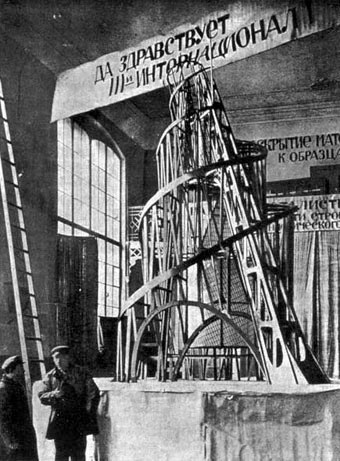
Amongst those who cheered the loudest was Vladimir Tatlin (1885-1953), designer of the immense (perhaps 1,200 feet tall) unbuilt structure that became a defining emblem of revolutionary élan. He is the subject of this fascinating, if in one sense tellingly uncritical, study completed by the noted British art historian Norbert Lynton shortly before his death in 2007. Scholarly, densely argued, and rendered more opaque still by the gaps in Tatlin’s foggy biography, the book is wonderfully illustrated but not the easiest of reads. That said, persevere for long enough and you will be left mourning the brilliant culture of Russia’s imperial twilight, struck by the strangeness of what replaced it, and appalled by the moral vacuum at the heart of Lynton’s book.

Already deservedly (as Lynton demonstrates) famous as one of Russia’s leading modern artists, Tatlin began planning his building, the “tower” of Lynton’s title, in early 1919, shortly after taking a senior position in the ministry run by Anatoly Lunacharsky, Lenin’s commissar for enlightenment. The tower was to be a monument to the Third International (the Comintern) and thus to global revolution. As such, it would have been a celebration of massacres past, present, and to come. Dreamt up as a wonder of the modern world, Tatlin’s tower was to be the lighthouse of some nightmare Pharos, a beacon illuminating only the way to destruction.

None of this seems to have bothered Lynton overmuch. He confines himself to anodyne remarks about the tower’s role as an incitement to revolution without worrying too much what that revolution might mean in practice, a peculiar omission from a man (a Jewish boy in Hitler’s Reich) who had himself been forced to flee the rage of a state.

On the other hand, one of the strengths of this book is the manner in which Lynton links Tatlin’s plans for his tower to the curious (and now largely forgotten) fusion of mysticism and futurism (Lynton’s suggestion that the tower also reflects Christian imagery is less convincing) that could be found in the thinking of some sections of the pro-Bolshevik intelligentsia: His “temple” would, Tatlin gushed, be the precursor of a future “temple of the worlds—which would .  .  . move in infinite space,” emancipating “all the world from bondage to gravity” and paving the way for the “expression .  .  . of mutual love of all the generations,” of a mankind that must become “sky-mechanics and sky-physicists.”

A marginally less overexcited Nikolai Punin, future lover, companion, and heartbreaker of the poetess Anna Akhmatova, and a man ultimately destined to perish in the Gulag, explained how the tower, home to the coming world government, would be an “organic synthesis of architecture, sculpture, and painting.” It was to encompass three large halls, one “for legislative purposes,” shaped like a cube, that rotated annually, one pyramidal (for bureaucrats) that rotated monthly, and one cylindrical, dedicated to “disseminating information to the world proletariat,” which was meant to rotate daily. These halls would be enveloped within a double helix framework that hinted at the ziggurats of antiquity and myth. Location, too, was crucial. The idea was that this vast, asymmetrical edifice of steel, iron, and glass would squat in the middle of the former St. Petersburg. Taunting and overshadowing the elegance and grandeur of the old imperial capital that had itself once represented a new direction for Russia, it would stand as a rebuke to history and homage to the future.

tatlin2.png

Spiraled, pointing, angled, closer in appearance to a giant telescope or piece of artillery than to a building, Tatlin’s work conveyed both an impression of coiled power and energy unleashed. This was an architecture parlante intended to roar, a stupendous symbol of the new age. Statues of men on horseback were, like the aristocrats—the individuals—they depicted, to be consigned to the past. Tatlin’s tower would be utilitarian, a manifestation of the collective will, a “living machine” made of industrial materials yet somehow organic, functional, more-than-modern and, like the revolution, in perpetual motion.

Of course, it was never built. The resources were not there; the political will was not there (those running the new Soviet state preferred their monuments representational, solid, and stolid); and the technology was not there. Failing to take account of the last was a rare lapse for Tatlin, the son of an engineer and a man who took pride in his technical savvy, unless the tower was (as plausibly claimed by John Milner in the fine monograph on Tatlin he wrote in the 1980s) not so much impractical as explicitly utopian from the get-go, a manifesto rather than a blueprint.

Tatlin did manage to build at least three large-scale models of his tower, photographs of which are included in Lynton’s book. The first stood around 15 feet high above a circular base (in which someone could crouch, turning the cranks that moved the tower’s halls); the second, slightly smaller and decidedly more elegant, was exhibited in 1925 in Paris, home of the Eiffel Tower that had partly inspired it; and the third, stripped down and simplified, made an appearance, like some futurist fetish, at a ceremonial parade in Leningrad the same year. All three have since vanished, long since lost like so much else in the Soviet junkyard, but Tatlin’s original vision itself endured in the leftist imagination as a statement of the what-could-be and, later, the what-could-have-been. Artistically, its status as one of the 20th century’s most influential icons of architecture unbound remains undiminished.

tatlin3.jpg

As for Tatlin, his career went into a decline in the culturally more conventional years of full Stalinism, neither out of favor, nor quite in. His became a life of smaller-scale projects, from furniture design, to stage sets, to art more traditional than anything he had produced for decades. What was left of his old utopian obsessions revealed itself in prolonged attempts to perfect the Letatlin, his final challenge to “the bondage of gravity.” A man-powered flying machine of remarkable beauty—oddly, no images of this craft are included in Lynton’s book—it was inspired by the work of Leonardo da Vinci, another artist uncomfortable with strict divisions between the aesthetic and the practical, in the same field. It never flew.

Tatlinplane.jpg

Towards the end, Lynton includes a picture of an older Tatlin. He looks sad, beaten, crushed, an Icarus who had fallen to earth without ever reaching the heavens.

Twentieth-Century Ghost

Metropolis

National Review Online, June 4, 2010 

To H. G. Wells, it was the “silliest film,” a “soupy whirlpool” and a “pretentious stew.” Yet on a Saturday night in Manhattan this May, 84 years after Metropolis was shot, the line to see Fritz Lang’s legendary sci-fi drama stretched halfway down the block. To be fair to Wells, the version of the movie he saw had been hacked down from an initial running time of 153 minutes to around an hour and a half in a counterproductive attempt to make its plot more comprehensible. He would probably not, however, have been much more impressed had he attended Metropolis’s January 1927 premiere. “The whole of Berlin” may have turned up to witness 153 minutes of a film intended to take German cinema to a whole new level, but by the end of those minutes much of Berlin was left thoroughly confused.

The managers of Germany’s UFA studios, the unfortunates who had spent nearly a year and a budget-busting 5 million reichsmarks (perhaps some $200 million today) on making Metropolis clearly knew that they had a problem on their hands even before their film was released and they marketed it as much as spectacle as cinema. A spread in the UFA magazine highlighted some of the movie’s vital (if not necessarily accurate) statistics: Seven hundred fifty children had, the publicists claimed, been used in the film’s making, along with “1,100 bald people, 100 Blacks, 25 Chinese, 3,500 pairs of shoes, 75 wigs” and, well, you get the picture. With 36,000 extras, how bad could Metropolis be? There was a tie-in novel by Lang’s wife, Thea von Harbou, that is, if anything, even more chaotic than the film, an overwrought mélange of pulp fiction, millennial raving, and begging-for-straitjacket hysteria that its author, at least, believed to have been art. Do not read it. I beg you.

UFA was not wrong. As story, Metropolis is a mess; as spectacle, it is superb, a glorious, oneiric depiction of a future urban dystopia (it’s set in 2026), part hive, part Manhattan, part megalopolis-of-the-future wow, and the inspiration for decades of cinematic cityscapes of not-yets to come, all the way from Just Imagine, a Depression-era musical comedy set in 1980, to Blade Runner, to the sadly underrated Dark City, to the sadly overrated Matrix trilogy. In a film where many characters fail to convince (the most striking exception to this is, tellingly, a robot), it is the city itself that is, like the Metropolis-influenced Gotham of the revived Batman franchise, the star.

But the future has a way of taking prophets by surprise. Within months of Metropolis’s opening, The Jazz Singer was released. This somewhat old-fashioned tale of a cantor’s son who performed in blackface heralded a technological change that was to drown out Lang’s suddenly dated depiction of modernity. Lang’s silent movie had been dumbed down overnight, its special effects eclipsed by the miracle of Vitaphone.

Metropolis faded from view. Its memory lingered, at least in cineaste lore, but the full breadth of Lang’s vision appeared to have vanished for good. All, it seemed, that remained was an abbreviation, a collection of truncated relics reasonably close to the bewildering 90 minutes of the international release. As for the rest, well, like the Weimar Berlin in which Metropolis had been filmed, it seemed to have been consigned to history.

Then something changed. As Europeans emerged from the devastation of 1939–45, the rebuilding of their ruined cities evolved into projects more ambitious than the hasty patchwork repair of the immediate post-war years. Historic town centers were painstakingly restored in an attempt to retrieve, reconnect, and sometimes reimagine the brutally shattered past. The same impulses can be detected in the reconstruction of Metropolis. It was an effort that gathered pace in the 1960s, and included a longer restoration put together by the East German state Film Archive (1968–72), disco guru Giorgio Moroder’s controversial 1984 appropriation  (shorter, but with color tinting and a classically 1980s soundtrack), and, after years of restoration work by Enno Patalas, the director of Munich’s film museum, the “Munich” Metropolis of 1987.

That’s not the end of the story. Using the Munich version as their core, and scrounging up every additional scrap of footage they could find, a team of restorers was able to assemble the “definitive” (124 minute) Metropolis issued in this country in 2002 on a fine DVD by Kino International. And that was meant to be that.

“Definitive” is a dangerous word. Six years after the Kino release, a 16mm copy of Lang’s epic was located in the archives of the film museum in, of all places, Buenos Aires. The footage was scratched, grubby, and the wrong size (16mm rather than 35mm), but it was as close to the original length as anyone could ever have hoped. Two years of restoration work followed as sections of the Argentine find were woven into the earlier definitive version filling in nearly all the missing links. Even after restoration, they are not perfect, but in their misty, messy way they are an evocative reminder of the time passed since the footage was shot and lost. The resulting patchwork—147 minutes long—comes as close to what was shown that long-ago night in Berlin as, probably, anything we are ever likely to see.

Fittingly enough, the new reunited Metropolis premiered earlier this year in the reunited Berlin that had too once seemed like an impossible dream. The movie arrived in the United States in April, debuting—where else—at Grauman’s Chinese Theatre. By May, it had made its way to New York City (the night I saw it, the film was introduced by the endearingly modest director of the Buenos Aires museum) and will, doubtless, once again become a regular on the art-house circuit. A DVD is not far behind.

Gaps have been filled, and subplots added. With the additions, the film makes a bit more sense than before. A bit. Metropolis remains a city where the economics fail (as Wells pointed out) to hang together, and its supposedly sophisticated machines are oddly clumsy, closer to treadmills than agents of production. Meanwhile, the Bildungsroman that lies at the movie’s heart, the awakening of the son of the city’s presiding genius to the injustice and oppression that are the essence of Metropolis, is muddied by apocalyptic mysticism, suggestions of magic, and a psychologically fraught love story involving the son, his father, his dead mother, a mad scientist, the holy Madonna-like Maria, and Futura, her disturbing “machine woman” robot doppelganger. The conclusion is as sappy as it is unconvincing, a sentimental submission to some sort of organic unity between all classes that helps explain why Goebbels was a fan (interestingly, Thea von Harbou later became a Nazi), but didn’t do much for me.

But not to worry—dazzlingly shot, frantically kinetic, and brilliantly edited, this is a film that can be enjoyed for its imagery alone, from the remarkable shots of Metropolis, to the portrayal of the flood that all but sweeps the city away, to the most famous sequence of all, the coming to life of the robot, a gorgeous deco goddess encircled by electric halos as she gradually assumes the form of the virginal Maria to become the whore—complete at one moment with Babylonian headgear—who will seduce the city into erotic and then self-destructive frenzy. Oh yes, a monk is also involved, and statues of the seven deadly sins come to life.

No wonder Wells, whose science-fiction vision was shortly to shift to an enlightened “air dictatorship” (Things to Come) run by clean-limbed flyboys in jackboots, disapproved, but then, for all its status as one of the first great sci-fi films, Metropolis was in reality something very different. It was not so much an anticipation of the future as a reflection of its own epoch. The greatest science-fiction movies, 2001Blade Runner, the Soviet Solaris, are in many respects beyond their time — beyond any time. Any dates they include are there just for decoration. Not so with Metropolis. By setting the film in 2026, exactly a century after it was shot, Lang was guiding the audience back to their own time, an impression only reinforced by the costumes worn by the cast — and even the cars. “1926 models or earlier,” sniffed Wells. The notorious scenes shot in and around the Yoshiwara nightclub district conjure up images not of some 21st-century pleasure dome, but of the wicked delights of Weimar at its exuberant, brittle peak.

For Lang was making his movie during the brief interlude when it seemed as if Germany’s fragile democracy might survive, a fact that might have influenced the film’s message of reconciliation between the lower city’s (the proletariat lives a subterranean existence) crushed and regimented workers and those who — in all senses — lived above them. At the same time, to watch the sequences when the mob careens behind Maria/Futura, a pied piper bewitching them into a riot that can only lead to their doom, is to witness the anxieties of an era (less than ten years after the Bolshevik Revolution) all too conscious of where the failure to narrow too wide a gap between labor and capital might lead and, for that matter, of just how dangerously malleable the masses could be.

Within a few years, of course, Germany had found its pied piper, and the consequences of the lethal dance in which he led his people cannot help but shape how we view this film today. The horrors anticipated by Lang’s images of shaven-headed workers marching into the fiery maw of the machine-god Moloch are too obvious to need explanation, but the plight of the children trapped by the floodwaters rising in Metropolis’s underground city also seems like an uncanny foreshadowing of another tragedy, the fate of the thousands drowned when Hitler ordered the flooding of the Berlin subway system in April 1945. Even looking at the cast, one cannot help but wonder how many of those 36,000 extras, or the 750 children — in their twenties by the time of the war — were to perish in the course of Hitler’s rule, whether as victims, perpetrators, or, sometimes, both. As for Lang, Roman Catholic of partly Jewish descent, he rejected what he claimed was Goebbels’s invitation of a senior position within the Reich’s movie industry and decamped for France and thence to the United States and a second, Hollywood, career, leaving Metropolis behind him. It was lost, he later said.

But sometimes Atlantis can rise again.

The ‘Beneficial Crisis’

The Weekly Standard, May 31, 2010

It would have taken a heart of stone not to laugh. Wheeled out earlier this month for celebrations to mark his 80th birthday, a rickety Helmut Kohl announced that the fate of the EU’s floundering single currency was a matter of life and death: “European unification is a question of war and peace .  .  . and the euro is part of our guarantee of peace.”

The former chancellor’s dire warning might have been a touch more persuasive had it not been repeated quite so many times before. To take just one example, in the course of Sweden’s 2003 referendum on whether to sign up for the euro, a “weeping” Kohl told the Swedish premier that he did not want his sons to die in a third world war. A reasonable ambition, but hardly the strongest of arguments for junking the krona. Sensible folk that they are, the Swedes voted nej and are all the better for it today.

Panzers will not roll in the event of a euro collapse, but that doesn’t mean there isn’t a decent case to be made for the $1 trillion (actually $937 billion at the time of writing, but who’s counting?) support package for the EU’s single currency union announced on May 10. The growing financial panic triggered by Greece’s economic woes was metastasizing into a crisis of confidence in the eurozone’s southern and western rim—the now notorious PIIGS (Portugal, Italy, Ireland, Greece, Spain)—a development that threatened ruin for much of the EU’s fragile banking sector and the shattering of any hopes of European economic recovery. After a dangerous delay caused by German hostility to the idea of bankrolling the Greeks, a 110 billion euro ($137 billion) EU/IMF bailout of the Augean state had been agreed. But it came too late to head off the financial markets’ mounting unease.

Financial panics are best dissipated by a swift, decisive, and dramatic response that signals that a believable lender of last resort has arrived on the scene. This is why, for all its faults, TARP worked. Uncle Sam had rolled into town. There would be no need after all to storm the ATMs.

Jittery Europeans have had to make do with considerably less reassurance. The eurozone lacks the characteristics and resources of a unified nation. It is a hodgepodge of pacts—some observed, some not—whispered understandings, cultivated ambiguities, and clashing interests that does little to inspire confidence. The nearest it comes to a plausible lender of last resort is Germany, historically the EU’s most generous paymaster—a real nation, with real wealth but, awkwardly, real voters too.

Those voters have been up in arms at the thought of helping out Greece. This was the real reason that German chancellor Angela Merkel dithered so long before coming to Athens’s aid. She was right to be worried. Within a day or so of the Greek bailout, her governing coalition was thrashed in regional elections in North Rhine-Westphalia, Germany’s most populous state.

Something spectacular had to be done. And if $1 trillion isn’t spectacular I don’t know what is. The support package that finally emerged on May 10 falls into three main parts. The largest is the creation of a “temporary” (three-year) special purpose financing vehicle. This is authorized to borrow up to 440 billion euros ($550 billion) to fund or guarantee loans to member states who find themselves being frozen out of the capital markets. On top of this, there will be a 60 billion euro  ($75 billion) “rapid reaction” facility operated by the EU Commission and designed to help any eurozone country facing an immediate cash crunch. Oh yes, the IMF agreed to throw another 250 billion euros ($312 billion) into the kitty.

But, wait, there’s more. To make sure that struggling European financial institutions are not starved of dollars, a number of the world’s major central banks, including the European Central Bank (ECB) and the Fed, revived the emergency currency swap agreements put in place in late 2007. The ECB then topped up the punch bowl by commencing to purchase government debt from the PIIGS, a move explained by the need to move fast (it will be a while before the full support package can be put in place), but which opened the ECB to the charge that it had been reduced to printing money (“quantitative easing” is the preferred euphemism). The ECB denies this, saying the bond purchases are being “sterilized” by other maneuvers draining the excess liquidity the purchases create.

International investors feted the support package for all of one day. Then they recognized that, as Merkel conceded, it had “done nothing more than buy time.” The rot within the eurozone continues to fester. As for claims that this was all the fault of the wicked speculators of Wall Street and the City of London (a tiresome cry from the EU’s leadership in recent months that reached a new crescendo last week), well, that’s like blaming the canary for the gas in the coal mine.

The Greeks, Portuguese, and Spanish have all announced new austerity measures, but, even if we make the optimistic assumption that the recent riots in Greece will be the exception rather than the rule, these steps are unlikely to be enough to bring this story to happy ever after. Piled on top of existing budget cuts, the fresh rounds of slashing and taxing run the risk of crushing what’s left of domestic demand and with it an essential element in these countries’ ability to generate the additional tax revenues their treasuries so badly need. The usual remedy for such a predicament is devaluation and an export-led recovery, but with the PIIGS yoked to the euro that option is not available. The euro may be weakening against currencies outside the zone, but against their competitors within, the PIIGS are as uncompetitive as always.

It’s not easy to unscramble an egg. For one of the PIIGS to quit the euro would almost certainly mean both default on its public debt and the bankruptcy of wide swaths of its private sector. The domino effect across the rest of the continent, and beyond, would be appalling. Another, more promising, alternative, albeit one freighted with severe technical and practical risks of its own, would be for a German-led group to depart the euro and form a separate “hard currency” union of its own, leaving the PIIGS with the deeply depreciated (down perhaps 30-40 percent) euros they so obviously need. This would be tough on the PIIGS’ unfortunate creditors, but there would be a chance that default, and all its attendant dangers, could be sidestepped.

Yet no such alternative is on the menu. In confronting the hole into which joining the euro has dropped them, the eurozone’s leaders seem determined to dig ever deeper. We can debate their rationale, in all probability a mix of cowardice, conviction, careerism, and delusion, but not the likelihood of the conclusion to which they will come. Speaking in Aachen—the burial place of Charlemagne, an early Eurocrat—on May 13, Merkel made clear that she was still drinking the Kohl-Aid: “If the euro fails,” she warned, “Europe fails too, [and so does] the idea of European unification. We have a common currency, but no common political and economic union. And this is exactly what we must change. To achieve this, therein lies the opportunity of this crisis.”

Long before Rahm Emanuel’s infamous dictum, the idea of a “beneficial crisis” (to borrow the terminology of Jacques Delors, a former president of the EU Commission) was common in Brussels. Indeed, there is evidence to suggest that some smarter Eurocrats saw the flaws in the way that the euro had been set up as a feature, not a bug. The crisis to come would create the conditions in which the nations of the EU could be persuaded to submit to further federation.

On May 12, the current president of the EU Commission, José Manuel Barroso, argued that “member states should have the courage to say if they want an economic union or not. Because without it, monetary union is not possible.” The commission’s proposals include greater macroeconomic supervision, increased emphasis on deficit reduction, and the establishment of a permanent emergency financing mechanism. The most controversial idea is the suggestion EU governments submit their national budgets for review by their counterparts within the union before presenting them to their own parliaments. Whether this review would be merely advisory or carries a veto power has been left conveniently vague.

Barroso also wants a more punitive regime imposed on governments that persist in breaking the budgetary rules that supposedly underpin the euro. There are limits, however. The commission did not back Merkel’s call for provision to be made to allow the eurozone’s more persistent reprobates to be expelled from the currency union. Permitting such a procedure, even in theory, would imply that the grand European project could sometimes go into reverse, and that would never do.

Most of these measures will edge forward at best. Not all member states are enthusiastic about the push for what Herman Van Rompuy, the president of the EU’s council, has referred to as a European “gouvernement économique,” an elastic term capable of, in Van Rompuy’s sinuous prose, “asymmetric translation” in different languages, from the comparatively nebulous English “governance” to something altogether more concrete.

But, if some governments are not enthusiastic, it’s difficult to see what else they can do—unless they are prepared to quit the eurozone. And they are even less enthusiastic about that.

The next stage of this drama ought to have been something of an anticlimax as nerves were soothed by that calming trillion. Instead, Merkel sent markets sliding by imposing, amongst other measures, a “temporary” ban in Germany on “naked” short selling (selling securities that you do not own and have not made arrangements to borrow) of eurozone government bonds and the stocks of some of her country’s leading financial institutions. This was accompanied by promises of further regulation and yet more railing against speculators, “out-of-control” markets, and banks.

The message sent by the new rules was grim. And it was received. By playing the populist card, Merkel had highlighted the extent of the political problems she faces back home. That’s not what investors wanted to hear. Some also fretted that the new restrictions were a hint that the finances of Germany’s banking sector were even worse than feared.

So, what’s next? Predicting short-term currency movements at a time like this is a mug’s game. I’ll just stick with the word “choppy” and the belief that a trillion dollars ought to buy the euro some time. It won’t be a huge surprise if some of that time—and some of that money—is eventually used to smooth the increasingly inevitable “restructuring” of Greek, and possibly Portuguese, sovereign debt. Nevertheless that will not be the end of the matter. A trillion dollar band-aid is still a band-aid. This spring’s crisis has demonstrated that the existing system cannot survive as it stands.

To succeed, a monetary union the size of the eurozone needs a high degree of central control, consistent and enforceable budgetary discipline, and spending (and thus taxing) powers sufficient to ensure that the cyclical imbalances in its constituent parts can be evened out. That reality has now essentially been accepted by the German and the French governments. Although negotiating the details of common economic governance will drag on for years, in the end the French and the Germans will, despite some truly fundamental differences, get there—and they won’t be alone. Faced with the prospect of being excluded from the EU’s tightening core, more countries than might now be imagined will choose to jump in notwithstanding its tougher disciplinary regime. While today’s “two-speed” union will continue to exist, the division will deepen, and on one side of it there will be something that looks suspiciously like a European superstate.

The financial markets could still disrupt this transition, which is one reason that the EU’s leadership is so keen to rein them in. Trouble may also come from a group often ignored in the saga of “ever closer” union—the electorates of Europe.

One of the more telling characteristics of the EU’s progress is the way it has been forced through regardless of the wishes of ordinary voters. The “reuniting” of Europe has been a project of the elites, the fruit of mandarin cabal and backroom deal. Voters have rarely been given much of an opportunity to demur. And when they have been asked their opinion and called for a halt to further integration, the results have been ignored or subjected to do-over until the “right” result came through.

That’s not to claim that Europe’s mainland is seething with euroskepticism. It’s not. There is, however, widespread apathy and a profound alienation. As the voters of North Rhine-Westphalia have just reminded us, there’s not a lot of fellow-feeling in that imaginary European family.

This might have mattered less in economically more comfortable times, or in the times when Brussels was not stretching so far, blithe times when voters (foolishly) and Eurocrats (realistically) could, for the most part, pretend that the other did not exist. That’s over now. Building an economic union is messy and intrusive. It’ll be hard to slip it through on the quiet. The PIIGS are being ordered to take a long hard road. The peoples of Northern Europe will be told to pay for its paving.

What if either says no?

What Is Going on in Blighty?

National Review Online, May 10, 2010

Britain’s election has left the country’s politics in a chaotic, confused mess. With the situation in such flux, there’s a decent chance that much of what I might write now (Sunday afternoon) will be obsolete by the time that you read it. So here instead are the answers to nine questions that should be relevant for some time. Well, a few days, anyway.

HOW DID THE VOTE GO?

To use an understatement: inconclusively. The House of Commons now has 650 MPs, so for one party to secure a majority, it needs to win 326 seats (in practice one or two fewer, but let’s not worry about that). For the first time since 1974, no one party has won that absolute majority. Parliament is “hung.” So far, the Conservatives have won 306 seats in the 2010 election and are forecast to win another after a special vote later this month, but it still won’t be enough. Labour came in second, with 258, and the Liberal Democrats third, with 57. With the exception of the eight sturdy Ulstermen of Northern Ireland’s Democratic Unionist party, the remaining 28 seats (located in Scotland, Wales, Northern Ireland, and, in the case of Brighton — where a Green was elected — outer space) were mainly won by Celtic nationalists, few of whom have any time for the Tories. David William Donald Cameron has two Scottish names, but only one Tory MP in Scotland.

DID THE CONSERVATIVES BLOW IT?

Yes, if by less than some would claim. Thirteen years of Labour misrule capped by an economic and fiscal crisis ought to have paved the way for a solid Conservative victory. For most of 2008 and 2009, the opinion polls signaled that the Tories were set for an overall majority. Then something changed. In part this was the usual reversion of voters to their traditional voting habits in the run-up to a general election. And in part it was the fallout from a parliamentary expenses scandal that left the electorate disgusted by politicians of both the main parties. But there was something else. Looking at the support for David Cameron, it was striking how little enthusiasm for him there really was, even amongst the Tory faithful. To many voters, he came across as likable enough, even if he had a touch too much of the salesman about him, but that was it. In particular, he did not appear to be for anything worth getting excited about. I’ll go into the reasons for that in the answer to the next question, but let’s just note for now that in 2010 being Not-Labour was not quite enough.

But the word there is “quite.” Critics of David Cameron need to remember how far his party has come since the last election, in 2005, its third consecutive humiliating defeat. This time round, the Tories increased their tally of votes by 2 million, the same number by which their score exceeded Labour’s. They won more new seats than at any election since 1931, and they secured almost as big a swing against Labour as did Mrs. Thatcher in her legendary 1979 triumph. With 97 additional seats in the bag, the parliamentary party is roughly 50 percent larger than it was a week ago.

At the same time, the Conservative share of the popular vote only increased from a little over 32 percent to 36.1 percent. Financial crisis, broken borders, rising social disorder, and the peculiarities of that strange Gordon Brown ought to have been worth more than that.

WHAT DID THEY DO WRONG?

David Cameron took over a Conservative party that was, to put it bluntly, unelectable. Rightly or wrongly (in my view, wrongly) it was seen by many as the “nasty” party, not least thanks to the efforts and metropolitan prejudices of a media elite that is far more influential in Britain than are its counterparts in the United States. To tackle this, Cameron had to soften media hostility to a degree sufficient to enable his party to get its message out. He succeeded, but it meant dragging the Conservatives in an ostentatiously (to use the bleak newspeak) “inclusive” direction, a direction that (to be fair) at least partly reflected contemporary political attitudes amongst the wider population. Britain is no longer the Britain that elected Mrs. Thatcher.

Unfortunately, Cameron failed to realize he won the argument years ago. He had “decontaminated the brand,” and yet he went into the election still seemingly apologetic for it. He campaigned in 2010 as if it were 2007, afraid or unwilling to play those traditional Conservative tunes that — whatever they may say in Notting Hill — are still capable of pulling in the crowds. Instead, Cameron made clear that his faith in Al Gore’s gospel was undimmed by Climategate. He could barely bring himself to mention immigration, and his big vision was of a “Big Society” (I have no idea). Meanwhile, sending his most senior Europhile on a secret mission to Brussels added insult to the injuries of the Tories’ restless Euroskeptic core. In that context, it’s worth noting that Cameron’s lead at the polls started to decline almost immediately after he reneged late last year on a “cast iron” pledge to hold a referendum on the EU’s Lisbon treaty. This wasn’t an altogether unreasonable decision (the treaty had since come into effect, and would be extremely difficult to unscramble), but politically it was a serious mistake.

Perhaps this was simple miscalculation, the error of an out-of-touch individual surrounded by a small, like-minded clique. Perhaps. But there was another possibility: Had Cameron drunk too much of his own Kool-Aid? For the Tory leader to have changed his party’s course out of cynical political calculation is understandable; for him actually to believe the more obviously idiotic “progressive” nonsense he has been spouting would be unforgivable.

Either way, the base was unimpressed. In the most telling sign of this, over 900,000 people (roughly 3 percent of the popular vote, and an increase of 50 percent over 2005) voted for the euroskeptic UKIP, Britain’s fourth-largest party. To quote blogger Archbishop Cranmer, UKIP is a “lost tribe” of conservatism, made up of natural Tories whose politics are, to quote another blogger, the entertaining Guido Fawkes, those of the Conservative party “after a few gin and tonics.” Their votes may have cost the Tories as many as 20 seats, and thus a parliamentary majority. More than a few of those UKIP supporters might have returned to the Cameron fold had he been prepared to give them some sort of sign that he was, you know, just a little bit like them. Instead, he did the opposite.

IS THERE A LESSON FOR U.S. CONSERVATIVES?

When it comes to policy specifics, not so much. The U.K. is not the U.S. Its politics are very different (to start with, the British mainstream tends more to the center-left than is often understood over here). The challenge faced by David Cameron was very different from that now confronting the GOP. If there is one thing, perhaps, that Republicans could learn, it is this. Neither RINOs, nor the “reformers” of various hues, nor the various keepers of the conservative flame should drink too much of their different varieties of Kool-Aid. They should deal with the electorate as it is, not as they would like — or believe — it to be.

WHATEVER HAPPENED TO CLEGG?

Nick Clegg, the leader of the Liberal Democrats, Britain’s third party, shot to prominence after a strong showing in the first televised party leaders’ debate. According to one opinion poll, “nice Nick” had become the most popular politician since Winston Churchill. He was articulate, a fresh face, and, briefly, “none of the above.” Unfortunately for Clegg, he was also a Liberal Democrat, and he was unable to carry his reliably unsuccessful party along on his coattails. The Liberal Democrats ended up losing a net five seats. Their 23 percent of the vote, slightly more than in 2005, was well below the high 20s (and more) recorded in the giddy days of early Cleggmania.

Despite that, the hung Parliament has left Nick Clegg in the game, busy being wooed by David Cameron and shouted at by Gordon Brown (it’s a tough-love thing).

HOW BAD ARE THE LIB-DEMS?

Pretty bad. The Liberal Democrats are usually described as left-of-center, and so they are, but that’s not the end of it. Nine decades out of office will leave any party looking a tad strange, and Clegg’s crew has proved no exception. Their ideology is a ragbag of policies, some good, some bad, some plain loopy, some well-intentioned, some not, the flotsam and jetsam of nearly a century of passing fads, prejudices, and dreams untouched by the realities of government. What does unite this somewhat fractious party, however, is a belief in electoral reform.

ELECTORAL REFORM?

British general elections operate on a strict “first past the post” basis. The candidate with the most votes in each constituency wins. Historically, this simplest of systems has been a force for political stability, generally producing governments with a majority large enough to govern by themselves for the whole of their term. Thus, Tony Blair’s Labour party won 55 percent of the parliamentary seats in 2005 with only 35 percent of the national vote.

This extreme, but not entirely untypical result was just the latest in a series bound to raise questions of fairness, questions that have been asked with mounting insistence in recent decades. The old system worked well enough when the two major parties carved up most of the vote between them, but in the multiparty Britain that has been evolving since the 1970s, it has come to look increasingly rough-hewn.

Crucially, first past the post squeezes a third party with appeal across much of Britain, but lacking the regional redoubt enjoyed, say, by the Scottish Nationalists. In short, it squeezes the Liberal Democrats. With 23 percent of the vote in 2010, they only won 9 percent of the seats. That’s why they are yet again calling for some move towards proportional representation as the price for their support. Labour is now desperate enough to make a move in that direction. For the Tories, it’s not so easy. Not only are there good practical arguments for preserving the current system, but also, a change to proportional representation would almost certainly mean that the Right would never rule Britain on its own again.

HAS HER MAJESTY BEEN MINDING THE STORE?

No, the constitutional position is that Gordon Brown continues to serve as prime minister (basically as a caretaker) until a replacement is found. It would take a vote of the newly elected House of Commons to force his government out of office, but Parliament is not due to sit until May 18.

AND THAT DEBT BUSINESS?

The renewed spasm of global financial uncertainty could hardly have come at a worse time. With a public-sector deficit at a Greek 12 percent of GDP, the United Kingdom is highly vulnerable to market panic. International investors have waited for months to see what steps Britain would take to reduce its deficit and when. Neither the Liberal Democrats, nor Labour, nor the Conservatives have come up with a convincing plan, but many market players seem to have taken the view that such discretion was inevitable in a closely fought electoral contest. They appeared to have been reassured by the thought that the Tories would prevail and that somehow “something” would be done. That comforting illusion has now been dispelled. However you parse the election results, there was no majority for spending cuts on the scale that will be needed, and with another election almost certainly in the offing who now will be prepared to suggest them?

Hang onto your hats.