Europe, Bloody Europe

The Weekly Standard, August 13, 2012

david-cameron.jpg

It’s always bloody Europe. It was Europe (specifically, Tory splits over Britain’s relationship with the EU) that finally did in Mrs. Thatcher, and it did in poor John Major too. Now it is beginning to look like David Cameron might eventually go the same way, felled by the issue he has tried to dodge since becoming party leader in 2005. To borrow his phrase from the following year, “banging on” about Brussels was over. Saving the planet was in.

But the elephant was still in the room, increasingly intrusive, increasingly destructive, and increasingly unwanted. Britons have never truly warmed to the EU, but a 2009 poll showing that more than half of them wanted out was just one more sign that resigned exasperation was at last giving way to something more determined. With the economic crisis drawing attention away from the Conservatives’ divisive past and onto the ruling Labour party’s dismal present, some carefully calibrated Brussels bashing would have been a smart way for Cameron both to score points against a notoriously europhile government and, no less important, to calm a restive (and euroskeptic) Conservative base dismayed by their leader’s often clumsy attempts to reboot the party’s image. It was an opportunity Cameron largely ignored, preferring to stay in his comfort zone and sing the old tunes that had worked so well. Carbon menace!

Many voters weren’t impressed. In the 2009 European Parliament elections, the euroskeptic—and distinctly maverick—UKIP (the United Kingdom Independence party) beat Labour into second place behind the Tories, grabbing 16.5 percent of the vote, up a sliver from the already remarkable 16.1 percent scooped up in 2004. It was a humiliation for Labour but a warning for the Conservatives. Less than 12 months before a crucial general election, the Tories who had flocked to UKIP’s side had not come home. A commitment from Cameron to hold a referendum on the EU’s pending Lisbon Treaty—if he was elected before it was in force—reassured few. Rightly so: The treaty came into effect ahead of the election. The Conservatives dropped their referendum.

It may be a coincidence that it was from roughly this point that the Tories struggled to retain a clear lead at the polls. What cannot be denied is that UKIP won enough votes in enough constituencies to deprive the Conservatives of an absolute majority in the 2010 general election. Rather than shoot for a minority government (the bolder, better course), Cameron opted for a coalition with the Liberal Democrats, the most europhile of all Britain’s major parties. The irony was obvious. The self-inflicted wound has taken a little longer to become visible.

With the keys to 10 Downing Street so close, Cameron’s choice can perhaps be forgiven. The same cannot be said of his reluctance to take a more aggressively euroskeptic tack in the years that have followed. The constraints of coalition have something to do with it, naturally, as do memories of earlier Tory disaster. Nevertheless, with the woes of the euro—a dangerous experiment lauded by many in the Labour party and by the Liberal Democrats—both unnerving the electorate and vindicating those squabbling Conservatives, it ought to be a time to make hay. But that’s not what Cameron has done.

And the chances thrown away may not just be domestic. As things stand, the currency union’s nervous breakdown offers the only remotely realistic prospect of a successful renegotiation of the U.K.’s position in the EU along lines that most Britons, including (he claims) Cameron, really want—to remain in the club, but less so. That’s because any credible long-term fix for the eurozone is likely to involve amendments to the EU’s governing treaty. That would need the approval of all member states including the U.K. That in turn might give Cameron the leverage he would need to secure all the other member states’ agreement to the treaty changes that would be required to accommodate the U.K.’s EU lite.

It’s not going to happen. Holding the global financial system ransom (and that’s how it would be portrayed) is a gamble too far, particularly for the prime minister of the country that hosts that hub of international finance, the City of London, and even more so when that same prime minister is unwilling to risk a breach with his Liberal Democrat partners.

It’s possible—just—to see the current approach as one of accidentally masterful inactivity. If the 17 eurozone countries are permitted to merge into a politically united core within a broader “multi-speed” EU, that could leave Britain to its own devices in a more congenial outer-EU. But you’d have to be very naïve to believe in such an outcome. All 27 EU countries would still be trapped within a European project that is explicitly set up to grind relentlessly forward (“ever closer union”). The speeds might differ, the direction would not.

If that’s to change, there will have to be treaty changes of the type that Cameron, pleading crisis and coalition, has not begun to attempt to renegotiate or, for that matter, even design. To be fair, his government has passed legislation designed to subject any future significant transfer of powers to Brussels to a referendum, a step almost unthinkable a few years ago. It was a start (and one day it may trigger a necessary confrontation), but the suspicion with which the new law was greeted by euroskeptics (because of the loopholes lurking within it) was yet another sign of how estranged Cameron has become from those who should be his party’s natural supporters.

That estrangement has been sharpened by a series of recent blunders. One of the biggest was an effort last October to browbeat Tory MPs into voting against a largely symbolic motion calling for a referendum on Britain’s membership in the EU. The motion had no hope of passing, but Cameron’s rather telling overreaction helped provoke a massive revolt within his parliamentary party, a revolt that goes some way to explaining the prime minister’s decision to keep the U.K. out of the fiscal pact cooked up by Merkel and Sarkozy in December.

The goodwill generated by that faint flicker of the bulldog spirit has since been squandered with characteristic carelessness of euroskeptic sensibilities. Cameron may have respectable, even euroskeptic, reasons for rejecting a referendum just now, but to argue (as his spokesman did in June) that there was “no popular support” for an immediate referendum at a time when half the voters were telling the pollsters they wanted just that (another third wanted one “in the next few years”) was not only inaccurate but, politically speaking, nuts: Cameron is lucky that Labour remains unenthusiastic about such a vote.

Even nuttier, and much more damaging, was his subsequent observation that he would “never” campaign for the U.K. to quit the EU. Again, there can be good reasons for a “practical euroskeptic” (as Cameron styles himself) to oppose an in/out referendum, not least the danger that, faced with a stark decision (made, doubtless, to seem even starker by big business), the electorate might well “keep ahold of nurse / For fear of finding something worse.” Read that way, opposition to such a vote is a question of tactics, not principle.

But by going further—and in such categorical terms—Cameron shredded the shreds of his euroskeptic credibility for no evident reward other than, perhaps, a smattering of the bien-pensant applause he treasures for reasons, sadly, other than cynical political calculation. How now was he supposed to be able to renegotiate a better deal with the EU? With the threat of a British withdrawal removed (quite a few EU countries still want the U.K. to stick around) and the idea of vetoing closer eurozone integration long off the table, it’s unclear what cards the prime minister would have left to play. “Practical” euroskepticism looks to be not so very practical after all.

The inescapable logic, for euroskeptics, points to an in/out referendum, followed, in the event of an “out” vote, by a total recasting of Britain’s relationship with Brussels, as the country begins the withdrawal process provided for under the EU treaty. That’s not what they will get. The best guess, amongst a bewildering range of scenarios, is that at the next general election (due in 2015) the Conservatives will guarantee a referendum on whatever feeble deal Cameron, reelected and freed from the chains of coalition, might (fingers crossed) manage to extract from the EU. Will that lure enough UKIP Tories back to the fold?

It’s unlikely, not least because there will probably be more of them than in 2010 (the 2014 elections to the European Parliament should add to UKIP’s momentum). The chances of a Conservative majority in 2015 thus appear (in the absence of an intervening economic miracle) slight. Instead the odds must be that Labour will be back in power, in which case there will be no renegotiations with Brussels, and that will be that.

What was that slogan about a roach motel?

Quidditch, It’s Not

Suzanne Collins: The Hunger Games, Catching Fire, Mockingjay

National Review, July 12, 2012 (July 30, 2012 issue)

Dystopias — dark, funhouse mirrors of our fears — will always be with us. Nineteen Eighty-Four was the product of a time when Big Brother Stalin was on the march, and the Eloi and the Morlocks of The Time Machine reflected H. G. Wells’s anxiety about where the onrush of 19th-century capitalism could lead. So what to make of the success of a “young adult” trilogy set in a North America that has — here a shout-out to a fashionably green vision of global catastrophe — emerged after “the droughts, the storms, the fires, the encroaching seas that swallowed up so much,” including, it appears, all of the spirit of 1776? This land is now Panem, run by a despotism that proclaims and reinforces its control with the Hunger Games, a brilliantly, sadistically choreographed contest that is broadcast across the nation. This annual ritual turns slaughter into both spectacle and terrifying statement of who is in charge.

The Hunger Games, the first of the trilogy by Suzanne Collins, spent nearly two years on the New York Times bestseller list after its release in 2008. By May 2012, Scholastic reported that some 36 million copies of the three books were in print in the U.S. The movie version (not bad, incidentally) has been a smash, grossing over $150 million in its opening weekend alone.

Earlier this year Collins became the best-selling author in Kindle’s history. That’s quite something for a writer of works aimed at (to repeat that cloying phrase) young adults, even in the age of Harry Potter and Twilight. What she has produced is no great work of art (the trilogy’s numerous grown-up devotees need to move on to more challenging fare), but Collins fully deserves her legions of teenaged fans. Her characters can find themselves burdened with names that hint at vintage sci-fi or sepia bucolic idyll (Katniss, Peeta, Haymitch, Cartwright), but the writing is taut and spare. Chapters frequently finish with cliffhangers that beg for a turned page.

Collins’s heroine, 16-year-old Katniss Everdeen, is tough and ornery, an accomplished huntress and, when she has to be, a deft killer. If less glamorously so, she is a model of adolescent female empowerment in the venerable Buffy tradition, with her harsher traits both diluted and emphasized by nods to girliness that won’t have hurt Collins’s sales in Sweet Valley High: Despite the dangers that lie in the Hunger Games ahead, and despite herself, Katniss exults in the outfit created for her presentation to the crowds in Panem’s capital. Nor is this the trilogy’s only fashionista interlude: Throughout the books there are detailed descriptions of what is being worn by whom, and a “stylist” is one of the heroes.

There is also a love triangle that could have matched that between Twilight’s Edward, Bella, and Jacob in its angst, but, revealingly, does not. Perhaps Collins felt that male readers could take only so much. They, and other savages, are thrown plenty of bones, limbs, mutilations, sinister mutant creatures, and well-told grotesque, disgusting deaths.

The brutality is inclusive. Sympathetic characters don’t escape Collins’s chopping block. Then again, dystopias are not meant to be happy places. And Panem is not. It exists purely to serve the needs of a predatory capital — the Capitol — that feeds off twelve ruthlessly exploited districts. Its coal is mined in Katniss’s Appalachian home, the desperately hardscrabble District 12; its fish comes from District 4; and so on. The Capitol regime is a caricature of vicious imperial misrule, and the Hunger Games are the acme of a cruelty as depraved as it is carefully targeted, a reminder of the consequences of a failed revolt by the districts three-quarters of a century before. Each district has to furnish two “tributes,” a boy and a girl between the ages of twelve and 18, for a gladiatorial competition in which they and the other 22 will be consigned to an arena from which only one is allowed to emerge alive.

Unkind critics have commented on similarities between The Hunger Games and Battle Royale, a Japanese saga of high schoolers forced to fight to the death by a totalitarian state, a connection that Collins denies. She cites instead, as an influence, the legend of the, uh, young adults handed over to the Minotaur. Spartacus, she says, is another: “Katniss follows the same arc from slave to gladiator to rebel to face of a war.” Lest the classical analogies pass anyone by, there are other clues, from the occasional Latinate coinage (a slave with his or her tongue cut out is an Avox) to the fact that many of the Capitol’s inhabitants, not to speak of the city itself, are named with a distinctly Roman flourish: Coriolanus Snow, Seneca Crane, Caesar Flickerman — you get the point. Then there is this from a member of the Capitol’s elite who switches sides: “In the Capitol, all they’ve known is Panem et Circenses. . . . [It] translates into ‘Bread and Circuses.’ The [Roman] writer was saying that in return for full bellies and entertainment, his people had given up their political responsibilities and therefore their power.”

Ah, Panem.

Katniss connects the remaining dots. The districts are compelled to provide the Capitol’s frivolous and decadent citizenry with abundance and, through the tributes, the “ultimate” distraction of the Hunger Games. Duly sated, the frivolous and decadent citizenry then leaves the business of power to those who wield it. By now even the slowest of Collins’s readers may suspect whose reflection they have been glimpsing in this particular funhouse mirror.

That seems to have been her intent. She has said that the idea for The Hunger Games first struck her while channel-surfing between reality TV and coverage of the Iraq War, something that troubled her NPRish fastidiousness more than it should: It’s a long way from Survivor to Katniss. There are certainly viewers who have been desensitized by the tube’s manufactured conflicts, but only psychopaths or the extremely stupid could have confused the images from Iraq with entertainment, make-believe, or both.

Collins’s explanation that war is hell (a theme of her Underland Chronicles too) is unoriginal, but commendable enough, at least until the moment — sometime in the course of Mockingjay — when sermon overwhelms story. The tale of the Capitol’s fall offered an ideal opportunity for a deeper exploration of the principle of morally legitimate violence that, from Katniss’s arrival in the arena, forms one of a number of this trilogy’s more interesting subtexts. That opportunity is at first grasped but then thrown away in favor of a dull plague-on-both-your-houses world-weariness that is more evasion or tantrum than an attempt at an answer.

There are always true believers of one sort or another who see a popular phenomenon and claim it for their own. Some Christians have detected a Christian message in these books. Meanwhile, writing in The Atlantic, Nicole Allan saw Katniss as “the populist hero the Occupy movement wasn’t able to deliver.” To be fair, that’s a proposition more credible than the notion of one of Katniss’s two suitors (an admirable lad, but still) as a Christ figure. At a time when the left side of the elite is using inequality to bludgeon the right, it’s easy to see how this trilogy could be cast as a manifesto for the 99 percent. Maybe that has been some of its appeal. Perfectly, The Hunger Games came out as Lehman went down.

And there are historical resonances far closer to home than ancient Rome is. Collins has given Zola’s Germinal, no mash note to the 1 percent, as a reason for picking coal-mining as District 12’s industry, but that district’s pinched iconography also has more than a trace (underlined in the movie) of Depression-era photographer Dorothea Lange about it. District 11 suggests the Jim Crow South. There are class and, possibly, ethnic tensions within the districts — the closest that District 12 comes to a bourgeoisie is WASPy, light-haired, and blue-eyed; the miners are olive-skinned, black-haired, and gray-eyed — and also between them. Pampered District 2, the source of Panem’s thuggish Peacekeepers, is filled with Capitol loyalists, but its stoutly proletarian stonecutters swiftly rally to the revolution.

But before draping Collins in a flag of the deepest red, look more carefully. The revolution’s base — the never-vanquished District 13 — is a repressive, sternly egalitarian place somewhere between Sparta and Mao, and it’s not sympathetically portrayed. Libertarians may appreciate the Sic semper tyrannis twist towards the trilogy’s end, and tea-party types will note that the Capitol is overthrown by a union of 13 districts.

Rebels of both Left and Right will identify with the contrast between the homespun virtues that can be found in the “real” Panem and the excess, affectations, and vice of its capital. And so they should: This is a time-honored narrative, sometimes accurate, sometimes not, but, in its combination of resentment and self-congratulation, one of eternal appeal to those on the outside. You would have heard it in Imperial Russia, you would have heard it in Imperial Rome, and, if there’s any truth to an old, old story, you would have heard it in Sherwood Forest too. Katniss, of course, is deadly with a bow.

Europe’s Political Contagion

The Weekly Standard, June 11, 2012

That the eurozone has been reduced to a financial and economic shambles was predictable. How little that has changed the continent’s politics was not. To be sure, there have been massive protests in Greece and elsewhere, but the widespread disorder feared by many (including me) in the wake of the 2008/09 financial collapse—arguably the iceberg to the euro’s Titanic—hasn’t materialized, yet. If there is a revolt in the making, it is burning with a slow fuse.

Yes, government after government has fallen, but to what effect? Spain has witnessed the rise of the Indignados, a Mass Occupyish movement, but when the Socialists lost last year’s election, they were replaced by a conservative administration even more determined to trudge to Merkozy than its predecessor. Why so many Europeans have accepted so much misery so quietly so far is a mystery. Welfare narcosis? The calming effect of what’s left of boom-time wealth? It is no coincidence that the most dramatic political upheaval in Europe has been in Greece, the country where the social security net has frayed the most and living standards have collapsed the furthest. The continent’s increasingly post-democratic political structures have also operated as a brake on radical change. The defeat of one party by another has generally made little difference. The eurozone’s dominant political class, center-left, center-right, Tweedledum, Tweedledee, has signed up for muddy approximations of the social market economy and a concrete version of the “ever closer” European integration for which austerity has been the agreed-upon price.

Shortly before the December meeting that launched the fiscal pact designed to enforce better budgetary discipline within most of the EU (the Czechs and Brits kept their distance), a German journalist reminded me that a large majority in his country’s parliament favored plunging even deeper into the European swamp (not his word). When I replied that many German voters did not, his response was a shrug of the shoulders. Yet this mismatch—visible across the eurozone—between the opinions of those who sit in Europe’s parliaments and those that they purport to represent could prove dangerous in times as fraught as these. Elite consensus is forcing voters searching for alternatives to today’s destructive euro-federalism into some very strange places. They may not resort to riot, but their choices at the ballot box could amount to much the same, or, indeed, to something even worse.

Greece’s May elections saw the arrival in parliament of the neo-Nazi Golden Dawn and the dramatic rise of Syriza, a far-left anti-austerity coalition led by Alexis Tsipras, a wannabe Aegean Hugo Chávez. Come the next elections (June 17), Golden Dawn may run into a spot of dusk, but Syriza is likely to end up either in the catbird seat, or close to it. That may mean a hot summer, even by Athenian standards.

Fiercer political discontent is not confined to Greece. In Ireland, another eurozone casualty, voters approved the fiscal pact in a referendum on May 31, but Syriza’s surge has been echoed in gains by the leftist, nationalist Sinn Fein (traditionally the political wing of the IRA) on the back of a platform with distinctly Tsipras touches: opposition to austerity and rejection of a discredited political elite. Such sentiments are not confined to the currency union’s mendicant fringe. In the Netherlands, Geert Wilders’s populist-right PVV maintains that too much austerity is being asked too soon of the tolerably prudent Dutch (and can we have our guilder back?), while the ascendant leftists of the Socialist party just don’t like the idea of austerity, dank u wel.

In April, the first round of their presidential elections saw over 11 percent of the French opt for a leftist hardliner calling for a “citizens’ insurrection” against a sadly imaginary “ultra [classical] liberal” Europe. The far-right National Front grabbed third place and nearly a fifth of the votes. Its promise to junk austerity, and with it the euro, did it no harm.

Italy being Italy, there have been troubling terrorist stirrings, but its mutineer-in-chief is a comedian. Beppe Grillo’s Five Star movement emerged from hugely popular “V-Day” protests in September 2007 opposed to Italy’s rancid status quo (the V stood for vaffanculo, a phrase untranslatable in a respectable magazine but useful enough as an expression of inchoate rage). These demonstrations predated the eurozone’s meltdown (if not the euro’s steadily corrosive effect on the Italian economy), but have since been reinforced by it. After impressive local election victories in May, Grillo’s movement stands at almost 20 percent in the polls on a program that includes greenery, anticorruption, disdain for austerity, and hostility to the euro.

François Hollande’s ultimately successful campaign for the French presidency played skillfully into some of these themes. He harnessed the social resentment that has been sharpened across large swaths of Europe by economic slowdown, prolonged financial crisis, and the drive, however meandering, for austerity, and he rode it all the way into the Élysée Palace. The eurozone’s straitjacket could, he promised, be loosened to accommodate “growth.” Doubtless Mrs. Merkel will offer some cosmetic alterations, but that will then be that, and there will be little that Hollande can do about it. Instead he will have to face the bleak reality foretold by the flawed, darkly brilliant British politician Enoch Powell in a debate on European monetary union more than three decades ago:

Surrender the right to control the exchange rate .  .  . and one has, directly or indirectly, surrendered the controls of all the economic levers of government.

As the eurozone economy twists in the wind, that’s something that President Hollande will find tricky to explain to his voters. Even if Angela Merkel, the person closest to those levers (with solvency comes power), wanted to help him out (and in some respects she might)—the chancellor appears torn between German frugality and loyalty to European “solidarity”—her ability to do so may be constrained by the way that the euro’s woes are continuing to rile up a domestic electorate already deeply skeptical of the eurozone’s bailouts, particularly when headed in Athens’s direction. It’s not easy to work out exactly what the upstart Internet freebooters of Germany’s Pirate party (in another sign of Europe’s increasingly febrile politics, they have now swept into four state legislatures) stand for. But it seems not to include bailouts.

As for the once again fashionable miracle cure, “eurobonds” issued by the eurozone as a whole, that’s finding few fans in the country that would effectively be underwriting this paper. According to a ZDF poll in late May, 79 percent of Germans rejected the idea, and even its proponents in Merkel’s principal opposition, the left of center, more-euro-than-thou Social Democrats, were showing some signs of backing away.

Merkel finds herself stuck. Her support has, until recently, held up well at the national level, but that’s been bolstered by the hard line she has been taking on the eurozone. Austerity may be enraging many beyond Germany’s borders, and it may be the wrong medicine for what ails the single currency in which Merkel evidently still believes. Too bad it’s the only approach that her voters (who are, after all, paying the bill) seem prepared to accept. If she backs down now.  .  .

So many rocks. So many hard places.

Darkness at dawn

Keith Lowe: Savage Continent - Europe in the Aftermath of World War Two

The New Criterion, May 1, 2012

The starving, shattered Europe that Hitler left behind is a topic so vast, so terrible and so chaotic that it is hard to see how it could be confined to a single volume. The British historian Keith Lowe has not attempted to do so. In Savage Continent he uses just some of the fragments of history to assemble a vivid, if occasionally unevenly written, portrait of a broken, vagrant place oscillating between ancient barbarism and a post-apocalyptic future. With the Marshall Plan as yet undreamed, and Marshal Stalin on the prowl, no safe haven lay in sight.

Such a vision goes too far. More of old Europe endured than this volume—and its title—let on, but to worry about that, or the fact that Lowe has little to say about economics, the arts, or the broader culture of the time is to miss the point of what he is trying to do. This is primarily a book about the horrors of the first years of a questionable peace. That’s a story that’s well worth telling, and in Lowe’s hands, well worth reading. That it challenges the reassuring narrative of the Good War is another reason that it deserves an audience in America. And not just for historical accuracy’s sake: Old ghosts are stirring in Europe. We would do well to grasp where they come from, and why.

There is little in this book about Britain. There is less than might be expected on that slice of the Reich that rapidly and hungrily became West Germany, and—chocolates and Trümmerfrauen and black market and GIs and war brides and all that—never slipped far from the Anglo-American gaze. Instead, Lowe’s focus rests mainly on those nations that had emerged from under German occupation, nations in which (in the West) memories of the immediate postwar had either been muddled by (as he shows) kindly legend and convenient amnesia or (in the East) were suppressed under totalitarian rule.

Mr. Lowe describes a fragile, combustible, and lawless European wasteland so physically and morally degraded that it takes on the quality of nightmare, or a canvas by Hieronymus Bosch. Where to begin? With the rape of millions by a brutalized and brutalizing Red Army in a frenzy so revolting that to read about it is to despair (again) of mankind? There are so many abominations to choose from. Quieter, lesser known atrocities shine a new light on the extent of the abyss. Take, say, the fate of the ten thousand or so children fathered by German soldiers in occupied Norway. After the liberation that was not for them, many were labeled retarded by the Norwegian authorities on, Lowe maintains, “no evidence whatsoever.” A number were permanently institutionalized, and “right up until the start of the 1960s” all “had to undergo the annual humiliation of applying to the local police . . . for permission to remain in the country” of their birth.

They were a constant and peculiarly emasculating reminder of the powerlessness of life under a tyranny imposed from the outside. And it was not just in Norway that such feelings darkened the new dawn. The disgusting—and clearly related—spectacle of women stripped and shorn for sleeping with the enemy was, throughout Western Europe, a frequent accompaniment to the giddy celebration of liberation, shame repaid with shaming, the old sexual order reasserted. It would have been of no consolation to the wretched victims that these violent, but by the grotesque standards of this period, “relatively safe” (to use Lowe’s words) acts of retribution may have brought some sort of closure to communities that might have otherwise wanted much, much more.

Vengeance dominates this book. It “permeated everything” writes Lowe. It was “a fundamental part of the bedrock upon which postwar Europe was rebuilt.” After six years of Nazi savagery, 1945 was a time for a settling of scores. The Red Army was not alone in its ferocity. Without ever drawing facile analogies between the deeds of Germans and their collaborators and what was now being done to them, Lowe tracks the grim trajectory of revenge back and forth across the continent from the early explosions of long repressed rage—the first shootings, lynchings, and beatings—to the more systematic cruelties that followed.

Lowe explains that mob law waned once incoming governments took strong enough action to persuade their citizens that the state would punish those that merited it. In the West, this did the trick more often than not, and more quickly than not. This was helped along by the presence of liberating armies infinitely more benign than the Soviets and by the fact that the fabric of civilization had survived far better there than in the East. There was also something else at play. The ambiguities of occupations much gentler in the West than in the lands of the Lebensraum, and which even had some appeal to certain strands of local opinion, were impossible to reconcile with the sagas of unified resistance that were to play so prominent a role in the task of national reconstruction. To pursue the guilty too aggressively would be to uncover truths too incendiary for these battered societies to take. After an initial, demonstrative wave of harsh sentences, there were many who were left untouched.

In Western Europe, wild justice persisted in those parts of France and Italy where it could be transformed into vicious “revolutions in miniature” by a hard left that was on the ascendant all throughout Europe, a phenomenon about which Lowe is oddly insouciant: “Communism in Western Europe was a hugely popular, and largely democratic movement.” Maybe: Had it prevailed, it would not have been either for long.

But it was in the East that vengeance was the bloodiest, the most prolonged, and the most politically useful. These were the territories where Nazi criminality had descended to its dreadful nadir. What it hadn’t destroyed, it had warped and polluted. As the Wehrmacht retreated, these portions of the Bloodlands (to borrow the title of Timothy Snyder’s indispensable book) became Hobbes’ kingdom, and Stalin’s opportunity. Already emptied of its slaughtered Jews, the venerable overlap of peoples that had once given this region much of its character was too complex, too awkward, and, after decades in which touchy ethnic sensitivities had been groomed by rising nationalist ideologies, too dangerous to survive—but all too easy to manipulate.

Communities that had flourished for centuries were smashed up. In the greatest purge of all, some twelve million Germans were expelled from a wide swath of Eastern Europe including territories that had, until 1945, formed part of the old Reich. Half a million or, quite possibly, many more, died, a toll that seems heavier than the “many, many thousands” mentioned by Lowe. Germany itself shrank as Stalin shifted his puppet Poland miles to the West, a move sweetened for Poles by the fact that this land was to be theirs alone. Jews who returned to what they had still thought was home risked a roughing-up and, sometimes, much worse. But this at least did not have the official sanction of the state. Ukrainians were not so fortunate. Another unhappy minority of the old Poland, they were either driven from, or made to assimilate into, the new. Meanwhile, a feral civil war between Poles and Ukrainians in Western Ukraine concluded with the resumption of Soviet control and the region’s depolonization. Ukrainian nationalist insurgents were next on Moscow’s list.

They held out into the following decade, as did their counterparts in the re-enslaved Baltic States, three countries for whom 1945 was just another in a series of very bad years. Lowe focuses rare, overdue, but perversely grudging attention on the heroic and hopeless battle by Baltic “forest brothers” against Soviet despotism. Barely known, even now, in the West, it was a struggle that did much to keep alive the ideas of nationhood that were to prove so powerful in the Gorbachev era. Those who fought did not die in vain.

Even for a book that makes no claim to be comprehensive, there are puzzling omissions, however. Lowe makes room for the Communist takeovers in Hungary and Romania, but includes little on the one in Poland. Stranger still, in a work so attuned to the twisted politics of this twisted time, there is nothing on the forcible repatriation by the Western allies (and certain neutrals too) of huge numbers of individuals to the USSR and, all too often, their doom. By contrast, too much effort is devoted to finding a degree of equivalence between the actions of the Soviets and of those doing their best to keep them out of the half of Europe they had not already devoured.

Savage Continent combines hand-wringing with Kumbaya in its conclusion. There is happy talk of reconciliation, but there is also some fretting that older and darker sentiments may still be around. That the latter are increasingly stoked by the stresses and strains induced by an EU that portrays itself as the guarantor of European peace is an irony apparently lost on Lowe. Then again, his book went to press before neo-Nazis rode the Eurozone crisis into the Greek parliament with 7 percent of the vote.

Shatner’s World

Shatner's World - We Just Live in It


National Review Online, May 1, 2012

James T. Kirk has been voyaging through my head since I was about ten years old, ambassador for a Technicolor, offbeat, promising, and very American future that caught my very British imagination in about 1968 and has never quite let go. But the only time I had ever seen William Shatner — the real McCoy, so not to speak — in the flesh was in a New York City steakhouse a few years back. It was a brush with nostalgia and a certain askew greatness, and it was not enough.

Under the circumstances, the hundred-minute one-man show that Shatner launched on Broadway this February (his first appearance there for half a century), and which traveled the country for the next couple of months, was not to be missed. An Away Team was assembled in midtown Manhattan. Only one of its members (no, not this writer) was wearing a Starfleet shirt. We headed to 45th Street and found the entrance of a theater festooned with Shatnerabilia and filled with carbon-based life forms who had probably made their first contact with Star Trek in the dark era somewhere between the last of the original series and the first of the movies (and no, the cartoons don’t count). For an extra couple of hundred dollars, it would have been possible to meet Shatner in person. But these are hard times, and we were not Ferengi.

The successor to the 2011 Canadian How Time Flies: An Evening with William Shatner (Winnipeg! Edmonton! Regina!) and another Commonwealth treat, Australia’s Kirk, Crane, and Beyond: Shatner Live, that preceded it, Shatner’s World: We Just Live in It was promoted in ways that included splendidly arch commercials and a poster. The latter featured a photo of a smiling Shatner, complete with heroic hairline (how, Jim, how?) and a model of the planet we had previously thought was ours. That image was capped by the show’s logo, which had room for another picture of Shatner, a drawing this time, with his smile just that bit more knowing.

But if the joke was on us, it was gentle and hardly a secret. The banner that decorates Shatnersworld.com wraps bragging (“iconic,” “handsome,” and “smooth”) in self-parody and adds the invitation to play along: “Who doesn’t want to be a part of William Shatner’s world?”

Not me. And. Not. William. Shatner. There is something both endearing and impressive about the way this veteran trouper (81 on March 22, Kirk’s birthday too), chunkier now than in that future when he had wrestled with Gorn and liberated Triskelion, tips his toupee at age, flips his finger at the critics, and just carries right on. On a stage backlit with stars (of course), he was clad in weekend CEO casual, suit jacket and jeans, and was creaky but kinetic, pacing around, sitting down in his chair, getting up from his chair (not that chair, incidentally), sometimes almost breaking into a trot as he reminisced about the early days, about growing up Jewish in Montreal, about Broadway back when, about television back when, about hitchhiking across America, about playing Shakespeare at Canada’s Stratford, about half-celebrities of once upon a time, about family and horses, about a tricky encounter with Koko the clever gorilla, about more than half a lifetime on big screen and small. Alexander the Great? Really? A film in Esperanto? Jes, that too.

Some stories slid lightly and slightly by, late-night-talk-show confidences; others were given a fuller shtick, as this venerable spieler gamely, if not always effectively, tried to take us up and down an emotional range that he could not quite — never could quite — convey. There was some embarrassing philosophizing — oh well — and there were some good jokes, deftly told; the best involved George Takei, the next best, another seasoned antagonist, the parvenu Star Wars. His voice is still strong, more gravelly these days, more dinner theater maybe than Captain Picard’s rich Royal Shakespeare Company baritone (Patrick Stewart’s flair for the Bard must hurt, just a bit) but — even now — fully flavored with that evocative and familiar ham. And, as always, there was the leavening of the likable, if not always convincing, self-deprecation that has become his trademark.

Sporadic twilights darkened Shatner’s World, and not just those of that zone, which he twice visited. There was quite a bit of talk, occasionally maudlin, about death — of his father’s passing (touching), of Steve Jobs’s closing moments (strange), of the debate over the moment (“Oh my”) when Captain Kirk met his end, an event that Shatner had fretted was not going to be treated with the seriousness it deserved.

Shatner has grown protective of the captain he once played. The resentment he once felt for the spaceman who eclipsed the Shakespearean (we were told about his last-minute Henry V) has vanished. It is as Kirk that Shatner will be remembered, and he has come to be proud of that. Naturally the show starts with him walking onto the stage to the cheesy cosmic woo-woo of the Star Trek theme. It’s Kirk’s soundtrack and his too. Then there was the moment when he was standing beneath an image of his much younger self — prime Kirk, immortal — projected onto an enormous circular screen with a hint of some strange new world about it. And yes, yes, to see that was something. A projection of Shatner as a young, half-naked barbarian in a Broadway Tamburlaine the Great was rather less so, and (if I remember correctly) a shot of Jeff Flake from Barbary Coast (oh, look it up) was even more less so, but all these Shatners — and there were plenty to choose from — were reminders that this actor still wants us to know that he contains multitudes.

But back to Shatnersworld.com for a mission statement and eccentric typography: “I haven’t saved the universe countless times (or even once), but a part of me is Captain Kirk. I’m not a hard-bitten, L.A. cop, but a part of me is T. J. Hooker. I’m not an addled (well, maybe), high-powered attorney, but a part of me is Denny Crane. I’ve had many other roles, on-screen and off . . . Husband, father, friend. Horseman, Singer, Philanthropist,NEGOTIATOR. All of the parts contribute to the whole, AND IT MAKES FOR ONE HELL OF A STORY!

Maybe, but, as entertaining as Shatner tried to make it, it was not the story that many in the audience had come to hear. What they were craving (well, I know I was) was the old campfire tales, and a curated trip back to the yesterdays we had all, one way or another, shared with a starship. They were hoping for Nimoy gossip, Scotty dish, and the frequently told untold truth about Gene Roddenberry. But if their — our — wishes had been fulfilled, Shatner’s World would have been spinning through a very well-traveled orbit indeed, that of the Star Trek convention circuit, more suited to some Sheraton somewhere in nowhere than to Broadway. The tickets would have sold, nonetheless. The fans are like that.

Like Star Trek in all its incarnations, they just keep coming back. And so does Shatner. The man who once would rather have no longer been Kirk now most definitely still is. To have devoted more of his one-man show to exploring his own long relationship with Kirk  would not exactly have been to go where, well, you know, but it would have added meat to the meta. Instead we had to make do with an anecdote or two that only hinted at the strangeness of a life dominated by a collective fantasy that would not go away.

Shatner concluded with a song, “Real,” from Has Been, the album with a characteristically canny, self-mocking title that he released a few years back, just one of a series of recordings that have fed off the notoriety of earlier musical catastrophes. No, he cannot carry a tune, but Shatner, self-congratulatory, self-mocking, unstoppable, is not the type to let a technicality like that hold him back, so he sort of sang, sort of seriously:

And while there’s a part of me in that guy you’ve seen

Up there on that screen, I am so much more.

And I wish I knew the things you think I do.

I would change this world for sure.

But I eat and sleep and breathe and bleed and feel.

Sorry to disappoint you, but I’m real.

Sort of.

Here We Go Again

The Weekly Standard, April 30, 2012

Penas Blancas , Spain, 1972 © Andrew Stuttaford

Penas Blancas , Spain, 1972 © Andrew Stuttaford

A phony peace is unlikely to end much better than a phony war. When the European Central Bank (ECB) poured a total of $1.3 trillion in cheap three-year funding into the continent’s financial institutions, that’s what it got.

Sure, it beat the alternative. Lehman part deux was staved off yet again. All those billions (and the suggestion of future ECB support that they represented) were enough to restore confidence that Europe’s sickly banking system would not crumble too far or too fast—for now. Between the announcement of the first of the bank’s long-term refinancing operations (LTRO) in December and the arrangement of the second at the end of February, many of Europe’s stock markets soared, and yields on much of its sovereign debt fell. But that was then and this is now. Dodging a bullet is not the same as victory. That trillion-and-a-bit bought time as well as confidence, but it bought less breathing space than was first hoped, and what little it did buy was squandered. The markets noticed. The crisis is back. And Spain is taking its turn on the rack. But if it hadn’t been Spain, the fear would simply have settled somewhere else. On Portugal, perhaps, or on Italy, or maybe even France, take your pick.

Given the scale of the problem, the rescue party has been grudging. There was the ill-tempered finalization of the second ($170 billion) Greek rescue in March. There was also the gritted-teeth agreement in the same month to use the eurozone’s new $650 billion permanent bailout fund (the European Stability Mechanism) to complement, rather than replace, the existing “temporary” European Financial Stability Facility. But band-aids costing hundreds of billions are still band-aids, and the eurozone’s key political problem remains unresolved.

Those running the richer, mainly northern member-states continue to be unwilling to risk the wrath of domestic electorates already riled up by bailout after bailout and resistant to further moves towards the closer fiscal union that is the best hope of preserving the single currency in its current form. Many northern voters have grasped that this process would culminate in the creation of a grotesquely expensive bailout regime (“transfer union” is the polite term). Given the vast economic divergence that is found within the eurozone, this would endure through the ages. Over a century and a half after Italian unification, Naples is still not Milan. How long would it take to transform Athens into Berlin?

So for now the “fiscal pact,” the Merkel-driven attempt to enforce a shared budgetary discipline that was drawn up in Brussels in December before being finally agreed to in early March (it has yet to be fully ratified), is all that is going in the way of structural change, and to the extent that it’s going anywhere, it’s going in the wrong direction. The imposition of austerity on the eurozone’s stragglers may be good politics (in Germany, the Netherlands, and Finland anyway), but it is primitive, apothecary economics. Draining the blood out of enfeebled, tottering economies and then—fingers crossed—hoping that they bounce back into rude health is a dead end, not a discipline.

Consider the sorry spectacle of hopelessly dysfunctional, hopelessly uncompetitive, hopelessly indebted Greece. Its GDP will have fallen by almost a fifth between 2009 and the end of this year. The country is trapped in a spiral in which austerity (however overdue) is dragging its laggard economy ever lower, shrinking the tax base and thereby increasing the fiscal woe that better budgeting is meant to resolve. Greece holds a general election on May 6. With the political establishment under pressure, and radicals polling strongly, a dramatic rejection of the apothecary regime cannot be ruled out. And the markets know this all too well. They also recognize that Portugal, now doing its best to adapt to the single currency for which it was never going to be suited, but struggling badly, is headed towards a second bailout.

Then there’s the other Iberian nation, Spain, the twelfth largest economy in the world and, therefore, potentially much more of a problem than, say, puny Greece, a country that took an infinitely more self-indulgent route to hell. Prior to the crash, Spain’s government finances were decently managed. Debt stands at around 70 percent of GDP, even now a ratio that is far from the worst in the eurozone, but it has been rising rapidly (the budget deficit was 8.5 percent of GDP in 2011). Overspending by this highly decentralized country’s regional authorities is emerging as a major problem, but the most dangerous poison may be brewing in the banks.

Like just about everywhere else, Spain saw a massive construction and real estate boom in the 2000s. This was fueled by low interest rates that reflected conditions in the eurozone’s Franco-German core rather than Spanish reality, as well as the belief, cheer-led by Brussels, that the economies of the currency union’s members were converging when, particularly as compared with Germany, they were doing anything but.

The bust that followed that boom took down a large chunk of the Spanish economy (unemployment stands at 23 percent, over 50 percent among the under-25s, a disaster exacerbated both by Spain’s sclerotic labor market and the malign impact of apothecary economics). There will be more misery to come. The IMF is forecasting that Spanish GDP will shrink by 1.8 percent in 2012. If Ireland is any precedent, and if the apothecaries have their way (the proposed deficit reduction amounts to a daunting 5.5 percent of GDP over this year and next), Spanish real estate prices could fall by another third. Should that happen, the country’s battered banks are (according to Open Europe, a mildly Euroskeptic think tank) likely to take a hit too large for cash-strapped Spain to cover by itself.

And the knife has further to twist. When the first LTRO was announced, French president Nicolas Sarkozy had a bright idea. Each state could sell its bonds to its newly flush banks. At first glance, such a trade would not only be patriotic, but profitable. The yield on debt issued by the eurozone’s struggling sovereign borrowers would comfortably exceed the bargain rate that the banks were paying to borrow from the ECB. And that’s the “carry trade” that Spain’s banks made. Indeed, in the view of Open Europe, Spanish banks have been the principal (“essentially the only”) buyers of Spanish government debt since December. But these banks are fragile and frighteningly reliant on ECB support (their borrowing from the central bank almost doubled between February and March). What would happen if their vulnerability to Spain’s mounting economic distress, not to speak of their specific exposure to Spain’s real estate nightmare, meant that those banks could no longer keep buying? How would Spain’s bills then be paid? After all, membership in a currency union means that Spain (unlike, say, the U.K.) can no longer print its own way out of a liquidity crunch. As the University of Leuven’s Paul De Grauwe pointed out last year, a “liquidity crisis, if strong enough, [could] force the Spanish government into default.” Indeed it could. Spain has already (and wisely) issued about half the debt it will need for 2012, but the rest?

Wait, there’s more. Spain’s borrowing costs are rising (yields on its 10-year bonds have been testing, and sometimes breaking, the toxic 6 percent barrier), to a level that may not be sustainable. That’s bad enough, but those higher yields also mean that the value of Spanish bonds bought by Spanish banks playing that Sarkozy carry trade will have been falling, with unpleasant implications for their beleaguered balance sheets at exactly the wrong time. If you are looking for a fine example of a vicious circle, this will do nicely.

Optimists will counter that the European Central Bank can again help out. And they are right. As an institution subject to relatively low levels of direct democratic control, it is better placed to ignore the concerns of northern voters than many eurozone institutions. Meanwhile the IMF’s managing director is in full telethon mode. Maybe the IMF/G20 meetings (underway in Washington, D.C., as I write) will see agreements to fund a firewall large enough to reassure. Maybe, maybe, maybe .  .  .

Outside Spain, Portugal, and the carcass that was Greece, the theoretically praiseworthy reforms launched by the eurozone’s proconsul in Italy, the technocrat prime minister Mario Monti, are beginning to run into serious opposition. The country’s planned move to a balanced budget in 2013 has also been postponed by two years (for now). New spending cuts will add to the economy’s pain. Italy has revised its forecasts for 2012’s decline in GDP from 0.4 percent to 1.2 percent, but that’s a sunny projection when contrasted with the fall of 1.9 percent forecast by the IMF.

Then there’s France, facing a presidential election in which the increasingly clear favorite (as I write), Socialist François Hollande, is clearly no great fan of the fiscal pact. And finally there’s the awful, undeniable fact that lies at the core of this tragedy: One size does not fit all. Laurel cannot wear the same suit as Hardy. Portugal is not Finland. Greece is not Germany. A shared currency designed to bring nations together is tearing them apart. Confining them in a monetary union that, as constituted today, cannot realistically cope with the profound differences that define their economies is an insult to common sense, an affront to democracy, and a rejection of elementary decency. Those countries it does not loot, it will sentence to stagnation and worse.

No matter: Whether due to the (not unreasonable) fear of what a breakup could mean, or to fanaticism, careerism, or simple, dumb inertia, the eurozone’s political class is sticking with its funny money. As it does so, other Europeans are quietly passing their own judgment. Stories of capital flight from Greece are not new, but a recent analysis of eurozone central bank data by Bloomberg News appears to show that euros are flowing out of Italy and Spain and into Germany, the Netherlands, and Luxembourg at an accelerating and unprecedented pace.

Just a few weeks ago, Mario Monti declared that the eurozone crisis was “almost over.”

Not yet, I reckon.

What Lies Beneath

Norman Davies: Vanished Kingdoms - The History of Half-Forgotten Europe

National Review, April 13, 2012 (April 30, 2012 issue) 

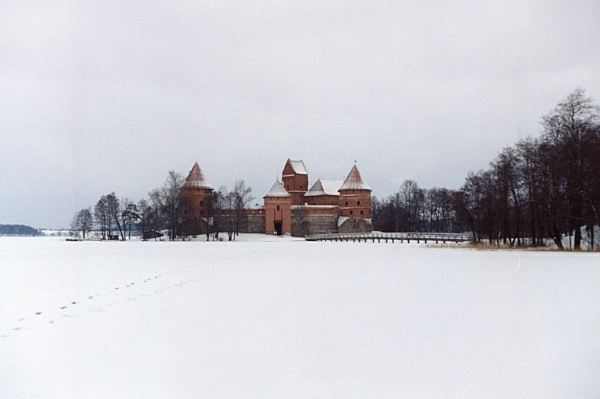
Trakai, Lithuania, March 1994 © Andrew Stuttaford

Trakai, Lithuania, March 1994 © Andrew Stuttaford

How to make a nation? In Vanished Kingdoms, his fascinating — and characteristically hefty — new book chronicling the rise and fall of 15 European states (from Visigoth Tolosa to the good-riddance empire of the Soviets), historian Norman Davies offers a number of suggestions. They include “good fortune, benevolent neighbors, and a sense of purpose.” There are nods to the power of a common language and a shared myth, and an implied recognition of the usefulness of conquest (where now are the Baltic people, the Prusai, whose land formed the core of ascendant Teutonic Prussia?), but little focus on the shared (if often exaggerated) sense of an ethnic bond that has held nations, and nations-in-waiting, together through the centuries. Perhaps the last was too obvious to need spelling out, or, in an era that sets such store in being over that sort of thing, just too embarrassing.

Making matters more complicated still is the way that history has left many Europeans with overlapping, and, not infrequently, conflicting identities: Sorb and/or German, Briton and/or Scot? But there can be few better guides to these muddled layers of nationality than Norman Davies, a combative, unusually original historian of Europe (Europe: A History) best known for his studies of Poland (God’s Playground, most famously), a nation blessed and burdened by shifts in borders and identity to an extent that stands out even in this most tangled of continents. That said, those expecting Vanished Kingdoms to be a comprehensive guide as to how, why, and when countries fail will, despite a postscript titled “How States Die,” be left a little disappointed. Suspects, usual or otherwise, are listed: invasion, of course; artificiality (Napoleonic Etruria); stillbirth (the day-long Republic of Carpatho-Ukraine); exhaustion; merger; de-merger; and the loosely defined “implosions” that put paid to the USSR and Austria-Hungary alike. But Davies has both a romantic streak and a sharp awareness of humanity’s susceptibility to hubris, and the explanation, I suspect, that really appeals to him is the inevitability of impermanence: Nothing endures forever, Ozymandias and all that.

For the most part, we are left to draw our own conclusions from the 15 national obituaries that form the backbone of this book. So densely packed that they can be difficult to digest (the five, six, or was it seven Kingdoms of Burgundy do rather blur), they reveal their author’s romanticism in a sometimes elegiac tone, crowned with moments of unexpected beauty. In his description of a piece of ancient Britain that endured in Scotland until the 12th century, Davies includes lines from a poem written in the days of its twilight of a loveliness so vivid that a scene from 800 years ago comes close enough — almost — to touch: “Gentle meadows and plump swine, gardens pleasant beyond belief, / Nuts on the bough of hazel, and longships sailing by.”

The forgotten and the neglected attract Davies, a passionate writer drawn to history’s underdogs (thanks to this book, I am now something of a Montenegrin nationalist): “Historians usually focus . . . on the past of countries that still exist. . . . They are seeking the roots of the present, thereby putting themselves in danger of reading history backwards. . . . In [the] jungle of information about the past, [today’s] big beasts invariably win out.” Attention is sucked away from smaller states, let alone those that no longer exist. We learn more about that of which we are already aware, and “the blank spaces in our minds are reinforced.”

References to “big beasts” hint at Europe’s history of, given human nature, all too imaginable violence, a blood-drenched danse macabre that reached a ghastly apogee in the wars, genocides, and ethnic cleansings of the mid–20th century. As so often is the case, these horrors are most powerfully conveyed in miniature. Thus we learn of Ustrzyki Dolne, a small, largely Jewish sub-Carpathian town that emerged from Austro-Hungarian Galicia into the interwar Polish republic. When, after Stalin’s pact with Hitler, the Soviets arrived, the local Germans were sent off into the temporary safety of the expanded Reich, and most of the town’s ethnic Polish inhabitants were deported to the east, and, in the majority of cases, their death. Two years later Hitler’s legions arrived. Ustrzyki’s Jews were exterminated.

That left the Lemkos, Ruthenians who had long farmed the surrounding countryside — and then they, too, were cleared out by the Communist authorities after the end of the war. Their replacements inherited a ghost town and ruined villages, “blank spaces” of the most literal type, and filled them with a Polishness that lacked any traces of that old awkward, butchered Galician ambiguity. Violence had done its bit for nation-building yet again, helped, as the years passed, by fading memory and the easing of inconvenient history into convenient oblivion. The annihilation of old Ustrzyki has little to tell us about Poland today: Lemkos, Germans, and Jews will never again come back to their land by the River San.

Under the circumstances, it’s unsurprising that the notes that conclude Vanished Kingdoms occasionally strike a wistful tone: “Since it cannot be fitted tidily into French, Swiss, or Italian history, Savoy is frequently overlooked. No standard survey has been published in English, either of the land of Savoy or of the House of Savoy.” Such are the “blank spaces” that Davies is looking to fill, beginning, as he has to, with “flotsam and jetsam.” He is a beachcomber-historian, delighted by a cabinet de curiosites in Krakow’s Czartoryski Museum bursting with celebrity treasures that include Rousseau’s briefcase, Voltaire’s quill, and Queen Barbara Radziwiłł’s knife and fork. Nearby is “a half-gnawed, rock-solid, bright green chunk of moldy bread . . . allegedly cast aside by . . . Napoleon.”

Allegedly: With a wink, Davies hints that, like some of the other wonders on display, Bonaparte’s bread may not be the real thing. But never mind: “Like all holy relics, genuine or fake, it has immense powers of imaginatory stimulation.” Above it hangs an inscription (“The Past in the Service of the Future”) that once crowned the entrance to a Temple of the Sibyl erected by Izabella Czartoryska (1746–1835), a Polish princess of the Enlightenment who was, splendidly, “as rich as she was patriotic as she was debauched.” But “whose past,” asks Davies, and “whose future”? The past, for Czartoryska, was the Polish-Lithuanian Commonwealth that had stretched from the Baltic to the Black Sea. The future of which she dreamed was the reversal of the partitions that had consigned that state to history, but if that past, and its relics and its memory, mean anything now, it is as symbol of a reinvented Poland — and a Polishness — very different from the sprawling multiethnic Rzeczpospolita for which the princess so yearned.

The persistence of some sort of Poland, however changed, brings up the question that lurks just below the surface of Vanished Kingdoms: What is it that defines a nation? And identifying that question helps us detect what Davies is really up to. A Briton of Welsh descent (aha!) who has predicted the disintegration of the U.K. with somewhat unseemly relish, he clearly doubts the authenticity, and thus the pretensions, of some of the nation-states that now dominate Europe, at the expense, in his view, of the essence of the peoples that live within their borders, and, indeed, beyond.

The time of the Prusai has irrevocably passed, but including a chapter in Vanished Kingdoms on the glories of Aragon makes the point that Spain’s restless Catalans may well be on to something, an approach Davies explored at even greater length in The Isles (1999), in which he argued that the United Kingdom was, is, and will be anything but united. The road to the future apparently ran through Brussels: The EU, wrote Davies, long an over-enthusiast for the gold stars on blue, “gives a place in the sun to Europe’s smaller and middle-sized nations,” a claim that looks absurd in the era of Merkozy and that was, even a decade or so ago, at best willfully naive. It is true that Scots and Fleming nationalists (and, doubtless, others too) maintain that the EU provides a framework within which they can “safely” claim their independence, but this independence would be one stripped of all meaning by a European project profoundly opposed to popular sovereignty and the assertion of national identity.

But as the bitter, distinctly un-communautaire feuding over the euro-zone crisis reminds us, notions of nationhood have a way of climbing out of the footnotes to which they have been banished. Rousseau warned the Poles of the doomed Rzeczpospolita that they were “likely to be swallowed whole” but must “ensure that [they were] not digested.” They did. The Baltic States were not fully “digested” by their Soviet occupiers either, but, as Davies (in a typically striking image) notes, “fifty years later, like the Biblical Jonah, they re-emerged from the belly of the whale, gasping, but intact.”

Should they so choose, the nations of the EU will now face a subtler challenge: how to escape from a trap they (or their politicians) set for themselves. Were they to succeed, and were Davies to write about it, the results would be well worth reading, but they would differ from Vanished Kingdoms in at least one crucial respect: Telling that story would not be a labor of love.

Declarer of Independence

National Review, March 1, 2012 (March 19, 2012 Issue)

He’s a tolerant man, Nigel Farage, a devotee of John Stuart Mill, a cricket-loving happy warrior, an “accidental politician.” The leader of the Euroskeptic United Kingdom Independence party (UKIP), and, since 1999, a member of the EU’s Potemkin parliament, he is standing expectantly at the bar of his local, the George & Dragon (of course) in Downe, a friendly low-ceilinged Kentish pub as English as its name. I’m ordering the beers. There’s a traditional, brewed-by-two-yokels county bitter for him (of course) and for me an industrial, vaguely Teutonic lager, bitte. “Euro-piss, I see.” Mock shock: Live and let live. Later on we share a bottle of good red wine. French.

We met up earlier at a railway station in a spot where the countryside emerges from London’s shadow. As we drove past tall hedgerows and stark winter trees, the late-fortysomething Farage proudly played guide: “I’ve always lived around here.” There’s landscape, history, old graveyards to inspect, English Shinto. Up there (he gestures) are the remnants of the oak where William Wilberforce resolved to launch his great anti-slavery campaign, and over here is the splendid pile where Pitt the Younger once lived. I point out Biggin Hill, an RAF redoubt during the Battle of Britain. Replicas of a Hurricane and a Spitfire stand guard. “They had real ones when I was a boy.”

Farage feels the past in this place. He’s a history buff, a battlefield maven, just finishing reading a book on Allenby of Great War fame. We stopped off at the small town of Westerham to inspect a statue of its most famous son, General Wolfe, conqueror of Quebec. Nearby, a restless-looking Churchill seems ready to leap out off the chair on which his sculptor sat him. The last lion’s last den — Chartwell — is nearby. Then on to the George & Dragon, just past the house of another Farage hero, Charles Darwin: The woods where the great scientist wandered are “just as they were . . . almost.”

But to believe, as many critics like to suggest, that Farage and his party are golf-club xenophobes wanting their country back as it was (. . . almost) is to subscribe to a very partial version (in both senses) of the truth. To be sure, there is a trace of the 19th hole about them; oh, what a horror. And is the idea that the country has gone to the dogs imprinted in UKIP’s DNA? Maybe, but the country has gone to the dogs. Claims of xenophobia, however, are difficult to reconcile with reality, in ways both small (Farage’s second wife is German; their two young children are being brought up to speak the language) and large: UKIP is a defender of de Gaulle’s Europe des patries, fighting the bureaucratic drive to remold the continent into a homogenized administrative unit in which history has been sanitized, tradition reduced to decoration, and difference regulated away.

If there is an era for which Farage is nostalgic, it’s more likely to be the 1980s, a time when big government was in retreat and big opportunity was round the corner. Not the most diligent of students, he skipped university and went straight into the City, London’s financial center, just as Mrs. Thatcher’s reforms were transforming it from an entertainingly seedy, mildly run-down club into today’s chilly international hub. It was “like a gold rush,” as we both recall. And there’s still the hint of an Eighties trading desk about Farage, an engaging, quick-witted risk-taker (a survivor of testicular cancer, he still enjoys his Rothmans) with a taste for a good time that has sometimes got him into trouble. Rick Santorum he’s not. Smart, direct, and impressively fluent, he speaks in paragraphs, punctuated with one-liners: He has a way with words, and he knows it.

If you doubt that, just check out the way he welcomed Herman Van Rompuy to the European Parliament shortly after that discreetly sinister Belgian had taken the EU’s top job at the beginning of 2010. Farage’s speech was brutally iconoclastic, rudely funny, and, in its warning of the threat that this official with “the charisma of a damp rag” posed to European democracy, deadly serious. It created uproar across the EU and made UKIP’s leader a YouTube star. Check it out, and you will see why.

“You’re a bit of actor, aren’t you?”

Farage grins his confession. His only regret — a very English regret — is that he may sometimes appear “too shrill.” In fact he doesn’t, but, endearingly, he insists on explaining that the microphones in the EU parliament’s chamber are set up in a way that makes it difficult for viewers to hear the barracking to which he is, not infrequently, reacting. But if it’s not always possible to make out the jeers, you can, I tell him, occasionally see the faces of his critics twisted into something that looks a lot like hatred.

“Oh, it’s hatred.” He names a couple of names. “They have their dream. It’s their religion. These are dangerous people.” They cannot accept dissent, especially when they know they’ve been rumbled: They just don’t want to be told how anti-democratic they really are. Wouldn’t they be happier if bolshie John Bull just quit the EU? “Some of the Euronuts,” maybe, but not the Merkels and Sarkozys: They’d be too nervous about which country would be next.

But is UKIP the right vehicle to extricate Britain from this mess? Since its founding in 1993 as a party set on taking the country out of the EU, it has woven an unsteady path, marked by scandal, factionalism, sporadic incursions by the far right, PR disasters, leadership crises, damaging outbreaks of eccentricity, and, above all, the pervasive, persistent sense that it was not ready for prime time. This was probably inevitable, and not just because small parties tend to be a lot like that. There was also the matter of UKIP’s great cause.

Euroskepticism was hardly unknown in Britain at the time — particularly amongst Conservatives — but it was house-trained. Withdrawal from the EU was widely considered a step too far even amongst those who loved Brussels least. “Banging on” about Europe (to borrow David Cameron’s notorious phrase from a decade or so later) was portrayed by media and political grandees alike as obsessional, retrograde, and profoundly damaging to the governing Tories’ unity, the last a development that, in a paradox understood by just about everyone, could only help sweep the slavishly Europhile Tony Blair into power. And, it turned out, keep him there.

Smears can be self-fulfilling prophecies: The nascent UKIP attracted more than its fair share of cranks, outsiders, and the hopelessly adrift. And it continued to do so, creating the image of the party to which David Cameron played when, in 2006, he referred to UKIP as a bunch of “fruitcakes and loonies and closet racists, mostly.” The feigned reasonability of that “mostly” was a clever touch.

Farage is no fan of Cameron. Is the prime minister a Christian Democrat on Rhineland lines? Not really. “Dave” (“an affable chap,” he adds, kindly) is more of a social democrat, a paternalist, a statist, and he’s not going to do much about Brussels: nothing that counts, anyway. Farage, a staunch Thatcherite back in the day, doesn’t have much time for the way in which the Conservative party has evolved. To read what UKIP would stand for, at least in theory (once Britain was out of the EU), is to be presented with an attractive mix of the hard-nosed and the libertarian, including deregulation, flat taxes, strict immigration controls, proper schools, tough policing, an aversion to multiculturalism, and a reversal of the kamikaze greenery of the Cameron years. Compared with the Tories, what’s not to like?

The problem is that Britain’s “first past the post” electoral system guarantees that, in most elections, a vote for UKIP is wasted — or worse. It’s “difficult,” Farage admits, an understatement. In the 2010 general election, UKIP scored some 3 percent of the vote, but took no seats, and, by nibbling away at Tory support, cost the Conservatives an absolute majority, thus (more or less) forcing them into coalition with the Eurofanatic Liberal Democrats. UKIP hoped that the Lib Dems would use their new position to push for the adoption of a voting system friendlier to small parties. They did, but they failed: A switch to the Alternative Vote was rejected in a referendum in May 2011.

Farage still wants electoral reform (AV+, since you asked). A glance at Britain’s elections for the European parliament (where a type of proportional representation is used) in 2009 explains why. Led by Farage since 2006, UKIP came in second (slightly ahead of Labour) with 16.5 percent of the vote and, like Labour, won 13 seats out of the UK’s total of 72. Even allowing for the low turnout and the fact that European elections are an excellent opportunity for Britons to register a protest against the EU, the result was a triumph.

Stymied at home, however, by the uncooperative electoral system, UKIP continues to struggle domestically, even as it stands at about 6 percent in the polls, not so far behind the Liberal Democrats. But Farage is determined, stubborn, and resilient (he has survived a plane crash as well as cancer). He’s not giving up. And he’s going to do it his way. Deals with the Conservatives, such as (one suggestion) an agreement not to challenge the party’s many genuinely Euroskeptic MPs, seem out of the question for now. Farage clearly wants UKIP to be seen as more than a Tory offshoot (he takes pains to tell me that its membership also includes “patriotic old Labour and classical liberals”). Those Euroskeptic Tory MPs? Useful camouflage for a Conservative party unserious about the only thing that really counts: prising Brussels out of Britain. “Unless we sort this out, we can’t do the rest.” The financial cost of EU membership is enormous (in direct payments alone, a net £10.3 billion in 2010, UKIP estimates). The democratic toll is still higher: About half of all “British” laws are now passed at the EU level. True enough, bad enough, but by splitting the right-of-center vote, Farage risks helping the Europhile left, which is always pressing to make matters even worse.

So there he stands athwart a political conundrum, Captain Sparrow at the head of UKIP’s motley crew, but something of a one-man band too, harrying the Eurocrats, embarrassing Britain’s establishment, deftly playing new media and old, deftly playing politics, new style and old. He crisscrosses the country, addressing meetings (he truly is a terrific speaker), talking to schools, retail stuff, good stuff. He’d like UKIP to take first place in the next European elections (2014), but what Farage, the gambler, wants most is a referendum — in or out — a high-stakes, binary game (a vote, however reluctant, to remain in the EU is every Euroskeptic’s nightmare). It would bypass that domestic impasse. And he believes it is winnable: His much-disdained UKIP has, “like Stalin’s [Red Army] punishment battalions, softened the ground up.”

The polls suggest that Farage might be right, but he understands that fear of what lies outside (possibly exaggerated further, and ironically, by the instability that the battered euro is leaving in its wake) could make voters pause. To calm that, he’s looking for business support to rally behind his idea of a country that sees its future in a world far wider, and freer, than the EU’s inward-looking, closed, and highly regulated customs union. That’s a vision that ought to be made all the more sellable to clearer-headed voters by the damage that the euro-zone crisis has done to the whole notion of Brussels’s “ever closer union.” And that crisis is unlikely to end soon or well. Farage doesn’t know what’s coming next. If he did, he’d be “in the betting shop.” He guesses that Greece will exit sometime in 2012, followed by Portugal, and believes that the “ultimate question” is France. But he’s not waiting to find out. To him, the issue is this: If Britain does not quit now, then when? Remaining in the EU is death “by a thousand cuts.”

I ask Farage whether he’d like Pitt the Younger’s old job. No thanks, he’s not interested in rank. He’d rather be remembered like a Wilberforce, for having changed things for the better.

Put another way, he will damn the torpedoes and steam on ahead.

A Bridge, but Leading Where?

The Weekly Standard, February 4, 2012

Purity has no place in a crisis. The 2008 TARP bailout was a clumsy, ugly, and rather shameful creation, but by signaling that Uncle Sam was in the room (with his printing press not far behind), it headed off the final descent into a panic that would have brought the banks, and, with them, the economy, and, with that, who knows what else, tumbling down. Three years later, another four-lettered program has been launched, this time in Europe, but once again designed to calm fears that were threatening to metastasize into catastrophe.

It was no coincidence that the European Central Bank (ECB) launched its first LTRO (long-term refinancing operation) on December 8, the first day of a two-day Brussels summit in which the EU’s leaders planned to show that they were really, really in control of a currency union on the edge of chaos. The central bank’s billions were intended to sugar the bitter pills that the Brussels summiteers were bound to prescribe—and did. The eventual, uh, “Treaty on Stability, Coordination and Governance in the Economic and Monetary Union” that was hacked out of those talks (and a second summit last week) combines the big-heartedness of Scrooge with the vision of Magoo and the credibility of Madoff. Its significance lies more in what it won’t do than what it will. Few were impressed.

The LTRO, by contrast, got off to a tremendous start. In the months prior to the new program’s debut the central bank had been criticized (not always fairly) for not doing enough to support the eurozone’s stumblebum banks. Its rescues were too ad hoc, too brief, and too grudging. Not any more: Just in time for Christmas, the ECB repackaged itself as Santa, offering out longer-term (three year) funding at highly attractive rates and, as an added bonus, not being too fussy about how it was collateralized.

The combination of one generous lender and many anxious takers produced a spectacular result. From across the eurozone, 523 banks borrowed a total of 489 billion euros ($641 billion), a far larger haul than financial markets had anticipated. This was a measure both of the easy terms being offered and the difficult straits in which so many European banks had found themselves. Lehman’s unquiet ghost was on the move. Trust in the banks was eroding, as was trust between them. Interbank lending was slowing, crimping the banks’ ability and willingness to lend money out into the “real” economy.

By December, credit to the eurozone’s businesses and consumer clients was falling at a rate that conjured up memories of the nightmare of 2008. With the currency union’s extended ordeal driving Europe into recession, the last thing anybody needed was credit crunch part deux to make matters even worse. Yet that is what the continent was getting. And the deeper the recession, the harder it would be for the PIIGS (Portugal, Italy, Ireland, Greece, Spain) to escape their budgetary hell, and, crucially, for their lenders’ faith in them to return. And so the vicious circle turns.

Initially, the market was unsure how to respond to the LTRO. Was the program’s size a reason for celebration or concern? But then sentiment changed for the better. Italy completed a number of successful bond auctions. Yields on French and Spanish government debt fell—while those of Germany’s safe haven bunds rose. The Rodney Dangerfield euro even made up some lost ground against the dollar. And this was despite the flow of dreary news that just would not go away. The impasse over the “voluntary” restructuring of Greek debt continued, Portugal slid closer, again, into bailout territory, there was a further round of ratings agencies downgrades (this time from Fitch), and hideous fresh reminders of the plight of the eurozone’s periphery continued to slouch into view. In late January statistics were released showing that Spain’s unemployment rate had hit 22.8 percent in the last quarter of 2011. For the under-25s the rate is nearly 50 percent.

But for now the glass was half full. The old TARP trick had worked again. The European Central Bank had not only supplied the banks with nearly 500 billion euros ($650 billion) in badly needed liquidity, but it had also signaled that it was there on the ramparts alongside them. The cash was important, the boost to confidence no less so, and the message will be rammed home with an LTRO 2.0 scheduled to take place later this month. Another gusher? Maybe. The standard guess is that this second round will amount to 350 billion euros or so, but some have speculated that the total could swell to as much as 1 trillion euros.

According to the logic of a seminal paper published last year by Belgian economist Paul De Grauwe, the very structure of the eurozone (monetary union without fiscal union) was an invitation to financial panic. Fears that money would drain out of the zone’s weaker countries would be self-fulfilling. One consequence is that the possibility of bank runs cascading through the system has been among the most dangerous of the many threats swirling around the eurozone. By supplying that extra liquidity, by promising a second helping, and by implicitly suggesting that in a pinch there could be even more, the ECB is trying to deliver the message that there will always be cash in the banks’ tills. No need to panic, or even think about panicking, after all.

Theoretically (and for now in practice) that should make it easier—and cheaper—for those eurozone countries not yet in intensive care to borrow on the international markets. There’s something else that may be helping too. One of the devices used to reassure skeptical Germans that the new European Central Bank would be more Bundesbank than Weimar was a broad ban on direct purchases by the ECB of government bonds from the eurozone’s members. There’s no equivalent rule, however, that stops commercial banks from using the LTRO loot they have just received from the ECB to purchase the bonds that the central bank cannot. Indeed the banks appear to have been incentivized to do just that. Using cheap ECB funds to buy high-yielding eurozone government bonds looks, at first glance (if not necessarily the second), like a nicely profitable carry trade.

Pause for a moment, though, to think through this money-laundering: Banks that have been weakened by their exposure to dodgy European sovereign debt were being encouraged to use loans (secured by similar debt, and worse) from an already highly leveraged central bank (underwritten by increasingly restive taxpayers) that was itself heavily exposed to identical crumbling borrowers, to buy even more of the same poison. Ponzi himself would have blanched. Nicolas Sarkozy, however, thought it was a great idea. “Each state,” he said, “can turn to its banks” to buy its bonds. Because thanks to the LTRO, the banks “will have liquidity at their disposal.”

It remains uncertain how many banks followed the French president’s advice. Quite a few, in all probability: Nevertheless a good portion of the LTRO proceeds have been placed right back on deposit with the ECB. The banks are still building fortifications in preparation for the day of reckoning they obviously fear may be on the way. That they are has something to be said for it (healthy cash reserves represent a handy preemptive strike against panic), but it is also a sign of a system that no longer believes in itself. The wider slowdown in lending that comes with it carries, as Europe has seen, its own terrible cost.

The next few months will show how effective the LTROs are at calming these fears. Somewhat, I’d guess, but sorting out the eurozone’s predicament will take more than the European Central Bank’s billions. The fundamental flaw of the euro was, and is, that this one-size currency does not fit all. All the liquidity in the world will not change that. Europe’s monetary union was assembled on the basis of political fiat rather than economic reality, and the economics and politics have both turned sour. And not just sour: They have combined into a murderous cocktail. Understandably enough, the looted taxpayers of the north want to see budgetary discipline imposed on the dysfunctional south. German chancellor Angela Merkel has been leading the posse pushing for just that. But too much austerity too soon is draining the ability of the PIIGS to generate the growth that is the only way out of their burning sty. More dangerously still, it is reaching the limits of the politically possible. Shuttered businesses, soaring unemployment, and the prospect of years of stagnation to come are not the stuff of social stability. If insults like the recent draft German proposals that would have ground into dust the last shards of Greece’s economic sovereignty (and much of what remains of its self-respect) are then added to the mix, an explosion is unlikely to be far behind.

The next moves will not be straightforward, but, if they want the eurozone to survive in its current form, those who control its destiny will have to reshape it into a cut that will eventually (if they are very lucky) have a chance of fitting all. They will have to make a drastic change of course. They will have to acknowledge that austerity alone is failing and move instead to fiscal union (and a permanent transfer payment regime) buttressed with, to quote IMF managing director Christine Lagarde, a “clear, simple firewall.” This, I’d guess, would have to be a jointly underwritten financing mechanism of a size (2 trillion euros?) that recognizes how prolonged and tricky this process will be.

Whether the voters will go along with all this is an entirely different and very pointed question, but if the eurozone continues to be run as it is now, the LTROs will turn out to be brilliant, necessary bridge financings that lead, ultimately, to nowhere.