Monster, Man & Principal Boy

Planning a date ought to involve hope, care, and a reasonable expectation that the invitee will enjoy what has been laid on. Simple enough principles, but judging by what I witnessed during the RSC veteran Michael Boyd’s powerful production of Christopher Marlowe’s Tamburlaine (Parts I and II) at Brooklyn’s Theatre for a New Audience, the man sitting two down from me had not followed them.

Read More

After Charlie

To look at most of the photographs of the march in Paris the Sunday after the terror attacks was to see something glorious after the horror that had gone before. More than a million people had gathered to proclaim their defiance in the face of jihadi insistence — enforced in this case by mass murder — that Islamic fundamentalists would determine what could or could not be written, said, or drawn about Islam. And then there were the images of the leaders — Merkel, Hollande, Cameron, and all the rest of a somewhat motley crew (but not Obama) — marching side-by-side, sometimes with arms linked in a gesture of unity. But all was not as it seemed.

Read More

The Prog Prince

Caravan!   Van der Graaf Generator! Yes! Genesis! To Englishmen of a certain age, just reading some of these old names will take them back to an era when progressive rock haunted the turntable, songs stretched out endlessly (three minutes would barely be enough for a proper guitar solo), and lyrics—well, they took themselves more seriously than be-bop-a-lula ever could: “For from the north overcast ranks advance / Fear of the storm accusing with rage and scorn.” That was Genesis, by the way, from their song “Can-Utility and the Coastliners” (1972), a characteristic ramble from their prog-rock heyday, a time whenPeter Gabriel, notPhil Collins, was the front man. 

Read More

Writing the Coattails

Boris Johnson: The Churchill Factor - How One Man Made History

National Review, December 18, 2014 (December 31, 2014 Issue)

About halfway through Britain’s long Blair nightmare, I went to two dinners where Boris Johnson was billed as the guest speaker. Each time he was eagerly awaited: a man on the rise, a gifted journalist, an engaging and eccentric television personality, a Tory MP. Each time he was late. When he eventually turned up — all scarecrow hair and unconvincing excuses — he explained that he’d left his notes behind. He pressed on regardless in that blend of Drones Club and High Table that he has made his own. Both speeches were funny, sharp — and more or less identical. Johnson knows, as Winston Churchill knew, that a spontaneous speech takes plenty of preparation. A book by Boris on Winston — first-name politicians both — ought to make sense. Like Churchill, Johnson is phenomenally ambitious, unusually resilient, and remarkably skilled at using showmanship, élan, and his pen to build, refine, and reshape his image.

It’s a shame, then, that The Churchill Factor is not very good. The grand old stories roll on grandly by, but there’s little that’s new for those who know their Churchill, and not enough depth for those who don’t. But if you’re interested in Johnson, this book is well worth a look. If Boris was someone to watch back when I listened to him make one speech two times, he is much more so today. He has since twice won election as mayor of London — no small feat for a Conservative — and is poised to reenter Parliament in the 2015 general election. From there he will be well placed to run for the Tory leadership in the likely event that David Cameron has just led his party off a cliff.

Johnson’s success owes a great deal to the manner in which he has defused his potentially toxic poshness. Like the hapless Cameron, Alexander Boris de Pfeffel Johnson went to the wrong school (Eton) and the wrong university (Oxford), and then capped the whole disgraceful gilding by joining the Bullingdon Club, an Oxford gang of the rich and sporadically destructive brought to politically tricky national attention some years ago when an ill-wisher leaked the club’s 1987 photo — a snapshot of archaic finery, Flashman attitude, and Sloane Ranger hair, a photo in which both Cameron and Johnson appeared.

Cameron has tried to deal with this embarrassment of privilege by recasting his public persona (very) gently downscale. The more charismatic Johnson, gambling that Brits take more pleasure in eccentricity than in reverse snobbery, has moved in the opposite direction, putting on a display of wild toff rococo — a bit of Wooster, a spot of Biggles, a touch of Raffles — that has left class warriors too amused to be chippy.

It’s a performance that rests heavily on Johnson’s way with words. His speeches are punctuated by slang, dated terminology, and madcap verbal construction. An accusation of infidelity was famously, if inaccurately, dismissed as an “inverted pyramid of piffle.” But what works in a sound bite palls over the course of a book. Tootling, monstering, wonky, squiffily, tosser, prang, perv, titfer, snortingly, bonkers, bunging — crikey, Boris, hold the shtick already. Unnecessary adjectives and superfluous adverbs run wild. Metaphors meander. A promising description of Churchill’s house — crammed with researchers, writers, and secretaries — as “one of the world’s first word processors . . . a gigantic engine for the generation of text” dragged on so long that all I wanted was the delete button. To be sure, there are splendid moments (“the French were possessed of an origami army: they just kept folding”), but they are swamped by verbosity.

So it’s ironic that the best section of the book is Johnson’s superb analysis of how Churchill’s oratory was put together, what it was meant to convey, and why it worked as well as it did. Sadly, Johnson himself ignores two key Churchillian tricks — short words over long, “Anglo-Saxon pith” over intruders with Latin and Greek origins — burdening the readers of this book with such treats as chiasmus, philoprogenitive, and eirenic, words that probably played little part in the small talk of Alfred the Great.

But these ten-guinea words are sly demonstrations of erudition, deployed for political, not literary, effect. Boris may play Wooster to beguile the plebs, but he wants them to understand that he is no upper-class twit. At the same time, he needs his audiences to feel that he is an inclusive sort of fellow, with them if not necessarily of them. So he brings his readers alongside him on trips to the sacred sites — to Chartwell, to the House of Commons, to kind Nurse Everest’s grave — while throwing in glimpses of a life that he invites them to share, if only by proxy: lunch at the Savoy, a birthday bash for a hedge-fund “king” at Blenheim Palace. Condescending, yes, but cleverly disguised. Only rarely does the mask slip, and the text sprouts tics more typical of history books written for the late-Victorian nursery: “Those were the days, you see, when there was no moral pressure on MPs to have a ‘home’ in the constituency.”

“You see”? Well, I suppose I do. Thank you, sir.

Notionally, Johnson has written this book to revive ebbing memories of Churchill and to remind his readers that, whatever some cruder Marxists might have to say about history’s being driven by “vast and impersonal economic forces,” one man can make a difference. Based primarily on a fine retelling of the events of 1940, Johnson makes a strong, if unsurprising, case that Churchill was such a man.

But Boris’s real objective in writing about Churchill is to promote Boris. Wisely, he doesn’t try to push Churchill comparisons — hosting the London Olympics doesn’t quite rank with seeing off Hitler — but there’s enough there for a satisfactory subliminal message. So Johnson tells the story of a man comfortable in his unorthodoxies, a statesman who was larger than life, and, like a certain twice-elected mayor of London that I could mention, larger than party.

In recent years, Johnson has positioned himself as offering a more robust, less politically correct version of David Cameron’s “modernized” conservatism, more libertarian, not so committed to environmentalist piety, pro-immigration (for its purported qualities as an agent of economic growth), and a booster of London’s cosmopolitanism, too, but not so respectful of multiculturalist orthodoxy. Johnson portrays Churchill, not unreasonably, as an early-20th-century Whig, an optimist, a Progressive of sorts.

But the old imperialist is not safely pigeonholed. Johnson defends his hero against the accusation that he was a warmonger and — as he should — places some of Churchill’s rougher views within the context of his times. Occasionally (not as uncharacteristically as fans of the allegedly plain-speaking Johnson like to believe), Boris simply dodges the issue: There is nothing on Churchill’s response to the Bengal famine of 1943, startlingly callous then and now.

Johnson — clearly conscious that times have moved on for the island race — takes care to signal that, despite his obvious admiration for Churchill, he himself is no reactionary. He distances himself from some instances of the more “unpasteurized” Churchill, but not too far. The last lion is still idolized by many of those who will be picking the next Conservative leader, an election evidently on Johnson’s mind. Why else tread quite so carefully on the question of Churchill’s complicated views on a united Europe, that most treacherous of Tory topics?

But tread carefully Johnson does. He has his eyes on the prize. Churchill would have understood.

From UKIP to ‘Brexit,’ Possibly

hortly after former Tory MP Mark Reckless had defected to UKIP and triggered a by-election (special election) in his Rochester and Strood constituency, David Cameron vowed that the Conservatives would stop Reckless from getting “his fat arse back onto the green benches” of the House of Commons. Well, the Tories did what they could, but there was no bum’s rush for the fat arse.

Read More

Baltic Dawn

Sigrid Rausing: Everything is Wonderful - Memories of a Collective Farm in Estonia

The Weekly Standard, November 10, 2014

Tallinn-Narva road, February 1996 © Andrew Stuttaford

Tallinn-Narva road, February 1996 © Andrew Stuttaford

I first visited Estonia—or more specifically, its capital, Tallinn—in August 1993, two years after the small Baltic state regained its independence after nearly half-a-century of Soviet occupation. Tallinn was in the process of uneasy, edgy transformation. The Soviet past was not yet cleanly past. It was still lurking in the dwindling Russian military bases. It was still visible in the general shabbiness, in the rhythms of everyday life, and, above all, in the presence of the large Russian settler population, a minority that Vladimir Putin now eyes hopefully, if not necessarily realistically, for its troublemaking potential.

Totalitarian colonial rule had been replaced by a national democracy, the ruble had been succeeded by the kroon, and free-market reformers were at the helm; but the new government was operating in the rubble of the command economy. There was no spare cash to smooth the transition to capitalism. Inflation had exceeded 1,000 percent during the course of the previous year, savings had been wiped out, the old Soviet enterprises were dying, and the welfare net was fraying.

Yet in Tallinn there was a discernible sense of purpose, buttressed by memories of the prosperous nation prewar Estonia had been. What people wanted, I was told, was a “normal life.” That was a phrase that could be heard all over the former Eastern Bloc in those days, a phrase that damned the Soviet experience as an unwanted, unnatural interruption and resonated with dreams of that elusive Western future. Life was tough in Tallinn, but there were hints of better times to come. If the country was to be rebuilt, this was where the turnaround was taking shape.

But Sigrid Rausing went somewhere else in 1993, to a place far from the hub of national reconstruction, a place where the inhabitants had little idea of what could or should come next, a bleak place—poor, even by the demanding standards of post-Soviet Estonia—where nationhood was misty and visions of the future were still obscured by the wreckage of an alien utopia. Rausing, a scion of one of Sweden’s richest families, was a doctoral student in social anthropology. To gather material for her thesis, she spent a year on the former V. I. Lenin collective farm on Noarootsi, a remote peninsula on the western Estonian coast.

Noarootsi had once been inhabited by members of the country’s tiny Swedish minority, most of whom had been evacuated to the safety of their ancestral homeland by Estonia’s German occupiers shortly before the Red Army returned in 1944. The final minutes before their departure were caught on film: the exiles-to-be assembled on a beach, Red Cross representatives mingling with smiling SS officers. Baltic history is rarely straightforward.

Rausing’s thesis formed the basis of her History, Memory, and Identity in Post-Soviet Estonia: The End of a Collective Farm, an academic work published by Oxford University Press 10 years ago. This was never a book destined to top the bestseller lists, but for anyone able to weather the clouds of jargon that drift by—“the effect was to emphasize the experience of oppositions in the form of a homology”—it offers a sharp, intriguing, and unexpectedly wry portrait of what Rausing refers to as the “particular post-Soviet culture of 1993-94, the culture of transition and reconstruction,” a culture that no longer exists.

Rausing has now reworked the topic of her time in Noarootsi into Everything Is Wonderful, a personal, intimate account of that year in which she largely dispenses with academic analysis—indeed, there are moments when she pokes gentle fun at its absurdities—and gives her considerable lyrical gifts free rein. Graduate-school prose now finds itself transformed into passages of austere beauty. They describe a landscape that reminds her of Sweden, only “deeper, vaster, and sadder”; more than that, they portray a people adrift. There is something of dreaming in her writing, images that haunt. Spring returns, and

the children were outside again, playing and shouting in the long twilight, until there was an almost deafening din echoing between the blocks of flats. One day someone burnt the old brown grass strewn with rubbish between the blocks, and the children kept up their own private fires deep into the night.

There is a subplot too, tense and awkward, sometimes expressed in not much more than a hint, that surrounds the position of Rausing herself, an attractive thirty-something Swedish heiress inserted into this exhausted husk of a community and, for a while, lodging with the heavy-drinking, possibly/probably lecherous Toivo and his long-suffering wife, Inna. Ingmar Bergman, your agent is on the line.

That’s not to say that Rausing neglects the broad themes of her academic research. As she notes, the two books “overlap to some degree,” and they have to. Without repeating some of the background covered in the first volume, isolated, depopulated Noarootsi—with its Soviet dereliction, abandoned watch-towers (the peninsula had been in a restricted border zone), emptied homesteads, and taciturn, enigmatic inhabitants scarred by alcoholism and worse and speaking a language of a complexity Rausing struggled to grasp—would have seemed like nothing so much as the setting for a piece of post-apocalyptic gothic. So Rausing provides a brief, neatly crafted, and necessary guide to Estonia’s difficult and troubled history, neglecting neither the obvious horrors nor the subtler atrocities, such as the attempted cultural annihilation represented by the wholesale destruction of Estonian literature. Tallinn Central Library lost its entire collection of books—some 150,000 of them—between 1946 and 1950.

Sometimes, traces of that history—forbidden for so long—come crashing through the silence. Ruth, 76, a Seventh-Day Adventist, tipped by tyranny into something more unhinged than eccentricity, hands Rausing a handwritten retelling of her life: “Devilish age, sad age. Schoolchildren also spies .  .  . life as leprosy.” But Everything Is Wonderful is a book in which the story lies mainly beneath the surface. Old ways linger on amid new realities. There is a new cooperative store, but the old Soviet shop hangs on, “selling household stuff as well as some food, pots and pans, exercise books, shoes if they got a consignment, and ancient Russian jars of jams and pickles with rusty lids and falling-off labels.”

Throughout the brutal winter, heating is intermittent. Heating bills are no longer subsidized, but the majority of villagers “patiently” pay them nonetheless. New habits creep in. Empty Western bottles and other packaging are displayed in apartments, demonstrations of “a connection with the West, a way of expressing the new normal”—that word again, that “normal” in which most had yet to find their feet. Meanwhile, Swedes bring hand-me-down help and the suspicion that they might be looking to reclaim a long-lost family home.

Rausing is a participant in this drama. We learn of her fears, her loneliness, of her wondering what she is doing in this distant Baltic corner, and of her small pleasures, too (“the tipsy sweet happiness of strawberry liqueur”). But she is a spectator as well, and a perceptive one, not least when it comes to the profoundly uncomfortable relationship between Estonians and the Russian minority. The latter are resented as colonists, yet caricatured in terms that remind Rausing of the “natives” of the “colonial imagination: happy-go-lucky, hospitable people lacking industry, application, and predictability.” She dines in a restaurant in a nearby town, where “the atmosphere was a little strained between a Russian group of guests and the few Estonians in the room.” Later, Rausing learns that the “only” Russians living in the “comfortable Estonian part of town” are deaf and dumb; they are “outside language,” as she puts it, and thus able (she theorizes) to “assimilate .  .  . through muteness.”

That sounds extreme, but the scars of the past were still very raw back then. Sometime in the mid-1990s, I watched a senior member of the Estonian government bluntly explain the facts of Estonia’s (to borrow a Canadian phrase) twin solitudes to a delegation of Swedish investors. There was, he said, little overt trouble between ethnic Estonians and the country’s Russians, but there was little contact either: “We don’t get on.”

Rausing’s tone is quiet, often wistful, marred only by interludes of limousine liberalism—apparently there was something “liberating” in the way the locals didn’t care too much about their possessions, which is easy enough, I imagine, when those possessions were, for the most part, Soviet junk—including an element of disdain for the market reforms that were to work so well for Estonia. The prim pieties of Western feminism also make an unwelcome appearance. Watching a pole dancer in a rundown resort town summons up concerns over “objectification,” but Rausing’s response to reports of a topless car wash in Tallinn is endearingly puzzled and—so Swedish—practical: “Really strange, particularly given the Estonian climate.”

But this should not detract from Rausing’s wider achievement. Her book is the last harvest yielded up by that old collective farm, and the finest.

Testing The Limits

The Weekly Standard, October 20, 2014

Brāļu Kapi, Riga, March 1994 © Andrew Stuttaford

Brāļu Kapi, Riga, March 1994 © Andrew Stuttaford

“I don’t think it’s 1940,” the woman in Riga told me in June, referring to the year the Soviets brought their own variety of hell to Latvia. “But then, I wouldn’t have expected 1940 in 1940 either.” And then she laughed, nervously. With Russia’s ambitions spilling across the borders that the breakup of the Soviet Union left behind, and talk from Vladimir Putin of a broader Russian World (Russkiy Mir), in which the Kremlin has the right to intervene to “protect” ethnic Russian “compatriots” in former Soviet republics, the once bright line that had cut the Baltic states off from the horrors of their past now seems fuzzy.

And in a more literal sense the borders that separated the Baltics from their old oppressor have lately appeared more vulnerable than once believed. Moscow has been pressing and provoking in the Pribaltika for years​—​some subversion here, some denial of history there. There have been maliciously random trade bans (Lithuanian cheese, Latvian sprats, and quite a bit more besides) and carefully planned cyberattacks. But the bullying has been stepped up sharply this year. The saber-rattling has evolved from menacing “training exercises,” such as last year’s Zapad-13 (70,000 Russian and Belarusian troops war-gaming their way through a fight against “Baltic terrorists”), to include too many flights by Russian fighters near or even in Baltic airspace to be anything other than part of a significantly more aggressive strategy.

On September 3, Barack Obama traveled to Tallinn, the Estonian capital, to reaffirm NATO’s commitment to the three Baltic states, all of which have been members of the alliance since 2004. Two days later Eston Kohver, an Estonian intelligence officer investigating smuggling across Estonia’s remote and poorly defended southeastern frontier, was, claims Tallinn, grabbed by a group of gunmen and dragged across the border into Russia. His support team at the Luhamaa frontier post nearby were distracted and disoriented by flash grenades and their communications were jammed: They were in no position to help.

Shortly afterwards, Kohver turned up in Moscow’s notorious Lefortovo prison. According to Russia’s rather different version of events, the Estonian was captured while on a mission on the Russian side of the border. Kohver faces espionage charges that could mean decades behind bars. He has “decided” to drop the lawyer that the Estonian government had arranged for him. Court-appointed lawyers will fill the gap. The stage is being set for a show trial, complete, I would imagine, with confession.

After a year of Russian lies over Ukraine, I’m inclined to believe democratic Estonia over Putin’s Russia. The timing was just too good. Barack Obama descends on Tallinn with fine words and a welcome promise of increased support, and Russia promptly trumps that with a move clearly designed to demonstrate who really rules the Baltic roost. In the immediate aftermath of Kohver’s kidnapping the Estonians signaled that they were prepared to treat the whole incident as an unfortunate misunderstanding. No deal. The power play stands, made all the more pointed by the way that it breaks the conventions of Spy vs. Spy, a breach that comes with the implication that Estonia is not enough of a country to merit such courtesies.

If anything could make this outrage worse, it is the historical resonances that come with it. There are the obvious ones, the memories of half a century of brutal Soviet occupation, the slaughter, the deportations, the Gulag, and all the rest. But there are also the echoes of a prelude to that: the kidnapping of a number of Estonians in the border region by the Soviets in the days of the country’s interwar independence, intelligence-gathering operations of the crudest type. These days Russia prefers more sophisticated techniques: Earlier this year, it polled people in largely Russian-speaking eastern Latvia for their views of a potential Crimean-type operation there (as it happens, they weren’t too keen).

But whatever the (pretended) ambiguities of the Kohver case, there were none about what came next. Moscow reopened decades-old criminal cases against Lithuanians who acted on their government’s instructions and declined to serve in the Red Army after Lithuania’s unilateral declaration of independence in March 1990. That government may not have won international recognition at that time, but recognition​—​including from Moscow​—​followed within 18 months. To attempt to overturn now what it approved in the interim comes very close to questioning the legitimacy of Lithuanian independence today.

This could turn out to be more than merely symbolic harassment. The Lithuanian government has advised any of its citizens theoretically at risk of Russian prosecution on these grounds not to travel beyond EU or NATO countries. That’s not as paranoid as it sounds​—​Russia has been known to abuse Interpol’s procedures in ways that can make for trying times at the airport for those it regards as its opponents.

As if that was not enough, injury has since been added to insult: A week or so later, Russia detained a Lithuanian fishing boat in waters that are international but within Russia’s exclusive economic zone. Lithuania acknowledges that’s where the vessel was, but argues that it had every right to be there. Russia maintained that the boat had been illegally fishing for crab, and took it back to Murmansk. Such disputes blow up from time to time, but once again the timing is, well .  .  .

And of course these actions are unfolding against a background not only of Russian aggression in Ukraine, but heightened verbal violence against the Baltics. We can be confident that when (as it seems he did) Putin boasted to Ukraine’s president, Petro Poroshenko, last month that Russian troops could be in the Baltic capitals (and, for good measure, Kiev, Bucharest, and Warsaw) “within two days,” he did so safe in the knowledge that his threatening braggadocio would be passed on.

Konstantin Dolgov, the Russian foreign ministry’s Special Representative for Human Rights, Democracy, and the Rule of Law (yes, really), obviously didn’t want to rely on third parties to get the message out: He went straight to Riga to deliver the message that Russia “would not tolerate the creeping offensive against the Russian language that we are seeing in the Baltics.” He pledged Russia’s “most serious” support to its purportedly embattled “compatriots.” No matter that they are, in reality, considerably freer (and generally better off) than Russians in Russia itself.

To be sure, Balts have heard this sort of talk before, but it’s hard not to suspect that this time something wicked might be on its way. A direct assault remains highly unlikely. This is not 1940. But the probing, the baiting, and the bullying will intensify, and so will efforts to foment trouble among the large Russian minorities in Latvia and Estonia. The October 4 election in Latvia passed peacefully, but the fact that “Russian” parties took about a quarter of the vote nationally (out of an electorate that excludes 300,000 mainly Russian “noncitizens”) and over 40 percent in Latgale in eastern Latvia will not, to put it mildly, have been overlooked in Moscow.

As to what Putin might want out of the Baltics in the end, it’s hard to say. If he succeeds in proving that NATO’s shield is nothing more than bluff (with all the consequences elsewhere that such an unmasking would bring in its wake), leaving Latvia, Lithuania, and Estonia with nominal independence​—​flags, folk dancing, presidents, elections, and all that​—​would probably be acceptable so long as real power resided in Moscow. Continued Baltic membership in the EU might still be possible, even desirable: A Trojan horse or three within the EU could come in handy one day. Guesses too far? Maybe, but what we know is that Putin will try to take what he thinks he can get away with.

That’s why deterrence counts. Both Latvia and Lithuania have committed to increase defense spending from current (meager) levels to the NATO minimum target of 2 percent of GDP, a target that Estonia has met for a while. Latvia recently bought 123 secondhand armored combat vehicles from the United Kingdom. Estonia has announced that it will improve the demarcation of the border with Russia and will reinforce its border guard with special response teams. Recruitment is running at much higher levels for volunteer home defense units such as Estonia’s Kaitseliit and the Lithuanian Riflemen’s Union. Again, this is not 1940: This time the Baltics would fight.

That’s all well and good, but it’s important to remember that the Estonian military can boast fewer than 4,000 regulars. Latvia may be getting those combat vehicles, but it only has three tanks. In the end, the security of the Baltic states depends on their membership in NATO and the guarantee that comes with it: An attack on one NATO member, be it France or be it Estonia, is treated as an attack on all. In recent months, NATO has sent a blunt message​—​from tough declarations to an increased and increasing presence in the region​—​that this would indeed be the case, but Moscow’s continued pressure indicates that it is not convinced.

Until it is, this dangerous game will continue.

A Schoolboy's Guide To War

Anthony Seldon and David Walsh: Public Schools and the Great War - The Generation Lost

The New Criterion, October 1, 2014

Richard Ropner (Harrow), Royal Machine Gun Corps

Richard Ropner (Harrow), Royal Machine Gun Corps

On August 3, 1914, twenty-two of England’s best public school cricketers gathered for the annual schools’ representative match. The game ended the following evening. Britain’s ultimatum to Germany expired a few hours later. Seven of those twenty-two would be dead before the war was over. Anthony Seldon and David Walsh’s fine new history of the public schools and the First World War bears the subtitle “The Generation Lost” for good reason.

Britain neither wanted nor was prepared for a continental war. Its armed forces were mainly naval or colonial. The regular army that underwrote that ultimatum was, in the words of Niall Ferguson, “a dwarf force” with “just seven divisions (including one of cavalry), compared with Germany’s ninety-eight and a half.”

Britain’s more liberal political traditions, so distinct then—and now—from those of its European neighbors, had rendered peacetime conscription out of the question, but manpower shortages during the Boer War and growing anxiety over the vulnerability of the mother country itself led to a series of military reforms designed to toughen up domestic defenses. These included the consolidation of ancient yeomanry and militias into a Territorial Force and Special Reserve. The old public-school “rifle corps,” meanwhile, were absorbed into an Officers’ Training Corps and put under direct War Office control.

Most public schools signed up for this, and by 1914 most had made “the corps” compulsory. Some took it seriously. Quite a few did not. Stuart Mais, the author of A Public School in Wartime (1916), wrote that Sherborne’s prewar OTC was seen as “a piffling waste of time . . . playing at soldiers” that got in the way of cricket. Two decades later, Adolf Hitler cited the OTC to a surprised Anthony Eden (then Britain’s foreign secretary) as evidence of the militarization of Britain’s youth. It “hardly deserved such renown,” drily recalled Eden (in his unexpectedly evocative Another World 1897–1917), “even though the light grey uniforms with their pale blue facings did give our school contingent a superficially Germanic look.”

And yet this not-very-military nation saw an astonishing response to the call for volunteers to join the fight. By the end of September 1914 over 750,000 men had enlisted. But where were the officers to come from? A number of retired officers returned to the colors, and the Territorials boasted some men with useful experience, but these were not going to be close to sufficient numbers. The army turned to public-school alumni to fill the gap. In theory, this was because these men had enjoyed the benefit of some degree of military training, however inadequate, with the OTC, but in truth it was based on the belief of those in charge, themselves almost always former public schoolboys, that these chaps would know what to do. Looked at one way, this was nothing more than crude class prejudice; looked at another, it made a great deal of sense. In the later years of the war, many officers (“temporary gentlemen” in the condescending expression of the day) of humbler origins rose through the ranks, but in its earlier stages the conflict was too young to have taught the army how best to judge who would lead well. In the meantime, Old Harrovians, Old Etonians, and all those other Olds would have to do.

To agree that this was not unreasonable implies a level of acceptance of the public school system at its zenith utterly at odds with some of the deepest prejudices festering in Britain today. British politics remain obsessed with class in a manner that owes more to ancient resentments than any contemporary reality. A recent incident, in which a columnist for the far left Socialist Worker made fun of the fatal mauling of an Eton schoolboy by a polar bear (“another reason to save the polar bears”), is an outlier in its cruelty, but it’s a rare week that goes by in which a public school education is not used to whip a Tory cur, as David Cameron (Eton) knows only too well.

Under the circumstances it takes courage to combine, as Seldon and Walsh do, a not-unfriendly portrait of the early twentieth-century public schools (it should be noted that both men are, or have been, public schoolmasters) with a broader analysis that implies little sympathy for the sentimental clichés that dominate current British feeling—and it is felt, deeply so—about the Great War: Wilfred Owen and all that. It is not necessary to be an admirer of the decision to enter the war or indeed of how it was fought (I am neither) to regret how Britain’s understanding of those four terrible years has been so severely distorted over the past decades. Brilliantly deceptive leftist agitprop intended to influence modern political debate has come to be confused with history.

Oh! What a Lovely War smeared the British establishment of the 1960s with the filth of Passchendaele and the Somme. Similarly, the caricature of the war contained in television productions such as Blackadder Goes Forth (1989) and The Monocled Mutineer (1986) can at least partly be read as an angry response to Mrs. Thatcher’s long ascendancy. Coincidentally or not, the late 1980s also saw the appearance of The Old LieThe Great War and the Public-School Ethos by Peter Parker. For a caustic, literary, and intriguing—if slanted—dissection of these schools’ darker sides, Parker’s book is the place to go.

Seldon and Walsh offer a more detailed and distinctly more nuanced description of how these schools operated, handily knocking down a few clichés on the way: There were flannelled fools aplenty, but there was also the badly wounded Harold Macmillan (Eton), “intermittently” reading Aeschylus (in Greek) as he lay for days awaiting rescue in a shell hole. Aeschylus was not for all, but a glance at the letters officers wrote from the front is usually enough to shatter the myth of the ubiquitous philistine oaf. There was much more to the public schools than, to quote Harrow’s most famous song, “the tramp of the twenty-two men.”

But however harsh a critic he may be (“that men died for an ethos does not mean that the ethos was worth dying for”), Parker is too honest a writer not to acknowledge the good, sometimes heroic, qualities of these hopelessly ill-trained young officers and the bond they regularly forged across an often immense class divide with the troops that they led. “I got to know the men,” wrote my maternal grandfather Richard Ropner (Harrow, Machine Gun Corps) in an unpublished memoir half a century later, “I hope they got to know me.” In many such cases they did. It is tempting to speculate that such bonds (easier to claim, perhaps, de haut than en bas) may have been more real in the eyes of the commanders than of the commanded, but there is strong evidence to suggest that there was nothing imaginary about them. Men died for their officers. Officers died for their men.

My grandfather owned a set of memorial volumes published by Harrow in 1919. Each of the school’s war dead is commemorated with a photograph and an obituary. It is striking to see how frequently the affection with which these officers—and they almost all were officers—were held by their men is cited. Writing about Lieutenant Robert Boyd (killed at the Somme, July 14, 1916, aged twenty-three), his company commander wrote that Boyd’s “men both loved him and knew he was a good officer—two entirely different things.” This subtle point reflects the way that the public school ethos both fitted in with and smoothed the tough paternalism of the regular army into something more suited to a citizen army that now included recruits socially, temperamentally, and intellectually very different from that rough caste apart, Kipling’s “single men in barricks.”

The public schools relied heavily on older boys to maintain a regime that had come a long way from Tom Brown’s bleak start. This taught them both command and, in theory (Flashman had his successors), the obligations that came with it. That officers were expected both to lead and care for their men was a role for which they had thus already been prepared by an education designed, however haphazardly, to mold future generations of the ruling class. Contrary to what Parker might argue, these schools had not set out to groom their pupils for war. But the qualities these institutions taught—pluck, dutifulness, patriotism, athleticism (both as a good in itself and as a shaper of character), conformism, stoicism, group loyalty, and a curious mix of self-assurance and self-effacement—were to prove invaluable in the trenches as was familiarity with a disciplined, austere, all-male lifestyle.

There was something else: The fact that many of these men had boarded away from home, often from the age of eight, and sometimes even earlier, meant that they had learned how to put on a performance for the benefit of those who watched them. A display of weakness risked transforming boarding school life into one’s own version of Lord of the Flies. That particular training stayed with them on the Western Front: “I do not hold life cheap at all,” wrote Edward Brittain (Uppingham), “and it is hard to be sufficiently brave, yet I have hardly ever felt really afraid. One has to keep up appearances at all costs even if one is.” It was all, as Macmillan put it, part of “the show.”

There are countless examples of how stiff that upper lip could be, but when Seldon and Walsh cite the example of Captain Francis Townend (Dulwich), even those accustomed to such stories have to pause to ask, who were these men?: “Both legs blown off by a shell and balancing himself on his stumps, [Townend] told his rescuer to tend to the men first and said that he would be all right, though he might have to give up rugby next year. He then died.”

Pastoral care was all very well, but the soldiers also knew that, unlike the much-resented staff officers, their officers took the same, or greater, risks that they did. This was primarily due to the army’s traditional suspicion that the lower orders—not to speak of the raw, half-trained recruits who appeared in the trenches after 1914—could not be trusted with anything resembling responsibility, but it also reflected the officers’ own view of what their job should be. And so, subalterns (a British army term for officers below the rank of captain), captains, majors, and even colonels led from the front, often fulfilling, particularly in the case of subalterns, a role that in other armies would be delegated to NCOs. The consequences were lethal. Making matters worse, the inequality between the classes was such that officers were on average five inches taller than their men, and, until the rules were changed in 1916, they always wore different uniforms too. The Germans knew who to shoot. The longer-term implications of this cull of the nation’s elite may have been exaggerated by Britons anxious to explain away their country’s subsequent decline, but the numbers have not: some 35,000 former public schoolboys died in the war, a large slice of a small stratum of society.

Roughly eleven percent of those who fought in the British army were killed, but, as Seldon and Walsh show, the death rate among former public schoolboys (most of whom were officers) ran at some eighteen percent. For those who left school in the years leading up to 1914 (and were thus the most likely to have served as junior officers) the toll was higher still. Nearly forty percent of the Harrow intake of the summer of 1910 (my grandfather arrived at the school the following year) were not to survive the war. Six Weeks: The Short and Gallant Life of the British Officer in the First World War (2010) by John Lewis-Stempel is an elegiac, moving, and vivid account of what awaited them. Lewis-Stempel explains his title thus: “The average time a British Army junior officer survived during the Western Front’s bloodiest phases was six weeks.”

To Lewis-Stempel, a fierce critic of those who see the war as a pointless tragedy, the bravery and determination of these young officers made them “the single most important factor in Britain’s victory on the Western Front,” a stretch, but not an altogether unreasonable one, and he is not alone in thinking this way. The British army weathered the conflict far better—and far more cohesively—than did those of the other original combatants, and effective officering played no small part in that.

Lewis-Stempel attributes much of that achievement to the “martial and patriotic spirit” of the public schools, a view of those establishments with which Parker would, ironically, agree, but that is to muddle consequence with cause. Patriotic, yes, the schools were that, as was the nation—being top dog will have that effect. But, like the rest of the country, they were considerably less “martial” than Britain’s mastery of so much of the globe would suggest. A public school education may have provided a good preparation for the trenches, but it did not pave the way to them. That so many alumni came to the defense of their country in what was seen as its hour of need ought not to form any part of any serious indictment against the schools from which they came. That they sometimes did so with insouciance and enthusiasm that seems remarkable today was a sign not of misplaced jingoism, but of a lack of awareness that, a savage century later, it’s difficult not to envy.

And when that awareness came, they still stuck it out, determined to see the job done. Seldon and Walsh write that “It was the ability . . . to endure which underpinned the former public schoolboys’ leadership of the army and the nation.” Perhaps it would have been better if they had had been less willing to endure and more willing to question, but that’s a different debate. To be sure, there was plenty of talk of the nobility of sacrifice—and of combat—but, for the most part, that was evidence not of a death wish or any sort of bloodlust, but of the all too human need to put what they were doing, and what they had lost, into finer words and grander context.

And that they clung so closely to memories of the old school—to an extent that seems extraordinary today—should come as no surprise. These were often very young men, often barely out of their teens. School, especially for those who had boarded, had been a major part of their lives, psychologically as well as chronologically. “School,” wrote Robert Graves (Charterhouse), “became the reality, and home life the illusion.” And now its memory became something to cherish amid the mad landscape of war.

They wrote to their schoolmasters and their schoolmasters wrote to them. They returned to school on leave and they devoured their school magazines. They fought alongside those who had been to the same schools and they gave their billets familiar school names. They met up for sometimes astoundingly lavish old boys’ dinners behind the lines, including one attended by seventy Wykehamists to discuss the proposed Winchester war memorial. The names of three of the subalterns present would, Seldon and Walsh note, eventually be recorded on it.

So far as is possible given what they are describing, these two authors tell this story dispassionately. Theirs is a calm, thoroughly researched work, lacking the emotional excesses that are such a recurring feature of the continuing British argument over the Great War. That said, this book’s largely uninterrupted sequence of understandably admiring tales could have done with just a bit more counterbalance. For that try reading the recently published diaries written in a Casualty Clearing Station by the Earl of Crawford (Private Lord Crawford’s Great War Diaries: From Medical Orderly to Cabinet Minister) with its grumbling about “ignorant and childish” young officers arousing “panic among the men [with] their wild and dangerous notions.”

Doubtless the decision by Captain Billy Neville (Dover College) to arrange for his platoons to go over the top on the first day of the Somme kicking soccer balls is something that Crawford would have included amongst the “puerile and fantastic nonsense” he associated with such officers. Seldon and Walsh, by contrast, see this—and plausibly so—not as an example of Henry Newbolt’s instruction to “Play up! play up! and play the game!” being followed to a lunatic degree, but rather as an astute attempt by Neville to give his soldiers some psychological support. “His aim was to make his men, who he knew would be afraid, more comfortable.” Better to think of those soccer balls than the enemy machine guns waiting just ahead. Nineteen thousand British troops were killed that day, including Neville. He was twenty-one.

Crawford was a hard-headed, acerbic, and clever Conservative, but occasionally his inner curmudgeon overwhelmed subtler understanding, as, maybe, did his location behind the lines, fifteen miles from where these officers shone. Nevertheless, one running theme of his diaries, the luxuries that some of them allowed themselves (“yesterday a smart young officer in a lofty dogcart drove a spanking pair of polo ponies tandem past our gate”) touches on a broader topic—the stark difference in the ways that officers and men were treated—that deserves more attention than it gets in Public Schools and the Great War. Even the most junior officers were allocated a “batman” (a servant). They were given more leave, were paid a great deal more generously, and, when possible, were fed far better and housed much more comfortably than their men. Even in a more deferential age, this must have rankled. Perhaps unsurprisingly, Parker dwells on this issue in more detail than Seldon and Walsh, but, fair-minded again, agrees that what truly counted with the troops was the fact that “when it came to battle [the young officers’] circumstances were very much the same as their own.”

They died together. And they are buried together, too, not far from where they fell. As the founder of the Imperial War Graves Commission explained, “in ninety-nine cases out of a hundred, the officers will tell you that, if they are killed, they would wish to be among their men.”

A century later, that’s where they still are.
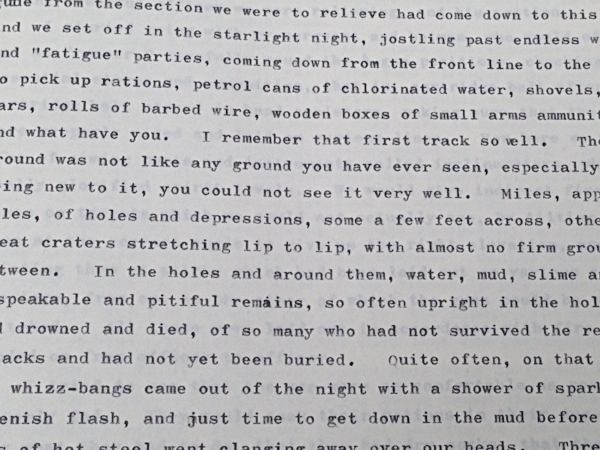
Richard Ropner - Random Recollections (unpublished - 1965)

Richard Ropner - Random Recollections (unpublished - 1965)

Baltics on the Edge

National Review Online, September 4, 2014

Hermann Castle, Narva, Estonia (with Ivangorod Castle, Russia, in the background), March 2015 © Andrew Stuttaford

Hermann Castle, Narva, Estonia (with Ivangorod Castle, Russia, in the background), March 2015 © Andrew Stuttaford

Prisoners of geology, Icelanders make it their business to understand volcanoes. Prisoners of geography, the peoples of the Baltic States do the best they can to understand the unruly, dangerous, and enigmatic superpower next door.

So, when Janis Berzins of Latvia’s National Defense Academy published a report in April titled “Russia’s New-Generation Warfare in Ukraine,” it was worth paying attention. Since then, Russia’s actions in Ukraine have evolved beyond the deployment of “little green men” and other irregulars of nominally uncertain provenance into an old-fashioned invasion, plain, simple, and bloody, but the West still needs to focus on what Berzins had to say. His subtitle — “Implications for Latvian Defense Policy” — suggests why.

With Putin seemingly set, so far as opportunity will allow, on reconstituting the “Russian World” (Russkiy Mir) that fell apart with the Soviet Union, it’s easy to imagine that Latvia and Estonia might be somewhere on the target list. They are both former Soviet republics. For two centuries, they were part of the Russian Empire. Both have large, imperfectly assimilated Russian minorities, who, Putin reckons, belong within that Russian World, a status that entitles them — lucky “compatriots” — to his “protection.” Each has a major, almost 100 percent Russian-speaking city (Daugavpils, Latvia, and Narva, Estonia) temptingly close to the Russian border.

Both countries are in NATO, and thus theoretically covered by Article V of the NATO Treaty, which provides that all the alliance’s member states “agree that an armed attack against one or more of them in Europe or North America shall be considered an attack against them all.” But in an age in which war can proceed by half-denied incursions and bogus popular uprisings (“non-traditional combat,” in Berzins’s phrase), who is to say what an “armed attack” really is? Berzins asks what would happen if a “Crimea-like situation” were to erupt in Narva. After all, Russia would undoubtedly insist that this too was the exercise of a “democratic right of self-determination.” And that, Berzins clearly fears, would cloud the picture enough for some Western politicians to claim that Article V should not apply. If that sounds too cynical, recall the lengths that some of them went last month to avoid calling the Russian assault on Ukraine (a country without the benefit of an Article V guarantee) by its right name: invasion.

According to the (anti-Putin) Russian commentator Andrey Piontkovsky, Putin is well aware that many NATO countries would be reluctant to be drawn into conflict by Article V. And even if they did come to Estonia’s aid, “Putin [could] respond with a very limited nuclear strike and destroy for example two European capitals. Not London and not Paris, of course.” Were that to happen, Piontkovsky believes, Putin would calculate that “all progressive and even all reactionary American society” would shout “‘We do not want to die for f***ing Narva, Mr. President!’”

Far-fetched? Probably. Putin is a gambler, but he’s not reckless. That said, it is worth noting, as did Anne Applebaum in a recent article for the Washington Post, that “Vladimir Zhirinovsky — the Russian member of parliament and court jester who sometimes says things that those in power cannot — argued on television that Russia should use nuclear weapons to bomb Poland and the Baltic countries . . . and show the West who really holds power in Europe.” Zhirinovsky is not, thankfully, in a position to shape policy, but he is occasionally used by those in the Kremlin to float ideas that they would like to see in circulation. As (notes Applebaum) Putin has put it, he “gets the party going.”

That this sort of talk is even out there will, as Putin knows, encourage a good number of NATO members to define Article V as narrowly as they can. Psychological pressure has always been a part of warfare, but it has an even larger role to play in Russia’s notion of a “New Generation” war. Within that, writes Berzins, “the main battle-space is the mind. . . . The main objective is to reduce the necessity for deploying hard military power to the minimum necessary, making the opponent’s military and civil[ian] population support the attacker to the detriment of their own government and country,” a strategy (essentially what once might have been called subversion, but taken to a whole new level) peculiarly suited to some of the more fragile countries that emerged from the wreckage of the Soviet Union. In this respect, Berzins’s account of the early months of the Russian onslaught in Ukraine makes depressing reading: “In just three weeks, and without a shot being fired, the morale of the Ukrainian military was broken [in the Crimea] and all of their 190 bases had surrendered.”

But Ukraine, I was repeatedly told during a visit to the Latvian capital, Riga, in June, was a failed state. Latvia is not. Nor is Estonia. Both have made remarkable strides since winning back their freedom from the USSR. They are members of the EU as well as NATO. Their economies have grown fast (if not smoothly), delivering a standard of living far better than that of their Russian neighbor. That is not the case in Ukraine. At their core, Latvia and Estonia have a powerful sense of national identity. Memories of their independent inter-war republics and the nearly half a century of brutal Soviet occupation that followed still sear. In 1940 they were annexed by Moscow without a fight. That would not happen again.

Nevertheless, their political structures are not yet as developed as they could be, and their economies are far from robust. There is a lot of Russian money floating around, particularly in Latvia, and their Russian-speaking populations (30 percent or so of the population in Latvia and approximately 25 percent in Estonia) are not only a cause for Putin, but a potential source of instability that the Kremlin is continually trying to exploit. This should not be overestimated: Most Latvian and Estonian Russians feel at least a degree of loyalty to those countries, and the approval that some of them show for Russian adventurism abroad (in the Crimea, for example) does not necessarily mean that they want Russian troops showing up at their front door.

Looking specifically at Latvia, Berzins cites instances of the early phases of New Generation warfare, including “supporting pseudo human-rights organizations, backing the organization of a referendum for Russian to be the second official language [it failed, but, tellingly, won a majority in Eastern Latvia], and surveying the population of the eastern border to get intelligence on their inclination to support a [Crimean-style] scenario.” Plus, adds Berzins, “in a more subtle way, Russia has been successfully influencing internal politics through some of the political parties.” That may be a reference to, amongst others, Harmony Center, Latvia’s largest, a party that draws most of its support from the country’s Russians, and that has links to Putin’s United Russia party. Its leader is the mayor of Riga, a city in which the population divides roughly evenly between Russian-speakers and ethnic Latvians.

Then throw the Russian media into the mix. It’s no secret that Russian television has become a pathway to a world of nationalist delirium, a world where two plus two does indeed equal five, a “parallel reality,” in Berzins’s words, “legitimizing . . . Russian actions in the realm of ideas.” And this is the TV that most Baltic Russians watch most of the time (local Russian programming is thin gruel). Its poison may be diluted by the fact that these viewers live in the West, but still . . .

And then there is the constant saber-rattling at the border, the incursions into Latvian or Estonian airspace, military exercises such as, most notoriously, Zapad-2013 (“West 2013”), in which some 70,000 Russian and Belarusian troops massed near the Latvian, Lithuanian, and Polish borders to war-game a scenario in which “Baltic terrorists” were the villains, an exercise designed to demonstrate who was really boss in this part of the world.

But for now, the spying, the probing, the pressing, occasional trade embargoescyber-attacks, dirty tricks (check out the way that Interpol was abused in the 2013 mayoral elections in Tallinn, the Estonian capital, for one example), a gnawing at the foundations is “all” that there has been. Polling the inhabitants of the border region is as close as Russia has come to crossing the line that would herald the next phase of a New Generation war — the seizing, maybe, of a building or two in Narva or Daugavpils by a bogus “people’s republic” and the arrival of those “little green men” — a phase that, for now, seems mercifully far off.

Berzins has suggestions as to how Latvia might head off that moment. These include increased funding for economic development in the poorer regions, a boost to military spending (Latvia has since committed to hike its defense spending to 2 percent of GDP, the minimum NATO target that nonetheless hardly any member states hit), and the introduction of something like Swiss-style conscription. But perhaps the most important — and the most optimistic — revolves around securing the revision of Article V to reduce the dangerous ambiguity that New Generation warfare has opened up, an ambiguity that quite a few NATO members might well prefer to keep intact.

It’s an ambiguity that comes with terrible perils — not just for Latvia and Estonia (and, quite probably, Lithuania as well: the third of the Baltic trio has a far smaller Russian-speaking population, but cuts off the Russian exclave of Kaliningrad from Moscow-friendly Belarus), but for NATO too. Standing by our Baltic allies — three democracies that have emerged from Soviet darkness — is the right thing to do, but it is a matter of self-interest too. If Putin prevails over the Baltic countries despite their NATO membership, that would, argues Piontkovsky, “mean the end of NATO, and the end of the U.S. as a world power, and the complete political dominance of Putin’s Russia not only in the area of the Russian World but in the entire European continent.” That may be overstating it, but such a blow to the prestige of Article V would at least risk an unraveling of NATO, with all the nightmares that would come in its wake.

Ambiguity can tempt the aggressor into believing that he get can get away with his next coup at little cost. This can, in turn, lead to catastrophe. Hitler was unconvinced that the British and the French would truly stand by Poland in 1939. The ambiguity over the Baltic guarantee can never be eliminated, but it can be reduced. The symbolism of Obama’s speech in Tallinn this week — and the promise to send additional U.S. Air Force units and aircraft to the Baltics — will have done no harm. The increasing presence of NATO aircraft in Baltic airspace in recent months is a good move, as is the stepped-up pace of joint NATO exercises on Baltic territory. A NATO rapid-response force of several thousand troops, capable of deployment within 48 hours, is now being proposed. Its equipment and supplies would be based in the east. Permanent manned NATO bases would be better still. As Estonia’s President Ilves remarked earlier this week, maintaining a “two-tier” NATO, divided between those countries with permanent bases and those without, sends the “wrong signal” to a “potential aggressor.” We can’t be sure that even bases would be enough to do the trick, but the more the West does now, the less likely it is that Americans will ever be asked whether they are prepared to die for Narva.

Latvia Divided

National Review, August 25, 2014

Riga, Latvia, June 2014 © Andrew Stuttaford

Riga, Latvia, June 2014 © Andrew Stuttaford

Riga — The cover of the British edition of Anna Arutunyan’s The Putin Mystique features a grainy, somewhat sinister image of the Russian leader, remote, mysterious, distant. In a bookstore on Riga’s Krisjana Valdemara Street, the Latvian edition is on sale; its cover shows Putin at the shooting range, a gun in his hand, a wry smile on his face, close, too close.

The key to understanding Putin, explained one Latvian official, is to think of him as a petulant and badly behaved teenager who likes to provoke, prod, and see what he can get away with. For quite some time now, that’s what Russia has been doing in the Baltic. Planes skim and sometimes cross borders. Military exercises are staged that seem intended to intimidate rather than to train. Last year saw some 70,000 Russian and Belarusian troops war-gaming a scenario in which “Baltic terrorists” were the villains.

Walk into the Latvian foreign ministry and you’ll see three large flags, Latvian, EU, and NATO. The EU is meant to secure Latvia’s economic development, NATO its safety. Article 5 of the NATO treaty provides that an armed attack on one NATO member is to be treated as an attack on all, but in a paper written in April, Janis Berzins of Latvia’s National Defense Academy wondered how NATO’s politicians would react in the event of a Crimea-like assertion of “self-determination” in Narva, an Estonian city on the Russian border where almost all the inhabitants are of Russian descent. It’s a question that’s just as easy to ask about Daugavpils, the overwhelmingly Russian-speaking capital of Latvia’s poorest, easternmost region.

Daugavpils, Latvia, June 2014 © Andrew Stuttaford

Daugavpils, Latvia, June 2014 © Andrew Stuttaford

And it’s not a question that can safely be confined to Daugavpils. When Putin speaks about the plight of his “compatriots” cut off from their kin by the collapse of the Soviet Union, it is countries like insultingly independent Latvia that he has in mind. Around 26 percent of Latvia’s 2 million people are of Russian descent (and, more significantly, a higher percentage speak Russian at home). Riga itself is roughly evenly divided between Latvian and Russian speakers. The city’s mayor, Nils Usakovs, an ethnic Russian, heads up the leftish Harmony Centre, a political alliance that draws much of its support from the Russian community and, less than reassuringly, has links to Putin’s United Russia party.

But if Putin is to play his games here, he needs his “compatriots” in Latvia to be not only numerous but unhappy. Ukraine, I am frequently told, was a failed state, but Latvia is not. Latvia’s Russians are freer, and generally richer, than their counterparts in the motherland. And they know it. At the same time, there’s no denying the sense of exclusion that many of them feel, especially the nearly 300,000 who are “non-citizens,” a status that Putin has described as “shameful” and worse.

To talk to Elizabete Krivcova of the Latvian “Non-Citizens” Congress is to hear an echo of Selma, but, to add some proportion to that picture, consider that Latvia’s non-citizens have permanent residency, can travel visa-free through most of the EU and (unlike Latvians) in Russia too, and are eligible for most social benefits. They are excluded from voting and a range of jobs, most of them in the public sector, but the door to citizenship is wide open. Quotas have long since been scrapped, and the citizenship requirements (residency, a language test, some knowledge of Latvian history, and so on) have eased over the years: Some 140,000 (including Krivcova) have now been naturalized.

The House on The Corner, Riga, Latvia, June 2014 © Andrew Stuttaford

The House on The Corner, Riga, Latvia, June 2014 © Andrew Stuttaford

But when I suggest to one prominent Latvian politician that it might be time to lance this boil and grant citizenship to all the rest, he flinches, quickly adding that this would mean “losing Riga.” His body language says more than his reply: This is not just an expression of political calculation. In 1989, a future president of Estonia spoke of the “biological and social terror of belonging to a people that is dying out.” That’s a fear evidently shared by a good number of the 1.2 million Latvians who remain in their native land, the last of the last after half a century of Soviet occupation in which Latvians were brutalized, imprisoned, exiled, slaughtered, and denied their right to be. It was a systematic process of national obliteration, and it was reinforced by a continuous inflow of Russian settlers designed to swamp the people whose country Latvia once was.

Many local Russians supported Latvia’s bid for independence, which it finally won in 1991, and most of them thought that they should automatically become citizens of the republic in which they had lived for a good part, or maybe even all, of their lives. Latvians did not agree. From a strictly legal point of view — and during an occupation denied legal recognition by much of the West, strictly legal was all Latvians had had — the restoration of the pre–World War II Latvian republic meant that only its citizens (or their descendants) would be immediately eligible for a Latvian passport: The settlers would have to wait in line.

This bought time for Latvia to reestablish itself as a national republic, time in which the population balance shifted in a direction that favored ethnic Latvians, but not by enough to resolve the demographic impasse that history had left behind. For ethnic Latvians, the way to proceed was with a unitary state, with Latvian as its sole official language: “We are too small to be Canada.” Russian speakers would be slowly assimilated: Indeed, those under 35 can generally now manage pretty well in Latvian. Left (usually) unsaid: The problem of the non-citizens, a significant percentage of whom are elderly, would fade away as the Soviet generations died off.

Riga, Latvia, June 2014 © Andrew Stuttaford

Riga, Latvia, June 2014 © Andrew Stuttaford

For many Russian speakers, this will not do. What they argue for is integration rather than assimilation, perhaps not formal bilingualism but certainly increased recognition by the state of both the Russian language and a distinct Russian cultural identity. The current generation is, it is maintained, not responsible for the crimes of the past. Maybe, but too many of Latvia’s Russians are still reluctant to acknowledge the full horror of what happened here. Whatever one thinks of criminalizing speech (I’m not a fan), it is still a jolt to see the poster in Krivcova’s office mocking recent legislation banning the denial, justification, or trivialization of both Nazi and Soviet aggression against Latvia. This is not the best way to reassure Latvians nervous about the bully next door and a fifth column within.

Nevertheless, despite occasional bouts of bad feeling — such as that generated by a failed 2012 referendum to introduce Russian as a second official language — the two communities rub along well enough. The difficulty is that there is a third party — Russia — in this mix, and it seems set on contributing all the poison it can. Latvia’s NATO membership means that the likelihood of a direct attack by Russia is very small. What can be expected instead is an intensification of Russia’s longstanding attempts to subvert the country from the inside. For now, a Donetsk- or Crimea-style “uprising” is unlikely: The Russians reportedly took soundings in the Daugavpils area and found, even there, little enthusiasm for a move of that type. Meanwhile, Riga is quiet. Even the polling that showed that most Russian-speaking Latvians supported the annexation of Crimea should not be cause for too much concern: Cheering on the ancestral motherland at a safe distance is very different from wanting it to turn up on the doorstep.

Freedom Monument, Riga, Latvia, June 2014 © Andrew Stuttaford

Freedom Monument, Riga, Latvia, June 2014 © Andrew Stuttaford

But the potential for trouble exists, made more dangerous by the fact that a huge majority of Latvia’s Russian speakers get so much of their information from Russian TV. The Russian stations are typically more entertaining than the local offering, but they act as portals into the venomous parallel universe where Kremlin propaganda roams. The loyalty of many of Latvia’s Russians to Latvia is real, but it is not particularly deep. It’s easy to see how Russia could stir the pot. It has the resources, and Latvia’s is a divided society, history is still raw, and there is more than enough resentment to go around. Another risk is that further Russian adventurism, even if well away from the Baltic, creates a heightened climate of mutual distrust within Latvia that rapidly degenerates into something worse. And then there is the general election due in October. Best guess is that Harmony Centre will again come out on top, if less convincingly than in 2011, and will once more be kept out of power by an unwieldy coalition of the weak, often chaotic “Latvian” parties, a result that will only emphasize the divisions that Mr. Putin will undoubtedly still be looking to exploit.